
Probabilistically Robust Watermarking of Neural Networks
Proceedings of the Thirty-Third International Joint Conference on Artificial Intelligence. Main Track. Pages 4778-4787.
https://doi.org/10.24963/ijcai.2024/528
Keywords
- AI Ethics, Trust, Fairness: ETF: Trustworthy AI
- AI Ethics, Trust, Fairness: ETF: Safety and robustness
- Machine Learning: ML: Adversarial machine learning
- Uncertainty in AI: UAI: Applications
Abstract
As deep learning (DL) models are widely and effectively used in Machine Learning as a Service (MLaaS) platforms, there is a rapidly growing interest in DL watermarking techniques that can be used to confirm the ownership of a particular model. Unfortunately, these methods usually produce watermarks susceptible to model stealing attacks. In our research, we introduce a novel trigger set-based watermarking approach that demonstrates resilience against functionality stealing attacks, particularly those involving extraction and distillation. Our approach does not require additional model training and can be applied to any model architecture. The key idea of our method is to compute the trigger set, which is transferable between the source model and the set of proxy models with a high probability. In our experimental study, we show that if the probability of the set being transferable is reasonably high, it can be effectively used for ownership verification of the stolen model. We evaluate our method on multiple benchmarks and show that our approach outperforms current state-of-the-art watermarking techniques in all considered experimental setups.
- [Adi et al., 2018] Yossi Adi, Carsten Baum, Moustapha Cisse, Benny Pinkas, and Joseph Keshet. Turning your weakness into a strength: Watermarking deep neural net- works by backdooring. In 27th USENIX Security Sympo- sium (USENIX Security 18), pages 1615-1631, 2018.
- [Bansal et al., 2022] Arpit Bansal, Ping-yeh Chiang, Michael J Curry, Rajiv Jain, Curtis Wigington, Varun Manjunatha, John P Dickerson, and Tom Goldstein. Certified neural network watermarks with randomized smoothing. In International Conference on Machine Learning, pages 1450-1465. PMLR, 2022.
- [Brown et al., 2020] Tom Brown, Benjamin Mann, Nick Ry- der, Melanie Subbiah, Jared D Kaplan, Prafulla Dhari- wal, Arvind Neelakantan, Pranav Shyam, Girish Sastry, Amanda Askell, et al. Language models are few-shot learners. Advances in Neural Information Processing Sys- tems, 33:1877-1901, 2020.
- [Buhalis and Moldavska, 2022] Dimitrios Buhalis and Iuliia Moldavska. Voice assistants in hospitality: using artificial intelligence for customer service. Journal of Hospitality and Tourism Technology, 13(3):386-403, 2022.
- [Clopper and Pearson, 1934] Charles J Clopper and Egon S Pearson. The use of confidence or fiducial limits illustrated in the case of the binomial. Biometrika, 26(4):404-413, 1934.
- [Ding et al., 2021] Xiaohan Ding, Xiangyu Zhang, Ningning Ma, Jungong Han, Guiguang Ding, and Jian Sun. Repvgg: Making vgg-style convnets great again. In Proceedings of the IEEE/CVF conference on computer vision and pattern recognition, pages 13733-13742, 2021.
- [Dosovitskiy et al., 2021] Alexey Dosovitskiy, Lucas Beyer, Alexander Kolesnikov, Dirk Weissenborn, Xiaohua Zhai, Thomas Unterthiner, Mostafa Dehghani, Matthias Min- derer, Georg Heigold, Sylvain Gelly, Jakob Uszkoreit, and Neil Houlsby. An image is worth 16x16 words: Trans- formers for image recognition at scale. In International Conference on Learning Representations, 2021.
- [Goncharov et al., 2021] Mikhail Goncharov, Maxim Pisov, Alexey Shevtsov, Boris Shirokikh, Anvar Kurmukov, Ivan Blokhin, Valeria Chernina, Alexander Solovev, Victor Gombolevskiy, Sergey Morozov, et al. Ct-based covid-19 triage: Deep multitask learning improves joint identifica- tion and severity quantification. Medical image analysis, 71:102054, 2021.
- [Guo and Potkonjak, 2018] Jia Guo and Miodrag Potkonjak. Watermarking deep neural networks for embedded sys- tems. In Iris Bahar, editor, Proceedings of the Interna- tional Conference on Computer-Aided Design -ICCAD '18, pages 1-8. ACM Press, 2018.
- [Hartung and Kutter, 1999] Frank Hartung and Martin Kut- ter. Multimedia watermarking techniques. Proceedings of the IEEE, 87(7):1079-1107, 1999.
- [He et al., 2016] Kaiming He, Xiangyu Zhang, Shaoqing Ren, and Jian Sun. Deep residual learning for image recognition. In Proceedings of the IEEE Conference on Computer Vision and Pattern Recognition, pages 770-778, 2016.
- [He et al., 2023] Kelei He, Chen Gan, Zhuoyuan Li, Islem Rekik, Zihao Yin, Wen Ji, Yang Gao, Qian Wang, Junfeng Zhang, and Dinggang Shen. Transformers in medical im- age analysis. Intelligent Medicine, 3(1):59-78, 2023.
- [Hinton et al., 2015] Geoffrey Hinton, Oriol Vinyals, and Jeffrey Dean. Distilling the knowledge in a neural net- work. In NIPS Deep Learning and Representation Learn- ing Workshop, 2015.
- [Huang et al., 2022] Yanjun Huang, Jiatong Du, Ziru Yang, Zewei Zhou, Lin Zhang, and Hong Chen. A survey on trajectory-prediction methods for autonomous driving. IEEE Transactions on Intelligent Vehicles, 7(3):652-674, 2022.
- [Jia et al., 2021] Hengrui Jia, Christopher A Choquette- Choo, Varun Chandrasekaran, and Nicolas Papernot. En- tangled watermarks as a defense against model extraction. In 30th USENIX Security Symposium (USENIX Security 21), pages 1937-1954, 2021.
- [Kim et al., 2023] Byungjoo Kim, Suyoung Lee, Seanie Lee, Sooel Son, and Sung Ju Hwang. Margin-based neural net- work watermarking. In International Conference on Ma- chine Learning, pages 16696-16711. PMLR, 2023.
- [Krizhevsky et al., 2009] Alex Krizhevsky, Geoffrey Hinton, et al. Learning multiple layers of features from tiny im- ages. 2009.
- [Le Merrer et al., 2020] Erwan Le Merrer, Patrick Pérez, and Gilles Trédan. Adversarial frontier stitching for remote neural network watermarking. Neural Computing and Ap- plications, 32(13):9233-9244, Jul 2020.
- [Li et al., 2019] Zheng Li, Chengyu Hu, Yang Zhang, and Shanqing Guo. How to prove your model belongs to you. In David Balenson, editor, Proceedings of the 35th Annual Computer Security Applications Conference on -ACSAC '19, pages 126-137. ACM Press, 2019.
- [Li et al., 2021] Yue Li, Hongxia Wang, and Mauro Barni. A survey of deep neural network watermarking techniques. Neurocomputing, 461:171-193, 2021.
- [Liu et al., 2023] Yiheng Liu, Tianle Han, Siyuan Ma, Jiayue Zhang, Yuanyuan Yang, Jiaming Tian, Hao He, Antong Li, Mengshen He, Zhengliang Liu, et al. Summary of chatgpt- related research and perspective towards the future of large language models. Meta-Radiology, page 100017, 2023.
- [Lukas et al., 2021] Nils Lukas, Yuxuan Zhang, and Florian Kerschbaum. Deep neural network fingerprinting by con- ferrable adversarial examples. In International Conference on Learning Representations, 2021.
- [Ma et al., 2018] Ningning Ma, Xiangyu Zhang, Hai-Tao Zheng, and Jian Sun. Shufflenet v2: Practical guidelines for efficient cnn architecture design. In Proceedings of the European conference on computer vision (ECCV), pages 116-131, 2018.
- [Netzer et al., 2011] Yuval Netzer, Tao Wang, Adam Coates, Alessandro Bissacco, Bo Wu, and Andrew Y Ng. Reading digits in natural images with unsupervised feature learn- ing. 2011.
- [Parekh et al., 2022] Darsh Parekh, Nishi Poddar, Aakash Rajpurkar, Manisha Chahal, Neeraj Kumar, Gyanen- dra Prasad Joshi, and Woong Cho. A review on au- tonomous vehicles: Progress, methods and challenges. Electronics, 11(14):2162, 2022.
- [Sandler et al., 2018] Mark Sandler, Andrew Howard, Men- glong Zhu, Andrey Zhmoginov, and Liang-Chieh Chen. Mobilenetv2: Inverted residuals and linear bottlenecks. In Proceedings of the IEEE conference on computer vision and pattern recognition, pages 4510-4520, 2018.
- [Shafieinejad et al., 2021] Masoumeh Shafieinejad, Nils Lukas, Jiaqi Wang, Xinda Li, and Florian Kerschbaum. On the robustness of backdoor-based watermarking in deep neural networks. In Proceedings of the 2021 ACM Workshop on Information Hiding and Multimedia Security, pages 177-188, 2021.
- [Simonyan and Zisserman, 2015] Karen Simonyan and An- drew Zisserman. Very deep convolutional networks for large-scale image recognition. In 3rd International Con- ference on Learning Representations, ICLR 2015, San Diego, CA, USA, May 7-9, 2015, Conference Track Pro- ceedings, 2015.
- [Subramanian et al., 2021] Nandhini Subramanian, Omar Elharrouss, Somaya Al-Maadeed, and Ahmed Bouridane. Image steganography: A review of the recent advances. IEEE Access, 9:23409-23423, 2021.
- [Tang et al., 2022] Jiajia Tang, Kang Li, Ming Hou, Xuanyu Jin, Wanzeng Kong, Yu Ding, and Qibin Zhao. Mmt: Multi-way multi-modal transformer for multimodal learn- ing. In IJCAI, pages 3458-3465, 2022. IJCAI
- [Tramèr et al., 2016] Florian Tramèr, Fan Zhang, Ari Juels, Michael K. Reiter, and Thomas Ristenpart. Stealing ma- chine learning models via prediction apis. In Proceedings of the 25th USENIX Conference on Security Symposium, SEC'16, page 601-618, USA, 2016. USENIX Associa- tion. Vaswani et al., 2017]
- Ashish Vaswani, Noam Shazeer, Niki Parmar, Jakob Uszkoreit, Llion Jones, Aidan N Gomez, Łukasz Kaiser, and Illia Polosukhin. Attention is all you need. Advances in Neural Information Processing Sys- tems, 30, 2017.
- [Zagoruyko and Komodakis, 2016] Sergey Zagoruyko and Nikos Komodakis. Wide residual networks. In Richard C. Wilson, Edwin R. Hancock, and William A. P. Smith, editors, Proceedings of the British Machine Vision Con- ference 2016, BMVC 2016, York, UK, September 19-22, 2016. BMVA Press, 2016.
- [Zhang et al., 2018a] Hongyi Zhang, Moustapha Cissé, Yann N. Dauphin, and David Lopez-Paz. mixup: Beyond empirical risk minimization. In 6th International Confer- ence on Learning Representations, ICLR 2018, Vancouver, BC, Canada, April 30 -May 3, 2018, Conference Track Proceedings, 2018.
- [Zhang et al., 2018b] Jialong Zhang, Zhongshu Gu, Jiyong Jang, Hui Wu, Marc Ph Stoecklin, Heqing Huang, and Ian Molloy. Protecting intellectual property of deep neural net- works with watermarking. In Proceedings of the 2018 on Asia Conference on Computer and Communications Secu- rity, pages 159-172, 2018.
- [Zhao et al., 2020] Jingjing Zhao, Qingyue Hu, Gaoyang Liu, Xiaoqiang Ma, Fei Chen, and Mohammad Mehedi Hassan. Afa: Adversarial fingerprinting authentica- tion for deep neural networks. Comput. Commun., 150(C):488-497, jan 2020.
References were extracted automatically from the PDF and may contain errors.
Full text extracted automatically from the PDF; figures, tables and equations may differ. The PDF is the version of record.
1 Introduction
Deep learning models achieved tremendous success in practical problems from different areas, such as computer vision [He et al., 2016; Dosovitskiy et al., 2021], natural language processing [Vaswani et al., 2017; Brown et al., 2020] and multimodal learning [Tang et al., 2022]. They are used in medical diagnostics [He et al., 2023; Goncharov et al., 2021], deployed in autonomous vehicles [Huang et al., 2022; Parekh et al., 2022] and embedded in AI-as-a-service settings [Buhalis and Moldavska, 2022; Liu et al., 2023]. Unfortunately, the development, training, and production of these models nowadays come at a high cost due to the availability and quality of the training data, the large size of the models, and, hence, the necessity of cloud computing and data storage platforms. This motivates the owners to prevent third parties from obtaining an illegal copy of their models, acquiring the powerful tools without spending much time and money on development and training.
Among the methods to protect the copyright of digital assets, digital watermarking techniques [Hartung and Kutter, 1999] are the most widely used. To determine the copyright violation, the intellectual property owner embeds the special information in the product, for example, adding an imperceptible pattern or digital signature to the image or within the program's source code. If the violation is suspected, this information may be extracted from the intellectual property, confirming the illegal obtaining of the latter. In recent years, watermarking techniques have been adapted to protect the ownership of deep learning models embedded in the blackbox manner. To do so, the owner of the model may prepare the special (trigger) set of points the source model should have the specific predictions on: the more similar the predictions of a suspicious on this set to the prespecified ones, the more likely it is that the source model has been compromised [Zhang et al., 2018b; Adi et al., 2018; Bansal et al., 2022; Kim et al., 2023].
In practice, watermarks are not resistant to attacks that are aimed to steal the model's functionality. In particular, distillation attacks, fine-tuning, and regularization of models tend to affect the transferability of trigger sets [Shafieinejad et al., 2021]. Thus, researchers are motivated to explore the robustness of watermarks to stealing attacks.
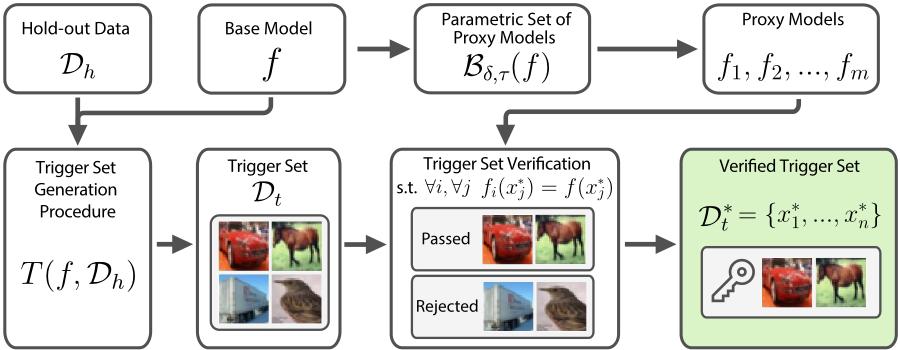
In this paper, we propose a novel framework that enhances the resistance of trigger set-based watermarks to stealing attacks. Given the source model f, we construct a parametric set Bδ,τ (f ) of proxy models which imitate the set of surrogate (or stolen) copies of f. We assume that, given the parametric set of proxy models, there exist input data points S(f, δ, τ) that all the models assign to the same class. If the behavior of the source model on these points is prespecified, they are treated as good trigger points for ownership verification. In our method, we ensure that all the proxy models assign a particular sample from the trigger set to some specific class by comparing the predictions of m randomly sampled proxy models (see Figure 1).
We summarize the contributions of this work as follows:
- We introduce a novel probabilistic approach for enhancing trigger-set-based watermarking methods' robustness against stealing attacks. Our approach can be applied to enhance the robustness of any trigger set-based water-
marking technique, which makes it universal.
- We analyze the probability that a given trigger set is transferable to the set of proxy models that mimic the stolen models.
- We experimentally show that, even if the stolen model does not belong to the set of proxy models, the trigger set is still transferable to the stolen model.
- We evaluate our approach on multiple benchmarks and show that it outperforms current methods in all considered experimental setups.
2 RelatedWork
The process of DNN watermarking serves the purpose of safeguarding intellectual property by encoding a distinctive pattern and employing it for the purpose of asserting ownership [Subramanian et al., 2021; Li et al., 2021].
Certain watermarking techniques insert digital media watermarks into the initial training data to create a trigger dataset for the model. For example, [Guo and Potkonjak, 2018] generates an n-bit signature representing the model owner and embeds it into the training data to create the trigger dataset. The authors ensure that the altered images in the trigger dataset receive unique labels different from the original data points.
In [Zhang et al., 2018b], the authors proposed algorithms for watermarking neural networks used in image classification, along with remote black-box verification methods. One technique involves adding meaningful content alongside the original training data to create a watermark. For example, they embed a unique string, like a company name, into an image from the training set during the prediction process, assigning a different label to the modified sample. Alternatively, noise can be added to the original training data as part of the watermarking process.
A similar approach suggested in [Li et al., 2019] features blending the regular data samples with distinctive "logo" elements and training the model to categorize them under a specific label. To maintain similarity with the original samples, they use an autoencoder, and its discriminator is trained to distinguish between benign training samples and watermarkcontaining trigger samples.
In contrast, there are studies on certain disadvantages of trigger set-based watermarking methods.
First, this category of methods has a limitation tied to the maximum number of backdoors that can be integrated into a neural network. There are works showing that the large number of watermarked samples in the training set leads to notable performance degradation of the source model [Jia et al., 2021; Kim et al., 2023].
Secondly, watermarking schemes lacking a verifiable connection between the watermark and the legitimate model owner create an opportunity for attackers to counterfeit the watermark [Adi et al., 2018; Guo and Potkonjak, 2018]. Lastly, the use of adversarial examples for trigger set-based watermarking [Le Merrer et al., 2020] or fingerprinting [Lukas et al., 2021; Zhao et al., 2020] has significant drawbacks, including insufficient transferability to the surrogate models [Kim et al., 2023], potential vulnerability to knowledge distillation attacks [Hinton et al., 2015], fine-tuning and retraining.
3 Problem Statement
3.1 Trigger Set-Based Digital Watermarking
In our work, we consider classification problem with K classes. Namely, given the dataset D = {(xi, yi)}Ni=1 , where xi ∈ Rd and yi ∈ [1, . . . ,K], we train the source model f to minimize the empirical risk
where l(·, ·) is the cross-entropy loss.
If the source model performs well, an adversary can try to steal its functionality. Namely, one can train surrogate model f ∗ on surrogate dataset ˆD that aims to imitate the outputs of the base model. In general, the architectures of the source model and the surrogate one do not have to be the same. It is equivalently not required that the initial dataset is known, which makes it possible to steal the models in the black-box manner [Jia et al., 2021; Kim et al., 2023].
To detect theft, the owner of the source model can apply trigger set-based watermarking. For example, the subset Ds = {(xik , yik )}nk=1 of the initial dataset D undergoes label flipping: each label yik is replaced with another label y′ik ̸= yik yielding the trigger set Dt = {(xik , y′ik )}nk=1 . Then, the source model is trained to minimize the empirical risk on the changed dataset D := (D \ Ds) ∪ Dt.
If the performance of suspicious model f ∗ on the trigger set Dt is similar to the one of the source model f, it is claimed that the source model is stolen.
Unfortunately, trigger set-based watermarking approaches have two significant drawbacks. Firstly, the size n of the trigger set has to be small to not cause a notable performance decrease. On the other hand, n should be sufficiently large so that the similarity in the behavior of the source model and the stolen model is statistically significant. Secondly, trigger sets tend to be barely transferable between the source model and the stolen model: a sample from a trigger set is pushed away from the samples of the same class closer to the decision boundary of the surrogate model [Kim et al., 2023].
In this work, we propose a simple and effective approach to generate the trigger set Dt, which is transferable between the source model and its surrogate copies obtained by model stealing attacks.
3.2 Model Stealing Attacks
In our work, we assume that an adversary attempts to steal the source model by applying knowledge distillation 1 [Hinton et al., 2015; Tram`er et al., 2016] considering it the strongest attack for the watermark removal [Kim et al., 2023].
In particular, a sample ˆxi from the surrogate dataset ˆD is passed to the source model f to obtain its prediction f(ˆxi). Then, the stealing is performed by training a new model f ∗ by minimizing the divergence between its predictions and the source model's predictions on the dataset ˆD:
where DKL is Kullback-Leibler divergence.
We consider both soft-label and hard-label attacks, i.e., f ∗ (ˆxi) can be either the predicted class or vector of class probabilities.
1 We include additional experiments with other stealing attacks in the supplementary material.
Algorithm 1 Trigger set candidate
Input: Hold-out dataset Dh, source model f Output: Trigger set candidate (x∗ , y∗ ) 1: while True do 2: Sample (x1, y1), (x2, y2) ∼ U(Dh) 3: if y1 ̸= y2 then 4: Sample λ ∼ U(0, 1) 5: x∗ = λx1 + (1 - λ)x2 6: y∗ = f(x∗ ) 7: if y∗ ̸= y1 and y∗ ̸= y2 then 8: return (x∗ , y∗ ) 9: end if 10: end if 11: end while4 Method
4.1 Computing the Trigger Set
In our approach, we exploit the procedure of computing the candidates for the trigger set Dt as convex combinations of the pairs of points from the hold-out dataset [Zhang et al., 2018a]. Namely, suppose the source model f is trained on the dataset D. Then, given the hold-out test data Dh : Dh ∩D = ∅, we uniformly sample a pair of points (xi1 , yi1 ), (xi2 , yi2 ) from different classes yi1 and yi2 ̸= yi1 , and compute the convex combination of xi1 and xi2 in the form
where λ ∼ U(0, 1). To assure the unexpected behaviour of the model f on the trigger set candidate, we accept x∗i as the candidate only if the source model predicts x∗i as the sample from some other class y∗ i : y∗ i ̸= yi1 and y∗ i ̸= yi2 . The procedure of computing the candidates for the trigger set is presented in Algorithm 1. We execute Algorithm 1 until the candidate set Dt = {(x∗i , y∗ i )}ni=1 is computed. Note that the described procedure requires no additional training of the source model.
4.2 Verification of the Trigger Set
The core idea of our method is to ensure that the trigger set is transferable to the stolen models or, in other words, to verify that the predictions of a stolen trigger set are similar to the ones of the source model. To do so, we introduce the parametric set of models Bδ,τ(f) that mimics the set of stolen models. In our experiments, we mainly consider the case when the architecture of the source model is known to a potential adversary. Hence, this parametric set consists of proxy models f ′ of the same architecture as the source f that perform reasonably well on the training dataset D. Namely, if θ(f) is the flattened vector of weights of the model f , the parametric set Bδ,τ (f) is defined as follows:
Algorithm 2 Trigger set verification
Input: Hold-out dataset Dh, source model f , weights threshold δ, performance threshold τ , verified trigger set size n Output: Verified trigger set D∗
- t 1: Initialize Bδ,τ(f) 2: Sample f1, . . . , fm ∼ Bδ,τ(f) 3: Let i = 0 4: Let D∗ t = ∅ 5: while i < n do 6: (x∗i , y∗ i ) ← TriggerSetCandidate(Dh, f ) 7: if f1(x∗i ) = f2(x∗i ) = · · · = fm(x∗i ) = y∗ i then 8: D∗ t ←D∗ t ∪ {(x∗i , y∗ i )} 9: i ← i + 1 10: end if 11: end while 12: return D∗ t
where acc(D, f) is the accuracy of model f on the dataset D, δ is the weights threshold and τ is the performance threshold.
To verify the transferability of the trigger set, we sample m proxy models f1, . . . , fm from Bδ,τ (f). Then, we check if all m proxy models assign the same class label to the samples of the trigger set as the source model f. The procedure of trigger set verification is presented in Algorithm 2. The method of computing the verified trigger set is illustrated in Figure 1.
Remark. In our experiments, we sample proxy model fi ∼ Bδ,τ(f) by generating a noise vector ∆i ∼ N(0, σ2 I) for some σ2 > 0 and assuring ∥∆i∥2 ≤ δ. Then, the vector of weights of proxy model fi is computed as θ(fi) ← θ(f)+∆i.
5 Experiments
5.1 Setup of Experiments
Datasets and Training
In our experiments, we use CIFAR-10 and CIFAR-100 [Krizhevsky et al., 2009] as training datasets for our source model f. For the purpose of comparison, as the source model, we use ResNet34 [He et al., 2016], which is trained for 100 epochs to achieve high classification accuracy (namely, 91.0% for CIFAR-10 and 66.7% for CIFAR-100). We used SGD optimizer with learning rate of 0.1, weight decay of 0.5 × 10⁻³ and momentum of 0.9.
Parametric Set of Proxy Models
Once the source model is trained, we initialize a parametric set of proxy models Bδ,τ(f). In our experiments, we vary the parameters of the proxy models set to achieve better trigger set accuracy of our approach. Namely, parameter δ was varied in the range [0.5, 40] and τ was chosen from the set {0.1, 0.2, 1.0}. We tested different number of proxy models sampled from Bδ,τ (f) for verification. Namely, parameter m was chosen from the set {1, 2, 4, 8, 16, 32, 64, 128, 256}.
Model Stealing Attacks
Following the other works [Jia et al., 2021; Kim et al., 2023], we perform functionality stealing attack by training the surrogate model f ∗ in the following three settings:
- Soft-label attack. In this setting, the training dataset D is known, and, given input x, the output f(x) of the source model is a vector of class probabilities. The surrogate model f ∗ is trained to minimize the functional from Eq. (2).
- Hard-label attack. In this setting, the training dataset D is known, and, given input x, the output f(x) of the source model is the class label assigned by f to input x. This setting corresponds to the training of the surrogate model on the dataset ˆD = {xi, f(xi)}Ni=1 .
- Regularization with ground truth label. In [Kim et al., 2023], it was proposed to train the surrogate model by minimizing the empirical loss on the training dataset D and the KL-divergence between the outputs of the source model and surrogate model simultaneously. This setting corresponds to the minimization of the convex combination of the losses from Eq. (1) and Eq. (2) in the form
where γ ∈ [0, 1] is the regularization coefficient. In our experiments, this is the strongest functionality stealing attack.
Concurrent Works
We evaluate our approach against the following methods.
- Entangled Watermark Embedding (EWE). In [Jia et al., 2021], it was proposed to embed watermarks by forcing the source model to entangle representations for legitimate task data and watermarks.
- Randomized Smoothing for Watermarks (RS). In [Bansal et al., 2022], randomized smoothing is applied to the parameters of the source model, yielding guarantees that watermarks can not be removed by a small change in the model's parameters.
- Margin-based Watermarking (MB). In [Kim et al., 2023], it was proposed to train the surrogate model by pushing the decision boundary away from the samples from the trigger set so that their predicted labels can not change without compromising the accuracy of the source model.
It is worth mentioning that all the baselines we compare our approach against either require modification of the training procedure of the source model or make its inference computationally expensive.
Evaluation Protocol
Once the verified trigger set D∗ t = {(x∗i , y∗ i )}ni=1 is collected and surrogate model f ∗ is obtained, we measure the accuracy
of f ∗ on D∗ t to evaluate the effectiveness of our watermarking approach.
Remark. Later, to compare our approach with concurrent works, we denote the trigger set as D∗ to emphasize the differences in trigger set collection procedures.
| D | ˆD | Attack | ∆ |
|---|---|---|---|
| CIFAR-10 | CIFAR-10 | Soft Hard RGT | 44.65±0.04 54.79±1.10 49.61±0.36 |
| CIFAR-100 | CIFAR-100 | Soft Hard RGT | 82.03±1.91 82.21±3.52 82.29±2.92 |
| CIFAR-10 | SVHN | Soft | 46.33±0.07 |
Parameters of Experiments
Unless stated otherwise, we use the following values of hyperparameters in our experiments: the size of the verified trigger set n is set to be n = 100 for consistency with the concurrent works, confidence level α for Clopper-Pearson test from Eq. (9) is set to be α = 0.05. In our experiments, we found that better transferability of the verified trigger set is achieved when no constraint on the performance of the proxy models is applied, so the performance threshold parameter is set to be τ = 1.0.
5.2 Results of Experiments
Knowledge Required for Model Stealing
In our experiments, we assume either the architecture of the source model or its training dataset is known to a potential adversary. In Table 2, we present the results for the most aggressive stealing setting, i.e., the one where the adversary is aware of both the architecture and the training data of the source model. In Table 3, we report the results for the setting where either architecture or the training dataset is unknown to the adversary. Namely, following [Kim et al., 2023], we (i) perform a model stealing attack using the surrogate dataset SVHN [Netzer et al., 2011] and (ii) perform stealing attack by replacing the architecture of the surrogate model by VGG11 [Simonyan and Zisserman, 2015].
For each experiment, we train a single instance of the source model f and perform Nst = 10 independent model stealing attacks. For our approach and concurrent works, we report the accuracy of the source model f and the surrogate models f ∗ on training dataset D and trigger set D∗ . It is notable that our approach not only outperforms the baselines in terms of trigger set accuracy but also yields the source model with higher accuracy.
Hyperparameters Tuning
It is important to mention that the parameters of proxy set Bδ,τ(f) affect not only the transferability of the trigger set but also the computation time needed to collect the trigger set. Indeed, the larger the value of δ is, the more proxy models are used for verification of the trigger set, the more often the procedure from Algorithm 2 rejects trigger set candidates. To find the trade-off between the accuracy of the surrogate model on the trigger set and the computation time, we perform hyperparameter tuning. We tune parameters m and δ according to Section 5.1.
According to parameters tuning, we choose m = 64 and δ = 40.0 as the default parameters of the proxy set. In Table 4, we report the values of parameters we used in each experiment. It is noteworthy that tuning only parameters of the proxy set Bδ,τ(f) allows our method to surpass existing approaches by a notable margin.
6 Discussions
6.1 Transferability of the Verified Trigger Set
In our approach, we assume that all the models from the parametric set Bδ,τ (f) are agreed in predictions on data samples from unknown common set S(f, δ, τ ). In other words, if f(x) is the class assigned by model f to sample x, the set S(f, δ, τ ) is defined as follows:
If the stolen model belongs to the set of proxy models Bδ,τ (f), a trigger set build-up from points from common set S(f, δ, τ) would be a good candidate for ownership verification: by design, the predictions of the source model and the stolen model would be identical on such a set.
Since it is impossible to guarantee that a certain data point belongs to the common set S(f, δ, τ), we perform the screening of the input space for the candidates to belong to S(f, δ, τ ).
Namely, given a candidate x, we check the agreement in predictions of m randomly sampled proxy models f1, . . . , fm from Bδ,τ(f) and accept x as the potential member of S(f, δ, τ ) only if all m models have the same prediction. One can think of the selection process of such points as tossing a coin: checking the predictions of m proxy models represents m coin tosses. The input data points represent unfair coins, i.e., those with different probabilities of landing on heads and tails. If the input point x and the index of proxy model i is fixed, such an experiment Ai = Ai(x) is a Bernoulli trial:
Let the success of the Bernoulli trial from Eq. (8) correspond to the agreement in predictions of the source model f and i-th proxy model fi. Thus, the screening reduces to the search of input points with the highest probability p(x).
In our experiments, we estimate the parameter p(x) of the corresponding random variable by observing the results of m experiments A1(x), . . . ,Am(x). We use interval estimation for p(x) in the form of Clopper-Pearson test [Clopper and Pearson, 1934] that returns one-sided (1 -α) confidence interval for p(x):
In Eq. 9, ˆ p(x) = B ( α2 ,m, 1) is the quantile from the Beta distribution and the number of successes t = m. The following Lemma gives probabilistic guarantees on the transferability of predictions on the verified trigger set from the source model to a proxy model from the set Bδ,τ (f).
| Method | Metric | Source model f | Surrogate models f ∗ | ||
|---|---|---|---|---|---|
| Soft-label | Hard-label | RGT | |||
| EWE [Jia et al., 2021] RS [Bansal et al., 2022] MB [Kim et al., 2023] Probabilistic (Ours) | CIFAR-10 acc. (%) | 86.10 ± 0.54 84.17 ± 1.01 87.81 ± 0.76 91.00 ± 0.00 | 83.97±1.02 88.93±1.18 91.17±0.76 92.60±0.91 | 82.22±0.50 89.62±0.97 91.88±0.40 94.87±0.59 | 88.88±0.35 90.14±0.08 93.05±0.20 99.42±0.02 |
| EWE [Jia et al., 2021] RS [Bansal et al., 2022] MB [Kim et al., 2023] Probabilistic (Ours) EWE [Jia et al., 2021] RS [Bansal et al., 2022] MB [Kim et al., 2023] | Trigger set acc. (%) | 26.88 ± 8.32 95.67 ± 4.93 100.00±0.00 100.00±0.00 | 51.01±5.58 7.67±4.04 82.00±1.00 85.10±6.33 | 36.05±6.48 6.33±1.15 51.33±4.93 73.70±4.65 | 1.64±1.05 3.00±0.00 72.67±6.66 78.00±5.58 |
| Probabilistic (Ours) | CIFAR-100 acc. (%) | 55.11 ± 1.67 59.87 ± 2.78 62.13 ± 4.36 | 53.00±1.57 65.66±1.53 67.66±0.36 | 46.78±1.00 65.79±0.39 70.65±0.49 | 63.73±0.40 64.99±0.30 70.24±0.46 |
| EWE [Jia et al., 2021] RS [Bansal et al., 2022] MB [Kim et al., 2023] | Trigger set acc. (%) | 66.70 ± 0.00 | 67.49±0.03 30.90±11.34 | 68.05±0.73 | 67.85±0.04 5.73±3.42 |
| Probabilistic (Ours) | 68.14±10.16 99.00 ± 1.00 100.00±0.00 | 2.67±1.53 70.67±7.57 | 15.10±5.64 4.33±4.16 40.00±8.89 | 2.00±1.00 | |
| 62.66±10.12 | |||||
| 100.00±0.00 | 78.80±2.93 | 74.70±3.16 | 79.10±2.77 | ||
| Method | f ∗ | ˆD | acc(D, f ) | acc(D∗ , f ) | acc(D, f ∗ ) | acc(D∗ , f ∗ ) |
|---|---|---|---|---|---|---|
| MB [Kim et al., 2023] | ResNet34 | SVHN | 87.81±0.76 | 100.0±0.00 | 63.99±3.90 | 72.00±6.08 |
| VGG11 | CIFAR-10 | 87.81±0.76 | 100.0±0.00 | 86.00±2.17 | 32.00±7.21 | |
| Probabilistic (ours) | ResNet34 | SVHN | 91.00±0.00 | 100.0±0.00 | 73.01±1.18 | 77.70±2.90 |
| VGG11 | CIFAR-10 | 91.00±0.00 | 100.0±0.00 | 89.24±2.69 | 80.10±3.86 |
Lemma 1. Given the sampling procedure for proxy models from Section 4.2, the confidence level α from Eq. (9), with probability at least ϕ = (1-α)n , the expectation of accuracy of the proxy model fi ∼ Bδ,τ (f) on the verified trigger set D∗ t of size n is at least acc(D∗ t , f ∗ ) = ˆ p(x).
Proof. Note that with probability at least ϕ = (1 - α)n the interval estimations for p(x) from Eq. (9) hold for all the n samples from D∗ t . Fixing the proxy model fi ∼ Bδ,τ (f), we can compute its accuracy acc(D∗ t , f ∗ ) on the verified trigger set:
where Ai(xj) is in the form from Eq. (8). Taking expectation of Eq. (10) yields
Remark. If the distributions of the proxy models and the surrogate models on Bδ,τ(f) are the same, the Lemma above yields probabilistic guarantees on the transferability of the predictions on the trigger set to surrogate models.
We treat ˆ p(x) as the lower bound of p(x); the higher the value of ˆ p(x), the higher the probability that a certain sample x belongs to the common set S(f, δ, τ), given the finite number of proxy models used for verification.
In the majority of our experiments, we use m = 64 proxy models for the verification of the trigger set. It yields a uniform lower bound ˆ p(x) ≥ 0.9 from Eq. 9 for all the samples x that are included in the verified trigger set.It is notable that such a moderate lower bound in practice leads to high transferability of the trigger set to the surrogate models.
| Surrogate model f ∗ | Training dataset D | Surrogate dataset ˆD | Stealing method | Parameter m | Parameter δ |
|---|---|---|---|---|---|
| ResNet34 | CIFAR-10 | CIFAR-10 | Soft-label Hard-label RGT | 64 64 256 | 40.0 40.0 40.0 |
| SVHN | Soft-label | 256 | 40.0 | ||
| CIFAR-100 | CIFAR-100 | Soft-label Hard-label RGT | 64 64 64 | 40.0 40.0 40.0 | |
| VGG11 | CIFAR-10 | CIFAR-10 | Plain training | 64 | 40.0 |
However, according to our experimental settings, surrogate models f ∗ do not have to belong to the proxy set Bδ,τ (f) due to plausible difference in architectures or large difference in weights. Hence, it is not guaranteed that surrogate models have the same common set S(f, δ, τ) as proxy ones. In Table 1, we report the norm of the difference of models' parameters between the source model and surrogate models. It is noteworthy that the surrogate models do not belong to the proxy set Bδ,τ(f). Despite this, our approach yields trigger sets that, in practice, are transferable beyond the proxy set.
6.2 Integrity of the Method
It should be mentioned that a watermarking approach not only should not affect the source model's performance and be robust to stealing attacks, it should also satisfy the property of integrity. In other words, it should not judge nonwatermarked networks as watermarked ones. In trigger setbased watermarking settings, checking if a model is stolen may be thought of as a detection problem with certain false positive and false negative rates. The first one corresponds to the probability that a benign model is detected as stolen, and the second one corresponds to the probability that a stolen model is not detected as such.
Assuming that a stolen model belongs to the parametric set of proxy models Bδ,τ(f), it is possible to provide probabilistic guarantees that the one would be detected as stolen by our method. In contrast, it is, in general, nontrivial to guarantee that a benign model would not be detected as stolen. With our method, such guarantees may be provided under certain modifications of the verification procedure. Namely, one may assume that all the models that belong to the compliment ¯ Bδ,τ(f) of the set of proxy models Bδ,τ (f) are not stolen ones. Then, the verification procedure may be adapted: given models f1, . . . , fm ∈ Bδ,τ(f) and models ¯ f1, . . . , ¯ fm ∈ ¯ Bδ,τ (f), the sample (x∗ , y∗ ) is verified iff:
In other words, it is also required that the models from
¯ Bδ,τ (f) are not agreed with the source model on the samples from trigger set. It is notable that such a verification procedure requires careful parameterization of the set of proxy models: underestimation of its parameters would lead to some stolen models not being included in it, and overestimation of its parameters may lead to the inclusion of the benign models.
Experiments on the Integrity of the Method
To satisfy the integrity property, the method has to be able to distinguish between stolen models and independent (not stolen) models g. To check this property, we evaluate our approach on independent models g, which were trained in several different setups:
- In the first setting, we train Ni = 64 models on random subsets of initial training dataset. Architectures of independent models are either ResNet34 or WideResNet28 [Zagoruyko and Komodakis, 2016]. For each model, the training dataset is twice as small as the dataset of the source model. We report the results of this setting in Table 5.
- In the second setting, we evaluate models of different architectures trained on the whole CIFAR-10 dataset. We consider VGG [Simonyan and Zisserman, 2015], ShuffleNetV2 [Ma et al., 2018], ResNet20, ResNet32, ResNet44, ResNet56 [He et al., 2016], RepVGG [Ding et al., 2021] and MobileNetV2 [Sandler et al., 2018] architectures. We report the results of this setting in Table 6.
- In the third setting, we train Ni = 3 models of different architectures on different dataset, D = SVHN [Netzer et al., 2011]. All the models were trained for 30 epochs with SGD optimizer, learning rate of 0.1, and weight decay of 10-4 . We report the results of this setting in Table 7.
It is expected that if the model is independent, then it is less similar to the source model and, hence, its accuracy on the trigger set is lower than that of the source model and stolen models. As the results, we report the accuracy of independent models on respective training datasets D and accuracy on watermarks D∗ t .
| g | acc(D, f) | acc(D, g) | acc(D∗ t , g) |
|---|---|---|---|
| ResNet34 | 90.6±0.4 | 77.9±2.6 | 55.7±7.2 |
| WideResNet28 | 92.3±0.3 | 53.9±5.0 |
| g | acc(D, f) | acc(D, g) | acc(D∗ t , g) |
|---|---|---|---|
| VGG | 90.6 ± 0.4 | 93.7±0.5 | 58.2±3.9 |
| ShuffleNetV2 | 92.6±1.5 | 57.3±2.7 | |
| ResNet | 93.6±0.7 | 53.9±5.0 | |
| RepVGG | 94.8±0.3 | 53.3±2.4 | |
| MobileNetV2 | 93.6±0.5 | 57.0±2.2 |
Notably, the independent models from the setups considered have different degrees of similarity with the source model. Regardless of architecture, the model trained on the same dataset as the source model partially retains the behavior of the source model on the watermarks. However, trigger set accuracy is significantly lower than that of surrogate (stolen) models. Our experiments show that the least similar independent models are the ones trained on the different datasets, regardless of architecture.
The key advantage of our method is that treating the stealing attack as a random process, we obtain the probabilistic guarantees on the transferability of the predictions on the trigger set from the source model to the stolen one utilizing random (proxy) models from Bτ,δ(f) and ¯ Bτ,δ(f). To sum up, we want to outline that our model can catch the difference between the stolen model and independent models; the larger the dissimilarity between the independent model and the source model, the greater the difference in behavior on the trigger set.
| g | acc(D, g) | acc(D∗ t , g) |
|---|---|---|
| ResNet34 | 84.0±7.5 | 14.0±3.2 |
| MobileNetV2 | 77.0±6.5 | 12.7±2.9 |
| VGG11 | 83.1±1.8 | 13.3±1.5 |
7 Conclusion
In this paper, we propose a novel trigger set-based watermarking approach to address intellectual property protection in the context of black-box model stealing attacks. Our method produces trigger sets that are transferable between the source model and the surrogate models with high probability. Our approach is model-agnostic, does not require any additional model training, and does not imply any limitations on the size of the trigger set. Thus, it can be applied to any model without causing performance sacrifice and minimal computational overhead for trigger set generation. We evaluate our approach on multiple benchmarks against the concurrent methods and show that our method outperforms state-of-theart watermarking techniques in all considered experimental setups. Future work includes analysis of the guarantees of transferability of digital watermarks and study of provable integrity for certified ownership verification.
Acknowledgements
The authors would like to thank Anastasia Antsiferova from the video group of MSU Graphics and Media Laboratory, Nikita Kotelevskii and Ekaterina Kuzmina from Skolkovo Institute of Science and Technology for useful discussions during the preparation of this paper. This work was partially supported by a grant for research centers in the field of artificial intelligence, provided by the Analytical Center in accordance with the subsidy agreement (agreement identifier 000000D730321P5Q0002) and the agreement with the Ivannikov Institute for System Programming of the Russian Academy of Sciences dated November 2, 2021 No. 70-202100142.
@inproceedings{ijcai2024p528,
  title     = {Probabilistically Robust Watermarking of Neural Networks},
  author    = {Pautov, Mikhail and Bogdanov, Nikita and Pyatkin, Stanislav and Rogov, Oleg and Oseledets, Ivan},
  booktitle = {Proceedings of the Thirty-Third International Joint Conference on
               Artificial Intelligence, {IJCAI-24}},
  publisher = {International Joint Conferences on Artificial Intelligence Organization},
  editor    = {Kate Larson},
  pages     = {4778--4787},
  year      = {2024},
  month     = {8},
  note      = {Main Track},
  doi       = {10.24963/ijcai.2024/528},
  url       = {https://doi.org/10.24963/ijcai.2024/528},
}
TY - CPAPER TI - Probabilistically Robust Watermarking of Neural Networks AU - Pautov, Mikhail AU - Bogdanov, Nikita AU - Pyatkin, Stanislav AU - Rogov, Oleg AU - Oseledets, Ivan T2 - Proceedings of the Thirty-Third International Joint Conference on Artificial Intelligence, IJCAI-24 PB - International Joint Conferences on Artificial Intelligence Organization PY - 2024 SP - 4778 EP - 4787 DO - 10.24963/ijcai.2024/528 UR - https://doi.org/10.24963/ijcai.2024/528 ER -Copied
Machine-readable versions of this paper, for tools and AI agents:





