
Large Language Model as a Policy Teacher for Training Reinforcement Learning Agents
Proceedings of the Thirty-Third International Joint Conference on Artificial Intelligence. Main Track. Pages 5671-5679.
https://doi.org/10.24963/ijcai.2024/627
Keywords
- Natural Language Processing: NLP: Language models
- Uncertainty in AI: UAI: Sequential decision making
- Machine Learning: ML: Reinforcement learning
Abstract
Recent studies have uncovered the potential of Large Language Models (LLMs) in addressing complex sequential decision-making tasks through the provision of high-level instructions. However, LLM-based agents lack specialization in tackling specific target problems, particularly in real-time dynamic environments. Additionally, deploying an LLM-based agent in practical scenarios can be both costly and time-consuming. On the other hand, reinforcement learning (RL) approaches train agents that specialize in the target task but often suffer from low sampling efficiency and high exploration costs. In this paper, we introduce a novel framework that addresses these challenges by training a smaller, specialized student RL agent using instructions from an LLM-based teacher agent. By incorporating the guidance from the teacher agent, the student agent can distill the prior knowledge of the LLM into its own model. Consequently, the student agent can be trained with significantly less data. Moreover, through further training with environment feedback, the student agent surpasses the capabilities of its teacher for completing the target task. We conducted experiments on challenging MiniGrid and Habitat environments, specifically designed for embodied AI research, to evaluate the effectiveness of our framework. The results clearly demonstrate that our approach achieves superior performance compared to strong baseline methods. Our code is available at https://github.com/ZJLAB-AMMI/LLM4Teach.
- [Agarwal et al., 2022] Rishabh Agarwal, Max Schwarzer, Pablo Samuel Castro, Aaron C Courville, and Marc Belle- mare. Reincarnating reinforcement learning: Reusing prior computation to accelerate progress. Advances in Neural In- formation Processing Systems, 35:28955-28971, 2022.
- [Ahn et al., 2022] Michael Ahn, Anthony Brohan, Noah Brown, Yevgen Chebotar, Omar Cortes, Byron David, Chelsea Finn, Chuyuan Fu, Keerthana Gopalakrishnan, Karol Hausman, et al. Do as I can, not as I say: Grounding language in robotic affordances. arXiv preprint arXiv:2204.01691, 2022.
- [Biggie et al., 2023] Harel Biggie, Ajay Narasimha Mopi- devi, Dusty Woods, and Christoffer Heckman. Tell me where to go: A composable framework for context- aware embodied robot navigation. arXiv preprint arXiv:2306.09523, 2023.
- [Brown et al., 2020] Tom Brown, Benjamin Mann, Nick Ry- der, Melanie Subbiah, Jared D Kaplan, Prafulla Dhari- wal, Arvind Neelakantan, Pranav Shyam, Girish Sastry, Amanda Askell, et al. Language models are few-shot learn- ers. Advances in neural information processing systems, 33:1877-1901, 2020.
- [Carta et al., 2023] Thomas Carta, Clément Romac, Thomas Wolf, Sylvain Lamprier, Olivier Sigaud, and Pierre-Yves Oudeyer. Grounding large language models in interactive environments with online reinforcement learning. arXiv preprint arXiv:2302.02662, 2023.
- [Chevalier-Boisvert et al., 2023] Maxime Chevalier- Boisvert, Bolun Dai, and al et. Minigrid & miniworld: Modular & customizable reinforcement learning environ- ments for goal-oriented tasks. CoRR, abs/2306.13831, 2023.
- [Chiang et al., 2023] Wei-Lin Chiang, Zhuohan Li, Zi Lin, and et. al. Vicuna: An open-source chatbot impressing gpt- 4 with 90%* chatgpt quality, March 2023.
- [Colas et al., 2023] Cédric Colas, Laetitia Teodorescu, Pierre-Yves Oudeyer, Xingdi Yuan, and Marc-Alexandre Côté. Augmenting autotelic agents with large language models. arXiv preprint arXiv:2305.12487, 2023.
- [Da Silva et al., 2017] Felipe Leno Da Silva, Ruben Glatt, and Anna Helena Reali Costa. Simultaneously learning and advising in multiagent reinforcement learning. In Pro- ceedings of the 16th conference on autonomous agents and multiagent systems, pages 1100-1108, 2017.
- [Da Silva et al., 2020] Felipe Leno Da Silva, Garrett War- nell, Anna Helena Reali Costa, and Peter Stone. Agents teaching agents: a survey on inter-agent transfer learn- ing. Autonomous Agents and Multi-Agent Systems, 34:1- 17, 2020.
- [Driess et al., 2023] Danny Driess, Fei Xia, Mehdi SM Saj- jadi, Corey Lynch, Aakanksha Chowdhery, Brian Ichter, Ayzaan Wahid, Jonathan Tompson, Quan Vuong, Tianhe Yu, et al. Palm-e: An embodied multimodal language model. arXiv preprint arXiv:2303.03378, 2023.
- [Du et al., 2022] Zhengxiao Du, Yujie Qian, Xiao Liu, Ming Ding, Jiezhong Qiu, Zhilin Yang, and Jie Tang. Glm: Gen- eral language model pretraining with autoregressive blank infilling. In Proc. of the 60th Annual Meeting of the As- sociation for Computational Linguistics, pages 320-335, 2022.
- [Du et al., 2023] Yuqing Du, Olivia Watkins, Zihan Wang, Cédric Colas, Trevor Darrell, Pieter Abbeel, Abhishek Gupta, and Jacob Andreas. Guiding pretraining in re- inforcement learning with large language models. arXiv preprint arXiv:2302.06692, 2023.
- [Hinton et al., 2015] Geoffrey Hinton, Oriol Vinyals, and Jeff Dean. Distilling the knowledge in a neural network. arXiv preprint arXiv:1503.02531, 2015.
- [Hu et al., 2023] Bin Hu, Chenyang Zhao, Pu Zhang, Zi- hao Zhou, Yuanhang Yang, Zenglin Xu, and Bin Liu. Enabling efficient interaction between an agent and an llm: A reinforcement learning approach. arXiv preprint arXiv:2306.03604, 2023.
- [Hu et al., 2024] Bin Hu, Chenyang Zhao, Pu Zhang, Zihao Zhou, Yuanhang Yang, Zenglin Xu, and Bin Liu. Enabling intelligent interactions between an agent and an llm: A re- inforcement learning approach. Reinforcement Learning Conference (RLC), 2024.
- [Huang et al., 2022] Wenlong Huang, Pieter Abbeel, Deepak Pathak, and Igor Mordatch. Language models as zero-shot planners: Extracting actionable knowledge for embodied agents. In International Conference on Machine Learning, pages 9118-9147. PMLR, 2022.
- [Klissarov et al., 2023] Martin Klissarov, Pierluca D'Oro, Shagun Sodhani, Roberta Raileanu, Pierre-Luc Bacon, Pascal Vincent, Amy Zhang, and Mikael Henaff. Motif: Intrinsic motivation from artificial intelligence feedback. arXiv preprint arXiv:2310.00166, 2023.
- [Knox and Stone, 2009] W Bradley Knox and Peter Stone. Interactively shaping agents via human reinforcement: The tamer framework. In Proceedings of the tth International conference on Knowledge capture, pages 9-16, 2009.
- [Kwon et al., 2023] Minae Kwon, Sang Michael Xie, Kale- sha Bullard, and Dorsa Sadigh. Reward design with lan- guage models. arXiv preprint arXiv:2303.00001, 2023.
- [Mao et al., 2023] Jiageng Mao, Yuxi Qian, Hang Zhao, and Yue Wang. Gpt-driver: Learning to drive with gpt. arXiv preprint arXiv:2310.01415, 2023.
- [Matthews et al., 2022] Michael Matthews, Mikayel Samvelyan, Jack Parker-Holder, Edward Grefenstette, and Tim Rocktäschel. Hierarchical kickstarting for skill transfer in reinforcement learning. arXiv preprint arXiv:2207.11584, 2022.
- [Nottingham et al., 2023] Kolby Nottingham, Yasaman Razeghi, Kyungmin Kim, JB Lanier, Pierre Baldi, Roy Fox, and Sameer Singh. Selective perception: Optimizing state descriptions with reinforcement learning for language model actors. arXiv preprint arXiv:2307.11922, 2023.
- [Radford et al., 2019] Alec Radford, Jeffrey Wu, Rewon Child, David Luan, Dario Amodei, Ilya Sutskever, et al. Language models are unsupervised multitask learners. OpenAI blog, 1(8):9, 2019.
- [Radford et al., 2021] Alec Radford, Jong Wook Kim, and al et. Learning transferable visual models from natural lan- guage supervision. In International conference on machine learning, pages 8748-8763. PMLR, 2021.
- [Schaal, 1996] Stefan Schaal. Learning from demonstra- tion. Advances in neural information processing systems, 9, 1996.
- [Schmitt et al., 2018] Simon Schmitt, Jonathan J Hudson, Augustin Zidek, Simon Osindero, Carl Doersch, Woj- ciech M Czarnecki, Joel Z Leibo, Heinrich Kuttler, An- drew Zisserman, Karen Simonyan, et al. Kickstarting deep reinforcement learning. arXiv preprint arXiv:1803.03835, 2018.
- [Schulman et al., 2017] John Schulman, Filip Wolski, Pra- fulla Dhariwal, Alec Radford, and Oleg Klimov. Prox- imal policy optimization algorithms. arXiv preprint arXiv:1707.06347, 2017.
- [Sha et al., 2023] Hao Sha, Yao Mu, Yuxuan Jiang, Li Chen, Chenfeng Xu, Ping Luo, Shengbo Eben Li, Masayoshi Tomizuka, Wei Zhan, and Mingyu Ding. Languagempc: Large language models as decision makers for autonomous driving. arXiv preprint arXiv:2310.03026, 2023.
- [Shinn et al., 2023] Noah Shinn, Federico Cassano, Ashwin Gopinath, Karthik R Narasimhan, and Shunyu Yao. Re- flexion: Language agents with verbal reinforcement learn- ing. In Thirty-seventh Conference on Neural Information Processing Systems, 2023.
- [Song et al., 2023] Chan Hee Song, Jiaman Wu, Clayton Washington, Brian M Sadler, Wei-Lun Chao, and Yu Su. Llm-planner: Few-shot grounded planning for embodied agents with large language models. In Proceedings of the IEEE/CVF International Conference on Computer Vision, pages 2998-3009, 2023.
- [Szot et al., 2021] Andrew Szot, Alexander Clegg, and al et. Habitat 2.0: Training home assistants to rearrange their habitat. Advances in Neural Information Processing Sys- tems, 34:251-266, 2021.
- [Uchendu et al., 2023] Ikechukwu Uchendu, Ted Xiao, Yao Lu, Banghua Zhu, Mengyuan Yan, Joséphine Simon, Matthew Bennice, Chuyuan Fu, Cong Ma, Jiantao Jiao, et al. Jump-start reinforcement learning. In International Conference on Machine Learning, pages 34556-34583.
- PMLR, 2023.
- [Wang et al., 2022] Xuezhi Wang, Jason Wei, and al et. Self- consistency improves chain of thought reasoning in lan- guage models. arXiv preprint arXiv:2203.11171, 2022.
- [Wang et al., 2023a] Guanzhi Wang, Yuqi Xie, Yunfan Jiang, Ajay Mandlekar, Chaowei Xiao, Yuke Zhu, Linxi Fan, and Anima Anandkumar. Voyager: An open- ended embodied agent with large language models. arXiv preprint arXiv:2305.16291, 2023.
- [Wang et al., 2023b] Lei Wang, Chen Ma, Xueyang Feng, Zeyu Zhang, Hao Yang, Jingsen Zhang, Zhiyuan Chen, Ji- akai Tang, Xu Chen, Yankai Lin, et al. A survey on large language model based autonomous agents. arXiv preprint arXiv:2308.11432, 2023.
- [Wei et al., 2022] Jason Wei, Xuezhi Wang, Dale Schuur- mans, Maarten Bosma, Ed Chi, Quoc Le, and Denny Zhou. Chain of thought prompting elicits reasoning in large lan- guage models. arXiv preprint arXiv:2201.11903, 2022.
- [Xi et al., 2023] Zhiheng Xi, Wenxiang Chen, Xin Guo, Wei He, Yiwen Ding, Boyang Hong, Ming Zhang, Junzhe Wang, Senjie Jin, Enyu Zhou, et al. The rise and poten- tial of large language model based agents: A survey. arXiv preprint arXiv:2309.07864, 2023.
- [Yang et al., 2023] Sherry Yang, Ofir Nachum, Yilun Du, Ja- son Wei, Pieter Abbeel, and Dale Schuurmans. Foundation models for decision making: Problems, methods, and op- portunities. arXiv preprint arXiv:2303.04129, 2023.
- [Yao et al., 2022] Shunyu Yao, Jeffrey Zhao, Dian Yu, Izhak Shafran, Karthik R Narasimhan, and Yuan Cao. React: Synergizing reasoning and acting in language models. In NeurIPS 2022 Foundation Models for Decision Making Workshop, 2022.
- [Yu et al., 2023] Wenhao Yu, Nimrod Gileadi, Chuyuan Fu, Sean Kirmani, Kuang-Huei Lee, Montse Gonzalez Arenas, Hao-Tien Lewis Chiang, Tom Erez, Leonard Hasenclever, Jan Humplik, et al. Language to rewards for robotic skill synthesis. arXiv preprint arXiv:2306.08647, 2023.
- [Zhen et al., 2023] Yue Zhen, Sheng Bi, Lu Xing-tong, Pan Wei-qin, Shi Hai-peng, Chen Zi-rui, and Fang Yi-shu. Robot task planning based on large language model rep- resenting knowledge with directed graph structures. arXiv preprint arXiv:2306.05171, 2023.
- [Zhou et al., 2023] Zihao Zhou, Bin Hu, Pu Zhang, Chenyang Zhao, and Bin Liu. Large language model as a policy teacher for training reinforcement learning agents. arXiv preprint arXiv:2311.13373, 2023.
References were extracted automatically from the PDF and may contain errors.
Full text extracted automatically from the PDF; figures, tables and equations may differ. The PDF is the version of record.
1 Introduction
Large Language Models (LLMs) have revolutionized the field of artificial intelligence. These models are trained with an internet-scale text corpus, enabling them to exhibit remarkable capabilities such as natural language generation, question answering, and translation [Brown et al., 2020; Du et al., 2022; Chiang et al., 2023]. Previous work suggests that these models contain vast general knowledge about the world and are capable of solving complex reasoning problems [Radford et al., 2019; Brown et al., 2020; Wei et al., 2022]. Recently, several works have attempted to use LLMs to generate action plans in an embodied environment [Ahn et al., 2022; Wang et al., 2023a; Driess et al., 2023; Song et al., 2023; Sha et al., 2023; Mao et al., 2023]. However, LLMs face challenges in generating effective end-to-end instructions for specific embodied tasks, especially in real-world dynamic scenarios. This limitation arises from two key factors. Firstly, LLMs do not possess the appropriate task incentives during the training process. Secondly, these models lack the capability to actively interact with the environment and gather realtime data [Carta et al., 2023]. Furthermore, the utilization of LLMs often requires substantial computational resources, e.g., memory and power. These requirements render their deployment impractical and expensive, especially when considering their use on lightweight edge devices. These challenges motivate us to address the following question:
∗Corresponding author (Email:bins@ieee.org)
How do we develop a lightweight, specialized agent that can quickly acquire the capabilities of LLMs for a specific sequential decision-making task?
A commonly used solution is to train a specialized reinforcement learning (RL) based agent that starts learning from scratch. However, this approach often incurs a significant exploration cost, especially in high-dimensional and complex embodied environments with sparse reward signals, due to the low sampling efficiency of RL methods.
In this paper, we propose a novel approach called LLM for policy teaching (LLM4Teach), which utilizes a pre-trained LLM to expedite the training process of a small-scale RLbased student agent specialized for a target task. Specifically, in the early stage of training, the student agent queries the LLM-based teacher agent for action instructions and learns to mimic the behavior of its teacher through minimizing a distillation loss. As the learning process proceeds, the student gradually shifts from learning from its teacher to learning from the environment by upweighting a conventional RL loss. In another word, the objective function used for policy training is defined as a weighted average of the distillation loss and the RL loss. Since it allows the student agent to not only incorporate guidance from its LLM teacher but also learn from online interactions with the environment, LLM4Teach enables the student agent to identify and correct any mistakes made by its teacher, leading to improved performance on the target task compared to its teacher. Note that only the student agent is deployed and it shall not interact with the LLM in the test phase. That means the model finally deployed is very lightweight compared to an LLM.
To summarize, our main contributions are:
- We propose LLM4Teach, a policy distillation approach to address the limitations of LLM and RL-based agents for embodied sequential decision making.
- We demonstrate the performance of our approach empirically by extensive experiments conducted on challenging embodied environments. In contrast to LLM-based agents, our approach shows improved accuracy and decreased computational workload. In comparison to RLbased agents, it has much greater sample efficiency.
- As a byproduct, we demonstrate that relying solely on LLM can result in various types of incorrect decisions in embodied settings, while LLM4Teach offers an effective approach to mitigate or avoid the influence caused by such incorrect decisions. We also verify that offering uncertainty-aware rather than deterministic guidance through LLM can improve the sample efficiency for the student agent.
2 RelatedWork
In this paper, we consider an algorithmic agent operating in an open dynamic environment. The agent is required to make a series of decisions and take actions based on the current state of the environment, employing a specific policy to successfully complete a designated task. Here we provide a brief overview of relevant research in the literature.
2.1 LLM-based Agents
LLMs have exhibited impressive reasoning abilities, motivating researchers to employ them as fundamental components for constructing LLM-based agents in diverse decisionmaking scenarios [Xi et al., 2023; Yang et al., 2023; Wang et al., 2023b; Biggie et al., 2023; Zhen et al., 2023]. Recent research has demonstrated that LLMs can generate high-level plans in response to natural language descriptions of a given situation [Huang et al., 2022; Shinn et al., 2023; Yao et al., 2022] . However, these plans may propose actions that are not compatible with the acting agent or the environment due to a lack of grounding in the specific problem domain. In addressing this issue, Ahn et al. [2022] proposed grounding LLMs through an affordance function of pre-trained skills, which assists LLMs in formulating feasible plans for execution by the agents. Additionally, Carta et al. [2023] proposed an approach in which the agent interacts with the environment and subsequently fine-tunes the LLMs using online collected data, thereby enhancing adaptation to the target task. However, frequent interaction with an LLM can be costly. Therefore, Hu et al. [2024] suggested an intelligent interaction approach that employs RL to determine when it is necessary to query the LLM, thus avoiding unnecessary interactions. Furthermore, Nottingham et al. [2023] optimized the selection of information presented to LLMs, thereby reducing the length of input contexts. While these methods reduce the cost of utilizing LLMs for decision-making tasks, they all necessitate online access to a pre-trained LLM when the agent is deployed online during the testing phase.
In contrast, our approach involves utilizing the LLM solely during the training phase to distill task-specific knowledge from the LLM into a RL-based agent. Subsequently, during the testing phase, only the lightweight student agent is deployed, which works independently without dependence on the LLM.
2.2 LLMAssisted RL
Several studies have investigated the potential of utilizing LLMs to support the standard RL process by tapping into the general knowledge embedded in LLMs. For example, Kwon et al. [2023]; Yu et al. [2023] and Klissarov et al. [2023] employ LLMs to assist in assigning rewards. Kwon et al. [2023] use LLMs as proxy reward functions to automatically label trajectory data with rewards, while Yu et al. [2023] utilize LLMs to flexibly define reward parameters for optimizing and completing various robot tasks. In a different approach, Klissarov et al. [2023] leverage an offline dataset of behaviors and use LLMs' preferences over pairs of randomly sampled trajectories to construct a reward model. Furthermore, Du et al. [2023] and Colas et al. [2023] focus on learning diverse behaviors without relying on reward supervision, employing LLMs to generate novel goals during exploration in the environment. In contrast to these previous works, our approach focuses on leveraging prior knowledge about the target task to enhance the initial exploration stage of an RL agent. This allows us to train the policy model with significantly less data, thereby improving the efficiency of the learning process.
2.3 Learning fromTeacher Agents
Prior research has sought to improve the inefficiencies of tabula rasa RL by utilizing existing teacher agents to guide the learning process of a specialized RL agent for a specific target problem [Da Silva et al., 2020; Agarwal et al., 2022]. These instructions can manifest as demonstrations [Schaal, 1996], scalar feedback [Knox and Stone, 2009], or action advice [Da Silva et al., 2017]. Jump-start RL involves the use of a teacher agent to assist in gathering high-quality data during the initial exploration phase of RL [Uchendu et al., 2023]. Kickstarting RL combines on-policy distillation with RL, prompting the student agent to emulate the teacher's behavior while optimizing for accumulated returns [Schmitt et al., 2018]. Matthews et al. [2022] further extends this approach to hierarchical policies, transferring pre-trained lowlevel skill policies as teachers and training the student agent alongside a policy-over-teachers from scratch, which weighs the advice from each teacher agent at every time step.
In contrast, our approach does not rely on specialized teacher agents for the target problem. Instead, we harness the extensive general knowledge embedded in LLMs to expedite the learning process of the student agent through on-policy distillation for combining pre-trained fundamental skills to complete the target task.
3 LLM4Teach
In this section, we present our methodology LLM4Teach. To begin with, we fix the notations as follows.
We consider a sequential decision-making problem formalized as a Markov Decision Process (MDP), denoted by 〈S,A, T ,R, γ〉, where S and A denote the state and action spaces, respectively. The transition probability function is denoted as T : S ×A→ P(S), and the reward function is denoted as R : S ×A× S → R. Additionally, γ represents the discount factor. The primary objective is to learn an optimal policy π : S → P(A), which maximizes the expected cumulative return over time: maxπ E[∑t γ t rt]. The parameter of the policy π is denoted as θ. A standard gradient-based RL algorithm minimizes a surrogate loss, LRL(θ), using gradient descent with respect to θ. This loss is estimated using sampled trajectories, where each trajectory consists of a sequence of tuples of state, action, and reward.
3.1 The LLM4Teach Framework
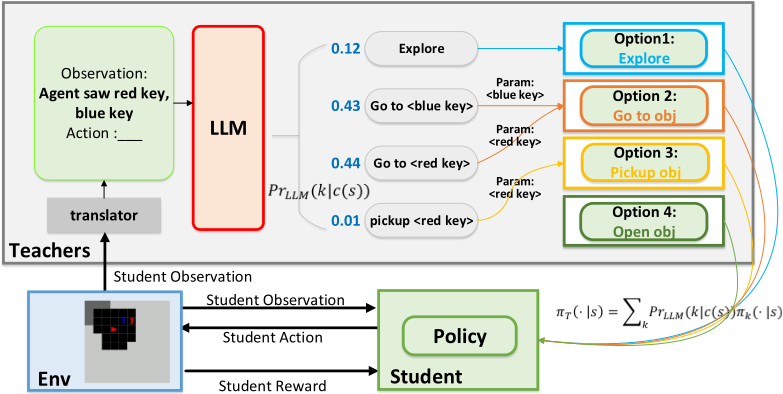
The core principle of LLM4Teach involves the utilization of a pre-trained LLM as a teacher agent to guide a lightweight student RL agent in swiftly acquiring a policy for real-time decision-making to accomplish a specific embodied task. The student agent is allowed to interact with the environment and receive feedback from these interactions to rectify any errors provided by the teacher agent. Following the training phase, only the lightweight student agent is utilized during the testing phase, yet it owns superior capability in accomplishing the target task compared to its teacher. The conceptual framework of this approach is depicted in Figure 1.
3.2 On the LLM-based Teacher Agent
In accordance with Ahn et al. [2022], we first notify the LLM of a set of K option policies Π : {πk : S → P(A)} related to the current task using appropriate prompts, where k ∈ {1, 2, ...,K} denotes the option index. When presented with a state s, the student agent requests guidance from the teacher agent for the next step action. The teacher agent initially selects a high-level option πk from the set Π, prompted by a textual description c(s) of the state s. Subsequently, an action suggestion a ∼ πk(s) is generated based on the chosen option, serving as an instruction provided by the teacher.
Generating Uncertainty-aware Instructions Using LLM
The process of the student agent learning policies from the teacher agent can be seen as distilling important task-related knowledge from the LLM agent. As demonstrated in Hinton et al. [2015], incorporating uncertainty into knowledge distillation can improve sample efficiency and prevent model over-fitting. Consequently, we propose having the LLM offer uncertainty-aware soft instructions to the student agent. When the student agent sends a text description c(s) to the teacher agent, the teacher agent responds by providing a soft decision πT (·|s), i.e., a distribution over available options, in the following way:
where PrLLM(k|c(s)) represents the probability of the LLM teacher selecting the kth option given the textual description c(s) of the current state s, and πk(·|s) denotes the policy associated with the kth option. To estimate the uncertainties
Algorithm 1 The student agent's policy learning algorithm
Require: an LLM agent, pre-trained option policies {πk}, initial policy parameter value θ, maximum allowable number of iterations T
- 1: for i = 1, 2, ..., T do
- 2: Collecting rollouts following the student agent's initial policy and stores the data in a buffer D
- 3: for each transition (s, a, r) ∈ D do
- 4: Generate a prompt with a textual description c(s) of the state s for the LLM-based teacher agent
- 5: Get the soft decision of the LLM-based teacher agent according to Equation (1)
- 6: end for
- 7: for each gradient descent step do
- 8: θ ← θ - α∇θ (LRL(θ) + λiEsH (πT (·|s)||πθ (·|s)))
- 9: end for
- 10: end for
PrLLM(k|c(s)) in our experiments, we query the LLMmultiple times with the same prompt to estimate the probability of each decision, similar to Wang et al. [2022]. An alternative approach is to access the logits of tokens relevant to option plans and convert them into probabilities [Carta et al., 2023; Ahn et al., 2022]. We conduct an ablation study on these two approaches in subsection 4.1.
3.3 On the Learning Process of the Student Agent
The learning process is summarized in Algorithm 1. The policy of the student agent, denoted as πθ(·|s), is learned by minimizing the following loss function:
where LRL(θ) denotes the traditional loss used in RL algorithms to encode the feedback from the environment. This loss is typically designed to maximize the expected return or rewards obtained by the agent. We incorporate the teacher agent's guidance into the student agent's learning process by introducing the regularization term H(πT (·|s)||πθ(·|s)) that describes the difference between the teacher policy πT (·|s) and the student policy. This term captures the KullbackLeibler (KL) divergence or Wasserstein distance between those two policies. To control the extent to which the student agent relies on the teacher agent, we introduce an annealing parameter λ. When λ is set to zero, the learning process of the student agent reduces to a standard RL process without any influence from the teacher agent.
We initialize the annealing parameter λ with larger values during the initial stages of training. This setup ensures that the student agent pays more attention to the guidance provided by the LLM-based teacher agent, aiming to align its policy with that of the teacher. As the training progresses, we gradually decay λ, allowing the student agent to shift its focus towards maximizing its expected return. By reducing the influence of the teacher's guidance, the student agent becomes more independent in its decision-making process and emphasizes its own learned policy. Specially, the annealing schedule used is designed as follow:
where i represents the index of the training iteration, k represents the decay rate, λ0 is the initial value of λ, λc is a constant value smaller than λ0, which is maintained from the i1th iteration to the i2th iteration, i2 indicates the point at which the connection to the LLM-based teacher agent is closed. For more details on the annealing schedule used in our experiments, see Appendix A.7 of Zhou et al. [2023].
This linear reduction of λ enables a smooth transition for the student agent from heavily relying on the teacher's guidance to prioritizing the RL objective. It provides a balance between learning from the teacher and acquiring autonomy in decision-making. When λ eventually reaches 0, we effectively remove the influence of the teacher's instructions on the student agent's policy, then the student agent no longer requires the teacher's guidance.
4 Experiments
We validated the performance of our method, LLM4Teach, through extensive experiments. The aim of the experiments is to demonstrate the specific advantages of LLM4Teach compared to RL baseline methods and approaches that solely rely on LLM for decision-making, and to test its potential in handling real-world sequential decision making problems.
Simulation Platforms
MiniGrid offers a customizable grid world environment with various sizes, object types, and objectives, making it a simple representation of grid-based tasks [Chevalier-Boisvert et al., 2023]. These tasks pose a challenge for RL methods because of their sparse rewards.
Habitat is a simulation platformspecifically created to support the development of embodied AI systems [Szot et al., 2021]. It provides a comprehensive framework for defining and executing various embodied AI tasks, such as navigation, object rearrangement, and question-answering. Additionally, Habitat enables detailed configuration of embodied agents, including their physical attributes and sensor specifications.
Baseline Methods
In the experiments, we include three baseline approaches to assess the performance of LLM4Teach.
LLM soly operates in two stages. First, the LLM selects an option from a set of available pre-trained options. Then, a low-level action is generated following the selected option policy. In this configuration, only an LLM-based agent is utilized to make real-time decisions, without the involvement of the student agent. This approach allows us to investigate the potential of our proposed LLM4Teach framework in enabling the student agent to outperform its teacher in completing the desired task.
Hierarchical RL is an RL baseline approach that involves training the student agent with pre-trained option policies [Matthews et al., 2022]. In light of the hierarchical nature of the tasks, we explore such hierarchical RL approach in our experiments, so that we can assess the benefits of knowledge distillation from a pre-trained LLM that captures world knowledge.
Baseline RL is a Tabula rasa RL baseline trained from scratch using the proximal policy optimization (PPO) algorithm [Schulman et al., 2017]. The policy model structure and the training loss function are set the same as our student agent in LLM4Teach.
4.1 Experiments onMiniGrid
Experimental Setting
We created 4 procedurally generated tasks in the MiniGrid environment: {SimpleDoorKey, ColoredDoorKey, LavaDoorKey and DivergedDoorKey}. In each task, the agents are situated in rooms with varying layouts and their goal is to unlock the exit door using the correct key. In SimpleDoorKey, the agent must explore the room, find a key, and use it to unlock the exit door. In ColoredDoorKey, the exit door can only be unlocked with a key that matches its color, adding complexity for the agent to understand task-specific rules. LavaDoorKey introduces hazard grids (Lava) to the room, requiring the agent to quickly adapt to new elements. DivergedDoorKey presents two exit doors instead of one, allowing the agent to choose either door to escape, emphasizing the importance of using uncertainty-aware instructions to improve overall sample efficiency.
For every task, we incorporate 5 specialized options, which are: {explore, go to, pickup, drop, open}. All options, with the exception of explore, are dependent on specific conditions, such as interacting with an object, for example, pickup the red key. These expert policies are compiled under the fundamental task of SimpleDoorKey. Each option policy produces a Dirac delta distribution over actions based on the state. Additional information about the environments and options can be found in Appendix A.4 of Zhou et al. [2023].
We use ChatGLM-turbo [Du et al., 2022] as the LLM to construct our teacher agent. This powerful model enables our teacher agent to possess complex reasoning capabilities. To leverage these capabilities, we employ Chain-of-thought (CoT) [Wei et al., 2022] style prompts. The CoT prompts consist of multiple stages that guide the LLM's decisionmaking process. Firstly, the LLM is prompted to summarize the scene, providing a condensed description of the environment. Secondly, it is instructed to reason about the appropriate course of action based on the given context. Finally, the LLM outputs its decision for the given task. To aid the LLM in understanding the reasoning process and ensuring correct output formatting, an arbitrary example is included in the prompt. This example serves as a reference point and helps the LLM grasp the desired output structure. Figure 2 illustrates an example of the dialogues generated by the LLM using this prompt setup in the ColoredDoorKey task.
Figure 2: An example of a prefix prompt and an interaction between the student agent and the LLM-based teacher agent for the task ColoredDoorKey. The Prefix prompt consists of two blocks: the instruction block briefly introduces the target problem and the CoT reasoning process; and the example block provides one arbitrary example of the expected format of the response from the LLM.
Results on MiniGrid
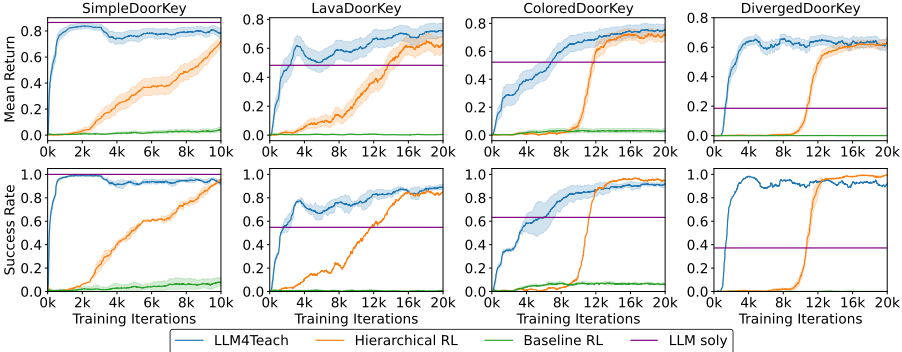
The main results in Figure 3 show that the baseline RL struggles to complete tasks, even the simplest one (SimpleDoorKey), due to highly sparse rewards. In contrast, hierarchical RL eventually succeeds in the tasks but requires over 10,000 training iterations across all tasks. However, LLM4Teach, guided by the LLM-based teacher, effectively leverages the world knowledge embedded in the LLM, leading to significantly higher sample efficiency compared to prior art RL baselines with sparse rewards.
Results also show that LLM4Teach outperforms LLM soly in terms of accumulated returns for all tasks, except for SimpleDoorKey. SimpleDoorKey is the simplest one, with low reasoning difficulty for LLM. Moreover, all option policies are designed based on this environment, so there is no issue of option policy transfer. Therefore, LLM soly can achieve a success rate of nearly 100% for the task.
For the other tasks which are more complex than SimpleDoorKey, LLM soly performs unsatisfactorily due to the lack of enough task-grounding knowledge. In comparison, LLM4Teach allows the student agent to learn task-grounding knowledge from the environmental feedback, thus performs much better than LLM soly. For example, in Colored- DoorKey, given the observation "Agent sees a red key, a blue key, a blue door.", an LLM can suggest "pickup the red key", while the right option is "pickup the blue key", since only the the key with the same color of the door can be used to unlock the door. As a result, LLM soly only achieves an average return of 0.52. In contrast, utilizing the student agent within LLM4Teach leads to a significantly higher average return of 0.77, as illustrated in Figure 3. This is due to the student agent's ability to rectify its teacher's errors and adjust its behavior according to environmental feedback.
We have identified three major categories for the error policies generated by the LLM:
- Incorrect policies, which are executable but result in task failure. For example, an incorrect policy could involve moving into the lava, leading to the failure of task completion.
- Inefficient policies, which are executable but not necessary for task completion. They can increase the number of steps required to accomplish the task, potentially resulting in time-out errors. For instance, an inefficient policy could involve continuously exploring even after finding the correct key and door, instead of directly proceeding to the door.
- Inconsistent policies, which are not executable due to non-compliance with behavioral logic or contextual constraints, e.g., attempting to pick up a new key without first dropping the key that the agent is currently holding.
Ablation Study on Uncertainty-aware Instructions
As presented in subsection 3.2, the teacher agent in LLM4Teach offers uncertainty-aware instructions to the student agent, which is a distinguishing feature compared to previous LLM-based agents (e.g., in Ahn et al. [2022]), where deterministic feedback is provided upon receiving a query.
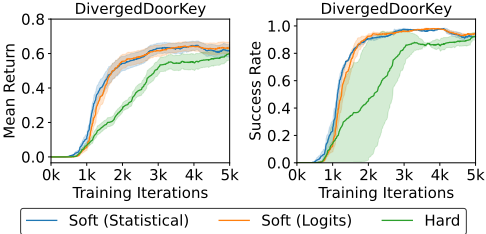
We conducted ablation studies to investigate the benefits of using uncertainty-aware instructions instead of deterministic ones in the DivergedDoorKey task. We considered two approaches for the LLM to provide uncertainty-aware soft instructions. The first one is to query the LLM multiple times with the same prompt to statistically estimate the probability of each decision, similar to Wang et al. [2022]. The other approach is to access the logits of tokens relevant to option plans and convert them into probabilities [Carta et al., 2023; Ahn et al., 2022]. We compare these two approaches with a hard instruction baseline, where the LLM's responses are directly used as deterministic instructions.
The result of the ablation study is shown in Figure 4. It is shown that utilizing uncertainty-aware instructions improves the overall sample efficiency compared to using deterministic ones. Moreover, there is no significant disparity in performance between the two approaches for generating uncertainty-aware instructions. The first approach is simpler to implement in practical scenarios but consumes more computational resources due to multiple queries to LLMs, particularly when the observation space is large. The second approach necessitates access to logits, making it applicable only to open-source LLMs.

4.2 Experiments on Habitat
To evaluate the potential applicability of our method in realworld scenarios, we conducted additional experiments using Habitat [Szot et al., 2021], which involves continuous action spaces and high-dimensional observations.
Experimental Setting
We focus on a manipulation task called Nav & Pick. The objective of the robotic agent is to navigate to the table without any collisions and subsequently perform a precise object pickup. Refer to Figure 5 for a visual representation.
We conduct separate pre-training for two high-level options, namely Navigate and Pick. These options are utilized by both LLM4Teach and the hierarchical RL baseline [Matthews et al., 2022]. To ensure the effectiveness of option training, we employ ten distinct training environment specifications, each with varying object and target locations. Furthermore, the agent's initial positions are randomly generated upon environment reset, ensuring diverse training scenarios. For each option, we utilize a ResNet18 backbone in conjunction with a 2-layer MLP architecture to train the corresponding models. For more detailed information about the environments and training parameters, refer to Appendix A.5 of Zhou et al. [2023].
We select the Vicuna-7b model [Chiang et al., 2023] as the LLM used in LLM4Teach, following a similar prompt design as in previous experiments on Minigrid. We utilize visual observations captured by the on-board camera as input queries for the LLM. To enable the LLM-based teacher agent to comprehend these visual inputs, we utilize a pre-configured translator in the same way as in Hu et al. [2024] to generate natural language descriptions which list identified objects in the visual inputs.
Results on Habitat
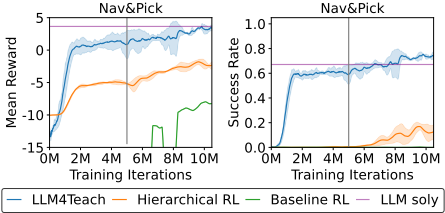
Due to the task being limited to home scenarios, the LLM effectively covers the common-sense reasoning abilities required to successfully complete the task. This results in few erroneous decision-making during option selection. Consequently, the task completion rate and average returns for LLM soly, as depicted in Figure 6, are relatively high. In contrast, the RL baselines struggle to complete the task due to the scarcity of rewards. Our approach, LLM4Teach, consistently outperforms all RL-based baselines in terms of both sample efficiency and asymptotic performance. This highlights the effective utilization of the LLM-based teacher's knowledge by the student agent in LLM4Teach, facilitating the learning of appropriate policies. Given enough training iterations, our approach exhibits a higher success rate compared to LLM soly. The primary advantage of LLM4Teach is that it is an extremely lightweight RL-based student agent specifically designed for utilization in the final online testing phase.
5 Concluding Remarks
Both RL and LLMs have limitations in handling complex sequential decision-making problems. RL often lacks sample efficiency and incurs high exploration costs, while LLMs are prone to decision errors and have high deployment costs. Combining LLMs with RL to overcome these limitations is a natural idea, but creating an effective interface between them poses challenges. LLMs utilize texts as input and output, making them suitable for providing high-level instructions, whereas RL operates at a much lower fine-grained level and uses numerical vectors instead of texts as inputs and outputs.
Here we present LLM4Teach, a novel framework that combines LLMs and RL for embodied sequential decisionmaking tasks. Our approach leverages the reasoning capabilities of LLMs to develop a highly capable RL-based student agent. In particular, we use the LLM to provide high-level suggestions on available options for policy training of the student agent. Extensive experiments demonstrate that our student agent outperforms all RL baselines in sample efficiency. Meanwhile, it achieves superior performance to LLM soly in terms of task completion success rate with much fewer computational resources during online testing. For instance, in MiniGrid experiments, the student agent's model size is 24K compared to LLM's 130B. Similarly, in Habitat experiments, the student agent's model size is 10M while an LLM's is 7B.
Ethical Statement
There are no ethical issues.
Acknowledgments
This work was supported by Exploratory Research Project (No.2022RC0AN02) of Zhejiang Lab.
Contribution Statement
- Zhou, B. Hu, C. Zhao and P. Zhang contribute equally. B. Liu is project lead.
@inproceedings{ijcai2024p627,
  title     = {Large Language Model as a Policy Teacher for Training Reinforcement Learning Agents},
  author    = {Zhou, Zihao and Hu, Bin and Zhao, Chenyang and Zhang, Pu and Liu, Bin},
  booktitle = {Proceedings of the Thirty-Third International Joint Conference on
               Artificial Intelligence, {IJCAI-24}},
  publisher = {International Joint Conferences on Artificial Intelligence Organization},
  editor    = {Kate Larson},
  pages     = {5671--5679},
  year      = {2024},
  month     = {8},
  note      = {Main Track},
  doi       = {10.24963/ijcai.2024/627},
  url       = {https://doi.org/10.24963/ijcai.2024/627},
}
TY - CPAPER TI - Large Language Model as a Policy Teacher for Training Reinforcement Learning Agents AU - Zhou, Zihao AU - Hu, Bin AU - Zhao, Chenyang AU - Zhang, Pu AU - Liu, Bin T2 - Proceedings of the Thirty-Third International Joint Conference on Artificial Intelligence, IJCAI-24 PB - International Joint Conferences on Artificial Intelligence Organization PY - 2024 SP - 5671 EP - 5679 DO - 10.24963/ijcai.2024/627 UR - https://doi.org/10.24963/ijcai.2024/627 ER -Copied
Machine-readable versions of this paper, for tools and AI agents:





