
RSAP-DFM: Regime-Shifting Adaptive Posterior Dynamic Factor Model for Stock Returns Prediction
Proceedings of the Thirty-Third International Joint Conference on Artificial Intelligence. Main Track. Pages 6116-6124.
https://doi.org/10.24963/ijcai.2024/676
Keywords
- Multidisciplinary Topics and Applications: MTA: Finance
- Machine Learning: ML: Applications
Abstract
As the latest development of asset pricing research, how to use machine learning to improve the performance of factor models has become a topic of concern in recent years. The variability of the instantaneous macro environment brings great difficulties to quantitative investment, so the extended factor model must learn how to self-adapt to extract the macro pattern from the massive stock volume and price information, and how to continuously map the extracted macro pattern to the stock investment is also an open question. To this end, we propose the first continuous regime-based dynamic factor model, RSAP-DFM, which adaptively extracts continuous macroeconomic information and completes the dynamic explicit mapping of stock returns for the first time through dual regime shifting, while the adversarial posterior factors effectively correct the mapping deviation of prior factors. In addition, our model integrates an innovative two-stage optimization algorithm and normally distributed sampling, which further enhances the robustness of the model. Performance on three real stock datasets validates the validity of our model, which exceeds any previous methods available.
- [Carhart, 1997] Mark M Carhart. On persistence in mutual fund performance. The Journal of finance, 52(1):57-82, 1997.
- [Chen and Guestrin, 2016] Tianqi Chen and Carlos Guestrin. Xgboost: A scalable tree boosting system. In Proceedings of the 22nd acm sigkdd international conference on knowl- edge discovery and data mining, pages 785-794, 2016.
- [Ding et al., 2020] Qianggang Ding, Sifan Wu, Hao Sun, Ji- adong Guo, and Jian Guo. Hierarchical multi-scale gaus- sian transformer for stock movement prediction. In IJCAI, pages 4640-4646, 2020. IJCAI
- [Du et al., 2021] Yuntao Du, Jindong Wang, Wenjie Feng, Sinno Pan, Tao Qin, Renjun Xu, and Chongjun Wang. Adarnn: Adaptive learning and forecasting of time se- ries. In Proceedings of the 30th ACM international con- ference on information & knowledge management, pages 402-411, 2021.
- [Duan et al., 2022] Yitong Duan, Lei Wang, Qizhong Zhang, and Jian Li. Factorvae: A probabilistic dynamic fac- tor model based on variational autoencoder for predicting cross-sectional stock returns. In Proceedings of the AAAI Conference on Artificial Intelligence, volume 36, pages 4468-4476, 2022.
- [Fama and French, 1992] Eugene F Fama and Kenneth R French. The cross-section of expected stock returns. the Journal of Finance, 47(2):427-465, 1992.
- [Geweke, 1977] John Geweke. The dynamic factor analy- sis of economic time series. Latent variables in socio- economic models, 1977.
- [Goodfellow et al., 2014] Ian J Goodfellow, Jonathon Shlens, and Christian Szegedy. Explaining and harnessing adversarial examples. arXiv preprint arXiv:1412.6572, 2014.
- [Gu et al., 2021] Shihao Gu, Bryan Kelly, and Dacheng Xiu. Autoencoder asset pricing models. Journal of Economet- rics, 222(1):429-450, 2021.
- [Hochreiter and Schmidhuber, 1997] Sepp Hochreiter and Jürgen Schmidhuber. Long short-term memory. Neural computation, 9(8):1735-1780, 1997.
- [Ke et al., 2017] Guolin Ke, Qi Meng, Thomas Finley, Taifeng Wang, Wei Chen, Weidong Ma, Qiwei Ye, and Tie-Yan Liu. Lightgbm: A highly efficient gradient boost- ing decision tree. Advances in neural information process- ing systems, 30, 2017.
- [Kelly et al., 2019] Bryan T Kelly, Seth Pruitt, and Yinan Su. Characteristics are covariances: A unified model of risk and return. Journal of Financial Economics, 134(3):501- 524, 2019.
- [Krizhevsky et al., 2012] Alex Krizhevsky, Ilya Sutskever, and Geoffrey E Hinton. Imagenet classification with deep convolutional neural networks. Advances in neural infor- mation processing systems, 25, 2012.
- [Lin et al., 2021a] Hengxu Lin, Dong Zhou, Weiqing Liu, and Jiang Bian. Deep risk model: a deep learning solu- tion for mining latent risk factors to improve covariance matrix estimation. In Proceedings of the Second ACM In- ternational Conference on AI in Finance, pages 1-8, 2021.
- [Lin et al., 2021b] Hengxu Lin, Dong Zhou, Weiqing Liu, and Jiang Bian. Learning multiple stock trading patterns with temporal routing adaptor and optimal transport. In Proceedings of the 27th ACM SIGKDD Conference on Knowledge Discovery & Data Mining, pages 1017-1026, 2021.
- [Mari and Mari, 2023] Carlo Mari and Emiliano Mari. Deep learning based regime-switching models of energy com- modity prices. Energy Systems, 14(4):913-934, 2023.
- [Nelson et al., 2017] David MQ Nelson, Adriano CM Pereira, and Renato A De Oliveira. Stock market's price movement prediction with lstm neural networks. In 2017 International joint conference on neural networks (IJCNN), pages 1419-1426. Ieee, 2017.
- [Qin et al., 2017] Yao Qin, Dongjin Song, Haifeng Chen, Wei Cheng, Guofei Jiang, and Garrison W. Cottrell. A dual-stage attention-based recurrent neural network for time series prediction. In IJCAI, pages 2627-2633, 2017. IJCAI
- [Ross, 2013] Stephen A Ross. The arbitrage theory of capital asset pricing. In Handbook of the fundamentals of finan- cial decision making: Part I, pages 11-30. World Scien- tific, 2013.
- [Rumelhart et al., 1986] David E Rumelhart, Geoffrey E Hinton, and Ronald J Williams. Learning representations by back-propagating errors. nature, 323(6088):533-536, 1986.
- [Sawhney et al., 2021] Ramit Sawhney, Shivam Agarwal, Arnav Wadhwa, Tyler Derr, and Rajiv Ratn Shah. Stock selection via spatiotemporal hypergraph attention net- work: A learning to rank approach. In Proceedings of the AAAI Conference on Artificial Intelligence, volume 35, pages 497-504, 2021.
- [Selvin et al., 2017] Sreelekshmy Selvin, R Vinayakumar, EA Gopalakrishnan, Vijay Krishna Menon, and KP So- man. Stock price prediction using lstm, rnn and cnn- sliding window model. In 2017 international conference on advances in computing, communications and informat- ics (icacci), pages 1643-1647. IEEE, 2017.
- [Sharpe, 1964] William F Sharpe. Capital asset prices: A theory of market equilibrium under conditions of risk. The journal of finance, 19(3):425-442, 1964.
- James H Stock and Mark W Wat- son. Dynamic factor models. 2011. [Sutskever et al., 2014] Ilya Sutskever, Oriol Vinyals, and Quoc V Le. Sequence to sequence learning with neural networks. Advances in neural information processing sys- tems, 27, 2014.
- [Uddin and Yu, 2020] Ajim Uddin and Dantong Yu. Latent factor model for asset pricing. Journal of Behavioral and Experimental Finance, 27:100353, 2020.
- [Velickovic et al., 2017] Petar Velickovic, Guillem Cucu- rull, Arantxa Casanova, Adriana Romero, Pietro Lio, Yoshua Bengio, et al. Graph attention networks. stat, 1050(20):10-48550, 2017.
- [Wang et al., 2022] Heyuan Wang, Tengjiao Wang, Shun Li, Jiayi Zheng, Shijie Guan, and Wei Chen. Adaptive long- short pattern transformer for stock investment selection. In IJCAI, pages 3970-3977, 2022.
- [Wei et al., 2022] Zikai Wei, Bo Dai, and Dahua Lin. Factor investing with a deep multi-factor model. arXiv preprint arXiv:2210.12462, 2022.
- [Wei et al., 2023] Zikai Wei, Anyi Rao, Bo Dai, and Dahua Lin. Hirevae: An online and adaptive factor model based on hierarchical and regime-switch vae. In IJCAI, page 4903-4911, 2023. IJCAI
- [Wu et al., 2021] Xueqing Wu, Lewen Wang, Yingce Xia, Weiqing Liu, Lijun Wu, Shufang Xie, Tao Qin, and Tie- Yan Liu. Temporally correlated task scheduling for se- quence learning. In International Conference on Machine Learning, pages 11274-11284. PMLR, 2021.
- [Xu et al., 2021a] Wentao Xu, Weiqing Liu, Jiang Bian, Jian Yin, and Tie-Yan Liu. Instance-wise graph-based frame- work for multivariate time series forecasting. arXiv preprint arXiv:2109.06489, 2021.
- [Xu et al., 2021b] Wentao Xu, Weiqing Liu, Lewen Wang, Yingce Xia, Jiang Bian, Jian Yin, and Tie-Yan Liu. Hist: A graph-based framework for stock trend forecast- ing via mining concept-oriented shared information. arXiv preprint arXiv:2110.13716, 2021.
- [Yang et al., 2020] Xiao Yang, Weiqing Liu, Dong Zhou, Jiang Bian, and Tie-Yan Liu. Qlib: An ai- oriented quantitative investment platform. arXiv preprint arXiv:2009.11189, 2020.
- [Zhang et al., 2017] Liheng Zhang, Charu Aggarwal, and Guo-Jun Qi. Stock price prediction via discovering multi- frequency trading patterns. In Proceedings of the 23rd ACM SIGKDD international conference on knowledge discovery and data mining, pages 2141-2149, 2017.
References were extracted automatically from the PDF and may contain errors.
Full text extracted automatically from the PDF; figures, tables and equations may differ. The PDF is the version of record.
1 Introduction
Asset pricing, a central topic in modern financial research, seeks to explain the cross-sectional differences in the expected returns of different assets. Influenced by the Capital Asset Pricing Model (CAPM) [Sharpe, 1964], the FamaFrench three-factor model ushers in the era of factor modeling. This approach conceptualizes stock excess returns as combinations of multiple factor-based returns, with these factors symbolizing distinct sources of excess returns. However, the traditional static factor exposure is now being reevaluated in favor of dynamic models, acknowledging time-varying influences on investment performance [Stock and Watson, 2011]. Unlike linear factor models, machine learning can use multi-layer nonlinear networks, offering a more robust framework for capturing complex financial relationships.
∗Corresponding Author
Given the above advantages, the application of machine learning to the prediction of cross-sectional expected excess returns becomes the focus of academic attention. Existing studies transfer machine learning methods such as tree model [Chen and Guestrin, 2016], time series model [Sutskever et al., 2014], graph model [Velickovic et al., 2017], and attention model [Ding et al., 2020] to stock prediction problem. Although the performance is improved, interpretability remains a challenge. To further describe the interdependence between intertemporal stock features, researchers develop some machine learning models specifically for financial markets [Lin et al., 2021a; Xu et al., 2021b]. Compared to these model-free approaches, machine learning technology also offers an entirely new perspective on traditional dynamic factor models (linear relationship), which dynamically learn factor exposures and factors returns in different periods [Kelly et al., 2019; Uddin and Yu, 2020; Gu et al., 2021; Duan et al., 2022].
However, we believe that two unresolved issues remain. Firstly, in the current complex and volatile economic environment, the key to the success of the investment model is whether it can judge the macroeconomic state in time and integrate it into the investment decision. Existing machine learning and dynamic factor models struggle to encapsulate this characteristic effectively. [Wei et al., 2023] introduces an innovative concept of hierarchical market states, yet the approach of broadly categorizing economic features into discrete market states and employing black-box integration appears somewhat imprecise. Secondly, traditional data-driven factor construction is polluted by the low signal-to-noise ratio of stock data, making predicting returns accurately difficult.
In this paper, we propose a Regime-Shifting Adaptive Posterior Dynamic Factor Model for stock returns prediction called RSAP-DFM. In our approach, we reshape the relationship between factor construction, factor return, and factor exposure. We leverage a multi-head attention mechanism to dynamically generate and sample factors from normal distributions. These factors are crucial components within our dynamic factor model (DFM), which is instrumental in predicting stock returns. To enhance the precision of current factor state identification, we have introduced a novel regime recognition method that is applied distinctively to factor returns and factor loadings. Specifically, we employ a "jumping encoder" to capture the influence of macroeconomic states derived from historical stock time series data on factor returns. Additionally, a "loading encoder" characterizes the influence of these macro states on factor loadings and idiosyncratic returns. Furthermore, we have devised an innovative bilevel optimization algorithm for constructing posterior factors through adversarial learning, which enhances the robustness of the factor constructions and optimizes their predictive returns. Our findings substantiate the superior performance of RSAP-DFM compared to alternative baseline methods. The contributions of our paper are as follows:
1. We propose a stock returns prediction framework named RSAP-DFM, which discards the artificial factor construction process by constructing factors sampled from the normal distribution and posterior factors constructed by adversarial learning. To the best of our knowledge, we are the first to propose gradient-based posterior factor construction and optimize it in a bilevel form.
- To the best of our knowledge, in a neural-network training framework, we propose a dual regime shifting structure and apply it in DFM, which is the first to describe explicitly, rather than in a black box, how macroeconomic state affects stock returns; furthermore, we are also the first to perform regime shifting in continuous rather than discrete intervals.
- We conduct a comprehensive array of experiments employing real stock market data. Experiments on datasets from the A-share market demonstrate our achievement of an unprecedented state-of-the-art (SOTA) performance, thus surpassing prior benchmarks.
2 RelatedWorks
2.1 Deep Learning in Technical Analysis
Since Alexnet [Krizhevsky et al., 2012] proves the power of neural networks, the development and application of deep learning have surpassed imagination. In stock prediction, technical analysis, as a core area, is particularly suitable for the application of deep learning models. Technical analysis uses only numerical characteristics of stocks and markets as data. [Selvin et al., 2017] uses RNN [Rumelhart et al., 1986], LSTM [Hochreiter and Schmidhuber, 1997], and CNN-sliding window for stock price prediction. Using LSTM as the backbone like [Nelson et al., 2017], [Zhang et al., 2017] also proposes a high-frequency trading prediction model using only historical data.
Based on traditional neural network models, more advanced neural networks have been developed for stock forecasting. The improvement of classical deep learning models specific to the stock market becomes an essential direction of technical analysis, such as adversarial LSTM [Qin et al., 2017], multi-scale Gaussian prior Transformer [Ding et al., 2020], and adaptive RNN [Du et al., 2021]. How to better analyze the volume and price information and correlation relationship of the stock market becomes another major direction for predicting returns. Existing studies use hypergraph ranking method [Sawhney et al., 2021], instance-wise graphbased method [Xu et al., 2021a], optimal transport [Lin et al., 2021b], and adaptive long-short pattern transformer [Wang et al., 2022] to deeply characterize the stock information and relationship. However, research addressing regime switching via deep learning methodologies remains limited. [Mari and Mari, 2023] only focuses on energy commodity prices, while [Wei et al., 2023] learns the hierarchical latent space by using a moving-average online learning algorithm to identify discrete market institutions. Different from any regime switching approach, we believe that market regime shifts in continuous intervals and maps explicitly.
2.2 Factor Model
Following the traditional definition, the factor model here only refers to a model in which stock returns are a linear combination of exposure returns on each factor. Traditional factor models in finance have progressed from the single market factor in CAPM [Sharpe, 1964] through Ross's development of the Arbitrage Pricing Theory [Ross, 2013] and the expansion to multi-factor models like the Fama-French three-factor model [Fama and French, 1992] and the Carhart four-factor model [Carhart, 1997]. The latest factor model has developed hundreds of factors, forming the famous "factor zoo".
In dynamic factor models, factors and factor exposures vary over time and are typically derived from individual characteristics. Dynamic factor models are originally proposed by Geweke [Geweke, 1977] as a time-series extension of crosssectional factor models; for a detailed explanation and collection of traditional dynamic factor models, see [Stock and Watson, 2011]. However, the dynamic factor model has limitations in that it relies on complex statistical techniques for factor construction, while machine learning can obscure these methods as a black box. Unlike the linear assumption of Instrumented Principal Components Analysis (IPCA) [Kelly et al., 2019], [Gu et al., 2021] models factor exposures as flexible nonlinear functions of covariates. Furthermore, [Lin et al., 2021a] proposes a risk factor model to better explain the variance of stock returns, and [Wei et al., 2022] proposes a deep multi-factor model to build a dynamic and multirelational stock graph in a hierarchical structure. The latest research is [Duan et al., 2022], which considers using variational autoencoders to model noise based on [Gu et al., 2021]. However, existing factor models are limited to wrapping each step of the traditional factor model in machine learning rather than incorporating new ideas into model design.
3 Preliminaries
In this section, we briefly introduce the dynamic factor model as a backbone, then define regime shifting and introduce our problem.
To broadly convey this concept, we consistently utilize the notation and problem definition outlined below. In the complete set Ω, there are a total of T subsets {xt, rt} sorted in chronological order: Ω = {{x1, r1}, . . . , {xT , rT }} where t = 1, . . . , T is the total number of trading days in the data set. xt ∈ RNt×B×F denotes F features (such as price, volume, text-data) of Nt stocks in past B time-steps, and rt ∈ RNt denotes the future returns of Nt cross-sectional stocks. The goal of this type of problem is to predict crosssectional future returns through current characteristics, which can be summarized as follows:
3.1 Dynamic Factor Model
To fulfill the objective mentioned above, it is imperative to provide the reader with a comprehensive understanding of the dynamic factor model. A typical representation of the dynamic factor model is formulated as follows:
where rt = (yt+1 - yt)/yt ∈ RNt denotes the future 1-day returns of Nt stocks at time step t, and yt ∈ RNt denotes the price at time step t, which can be represented by a variety of prices, such as the opening price, the closing price, or the volume weighted average price (VWAP). αt ∈ RNt denotes the vector of stock idiosyncratic returns, βt ∈ RNt×K denotes the factor exposure, λt ∈ RK denotes the return vector of K factors. εt denotes the idiosyncratic noises, with E(εt) = 0.
When it comes to applying machine learning to the dynamic factor model, the common practice is to fit an unknown prediction function f to a large amount of data and predict the intertemporal return using the historical data of the stock. The historical data of the stock determines all the parameters of f :
3.2 Our Problem
Definition 1. The market environment, also known as the regime, changing within the continuous interval [a, b] is defined as regime shifting.
Different from the regime switching which changes in the discrete interval {a, a1, ...bn-1, b}, we believe that the regime change is in a continuous interval rather than several fixed discrete regimes. This dimension helps illuminate the complex correlation between economic dynamics and stock return.
Compared with the traditional dynamic factor model, we introduce our new dynamic factor model by dual dynamic regime shifting:
where m denotes regime shifting features. In RSAP-DFM, m can be adaptively extracted from the cross-sectional stock features. To avoid notational confusion, we ignore the subscript t in the following pages because our goal is to predict cross-sectional returns, and each prediction will involve only a subset of Ω.
4 Methodology
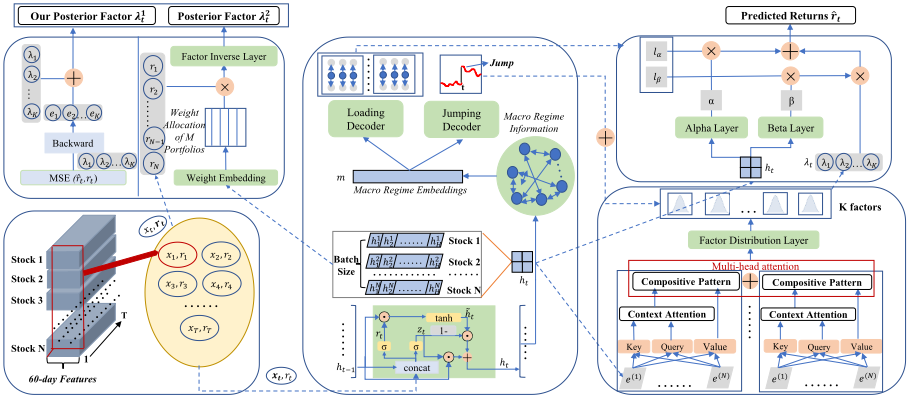
In this section, we elaborate on our Regime-Shifting Adaptive Posterior Dynamic Factor Model (RSAP-DFM) framework. Figure 1 is the illustration of our RSAP-DFM framework. In this section, we first show how the feature extractor works for stock hidden states and macro regime embeddings and present a dual-encoder to handle dual regime-shifting features (4.1). Then, we describe our prior factor encoder based on a multi-head attention mechanism to encode factors with regime-shifting jumping (4.2). With regime-shifting loading, we describe our dual dynamic factor model for stock prediction, which combines neural networks to coordinate α, β, and factors (4.3). After that, we introduce factor posterior following the idea of adversarial learning to further modify factor selection and factor return (4.4). At last, we introduce dual tasks as a bilevel form and present an innovative two-stage optimization method for training (4.5).
4.1 Feature Embedding Extractor
Stock Feature Construction
Future stock returns can be predicted by features constructed from stock time series data. We utilize a GRU model to extract hidden stock features from x:
where ⊙ is Hadamard product, W∗ and U∗ are trainable weights and biases. In the following section, we use e to refer to ht.
Dual-Regime-Shifting Encoder Structure
Regime shifting in the dynamic factor model, in our perspective, assumes a dual role. Firstly, it influences the overall market's returns, thereby impacting factor returns. Secondly, it exerts varying degrees of influence on returns of individual stocks, consequently altering the factor exposure of stocks.
To avoid providing additional information and thus making the model incomparable, we dynamically extract macroeconomic features from the stock hidden features e:
where m ∈ RM denotes M regime shifting features.
Regime Shifting Jumping Encoder. When we choose macroeconomic featuresm, capturing their temporal patterns is not needed; we just need to know the current regime and characterize how the regime affects the return of each factor. Therefore, after extracting relatively low-dimensional features, the regime shifting jumping encoder ϕRJ must have components to further project into K-dimensional space:
where erj ∈ RK , K is the number of factors.
Regime Shifting Loading Encoder. Similar to ϕRJ, our regime shifting loading encoder ϕRL also adopts a similar architecture. Note that the purpose of introducing macroeconomic features into the model is to characterize regime shifting in terms of factor loading, so ϕRL will output lα and lβ. But unlike ϕRJ, ϕRL shows the different effects of regime shifting on the factor loadings of different stocks, so ϕRL needs to introduce the individual features of the stock:
where lα ∈ RN denotes regime shifting on the α loading, lβ ∈ RN×K denotes regime shifting on the β exposure.
4.2 Multi-Head Attention-Based Factor Encoder
To enhance the model's resilience, we incorporate a variational encoder that introduces stochasticity into factor returns, thus rendering them as random variables conforming to a normal distribution. Prior factor encoder ϕprior extracts prior factors λprior from hidden features of stocks without revealing future information.
We divide the "factor mining" process into two perspectives: factor construction and factor return. In traditional factor investing, each factor reflects a risk premium in the market, and the factor construction is usually constructed manually, while the factor return is obtained by using the crosssectional order of the factor values to build a long-short combination and there is no relationship between the two.
The ϕprior we design incorporates both factor construction and factor return: a multi-headed attention mechanism characterizes factor construction and partial factor return; a regime shifting factor encoder characterizes the other part of factor returns from an unbiased global perspective:
Formally, ϕatt stitches multiple attention heads together:
Then we merge factor construction with factor return through πprior to form an end-to-end factor coding process without the hand-made construction part:
4.3 Dual Dynamic Factor Model
Now that we have explained in detail how to output the optimal prior factors of a dynamic factor model, let us take another look at our problem (4), then reconstruct the model based on the known prior factors:
Alpha Layer. In the Alpha layer, we generate idiosyncratic returns denoted as α, which are derived from latent features e. It's posited that α follows a Gaussian distribution, characterized as α ∼ N (µα, diag (σ2α)). Here, the mean µα ∈ RN and the standard deviation σα ∈ RN are produced by a distribution network πα := [µα, σα]:
where h(i) α ∈ RH denotes the hidden space.
BetaLayer. Beta Layer is taskedwith calculating factor exposure β ∈ RN×K which is a linear mapping from the latent features e:
Regime Shifting. Here, we present the dual dynamic factor model. We believe that regime shifting can be reflected in factor exposure and stock idiosyncratic returns, where macroeconomic information is explicitly mapped into dynamic factor model. Since market information represented by regime shifting is also dynamic, we name the model the dual dynamic factor model. We take the form of factor loadings (or "element-wise multiplication"):
Consequently, the output of the dual dynamic factor model, denoted as ˆ r ∈ RN , is also governed by a Gaussian distribution, specifically ˆ r(i) ∼ N(µ(i) r ,σ(i) r ), where
4.4 Adaptive Factor Posterior Module
The gradient-based factor posterior absorbs the idea of adversarial learning [Goodfellow et al., 2014] and adds an adaptive perturbation to the data in a batch to form adversarial factors λG ∈ RK during each iteration training. We construct a perturbation such that applying it causes the most significant change in the prediction compared to the perturbation of the same size and approximate the predicted returns formed by λG and future returns, thus enhancing the robustness of prior factors.
By calculating the MSE loss between predicted returns ˆ r and returns r, and calculating the gradient of the loss with respect to λprior, the adaptive perturbation is constructed:
4.5 Our Algorithm
Our basic idea is to construct the model training as a bilevel optimization form by introducing a posterior factor to construct an adaptive auxiliary training task to improve the performance of the main task. The basic principle of our algorithm is that both the main task and the auxiliary task can share parameters. Following the thought of traditional finance, it is a natural choice to separate factor construction and factor model optimization. We split the model parameters into two parts so that there are two sets of parameters that can be learned alternately:
where Ωtr denotes the training part of Ω, θC denotes the parameters of factor construction part, θD denotes the parameters of dual dynamic factor model part, LM denotes the loss function of the main task,ℓA denotes the loss function of the auxiliary task on data (x, r).
Intuitively, we hope that this auxiliary task can promote the performance of our model on the main task. Here, we choose gradient-based posterior factors to participate in the construction of auxiliary tasks to construct more robust factors so as to minimize the loss of the model on the main task.
Algorithm 1 Optimization Algorithm
Input: Training epochs E; update iterations I; training dataset Ωtr = {Ω1Batch , ..., ΩNtrain Batch };
Parameter: Model parameters θC,θD;
Output: Trained model parameters θC,θD;
- 1: for e ← 1 : E do
- 2: Randomly Sample ΩaBatch from Ω, batch size B1 equals to stock num of ΩaBatch ;
- 3: Randomly Sample ΩbBatch from Ω, batch size B2 equals to stock num of ΩbBatch ;
- 4: for i ← 1 : I do
- For each (x, r) ∈ ΩaBatch , calculate the loss of aux-
- 5: iliary task:
- 6: Update θC: θC ← θC - (η1/B1)∇θC LA;
- 7: For each (x, r) ∈ ΩbBatch , calculate the loss of main task:
- 8: Update θD: θD ← θD - (η2/B2)∇θD LM;
- 9: end for
- 10: end for
- 11: return θC,θD
Our approach is shown in Algorithm 1. The training process consists of E epochs: in the inner layer, we fix θD and optimize θC on the auxiliary task; On the outer layer, optimize θD on the main task by fixing θC. Such algorithm setting can be generalized, but in this experiment, the main task loss and auxiliary task loss are respectively:
5 Experiments
In this section, we compare our framework with other major related works and verify the effectiveness, state-of-theart, and robustness of our framework through multiple experiments. The following five questions are explored in the following experiments:
Question 1: Does our model outperform current state-ofthe-art models in stock prediction?
Question 2: Can bilevel optimization promote the performance of our model?
Question 3: Is dual regime-shifting architecture useful for improving performance?
Question 4: Is the posterior factor we designed better than the previous methods?
Question 5: Can our model's superior prediction performance generate superior investment performance?
5.1 Experiment Setting
SettingDetails. We evaluate the performance of our RSAPDFM model on China's A-share market, which is split into a training period (2008.01-2014.12), a validation period (2015.01-2016.02), and a test period (2017.01-2020.08). Our stock features come from Alpha360 on the Qlib platform
Baselines
| XGBoost[Chen and Guestrin, 2016] | A scalable end-to-end tree boosting method. |
| LightGBM[Ke et al., 2017] | A boosting decision tree, with gradient-based one-side sampling and exclusive feature bundling. |
| MLP | A non-linear factor model with multilayer perceptrons, with an LSTM model to extract hidden features from temporal features. |
| Transformer[Ding et al., 2020] | A stock return prediction framework with the transformer architecture. |
| ALSTM[Qin et al., 2017] | A variant of LSTM, which adds an attention mechanism to automatically learn and focus on the information at critical moments. |
| GATs[Velickovic et al., 2017] | A graph attention network that treats each stock as a node to specify different weights to different nodes by stacking layers. |
| AdaRNN[Du et al., 2021] | An adaptive RNN which aims to solve the temporal covariate shift problem of time series. |
| IGMTF[Xu et al., 2021a] | An instance-based graph framework to make predictions using the interdependencies of different variables at different time stamps. |
| TRA[Lin et al., 2021b] | A learning algorithm based on optimal transport for learning multiple stock trading patterns. |
| TCTS[Wu et al., 2021] | A sequence learning model combined with a learnable scheduler that adaptively selects auxiliary tasks for training. |
| FactorVAE[Duan et al., 2022] | A dynamic factor model with the variational autoencoder and prior-posterior learning. |
| Model | IC | ICIR | CSI100 RANK IC | RANK ICIR | IC | ICIR | CSI300 RANK IC | RANK ICIR | IC | ICIR | CSI500 RANK IC | RANK ICIR |
|---|---|---|---|---|---|---|---|---|---|---|---|---|
| XGBoost | 0.0517 | 0.3096 | 0.0547 | 0.3744 | 0.0517 | 0.4642 | 0.0596 | 0.5696 | 0.0517 | 0.4642 | 0.0596 | 0.5696 |
| LightGBM | 0.0502 | 0.3211 | 0.0595 | 0.3858 | 0.0560 | 0.4703 | 0.0654 | 0.5608 | 0.0555 | 0.5286 | 0.0667 | 0.6554 |
| MLP | 0.0413 | 0.2466 | 0.0427 | 0.2676 | 0.0358 | 0.2587 | 0.0427 | 0.3246 | 0.0353 | 0.2754 | 0.0460 | 0.4076 |
| Transformer | 0.0475 | 0.2668 | 0.0578 | 0.3435 | 0.0415 | 0.3094 | 0.0564 | 0.428 | 0.0396 | 0.3359 | 0.0533 | 0.4624 |
| ALSTM | 0.0574 | 0.3340 | 0.0655 | 0.3866 | 0.0658 | 0.5394 | 0.0763 | 0.6231 | 0.0586 | 0.5919 | 0.0671 | 0.6737 |
| GATS | 0.0583 | 0.3526 | 0.0678 | 0.4208 | 0.0717 | 0.5655 | 0.0804 | 0.6520 | 0.0680 | 0.6628 | 0.0798 | 0.7931 |
| AdaRNN | 0.0657 | 0.3865 | 0.0697 | 0.4222 | 0.0640 | 0.5077 | 0.0769 | 0.6148 | 0.0705 | 0.7104 | 0.0833 | 0.8694 |
| IGMTF | 0.0622 | 0.3678 | 0.0708 | 0.4352 | 0.0669 | 0.5250 | 0.0765 | 0.6196 | 0.0653 | 0.6025 | 0.0771 | 0.7387 |
| TRA | 0.0674 | 0.4157 | 0.0755 | 0.4784 | 0.0638 | 0.5207 | 0.0731 | 0.6084 | 0.0688 | 0.7046 | 0.0788 | 0.8214 |
| TCTS | 0.0593 | 0.3429 | 0.0632 | 0.3738 | 0.0763 | 0.6633 | 0.0806 | 0.6828 | 0.0718 | 0.7294 | 0.0834 | 0.8881 |
| FactorVAE | 0.0487 | 0.3084 | 0.0518 | 0.3321 | 0.0528 | 0.4417 | 0.0627 | 0.5350 | 0.0606 | 0.5894 | 0.0736 | 0.7491 |
| RSAP-DFM | 0.0768 | 0.4260 | 0.0870 | 0.4852 | 0.0855 | 0.6194 | 0.0961 | 0.6849 | 0.0854 | 0.7317 | 0.1025 | 0.8770 |
[Yang et al., 2020]. This dataset provides six basic transaction information for stocks over the past 60 days, including opening - high - low - closing prices, volume weighted average price (VWAP), and trading volume. We set the label and forecast target as the daily stock return, defined as rt = (yt+1 - yt)/yt, yt denotes opening price here because we believe this better captures the hidden information of the stock's history and eliminates the interference of unexpected situations the next day. Since ST stocks are not included, we set the batch size to a float equal to the number of stocks included in the day. We adopt the Pytorch framework to implement our model and perform all experiments on the NVIDIA GEFORCE RTX 2080 GPU.
Baselines. We compare our model with the baselinemodels in Table 1, which represent the latest related research.
5.2 Overall Performance Evaluation
In this experiment, we verify the performance evaluation of our RSAP-DFM. To show the superiority of our model's prediction performance, we use three significant datasets on the A-share market (CSI100, CSI300, CSI500) and four indicators commonly used in the academic community to describe comprehensively: the information coefficient (IC), the information ratio of IC (ICIR), the rank information coefficient (Rank IC), the information ratio of RankIC (RANK ICIR). Table 2 presents our main experimental results. Compared with the baseline models, RSAP-DFM achieves all-round leading prediction performance on all three datasets. Surprisingly, the performance on the different datasets validates the high robustness of RSAP-DFM. Such results fully demonstrate the effectiveness of our method (Q1).
5.3 Ablation Study
Bilevel Optimization and Auxiliary Task Can Promote Model Performance
End-to-end optimization (E2E) via neural networks is widely employed. In the context of our experiments, we seek to validate the efficacy of our novel approach, which centers on auxiliary task-based bilevel optimization and its capacity to enhance model performance. We formulate an end-to-end optimization strategy as the baseline against which we compare our proposed method. Furthermore, we propose a model that removes a posteriori auxiliary task (RS-DFM) as a baseline, that is, optimizes for central task performance only. As depicted in Table 3, our bilevel optimization approach consistently demonstrates its effectiveness in enhancing model performance across diverse factor model configurations. In the entire Chinese stock market, our method consistently outperforms conventional end-to-end optimization techniques (Q2).
Dual Regime-Shifting Architecture Drives Our Model Better
In this experiment, we will explain the necessity of our model components. Therefore, we construct three models that modify some components: DFM represents the dynamic factor model part, RSAP-DFM(wo-Jump) represents the removal of the regime-shifting jumping encoder component, and RSAPDFM(wo-Load) represents the removal of the regime-shifting loading encoder component. These models help analyze the effectiveness of RSAP-DFM components.
As shown in Table 3, the performance of our model is better in almost all metrics than that of the model after changing the components. The following conclusions can be drawn: 1) Compared with models based on only one region shifting method, RSAP-DFM based on dual regime shifting can better capture macro hidden information. 2) RSAP-DFM better encodes market information extracted from stock features and dynamically injects it into the dual dynamic factor model, providing the model with more robustness and accuracy (Q3).
| Model | Method | IC | ICIR | RANK IC | RANK ICIR |
|---|---|---|---|---|---|
| RS-DFM | E2E | 0.0697 | 0.3713 | 0.0802 | 0.4359 |
| RSAP-DFM | E2E | 0.0761 | 0.4426 | 0.0824 | 0.4800 |
| DFM | E2E | 0.0752 | 0.4134 | 0.0833 | 0.4735 |
| CSI100 RSAP-DFM(wo-Jump) | Bilevel | 0.0743 | 0.4020 | 0.0844 | 0.4782 |
| RSAP-DFM(wo-Load) | Bilevel | 0.0738 | 0.4056 | 0.0861 | 0.4852 |
| RSAP-DFM | Bilevel | 0.0768 | 0.4260 | 0.0870 | 0.4852 |
| RS-DFM | E2E | 0.0791 | 0.5604 | 0.0945 | 0.6556 |
| RSAP-DFM | E2E | 0.0767 | 0.5698 | 0.0922 | 0.6605 |
| DFM | E2E | 0.0744 | 0.4941 | 0.0901 | 0.5996 |
| CSI300 RSAP-DFM(wo-Jump) | Bilevel | 0.0766 | 0.5502 | 0.0907 | 0.6490 |
| RSAP-DFM(wo-Load) | Bilevel | 0.0773 | 0.5390 | 0.0919 | 0.6321 |
| RSAP-DFM | Bilevel | 0.0855 | 0.6194 | 0.0961 | 0.6849 |
| RS-DFM | E2E | 0.0761 | 0.6703 | 0.0957 | 0.8285 |
| RSAP-DFM | E2E | 0.0743 | 0.6641 | 0.0903 | 0.7790 |
| DFM | E2E | 0.0826 | 0.7540 | 0.0967 | 0.8762 |
| CSI500 RSAP-DFM(wo-Jump) | Bilevel | 0.0767 | 0.6555 | 0.0970 | 0.8453 |
| RSAP-DFM(wo-Load) | Bilevel | 0.0796 | 0.6932 | 0.0948 | 0.8081 |
| RSAP-DFM | Bilevel | 0.0854 | 0.7317 | 0.1025 | 0.8770 |
5.4 Gradient-Based Posterior Factor Construction Is Better
Considering the large number of stocks in the real market, we follow the approach by [Gu et al., 2021; Duan et al., 2022] and use the portfolio returns instead of the returns of individual stocks, thus building return-based posterior factors.
The steps of this method are as follows: First, construct P portfolios, and the stock weights of each portfolio are dynamically redistributed according to the stocks' latent features e. Second, introduce r and calculate the return of the portfolios R. Third, dynamically map R to K Gaussian distributions through a neural network. Last, extract posterior factors λR from each of K Gaussian distributions:
where ∑Ni=1 w(i,j) p = 1, wp ∈ RN×P denotes stock weight of P portfolios, w(i,j) p denotes the weight of i-th stock in j-th portfolio, R ∈ RP denotes the returns of P portfolios.
Based on λG and λR, we use three other auxiliary tasks as baselines to verify the superiority of our auxiliary tasks:
Table 4 presents a comparative prediction analysis of the four models. Compared with the existing and popular poste- XGBoost LightGBM
Transformer ALSTM
AdaRNN
FactorVAE
RSAP-DFM
Figure 2: Average Investment Performance
rior factor construction methods, our new gradient-based posterior factor can steadily bring superior performance (Q4).
| DataSet | Model | IC | ICIR | RANK IC | RANK ICIR |
|---|---|---|---|---|---|
| CSI100 | RSAP-DFM-ℓ1 RSAP-DFM-ℓ2 RSAP-DFM-ℓ3 RSAP-DFM | 0.0672 0.0737 0.0645 0.0768 | 0.3788 0.3980 0.3432 0.4260 | 0.0734 0.0843 0.0802 0.0870 | 0.4203 0.4634 0.4394 0.4852 |
| CSI300 | RSAP-DFM-ℓ1 RSAP-DFM-ℓ2 RSAP-DFM-ℓ3 RSAP-DFM | 0.0757 0.0736 0.0689 0.0855 | 0.5440 0.5298 0.4741 0.6194 | 0.0892 0.0882 0.0838 0.0961 | 0.6466 0.6292 0.5820 0.6849 |
| CSI500 | RSAP-DFM-ℓ1 RSAP-DFM-ℓ2 RSAP-DFM-ℓ3 RSAP-DFM | 0.0685 0.0760 0.0839 0.0854 | 0.5934 0.6486 0.7613 0.7317 | 0.0878 0.0952 0.1008 0.1025 | 0.7538 0.8133 0.9271 0.8770 |
5.5 Investment Performance
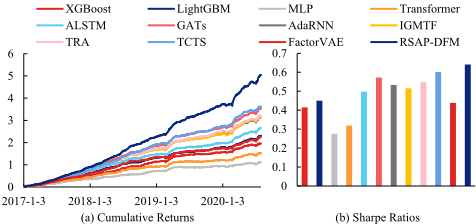
We adopt the most common investment strategy named Long/Short Strategy to demonstrate our profitability. We rank prediction scores from highest to lowest and divide them into five groups, where the first group is assigned to long positions and the fifth group to short positions, with adjustments made each trading day. Our model significantly outperforms the baselines in terms of average cumulative long-short return and Sharpe ratio across three datasets in Figure 2 (Q5).
6 Conclusion
In this paper, we present RSAP-DFM, a novel adaptive dual dynamic factor model with regime-shifting and bilevel optimization, which can adaptively extract macroeconomic information into the dynamic factor model in a regime-shifting manner to improve model performance. The explicit macroeconomic information mapping method improves the interpretability of our model and provides a new perspective for future research. Our model effectively exploits the hidden features of stock time-series data with the relationship reconstruction between factor construction, factor return and factor exposure. We have also verified the effectiveness of our model in the real stock market. In the future, we plan to further verify the universality of our proposed dual regime shifting method and apply it to other methods.
Acknowledgments
Rujun Jiang is partly supported by NSFC 12171100 and Natural Science Foundation of Shanghai 22ZR1405100.
@inproceedings{ijcai2024p676,
  title     = {RSAP-DFM: Regime-Shifting Adaptive Posterior Dynamic Factor Model for Stock Returns Prediction},
  author    = {Xiang, Quanzhou and Chen, Zhan and Sun, Qi and Jiang, Rujun},
  booktitle = {Proceedings of the Thirty-Third International Joint Conference on
               Artificial Intelligence, {IJCAI-24}},
  publisher = {International Joint Conferences on Artificial Intelligence Organization},
  editor    = {Kate Larson},
  pages     = {6116--6124},
  year      = {2024},
  month     = {8},
  note      = {Main Track},
  doi       = {10.24963/ijcai.2024/676},
  url       = {https://doi.org/10.24963/ijcai.2024/676},
}
TY - CPAPER TI - RSAP-DFM: Regime-Shifting Adaptive Posterior Dynamic Factor Model for Stock Returns Prediction AU - Xiang, Quanzhou AU - Chen, Zhan AU - Sun, Qi AU - Jiang, Rujun T2 - Proceedings of the Thirty-Third International Joint Conference on Artificial Intelligence, IJCAI-24 PB - International Joint Conferences on Artificial Intelligence Organization PY - 2024 SP - 6116 EP - 6124 DO - 10.24963/ijcai.2024/676 UR - https://doi.org/10.24963/ijcai.2024/676 ER -Copied
Machine-readable versions of this paper, for tools and AI agents:





