
Domain Adaptive and Fine-grained Anomaly Detection for Single-cell Sequencing Data and Beyond
Proceedings of the Thirty-Third International Joint Conference on Artificial Intelligence. Main Track. Pages 6125-6133.
https://doi.org/10.24963/ijcai.2024/677
Keywords
- Data Mining: DM: Anomaly/outlier detection
- Machine Learning: ML: Applications
- Multidisciplinary Topics and Applications: MTA: Bioinformatics
Abstract
Fined-grained anomalous cell detection from affected tissues is critical for clinical diagnosis and pathological research. Single-cell sequencing data provide unprecedented opportunities for this task. However, current anomaly detection methods struggle to handle domain shifts prevalent in multi-sample and multi-domain single-cell sequencing data, leading to suboptimal performance. Moreover, these methods fall short of distinguishing anomalous cells into pathologically distinct subtypes. In response, we propose ACSleuth, a novel, reconstruction deviation-guided generative framework that integrates the detection, domain adaptation, and fine-grained annotating of anomalous cells into a methodologically cohesive workflow. Notably, we present the first theoretical analysis of using reconstruction deviations output by generative models for anomaly detection in lieu of domain shifts. This analysis informs us to develop a novel and superior maximum mean discrepancy-based anomaly scorer in ACSleuth. Extensive benchmarks over various single-cell data and other types of tabular data demonstrate ACSleuth's superiority over the state-of-the-art methods in identifying and subtyping anomalies in multi-sample and multi-domain contexts. Our code is available at https://github.com/Catchxu/ACsleuth.
- [Aevermann et al., 2018] Brian D. Aevermann, Mark Novotny, Trygve E Bakken, Jeremy A. Miller, Alexan- der D. Diehl, David Osumi-Sutherland, Roger S. Lasken, Ed S. Lein, and Richard H. Scheuermann. Cell type dis- covery using single-cell transcriptomics: implications for ontological representation. Human Molecular Genetics, 27:R40 -R47, 2018.
- [Alquicira-Hernandez et al., 2019] Jose Alquicira- Hernandez, Anuja Sathe, Hanlee P Ji, Quan Nguyen, and Joseph E Powell. scpred: accurate supervised method for cell-type classification from single-cell rna-seq data. Genome Biology, 20(1):1-17, 2019.
- [Brbić et al., 2020] Maria Brbić, Marinka Zitnik, Sheng Wang, Angela O Pisco, Russ B Altman, Spyros Darma- nis, and Jure Leskovec. Mars: discovering novel cell types across heterogeneous single-cell experiments. Na- ture Methods, 17(12):1200-1206, 2020.
- [Cai et al., 2022] Jinyu Cai, Jicong Fan, Wenzhong Guo, Shiping Wang, Yunhe Zhang, and Zhao Zhang. Efficient deep embedded subspace clustering. In Proceedings of the IEEE/CVF Conference on Computer Vision and Pat- tern Recognition, pages 1-10, 2022.
- [Chen et al., 2020] Liang Chen, Yuyao Zhai, Qiuyan He, Weinan Wang, and Minghua Deng. Integrating deep su- pervised, self-supervised and unsupervised learning for single-cell rna-seq clustering and annotation. Genes, 11(7):792, 2020.
- [Cheng et al., 2023] Yue Cheng, Yanchi Su, Zhuohan Yu, Yanchun Liang, Ka-Chun Wong, and Xiangtao Li. Unsu- pervised deep embedded fusion representation of single- cell transcriptomics. In Proceedings of the AAAI Confer- ence on Artificial Intelligence, volume 37, pages 5036- 5044, 2023.
- [De Kanter et al., 2019] Jurrian K De Kanter, Philip Lijn- zaad, Tito Candelli, Thanasis Margaritis, and Frank CP Holstege. Chetah: a selective, hierarchical cell type iden- tification method for single-cell rna sequencing. Nucleic Acids Research, 47(16):e95-e95, 2019.
- [Fernández-Saúco et al., 2019] Igr Alexánder Fernández- Saúco, Niusvel Acosta-Mendoza, Andrés Gago-Alonso, and Edel Bartolo García-Reyes. Computing anomaly score threshold with autoencoders pipeline. In Progress in Pattern Recognition, Image Analysis, Computer Vision, and Applications: 23rd Iberoamerican Congress, CIARP 2018, Madrid, Spain, November 19-22, 2018, Proceedings 23, pages 237-244. Springer, 2019.
- [Gong et al., 2019] Dong Gong, Lingqiao Liu, Vuong Le, Budhaditya Saha, Moussa Reda Mansour, Svetha Venkatesh, and Anton van den Hengel. Memorizing nor- mality to detect anomaly: Memory-augmented deep au- toencoder for unsupervised anomaly detection. In Pro- ceedings of the IEEE/CVF International Conference on Computer Vision, pages 1705-1714, 2019.
- [Gretton et al., 2012] Arthur Gretton, Karsten M Borgwardt, Malte J Rasch, Bernhard Schölkopf, and Alexander Smola. A kernel two-sample test. The Journal of Machine Learning Research, 13(1):723-773, 2012.
- [Gulrajani et al., 2017] Ishaan Gulrajani, Faruk Ahmed, Martin Arjovsky, Vincent Dumoulin, and Aaron C Courville. Improved training of wasserstein gans. Ad- vances in Neural Information Processing Systems, 30, 2017.
- [Haghverdi et al., 2018] Laleh Haghverdi, Aaron TL Lun, Michael D Morgan, and John C Marioni. Batch ef- fects in single-cell rna-sequencing data are corrected by matching mutual nearest neighbors. Nature Biotechnol- ogy, 36(5):421-427, 2018.
- [Hao et al., 2023] Yuhan Hao, Tim Stuart, Madeline H Kowalski, Saket Choudhary, Paul Hoffman, Austin Hart- man, Avi Srivastava, Gesmira Molla, Shaista Madad, Car- los Fernandez-Granda, et al. Dictionary learning for inte- grative, multimodal and scalable single-cell analysis. Na- ture Biotechnology, pages 1-12, 2023.
- [Holmström et al., 2022] Susanna Holmström, Sampsa Hau- taniemi, and Antti Häkkinen. POIBM: batch correction of heterogeneous RNA-seq datasets through latent sample matching. Bioinformatics, 38(9):2474-2480, 02 2022.
- [Hornung et al., 2016] Roman Hornung, Anne-Laure Boulesteix, and David Causeur. Combining location-and- scale batch effect adjustment with data cleaning by latent factor adjustment. BMC Bioinformatics, 17:1-19, 2016.
- [Kiselev et al., 2018] Vladimir Yu Kiselev, Andrew Yiu, and Martin Hemberg. scmap: projection of single-cell rna- seq data across data sets. Nature Methods, 15(5):359-362, 2018.
- [Li et al., 2020] Xiangjie Li, Kui Wang, Yafei Lyu, Huize Pan, Jingxiao Zhang, Dwight Stambolian, Katalin Susz- tak, Muredach P Reilly, Gang Hu, and Mingyao Li. Deep learning enables accurate clustering with batch effect re- moval in single-cell rna-seq analysis. Nature Communica- tions, 11(1):2338, 2020.
- [Li et al., 2022] Ziyi Li, Yizhuo Wang, Irene Ganan-Gomez, Simona Colla, and Kim-Anh Do. A machine learning- based method for automatically identifying novel cells in annotating single-cell rna-seq data. Bioinformatics, 38(21):4885-4892, 2022.
- [Liu et al., 2021] Boyang Liu, Ding Wang, Kaixiang Lin, Pang-Ning Tan, and Jiayu Zhou. Rca: A deep collabora- tive autoencoder approach for anomaly detection. In Pro- ceedings of the Thirtieth International Joint Conference on Artificial Intelligence (IJCAI-21), 2021. IJCAI
- [Macnair and Robinson, 2023] Will Macnair and Mark Robinson. Sampleqc: robust multivariate, multi-cell type, multi-sample quality control for single-cell data. Genome Biology, 24(1):23, 2023.
- [Petegrosso et al., 2020] Raphael Petegrosso, Zhuliu Li, and Rui Kuang. Machine learning and statistical methods for clustering single-cell rna-sequencing data. Briefings in Bioinformatics, 21(4):1209-1223, 2020.
- [Pouyan et al., 2016] Maziyar Baran Pouyan, Vasu Jindal, Javad Birjandtalab, and Mehrdad Nourani. Single and multi-subject clustering of flow cytometry data for cell- type identification and anomaly detection. BMC Medical Genomics, 9(2):99-110, 2016.
- [Qiu et al., 2021] Chen Qiu, Timo Pfrommer, Marius Kloft, Stephan Mandt, and Maja Rudolph. Neural transforma- tion learning for deep anomaly detection beyond images. In International Conference on Machine Learning, pages 8703-8714. PMLR, 2021.
- [Ruff et al., 2018] Lukas Ruff, Robert Vandermeulen, Nico Goernitz, Lucas Deecke, Shoaib Ahmed Siddiqui, Alexan- der Binder, Emmanuel Müller, and Marius Kloft. Deep one-class classification. In International conference on Machine Learning, pages 4393-4402. PMLR, 2018.
- [Schlegl et al., 2017] Thomas Schlegl, Philipp Seeböck, Se- bastian M Waldstein, Ursula Schmidt-Erfurth, and Georg Langs. Unsupervised anomaly detection with generative adversarial networks to guide marker discovery. In Inter- national Conference on Information Processing in Medi- cal Imaging, pages 146-157. Springer, 2017.
- [Shenkar and Wolf, 2021] Tom Shenkar and Lior Wolf. Anomaly detection for tabular data with internal con- trastive learning. In International Conference on Learning Representations, 2021.
- [Traag et al., 2019] Vincent A Traag, Ludo Waltman, and Nees Jan Van Eck. From louvain to leiden: guaran- teeing well-connected communities. Scientific Reports, 9(1):5233, 2019.
- [Tu et al., 2021] Wenxuan Tu, Sihang Zhou, Xinwang Liu, Xifeng Guo, Zhiping Cai, En Zhu, and Jieren Cheng. Deep fusion clustering network. In Proceedings of the AAAI Conference on Artificial Intelligence, volume 35, pages 9978-9987, 2021.
- [Xie et al., 2016] Junyuan Xie, Ross Girshick, and Ali Farhadi. Unsupervised deep embedding for clustering analysis. In International Conference on Machine Learn- ing, pages 478-487. PMLR, 2016.
- [Xu et al., 2023] Hongzuo Xu, Yijie Wang, Juhui Wei, Songlei Jian, Yizhou Li, and Ning Liu. Fascinating su- pervisory signals and where to find them: Deep anomaly detection with scale learning. In Proceedings of the 40th International Conference on Machine Learning, ICML'23. JMLR.org, 2023.
- [Yang et al., 2020] Yuchen Yang, Gang Li, Huijun Qian, Kirk C Wilhelmsen, Yin Shen, and Yun Li. SMNN: batch effect correction for single-cell RNA-seq data via supervised mutual nearest neighbor detection. Briefings in Bioinformatics, 22(3):bbaa097, 06 2020.
- [You et al., 2018] Jiaxuan You, Rex Ying, Xiang Ren, William Hamilton, and Jure Leskovec. GraphRNN: Gen- erating realistic graphs with deep auto-regressive models. In Jennifer Dy and Andreas Krause, editors, Proceedings of the 35th International Conference on Machine Learn- ing, volume 80 of Proceedings of Machine Learning Re- search, pages 5708-5717. PMLR, 10-15 Jul 2018.
- [Yu et al., 2022] Zhuohan Yu, Yifu Lu, Yunhe Wang, Fan Tang, Ka-Chun Wong, and Xiangtao Li. Zinb-based graph embedding autoencoder for single-cell rna-seq interpreta- tions. In Proceedings of the AAAI conference on Artificial Intelligence, volume 36, pages 4671-4679, 2022.
- [Yu et al., 2023] Xiaokang Yu, Xinyi Xu, Jingxiao Zhang, and Xiangjie Li. Batch alignment of single-cell transcrip- tomics data using deep metric learning. Nature Communi- cations, 14(1):960, 2023.
- [Zenati et al., 2018] Houssam Zenati, Manon Romain, Chuan-Sheng Foo, Bruno Lecouat, and Vijay Chan- drasekhar. Adversarially learned anomaly detection. In 2018 IEEE International Conference on Data Mining (ICDM), pages 727-736. IEEE, 2018.
- [Zhai et al., 2023a] Yuyao Zhai, Liang Chen, and Min Deng. Realistic cell type annotation and discovery for single-cell rna-seq data. In International Joint Conference on Artifi- cial Intelligence, 2023. IJCAI
- [Zhai et al., 2023b] Yuyao Zhai, Liang Chen, and Min Deng. scgad: a new task and end-to-end framework for general- ized cell type annotation and discovery. Briefings in Bioin- formatics, 2023.
- [Zhao et al., 2020] Sicheng Zhao, Bo Li, Pengfei Xu, and Kurt Keutzer. Multi-source domain adaptation in the deep learning era: A systematic survey. arXiv preprint arXiv:2002.12169, 2020.
- [Zhu et al., 2017] Jun-Yan Zhu, Taesung Park, Phillip Isola, and Alexei A Efros. Unpaired image-to-image translation using cycle-consistent adversarial networks. In Proceed- ings of the IEEE international conference on computer vi- sion, pages 2223-2232, 2017.
References were extracted automatically from the PDF and may contain errors.
Full text extracted automatically from the PDF; figures, tables and equations may differ. The PDF is the version of record.
1 Introduction
The detection and differentiation of anomalous cells (ACs) from affected tissues, which we refer to as Fine-grained Anomalous Cell Detection (FACD), is critical for investigating the pathological heterogeneity of diseases, significantly contributing to the clinical diagnostics, biomedical research, and the development of targeted therapies [Aevermann et al., 2018]. Single-cell (SC) sequencing data, referred to as SC data for brevity, such as single-cell RNAsequencing (scRNA-seq) and single-cell ATAC-sequencing (scATAC-seq) data, provide unprecedented opportunities for FACD analysis from distinct perspectives [Zhai et al., 2023b; Pouyan et al., 2016; Macnair and Robinson, 2023]. For example, a typical scRNA-seq dataset is organized as a tabular matrix X ∈ RN×G, where Xi,j represents the expression read counts of the j-th gene in the i-th cell. This dataset characterizes gene expression levels within single cells, thus facilitating the FACD.
∗Corresponding author.
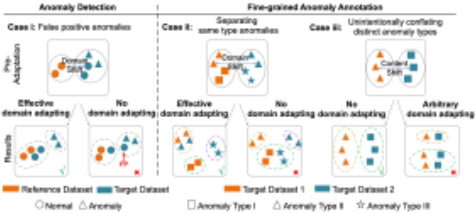
The FACD workflow is a two-step process: the detection of anomalous cells as a whole followed by their fine-grained annotating. The detection step aims to identify ACs in target datasets by comparing them to "normality" defined by a reference dataset containing normal cells only. The subsequent fine-grained annotating step involves clustering the detected ACs into different groups, each representing a biologically distinct subtype. However, de novo FACD using SC data presents a significant challenge, especially in multi-sample contexts, primarily due to various types of cross-sample Domain Shifts (DS), i.e., batch effects, stemming from nonbiological variations in data types, sequencing technologies, and experimental conditions [Holmstr¨om et al., 2022; Zhao et al., 2020]. These DS often intermingle with content shifts, which originate from biological variations and represent true signals crucial for AC detection, leading to several types of errors in FACD analysis as shown in Figure 1: i) False positive AC. Normal cells in the target dataset can be erroneously labeled as anomalous due to the DS relative to the reference dataset; ii) Separating same type ACs. ACs of the same type across different target datasets may appear very different due to DS, leading to their misclassification as distinct types; iii) Unintentionally conflating distinct AC types. Efforts to mitigate DS can inadvertently diminish content shifts critical for distinguishing between sample-specific AC types, leading to their merging as one type.
Anomaly detection (AD) methods generally involve assigning an anomaly score to each target instance, followed by setting a threshold for anomaly determination as per the user's tolerance for false positives [Fern´andez-Sa´uco et al., 2019]. This strategy is followed by approaches tailored for AC detection, including uncertainty-based and generative methods [Li et al., 2022]. The former methods, exemplified by scmap [Kiselev et al., 2018], assign anomaly scores based on cluster assignment uncertainty, while the latter methods, such as CAMLU [Li et al., 2022], attempt to reconstruct cells and output reconstruction deviations as anomaly scores. These methods either are susceptible to DS or fail to provide fine-grained annotation, i.e., labeling all ACs as "unassigned" [Petegrosso et al., 2020; Zhai et al., 2023a]. To mitigate DS, domain adaptation methods like MNN [Haghverdi et al., 2018] are often used before AC detection, yet with limited effectiveness owing to their sensitivity to ACs [Yang et al., 2020]. For fine-grained AC annotation, researchers often resort to clustering methods, which are not specifically oriented towards this purpose and thus struggle to capture subtle differences among ACs. Particularly, this separation of fine-grained AC annotation as an independent clustering task can disrupt the methodological coherence of the workflow, leading to the overall underperformance of FACD [Chen et al., 2020]. MARS [Brbi´c et al., 2020] and scGAD (also known as scPOT) [Zhai et al., 2023b; Zhai et al., 2023a] represent the only two available methods that integrate AC detection and fine-grained annotation. Yet, MARS, lacking a domain adaptation mechanism, exhibits compromised performance in lieu of DS [Zhai et al., 2023a]. scGAD falls short of handling multiple target datasets due to its reliance on MNN for domain adaptation, which is effective primarily in single target dataset scenarios [Yu et al., 2023].
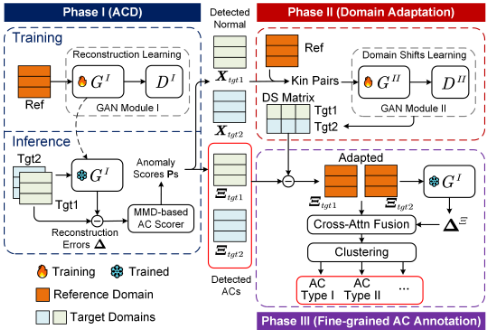
Inspired by the versatility of generative adversarial networks (GAN) in AD [Zenati et al., 2018] and domain adaptation-related style-transfer [Zhu et al., 2017] tasks, we propose ACSleuth, an innovative GAN-based framework designed to integrate AC detection, domain adaptation, and finegrained annotation into a cohesive workflow, as shown in Figure 2. For AC detection (Phase I), a specialized GAN module (module I) is trained on the reference dataset and then applied to target datasets to discriminate between normal and anomalous cells based on their anomaly scores. Module I differs from existing GAN-based AD methods in incorporating a memory block to reduce mode collapse risk [Gong et al., 2019] and featuring a novel maximum mean discrepancy (MMD)-based anomaly scorer. This scorer translates cell reconstruction deviations into anomaly scores, whose efficacy in facilitating AD is theoretically proved in Theorem 3.3. In the subsequent Phase II, ACSleuth utilizes a second GAN module (module II) to pinpoint "kin" normal cell pairs between the reference and target datasets, from which DS inherent in each target dataset can be learned as a matrix for domain adaptation. This approach prevails over existing domain adaptation methods for SC data, e.g., MNN, in preserving the data's original scale and semantic integrity, simultaneously adapting multiple datasets, and being resilient against complications caused by sample-specific AC types. Finally, ACSleuth performs a self-paced deep clustering (Phase III) on fusions of embeddings and reconstruction deviations of domain-adapted ACs, obtaining iteratively enhanced finegrained annotations. Overall, our main contributions are:
- We propose an innovative framework for FACD in SC data, which integrates AC detection, domain adaptation, and fine-grained annotation into a cohesive workflow.
- We provide the first theoretical analysis of using reconstruction deviations for AD in lieu of DS (Theorem 3.13.3). This analysis also informs us to develop a novel and effective MMD-based anomaly scorer.
- We introduce a novel domain adaptation method in multisample and multi-domain contexts.
- We innovatively fuse reconstruction deviations with domain-adapted cell embeddings as clustering inputs for enhanced AC fine-grained annotations.
- ACSleuth has been rigorously benchmarked in various experimental scenarios regarding DS types, target sample quantity, and sample-specific AC types. ACSleuth consistently outperforms the state-of-the-art (SOTA) methods across all scenarios. Furthermore, ACSleuth is also applicable to other types of tabular data.
2 RelatedWorks
2.1 Anomalous Single Cell Detection
AD methods tailored for SC data, such as scmap, CHETAH [De Kanter et al., 2019], and scPred [Alquicira-Hernandez et al., 2019], typically involve cell classification or clustering, labeling cells with uncertain assignments as ACs. These methods suffer from high false positive rates, as the assignment uncertainty might stem from similarities among normal cell types rather than the presence of ACs [Li et al., 2022]. To circumvent this issue, CAMLU directly discriminates ACs from normal cells using informative genes selected based on their reconstruction deviations. Moreover, AD methods for general types of tabular data, categorized as generative, one-class classification, and contrastive approaches, are also adaptable to SC data. Generative methods like RCA [Liu et al., 2021] and ALAD [Zenati et al., 2018] detect anomalies based on instance reconstruction deviations, using collaborative autoencoders (AE) and a GAN model, respectively. DeepSVDD [Ruff et al., 2018], a one-class classification method, learns a finite-sized "normality" hypersphere in a latent space and labels outside instances as anomalies. Contrastive methods ICL [Shenkar and Wolf, 2021] and NeuTraL [Qiu et al., 2021] generate different views for contrastive learning using mutual information-based mappings and learnable neural transformations, respectively, with anomalies identified as those with large contrastive losses. Lastly, a recent study SLAD [Xu et al., 2023] introduces scale learning to identify anomalies as those unfitted to the scale distribution of inlier representations. A common limitation across these methods is their inability to account for DS between reference and target datasets and to further categorize ACs into fine-grained subtypes.
2.2 Fine-grained Anomalous Cell Annotation
As a task following AC detection, fine-grained AC annotation in SC data is often approached as an independent clustering task using general-purpose clustering methods like Leiden [Traag et al., 2019], EDESC [Cai et al., 2022], and DFCN [Tu et al., 2021], or methods specifically designed for SC data, such as scTAG [Yu et al., 2022], Seurat V5 [Hao et al., 2023], and scDEFR [Cheng et al., 2023]. EDESC, DFCN, scTAG, and scDEFR, which are based on DEC [Xie et al., 2016], adopt a schema of joint optimization of instance representation learning and discriminatively boosted clustering, yet differ in their specific approaches for learning representations and calculating cluster soft assignments. Seurat V5, on the other hand, first builds a KNN graph based on cell-cell similarities and then applies community detection clustering using the Louvain algorithm. A significant challenge with these methods is their dependency on the accuracy of the AC detection in the first place. Treating AC detection and fine-grained annotation as separate tasks can disrupt the methodological coherence of the FACD workflow, potentially compromising its overall performance. To tackle this issue, scGAD and MARS integrate both tasks into a unified process. MARS, for example, learns a latent space where cells positioned near landmarks of distinct anomaly subtypes are assigned corresponding anomaly annotations. While these methods have shown promising results when all ACs are from the same domain, their efficacy can be undermined in the presence of DS. To tackle this, scGAD employs the MNN to adapt DS before fine-grained annotating. However, MNN's limitation to a single reference and target dataset makes scGAD less suitable for multi-sample and multi-domain contexts.
3 Methods
ACSleuth's workflow (Figure 2) comprises three phases corresponding to AC detection (Phase I), domain adaptation (Phase II), and fine-grained annotation (Phase III).
3.1 Anomalous Cell Detection (Phase I)
In Phase I, a GAN model (module I) is initially trained to reconstruct normal cells in the reference dataset, and then applied to target datasets. Anomaly scores, derived from reconstruction deviations, are then used to identify ACs. Let xi ∈ RNgene denote the gene expression vector of a cell i ∈ Sk , Sk denote the single-cell set in domain k, Ngene the number of genes. Then we have the following assumption [Hornung et al., 2016]:
Assumption 3.1.
where x∗i denotes cell i's biological content, bk the nonbiological content specific to domain k, ϵi ∼ N(0,σ2 i ) a random Gaussian noise.
GANModel Training. Module I comprises a generator GI and a discriminator DI . The generator itself is composed of three components: an MLP-based encoder (GIE : RNgene → Rp ), an MLP-based decoder (GID : Rp → RNgene ), and a queue-based memory block (Q ∈ RNmem×p ), where p is the cell embedding dimension, Nmem is the memory block size. The embedding of any cell i can be expressed as:
The memory block provides an attention-based means to reconstruct zi as ˜ zi:
where τ is a temperature hyperparameter. During the training, Q is dynamically updated by enqueuing the most recent ˜ z and dequeuing the oldest ones to maintain a balance between preserving learned features and adapting to new data, thus reducing the risk of mode collapse. GID reconstructs cell i from ˜ zi as ̂xi:
The discriminator DI comprises an encoder, similar to GIE , and an MLP-based classifier. DI is trained to distinguish between x and ̂x . The loss functions for the generator (LGI ) and discriminator (LDI ) are defined as:
where ˜x = ϵ̂x+(1-ϵ)x, ϵ ∈ (0, 1). Here, Lrec represents the reconstruction loss, Ladv the adversarial loss, and α, β, λ ≥ 0 the weights of three loss terms. A gradient penalty term applied to ˜x ensures the Lipschitz continuity of the discriminator [Gulrajani et al., 2017].
MMD-based anomalous cell scorer. Let xi denote a normal cell, and ξj an anomalous cell, δx i := xi - ̂xi, δξ j := ξj - ̂ ξj denote their reconstruction deviations. The scorer aims to utilize the MMD metric to translate δs into anomaly scores that can represent the maximized discrepancy between
δx and δξ in the Reproduced Hilbert Kernel Space (RHKS), thus more effective facilitating the differentiation between normal and anomalous cells. Specifically, given the distributions δx i ∼ p, δξ j ∼ q, the MMD metric is calculated as [Gretton et al., 2012]:
where k is a positive definite kernel function, m and n denote the actual yet unknown numbers of inliers and anomalies in the target dataset. An AC scorer function can be trained by minimizing the loss function:
where δxm = {δx i |δx i ∈ RNgene , i = 1, 2, · · · ,m]}, δξn = {δξ j |δξ j ∈ RNgene , j = 1, 2, · · · , n} denote the sets of reconstruction deviations of inliers and anomalies, respectively.
As shown in the theoretical analysis in section 3.4, given a linear kernel k, the loss function in equation (8) can be reformulated as:
where pi := fp(δi) ∈ (0, 1) is instance i's anomaly score, and fp is a trainable MLP-based function. γc(pi, pj) : (0, 1) × (0, 1) → R defines a mapping function as:
Here, ˜n = ∑m+n i pi and ˜m= (m+n)-˜n are used in place of the unknown m and n. During the training, p, ˜n and ˜m are iteratively updated until convergence. Upon training completion, anomalies can be identified based on their anomaly scores p. Particularly, the property of Lp's bounded variation across domains endows our AC scorer's robustness against DS, as formalized in section 3.4.
3.2 Multi-sample Domain Adaptation (Phase II)
This phase aims to adapt non-biological DS among ACs to expose their biological differences for fine-grained cell annotating. Initially, ACs detected in Phase I are excluded from the datasets to eliminate their interference. The DS of Ntarget datasets relative to the reference dataset are then learned as a matrix S ∈ RNtarget×p through the generator (GII ) of the second GAN module (module II), which has an encoder (GII E ) and a decoder (GII D ) similar to those in module I. A target cell x is adapted to the reference domain as follows:
where b ∈ {0, 1}Ntarget denotes the cell's one-hot encoded domain-identity vector, ̂x represents the cell post-domain adaptation. The discriminator of module II, DII , is trained to discriminate ̂x as either from the reference domain or not. The loss functions of GII and DII are:
where ˜x = ϵ̂x + (1 - ϵ)x+, ϵ ∈ (0, 1). x+ is a "kin" cell from the reference dataset that is most similar to x in their biological contents. For each target cell xi, its "kin" reference cell x+i is identified as:
where Xref denotes the reference dataset, K is a Gaussian kernel function as in [You et al., 2018].
3.3 Fine-grained Anomalous Cell Annotation (Phase III)
In Phase III, we first obtain module I-generated reconstruction deviations (denoted as ∆ ∈ RNan×Ngene ) of ACs postdomain adaptation (denoted as Ξ ∈ RNan×Ngene ), where Nan is the number of detected ACs:
Next, AC embeddings and reconstruction deviations are fused using a cross-attention fusion block:
where W Q,W K ,W V ∈ RNgene×d , and W Ψ ∈ Rd×d are trainable weight matrices. The resulting Z∗ contains more expressive AC representations, on which a self-paced clustering [Li et al., 2020] is conducted to cluster ACs into finegrained groups. Cell i's soft assignment score to group j is calculated using a Cauchy kernel:
where ν denotes the degree of freedom. µj is the centroid of group j, initialized by K-means clustering on Z∗ . The clustering loss function, a KL-divergence LC, is calculated on q and an auxiliary target distribution p, defined as:
LC overweights ACs with high-confident cluster assignments in updating the parameters of the cross-attention fusion block and the cluster centroids. Consequently, harder-to-cluster AC embeddings in Z∗ are incrementally transformed into easier ones in iterations, which continues until the changes in anomalies' hard assignments fall below a threshold or a predetermined number of iterations is reached. The number of AC clusters is either known as a priori or automatically inferred (see Supplementary 2).
3.4 Theoretical Analysis
In this section, we provide a theoretical analysis on the existence of γc(pi, pj) in equation (9) and the variation boundary of Lp across domains. Following the definitions and notations in section 3.1, we have the following theorem (detailed proof in Supplementary 1.1) :
Theorem 3.1. Let m and n denote the actual numbers of inliers and anomalies in the target dataset, respectively. Let δi ∈ δxm ∪ δξn , as defined in equation (8). Define si := fs(δi) ∈ {0, 1}. The equation (8) can be rewritten as:
where
If si = 1, instance i is annotated as anomalous, or normal otherwise.
To ensure a smooth backpropagation of the loss gradients, fs is replaced with a continuous function fp : Rp → (0, 1), and γ(si, sj) : {0, 1} × {0, 1} → R with a continuous mapping function γc(pi, pj) : (0, 1) × (0, 1) → R, where pi := fp(δi) is the anomaly score for instance i. Theorem 3.2 guarantees the existence of γc (proof in Supplementary 1.2):
Theorem 3.2. For any discrete mapping function γ(si, sj) : {0, 1} × {0, 1} → R, there exists a continuous function γc that satisfies:
- γc is analytic everywhere within its domain.
For γ in Equation (21), a potential γc is specified in Equation (10).
Theorem 3.3 addresses the bounded variation of Lp across domains (proof in Supplementary 1.3).
Theorem 3.3. Given Assumption 3.1 and a linear kernelinduced MMD, the reconstruction deviations of m inliers (δxm) and n anomalies (δξn ) in any domain satisfy:
| Domain Shift Type | Ref Dataset | Target Dataset (Anomaly Type) | Experiment ID | |
|---|---|---|---|---|
| Experimental | a-TME-0 | a-TME-1 (Tumor) | 1 | |
| a-Brain-0 | a-Brain-1 (Cerebellar granule) | 2 | ||
| a-Brain-2 (Microglia) | 3 | |||
| a-Brain-1 (Cerebellar granule) a-Brain-2 (Microglia) | 4 | |||
| r-PBMC-0 | r-PBMC-1 (B cell) | 5 | ||
| r-PBMC-2 (Natural killer) | 6 | |||
| r-PBMC-1 (B cell) r-PBMC-2 (Natural killer) | 7 | |||
| Condition (Type I) | r-Cancer-0 | r-Cancer-1 (Epithelial, Immune tumor) | 8 | |
| r-Cancer-2 (Epithelial, Stromal tumor) | 9 | |||
| r-Cancer-1 (Epithelial, Immune tumor) r-Cancer-2 (Epithelial, Stromal tumor) | 10 | |||
| r-CSCC-0 | r-CSCC-1 ( | Basal, Cycling, Keratinocyte tumor | ) 11 | |
| r-CSCC-2 ( | Basal, Cyclng, Keratinocyte tumor | ) 12 | ||
| r-CSCC-1 ( | Basal, Cycling, Keratinocyte tumor | ) | ||
| r-CSCC-2 ( | Basal, Cycling, Keratinocyte tumor | 13 ) | ||
| r-CSCC-3 ( | Basal, Cycling, Keratinocyte tumor | ) | ||
| Sequencing Technology (Type II) | r-Pan-0 | r-Pan-1 (Delta, Acinar cell) | 14 | |
| r-Pan-2 (Delta, Acinar cell) | 15 | |||
| r-Pan-1 (Delta, Acinar cell) r-Pan-2 (Delta, Acinar cell) | 16 | |||
| Data Type (Type III) | r-PBMC-0 | a-TME-1 (Tumor) | 17 | |
| Protocol Type (Type IV) | KDDRev-0 | KDDRev-1 (DOS,PROBING) KDDRev-2 (DOS,R2L,U2R,PROBING) | 18 | |
where C = mn ≥ 1, α, β are constants, ε denotes domainassociated variation of Lp. Pδx∗ and Pδξ∗ denote the domain-shift-free distributions of reconstruction deviations of inliers and anomalies, respectively.
4 Experiments
4.1 Experimental Settings
Datasets. scRNA-seq datasets used in this study include three 10x Peripheral Blood Mononuclear Cell (PBMC) datasets, three 10x lung cancer (Cancer) datasets, four 10x Cutaneous Squamous Cell Carcinoma (CSCC) datasets, and three Pancreatic (Pan) datasets sequenced with different technologies (InDrop, Smart-Seq2, and CEL-Seq2). scATAC-seq datasets include two 10x Human Tumor Microenvironment (TME) datasets and three 10x Mouse Brain (Brain) datasets. We use the KDDRev dataset for fine-grained cyber-intrusion detection. See Supplementary Table 1 for more details.
Experimental Scenarios. Experiments are carefully designed for scenarios regarding DS types, target dataset quantity, and dataset-specific AC types (table 1). For SC data (i.e., experiments 1-17), DS is categorized into three types based on their origins: variations in experimental conditions (Type I), sequencing technologies (Type II), and data types (Type III). For cyber-intrusion detection data (i.e., experiment 18), DS stems from variations in connection protocol types (Type IV). Experiments 1-3, 5-6, 8-9, 11-12, 14-15, and 17 focus on a single target dataset. In cases involving more than one target dataset, experiments 13 and 16 feature target datasets with identical AC types, experiments 10 and 18 include both shared and dataset-specific anomaly types, while experiments 4 and 7 are set up with exclusively dataset-specific AC types.
| Method | Experiment ID | ||||||||||||||||
|---|---|---|---|---|---|---|---|---|---|---|---|---|---|---|---|---|---|
| 1 | 2 | 3 | 4 | 5 | 6 | 7 | 8 | 9 | 10 | 11 | 12 | 13 | 14 | 15 | 16 | 17 | |
| SLAD | .52(.02) | .70(.00) | .63(.01) | .58(.01) | .77(.01) | .88(.01) | .82(.01) | .93(.00) | .92(.01) | .93(.01) | .59(.01) | .68(.02) | .60(.02) | .78(.02) | .81(.04) | .62(.01) | .49(.03) |
| ICL | .78(.06) | .70(.01) | .54(.01) | .50(.01) | .65(.03) | .72(.04) | .68(.03) | .93(.01) | .93(.01) | .93(.01) | .37(.01) | .33(.01) | .14(.02) | .77(.02) | .84(.01) | .62(.01) | .50(.05) |
| NeuTraL | .49(.02) | .67(.01) | .70(.02) | .56(.01) | .71(.01) | .74(.02) | .71(.01) | .96(.01) | .95(.03) | .95(.01) | .25(.05) | .20(.04) | .19(.04) | .53(.04) | .47(.06) | .51(.05) | .59(.07) |
| RCA | .37(.04) | .69(.02) | .77(.03) | .69(.01) | .72(.01) | .79(.01) | .77(.02) | .84(.03) | .75(.05) | .81(.04) | .33(.02) | .33(.03) | .21(.01) | .66(.04) | .72(.02) | .81(.02) | .37(.04) |
| CAMLU | .66(.12) | .69(.02) | .79(.09) | .55(.02) | .70(.05) | .82(.04) | .71(.05) | .90(.00) | .85(.13) | .88(.01) | .80(.02) | .79(.00) | .78(.01) | .55(.06) | .62(.03) | .53(.05) | .58(.00) |
| ALAD | .36(.18) | .40(.09) | .46(.18) | .45(.08) | .42(.05) | .33(.08) | .33(.02) | .22(.07) | .16(.08) | .20(.08) | .53(.09) | .48(.13) | .51(.13) | .33(.04) | .41(.05) | .38(.04) | .60(.07) |
| DeepSVDD | .57(.02) | .55(.01) | .61(.02) | .51(.01) | .62(.02) | .42(.02) | .48(.02) | .44(.14) | .64(.04) | .56(.08) | .47(.03) | .53(.02) | .50(.02) | .62(.01) | .43(.06) | .53(.03) | .62(.03) |
| scmap | .50(.00) | .59(.00) | .56(.00) | .57(.00) | .70(.00) | .83(.00) | .76(.00) | .53(.00) | .47(.00) | .50(.00) | .57(.00) | .65(.00) | .67(.00) | .77(.00) | .54(.00) | .78(.00) | .50(.00) |
| ACSleuth | .83(.02) | .74(.02) | .72(.03) | .71(.01) | .78(.03) | .85(.00) | .83(.02) | .97(.01) | .95(.02) | .96(.01) | .81(.02) | .70(.02) | .69(.03) | .85(.02) | .93(.03) | .88(.03) | .74(.03) |
| Method | Experiment ID | ||||||||||
|---|---|---|---|---|---|---|---|---|---|---|---|
| 4 | 7 | 8 | 9 | 10 | 11 | 12 | 13 | 14 | 15 | 16 | |
| scGAD | .18(.01) | .13(.08) | .51(.02) | .55(.00) | .42(.01) | .27(.01) | .18(.00) | .16(.01) | .11(.01) | .16(.01) | .13(.01) |
| MARS | .19(.01) | .28(.02) | .34(.00) | .40(.00) | .28(.02) | .23(.01) | .24(.01) | .23(.01) | .21(.01) | .27(.02) | .20(.01) |
| SLAD-EDESC | .19(.06) | .27(.13) | .61(.28) | .64(.05) | .36(.14) | .17(.02) | .05(.04) | .05(.04) | .10(.05) | .15(.10) | .17(.10) |
| SLAD-DFCN | .26(.01) | .41(.02) | .71(.02) | .60(.01) | .37(.04) | .08(.03) | .04(.02) | .05(.03) | .05(.04) | .29(.04) | .02(.01) |
| SLAD-scTAG | .07(.05) | .10(.05) | .53(.05) | .50(.15) | .23(.07) | .20(.02) | .03(.02) | .02(.01) | .03(.01) | .11(.01) | .16(.05) |
| SLAD-Leiden | .11(.01) | .25(.02) | .10(.04) | .07(.03) | .27(.10) | .20(.00) | .13(.01) | .02(.00) | .20(.02) | .31(.03) | .13(.01) |
| SLAD-Seurat V5 | .11(.01) | .40(.02) | .31(.02) | .27(.01) | .31(.01) | .22(.01) | .04(.01) | .03(.00) | .02(.01) | .00(.00) | .00(.00) |
| ACSleuth | .36(.03) | .47(.06) | .79(.02) | .69(.03) | .74(.03) | .61(.02) | .52(.07) | .58(.04) | .31(.07) | .65(.04) | .43(.06) |
Baselines. The baselines for AC detection cover the SOTA methods across three major categories: contrastive methods (ICL [Shenkar and Wolf, 2021] and NeuTraL [Qiu et al., 2021]), generative methods (CAMLU [Li et al., 2022], RCA [Liu et al., 2021], and ALAD [Zenati et al., 2018]), and oneclass classification method (DeepSVDD [Ruff et al., 2018]). We also include SLAD [Xu et al., 2023], a cutting-edge scale-learning method, and scmap [Kiselev et al., 2018], an uncertainty-based method tailored for scRNA-seq. For overall FACD, the baselines encompass five composite methods that combine SLAD for AC detection with EDESC [Cai et al., 2022], DFCN [Tu et al., 2021], scTAG [Yu et al., 2022], Leiden [Traag et al., 2019], and Seurat V5 [Hao et al., 2023] for fine-grained AC annotation, where the first three are deep clustering methods, and the last two are for SC clustering. We also include MARS [Brbi´c et al., 2020] and scGAD [Zhai et al., 2023b], the only two methods available that integrate AC detection and fine-grained annotation. For fine-grained cyber-intrusion detection, MARS, scGAD, and three composite methods, SLAD-EDESC, SLAD-DFCN, and SLADLeiden, serve as baselines.
Evaluation Protocols. Both the AUC and F1 scores are used to evaluate AD accuracy. For a fair comparison across methods, the F1 score is calculated with a deliberately chosen anomaly score threshold such that the number of samples exceeding this threshold (i.e., labeled as anomalies) matches the actual number of true anomalies [Shenkar and Wolf, 2021]. The normalized mutual information (NMI) is used to evaluate fine-grained anomaly annotation in both SC and cyberintrusion data. As the overall performance of anomaly analysis hinges on both anomaly detection and fine-grained annotation, it is evaluated using the product of the F1 and NMI scores. The reported metrics represent averaged results, along with standard deviations obtained over ten independent runs.
Implementation Details. GAN models in module I and module II share the same architecture-the encoder: Input512-256-256-256-256-256; the decoder is symmetric to the encoder; the discriminator: Input-512-64-64-64. The MMDbased AC scorer in module I is a three-layer MLP with an Input-512-256-1 configuration. The memory block in module I has a 512×256 dimension. The style block in module II has a Ntgt × 256 dimension, where Ntgt is the number of target datasets. The weight parameters α, β, and λ in GAN's loss functions are set to 50, 1, and 10, respectively. The crossattention block in Phase III includes two attention heads of dimension 256. The mini-batch size of two GAN models is 256, while the MMD-based AC scorer and the clustering module utilize the full batch. The training is conducted using an Adam optimizer with a default learning rate of 3e-4.
4.2 Results
Anomalous Cell Detection. Table 2 showcases ACSleuth's superiority over the competing methods in accurate AC detection across various scenarios (Table 1). ACSleuth ranks first 13 times, and among the top two performers 16 times. Significantly, ACSleuth consistently leads in experiments (4, 7, and 10) involving multiple target datasets and dataset-specific AC types. Moreover, the addition of a new target dataset (aBrain-1) with its unique AC type in experiment 4, compared to experiment 3, highlights ACSleuth as the only method that maintains its performance level amidst the newly introduced DS and dataset-specific AC type. Furthermore, ACSleuth significantly outperforms other methods in experiments 1417 featuring DS (Type II and III), with an average leap of 11.92% in AUC scores. This underscores the essential role of domain adaptation in ensuring accurate AC detection in such complex scenarios. Collectively, these findings affirm ACSleuth's efficacy in AD, especially in scenarios involving significant DS and dataset-specific AC types.
Overall Performance of Fine-grained Anomalous Cell Detection. Here, the overall performance of ACSleuth in FACD is compared to the baseline methods, using the product of F1 (for AC detection) and NMI (for fine-grained AC annotating) scores as the evaluation metric. Table 3 showcases that ACSleuth consistently outperforms the top-performing baseline methods across 11 experiments, achieving an average leap of 74.13% in F1×NMI scores. These results reveal several specific strengths of our method: Experiments 4 and 7-13 demonstrate ACSleuth's excelling in handling DS Type I, while experiments 14-16 showcase its robustness against DS Type II. Moreover, experiments 4, 7, and 10 highlight ACSleuth's ability to manage complications arising from sample-specific AC types. In contrast, all baseline methods exhibit suboptimal performance, primarily due to their lack of a domain adaptation step. Although scGAD integrates MNN for domain adaptation, its performance is compromised in scenarios involving sample-specific AC types (see Case ii in Figure 1), as indicated in experiments 4 and 7. Finally, ACSleuth, scGAD, and MARS, which unify the AC detection and fine-grained annotation, emerge as at least two among the top three performers in seven out of the eleven experiments, suggesting the importance of maintaining methodological coherence of the workflow.
| Experiment ID | Metrics | ACSleuth | scGAD | MARS | SLAD | ||
|---|---|---|---|---|---|---|---|
| EDESC | DFCN | Leiden | |||||
| 18 | F1 | .72(.02) | .41(.08) | .70(.01) | .44(.02) | ||
| NMI | .73(.02) | .49(.05) | .70(.01) | .47(.06) | .32(.04) | .50(.00) | |
| F1×NMI | .53(.03) | .20(.04) | .49(.01) | .20(.02) | .15(.01) | .22(.01) | |
Fine-grained Cyber-intrusion Detection. Here, we assess ACSleuth's applicability to fine-grained cyber-intrusion detection in the presence of DS rooted in variations in connection protocol types. The reference dataset includes UDP records only, while the two target datasets contain ICMP and TCP records, respectively. Table 4 showcases ACSleuth outperforms the competing methods in detecting and distinguishing various types of cyber-intrusions in terms of F1×NMI scores. Intriguingly, since R2L and U2R anomaly types are unique to KDDRev-2, using domain adaptation methods like MNN, which are sensitive to complications caused by dataset-specific anomaly types, can deteriorate performance in both AD and fine-grained annotation (see Case ii in Figure 1). This is supported by scGAD's low-performance ranking in both tasks. Conversely, ACSleuth's superior performance suggests its domain adaptation strategy is robust against such complications. Furthermore, these results also indicate ACSleuth's greater versatility, compared to MARS and scGAD, in handling general tabular data.
| Task | Ablation | Experiment ID | |||
|---|---|---|---|---|---|
| 4 | 10 | 13 | 16 | ||
| ACD | w/ FG | .59(.02) | .88(.03) | .66(.01) | .77(.02) |
| w/ FD | .64(.05) | .58(.08) | .65(.05) | .83(.08) | |
| w/o MB | .67(.01) | .89(.03) | .61(.02) | .76(.02) | |
| Full | .71(.01) | .96(.04) | .69(.03) | .88(.03) | |
| FACD | w/o DA | .22(.06) | .50(.11) | .39(.09) | .25(.08) |
| w/o FB | .34(.02) | .65(.07) | .46(.05) | .34(.03) | |
| Full | .36(.03) | .74(.03) | .58(.04) | .43(.06) | |
4.3 Ablation Study
A series of ablation studies are conducted to evaluate the roles of ACSleuth's key components in AC detection and fine-grained annotating (Table 5). The MMD-based anomaly scorer's efficacy is assessed by substituting it with two other commonly used anomaly scoring functions in reconstruction deviation-guided generative models [Schlegl et al., 2017; Zenati et al., 2018]: FG(xi) := ∥xi - ̂xi∥2 and FD(xi) := ∥DI (xi) - DI (̂xi)∥2, where ̂xi is the reconstructed xi by module I. Our scorer outperforms FG and FD in detecting ACs, as evidenced by its average AUC improvement of 12.07% over FG and 22.16% over FD. Removing the memory block in module I (w/o MB) leads to a notable decrease in anomaly detection accuracy, averaging a 19.89% reduction in AUC scores. The essential role of the domain adaptation step in Phase II (w/o DA) in ensuring accurate finegrained AC annotation is reflected by the observation that its omission leads to an average decline of 36.49% in F1×NMI scores. Lastly, using solely domain-adapted cell embeddings (w/o FB), rather than their fusions with reconstruction deviations, for the clustering in Phase III reduces F1×NMI scores by 14.84% on average.
5 Conclusion
We propose ACSleuth, a novel method for FACD in multisample and multi-domain contexts. ACSleuth provides a generative framework that integrates AC detection, domain adaptation, and fine-grained annotation into a methodological cohesive workflow. Our theoretical analysis corroborates ACSleuth's resilience against DS. Extensive experiments, designed for scenarios involving various real datasets and DS types, have shown ACSleuth's superiority over the SOTA methods in identifying and differentiating ACs. Our method is also versatile for tabular data types beyond SC.
Acknowledgments
The project is funded by the Excellent Young Scientist Fund of Wuhan City (Grant No. 21129040740) to X.S.
Contribution Statement
Kaichen Xu and Yueyang Ding are Equal Contributions.
@inproceedings{ijcai2024p677,
  title     = {Domain Adaptive and Fine-grained Anomaly Detection for Single-cell Sequencing Data and Beyond},
  author    = {Xu, Kaichen and Ding, Yueyang and Hou, Suyang and Zhan, Weiqiang and Chen, Nisang and Wang, Jun and Sun, Xiaobo},
  booktitle = {Proceedings of the Thirty-Third International Joint Conference on
               Artificial Intelligence, {IJCAI-24}},
  publisher = {International Joint Conferences on Artificial Intelligence Organization},
  editor    = {Kate Larson},
  pages     = {6125--6133},
  year      = {2024},
  month     = {8},
  note      = {Main Track},
  doi       = {10.24963/ijcai.2024/677},
  url       = {https://doi.org/10.24963/ijcai.2024/677},
}
TY - CPAPER TI - Domain Adaptive and Fine-grained Anomaly Detection for Single-cell Sequencing Data and Beyond AU - Xu, Kaichen AU - Ding, Yueyang AU - Hou, Suyang AU - Zhan, Weiqiang AU - Chen, Nisang AU - Wang, Jun AU - Sun, Xiaobo T2 - Proceedings of the Thirty-Third International Joint Conference on Artificial Intelligence, IJCAI-24 PB - International Joint Conferences on Artificial Intelligence Organization PY - 2024 SP - 6125 EP - 6133 DO - 10.24963/ijcai.2024/677 UR - https://doi.org/10.24963/ijcai.2024/677 ER -Copied
Machine-readable versions of this paper, for tools and AI agents:





