
Learning to Solve Geometry Problems via Simulating Human Dual-Reasoning Process
Proceedings of the Thirty-Third International Joint Conference on Artificial Intelligence. Main Track. Pages 6559-6568.
https://doi.org/10.24963/ijcai.2024/725
Keywords
- Knowledge Representation and Reasoning: KRR: Learning and reasoning
- Natural Language Processing: NLP: Question answering
Abstract
Geometry Problem Solving (GPS), which is a classic and challenging math problem, has attracted much attention in recent years. It requires a solver to comprehensively understand both text and diagram, master essential geometry knowledge, and appropriately apply it in reasoning. However, existing works follow a paradigm of neural machine translation and only focus on enhancing the capability of encoders, which neglects the essential characteristics of human geometry reasoning. In this paper, inspired by dual-process theory, we propose a Dual-Reasoning Geometry Solver (DualGeoSolver) to simulate the dual-reasoning process of humans for GPS. Specifically, we construct two systems in DualGeoSolver, namely Knowledge System and Inference System. Knowledge System controls an implicit reasoning process, which is responsible for providing diagram information and geometry knowledge according to a step-wise reasoning goal generated by Inference System. Inference System conducts an explicit reasoning process, which specifies the goal in each reasoning step and applies the knowledge to generate program tokens for resolving it. The two systems carry out the above process iteratively, which behaves more in line with human cognition. We conduct extensive experiments on two benchmark datasets, GeoQA and GeoQA+. The results demonstrate the superiority of DualGeoSolver in both solving accuracy and robustness from explicitly modeling human reasoning process and knowledge application.
- [Achiam et al., 2023] Josh Achiam, Steven Adler, Sandhini Agarwal, Lama Ahmad, Ilge Akkaya, Florencia Leoni Aleman, Diogo Almeida, Janko Altenschmidt, Sam Alt- man, Shyamal Anadkat, et al. Gpt-4 technical report. arXiv preprint arXiv:2303.08774, 2023.
- [Bahdanau et al., 2014] Dzmitry Bahdanau, Kyunghyun Cho, and Yoshua Bengio. Neural machine translation by jointly learning to align and translate. arXiv preprint arXiv:1409.0473, 2014.
- [Cao and Xiao, 2022] Jie Cao and Jing Xiao. An aug- mented benchmark dataset for geometric question answer- ing through dual parallel text encoding. In Proceedings of the 29th International Conference on Computational Lin- guistics, pages 1511-1520, 2022.
- [Chen et al., 2021] Jiaqi Chen, Jianheng Tang, Jinghui Qin, Xiaodan Liang, Lingbo Liu, Eric Xing, and Liang Lin. Geoqa: A geometric question answering benchmark to- wards multimodal numerical reasoning. In Findings of the Association for Computational Linguistics: ACL-IJCNLP 2021, pages 513-523, 2021.
- [Chen et al., 2022] Jiaqi Chen, Tong Li, Jinghui Qin, Pan Lu, Liang Lin, Chongyu Chen, and Xiaodan Liang. Uni- geo: Unifying geometry logical reasoning via reformulat- ing mathematical expression. In Proceedings of the 2022 Conference on Empirical Methods in Natural Language Processing, pages 3313-3323, 2022.
- [Devlin et al., 2018] Jacob Devlin, Ming-Wei Chang, Ken- ton Lee, and Kristina Toutanova. Bert: Pre-training of deep bidirectional transformers for language understand- ing. arXiv preprint arXiv:1810.04805, 2018.
- [Ding et al., 2021] Ming Ding, Zhuoyi Yang, Wenyi Hong, Wendi Zheng, Chang Zhou, Da Yin, Junyang Lin, Xu Zou, Zhou Shao, Hongxia Yang, et al. Cogview: Mastering text-to-image generation via transformers. Advances in Neural Information Processing Systems, 34:19822-19835, 2021.
- [Du et al., 2022] Zhengxiao Du, Yujie Qian, Xiao Liu, Ming Ding, Jiezhong Qiu, Zhilin Yang, and Jie Tang. Glm: Gen- eral language model pretraining with autoregressive blank infilling. In Proceedings of the 60th Annual Meeting of the Association for Computational Linguistics (Volume 1: Long Papers), pages 320-335, 2022.
- [Evans, 2008] Jonathan Evans. Dual-processing accounts of reasoning, judgment, and social cognition. Annual review of psychology, 59:255-278, 2008.
- [He et al., 2017] Kaiming He, Georgia Gkioxari, Piotr Dollár, and Ross Girshick. Mask r-cnn. In Proceedings of the IEEE International Conference on Computer Vision, pages 2961-2969, 2017.
- [He et al., 2022] Kaiming He, Xinlei Chen, Saining Xie, Yanghao Li, Piotr Dollár, and Ross Girshick. Masked au- toencoders are scalable vision learners. In Proceedings of the IEEE/CVF Conference on Computer Vision and Pat- tern Recognition, pages 16000-16009, 2022.
- [Hochreiter and Schmidhuber, 1997] Sepp Hochreiter and Jürgen Schmidhuber. Long short-term memory. Neural Computation, 9:1735-1780, 1997.
- [Huang et al., 2020] Zhenya Huang, Qi Liu, Weibo Gao, Jinze Wu, Yu Yin, Hao Wang, and Enhong Chen. Neu- ral mathematical solver with enhanced formula structure. In Proceedings of the 43rd International ACM SIGIR Con- ference on Research and Development in Information Re- trieval, pages 1729-1732, 2020.
- [Kahneman, 2011] Daniel Kahneman. Thinking, fast and slow. macmillan, 2011.
- [Lieto et al., 2017] Antonio Lieto, Daniele P Radicioni, and Valentina Rho. Dual peccs: a cognitive system for concep- tual representation and categorization. Journal of Exper- imental & Theoretical Artificial Intelligence, 29(2):433- 452, 2017.
- [Lin et al., 2021] Xin Lin, Zhenya Huang, Hongke Zhao, Enhong Chen, Qi Liu, Hao Wang, and Shijin Wang. Hms: A hierarchical solver with dependency-enhanced under- standing for math word problem. In Proceedings of the AAAI Conference on Artificial Intelligence, 2021.
- [Lin et al., 2023] Xin Lin, Zhenya Huang, Hongke Zhao, Enhong Chen, Qi Liu, Defu Lian, Xin Li, and Hao Wang. Learning relation-enhanced hierarchical solver for math word problems. IEEE Transactions on Neural Networks and Learning Systems, pages 1-15, 2023.
- [Liu et al., 2019] Yinhan Liu, Myle Ott, Naman Goyal, Jingfei Du, Mandar Joshi, Danqi Chen, Omer Levy, Mike Lewis, Luke Zettlemoyer, and Veselin Stoyanov. Roberta: A robustly optimized bert pretraining approach. arXiv preprint arXiv:1907.11692, 2019.
- [Liu et al., 2022] Jiayu Liu, Zhenya Huang, Xin Lin, Qi Liu, Jianhui Ma, and Enhong Chen. A cognitive solver with au- tonomously knowledge learning for reasoning mathemat- ical answers. In 2022 IEEE International Conference on Data Mining (ICDM), pages 269-278. IEEE, 2022.
- [Liu et al., 2023] Jiayu Liu, Zhenya Huang, Zhiyuan Ma, Qi Liu, Enhong Chen, Tianhuang Su, and Haifeng Liu. Guiding mathematical reasoning via mastering common- sense formula knowledge. In Proceedings of the 29th ACM SIGKDD Conference on Knowledge Discovery and Data Mining, pages 1477-1488, 2023.
- [Lu et al., 2021] Pan Lu, Ran Gong, Shibiao Jiang, Liang Qiu, Siyuan Huang, Xiaodan Liang, and Song-chun Zhu. Inter-gps: Interpretable geometry problem solving with formal language and symbolic reasoning. In Proceedings of the 59th Annual Meeting of the Association for Compu- tational Linguistics and the 11th International Joint Con- ference on Natural Language Processing (Volume 1: Long Papers), pages 6774-6786, 2021.
- [Ning et al., 2023] Maizhen Ning, Qiu-Feng Wang, Kaizhu Huang, and Xiaowei Huang. A symbolic characters aware model for solving geometry problems. In Proceedings of the 31st ACM International Conference on Multimedia, pages 7767-7775, 2023.
- [Raffel et al., 2020] Colin Raffel, Noam Shazeer, Adam Roberts, Katherine Lee, Sharan Narang, Michael Matena, Yanqi Zhou, Wei Li, and Peter J Liu. Exploring the limits of transfer learning with a unified text-to-text transformer. The Journal of Machine Learning Research, 21(1):5485- 5551, 2020.
- [Sachan and Xing, 2017] Mrinmaya Sachan and Eric Xing. Learning to solve geometry problems from natural lan- guage demonstrations in textbooks. In Proceedings of the 6th Joint Conference on Lexical and Computational Se- mantics (* SEM 2017), pages 251-261, 2017.
- [Sachan et al., 2017] Mrinmaya Sachan, Kumar Dubey, and Eric Xing. From textbooks to knowledge: A case study in harvesting axiomatic knowledge from textbooks to solve geometry problems. In Proceedings of the 2017 Confer- ence on Empirical Methods in Natural Language Process- ing, pages 773-784, 2017.
- [Schneider and Shiffrin, 1977] Walter Schneider and Richard M Shiffrin. Controlled and automatic human information processing: I. detection, search, and attention. Psychological review, 84(1):1, 1977.
- [Seo et al., 2014] Min Joon Seo, Hannaneh Hajishirzi, Ali Farhadi, and Oren Etzioni. Diagram understanding in ge- ometry questions. In Proceedings of the AAAI Conference on Artificial Intelligence, volume 28, 2014.
- [Seo et al., 2015] Minjoon Seo, Hannaneh Hajishirzi, Ali Farhadi, Oren Etzioni, and Clint Malcolm. Solving geom- etry problems: Combining text and diagram interpretation. In Proceedings of the 2015 conference on Empirical Meth- ods in Natural Language Processing, pages 1466-1476, 2015.
- [Vaswani et al., 2017] Ashish Vaswani, Noam Shazeer, Niki Parmar, Jakob Uszkoreit, Llion Jones, Aidan N Gomez, Łukasz Kaiser, and Illia Polosukhin. Attention is all you need. Advances in Neural Information Processing Sys- tems, 30, 2017.
- [Wang et al., 2023] Weihan Wang, Qingsong Lv, Wenmeng Yu, Wenyi Hong, Ji Qi, Yan Wang, Junhui Ji, Zhuoyi Yang, Lei Zhao, Xixuan Song, et al. Cogvlm: Visual expert for pretrained language models. arXiv preprint arXiv:2311.03079, 2023.
- [Xie and Sun, 2019] Zhipeng Xie and Shichao Sun. A goal- driven tree-structured neural model for math word prob- lems. In International Joint Conference on Artificial Intel- ligence, pages 5299-5305, 2019.
- [Xu et al., 2017] Danfei Xu, Yuke Zhu, Christopher B Choy, and Li Fei-Fei. Scene graph generation by iterative mes- sage passing. In Proceedings of the IEEE/CVF Conference on Computer Vision and Pattern Recognition, pages 5410- 5419, 2017.
- [Ying et al., 2021] Hui Ying, Zhaojin Huang, Shu Liu, Tian- jia Shao, and Kun Zhou. Embedmask: Embedding cou- pling for instance segmentation. In International Joint Conference on Artificial Intelligence, pages 1266-1273, 2021. IJCAI
- [Yu et al., 2019] Zhou Yu, Jun Yu, Yuhao Cui, Dacheng Tao, and Qi Tian. Deep modular co-attention networks for vi- sual question answering. In Proceedings of the IEEE/CVF Conference on Computer Vision and Pattern Recognition, pages 6281-6290, 2019.
- [Zhang et al., 2020] Jipeng Zhang, Lei Wang, Roy Ka-Wei Lee, Yi Bin, Yan Wang, Jie Shao, and Ee-Peng Lim. Graph-to-tree learning for solving math word problems. In Proceedings of the 58th Annual Meeting of the Association for Computational Linguistics, pages 3928-3937, 2020.
- [Zhang et al., 2022] Ming-Liang Zhang, Fei Yin, Yi-Han Hao, and Cheng-Lin Liu. Plane geometry diagram pars- ing. arXiv preprint arXiv:2205.09363, 2022. IJCAI
- [Zhang et al., 2023] Ming-Liang Zhang, Fei Yin, and Cheng-Lin Liu. A multi-modal neural geometric solver with textual clauses parsed from diagram. In International Joint Conference on Artificial Intelligence, 2023. IJCAI
References were extracted automatically from the PDF and may contain errors.
Full text extracted automatically from the PDF; figures, tables and equations may differ. The PDF is the version of record.
1 Introduction
Automatically solving math problems with AI techniques has attract much attention recently [Xie and Sun, 2019;
∗Corresponding author.
The source code and datasets are available at https:// github.com/tongxiao2002/DualGeoSolver
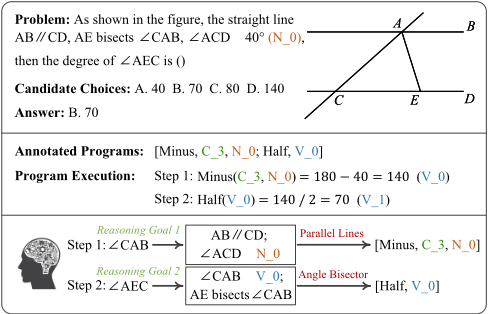
Zhang et al., 2020; Huang et al., 2020; Lin et al., 2021; Lin et al., 2023], which is considered a crucial step towards achieving general artificial intelligence. Among various math problems, geometry problem solving (GPS) stands out as a classic and challenging task that demands the ability of multimodal understanding and reasoning. As shown in the upper part of Figure 1, a typical geometry problem consists of a textual problem description ("As shown ... ̸ AEC is ()") and a geometry diagram (the image of A, B, C, D, E), and requires solvers to select an option from given candidates as the final answer ("B. 70"). This process requires solvers to thoroughly understand both text and diagram and to have essential geometry knowledge for multi-modal reasoning.
Existing works about GPS can be divided into two genres: symbolic geometry solvers and neural geometry solvers. The symbolic solvers [Seo et al., 2014; Seo et al., 2015; Lu et al., 2021] typically depend on the handcrafted rules to parse the problem text and diagram into logical formal language and then solve the problem by logical deduction. Although having strong interpretability, they encounter severe generalization problems in large scale datasets. Recently, with the rising usage of deep learning for automated math problem solving, many neural geometry solvers [Chen et al., 2021; Cao and Xiao, 2022; Ning et al., 2023] have been developed.
Neural solvers adopt a encoder-decoder framework to solve geometry problems in a Sequence-to-Sequence way. They encode the problem text and diagram and then feed them into a program decoder to generate a program sequence as shown in "Annotated Program" of Figure 1 (i.e. "[Minus, C 3, N 0; Half, V 0]"), obtaining the final answer through program execution. This line of research has achieved remarkable progress in GPS, with relatively great performance and generalization ability. However, it still follows the paradigm of neural machine translation which is greatly different from the geometry reasoning process of humans. For instance, when humans solve the problem in Figure 1, they first recognize that the reasoning goal in Step 1 is to "calculate ̸ CAB". For this purpose, they note that AB // CD and would recall the geometry knowledge "If the two lines are parallel, then consecutive interior angles are supplementary" from their mind. Guided by this knowledge and realizing ̸ ACD = 40◦ , they finally deduce that the measure of ̸ CAB could be obtained by subtracting the measure of ̸ ACD from 180◦ (i.e., "C 3" in Figure 1). Existing methods do not explicitly model this reasoning process, and only learn a fitting pattern from problems to programs, while lacking application of the geometry knowledge in reasoning, which may result in model confusion and robustness issues [Liu et al., 2022; Liu et al., 2023]. Therefore, in this paper, we aim to explicitly model the above human reasoning behaviors to achieve more reliable reasoning process for GPS.
To this end, we draw insights from dual-process theory [Schneider and Shiffrin, 1977; Evans, 2008; Kahneman, 2011; Lieto et al., 2017] of human cognition, which states that there exist two cognitive systems underlying human reasoning, including System 1 and System 2. System 1 represents an implicit process, which is heuristics and retrieves information in a rapid and unconscious way. System 2 represents an explicit process, which is analytic and conducts a slow but controlled thinking process. Combined with the above example, in terms of GPS, System 1 is responsible for providing information about geometry primitives in diagram and appropriate geometry knowledge. System 2 conducts analytic and sequential reasoning by generating step-wise reasoning goals for the problem and integrates the knowledge of System 1 to resolve them. However, when attempting to simulate this human reasoning process in neural solvers, we may encounter three challenges. Firstly, the reasoning goal serves as the core that guides the whole reasoning process. It is crucial but difficult to precisely identify and update the reasoning goal. Secondly, the geometry knowledge used may vary throughout the entire reasoning process, making it challenging to correctly select geometry knowledge for different reasoning steps. Thirdly, after obtaining the geometry knowledge, it is also a challenge to integrate it with reasoning goal and apply them to guide the explicit reasoning in System 2.
To tackle the aforementioned issues, we propose a DualReasoning Geometry Solver (DualGeoSolver), which explicitly models human dual-reasoning process in GPS. Specifically, we construct two systems in DualGeoSolver, namely Knowledge System and Inference System, which simulate System 1 and System 2, respectively. At the beginning of each reasoning step, Knowledge System provides diagram information and geometry knowledge according to the current reasoning goal. For the former, we propose a Visual Spotlight Module that captures the relationships between reasoning goal and geometry primitives in the diagram, while for the latter we propose another Knowledge Selection Module to retrieve sufficient and relevant knowledge from an external knowledge base. Furthermore, we design a Knowledge Injection Module to aggregate diagram information and geometry knowledge to direct the reasoning process in Inference System. In Inference System, we first apply the the knowledge from Knowledge System to generate target program tokens for resolving the current reasoning goal. Then, we develop a novel Goal Generation Module to identify the next solvable reasoning goal based on known conditions and preceding reasoning information as humans. This goal is then fed back into Knowledge System to start the next reasoning step. By alternately repeating the above two processes, our DualGeoSolver eventually solves the original geometry problem in a humanlike manner.
In summary, the contributions of this paper include:
- We propose a novel DualGeoSolver that constructs Knowledge-Inference systems to model human dualreasoning process in solving geometry problems.
- We propose elaborate knowledge selection and injection mechanisms to simulate the implicit reasoning process of humans, and design a novel goal-oriented manner to achieve explicit reasoning process.
- Extensive experiments on two public datasets GeoQA and GeoQA+ demonstrate the superiority of our DualGeoSolver compared with 7 GPS baselines and 7 LLMs.
2 RelatedWorks
Existing works on GPS could be divided into two genres: Symbolic Geometry Solvers and Neural Geometry Solvers.
2.1 Symbolic Geometry Solvers
[Seo et al., 2015] proposed the first symbolic solver GeoS, which first parsed the problem text and diagram into firstorder logic literals using handcrafted rules and OCR techniques [Seo et al., 2014], then solved the geometry problem by finding an assignment that satisfied all the parsed literals. In order to alleviate the reliance of GeoS on handcrafted rules, [Sachan et al., 2017; Sachan and Xing, 2017] injected geometry theorem knowledge as the form of horn-clauses into the solver and replaced the handcrafted rules. Recently, Inter-GPS [Lu et al., 2021] improved the reasoning process of previous symbolic solves by iteratively searching geometry primitives and applying a series of manually defined geometry theorems. Although symbolic solvers have achieved significant progress and possess strong interpretability, they heavily rely on the handcrafted rules to parse the geometry problems and lack generalization.
2.2 Neural Geometry Solvers
With the rising usage of deep learning for automated math problem solving, [Chen et al., 2021] first proposed a neural geometry solver called NGS which solved the geometry problems with an encoder-decoder framework. It encoded the problem text and diagram separately, then fused them using a multi-modal fusion module, and finally sent them to a program decoder to generate program tokens that can produce final numeric result through program execution. On this basis, to improve the text encoder, DPENGS [Cao and Xiao, 2022] adopted both Bi-LSTM and RoBERTa[Liu et al., 2019] for encoding, which were further enhanced by SCA-GPS [Ning et al., 2023] through integrating diagram features with symbolic characters. Geoformer [Chen et al., 2022] adopted T5 [Raffel et al., 2020] model as the backbone and strengthened the reasoning ability by introducing geometry proving problems. For precisely describing the diagram, [Zhang et al., 2022] proposed PGDPNet which utilized instance segmentation [He et al., 2017; Ying et al., 2021] and scene graph generation [Xu et al., 2017] techniques to parse the geometry primitives and their relations from the diagram. Subsequently, to better understand the semantics meanings of different geometry primitives, PGPSNet [Zhang et al., 2023] solved geometry problems by applying semantic embeddings to different types of geometry primitives. Though neural solvers have achieved remarkable performance and possessed strong generalization ability, they still solve geometry problems by following a neural machine translation paradigm, while neglecting the characteristics of human reasoning in geometry problem solving, which may lead to model confusion and robustness issues. Differently, in this paper, we draw insights from dual-process theory and simulate human dual-reasoning process to solve geometry problems.
3 Methodology
3.1 ProblemDefinition
Formally, a geometry problem is defined as a tuple (D, P, c), where D represents the geometry diagram, P = [p1, p2, . . . , pn] represents n tokens in the problem description, and c = {c1, c2, c3, c4} represents the multi-choice candidates where each choice is a numeric value. Given the geometry diagram D and problem description P, one GPS solver is trained to select a choice ci ∈ c.
In the current field of GPS, researchers do not make neural solvers predict a choice from candidates c directly. Alternately, they annotate a program as a sequence of tokens YP = [y1, y2, . . . , yT ] that can be executed to obtain a numeric result. Each yt ∈ YP comes from a program vocabulary VP composed of four parts: the operators VO where each operator represents a mathematical operation (e.g., "Minus"), the numeric constants VC (e.g., "C 3" which stands for 180◦ ), the numeric values NP which appear in problem description P (e.g. "N 0" which stands for 40◦ ), and the numeric variables NV which are the intermediate execution results of previous reasoning steps (e.g., "V 0" which stands for 140◦ ). That is, VP = VO ∪VC ∪NP ∪NV . It is worth noting that NP and NV are constructed by number mapping, which transforms the numerical values into a unified representation.
Definition 3.1. Given a geometry problem (D, P, c), our goal is to build a model that could reason the program YP = [y1, y2, . . . , yT ], then obtain the numeric result z through executing the program YP , and finally select a choice ci matching z from candidates c.
3.2 Overall Framework
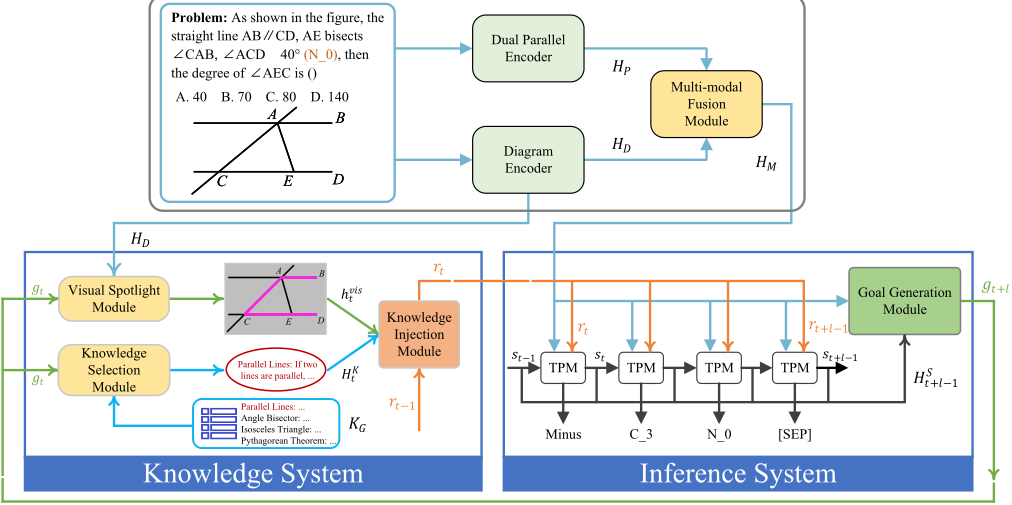
To explicitly model human reasoning process, inspired by the dual-process theory, we propose a Dual-Reasoning Geometry Solver (DualGeoSolver) as depicted in Figure 2. Firstly, we encode the problem text P and diagram D through separate encoders and fuse them through a multi-modal fusion module. Then, we feed them into our dual-reasoner to iteratively generate the target program YP = [y1, y2, . . . , yT ] with the cooperation of Knowledge-Inference systems, and obtain the numeric result through program execution.
3.3 ProblemEncoders
We adopt two encoders to extract the features of diagram D and problem text P separately, and then fuse and align them.
Diagram Encoder. To extract visual information from geometry diagram D, we employ a ViTMAE [He et al., 2022] that handles geometry diagram through two pre-training tasks, including Masked Image Modeling (MIM) and symbolic character detection [Ning et al., 2023]. Given diagram D, we divide it into regularly non-overlapping γ × γ patches and input them into ViTMAE. We take the outputs of last hidden layer as the visual features HD = [hD1 , hD2 , . . . , hDm], where m = γ × γ is the number of diagram patches.
Text Encoder. Given textual problemdescriptionwith n tokens P = [p1, p2, . . . , pn], we feed it into a LSTM [Hochreiter and Schmidhuber, 1997] and RoBERTa [Liu et al., 2019] separately to obtain richer representations of P . Then, we aggregate them through a linear layer to obtain the final encoded textual features HP = [hP1 , hP2 , . . . , hPn ].
Multi-modal Fusion Module. We employ a multi-modal co-attention module [Yu et al., 2019] to fully fuse and align the diagram features HD and text features HP . The coattention module takes HD and HP as inputs and outputs the multi-modal representation FD = [f D 1 , f D 2 , . . . , f D m ]. We concatenate HP and FD to form HM = [HP ; FD] = [hM1 , hM2 , . . . , hMn+m] for subsequent reasoning. Additionally, we apply an attention-reduction network [Chen et al., 2021] to aggregate FD into a vector. We then concatenate this vector with the features of the last token in HP , obtaining the aggregated multi-modal feature vector hM.
3.4 Dual-Reasoner
Existing geometry solvers decode the program YP in a totally Seq2Seq manner, which is greatly different from human reasoning process. Taking Figure 1 as an example, humans start by identifying the first reasoning goal as "calculate ̸ CAB". Then, they conduct implicit reasoning from two aspects: 1) refer to the diagram and capture relationships between ̸ CAB and other geometry primitives, 2) retrieve the geometry knowledge such as "Parallel Lines". Under the guidance of them, humans conduct explicit reasoning and deduce tokens "[Minus, C 3, N 0]" to solve this goal. Afterwards, they realize the next goal is to "calculate ̸ AEC' and repeat the above processes until obtaining the final answer.
: Reasoning goal guides retrieving in Knowledge System
: Guiding information guides reasoning in Inference System
Figure 2: Overview of our DualGeoSolver. The whole dual-reasoner consists of a Knowledge System and an Inference System. We illustrate the first reasoning step with the cooperation of two systems, which finally generates program tokens "[Minus, C 3, N 0]".
To achieve the aforementioned processes, we propose a dual-reasoner which conducts a dual-reasoning process with two systems, namely Knowledge System and Inference System, inspired by dual-process theory [Schneider and Shiffrin, 1977; Evans, 2008; Kahneman, 2011; Lieto et al., 2017]. Specifically, Knowledge System represents the implicit reasoning process. At time step t, it receives reasoning goal gt generated by Inference System, and retrieves both geometry knowledge and diagram information to form an overall guiding information rt. Inference System represents the explicit reasoning process. It resolves the reasoning goal gt based on rt, which sequentially generates l program tokens that can solve gt through execution until it reaches a delimiter (e.g. "[Minus, C 3, N 0, [SEP]]" in Figure 2). Subsequently, Inference System identifies a new reasoning goal gt+l and feeds it into Knowledge System to start next reasoning step. These two systems alternate until completing the entire reasoning process. In the following parts, we introduce them in detail.
Knowledge System
In Knowledge System, we design three modules: Knowledge Selection Module (KSM), Visual Spotlight Module (VSM) and Knowledge Injection Module (KIM). At time step t, KSM receives reasoning goal gt from Inference System and then retrieves geometry knowledge HK t that contributes to resolving the reasoning goal from an external knowledge base. Meanwhile, VSM retrieves diagram information hvis t from the diagram based on gt, which captures the relationships between reasoning goal and geometry primitives in the diagram. Finally, KIM integrates HK t , hvis t and previous reasoning state (denoted as st-1) from Inference System to form a guiding information rt that directs the subsequent explicit reasoning process in Inference System.
Knowledge Selection Module. Given a reasoning goal gt generated by Inference System, we utilize Knowledge Selection Module (KSM) to retrieve relevant geometry knowledge (e.g., "Parallel Lines"). To the best of our knowledge, there hasn't been a dedicated geometry knowledge collection. so we first manually build a geometry knowledge base KG. Each item in KG is a knowledge-explanation pair, where the "knowledge" represents a geometry knowledge concept, and the "explanation" provides a textual description of the knowledge. For example, the knowledge concept "Parallel Lines" in KG corresponds to the textual description "If the two lines are parallel, then consecutive interior angles are supplementary". To build KG from scratch, we initially gathered the geometry knowledge annotated in GeoQA and GeoQA+ datasets, then collected the detailed explanations of these knowledge concepts fromWikiPedia 1 and Baidu-Baike 2 . Subsequently, these explanations were manually verified for correctness and underwent optimization of expression and logic by three welltrained annotators with undergraduate degrees.
Formally, for each knowledge-explanation pair < kp i , ke i > in knowledge base KG, we denote its knowledge concept as kp i and corresponding explanation as ke i :
We model knowledge selection as a multi-label classification task. Therefore, we input gt into a linear layer with sigmoid activation to obtain the prediction score for each geometry knowledge. We then select and concatenate explanations whose prediction score are higher than a pre-defined threshold θ for further reasoning. Finally, the selected explanations will be fed into the same text encoder of problem description to obtain knowledge representation HK t = [ut1 , ut2 , . . . , utnc ], where nc represents the length of concatenated explanations.
Visual Spotlight Module. Given the reasoning goal gt, humans also refer to the diagram to capture essential relationships between geometry primitives in the diagram (e.g. notice that ̸ ACD and ̸ CAB are consecutive interior angles in Figure 2). We simulate this behavior through Visual Spotlight Module (VSM). To let Knowledge System pay more attention to the geometry primitives related to the reasoning goal gt rather than other meaningless places, we utilize an attention mechanism to fuse gt and the features of geometry diagram HD, and obtain the visual context vector hvis t .
Knowledge InjectionModule. Knowledge InjectionModule (KIM) aims to integrate the knowledge HK t and visual context hvis t to forma guiding information rt. We first utilizes an attention mechanism to aggregate HK t into vector hknow t based on rt-1, then we employ a single-layer unidirectional LSTM network ζ to integrates hknow t , hvis t and the previous reasoning state st-1 from Inference System (described later in Eq. (6)), updating rt-1 into rt (r0 is obtained by feeding hM into a linear layer):
Inference System
In Inference System, we design two modules: Token Prediction Module (TPM) and Goal Generation Module (GGM). TPM combines the multi-modal features HM and guiding information rt from Knowledge System to sequentially generate the target program tokens {yi}(t ≤ i < t + l) until it reaches a pre-defined delimiter (e.g. "[SEP]" token in Figure 2). Here, l represents the number of program tokens generated by TPM in the current reasoning step. Next, GGM finds the next reasoning goal gt+l according to the known conditions and the preceding reasoning information until time step t+l-1. It then sends gt+l back to Knowledge System to start the next reasoning step. For the sake of symbol consistency, we denote next reasoning goal as gt+l rather than gt+1.
Token Prediction Module. Token Prediction Module (TPM) is designed to generate target program tokens {yi}(t ≤ i < t + l) which could resolve the current reasoning goal gt through program execution. We employ an LSTM network φ with attention mechanism [Bahdanau et al., 2014] as our TPM. At time step t, φ updates its hidden state st-1 according to the multi-modal features HM, guiding information rt, and the embedding of last generated token et-1:
Then we feed st into a linear layer with softmax function to predict the distribution of next program token Pt. It is worth noting that the guiding information rt will not change within a reasoning step, i.e., rt = rt+1 = · · · = rt+l-1.
Goal Generation Module. Goal Generation Module (GGM) is designed to identify the next solvable reasoning goal according to the known conditions and preceding reasoning information. Specifically, we consider the multi-modal features HM as the known conditions since it contains rich information about the raw problem. We regard HS t+l-1 = [s0, s1, . . . , st+l-1] containing all the preceding reasoning information. Then we employ a 2-layer Transformer-Decoder [Vaswani et al., 2017] network to fully integrate HM and HS t+l-1 , where we treat HS t+l-1 as query and HM as key and value, and take the last vector of the outputs as the next reasoning goal gt+l. When t = 0, HS 0 degenerates to only include the "[BOS]" token, which means GGM only takes known conditions of the question to determine the first solvable reasoning goal.
In summary, the training objectives of DualGeoSolver come from two parts, a generation loss Lg from Token Prediction Module and a multi-label classification loss Lc from Knowledge SelectionModule. Specifically, Lg is the negative log-likelihood (NLL) of generating target program tokens:
The multi-label classification loss is the sum of binary cross entropy (BCE) loss of all reasoning steps:
where S is the number of reasoning steps of the geometry problem, kij and pij are the label/probability for the j-th knowledge in i-th reasoning step, respectively. The entire loss is the sum of Lg and Lc: L = Lg + Lc.
4 Experiments
4.1 Experimental Setup
Datasets. We conduct experiments on two public available datasets: GeoQA and GeoQA+. The problems in GeoQA are classified into three categories: Angle, Length, and Other, and problems in GeoQA+ are also classified into three categories: Angle, Length and Area. GeoQA+ dataset is an extension of GeoQA dataset, which includes additional problems with a higher average number of reasoning steps and a wider range of problem types, making them more challenging to solve [Cao and Xiao, 2022].
Since Knowledge Selection Module retrieves knowledge for each reasoning step, it requires knowledge annotations on each individual reasoning step for training. However, both datasets only provide annotations for the entire problem without specifying them to each individual reasoning step. Fortunately, both datasets provide a detailed textual analysis for each problem, which allows us to leverage ChatGPT 3 to assign a subset of knowledge to each reasoning step.
| GeoQA | GeoQA+ | |||||||||
|---|---|---|---|---|---|---|---|---|---|---|
| Methods | Total | Angle | Length | Other | No Result | Total | Angle | Length | Area | No Result |
| Human Text Only | 63.0 | 58.0 | 71.7 | 55.6 | - | - | - | - | - | - |
| Human Text-Diagram | 92.3 | 94.2 | 90.5 | 87.0 | - | - | - | - | - | - |
| CogVLM-17B | 7.96 | 8.39 | 7.77 | 5.55 | 65.2 | 8.09 | 7.45 | 10.1 | 6.15 | 63.0 |
| VisualGLM-6B | 10.6 | 9.60 | 12.4 | 9.26 | 62.5 | 11.2 | 10.6 | 0.00 | 25.0 | 62.0 |
| ChatGPT | 12.1 | 13.9 | 9.54 | 11.1 | 61.4 | 18.0 | 18.1 | 17.7 | 18.5 | 60.1 |
| GPT-4 | 26.4 | 25.9 | 29.3 | 14.8 | 56.6 | 30.4 | 23.9 | 35.9 | 38.5 | 51.2 |
| GPT-4V | 29.7 | 28.1 | 32.5 | 27.8 | 51.4 | 28.5 | 24.2 | 29.0 | 40.0 | 52.5 |
| GPT-4 + Knowledge | 32.2 | 33.1 | 32.2 | 25.9 | 50.9 | 32.4 | 22.9 | 42.7 | 40.0 | 49.5 |
| GPT-4V + Knowledge | 34.4 | 32.9 | 35.7 | 38.9 | 49.2 | 31.6 | 25.5 | 37.5 | 37.7 | 48.7 |
| Seq2Prog | 60.7 | 71.2 | 49.1 | 40.7 | 17.0 | 57.2 | 57.7 | 52.0 | 65.4 | 20.3 |
| BERT2Prog | 57.6 | 67.9 | 45.6 | 40.7 | 14.6 | 56.6 | 57.4 | 54.4 | 58.5 | 19.0 |
| RoBERTa2Prog | 60.7 | 71.7 | 48.0 | 42.6 | 16.7 | 59.4 | 59.3 | 58.5 | 61.5 | 19.0 |
| NGS# | 61.9 | 72.4 | 49.8 | 40.7 | 13.7 | 59.1 | 59.0 | 59.7 | 56.9 | 16.8 |
| Geoformer# | 62.7 | 74.1 | 49.8 | 40.7 | 16.3 | 60.2 | 60.9 | 58.1 | 62.3 | 17.2 |
| DPE-NGS# | 63.4 | 72.7 | 53.0 | 44.4 | 12.7 | 60.9 | 62.5 | 54.0 | 66.9 | 15.2 |
| SCA-GPS# | 63.7 | 75.0 | 49.8 | 46.8 | 13.0 | 61.8 | 62.6 | 58.9 | 64.6 | 15.9 |
| DualGeoSolver | 65.2∗ | 73.6 | 55.1 | 48.2 | 12.2 | 65.1∗ | 65.2 | 63.7 | 66.2 | 14.6 |
Implementation Details. During training, we keep the parameter of diagram encoder unchanged, and we set the learning rate of RoBERTa to 2e-5 , the learning rate of multimodal fusion module and Goal Generation Module (GGM) to 1e-5 , and the learning rate of other modules to 1e-3 . We use Adam as the optimizer and set the batch size as 32 while training. The total training epochs is set to 100. All experiments were conducted on an NVIDIA A6000 GPU, with PyTorch version 1.13.1. While testing, we apply beam-search strategy with beam size B = 10 to generate program sequences and utilize a program executor to execute these program sequences in descending order of their predicted probabilities to obtain numerical results. It selects the program sequence that is first successfully executed and matches an option ci in the candidates c = {c1, c2, c3, c4} as the final solution. If all B program sequences fail or none of them matches an option in the candidates, the program executor will report "No Result" instead of guessing an option.
Baselines. We compare our DualGeoSolver with baselines from three classes, including: general Seq2Seq methods, GPS specified neural solvers and large language models. Specifically, general Seq2Seq methods include a LSTMbased model (LSTM2Prog) [Hochreiter and Schmidhuber, 1997], a BERT-based model (BERT2Prog) [Devlin et al., 2018] and a RoBERTa-based model (RoBERTa2Prog) [Liu et al., 2019]. GPS specified solvers are NGS [Chen et al., 2021], Geoformer [Chen et al., 2022], DPE-NGS [Cao and Xiao, 2022] and SCA-GPS [Ning et al., 2023]. LLMs include methods utilize textual inputs only, including ChatGPT and GPT-4 [Achiam et al., 2023], and methods utilize both text and diagram, including CogVLM-17B [Wang et al., 2023], VisualGLM-6B [Ding et al., 2021; Du et al., 2022] and GPT4V. To verify the effectiveness of explicitly providing relevant knowledge in LLMs' reasoning process, We also provide LLMs with geometry knowledge extracted from KG in the prompt, which are denoted as "GPT-4(V) + Knowledge".
The prompt for instructing LLMs to solve geometry problems is designed in a one-shot approach. For GPT-4(V) + Knowledge, we additionally provide the ground truth geometry knowledge to the example and the problem to be solved. The geometry knowledge and their explanations are obtained from KG. The detailed prompts are provided in Figure 3.
Moreover, we also provide the performances of humans in GPS, which are excerpted from [Chen et al., 2021].
4.2 Experimental Results
We show the Total Accuracy ("Total"), accuracy on specific problem categories (e.g., "Angle"), and No Result Rate ("No Result") in Table 1 4 . First, our DualGeoSolver surpasses all the baselines. By applying paired t-test, its improvements over the SOTA method SCA-GPS on "Total" of both datasets are statistically significant with p < 0.01 (marked with ∗). It demonstrates the rationality and effectiveness of our DualGeoSolver in modeling human reasoning process for GPS. Second, our DualGeoSolver achieves greater performance
4 Due to the different version of PyTorch, we rerun all the baselines with PyTorch version 1.13.1 for a fair comparison.
Geometry Problem Solving Prompts for LLMs
Please solve the geometry problem based on the following problem text and diagram. After solving the problem, provide the final calculation result individually at the end, and the final result should be a numerical number or a LaTeX expression, for example: "[Final Result]: 120". Here is an example of solving geometry problems: {example}. Problem: {problem}.
{Instruction and Example} (Same as the prompt above).
Problem: {problem}. Relevant knowledge explanations: {geometry knowledge}.| GeoQA | GeoQA+ | |||
|---|---|---|---|---|
| Models | Total | No Result | Total | No Result |
| DualGeoSolver w/o KSM w/o VSM w/o KIM | 65.2 | 12.2 | 65.1 | 14.6 |
| 63.3 | 14.4 | 63.1 | 15.4 | |
| 64.4 | 11.3 | 64.7 | 16.5 | |
| 64.8 | 13.2 | 64.0 | 15.2 | |
| w/o GGM | 63.3 | 15.2 | 63.6 | 15.1 |
improvements on the more difficult dataset GeoQA+. It reflects that through modeling human application of geometry knowledge and the goal-oriented reasoning manner in dualreasoner, our DualGeoSolver has better generalization ability and robustness. Third, all the GPS specific solvers, except NGS on GeoQA+, outperforms the general Seq2Seq methods. It indicates the importance of diagram in solving geometry problems, which further shows the necessity of our Visual Spotlight Module to capture the relationship between reasoning goals and diagram. Fourth, LLMs do not perform well in GPS, which we believe is caused by the disparity between geometry diagrams and images used for pre-training LLMs. But we notice that by applying geometry knowledge, GPT-4(V)'s performances have drastically improved, which demonstrates the necessity of introducing knowledge into current methods.
4.3 Ablation Study
To verify the effectiveness of modules in our DualGeoSolver, we conduct the ablation study in Table 2. Specifically, for Knowledge System, "w/o KSM" omits Knowledge Selection Module, thus ignores the geometry knowledge application in reasoning and the loss Lc in Eq. (8) in training. "w/o VSM" ignores Visual Spotlight Module that captures visual information related to reasoning goal and only inputs HK t into KIM for generating guiding information. "w/o KIM" ignores Knowledge Injection Module, and directly feeds the geometry knowledge HK t , which will be aggregated by st-1, and visual context vector hvis t into Token Prediction Module. For Inference System, "w/o GGM" omits Goal Generation Module and directly regards st as the reasoning goal.
| GeoQA | GeoQA+ | |||
|---|---|---|---|---|
| Models | OP | Absolute | OP | Absolute |
| w/o KSM | 56.1 | 44.0 | 44.7 | 31.8 |
| DualGeoSolver | 58.4 | 46.9 | 45.6 | 32.4 |
From Table 2, we first notice that the accuracy degrades when any module is missing, which verifies the rationality and necessity of all components in DualGeoSolver. Second, the accuracy degrades the most when KSM is missing, showing that KSM is the most crucial module in DualGeoSolver and applying geometry knowledge in solving geometry problems is important. Third, the performance of DualGeoSolver is significantly hindered without Goal Generation Module, which indicates that it is necessary to develop a human-like goal-oriented mechanism that fully integrates the known conditions and all preceding reasoning information to derive the next reasoning goal. Last but not least, the importance of KIM and VSM varies with the difficulty of the geometry problems. On GeoQA+, which is more challenging than GeoQA, KIM becomes more crucial than VSM. We believe this is because, for harder geometry problems, simply capturing the relationships between geometry primitives in the diagram is not sufficient to provide enough information for solving the problem, where KIM is needed to effectively integrate the diagram information with geometry knowledge.
4.4 Knowledge Analysis
To verify the role of geometry knowledge in solving geometry problems, we conduct two experiments: evaluating the performance of our DualGeoSolver with varying threshold θ in Knowledge Selection Module, and assessing the single-step accuracy with/without application of geometry knowledge.
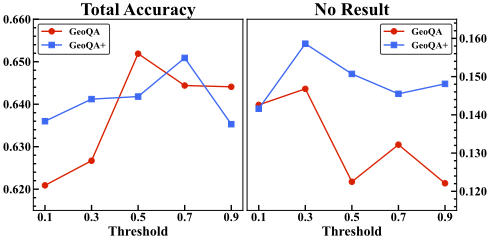
From Figure 4, we observe that the performance is better when the threshold θ is closer to the middle value and decreases when the threshold is too low or too high. This demonstrates that applying excessive incorrect knowledge or missing essential knowledge during reasoning is detrimental to geometry problem solving. Besides, the optimal knowledge threshold for our DualGeoSolver to achieve the best performance varies across different datasets, being θ = 0.5 on GeoQA and θ = 0.7 on GeoQA+. It indicates that our DualGeoSolver prefers the usage of more precise and accurate geometry knowledge on GeoQA+, while tends to use a greater amount of geometry knowledge on GeoQA.
We also assess the single-step accuracy with and without applying geometry knowledge in Table 3. Specifically, "OP" means the accuracy of operator in each reasoning step, and "Absolute" means the accuracy of the whole step. For example, for Step 1 in Figure 1 that requires to reason "[Minus, C 3, N 0]", if the model correctly derives operator "Minus", then "OP" will be considered correct; only if all three tokens are correctly generated, "Absolute" will be considered correct. From Table 3, the performances are worse without Knowledge Selection Module on both datasets, which directly demonstrates the effectiveness of applying geometry knowledge in GPS. It is worth noting that the lower accuracy on "OP" and "Absolute" compared to "Total Accuracy" may be due to that model predicts a program that differs from the gold program but can still solve the geometry problem.
4.5 Case Study
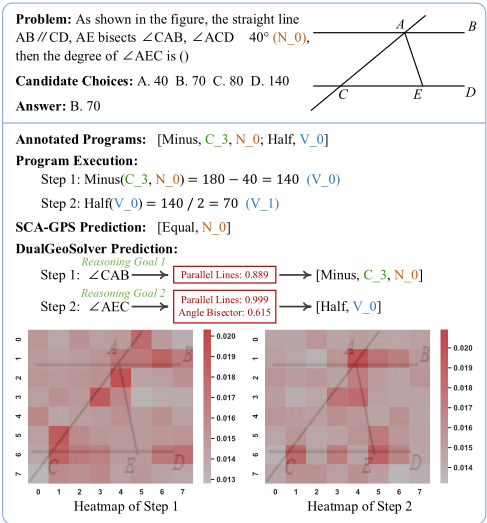
Further, we present a typical case in Figure 5 to verify the interpretability of DualGeoSolver. We first present the problem
̸
and program sequences generated by different solvers. Then, we report the knowledge selection probability in knowledge Selection Module and visualize the attention weights of Visual Spotlight Module in our DualGeoSolver.
This problem requires solvers to understand the properties of parallel lines and be aware that an angle bisector AE divides ̸ CAB into two equal angles. The program sequence generated by SOTA method SCA-GPS is incorrect, which appears to calculate the corresponding angle of ̸ ACE. Comparatively, our DualGeoSolver achieves a two-step reasoning process. In step 1, its reasoning goal focuses on ̸ ACE, CAB and parallel lines AB, CD according to the heatmap. Meanwhile, it selects geometry knowledge "Parallel Lines" with the confidence of 0.889. Combining them, it correctly deduces the program tokens "[Minus, C 3, N 0]". In step 2, its reasoning goal turns to the angle bisector AE and ̸ CAB, and selects two knowledge "Parallel Lines" and "Angle Bisector" simultaneously, and finally deduces the correct program tokens "[Half, V 0]". These observations verify the rationality and effectiveness of DualGeoSolver in simulating human reasoning process, which benefits from Knowledge System and Goal Generation Module in dual-reasoner.
5 Conclusion
In this paper, we proposed a novel Dual-reasoning Geometry Solver (DualGeoSolver), which drew insights from dualprocess theory and built Knowledge-Inference systems to conduct human-like dual-reasoning. Knowledge System managed geometry knowledge and diagram information that aided reasoning. Inference System adopted a goal-oriented reasoning mechanism and applied knowledge to program generation. Experiments on GeoQA and GeoQA+ datasets demonstrated the advantages of DualGeoSolver in answer accuracy and robustness. For future studies, we will enhance the ability of LLMs by introducing reasoning goals and geometry knowledge to achieve more reliable and interpretable GPS.
Acknowledgements
This research was partially supported by grants from the National Natural Science Foundation of China (Grants No. 62106244, No. U20A20229), and the University Synergy Innovation Program of Anhui Province (GXXT-2022-042).
@inproceedings{ijcai2024p725,
  title     = {Learning to Solve Geometry Problems via Simulating Human Dual-Reasoning Process},
  author    = {Xiao, Tong and Liu, Jiayu and Huang, Zhenya and Wu, Jinze and Sha, Jing and Wang, Shijin and Chen, Enhong},
  booktitle = {Proceedings of the Thirty-Third International Joint Conference on
               Artificial Intelligence, {IJCAI-24}},
  publisher = {International Joint Conferences on Artificial Intelligence Organization},
  editor    = {Kate Larson},
  pages     = {6559--6568},
  year      = {2024},
  month     = {8},
  note      = {Main Track},
  doi       = {10.24963/ijcai.2024/725},
  url       = {https://doi.org/10.24963/ijcai.2024/725},
}
TY - CPAPER TI - Learning to Solve Geometry Problems via Simulating Human Dual-Reasoning Process AU - Xiao, Tong AU - Liu, Jiayu AU - Huang, Zhenya AU - Wu, Jinze AU - Sha, Jing AU - Wang, Shijin AU - Chen, Enhong T2 - Proceedings of the Thirty-Third International Joint Conference on Artificial Intelligence, IJCAI-24 PB - International Joint Conferences on Artificial Intelligence Organization PY - 2024 SP - 6559 EP - 6568 DO - 10.24963/ijcai.2024/725 UR - https://doi.org/10.24963/ijcai.2024/725 ER -Copied
Machine-readable versions of this paper, for tools and AI agents:





