
Functional Graph Convolutional Networks: A Unified Multi-task and Multi-modal Learning Framework to Facilitate Health and Social-Care Insights
Proceedings of the Thirty-Third International Joint Conference on Artificial Intelligence. AI for Good. Pages 7188-7196.
https://doi.org/10.24963/ijcai.2024/795
Keywords
- Machine Learning: General
- Multidisciplinary Topics and Applications: General
Abstract
This paper introduces a novel Functional Graph Convolutional Network (funGCN) framework that combines Functional Data Analysis and Graph Convolutional Networks
to address the complexities of multi-task and multi-modal learning in digital health and longitudinal studies. With the growing importance of health solutions to improve health care and social support, ensure healthy lives, and promote well-being at all ages, funGCN offers a unified approach to handle multivariate longitudinal data for multiple entities and ensures interpretability even with small sample sizes. Key innovations include task-specific embedding components that manage different data types, the ability to perform classification, regression, and forecasting, and the creation of a knowledge graph for insightful data interpretation. The efficacy of funGCN is validated through simulation experiments and a real-data application. funGCN source code is publicly available at https://github.com/IBM/funGCN.
- [Bergmann et al., 2017] Michael Bergmann, Thorsten Kneip, Giuseppe De Luca, and Annette Scherpenzeel. Survey participation in the survey of health, ageing and retirement in europe (share), wave 1-6. Munich: Munich Center for the Economics of Aging, 2017.
- [Börsch-Supan et al., 2013] Axel Börsch-Supan, Martina Brandt, Christian Hunkler, Thorsten Kneip, Julie Korb- macher, Frederic Malter, Barbara Schaan, Stephanie Stuck, and Sabrina Zuber. Data resource profile: the survey of health, ageing and retirement in europe (share). Interna- tional journal of epidemiology, 42(4):992-1001, 2013.
- [Börsch-Supan, 2020] Axel Börsch-Supan. Survey of health, ageing and retirement in europe (share) wave 5. Release version, 7(0), 2020.
- [Boschi et al., 2021] Tobia Boschi, Jacopo Di Iorio, Lorenzo Testa, Marzia A Cremona, and Francesca Chiaromonte. Functional data analysis characterizes the shapes of the first covid-19 epidemic wave in italy. Scientific reports, 11(1):1-15, 2021.
- [Boschi et al., 2023] Tobia Boschi, Lorenzo Testa, Francesca Chiaromonte, and Matthew Reimherr. Fasten: an efficient adaptive method for feature selection and estimation in high-dimensional functional regressions. arXiv preprint arXiv:2303.14801, 2023.
- [Boschi et al., 2024] Tobia Boschi, Francesca Bonin, Ro- drigo Ordonez-Hurtado, Alessandra Pascale, and Jonathan Epperlein. A new computationally efficient algorithm to solve feature selection for functional data classification in high-dimensional spaces. arXiv preprint arXiv:2401.05765, 2024.
- [Breiman, 2001] Leo Breiman. Random forests. Machine learning, 45:5-32, 2001.
- [Chung et al., 2014] Junyoung Chung, Caglar Gulcehre, KyungHyun Cho, and Yoshua Bengio. Empirical evaluation of gated recurrent neural networks on sequence modeling. arXiv preprint arXiv:1412.3555, 2014.
- [Cover and Hart, 1967] Thomas Cover and Peter Hart. Near- est neighbor pattern classification. IEEE transactions on information theory, 13(1):21-27, 1967.
- [Craven and Wahba, 1978] Peter Craven and Grace Wahba. Smoothing noisy data with spline functions. Numerische mathematik, 31(4):377-403, 1978.
- [Cremona et al., 2019] Marzia A Cremona, Hongyan Xu, Kateryna D Makova, Matthew Reimherr, Francesca Chiaromonte, and Pedro Madrigal. Functional data anal- ysis for computational biology. Bioinformatics (Oxford, England), 35(17):3211, 2019.
- [Cuff, 2023] Alison Cuff. The evolution of digital health and its continuing challenges, 2023.
- [D'Souza et al., 2022] Niharika S D'Souza, Hongzhi Wang, Andrea Giovannini, Antonio Foncubierta-Rodriguez, Kris- ten L Beck, Orest Boyko, and Tanveer Syeda-Mahmood. Fusing modalities by multiplexed graph neural networks for outcome prediction in tuberculosis. In International Confer- ence on Medical Image Computing and Computer-Assisted Intervention, pages 287-297. Springer, 2022.
- [Eilers and Marx, 1996] Paul HC Eilers and Brian D Marx. Flexible smoothing with b-splines and penalties. Statistical science, 11(2):89-121, 1996.
- [Farah et al., 2023] Line Farah, Juliette M Murris, Isabelle Borget, Agathe Guilloux, Nicolas M Martelli, and San- drine IM Katsahian. Assessment of performance, in- terpretability, and explainability in artificial intelligence- based health technologies: What healthcare stakeholders need to know. Mayo Clinic Proceedings: Digital Health, 1(2):120-138, 2023.
- [Garssen et al., 2021] Bert Garssen, Anja Visser, and Gri- eteke Pool. Does spirituality or religion positively af- fect mental health? meta-analysis of longitudinal studies. The International Journal for the Psychology of Religion, 31(1):4-20, 2021.
- [Gruber et al., 2014] Stefan Gruber, Christian Hunkler, and Stephanie Stuck. Generating easyshare: guidelines, struc- ture, content and programming. Technical report, SHARE Working Paper Series 17-2014. Munich, 2014.
- [Hakkoum et al., 2022] Hajar Hakkoum, Ibtissam Abnane, and Ali Idri. Interpretability in the medical field: A system- atic mapping and review study. Applied Soft Computing, 117:108391, 2022.
- [Hochreiter and Schmidhuber, 1997] Sepp Hochreiter and Jürgen Schmidhuber. Long short-term memory. Neural computation, 9(8):1735-1780, 1997.
- [Hu et al., 2015] Zhongkai Hu, Shiying Hao, Bo Jin, An- drew Young Shin, Chunqing Zhu, Min Huang, Yue Wang, Le Zheng, Dorothy Dai, Devore S Culver, et al. Online prediction of health care utilization in the next six months based on electronic health record information: a cohort and validation study. Journal of medical Internet research, 17(9):e4976, 2015.
- [Ildstad et al., 2001] Suzanne T Ildstad, Charles H Evans Jr, et al. Small clinical trials: Issues and challenges. 2001.
- [Jiang et al., 2022] Hao Jiang, Lianguang Liu, and Cheng Lian. Multi-modal fusion transformer for multivariate time series classification. In 2022 14th International Conference on Advanced Computational Intelligence (ICACI), pages 284-288. IEEE, 2022.
- [Kingma and Ba, 2014] Diederik P Kingma and Jimmy Ba. Adam: A method for stochastic optimization. arXiv preprint arXiv:1412.6980, 2014.
- [Kokoszka and Reimherr, 2017] Piotr Kokoszka and Matthew Reimherr. Introduction to functional data analysis. CRC Press, 2017.
- [Langbridge et al., 2023] Abigail Langbridge, Fearghal O'Donncha, Amadou Ba, Fabio Lorenzi, Christopher Lohse, and Joern Ploennigs. Causal temporal graph convolutional neural networks (ctgcn). arXiv preprint arXiv:2303.09634, 2023.
- [Lee and Hastie, 2015] Jason D Lee and Trevor J Hastie. Learning the structure of mixed graphical models. Journal of Computational and Graphical Statistics, 24(1):230-253, 2015.
- [Müller et al., 1997] Klaus-Robert Müller, Alexander J. Smola, Gunnar Rätsch, Bernhard Schölkopf, Jens Kohlmor- gen, and Vladimir Vapnik. Predicting time series with support vector machines. In International conference on artificial neural networks, pages 999-1004. Springer, 1997.
- [Paszke et al., 2019] Adam Paszke, Sam Gross, Francisco Massa, Adam Lerer, James Bradbury, Gregory Chanan, Trevor Killeen, Zeming Lin, Natalia Gimelshein, Luca Antiga, et al. Pytorch: An imperative style, high- performance deep learning library. Advances in neural information processing systems, 32, 2019.
- [Petrie et al., 2018] John R Petrie, Tomasz J Guzik, and Rhian M Touyz. Diabetes, hypertension, and cardiovas- cular disease: clinical insights and vascular mechanisms. Canadian Journal of Cardiology, 34(5):575-584, 2018.
- [Powell-Wiley et al., 2021] Tiffany M Powell-Wiley, Paul Poirier, Lora E Burke, Jean-Pierre Després, Penny Gordon- Larsen, Carl J Lavie, Scott A Lear, Chiadi E Ndumele, Ian J Neeland, Prashanthan Sanders, et al. Obesity and cardio- vascular disease: a scientific statement from the american heart association. Circulation, 143(21):e984-e1010, 2021.
- [Ramsay and Silverman, 2005] James O. Ramsay and Bernard W. Silverman. Functional data analysis. Springer, 2 edition, 2005.
- [Rao and Reimherr, 2023] Aniruddha Rajendra Rao and Matthew Reimherr. Nonlinear functional modeling using neural networks. Journal of Computational and Graphical Statistics, pages 1-10, 2023.
- [Reiss and Ogden, 2007] Philip T Reiss and R Todd Ogden. Functional principal component regression and functional partial least squares. Journal of the American Statistical Association, 102(479):984-996, 2007.
- [Resolution and others, 2015] General Assembly Resolution et al. Transforming our world: the 2030 agenda for sus- tainable development. UN Doc. A/RES/70/1 (September 25, 2015), 2015.
- [Sivertsen et al., 2015] Heidi Sivertsen, Guro Hanevold Bjørkløf, Knut Engedal, Geir Selbæk, and Anne-Sofie Helvik. Depression and quality of life in older persons: a review. Dementia and geriatric cognitive disorders, 40(5- 6):311-339, 2015.
- [Tan et al., 2012] Dawn Tan, Mary Danoudis, Jennifer McGinley, and Meg E Morris. Relationships between mo- tor aspects of gait impairments and activity limitations in people with parkinson's disease: a systematic review. Parkinsonism & related disorders, 18(2):117-124, 2012.
- [Ullah and Finch, 2013] Shahid Ullah and Caroline F Finch. Applications of functional data analysis: A systematic re- view. BMC medical research methodology, 13(1):1-12, 2013.
- [Vijay et al., 2023] Ekambaram Vijay, Arindam Jati, Nam Nguyen, Gift Sinthong, and Jayant Kalagnanam. Tsmixer: lightweight mlp-mixer model for multivariate time series forecasting. In ACM SIGKDD International Conference on Knowledge Discovery and Data Mining, 2023.
- [Vijayan et al., 2021] Vini Vijayan, James P Connolly, Joan Condell, Nigel McKelvey, and Philip Gardiner. Review of wearable devices and data collection considerations for connected health. Sensors, 21(16):5589, 2021.
- [Walker et al., 2014] Robin L Walker, Guanmin Chen, Fin- lay A McAlister, Norm RC Campbell, Brenda R Hemmel- garn, Elijah Dixon, William Ghali, Doreen Rabi, Karen Tu, Nathalie Jette, et al. Relationship between primary care physician visits and hospital/emergency use for uncompli- cated hypertension, an ambulatory care-sensitive condition. Canadian Journal of Cardiology, 30(12):1640-1648, 2014.
- [Wang et al., 2016] Jane-Ling Wang, Jeng-Min Chiou, and Hans-Georg Müller. Functional data analysis. Annual Review of Statistics and its application, 3:257-295, 2016.
- [Yao et al., 2005] Fang Yao, Hans-Georg Müller, and Jane- Ling Wang. Functional data analysis for sparse longitudi- nal data. Journal of the American statistical association, 100(470):577-590, 2005.
- [Zanin, 2017] Luca Zanin. Education and life satisfaction in relation to the probability of social trust: a conceptual framework and empirical analysis. Social Indicators Re- search, 132(2):925-947, 2017.
- [Zhang et al., 2019] Si Zhang, Hanghang Tong, Jiejun Xu, and Ross Maciejewski. Graph convolutional networks: a comprehensive review. Computational Social Networks, 6(1):1-23, 2019.
- [Zhou et al., 2024] Tian Zhou, Peisong Niu, Liang Sun, Rong Jin, et al. One fits all: Power general time series analysis by pretrained lm. Advances in neural information processing systems, 36, 2024.
References were extracted automatically from the PDF and may contain errors.
Full text extracted automatically from the PDF; figures, tables and equations may differ. The PDF is the version of record.
1 Introduction
Ensure healthy lives and promote well-being for all at all ages and leave no one behind - this idea is embedded in the core vision of the UN's 2030 Agenda for Sustainable Development 1 [Resolution and others, 2015]. In line with this, in the contemporary healthcare landscape, digital health solutions and longitudinal studies have become increasingly significant to monitor health care and wellbeing of populations around the world. These approaches enable a comprehensive understanding of health outcomes over time, providing valuable insights into disease progression, treatment efficacy, and overall patients' well-being [Garssen et al., 2021][Cuff, 2023]. Digital health solution are therefore critical tools for achieving the UN sustainable development goals.
With the advent of new technologies, data are collected frommultiple sources, including surveys, phone interviews, wearable devices, and mobile health applications, to cite a few.
1 SDG, goal 3, https://sdgs.un.org/goals/goal3
These tools allow patients to capture a wide array of healthrelated signals from the comfort of their homes. They facilitate the entry of multiple measurements over time [Vijayan et al., 2021] and enhance medical professionals' and policymakers' understanding of a population's health, the impact of interventions, or, more in general, the well-being of subjects. However, they also add to the complexity of the analysis.
Artificial intelligence (AI) plays a key role in effectively dealing with such diverse information. Investigating these studies necessitates a variety of analytical tasks, including classification, longitudinal regression, and forecasting. Classification is crucial for separating patient subgroups or "arms", assessing treatments' effectiveness, or identifying the presence of diseases. Longitudinal regression can estimate critical variables that evolve over the entire study's duration, like patient well-being or healthcare service utilization, and can help determine the impact of a trial or a solution on individual patients. Forecasting, on the other hand, predicts future trends, informing on a trial's potential success and interventions' forthcoming effects [Hu et al., 2015]. On top of the different required analytical tasks, the analysis of the collected data presents substantial challenges. First, the variables are of different modalities. Second, the longitudinal signals can be recorded at various times and frequencies. Third, the difficulties of recruiting participants may result in small sample sizes, even smaller than the number of variables [Ildstad et al., 2001]. Last, the interpretability of the results is crucial: understanding the relationships between variables and how they influence specific outcomes can enhance future trial designs, improve patient care, and optimize resource allocation [Hakkoum et al., 2022][Farah et al., 2023]. All the above challenges constitute a complex methodological barrier, even for the most advanced AI and machine learning (ML) approaches. Hence, there is a need for new informative methodologies able to i) deal with multi-modal data and multivariate longitudinal signals for multiple entities, ii) perform different inference tasks , and iii) be effective even when the sample size is small. In response to these demands, we introduce a novel approach called Functional Graph Convolutional Network (funGCN), which synergizes Functional Data Analysis (FDA) [Ramsay and Silverman, 2005][Kokoszka and Reimherr, 2017] and Graph Convolutional Networks (GCNs) [Zhang et al., 2019].
FDA a dynamic area of statistical research that allows working with multivariate longitudinal data by estimating smooth curves across a continuous domain. GCNs are renowned for their capacity to discern relations between variables. By integrating FDA and GCNs, we create a unified framework for multi-task learning with multi-modal longitudinal data. The innovative aspects of funGCN include:
- The introduction of two task-specific embeddings designed for multi-modality. Specifically, they can handle longitudinal, categorical, and constant scalar variables (the latter are numerical values that remain constant over time) and facilitate the comparison of diverse variables and statistical entities throughout the temporal domain.
- The capability to execute three analytics tasks: classification, (longitudinal) regression, and forecast. Moreover, given the embeddings' flexibility, funGCN can concurrently perform regression and classification of multiple target variables within a single training session.
- The generation of a knowledge graph that quantifies the connections between all variables, facilitating dimensionality reduction and providing interpretable insights into the outcomes, even in scenarios with small sample sizes.
The effectiveness of funGCN is demonstrated through simulation experiments and a real-data application, showcasing its ability to construct an informative knowledge graph and offering a new approach for analyzing complex longitudinal datasets.
This work is part of the SEURO Project 2 that aims to develop and evaluate a digital social health platform to improve and advance home-based self-management and integrated care for older adults (over 65 years) with multiple chronic conditions. The project focuses on deploying new technologies for improving health care in elderly population and on evaluating innovative, flexible, and individual-centered healthcare models through data from diverse longitudinal studies. The project brings together academic/research institutions, Small to Medium Enterprises (SMEs), health service providers and NGOs and benefits from the a multidisciplinary collaboration between computer scientists/statistician, health-care professionals, stakeholders in the health/social care field.
Related work. Multi-modal GCN, Temporal GCN, and time-series analysis and forecasting are all active research fields. However, aside from funGCN, there seems to be a lack of a comprehensive framework that combines all their capabilities. For a clearer understanding of the terminology associated with the applicability of the various models, see Table 1.
Recently work in [Langbridge et al., 2023] introduced a Causal Temporal GCN for multivariate time series, while novel approaches in [Jiang et al., 2022], [Vijay et al., 2023], and [Zhou et al., 2024] extended transformers and large language models to time series. Yet, these approaches do not consider multi-modality or multiple statistical entities. [D'Souza et al., 2022] presents a multi-modal GCN for classification but, differently from funGCN, does not tackle longitudinal variables. Long short-term memory (LSTM) networks [Hochreiter and Schmidhuber, 1997] and gated recurrent unit (GRU) networks [Chung et al., 2014] allow to perform multiple-task for longitudinal variable and multiple-entities, however they cannot handle multi-modal data. Similarly, classical ML algorithms such supporting vector machines (SVM) [M¨uller et al., 1997] and random forest [Breiman, 2001], can manage multi-modal data only after flattening the longitudinal features, losing the time dependency information and interpretability while, at the same time, increasing the total number of variables. On the other hand, FDA has shown promising results in dealing with multi-modal variables across numerous longitudinal applications [Ullah and Finch, 2013][Cremona et al., 2019][Boschi et al., 2021] and, recently, has been effectively extended to deep learning methodologies [Rao and Reimherr, 2023]. funGCN is designed to combine the strengths of the FDA in handling multi-modal longitudinal data with the GCN's capabilities at detecting their interrelationships and producing interpretable outcomes.
In the remainder of this paper, we first present our methodology (Section 2), then we evaluate the performance of our approach against various competing algorithms through simulations (Section 3), and investigate a real-world application using the longitudinal SHARE dataset (Section 4). Finally, we draw our conclusions in Section 5. The Appendix material can be found at https://arxiv.org/pdf/2403.10158.
2 Methodology
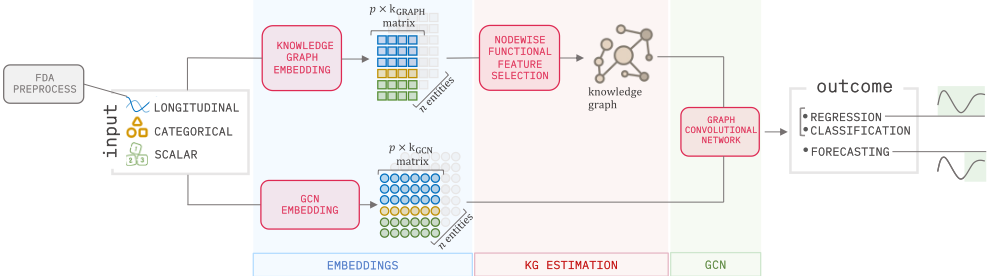
The architecture of funGCN is illustrated in Figure 1. The input data are transformed through two distinct embedding modules, each serving a preparatory role - KG embedding, estimating the knowledge graph through a node-wise feature selection approach, and GCN embedding, preparing the input for the GCN component. The embedding modules' outputs are tensors of dimensions (n, p, kgraph) and (n, p, kgcn), respectively. The GCN takes as input both the knowledge graph and its specifically embedded data, and performs three analytics tasks: regression, classification, and forecasting. While regression estimates the feature across the entire time domain, forecasting predicts the horizon (future) trajectory of a longitudinal feature given its history (past) values.
The problem dimensions are defined by n, representing the number of statistical entities, and p = pl + pc + ps, which denotes the total number of variables (or features), where pl, pc, ps indicate the numerosity of each input data modality. Longitudinal variables (pl) evolve over time, categorical variables (pc) can have an arbitrary number of levels, and scalar features (ps) are numerical values that remain constant.
Assumptions on longitudinal features. For each of the n statistical entities, we observe pf distinct longitudinal variables, denoted as Xij for i = 1, . . . , n and j = 1, . . . , pf . Typically, in real-world scenarios, these variables are sampled at discrete time points, which might differ across variables and entities [Ramsay and Silverman, 2005][Ullah and Finch, 2013]. However, FDA provides various established preprocessing tools to construct smooth and continuous curves from discrete measurements, such as basis expansions, moving average smoothing, and sparse conditional estimation [Yao et Table 1: Definitions. Terminology associated with a model applicability.
| Term | Definition |
|---|---|
| Multivariate time series | Multiple longitudinal variables for one entity/subject. |
| Multi-modal model | Model dealing with variables of different modalities (e.g. longitudinal, categorical,...). |
| Multiple entities model | Model dealing with more statistical entities (e.g. several subjects). |
| Multi-task | Model performing more that one analytical tasks (i.e. regression, classification, forecast). |
al., 2005]. Throughout this paper, we assume that such preprocessing has been applied where necessary and consider Xij ∈ L2 (T ), the space of square-integrable functions over the closed and bounded interval T . This implies that if f is a function in L2 (T ), then ∥f∥2L2 = ⟨f, f⟩L2 = ∫T f 2 (t)dt < ∞. Hence, Xij are infinite-dimensional mathematical objects.
2.1 EmbeddingModules
The two embedding modules differ on the representation of longitudinal features, while the same transformation is applied to categorical and scalar variables.
Longitudinal features. To transform the longitudinal variable into finite-dimensional objects, we employ a tensor representation, expressing each variable as linear combinations of basis functions [Ramsay and Silverman, 2005]. Let (bj1 , . . . , bjk ) denote the k functional basis for the feature j. Then, the embedded longitudinal features are a tensor Xl ∈ Rn×pl×k defined as:
Hence, a functional feature for a specific entity is converted to a vector in Rk , with the coefficients derived by computing the L2 -inner product between the curve and each basis function. The selection of the basis system is crucial, as it influences the characteristics of the resulting embedding. To effectively exploit their properties, we propose two different sets of basis functions for the knowledge graph and the GCN embedding modules.
KG embedding. The longitudinal features are represented using their first kgraph functional principal components (FPCs), derived through an eigen-decomposition of the functional covariance operator [Kokoszka and Reimherr, 2017]. FPCs capture the directions of larger variability of the curves and are a well-established technique in FDA, generally used to solve a wide range of problems, including regression [Reiss and Ogden, 2007] and classification [Wang et al., 2016]. Given their proven effectiveness in detecting significant relationships among variables [Boschi et al., 2023], FPCs are an optimal basis system to determine the structure of the node-wise feature selection module input.
GCN embedding. The longitudinal features are embedded using kgcn equispaced cubic B-splines. B-splines, known for their piece-wise polynomial structure, offer a flexible yet stable method for curves representation [Eilers and Marx, 1996]. Differently from FPCs, which are derived from the data and vary across features, B-spline bases are pre-determined and consistent across different variables. Moreover, while FPCs can influence the entire time domain, cubic B-splines are nonzero over a limited range, defined by a three-knot interval. The localized influence is crucial for effective forecasting while preserving the original embedded form. It enables a clear distinction between the coefficients associated with past values and those associated with the future, which ensures continuity between the history and the horizon prediction and makes B-splines an ideal tool to define the GCN input.
Categorical features. Each of the pc categorical variables, which can have an arbitrary number of levels, is mapped to a k-dimensional space using a standard embedding layer in PyTorch [Paszke et al., 2019]. This process assigns a unique k-dimensional vector to every level of the categorical variable, with k = kgraph, kgcn depending on the embedding module. Unlike the typical method where vector representations are learned and optimized within the GCN module, funGCN predetermines these vectors before the network's initialization. This approach ensures a static representation that, while not updated during GCN training, allows the integration of multi-
Algorithm 1 Node-wise functional feature selection
GOAL: Estimate adjacency matrix A ∈ Rp×p
- Perform functional feature selection SET target = j and penalty λ = cλλmax SET cλ = 1 and active set S = ø
- (a) IF feature t selected and t /∈ S: → add t to S and set Ajt = cλ
- (b) decrease cλ
- Make A symmetric: A = 12 AAT
- Prune A: if Aij < θ ⇒ Aij = 0 and normalize it.
modal data by maintaining consistent embeddings.
Scalar features. Scalar features are treated as constant functions over time. We follow the same module-specific basis representation used for the longitudinal variables.
The embedding modules transform each feature modality into kgraph and kgcn-dimensional vectors, resulting in output tensors Xgraph ∈ Rn×p×kgraph and Xgcn ∈ Rn×p×kgcn , respectively. These tensors are then standardized to ensure that, if the third dimension is fixed, feature values across all entities have a mean of 0 and a standard deviation of 1. This process guarantees uniform representation of features. For each entity, the features are encapsulated in a p × k matrix. This structure aids the comparison of different entities and enables the fusion of different modalities, while preserving the time-dependency information of the longitudinal features.
Selection of kgraph and kgcn. The choice of k for longitudinal features determines how closely the basis representation approximates the original curves. A lower kgraph, such as fewer than 5, offers computational efficiency and effectiveness. Indeed, FPCs provide a parsimonious yet comprehensive basis system: few components capture most of the curves' variability and identify key feature relationships. On the other hand, B-splines require a larger number of basis functions to reconstruct the original signal. For capturing smooth curves accurately, it is recommended to set kgcn around 10, with adjustments based on signal complexity and task.
2.2 Knowledge Graph Estimation
The aim of the node-wise functional feature selection module is the creation of a knowledge graph with nodes representing the p features and edges indicating their association strength. Hence, the graph information can be encapsulated in a p × p adjacency matrix A. To estimate A, a node-wise regression method is employed, conducting separate feature selection for each feature as a target variable [Lee and Hastie, 2015]. This strategy enhances the accuracy and specificity of the knowledge graph by allowing for individualized analysis of feature relationships.
We adopt the functional feature selection methodology proposed in [Boschi et al., 2023]. This approach was designed to work with longitudinal features and basis representation. Still, given the flexible structure of Xgraph, we can enhance its applicability to multi-modal data. The node-wise strategy is outlined in Algorithm 1. For each target variable j, j = 1, . . . , p, we explore different penalty parameters λ = cλλmax. Initially, cλ is set to 1, corresponding to no active features. As cλ gradually reduces, the number of selected features in the model increases. We stop the procedure when this number reaches an upper bound of pmax. In the adjacency matrix A, for each row corresponding to a target variable j, we mark the columns linked to selected features with their respective cλ values, indicating the order of selection within the model. The diagonal elements are set to 1 for self-association, and all other non-selected feature columns are zeroed out. The earlier a feature is chosen, the higher its cλ value. Thus, the association strength reflects the selection sequence of features.
Once the node-wise selection routine is completed, first, we compute the symmetric matrix ˜ A = 12 (A+AT ), and we then prune the matrix by setting values below a certain threshold θ to zero. Finally, we normalize it as follows:
This pruning and normalization process further reduces the problem dimension and sharpens the GCN focus on the most significant connections, enhancing the efficiency of training.
Note that, despite the single feature selection procedure being highly computationally efficient, the graph construction cost grows with the number of features p. However, the graph is independent of the specific tasks or targets, and, therefore, it can be used across different GCN training scenarios without being recomputed.
2.3 Graph Convolutional Network
The GCN module has a simple structure consisting of two convolutional layers, each followed by a ReLU activation function, and a final linear layer.
Input. The GCN receives as input the preprocessed tensor Xgcn ∈ Rn×p×kgcn and the adjacency matrix ¯ A. At this stage, it is necessary to define one or more target variables, denoted as ptarget. In forecasting, Xgcn is divided into 2 parts based on its third dimension. We define k2 = rf ∗ kgcn and k1 = kgcn - k2. Here, rf represents the ratio of the time domain that will be forecasted, and k1 and k2 denote the number of coefficients associated with history and horizon, respectively. We can simply consider k1 = k2 = kgcn for the regression and classification tasks.
Training. We employ the Adam optimizer [Kingma and Ba, 2014] and the means-square error loss to deal with finite vectors. The n entities are divided into training and validation sets of dimension ntrain and nval, respectively. Throughout each epoch, the training process iterates over the ntrain entities feeding the GCN a p × k1 matrix and receiving a ptarget × k2 output. The optimization procedure occurs after each epoch.
Monitoring validation loss enables early stopping if no improvement is observed for vstop consecutive epochs or upon reaching the maximum number of epochs.
Mapping back to original features. For longitudinal and scalar variables, their original form can be easily recovered once the training is completed due to the adaptable nature of their embeddings. Given the estimated coefficients ˆ cijs and the basis system (bj1 , . . . , bjk ), the curves are computed as follows [Kokoszka and Reimherr, 2017]:
However, for categorical variables, the embedding cannot be directly inverted to the original space. Instead, a nearest neighbors algorithm [Cover and Hart, 1967] is employed to match each estimated vector with the nearest original category, ensuring a meaningful approximation of the categorical data.
The GCN learns the most important connections between different types of features from the adjacency matrix. Despite its straightforward architecture, it handles multi-modal data and executes different analytics tasks. Notably, ptarget can be greater than one, meaning the GCN can predict multiple targets after one training. Furthermore, it is feasible to train the GCN for both classification and regression simultaneously, given that the problem dimensionality is the same for both tasks.
3 Simulation Experiments
Methods comparison. This section assesses the funGCN model's effectiveness with synthetic data, comparing it to lstm, gru, svm, and functional regression (fReg). The implementation and hyper-parameters used for all the methods are detailed in Section A of the Appendix. To the best of our knowledge, these are the only methodologies able to handle multivariate longitudinal data and multiple entities.
Table 2 compares the selected methods based on their task execution capabilities, applicable scenarios, and interpretability. Notably, funGCN is the only framework supporting diverse tasks for multi-modal data and offering comprehensive insights into feature relationships. lstm and gru lack interpretability and support for categorical features, necessitating that we remove such variables before executing these methods. svm is limited to classification and requires one-hot encoding of categorical features and flattening of longitudinal variables, resulting in the loss of the time-dependency information and interpretability. Finally, fReg cannot handle classification and scenarios with more features than entities.
Experiments settings. We set the number of entities n = 300 and examine four distinct scenarios with varying numbers of features: p = 20, 50, 100, 500. In each scenario, the proportion of longitudinal, categorical, and scalar variables is 0.6, 0.2, and 0.2, respectively, and the number of interconnected features is p0 = 10. We split p0 = 10 into four longitudinal, 4 categorical (2 with two levels, 1 with three levels, and 1 with four levels), and 2 scalar features. The synthetic data generation process is described in Section B of the Appendix.
In each scenario, the target variables are the 4 longitudinal and the 4 categorical from the p0 interconnected features. For forecasting, we set the forecast ratio at 0.3, utilizing 70% of the domain for predictions.. For each target, we conduct 20 replications using 225 entities for training and 75 for testing across all methods, totaling 80 replications per task. For fReg, we limit to 10 replications per target in the scenario with 50 features due to its computational complexity (see Table 3) and do not consider scenarios with 100 and 500 features due to its inability to deal with more parameters than entities.
Regression and forecasting tasks are assessed using the standardized root mean-squared error, which for the longitudinal target Y is computed as:
Classification performances are evaluated in terms of accuracy, reflecting the proportion of correctly predicted instances.
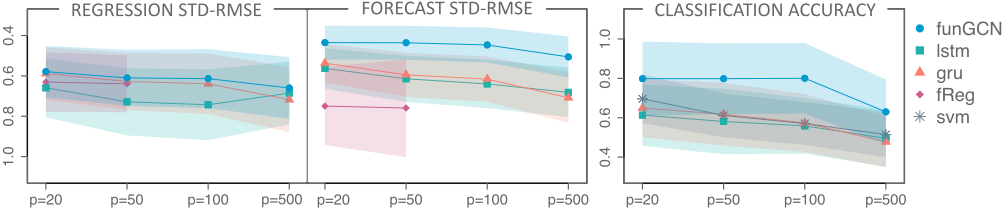
Results. The results of the simulation experiments are presented in Figure 2. For each task across varying p, the dots illustrate the average performance derived from 80 replications (20 for each target), with the width of the intervals indicating the standard deviation. In regression tasks, the performance of all algorithms is comparable, though funGCN exhibits a marginal advantage. In forecasting and classification, funGCN outperforms its competitors, which achieve similar results among themselves. These findings underline the versatility and effectiveness of funGCN across different tasks and numbers of features, even in challenging scenarios where the sample size is small relative to the number of variables.
Table 3 shows the average CPU time required for completing all replications across various tasks performed by each algorithm. The computation time for funGCN is divided into two parts: the creation of the knowledge graph and the training of the GCN module. Although the graph was recomputed for each simulation, it is important to note that this computation is required only once in real-world applications, as the graph does not need to be recomputed at inference time. svm is the most time-efficient algorithm, whereas fReg is significantly more computationally expensive. Compared to other deep learning methods, funGCN exhibits greater efficiency, particularly as the number of variables increases. Notably, for scenarios with p = 500, funGCN's inference phase even surpasses svm in speed, highlighting its efficiency in handling a large number of variables.
4 SHARE Analysis
The Survey of Health, Ageing and Retirement in Europe (SHARE) is a pivotal research project that examines the impact of health, social, economic, and environmental policies on the life course of European citizens [B¨orsch-Supan et al., 2013][Bergmann et al., 2017][B¨orsch-Supan, 2020]. SHARE stands out for its longitudinal design, tracking the same individuals across eight survey waves from 2004 to 2020. We restrict our analysis to the 1,518 participants who were part of at least seven waves, ensuring sufficient measurements for reliable curve estimation. We investigate a subset of 35 variables sample size. The interpretability columns refer to the ability to estimate i) effect of single feature on the target, ii) importance of the feature for the specific task, or iii) the global relationship between all the variables. [Notation: ⋆ indicates that funGCN is the only algorithm able to concurrently perform regression and classification of multiple target variables within just one training process; ▲ denotes that svm can handle multi-modal data only after flattening the longitudinal variables, losing the time information.]
| tasks | capability | feature interpretability | |||||||
|---|---|---|---|---|---|---|---|---|---|
| regress | classify | forecast | multi-modal | multi-entities | p > n | single effect | importance | global relation | |
| funGCN | ✓⋆ | ✓⋆ | ✓ | ✓ | ✓ | ✓ | ✗ | ✓ | ✓ |
| lstm | ✓ | ✓ | ✓ | ✗ | ✓ | ✓ | ✗ | ✗ | ✗ |
| gru | ✓ | ✓ | ✓ | ✗ | ✓ | ✓ | ✗ | ✗ | ✗ |
| fReg | ✓ | ✗ | ✓ | ✓ | ✓ | ✗ | ✓ | ✓ | ✗ |
| svm | ✗ | ✓ | ✗ | ▲ | ✓ | ✓ | ✗ | ✗ | ✗ |
20
| p | funGCNkg | funGCNinf | lstm | gru | fReg | svm |
|---|---|---|---|---|---|---|
| 20 | 0.8 | 2.5 | 4.3 | 10.8 | 472.5 | 0.1 |
| 50 | 1.8 | 2.2 | 9.7 | 18.6 | 5,006.5 | 0.2 |
| 100 | 3.5 | 2.4 | 16.8 | 25.1 | - | 0.4 |
| 500 | 16.1 | 3.1 | 80.7 | 80.8 | - | 4.7 |
0
0
2
0
2
0
2
from the EasySHARE dataset [Gruber et al., 2014], a preprocessed version of the SHARE data. These variables, which can be longitudinal, categorical, or scalar, span physical and mental health, socio-demographics, and healthcare, offering a rich dataset for comprehensive analysis - the complete list of the examined variables is reported in Appendix Table C1. 0 0 1 0 1 0 0 1
Following the strategy in [Boschi et al., 2024], we employ cubic B-splines for smoothing longitudinal variables, with knots at survey dates and a roughness penalty on the curve's second derivative. The optimal smoothing parameter is determined by minimizing the generalized cross-validation criterion [Craven and Wahba, 1978]. Despite variations in survey dates and data points across participants, this approach offers a consistent functional representation, allowing for a natural imputation of missing values and facilitating comparisons across the entire timeline.
5
0
svm
svm
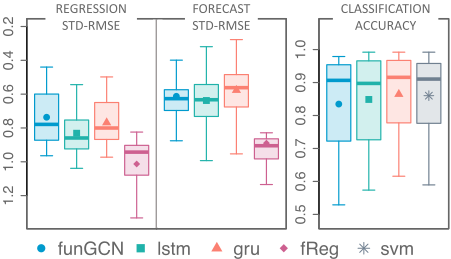
5 10 15 20 0 5 10 15 5 10 15 5 10 15 20 Figure 3: SHARE results. Boxplots generated from the distribution obtained from a total of 260 replications for regression and forecasting tasks, and 80 replications for classification - encompassing 20 replications for each target. The dots and the lines indicate the means and medians of the distributions, respectively. The y-axis for regression and forecast are inverted: higher values correspond to better performance in all the panels.
0
0
0
0
Across task results. To evaluate the algorithms' performance across the 3 different tasks, we select each of the 13 longitudinal and 4 categorical variables from the chosen 35feature subset as target variables (detailed in Appendix Table C1). We conduct 20 replications for each target, randomly splitting the 1,518 subjects into a training set of 1,139 and a test set of 379. The aggregate average results are depicted in Figure 3, while the individual targets performance are avail-
5
4
3
2
1
0
0
3
4
20
20
able in Appendix Table C2. Except for fReg, which shows lower efficacy, all methods - including funGCN - yield similar results across all evaluation metrics and tasks in this analysis. However, funGCN provides interpretable results, analyzed in the next section.
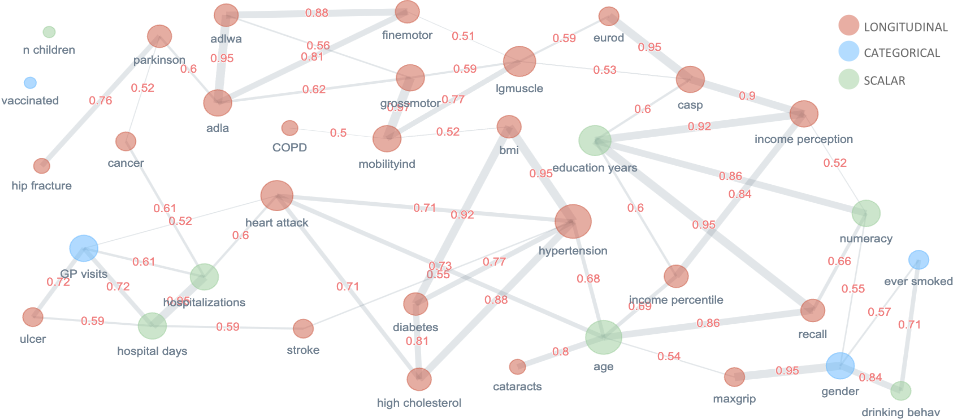
Graph Analysis. While the evaluation metrics are comparable across algorithms, funGCN provides a unique interpretability feature. Figure 4 illustrates the knowledge graph generated for all 1,518 subjects with kgraph = 3 and pruning parameter θ = 0.5. The graph unveils significant insights into the interconnection between multi-modal features, and also highlights complex relationships between health, social, and economic factors.
In particular, the graph finds connections among chronic conditions such as hypertension, heart attacks, and diabetes, demonstrating their associations with factors like body mass index (BMI) and age. This visualization highlights the diseases' intertwined nature and potential common drivers or consequences, findings confirmed by medical literature [Petrie et al., 2018][Powell-Wiley et al., 2021].
Moreover, funGCN reveals how variables describing healthcare service utilization, such as the number of general practitioner visits and hospitalizations, are interconnected. This helps to provide a clearer understanding of the healthcare engagement and utilization patterns among individuals with different health conditions [Walker et al., 2014].
Noteworthy is also the relationship between casp, a quality of life measure, and eurod, an index assessing depression levels, alongside perceptions of income and years of education. This connection underscores the multifaceted impacts of mental health, socioeconomic status, and education on overall life satisfaction [Sivertsen et al., 2015][Zanin, 2017].
Additionally, the graph spotlights the link between Parkinson's disease, hip fractures, and variables related to the subjects' mobility, such as adla (which measures the activities of daily living) and fine motor skills. This association points to the broader implications of such health conditions on individuals' independence and daily functioning [Tan et al., 2012].
Through these detailed insights, the knowledge graph serves as a tool for understanding specific health and social connections and emphasizes the value of funGCN in offering a comprehensive overview of the factors influencing health outcomes.
5 Conclusions
The proposed Functional Graph Convolutional Network (funGCN) model offers a powerful and innovative approach to analyzing complex multi-modal longitudinal data. By combining Functional Data Analysis and Graph Convolutional Networks, funGCN provides a unified framework for multitask learning and generates interpretable insights through the creation of a knowledge graph. The promising simulation experiments and a real-data application demonstrate funGCN's capability to improve the analysis of outcomes from the implementation of digital health solutions and longitudinal studies.
funGCN is an essential component of the SEURO Project that aims to enhance home-based care and self-management for older and frail adults. By identifying the most significant interconnections between variables of different natures, funGCN has the potential to provide new insights on personalized health and social care models. This can assist medical professionals and policymakers in enhancing patient wellbeing, reducing healthcare costs, and associated burden on patients services.
Future plans include expanding funGCN's applicability to a wider range of healthcare datasets and settings, incorporating more data types like imaging and genomics, and increasing model interpretability with explainable AI techniques.
Acknowledgments
The authors received funding from the European Union's Horizon 2020 research and innovation program under grant agreement No. 945449. The authors also thank their partners at IMEC for helping them access the SHARE data, and Abigail Langbridge for the useful discussions on Convolutional Graphical Networks.
@inproceedings{ijcai2024p795,
  title     = {Functional Graph Convolutional Networks: A Unified Multi-task and Multi-modal Learning Framework to Facilitate Health and Social-Care Insights},
  author    = {Boschi, Tobia and Bonin, Francesca and Ordonez-Hurtado, Rodrigo and Rousseau, Cécile and Pascale, Alessandra and Dinsmore, John},
  booktitle = {Proceedings of the Thirty-Third International Joint Conference on
               Artificial Intelligence, {IJCAI-24}},
  publisher = {International Joint Conferences on Artificial Intelligence Organization},
  editor    = {Kate Larson},
  pages     = {7188--7196},
  year      = {2024},
  month     = {8},
  note      = {AI for Good},
  doi       = {10.24963/ijcai.2024/795},
  url       = {https://doi.org/10.24963/ijcai.2024/795},
}
TY - CPAPER TI - Functional Graph Convolutional Networks: A Unified Multi-task and Multi-modal Learning Framework to Facilitate Health and Social-Care Insights AU - Boschi, Tobia AU - Bonin, Francesca AU - Ordonez-Hurtado, Rodrigo AU - Rousseau, Cécile AU - Pascale, Alessandra AU - Dinsmore, John T2 - Proceedings of the Thirty-Third International Joint Conference on Artificial Intelligence, IJCAI-24 PB - International Joint Conferences on Artificial Intelligence Organization PY - 2024 SP - 7188 EP - 7196 DO - 10.24963/ijcai.2024/795 UR - https://doi.org/10.24963/ijcai.2024/795 ER -Copied
Machine-readable versions of this paper, for tools and AI agents:





