
Empathy and AI: Achieving Equitable Microtransit for Underserved Communities
Proceedings of the Thirty-Third International Joint Conference on Artificial Intelligence. AI for Good. Pages 7179-7187.
https://doi.org/10.24963/ijcai.2024/794
Keywords
- Multidisciplinary Topics and Applications: General
- Agent-based and Multi-agent Systems: General
- AI Ethics, Trust, Fairness: General
Abstract
This paper describes a newly launched project that will produce a new approach to public microtransit for underserved communities. Public microtransit cannot rely on pricing signals to manage demand, and current approaches face the challenges of simultaneously being underutilized and overextended. This project conceives of the setting as a sociotechnical system. Its main idea is to engage users through AI agents in conjunction with platform constraints to find solutions that purely technical conceptions cannot find. The project was specified over an intense series of discussions with key stakeholders (riders, city government, and nongovernmental agencies) and brings together expertise in the disciplines of AI, Operations Research, Urban Planning, Psychology, and Community Development. The project will culminate in a pilot study, results from which will facilitate the transfer of its technology to additional communities.
- [Alonso-Mora et al., 2017] Javier Alonso-Mora, Samitha Samaranayake, Alex Wallar, Emilio Frazzoli, and Daniela Rus. On-demand high-capacity ride-sharing via dynamic trip-vehicle assignment. Proceedings of the National Academy of Sciences, 114(3):462-467, January 2017.
- [Bardaka et al., 2020] Eleni Bardaka, Leila Hajibabai, and Munindar P. Singh. Reimagining ride sharing: Efficient, equitable, sustainable public microtransit. IEEE Internet Computing, 24(5):38-44, September 2020.
- [Baumsteiger and Siegel, 2018] Rachel Baumsteiger and Ja- son T. Siegel. Measuring prosociality: The development of a prosocial behavioral intentions scale. Journal of Per- sonality Assessment, 101(3):305-314, March 2018.
- [Belk, 2016] Belk. North Carolina's economic im- perative: Building an infrastructure of opportunity. Technical report, John M. Belk Endowment, Char- lotte, NC, April 2016. https://www.belkfoundation.org/ nc-economic-imperative/. Link
- [Chopra and Singh, 2018] Amit K. Chopra and Munindar P. Singh. Sociotechnical systems and ethics in the large. In Proceedings of the AAAI/ACM Conference on Artificial In- telligence, Ethics, and Society (AIES), pages 48-53, New Orleans, February 2018. ACM.
- [Cialdini, 2009] Robert B. Cialdini. Influence: Science and Practice. Pearson, New Jersey, 5th edition, 2009.
- [Cipolina-Kun et al., 2022] Lucia Cipolina-Kun, Vahid Yaz- danpanah, Enrico H. Gerding, and Sebastian Stein. Coali- tion formation in ridesharing with walking options. In ICLR Workshop on Gamification and Multiagent Solu- tions, April 2022.
- [Dijkstra, 2008] Arie Dijkstra. The psychology of tailoring- ingredients in computer-tailored persuasion. Social and Personality Psychology Compass, 2(2):765-784, March 2008.
- [Foth et al., 2013] Nicole Foth, Kevin Manaugh, and Ahmed M. El-Geneidy. Towards equitable transit: Ex- amining transit accessibility and social need in Toronto, Canada, 1996-2006. Journal of Transport Geography, 29:1-10, May 2013.
- [Ghimire et al., 2024] Subid Ghimire, Eleni Bardaka, Kai Monast, Juan Wang, and Waugh Wright. Policy, manage- ment, and operation practices in u.s. microtransit systems. Transport Policy, 145:259-278, January 2024.
- [Kim et al., 2023] Youngseo Kim, Danushka Edirimanna, Michael Wilbur, Philip Pugliese, Aron Laszka, Abhishek Dubey, and Samitha Samaranayake. Rolling horizon based temporal decomposition for the offline pickup and delivery problem with time windows. In Proceedings of the 37th AAAI Conference on Artificial Intelligence, pages 5151- 5159, Washington, DC, February 2023. AAAI Press.
- [Laguna et al., 2020] Mariola Laguna, Zofia Mazur, Michał Ke ¸dra, and Karol Ostrowski. Interventions stimulating prosocial helping behavior: A systematic review. Journal of Applied Social Psychology, 50(11):676-696, November 2020.
- [Lindegren et al., 2021] Daniel Lindegren, Farzaneh Kare- gar, Bridget Kane, and John Sören Pettersson. An eval- uation of three designs to engage users when providing their consent on smartphones. Behaviour and Information Technology, 40(4):398-414, April 2021.
- [Liscio et al., 2022] Enrico Liscio, Michiel van der Meer, Luciano Cavalcante Siebert, Catholijn M. Jonker, and Pradeep K. Murukannaiah. What values should an agent align with? An empirical comparison of general and context-specific values. Journal of Autonomous Agents and Multi-Agent Systems (JAAMAS), 36(1):23, 2022.
- [Macfarlane et al., 2021] Gregory S. Macfarlane, Christian Hunter, Austin Martinez, and Elizabeth Smith. Rider per- ceptions of an on-demand microtransit service in Salt Lake County, Utah. Smart Cities, 4(2):717-727, May 2021.
- [Maxwell, 2012] Joseph A. Maxwell. Qualitative Research Design: An Interactive Approach. Number 41 in Applied Social Research Methods. SAGE Publications, Thousand Oaks, California, 3rd edition, June 2012.
- [Mayer et al., 1995] Roger C. Mayer, James H. Davis, and F. David Schoorman. An integrative model of organi- zational trust. The Academy of Management Review, 20(3):709-734, July 1995.
- [Moerland et al., 2023] Thomas M. Moerland, Joost Broekens, Aske Plaat, and Catholijn M. Jonker. Model- based reinforcement learning: A survey. Foundtions of Trends in Machine Learning, 16(1):1-118, 2023.
- [Murukannaiah et al., 2016] Pradeep K. Murukannaiah, Ni- rav Ajmeri, and Munindar P. Singh. Acquiring creative requirements from the crowd: Understanding the influ- ences of personality and creative potential in crowd RE. In Proceedings of the 24th IEEE International Require- ments Engineering Conference (RE), pages 176-185, Bei- jing, September 2016. IEEE Computer Society.
- [Murukannaiah et al., 2022] Pradeep K. Murukannaiah, Ni- rav Ajmeri, and Munindar P. Singh. Enhancing creativity as innovation via asynchronous crowdwork. In Proceed- ings of the 14th ACM Web Science Conference (WebSci), pages 66-74, Barcelona, June 2022. ACM.
- [Ostrom et al., 1992] Elinor Ostrom, James Walker, and Roy Gardner. Covenants with and without a sword: Self- governance is possible. American Political Science Re- view, 86(2):404-417, June 1992.
- [Schleibaum and Müller, 2020] Sören Schleibaum and Jörg P. Müller. Human-centric ridesharing on large scale by explaining AI-generated assignments. In Proceedings of the 6th EAI International Conference on Smart Objects and Technologies for Social Good (GoodTechs), pages 222-225, Antwerp, Belgium, September 2020. ACM.
- [Schwartz, 2012] Shalom H. Schwartz. An overview of the Schwartz theory of basic values. Online Readings in Psy- chology and Culture, 2(1):3-20, December 2012.
- [Shaheen and Cohen, 2018] Susan Shaheen and Adam Co- hen. Is it time for a public transit renaissance?: Navigat- ing travel behavior, technology, and business model shifts in a brave new world. Journal of Public Transportation, 21(1):67-81, 2018.
- [Shaheen et al., 2020] Susan Shaheen, Adam Cohen, Nelson Chan, and Apaar Bansal. Sharing strategies: Carsharing, shared micromobility (bikesharing and scooter sharing), transportation network companies, microtransit, and other innovative mobility modes. In Elizabeth Deakin, editor, Transportation, Land Use, and Environmental Planning, chapter 13, pages 237-262. Elsevier, 2020.
- [Simpson and Willer, 2015] Brent Simpson and Robb Willer. Beyond altruism: Sociological foundations of coopera- tion and prosocial behavior. Annual Review of Sociology, 41:43-63, August 2015.
- [Singh and Singh, 2023] Amika M. Singh and Munindar P. Singh. Wasabi: A conceptual model for trustworthy artifi- cial intelligence. IEEE Computer, 56(2):20-28, February 2023.
- [Singh, 2013] Munindar P. Singh. Norms as a basis for gov- erning sociotechnical systems. ACM Transactions on In- telligent Systems and Technology (TIST), 5(1):21:1-21:23, December 2013.
- [Singh, 2022] Munindar P. Singh. Consent as a foun- dation for responsible autonomy. Proceedings of the 36th AAAI Conference on Artificial Intelligence (AAAI), 36(11):12301-12306, February 2022. Blue Sky Track. Spreng et al., 2009]
- R. Nathan Spreng, Margaret C. McK- innon, Raymond A. Mar, and Brian Levine. The Toronto empathy questionnaire: Scale development and initial val- idation of a factor analytic solution to multiple empathy measures. Journal of Personality Assessment, 91(1):62- 71, January 2009.
- [Sunstein, 2015] Cass R. Sunstein. The ethics of nudging. Yale Journal on Regulation, 32(2):413-450, 2015.
- [Sutton and Barto, 2018] Richard S. Sutton and Andrew G. Barto. Reinforcement Learning: An Introduction. Adap- tive Computation and Machine Learning. MIT Press, Cambridge, Massachusetts, 2nd edition, 2018.
- [Tahtinen et al., 2022] Lotta Tahtinen, Naiara Costa, Yunx- iao Long, and Gwilym Roberts-Harry. SDG Good Prac- tices: A Compilation of Success Stories and Lessons Learned in SDG Implementation. United Nations Depart- ment of Economic and Social Affairs, New York, 2nd edi- tion, 2022.
- [Toukabri and Medina, 2020] Amel Toukabri and Lauren Medina. Latest city and town population estimates of the decade show three-fourths of the nation's incorporated places have fewer than 5,000 people. https://www.census.gov/library/stories/2020/05/america- a-nation-of-small-towns.html, May 2020. Accessed 2024-05-24. Link
- [Woodgate and Ajmeri, 2024] Jessica Woodgate and Nirav Ajmeri. Normative ethics principles for responsible AI systems: Taxonomy and directions. ACM Computing Sur- veys, 2024. To appear.
- [Yousaf et al., 2014] Jamal Yousaf, Juanzi Li, Lu Chen, Jie Tang, and Xiaowen Dai. Generalized multipath planning model for ride-sharing systems. Frontiers of Computer Science, 8(1):100-118, 2014.
- [Zhang-Kennedy et al., 2014] Leah Zhang-Kennedy, Sonia Chiasson, and Robert Biddle. Stop clicking on "update later": Persuading users they need up-to-date antivirus protection. In Anna Spagnolli, Luca Chittaro, and Lu- ciano Gamberini, editors, Persuasive Technology, volume 8462 of Lecture Notes in Computer Science, pages 302- 322. Springer, 2014.
References were extracted automatically from the PDF and may contain errors.
Full text extracted automatically from the PDF; figures, tables and equations may differ. The PDF is the version of record.
1 Introduction
The US has almost 19,000 cities and towns with a population of 50,000 or below [Toukabri and Medina, 2020]. In many of these small communities, (fixed-route) bus services are sparse, infrequent, and inefficient, if they exist at all. Without transit service within reach, people without personal cars (often the poor, elderly, or disabled) cannot access employment and health care [Foth et al., 2013].
By microtransit, we mean a shared, technology-enabled public transit system with flexible routing and pick-up and drop-off locations that accommodates on-demand trip requests [Shaheen et al., 2020; Shaheen and Cohen, 2018]. Trip scheduling takes place through an app. A nominal fare (similar to a bus fare) is charged for using the service [Bardaka et al., 2020]. However, the cost of providing microtransit borne by public agencies is high-it includes fees paid to a technology provider and the cost of vehicles and drivers who are typically hired on eight-hour shifts [Ghimire et al., 2024]- especially as government funding in the US for microtransit remains scarce. Thus, improving system efficiency is critical.
1.1 Deployment Context andMotivation
Our solution will be piloted in the City of Wilson (population: 40,000) in North Carolina (NC). In 2020, Wilson was the first city in NC to implement microtransit to replace their fixed route bus service. RIDE, their microtransit service, has a fleet of 18 vans and operates only on demand (i.e., no prebooking) Monday to Saturday, at $2.50 per ride. RIDE sees higher ridership than its predecessor bus service, receiving about 18,000 trip requests per month. Of these, 25% requests are not served: during peak times, riders often experience denied requests or canceled or trips. Both the increasing popularity of microtransit in small, disadvantaged communities and the challenges of high waiting times and unserved trip requests are common observations [Ghimire et al., 2024].
But why is this a significant problem? A recent survey in Wilson, conducted by Via, the current microtransit service provider, revealed that 47% of the respondents use microtransit primarily to travel to and from work, 86% are carless, 57% make less than $25K per year, and 62% are Black. Focus group discussions (elaborated in Section 2.2) revealed the daily struggles faced by users: [s]ometimes I have waited 1hr and a half to get home [from work], but I waited because I have no other option getting back and forth. One woman with a disability described trying to book a ride after her doctor's appointment unsuccessfully for over an hour and ending up traveling five miles in her wheelchair to get home not knowing if my battery's charge is going to make it.
Individual trip data corroborate these comments. Surprisingly, microtransit vans, which seat six passengers, remain highly underutilized despite high demand. RIDE serves under four trips per vehicle hour on average, and only one-third of the trips are shared with another booking.
About 60% of the riders in Wilson use microtransit for time-constrained work and medical trips. But some popular trip purposes, such as getting groceries, are more flexible; such trips could happen in off-peak periods to help reduce delays for work and medical trips. However, there is currently no mechanism to equitably manage microtransit demand. Microtransit cannot rely upon pricing signals for shifting demand as it is geared toward serving the public and not maximizing profit. Moreover, monetary incentives would exacerbate inequity by subjecting the poorest members of the user population to unconscionable pressure to alter their plans.
1.2 Vision and Objectives
Our overarching vision is to develop, test, and evaluate AIbased, community-supported solutions for distributing travel demand over time and increasing microtransit efficiency in an equitable manner. We propose applying empathy-building interventions (including persuasive messaging with factors such as reciprocity) based on real-time user information, to enable and motivate prosocial behavior [Simpson and Willer, 2015]. Examples of prosociality include shifting one's trip time by 15 minutes to more easily share a ride with someone with a fixed schedule and walking 400m to share a ride with a disabled user. A challenge is to reduce the user's cognitive burden while accommodating their preferences.
We seek to create a new paradigm for microtransit, viewing it as a computational sociotechnical system (STS) in which agents work with people to help them accomplish their goals [Singh, 2013]. The idea is to include a social tier, not merely a technical tier, as conventional AI approaches. Through this STS conception, we can promote prosocial behavior to realize smart, community-centered, and equitable microtransit. We will also leverage trip data (origin-destination pairs) and work or school schedules to develop a microtransit hybrid system that combines on-demand and scheduled trips with a monthly commuter program (for predictable shared rides).
1.3 Expected Results and Impact on UN SDGs
Our research will lead to improved microtransit. Fewer missed or delayed trips will lead to fewer missed medical appointments and lost wages. This project seeks to benefit not only the riders but also the transit agencies, leading to higher vehicle utilization (completing more trips with the same number of vehicles) and system efficiency. Through the dissemination of our research products and commercialization efforts, we seek to make a big impact on the thousands of suburban and rural U.S. communities that lack effective public transportation and improve access to opportunities for vulnerable groups. Our vision for equitable microtransit will build up local human and social capital and result in more resilient and financially sustainable microtransit systems.
Reliable and stress-free transportation will improve the lives of disadvantaged workers and students, and the prosocial acts motivated through this research will strengthen community membership, emotional safety, and a sense of belonging. Therefore, our research directly contributes to UN Sustainable Development Goals 8 (Promote sustained, inclusive and sustainable economic growth, full and productive employment and decent work for all) and 11 (Make cities and human settlements inclusive, safe, resilient and sustainable), and specifically Subgoal 11.2 (By 2030, provide access to safe, affordable, accessible and sustainable transport systems for all, improving road safety, notably by expanding public transport, with special attention to the needs of those in vulnerable situations, women, children, persons with disabilities and older persons) [Tahtinen et al., 2022].
The societal impact of our research is enhanced by its intended deployment in Wilson. Wilson is the city with the lowest intergenerational mobility in NC and one of the lowest in the US [Belk, 2016], so any improvement in access to work, healthcare, and education will yield high rewards.
2 Overview and Research Challenges
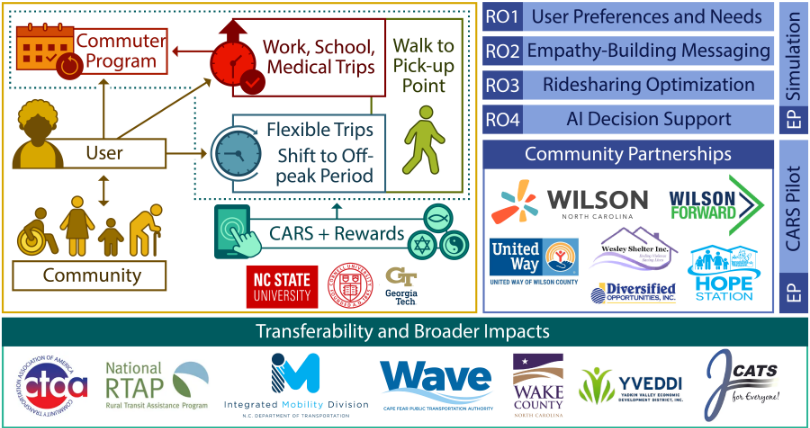
Figure 1 shows an overview of this project and the strategy we adopt to improve microtransit. To manage microtransit trip requests equitably and reduce waiting times and canceled trips, we will enable users to make choices while considering the constraints of other users and the system overall through a Cooperative Adaptive Ride-Sharing (CARS) system. A contribution of our work is the novel integration of on-demand fleet management algorithms with AI to allow for user schedule flexibility, preferences, and constraints.
2.1 Community Engagement
Our primary community partner, the City of Wilson, is conveniently located within a 50-minute drive from Raleigh, where NC State University (the hub of this project) is located. We developed our research goals based on virtual and in-person meetings with City of Wilson personnel, a workshop with key stakeholders, and focus group sessions as described next.
Despite Wilson being a disadvantaged community, it embraces innovation and is the first in NC to implement microtransit. Our partnership with community-based organizations (CBOs) helps ensure that their members' needs are reflected in our research and that data collection and pilot participation are inclusive. Among these agencies are (1) United Way of Wilson, a network of local agencies and nonprofits that work for the health, education, and financial stability; (2) Hope Station, a hub of support for families in crisis through food, shelter, housing, and emergency support; (3) Diversified Opportunities, a nonprofit that provides training and job placement for individuals with disabilities so that they enhance their independence in the community; and (4) Wesley Shelter, a nonprofit for victims of domestic and sexual violence.
We have partnered with the Wilson Economic Development Council and Wilson Forward, which bring together the business sector in Wilson and provide workforce development. We will engage these community stakeholders in our research through workshops, online updates, recruitment of research participants, industry focus groups, app prototype testing, and pilot education.
2.2 Focus Groups for Riders
Focus groups are an established way to understand how user needs [Maxwell, 2012]. We advertised our groups through a video played in the RIDE vans, a pop-up message on the RIDE app, and our community partners. 165 microtransit users signed up for the five focus group sessions we organized in Wilson, NC (NC State University eIRB# 25553). We confirmed 32 participants, paying each of them $100 as a research incentive. To ensure that the discussions were effective, we invited six or seven participants to each session. In each session, participants completed a short survey, followed by 45 minutes of discussion. The sample was predominantly female (63%) and diverse (78% African American) with a mean age of 49 (age range: 27-70). The majority (97%) reported using microtransit 2-5 times per week. While the waiting times given by the participants range between 30 minutes to an hour, some try to schedule their rides in advance to offset any delays: I have to be at work at 5:00, so I try to set my ride at least about 3:50 because I know sometimes it might have a delay due to other pickups. Others described cycles of canceled and rescheduled rides: I might get a ride that says 30 minutes for the person, ok, I'm sitting there, wait, wait, wait. Get down to 12 minutes, then cancel that and put me over to another person. That person I wait for 20 minutes. Gets down to five minutes, they cancel that, then give me another person.
Many participants expressed flexibility in their trips and were willing to prioritize vulnerable others over their own schedules: time is on my side, man, I got all the time; if a person in a wheelchair has a doctor's appointment, then that's a priority. Willingness to walk varied from a block or two to half a mile and depended on individual attributes, weather, and safety: I'm low vision; Ain't a fan of the rain; and, The doctor has told me that they want me to get some exercise. Most participants were willing to share personal information through the app, and a few emphasized that sharing personal information should be optional. When asked about a rewards program to recognize volunteers, many participants agreed it is a good idea, but many others said it is not needed: kindness does not cost anything; I wouldn't really care. I mean, if someone needs help, I'll try my best to help them out. It's not really a matter of getting something in return; and, we don't need no incentives, just to help somebody out.
The participants welcomed the idea of prebooking multiple rides based on weekly schedules: That's what I want. I need that and All of these different manufacturing pods around town that would run consistent with the shifts could have a lot of appeal because multiple people are using RIDE to get to the same place at the same time.
City of Wilson personnel corroborated the high waiting times and the inability to book rides during peak hours. And a discussion with microtransit drivers revealed that the current solution fails to consider the local traffic and road characteristics, creating unsafe crossings and walk requests.
3 Concept of Operations and Research Questions
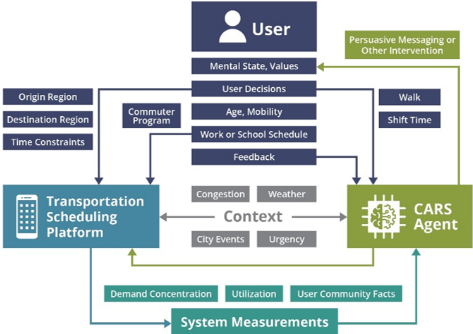
Figure 2 illustrates our concept of operations. A user first creates an app profile (age, disability, mobility constraints, work or school schedule, traveling with children often). Then, when requesting a trip, the user is asked about its purpose. If the volume of trip requests is high, we will motivate users to move flexible trips to off-peak periods and walk more to catch a ride, when appropriate, using empathy-building messages and social rewards. The scheduling platform takes context information (weather, time of day) and user data and gives the CARS AI agent a set of optimal options based on system efficiency goals. The CARS agent creates messaging (with or without rewards) for these options while accounting for context and user attributes and preferences. It offers these options (up to two or three to avoid being an annoyance) to the user, potentially either serially or in pairs shown on a map.
In CARS, users are asked to indicate their trip purpose when requesting a trip and receive empathy-building messaging that encourages them to move potentially flexible trips (shopping, errands, social, or recreational trips) to off-peak periods to help others with work, school, or medical trips reach their destinations on time. Messaging will be designed to ethically promote prosocial behavior. We will test the effectiveness of messaging strategies to incentivize prosocial behavior without immediate return, as well as a rewards program that provides karma points for priority rides and recognizes users who cooperate by being flexible.
Previous AI approaches to ride assignments are limited to some user preferences (driver competence, vehicle safety) [Schleibaum and M¨uller, 2020; Yousaf et al., 2014] or economic incentives [Cipolina-Kun et al., 2022]. No previous research has explored empathy and prosocial behavior in the context of decision making by riders. Our AI agents will provide decision support: they will learn users' preferences and produce small, tailored sets of scheduling options to reduce the cognitive burden on users.
Ridesharing can help reduce canceled trips and time spent waiting for a ride. Therefore, CARS will provide scheduling options involving walking and will motivate riders who can walk to walk further to catch a ride and those who are flexible in time to delay or advance their rides. Microtransit systems already include walking but ignore the local, temporal, and personal circumstances that deter individuals from walking [Ghimire et al., 2024]. CARS will incorporate weather, time of day, pedestrian safety, and user constraints (disability, mobility constraints, traveling with young children). CARS will include psychologically validated messaging strategies based on empathy and health.
The foregoing conception leads us to six main research questions, which will guide the intellectual contributions underlying the practical deployment:
- RQ1 Which factors are important to a user in deciding to adjust their schedule or walk in various contexts?
- RQ2 How can we bring forth prosocial rider preferences that lead to improved system-level outcomes?
- RQ3 What high-capacity ridesharing algorithms accommodate on-demand and scheduled rides, user flexibility, and a commuter program for microtransit?
- RQ4 How can we integrate AI-based user models with optimization algorithms to support prosociality by riders?
- RQ5 How can education through partnerships with community-based organizations help overcome adoption barriers in public microtransit?
RQ6 How can we predict and assess the effects of various innovations prior to (costly in time and effort) microtransit software development and implementation?
Messages to riders are based on system measurements (real-time or recent, anonymous information from the community of users) and seek to motivate prosociality and do so transparently. They will reflect average statistics (e.g., a 10% increase in shared trips last week reduced waiting time by up to 20 minutes), specific group information (e.g., 20 users shifted their trips today to help people trying to get to work), facts about a specific user (e.g., you benefited from another user shifting her trip time last week or walk for five minutes to be picked up with a user who is on a wheelchair), or general facts (e.g., the health benefits of walking). The CARS agent learns from the user responses; it tailors the messaging and sends information to the optimizer (e.g., to focus on options within the next two hours for this flexible user). The CARS agent receives feedback from the user directly and incorporates it into the user model.
As envisioned, users may request rides on-demand, schedule them, or indicate their willingness to participate in a subscription-based commuter program. The scheduling platform arranges commuters on fixed-schedule rides by identifying common desired arrival times, origins, and destinations. Users can submit a work or school schedule revision up to once a week; such revisions trigger an update in the subscription-based ride allocations. The commuter program seeks to offer stable, low-stress transportation to work or school (and back home) by grouping people with similar origins, destinations, and schedules.
4 Method: Integrating Research and Practice
We introduce our objectives, evaluation style, and pilot study.
4.1 Research Objectives
We now present the main research objectives of this project.
RO1: Understanding User Needs and Preferences
Few extant studies consider individual preferences and travel behavior in microtransit; most are limited to willingness to adopt the service [Macfarlane et al., 2021]. We will survey microtransit users to collect information on sociodemographics, how frequently they use the service and for what purposes, satisfaction and the challenges currently faced, their flexibility of schedule by trip purpose and if and how often they are willing to alter plans, their work or school schedule, the earliest and latest arrival to their appointments, how far users are willing to walk to catch a ride and under which conditions, preferences related to scheduling trips, eligibility and need for a commuter service, and their willingness to share personal information with the microtransit app. The outcomes of RO1 will serve as input to the design of messaging strategies in RO2. We will include an empathy questionnaire, based on Baumsteiger and Siegel's [2018] Prosocial Behavioral Intentions Scale and Spreng et al.'s [2009] Toronto Empathy Questionnaire, to identify the users' potential to empathize with other users. The surveys will be administered through the microtransit app and call center, and help address RQ1 (stated in Section 3).
RO2: Empathy-Building Messaging
We seek to promote prosocial behavior within a public microtransit system where users engage in helping behaviors to benefit others [Laguna et al., 2020]. Because prosocial behaviors rely on cognitive as well as affective processes, empathetic concern for others makes it easier for an individual to feel compassion for someone in need thereby eliciting helping behavior [Laguna et al., 2020]. Persuasive message design has been studied in a variety of contexts, e.g., [Cialdini, 2009; Zhang-Kennedy et al., 2014], but not for empathybuilding in the context of transportation.
Our focus groups confirmed that prospective riders are empathetic towards others, willing to adjust trips for others they consider to be a higher priority, and like walking for exercise. However, people's thresholds for walking distances vary based on certain factors such as weather and mobility constraints. These thresholds (identified in RO1), as well as the empathetic messages a person responds to, will be used to design effective messaging. We will develop an iterative design process (design, test, and repeat) to build prototype messages that cause low inconvenience and make empathetic suggestions. We will convene a series of small focus groups (45-50 users) to engage in participatory design using storyboards to generate messaging strategies that build upon Dijkstra [2008]. Prototype messages designed to facilitate the prosocial behavior of altering rides will be continually redesigned and improved (removing strategies that do not work).
To answer RQ2, we will study how the individual characteristics of users can be persuaded by technology. What messages will be most effective in convincing users to walk a bit further or shift their trip time for the benefit of another person? The answer to this question lies in tailoring the message to the individual user through techniques such as personalization, adaptation, and feedback [Dijkstra, 2008].
RO3: Fleet Scheduling and Rider Assignment
We begin by describing the high-level fleet management framework that will be extended to achieve the goals of this project. We consider a model where passenger requests arrive online and require real-time assignment to a vehicle. Each passenger has a maximum time they are willing to wait prior to pick up, a maximum delay, and a maximum walking distance. These constraints can be specific to rider and context (e.g., whether traveling with children and the weather conditions). There is a fixed fleet of on-demand vehicles with each vehicle having a corresponding vehicle capacity.
We will begin from our recent framework [Alonso-Mora et al., 2017] that enables tractable solutions (15-60 second computation time) even to large-scale instances (e.g., New York City), by decomposing the underlying Dynamic Vehicle Routing Problem (VRP) with time windows as follows: (1) Solve a large number of generalized Traveling Salesman Problems (TSP) to identify feasible trips. This can be done efficiently via a shareability network (a graph construction where a node corresponds to a request and an edge connecting two nodes implies that the corresponding requests can share a ride) due to the downward closed nature of feasible trips. (2) Solve an assignment integer linear problem (ILP) to maximize how many riders can be served.
A key feature of CARS is to enhance opportunities for shared rides by increasing spatial and temporal flexibility based on ride type and the network state. Specifically, incorporating a new class of riders who are flexible about pickup or dropoff time and location can improve system efficiency. The system needs to manage its capacity such that there is reserve capacity to accommodate inflexible riders whenever a request is made (assuming that the fleet size is large enough). Therefore, we will design a fleet optimization algorithm to accommodate multiple objectives (e.g., maximize total ridership, guarantee inflexible trips to the extent possible, and minimize waiting time). The new features will be incorporated by generalizing the third step of the high-capacity ridesharing framework [Alonso-Mora et al., 2017] to a generalized TSP allowing flexible pickup points and times. Doing so greatly increases the complexity of the TSP problem and requires developing effective heuristic strategies specific to our setting. The assignment problem must also be modified to incorporate the more complex multiobjective setting, which includes parameter tuning for the right tradeoff between the objectives.
CARS will incorporate scheduled trips (e.g., day-ahead) and a commuter program. We will identify commuters with common spatiotemporal attributes (e.g., pick-up points, dropoff points, and time of day) as eligible candidates for the commuter program. Doing so introduces complexity as some rides are scheduled in advance, while some are requested in real-time. A naive approach would be to split the fleet into vehicles that serve the advanced bookings and those that serve on demand, but we aim to combine these offerings and serve both types of customers with the same fleet to increase efficiency. We will extend our offline solution framework [Kim et al., 2023] for scheduled rides while preserving capacity for on-demand requests. The scheduler will coordinate with the AI agent (RO4) to capture the requirements of each request, determine what capacity to set aside for the expected inflexible riders in the future, and provide feedback to the AI agent on the state of the fleet. In this way, we will address RQ3 by introducing algorithms that go beyond existing method to tackle new community-oriented constraints.
RO4: AI-Based Decision Support
To answer RQ4, we will bridge the psychological user modeling (RO2) and the transportation optimization (RO3) objectives. We will develop AI agents that learn user preferences while trying to shift those preferences toward prosociality. Preferences depend upon the context (is it rainy, dark, or cold?) as well as values (introduced below). An agent will motivate its user to move flexible trips to off-peak periods with the application of three kinds of persuasion techniques: (1) changing the choice architecture, as in nudge theory [Sunstein, 2015], by designing effective user interfaces; (2) persuasive messaging [Cialdini, 2009] geared toward a user's values, including empathy and health (gleaned from RO2); and (3) social rewards such as karma points. Each of these techniques requires intelligence, as described below.
A possible use of choice architecture is to present the user with choices that make societally desirable decisions easier. For example, consider a rainy day, when few people are ready to walk (and thus the load on the CARS service is high). If a user asks for a ride to a grocery store, we can open the timeselection interface to the next day and display weather forecast icons for the next few mornings and afternoons. Users would naturally opt for a bright day if their trip were flexible. Or, if a user asks for a ride to an errand at 3:00, we can show them the load for various options along with options where the load is light. To generate effective persuasive messages for a user, we need to learn their values and preferences. Users may be persuaded by empathy for the elderly, families with young children, or those with disabilities. But they may also have other concerns. Suggesting that a user walk in the dark merely because they value health may cause frustration if they have safety concerns, but asking if they can take their trip earlier or later may be appropriate.
To generate karma points for a user, we need to know how much their flexibility benefits the system. Karma points serve as an incentive mechanism because they pay off in future interactions, but they also contribute to the persuasion strategies of social proof (all your neighbors are flexible) and competition (leaderboard) [Cialdini, 2009]. These computations rely on reasoning about users and the system state together: what choices to prioritize, what messages to prefer, and what benefits would accrue to the system from a user's flexibility. RO4 will thus apply model-based reasoning. Knowing the vehicles and rides in progress, the systemmodel (RO3) can tell us the benefits of any intervention under consideration in RO4.
We will initialize a user model based on RO1 outcomes and registration data: age and mobility constraints, sex (which correlates with personal safety concerns), and values. Values are matters of personal belief and identity that motivate people. Some values are regarded as universal (e.g., safety, benevolence, and conformity) [Schwartz, 2012], though, in general, each person may prioritize them differently. Recent research suggests that values are better understood as contextsensitive [Liscio et al., 2022]. For CARS, therefore, we will model relevant values beginning with helping others, promoting health, independent living, and general civic sense. We will combine these values with the persuasion strategies introduced in RO2. For example, benevolence maps to helping others, including the elderly, and conformity maps to receptivity to persuasion by social proof. Feedback from users will be used to recalibrate each user's agent. User feedback about unsafe crossings and waiting points will provide a basis for assessing the safety impacts of different alternatives.
The computational method used in RO4 would be modelbased reinforcement learning (RL) [Moerland et al., 2023; Sutton and Barto, 2018]. Whereas model-free RL seeks to learn optimal policies essentially by trial and error, modelbased RL seeks to exploit and maintain a model of the environment. In general, obtaining an effective model can be difficult. Fortunately, the present setting provides two sources to together form the CARS model. The first is the transportation model created in RO3. This model makes naive but generally effective assumptions about ride requests being combinable based on the distance between them. It can typically produce good estimates of how long it would take to pick up and drop off a rider given their origin and destination. RO4 will thus figure out the net benefit to the system of successful persuasion. By figuring out the users' willingness to walk or shift their time window, RO4 will produce a more realistic estimate of ride-request compatibility than the naive distanceonly formulation in transportation models. Lastly, by persuading some users, RO4 affects the system state, which affects the model predictions for other users.
RO4 will be seeded by the user studies in RO1 and RO2. Users' self-reports of their flexibility in different circumstances can be used to initialize the prediction model, i.e., by naively ignoring interactions between attributes. As CARS is deployed and actual user experience is observed, the prediction model can begin to capture dependencies between the factors. For example, darkness and cold may matter for a specific user much more than either factor individually. RO4 will interface with RO3 to determine explanations to share with users. These explanations can be based on calculating alternative outcomes from the optimization model and reporting the benefits of a user's flexibility. The explanations could be based on system status (how many work trip requests are pending) or statistical metrics, such as spatiotemporal demand concentration (SDC). We can inform the user that delays are likelier because of the high SDC in their neighborhood and that they earn high karma points because their action lowers the SDC substantially.
4.2 Continual Evaluation
As a lead-up to the pilot, we will evaluate CARS continually through simulation and small-scale user studies.
Simulation We will develop a simulation testbed to assess service designs in streamlined operational scenarios, including shifting trips to off-peak periods, increasing walking, and a commuter program. The simulation can be run with existing trip microdata from Wilson that we have access to. We will vary the simulation parameters to test the sensitivity of results to user behavior but we will also use the RO1 outcomes to simulate user preferences. We will perform sensitivity analyses on the benefits of flexibility, the potential for some users to exploit others and the gains due to prosocial interventions under different system loads.
Testing the microtransit app The measures of success are usability and user satisfaction. These will be tested with varying levels of realism, including wireframe designs, a partially implemented app, and a full-featured app, by university students. We will score the ease of performing key tasks, such as booking and canceling rides. Full-featured prototypes will be tested by community stakeholders and by a focus group of 40 microtransit users in Wilson to help us identify points of confusion, and lead to improvements in design.
4.3 CARS Pilot Deployment
Our pilot in Wilson will use three minivans (compliant with the Americans with Disabilities Act to ensure support for riders with disabilities), drivers, call-center personnel, and other local staff over a four-month period. A between-subjects factorial design will be used to manipulate the presence of a persuasive message (yes or no) and enrollment in the reward program (yes or no). The pilot will occur in the same service area and service hours as the existing microtransit system to allow for comparisons, when appropriate.
A mobile app that integrates the CARS optimization algorithms and AI agent will leverage the front-end and software infrastructure of a successful microtransit pilot (MARTA Reach) in Atlanta. With the help of our community partners and advertisement through social networks and the existing service (RIDE), our goal will be to recruit 1,000 participants. To educate participants in using the pilot system (RQ5), we will engage in multiple modalities that scaffold participants' learning in using CARS. We will log user requests, agent interventions, and system snapshots.
Success measures for the pilot are service performance, behavioral change, user satisfaction, and equity. The betweensubjects factorial design of the pilot enables comparisons between control and treatment groups of CARS users to assess the success of the empathy-building messaging and rewards program. To assess the success of the CARS pilot in comparison to RIDE (the existing microtransit service in Wilson), we will strive to ensure that the trip requests per vehicle-hour between the two systems are similar. Trip microdata and user surveys (to be administered to both CARS and RIDE users during the pilot period) will be used for the assessment.
5 Scalability and Economic Sustainability
We have partnered with national, state, and regional organizations to disseminate our findings and products and create a greater network for the exchange of microtransit research and practice. Our collaboration with the Community Transportation Association of America (which houses the National Center for Applied Transit Technology) gives us access to a nationwide network of small transit agencies, which could help through improved training and technical assistance based on our research outcomes. The National Rural Transit Assistance Program will serve as our connection to rural communities across the US and have an advising role in this project, given their rural transit expertise. We are bringing together seven public agencies in the US Southeast that have implemented microtransit and the NC Department of Transportation to form a regional microtransit working group to share research and practice updates, provide feedback, and help us refine our vision for learning-centered commercialization.
This project has pathways for commercialization through federal (NSF Partnerships for Innovation program, the NSF America's Seed Fund) and university (Chancellor's Innovation Fund) programs. A potential startup will develop microtransit software that can be configured and adapted to specific communities. NC State University's Office of Research Commercialization and similar organizations at Cornell and Georgia Tech will help with technology transfer and obtain seed funding for commercial development.
With the success of the pilot, this project could be ported to new communities. Funding may come from local partners who see benefits from microtransit. For example, local employers may be willing to help sustain a commuter program for their workers. Such a program aligns with the local initiative of the Wilson Workforce Alliance, a program by Wilson Forward (an NGO) seeking to connect the Wilson youth to employment and opportunity. We will leverage such connections to identify ways to jointly fund a commuter program.
6 Conclusions
Microtransit is societally important and puts forth an interesting set of research problems. A publicly funded service is most beneficial in locales with a disadvantaged, carless population [Ghimire et al., 2024]. Success depends on uniting AI with operations research, urban planning, psychologically inspired user modeling and community engagement. This project brings all these elements together in a novel way.
We formulate general hypotheses about the scalability and transferability of our innovations: (1) demand management strategies that motivate prosocial behavior will more easily transfer to small cities and towns, where the sense of community is strong, (2) accounting for individual and contextual constraints in microtransit vehicle access is scalable and transferable in multiple settings, but the specific constraints may vary across locales, and (3) commuter programs will be higher in areas where employment clusters are of medium sizes and spread out. To assess these hypotheses, we will expand our survey and analysis of user preferences and needs (RO1) to five to seven additional microtransit systems located in various geographies and serving diverse populations. In this manner, we will identify the local conditions that increase each project component's transferability and scalability potential and accordingly direct future efforts.
7 Directions
Although we adopt participatory design, for renewal and sustainability of the service, we will consider more sophisticated methods that engage the public as a source of creative design ideas [Murukannaiah et al., 2016; Murukannaiah et al., 2022]. In addition, this project brings up challenges in ethics and responsibility. Among these are (1) the trustworthiness of the agents (and scheduler) [Singh and Singh, 2023] regarding their ability, benevolence, and integrity [Mayer et al., 1995], and (2) ensuring fairness across users, nuanced with prioritizing those in greatest need [Woodgate and Ajmeri, 2024].
CARS faces the challenge of potential antisocial behavior by some. We can combat certain kinds of antisocial behavior through social mechanisms. For example, by revealing minimal information, such as a trip's stated purpose, to the driver and other riders in the same car, we can exert social pressure on those who might have lied about the purpose. When microtransit is viewed as a community resource, selfgovernance by the community (through norms and sanctions) can be effective, as shown by the Nobel laureate, Elinor Ostrom et al. [1992]. Microtransit hits the sweet spot for developing a new sociotechnical approach because it is both societally impactful and valuable and is structurally simpler than many other civic services. Generalizing from microtransit to other civic services may require additional consideration for macro-level ethics in STSs [Chopra and Singh, 2018].
Small cities and towns like Wilson have a strong sense of community and empathy between their members, something that we witnessed in our interactions with riders, drivers, and CBOs. By engaging our partners within Wilson and beyond, we will continue refining our research direction, assess the transferability of our innovations, and disseminate our findings at the local, regional, and national levels.
Ethics Statement
One potential risk with any transit service is a rider's privacy loss, including information about their origin and destination addresses (e.g., if someone is going to a cardiologist's office) and times as well as their appearance and what might be inferred from it (e.g., if they are wearing scrubs or not when going to a medical office). This information would be revealed to providers and their staff and potentially to fellow riders and those waiting for a ride (as at a bus stop). CARS faces this risk as well. Please note that an alternative would be a fixed-route bus service (in which people can see each other and where pickup and dropoff stops and times may be logged on a travel pass) or a commercial taxi service or commercial ride-sharing service (in each of which, a rider's addresses and travel times are revealed to the service provider and their staff). CARS potentially faces an additional privacy risk, e.g., if a rider reveals their health condition to receive a pickup with reduced walking. We will control this risk by letting riders choose what information to share and whether it may be disclosed to other riders.
The main new ethical risk introduced by CARS is that the empathy-producing persuasive messaging and choice architecture modifications that we apply might end up manipulating users. We control this risk by limiting the extent of the objectives achieved through such interventions. For example, no one would be asked to walk an excessive distance. Moreover, a user can always decline any suggestion made to them. In addition to modeling valid consent [Singh, 2022] and adopting best human-computer interaction practices for consent [Lindegren et al., 2021], we will benefit from collaborating with community organizations to ensure that user consent is genuine.
The research components of this project will comply with an IRB process at the partner universities.
Acknowledgments
Thanks to Rodger Lentz and Gronna Jones of the City of Wilson for the invaluable discussions and data that made this project possible. Thanks also to Divya Sundaresan for helpful discussions on preliminary research and Akhira Watson for help in conducting the focus group studies. Thanks to the NSF for support under the Smart Cities and Communities (SCC) program through a Planning Grant (SCC-2125447) and an Integrative Research Grant (SCC-2325720).
@inproceedings{ijcai2024p794,
  title     = {Empathy and AI: Achieving Equitable Microtransit for Underserved Communities},
  author    = {Bardaka, Eleni and Van Hentenryck, Pascal and Lee, Crystal Chen and Mayhorn, Christopher B. and Monast, Kai and Samaranayake, Samitha and Singh, Munindar P.},
  booktitle = {Proceedings of the Thirty-Third International Joint Conference on
               Artificial Intelligence, {IJCAI-24}},
  publisher = {International Joint Conferences on Artificial Intelligence Organization},
  editor    = {Kate Larson},
  pages     = {7179--7187},
  year      = {2024},
  month     = {8},
  note      = {AI for Good},
  doi       = {10.24963/ijcai.2024/794},
  url       = {https://doi.org/10.24963/ijcai.2024/794},
}
TY - CPAPER TI - Empathy and AI: Achieving Equitable Microtransit for Underserved Communities AU - Bardaka, Eleni AU - Van Hentenryck, Pascal AU - Lee, Crystal Chen AU - Mayhorn, Christopher B. AU - Monast, Kai AU - Samaranayake, Samitha AU - Singh, Munindar P. T2 - Proceedings of the Thirty-Third International Joint Conference on Artificial Intelligence, IJCAI-24 PB - International Joint Conferences on Artificial Intelligence Organization PY - 2024 SP - 7179 EP - 7187 DO - 10.24963/ijcai.2024/794 UR - https://doi.org/10.24963/ijcai.2024/794 ER -Copied
Machine-readable versions of this paper, for tools and AI agents:





