
Effective High-order Graph Representation Learning for Credit Card Fraud Detection
Proceedings of the Thirty-Third International Joint Conference on Artificial Intelligence. AI for Good. Pages 7581-7589.
https://doi.org/10.24963/ijcai.2024/839
Keywords
- Data Mining: General
- Multidisciplinary Topics and Applications: General
Abstract
Credit card fraud imposes significant costs on both cardholders and issuing banks. Fraudsters often disguise their crimes, such as using legitimate transactions through several benign users to bypass anti-fraud detection. Existing graph neural network (GNN) models struggle with learning features of camouflaged, indirect multi-hop transactions due to their inherent over-smoothing issues in deep multi-layer aggregation, presenting a major challenge in detecting disguised relationships. Therefore, in this paper, we propose a novel High-order Graph Representation Learning model (HOGRL) to avoid incorporating excessive noise during the multi-layer aggregation process. In particular, HOGRL learns different orders of \emph{pure} representations directly from high-order transaction graphs. We realize this goal by effectively constructing high-order transaction graphs first and then learning the \emph{pure} representations of each order so that the model could identify fraudsters' multi-hop indirect transactions via multi-layer \emph{pure} feature learning. In addition, we introduce a mixture-of-expert attention mechanism to automatically determine the importance of different orders for jointly optimizing fraud detection performance. We conduct extensive experiments in both the open source and real-world datasets, the result demonstrates the significant improvements of our proposed HOGRL compared with state-of-the-art fraud detection baselines. HOGRL's superior performance also proves its effectiveness in addressing high-order fraud camouflage criminals.
- [Bhattacharyya et al., 2011] Siddhartha Bhattacharyya, San- jeev Jha, Kurian Tharakunnel, and J Christopher Westland. Data mining for credit card fraud: A comparative study. Decision support systems, 50(3):602-613, 2011.
- [Bo et al., 2021] Deyu Bo, Xiao Wang, Chuan Shi, and Huawei Shen. Beyond low-frequency information in graph convolutional networks. In Proceedings of the AAAI con- ference on artificial intelligence, volume 35, pages 3950- 3957, 2021.
- [Burrell, 2016] Jenna Burrell. How the machine 'thinks': Understanding opacity in machine learning algorithms. Big data & society, 3(1):2053951715622512, 2016.
- [Cheng et al., 2020] Dawei Cheng, Xiaoyang Wang, Ying Zhang, and Liqing Zhang. Graph neural network for fraud detection via spatial-temporal attention. IEEE Transac- tions on Knowledge and Data Engineering, 34(8):3800- 3813, 2020.
- [Cheng et al., 2023] Dawei Cheng, Yujia Ye, Sheng Xiang, Zhenwei Ma, Ying Zhang, and Changjun Jiang. Anti- money laundering by group-aware deep graph learning. IEEE Transactions on Knowledge and Data Engineering, 2023.
- [Chien et al., 2021] Eli Chien, Jianhao Peng, Pan Li, and Ol- gica Milenkovic. Adaptive universal generalized pager- ank graph neural network. In International Conference on Learning Representations, 2021.
- [Dong et al., 2021] Yushun Dong, Kaize Ding, Brian Jala- ian, Shuiwang Ji, and Jundong Li. Adagnn: Graph neural networks with adaptive frequency response filter. In Pro- ceedings of the 30th ACM Conference on Information and Knowledge Management, pages 392-401, 2021.
- [Dou et al., 2020] Yingtong Dou, Zhiwei Liu, Li Sun, Yu- tong Deng, Hao Peng, and Philip S Yu. Enhancing graph neural network-based fraud detectors against camouflaged fraudsters. In Proceedings of the 29th ACM Conference on Information and Knowledge Management, pages 315-324, 2020.
- [Feng et al., 2020] Wenzheng Feng, Jie Zhang, Yuxiao Dong, Yu Han, Huanbo Luan, Qian Xu, Qiang Yang, Evgeny Kharlamov, and Jie Tang. Graph random neu- ral networks for semi-supervised learning on graphs. Advances in neural information processing systems, 33:22092-22103, 2020.
- [Fiore et al., 2019] Ugo Fiore, Alfredo De Santis, Francesca Perla, Paolo Zanetti, and Francesco Palmieri. Using gen- erative adversarial networks for improving classification effectiveness in credit card fraud detection. Information Sciences, 479:448-455, 2019.
- [Fu et al., 2016] Kang Fu, Dawei Cheng, Yi Tu, and Liqing Zhang. Credit card fraud detection using convolutional neural networks. In International Conference on Neural Information Processing, 2016.
- [Hamilton et al., 2017] Will Hamilton, Zhitao Ying, and Jure Leskovec. Inductive representation learning on large graphs. Advances in neural information processing sys- tems, 30, 2017.
- [He et al., 2016] Kaiming He, Xiangyu Zhang, Shaoqing Ren, and Jian Sun. Deep residual learning for image recog- nition. In Proceedings of the IEEE conference on computer vision and pattern recognition, pages 770-778, 2016.
- [He et al., 2021] Mingguo He, Zhewei Wei, Hongteng Xu, et al. Bernnet: Learning arbitrary graph spectral filters via bernstein approximation. Advances in Neural Information Processing Systems, 34:14239-14251, 2021.
- [Kingma and Ba, 2015] Diederik Pieter Kingma and Jimmy Ba. Adam: A method for stochastic optimization. In Inter- national Conference on Learning Representations, 2015.
- [Kipf and Welling, 2016] Thomas Nikolaus Kipf and Max Welling. Semi-supervised classification with graph convo- lutional networks. In International Conference on Learn- ing Representations, 2016.
- [Li et al., 2018] Qimai Li, Zhichao Han, and Xiao-Ming Wu. Deeper insights into graph convolutional networks for semi-supervised learning. In Proceedings of the AAAI con- ference on artificial intelligence, volume 32, 2018.
- [Li et al., 2019] Guohao Li, Matthias Muller, Ali Thabet, and Bernard Ghanem. Deepgcns: Can gcns go as deep as cnns? In Proceedings of the IEEE/CVF international conference on computer vision, pages 9267-9276, 2019.
- [Liu et al., 2018] Ziqi Liu, Chaochao Chen, Xinxing Yang, Jun Zhou, Xiaolong Li, and Le Song. Heterogeneous graph neural networks for malicious account detection. In Proceedings of the 27th ACM international conference on information and knowledge management, pages 2077- 2085, 2018.
- [Liu et al., 2020] Zhiwei Liu, Yingtong Dou, Philip S Yu, Yutong Deng, and Hao Peng. Alleviating the inconsistency problem of applying graph neural network to fraud detec- tion. In Proceedings of the 43rd ACM SIGIR Conference on Information Retrieval, pages 1569-1572, 2020.
- [Liu et al., 2021] Yang Liu, Xiang Ao, Zidi Qin, Jianfeng Chi, Jinghua Feng, Hao Yang, and Qing He. Pick and choose: a gnn-based imbalanced learning approach for fraud detection. In Proceedings of the web conference 2021, pages 3168-3177, 2021.
- [Luque et al., 2019] Amalia Luque, Alejandro Carrasco, Alejandro Martín, and Ana de Las Heras. The impact of class imbalance in classification performance metrics based on the binary confusion matrix. Pattern Recogni- tion, 91:216-231, 2019.
- [Ma et al., 2023] Jiacheng Ma, Fan Li, Rui Zhang, Zhikang Xu, Dawei Cheng, Yi Ouyang, Ruihui Zhao, Jianguang Zheng, Yefeng Zheng, and Changjun Jiang. Fighting against organized fraudsters using risk diffusion-based parallel graph neural network. In Proceedings of the Thirty-Second International Joint Conference on Artificial Intelligence, pages 6138-6146, 2023. IJCAI
- [McAuley and Leskovec, 2013] Julian John McAuley and Jure Leskovec. From amateurs to connoisseurs: model- ing the evolution of user expertise through online reviews. In Proceedings of the 22nd international conference on World Wide Web, pages 897-908, 2013.
- [Meng et al., 2023] Lin Meng, Hesham Mostafa, Marcel Nassar, Xiaonan Zhang, and Jiawei Zhang. Generative graph augmentation for minority class in fraud detection. In Proceedings of the 32nd ACM International Conference on Information and Knowledge Management, pages 4200- 4204, 2023.
- [Niu et al., 2020] Zhibin Niu, Runlin Li, Junqi Wu, Dawei Cheng, and Jiawan Zhang. iconviz: Interactive visual exploration of the default contagion risk of networked- guarantee loans. In 2020 IEEE conference on visual an- alytics science and technology, pages 84-94. IEEE, 2020.
- [Panigrahi et al., 2009] Suvasini Panigrahi, Amlan Kundu, Shamik Sural, and Arun Kumar Majumdar. Credit card fraud detection: A fusion approach using dempster- shafer theory and bayesian learning. Information Fusion, 10(4):354-363, 2009.
- [Paszke et al., 2019] Adam Paszke, Sam Gross, Francisco Massa, Adam Lerer, James Bradbury, Gregory Chanan, Trevor Killeen, Zeming Lin, Natalia Gimelshein, Luca Antiga, et al. Pytorch: An imperative style, high- performance deep learning library. Advances in neural in- formation processing systems, 32, 2019.
- [Pei et al., 2020] Hongbin Pei, Bingzhe Wei, Kevin Chen- Chuan Chang, Yu Lei, and Bo Yang. Geom-gcn: Geomet- ric graph convolutional networks. In International Confer- ence on Learning Representations, 2020.
- [Platonov et al., 2024] Oleg Platonov, Denis Kuznedelev, Artem Babenko, and Liudmila Prokhorenkova. Character- izing graph datasets for node classification: Homophily- heterophily dichotomy and beyond. Advances in Neural Information Processing Systems, 36, 2024.
- [Rayana and Akoglu, 2015] Shebuti Rayana and Leman Akoglu. Collective opinion spam detection: Bridging re- view networks and metadata. In Proceedings of the 21st ACM SIGKDD Conference on Data Mining, pages 985- 994, 2015.
- [Sánchez et al., 2009] Daniel Sánchez, MA Vila, L Cerda, and José-Maria Serrano. Association rules applied to credit card fraud detection. Expert systems with applica- tions, 36(2):3630-3640, 2009.
- [Seeja et al., 2014] KR Seeja, Masoumeh Zareapoor, et al. Fraudminer: A novel credit card fraud detection model based on frequent itemset mining. The Scientific World Journal, 2014, 2014.
- [Shi et al., 2022] Fengzhao Shi, Yanan Cao, Yanmin Shang, Yuchen Zhou, Chuan Zhou, and Jia Wu. H2-fdetector: A gnn-based fraud detector with homophilic and heterophilic connections. In Proceedings of the ACM Web Conference 2022, pages 1486-1494, 2022.
- [Tang et al., 2022] Jianheng Tang, Jiajin Li, Ziqi Gao, and Jia Li. Rethinking graph neural networks for anomaly de- tection. In International Conference on Machine Learn- ing, pages 21076-21089, 2022.
- [van der Maaten and Hinton, 2008] Laurens van der Maaten and Geoffrey Hinton. Visualizing data using t-sne. Journal of Machine Learning Research, 9(86):2579-2605, 2008.
- [Wang and Derr, 2021] Yu Wang and Tyler Derr. Tree de- composed graph neural network. In Proceedings of the 30th ACM international conference on information & knowledge management, pages 2040-2049, 2021.
- [Wang and Zhang, 2022] Xiyuan Wang and Muhan Zhang. How powerful are spectral graph neural networks. In Inter- national Conference on Machine Learning, pages 23341- 23362, 2022.
- [Wang et al., 2019] Daixin Wang, Jianbin Lin, Peng Cui, Quanhui Jia, Zhen Wang, Yanming Fang, Quan Yu, Jun Zhou, Shuang Yang, and Yuan Qi. A semi-supervised graph attentive network for financial fraud detection. In 2019 IEEE International Conference on Data Mining, pages 598-607. IEEE, 2019.
- [Xiang et al., 2023] Sheng Xiang, Mingzhi Zhu, Dawei Cheng, Enxia Li, Ruihui Zhao, Yi Ouyang, Ling Chen, and Yefeng Zheng. Semi-supervised credit card fraud de- tection via attribute-driven graph representation. In Pro- ceedings of the AAAI Conference on Artificial Intelligence, volume 37, pages 14557-14565, 2023.
- [Xu et al., 2018] Keyulu Xu, Chengtao Li, Yonglong Tian, Tomohiro Sonobe, Ken-ichi Kawarabayashi, and Stefanie Jegelka. Representation learning on graphs with jumping knowledge networks. In International conference on ma- chine learning, pages 5453-5462, 2018.
- [Xue et al., 2020] Hui Xue, Xin-Kai Sun, and Wei-Xiang Sun. Multi-hop hierarchical graph neural networks. In 2020 IEEE International Conference on Big Data and Smart Computing (BigComp), pages 82-89. IEEE, 2020.
- [Zhang et al., 2024] Rui Zhang, Dawei Cheng, Jie Yang, Yi Ouyang, Xian Wu, Yefeng Zheng, and Changjun Jiang. Pre-trained online contrastive learning for insurance fraud detection. In Proceedings of the AAAI Conference on Arti- ficial Intelligence, volume 38, pages 22511-22519, 2024.
References were extracted automatically from the PDF and may contain errors.
Full text extracted automatically from the PDF; figures, tables and equations may differ. The PDF is the version of record.
1 Introduction
Credit card fraud significantly harms the financial health of individuals and businesses, has a major impact on the wider economy, undermines trust in the financial system, and disrupts the legal environment of society. Credit card fraud, typically conducted through credit or debit cards, refers to the unauthorized use of funds in a transaction [Bhattacharyya et al., 2011]. According to the Nilson Report, card fraud losses for issuers, merchants, and acquirers globally are projected to total 397.40 billion over the next decade [Report, 2022]. Obviously, credit card fraud has inflicted substantial economic losses, and effective credit card fraud detection is crucial for maintaining financial health and achieving the goals of Decent Work and Economic Growth.
∗Corresponding Author.
Many models have been extensively researched and analyzed to address fraudulent transactions, ranging from rulesbased approaches [S´anchez et al., 2009; Seeja et al., 2014] to machine learning methods [Burrell, 2016]. Later, deep learning models have been developed to uncover latent fraud patterns [Fiore et al., 2019; Ma et al., 2023]. However, these methods treat each fraud action as isolated, lacking the capability to identify more sophisticated and covert transactions. Recently, graph neural networks (GNNs) have been employed for credit card fraud detection [Wang et al., 2019; Cheng et al., 2020; Zhang et al., 2024] and achieve remarkable success as GNNs can more accurately infer the fraud probability by capturing patterns within relational graphs.
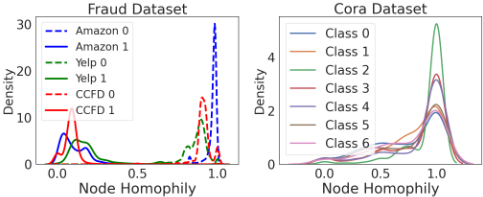
However, current fraudsters often use multiple benign entities as intermediaries for indirect transactions to disguise themselves and avoid being identified as part of a fraud ring [Liu et al., 2021]. This disguise behavior means that a fraudster's direct neighbors might predominantly be benign entities, challenging the assumption in GNNs that entities of similar categories connect more frequently, which could compromise the model's effectiveness [Platonov et al., 2024]. As depicted in Figure 1, we analyzed the proportion of nodes connecting with neighbors of the same label (referred to as node homophily) in three fraud datasets and one general dataset
(Cora). Fraudulent nodes are mainly distributed around 0, exhibiting low homophily, providing evidence for their deceptive behavior, while benign nodes are primarily distributed around 1, showing high homophily. Furthermore, within the Cora dataset, different categories often display higher levels of homophily, whereas in the fraud dataset, categories of varying types exhibit completely different homophily distributions. Some studies have acknowledged the challenges posed by the deceptive behavior of fraudsters [Liu et al., 2020; Shi et al., 2022; Meng et al., 2023].
However, cunning fraudsters may engage in these indirect transactions through four or even more unsuspecting benign entities. The aforementioned methods require deeper network layers to identify such multi-hop indirect transactions, but increasing depth leads to the phenomenon of feature oversmoothing [Li et al., 2018; Chien et al., 2021]. Although some high-order GNNs [He et al., 2021; Wang and Zhang, 2022; Bo et al., 2021] have developed to alleviate the oversmoothing issue, they mostly rely on mixed-order propagation. This entails the mixing of high-order and low-order information before propagation to the central node [Feng et al., 2020]. However, in disguise scenarios, these approaches [Wang and Derr, 2021] face significant challenges as the propagation characteristics inevitably lead to the blending of high-order information with low-order noise, consequently producing non-discriminative node representations.
Therefore, to address the issue of disguised fraud involving multi-hop indirect transactions, we propose a novel Highorder Graph Representation Learning model (HOGRL), aiming to avoid introducing excessive noise during the multilayer aggregation process. Specifically, HOGRL directly learns distinct orders of pure representations from high-order transaction graphs. We achieve this by effectively decoupling neighbor nodes across different hierarchical levels to construct high-order transaction graphs. Subsequently, we learn the pure representations of each high-order graph, allowing the model to recognize multi-hop indirect transactions by means of multi-layer pure feature learning for identifying concealed fraudsters. Additionally, we introduce mixtureof-expert attention mechanism to automatically determine the significance of different orders, thus jointly optimizing fraud detection performance. Considering the potential loss of original structural information in the constructed multilayer high-order transaction graphs, HOGRL combines embeddings from the original graph and multi-layer high-order transaction graphs into the final node representation. Extensive experiments conducted on a real credit card dataset and two public fraud datasets demonstrate the superior performance of HOGRL compared with state-of-the-art baselines. Contributions of our work are summarized as follows:
- We propose a high-order graph representation learning model to address the issue of disguised fraudsters engaging in multi-hop indirect transactions.
- We effectively construct high-order transaction graphs and directly learn distinct orders of pure representations from them. Additionally, we introduce mixture-ofexpert attention mechanism to automatically determine the significance of different orders, thereby jointly opti-
mizing the learning process.
- We conduct extensive experiments to compare our method with state-of-the-art baselines on both public and real-world datasets. The results show the superiority of our proposed HOGRL on fraud detection.
2 RelatedWorks
2.1 GNN-based Fraud Detection
Several machine learning techniques have been proposed in the literature to address the problem of fraud detection [Panigrahi et al., 2009; Fu et al., 2016; Niu et al., 2020]. Recently, techniques based on GNNs have been introduced for fraud detection [Cheng et al., 2020; Xiang et al., 2023]. However, current fraudsters employ sophisticated disguises to evade detection. Some studies have noticed similar challenges. CAREGNN [Dou et al., 2020] employs label-aware similarity measurement and reinforcement learning modules to select more informative neighbors. PCGNN [Liu et al., 2021] employs balanced sampling and selective neighbor aggregation for node representation. Some studies attribute it to the heterogeneity of the graph [Liu et al., 2018; Cheng et al., 2023]. For instance, H2 -FDetector [Shi et al., 2022] leverages homophilic and heterophilic interactions along with a specialized aggregation strategy and category prototypes to enhance detection effectiveness. However, the mentioned approaches struggle with oversmoothing in identifying multi-hop indirect disguised transactions. In contrast, HOGRL learns pure representations directly from high-order transaction graphs, facilitating the recognition of multi-hop indirect disguised transactions through layered configurations.
2.2 High-order Graph Neural Networks
Recently, scholars have started to tackle the problem of shallow layers in GNNs. [Li et al., 2019] adopted the ResNet [He et al., 2016] concept from image processing, enabling the construction of deep network structures with dozens of layers in GNNs. GPRGNN [Chien et al., 2021] introduces a novel Generalized PageRank architecture, assigning learnable weights to enable deep learning capabilities in the model. There are also some studies [He et al., 2021; Wang and Zhang, 2022] that attempt alternative methods of learning weights. MHGNN [Xue et al., 2020] expands the receptive field by utilizing multi-hop node information, enabling the capture of nodes within multiple hops in a single layer. FAGCN [Bo et al., 2021] introduces an adaptive graph convolutional network with a self-gating mechanism to simultaneously capture both low-order and high-order information. AdaGNN [Dong et al., 2021] incorporates a trainable filter design that spans across multiple layers to capture the varying importance of different frequency components for node representation learning. Although these methods theoretically detect fraud through high-order information, in practical applications, due to mixed-order propagation, integrating high-order multi-hop information can blend with loworder noise. HOGRL, by decoupling neighbors at different orders to construct high-order transaction graphs and directly learning pure representations at different orders, avoids the mixture of noise during the aggregation process.
3 Methodology
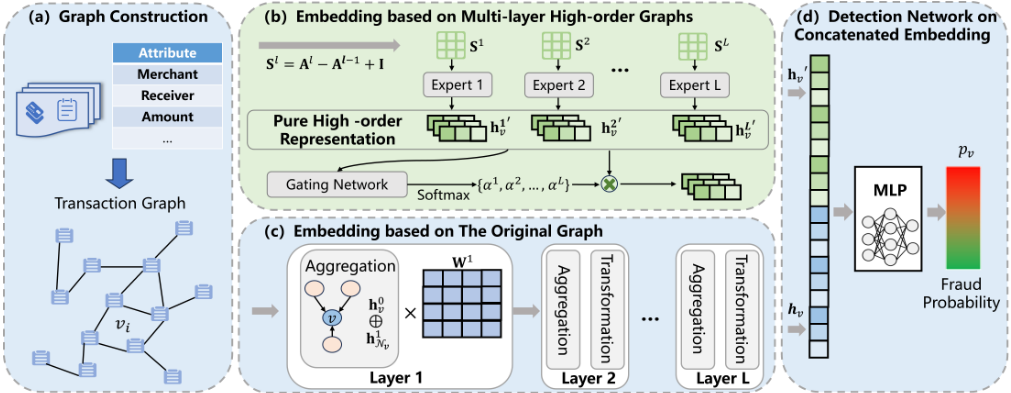
As shown in Figure 2, our model is primarily divided into four parts: the construction of the transaction graph, the generation of node embeddings based on both multi-layered high-order graphs and the original graph, and the detection network. In this section, we first introduce relevant definitions and the construction of the credit card fraud transaction graph. Following that, we introduce how to construct highorder transaction graphs and obtain pure high-order representations from them, as well as generate embeddings based on the original graph. Finally, we introduce the detection network and optimization strategy.
3.1 Preliminaries
Node homophily. The homophily of node [Pei et al., 2020] v represents the proportion of its neighbors that have the same label as v, which can be expressed as:
In credit card fraud detection, we define the credit card transaction graph as G = (V, E), where V = (v1, v2, . . . , vn) denotes a set of credit card transactions (i.e, n = |V|, we call it node), and E ⊂ V × V represents the set of m edges (i.e, m = |E|) between transactions in V with eu,v denoting that the transaction u and the transaction v have the same merchant or receiver, and X ∈ Rn×d denotes the feature matrix, where each row xi ∈ Rd represents the feature of vector of the node vi and d is the dimension of node features. We define Y = {y1, . . . , yn} as the set of fraud labels, where yi ∈ {0, 1} with 0 representing normal and 1 representing fraud. The topological information of the G is described by the adjacency matrix A ∈ Rn×n , where Au,v = 1 if an edge exists between the node u and the node v. Nv is the neighborhood node set of the center node v, which is given by Nv = {u | eu,v ∈ E}. We extend this definition by using N l v to denote the l-th layer neighborhood nodes of the center node v, which includes all nodes that can be reached from the center node v in exactly l hops. For each credit card record, we aim to infer the possibility of whether it is a fraud event, and our task can be formulated a node classification.
3.2 High-Order Graphs Generation
The fundamental assumption of GNNs is that leveraging neighborhood information through feature propagation and aggregation can enhance the predictive performance of the central node [Xu et al., 2018]. This assumption is based on the premise that connected nodes tend to share similar features and usually belong to the same category [Pei et al., 2020; Paszke et al., 2019]. However, in scenarios involving camouflage, the fraudulent nodes' indirect transaction disguises may result in low-order neighbors of fraudsters being multiple benign nodes, which contradicts the premise. This implies the need to introduce higher-order fraudulent information for identifying disguised fraudsters.
Nevertheless, existing high-order GNNs mostly rely on mixed-order propagation, where while introducing higherorder information, all layers of information are mixed and propagated to the central node. This can lead to contamination of high-order effective information by low-order noise information. An intuitive idea is to allow high-order information to be directly conveyed to the central node without mixing, ensuring purer higher-order information. Therefore, we propose decoupling neighbors at different orders to construct high-order transaction graphs. The high-order transaction graph for the l-th layer only includes neighboring nodes that can be reached within at least l hops. The adjacency matrix of the high-order transaction graph for the l-th layer can be represented as follows:
where A0 = I is the identity matrix. Nv(Sl ) represents the set of neighboring nodes of node v under the adjacency matrix Sl , which can be represented as:
3.3 Graph Representation Learning
For the l-th layer high-order transaction graph, the aggregation process can be represented as:
where Wl ′ is the parameter matrix of the l-th layer high-order transaction graph. Due to the varying contributions of each layer's high-order transaction graph to the final node embeddings, we employ a mixture-of-expert attention mechanism to automatically determine the importance of different layer high-order transaction graphs. Specifically, we treat each layer of the graph neural network (Eq(4)), as an individual expert network. The intermediate representations generated by these layers are considered the outputs of the expert networks. A gating network is then utilized to distribute weights across the outputs from each expert network. For the highorder transaction graph at the l-th layer, the weight allocated can be articulated as follows:
where wl is the weight vector for the l-th expert from the gating network, and be is the bias term. It's important to note that while the design of the gating network's weights is similar to traditional attention mechanisms, its goal is to dynamically adjust the influence of each expert network's output on the final output, aligning with the central idea of a mixtureof-experts. Then, the embeddings generated based on multilayer high-order graphs can be represented as:
The mixture-of-expert attention mechanism enables the model to adaptively select more informative hierarchical features, thereby improving the overall performance of the model. Then, we delve into the process of generating embeddings from the original graph. In the context of the original graph, we adopt the mean operator as the aggregator within the GNN, which is represented as follows:
where h0v = xv, the Wl ∈ Rdl×dl-1 is the l-th parameter matrix and ⊕ denotes the concat operation. We combine the learned hLv (represented it as hv for simplicity.) with h′v as the last representation:zv = hv + γh′v , (10)
where γ is a hyperparameter that determines the weight of embeddings generated based on multi-layer high-order graphs. Integrating embeddings generated from the original graph with multi-layer high-order graphs is based on the following concept: Although the constructed high-order graphs can directly transmit high-order information to the central node, they lose the original multi-hop dependencies [Wang and Derr, 2021]. Specifically, the l-th layer high-order graph includes connections reached exactly within at least l hops, neglecting intermediate nodal entities. By integrating embeddings derived from the original graph, it becomes feasible to preserve multi-hop dependencies. This strategy enhances information propagation efficiency and maintains critical pathway dependencies within the network's framework, thereby enriching the insight available for advanced network structure analysis and understanding.
For a multi-relational graph G = (V,E), where E = {E1, . . . , ER} is the edge set of R relations, we perform graph propagation separately for each relation and concatenate the embeddings. This can be represented as:
3.4 Detection Network and Optimization
In the downstream detection task, we utilize a multi-layer perceptron (MLP) as the detection network to infer the fraud probability as:
For the node classification task, we adopt the cross-entropy loss function for optimization, which can be formulated as:
where yv ∈ Y is the label of the node v. The proposed method can be optimized through the standard stochastic gradient descent-based algorithms. In this paper, we used the Adam optimizer [Kingma and Ba, 2015] to learn the parameters. We set the initial learning rate to 5×10⁻³ and the weight decay to 5 × 10⁻⁵ by default.
3.5 Complexity Analysis
Compared to traditional GCNs, the additional computational burden in our approach primarily stems from generating node intermediate representations based on high-order transaction graphs. There is no need to calculate Al . We can calculate Sl · X with right-to-left multiplication. The calculation process can be represented as follows:
| Dataset | #Node | Relations | #Relations |
|---|---|---|---|
| YelpChi | 45,954 | R-U-R R-S-R R-T-R | 49,315 3,402,743 573,616 |
| Amazon | 11,944 | U-P-U U-S-U U-V-U | 175,608 3,566,479 1,036,737 |
| CCFD | 1,820,840 | - | 31,619,440 |
If we store A as a sparse matrix with m non-zero entries, then the embeddings generated by the l-th order transaction graph require O(l ×m× d) computational time, where d is the feature dimension of X. Under the realistic assumptions that l ≪ m and d ≪ m, running an L-order layer requires O(Lm) computational time. This matches the computational complexity of the traditional GCN.
4 Experiments
4.1 Experimental Settings
Datasets. We have collected fraudulent transaction data from a major commercial bank, including real-world credit card transaction records, involving a total of 476, 124 different users. The ground truth labels are based on consumer reports, verified by financial domain experts. Transactions reported as fraud or confirmed by experts were marked as 1, while non-fraudulent transactions were marked as 0. We refer to this dataset as CCFD (Credit Card Fraud Detection Dataset). Besides, we also experimented on two public fraud detection datasets. The YelpChi graph dataset [Rayana and Akoglu, 2015] contains a selection of hotel and restaurant reviews on Yelp. There are three edge types in the graph, including R-U-R (the reviews posted by the same user), R-S-R (the reviews under the same product with the same star rating), and R-T-R (the reviews under the same product posted in the same month). The Amazon graph dataset [McAuley and Leskovec, 2013] includes product reviews of musical instruments. There are also three relations: U-P-U (users reviewing at least one same product), U-S-U (users having at least one same star rating within one week), and U-V-U (users with top-5% mutual review TF-IDF similarities). CCFD is a single-relation graph. Some basic statistics of three fraud datasets are shown in Table 1.
Compared Baselines. We compare with several state-ofthe-art GNN-based methods to verify the effectiveness of HOGRL: GCN [Kipf and Welling, 2016], GAT [?], Graphsage [Hamilton et al., 2017], GPRGNN [Chien et al., 2021], FAGCN [Bo et al., 2021], GraphConsis [Liu et al., 2020], CARE-GNN [Dou et al., 2020], PC-GNN [Liu et al., 2021], H2 -FDetector [Shi et al., 2022], GTAN [Xiang et al., 2023], BWGNN [Tang et al., 2022].
Metrics and Implementation. For class imbalance classification, the evaluation metrics should have no bias to any class [Luque et al., 2019]. Therefore, We evaluate the experimental results on three fraud datasets by the area under the ROC curve (AUC), macro average of F1-macro score (F1-macro), and GMean (Geometric Mean).
For all baselines, if the original hyperparameters are provided, we use them. If not, the hyper-parameter search space is: learning rate in {0.01, 0.05, 0.001}, dropout in {0.3, 0.4, 0.5, 0.6}, weight decay in {10-3 , 10-4 , 10-5 } hidden dimension in {16, 32, 64}. For high-order GNNs, we explore the number of layers {1, 2, ... , 9}. For HOGRL, we set the batch size to 2048 for yelp and CCFD, 256 for amazon, the dropout ratio to 0.3, the embedding dimension to 64 (hv and hv ′ ), the number of layers to 7, and the maxinum number of epochs is set to 1000. The train, val and test are set to be 40%, 40%, 20% respectively. We train and test on the validation set every 10 times, and select the model that performs best on the validation set to test after training ends. Our method is implemented using PyTorch 1.12.1 with CUDA 11.2 and Python 3.7 as the backend. The model is trained on a server with two 32GB NVIDIA Tesla V100 GPUs.
4.2 Fraud Detection Performance
We repeat the experiments ten times for each method and show the average performance in Table 2. ∗ denotes that the improvements are statistically signifcant for p < 0.01 according to the paired t-test.
The first three rows of Table 2 report the results of some classic graph-based methods, including GCN, GAT, GraphSage. It is clear that the results of GCN and GAT not satisfactory, showing the limitation of traditional GNNs-based model in addressing the complex fraud patterns. GraphSage improves performance, attributed to its suitability for large graphs. FAGCN and GPRGNN can capture higherorder information, thus performing well. They even outperform all graph-based fraud detection methods on the CCFD dataset, further highlighting the importance of higher-order information in identifying disguised fraudsters. The graphbased fraud detection methods (GraphConsis, CARE-GNN, PC-GNN, H2 -FDetector) focus on the deceptive behaviors of fraudsters, but their models still perform lower than HOGRL due to their shallow model limitations. The comparison with the semi-supervised model GTAN is detailed in Section 4.4.
BWGNN excels by employing customized spectral filters to capture effective information of fraudsters, making it the state-of-the-art method for graph-based anomaly detection, while HOGRL outperforms it significantly. On the YelpChi dataset, compared to BWGNN, HOGRL achieves improvements of 8.9% in F1-macro, 6.9% in AUC, and 6.4% in GMean. It's worth noting that popular fraud detection models perform poorly on CCFD, mainly due to the presence of complex fraudulent techniques in real-world scenarios, affecting fraud models' performance. However, our proposed HOGRL outperforms other models on this dataset. We achieves the best results with an improvement of 5.4% in AUC compared to the BWGNN, and a 9.5% improvement in GMean score. Compared to high-order GNNs, HOGRL shows an improvement of 1.9% in AUC score, 3.6% in F1 Score, and 2.9% in GMean score at least.
4.3 Ablation Study
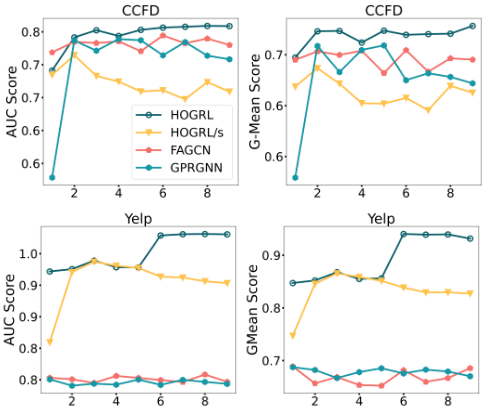
To validate the effectiveness of constructing pure representations using high-order graphs, we designed HOGRL/s, a model that generates embeddings solely based on the original graph. We chose FAGCN and GPRGNN as controls to explore HOGRL's ability to capture high-order information. We visualize the performance of each model using layers from up to 1 to up to 9 in Figure 3. It is evident that HOGRL/s achieves its highest performance on the Yelp dataset when L=3, and on the CCFD dataset when L=2. This pattern is consistent with most GNNs, where an increase in the number of layers beyond a certain point leads to a decline in performance. The reason for this decline is attributed to the oversmoothing caused by the coupling of multiple features. However, HOGRL directly generates pure higher-order representations from high-order graphs, alleviating the oversmoothing caused by feature coupling. It is observable that on the Yelp dataset, as the number of layers increases to 6, HOGRL significantly outperforms HOGRL/s in both AUC and Gmean metrics. On the CCFD dataset, a clear difference between the two is evident when the number of layers reaches 3. As the number of layers continues to increase, the performance of HOGRL/s steadily declines, whereas the performance of HOGRL remains stable and peaks at L=9. We set L to 7 due to the computational complexity.
| Model | YelpChi | Amazon | CCFD | |||||||
|---|---|---|---|---|---|---|---|---|---|---|
| F1-macro | AUC | GMean | F1-macro | AUC | GMean | F1-macro | AUC | GMean | ||
| Traditional | GCN | 0.5735 | 0.6128 | 0.5752 | 0.6438 | 0.8422 | 0.7793 | 0.4873 | 0.5236 | 0.5192 |
| GAT | 0.5019 | 0.6171 | 0.2072 | 0.5089 | 0.8503 | 0.2045 | 0.4958 | 0.5405 | 0.6232 | |
| GraphSage | 0.6548 | 0.8351 | 0.7597 | 0.7849 | 0.9519 | 0.9084 | 0.5104 | 0.5444 | 0.5011 | |
| High-order | FAGCN | 0.6256 | 0.7583 | 0.6667 | 0.8719 | 0.9644 | 0.8898 | 0.6621 | 0.7444 | 0.6545 |
| GPRGNN | 0.6086 | 0.7503 | 0.6954 | 0.8023 | 0.9546 | 0.8825 | 0.5974 | 0.7389 | 0.6587 | |
| Fraud Detection | GraphConsis | 0.5673 | 0.6985 | 0.6182 | 0.7378 | 0.8836 | 0.7391 | 0.6506 | 0.6053 | 0.4626 |
| CARE-GNN | 0.6332 | 0.7619 | 0.6791 | 0.8946 | 0.9067 | 0.8962 | 0.5771 | 0.6623 | 0.5728 | |
| PC-GNN | 0.6300 | 0.7987 | 0.7160 | 0.8999 | 0.9585 | 0.8995 | 0.6077 | 0.6795 | 0.5929 | |
| H2 -FDetector | 0.6944 | 0.8877 | 0.8160 | 0.8470 | 0.9711 | 0.9223 | 0.6531 | 0.6739 | 0.6163 | |
| GTAN | 0.7788 | 0.9141 | 0.8821 | 0.9213 | 0.9621 | 0.9081 | 0.6913 | 0.7218 | 0.6291 | |
| BWGNN | 0.7891 | 0.9170 | 0.8791 | 0.9191 | 0.9759 | 0.9195 | 0.6856 | 0.7195 | 0.6193 | |
| Ours | HOGRL | 0.8595* | 0.9808* | 0.9361* | 0.9198* | 0.9800* | 0.9438* | 0.6861 | 0.7590* | 0.6784* |
In comparison with higher-order GNNs, it is observed that the performance of FAGCN and GPRGNN on the Yelp and CCFD datasets exhibits significant fluctuations with an increase in the number of network layers, highlighting their lack of stability. Notably, on the Yelp dataset, HOGRL significantly outperforms FAGCN and GPRGNN in terms of AUC and GMean metrics. On the CCFD dataset, except for when the layer count L is 1, where HOGRL's AUC performance is slightly inferior to FAGCN, in all other cases it surpasses both FAGCN and GPRGNN. These results further emphasize the substantial advantage of HOGRL in capturing higher-order information, thereby better identifying disguised fraudsters.
4.4 Parameter Sensitivity
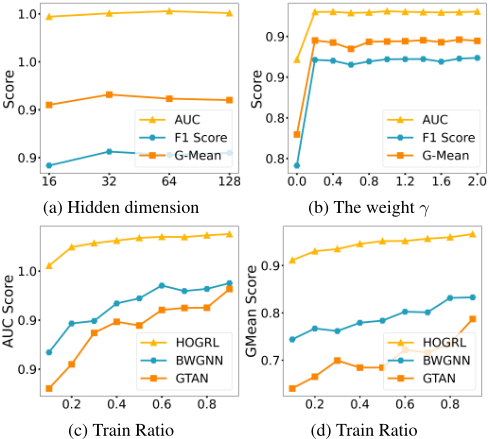
We study the model parameter sensitivity by varying the hidden dimension, the weight γ on the yelp dataset. Figure 4 (a) shows that when we increase the hidden dimensions from 16 to 128, our model maintains stable model performance and reaches the performance peak at 64. As shown in fig4 (b), We varied the weight hyperparameter γ from 0 to 2. Performance reached its peak when γ=1. When the weight was 0, it corresponds to HOGRL/s. When the weight γ varies between 0.2 and 2, the performance of our proposed HOGRL model shows no significant changes.
To further compare the learning capabilities of the models, we adjusted the proportion of the training set from 10% to 90%, with the remaining nodes equally divided between the validation set and the test set. For the sake of simplicity in our illustrations, we selected the state-of-the-art baseline model BWGNN and the superior semi-supervised learning model GTAN, and conducted experiments on the Yelp dataset. The results of these experiments are shown in Figure 4 (c) and (d). It can be observed that, regardless of the training ratio, HOGRL consistently performs well. Even with limited data (10% training ratio), HOGRL still significantly outperforms both BWGNN and GTAN.
4.5 Interpretability Exploration
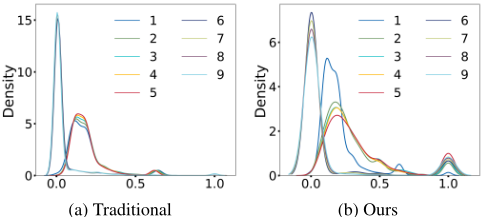
We visualize the homophily density distribution of fraudulent nodes at different layers on yelp dataset in Figure 5. It can be observed that as the number of layers increases from 2 to 5, the peak density in the left figure remains nearly unchanged, whereas the peak density in the right figure shifts to the right. This indicates that the constructed high-order graph exhibits higher homophily. As the number of layers exceeds 6, the peak density on the left remains nearly constant, and the peak density on the left figure is at least twice that of the right figure. This demonstrates that the high-order graph constructed by HOGRL enhances the homophily of fraudulent nodes, reducing noise during the aggregation of high-order information. This is also the reason why HOGRL significantly outperforms HOGRL/s starting from L=6 layers.
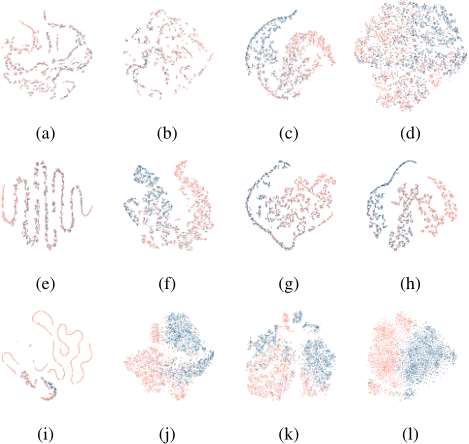
We also conducted a visualization analysis of node embeddings on the Yelp dataset. To visually compare the performance of different models, we employed the t-SNE technique [van der Maaten and Hinton, 2008] to map the outputs from various models, just before their final layers, into a two-dimensional space for dimensionality reduction. This visualization method enabled us to clearly observe and analyze differences in the outputs of the models. The results, displayed in Figure 6, show fraud nodes in red and benign nodes in blue, thus highlighting the distinction between the types of nodes. (a)-(k) represent the baseline models as listed in Table 2 in sequential order, and (l) depicts the visualization outcome for HOGRL. Compared to other models, the visualization of HOGRL distinctly shows a more effective separation between fraudulent and benign nodes. This improvement in discriminative ability is attributed to HOGRL directly learning distinct orders of pure representations from high-order transaction graphs, resulting in embeddings with greater distinction. For instance, compared to the BWGNN model, HOGRL demonstrates a notably reduced overlap between the two types of nodes.
5 Conclusion
In this paper, we propose a novel high-order graph representation learning model to reduce noise during multi-layer aggregation and identify disguised fraudsters involved in multihop indirect transactions. Specifically, we construct highorder transaction graphs and directly learn pure representations from them. Additionally, we introduce a mixture-ofexpert attention mechanism to determine the significance of different orders. The comprehensive experiments demonstrated the superiority of HOGRL compared with other baselines. The outstanding performance of HOGRL demonstrates its effectiveness in addressing high-order fraud camouflage crimes, maintaining the stability of the financial system, and positively influencing economic growth.
Acknowledgements
This work was supported by the National Key R&D Program of China (Grant no. 2022YFB4501704), the National Natural Science Foundation of China (Grant no. 62102287), the foundation of Key Laboratory of Artificial Intelligence, Ministry of Education, P.R. China and the Shanghai Science and Technology Innovation Action Plan Project (Grant no. 22YS1400600 and 22511100700).
@inproceedings{ijcai2024p839,
  title     = {Effective High-order Graph Representation Learning for Credit Card Fraud Detection},
  author    = {Zou, Yao and Cheng, Dawei},
  booktitle = {Proceedings of the Thirty-Third International Joint Conference on
               Artificial Intelligence, {IJCAI-24}},
  publisher = {International Joint Conferences on Artificial Intelligence Organization},
  editor    = {Kate Larson},
  pages     = {7581--7589},
  year      = {2024},
  month     = {8},
  note      = {AI for Good},
  doi       = {10.24963/ijcai.2024/839},
  url       = {https://doi.org/10.24963/ijcai.2024/839},
}
TY - CPAPER TI - Effective High-order Graph Representation Learning for Credit Card Fraud Detection AU - Zou, Yao AU - Cheng, Dawei T2 - Proceedings of the Thirty-Third International Joint Conference on Artificial Intelligence, IJCAI-24 PB - International Joint Conferences on Artificial Intelligence Organization PY - 2024 SP - 7581 EP - 7589 DO - 10.24963/ijcai.2024/839 UR - https://doi.org/10.24963/ijcai.2024/839 ER -Copied
Machine-readable versions of this paper, for tools and AI agents:





