
Graph Neural Networks for Brain Graph Learning: A Survey
Proceedings of the Thirty-Third International Joint Conference on Artificial Intelligence. Survey Track. Pages 8170-8178.
https://doi.org/10.24963/ijcai.2024/903
Keywords
- Data Mining: DM: Mining graphs
- Humans and AI: HAI: Brain sciences
Abstract
Exploring the complex structure of the human brain is crucial for understanding its functionality and diagnosing brain disorders. Thanks to advancements in neuroimaging technology, a novel approach has emerged that involves modeling the human brain as a graph-structured pattern, with different brain regions represented as nodes and the functional relationships among these regions as edges. Moreover, graph neural networks (GNNs) have demonstrated a significant advantage in mining graph-structured data. Developing GNNs to learn brain graph representations for brain disorder analysis has recently gained increasing attention. However, there is a lack of systematic survey work summarizing current research methods in this domain. In this paper, we aim to bridge this gap by reviewing brain graph learning works that utilize GNNs. We first introduce the process of brain graph modeling based on common neuroimaging data. Subsequently, we systematically categorize current works based on the type of brain graph generated and the targeted research problems. To make this research accessible to a broader range of interested researchers, we provide an overview of representative methods and commonly used datasets, along with their implementation sources. Finally, we present our insights on future research directions. The repository of this survey is available at https://github.com/XuexiongLuoMQ/Awesome-Brain-Graph-Learning-with-GNNs.
- [Asad et al., 2023] Rimsha Asad, Saif Ur Rehman, Azhar Imran, Jianqiang Li, Abdullah Almuhaimeed, and Ab- dulkareem Alzahrani. Computer-aided early melanoma brain-tumor detection using deep-learning approach. Biomedicines, 11(1):184, 2023.
- [Bannadabhavi et al., 2023] Anushree Bannadabhavi, Soo- jin Lee, Wenlong Deng, Rex Ying, and Xiaoxiao Li. Community-aware transformer for autism prediction in fmri connectome. In MICCAI, pages 287-297, 2023.
- [Bassett and Bullmore, 2006] Danielle Smith Bassett and ED Bullmore. Small-world brain networks. The Neuro- scientist, 12(6):512-523, 2006.
- [Bessadok et al., 2021] Alaa Bessadok, Mohamed Ali Mahjoub, and Islem Rekik. Brain multigraph prediction using topology-aware adversarial graph neural network. Medical Image Analysis, 72:102090, 2021.
- [Bongini et al., 2021] Pietro Bongini, Monica Bianchini, and Franco Scarselli. Molecular generative graph neural networks for drug discovery. Neurocomputing, 450:242- 252, 2021.
- [Cui et al., 2022a] Hejie Cui, Wei Dai, Yanqiao Zhu, Xuan Kan, Antonio Aodong Chen Gu, Joshua Lukemire, Liang Zhan, Lifang He, Ying Guo, and Carl Yang. Braingb: A benchmark for brain network analysis with graph neural networks. IEEE TMI, 42(2):493-506, 2022.
- [Cui et al., 2022b] Hejie Cui, Wei Dai, Yanqiao Zhu, Xiaox- iao Li, Lifang He, and Carl Yang. Interpretable graph neu- ral networks for connectome-based brain disorder analy- sis. In MICCAI, pages 375-385, 2022.
- [Dai et al., 2023] Wei Dai, Hejie Cui, Xuan Kan, Ying Guo, Sanne van Rooij, and Carl Yang. Transformer-based hi- erarchical clustering for brain network analysis. In ISBI, pages 1-5, 2023.
- [Gadgil et al., 2020] Soham Gadgil, Qingyu Zhao, Adolf Pf- efferbaum, Edith V Sullivan, Ehsan Adeli, and Kilian M Pohl. Spatio-temporal graph convolution for resting-state fmri analysis. In MICCAI, pages 528-538, 2020.
- [Guo et al., 2021] Zhichun Guo, Chuxu Zhang, Wenhao Yu, John Herr, Olaf Wiest, Meng Jiang, and Nitesh V Chawla. Few-shot graph learning for molecular property predic- tion. In WWW, pages 2559-2567, 2021.
- [Hu et al., 2021] Jinlong Hu, Lijie Cao, Tenghui Li, Shoubin Dong, and Ping Li. Gat-li: a graph attention network based learning and interpreting method for functional brain net- work classification. BMC Bioinformatics, 22(1):1-20, 2021.
- [Jalali and Safayani, 2023] Parniyan Jalali and Mehran Safayani. Hdgl: A hierarchical dynamic graph representa- tion learning model for brain disorder classification. arXiv preprint arXiv:2311.02903, 2023.
- [Jiang et al., 2020] Hao Jiang, Peng Cao, MingYi Xu, Jinzhu Yang, and Osmar Zaiane. Hi-gcn: A hierarchical graph convolution network for graph embedding learning of brain network and brain disorders prediction. Computers in Biology and Medicine, 127:104096, 2020.
- [Kan et al., 2022a] Xuan Kan, Hejie Cui, Joshua Lukemire, Ying Guo, and Carl Yang. Fbnetgen: Task-aware gnn- based fmri analysis via functional brain network genera- tion. In MIDL, pages 618-637, 2022.
- [Kan et al., 2022b] Xuan Kan, Wei Dai, Hejie Cui, Zilong Zhang, Ying Guo, and Carl Yang. Brain network trans- former. In NeurIPS, pages 25586-25599, 2022.
- [Kipf and Welling, 2017] Thomas N Kipf and Max Welling. Semi-supervised classification with graph convolutional networks. In ICLR, pages 1-14, 2017.
- [Klepl et al., 2022] Dominik Klepl, Fei He, Min Wu, Daniel J Blackburn, and Ptolemaios Sarrigiannis. Eeg- based graph neural network classification of alzheimer's disease: An empirical evaluation of functional connectiv- ity methods. IEEE TNSRE, 30:2651-2660, 2022.
- [Li et al., 2019] Xiaoxiao Li, Nicha C Dvornek, Yuan Zhou, Juntang Zhuang, Pamela Ventola, and James S Duncan. Graph neural network for interpreting task-fmri biomark- ers. In MICCAI, pages 485-493, 2019.
- [Li et al., 2021] Xiaoxiao Li, Yuan Zhou, Nicha Dvornek, Muhan Zhang, Siyuan Gao, Juntang Zhuang, Dustin Scheinost, Lawrence H Staib, Pamela Ventola, and James S Duncan. Braingnn: Interpretable brain graph neu- ral network for fmri analysis. Medical Image Analysis, 74:102233, 2021.
- [Li et al., 2023] Gaotang Li, Marlena Duda, Xiang Zhang, Danai Koutra, and Yujun Yan. Interpretable sparsification of brain graphs: Better practices and effective designs for graph neural networks. In KDD, pages 1223-1234, 2023.
- [Liu et al., 2018] Ye Liu, Lifang He, Bokai Cao, Philip S. Yu, Ann Ragin, and Alex Leow. Multi-view multi-graph embedding for brain network clustering analysis. In AAAI, pages 117-124, 2018.
- [Liu et al., 2019] Jiahao Liu, Guixiang Ma, Fei Jiang, Chun- Ta Lu, Philip S. Yu, and Ann B Ragin. Community- preserving graph convolutions for structural and functional joint embedding of brain networks. In Big Data, pages 1163-1168, 2019.
- [Liu et al., 2023] Hongzhi Liu, Kaizhong Zheng, Shujian Yu, and Badong Chen. Towards a more stable and gen- eral subgraph information bottleneck. In ICASSP, pages 1-5, 2023.
- [Luo et al., 2022] Gongxu Luo, Chenyang Li, Hejie Cui, Lichao Sun, Lifang He, and Carl Yang. Multi-view brain network analysis with cross-view missing network gener- ation. In BIBM, pages 108-115, 2022.
- [Luo et al., 2024a] Xuexiong Luo, Guangwei Dong, Jia Wu, Amin Beheshti, Jian Yang, and Shan Xue. An interpretable brain graph contrastive learning framework for brain dis- order analysis. In WSDM, pages 1074-1077, 2024.
- [Luo et al., 2024b] Xuexiong Luo, Jia Wu, Jian Yang, Hongyang Chen, Zhao Li, Hao Peng, and Chuan Zhou. Knowledge distillation guided interpretable brain sub- graph neural networks for brain disorder exploration. IEEE TNNLS, pages 1-14, 2024.
- [Ma et al., 2017] Guixiang Ma, Chun-Ta Lu, Lifang He, Philip S. Yu, and Ann B Ragin. Multi-view graph em- bedding with hub detection for brain network analysis. In ICDM, pages 967-972, 2017.
- [Ma et al., 2023] Yunling Ma, Qianqian Wang, Liang Cao, Long Li, Chaojun Zhang, Lishan Qiao, and Mingxia Liu. Multi-scale dynamic graph learning for brain disorder de- tection with functional mri. IEEE TNSRE, 31:3501-3512, 2023.
- [Sporns, 2018] Olaf Sporns. Graph theory methods: appli- cations in brain networks. Dialogues in Clinical Neuro- science, 20(2):111-121, 2018.
- [Stankeviciute et al., 2020] Kamile Stankeviciute, Tiago Azevedo, Alexander Campbell, Richard Bethlehem, and Pietro Lio. Population graph gnns for brain age prediction. In ICML Workshop, pages 17-83, 2020.
- [Sun et al., 2021] Qingyun Sun, Jianxin Li, Hao Peng, Jia Wu, Yuanxing Ning, Philip S. Yu, and Lifang He. Sugar: Subgraph neural network with reinforcement pooling and self-supervised mutual information mechanism. In WWW, pages 2081-2091, 2021.
- [Tan et al., 2023] Qiaoyu Tan, Xin Zhang, Ninghao Liu, Daochen Zha, Li Li, Rui Chen, Soo-Hyun Choi, and Xia Hu. Bring your own view: Graph neural networks for link prediction with personalized subgraph selection. In WSDM, pages 625-633, 2023.
- [Wen et al., 2022] Guangqi Wen, Peng Cao, Huiwen Bao, Wenju Yang, Tong Zheng, and Osmar Zaiane. Mvs-gcn: A prior brain structure learning-guided multi-view graph convolution network for autism spectrum disorder diag- nosis. Computers in Biology and Medicine, 142:105239, 2022.
- [Wu et al., 2020] Zonghan Wu, Shirui Pan, Fengwen Chen, Guodong Long, Chengqi Zhang, and Philip S. Yu. A comprehensive survey on graph neural networks. IEEE TNNLS, 32(1):4-24, 2020.
- [Xu et al., 2022] Minkai Xu, Lantao Yu, Yang Song, Chence Shi, Stefano Ermon, and Jian Tang. Geodiff: A geometric diffusion model for molecular conformation generation. In ICLR, 2022.
- [Yan et al., 2022] Jiadong Yan, Yuzhong Chen, Zhenxiang Xiao, Shu Zhang, Mingxin Jiang, Tianqi Wang, Tuo Zhang, Jinglei Lv, Benjamin Becker, Rong Zhang, et al. Modeling spatio-temporal patterns of holistic functional brain networks via multi-head guided attention graph neu- ral networks (multi-head gagnns). Medical Image Analy- sis, 80:102518, 2022.
- [Yang et al., 2022] Yi Yang, Yanqiao Zhu, Hejie Cui, Xuan Kan, Lifang He, Ying Guo, and Carl Yang. Data-efficient brain connectome analysis via multi-task meta-learning. In KDD, pages 4743-4751, 2022.
- [Yang et al., 2023a] Yanwu Yang, Chenfei Ye, Xutao Guo, Tao Wu, Yang Xiang, and Ting Ma. Mapping multi-modal brain connectome for brain disorder diagnosis via cross- modal mutual learning. IEEE TMI, 43(1):108-121, 2023.
- [Yang et al., 2023b] Yi Yang, Hejie Cui, and Carl Yang. Ptgb: Pre-train graph neural networks for brain network analysis. In CHIL, pages 526-544, 2023.
- [Ye et al., 2023] Ziyuan Ye, Youzhi Qu, Zhichao Liang, Mo Wang, and Quanying Liu. Explainable fmri-based brain decoding via spatial temporal-pyramid graph con- volutional network. Human Brain Mapping, 44(7):2921- 2935, 2023.
- [Yuan et al., 2021] Hao Yuan, Haiyang Yu, Jie Wang, Kang Li, and Shuiwang Ji. On explainability of graph neural net- works via subgraph explorations. In ICML, pages 12241- 12252, 2021.
- [Zhang et al., 2022] Hao Zhang, Ran Song, Liping Wang, Lin Zhang, Dawei Wang, Cong Wang, and Wei Zhang. Classification of brain disorders in rs-fmri via local-to- global graph neural networks. IEEE TMI, 42(2):444-455, 2022.
- [Zhao et al., 2022a] Xusheng Zhao, Qiong Dai, Jia Wu, Hao Peng, Mingsheng Liu, Xu Bai, Jianlong Tan, Senzhang Wang, and Philip S. Yu. Multi-view tensor graph neural networks through reinforced aggregation. IEEE TKDE, 35(4):4077-4091, 2022.
- [Zhao et al., 2022b] Xusheng Zhao, Jia Wu, Hao Peng, Amin Beheshti, Jessica JM Monaghan, David McAlpine, Heivet Hernandez-Perez, Mark Dras, Qiong Dai, Yangyang Li, et al. Deep reinforcement learning guided graph neural networks for brain network analysis. Neural Networks, 154:56-67, 2022.
- [Zheng et al., 2022] Shuai Zheng, Zhenfeng Zhu, Zhizhe Liu, Zhenyu Guo, Yang Liu, Yuchen Yang, and Yao Zhao. Multi-modal graph learning for disease prediction. IEEE TMI, 41(9):2207-2216, 2022.
- [Zhou et al., 2019] Fan Zhou, Chengtai Cao, Kunpeng Zhang, Goce Trajcevski, Ting Zhong, and Ji Geng. Meta- gnn: On few-shot node classification in graph meta- learning. In CIKM, pages 2357-2360, 2019.
- [Zhou et al., 2022] Houliang Zhou, Lifang He, Yu Zhang, Li Shen, and Brian Chen. Interpretable graph con- volutional network of multi-modality brain imaging for alzheimer's disease diagnosis. In ISBI, pages 1-5, 2022.
- [Zhu et al., 2021] Yanqiao Zhu, Weizhi Xu, Jinghao Zhang, Yuanqi Du, Jieyu Zhang, Qiang Liu, Carl Yang, and Shu Wu. A survey on graph structure learning: Progress and opportunities. arXiv preprint arXiv:2103.03036, 2021.
- [Zhu et al., 2022a] Qi Zhu, Heyang Wang, Bingliang Xu, Zhiqiang Zhang, Wei Shao, and Daoqiang Zhang. Multi- modal triplet attention network for brain disease diagnosis. IEEE TMI, 41(12):3884-3894, 2022.
- [Zhu et al., 2022b] Yanqiao Zhu, Hejie Cui, Lifang He, Lichao Sun, and Carl Yang. Joint embedding of structural and functional brain networks with graph neural networks for mental illness diagnosis. In EMBC, pages 272-276, 2022.
References were extracted automatically from the PDF and may contain errors.
Full text extracted automatically from the PDF; figures, tables and equations may differ. The PDF is the version of record.
1 Introduction
Analyzing brain structure remains a challenging research problem, yet it is critically important for exploring brain functions and diagnosing disorders. Advancements in neuroimaging technology have enhanced our understanding of brain neuroscience and significantly improved diagnostic capabilities. For instance, functional magnetic resonance imaging
(fMRI) primarily uncovers the functional activities of different brain regions of interest (ROIs) by assessing changes in blood oxygenation level dependent (BOLD) signals. Diffusion tensor imaging (DTI) analyzes the structural connectivity among ROIs based on the density of white matter fibers. Electroencephalography (EEG) records the variations in electrical waves during brain activity. Although intelligent diagnosis methods, such as lesion detection [Asad et al., 2023], have been proposed to employ these neuroimaging data for disorder analysis directly, they often fall short in effectively extracting useful structural information about the human brain for deeper functional mechanism analysis. To address this, a novel data analysis method using graphstructured patterns has emerged, which models the human brain as a brain graph (or brain network) based on neuroimaging data, where different brain regions are represented as nodes and the functional relationships among brain regions as edges. However, traditional brain graph analysis methods [Sporns, 2018] tend to focus more on evaluating statistical characteristics through graph theory, such as degree profiles, node centralities, and so forth. These methods suffer from low efficiency and cannot achieve intelligent diagnosis.
GNNs [Wu et al., 2020] have made substantial progress in graph-structured data mining recently. GNNs are designed to learn node representations by aggregating features from the node itself and its neighbors, facilitating various downstream tasks, such as node classification [Zhou et al., 2019], and link prediction [Tan et al., 2023]. Additionally, GNNs have been successfully applied in real-world scenarios, like drug discovery [Bongini et al., 2021] and molecular prediction [Guo et al., 2021]. Given these advancements, applying GNNs for brain graph mining has become an increasingly studied area. Current research primarily focuses on modeling various brain graphs using neuroimaging data and then designing corresponding GNN models to learn representations of these brain graphs. Furthermore, these studies aim to improve brain disorder prediction, essentially brain graph classification, and pathogenic analysis. The latter involves identifying salient ROIs and connections pertinent to specific disorders, as illustrated in Figure 1.
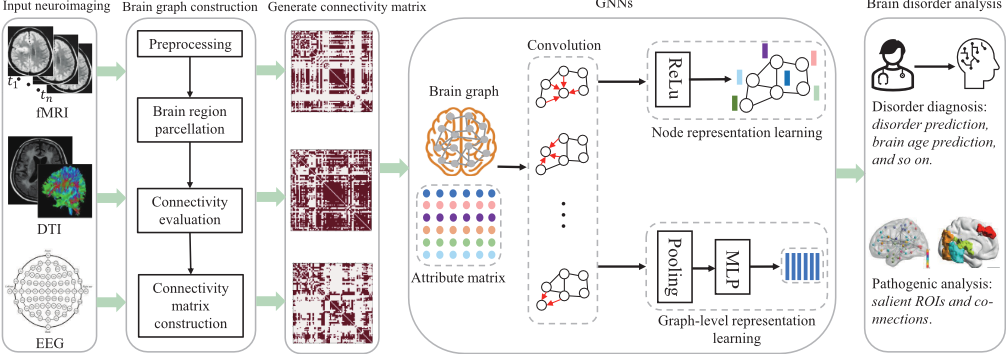
While some existing articles have endeavored to review the field's progress to date in brain graph analysis, there has been little effort to systematically summarize these studies specifically from the perspective of brain graph learning with GNNs. With this paper, we aim to bridge this gap. We first introduce foundational knowledge of graphs and GNNs. Subsequently, we detail the process of brain graph modeling based on common neuroimaging data, such as fMRI, DTI, and EEG, focusing on two main research problems: disorder prediction and pathogenic analysis. Next, we propose a systematic taxonomy of existing methods in brain graph learning. Specifically, we categorize these works into three groups based on the type of brain graph generated: static brain graphs, dynamic brain graphs, and multi-modal brain graphs. For each category, we introduce representative approaches tailored to different research problems. Additionally, we offer an overview of libraries with implementations of these methods and commonly used datasets. Finally, we discuss future research directions to advance brain graph learning. The primary goal of this paper is to represent a novel perspective for brain disorder analysis and encourage more researchers to contribute to the burgeoning field of brain graph mining.
2 Preliminaries
This section begins by providing the basic definitions of a graph. Following this, we introduce a unified formulation of GNNs. Next, we detail the process of constructing brain graphs based on three types of neuroimaging data. Finally, we define the two main research problems that are currently prevalent in the field of brain graph learning.
2.1 Graph Definitions
A given graph G generally consists of the following elements: {V,E,A,X}, where V = {v1, v2, · · ·, vN} and E = {eij, i, j ∈ V }. These are the node and edge sets, respectively. A ∈ RN×N is the adjacency matrix, where Aij = 1 if an edge exists between node vi and vj , otherwise, Aij = 0. X = {x1, x2, · · ·, xN} is the attribute feature matrix, where xi ∈ Rd represents attribute information of node vi with d denoting the feature dimensions. Thus, the generated brain graphs based on neuroimaging also include the elements above.
2.2 Graph Neural Networks
Currently, a wide array of GNN methods for processing graph-structured data have emerged [Wu et al., 2020]. These methods primarily share a common underlying principle, being the message-passing mechanism. This mechanism recursively aggregates features from both the node itself and its neighbors to learn node representations. Consequently, a unified formulation for the convolution operation of GNNs can be expressed as follows:
where h(l) v is the node representations at the l-th layer. Nv denotes the set of neighbors of node v, and h(0) v is initialized using the node attribute feature xv. COM(·) and AGG(·) respectively represent the combination and aggregation functions in the GNN. Here, the output of the GNN is node-level representations of the graph suitable for nodelevel tasks, such as node classification and link prediction. Notably, graph pooling methods have been extensively explored to obtain graph-level representations of the graph for graph classification and graph generation tasks. The basic operation of graph pooling is as follows:
where h(l) G are the graph-level representations in the l-th layer, and READOUT(·) is the graph pooling function, such as mean, sum, and max-pooling.
2.3 Brain Graph Construction
In current brain graph learning research, three common types of neuroimaging data are predominantly used to construct brain graphs. We introduce vital steps of brain graph construction for these neuroimaging data.
fMRI-Driven Brain Graphs. The fMRI data for one given subject first needs to be preprocessed [Cui et al., 2022a], which generally involves format conversion, removing the start data, slice timing correction, head motion correction, normalization, smoothing, and temporal filtering. Then, a brain atlas template, like the automated anatomical labeling (AAL) atlas, is used to compartmentalize the brain into different ROIs of a specific number depending on the selected atlas. Next, all ROIs' corresponding BOLD signal series are extracted, and Pearson correlation coefficients for all ROI pairs are computed to construct a functional connectivity matrix. Finally, the functional matrix is generated into the adjacency matrix of the brain graph via the k-nearest neighbour (KNN) method or the threshold setting method. In general, existing methods consider the functional matrix or the adjacency matrix to be an attribute feature matrix, which conducts the graph convolution operation for brain graph learning [Cui et al., 2022a].
DTI-Driven Brain Graphs. DTI data must be preprocessed as a first step [Cui et al., 2022a]. This will involve format conversion, distortion removal, head motion correction, brain extraction, co-registration, reconstructing local diffusion patterns, and tractography. The brain is then parcellated into different ROIs following the selected atlas and the number of fibers in each ROI is calculated. The structure connectivity between ROIs is constructed according to the number of fibers. Similarly, the structure connectivity matrix generates the adjacency matrix and attribute feature matrix.
EEG-Driven Brain Graphs. EEG data must also be preprocessed [Klepl et al., 2022]. This will include removing related power-noise frequencies, frequency downsampling, data correction, segment division, and creating frequency bands. The electrodes of the EEG become the nodes of the brain graph, and corresponding connectivity measurement methods are used to construct the edges based on their recorded signals to generate a connectivity matrix. Similarly, the connectivity matrix generates the adjacency matrix and attribute feature matrix.
2.4 Research Problems
As an emerging research perspective in brain disorder analysis, brain graph learning is significant in addressing specific research problems. By reviewing existing works on brain graph learning that employ GNNs, we identify two critical research problems that are the primary focus of these studies:
Problem 1. Disorder Prediction. Disorder prediction aims to utilize GNNs to learn brain graph-level representations and then predict brain graph labels, i.e., diagnose whether the subject suffers from the given disorder.
Problem 2. Pathogenic Analysis. Pathogenic analysis aims to recognize important nodes or edges of brain graphs for the final prediction in the brain graph learning process, i.e., detect which brain regions or connections are related to the brain disorder.
3 Taxonomy of Brain Graph Learning Approaches
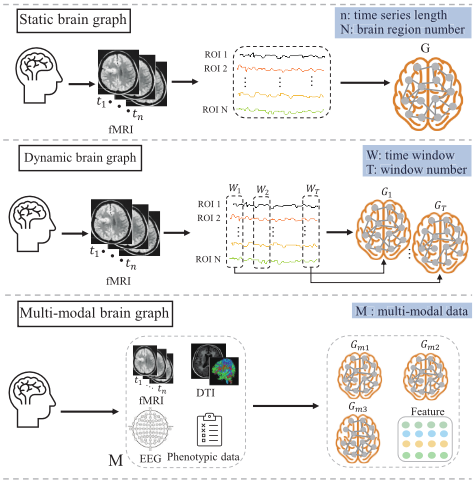
In this survey, we consider three types of brain graphs commonly used in brain graph learning, as illustrated in Figure 2 with a toy example. Within each brain graph type, the methods are categorized into two groups based on the specific research problem they address. For instance, the predictionbased methods are designed to address Problem 1, while the interpretation-based methods address Problem 2. A library with open-source implementations of the representative methods is provided in Table 1.
3.1 Static Brain Graph Learning (SBGL)
Static brain graphs typically represent a single brain graph. While static brain graphs are commonly derived from DTI data, they also involve fMRI and EEG data. For example, fMRI data comprise a series of scanned slices captured over a period of time. Some methods circumvent the temporal aspect by integrating all slices for a subject into a singular, static brain graph. In this section, we explore existing works on SBGL, dividing them into two parts: prediction-based methods and interpretation-based methods.
Prediction-Based Methods. Typically, the aim of prediction-based SBGL is to design a GNN-specific model that will learn brain graph-level representations and perform disorder prediction, i.e., brain graph classification, to judge whether a subject suffers from a given disorder. For example, BRAINNETTF [Kan et al., 2022b] designs a graph transformer-based model for brain graph learning, where the connection profiles of the brain nodes are the attribute features instead of using the positional features of a Transformer model. BRAINNETTF involves a graph pooling method with soft clustering of the brain's functional modules and orthonormal projection to obtain graph-level representations for disorder prediction. To capture the hierarchical structure of ROIs for higher-level representations, THC [Dai et al., 2023] utilizes a Transformer-based encoder with pairwise attention and a clustering layer. This framework learns a globally shared clustering assignment and integrates clustering embedding of multiple layers to learn hierarchical feature representations. Conversely, Com-BrainTF [Bannadabhavi et al., 2023] preserves community information in a transformer encoding of a brain graph.
Several approaches have focused on optimizing the convolution process within brain graph learning to achieve superior brain graph representations. For example, BN-GNN [Zhao et al., 2022b] introduces reinforcement learning to perform the convolutional operation adaptively. hi-GCN [Jiang et al., 2020] relies on a hierarchical framework with a twolevel GCN [Kipf and Welling, 2017] designed for a single brain graph and a population brain graph. Furthermore, recent studies also consider addressing the problem of limited disorder data, largely because GNN-based brain graph learning models easily suffer from overfitting and poor generalization ability on insufficient training data. Thus, MML [Yang et al., 2022] and PTGB [Yang et al., 2023b] both offer a multi-task meta-learning method for pre-training a GNNbased brain graph model for later fine-tuning on the target task data for the idea being to improve disorder prediction.
Interpretation-Based Methods. In essence, interpretation-based brain graph learning aims to provide interpretable analysis results to support disorder prediction, i.e., to recognize the biomarkers associated with disorderspecific brain regions and connections. For instance, using the community-clustering method, tfMRI [Li et al., 2019] first divides a brain graph into subgraphs. Importance scores for the subgraphs are then evaluated based on a salience mapping method. Once the model classifier reaches optimal performance, the biomarkers associated with the specific brain disorder, i.e., the important brain regions, are revealed. Similarly, another work [Luo et al., 2024b] introduces the knowledge distillation to extract important brain subgraphs for analyzing the pathogenic reason. To incorporate the prior information to identify salient subnetworks, MVS-GCN [Wen et al., 2022] constructs multi-view brain graphs with different thresholds and highlights important connections guided by the functional subnetworks.
Furthermore, some methods design the interpretable graph pooling layer to highlight important node features for pathogenic analysis. For example, BrainGNN [Li et al., 2021] proposes an R-pool module to keep informative nodes at each graph pooling process and highlight salient ROIs. Other similar methods have also been developed, such as LGGNN [Zhang et al., 2022], GAT-LI [Hu et al., 2021] using explainable GNN methods, and IGS [Li et al., 2023] with graph sparsification pooling based on important edge selection. We also observe that numerous methods based on generating explanations have also been developed. These approaches first generate a new brain graph and then evaluate important information in the brain graph to give analysis results. IBGNN [Cui et al., 2022b] generates a globally shared mask across all subjects and evaluates all the edge weights plus the weight sums of all nodes to find important brain regions and connections related to specific disorders. FBNETGEN [Kan et al., 2022a] first conducts feature reduction and denoising. Then, it generates individual brain graphs based on processed timeseries features to identify the difference between the given graph and standard brain graphs. However, these methods still generate a shared brain graph to highlight salient ROIs, and they cannot recognize biomarkers within a single brain graph. Hence, to find an important local structure within a single brain graph, BrainIB [Liu et al., 2023] uses the information bottleneck to generate an interpretable brain subgraph toward the corresponding brain graph label.
3.2 Dynamic Brain Graph Leaning (DBGL)
Given that fMRI data encapsulates multiple scans of brain activity over a period, capturing the spatio-temporal information in brain graphs is pivotal for unveiling intricate details of the brain's structures. Contemporary studies have leveraged time series-based fMRI data to construct dynamic brain graphs by setting time windows. In essence, this approach results in a subject being represented by a series of brain graphs, each corresponding to a different time window. Accordingly, we have summarized existing studies on dynamic brain graph learning in the following two categories.
Prediction-Based Methods. Prediction-based DBGL mainly involves building spatio-temporal GNNs from brain graph data to learn a representation at the graph level. For example, Multi-Head GAGNN [Yan et al., 2022] models dynamic brain graphs instead of a single brain graph, to capture spatial and temporal patterns from the given fMRI data. This method first uses a graph U-Net model with multi-head attention to capture spatial patterns. Then the obtained spatial features guide a multi-head attention network learning for the temporal pattern extraction. This approach proves to be beneficial when trying to evaluate the state of an individual brain graph. To accomplish other prediction tasks, ST-GCN [Gadgil et al., 2020] utilizes a subsequence of time seriesbased fMRI data to construct dynamic brain graphs. It then applies the spatio-temporal brain graph convolution to help predict gender and age. However, both methods rely solely on an atlas to generate the brain graphs and so the graphs are of a fixed size, which ignores multi-scale structure information. Recently, MDGL [Ma et al., 2023] uses two different atlases to partition the brain into different-sized brain graphs. Hence, this approach does capture multi-scale structure information. Dynamic brain graphs for each scale structure are then constructed, after which a graph isomorphism network captures the spatial patterns and a Transformer network captures the temporal patterns. This multi-scale information is then fused together for disorder prediction.
Interpretation-Based Methods. In general, the goal of modeling dynamic brain graphs is to capture any brain activity changes. To this end, some methods focus on exploring interpretations of the brain's activity for pathogenic analysis. For example, STpGCN [Ye et al., 2023] first divides fMRI data into multiple frames of equidistant time windows to form a dynamic brain graph. Then, STpGCN proposes a spatiotemporal pyramid graph convolutional network to learn fea- Note: [1] [Li et al., 2019]; [2] [Jiang et al., 2020]; [3] [Li et al., 2021]; [4] [Kan et al., 2022b]; [5] [Zhao et al., 2022b]; [6] [Yang et al., 2022]; [7] [Wen et al., 2022]; [8] [Zhang et al., 2022]; [9] [Cui et al., 2022b]; [10] [Bannadabhavi et al., 2023]; [11] [Gadgil et al., 2020]; [12] [Yan et al., 2022]; [13] [Ma et al., 2023]; [14] [Ye et al., 2023]; [15] [Ma et al., 2017]; [16] [Liu et al., 2018]; [17] [Zheng et al., 2022];[18] [Stankeviciute et al., 2020]; [19] [Zhao et al., 2022a];[20] [Zhu et al., 2022b]; [21] [Luo et al., 2022];[22] [Zhou et al., 2022];[23] [Yang et al., 2023a].
| Methods | Data Modalities | Research Problems | Datasets | Venue | Code Links |
|---|---|---|---|---|---|
| Static Brain Graph Learning | |||||
| tfMRI[1] | fMRI | Disorder Prediction, Pathogenic Analysis | Biopoint | MICCAI'19 | - |
| hi-GCN[2] | fMRI | Disorder Prediction | ABIDE, ADNI | Comput. Biol. Med.'20 | https://github.com/haojiang1/hi-GCN |
| BrainGNN[3] | fMRI | Disorder Prediction, Pathogenic Analysis | Biopoint, HCP | Med. Image Anal.'21 | https://github.com/xxlya/BrainGNN Pytorch |
| BRAINNETTF[4] | fMRI | Disorder Prediction | ABIDE, ABCD | NeurIPS'22 | https://github.com/Wayfear/BrainNetworkTransformer |
| BN-GNN[5] | fMRI, DTI, EEG | Disorder Prediction | HIV, BP, ADHD, HA, HI, GD | Neural Netw.'22 | https://github.com/RingBDStack/BNGNN |
| MML[6] | fMRI, DTI | Disorder Prediction | HIV, BP, PPMI | KDD'22 | https://github.com/Owen-Yang-18/BrainNN-PreTrain |
| MVS-GCN[7] | fMRI | Disorder Prediction, Pathogenic Analysis | ABIDE, ADNI | Comput. Biol. Med.'22 | https://github.com/GuangqiWen/MVS-GCN |
| LG-GNN[8] | fMRI, PET | Disorder Prediction, Pathogenic Analysis | ABIDE, ADNI | TMI'22 | https://github.com/cnuzh/LG-GNN |
| IBGNN[9] | fMRI, DTI | Disorder Prediction, Pathogenic Analysis | HIV, BP, PPMI | MICCAI'22 | https://github.com/HennyJie/IBGNN.git |
| Com-BrainTF[10] | fMRI | Disorder Prediction | ABIDE | MICCAI'23 | https://github.com/ubc-tea/Com-BrainTF |
| Dynamic Brain Graph Learning | |||||
| ST-GCN[11] | fMRI | Disorder Prediction | NCANDA, HCP | MICCAI'20 | https://github.com/sgadgil6/cnslab fmri |
| Multi-Head GAGNN[12] | fMRI | Disorder Prediction | ABIDE, HCP | Med. Image Anal.'22 | https://github.com/JDYan/Multi-Head-GAGNNs |
| MDGL[13] | fMRI | Disorder Prediction | ABIDE | TNSRE'23 | - |
| STpGCN[14] | fMRI | Disorder Prediction, Pathogenic Analysis | HCP | Hum. Brain Mapp.'23 | - |
| Multi-Modal Brain Graph Learning | |||||
| MVGE-HD[15] | fMRI, DTI | Disorder Prediction | HIV, BP | ICDM'17 | - |
| M2E[16] | fMRI, DTI | Disorder Prediction | HIV, BP | AAAI'18 | https://github.com/yeliu918/M2E |
| MMGL[17] | fMRI, MRI, PET, Phenotypic Data | Disorder Prediction | TADPOLE, ABIDE | TMI'20 | https://github.com/SsGood/MMGL |
| Population-GNN[18] | fMRI, Phenotypic Data | Brain Age Prediction | UKB | ICML'20 | https://github.com/kamilest/brain-age-gnn. |
| RTGNN[19] | fMRI, DTI | Disorder Prediction | HIV, BP | TKDE'22 | https://github.com/RingBDStack/RTGNN |
| BrainNN[20] | fMRI, DTI | Disorder Prediction | HIV, BP | EMBC'22 | - |
| CroGen[21] | PICo, Hough | Disorder Prediction | PPMI | BIBM'22 | https://github.com/GongxuLuo/CroGen |
| Grad-GCN[22] | Structural MRI, PET | Disorder Prediction, Pathogenic Analysis | ADNI | ISBI'22 | - |
| Cross-GNN[23] | fMRI, DTI | Disorder Prediction, Pathogenic Analysis | ADNI, Xuanxu, PPMI | TMI'23 | - |
PET: positron emission tomography data; Phenotypic Data: contains cognitive tests, demographic information and biological information; PICo and Hough: Probabilistic Index of Connectivity and Hough Voting are all different whole brain tractography algorithms.
Table 1: A list of representative brain graph learning methods based on GNNs.
ture representations. The spatio-temporal features are fused via a bottom-up pathway that can decode multiple cognitive tasks. Importantly, STpGCN introduces a model-agnostic interpretation method to highlight important ROIs for each cognitive task. Quantitative analysis experiments are then performed to evaluate the annotated ROIs. Separately, HDGL [Jalali and Safayani, 2023] uses a gated recurrent unit to process time series data from the brain regions, generating node feature representations of the brain graph. Spatio-temporal feature information is then captured and a population brain graph is constructed that represents each subject as a node. The edges reflect phenotypic similarity. One of the key ideas behind HDGL is its self-attention pooling, which identifies salient ROIs for explaining brain disorders during the disorder prediction process via node classification task.
3.3 Multi-Modal Brain Graph Learning (MBGL)
Multiple neuroimaging, such as fMRI and DTI, are employed simultaneously to assess brain health when diagnosing a brain disorder. Modeling these diverse data into multi-modal brain graphs, MBGL is particularly advantageous for characterizing brain states and uncovering hidden information relevant to specific disorders. However, the challenge lies in effectively fusing multi-modal data to learn brain graph representations.
Prediction-Based Methods. In general, prediction-based MBGL considers multi-modal data processing and fusion to achieve abundant brain graph representations. For example, MMGL [Zheng et al., 2022] uses multi-modal data, including multi-imaging and non-imaging data like demographic information and biological metrics. MMGL first aligns the features in all modalities into a uniform feature dimension. An inter-modal attention matrix learns the modality-shared and modality-specific representations. In this way, MMGL fuses the two representations into modality-aware representations for each subject. The aim is to capture correlation and complementary information from the multi-modal data. The last step is to construct a population brain graph using an adaptive graph structure learning module and jointly optimize the GNNs and structure learning for disorder prediction. However, other methods only consider the complementary information between different modalities, such as M2E [Liu et al., 2018], RTGNN [Zhao et al., 2022a] using tensor decomposition for information fusion, and BrainNN [Zhu et al., 2022b] based on multi-view contrastive learning fusion. Some methods introduce a generative model to avoid the problem of missing data in a single modality. For example, CroGen [Luo et al., 2022] designs a translator to map the hidden representations of a given modality to the corresponding missing modalities. The problem is treated as a regression task that involves structure decoding to generate the brain graph. A generative adversarial network then decides whether the graph is real or generated. Differently, other methods aim to construct population brain graphs. topoGAN [Bessadok et Note: [1] [Kan et al., 2022b]; [2] [Zhou et al., 2022]; [3] [Yang et al., 2022]; [4] [Li et al., 2021]; [5] [Zhao et al., 2022b].
| Datasets | Data Source | DataModalities | Brain Graphs | Nodes | Data Links |
|---|---|---|---|---|---|
| ABIDE[1] ADNI[2] PPMI[3] HIV[3] BP[3] HCP[4] ABCD[1] ADHD[5] Biopoint [4] | Autism Spectrum Disorder Alzheimer Disorder Parkinson Disorder Human Immunodeficiency Virus Disorder Bipolar Disorder Human Connectome Project Adolescent Brain Cognitive Development Study Attention Deficit Hyperactivity Disorder Autism Spectrum Disorder | fMRI Structural MRI, PET DTI fMRI, DTI fMRI, DTI fMRI fMRI fMRI fMRI | 1,009 755 718 70 97 3,542 7,901 83 118 | 200 90 84 90 82 268 360 200 84 | http://fcon 1000.projects.nitrc.org/indi/abide/ http://www.loni.ucla.edu/ADNI/Data/index.shtml. https://www.ppmi-info.org/ - - https://db.humanconnectome.org/ https://abcdstudy.org - - |
Table 2: A list of commonly used brain graph datasets.
al., 2021] clusters population brain graphs constructed from some learned multi-modal graph representations. Multiple brain graphs are then predicted for each cluster by a discriminator. Alternatively, Population-GNN [Stankeviciute et al., 2020] introduces a population graph based on neuroimaging and non-imaging modalities to predict the age of the brain.
In addition, some methods consider capturing community structures to improve graph representations. Specifically, MVGE-HD [Ma et al., 2017] proposes a joint training framework for graph representation learning and hub detection, and designs a weighted fusion strategy for multi-modal data. To alleviate missing attribute features and inject community information into embedding representations, SCP-GCN [Liu et al., 2019] defines an fMRI graph as a feature matrix and a DTI graph as a structure matrix. Then, SCP-GCN designs a Siamese framework including two sample inputs to preserve community structures during the graph convolution process.
Interpretation-Based Methods. Interpretation-based MBGL focuses on fusing multi-modal information to yield more reliable and comprehensive analytical results. For example, the work by [Zhu et al., 2022a] proposes a triplet network to fuse multi-modal brain graphs, where self-attention is used to learn single-modality representations and crossattention is used to fuse the multi-modal representations. Specifically, the self-attention weight highlights the importance of each brain region, and pathogenic regions are detected by contrasting these important regions with the brain graphs of healthy controls and patients. To improve crossmodal fusion and help detect important ROIs, Cross-GNN [Yang et al., 2023a] generates a dynamic brain graph by defining multi-modal representations as node features and a correspondence matrix as an adjacency matrix. Crossdistillation is then conducted from single-modality and multimodal representations. Finally, the correspondence matrix is used to evaluate disorder-specific biomarkers. However, other methods introduce a feature map to visualize important ROIs for pathogenic analysis after learning multi-modal representations. Grad-GCN [Zhou et al., 2022] integrates three modalities of imaging data into a multi-modal brain graph and computes the feature map by gradient class activation mapping to identify important ROIs after the GNN operation.
4 Brain Graph Datasets
To advance brain disorder analysis through brain graph learning and encourage broader research participation, we have compiled the commonly used datasets, with their statistics detailed in Table 2. This summary includes each dataset's research source, modality type, number of subjects (i.e., brain graphs), and the number of divided brain regions (i.e., brain graph nodes), thus, offering a comprehensive overview of these resources. Additionally, we have provided links to the public datasets to facilitate easy access.
5 Future Research Directions
While there have been significant advancements in brain graph learning with GNNs, the field still faces several unresolved challenges. In this section, we identify and discuss key research directions that merit future exploration.
5.1 Reliable Brain Graph Construction
In preprocessing brain neuroimaging data to obtain weight connectivity matrices, the current methods typically either adopt a weight threshold to determine the edges between brain regions or employ a KNN method to generate the structural information. However, setting a weight threshold often involves arbitrary decision-making, making identifying an effectively optimized threshold challenging. Additionally, the absence of explicit brain node features means that using the connectivity matrix as node features in KNN-based graph construction may not always yield an effective brain graph structure. Therefore, designing a reliable method for brain graph construction is crucial, as it significantly impacts the overall quality of brain graph learning. One potential avenue to address these challenges is the application of reinforcement learning to optimize the threshold selection for connectivity matrices tailored explicitly for different brain disorders. Furthermore, employing graph structure learning methods [Zhu et al., 2021] represents another promising research direction for enhancing brain graph structures.
5.2 Multi-Scale Brain Graph Fusion
To partition the brain into different brain regions as the definition of brain graph nodes, a corresponding brain atlas needs to be used, such as the commonly used AAL 116, Craddock 200 atlas (CC200), or similar. However, selecting a different brain atlas will generate a different brain graph at the corresponding size. Currently, there are no well-defined criteria for choosing the most suitable brain atlas with which to segment the brain about a specific brain disorder. However, creating multi-scale brain graph structures using multiple atlases for a single subject can be beneficial. This approach helps to depict the connectivity state of brain networks and enriches brain graph representations. While the MDGL method [Ma et al., 2023] constructs multi-scale dynamic brain graphs utilizing both the AAL and CC200 atlases for disorder prediction, it falls short in thoroughly exploring the optimal scale size selection. Additionally, the simplistic approach of concatenating multi-scale features does not substantially enhance the representations of brain graphs. Thus, more research efforts are needed to address the above problems.
5.3 Prior Domain Knowledge Fusion
Currently, most research focuses on using neuroimaging data to generate various brain graphs and designing a brain graphoriented GNN to learn the embedding representations. Yet neuroscientists have reached many conclusions about the brain's mechanisms. For example, the human brain contains different neural systems, such as the Somato-Motor Network and the Visual Network. These neural systems are often closely related to human behaviours and can affect the occurrence of some brain disorders. We also note that some studies [Liu et al., 2019; Cui et al., 2022b] consider capturing the community structures in brain graphs or performing interpretation analysis from the view of the neural systems. However, these methods do not draw on prior knowledge for their model designs to improve brain graph learning. It could be fruitful to fuse this prior domain knowledge into brain graph learning, especially disorder interpretation analysis. Doing so may greatly promote research progress in brain disorder analysis.
5.4 Brain Subgraph Extraction
As an important component of graph structures, subgraphs have been studied extensively. For example, SubgraphX [Yuan et al., 2021] uses a Monte Carlo tree search algorithm to identify important subgraphs to explain GNN prediction. SUGAR [Sun et al., 2021] employs a reinforcement learning method to select important subgraphs and a subgraph neural network that learns graph-level representations. Brain subgraphs play a pivotal role in brain graph learning. On the one hand, identifying discriminative brain subgraphs between healthy individuals and patients can reveal underlying pathogenic factors, as abnormalities in specific brain regions often result in atypical connections with neighboring areas. On the other hand, brain graphs are often characterized by clustering and small-world properties, as evidenced in previous research [Bassett and Bullmore, 2006]. Extracting brain subgraphs, therefore, is instrumental in exploring pathogenic reasons and enhancing the quality of brain graph representations. Despite its importance, this research area has not received adequate attention and remains underexplored.
5.5 Brain Graph Augmentation
The collection and preprocessing of neuroimaging data are notably costly, resulting in a paucity of available datasets. This limitation often leads to a small sample size in commonly used datasets, which poses a risk of overfitting and poor generalization ability in deep brain graph models. While some studies have suggested using pre-training strategies or graph contrastive learning methods to mitigate these issues [Yang et al., 2022; Luo et al., 2024a], these approaches still rely on large source datasets for pre-training and require data augmentation for contrastive learning optimization. However, given the subtle differences between healthy and patient brain graphs, traditional graph data augmentation methods, like node dropping and edge perturbation, risk distorting the brain graph structure. Therefore, developing effective brain graph data augmentation techniques remains a critical research area. Drawing inspiration from the successful application of diffusion models in molecular graph generation [Xu et al., 2022], exploring similar methods for brain graph generation presents a promising research direction.
5.6 Medical Experimental Evaluation
Current interpretation-based brain graph learning methods, such as those in [Cui et al., 2022b; Luo et al., 2024a], primarily assess their interpretative results by comparing identified brain regions and connections with related medical findings. However, this approach relies solely on existing knowledge for validation. What is lacking is a comprehensive looplocked test and evaluation. Given the ongoing quest to unravel the pathogenic mechanisms of brain disorders, a field still replete with unknowns, these interpretation results from brain graph learning models are not fully corroborated by existing medical findings. Some salient brain regions and connections identified by current models do not align with established medical research conclusions. This discrepancy underscores the need for more rigorous and reliable experimental analyses to validate these interpretations. Therefore, a significant future research direction lies in enhancing the integration of brain graph learning with brain neuroscience research. Specifically, combining medical analysis experiments to evaluate interpretive results is crucial for advancing our understanding and ensuring these computational models' reliability in medical science.
6 Conclusion
In this work, we introduce brain graph construction and current research problems. We systematically review existing studies and discuss future research directions. To promote the development of the research community, we summarize the representative methods and commonly used datasets providing links to the code and data where available. We also provide the repository of this survey and hope this survey will attract more attention and advance brain graph learning for disorder research.
Acknowledgments
This work was supported by the Australian Research Council Projects with Nos. LP210301259 and DP230100899, Macquarie University DataX Research Centre, and NSF under grant III-2106758. J. Wu is the corresponding author.
@inproceedings{ijcai2024p903,
  title     = {Graph Neural Networks for Brain Graph Learning: A Survey},
  author    = {Luo, Xuexiong and Wu, Jia and Yang, Jian and Xue, Shan and Beheshti, Amin and Sheng, Quan Z. and McAlpine, David and Sowman, Paul and Giral, Alexis and Yu, Philip S.},
  booktitle = {Proceedings of the Thirty-Third International Joint Conference on
               Artificial Intelligence, {IJCAI-24}},
  publisher = {International Joint Conferences on Artificial Intelligence Organization},
  editor    = {Kate Larson},
  pages     = {8170--8178},
  year      = {2024},
  month     = {8},
  note      = {Survey Track},
  doi       = {10.24963/ijcai.2024/903},
  url       = {https://doi.org/10.24963/ijcai.2024/903},
}
TY - CPAPER TI - Graph Neural Networks for Brain Graph Learning: A Survey AU - Luo, Xuexiong AU - Wu, Jia AU - Yang, Jian AU - Xue, Shan AU - Beheshti, Amin AU - Sheng, Quan Z. AU - McAlpine, David AU - Sowman, Paul AU - Giral, Alexis AU - Yu, Philip S. T2 - Proceedings of the Thirty-Third International Joint Conference on Artificial Intelligence, IJCAI-24 PB - International Joint Conferences on Artificial Intelligence Organization PY - 2024 SP - 8170 EP - 8178 DO - 10.24963/ijcai.2024/903 UR - https://doi.org/10.24963/ijcai.2024/903 ER -Copied
Machine-readable versions of this paper, for tools and AI agents:





