
X-former Elucidator: Reviving Efficient Attention for Long Context Language Modeling
Proceedings of the Thirty-Third International Joint Conference on Artificial Intelligence. Survey Track. Pages 8179-8187.
https://doi.org/10.24963/ijcai.2024/904
Keywords
- Natural Language Processing: NLP: Language models
- Machine Learning: ML: Attention models
- Multidisciplinary Topics and Applications: MTA: Computational sustainability
- Natural Language Processing: General
Abstract
Transformer-based LLMs are becoming increasingly important in various AI applications. However, apart from the success of LLMs, the explosive demand of long context handling capabilities is a key and in-time problem for both academia and industry.
Due to the limitations from the quadratic complexity of the attention mechanism, long context scenarios require much more resources for LLM development and deployment, bringing huge challenges to the underlying AI infrastructure.
Meanwhile, we observe that there is a trend of reviving previous efficient attention mechanisms to latest LLMs.
However, it still remains an open question about how to select from these diverse approaches in practice.
In this paper, we answer this question from several aspects.
First, we revisit these latest long-context LLM innovations and discuss their relationship with prior approaches with a novel and comprehensive taxonomy.
Next, we conduct a thorough evaluation over various types of workloads considering both efficiency and effectiveness.
Finally, we provide an in-depth analysis, summarize our key findings, and offer insightful suggestions on the trade-offs of designing and deploying efficient attention mechanisms for Transformer-based LLMs.
- [Ainslie et al., 2023] Joshua Ainslie, James Lee-Thorp, Michiel de Jong, Yury Zemlyanskiy, Federico Lebrón, and Sumit Sanghai. Gqa: Training generalized multi- query transformer models from multi-head checkpoints. In EMNLP, 2023.
- [Anagnostidis et al., 2023] Sotiris Anagnostidis, Dario Pavllo, Luca Biggio, Lorenzo Noci, Aurelien Lucchi, and Thomas Hoffmann. Dynamic context pruning for efficient and interpretable autoregressive transformers. In NeurIPS, 2023.
- [Beltagy et al., 2020] Iz Beltagy, Matthew E Peters, and Ar- man Cohan. Longformer: The long-document transformer. arXiv preprint arXiv:2004.05150, 2020.
- [Chevalier et al., 2023] Alexis Chevalier, Alexander Wettig, Anirudh Ajith, and Danqi Chen. Adapting language models to compress contexts. In EMNLP, 2023.
- [Child et al., 2019] Rewon Child, Scott Gray, Alec Radford, and Ilya Sutskever. Generating long sequences with sparse transformers. arXiv preprint arXiv:1904.10509, 2019.
- [Choromanski et al., 2020] Krzysztof Choromanski, Valerii Likhosherstov, David Dohan, Xingyou Song, Andreea Gane, Tamas Sarlos, Peter Hawkins, Jared Davis, Afroz Mohiuddin, Lukasz Kaiser, et al. Rethinking attention with performers. arXiv preprint arXiv:2009.14794, 2020.
- [Clevert et al., 2015] Djork-Arné Clevert, Thomas Un- terthiner, and Sepp Hochreiter. Fast and accurate deep network learning by exponential linear units (elus). arXiv preprint arXiv:1511.07289, 2015.
- [Correia et al., 2019] Gonçalo M Correia, Vlad Niculae, and André FT Martins. Adaptively sparse transformers. In EMNLP-IJCNLP, pages 2174-2184, 2019.
- [Ding et al., 2023] Jiayu Ding, Shuming Ma, Li Dong, Xingx- ing Zhang, Shaohan Huang, Wenhui Wang, and Furu Wei. Longnet: Scaling transformers to 1,000,000,000 tokens. arXiv:2307.02486, 2023.
- [Ge et al., 2023] Tao Ge, Jing Hu, Xun Wang, Si-Qing Chen, and Furu Wei. In-context autoencoder for context com- pression in a large language model. arXiv preprint arXiv:2307.06945, 2023.
- [Gray et al., 2017] Scott Gray, Alec Radford, and Diederik P Kingma. Gpu kernels for block-sparse weights. arXiv preprint arXiv:1711.09224, 3:2, 2017.
- [Gu and Dao, 2023] Albert Gu and Tri Dao. Mamba: Linear- time sequence modeling with selective state spaces. arXiv preprint arXiv:2312.00752, 2023.
- [Gupta et al., 2021] Ankit Gupta, Guy Dar, Shaya Goodman, David Ciprut, and Jonathan Berant. Memory-efficient trans- formers via top-k attention. In SustaiNLP@EMNLP, 2021.
- [Han et al., 2023] Insu Han, Rajesh Jayaram, Amin Karbasi, Vahab Mirrokni, David P Woodruff, and Amir Zandieh. Hyperattention: Long-context attention in near-linear time. arXiv preprint arXiv:2310.05869, 2023.
- [Jiang et al., 2023a] Albert Q Jiang, Alexandre Sablayrolles, Arthur Mensch, Chris Bamford, et al. Mistral 7b. arXiv preprint arXiv:2310.06825, 2023.
- [Jiang et al., 2023b] Huiqiang Jiang, Qianhui Wu, Chin-Yew Lin, Yuqing Yang, and Lili Qiu. Llmlingua: Compressing prompts for accelerated inference of large language models. arXiv preprint arXiv:2310.05736, 2023.
- [Jiang et al., 2023c] Huiqiang Jiang, Qianhui Wu, Xufang Luo, Dongsheng Li, Chin-Yew Lin, Yuqing Yang, and Lili Qiu. Longllmlingua: Accelerating and enhancing llms in long context scenarios via prompt compression. arXiv preprint arXiv:2310.06839, 2023.
- [Katharopoulos et al., 2020] Angelos Katharopoulos, Apoorv Vyas, Nikolaos Pappas, and François Fleuret. Transformers are rnns: Fast autoregressive transformers with linear attention. In ICML, 2020.
- [Kitaev et al., 2019] Nikita Kitaev, Lukasz Kaiser, and Anselm Levskaya. Reformer: The efficient transformer. In ICLR, 2019.
- [Li et al., 2023a] Longhai Li, Lei Duan, Junchen Wang, Chengxin He, Zihao Chen, Guicai Xie, Song Deng, and Zhaohang Luo. Memory-enhanced transformer for repre- sentation learning on temporal heterogeneous graphs. Data Sci. Eng., 8(2):98-111, 2023.
- [Li et al., 2023b] Yucheng Li, Bo Dong, Frank Guerin, and Chenghua Lin. Compressing context to enhance inference efficiency of large language models. In EMNLP, 2023.
- [Lingle, 2023] Lucas D Lingle. Transformer-vq: Linear- time transformers via vector quantization. arXiv preprint arXiv:2309.16354, 2023.
- [Liu et al., 2023a] Yuhan Liu, Hanchen Li, Kuntai Du, Ji- ayi Yao, Yihua Cheng, Yuyang Huang, Shan Lu, Michael Maire, Henry Hoffmann, Ari Holtzman, Ganesh Anantha- narayanan, and Junchen Jiang. Cachegen: Fast context loading for language model applications. arXiv preprint arXiv:2310.07240, 2023.
- [Liu et al., 2023b] Zichang Liu, Aditya Desai, Fangshuo Liao, Weitao Wang, Victor Xie, Zhaozhuo Xu, Anasta- sios Kyrillidis, and Anshumali Shrivastava. Scissorhands: Exploiting the persistence of importance hypothesis for llm kv cache compression at test time. In NeurIPS, 2023.
- [Liu et al., 2023c] Zichang Liu, Jue Wang, Tri Dao, Tianyi Zhou, Binhang Yuan, Zhao Song, Anshumali Shrivastava, Ce Zhang, Yuandong Tian, Christopher Ré, and Beidi Chen. Deja vu: Contextual sparsity for efficient llms at inference time. In ICML, pages 22137-22176. PMLR, 2023.
- [Miao et al., 2023a] Xupeng Miao, Xiaonan Nie, Hailin Zhang, Tong Zhao, and Bin Cui. Hetu: A highly effi- cient automatic parallel distributed deep learning system. Sci. China Inf. Sci., 66(1):117101, 2023.
- [Miao et al., 2023b] Xupeng Miao, Gabriele Oliaro, Zhihao Zhang, Xinhao Cheng, Hongyi Jin, Tianqi Chen, and Zhi- hao Jia. Towards efficient generative large language model serving: A survey from algorithms to systems. arXiv preprint arXiv:2312.15234, 2023.
- [Mohtashami and Jaggi, 2023] Amirkeivan Mohtashami and Martin Jaggi. Landmark attention: Random-access in- finite context length for transformers. arXiv preprint arXiv:2305.16300, 2023.
- [Mu et al., 2023] Jesse Mu, Xiang Lisa Li, and Noah Good- man. Learning to compress prompts with gist tokens. arXiv preprint arXiv:2304.08467, 2023.
- [mya, 2023] Technical Report. https://github.com/Hsword/ X-former-Elucidator/blob/main/Report.pdf, 2023. Link
- [Pagliardini et al., 2023] Matteo Pagliardini, Daniele Paliotta, Martin Jaggi, and François Fleuret. Faster causal atten- tion over large sequences through sparse flash attention. arXiv:2306.01160, 2023.
- [Peng et al., 2021] Hao Peng, Nikolaos Pappas, Dani Yo- gatama, Roy Schwartz, Noah A. Smith, and Lingpeng Kong. Random feature attention. In ICLR, 2021.
- [Peng et al., 2023] Bo Peng, Eric Alcaide, Quentin Anthony, Alon Albalak, Samuel Arcadinho, et al. Rwkv: Reinventing rnns for the transformer era. In EMNLP (Findings), 2023.
- [Qin et al., 2022] Zhen Qin, XiaoDong Han, Weixuan Sun, Dongxu Li, Lingpeng Kong, Nick Barnes, and Yiran Zhong. The devil in linear transformer. In EMNLP, 2022.
- [Roy et al., 2021] Aurko Roy, Mohammad Saffar, Ashish Vaswani, and David Grangier. Efficient content-based sparse attention with routing transformers. In TACL, 2021.
- [Shao et al., 2024] Yunfan Shao, Zhichao Geng, Yitao Liu, Junqi Dai, Hang Yan, Fei Yang, Li Zhe, Hujun Bao, and Xipeng Qiu. Cpt: A pre-trained unbalanced transformer for both chinese language understanding and generation. Sci. China Inf. Sci., 67(5):1-13, 2024.
- [Su et al., 2024] Jianlin Su, Yu Lu, Shengfeng Pan, Ahmed Murtadha, Bo Wen, and Yunfeng Liu. Roformer: Enhanced transformer with rotary position embedding. Neurocomput- ing, 2024.
- [Tay et al., 2020] Yi Tay, Mostafa Dehghani, Dara Bahri, and Donald Metzler. Efficient transformers: A survey. ACM Computing Surveys (CSUR), 2020.
- [Tay et al., 2021a] Yi Tay, Dara Bahri, Donald Metzler, Da- Cheng Juan, Zhe Zhao, and Che Zheng. Synthesizer: Re- thinking self-attention for transformer models. In ICML, pages 10183-10192. PMLR, 2021.
- [Tay et al., 2021b] Yi Tay, Mostafa Dehghani, Samira Abnar, Yikang Shen, Dara Bahri, Philip Pham, Jinfeng Rao, Liu Yang, Sebastian Ruder, and Donald Metzler. Long range arena : A benchmark for efficient transformers. In ICLR, 2021.
- [Tsai et al., 2019] Yao-Hung Hubert Tsai, Shaojie Bai, Makoto Yamada, Louis-Philippe Morency, and Ruslan Salakhutdinov. Transformer dissection: An unified under- standing for transformer's attention via the lens of kernel. In EMNLP-IJCNLP, pages 4344-4353, 2019.
- [Vaswani et al., 2017] Ashish Vaswani, Noam Shazeer, Niki Parmar, Jakob Uszkoreit, Llion Jones, Aidan N. Gomez, Lukasz Kaiser, and Illia Polosukhin. Attention is all you need. In NeurIPS 2017, pages 5998-6008, 2017.
- [Vyas et al., 2020] Apoorv Vyas, Angelos Katharopoulos, and François Fleuret. Fast transformers with clustered attention. In NeurIPS, 2020.
- [Wang and Zhang, 2013] Shusen Wang and Zhihua Zhang. Improving cur matrix decomposition and the nyström ap- proximation via adaptive sampling. JMLR, 2013.
- [Wang et al., 2020] Sinong Wang, Belinda Z Li, Madian Khabsa, Han Fang, and Hao Ma. Linformer: Self-attention with linear complexity. arXiv preprint arXiv:2006.04768, 2020.
- [Xiao et al., 2024] Guangxuan Xiao, Yuandong Tian, Beidi Chen, Song Han, and Mike Lewis. Efficient streaming language models with attention sinks. In ICLR, 2024.
- [Xiong et al., 2021] Yunyang Xiong, Zhanpeng Zeng, Rudra- sis Chakraborty, Mingxing Tan, Glenn Fung, Yin Li, and Vikas Singh. Nyströmformer: A nyström-based algorithm for approximating self-attention. In AAAI, 2021.
- [Xu et al., 2023] Peng Xu, Wei Ping, Xianchao Wu, Lawrence McAfee, Chen Zhu, Zihan Liu, Sandeep Sub- ramanian, Evelina Bakhturina, Mohammad Shoeybi, and Bryan Catanzaro. Retrieval meets long context large lan- guage models. arXiv preprint arXiv:2310.03025, 2023.
- [Ye et al., 2023] Zihao Ye, Ruihang Lai, Junru Shao, Tianqi Chen, and Luis Ceze. Sparsetir: Composable abstractions for sparse compilation in deep learning. In ASPLOS, 2023.
- [Zaheer et al., 2020] Manzil Zaheer, Guru Guruganesh, Ku- mar Avinava Dubey, Joshua Ainslie, Chris Alberti, Santi- ago Ontañón, Philip Pham, Anirudh Ravula, Qifan Wang, Li Yang, and Amr Ahmed. Big bird: Transformers for longer sequences. NeurIPS, 33:17283-17297, 2020.
- [Zhang et al., 2023a] Qingru Zhang, Dhananjay Ram, Cole Hawkins, Sheng Zha, and Tuo Zhao. Efficient long-range transformers: You need to attend more, but not necessarily at every layer. In EMNLP, 2023.
- [Zhang et al., 2023b] Zhenyu Zhang, Ying Sheng, Tianyi Zhou, Tianlong Chen, Lianmin Zheng, Ruisi Cai, Zhao Song, Yuandong Tian, Christopher Ré, Clark W. Barrett, Zhangyang Wang, and Beidi Chen. H _2 o: Heavy-hitter oracle for efficient generative inference of large language models. In NeurIPS, 2023.
- [Zhen et al., 2022] Q Zhen, W Sun, H Deng, D Li, Y Wei, B Lv, J Yan, L Kong, and Y Zhong. cosformer: Rethinking softmax in attention. In ICLR, 2022.
- [Zheng et al., 2023] Lin Zheng, Jianbo Yuan, Chong Wang, and Lingpeng Kong. Efficient attention via control variates. arXiv preprint arXiv:2302.04542, 2023.
- [Zhong et al., 2022] Haiting Zhong, Wei He, Lizhen Cui, Lei Liu, Zhongmin Yan, and Kun Zhao. Joint atten- tion networks with inherent and contextual preference- awareness for successive poi recommendation. Data Sci. Eng., 7(4):370-382, 2022.
- [Zhou et al., 2021] Haoyi Zhou, Shanghang Zhang, Jieqi Peng, Shuai Zhang, Jianxin Li, Hui Xiong, and Wancai Zhang. Informer: Beyond efficient transformer for long sequence time-series forecasting. In AAAI, 2021.
References were extracted automatically from the PDF and may contain errors.
Full text extracted automatically from the PDF; figures, tables and equations may differ. The PDF is the version of record.
1 Introduction
Transformer-based large language models (LLMs) [Vaswani et al., 2017] are becoming a key backbone of foundation models in recent years, which has been applied to diverse areas [Shao et al., 2024; Zhong et al., 2022; Li et al., 2023a], such as natural language processing (NLP), computer vision (CV), and multi-modal tasks. It has been observed that emerging LLMs have achieved dramatic breakthroughs (e.g., ChatGPT, Bard), constantly improving the state-of-the-art model performance (e.g., generation quality). LLMs are leading this paradigm to shift in deep learning (DL) and becoming the cornerstone of AI development.
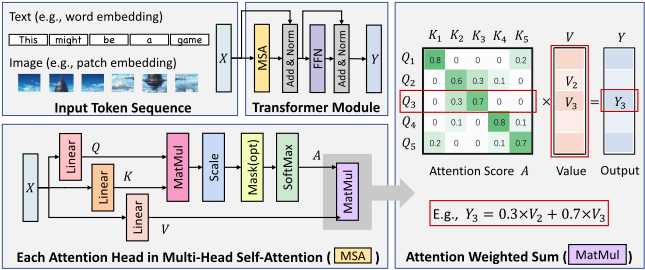
However, one of the main pitfalls of Transformer-based LLMs is the quadratic complexity of the attention mechanism (with respect to the sequence length). As shown in Figure 1a, the attention mechanism requires to calculate the attention score matrix A ∈ Rn×n from the dot product of row vectors in Q and K, where Q, K, V ∈ Rn×d and n is the sequence length. Specifically, each position (i, j) in A implies the strength of the relationship between the i-th token and the j-th token in the given sequence. Figure 1b illustrates the per-sequence execution time and memory footprint of a single Transformer module while increasing the sequence length from 128 to 8192 on one NVIDIA Titan RTX 24GB GPU. We can observe that multi-head self-attention (MSA) occupies more than half of overheads when the input sequence length grows to 512. Some latest LLM applications (e.g., long document handling, multi-round chatting) have claimed to support longer sequences with thousands of tokens (e.g., GPT4-32K, Yarn-Mistral-7b-128k, and Baichuan2-192K) and such requirements are still increasing. For these scenarios, the default full attention calculation (i.e., query-key productions between all pairs of tokens) dominates the entire LLM, requiring a large amount of computation and memory resources. Such limitations seriously affects the training and inference efficiency of LLMs and potentially restricts their applicability to more real-world scenarios.
We also notice that since the emergence of ChatGPT, dozens of approaches targeting attention optimizations over existing LLMs continuously appear during the past year. To make LLMs efficiently support long contexts, the key idea behind these explorations is seeking for alternative attention mechanisms to alleviate the computational inefficiency and memory pressure issues for LLM training and inference. However, they simplify attention in significantly different methods (e.g., selecting few important context tokens, reformulating non-linear activation functions), leading to unequal time cost or memory usage. Furthermore, there is no such thing as a free lunch because these optimizations have side effects on the model performance in varying degrees. Therefore, these efficient long context LLM optimizations exhibit vast diversity and pose tough choices for real LLM applications. Unfortunately, as a timely research topic, there lacks a comprehensive survey
(b) Time/memory costs
Figure 1: Fig. 1a: Transformer. Fig. 1b: The increasing time and memory costs when scaling a Transformer module to longer sequences
in this crowded field to provide constructive guidelines for long context LLMs.
Survey Scope In fact, scaling LLMs to long context requires innovations from various perspectives, such as designing context compression methods [Mohtashami and Jaggi, 2023; Jiang et al., 2023b; Zhang et al., 2023b], replacing Transformer architecture with attention-free solutions (e.g., recurrent units [Peng et al., 2023], state space models [Gu and Dao, 2023]), leveraging external knowledge during inference (e.g., retrieval-augmented generation [Xu et al., 2023]), and extrapolating the positional embedding for better contextual capabilities (e.g., RoPE [Su et al., 2024]). Our survey mainly focuses on the attention optimizations for efficient long context modeling and aims to provide a comprehensive understanding on the intuitions behind their design trade-offs. Surprisingly, we notice that there is a trend of applying previous efficient attention mechanisms (before 2022) to recent LLMs (since 2023), while minimizing the degradation of model performance. Although some of them are designed for encoders, most of them can easily adapt to the autoregressive decoding paradigm in decoder-only LLMs through certain algorithm adjustments (e.g., maintaining an upper triangular casual mask attention matrix like Figure 3). To the best of our knowledge, we are the first to reveal the development trajectory of these latest long-context LLM advancements as well as their relationships with previous work, making our survey fundamentally different from prior surveys on similar topics [Tay et al., 2020; Miao et al., 2023b].
Specifically, we summarize our contributions as follows:
- We critically revisit latest long-context LLM optimizations, illustrates their technical origins, and provide a new taxonomy to clarify the fundamental differences behind their designs.
- We conduct over 20,000 GPU hours empirical studies to compare the computational efficiency, memory usage, and model performance under relatively fair conditions.
- We provide practical suggestions on algorithm selection and system design for LLMs and offer valuable insights on designing effective and efficient attention mechanisms for long-context LLMs in the future.
2 Taxonomy of Efficient Attention for LLMs
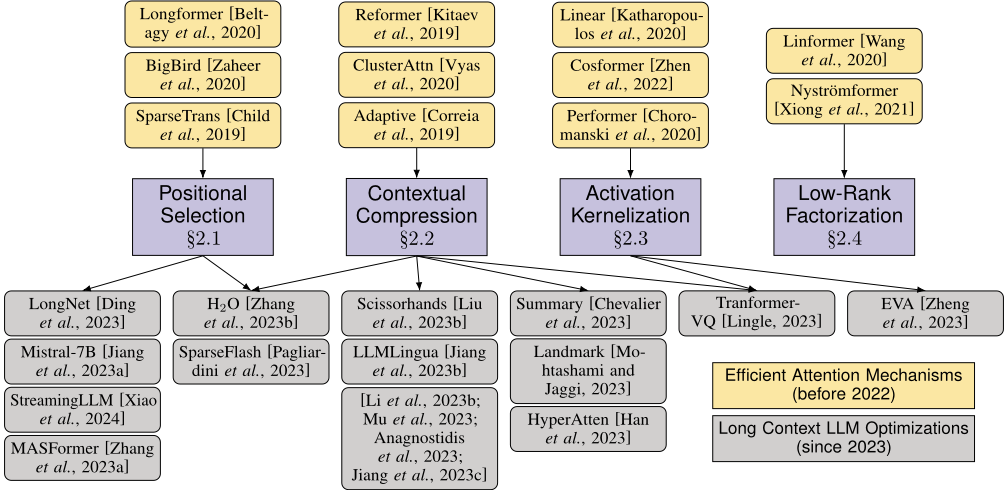
In this survey, we revisit previous efficient attention mechanisms and classify them into four categories. We then illustrate the relationship between these prior work with the recent attention optimizations for long context LLMs. Figure 2 presents our taxonomy of these approaches and the technological evolution pathway behind recent long context LLM advances. In the following, we will go through each category and provide an in-depth analysis of them.
2.1 Positional Selection
The first notable line of work directly select few tokens in some pre-defined positions to approximate the original attention results based on the full context. In this way, the query-key pairs to be calculated locate at few specific positions in the attention matrix suggested by algorithm experts. The design of these selected positions are usually determined by some observations in real distribution of attention scores from empirical studies or theoretical analysis. For example, Mistral-7B [Jiang et al., 2023a] takes a sliding window attention mechanism that only emphasizes the left neighboring tokens within the rotating buffer. MASFormer [Zhang et al., 2023a] employs a block sparse attention mechanism and only performs attention calculation within blocks. LongNet [Ding et al., 2023] adapts a dilated window approach to expand the attentive field and capture both short-range and long-range token dependencies. StreamingLLM [Xiao et al., 2024] maintains the sliding window and attention sinks by assuming the initial tokens have strong attention scores even if they are not semantically important. We found that the key ideas of these LLM optimizations are mostly originated from the following approaches.
A1: Longformer. Longformer [Beltagy et al., 2020] designs three types of sparse pattern, i.e. sliding window, dilated sliding window and global, as shown in Figures 3a,3b, and 3c. Since the local context in a sequence may have semantic associations, the two window patterns force a token to aggregate information from neighboring tokens (i.e., the diagonal area in the attention matrix with the size of w). The dilated variant allows a larger receptive field and can be used as an alternative to the original sliding window pattern in some settings. The global pattern introduces all-to-one connections (i.e., g nonzero columns in the attention matrix). It aims to emphasize some special and important tokens, making them noticed by all tokens. To better leverage different patterns, Longformer integrates them together as a combined sparse pattern.
A2: BigBird. BigBird [Zaheer et al., 2020] employs window and global attentions as Longformer does. In addition, BigBird proposes the random pattern, which allows a query to attend to a fixed number (i.e., r) of random keys. From a graph spectral theory perspective, these random edges between tokens benefit the information propagation between arbitrary token pairs. However, the random pattern brings inconvenience in an efficient implementation. To this end, in the GPU kernel implementation of BigBrid, it proposes to blockify the attention matrix and sparse patterns by defining a b × b block as a basic computation unit. Computation on the attention matrix is performed at the granularity of basic blocks. Figure 3e illustrates BigBird sparse patterns which are split into 2 × 2 blocks.
A3: Sparse Transformer (SparseTrans). SparseTrans [Child et al., 2019] is an early work directing only at decoder-only Transformers on auto-regressive generation workloads. SparseTrans defines a hybrid fixed-position attention pattern that is suitable for general data without any prior knowledge of the strided pattern. It integrates both blocklocal and block-global patterns as shown in Figure 3g. In this way, these global columns help to summarize previous tokens' information and propagate to all future tokens.
2.2 Contextual Compression
Another line of work directly compresses the context into fewer tokens to alleviate the computational and memory overheads. Therefore, it is necessary to find appropriate compression methods to keep important information in the attention matrix. Some approaches adaptively determine which querykey pairs to be calculated according to the context information based on different token importance measurements [Mu et al., 2023; Anagnostidis et al., 2023; Zhang et al., 2023b; Jiang et al., 2023c]. For example, Scissorhands [Liu et al., 2023b] drops the tokens whose corresponding attention scores are lower than a budget and keeps the remaining tokens for the following LLM decoding. H2O [Zhang et al., 2023b] combines these tokens with high attention scores and the sliding window approach for better performance. Selective Context [Li et al., 2023b] evaluates the informativeness of tokens with self-information and retain content with higher self-information. LLMLingua [Jiang et al., 2023b] further takes account into the conditional dependencies between tokens and proposes an iterative prompt compression method. Some approaches inserts some summary [Chevalier et al., 2023] or landmark [Mohtashami and Jaggi, 2023] tokens into the context to replace the original tokens during attention calculation [Ge et al., 2023]. There are also some approaches partitioning context tokens with similar information into small groups by hashing techniques [Han et al., 2023; Pagliardini et al., 2023]. We found that some prior work also optimize the attention calculation with similar design.
A4: Reformer. Reformer [Kitaev et al., 2019] proposes the locality sensitive hashing (LSH) attention mechanism. It gathers the nearest queries and keys into the same bucket during the pre-processing phase. More specifically, it uses a random-projection-based LSH function h(·) to map queries (keys) into different buckets. Suppose the number of buckets is s, given a random matrix R ∈ Rd×s/2 , we have h(x) = argmax([xR; -xR]). It assumes that similar queries (keys) will fall into identical buckets with high probability and then we can limit the attention calculation within the same bucket, rather than the whole sequence. It could be further improved by applying multiple rounds (i.e., l) of hashing. Besides, Reformer shares query and key weight matrices (WQ,WK ), which forces queries and keys to be identical. However, uneven bucket splitting may increase the difficulties of parallel computation in GPUs. Reformer proposes to reorder queries (keys) according to cluster indices and split them into small uniform chunks. It is also necessary to re-order the output vectors back after the chunk-wise multiplication.

A5: Clustered Attention (ClusterAttn). ClusterAttn [Vyas et al., 2020] uses centroids (representative queries) to provide a fast approximation for the full attention calculation. During pre-processing, a fast clustering (e.g., K-means with l iterations, which is also used by Routing Transformer [Roy et al., 2021]) step groups all queries into c non-overlapping clusters. It assumes queries in the same cluster (which suggests close in spatial) can be represented by the same one (i.e., cluster centroid). These centroids are then multiplied with all keys, and the resulting attention distribution will be broadcasted to all queries in the same cluster. It is further improved by using top-k keys for each cluster (i.e. the keys that get top-k highest attention scores with each centroid) to re-calculate the attention with clustered queries. It involves more computation overheads, but largely reduces the misusing risks (e.g., a key with low attention for some queries mistakenly gets high attention with the centroid).
Others. Some work adaptively select important tokens to compress the context, such as adaptively sparse Transformer [Correia et al., 2019], Informer [Zhou et al., 2021], and so on [Gupta et al., 2021]. However, considering the diversity of input workloads, it's still challenging for nowadays LLMs to find appropriate compression methods and keep important information in the attention matrix without prior knowledge.
2.3 Activation Kernelization
Another category of approaches is kernelization methods that reorganize the original activation function softmax(QK⊤) to a matrix multiplication after the kernel functions [Tsai et al., 2019]. Specifically, it replaces exp(·) with S(·, ·), which can be written as S(a, b) = ϕ(a)ϕ(b)⊤. Here S(·, ·) should be non-negative and the feature map function ϕ(·) is required to be non-negative and monotonically non-decreasing. As a result, given a query qi, its original attention output yoriginal i = softmax(qiK⊤)V could be approximated as:
Through getting rid of softmax, kernelization methods calculate ϕ(K)⊤V first and then multiply ϕ(Q) on the left. Such a computation order avoids directly calculating QK⊤, and reduces the time complexity fromO(dn2 ) to O(d2n).
A6: Linear Attention (LinearAttn). LinearAttn [Katharopoulos et al., 2020] is the first kernelization attention method that switches the order from (QK⊤)V to Q(K⊤V). It defines the feature map function as ϕ(·) = elu(·) + 1. The advantage of the exponential linear unit [Clevert et al., 2015] over the mediocre choice of ReLU(·) is its non-zero gradients when x is negative.
A7: Cosformer. Cosformer [Zhen et al., 2022] uses the feature map function of ϕ(·) = ReLU(·) and employs a cos-based re-weighting mechanism in the kernel function. Specifically, it multiplies the attention score of each query-key pair with a recency bias as following:
Such a re-weighting mechanism makes tokens in closer positions have a higher bias. E.q. (3) can be dissected in the kernel
where αt = tπ 2n , qcos i = ϕ(qi) cosαi, qsin i , kcos j , ksin j are defined in similar way. In this way, we only need to calculate
satisfying the calculation scheme of kernelization methods.
A8: Performer. Performer [Choromanski et al., 2020] defines the random feature map function as a series of carefully designed functions:
where Ω ∈ Rp×d is a random matrix composed of p i.i.d. random vectors obeying some d-dim distribution D. By specifying f, h, D as certain values, Performer gets a suitable random feature map for softmax-kernel estimation. In this series of feature maps, the feature map configuration which sets h = 1, f = ReLU, D = N(0, Id) has shown better performance against the approximated softmax-kernel.
Some recent LLM optimizations are built on top of these kernelization methods. For example, EVA [Zheng et al., 2023] generalize the formulation of Performer and random-featurebased attention [Peng et al., 2021] by control variates approximation. Tranformer-VQ [Lingle, 2023] combines LSH and kernelization techniques to reduce the attention complexity.
2.4 Low-Rank Factorization
Low-rank factorization methods go one step further beyond contextual compression and discard the mindset of reducing the number of dot-products of query-key pairs. This line of work treats the attention matrix (or the one after softmax) as a low-rank matrix and finds ways to decompose it into products of low-dimmatrices. These approaches reduce the time and memory complexities by directly reducing the dimension sizes of tensors. Although there is currently no long context LLM based on such methods, it's still worth discussing in our survey as a representative approach.
A9: Linformer. Linformer [Wang et al., 2020] reduces dimensions by linear projection on inputs. It projects key and value matrices from Rn×d to Rp×d using low-dim projections P1,P2 ∈ Rp×n , i.e.,
The projection on K results in a smaller attention matrix, reducing the quadratic complexity ultimately. The reduction on sequence length dimension means loss of a large portion of information, especially when the input sequence is extremely long. For better efficiency, Linformer can share projection matrices across heads, key-value pairs or even layers.
A10: Nyströmformer. Nyströmformer [Xiong et al., 2021] uses the Nyström method [Wang and Zhang, 2013] to approximate the softmax attention. Though conventional Nyström method needs to access full QK⊤ for approximation, Nyströmformer revises the approximation into the form:
Here ˜Q, ˜K ∈ Rp×d are sub-sampled fromQ,K by segmentmeans, which divides the original matrix into p segments of equal length and uses the means of segments (also called landmarks) to form the sub-sampling matrix. A+qk denotes the Moore-Penrose pseudoinverse of matrix Aqk, which is also approximated using an iterative algorithm (l rounds). The softmax attention is factorized into three low-dimmultipliers, Ak, A+qk , Aq. The order of matrix multiplication operations is referred by parenthesis in E.q. (8). Nyströmformer applies an additional skip connection of V using a 1-dim depth-wise convolution for better model performance.
2.5 Other Approaches
A11: Synthesizer. Synthesizer [Tay et al., 2021a] is an attempt to replace dot-product self-attention with (1) a learnable, randomly initialized alignment matrix, and (2) the output of a two-layered feed-forward network conditioning only on hidden vectors X. It further provides four synthetic attention variants as alternatives. Factorized random synthetic attention uses two learnable matrices R1,R2 ∈ Rn×p to generate a random attention matrix:
The attention matrix is independent of input tokens. For p < d, R1R⊤2 computes less than QK⊤.
A12: TransNormer. TransNormer [Qin et al., 2022] aims to tackle two empirically found problems in conventional kernelization methods: (1) unbounded gradients are observed due to the normalization inherited from the softmax function (i.e. the denominator in E.q. (2)), which leads to unstable convergence in model training, and (2) attention probabilities are diluted due to the non-existence of softmax function, which is detrimental to Transformers in capturing strong neighboring dependencies between tokens. Therefore, TransNormer divides the model into two parts. The early layers use blocklocal pattern in softmax attention (called DiagAttention) to facilitate the model's learning process on local dependencies of tokens, and the later layers use RMSNorm to replace the denominator as normalization for ϕ(Q) (ϕ(K)⊤V) (called NormAttention), aiming to stabilize the training gradients. Both of them have linear complexity w.r.t. sequence length.
2.6 Summary
To reduce the attention complexity for long context LLMs, there are many other attention simplification methods beyond prior work, e.g., reducing the complexity from hidden dimension. For example, attention sharing approaches make different attention heads share the same keys and values, such as Multi-query attention (MQA) and Group-query attention (GQA) [Ainslie et al., 2023]. Deja Vu [Liu et al., 2023c] cuts off specific attention heads by the contextual sparsity hypothesis. CacheGen [Liu et al., 2023a] takes a losslessly bitstream compression method to reduce the size of context representation (i.e., KV-cache). We acknowledge that these explorations can be beneficial to reduce the resource usage of attention calculation. However, our survey mainly focuses on the attention optimizations from the sequence length dimension, alleviating the quadratic complexity problem for long contexts.
3 Empirical Study and Analysis
To provide a more comprehensive understanding of prior efficient attention mechanisms, we also provide an empirical study and analysis to explore these reviving efficient attention mechanisms. Considering the technical similarities between prior work and recent LLM optimizations, we re-implement twelve representative efficient attention mechanisms in PyTorch. The involved dense algebras are based on PyTorch's default MatMul operators and we also write an efficient blocksparse GPU kernels to support sparse algebras [Miao et al., 2023a]. And we evaluate them on three kinds of popular and diverse LLM workloads by training these Transformers from scratch. The first is the long range arena (LRA) benchmark [Tay et al., 2021b], which is a systematic and unified benchmark designed for efficient Transformers with long input sequences. We then go beyond the LRA benchmark to both the NLP task and the CV task with long sequences. To obtain copious and unbiased conclusions, we also carefully design the configurations of each individual efficient attention mechanism and guarantee making a fair comparison, limiting all approaches within the same theoretical computational budget. The entire evaluations take around 21,114 GPU hours in total on a NVIDIA Titan RTX 24GB GPU cluster. The whole code repository of our evaluations are open sourced to benefit the follow-up studies. The code and more experiment details can be found in our additional technical report [mya, 2023].
3.1 Performance Comparison
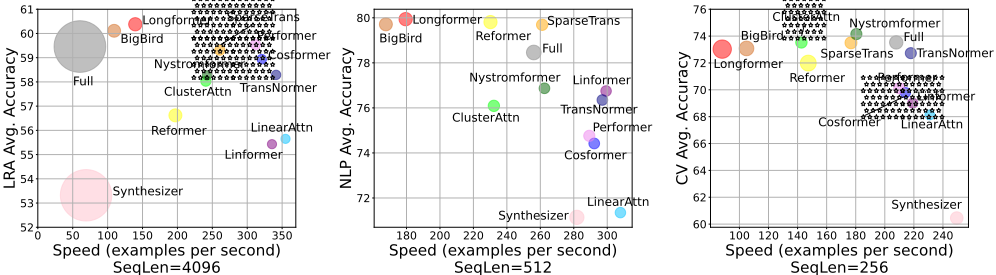
Figure 4 illustrates the overall performance comparison of these methods and their trade-offs for each individual task. In each subfigure, the y-axis represents the corresponding task statistical efficiency (in different evaluation metrics) and the x-axis shows the computation speed (i.e., the number of processed sequences per second for training). All evaluated approaches are expressed as circles with different colors and each circle's center coordinates refer to its corresponding statistical and computational efficiencies. The size of these circles illustrates the memory efficiency (i.e., memory footprint) of each approach.
We found that, in the LRA benchmark with long sequence, full attention has unbearable time and memory overheads, but achieves superior model performance. The kernelization methods (e.g., Performer and Cosformer) get the best balance between performance and speed with low memory usage. Positional selection methods (e.g., Longformer and BigBird) are also good alternatives to full attention with at least 1.81× speed up and 8.07× memory saving. But these methods are slower than full attention in NLP tasks with a slightly shorter sequence length of 512. Only SparseTrans surpasses full attention in all efficiency metrics. Other positional selection methods are slower, and the rest categories of methods have obvious performance degradation. In CV tasks with much shorter sequences, full attention itself is quite a good solution, as most efficient attention mechanisms are either slower or weaker. Due to the combination of positional selection and activation kernelization, TransNormer could be an alternative solution for less memory usage and faster speed with slight performance loss.
3.2 Interpretability Study
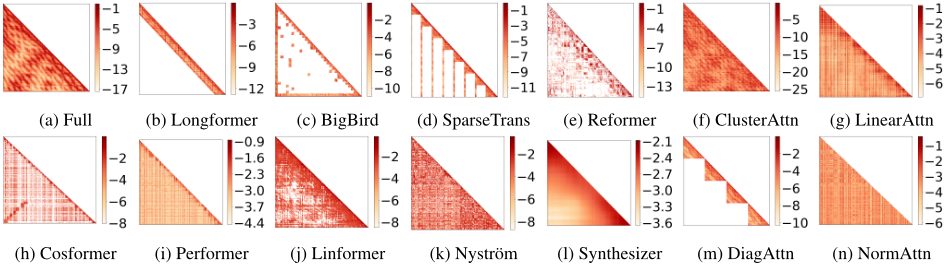
To better understand the fundamental differences of these efficient attention approaches, we study their impacts on the attention calculation results. We pick up one attention head of the last layer for each well-trained model on the NLP task and visualize their attention matrices in Figure 5. Illustrations for more heads are in [mya, 2023]. As we can see, the attention score of full attention has strong local biases. Many large attention scores appear even far away from the diagonal area, which complements long-range dependencies to the diagonal local attention. Positional selection methods apply sparse patterns on attention matrices, and blank positions in the visualization are not included in attention calculation. Their local sparse patterns formulate a diagonal region in the figures. There are also some dark rows and columns to learn the long-range dependencies in these sparse attentions. Longformer only uses sliding window attention and BigBird puts global blocks at the edges of attention matrices, while SparseTrans has a global column after each block. For contextual compression methods, their illustrated local and long-range dependencies change significantly. show the effectiveness of their hashing and/or clustering estimation. Both Reformer and ClusterAttn learn the dependencies in the low-dimensional space after hashing and/or clustering, rather than the original space. That's why there are no significant dark diagonal blocks in the attention matrices. Activation kernelization methods reorder the multiplication operators and do not have explicit attention anymore. But we can still obtain the approximate full attention by recomputing ϕ(Q)ϕ(K)⊤ first and divide it by the denominator of E.q. (2). We also observe some local biases, especially for Cosformer and Performer due to their additional optimizations (e.g., re-weighting). For low-rank factorization methods, we use the computation results before V in E.q. (7) and (8) as their attention matrices. The results involve some negative values due to P2 and A+qk , which are represented as the blank positions in Figures 5j and 5k. The random attention matrix of Synthesizer, which is independent of inputs and thus identical for all data instances, has broader local regions for high attention values. As a combination method, TransNormer uses DiagAttention to model local dependencies, while its NormAttention devotes to long-range dependencies and does not show a strong local trend as other kernelization methods do.
4 Lessons Learned and FutureWork
Section 2 and Section 3 provide a new taxonomy of existing Transformer methods and show a comprehensive analysis of their performance. In this section, we summarize the lessons learned from these analysis in two aspects. From the algorithm design perspective:
- Although positional selection methods are following simple and static token importance assumptions, they surprisingly outperform the other emerging methods in preserving models' performance (even better than full attention in some cases).
- The contextual compression approach seems more reasonable to preserve information but existing methods cannot achieve consistent performance improvements on different tasks.
- Kernelization methods show advantages on long sequence tasks, but meanwhile, they suffer from severe performance degradation in short sequence tasks.
- Factorization may not be suitable for LLMs because of the auto-regressive decoding algorithm. Existing LLMs usually have a growing KV cache, making it difficult to dynamically factorize these keys and queries.
- The combination of different methods is a promising avenue for future research as it leverages the advantages from different sides. However, how to effectively combine these methods remains an open research question.
From the system implementation perspective:
- Theoretical time complexity does not always match execution performance on GPUs; this is because the implementation of a GPU kernel can significantly affect its runtime performance. Enabling efficient kernel-level optimizations (e.g., block-sparse kernels [Gray et al., 2017] and sparse tensor compilers [Ye et al., 2023]) is becoming increasingly important for supporting efficient Transformer computation.
- The memory consumption also depends highly on the implementation. For resource-starved environments (e.g., consumer-level GPUs, mobile and edge devices), it is necessary to re-consider the choice of efficient attention mechanisms within the limited memory budget.
Besides, algorithm-hardware co-design is also becoming a promising direction to improve the overall efficiency from both sides. In summary, there is no one-size-fits-all solution of efficient attention mechanisms for long context LLMs. Considering the unique task characteristics (e.g., sequence length, token dependencies, attention score distribution) is essential when designing new methods.
5 Conclusion
The long sequence modeling ability of LLMs is becoming increasingly important in real-world AI applications from various fields. Emerging "X-former" approaches provide sufficient efficiency improvement opportunities but also bring unprecedented model selection challenges. We revisited the recent advances of long-context LLMs and provided a new taxonomy of these approaches and their origins. We selected twelve representative efficient attention mechanisms and provided a comprehensive evaluation and in-depth analysis to study their effectiveness and efficiencies. Based on these results, we summarized our findings and proposed several key insights to promote the follow-up research for both data scientists and system engineers aiming for developing LLMs.
Acknowledgments
This work is supported by National Key R&D Program of China (2022ZD0116315), National Natural Science Foundation of China (U22B2037, U23B2048), Beijing Municipal Science and Technology Project (Z231100010323002), China National Postdoctoral Program for Innovative Talents (BX20230012), Beijing Natural Science Foundation (4244080), and ZTE-PKU joint program (HC-CN20220614004). Bin Cui is the corresponding author, and the first two authors contributed equally.
@inproceedings{ijcai2024p904,
  title     = {X-former Elucidator: Reviving Efficient Attention for Long Context Language Modeling},
  author    = {Miao, Xupeng and Zhu, Shenhan and Fu, Fangcheng and Guo, Ziyu and Yang, Zhi and Tu, Yaofeng and Jia, Zhihao and Cui, Bin},
  booktitle = {Proceedings of the Thirty-Third International Joint Conference on
               Artificial Intelligence, {IJCAI-24}},
  publisher = {International Joint Conferences on Artificial Intelligence Organization},
  editor    = {Kate Larson},
  pages     = {8179--8187},
  year      = {2024},
  month     = {8},
  note      = {Survey Track},
  doi       = {10.24963/ijcai.2024/904},
  url       = {https://doi.org/10.24963/ijcai.2024/904},
}
TY - CPAPER TI - X-former Elucidator: Reviving Efficient Attention for Long Context Language Modeling AU - Miao, Xupeng AU - Zhu, Shenhan AU - Fu, Fangcheng AU - Guo, Ziyu AU - Yang, Zhi AU - Tu, Yaofeng AU - Jia, Zhihao AU - Cui, Bin T2 - Proceedings of the Thirty-Third International Joint Conference on Artificial Intelligence, IJCAI-24 PB - International Joint Conferences on Artificial Intelligence Organization PY - 2024 SP - 8179 EP - 8187 DO - 10.24963/ijcai.2024/904 UR - https://doi.org/10.24963/ijcai.2024/904 ER -Copied
Machine-readable versions of this paper, for tools and AI agents:





