
Learning Structural Causal Models through Deep Generative Models: Methods, Guarantees, and Challenges
Proceedings of the Thirty-Third International Joint Conference on Artificial Intelligence. Survey Track. Pages 8207-8215.
https://doi.org/10.24963/ijcai.2024/907
Keywords
- Machine Learning: ML: Causality
- Machine Learning: ML: Generative models
Abstract
This paper provides a comprehensive review of deep structural causal models (DSCMs), particularly focusing on their ability to answer counterfactual queries using observational data within known causal structures. It delves into the characteristics of DSCMs by analyzing the hypotheses, guarantees, and applications inherent to the underlying deep learning components and structural causal models, fostering a finer understanding of their capabilities and limitations in addressing different counterfactual queries. Furthermore, it highlights the challenges and open questions in the field of deep structural causal modeling. It sets the stages for researchers to identify future work directions and for practitioners to get an overview in order to find out the most appropriate methods for their needs.
- [Agrawal et al., 2024] Garima Agrawal, Amardeep Kaur, and Sowmya Myneni. A review of generative models in generating synthetic attack data for cybersecurity. Elec- tronics, 2024.
- [Bareinboim et al., 2022] Elias Bareinboim, Juan D. Correa, Duligur Ibeling, and Thomas Icard. On Pearl's Hierarchy and the Foundations of Causal Inference. ACM, 2022.
- [Cai et al., 2024] Ruichu Cai, Yuxuan Zhu, Jie Qiao, Zefeng Liang, Furui Liu, and Zhifeng Hao. Where and how to attack? a causality-inspired recipe for generating counter- factual adversarial examples. In AAAI, 2024.
- [Castro et al., 2019] Daniel C. Castro, Jeremy Tan, Bernhard Kainz, Ender Konukoglu, and Ben Glocker. Morpho- MNIST: Quantitative assessment and diagnostics for rep- resentation learning. JMLR, 2019.
- [Chao et al., 2023] Patrick Chao, Patrick Blöbaum, and Shiva Prasad Kasiviswanathan. Interventional and counterfactual inference with diffusion models. arxiv:2302.00860, 2023.
- [Dash et al., 2022] Saloni Dash, Vineeth N Balasubrama- nian, and Amit Sharma. Evaluating and mitigating bias in image classifiers: A causal perspective using counter- factuals. In IEEE/CVF Winter Conference on Applications of Computer Vision, 2022.
- [Deng et al., 2009] Jia Deng, Wei Dong, Richard Socher, Li- Jia Li, Kai Li, and Li Fei-Fei. Imagenet: A large-scale hierarchical image database. In IEEE Conference on Com- puter Vision and Pattern Recognition, 2009.
- [Dua and Graff, 2020] Dheeru Dua and Casey Graff. UCI machine learning repository. archive.ics.uci.edu/ml/datasets, 2020. Link
- [Faller et al., 2024] Philipp M Faller, Leena C Vankadara, Atalanti A Mastakouri, Francesco Locatello, and Dominik Janzing. Self-compatibility: Evaluating causal discovery without ground truth. In AIStats, 2024.
- [Frauen et al., 2024] Dennis Frauen, Fergus Imrie, Alicia Curth, Valentyn Melnychuk, Stefan Feuerriegel, and Mi- haela van der Schaar. A neural framework for generalized causal sensitivity analysis. In ICLR, 2024.
- [Hornik, 1991] Kurt Hornik. Approximation capabilities of multilayer feedforward networks. Neural Networks, 1991.
- [Ibeling and Icard, 2020] Duligur Ibeling and Thomas Icard. Probabilistic reasoning across the causal hierarchy. In AAAI, 2020. [Javaloy et al., 2023] Adrián Javaloy, Pablo Sánchez-Martín, and Isabel Valera. Causal normalizing flows: from theory to practice. NeurIPS, 2023.
- [Kaddour et al., 2022] Jean Kaddour, Aengus Lynch, Qi Liu, Matt J. Kusner, and Ricardo Silva. Causal machine learn- ing: A survey and open problems. arXiv:2206.15475, 2022.
- [Khemakhem et al., 2021] Ilyes Khemakhem, Ricardo Monti, Robert Leech, and Aapo Hyvarinen. Causal autoregressive flows. In AIStats, 2021.
- [Kim et al., 2019] Byungju Kim, Hyunwoo Kim, Kyungsu Kim, Sungjin Kim, and Junmo Kim. Learning not to learn: Training deep neural networks with biased data. In IEEE/CVF Conference on Computer Vision and Pattern Recognition, 2019.
- [Kocaoglu et al., 2018] Murat Kocaoglu, Christopher Sny- der, Alexandros G. Dimakis, and Sriram Vishwanath. CausalGAN: Learning causal implicit generative models with adversarial training. In ICLR, 2018.
- [Komanduri et al., 2022] Aneesh Komanduri, Yongkai Wu, Wen Huang, Feng Chen, and Xintao Wu. SCM-VAE: Learning identifiable causal representations via structural knowledge. In IEEE International Conference on Big Data, 2022.
- [Komanduri et al., 2023] Aneesh Komanduri, Xintao Wu, Yongkai Wu, and Feng Chen. From identifiable causal rep- resentations to controllable counterfactual generation: A survey on causal generative modeling. arXiv:2310.11011, 2023.
- [Liu et al., 2015] Ziwei Liu, Ping Luo, Xiaogang Wang, and Xiaoou Tang. Deep learning face attributes in the wild. In IEEE International Conference on Computer Vision, 2015.
- [Melnychuk et al., 2023] Valentyn Melnychuk, Dennis Frauen, and Stefan Feuerriegel. Partial counterfactual identification of continuous outcomes with a curvature sensitivity model. In NeurIPS, 2023.
- [Nasr-Esfahany et al., 2023] Arash Nasr-Esfahany, Moham- mad Alizadeh, and Devavrat Shah. Counterfactual identi- fiability of bijective causal models. In ICML, 2023.
- [Parafita and Vitrià, 2020] Álvaro Parafita and Jordi Vitrià. Causal inference with deep causal graphs. arXiv:2006.08380, 2020.
- [Pawlowski et al., 2020] Nick Pawlowski, Daniel Coelho de Castro, and Ben Glocker. Deep structural causal models for tractable counterfactual inference. In NeurIPS, 2020.
- [Pearl and Mackenzie, 2018] Judea Pearl and Dana Macken- zie. The book of why: the new science of cause and effect. Basic books, 2018.
- [Pearl, 1995] Judea Pearl. Causal diagrams for empirical re- search. Biometrika, 1995.
- [Pearl, 2009a] Judea Pearl. Causal inference in statistics: an overview. Statistics Surveys, 2009.
- [Pearl, 2009b] Judea Pearl. Causality: Models, Reasoning and Inference. Cambridge University Press, 2nd edition, 2009.
- [Poinsot and Leite, 2023] Audrey Poinsot and Alessandro Leite. A guide for practical use of ADMG causal data aug- mentation. In ICLR 2023 Workshop on Pitfalls of limited data and computation for Trustworthy ML, 2023.
- [Rahman and Kocaoglu, 2023] Md Musfiqur Rahman and Murat Kocaoglu. Towards modular learning of deep causal generative models. In ICML Workshop on Structured Probabilistic Inference & Generative Modeling, 2023.
- [Reisach et al., 2021] Alexander G. Reisach, Christof Seiler, and Sebastian Weichwald. Beware of the Simulated DAG! Causal Discovery Benchmarks May Be Easy to Game. In NeurIPS, 2021.
- [Rischel and Weichwald, 2021] Eigil F. Rischel and Sebas- tian Weichwald. Compositional abstraction error and a category of causal models. In UAI, 2021.
- [Sánchez-Martin et al., 2022] Pablo Sánchez-Martin, Miriam Rateike, and Isabel Valera. VACA: designing variational graph autoencoders for causal queries. In AAAI, 2022.
- [Sauer and Geiger, 2021] Axel Sauer and Andreas Geiger. Counterfactual generative networks. In ICLR, 2021.
- [Schröder et al., 2023] Maresa Schröder, Dennis Frauen, and Stefan Feuerriegel. Causal fairness under unobserved con- founding: a neural sensitivity framework. ICLR, 2023.
- [Scutari, 2010] Marco Scutari. Learning bayesian networks with the bnlearn R package. In Journal of Statistical Soft- ware, 2010.
- [Shen et al., 2022] Xinwei Shen, Furui Liu, Hanze Dong, Qing Lian, Zhitang Chen, and Tong Zhang. Weakly super- vised disentangled generative causal representation learn- ing. JMLR, 2022.
- [Sohl-Dickstein et al., 2015] Jascha Sohl-Dickstein, Eric Weiss, Niru Maheswaranathan, and Surya Ganguli. Deep unsupervised learning using nonequilibrium thermody- namics. In ICML, 2015.
- [Spirtes et al., 2000] Peter Spirtes, Clark N Glymour, and Richard Scheines. Causation, prediction, and search. The MIT Press, 2000.
- [Thompson et al., 2020] WH Thompson, R Nair, H Oya, O Esteban, JM Shine, CI Petkov, RA Poldrack, M Howard, and R Adolphs. Human es-fMRI resource: Concurrent deep-brain stimulation and whole-brain functional MRI. bioRxiv, 2020.
- [van Breugel et al., 2021] Boris van Breugel, Trent Kyono, Jeroen Berrevoets, and Mihaela van der Schaar. DECAF: Generating fair synthetic data using causally-aware gener- ative networks. In NeurIPS, 2021.
- [Vowels et al., 2022] Matthew J. Vowels, Necati Cihan Cam- goz, and Richard Bowden. D'ya like DAGs? a survey on structure learning and causal discovery. ACM Computing Surveys, 2022.
- [Wang et al., 2022] Benjie Wang, Matthew R Wicker, and Marta Kwiatkowska. Tractable uncertainty for structure learning. In ICML, 2022.
- [Wen et al., 2022] Bingyang Wen, Yupeng Cao, Fan Yang, Koduvayur Subbalakshmi, and Rajarathnam Chan- dramouli. Causal-TGAN: Modeling tabular data using causally-aware GAN. In ICLR Workshop on Deep Generative Models for Highly Structured Data, 2022.
- [Xia et al., 2021] Kevin Xia, Kai-Zhan Lee, Yoshua Ben- gio, and Elias Bareinboim. The causal-neural connection: Expressiveness, learnability, and inference. In NeurIPS, 2021.
- [Xia et al., 2023] Kevin Muyuan Xia, Yushu Pan, and Elias Bareinboim. Neural causal models for counterfactual iden- tification and estimation. In ICLR, 2023.
- [Xu et al., 2019] Depeng Xu, Yongkai Wu, Shuhan Yuan, Lu Zhang, and Xintao Wu. Achieving causal fairness through generative adversarial networks. In IJCAI, 2019. IJCAI
- [Yang et al., 2021] Mengyue Yang, Furui Liu, Zhitang Chen, Xinwei Shen, Jianye Hao, and Jun Wang. CausalVAE: Disentangled representation learning via neural structural causal models. In IEEE/CVF Conference on Computer Vi- sion and Pattern Recognition, 2021.
- [Yu et al., 2023] Fanyang Yu, Rongguang Wang, Pratik Chaudhari, and Christos Davatzikos. Investigating causal- ity between genotype and clinical phenotype in neurolog- ical disorders using structural causal model and normaliz- ing flow. In 1st Workshop on Deep Generative Models for Health, 2023.
- [Zaffalon et al., 2020] Marco Zaffalon, Alessandro An- tonucci, and Rafael Cabañas. Structural causal models are (solvable by) credal networks. In 10th International Con- ference on Probabilistic Graphical Models, 2020.
- [Zečević et al., 2021] Matej Zečević, Devendra Singh Dhami, Petar Veličković, and Kristian Kersting. Relat- ing graph neural networks to structural causal models. arXiv:2109.04173, 2021.
- [Zhang et al., 2022] Junzhe Zhang, Jin Tian, and Elias Bareinboim. Partial counterfactual identification from ob- servational and experimental data. In ICML, 2022.
- [Zhou et al., 2023] Guanglin Zhou, Shaoan Xie, Guangyuan Hao, Shiming Chen, Biwei Huang, Xiwei Xu, Chen Wang, Liming Zhu, Lina Yao, and Kun Zhang. Emerging syner- gies in causality and deep generative models: A survey. arXiv:2301.12351, 2023.
References were extracted automatically from the PDF and may contain errors.
Full text extracted automatically from the PDF; figures, tables and equations may differ. The PDF is the version of record.
1 Introduction
The extraction of general and scientific knowledge from extensive and complex datasets has increasingly become a critical expectation in various domains. As highlighted by Pearl [2009b], attaining a deeper understanding that transcends mere associations necessitates an exploration of causation. This is particularly true when seeking to answer "why" questions, which require an insight into the underlying data generating processes. Standard generative approaches typically model the joint density of a set of variables. In contrast, causal generative models emphasize distributions derived from causal interventions and counterfactual operations as classified by the Pearl Causal Hierarchy (PCH) [Pearl and Mackenzie, 2018; Bareinboim et al., 2022]. The PCH comprises three cognitive layers, named association, intervention, and counterfactual, correlating with the cognitive processes of seeing, doing, and imagining [Pearl and Mackenzie, 2018]. A comprehensive understanding of these layers is imperative for addressing diverse causal queries. The first layer, L1, focuses on associations and factual data. The second one, L2, delves into intervention data, shedding light on the effects of specific manipulations (a.k.a interventions). The third and final layer, L3, encompasses counterfactuals, facilitating the exploration of hypothetical scenarios that might have ensued under different interventions, as opposed to actual occurrences. Causal inference tasks aims to derive a quantitative understanding at a higher-level hierarchy when provided with data solely from lower-level ones [Pearl and Mackenzie, 2018]. However, achieving such a goal is inherently challenging without additional assumptions, primarily because the indeterminacy of higher levels by the lower ones poses a fundamental obstacle to such inference efforts [Ibeling and Icard, 2020; Bareinboim et al., 2022]. The so-called indeterminacy means that without making explicit assumptions about the higher level, it is impossible to answer higher-level questions from lower-level data. For instance, answering counterfactual questions requires one to model the influence of the unobserved variables [Bareinboim et al., 2022]. Structural causal models (SCMs) enable one to do so (Section 2). An SCM M models a set of causal mechanisms F on the observed X and unobserved U variables in addition to distributions over the unobserved variablesP(\mathbf {U}). Nevertheless, a complete SCM is rarely known in practice, which leads one to question how a counterfactual query (L3) can be evaluated using a set of data from the underlying levels (i.e., L1 and L2). In general, experimental data (L2) are difficult to access. Thus, in practice, one relies on observational data (L1) and the knowledge of the causal structure (L2), formulated as a causal graph [Pearl, 1995; Spirtes et al., 2000].
The recent advancements in deep learning, particularly the development of deep generative models (DGMs), have spawned a multitude of SCMs, the socalled DSCMs [Pawlowski et al., 2020], which rely on deep learning approaches to model causal mechanisms. DGMs enable one to build more expressive SCMs [Xia et al., 2021] thanks to the universal approximation capabilities of neural networks [Hornik, 1991]. As a result, they have been used in various high-stakes domains, including healthcare and fairness, where identifiability guarantees (i.e., existence and uniqueness) of the sought model are fundamental. However, it is essential to acknowledge that different DSCMs may operate under diverse assumptions regarding the functional form of causal mechanisms, leading to distinct guarantees. Understanding these variations is pivotal for informed and effective application of DSCMs in different contexts.
This paper aims to clarify the scope and limitations of the existing DSCMs when provided a known causal graph to answer counterfactual queries. Our primary goal is to make a tour of the state-of-the-art, enabling a practitioner to better identify their needs and the requisites to fulfill them. A secondary one is to list the open questions and challenges. Formally, the overarching question investigated by this paper can be articulated as follows. Given a known causal structure G ⋆ and observational data, what are the capabilities of existing DGMs in learning a SCM ̂ M that approximates the true but unknown SCMM⋆ ? In other words, we are interested in their capability in answering counterfactual questions as if one had access to the true SCMM⋆ .
Contributions. The contributions of this paper are threefold. First, it categorizes the existing deep structural causal models (Section 3) following their assumptions and guarantees based solely on observational data and a known causal structure. This classification provides a comprehensive framework for understanding the landscape of deep structural causal modeling when aiming to answer counterfactual questions. Second, analyzing existing DSCM from a theoretical and a empirical viewpoint, this paper assists practitioners when selecting an appropriate DGM to learn an SCM (Section 4) in order to apply these models effectively. Finally, this paper highlights some open questions and challenges (Section 5), serving as suggestions for future research directions in the field. Particularly, this paper stands out as the first one to classify the methods to learn SCMs through DGM based on their hypotheses and guarantees. In contrast, existing surveys [Zhou et al., 2023; Komanduri et al., 2023; Kaddour et al., 2022] primarily classify them according to their deep learning components.
2 Preliminaries of Causal Inference
In this work, we use capital letters for random variables, lowercase letters for their realizations, and bold letters to represent vectors.
2.1 Structural Causal Model
A Structural Causal Model [Pearl, 2009b] is a tuple M := (F, P(U)), where F comprises a set of d structural equations fi, one for each random variable, Xi ∈ X, \protect \mathcal {F} = \{X_i \coloneqq fi(\PA (X_i), U_i)\}^{d}_{i=1} . Each structural equation fi computes each variable X_i, also called endogenous variable, from its parents PA(Xi) ⊆ X \ {Xi}, and an exogenous noise variable Ui ∈ U. P(\mathbf {U})is a strictly positive measure over the exogenous noises, U. Whenever an unmeasured common cause exists for several endogenous variables, these variables are said to be confounded by a hidden confounder. If one assumes that no hidden confounder exists over the endogenous variables X, the exogenous noise variables U are considered jointly independent. An SCM characterizes a unique distribution over the variables, PM(X), called the entailed distribution. The conditional distribution of a variable given its parents, PM(Xi|PA(Xi)), is called a causal kernel [Pearl, 2009b]. An SCM describes the socalled causal graph G := (V, E) which encodes the causal dependencies between the variables. Each node corresponds to an endogenous variable, and the set of directed edges represents the parent-child relationships; i.e., V = X and E = {PA(Xi) -→ Xi, ∀i ∈ [1, d]}. A causal graph is usually assumed to be a Directed Acyclic Graph (DAG).
One can use an SCM to answer intervention and counterfactual questions [Pearl, 2009a]. Given an SCM M, an intervention consists in changing at least one of the structural equations, for instance, Xk := ˜ fk(˜ PA(Xk), ˜ Uk). This operation, denoted do(Xk := ˜ fk(˜ PA(Xk), ˜ Uk)), defines a new SCM ˜ M whose entailed distribution is called the intervention distribution, P˜ M(X) = PM(X|do(Xk := ˜ fk(˜ PA(Xk), ˜ Uk))). Given an SCM M and some factual realizations y of Y ⊂ X, a counterfactual consists in changing the exogenous noise distribution into the posterior distribution PU|Y=y. It defines a new SCM M′ , where PM′(U) = PM(U|Y = y), whose entailed distribution is called the counterfactual distribution. Counterfactuals generally also include an additional intervention. The counterfactual distribution is hence denoted by P Y =y M (X|do(Xk := ˜ fk(˜ PA(Xk), ˜ Uk))). Counterfactuals can be derived through the following three-step procedure [Pearl, 2009b]: (a) Abduction to change the exogenous noise distribution, (b) Action to build the new SCMM′ , and (c) Prediction to estimate the counterfactual distribution given M′ .
2.2 Identifiability
Once a causal task is defined in terms of its causal quantities, it needs to be translated into statistical ones for estimation. The property of identification amounts to showing whether, under the appropriate set of assumptions, such a unique translation exists. There exist several types of identifiability. For instance, structure identifiability states whether the causal graph can be recovered, model identifiability whether the full causal model can be recovered, and, estimand identifiability whether a specific causal estimand, such as a treatment effect, can be estimated. Finally, intervention and counterfactual identifiability involves checking whether all intervention and counterfactual queries can be retrieved. Formally, given a class of causal models M (e.g., SCMs), an Li-query Q(M) of a model M ∈ M is identifiable from Lj - data, 1 ≤ j < i, if for any pair of modelsM1 andM2 from M, Q(M1) = Q(M2) whenever M1 and M2 match in all Lj queries [Pearl, 2009b]. Let us note that model identifiability implies intervention and counterfactual identifiability.
3 Classification into SCMand DGMClasses
This section introduces a classification of DGMs designed to learn an approximate structural causal model ̂ M when provided a known causal graph G ⋆ and observational data. By abuse of language but without loss of generality, we refer to these methods as DSCMs, since they all model causal mechanisms with deep generative models. The purpose of the approximate structural causal model ̂ M is to answer counterfactual queries. In practical terms, a method aiming to answer counterfactual queries must effectively perform the abduction step by modeling the distribution of the exogenous variables given the realization of the factual data (i.e., P(U | X = x) by using the causal mechanisms (Section 2.1). In addition, assessing whether L3-identifiability holds is paramount to build trust in the estimated counterfactuals.
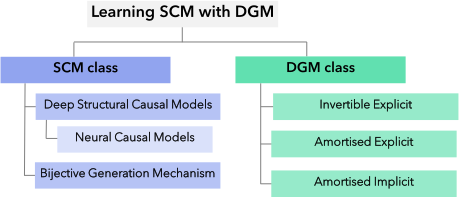
The classification, illustrated in Fig. 1, comprises two dimensions. The first dimension relates to the classes of SCM providing identifiability guarantees (Table 1), while the second one, originally proposed by Pawlowski et al. [2020], focuses on the characteristics of the DGM used to learn the SCM, restricting hence the tractability of the abduction step (Table 2). In this classification, DGM classes are exclusive while the SCM ones are not, as one can see in Table 3.
3.1 Classes of Deep Generative Models
DSCMs rely on deep learning components to capture and model the causal mechanisms. The choice of the network architecture can make it hard to compute the abduction step. Hence, a DSCM falls into one of the following classes introduced by Pawlowski et al. [2020]: invertible explicit, amortised explicit, and amortised implicit.
Invertible Explicit. Invertible explicit methods use invertible mechanisms with regard to the exogenous noises. The abduction step is hence directly tractable, computing the inverse transformation of the mechanism. Existing invertible explicit methods use conditional normalizing flows to represent the structural equations. In this case, each causal kernel can be computed as P(Xi|PA(Xi)) = P(Ui) · |det∇Ui fi(PA(Xi), Ui)|-1 |Ui=f -1 i (Ui,PA(Xi)) whenever fi is assumed to be a diffeomorphic transformation. Examples of methods include Causal-NF [Javaloy et al., 2023], NF-DSCM [Pawlowski et al., 2020], NCF [Parafita and Vitri`a, 2020], CAREFL [Khemakhem et al., 2021] and, NFBGM [Nasr-Esfahany et al., 2023].
Amortised Explicit. Amortised explicit methods enlarge the considered causal mechanisms to non-invertible functions. By losing the invertibility of the structural equations, the abduction step can no longer be directly computed. Hence, these methods approximate the conditional exogenous noise distribution through auto-encoders. Notably, fi(PA(Xi), Ui) = gi(PA(Xi), Ui) and Ui = ei(PA(Xi), Xi) where gi and ei represent the decoder and the encoder 1 . Examples of learning methods belonging to this class include iVGAE [Zeˇcevi´c et al., 2021], VACA [S´anchez-Martin et al., 2022], and, DCM [Chao et al., 2023].
1 Note that the initial functional form enables "low-level" transformations: fi(PA(Xi),Ui) = hi(PA(Xi), gi(PA(Xi), µi), ϵi) where gi is a function of any form, hi an invertible function, and Ui = (ϵi, µi) a noise decomposition such that P(Ui) = P (ϵi)P (µi).
| Class | Mechanism | Identifiability Guarantees |
|---|---|---|
| DSCM | Neural network | - |
| NCM | Feedforward neural network | L3-id. (resp. L2) iif L3-id. (resp. L2) from the true SCM |
| BGM | Bijective noise | L3-id. for three settings^\star cf. Theorems 5.1, 5.2 and 5.3 |
| ^\star Markovian, Instrumental Variable, and Backdoor Criterion | ||
Amortised Implicit. Instead of explicitly learning an encoder, one can also implicitly model it, for instance, using adversarial learning. Such approaches constitute the amortised implicit class. In this case, the abduction step must be conducted using sample rejection [Xia et al., 2023]. In other words, for a given observation Y = y and any SCM, one needs to sample and filter the exogenous noises not generating the desired observation y; and then, uses the remained samples to estimate the counterfactual distribution corresponding to P(U|Y = y). This class includes the following learning methods: SCM-VAE [Komanduri et al., 2022], Causal-TGAN [Wen et al., 2022], CausalGAN [Kocaoglu et al., 2018], CFGAN [Xu et al., 2019], DECAF [van Breugel et al., 2021], WhatIfGAN [Rahman and Kocaoglu, 2023], CGN [Sauer and Geiger, 2021], DEAR [Shen et al., 2022], GAN-NCM and MLE-NCM [Xia et al., 2023].
3.2 Classes of Structural Causal Models
As stated in the previous section, there are various deep generative approaches that can be used to learn an SCM. They all model DSCMs as they rely on deep learning components. However, they make different assumptions about the causal mechanisms leading to differences in the modelled DSCMs. In particular, the Bijective Generation Mechanisms [NasrEsfahany et al., 2023] and Neural Causal Models [Xia et al., 2021] are two classes of SCMs to distinguish them.
Bijective Generation Mechanisms
Bijective generation mechanism (BGM) models [NasrEsfahany et al., 2023] are structural causal models where the causal mechanisms fi : {PA(Xi),Ui} ↦→ Xi are bijective mappings from the exogenous noises to the endogenous variables. BGM models can also represent hidden confounders: if a hidden confounder has an impact on both Xi and Xj , their exogenous noises Ui and Uj are considered dependent. The bijective mapping enables to uniquely identify the exogenous noise Ui for each realization of the direct causes PA(Xi). As a result, all the invertible explicit methods are notably modeling BGM models. Nasr-Esfahany et al. [2023] provides sets of constraints on the causal mechanisms and probability distributions to guarantee L3-identifiability for three common causal structures: bivariate Markovian, Instrumental Variable, and Backdoor Criterion.
Neural Causal Models
The class of Neural Causal Models (NCMs) is introduced by [Xia et al., 2021]. It defines a set of DSCMs whose causal mechanisms are feedforward neural networks. They involve all generative models except diffusion models (e.g., GANs, VAE, NF). Unlike feedforward neural networks, which process data in a direct, layer-by-layer flow without feedback, diffusion models employ an iterative and inherently stochastic mechanism. It involves gradually adding noise to the data over a series of steps to form a noisy distribution, and then systematically reversing this process through feedback mechanisms to generate new samples from the noisy distribution [Sohl-Dickstein et al., 2015]. As a result, except DCM, all the methods mentioned previously model NCMs. NCMs are defined to consider hidden confounders. Besides the former exogenous noise (i.e., one per observed variable), NCMs consider additional exogenous noises, one for each hidden confounder impacting a subset C of variables: Xi = fi(PA(Xi), {UC|Xi ∈ C}). The distributions of the exogenous variables are set to Unif(0, 1)2 . It is proven that an L2 [Xia et al., 2021] or L3 [Xia et al., 2023] query is identifiable from an NCM if and only if it is identifiable from the true SCM. Indeed, given that there might exist some hidden confounders, neither L2 nor L3 identifiability are guaranteed in general.
| Abduction step | |||
|---|---|---|---|
| Class of DGM | Mechanism Inversion | Encoding | Sample Rejection |
| Invertible Explicit | ✓ | ✓ | ✓ |
| Amortised Explicit | ✗ | ✓ | ✓ |
| Amortised Implicit | ✗ | ✗ | ✓ |
4 Analysis of Deep Structural Causal Models
This section analyses the existing DSCMs under the hypotheses, guarantees, evaluation, and applications. Section 4.1 describes the hypotheses and guarantees under five distinct characteristics (Table 3): (a) causal structure knowledge: the required type of knowledge on the causal structure, (b) hidden confounding: whether the method can handle hidden confounding, (c) data assumption: the hypotheses on the causal generating process of the data, (d) abduction: the capacity of the method to perform the abduction step, and, (e) the additional guarantees highlight supplemental guarantees to the ones provided by the SCM class. Section 4.2 focuses on the practical capabilities of the existing methods based on the experiments reported in the corresponding papers and the existing applications (Table 4).
4.1 Hypotheses and Guarantees
Causal Structure Knowledge. Some approaches only need a causal ordering as input. Indeed, a causal ordering is usually sufficient to build a fully connected DAG compatible, but non-minimal, with the true SCM. However, this is at the expense of additional training, computation time, and complexity. Other methods rely on the known causal graph.
2 Note that, as the exogenous noise variable enters as input of the neural model, the assumption of uniform noise is not limiting.
Note that CARFEL can also learn the causal structure on top of the causal mechanisms. However, in this case, model identification is only provided in the Markovian bivariate setting.
Hidden confounding. As said, unobserved common causes create spurious correlations that bias L3 estimations, and realworld applications tend to involve hidden confounding. However, only five methods can deal with them. CGN considers confounded variables in a specific structure configuration, while NCM, BGM, WhatIfGAN, and NCF can deal with any position of unobserved variables in the causal graph as long as this position is known. NeuralID [Xia et al., 2023], an algorithm built on top of the NCM class, can automatically evaluate if a query is identifiable given a DAG with hidden confounders. To do so, two NCMs, constrained to preserve consistency with the observed data, are trained in parallel to maximize and minimize the target query. If the two resulting queries are identical, then the query is considered identifiable. Such a tool is crucial for sensitive applications.
Data Assumptions. Apart from the methods dealing with images (i.e., SCM-VAE, DEAR, and CGN), in general, no assumption is made about the data except those related to the selected DGM. SCM-VAE and DEAR make the hypothesis that one works with high dimensional data, knowing only a causal structure on some attributes characterizing the data, like labels of images. Both methods hence encode and decode the high-dimensional data into their attribute and model the SCM over the attributes. CGN is a computer vision model using a specific DAG over images, liking an image shape, texture, and background. Let us also highlight that WhatIfGAN has been designed to deal with an SCM with variables of different dimensions (e.g., scalars and images). Indeed, it trains the generators independently, when not confounded, to facilitate the convergence and enable one to utilize pre-trained models.
Abduction. On the one hand, as detailed in Section 3, all the explicit (i.e., invertible explicit and amortized explicit) methods are designed to automatically perform the abduction step. On the other hand, the implicit methods must rely on the sample rejection procedure. However, this abduction procedure is only implemented in NCM. As a result, if one wants to estimate counterfactuals with the other implicit methods, this procedure needs to be implemented on top of the existing code. Note that learning an encoder can replace the sample rejection procedure, though it is unclear how expensive and efficient it is compared to this procedure. Indeed, no comparison has been made yet.
Identifiability guarantees. Several results on identifiability exist. The most noticeable one is the NCM identifiability theorem, as the NCM class contains all the methods considered in this work except DCM; see Section 3. This result states that an L2 [Xia et al., 2021] or L3 [Xia et al., 2023] query is identifiable from a G ⋆ -constrained NCM if and only if it is identifiable from the true SCM. This can be interpreted as follows: if the search space of the selected feedforward deep conditional generative models is expressive enough to represent the causal mechanisms, the identifiability property depends only on the causal structure and the available data to train the model. Then, a natural question arises: What if the assumptions made about the causal graph are wrong due to imperfect causal knowledge? We shall return to this point in Section 5.2. DCM also provides the same L3-identifiability result but in the absence of hidden confounders. In addition, DCM is the only method to furnish L3-error bounds based on the encode-decoder reconstruction error after training.
| Classification | Additional Hypotheses | Additional Guarantees | |||||
|---|---|---|---|---|---|---|---|
| Method | SCM class | DGM class^\star | Causal Structure | Hidden Confounder | Data Assumptions | Available Abduction | Identifiability, Expressivity, Bounds |
| NF-BGM | BGM, NCM | IE | DAG | ✓ | - | Inversion | - |
| NF-DSCM | BGM, NCM | IE | DAG | ✗ | fi diffeomorphic | Inversion | - |
| GAN-NCM; MLE-NCM | NCM | AI | DAG | ✓^\sharp | - | Sample Rejection | - |
| Causal-NF | BGM, NCM | IE | Ordering | ✗ | fi diffeomorphic | Inversion | Model id. up to invertible transformation of U |
| NCF | BGM, NCM | IE | DAG | ✓^\sharp | fi diffeomorphic | Inversion | - |
| CARFEL | BGM, NCM | IE | DAG, ∅ | ✗ | Affine autoregres- sive flow | Inversion | Model id. in bivariate case |
| iVGAE | NCM | AE | DAG | ✗ | - | ✗ | - |
| VACA | NCM | AE | DAG | ✗ | - | Encoding | L2-expressivity if the decoder is deep enough cf. Prop.2 |
| DCM | - | AE | Ordering | ✗ | - | Encoding | L3-id. with error bounds cf. Corollary 1 & 2 |
| SCM-VAE | NCM | AI | DAG | ✗ | Additive noise on attributes | ✗ | - |
| Causal-TGAN | NCM | AI | DAG | ✗ | - | ✗ | - |
| CausalGAN | NCM | AI | DAG | ✗ | - | ✗ | - |
| CFGAN | NCM | AI | DAG | ✗ | Categ. outcome & sensitive feature | ✗ | - |
| DECAF | NCM | AI | DAG | ✗ | - | ✗ | - |
| WhatIfGAN | NCM | AI | DAG | ✓ | - | ✗ | - |
| CGN | NCM | AI | DAG^\tau | ✓^\tau | Image with at- tributes | ✗ | - |
| DEAR | NCM | AI | Ordering | ✗ | High-dimensional data with attributes | ✗ | Data to attribute encoder dis- entanglement |
Table 3: Hypotheses and guarantees of deep structural causal models. The classification (Figure 1) enables one to spot the identifiability results inherited by the SCM class and the compatible abduction step procedures. The methods are described in sections 3.1 and 3.2.
Discussion. Table 3 shows that, firstly, half of the method does not implement the abduction step automatically. However, one can rely on the sample rejection procedure [Xia et al., 2023] to answer L3 queries. Secondly, only a few methods consider hidden confounders. Thirdly, on one hand, in the absence of hidden confounding, knowing a causal ordering and building the associated fully connected DAG is sufficient to compute counterfactuals. On the other hand, if there are hidden confounders, it is preferable to precisely locate them in the causal graph and use the NeuralID algorithm of Xia et al. [2023] to evaluate if the desired query is identifiable. Fourthly, for all the methods reviewed in this paper, any L3query is identifiable if it is from the true SCMM⋆ .
4.2 Evaluation and Applications
Experimental evaluation. There is considerable heterogeneity in the evaluation of the methods: on the datasets, the PCH of the tasks, and the metrics. The PCH heterogeneity comes from the fact that only half of the methods automatically compute the abduction step. Those methods are hence evaluated on L2-tasks such as intervention estimation, disentanglement, invariant classification, or debiasing by intervening. fMRI [Thompson et al., 2020], Color-MNIST [Kim et al., 2019] are commonly used image datasets to evaluate intervention estimation. Pendulum [Yang et al., 2021] and CelebA [Liu et al., 2015] seem more suited for disentanglement while Morpho-MNIST [Castro et al., 2019] can be used for counterfactual estimation. Regarding tabular data, bnlearn [Scutari, 2010] datasets (ASIA, Child, ALARM, Insurance) are often used to evaluate intervention estimation accuracy as they are extracted from causal bayesian networks. Datasets from the UCI repository [Dua and Graff, 2020] (Adult, Credit Approval, Census, News) are also popular for real data L2-experiments as causal graphs can be easily approximated from common sense knowledge. However, regarding L3-estimations, there is a high heterogeneity between the simulated SCMs. As a result, without a unified benchmark, it is a hard task to compare their capabilities to answer counterfactual questions. Moreover, the simulated SCMs are designed without multiple sources of randomness (e.g., DAG
| Method | Dataset | PCH | DSCMComparison | Applications |
|---|---|---|---|---|
| NF-BGM | Ellips generation simulations | L3 | ✗ | Video streaming simulations for adaptive bi- trate |
| NF-DSCM | Morpho-MNIST | L3 | ✗ | Scientific discovery [Yu et al., 2023], cyber- security data generation [Agrawal et al., 2024] |
| GAN-NCM; MLE-NCM | Simulated SCMs | L3 | ✓GAN, MLE NCM | - |
| Causal-NF | Simulated SCMs | L3 | ✓VACA, CARFEL | Counterfactual fairness & fair regularization of classifier |
| NCF | Salary simulations using a simulated SCM | L3 | ✗ | Counterfactual fairness and explainability |
| CARFEL | 4-dimentional polynomial simulated SCM, fMRI | L2 & L3 | ✗ | - |
| iVGAE | ASIA | L2 | ✗ | - |
| VACA | Simulated SCMs | L3 | ✗ | Counterfactual fairness |
| DCM | Simulated SCMs, fMRI | L3 | ✓VACA, CARFEL | - |
| SCM-VAE | Pendulum, CelebA | L2 | ✗ | - |
| Causal-TGAN | ASIA, Child, ALARM, Insur- ance; Adult, Census, News | L1 | ✗ | In-domain data augmentation |
| CausalGAN | CelebA | L⋆2 | ✗ | Out-of-domain data augmentation |
| CFGAN | Adult | L♯2 | ✗ | Fairness debiasing |
| DECAF | Adult, Credit Approval | L♯2 | ✓CFGAN | Fairness debiasing |
| WhatIfGAN | Color-MNIST | L2 | ✓NCM | - |
| CGN | Color-MNIST; ImageNet [Deng et al., 2009] | Lτ2 | ✗ | Out-of-domain data augmentation |
| DEAR ^\star Disentanglement, | Pendulum, CelebA ^\sharp Fairness debiasing by | L⋆2 intervention, ^\tau Invariant | ✗ classification after intervention | - |
structure). This can introduce a bias in the evaluation, resulting in non-generalizable performance when facing real-world applications.
Applications. Three major goals have been considered in the literature: fairness, explainability, and robustness of machine learning models. Concretely, ImageCFGen 3 [Dash et al., 2022], Causal-NF, NCF, and VACA were used for counterfactual fairness evaluation. Counterfactual fairness consists of assessing the existence of discrimination regarding a sensitive feature by answering the following counterfactual question: "Would the outcome have been the same had the person had a different sensitive feature value?". Once a model is assessed to be counterfactually unfair, counterfactuals can also be used to debiasing a model. For instance, ImageCFGen and Causal-NF have been used to regularize classifiers on unfair classifications by penalizing outcome variation over unfair counterfactuals. Focusing on data fairness instead of model fairness, DECAF and CFGAN have been designed to remove unfair biases from datasets learning the SCM modeling the data generation process and generating a new dataset intervening on the causal graph to break unfair causal paths. Regarding explainability, NCF has also been used for counterfactual explanations of black box image classifiers. Causal data augmentation has been a common approach to increase the robustness of machine learning methods for image classification. CausalTGAN performs in-domain augmentation by sampling data from the learned SCM without intervention. CausalGAN and CGN rely on out-of-domain data augmentation by generating data from an intervened SCM. The interventions are performed on the variables that change the image without changing the label to predict. Cai et al. [2024] also use out-of-domain data generation for adversarial attacks of image classifiers. Yu et al. [2023] use NF-DSCM for scientific discovery in the case of a Bioinformatics application. They use a counterfactual approach to determine which genetic correlations actually correspond to causal effects on Alzheimer and Glioblastoma illnesses. Finally, Agrawal et al. [2024] uses DSCMs to generate synthetic data to train and test cybersecurity models.
3 ImageCFGEN [Dash et al., 2022] uses an SCM learned with NF-DSCM [Pawlowski et al., 2020].
5 Challenges and Future Directions
5.1 Lack of Evaluation
The lack of a benchmark comprises the major challenge one faces when comparing existing deep structural causal models, as underlined in Table 4. The methods must be evaluated using the same counterfactual distributions and metrics. In addition, they should be assessed regarding their data efficiency, computing time, and robustness to real-world challenges like selection bias, imbalanced data distributions, and imperfect causal knowledge. Furthermore, assessing the methods' robustness against potential misspecification of the causal graph is fundamental. To support a fair comparative evaluation, the community needs to build a referential SCM simulator. Indeed, instead of selecting specific SCMs, the simulator will enable one to randomly generate DAGs, exogenous noises, and causal mechanisms to fully assess these methods' capabilities, paying attention to the various pitfalls involved in such automatic procedures [Reisach et al., 2021]. Extending the evaluation methodology of Poinsot and Leite [2023] to counterfactuals could be a possible direction.
Finally, a first step towards such a comprehensible benchmarking of DSCMs could focus on the comparison of abduction procedures. Such a study is expected to assess the comparative merit of sample rejection with respect to learning an encoder.
5.2 From Identifiability to Partial Identifiability
Most of the causal generative methods presented in this survey assume knowing the actual causal graph. Yet, assuming complete knowledge of the causal structure is a strong assumption. Indeed, causal graphs are usually built either based on expert knowledge, which is sensitive to human biases, or using causal discovery algorithms, which still have numerous limitations nowadays [Vowels et al., 2022; Faller et al., 2024]. It is thus essential not to dismiss the possibility of relying on an erroneous causal graph, as this can have profound implications for the validity of causal inference results. Some other assumptions, such as additive noise or absence of selection bias, can also be questioned. An envisioned solution relies on moving towards partial identification, which consists of computing bounds for causal queries whenever point identification is impossible due to unsatisfied or un-testable assumptions. Some work has already been done to derive partial identifiability for discrete SCMs [Zaffalon et al., 2020; Zhang et al., 2022]. Hence, more research still needs to be carried out to provide such partial identifiability guarantees to DSCMs in general. However, some partial identifiability guarantees have been proven to be non-informative. Indeed, Melnychuk et al. [2023] showed, for instance, that, in general, the counterfactual outcome of (un)treated has non-informative bounds in the class of continuous bivariate SCMs. Even in these cases, it is still possible to carry out a sensitivity analysis to compute bounds on the causal query. Among the studied methods in this paper, only van Breugel et al. [2021] carried out a sensitivity analysis regarding the imperfect knowledge of the causal graph. However, the profound impact of any wrong assumption on the validity of causal query estimation should motivate the systematic use of sensitivity analysis for practitioners and theoreticians. Note that some work has already been done on sensitivity analysis under hidden confounding. For example, Frauen et al. [2024] developed a neural framework for generalized sensitivity analysis under unobserved confounding for L2-queries including conditional average treatment effect (CATE). Whereas, Schr¨oder et al. [2023] studied the sensitivity of causal fairness (L3-queries) under unobserved confounding.
5.3 Applications: Opportunities and Challenges
Realistic Causal Simulations. As done by Agrawal et al. [2024], we believe DSCMs constitute a great opportunity for practitioners to generate synthetic data similar to real ones following a causal generating process. We particularly think that such approaches could be very useful to benchmark causal inference methods on various types of data coming from numerous applications (e.g., finance, marketing, healthcare), while having a ground truth. Nevertheless, the causal graph, assumed to be known, may, in fact, be misspecified. For this reason, it is crucial to ensure that it was validated by experts beforehand. Otherwise, we recommend limiting the use of such DSCMs to realistic synthetic data generation. Moreover, it is important to note that the existing methods have only been designed to deal with tabular data and images.
Sensitive Applications. As presented in Section 4.1, there exists an algorithm, NeuralID [Xia et al., 2023], compatible with all the methods considered in this survey, automatically testing for query identifiability given the causal graph and the data. This constitutes a great opportunity for sensitive applications requiring identifiability guarantees. However, such an analysis still depends on the hypotheses about the causal graph. This emphasizes again the importance of sensitivity analyses. Moreover, it is also paramount for decision-makers to have access to uncertainty or error measures. DCM is the only method to provide error bounds. Therefore a major direction for forward research is related to uncertainty quantification extending the active research in numerical modeling [Rischel and Weichwald, 2021; Wang et al., 2022] to the field of causal inference. In practice, the reconstruction error used in DCM could be extended to amortised explicit models.
6 Conclusion
This paper reviews and classifies deep structural causal models (DSCMs), examining them from the perspectives of their underlying classes of structural causal model (SCM) and deep generative model (DGM). This dual viewpoint enables one to spotlight the guarantees concerning the identifiability and the ability of these models to address counterfactual queries using only observational data and existing causal knowledge. The analyses reveal that the majority of these guarantees are rooted in the intrinsic properties of the deep learning architectures. Moreover, the studied methods have predominantly been evaluated through heterogeneous and straightforward datasets. This highlights the critical need for developing benchmark datasets that encapsulate the complexities encountered in various high-stakes applications, such as in the medical and financial domains. Lastly, our findings underscore the importance of integrating uncertainty quantification methods and partial counterfactual estimation methods with DSCM. Such a joint approach could significantly improve the resilience and practical utility of these models, especially in complex environments.
Ethical Statement
In this paper, we try to prevent malicious or naive use of deep structural causal models by being transparent about the limitations and guarantees of the various methods. Readers are also warned about the veracity of the made assumptions. To mitigate the risk of misuse of these models, it is emphasized that these methods should not be used to answer causal questions for decision-making if upstream experts have not validated them.
Acknowledgments
This research received partial funding from the European Commission under the Horizon 2020 program (TRUST-AI Project, Contract No. 952060) and (TAILOR, Contract No. 952215), and from the ANR under the France 2030 program, under the reference 23-PEIA-004.
@inproceedings{ijcai2024p907,
  title     = {Learning Structural Causal Models through Deep Generative Models: Methods, Guarantees, and Challenges},
  author    = {Poinsot, Audrey and Leite, Alessandro and Chesneau, Nicolas and Sebag, Michèle and Schoenauer, Marc},
  booktitle = {Proceedings of the Thirty-Third International Joint Conference on
               Artificial Intelligence, {IJCAI-24}},
  publisher = {International Joint Conferences on Artificial Intelligence Organization},
  editor    = {Kate Larson},
  pages     = {8207--8215},
  year      = {2024},
  month     = {8},
  note      = {Survey Track},
  doi       = {10.24963/ijcai.2024/907},
  url       = {https://doi.org/10.24963/ijcai.2024/907},
}
TY - CPAPER TI - Learning Structural Causal Models through Deep Generative Models: Methods, Guarantees, and Challenges AU - Poinsot, Audrey AU - Leite, Alessandro AU - Chesneau, Nicolas AU - Sebag, Michèle AU - Schoenauer, Marc T2 - Proceedings of the Thirty-Third International Joint Conference on Artificial Intelligence, IJCAI-24 PB - International Joint Conferences on Artificial Intelligence Organization PY - 2024 SP - 8207 EP - 8215 DO - 10.24963/ijcai.2024/907 UR - https://doi.org/10.24963/ijcai.2024/907 ER -Copied
Machine-readable versions of this paper, for tools and AI agents:





