
Perspectives in Play: A Multi-Perspective Approach for More Inclusive NLP Systems
Proceedings of the Thirty-Fourth International Joint Conference on Artificial Intelligence. AI and Social Good. Pages 9827-9835.
https://doi.org/10.24963/ijcai.2025/1092
Keywords
- Natural Language Processing: General
- Uncertainty in AI: General
- AI Ethics, Trust, Fairness: General
- Humans and AI: General
Abstract
In the realm of Natural Language Processing (NLP), common approaches for handling human disagreement consist of aggregating annotators' viewpoints to establish a single ground truth. However, prior studies show that disregarding individual opinions can lead to the side-effect of under-representing minority perspectives, especially in subjective tasks, where annotators may systematically disagree because of their preferences. Recognizing that labels reflect the diverse backgrounds, life experiences, and values of individuals, this study proposes a new multi-perspective approach using soft labels to encourage the development of the next generation of perspective-aware models—more inclusive and pluralistic. We conduct an extensive analysis across diverse subjective text classification tasks including hate speech, irony, abusive language, and stance detection, to highlight the importance of capturing human disagreements, often overlooked by traditional aggregation methods. Results show that the multi-perspective approach not only better approximates human label distributions, as measured by Jensen-Shannon Divergence (JSD), but also achieves superior classification performance (higher F1-scores), outperforming traditional approaches. However, our approach exhibits lower confidence in tasks like irony and stance detection, likely due to the inherent subjectivity present in the texts. Lastly, leveraging Explainable AI (XAI), we explore model uncertainty and uncover meaningful insights into model predictions. All implementation details are available at our github repo.
- [Abercrombie et al., 2023] Gavin Abercrombie, Verena Rieser, and Dirk Hovy. Consistency is key: Disentangling label variation in natural language processing with intra- annotator agreement. arXiv preprint arXiv:2301.10684, 2023.
- [Ahdritz et al., 2024] Gustaf Ahdritz, Tian Qin, Nikhil Vyas, Boaz Barak, and Benjamin L Edelman. Distinguishing the knowable from the unknowable with language models. arXiv preprint arXiv:2402.03563, 2024.
- [Aoyagui et al., 2024] Paula Akemi Aoyagui, Sharon Fergu- son, and Anastasia Kuzminykh. Exploring subjectivity for more human-centric assessment of social biases in large language models. arXiv preprint arXiv:2405.11048, 2024.
- [Basile and others, 2020] Valerio Basile et al. It's the end of the gold standard as we know it. on the impact of pre- aggregation on the evaluation of highly subjective tasks. In CEUR workshop proceedings, volume 2776, pages 31-40. CEUR-WS, 2020.
- [Basile et al., 2021] Valerio Basile, Federico Cabitza, An- drea Campagner, and Michael Fell. Toward a perspectivist turn in ground truthing for predictive computing. arXiv preprint arXiv:2109.04270, 2021.
- [Beck et al., 2024] Tilman Beck, Hendrik Schuff, Anne Lauscher, and Iryna Gurevych. Sensitivity, performance, robustness: Deconstructing the effect of sociodemo- graphic prompting. In Proceedings of the 18th Conference of the European Chapter of the Association for Computa- tional Linguistics (Volume 1: Long Papers), pages 2589- 2615, 2024.
- [Cercas Curry et al., 2021] Amanda Cercas Curry, Gavin Abercrombie, and Verena Rieser. ConvAbuse: Data, analysis, and benchmarks for nuanced abuse detection in conversational AI. In Marie-Francine Moens, Xuanjing Huang, Lucia Specia, and Scott Wen-tau Yih, editors, Pro- ceedings of the 2021 Conference on Empirical Methods in Natural Language Processing, pages 7388-7403, Online and Punta Cana, Dominican Republic, November 2021. Association for Computational Linguistics.
- [Chen et al., 2024] Beiduo Chen, Xinpeng Wang, Siyao Peng, Robert Litschko, Anna Korhonen, and Barbara Plank. "seeing the big through the small": Can llms ap- proximate human judgment distributions on nli from a few explanations? In Findings of the Association for Compu- tational Linguistics: EMNLP 2024, pages 14396-14419, 2024.
- [Collins et al., 2022] Katherine M Collins, Umang Bhatt, and Adrian Weller. Eliciting and learning with soft labels from every annotator. In Proceedings of the AAAI con- ference on human computation and crowdsourcing, vol- ume 10, pages 40-52, 2022.
- [Devlin, 2018] Jacob Devlin. Bert: Pre-training of deep bidi- rectional transformers for language understanding. arXiv preprint arXiv:1810.04805, 2018.
- [Dhamdhere et al., 2018] Kedar Dhamdhere, Mukund Sun- dararajan, and Qiqi Yan. How important is a neuron? arXiv preprint arXiv:1805.12233, 2018.
- [Fleisig et al., 2023] Eve Fleisig, Rediet Abebe, and Dan Klein. When the majority is wrong: Modeling annotator disagreement for subjective tasks. In Proceedings of the 2023 Conference on Empirical Methods in Natural Lan- guage Processing, pages 6715-6726, 2023.
- [Frenda et al., 2023] Simona Frenda, Alessandro Pedrani, Valerio Basile, Soda Marem Lo, Alessandra Teresa Cignarella, Raffaella Panizzon, Cristina Sánchez-Marco, Bianca Scarlini, Viviana Patti, Cristina Bosco, et al. Epic: multi-perspective annotation of a corpus of irony. In Pro- ceedings of the 61st Annual Meeting of the Association for Computational Linguistics (Volume 1: Long Papers), pages 13844-13857, 2023.
- [Frenda et al., 2024] Simona Frenda, Gavin Abercrombie, Valerio Basile, Alessandro Pedrani, Raffaella Panizzon, Alessandra Teresa Cignarella, Cristina Marco, and Davide Bernardi. Perspectivist approaches to natural language processing: a survey. Language Resources and Evalua- tion, pages 1-28, 2024.
- [Gezici et al., 2021] Gizem Gezici, Aldo Lipani, Yucel Say- gin, and Emine Yilmaz. Evaluation metrics for measuring bias in search engine results. Information Retrieval Jour- nal, 24:85-113, 2021.
- [Hinton et al., 2015] Geoffrey Hinton, Oriol Vinyals, and Jeff Dean. Distilling the knowledge in a neural network. arXiv preprint arXiv:1503.02531, 2015.
- [Huang et al., 2024] Yue Huang, Lichao Sun, Haoran Wang, Siyuan Wu, Qihui Zhang, Yuan Li, Chujie Gao, Yixin Huang, Wenhan Lyu, Yixuan Zhang, et al. Position: Trustllm: Trustworthiness in large language models. In International Conference on Machine Learning, pages 20166-20270. PMLR, 2024.
- [Kennedy et al., 2018] Brendan Kennedy, Mohammad Atari, Aida Mostafazadeh Davani, Leigh Yeh, Ali Omrani, Yehsong Kim, Kris Coombs, Shreya Havaldar, Gwenyth Portillo-Wightman, Elaine Gonzalez, et al. The gab hate corpus: A collection of 27k posts annotated for hate speech. PsyArXiv. July, 18, 2018.
- [Kirk et al., 2024] Hannah Rose Kirk, Bertie Vidgen, Paul Röttger, and Scott A Hale. The benefits, risks and bounds of personalizing the alignment of large language models to individuals. Nature Machine Intelligence, pages 1-10, 2024.
- [Kokhlikyan et al., 2020] Narine Kokhlikyan, Vivek Miglani, Miguel Martin, Edward Wang, Bilal Alsallakh, Jonathan Reynolds, Alexander Melnikov, Natalia Kliushk- ina, Carlos Araya, Siqi Yan, et al. Captum: A unified and generic model interpretability library for pytorch. arXiv preprint arXiv:2009.07896, 2020.
- [Krishna et al., 2022] Satyapriya Krishna, Tessa Han, Alex Gu, Steven Wu, Shahin Jabbari, and Himabindu Lakkaraju. The disagreement problem in explainable ma- chine learning: A practitioner's perspective. arXiv preprint arXiv:2202.01602, 2022.
- [Leonardelli et al., 2023] Elisa Leonardelli, Alexandra Uma, Gavin Abercrombie, Dina Almanea, Valerio Basile, Tom- maso Fornaciari, Barbara Plank, Verena Rieser, and Mas- simo Poesio. Semeval-2023 task 11: Learning with dis- agreements (lewidi). arXiv preprint arXiv:2304.14803, 2023.
- [Liu, 2019] Y Liu. Roberta: A robustly optimized bert pretraining approach. arXiv preprint arXiv:1907.11692, 2019.
- [Lundberg, 2017] Scott Lundberg. A unified approach to interpreting model predictions. arXiv preprint arXiv:1705.07874, 2017.
- [Mostafazadeh Davani et al., 2022] Aida Mostafazadeh Da- vani, Mark Díaz, and Vinodkumar Prabhakaran. Dealing with disagreements: Looking beyond the majority vote in subjective annotations. Transactions of the Association for Computational Linguistics, 10:92-110, 2022.
- [Muscato et al., 2024] Benedetta Muscato, Praveen Bu- shipaka, Gizem Gezici, Lucia Passaro, Fosca Giannotti, et al. Multi-perspective stance detection. In CEUR WORK- SHOP PROCEEDINGS, volume 3825, pages 208-214. CEUR-WS, 2024.
- [Muscato et al., 2025] Benedetta Muscato, Praveen Bu- shipaka, Gizem Gezici, Lucia Passaro, Fosca Giannotti, and Tommaso Cucinotta. Embracing diversity: A multi- perspective approach with soft labels. arXiv preprint arXiv:2503.00489, 2025.
- [Nehring et al., 2024] Jan Nehring, Aleksandra Gabryszak, Pascal Jürgens, Aljoscha Burchardt, Stefan Schaffer, Matthias Spielkamp, and Birgit Stark. Large language models are echo chambers. In Proceedings of the 2024 Joint International Conference on Computational Lin- guistics, Language Resources and Evaluation (LREC- COLING 2024), pages 10117-10123, 2024.
- [Pereyra et al., 2017] Gabriel Pereyra, George Tucker, Jan Chorowski, Łukasz Kaiser, and Geoffrey Hinton. Reg- ularizing neural networks by penalizing confident output distributions. arXiv preprint arXiv:1701.06548, 2017.
- [Plank, 2022] Barbara Plank. The'problem'of human label variation: On ground truth in data, modeling and evalua- tion. arXiv preprint arXiv:2211.02570, 2022.
- [Ribeiro et al., 2016] Marco Tulio Ribeiro, Sameer Singh, and Carlos Guestrin. " why should i trust you?" explain- ing the predictions of any classifier. In Proceedings of the 22nd ACM SIGKDD international conference on knowl- edge discovery and data mining, pages 1135-1144, 2016.
- [Sandri et al., 2023] Marta Sandri, Elisa Leonardelli, Sara Tonelli, and Elisabetta Ježek. Why don't you do it right? analysing annotators' disagreement in subjective tasks. In Proceedings of the 17th Conference of the European Chap- ter of the Association for Computational Linguistics, pages 2428-2441, 2023.
- [Santurkar et al., 2023] Shibani Santurkar, Esin Durmus, Faisal Ladhak, Cinoo Lee, Percy Liang, and Tatsunori Hashimoto. Whose opinions do language models reflect? In International Conference on Machine Learning, pages 29971-30004. PMLR, 2023.
- [Schmeisser-Nieto et al., 2024] Wolfgang S Schmeisser- Nieto, Pol Pastells, Simona Frenda, and Mariona Taulé. Human vs. machine perceptions on immigration stereo- types. In Proceedings of the 2024 Joint International Conference on Computational Linguistics, Language Resources and Evaluation (LREC-COLING 2024), pages 8453-8463, 2024.
- [Sorensen et al., 2024] Taylor Sorensen, Jared Moore, Jillian Fisher, Mitchell Gordon, Niloofar Mireshghallah, Christo- pher Michael Rytting, Andre Ye, Liwei Jiang, Ximing Lu, Nouha Dziri, et al. A roadmap to pluralistic alignment. arXiv preprint arXiv:2402.05070, 2024.
- [Sundararajan et al., 2017] Mukund Sundararajan, Ankur Taly, and Qiqi Yan. Axiomatic attribution for deep net- works. In International conference on machine learning, pages 3319-3328. PMLR, 2017.
- [Szegedy et al., 2016] Christian Szegedy, Vincent Van- houcke, Sergey Ioffe, Jon Shlens, and Zbigniew Wojna. Rethinking the inception architecture for computer vision. In Proceedings of the IEEE conference on computer vision and pattern recognition, pages 2818-2826, 2016.
- [Uma et al., 2020] Alexandra Uma, Tommaso Fornaciari, Dirk Hovy, Silviu Paun, Barbara Plank, and Massimo Poe- sio. A case for soft loss functions. In Proceedings of the AAAI Conference on Human Computation and Crowd- sourcing, volume 8, pages 173-177, 2020.
- [Uma et al., 2021] Alexandra N Uma, Tommaso Fornaciari, Dirk Hovy, Silviu Paun, Barbara Plank, and Massimo Poe- sio. Learning from disagreement: A survey. Journal of Artificial Intelligence Research, 72:1385-1470, 2021.
- [Vitsakis et al., 2023] Nikolas Vitsakis, Amit Parekh, Tanvi Dinkar, Gavin Abercrombie, Ioannis Konstas, and Verena Rieser. ilab at semeval-2023 task 11 le-wi-di: Modelling disagreement or modelling perspectives? arXiv preprint arXiv:2305.06074, 2023.
- [Wang et al., 2023] Yufei Wang, Wanjun Zhong, Liangyou Li, Fei Mi, Xingshan Zeng, Wenyong Huang, Lifeng Shang, Xin Jiang, and Qun Liu. Aligning large lan- guage models with human: A survey. arXiv preprint arXiv:2307.12966, 2023.
- [Wu et al., 2024] Xuansheng Wu, Haiyan Zhao, Yaochen Zhu, Yucheng Shi, Fan Yang, Tianming Liu, Xiaoming Zhai, Wenlin Yao, Jundong Li, Mengnan Du, et al. Us- able xai: 10 strategies towards exploiting explainability in the llm era. arXiv preprint arXiv:2403.08946, 2024.
References were extracted automatically from the PDF and may contain errors.
Full text extracted automatically from the PDF; figures, tables and equations may differ. The PDF is the version of record.
1 Introduction
Recent studies in NLP have highlighted the significance of annotator disagreement, reframing it as a form of plausible and rich human label variation (HLV), rather than noise [Plank, 2022]. Research has shown that Large Language Models (LLMs) can be biased towards certain viewpoints [Santurkar et al., 2023], underscoring disparities which may affect underrepresented communities and potentially reinforce existing societal prejudices [Aoyagui et al., 2024]. As LLMs continue to advance, aligning them with human subjectivity-encompassing diverse perspectives, individual values, and pluralistic principles 1 -becomes increasingly crucial [Kirk et al., 2024; Wang et al., 2023].
∗Corresponding Author: benedetta.muscato@sns.it
To address this challenge, Perspectivism [Basile et al., 2021], an emerging multidisciplinary approach in NLP, leverages disaggregated datasets 2 that capture human disagreements. By doing so, it amplifies diverse voices while also considering sociodemographic factors and ethical concerns. This new paradigm differs from traditional methods that often rely on a single ground-truth derived from vote aggregation approaches such as majority voting. Instead, perspectivist approach aims to preserve all annotations and embraces diverse opinions through learning from human disagreement [Uma et al., 2021], thus avoiding the suppression of minority perspectives. To follow the perspectivist paradigm, we present a comprehensive overview of experiments conducted between established baselines from the literature [Mostafazadeh Davani et al., 2022]- predicting aggregated labels - and our approach, which models human disagreement in a nuanced, fuzzy manner without assuming the existence of a singular ground truth. To this end, we investigate whether the multiperspective methodology, through incorporating diverse human opinions, can enhance i) overall model performance, and ii) model confidence. As we are interested in exploring different subjective tasks, we introduce a new version of an existing dataset from [Gezici et al., 2021], which provides a summarized version of the original documents on controversial topics, designed for the stance detection task. To ensure the robustness of our analysis, we also perform ablation studies to test whether model predictions align with human disagreement using eXplainable AI (XAI) techniques, specifically post-hoc feature attribution methods, to enhance the transparency of the proposed models.
1 A system is considered pluralistic if it is designed to accommodate a broad range of human values and viewpoints [Sorensen et al., 2024].
2 In human-labeled datasets, disaggregated labels keep each annotator's input, avoiding to collapse them into one label through majority voting.
2 RelatedWork
In this section, we lay the foundation for our analysis by combining insights on preserving human disagreement in the dataset design process and reviewing the model learning approaches adopted in the literature so far.
Perspective-aware Datasets. Disagreement in human labeling, now recognized as subjectivity driven by HLV, affects all stages of the NLP pipeline, from data preparation to evaluation. This variability arises from different annotator perceptions, particularly in subjective tasks like hate and emotion detection. As a result, recent studies have embraced a perspectivist approach [Basile and others, 2020; Leonardelli et al., 2023; Sandri et al., 2023; Fleisig et al., 2023; Abercrombie et al., 2023; Muscato et al., 2025] to further explore and incorporate human preferences in various subjective NLP tasks. This has led to the creation of publicly available perspectivist disaggregated datasets 3 listed in one of the pioneering perspectivist surveys [Frenda et al., 2024], emphasizing the importance of recognizing and assessing human disagreement as a valuable and plausible aspect of data annotation.
Perspective-aware Models. The use of human disagreement as a learning signal has been shown to be effective in NLP and other areas of AI [Uma et al., 2021; Muscato et al., 2024]. Strategies including training annotator-specific classifiers [Basile and others, 2020], adopting multi-task architectures [Mostafazadeh Davani et al., 2022], or encoding socio-demographic information about the annotators [Beck et al., 2024] have been proposed to accommodate annotator diverse preferences. A key distinction lies in the usage of hard labels, i.e. aggregated labels, often criticized for oversimplifying complex data, versus soft labels, which can capture a range of possible values and better reflect the ambiguities. Techniques like Knowledge Distillation [Hinton et al., 2015], Label Smoothing [Szegedy et al., 2016] can improve model performances. Moreover, allowing models to learn from soft labels not only enhances robustness and generalization [Collins et al., 2022; Pereyra et al., 2017], but also proves particularly effective for subjective tasks such as detecting stereotypes [Schmeisser-Nieto et al., 2024], misogyny, and abusiveness [Leonardelli et al., 2023].
3 Methodology
We define the classification task on an annotated dataset D = (X, A, Y ), where X represents the set of text instances, A is the set of annotators, and Y is the annotation matrix. Each entry yij in Y indicates the annotation provided by the annotator aj ∈ A for the text instance xi ∈ X. Unlike conventional setups, each yij is represented as a probability distribution over the interval [0, 1], reflecting the likelihood that the annotator prefers one class over another. Our methodology is two-fold:
- Baseline: Similar to traditional models, our baselines learn from a set of hard labels, which are derived by aggregating all individual annotations of the matrix |Y |.
- Multi-Perspective: The model learns by leveraging the probabilistic version of the hard labels in |Y |, i.e., soft labels.
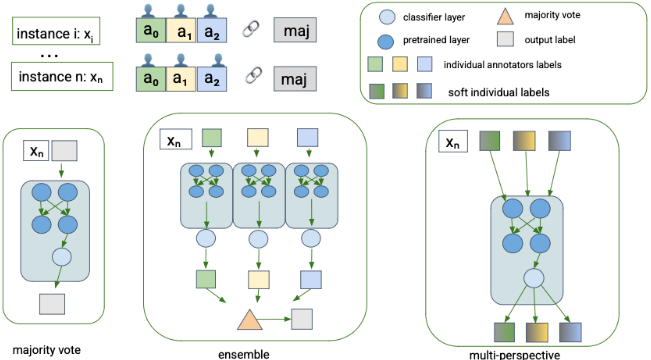
Figure 1, inspired by [Mostafazadeh Davani et al., 2022], provides an overview of the baselines and our proposed methodology, which we will elaborate in the following sections. Specifically, we fine-tune BERT-Large [Devlin, 2018] and RoBERTa-Large [Liu, 2019], both encoder-only models, particularly suitable for classification tasks, especially when working with relatively small datasets, as in the case of our study. Additional details regarding the fine-tuning settings are provided in our GitHub repository, linked on the first page.
3.1 Baseline Models using Hard Labels
In traditional machine learning (ML) settings, the most commonly used label aggregation technique is majority voting, where the label that appears most frequently among the annotations provided by annotators is chosen for each data point. Typically, the majority label is represented as a hard label, which, in binary classification settings, is encoded as either 0 or 1. Following [Mostafazadeh Davani et al., 2022], we consider two different baselines: majority vote, a single-task classifier trained to predict the aggregated label and an ensemble, a multi-annotator classifier whose aim is to predict the aggregated label.
Majority Vote. The majority vote baseline is a widely used approach in which a single-task classifier is fine-tuned to predict the aggregated label for each instance-in this case, the majority label. It is built by adding a fully connected layer to the outputs of the language model (hi), followed by the application of a linear transformation and a softmax function. The softmax generates the probability of the majority label, P (maj(¯ y) | h).
Ensemble. The ensemble approach involves predicting the annotations generated by each annotator. During training, each classifier is independently fine-tuned to predict all annotations provided by the j-th annotator. At test time, the outputs generated by the ensemble are aggregated to determine the majority label, meant to be the final prediction P (maj(¯ y) | h).
3.2 Multi-Perspective Model using Soft Labels
In the multi-perspective schema, differently from the baseline approach, a majority label is not created, meaning that the multi-perspective model uses disaggregated labels. Moreover, these disaggregated labels which are represented with discrete values are transformed into their continuous counterparts using softmax function and called as soft labels following the approach presented in [Uma et al., 2020]. Instead of assigning a single label to each data point, soft labels capture a probability distribution across the possible classes, ensuring that minority perspectives are included rather than being overlooked. This approach is particularly valuable in subjective tasks where annotator preferences may vary significantly [Plank, 2022]. Since the baseline and multi-perspective approaches design the datasets in a distinct manner- the baseline approach uses hard labels, while the multi-perspective approach uses soft labels- in the multiperspective settings, the soft loss [Uma et al., 2020] is applied instead of cross-entropy loss. This choice is driven by the need to encode the human label distribution with a more fine-grained representation. The soft loss is defined as:
-
where phum(y | x) represents the human label distribution (i.e. soft labels) which is obtained by applying the softmax function to the logits produced by the classifier.
4 Experimental Setup
This section details the technical aspects of the conducted experiments to evaluate our Multi-Perspective approach. We first provide an overview of the benchmark datasets used, followed by the introduction of our custom dataset for stance detection and its summarization process. Finally, we describe the fine-tuning setup employed in the experiments. Our code, along with supplementary materials - including document summarization, fine-tuning details, and XAI visualizations - is available at the referenced Github page.
4.1 Datasets
In this study, we conduct experiments on datasets related to four distinct subjective tasks: Gab Hate [Kennedy et al., 2018] for hate speech detection, ConvAbuse [Cercas Curry et al., 2021] for abusive language detection, EPIC [Frenda et al., 2023] for irony detection and finally our Stance Detection dataset [Gezici et al., 2021]. Details regarding dataset statistics 4 are shown in Table 1, where the percentage of disagreement is measured by determining the proportion of annotations that differ (by at least one vote) from the majority class (i.e., the hard label) out of the total number of annotations.
4 We show majority label distributions to highlight common trends while reflecting the diversity of individual annotations.
GabHate
GabHate consists of 27,665 English posts from Gab.com, 5 each annotated to check if they contain hate speech. Hate speech is defined by [Kennedy et al., 2018] as "language that dehumanizes, attacks human dignity, derogates, incites violence, or supports hateful ideology, such as white supremacy". In the dataset, each instance is annotated by at least three annotators from a set of ∥A∥ = 18 annotators.
ConvAbuse
The ConvAbuse dataset is the first corpus collecting English dialogues between users and three conversational AI agents, with the goal of detecting varying levels of abusiveness expressed in the text [Cercas Curry et al., 2021]. The dataset is annotated by multiple annotators, each labeling only a portion of the data. In the original dataset, the annotations ranged from [-3, 1], where 1 indicated no abuse, 0 represented ambivalence, and the remaining values denoted varying degrees of abuse severity. In prior studies [Vitsakis et al., 2023; Leonardelli et al., 2023], they consolidated these labels into a binary format, distinguishing between instances where abuse was detected (1) and those where it was not (0).
EPIC
EPIC is the first annotated corpus for irony detection grounded in the principles of data perspectivism [Frenda et al., 2023]. The dataset comprises short social media posts sourced from Twitter 6 and Reddit. 7 Each post is annotated by multiple annotators with a binary label, either irony (1) or not irony (0).
| Dataset | Class 0 | Class 1 | Class 2 | Class 3 | Tot.Class | Ann. | %Disagr. | Subj. Task |
|---|---|---|---|---|---|---|---|---|
| GabHate | 25212 | 2452 | - | - | 2 | 18 (3.13) | 69% | Hate speech detection |
| ConvAbuse | 3378 | 672 | - | - | 2 | 8 (3.24) | 46% | Abusive lang. detection |
| EPIC | 2228 | 761 | - | - | 2 | 5 (4.72) | 66% | Irony detection |
| StanceDetection | 223 | 199 | 298 | 177 | 4 | 3 (3.0) | 73% | Stance detection |
StanceDetection
The Stance Detection dataset consists of the top 10 news search results retrieved from Google and Bing for 57 queries on various controversial topics. These topics span a diverse range of areas, including education, health, entertainment, religion, and politics, which are known to elicit a variety of perspectives and opinions. Each data point consists of a query (about a controversial topic), a document title, and the textual content related to a given query, with varying lengths, i.e., an average of 1,200 tokens, extending up to 7,000 tokens. Documents (title and content) have been annotated by three annotators on MTurk 8 . The reported Fleiss-Kappa 9 score of 0.35 and inter-rater agreement score of 0.49 on the original dataset highlight the subjectivity and ambiguous nature of the stance detection task. Note that each document has not been annotated by the same three annotators due to the design choices which leads to a more enriched dataset with diverse opinions (annotations). With the aim of reducing document length and enabling processing with BERT-based models, we applied a summarization step to these documents. For details regarding the summarization method, including model selection, constraints, and performance, please refer to the GitHub repository.
4.2 EvaluationMetrics
The model evaluation results are reported using both hard and soft metrics. Hard metrics include accuracy and F1 score (Table 2), as defined in [Uma et al., 2021], and commonly used in related work [Mostafazadeh Davani et al., 2022]. We opted for macro F1-score to address dataset imbalance and ensure equal importance for each class. These metrics primarily assess model performance by measuring how accurately the model predicts the final (majority) label. Additionally, we report average model confidence scores (Table 3) and JensenShannon Divergence (JSD) (Table 4), following [Chen et al., 2024]. Confidence scores are calculated by applying the softmax function to the model's logits to obtain class probabilities, then selecting the highest probability as the confidence for each prediction. JSD is used as the principal soft metric to measure the distance between predicted probability distributions (or soft labels).
5 Results
The evaluation results demonstrate that multi-perspective models generally outperform baseline approaches- majority vote and ensemble methods-in most subjective tasks (Table 2). This is particularly evident in hate speech and abusive language detection, where multi-perspective models prove to be more effective at capturing the nuances of the content. Furthermore, both baseline and multi-perspective models tend to perform better in binary classification tasks, such as hate speech, irony, abusive language detection, compared to more complex multi-class tasks like stance detection. However, one notable exception in F1-score performance is observed with the RoBERTa-large [Liu, 2019] model fine-tuned on the ConvAbuse dataset. This anomaly can be attributed to the higher agreement among annotators, as indicated by Table 1. In this dataset, the level of disagreement is lower compared to all the other datasets. With greater consensus among annotators, the multi-perspective model faces challenges in capturing diverse viewpoints, making it more difficult to outperform the baseline majority vote. As a result, the majority vote approach achieves a higher F1-score in this case. An interesting pattern emerges when we examine the confidence levels of the models (Table 3). Multi-perspective models tend to exhibit higher confidence in tasks like hate speech and abusive language detection. In contrast, baseline models, especially those using majority vote aggregation, tend to perform better in tasks such as irony and stance detection. This suggests that different models may interpret dissenting opinions and subjective content in distinct ways, with the interpretation depending on the specific task.
9 Statistical measure of inter-rater agreement that extends Cohen's Kappa to multiple raters and accounts for chance agreement.
The observed uncertainty in multi-perspective models is likely a result of their design, which represents diverse viewpoints with equal importance. While this approach enhances the model's ability to capture dissenting voices, it also increases uncertainty in the predictions. As a result, we argue that confidence scores alone may not reliably evaluate multiperspective model performance.
To further investigate the performance of multi-perspective models, we use the JSD metric to compare model predictions with human-generated probability distributions, i.e., ground truth soft labels. For baseline models, JSD is computed using softmax predictions, which represent the normalized logits across the classes. Results show that the multi-perspective approach surpasses baselines in all subjective tasks, demonstrating a better ability to align with human label distributions (Table 4).
6 Ablation Study: XAI
To compare model predictions on aggregated (baseline) vs. disaggregated (multi-perspective) labels, we apply XAI techniques to RoBERTa-large and BERT-large. Using post-hoc 10 feature-based attribution, we pinpoint the key tokens that influence the model's decisions and its preference for certain perspectives.
| GabHate | ConvAbuse | EPIC | StanceDetection | ||||||
|---|---|---|---|---|---|---|---|---|---|
| Approach | RoBERTa | BERT | RoBERTa | BERT | RoBERTa | BERT | RoBERTa | BERT | |
| Accuracy | Maj. vote Ensemble | 91.54 91.49 | 91.47 91.49 92.21 | 82.97 82.14 | 82.14 82.14 78.92 | 79.11 78.22 | 70.88 77.33 | 46.76 58.99 | 38.84 43.16 38.84 |
| 45.09 | 66.80 | 39.15 | |||||||
| MultiP | 91.73 | 85.11 | 74.22 | 58.27 | |||||
| 74.44 | |||||||||
| Macro-F1 | Maj. vote | 48.63 | 47.77 | 61.24 | 56.79 | 45.61 | |||
| Ensemble | 47.77 | 47.77 | 45.09 | 45.09 | 59.93 | 47.99 | 59.21 | 43.30 | |
| MultiP | 72.26 | 71.03 | 48.96 | 57.71 | 69.38 | 61.00 | 61.08 | 45.22 | |
| GabHate | ConvAbuse | EPIC | StanceDetection | ||||||
|---|---|---|---|---|---|---|---|---|---|
| Approach | RoBERTa | BERT | RoBERTa | BERT | RoBERTa | BERT | RoBERTa | BERT | |
| Avg. Conf. | Maj. vote Ensemble MultiP | 93.40 95.40 97.55 | 94.84 94.90 96.19 | 79.73 86.07 98.02 | 87.74 87.61 90.84 | 97.92 83.54 89.35 | 93.63 79.26 77.61 | 70.48 47.37 62.60 | 60.76 50.07 51.18 |
| GabHate | ConvAbuse | EPIC | StanceDetection | ||||||
|---|---|---|---|---|---|---|---|---|---|
| Approach | RoBERTa | BERT | RoBERTa | BERT | RoBERTa | BERT | RoBERTa | BERT | |
| JSD | Maj. vote | 0.388 | 0.694 | 0.138 | 0.245 | 0.655 | 0.548 | 0.281 | 0.297 |
| Ensemble | 0.264 | 0.567 | 0.131 | 0.239 | 0.583 | 0.498 | 0.210 | 0.205 | |
| MultiP | 0.052 | 0.051 | 0.127 | 0.195 | 0.134 | 0.095 | 0.085 | 0.062 | |
6.1 Feature-basedMethods
There is growing interest in the NLP community in better understanding the uncertainty associated with LLM outputs, which are often regarded as black boxes as their interpretability remains challenging [Wu et al., 2024; Ahdritz et al., 2024]. To gain insights into model predictions, we explore various XAI techniques, in particular:
- Layer Integrated Gradient (LIG) [Sundararajan et al., 2017] is a variant of the Integrated Gradient algorithm that computes importance scores for input features by approximating the integral of the model's output across different layers along a baseline path 11 .
- LIME [Ribeiro et al., 2016] explains model predictions by auditing a black-box model on synthetic instances near the target instance, estimating feature importance using a locally fitted linear regression. Higher coefficients indicate greater influence, providing insights into local decision boundaries and model reasoning.
- SHAP [Lundberg, 2017], similarly to LIME, SHAP provides feature importance scores leveraging Shapley values to calculate additive feature attributions. High values indicate a strong positive contribution to the classifica-
10 A post hoc explanation interprets an ML model's predictions after training.
11 It is a zero vector representing no feature information.
- tion outcome, whereas values near zero or above suggest a negative or negligible impact.
- Layer Conductance (LC) [Dhamdhere et al., 2018], this method evaluates the conductance of each hidden layer, identifying the neurons that contributed the most to the model's prediction within a target layer.
- Attention scores indicate how much focus each token gives to others in the sequence across layers and attention heads. They provide a direct visualization of the model's focus distribution, revealing key relationships that influence its decision-making.
All the aforementioned methods, except for attention matrices, are implemented using Captum 12 which is an opensource model interpretability library for Pytorch [Kokhlikyan et al., 2020].
6.2 Results
We apply the aforementioned XAI methods to the topperforming models: the baseline majority vote for the EPIC dataset and the multi-perspective model for ConvAbuse. Model selection was based on average confidence scores on the respective test sets. We compute the prediction confidence (i.e., probability) for each test instance and ranked the instances accordingly. We then select the five instances with the lowest prediction probabilities (i.e., highest uncertainty) and, due to space constraints, present the two most representative examples. A key factor in feature-based attribution is the number of salient tokens (k). Following [Krishna et al., 2022], we set k based on average sentence length to ensure a balanced meaningful token selection. Some interest-
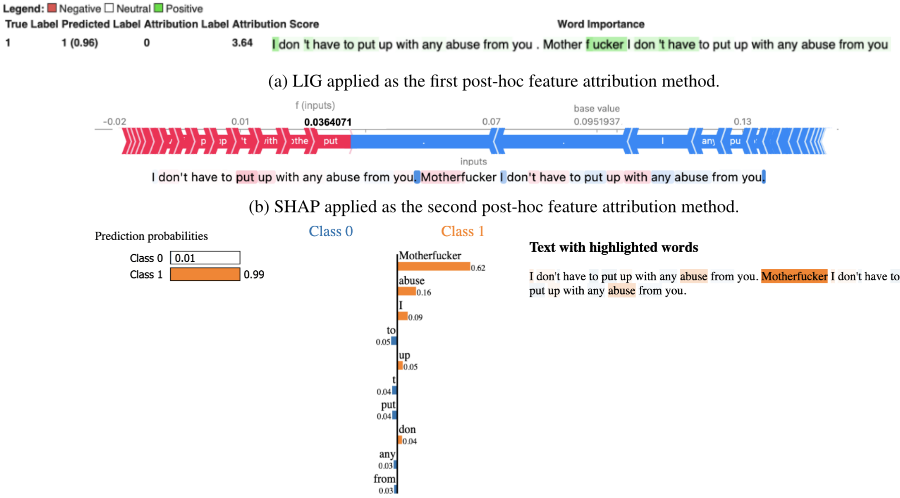
(c) LIME applied as the third post-hoc feature attribution method.
Figure 2: Three XAI methods applied to a low-confidence instance identified by the best multi-perspective model on ConvAbuse.
ing insights emerge from the models' lower-confidence predictions. Figure 2 illustrates the application of LIG, SHAP, and LIME on ConvAbuse dataset on the task of Abusive Language Detection. The example shown is classified as abusive language (1) by the best-performing multi-perspective model (black box) with a confidence score of 0.55. The true (hard) label for this instance is 1, while its soft label representation is [0.0, 1.0] 13 , meaning all annotators agreed on label 1, with no perspectives discarded. In Figure 2a, LIG highlights the key contributing words in green-'fucker' as the strongest (darkest shade), followed by 'don't' and 'have' (lighter green). Figure 2b shows a force plot with SHAP values for each word contributing to the model's output of 0.036 (i.e. class 0, non-abusive). Red indicates features increasing the prediction probability, while blue indicates features decreasing it. Figure 2c shows that the tokens 'motherfucker' and 'abuse' contribute the most to the prediction probability, with weights of 0.63 and 0.15 respectively, followed by 'I' and 'up' with lower contributions of 0.09 and 0.06, demonstrating LIME's accurate identification of key influential features. Among the three XAI methods, LIG and LIME consistently predict class 1. However, each method produces slightly different explanations, highlighting variability in token importance depending on the perspective. Figure 3 analyzes a low-confidence instance (model confidence score of 0.57) from the EPIC dataset (Irony Detection), classified by the best-performing baseline model (black box). The true (hard) label is 0 (nonironic content), while the soft label representation [0.9, 0.1] indicates slight disagreement. In this case, LIG classifies the instance as class 0, emphasizing tokens such as 'tiny', 'fun', 'gay', and 'suburbs', with suburbs having the strongest positive influence, indicated by a dark green shade. Similarly, SHAP assigns a prediction value of 0.044 (corresponding to class 0, non-ironic), while LIME confidently predicts class 1. Figure 3b shows that the tokens of 'shorts', and 'gay' (highlighted in blue) reduce the prediction probability. In contrast, Figure 3c indicates that the tokens 'fleece', 'shorts', and 'gay' contributed most to the incorrect prediction of class 1 (ironic content), with weights of 0.14, 0.11, and 0.09, respectively. Unlike the abusive language detection task, LIG and SHAP correctly agree on the prediction (class 0) for irony detection. However, they highlight different tokens, illustrating variability in token importance across methods. This underscores the limitations of relying on a single explainability technique. Additional analyses of token importance across layers and attention patterns are available in our GitHub repository, linked on the first page.
13 At index 0 class 0, at index 1 class 1.
7 Conclusion &FutureWork
This work presents a novel multi-perspective approach for subjective tasks. We advocate adopting perspective-aware models that preserve, rather than aggregate, diverse human opinions to promote responsible AI. The perspectivist approach promotes inclusivity and critically addresses assumptions inherent in the use of LLMs within multimodal contexts involving image, audio, and video analysis. Furthermore, it has potential applications in traditionally objective tasks, such as medical decision-making [Basile et al., 2021]. In this study, we extended prior work by introducing a methodology based on soft labels to avoid overshad-
(a) LIG applied as the first post-hoc feature attribution method.
(b) SHAP applied as the second post-hoc feature attribution method.
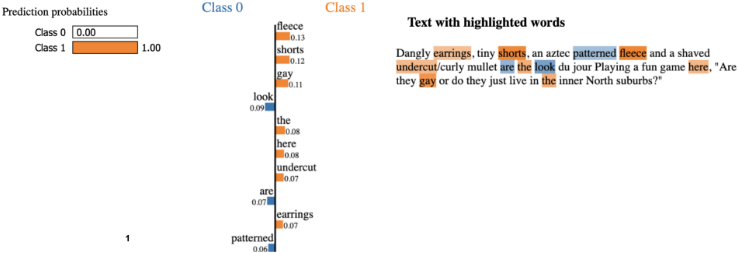
(c) LIME applied as the third post-hoc feature attribution method.
Figure 3: Three XAI methods applied to a low-confidence instance identified by the best baseline model on EPIC.
owing minority perspectives, particularly in the absence of a definitive ground truth. We performed an extensive analysis across diverse subjective tasks-including hate speech, irony, and stance detection-to capture and preserve multiple viewpoints. We fine-tuned BERT-large and RoBERTa-large models using both a baseline method-majority vote with ensemble-and a multi-perspective approach. Results indicate that employing soft labels enhances model performance (e.g., F1 score) and more accurately reflects human label distributions [Chen et al., 2024]. Additionally, we applied explainable AI techniques to identify key tokens influencing model predictions. Our findings expose inconsistencies in post-hoc attribution methods (LIG, SHAP, LIME), underscoring the inherent subjectivity of target tasks, where interpretations vary according to annotators' backgrounds, experiences, and values. This aligns with the variability observed in human judgments. Further investigation into the correlation between attribution variability and human subjectivity is warranted. We advocate adopting a pluralistic approach [Sorensen et al., 2024] to better align LLMs with diverse human values, as the majority viewpoint may not always be the most appropriate. This paradigm has the potential to lead to a new generation of more inclusive LLMs that avoid falling into the echo chamber loop [Nehring et al., 2024], bringing attention to even the minority perspectives that are often obscured. Thus, from a practical perspective, this approach could enhance the trustworthiness of LLMs and support the development of more personalized systems [Huang et al., 2024], ultimately improving multi-turn human-AI interactions, particularly in chatbot applications.
In future work, we plan to extend our approach to a broader range of models, including decoder-only architectures prompted for classification in both subjective and objective tasks. Additionally, we will investigate the relationship between model uncertainty and human disagreement. Moreover, we aim to employ advanced XAI techniques, such as neuron activation analysis, to enhance interpretability and facilitate bias detection.
8 Limitations
This study has certain limitations. While excluding instances without a majority label reduced the dataset size, this was essential to maintain a fair comparison with baseline models. Nevertheless, these instances offer important insights into diverse perspectives shaped by individuals' distinct backgrounds and experiences, and should not be disregarded as noise. In future work, we intend to incorporate highdisagreement instances and perform a more in-depth analysis of their effects. Our study was also limited by computational resources, which impacted batch size and model capacity. Finally, current XAI methods in NLP frequently fail to deliver the clarity of insights observed in other domains.
Acknowledgments
This work has been supported by the European Union under ERC-2018-ADG GA 834756 (XAI), the Partnership Extended PE00000013 - "FAIR - Future Artificial Intelligence Research" - Spoke 1 "Human-centered AI", and by the EU EIC project EMERGE (Grant No. 101070918).
@inproceedings{ijcai2025p1092,
  title     = {Perspectives in Play: A Multi-Perspective Approach for More Inclusive NLP Systems},
  author    = {Muscato, Benedetta and Passaro, Lucia and Gezici, Gizem and Giannotti, Fosca},
  booktitle = {Proceedings of the Thirty-Fourth International Joint Conference on
               Artificial Intelligence, {IJCAI-25}},
  publisher = {International Joint Conferences on Artificial Intelligence Organization},
  editor    = {James Kwok},
  pages     = {9827--9835},
  year      = {2025},
  month     = {8},
  note      = {AI and Social Good},
  doi       = {10.24963/ijcai.2025/1092},
  url       = {https://doi.org/10.24963/ijcai.2025/1092},
}
TY - CPAPER TI - Perspectives in Play: A Multi-Perspective Approach for More Inclusive NLP Systems AU - Muscato, Benedetta AU - Passaro, Lucia AU - Gezici, Gizem AU - Giannotti, Fosca T2 - Proceedings of the Thirty-Fourth International Joint Conference on Artificial Intelligence, IJCAI-25 PB - International Joint Conferences on Artificial Intelligence Organization PY - 2025 SP - 9827 EP - 9835 DO - 10.24963/ijcai.2025/1092 UR - https://doi.org/10.24963/ijcai.2025/1092 ER -Copied
Machine-readable versions of this paper, for tools and AI agents:





