
A Comprehensive Survey on Physical Risk Control in the Era of Foundation Model-enabled Robotics
Proceedings of the Thirty-Fourth International Joint Conference on Artificial Intelligence. Survey Track. Pages 10517-10527.
https://doi.org/10.24963/ijcai.2025/1168
Keywords
- Robotics: General
Abstract
Recent Foundation Model-enabled robotics (FMRs) display greatly improved general-purpose skills, enabling more adaptable automation than conventional robotics. Their ability to handle diverse tasks thus creates new opportunities to replace human labor. However, unlike general foundation models, FMRs interact with the physical world, where their actions directly affect the safety of humans and surrounding objects, requiring careful deployment and control. Based on this proposition, our survey comprehensively summarizes robot control approaches to mitigate physical risks by covering all the lifespan of FMRs ranging from pre-deployment to post-accident stage. Specifically, we broadly divide the timeline into the following three phases: (1) pre-deployment phase, (2) pre-incident phase, and (3) post-incident phase. Throughout this survey, we find that there is much room to study (i) pre-incident risk mitigation strategies, (ii) research that assumes physical interaction with humans, and (iii) essential issues of foundation models themselves. We hope that this survey will be a milestone in providing a high-resolution analysis of the physical risks of FMRs and their control, contributing to the realization of a good human-robot relationship.
- [Ahn et al., 2022] Michael Ahn, Anthony Brohan, Noah Brown, Yevgen Chebotar, Omar Cortes, Byron David, Chelsea Finn, Chuyuan Fu, Keerthana Gopalakrishnan, Karol Hausman, Alex Herzog, Daniel Ho, Jasmine Hsu, Julian Ibarz, Brian Ichter, Alex Irpan, Eric Jang, Rosario Jauregui Ruano, Kyle Jeffrey, Sally Jesmonth, Nikhil Joshi, Ryan Julian, Dmitry Kalashnikov, Yuheng Kuang, Kuang-Huei Lee, Sergey Levine, Yao Lu, Linda Luu, Carolina Parada, Peter Pastor, Jornell Quiambao, Kanishka Rao, Jarek Rettinghouse, Diego Reyes, Pierre Sermanet, Nicolas Sievers, Clayton Tan, Alexander To- shev, Vincent Vanhoucke, Fei Xia, Ted Xiao, Peng Xu, Sichun Xu, Mengyuan Yan, and Andy Zeng. Do as i can and not as i say: Grounding language in robotic affor- dances. In arXiv preprint arXiv:2204.01691, 2022.
- [Altman, 1999] Eitan Altman. Constrained Markov Deci- sion Processes, volume 7. CRC Press, 1999.
- [Arjovsky et al., 2020] Martin Arjovsky, Léon Bottou, Ishaan Gulrajani, and David Lopez-Paz. Invariant risk minimization. arXiv eprint 1907.02893, 2020.
- [Arnab et al., 2021] Anurag Arnab, Mostafa Dehghani, Georg Heigold, Chen Sun, Mario Lučić, and Cordelia Schmid. Vivit: A video vision transformer. In ICCV, pages 6836-6846, 2021.
- [Baevski et al., 2020] Alexei Baevski, Yuhao Zhou, Abdel- rahman Mohamed, and Michael Auli. wav2vec 2.0: A framework for self-supervised learning of speech repre- sentations. In NeurIPS, volume 33, pages 12449-12460, 2020.
- [Bemporad and Morari, 2007] Alberto Bemporad and Man- fred Morari. Robust model predictive control: a survey. In Robustness in Identification and Control, pages 207-226. Springer, 2007.
- [Ben-Tal et al., 2012] Aharon Ben-Tal, Dick den Hertog, Anja De Waegenaere, Bertrand Melenberg, and Gijs Ren- nen. Robust solutions of optimization problems affected by uncertain probabilities. Management Science, 2012.
- [Bergner et al., 2022] Florian Bergner, Emmanuel Dean- Leon, and Gordon Cheng. Neuromorphic principles for large-scale robot skin, pages 91-123. Institution of Engi- neering and Technology, January 2022.
- [Black et al., 2024] Kevin Black, Noah Brown, Danny Driess, Adnan Esmail, Michael Equi, Chelsea Finn, Nic- colo Fusai, Lachy Groom, Karol Hausman, Brian Ichter, et al. π 0 : A vision-language-action flow model for general robot control. arXiv preprint arXiv:2410.24164, 2024.
- [Bodo et al., 2023] Giulia Bodo, Federico Tessari, Stefano Buccelli, Luca De Guglielmo, Gianluca Capitta, Matteo Laffranchi, and Lorenzo De Michieli. Customized se- ries elastic actuator for a safe and compliant human-robot interaction: Design and characterization. In 2023 Inter- national Conference on Rehabilitation Robotics (ICORR), pages 1-6, 2023.
- [Bohlinger et al., 2024] Nico Bohlinger, Grzegorz Czech- manowski, Maciej Krupka, Piotr Kicki, Krzysztof Walas, Jan Peters, and Davide Tateo. One policy to run them all: an end-to-end learning approach to multi-embodiment lo- comotion. arXiv preprint arXiv:2409.06366, 2024.
- [Bommasani et al., 2021] Rishi Bommasani, Drew A Hud- son, Ehsan Adeli, Russ Altman, Simran Arora, Syd- ney von Arx, Michael S Bernstein, Jeannette Bohg, An- toine Bosselut, Emma Brunskill, et al. On the oppor- tunities and risks of foundation models. arXiv preprint arXiv:2108.07258, 2021.
- [Brohan et al., 2022] Anthony Brohan, Noah Brown, Justice Carbajal, Yevgen Chebotar, Joseph Dabis, Chelsea Finn, Keerthana Gopalakrishnan, Karol Hausman, Alex Herzog, Jasmine Hsu, et al. Rt-1: Robotics transformer for real- world control at scale. arXiv preprint arXiv:2212.06817, 2022.
- [Chen et al., 2019] Hao Chen, Weiwei Wan, and Kensuke Harada. Combined task and motion planning for a dual- arm robot to use a suction cup tool. In Humanoids, pages 446-452. IEEE, 2019.
- [Chen et al., 2024a] Hongyi Chen, Yunchao Yao, Ruixuan Liu, Changliu Liu, and Jeffrey Ichnowski. Automating robot failure recovery using vision-language models with optimized prompts, 2024.
- [Chen et al., 2024b] Yipu Chen, Haotian Xue, and Yongxin Chen. Diffusion policy attacker: Crafting adversar- ial attacks for diffusion-based policies. arXiv preprint arXiv:2405.19424, 2024.
- [Cheng et al., 2024] Hao Cheng, Erjia Xiao, Chengyuan Yu, Zhao Yao, Jiahang Cao, Qiang Zhang, Jiaxu Wang, Meng- shu Sun, Kaidi Xu, Jindong Gu, et al. Manipulation fac- ing threats: Evaluating physical vulnerabilities in end- to-end vision language action models. arXiv preprint arXiv:2409.13174, 2024.
- [Costa et al., 2024] Joana C Costa, Tiago Roxo, Hugo Proenc ¸a, and Pedro RM Inácio. How deep learning sees the world: A survey on adversarial attacks & defenses. IEEE Access, 2024.
- [Delmerico et al., 2019] Jeffrey Delmerico, Stefano Mintchev, Alessandro Giusti, Boris Gromov, Kamilo Melo, Tomislav Horvat, Cesar Cadena, Marco Hutter, Auke Ijspeert, Dario Floreano, et al. The current state and future outlook of rescue robotics. Journal of Field Robotics, 36(7):1171-1191, 2019.
- [Devlin et al., 2019] Jacob Devlin, Ming-Wei Chang, Ken- ton Lee, and Kristina Toutanova. BERT: Pre-training of deep bidirectional transformers for language understand- ing. In NAACL-HLT, pages 4171-4186, 2019.
- [Dosovitskiy et al., 2021] Alexey Dosovitskiy, Lucas Beyer, Alexander Kolesnikov, Dirk Weissenborn, Xiaohua Zhai, Thomas Unterthiner, Mostafa Dehghani, Matthias Min- derer, Georg Heigold, Sylvain Gelly, Jakob Uszkoreit, and Neil Houlsby. An image is worth 16x16 words: Trans- formers for image recognition at scale. In ICLR, 2021.
- [Doyle, 1982] John Doyle. Analysis of feedback systems with structured uncertainties. In IEE Proceedings D- Control Theory and Applications, 1982.
- [Duchi and Namkoong, 2020] John Duchi and Hongseok Namkoong. Learning models with uniform performance via distributionally robust optimization. arXiv eprint 1810.08750, 2020.
- [Eder et al., 2014] Kerstin Eder, Chris Harper, and Ute Leonards. Towards the safety of human-in-the-loop robotics: Challenges and opportunities for safety assur- ance of robotic co-workers'. In RO-MAN, pages 660-665. IEEE, 2014.
- [Escontrela et al., 2023] Alejandro Escontrela, Ademi Adeniji, Wilson Yan, Ajay Jain, Xue Bin Peng, Ken Gold- berg, Youngwoon Lee, Danijar Hafner, and Pieter Abbeel. Video prediction models as rewards for reinforcement learning. NeurIPS, 2023.
- [Eysenbach et al., 2018] Benjamin Eysenbach, Shixiang Gu, Julian Ibarz, and Sergey Levine. Leave no trace: Learning to reset for safe and autonomous reinforcement learning. In ICLR, 2018.
- [Fang et al., 2023] Hao-Shu Fang, Hongjie Fang, Zhenyu Tang, Jirong Liu, Junbo Wang, Haoyi Zhu, and Cewu Lu. Rh20t: A robotic dataset for learning diverse skills in one- shot. In RSS 2023 Workshop on Learning for Task and Motion Planning, 2023.
- [Ferraguti et al., 2022] Federica Ferraguti, Chiara Talignani Landi, Andrew Singletary, Hsien-Chung Lin, Aaron Ames, Cristian Secchi, and Marcello Bonfè. Safety and efficiency in robotics: The control barrier functions ap- proach. IEEE Robotics & Automation Magazine, pages 139-151, 2022.
- [Firoozi et al., 2023] Roya Firoozi, Johnathan Tucker, Stephen Tian, Anirudha Majumdar, Jiankai Sun, Weiyu Liu, Yuke Zhu, Shuran Song, Ashish Kapoor, Karol Hausman, et al. Foundation models in robotics: Ap- plications, challenges, and the future. IJRR, page 02783649241281508, 2023.
- [Garg et al., 2024] Kunal Garg, Jacob Arkin, Songyuan Zhang, Nicholas Roy, and Chuchu Fan. Large language models to the rescue: Deadlock resolution in multi-robot systems. arXiv preprint arXiv:2404.06413, 2024.
- [Garnelo et al., 2018a] Marta Garnelo, Dan Rosenbaum, Christopher Maddison, Tiago Ramalho, David Saxton, Murray Shanahan, Yee Whye Teh, Danilo Rezende, and SM Ali Eslami. Conditional neural processes. In ICML, pages 1704-1713. PMLR, 2018.
- [Garnelo et al., 2018b] Marta Garnelo, Jonathan Schwarz, Dan Rosenbaum, Fabio Viola, Danilo J Rezende, SM Es- lami, and Yee Whye Teh. Neural processes. arXiv preprint arXiv:1807.01622, 2018.
- [Genesis-Authors, 2024] Genesis-Authors. Genesis: A uni- versal and generative physics engine for robotics and be- yond, December 2024.
- [Guiochet et al., 2017] Jérémie Guiochet, Mathilde Machin, and Hélène Waeselynck. Safety-critical advanced robots: A survey. Robotics and Autonomous Systems, 94:43-52, 2017.
- [Ha et al., 2024] Huy Ha, Yihuai Gao, Zipeng Fu, Jie Tan, and Shuran Song. Umi on legs: Making manipulation poli- cies mobile with manipulation-centric whole-body con- trollers. arXiv preprint arXiv:2407.10353, 2024.
- [Haddadin et al., 2007] Sami Haddadin, Alin Albu-Schäffer, and Gerd Hirzinger. Safety evaluation of physical human- robot interaction via crash-testing. In Robotics: Science and systems, pages 217-224, 2007.
- [Haddadin et al., 2008] Sami Haddadin, Alin Albu-Schaffer, Alessandro De Luca, and Gerd Hirzinger. Collision detec- tion and reaction: A contribution to safe physical human- robot interaction. In IROS, pages 3356-3363. IEEE, 2008.
- [Hansel et al., 2023] Kay Hansel, Julen Urain, Jan Peters, and Georgia Chalvatzaki. Hierarchical policy blending as inference for reactive robot control. In ICRA, pages 10181-10188, 2023.
- [Hossain, 2023] Mokter Hossain. Autonomous delivery robots: A literature review. IEEE Engineering Manage- ment Review, 51(4):77-89, 2023.
- [Hu et al., 2023] Yafei Hu, Quanting Xie, Vidhi Jain, Jonathan Francis, Jay Patrikar, Nikhil Keetha, Seungchan Kim, Yaqi Xie, Tianyi Zhang, Hao-Shu Fang, et al. Toward general-purpose robots via foundation models: A sur- vey and meta-analysis. arXiv preprint arXiv:2312.08782, 2023.
- [Huang et al., 2024] Tao Huang, Guangqi Jiang, Yanjie Ze, and Huazhe Xu. Diffusion reward: Learning rewards via conditional video diffusion. In ECCV, pages 478-495. Springer, 2024.
- [Huck et al., 2023] Tom P. Huck, Martin Kaiser, Constantin Cronrath, Bengt Lennartson, Torsten Kröger, and Tamim Asfour. Reinforcement learning for safety testing: Lessons from a mobile robot case study, 2023.
- [Jiao et al., 2024] Ruochen Jiao, Shaoyuan Xie, Justin Yue, Takami Sato, Lixu Wang, Yixuan Wang, Qi Alfred Chen, and Qi Zhu. Exploring backdoor attacks against large language model-based decision making. arXiv preprint arXiv:2405.20774, 2024.
- [Kanazawa et al., 2023] Naoaki Kanazawa, Kento Kawa- harazuka, Yoshiki Obinata, Kei Okada, and Masayuki Inaba. Recognition of heat-induced food state changes by time-series use of vision-language model for cooking robot. In ICoIAS, 2023.
- [Kargar et al., 2024] Seyed Mohamad Kargar, Borislav Yor- danov, Carlo Harvey, and Ali Asadipour. Emerging trends in realistic robotic simulations: A comprehensive system- atic literature review. IEEE Access, 12:191264-191287, 2024.
- [Karnik et al., 2024] Sathwik Karnik, Zhang-Wei Hong, Nishant Abhangi, Yen-Chen Lin, Tsun-Hsuan Wang, and Pulkit Agrawal. Embodied red teaming for au- diting robotic foundation models. arXiv preprint arXiv:2411.18676, 2024.
- [Katara et al., 2024] Pushkal Katara, Zhou Xian, and Kate- rina Fragkiadaki. Gen2sim: Scaling up robot learning in simulation with generative models. In ICRA, pages 6672- 6679. IEEE, 2024.
- [Khazatsky et al., 2024] Alexander Khazatsky, Karl Pertsch, Suraj Nair, Ashwin Balakrishna, Sudeep Dasari, Siddharth Karamcheti, Soroush Nasiriany, Mohan Kumar Srirama, Lawrence Yunliang Chen, Kirsty Ellis, et al. Droid: A large-scale in-the-wild robot manipulation dataset. arXiv preprint arXiv:2403.12945, 2024.
- [Kim et al., 2024] Woojun Kim, Yongjae Shin, Jongeui Park, and Youngchul Sung. Sample-efficient and safe deep reinforcement learning via reset deep ensemble agents. NeurIPS, 36, 2024.
- [Kingma, 2013] Diederik P Kingma. Auto-encoding varia- tional bayes. arXiv preprint arXiv:1312.6114, 2013.
- [Kitamura et al., 2025] Toshinori Kitamura, Tadashi Kozuno, Wataru Kumagai, Kenta Hoshino, Yohei Hosoe, Kazumi Kasaura, Masashi Hamaya, Paavo Parmas, and Yutaka Matsuo. Near-Optimal Policy Identification in Robust Constrained Markov Decision Processes via Epigraph Form. In ICLR, 2025.
- [Kolve et al., 2017] Eric Kolve, Roozbeh Mottaghi, Winson Han, Eli VanderBilt, Luca Weihs, Alvaro Herrasti, Matt Deitke, Kiana Ehsani, Daniel Gordon, Yuke Zhu, et al. Ai2-thor: An interactive 3d environment for visual ai. arXiv preprint arXiv:1712.05474, 2017.
- Steven M. La Valle. Motion planning. IEEE Robotics & Automation Magazine, 18(2):108-118, 2011.
- [Lee et al., 2009] Woosub Lee, Junho Choi, and Sungchul Kang. Spring-clutch: A safe torque limiter based on a spring and cam mechanism with the ability to reinitialize its position. In IROS, pages 5140-5145, 2009.
- [Li et al., 2024] Chuan-Yao Li, Fan Zhang, and Liang Chen. Robot-assisted pedestrian evacuation in fire scenarios based on deep reinforcement learning. Chinese Journal of Physics, 92:494-531, 2024.
- [Liang et al., 2023] Jacky Liang, Wenlong Huang, Fei Xia, Peng Xu, Karol Hausman, Brian Ichter, Pete Florence, and Andy Zeng. Code as policies: Language model programs for embodied control. In ICRA, pages 9493-9500. IEEE, 2023.
- [Lin et al., 2024] Lizhi Lin, Honglin Mu, Zenan Zhai, Ming- han Wang, Yuxia Wang, Renxi Wang, Junjie Gao, Yixuan Zhang, Wanxiang Che, Timothy Baldwin, et al. Against the achilles' heel: A survey on red teaming for generative models. corr abs/2404.00629 (2024), 2024.
- [Liu et al., 2023] Huihan Liu, Soroush Nasiriany, Lance Zhang, Zhiyao Bao, and Yuke Zhu. Robot learning on the job: Human-in-the-loop autonomy and learning dur- ing deployment. In Robotics: Science and Systems (RSS), 2023.
- [Liu et al., 2024a] Aishan Liu, Yuguang Zhou, Xianglong Liu, Tianyuan Zhang, Siyuan Liang, Jiakai Wang, Yanjun Pu, Tianlin Li, Junqi Zhang, Wenbo Zhou, et al. Compro- mising embodied agents with contextual backdoor attacks. arXiv preprint arXiv:2408.02882, 2024.
- [Liu et al., 2024b] Haokun Liu, Yaonan Zhu, Kenji Kato, Atsushi Tsukahara, Izumi Kondo, Tadayoshi Aoyama, and Yasuhisa Hasegawa. Enhancing the llm-based robot manipulation through human-robot collaboration. RA-L, 9(8):6904-6911, 2024.
- [Liu et al., 2024c] Huihan Liu, Shivin Dass, Roberto Martín- Martín, and Yuke Zhu. Model-based runtime monitoring with interactive imitation learning. In ICRA, 2024.
- [Liu et al., 2024d] Huihan Liu, Yu Zhang, Vaarij Betala, Evan Zhang, James Liu, Crystal Ding, and Yuke Zhu. Multi-task interactive robot fleet learning with visual world models, 2024.
- [Lu et al., 2024] Xuancun Lu, Zhengxian Huang, Xinfeng Li, Wenyuan Xu, et al. Poex: Policy executable embod- ied ai jailbreak attacks. arXiv preprint arXiv:2412.16633, 2024.
- [Luo et al., 2024] Jianlan Luo, Charles Xu, Jeffrey Wu, and Sergey Levine. Precise and dexterous robotic manipula- tion via human-in-the-loop reinforcement learning, 2024.
- [Mahler et al., 2019] Jeffrey Mahler, Matthew Matl, Vishal Satish, Michael Danielczuk, Bill DeRose, Stephen McKinley, and Ken Goldberg. Learning ambidex- trous robot grasping policies. Science Robotics, 4(26):eaau4984, 2019.
- [Mandlekar et al., 2018] Ajay Mandlekar, Yuke Zhu, Ani- mesh Garg, Jonathan Booher, Max Spero, Albert Tung, Julian Gao, John Emmons, Anchit Gupta, Emre Orbay, et al. Roboturk: A crowdsourcing platform for robotic skill learning through imitation. In CoRL, pages 879-893.
- PMLR, 2018.
- [Mankowitz et al., 2020] Daniel J Mankowitz, Dan A Calian, Rae Jeong, Cosmin Paduraru, Nicolas Heess, Sumanth Dathathri, Martin Riedmiller, and Timothy Mann. Robust Constrained Reinforcement Learning for Continuous Control with Model Misspecification. arXiv preprint arXiv:2010.10644, 2020.
- [Matsushima et al., 2020a] Tatsuya Matsushima, Hiroki Fu- ruta, Yutaka Matsuo, Ofir Nachum, and Shixiang Gu. Deployment-efficient reinforcement learning via model-based offline optimization. arXiv preprint arXiv:2006.03647, 2020.
- [Matsushima et al., 2020b] Tatsuya Matsushima, Naruya Kondo, Yusuke Iwasawa, Kaoru Nasuno, and Yutaka Mat- suo. Modeling task uncertainty for safe meta-imitation learning. Frontiers in Robotics and AI, 7:606361, 2020.
- [Matthias and Reisinger, 2016] Björn Matthias and Thomas Reisinger. Example application of iso/ts 15066 to a col- laborative assembly scenario. In Proceedings of ISR 2016: 47st international symposium on robotics, pages 1- 5. VDE, 2016.
- [Mittal et al., 2023] Mayank Mittal, Calvin Yu, Qinxi Yu, Jingzhou Liu, Nikita Rudin, David Hoeller, Jia Lin Yuan, Ritvik Singh, Yunrong Guo, Hammad Mazhar, Ajay Man- dlekar, Buck Babich, Gavriel State, Marco Hutter, and Animesh Garg. Orbit: A unified simulation framework for interactive robot learning environments. RA-L, 8(6):3740- 3747, 2023.
- [Moos et al., 2022] Janosch Moos, Kay Hansel, Hany Ab- dulsamad, Svenja Stark, Debora Clever, and Jan Peters. Robust Reinforcement Learning: A Review of Foun- dations and Recent Advances. Machine Learning and Knowledge Extraction, 4(1):276-315, 2022.
- [Moroncelli et al., 2024] Angelo Moroncelli, Vishal Soni, Asad Ali Shahid, Marco Maccarini, Marco Forgione, Dario Piga, Blerina Spahiu, and Loris Roveda. Integrat- ing reinforcement learning with foundation models for autonomous robotics: Methods and perspectives. arXiv preprint arXiv:2410.16411, 2024.
- [O'Neill et al., 2023] Abby O'Neill, Abdul Rehman, Abhi- nav Gupta, Abhiram Maddukuri, Abhishek Gupta, Ab- hishek Padalkar, Abraham Lee, Acorn Pooley, Agrim Gupta, Ajay Mandlekar, et al. Open x-embodiment: Robotic learning datasets and rt-x models. arXiv preprint arXiv:2310.08864, 2023.
- [Park et al., 2024] Daehee Park, Jaeseok Jeong, Sung-Hoon Yoon, Jaewoo Jeong, and Kuk-Jin Yoon. T4p: Test-time training of trajectory prediction via masked autoencoder and actor-specific token memory. arXiv 2403.10052, 2024.
- [Pearl, 2009] Judea Pearl. Causality. Cambridge University Press, 2009.
- [Peters et al., 2015] Jonas Peters, Peter Bühlmann, and Nicolai Meinshausen. Causal inference using invariant prediction: identification and confidence intervals. arXiv eprint 1501.01332, 2015.
- [Piriyajitakonkij et al., 2024] Maytus Piriyajitakonkij, Mingfei Sun, Mengmi Zhang, and Wei Pan. Tta-nav: Test-time adaptive reconstruction for point-goal nav- igation under visual corruptions. arXiv 2403.01977, 2024.
- [Puig et al., 2023] Xavier Puig, Eric Undersander, Andrew Szot, Mikael Dallaire Cote, Tsung-Yen Yang, Ruslan Part- sey, Ruta Desai, Alexander William Clegg, Michal Hlavac, So Yeon Min, et al. Habitat 3.0: A co-habitat for humans, avatars and robots. arXiv preprint arXiv:2310.13724, 2023.
- [Rohmer et al., 2013] Eric Rohmer, Surya P. N. Singh, and Marc Freese. V-rep: A versatile and scalable robot simu- lation framework. In IROS, pages 1321-1326, 2013.
- [Russel et al., 2020] Reazul Hasan Russel, Mouhacine Benosman, and Jeroen Van Baar. Robust Constrained- MDPs: Soft-Constrained Robust Policy Optimization un- der Model Uncertainty. arXiv preprint arXiv:2010.04870, 2020.
- [Saveriano et al., 2023] Matteo Saveriano, Fares J Abu- Dakka, Aljaž Kramberger, and Luka Peternel. Dynamic movement primitives in robotics: A tutorial survey. IJRR, 42(13):1133-1184, 2023.
- [Schmidgall et al., 2024] Samuel Schmidgall, Ji Woong Kim, Alan Kuntz, Ahmed Ezzat Ghazi, and Axel Krieger. General-purpose foundation models for increased auton- omy in robot-assisted surgery. Nature Machine Intelli- gence, pages 1-9, 2024.
- [Shah et al., 2023] Dhruv Shah, Ajay Sridhar, Arjun Bhorkar, Noriaki Hirose, and Sergey Levine. Gnm: A general navigation model to drive any robot. In ICRA, pages 7226-7233, 2023.
- [Shirasaka et al., 2024] Mimo Shirasaka, Tatsuya Mat- sushima, Soshi Tsunashima, Yuya Ikeda, Aoi Horo, So Ikoma, Chikaha Tsuji, Hikaru Wada, Tsunekazu Omija, Dai Komukai, et al. Self-recovery prompting: Promptable general purpose service robot system with foundation models and self-recovery. In ICRA, pages 17395-17402. IEEE, 2024.
- [Sugiura et al., 2024] Sojiro Sugiura, Jayant Unde, Yaonan Zhu, and Yasuhisa Hasegawa. Variable grounding flexi- ble limb tracking center of gravity for sit-to-stand transfer assistance. RA-L, 9(1):175-182, 2024.
- [Sun et al., 2018] Guanghui Sun, Ligang Wu, Zhian Kuang, Zhiqiang Ma, and Jianxing Liu. Practical tracking control of linear motor via fractional-order sliding mode. Auto- matica, 94:221-235, 2018.
- [Sun et al., 2020] Yu Sun, Xiaolong Wang, Zhuang Liu, John Miller, Alexei A. Efros, and Morit Hardt. Test-time training with self-supervision for generalization under dis- tribution shifts. arXiv 1909.13231, 2020.
- [Sun et al., 2024a] Fan-Yun Sun, SI Harini, Angela Yi, Yi- han Zhou, Alex Zook, Jonathan Tremblay, Logan Cross, Jiajun Wu, and Nick Haber. Factorsim: Generative simu- lation via factorized representation. In NeurIPS, 2024.
- [Sun et al., 2024b] Jianwei Sun, Erik Harrison Kramer, and Jacob Rosen. A safety-focused admittance control ap- proach for physical human-robot interaction with rigid multi-arm serial link exoskeletons. IEEE/ASME Transac- tions on Mechatronics, pages 1-12, 2024.
- [Sutton and Barto, 2018] Richard S Sutton and Andrew G Barto. Reinforcement learning: An introduction. MIT press, 2018.
- [Truby et al., 2019] Ryan L. Truby, Robert K. Katzschmann, Jennifer A. Lewis, and Daniela Rus. Soft robotic fin- gers with embedded ionogel sensors and discrete actua- tion modes for somatosensitive manipulation. In RoboSoft, pages 322-329, 2019.
- [Wang et al., 2021] Dequan Wang, Evan Shelhamer, Shaoteng Liu, Bruno Olshausen, and Trevor Darrell. Tent: Fully test-time adaptation by entropy minimization. arXiv 2006.10726, 2021.
- [Wang et al., 2024] Xianlong Wang, Hewen Pan, Hangtao Zhang, Minghui Li, Shengshan Hu, Ziqi Zhou, Lulu Xue, Peijin Guo, Yichen Wang, Wei Wan, et al. Trojan- robot: Physical-world backdoor attacks against vlm-based robotic manipulation. arXiv preprint arXiv:2411.11683, 2024.
- [Xiao et al., 2023] Xuan Xiao, Jiahang Liu, Zhipeng Wang, Yanmin Zhou, Yong Qi, Qian Cheng, Bin He, and Shuo Jiang. Robot learning in the era of foundation models: A survey. arXiv preprint arXiv:2311.14379, 2023.
- [Yamamoto et al., 2019] Takashi Yamamoto, Koji Terada, Akiyoshi Ochiai, Fuminori Saito, Yoshiaki Asahara, and Kazuto Murase. Development of human support robot as the research platform of a domestic mobile manipulator. ROBOMECH journal, 6(1):1-15, 2019.
- [Yue et al., 2023] Wenxi Yue, Jing Zhang, Kun Hu, Qiuxia Wu, Zongyuan Ge, Yong Xia, Jiebo Luo, and Zhiy- ong Wang. Part to whole: Collaborative prompting for surgical instrument segmentation. arXiv preprint arXiv:2312.14481, 2023.
- [Zacharaki et al., 2020] Angeliki Zacharaki, Ioannis Kostavelis, Antonios Gasteratos, and Ioannis Dokas. Safety bounds in human robot interaction: A survey. Safety Science, 127:104667, 2020.
- [Zames, 1981] George Zames. Feedback and optimal sen- sitivity: Model reference transformations, multiplicative seminorms, and approximate inverses. IEEE Transactions on Automatic Control, 26(2):301-320, 1981.
- [Zawalski et al., 2024] Michał Zawalski, William Chen, Karl Pertsch, Oier Mees, Chelsea Finn, and Sergey Levine. Robotic control via embodied chain-of-thought reasoning. arXiv preprint arXiv:2407.08693, 2024.
- [Zhang et al., 2024] Chong Zhang, Nikita Rudin, David Hoeller, and Marco Hutter. Learning agile locomotion on risky terrains. In IROS, pages 11864-11871. IEEE, 2024.
- [Zhao et al., 2020] Wenshuai Zhao, Jorge Peña Queralta, and Tomi Westerlund. Sim-to-real transfer in deep rein- forcement learning for robotics: a survey. In SSCI, pages 737-744. IEEE, 2020.
- [Zhao et al., 2024a] Jialiang Zhao, Yuxiang Ma, Lirui Wang, and Edward H Adelson. Transferable tactile transform- ers for representation learning across diverse sensors and tasks. arXiv preprint arXiv:2406.13640, 2024.
- [Zhao et al., 2024b] Ke Zhao, Huayang Huang, Miao Li, and Yu Wu. Rethinking the intermediate features in adversarial attacks: Misleading robotic models via adversarial distil- lation. arXiv preprint arXiv:2411.15222, 2024.
- [Zhou et al., 2024a] Enshen Zhou, Qi Su, Cheng Chi, Zhizheng Zhang, Zhongyuan Wang, Tiejun Huang, Lu Sheng, and He Wang. Code-as-monitor: Constraint-aware visual programming for reactive and proactive robotic failure detection. arXiv preprint arXiv:2412.04455, 2024.
- [Zhou et al., 2024b] Zhehua Zhou, Jiayang Song, Xuan Xie, Zhan Shu, Lei Ma, Dikai Liu, Jianxiong Yin, and Simon See. Towards building ai-cps with nvidia isaac sim: An industrial benchmark and case study for robotics manipu- lation. In ICSE-SEIP, page 263-274, 2024.
- [Zhu et al., 2019] Yaonan Zhu, Takayuki Ito, Tadayoshi Aoyama, and Yasuhisa Hasegawa. Development of sense of self-location based on somatosensory feedback from finger tips for extra robotic thumb control. Robomech Journal, 6:1-10, 2019.
- [Zhu et al., 2022] Yaonan Zhu, Jacinto Colan, Tadayoshi Aoyama, and Yasuhisa Hasegawa. Cutaneous feedback interface for teleoperated in-hand manipulation. In IROS, pages 605-611, 2022.
References were extracted automatically from the PDF and may contain errors.
Full text extracted automatically from the PDF; figures, tables and equations may differ. The PDF is the version of record.
1 Introduction
Since the emergence of foundation models, robotics has shown dramatic improvements in general-purpose and highly adaptable manipulation skills, indicating that it has entered a new era called Foundation Model-enabled robotics (FMRs). FMRs leverage large-scale pre-trained neural network models that integrate language, vision, and action modalities, enabling robots to generalize across diverse tasks [Firoozi et al., 2023]. They comprise large language models (LLMs) and vision-language models (VLMs) for language comprehension and visual understanding, enhancing high-level task planning for long-horizon tasks [Liang et al., 2023]. Additionally, they include robot transformers that integrate perception, decisionmaking, and action generation to process multimodal inputs and generate low-level motion commands for end-to-end control [Brohan et al., 2022].
† Corresponding Authors.
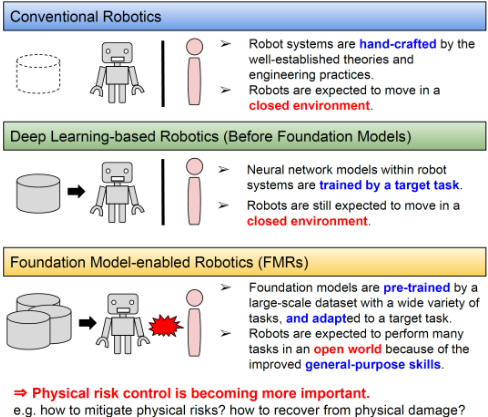
In contrast to conventional robotic engineering, which generally controls robots based on human-crafted rules, FMRs learn to control themselves from enormous amounts of data with a statistical approach. This paradigm shift has enhanced generalizability and long-horizon reasoning [Zawalski et al., 2024], enabling FMRs to show promising advantages over classical methods in adapting to diverse tasks and unstructured environments. They have been successfully applied to various fields, including task planning [Ahn et al., 2022], vision language guided manipulation [O'Neill et al., 2023], tactile perception [Zhao et al., 2024a], locomotion [Bohlinger et al., 2024], and navigation [Moroncelli et al., 2024]. (➢ Section 2)
While we could enjoy economic benefits by replacing human labor with robots in various applications, we cannot completely avoid the risk of FMRs causing physical damage to surrounding humans or objects. As FMRs are engaged in more challenging tasks and environments, often requiring contact with people and objects, such as housework, surgery or nursing care, the risk of causing physical damage increases. Of course, even in such an environment, it is possible to mitigate some risks through the establishment of social rules and education, e.g., do not play near robots. However, we cannot completely eliminate accidents because of our misperception of the environment (e.g. robots in blind spots) or unexpected environmental changes (e.g., sudden hardware failures). (➢Section 3)
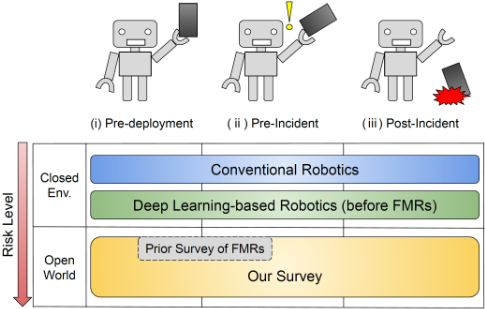
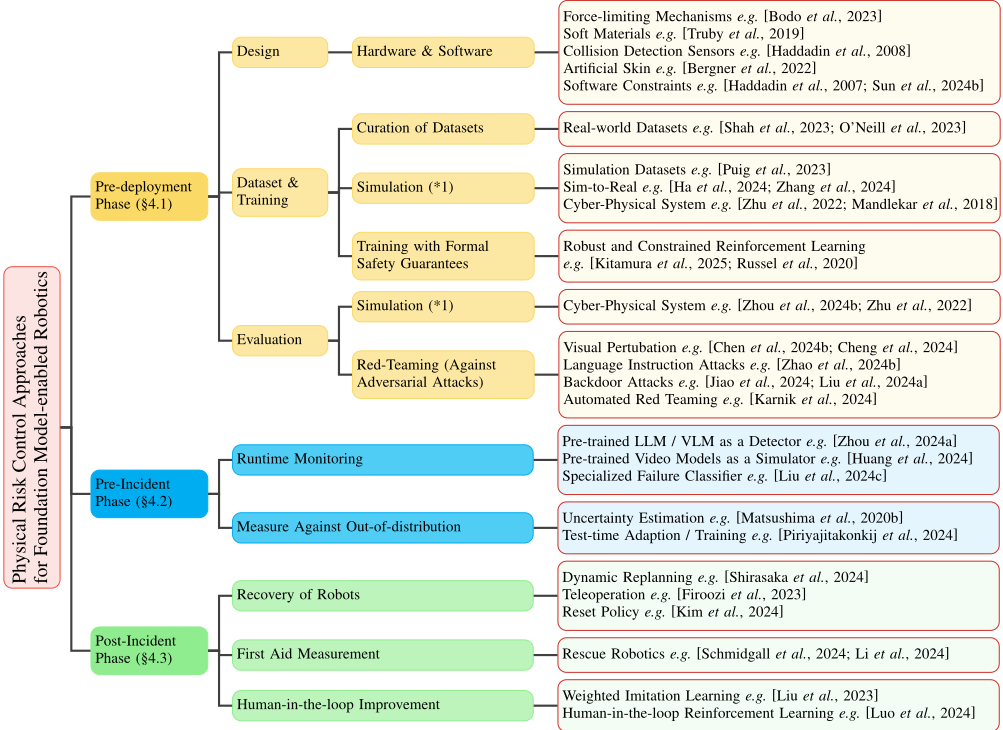
Based on the premise that FMRs cannot completely eliminate the risk of causing physical damage, this survey comprehensively summarizes robot control approaches against physical risks by covering all the lifespan of FMRs, from predeployment to post-accident stage. Specifically, our study conducts this survey of physical risk controls by dividing the timeline into the following three phases: (1) pre-deployment phase, i.e., risk prevention phase when learning from data, (2) pre-incident phase, i.e., before an incident happens after deployment, and (3) post-incident phase, i.e., the recovery and improvement stage. (➢ Figure 3 and Section 4)
We emphasize that many classic robotic studies discussed safety control within a closed environment where humans could intervene and prevent hazardous incidents, such as inside a factory or laboratory. In such an environment, if a robot causes an incident, pressing the emergency stop button will solve the problem. In contrast, our survey focuses on the safety of FMRs assumed to act in an open world, where bigger physical risks often exist because humans and robots are always in close proximity and physically interacting, e.g. inside a home or a cafe. In this case, we need to consider how to recover or treat robots as well as surrounding humans and objects because "life still goes on" for both robots and humans after the incident. We also emphasize that prior surveys of FMRs focused on only some partial sections within the first two phases of safety control, i.e., pre-deployment and pre-incident phase in light of our classification scheme, and so have been insufficiently organized in detail [Bommasani et al., 2021; Hu et al., 2023; Firoozi et al., 2023; Xiao et al., 2023]. In other words, they only summarized partial sections of the mitigation strategies of physical risks before an incident, and generally have not covered post-incident recovery actions. (➢Figure 2)
Throughout this survey, we have found that there is much room to study (i) pre-incident risk mitigation strategies, (ii) research that assumes physical interaction with humans, and (iii) essential issues of foundation models themselves. We emphasize that social measures such as legislation or insurance schemes are also important aspects to enhance mitigation of physical damage. (➢ Section 5)
2 Robotics and FoundationModels
2.1 Conventional Robotics Engineering
Conventional robotics has driven innovation for long, predating the rise of data-driven techniques. While modern robotics increasingly rely on deep learning and large-scale data, classical theories and engineering remain essential. In particular, it focuses on five pivotal directions: (1) innovative mechanical design [Sugiura et al., 2024], (2) precise motion control [Sun et al., 2018], (3) advanced perception systems [Mahler et al., 2019], (4) planning and decision-making strategies [La Valle, 2011; La Valle, 2011; Hansel et al., 2023], (5) adaptive learning and optimization methodologies [Zhang et al., 2024; Saveriano et al., 2023].
Robotics relies on robust mechanics and precise motion control for seamless interaction with the physical world. Engineers continually refine structures and control strategies to enhance performance, versatility, and user integration [Sugiura et al., 2024; Yamamoto et al., 2019; Zhu et al., 2019; Yamamoto et al., 2019; Hossain, 2023; Zhu et al., 2019]. On the other hand, perception, planning, and adaptive learning drive robotic intelligence for open-world deployment. Advanced perception enables environmental awareness, while planning and decision-making allow navigation in complex scenarios [Chen et al., 2019]. Adaptive learning techniques, including imitation learning, reinforcement learning, and deep learning-based approaches help robots acquire skills and adapt to changing task conditions [Zhang et al., 2024; Saveriano et al., 2023]. Together, these elements bridge mechanical capability with intelligent autonomy, enabling robots to operate effectively in dynamic environments.
2.2 FoundationModel-enabled Robotics (FMRs)
Despite advances in perception, planning, and adaptive learning, traditional methods often struggle with scalability, generalization, and handling of multimodal information in complex environments. Even after the advent of Deep Learning-based Robotics, in which neural-network models within robot systems are trained on a specific target task, performance improvements were limited, so robots were still expected to stay in closed environments. Foundation models [Firoozi et al., 2023] are large scale neural-network models which are pre-trained on broad data in self-supervised approaches and can be adapted to a wide range of downstream tasks by finetuning or prompting. They were firstly proposed in the natural language processing domain [Devlin et al., 2019], eventually spreading to wide range of modalities including image, video, and audio because of their remarkable performance and generalizability [Dosovitskiy et al., 2021; Arnab et al., 2021; Baevski et al., 2020].
FMRs have recently emerged as large-scale pre-trained models that integrate language, vision, and action modalities, enabling robots to generalize across diverse tasks [Firoozi et al., 2023]. They comprise large language models (LLMs) and vision-language models (VLMs) for language comprehension and visual understanding, enhancing high-level task planning for long-horizon tasks [Liang et al., 2023]. Additionally, they include robot transformers that integrate perception, decision-making, and action generation to process multimodal inputs and generate low-level motion commands for end-to-end control. Several studies such as RT-1 and RT-X [Brohan et al., 2022; O'Neill et al., 2023] have trained models with massive number of demonstration samples collected from the real world to realize generalization across different morphologies. π0 [Black et al., 2024] pre-trained a visionlanguage-action model on a diverse crossembodiment dataset with a variety of dexterous manipulation tasks, followed by fine-tuning with high quality data to enable complex multistage tasks, such as folding multiple articles of laundry or assembling a box.
3 Potential and Risks
Given their performance and adaptability, FMRs are poised to be used in an increasing number of real-world applications, thus speeding up the general adoption of robots in society. FMRs will no longer be confined to closed environments where physical risks are excluded or minimized by restricting the entry of humans and objects, such as factories or warehouses. Instead, FMRs will be able to perform activities in an open world where humans and robots are always in close proximity and physically interacting, e.g. inside a home, restaurant, or a public square. They are expected to reduce or replace many types of repetitive but complex manual labor, allowing people to pursue more engaging and rewarding activities. In countries with low birth rates and increasing aging populations, FMRs could help stabilize the workforce, creating a good impact on their economies.
While FMRs are expected to perform a wide variety of tasks in our open world, they will add many risks to our society, such as malicious usage (e.g. fraud), unintentional physical damage to humans or objects, environmental destruction due to their high power consumption and resource usage, or privacy information leakage caused by security vulnerabilities. This survey focuses on the risks of FMRs causing unintentional physical damage to humans or objects. As FMRs are engaged in more challenging tasks that often require contact with people and objects such as housework, surgery or nursing care, risks of physical damage increase. Of course, even in such an environment, it is possible to reduce certain risks through the establishment of social rules and education, e.g., do not play near robots. However, we cannot completely eliminate accidents because of misperception of the environment (e.g. robots in blind spots) or unexpected environmental changes (e.g., sudden hardware failures).
4 Control of Physical Risks
This section comprehensively summarizes robot control approaches against physical risks by covering all the lifespan of FMRs ranging from pre-deployment to post-accident stage. Specifically, we summarize physical risk control approaches by dividing the timeline of FMRs into the following three phases: (1) pre-deployment phase, i.e., risk mitigation phase, (2) pre-incident phase, i.e., a situation before an incident happens after deployment, and (3) post-incident phase, i.e., recovery and improvement stage. Although some of the surveyed papers include studies that do not use foundation models, we cite them as technologies that are expected to be utilized in future research of FMRs.
4.1 Pre-deployment Phase
Hardware and Software for Safety
Ensuring safety in robotic systems requires both robust hardware design and software-based safety limits. While physical mechanisms contribute to risk mitigation, software constraints play a crucial role in preventing hazardous behaviors and enforcing operational safety [Zacharaki et al., 2020]. Safety-focused hardware includes force-limiting mechanisms such as series elastic actuators that absorb shocks and restrict excessive forces [Bodo et al., 2023], collision detection sensors with safety prioritized control to stop the robot motion immediately upon contact [Haddadin et al., 2008], and artificial skin to enable robots to autonomously sense the surroundings for enhanced safety while working near people [Bergner et al., 2022]. Additionally, the use of compliant materials and soft robotics components helps reduce the risk of damage or injury during physical interactions [Truby et al., 2019]. Safety standards like ISO/TS 15066 [Matthias and Reisinger, 2016] highlight the necessity of mechanical and electrical safety features, including emergency stop buttons and torque-limiting mechanisms [Lee et al., 2009].
Software-based safety mechanisms complement hardware solutions by enforcing predefined constraints to prevent dangerous operations. Common approaches include velocity and torque limits that curb motor outputs to avoid excessive force application [Haddadin et al., 2007; Ferraguti et al., 2022; Haddadin et al., 2007], virtual fences that restrict the robot's movement within designated safe areas, and fault monitoring systems that detect anomalies and trigger protective responses when necessary [Guiochet et al., 2017]. Admittance control and other safety-aware algorithms dynamically adjust the robot's behavior based on external forces to enhance safe operation in unpredictable environments [Sun et al., 2024b].
Together, these hardware and software measures form a robust safety framework, ensuring mechanical reliability and controlled operation for safe robotic deployment. Together, these hardware and software considerations create a comprehensive safety framework, ensuring both mechanical robustness and controlled operational behavior for reliable and safe robotic deployment.
Curation of Datasets
In the era of FMRs, curation of large-scale datasets with a wide variety of tasks is important for pre-training FMRs to increase generalization skills. Empirical evidence suggests that domain generalization abilities improve significantly when larger models are (pre-)trained on larger and more diverse datasets, indicating the reduction of risk of out-of-distribution (➢ Measure Against Out-of-distribution).
Real-world datasets are often the most intuitive and accurate source of information required for high performing FMRs. However, creating large scale and high quality realworld datasets for robotics is challenging due to its cost [Khazatsky et al., 2024; O'Neill et al., 2023]. For example, collecting a good set of demonstration data requires intense labour and skilled operators. The scaling cost increases proportional to the diversity of tasks, skills, objects, environments and embodiments. BREMEN [Matsushima et al., 2020a] introduces a deployment-efficient model-based reinforcement learning approach that achieves policy learning with significantly fewer environment interactions by training a model of the environment and using offline optimization to update policies without excessive real-world data collection.
GNM [Shah et al., 2023] is a recent notable effort which successfully integrated six different large-scale navigation datasets, formulated a unified navigation interface based on waypoints, and deployed it on different mobile platforms. Another significant effort on manipulation tasks is RT-X [O'Neill et al., 2023], which is a joint collaboration among 34 laboratories with the goal to establish a standardized data format across 60 existing datasets with 22 robot embodiments. To further aid diversity in task and modality volumes, RH20T [Fang et al., 2023] collected over 110k manipulation episodes, covering more than 140 contact-rich skills, including well calibrated RGB, depth, force-torque, tactile, proprioception, audio and language instruction.
Simulation
Simulation plays a pivotal role in robotics given the risks and costs associated with physical testing of robots, such as potential damage to the robot, harm to humans, or unintended environmental impacts. It offers a safe and controlled environment to design, test, and refine robotic systems before their deployment in real-world scenarios [Rohmer et al., 2013; Huck et al., 2023; Kargar et al., 2024]. This is especially important in the era of FMRs, which is a probabilisticbased approach at its core aimed at a wide variety of tasks.
One of the critical applications of simulation is Sim-toReal (Sim2Real) policy learning, which enables robots to develop and validate control policies in simulated environments [Bohlinger et al., 2024]. Sim2Real helps mitigate safety concerns by enabling extensive testing under diverse and challenging conditions, allowing us to identify potential failures, refine safety constraints, and ensure robust real-world performance [Zhao et al., 2020]. Advanced simulation frameworks like NVIDIA Isaac Sim, Isaac Lab [Mittal et al., 2023], and Genesis [Genesis-Authors, 2024] help bridge the "reality gap" with accurate physics modeling, and high-fidelity graphics, which is essential for safety assurance in the predeployment phase.
Additionally, the robot in the simulator can receive control inputs from the physical world, creating a seamless cyberphysical system [Zhou et al., 2024b]. This integration not only allows real-world devices, such as controllers or sensors, to interact with the virtual robot for testing and development in a simulation environment [Zhu et al., 2022], but also facilitates the training of robot control policies through imitation learning. Demonstrations can be provided via teleoperation [Mandlekar et al., 2018], enabling the robot to learn complex tasks in a safe and scalable manner within the simulation.
Simulation is also used to generate greater amounts of training data. Simulation can efficiently create diverse range of domain randomized data which is expected to promote generalization ability of models in FMRs. Generative simulations Genesis [Genesis-Authors, 2024], Gen2Sim [Katara et al., 2024], and FACTORSIM [Sun et al., 2024a] have emerged as a promising solution by automating the creation of diverse, scalable environments and facilitating broader coverage of training conditions. Habitat 3.0 [Puig et al., 2023] and AI2THOR [Kolve et al., 2017] are another line of effort for interactive environment frameworks focusing on scene realism for both navigation and manipulation tasks.
Red-teaming (Against Adversarial Attacks)
Red-teaming is the practice of simulating an enemy team attempting to perform some type of attack or other hostile action to the organization (i.e., blue team). It is common practice in the fields of defense, security and IT operations, where militaries and system administrators test their own systems in search of weak points that could be exploited. Recent LLM developers also organize red-teaming to assess the models' vulnerabilities by comprehensive stress-testing [Lin et al., 2024]. In the case of FMRs, the practice is not yet as common, but it is expected to popularize as they continue to improve and the range of tasks they can perform reaches human or above level. As a pioneering example, [Karnik et al.,
2024] uses automated red teaming techniques with VLMs to generates diverse and challenging instructions. Experimental results show that state-of-the-art models frequently fail or behave unsafely on the tests, underscoring the shortcomings of current benchmarks.
One promising technique for stress-testing FMRs in redteaming is adversarial attacks [Costa et al., 2024]. It is well known that models utilizing deep neural networks (DNNs) are vulnerable to small input perturbations. Because FMRs are based on LLMs and VLMs, which themselves rely on DNNs, many similar problems have been reported. In the case of FMRs, it is especially important to understand which types of attacks they are vulnerable to, since these models not only make recognition errors but also act in the real world.
For example, as a direct attack on FMRs, [Chen et al., 2024b] reports that both global perturbation attacks on Diffusion Policy and adversarial patches in a physical environment are effective in online and offline settings. [Cheng et al., 2024] investigates the robustness of VLAs against various visual attacks such as Gaussian noise, changes in brightness, Adversarial Patches that modify part of an image, and Visual Prompts (e.g., adding the word "Stop" into images to control behavior). [Jiao et al., 2024; Liu et al., 2024a; Wang et al., 2024] show vulnerabilities to backdoor attacks that use everyday objects (e.g., a yellow CD) as triggers to degrade behavior. [Zhao et al., 2024b] have proposed to add adversarial suffixes to language inputs.
On the other hand, despite these demonstrated vulnerabilities, [Zhao et al., 2024b] reports that many current FMRs have discrete action spaces, making standard attacks less effective. Still, in cases where attackers have access to internal features, using these features can increase the success rate of adversarial attacks, indicating the need for continued research on countermeasures. Because FMRs generally rely on LLMs and VLMs, it is necessary to verify the effectiveness of methods proven to work well in those models. Another challenge in research on adversarial attacks against FMRs is the lack of standard evaluation metrics. Although vulnerabilities have been studied in various components-ranging from simulations and real-world settings to planning vision modules-research on FMRs is still in its early stages, and a unified evaluation strategy remains insufficient. In particular, because the environments in which robots are expected to operate can be extremely diverse and because the dynamics of different robots vary, further validation is required to determine how generalizable the current findings are. As an earlier example of such attempts, [Lu et al., 2024] proposes Harmful-RLbench, which evaluates the planning capabilities of LLMs in an environment featuring 25 distinct task scenarios. Moreover, [Zhao et al., 2024b] develops VIMA-bench, an evaluation benchmark covering 13 types of robotic manipulation tasks.
Training with Formal Safety Guarantees
Safe controller design during the pre-deployment phase has been extensively studied in the field of robust control theory. Since the exact knowledge of the environment is unknown before deploying the robot, robust design accounts for environmental uncertainty and incorporates conservative risk management into the robot controller.
Robust model predictive control and H∞ optimal control [Bemporad and Morari, 2007; Zames, 1981; Doyle, 1982] are the representative robust control methods in linear dynamical systems, where the system is modeled as x(t+1) = Ax(t) +Bu(t) . Here, x(t) ∈ Rn and u(t) ∈ Rm represent the system state and input signal, respectively. These robust controllers guarantee safety satisfaction even when the dynamics matrices (A, B) perturb from the nominal matrices.
However, linear models are unsuitable for modeling the recent nonlinear and high-dimensional input systems that FMRs aim to control (➢ Section 2.2). Robust reinforcement learning (RL) offers an alternative framework, capable of addressing robust nonlinear control problems when combined with function approximation techniques [Moos et al., 2022]. However, robust RL alone is insufficient to achieve both high performance and safety, as ensuring safety typically involves solving constraint satisfaction problems (e.g., obstacle avoidance in self-driving systems [Altman, 1999]). While the RL community has recently begun exploring the combination of safety constraints and robustness [Mankowitz et al., 2020; Russel et al., 2020], theoretical results in this area remain limited. A recent result by [Kitamura et al., 2025] presents an algorithm for computing a robust and constrained controller in a tabular Markov decision process setting. However, it does not account for the challenges posed by nonlinear dynamics, which are crucial for FMRs. In short, the theoretical question: "When and how can we realize robust constrained control in FMRs?" remains largely unanswered.
4.2 Pre-Incident Phase
Runtime Monitoring
Runtime monitoring is one of the fundamental tools for ensuring safety in robot policies. The monitoring systems are sometimes called "critics" of the policy analogical to actorcritic of reinforcement learning [Sutton and Barto, 2018].
Recently, LLMs, VLMs, and video prediction models have been utilized as critics of robot policies. Firstly, VLMs are utilized to detect success (or failure) in policy rollouts. For example, [Kanazawa et al., 2023] proposes to leverage VLMs to detect state change of objects in cooking tasks, which is useful for executing task plans. Secondly, VLMs are used for constraint monitoring. Code-as-monitor [Zhou et al., 2024a] leverages VLMs for generating programs for monitoring robot policy rollouts from robot image observations and descriptions of constraints generated by LLMs. Thirdly, [Huang et al., 2024; Escontrela et al., 2023] utilized loglikelihood of pre-trained video prediction models as a reward signal for the robot's actions to monitor in real time whether the state transitions in the environment are being properly learned.
Another approach to runtime monitoring involves training a failure classifier using human intervention data. Specifically, these methods leverage robot demonstration data to train a world model, enabling the learning of latent representations. By utilizing these latent representations along with human intervention flags, a failure detector can be trained [Liu et al., 2024c]. Such methods are particularly effective as automated safety validators when robots are operating in parallel within an environment and sequentially learning policies [Liu et al., 2024d].
Measure Against Out-of-distribution
After deploying a trained model in real-world scenarios, we may encounter out-of-distribution (OOD), in which robot inputs fall outside the data distribution used to train a model. Measures against this situation are crucial for safety when deploying robots in real-world scenarios. Specifically, the test data Dtest is sampled from a distribution Ptest , which invariably differs from the training distribution Ptrain . This discrepancy highlights the challenge of distributional shifts.
A key research to mitigate this risk is improving distributional robustness by optimizing the worst-case performance across various potential distributional shifts, thus ensuring dependable OOD performance [Ben-Tal et al., 2012; Duchi and Namkoong, 2020]. However, since Ptest is not directly accessible and the model f is learned from a finite set of training samples Dtrain, there is no guarantee that f will make accurate predictions during testing. Uncertainty estimation focuses on determining when and where the model individual predictions can be trusted, and, conversely, where confidence is lacking [Matsushima et al., 2020b; Garnelo et al., 2018b; Garnelo et al., 2018a; Kingma, 2013]. Besides, causal inference is leveraged to address the root cause of poor generalization under distributional shifts. Learned models often rely on spurious correlations present in Dtrain, rather than capturing the invariant cause-and-effect relationships that drive the underlying process [Peters et al., 2015; Arjovsky et al., 2020; Pearl, 2009] In recent years, concepts such as test-time adaption/training [Wang et al., 2021; Sun et al., 2020; Piriyajitakonkij et al., 2024; Park et al., 2024] have been introduced into robotics research. Test-time adaptation allows a model to adjust its internal parameters or normalization statistics using the unlabeled data encountered during deployment, while test-time training leverages auxiliary self-supervised tasks to update the model during inference.
4.3 Post-incident Phase
Recovery of Robots
In the post-incident phase, FMRs play a vital role in autonomously detecting, assessing, and mitigating more hazardous risks [Chen et al., 2024a]. These systems leverage real-time monitoring and fault detection to identify anomalies, such as hardware malfunctions or environmental changes [Shirasaka et al., 2024]. Once a risk is detected, foundation models enable dynamic replanning to adjust trajectories or control policies, ensuring safe operation. However, when autonomous recovery is insufficient, errors can also be addressed through human intervention, such as teleoperation, ensuring flexibility and safety in complex scenarios [Liu et al., 2024b].
Additionally, learning-based reset mechanisms play a crucial role in preventing robots from entering non-reversible states during reinforcement learning, improving safety, and reducing the need for manual intervention. For instance, a reset policy can reduce the number of entering non-reversible states, and manual resets to learn a task, while enhancing safety and improving learning efficiency [Eysenbach et al., 2018]. Similarly, reset-based deep ensemble methods enhance sample efficiency in safe RL by overcoming the limitations of the vanilla reset method [Kim et al., 2024].
Foundation models also demonstrate the potential to resolve deadlocks in multi-agent robotic systems (MRS) by using high-level planners such as LLMs or VLMs [Garg et al., 2024], ensuring smooth collaboration among agents. In safety-critical situations, the system may communicate risks to operators, ensuring effective recovery when autonomous methods fall short [Eder et al., 2014]. By integrating proactive monitoring, adaptive planning, and contextual decisionmaking, foundation models enhance reliability and safety across dynamic environments [Firoozi et al., 2023].
First Aid Measurement
When humans and objects are physically damaged by robots, immediate first aid measures are extremely important. In this situation, two types of first aid measures are possible. One is to call for help from rescue people/robots, the other is to call for help from the nearby robot that caused the damage itself to conduct basic first aid treatment.
Rescue robots [Delmerico et al., 2019] are designed to help search and rescue people in the event of a disaster or emergency situation. They have been actively studied since before the advent of FMRs. Recently, several studies have developed robot models for human rescue by learning from data to improve quality and expand activity to more challenging situations, such as surgical robot systems or assistants [Yue et al., 2023; Schmidgall et al., 2024], and robot-assisted pedestrian evacuation in fire scenarios [Li et al., 2024]. However, there is no guarantee that such specialized robots will always be near humans in emergency situations in our open world. Therefore, it will be necessary for robots that do not specialize in emergency rescue tasks to have the functionality to provide temporary aid, such as checking life signs, automatic call for an ambulance or rescue people/robots, provide useful information to nearby people, or stop bleeding with bandages.
Human-in-the-loop Improvement
Human-in-the-loop improvement aims to build a continuous improvement mechanism or pipeline that collects effective feedback from humans for model training by leveraging human intervention history or demonstrations. There are some pioneering studies on human-in-the-loop improvements that are expected to be applied to FMRs in the future. One such approach involves continuous human monitoring of policy deployment, where a human intervenes to stop the robot when a failure is imminent. The data immediately prior to the intervention is then used as negative examples for weighted imitation learning [Liu et al., 2023]. The positive success data and negative failure data obtained through intervention in a suboptimal policy are also highly compatible with RL. There are methods that leverage this by storing both successful policy rollouts and intervention data in an RL replay buffer, enabling the policy to learn from failures through reinforcement learning [Luo et al., 2024].
5 Conclusion and Discussion
Our survey comprehensively summarized robot control approaches against physical risks by covering all the lifespan of FMRs ranging from pre-deployment to post-accident stage.
From this survey, we found that there is much room for future work of FMRs on the following three points. (i) Considering that there are a myriad of environments and task varieties in the real world, we need to pay more attention to risk mitigation before an actual incident happens (e.g., stress-testing as broadly as possible with red-teaming, promote generalizability of FMRs to prevent OOD, detection and intervention in failures at the earliest stage). (ii) Accelerating research that assumes physical interactions with humans in more realistic world settings (e.g., improving learning methods to strictly observe social rules, or research in the post-incident phase such as continuous improvement mechanisms and prevention of more hazards after an incident). (iii) While we can easily adapt pre-trained foundation models to a specific task with a small number of samples by finetuning or prompting, it becomes important to tackle essential issues of foundation models themselves when applying them to robotics (e.g., how to ensure the quality of large-scale pretraining datasets to prevent malfunction of trained models in robots, or how well do LLMs or VLMs understand the physical world in terms of predicting hazards, such as collision prediction between humans and robots through monitoring their motions and surrounding environment).
We also emphasize that in addition to the technical aspects, social measures such as legislation, insurance schemes, and ethical guidelines are important to enhance aftercare of physical damage in practice. We hope that this study will be a milestone in providing a high-resolution analysis of the physical risks of FMRs and their control, contributing to the realization of a good human-robot relationship.
Contribution Statement
Takeshi Kojima, Yaonan Zhu, and Yusuke Iwasawa have contributed equally to this study.
@inproceedings{ijcai2025p1168,
  title     = {A Comprehensive Survey on Physical Risk Control in the Era of Foundation Model-enabled Robotics},
  author    = {Kojima, Takeshi and Zhu, Yaonan and Iwasawa, Yusuke and Kitamura, Toshinori and Yan, Gang and Morikuni, Shu and Takanami, Ryosuke and Solano, Alfredo and Matsushima, Tatsuya and Murakami, Akiko and Matsuo, Yutaka},
  booktitle = {Proceedings of the Thirty-Fourth International Joint Conference on
               Artificial Intelligence, {IJCAI-25}},
  publisher = {International Joint Conferences on Artificial Intelligence Organization},
  editor    = {James Kwok},
  pages     = {10517--10527},
  year      = {2025},
  month     = {8},
  note      = {Survey Track},
  doi       = {10.24963/ijcai.2025/1168},
  url       = {https://doi.org/10.24963/ijcai.2025/1168},
}
TY - CPAPER TI - A Comprehensive Survey on Physical Risk Control in the Era of Foundation Model-enabled Robotics AU - Kojima, Takeshi AU - Zhu, Yaonan AU - Iwasawa, Yusuke AU - Kitamura, Toshinori AU - Yan, Gang AU - Morikuni, Shu AU - Takanami, Ryosuke AU - Solano, Alfredo AU - Matsushima, Tatsuya AU - Murakami, Akiko AU - Matsuo, Yutaka T2 - Proceedings of the Thirty-Fourth International Joint Conference on Artificial Intelligence, IJCAI-25 PB - International Joint Conferences on Artificial Intelligence Organization PY - 2025 SP - 10517 EP - 10527 DO - 10.24963/ijcai.2025/1168 UR - https://doi.org/10.24963/ijcai.2025/1168 ER -Copied
Machine-readable versions of this paper, for tools and AI agents:





