
RobustX: Robust Counterfactual Explanations Made Easy
Proceedings of the Thirty-Fourth International Joint Conference on Artificial Intelligence. Demo Track. Pages 11067-11071.
https://doi.org/10.24963/ijcai.2025/1264
Keywords
- Machine Learning: ML: Explainable/Interpretable machine learning
Abstract
The increasing use of Machine Learning (ML) models to aid decision-making in high-stakes industries demands explainability to facilitate trust. Counterfactual Explanations (CEs) are ideally suited for this, as they can offer insights into the predictions of an ML model by illustrating how changes in its input data may lead to different outcomes. However, for CEs to realise their explanatory potential, significant challenges remain in ensuring their robustness under slight changes in the scenario being explained. Despite the widespread recognition of CEs' robustness as a fundamental requirement, a lack of standardised tools and benchmarks hinders a comprehensive and effective comparison of robust CE generation methods. In this paper, we introduce RobustX, an open-source Python library implementing a collection of CE generation and evaluation methods, with a focus on the robustness property. RobustX provides interfaces to several existing methods from the literature, enabling streamlined access to state-of-the-art techniques. The library is also easily extensible, allowing fast prototyping of novel robust CE generation and evaluation methods.
- [Agarwal et al., 2022] Chirag Agarwal, Satyapriya Krishna, Eshika Saxena, Martin Pawelczyk, Nari Johnson, Isha Puri, Marinka Zitnik, and Himabindu Lakkaraju. Openxai: Towards a transparent evaluation of model explanations. In NeurIPS, 2022.
- [Brughmans et al., 2024] Dieter Brughmans, Pieter Leyman, and David Martens. NICE: an algorithm for nearest in- stance counterfactual explanations. Data Min. Knowl. Dis- cov., 38(5):2665-2703, 2024.
- [Byrne, 2019] Ruth M. J. Byrne. Counterfactuals in explain- able artificial intelligence (XAI): evidence from human reasoning. In IJCAI, pages 6276-6282, 2019. IJCAI
- [Cao, 2022] Longbing Cao. AI in finance: challenges, tech- niques, and opportunities. ACM Computing Surveys, 55(3):1-38, 2022.
- [Chollet and others, 2015] Franc ¸ois Chollet et al. Keras. https://keras.io, 2015. Link
- [Dutta et al., 2022] Sanghamitra Dutta, Jason Long, Saumi- tra Mishra, Cecilia Tilli, and Daniele Magazzeni. Robust counterfactual explanations for tree-based ensembles. In ICML, volume 162 of Proceedings of Machine Learning Research, pages 5742-5756. PMLR, 2022.
- [Guidotti, 2024] Riccardo Guidotti. Counterfactual expla- nations and how to find them: literature review and benchmarking. Data Mining and Knowledge Discovery, 38(5):2770-2824, 2024.
- [Hamman et al., 2023] Faisal Hamman, Erfaun Noorani, Saumitra Mishra, Daniele Magazzeni, and Sanghamitra Dutta. Robust counterfactual explanations for neural net- works with probabilistic guarantees. In ICML, volume 202, pages 12351-12367. PMLR, 2023.
- [Jiang et al., 2023a] Junqi Jiang, Jianglin Lan, Francesco Le- ofante, Antonio Rago, and Francesca Toni. Provably ro- bust and plausible counterfactual explanations for neural networks via robust optimisation. In ACML, volume 222 of Proceedings of Machine Learning Research, pages 582- 597. PMLR, 2023.
- [Jiang et al., 2023b] Junqi Jiang, Francesco Leofante, Anto- nio Rago, and Francesca Toni. Formalising the robust- ness of counterfactual explanations for neural networks. In AAAI, pages 14901-14909, 2023.
- [Jiang et al., 2024a] Junqi Jiang, Francesco Leofante, Anto- nio Rago, and Francesca Toni. Interval abstractions for robust counterfactual explanations. Artificial Intelligence, 336:104218, 2024.
- [Jiang et al., 2024b] Junqi Jiang, Francesco Leofante, Anto- nio Rago, and Francesca Toni. Recourse under model multiplicity via argumentative ensembling. In AAMAS, pages 954-963. International Foundation for Autonomous Agents and Multiagent Systems / ACM, 2024.
- [Jiang et al., 2024c] Junqi Jiang, Francesco Leofante, Anto- nio Rago, and Francesca Toni. Robust counterfactual ex- planations in machine learning: A survey. In IJCAI, pages 8086-8094, 2024. Survey Track. IJCAI
- [Keane et al., 2021] Mark T. Keane, Eoin M. Kenny, Eoin Delaney, and Barry Smyth. If only we had better coun- terfactual explanations: Five key deficits to rectify in the evaluation of counterfactual XAI techniques. In IJCAI, pages 4466-4474, 2021. IJCAI
- [Leofante and Potyka, 2024] Francesco Leofante and Nico Potyka. Promoting counterfactual robustness through di- versity. In AAAI, pages 21322-21330, 2024.
- [Leofante et al., 2023] Francesco Leofante, Elena Botoeva, and Vineet Rajani. Counterfactual explanations and model multiplicity: a relational verification view. In KR, pages 763-768, 2023.
- [Marzari et al., 2024] Luca Marzari, Francesco Leofante, Ferdinando Cicalese, and Alessandro Farinelli. Rigorous probabilistic guarantees for robust counterfactual explana- tions. In ECAI, volume 392 of Frontiers in Artificial In- telligence and Applications, pages 1059-1066. IOS Press, 2024.
- [Miller, 2019] Tim Miller. Explanation in artificial intelli- gence: Insights from the social sciences. Artif. Intell., 267:1-38, 2019.
- [Mohammadi et al., 2021] Kiarash Mohammadi, Amir- Hossein Karimi, Gilles Barthe, and Isabel Valera. Scaling guarantees for nearest counterfactual explanations. In AIES, pages 177-187, 2021.
- [Paszke, 2019] Paszke. Pytorch: An imperative style, high- performance deep learning library. In NeurIPS, pages 8024-8035.
- Curran Associates, Inc., 2019.
- [Pawelczyk et al., 2021] Martin Pawelczyk, Sascha Bielawski, Johannes van den Heuvel, Tobias Richter, and Gjergji Kasneci. CARLA: A python library to bench- mark algorithmic recourse and counterfactual explanation algorithms. In NeurIPS Datasets and Benchmarks, 2021.
- [Pedregosa et al., 2011] Fabian Pedregosa, Gaël Varoquaux, Alexandre Gramfort, Vincent Michel, Bertrand Thirion, Olivier Grisel, Mathieu Blondel, Peter Prettenhofer, Ron Weiss, Vincent Dubourg, et al. Scikit-learn: Machine learning in python. Journal of machine learning research, 12(Oct):2825-2830, 2011.
- [Shaheen, 2021] Mohammed Yousef Shaheen. Applications of artificial intelligence (ai) in healthcare: A review. Sci- enceOpen Preprints, 2021.
- [Upadhyay et al., 2021] Sohini Upadhyay, Shalmali Joshi, and Himabindu Lakkaraju. Towards robust and reliable algorithmic recourse. In NeurIPS, pages 16926-16937, 2021.
- [Wachter et al., 2017] Sandra Wachter, Brent D. Mittelstadt, and Chris Russell. Counterfactual explanations without opening the black box: Automated decisions and the GDPR. Harv. JL & Tech., 31:841, 2017.
References were extracted automatically from the PDF and may contain errors.
Full text extracted automatically from the PDF; figures, tables and equations may differ. The PDF is the version of record.
1 Introduction
With the increasing use of Machine Learning (ML) models to aid decision-making in high-stakes fields such as healthcare [Shaheen, 2021] and finance [Cao, 2022], there is a growing need for better explainability of these models. Counterfactual Explanations (CEs) [Guidotti, 2024] are often leveraged in Explainable AI (XAI) to this end due to their intelligibility and alignment with human reasoning [Miller, 2019; Byrne, 2019]. In particular, CEs can offer insights into the predictions produced by an ML model by showing how small changes in its input may lead to different (often more desirable) outcomes. To see what benefits CEs can bring, consider an illustration of a loan application with features 27 years of age, low credit rating, and 15K loan amount. Assume a bank's ML model classifies the application as not creditworthy. A CE for this outcome could be an altered input where a medium credit rating (with the other features unchanged)
would result in the application being classified as creditworthy, thus giving the applicant an idea of what is required to have their loan approved.
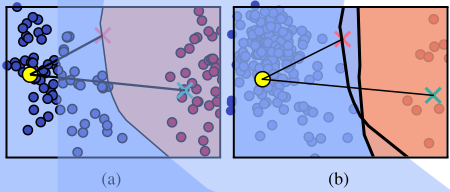
Despite their potential, current approaches to generating CEs often fall short in producing robust explanations. Consequently, these methods may produce explanations whose validity is compromised by slight changes in the scenario being explained. For instance, recent work [Upadhyay et al., 2021; Jiang et al., 2023b; Hamman et al., 2023] has highlighted that even small alterations in the parameters of an ML model, e.g. following fine-tuning, may invalidate previously generated CEs. An example of this scenario is captured in Figure 1, where a lack of robustness is demonstrated on a model trained for binary classification tasks. In Figure 1a, an input (yellow circle) receives an initial classification (blue class), and two counterfactuals are generated for it: one (red cross) laying exactly on the decision boundary (full black line) and one deeper inside the counterfactual class (green cross). In Figure 1b, we observe that the decision boundary of the model undergoes slight changes, induced by fine-tuning on a slightly shifted input distribution. As a result, previously generated CEs may cease to be valid if no precautions are taken to ensure robustness. For instance, we observe that the CE corresponding to the red cross is now classified as belonging to the blue class and is thus invalid. Now consider the consequences of these behaviours in our loan example: after finetuning, the applicant changing their credit rating to medium no longer ensures the success of the loan application, as the CE was not robust. When this happens, the CE previously generated by the bank is invalidated, and the bank may be liable for inconsistent statements made to customers regarding loan terms.
This and many other forms of robustness of CEs have recently been the subject of intense research efforts, and numerous algorithms to evaluate the robustness of CEs have been proposed (a recent survey identified about 40 methods [Jiang et al., 2024c]). However, the current state of robust CE research is fragmented, with various methods developed independently and implemented in different, often incompatible, ways. This lack of standardisation has resulted in challenges for the broader research community, as comparing the effectiveness of robust CE generation methods is impractical.
We fill this gap in this paper and introduce RobustX, an open-source Python library to standardise and streamline the generation, evaluation, and benchmarking of robust CEs. RobustX provides flexible, extensible, and customisable tools to implement custom CE methods. Differently from existing frameworks, e.g. [Pawelczyk et al., 2021; Agarwal et al., 2022], our library focuses on providing a consistent framework for testing robustness and systematically comparing various methods, ensuring fair and reliable evaluations. RobustX addresses key limitations on library tools in the current landscape ([Keane et al., 2021; Jiang et al., 2024c]) by offering a standardised approach to robust CE development while also promoting extensibility, allowing users to integrate new datasets and explanation algorithms as needed. The library, including documentation and tutorials, is publicly available at the following link:
https:// github.com/ RobustCounterfactualX/ RobustX
The reminder of this paper is organised as follows. Section 2 presents the main components of the library, providing details about their functionalities. Section 3 demonstrates how easy it is to use RobustX to benchmark existing CE generation algorithms and compare them using different metrics. Finally, Section 4 offers some concluding remarks and pointers for future work.
2 Overview
RobustX implements a complete pipeline for robust CE generation and evaluation (Figure 2) with three major components: Task, CE generator, and CE evaluator. Each has an abstract class template for easy customisation. Users start by creating a task which defines the model and inputs to be explained. Then, the user can choose whether to use RobustX to generate CEs, or directly evaluate the robustness of previously (externally) generated CEs.
Task objects, providing functionality for interactions between models and datasets, are the basic class passed into the CE generation and evaluation pipelines. Our current implementation assumes a ClassificationTask by default, as this is the most commonly considered use case in the literature; however, users can also implement customised Task objects for learning problems other than classification. RobustX natively supports models trained using sklearn [Pedregosa et al., 2011], Keras [Chollet and others, 2015] and PyTorch [Paszke, 2019]. Models trained using other frameworks can also be used by instantiating a BaseModel wrapper class. As far as datasets are concerned, RobustX offers a selection of pre-loaded example datasets that can be readily loaded using the DatasetLoader class. Additionally, this class also allows the uploading of custom datasets if needed via .csv files.
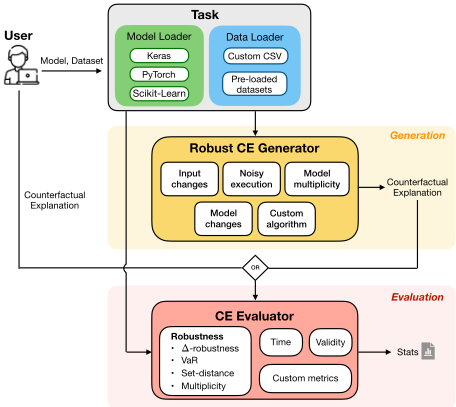
RobustX currently implements nine robust CE generation methods across different robustness use cases reported in the yellow box in Figure 2: AP∆S [Marzari et al., 2024], ArgEnsembling [Jiang et al., 2024b], DiverseRobustCE [Leofante and Potyka, 2024], MCER [Jiang et al., 2023b], ModelMultiplicityMILP [Leofante et al., 2023], PROPLACE [Jiang et al., 2023a], RNCE [Jiang et al., 2024a], ROAR [Upadhyay et al., 2021], STCE [Dutta et al., 2022; Hamman et al., 2023]. It also provides four popular non-robust methods that can be used as baselines to crease new generation methods: BLS [Leofante and Potyka, 2024], MCE [Mohammadi et al., 2021], KDTreeNNCE [Brughmans et al., 2024], and the seminal work by [Wachter et al., 2017]. All methods inherit from the abstract class CEGenerator and implement the generation method() function, providing an easy interface to other components in the pipeline.
CE evaluation methods can take in CEs, either generated within or outside RobustX, and benchmark their robustness along with other common properties identified in the literature. Currently, RobustX provides a CEEvaluator class to evaluate the validity and proximity of CEs [Wachter et al., 2017], as well as five classes specifically focusing on robustness evaluation metrics: VaRRobustnessEvaluator to assess the validity of CEs after retraining [Dutta et al., 2022], DeltaRobustnessEvaluator [Jiang et al., 2023b] to assess the robustness of CEs under plausible model changes, ApproximateDeltaRobustnessEvaluator [Marzari
1 # first prepare a task 2 from robustx.datasets.ExampleDatasets import get_example_dataset 3 from robustx.lib.models.pytorch_models.SimpleNNModel import SimpleNNModel 4 from robustx.lib.tasks.ClassificationTask import ClassificationTask 5 6 data = get_example_dataset("ionosphere") 7 data.default_preprocess() 8 model = SimpleNNModel(34, [8], 1) 9 model.train(data.X, data.y) 10 task = ClassificationTask(model, data) 11 12 # specify the names of the methods and evaluations we want to use, run benchmarking 13 # This will find CEs for all instances predicted with the undesirable class (0) and compare 14 from robustx.lib.DefaultBenchmark import default_benchmark 15 16 methods = ["KDTreeNNCE", "MCE", "MCER", "RNCE", "STCE", "PROPLACE"] 17 evaluations = ["Validity", "Distance", "Delta-robustness"] 18 default_benchmark(task, methods, evaluations, neg_value=0, column_name="target", delta =0.005)et al., 2024] assessing probabilistic robustness to plausible model changes, SetDistanceRobustnessEvaluator [Leofante and Potyka, 2024] for assessing stability of CEs when the input is perturbed, and MultiplicityValidityRobustnessEvaluator [Leofante et al., 2023] for checking CE robustness under model multiplicity. Additional robustness evaluators can be easily added through the extensible interface provided by RobustX.
3 RobustX in Action
In this section we provide an example on how to use RobustX in practice; additional examples are available online. Figure 3 shows how to run and compare six methods supported by RobustX. In this example we focus on robustness against model changes [Upadhyay et al., 2021] and perform a comparison between four robust methods and two non-robust baselines. To this end, we first import the (pre-loaded) ionosphere dataset for binary classification (line 6) and apply standard pre-processing. We then create and train a simple three-layer neural network model (line 8). A task object is then created from the dataset and model. Then, we specify the CE generation and evaluation methods of interest (line 16 and 17) and run the benchmarking procedure (line 18). The default benchmark function in this example runs each method with its default hyperparameters, although customised hyperparameters can be configured. It then generates CEs for all instances in the dataset which are predicted with an undesirable class (here 102 points with neg value=0), and runs the specified evaluation methods. In this example, we evaluate CEs along three metrics: validity, proximity [Wachter et al., 2017] and ∆-robustness [Jiang et al., 2023b]. The results along the selected evaluation metrics are then printed in a structured table, so that we can easily compare how each method performs.
Table 1 shows the results obtained, and reports the computation time, the percentage of valid CEs, average proximity (L2 distance to the input), and the percentage of CEs that are ∆-robust. Observing this table, users of RobustX will be able to identify that robustness performance improvements from the non-robust baselines (NNCE, MCE) to the robust methods (MCER, RNCE, STCE, PROPLACE) are notable, although MCER fails to achieve 100% robustness. Based on these results, users might conclude that RNCE is the optimal CE generator for this task, balancing between computation time, proximity, and robustness.
| Method | Time (s) | Validity (%) | Proximity | Rob. (%) |
|---|---|---|---|---|
| KDTreeNNCE | 0.2 | 100 | 5.76 | 51.6 |
| MCE | 3.4 | 100 | 2.95 | 0 |
| MCER | 137.6 | 100 | 4.84 | 64.8 |
| RNCE | 3.9 | 100 | 6.03 | 100 |
| STCE | 39.7 | 100 | 7.30 | 100 |
| PROPLACE | 12.9 | 100 | 6.02 | 100 |
4 Conclusion
We presented RobustX, a Python framework to generate, evaluate and compare robust CE for ML models. Our library fills a major gap in the existing literature on robust CEs, providing an easy-to-use and extensible platform to benchmark existing algorithms for robust CEs. Building upon extensive research in the area, RobustX provides a unified platform to run and compare existing approaches, as well as implementing new ones, reducing the need to re-implement software from scratch. Work is underway to further expand the list of available generation algorithms, evaluation methods and additional software facilities for testing and validation to ensure the correctness of the implementations. We believe RobustX will streamline research efforts in robust CEs, accelerating the development of innovative solutions and fostering collaboration within this rapidly growing field.
Contribution Statement
Jiang and Marzari contributed equally.
Acknowledgments
Jiang was funded by J.P. Morgan and by the Royal Academy of Engineering under the Research Chairs and Senior Research Fellowships scheme. Leofante was supported by Imperial College London through the Imperial College Research Fellowship scheme.
@inproceedings{ijcai2025p1264,
  title     = {RobustX: Robust Counterfactual Explanations Made Easy},
  author    = {Jiang, Junqi and Marzari, Luca and Purohit, Aaryan and Leofante, Francesco},
  booktitle = {Proceedings of the Thirty-Fourth International Joint Conference on
               Artificial Intelligence, {IJCAI-25}},
  publisher = {International Joint Conferences on Artificial Intelligence Organization},
  editor    = {James Kwok},
  pages     = {11067--11071},
  year      = {2025},
  month     = {8},
  note      = {Demo Track},
  doi       = {10.24963/ijcai.2025/1264},
  url       = {https://doi.org/10.24963/ijcai.2025/1264},
}
TY - CPAPER TI - RobustX: Robust Counterfactual Explanations Made Easy AU - Jiang, Junqi AU - Marzari, Luca AU - Purohit, Aaryan AU - Leofante, Francesco T2 - Proceedings of the Thirty-Fourth International Joint Conference on Artificial Intelligence, IJCAI-25 PB - International Joint Conferences on Artificial Intelligence Organization PY - 2025 SP - 11067 EP - 11071 DO - 10.24963/ijcai.2025/1264 UR - https://doi.org/10.24963/ijcai.2025/1264 ER -Copied
Machine-readable versions of this paper, for tools and AI agents:





