
Search Swarm: Multiagent Large Language Models Framework for E-commerce Product Search
Proceedings of the Thirty-Fourth International Joint Conference on Artificial Intelligence. Demo Track. Pages 11062-11066.
https://doi.org/10.24963/ijcai.2025/1263
Keywords
- Agent-based and Multi-agent Systems: MAS: Agent theories and models
- Agent-based and Multi-agent Systems: MAS: Applications
- Agent-based and Multi-agent Systems: MAS: Coordination and cooperation
- Agent-based and Multi-agent Systems: MAS: Engineering methods, platforms, languages and tools
Abstract
Search engines are vital for online e-commerce but often struggle with long, detailed queries. We introduce Search Swarm, a novel multi-agent system designed to improve search engine navigation on platforms like Amazon by accurately locating relevant products based on user instructions. Search Swarm employs multiple large language model (LLM) agents, each with a specific role: query planner, searcher, critic, and attribute selector. These agents collaborate to generate search queries, evaluate results, and identify the best product options tailored to users' needs. Our framework outperforms existing methods like ReAct and Reflexion in the WebShop environment, achieving a reward score of 62.64, compared to scores of 54.1, 59.8, 61.5, and 58.2 for other approaches. Furthermore, in a comparison with a basic rule-based method on Amazon, Search Swarm achieved a score 38.71 points higher and a 41\% greater success rate, demonstrating its superior ability to provide relevant product matches over traditional search engines.
- [Fu et al., 2024] Yao Fu, Dong-Ki Kim, Jaekyeom Kim, Sungryull Sohn, Lajanugen Logeswaran, Kyunghoon Bae, and Honglak Lee. AutoGuide: Automated Generation and Selection of Context-Aware Guidelines for Large Lan- guage Model Agents. In Workshop on LLMs and Cog- nition Poster, 2024. Accessed: November 22, 2024. [Online]. Available: https://doi.org/10.48550/arXiv.2403. 08978. DOI
- [Furuta et al., 2024] Hiroki Furuta, Kuang-Huei Lee, Ofir Nachum, Yutaka Matsuo, Aleksandra Faust, Shixi- ang Shane Gu, and Izzeddin Gur. Multimodal web nav- igation with instruction-finetuned foundation models. In In-Person Poster presentation, 2024. Accessed: Novem- ber 20, 2024. [Online]. Available: https://openreview.net/ forum?id=efFmBWioSc. Link
- [Grattafiori et al., 2024] Aaron Grattafiori, Abhimanyu Dubey, Abhinav Jauhri, Abhinav Pandey, Abhishek Kadian, Ahmad Al-Dahle, Aiesha Letman, Akhil Mathur, Alan Schelten, and et al. Alex Vaughan. The llama 3 herd of models, 2024.
- [Kagaya et al., 2024] Tomoyuki Kagaya, Thong Jing Yuan, Yuxuan Lou, Jayashree Karlekar, Sugiri Pranata, Akira Kinose, Koki Oguri, Felix Wick, and Yang You. RAP: Retrieval-Augmented Planning with Contextual Memory for Multimodal LLM Agents. In Workshop Open-World Agents Poster, 2024. Accessed: November 22, 2024. [On- line]. Available: https://arxiv.org/abs/2402.03610. Link
- Lewis et al., ] Patrick Lewis, Ethan Perez, Aleksandra Piktus, Fabio Petroni, Vladimir Karpukhin, Naman Goyal, Heinrich Küttler, Mike Lewis, Wen-tau Yih, and et al. Rocktäschel, Tim. Retrieval-augmented generation for knowledge-intensive nlp tasks. In Advances in Neural Information Processing Systems. 2020, pp. 9459- 9474. Accessed: November 20, 2024. [Online]. Avail- able: https://proceedings.neurips.cc/paper/2020/hash/ 6b493230205f780e1bc26945df7481e5-Abstract.html. Link
- [Luo et al., 2024] Chen Luo, Xianfeng Tang, Hanqing Lu, Yaochen Xie, Hui Liu, Zhenwei Dai, Limeng Cui, Ashutosh Joshi, Sreyashi Nag, Yang Li, Zhen Li, Rahul Goutam, Jiliang Tang, Haiyang Zhang, and Qi He. Ex- ploring query understanding for amazon product search, 2024.
- [Ma et al., 2023] Kaixin Ma, Hongming Zhang, Hong- wei Wang, Xiaoman Pan, Wenhao Yu, and Dong Yu. LASER: LLM Agent with State-Space Exploration for Web Navigation. In Workshop: Foundation Models for Decision Making, 2023. Accessed: November 20, 2024. [Online]. Available: https://openreview.net/forum? id=sYFFyAILy7. [OpenAI, 2024] OpenAI. Gpt-4 technical report, 2024. Link
- Prasad et al., ] Archiki Prasad, Alexander Koller, Mareike Hartmann, Peter Clark, Ashish Sabharwal, Mohit Bansal, and Tushar Khot. ADaPT: As-needed decomposition and planning with language models. In Findings of the Association for Computational Linguistics: NAACL 2024. 2024, pp. 4226-4252. Accessed: November 21, 2024. [Online]. Available: https://doi.org/10.18653/v1/ 2024.findings-naacl.264. DOI
- [Schroeder et al., 2024] Philip Schroeder, Nathaniel Mor- gan, Hongyin Luo, and James Glass. Thread: Thinking deeper with recursive spawning, 2024.
- [Shinn et al., 2023] Noah Shinn, Federico Cassano, Ashwin Gopinath, Karthik Narasimhan, and Shunyu Yao. Re- flexion: language agents with verbal reinforcement learn- ing. In A. Oh, T. Naumann, A. Globerson, K. Saenko, M. Hardt, and S. Levine, editors, Advances in Neural In- formation Processing Systems, volume 36, pages 8634- 8652.
- Curran Associates, Inc., 2023.
- [Tan et al., 2017] Zehong Tan, Canran Xu, Mengjie Jiang, Hua Yang, and Xiaoyuan Wu. Query rewrite for null and low search results in ecommerce. In eCOM@SIGIR, 2017.
- [Wang et al., 2024] Yaoxiang Wang, Zhiyong Wu, Junfeng Yao, and Jinsong Su. TDAG: A Multi-Agent Framework based on Dynamic Task Decomposition and Agent Gener- ation, 2024.
- [Yao et al., 2022] Shunyu Yao, Howard Chen, John Yang, and Karthik Narasimhan. Webshop: Towards scalable real-world web interaction with grounded language agents.
- In S. Koyejo, S. Mohamed, A. Agarwal, D. Belgrave, K. Cho, and A. Oh, editors, Advances in Neural Informa- tion Processing Systems, volume 35, pages 20744-20757.
- Curran Associates, Inc., 2022.
- [Yao et al., 2023] Shunyu Yao, Jeffrey Zhao, Dian Yu, Nan Du, Izhak Shafran, Karthik Narasimhan, and Yuan Cao. ReAct: Synergizing Reasoning and Acting in Language Models. In In-Person Poster presentation, 2023. Ac- cessed: November 20, 2024. [Online]. Available: https: //openreview.net/forum?id=WE vluYUL-X. Link
- [Yao et al., 2024] Weiran Yao, Shelby Heinecke, Juan Car- los Niebles, Zhiwei Liu, Yihao Feng, Le Xue, Rithesh Murthy, Zeyuan Chen, Jianguo Zhang, and et al. De- vansh Arpit. Retroformer: Retrospective Large Language Agents with Policy Gradient Optimization. In Spotlight, 2024. Accessed: November 23, 2024. [Online]. Available: https://openreview.net/forum?id=KOZu91CzbK. Link
- [Zhang et al., 2024] Jianguo Zhang, Tian Lan, Ming Zhu, Zuxin Liu, Thai Hoang, Shirley Kokane, Weiran Yao, Jun- tao Tan, Akshara Prabhakar, and et al. Haolin Chen. xlam: A family of large action models to empower AI agent sys- tems. CoRR, abs/2409.03215, 2024.
- Zhao et al., ] Andrew Zhao, Daniel Huang, Quentin Xu, Matthieu Lin, Yong-Jin Liu, and Gao Huang. Expel: Llm agents are experiential learners. In AAAI Conference on Artificial Intelligence. 2024, pp. 19632-19642. Ac- cessed: November 21, 2024. [Online]. Available: https: //doi.org/10.1609/aaai.v38i17.29936. DOI
- [Zhou et al., 2024] Andy Zhou, Kai Yan, Michal Shlapentokh-Rothman, Haohan Wang, and Yu-Xiong Wang. Language agent tree search unifies reasoning, acting, and planning in language models. In Proceedings
References were extracted automatically from the PDF and may contain errors.
Full text extracted automatically from the PDF; figures, tables and equations may differ. The PDF is the version of record.
1 Introduction
E-commerce search engines have been vital in helping customers find products, yet they encounter several challenges. One major issue is their difficulty in handling extensive and detailed queries that include factors such as buying intent, price range, and user age. As a result, users often have to depend on keyword matching and sift through a multitude of suggestions. Additionally, these search engines frequently overlook user-defined attributes, such as the quantity of items in a pack, necessitating manual selection by the user.
To mitigate these challenges, platforms like Amazon and eBay provide extra filters for attributes such as age group, price, and size. However, the sheer variety of product configurations makes thorough filtering impractical. Another approach involves using LLM-powered chatbots that can interpret natural language queries, but these are limited to search functionalities and do not facilitate the selection of product attributes. In contrast, LLM-based autonomous web agents [Yao et al., 2023; Zhang et al., 2024; Furuta et al., 2024;
Shinn et al., 2023; Zhou et al., 2024; Zhao et al., ; Prasad et al., ; Kagaya et al., 2024; Wang et al., 2024; Fu et al., 2024; Yao et al., 2024; Ma et al., 2023; Schroeder et al., 2024] offer a more interactive experience, treating shopping websites as environments to search for products and select their attributes.
Despite their potential, most LLM-based web agents tend to focus on general navigation rather than addressing the specific requirements of e-commerce searches, which diminishes their effectiveness in retrieving relevant product information. To fill this gap, we developed Search Swarm, a multiagent LLM framework that incorporates task-specific agents and simulates human-like thought processes within its search pipeline.
We assessed Search Swarm using the WebShop simulation benchmark [Yao et al., 2022] and tested it on Amazon through a sim-to-real transfer method, evaluating its capability to retrieve products based on user instructions. This evaluation involved calculating a reward function and success rate, with our results compared to existing solutions to highlight the framework's effectiveness.
The primary contribution of this study is a framework that enhances the functionality of e-commerce search engines by delivering more relevant results for complex queries and making informed decisions about product attributes. Our experiments demonstrate the efficiency of the proposed framework and provide a comparative analysis that validates its superiority.
2 RelatedWork
In this chapter, we examine contemporary e-commerce product search engines, highlighting their limitations when handling long and detailed queries, as well as existing web agent methods that attempt to address these challenges. We also identify gaps in the current solutions.
2.1 E-commerce Search Engines
Modern search engines enhance user queries before ranking them to improve relevance and recall, particularly for lengthy queries. Modifications may include grammar corrections and personalization. For instance, Amazon's Query Understanding (QU) modifies queries to align with its search grammar, traditionally relying on rules and handcrafted features, which struggle with long-tail queries [Luo et al., 2024]. Similarly, eBay's Cassini algorithm rewrites queries that yield few results by dropping or replacing terms. However, dropping essential terms can lead to incomplete results, and replacing terms using bigram language models [Tan et al., 2017] can falter with longer contexts.
2.2 LLMAgents
Large language models (LLMs) such as GPT-4 [OpenAI, 2024] and Llama 3 [Grattafiori et al., 2024] excel in various tasks. The Retrieval Augmented Generation (RAG) [Lewis et al., ] approach allows LLMs to access new information without needing retraining, expanding their applications, including functioning as agents in complex environments like WebShop, where actions are based on textual state representations. Notable examples of LLM agents include ReAct [Yao et al., 2023], which integrates reasoning into action generation, xLAM [Zhang et al., 2024], which emphasizes taskspecific models, and WebGUM [Furuta et al., 2024], a multimodal agent that utilizes transformers for web navigation.
2.3 Multi-agent Frameworks
Multi-agent frameworks, where agents assume distinct roles, tend to outperform single-agent systems by distributing tasks and minimizing errors.
For example, ADaPT [Prasad et al., ] breaks tasks into subtasks when the main agent cannot complete them, using a controller to manage execution and create new instances for each subtask. TDAG [Wang et al., 2024] similarly decomposes tasks, assigning them to subagents that adapt and further break down tasks if time limits are exceeded, while also expanding a skill library. THREAD [Schroeder et al., 2024] treats task execution as thread management, allowing an LLM to spawn child threads for subtasks, thus providing flexible task handling.
Frameworks like Reflexion [Shinn et al., 2023], ExpeL [Zhao et al., ], RAP [Kagaya et al., 2024], AutoGuide [Fu et al., 2024], and Retroformer [Yao et al., 2024] utilize feedback loops for self-reflection and learning, refining actions through iterative feedback and memory systems.
Additionally, LASER [Ma et al., 2023] and LATS [Zhou et al., 2024] employ data structures for task completion, with LASER modeling tasks as state-space exploration and LATS using Monte Carlo Tree Search (MCTS) for planning and reasoning, offering feedback on errors.
While the reviewed solutions present a variety of agent and multi-agent frameworks, they primarily target general web tasks and lack architectures specifically designed for e-commerce searches. To address this gap, we developed Search Swarm, a multi-agent framework optimized for ecommerce product searches, as multi-agent approaches have demonstrated superior performance in this area.
3 Framework
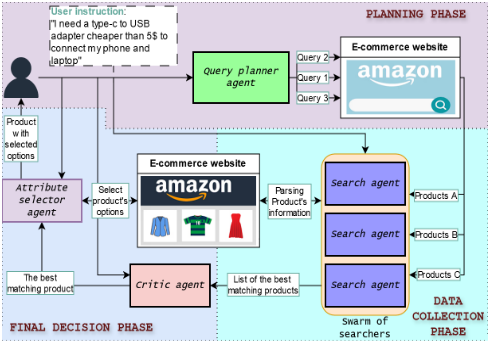
In our framework, we segmented the product search process into three sequential phases: Planning, Data Collection, and Final Decision (refer to algorithms 1, 3, and 2 for the workflow Figure 1). Each phase involves agents that perform specific subtasks based on their designated roles. These agents
Algorithm 1 Planning Phase
Input: A user instruction I Output: Product lists for each query L
Q ← QueryPlannerAgent(I )
L ← ∅
for all q ∈ Q do
O ← Environment.Step("Search[${q}]")
L ← L ∪ {(ParseProductList(O, q), q)}
end for
are large language models (LLMs) that take textual input, enhanced by role-specific prompts, and produce outputs that adhere to a defined JSON schema. While we do not specify the language model in this chapter, we will clarify it in the experiments section. We ensure the validity of the generated sequences using Structured Generation for OpenAI models and the Outlined Python library for Hugging Face models. These tools limit the tokens available for the LLM to sample from in each iteration, ensuring that the responses conform to a specific schema. The complete implementation of the agents pipeline and their prompts can be found in the source code. 1 .
The rationale for structuring the search process into these three phases is to replicate human behavior during a search. Typically, individuals start by formulating a query, input it into a search engine, and then browse through the suggested options before selecting the most suitable product from the displayed results.
We designed the prompts such that LLMs adhere to their assigned agent roles. During the development of the framework, we made slight modifications to the prompts to mitigate common errors made by the agents. For instance, we aimed to prevent them from favoring child products solely because they matched the instructions when such products were not explicitly requested, or from overlooking the fact that a product's color is a customizable option when selecting relevant items.
1 Code: https://github.com/Nagim123/Multiagent-Web-SearchSearch-Swarm
Algorithm 2 Final Decision Phase
| Input: Top-k relevant products R, a user instruction I |
| Output: The most relevant product x, best option values d |
| x ← CriticAgent(R, I) Environment.Step("Search[" + x.query + "]") |
| O ← Environment.Step("Click[" + x.id + "]") |
| d ← AttributeSelectorAgent(x, ParseOptions(O), I) |
Algorithm 3 Data Collection Phase
Input: Set of product lists L, the count of relevant products
k, a user instruction I Output: Top-k relevant products R R ← ∅ A ← {"Click[Description]", "Click[Attributes]", "Click[Reviews]", "Click[Features]"} for all l ∈ L do J ← ∅ for all p ∈ l1 do Environment.Step("Search[${l2}]") Environment.Step("Click[${p.id}]") D ← ∅ for all a ∈ A do D ← D ∪ {Environment.Step(a)} Environment.Step("Click[< Prev]") end for Environment.Step("Click[< Prev]") J ← J ∪ BuildProductJson(p, D) end for R ← R ∪ SearchAgent(J, k, I ) end for4 Evaluation
We conducted two experiments utilizing the Search Swarm framework: one aimed at validating its effectiveness against existing methods, and the other focused on evaluating its performance on Amazon.
4.1 WebShop Environment
The first experiment was carried out using the WebShop benchmark [Yao et al., 2022], which includes 100 random user instructions. WebShop simulates online shopping with over a million Amazon products and 12,000 crowd-sourced instructions. The agents' goal is to locate and select products that align with user instructions, measuring success through a success rate and reward metrics. The reward score reflects the relevance of the selected product, while the success rate indicates how frequently the maximum reward score-representing a perfect match to the user's goal-is achieved. In this context, we compared Search Swarm to ReAct, Reflexion, LATS, and ADaPT, using Llama-3-8b as the backbone model for consistency. Search Swarm achieved the highest reward score of 62.64, surpassing the other methods, and matched ADaPT's top success rate of 35% Table 1).
4.2 Sim-to-Real Transfer to Amazon
To assess real-world applicability, we implemented a simto-real transfer on Amazon, treating interactions similarly to those in WebShop by converting HTML pages into observations and actions into button clicks. Using GPT-4o, we compared Search Swarm to a rule-based baseline that input user instructions into the search engine and selected the first match. Search Swarm outperformed this baseline, achieving a success rate of 60% and a reward score of 84.51, compared to the baseline's 19% and 45.8, respectively (Table 2).
| Method | SR | Reward |
|---|---|---|
| Search Swarm | 35 | 62.64 |
| ADaPT | 35 | 58.2 |
| LATS | 34 | 61.5 |
| Reflexion | 32 | 59.8 |
| ReAct | 31 | 54.1 |
| Method | SR | Reward |
|---|---|---|
| Search Swarm | 60 | 84.51 |
| Rule based | 19 | 45.8 |
4.3 Results
Search Swarm demonstrated superior performance in both simulated and real-world environments, outperforming other methods in the WebShop benchmark and significantly enhancing product search and selection on e-commerce platforms. These results underscore its potential as a powerful tool for improving online search experiences.
5 Conclusion
Search engines are crucial for locating products on ecommerce websites, yet they encounter difficulties in processing detailed queries and automatically selecting attributes. Several solutions have been proposed, with web agents emerging as a particularly promising approach. However, much of the research has concentrated on generalpurpose agents, overlooking the specific requirements of taskoriented searches. To fill this gap, we developed Search Swarm, a framework that incorporates task-specific agents and simulates human-like thought processes within its search pipeline. We conducted two experiments to validate its efficiency and demonstrate its adaptability. Our results indicate that Search Swarm significantly enhances the user experience, representing a significant advancement in the development of intuitive and effective search system extensions.
Acknowledgements
This work was supported by the Ministry of Economic Development of the RF (code 25-139-66879-1-0003).
@inproceedings{ijcai2025p1263,
  title     = {Search Swarm: Multiagent Large Language Models Framework for E-commerce Product Search},
  author    = {Isyanbaev, Nagim and Makarov, Ilya},
  booktitle = {Proceedings of the Thirty-Fourth International Joint Conference on
               Artificial Intelligence, {IJCAI-25}},
  publisher = {International Joint Conferences on Artificial Intelligence Organization},
  editor    = {James Kwok},
  pages     = {11062--11066},
  year      = {2025},
  month     = {8},
  note      = {Demo Track},
  doi       = {10.24963/ijcai.2025/1263},
  url       = {https://doi.org/10.24963/ijcai.2025/1263},
}
TY - CPAPER TI - Search Swarm: Multiagent Large Language Models Framework for E-commerce Product Search AU - Isyanbaev, Nagim AU - Makarov, Ilya T2 - Proceedings of the Thirty-Fourth International Joint Conference on Artificial Intelligence, IJCAI-25 PB - International Joint Conferences on Artificial Intelligence Organization PY - 2025 SP - 11062 EP - 11066 DO - 10.24963/ijcai.2025/1263 UR - https://doi.org/10.24963/ijcai.2025/1263 ER -Copied
Machine-readable versions of this paper, for tools and AI agents:





