
DaringFed: A Dynamic Bayesian Persuasion Pricing for Online Federated Learning Under Two-sided Incomplete Information
Proceedings of the Thirty-Fourth International Joint Conference on Artificial Intelligence. Main Track. Pages 6687-6695.
https://doi.org/10.24963/ijcai.2025/744
Keywords
- Machine Learning: ML: Federated learning
- Machine Learning: ML: Online learning
- Game Theory and Economic Paradigms: GTEP: Mechanism design
- Planning and Scheduling: PS: Planning with Incomplete Information
Abstract
Online Federated Learning (OFL) is a real-time learning paradigm that sequentially executes parameter aggregation immediately for each random arriving client. To motivate clients to participate in OFL, it is crucial to offer appropriate incentives to offset the training resource consumption. However, the design of incentive mechanisms in OFL is constrained by the dynamic variability of Two-sided Incomplete Information (TII) concerning resources, where the server is unaware of the clients’ dynamically changing computational resources, while clients lack knowledge of the real-time communication resources allocated by the server. To incentivize clients to participate in training by offering dynamic rewards to each arriving client, we design a novel Dynamic Bayesian persuasion pricing for online Federated learning (DaringFed) under TII. Specifically, we begin by formulating the interaction between the server and clients as a dynamic signaling and pricing allocation problem within a Bayesian persuasion game, and then demonstrate the existence of a unique Bayesian persuasion Nash equilibrium. By deriving the optimal design of DaringFed under one-sided incomplete information, we further analyze the approximate optimal design of DaringFed with a specific bound under TII. Finally, extensive evaluation conducted on real datasets demonstrate that DaringFed optimizes accuracy and converges speed by 16.99%, while experiments with synthetic datasets validate the convergence of estimate unknown values and the effectiveness of DaringFed in improving the server’s utility by up to 12.6%.
- [McMahan et al., 2017] Brendan McMahan, Eider Moore, Daniel Ramage, Seth Hampson, and Blaise Arcas. Communication-Efficient Learning of Deep Networks from Decentralized Data. Artificial Intelligence and Statistics, 54:273-1282, 2017.
- [Zhu et al., 2022] Hongbin Zhu, Yong Zhou, Hua Qian, Yuanming Shi, Xu Chen, and Yang Yang. Online Client Selection for Asynchronous Federated Learning With Fairness Consideration. IEEE Transactions on Wireless Communications, 22(4):2493-2506, 2022.
- [Li et al., 2022] Youqi Li, Fan Li, Lixing Chen, Liehuang Zhu, Pan Zhou, and Yu Wang. Power of Redundancy: Surplus Client Scheduling for Federated Learning against User Uncertainties. IEEE Transactions on Mobile Com- puting, 22(9):5449-5462, 2022.
- [Cui et al., 2023] Zhenhua Cui, Tao Yang, Xiaofeng Wu, Hui Feng, and Bo Hu. The Data Value Based Asynchronous Federated Learning for UAV Swarm Under Unstable Com- munication Scenarios. IEEE Transactions on Mobile Com- puting, 23(6):7165-7179, 2023.
- [Xie et al., 2019] Cong Xie, Sanmi Koyejo, and Indranil Gupta. Asynchronous federated optimization. arXiv preprint arXiv:1903.03934, 2019.
- [Chen et al., 2020] Yujing Chen, Yue Ning, Martin Slawski, and Huzefa Rangwala. Asynchronous Online Federated Learning for Edge Devices with Non-IID Data. Proceed- ings of the IEEE International Conference on Big Data, pages 15-24, Atlanta, USA, December 2020. IEEE.
- [Dong et al., 2023] Xuewen Dong, Zhichao You, Ximeng Liu, Yuanxiong Guo, Yulong Shen, and Yanmin Gong. Federated and Online Dynamic Spectrum Access for Mo- bile Secondary Users. IEEE Transactions on Wireless Communications, 23(1):621-636, 2023.
- [Agrawal et al., 2024] Shipra Agrawal, Yiding Feng, and Wei Tang. Dynamic Pricing and Learning with Bayesian Persuasion. Proceedings of the Advances in Neural In- formation Processing Systems, pages 1-9, New Orleans, USA, December 2024. MIT Press.
- [Hu et al., 2022] Miao Hu, Wenzhuo Yang, Zhenxiao Luo, Xuezheng Liu, Yipeng Zhou, and Xu Chen. AutoFL: A Bayesian Game Approach for Autonomous Client Partici- pation in Federated Edge Learning. IEEE Transactions on Mobile Computing, 23(1):194-208, 2022.
- [Zhang et al., 2023] Tinghao Zhang, Kwok Lam, Jun Zhao, Feng Li, Huimei Han, and Norziana Jamil. Enhancing Federated Learning With Spectrum Allocation Optimiza- tion and Device Selection. IEEE/ACM Transactions on Networking, 31(5):1981-1996, 2023.
- [Saha et al., 2022] Rituparna Saha, Sudip Misra, Aishwariya Chakraborty, Chandranath Chatterjee, and Pallav K. Deb. Data-Centric Client Selection for Federated Learning over Distributed Edge Networks. IEEE Transactions on Paral- lel and Distributed Systems, 34(2):675-686, 2022.
- [Yuan et al., 2021] Yulan Yuan, Lei Jiao, Konglin Zhu, and Lin Zhang. Incentivizing Federated Learning under Long- Term Energy Constraint via Online Randomized Auc- tions. IEEE Transactions on Wireless Communications, 21(7):5129 -5144, 2021.
- [Ding et al., 2020] Ningning Ding, Zhixuan Fang, and Jian- wei Huang. Optimal Contract Design for Efficient Fed- erated Learning With Multi-Dimensional Private Informa- tion. IEEE Journal on Selected Areas in Communications, 39(1):186-200, 2020.
- [Deng et al., 2022] Yongheng Deng, Feng Lyu, Ju Ren, Yi C. Chen, Peng Yang, and Yuezhi Zhou. Improving Federated Learning With Quality-Aware User Incentive and Auto- Weighted Model Aggregation. IEEE Transactions on Par- allel and Distributed Systems,33(12):4515-4529, 2022.
- [Li et al., 2021] Xingyu Li, Zhe Qu, Shangqing Zhao, Bo Tang, Zhuo Lu, and Yao Liu. LoMar: A Local De- fense Against Poisoning Attack on Federated Learning. IEEE Transactions on Dependable and Secure Computing, 20(1):437-450, 2021.
- [Cho et al., 2020] Jaewoong Cho, Gyeongjo Hwang, and Changho Suh. A Fair Classifier Using Kernel Density Es- timation. Proceedings of the Advances in Neural Infor- mation Processing Systems, pages 1-12, December 2020. MIT Press.
- [Zhao et al., 2023] Yuxi Zhao, Xiaowen Gong, and Shiwen Mao. Truthful Incentive Mechanism for Federated Learn- ing with Crowdsourced Data Labeling. Proceedings of the IEEE Conference on Computer Communications, pages 1- 10, Rome, Italy, May 2023. IEEE.
- [Huang et al., 2022] Guangjing Huang, Xu Chen, Tao Ouyang, Qian Ma, Lin Chen, and Junshan Zhang. Col- laboration in Participant-Centric Federated Learning: A Game-Theoretical Perspective. IEEE Transactions on Mo- bile Computing, 22(11):6311-6326 2022.
- [Kamenica and Gentzkow, 2011] Emir Kamenica and Matthew Gentzkow. Bayesian Persuasion. American Economic Review, 101(6):2590-2615, 2011.
- [Lu et al., 2023] Jianfeng Lu, Haibo Liu, Riheng Jia, Zhao Zhang, Xiong Wang, and Jiangtao Wang. Incentiviz- ing Proportional Fairness for Multi-Task Allocation in Crowdsensing. IEEE Transactions on Services Comput- ing, 17(3):990-1000, 2023.
- [Murhekar et al., 2024] Aniket Murhekar, Zhuowen Yuan, Bhaskar Ray Chaudhury, Bo Li, and Ruta Mehta. Incen- tives in Federated Learning: Equilibria, Dynamics, and Mechanisms for Welfare Maximization. Proceedings of the Advances in Neural Information Processing Systems, pages 1-13, New Orleans, USA, December 2024. MIT Press.
- [Bergstrom et al., 1986] Theodore Bergstrom, Lawrence Blume, and Hal Varian. On the private provision of public goods. Journal of Public Economics, 29(1):25-49, 1986.
- [Boyd, 2004] Stephen Boyd. Convex Optimization. 2004.
- [Yann et al., 2021] Yann LeCun, Corinna Cortes, and Christopher Burges. MNIST Hand-written Digit Database. 2021.
- [Xiao et al., 2017] Han Xiao, Kashif Rasul, and Roland Vollgraf. Fashion-mnist: a novel image dataset for bench- marking machine learning algorithms. arXiv preprint arXiv:1708.07747, 2017.
- [Caldas et al., 2018] Sebastian Caldas, Sai Duddu, Peter Wu, Tian Li, Jakub Konec, Brendan McMahan, Virginia Smith, and Ameet Talwalkar1. LEAF: A benchmark for federated settings. arXiv preprint arXiv:1812.01097, 2018.
- [Krizhevsky, 2009] Alex Krizhevsky. Learning Multiple Layers of Features from Tiny Images. Technical Report, 2009.
- [Wang et al., 2022] Xiaofei Wang, Yunfeng Zhao, Chao Qiu, Zhicheng Liu, Jiangtian Nie, and Victor C. Leung. In- FEDge: A Blockchain-Based Incentive Mechanism in Hi- erarchical Federated Learning for End-Edge-Cloud Com- munications. IEEE Journal on Selected Areas in Commu- nications, 40(12):3325-3342, 2022.
- [Ding et al., 2023] Ningning Ding, Lin Gao, and Jianwei Huang. Joint Participation Incentive and Network Pric- ing Design for Federated Learning. Proceedings of the IEEE Conference on Computer Communications, pages 1- 10, Rome, Italy, May 2023. IEEE.
- [Hu et al., 2022] Miao Hu, Di Wu, Yipeng Zhou, Xu Chen, and Min Chen. Incentive-Aware Autonomous Client Par- ticipation in Federated Learning. IEEE Transactions on Parallel and Distributed Systems, 33(10):2612-2627, 2022.
- [Wang et al., 2023] Zhilin Wang, Qin Hu, Ruinian Li, Minghui Xu, and Zehui Xiong. Incentive Mechanism De- sign for Joint Resource Allocation in Blockchain-based Federated Learning. IEEE Transactions on Parallel and Distributed Systems, 34(5):1536-1547, 2023.
- [Mingjun et al., 2023] Mingjun Xiao, Yin Xu, Jinrui Zhou, Jie Wu, Sheng Zhang, and Jun Zheng. AoI-aware Incen- tive Mechanism for Mobile Crowdsensing using Stack- elberg Game. Proceedings of the IEEE Conference on Computer Communications, pages 1-10, Rome, Italy, May 2023. IEEE.
- [Mitra et al., 2021] Aritra Mitra, Hamed Hassani, and George J. Pappas Online Federated Learning. Proceedings of the IEEE Conference on Decision and Control, pages 4083-4090, Austin, Texas, December 2021. IEEE.
- [Pang et al., 2023] Jinlong Pang, Jieling Yu, Ruiting Zhou, and John C.S. Lui. An Incentive Auction for Heteroge- neous Client Selection in Federated Learning. IEEE Trans- actions on Mobile Computing, 22(10):5733-5750, 2023.
- [Han et al., 2020] Pengchao Han, Shiqiang Wang, and Kin K. Leung. Adaptive Gradient Sparsification for Effi- cient Federated Learning: An Online Learning Approach. Proceedings of the IEEE International Conference on Distributed Computing Systems, pages 1-11, Singapore, February 2021. IEEE.
- [Damaskinos et al., 2022] Georgios Damaskinos, Rachid Guerraoui, Anne-Marie Kermarrec, Vlad Nitu, Rhicheek Patra, and Francois Taiani. FLeet: Online Federated Learning via Staleness Awareness and Performance Pre- diction. ACM Transactions on Intelligent Systems and Technology, 13(5):1-30, 2022.
References were extracted automatically from the PDF and may contain errors.
Full text extracted automatically from the PDF; figures, tables and equations may differ. The PDF is the version of record.
1 Introduction
Online Federated Learning (OFL) extends Federated Learning (FL) by allowing numerous clients to collaboratively train a global model in a sequential manner, enabling realtime model updates as a random client arrives [Chen et al., 2020]. The efficient leverage of computation and communication resources while ensuring data privacy, OFL is emerging as a crucial research direction [Xie et al., 2019; Dong et al., 2023]. Since training consumes clients' computation and communication resources, establishing an efficient compensation to encourage clients collaboration is a key issue for the success of OFL [Pang et al., 2023].
To address the challenges arising from dynamically varying resources and real-time reward allocation requirements in the context of incomplete information, it is crucial to focus on client incentive issues in OFL. Some literatures optimistically assume that the server is aware of all clients' local computation resources [Zhu et al., 2022; Li et al., 2022; Cui et al., 2023], or relaxes this assumption by assuming that the server is only aware of their distribution [Hu et al., 2022]. Other literatures hypothesize that the amount of communication resources is publicly available to clients [Zhang et al., 2023; Saha et al., 2022; Yuan et al., 2021]. In summary, existing literatures commonly make assumptions to mitigate the dynamic nature and incompleteness in OFL, which are difficult to hold in practical scenarios and hinder its sustainable development.
Given the factors mentioned, researching an efficient incentive mechanism in OFL is both urgent and challenging, especially under dynamically varying Two-sided Incomplete Information (TII), where both the server and clients possess constantly changing incomplete information about each other. First, clients lack knowledge of the dynamically varying available communication resources [Agrawal et al., 2024; Hu et al., 2022; Ding et al., 2020]. Due to dynamic network conditions and the server's privacy concerns, clients have only statistical information about the communication resources allocated by the server. In this context, the server strategically disclose partial information to each arriving client to influence their participation decisions and achieve favorable outcomes. However, ensuring clients trust the disclosed information and align their actions with the server's expectations remains challenging. Second, the real-time computation resources owned by the clients are unknown to the server [Deng et al., 2022; Li et al., 2021; Cho et al., 2020]. The distribution of clients' computation resources is difficult for the server to estimate and is influenced by dynamic changes due to factors such as varying geographical locations and fluctuating device battery levels over time. Without knowledge of this distribution, estimating it based on the constantly updated historical information as accurately as possible remains a challenge.
To overcome the abovementioned challenges, we design a novel Dynamic Bayesian persuasion pricing for online Federated learning under TII, named DaringFed, which aims to persuade clients to participate in training by strategically disclose its private available communication resources and offering dynamic rewards to each arriving client. Specifically, in the design of DaringFed, the Bayesian persuasion signal rule allows the server to modify the posterior distribution of communication resources on the client side, thereby maximizing the server's utility by persuading clients to make decisions that are favorable to the server. The dynamic pricing rule transforms the problem of lacking distribution knowledge of clients' local computation resources into a multiarmed bandit problem, and applies a confidence bound policy to estimate this distribution, thus dynamically incentivizing and filtering client participation in OFL. We summarize our main contributions as follows:
- Theoretically, to maximize the server's utility in OFL under TII, we incorporate Bayesian persuasion and dynamic pricing into the mechanism design. Bayesian persuasion influences clients' beliefs about communication resources and modify their participation decisions by sending signals from the server. Meanwhile, dynamic pricing adapts rewards based on historical client decision-making, without prior knowledge of the clients.
- Methodologically, we start by modeling the interaction between the server and clients as a Bayesian persuasion game within the TII context, and subsequently prove the existence of a unique Bayesian persuasion Nash equilibrium. Following this, we design an approximate optimal DaringFed mechanism to approximate the maximization of the server's utility. Finally, we prove that there exists a specific bound on the difference between the approximate optimal solution and the optimal one.
- Experimentally, extensive experiments conducted on real datasets show that DaringFed optimizes accuracy and converges speed by 16.99%. On synthetic datasets, we demonstrate that the approximate solution in DaringFed can converge, and the server's utility can be improved by up to 12.6% using the proposed mechanism.
2 RelatedWork
Incentive Mechanism for FL. Since clients are resourceconstrained and unwilling to participate in FL training, it is necessary to motivate and attract high-quality clients through a well-designed incentive mechanism [Wang et al., 2022]. For example, Cui et al. [2022] proposed an asynchronous FL scheme that sequentially selects clients and estimates the reward value by integrating cooperative game and the Shapley value. Ding et al. [2023] derived an optimal contract and pricing mechanism to address the dynamic asynchronous issue. The above works focus on optimizing FL performance through optimal scheme design or clients selection algorithm, but cannot be directly adapted to address the dynamic and incomplete information context in FL. Unlike the above studies, we discuss and derive an approximate optimal mechanism that not only improves the performance but also operates under the context of TII, making it applicable to real-world FL.
Incomplete Information in FL. In a realistic FL platform, the server and clients have limited information about each other in terms of available resources [Hu et al., 2022]. Some works had proposed practical scenarios for recovering this incomplete information. For instance, Ding et al. [2020] and Wang et al. [2022] designed the optimal contract in the presence of incomplete information about clients' type for the server. Hu et al. [2022] and Mingjun et al. [2023] modeled a Bayesian game to make resource or reward allocation decisions with incomplete information, where a client lacks personal information about others. Existing works are mainly concerned about one-sided incomplete information scenario, where the server is unaware of clients' inherent information, or clients' lack information about other clients or the server. However, a practical FL platform is a dynamic changing TII context, where not only the server unknown the clients' inherent dynamic computation resources, but also the clients are unaware of the server's real-time communication resources, which need to be allocated to those of the clients. To address this challenge, we model the Bayesian persuasion game and further analyze the optimal signal and payment rules in the proposed mechanism under context of TII in FL.
OFL. OFL performs model updates immediately upon a random client arrives [Chen et al., 2020]. Most existing works in OFL focus on resource allocation and clients selection research. For instance, Chen et al.[2020] and Han et al.[2020] designed update strategies and adaptive gradient sparsification techniques to reduce resource consumption. Damaskinos et al.[2022] and Zhu et al.[2022] addressed the client selection through staleness awareness and performance prediction. Existing works overlook the resources dynamic and incomplete information in OFL, which may not applicable in practical scenarios and prevent its successful sustainable development. In contrast, we consider these context and design an incentive mechanism for a more general and practical scenario in OFL.
3 ProblemFormulation
In this section, we introduce the system overview, pricing model, and formulate the server's cost minimization problem in OFL.
3.1 SystemOverview of OFL
In OFL, the global model is dynamically and sequentially updated in real-time based on clients' local training results. The OFL framework consists of a server and N clients, denoted by N = {1, · · · ,N}, and operates over a series of time slots T = {1, · · · , T}. At each time slot t ∈ T , a client nt ∈ N arrives at the OFL platform and determines whether to join the training. We define ωt and ωn t as the global model parameters and the local model parameters of client nt respectively, and let xtn denotes the local training data of client nt. If the arriving client nt decides to participate in the FL training, she will perform her local update process as follows:
where η is the learning rate, and ▽l(ωt, xnt ) is the gradient of local average loss l(ωt, xnt ).
After the client nt finishes the local update, the server integrates the received update into the global model immediately, without waiting for all clients to complete their local computations and transmissions, i.e.,
where α is the weighting factor that controls the server's incorporation of the client's update into the global model.
3.2 PricingModel
If the client nt decides to join the FL training, her utility is the difference between the reward γt ∈ [γ, γ] offered by the server and the cost ct incurred during model training. The cost ct consists of computation and communication consumption [Huang et al., 2022]. Computation cost (measured by client CPU cycles and CPU frequency) for computing local gradients [Zhao et al., 2023]. Communication cost (measured by allocated bandwidth) for transmitting local gradients to the server [Zhang et al., 2023]. The client nt with adequate computing resources can complete local training more efficiently by reducing computational delays and computation energy consumption. Then, the higher the computation resources θt ∈ [θ, θ] that the client nt has, the lower the computation cost. The client nt with adequate communication resources can accelerate the upload of local gradients, reducing communication time and communication energy consumption [Hu et al., 2022]. Then, the higher the communication resources τt ∈ [τ, τ] assigned by the server to the client nt, the lower the communication cost. Therefore, the cost of client nt is determined by the computation resources θt inherent to the client and the communication resources τt assigned by the server, i.e. ct(θt, τt). Note that the cost function ct(θt, τt) related to θt and τt is public knowledge for both the server and the clients. All clients have the same form of cost function. Therefore, we omit the subscript t for ct, i.e., ct(θt, τt). Rational clients are willing to join FL if and only if the received reward exceeds the suffered cost c(θt, τt), i.e. γt ≥ c(θt, τt).
One round of the OFL process can be detailed as follows: First, the server sends the latest reward γt and allocable available communication resources τt to the arriving client nt (step 1⃝). Second, the client estimates the cost c(θt, τt) and determines whether to join the FL training process (step 2⃝).
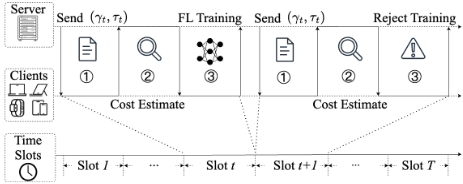
If the client decides to engage in FL training, the server sends the latest global model parameters ωt to the client, and the client sends back the updated local model parameters ωn t+1 to the server after finishing local training. Otherwise, the server needs to wait for the next client arrive and participate in training (step 3⃝). Finally, the server updates the global model ωt+1 according to Eq. (2) immediately.
3.3 Cost Minimization Problem
The OFL process terminates when the global model accuracy reaches a predefined threshold ε, supposed at the final time slot T [Pang et al., 2023]. Let vs(ε) represent the actual valuation the server receives with global accuracy ε. Then, the server's objective of maximizing its utility us can be formulated as follows:
where 1(γt ≥ c(θt, τt)) is an indicator function indicating whether client t joins the FL training. We declare that the reward given to clients here as the server's cost cs, which the server needs to compensate for the clients' service.
Considering that the global accuracy ε is fixed, vs(ε) is constant and can therefore be ignored. Clients with lower computation resources will lead to training bias, effecting the model's generalization capability and causing overfitting issues. To prevent this issue, the server needs to filter clients whose computation resources θt are below the threshold β by adjusting the reward γt. Consequently, maximizing the server's utility can be reformulated as follows:
In the context of TII, it is difficult for the server to minimize the cost without having complete information about each client's decision to join the FL training. On the one hand, the communication resource τt assigned by the server to client t is confidential to the client. On the other hand, the computation resource θt inherent to client t is private information for the server. Therefore, it is challenging for a client to decide whether to participate in OFL training, and for the server to provide a suitable reward that ensures adequate clients join while minimizing the cost.
4 DaringFedMechanism
In this section, we model the server's cost minimization problem in OFL under TII using the Bayesian persuasion game, and design a novel DaringFed mechanism to address it.
4.1 Bayesian Persuasion Game
The Bayesian persuasion (BP) game is a game-theoretic framework that investigates how the sender can strategically disclose private information through sending signals to persuade the receiver to make decisions favorable to the sender [Kamenica and Gentzkow, 2011]. Specifically, in this model, the server acts as a sender, sending signals, while the client acts as a receiver, receiving signals and making decision. Signals σ ∈ Σ are sent to update the posterior distribution of communication resource. We assume that the computation resource θt and communication resource τt are i.i.d. across all clients, thus, we can omit subscript t for Eq. (4). Therefore, the Bayesian persuasion problem can be formulated as the expected server's cost for any client t, i.e.,
where γ ∗ and σ∗ represent the optimal reward and signal that minimize the server's cost, respectively.
4.2 Formalization of DaringFedMechanism
DaringFed integrates a Bayesian persuasion signal rule to estimate the posterior expectation of the communication resources τ, and a dynamic pricing rule to determine the amount of reward γ in a TII environment.
Definition 1. (DaringFed) DaringFed mechanism is represented as a 2-tuple (S, P), i.e., a Bayesian persuasion signal rule S, and a dynamic pricing rule P.
- S: [τ, τ]×R+ →R+ determines how the distribution of the signal σ align with communication resources τ , i.e.,
where ϕ(·) is the Bayesian posterior distribution of τ after receiving signal σ, and λ(·) is the public prior distribution of τ .
- P: R+ ×[θ, θ] →R+ denotes the reward that the server can provide to a client, which is determined by the signal rule and the client's computation resources θ, i.e.,
We define µ as the posterior mean of τ, and transfer the Bayesian persuasion signal rule in DaringFed into selecting the distribution of µ over τ . And hence, Eq. (5) can be rewritten as the following optimization problem:
where ψ(γ, µ) defines the probability that a client is willing to join FL training when the reward is γ and her posterior estimate of the communication resources is µ.
To ensure the posterior belief remains correct after being updated with prior public information and signals, the distribution of ρ is feasible if and only if it satisfies the Bayesian Consistency (BayesCon) [Agrawal et al., 2024]. Additional, to guarantee the signals encourage clients to adjust their strategies in ways that benefit the server, while maintaining alignment between the clients' expected posterior belief and the prior, the distribution of ρ should also satisfy Bayesian Plausible (BayesPla) and Bayesian Benefit (BayesBen) [Kamenica and Gentzkow, 2011]. We provide formal definitions of BayesCon, BayesPla, and BayesBen as follows.
Definition 2. (BayesCon) ρ satisfies BayesCon if
Definition 3. (BayesPla) ρ satisfies BayesPla if
Definition 4. (BayesBen) ρ satisfies BayesBen if
Therefore, the DaringFed mechanism design problem can be formulated as:
DaringFed aims to minimize the server's cost, while ensuring clients' computation resources exceed a threshold, and satisfies BayesCon, BayesPla and BayesBen constraint under the optimal reward γ ∗ and signal ρ∗ . Analyzing the existence of γ ∗ and ρ∗ , and further identifying the optimal γ ∗ and ρ∗ , constitutes the objective of DaringFed.
5 Design of DaringFedMechanism
Due to the use of upper confidence bound for estimating the distribution of computation resources among clients, which involves a discrete decision space and limited exploration time, we can only derive an approximate optimal DaringFed. Consequently, in this section, we first analyze the existence of optimal DaringFed mechanism under one-sided incomplete information, where the server knows the distribution of computation resources among clients, and then design an approximately optimal DaringFed mechanism under a TII scenario.
5.1 Existence of Optimal DaringFedMechanism
We define that θ follows a distribution with survival function s(θ), describing the probability that the computation resources exceed a threshold θ. Recall the indicator function 1(γ ≥ c(θ, µ)), which indicates whether a client decides to join the FL. The values of γ and µ determine the minimum threshold for a client's computation resources ˆ θ, i.e. ˆ θ = min{θ|1(γ ≥ c(θ, µ))}. If the client's computation resources θ exceeds this threshold ˆ θ, the client is willing to join FL. Following the survival distribution s(θ), the probability that a client's computation resources exceeds the threshold ˆ θ is s(ˆ θ) = s(min{θ|1(γ ≥ c(θ, µ))}), which can be simplified as s(γ, µ). Therefore, we can reformulate Eq. (12) as:
Our goal in designing DaringFed is to establish an ideal Bayesian persuasion Nash equilibrium (BPNE) when s(γ, µ) is known to the server, with the objective of maximizing the server's utility. To analyze the equilibrium of the BP game, we make the following common assumptions regarding the cost function c(θ, τ) and survival function s(θ).
Assumption 1. The client's cost function c(θ, τ) satisfies:
- Given any τ, the function c(θ, τ) is a non-increasing, convex function w.r.t. θ.
- Given any θ, the function c(θ, τ) is a non-increasing, convex function w.r.t. τ.
The assumption on the client's cost function are standard in many economics scenarios [Lu et al., 2023; Murhekar et al., 2024]. It is natural to assume that a client's cost decrease with its ability and the communication resource. The convexity of cost functions is commonly used to reflect increasing marginal costs.
Assumption 2. The survival function s(θ) is a nonincreasing, concave function w.r.t. θ.
The assumption regarding the survival function has ample justifications for it being a non-increasing, concave function [Hu et al., 2022; Bergstrom et al., 1986]. It is reasonable to assume that as the threshold value of θ increases, the number of clients who meet this criterion decreases, leading to a lower probability. The concave of the survival function is generally used to capture decreasing marginal probability.
In the BPNE, the server selects a distribution ρ and a reward γ that maximize its utility, as defined below.
Definition 5. (BPNE) Let (γ ∗ , ρ∗ ) denotes the BPNE, i.e.,
At the BPNE, the server cannot benefit from changing its signals or rewards. Then, we investigate the existence and uniqueness of a BPNE.
Lemma 1. There exists a unique BPNE in the BP game.
Then, we derive the unique BPNE satisfying BayesCon, BayesPla, and BayesBen.
Theorem 1. The optimal signals ρ∗ over posterior means µ for the given prior value τ ∈ [τ , ¯ τ] are
where ρ(µ) = λ(τ)τ+λ(¯ τ )¯ τ µ , and the optimal reward γ ∗ is arg min γ ∫ τ τ ρ(µ)s(γ, µ)dµ.
5.2 Approximate Optimal DaringFedMechanism Under TII
In this section, we analyze the approximate optimal DaringFed mechanism in a TII scenario. Due to the uncertainty of s(γ, µ), the server needs to estimate it with respect to γ and µ first, and then design the optimal signal ρ and γ to maximize its expected utility.
To estimate s(·), we considering the reward space and the computation resources space are discrete spaces, i.e., γ ∈ R and θ ∈ Θ, where R = {γ, γ + ξ, · · · , γ - ξ, γ} and Θ = {θ, θ + ξ, · · · , θ - ξ, θ}. Let Nt(ˆ θ) represents the set of time rounds prior to time slot t where the threshold equals ˆ θ, i.e., Nt(ˆ θ) = {n|(n ≤ t) ∩ (ˆ θ = min{θ|1(γ ≥ c(θ, µ))})}. Nt(ˆ θ) denote the total number of such time slots, i.e., Nt(ˆ θ) = |Nt(ˆ θ)|. Then, we can derive s(ˆ θ) as follows.
Lemma 2. The upper confidence bound for the probability that the computation resources threshold is exactly ˆ θ is:
We define the approximate optimal reward as γ+ ∈ R, and the corresponding threshold for clients' computation resources as ˆ θ+ = min{θ|1(γ+ ≥ c(θ, µ))}. There exists z ∈ Z such that (z-1)ξ ≤ ˆ θ+ ≤ zξ for θ ∈ Θ. Then, we can find two posterior expectation of communication resources, µr and µl, such that (z - 1)ξ = min{θ|1(γ+ ≥ c(θ, µr))}) and zξ = min{θ|1(γ+ ≥ c(θ, µl))}). In the following, we derive the approximate optimal signals ρ+ from a given approximate optimal reward γ+ ∈ R using Theorem 2, and then design Algorithm 1 to obtain both γ+ and ρ+ globally.
Theorem 2. The approximate optimal signals ρ+ that ensures the clients' computation resources threshold ˆ θ exactly at the discrete space Θ are
Input: ξ, Θ = {θ, θ + ξ, · · · , θ - ξ, θ}, R = {γ, γ + ξ, · · · , γ - ξ, γ}, τ, τ, τ; Output: ρ, γ; 1 for t ∈ {1, 2, · · · , |Θ|} do 2 θ ← θ + t(ξ - 1); 3 γ ← {θ =min{θ|1(γ ≥ c(θ, τ))}}; 4 for t = |Θ| +1; t < T; t ++ do 5 Traverse θ ∈ Θ to update s(θ) by Eq. (16); 6 for γ ∈ R do 7 z ← {z|z ∈ Z+} ∩ {(z - 1)ξ ≤ θ ≤ zξ}; 8 µr ← {(z - 1)ξ = min{θ|1(γ ≥ c(θ, µr))}}; 9 µl ← {zξ = min{θ|1(γ ≥ c(θ, µl))}}; 10 Obtain ρ(µl|τ), ρ(µl|τ), ρ(µr|τ), and ρ(µr|τ) by Eq. (17); 11 Obtain cs by Eq. (13); 12 Retain γ and ρ that minimizes cs.In Algorithm 1, to initialize s(θ), we traverse each element θ ∈ Θ where θ = ˆ θ, without any signaling mechanism, i.e., the posterior expectation of communication resources µ is equal to real value τ directly (lines 1-3). Then, for each arriving client, we update s(θ) based on the historically information, where the provided reward γ and signals ρ can persuasion clients to participate in FL training (line 5). Finally, we traverse γ ∈ R to find the suitable γ and corresponding ρ according to Theorem 2, in order to minimize the server's cost cs (lines 6-12). The retained γ and ρ represent the selected reward and signals for the current time slot, and this process can iterate continuously until γ convergence to γ+, or the distribution of clients' local computation resources changes.
In the TII scenario, the approximate optimal signals ρ and reward γ can only be obtained from the discrete space Θ and R, respectively. However, the optimal value may not lie within these discrete spaces. Here, we analyze the bounds on the approximate optimal value as follows.
Theorem 3. The bound on the approximate optimal value is
According to Theorem 3, the approximate optimal solution obtained by Algorithm 1 in the TII almost converges to the optimal solution, with the gap bounded by 2ξ.
6 Experiments
In this section, we utilize four real datasets to evaluate the performance of the DaringFed under varying level of computation resources θ and communication resources τ. Subsequently, we employ a synthetic dataset to demonstrate the effectiveness of the DaringFed in terms of the convergence of the computation resources threshold ˆ θ and the reward γ. Furthermore, we compare the improvements achieved by the DaringFed with non-DaringFed in relation to the computation resources threshold ˆ θ and server's cost cs.
Setup on real datasets. We estimate the performance of the DaringFed on four real-world datasets: MNIST [Yann et al., 2021], Fashion-MNIST [Xiao et al., 2017], FEMNIST [Caldas et al., 2018], and CIFAR-10 [Krizhevsky, 2009]. For MNIST and Fashion-MNIST, we employ a 4-layer convolutional neural network (CNN) model consisting of two 5 × 5 convolutional layers with 10 and 20 channels, respectively. For FEMNIST, we employ a 3-layer CNN model, consisting of a 7 × 7 convolutional layer with 32 channels, a 3 × 3 convolution layer with 64 channels, and a fully connected layer. For CIFAR-10, we employ a 5-layer CNN model consisting of two 5 × 5 convolution layers , each with 64 channels, followed by ReLU activation and 3 × 3 max pooling, and three fully connected layers. All of the above models are trained for 2000 time slots. Note that in the OFL platform, only one client arrives per time slot.
Setup on synthetic datasets. We analyze the impact of convergence on ˆ θ and γ, as well as the improvements in ˆ θ and cs using a synthetic dataset. We generate τ from a uniform distribution over the interval [0.1, 0.9]. We define c = (1 - θ)2 (1.2 - µ)2 , which satisfies Assumption 1, where µ, θ ∈ [0.1, 0.9]. Additionally, we define s(θ) = 1 - ( θ-0.1 0.8 )8 , where θ ∈ [0.1, 0.9], to satisfy Assumption 2. For the discrete space in a TII scenario, we specific ξ as 0.01.
Performance of DaringFed. To the best of our knowledge, DaringFed represents the initial effort in designing an incentive mechanism for OFL under TII. To showcase the effectiveness of DaringFed (DF), we conduct a comparative analysis with its variants against a range of baselines to access the influence of different components within our proposed mechanism: (1) DaringFed (DF-B): without the Bayesian persuasion signal rule, where clients can only estimate communication resources based on the prior distribution. (2) DaringFed (DF-D): without the dynamic pricing rule, where the server provides clients with a fixed reward. (3) DaringFed (DF-BD): without both above rules.
Figure 2 illustrates the model accuracy versus time slot for different baselines. DaringFed achieves the highest accuracy and converges the fastest as shown in Table 1. DF-B and DFD exhibit lower accuracy and slower convergence, while DFBD has the worst accuracy and the slowest convergence. This demonstrates that DaringFed improves model performance by filtering out clients with low computation or communication resources in OFL. This is because only clients with sufficient computation or communication resources can meet the constraint that the cost is less than reward under a specific reward threshold, enabling their participation in OFL training. Allocating an appropriate reward through DaringFed, based on the distribution of clients' resources, can improve system performance. Even though clients resources change dynamically, DaringFed can adjust the reward based on feedback regarding whether each client join FL during per time slot.
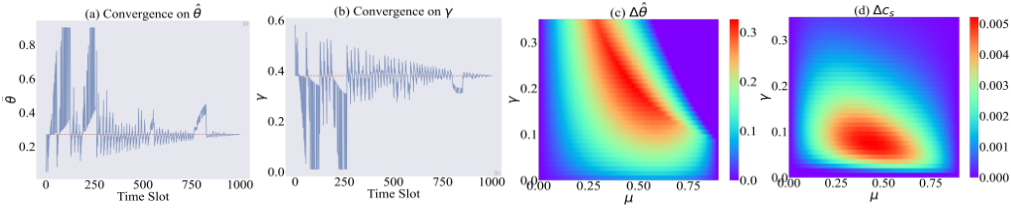
Impact of Convergence on ˆ θ and γ. Figure 3 (a) and (b) show that the client's local computation resource threshold ˆ θ and reward γ can converge after numerous time slot iterations. Each time slot has an optimal computation resource threshold ˆ θ∗ , which is determined by the arriving client's θ.

| Datasets | Accuracy (%) | |||
|---|---|---|---|---|
| DF | DF-B | DF-D | DF-BD | |
| MNIST | 88.38 | 87.56 | 86.93 | 83.35 |
| Fashion-MNIST | 69.11 | 68.65 | 68.14 | 67.18 |
| FEMNIST | 64.41 | 57.41 | 60.35 | 43.05 |
| CIFAR-10 | 34.73 | 34.27 | 34.48 | 31.73 |
The optimal threshold ˆ θ∗ ensures reward equal to client's cost exactly, thereby maximizing the server's utility. However, ˆ θ∗ is unknown to the server, as the server is unaware of the distribution of the client's computation resource. There are multiple discrete values of ˆ θ for the server to select from. The server needs to evaluate ˆ θ by exploiting the available known knowledge that the selected ˆ θ can persuade clients to join FL training, and by exploring the unknown knowledge regarding the unselected ˆ θ, which has never been chosen before. The server can estimate the distribution of θ through above process, and further converge to ˆ θ∗ and γ ∗ . This mechanism is still applicable in scenarios where the distribution of clients' computation resources is dynamic changing. After the distribution of clients' computation resources changes, the convergence value may changed after training, and multiple different convergence values can exist depending on distribution.
Improvements in ˆ θ and cs. Figure 3 (c) and (d) use heatmaps to evaluate the improvement in ˆ θ and cs from DFBD to DaringFed across various values of µ and γ in OFL, i.e. ∆ˆ θ = ˆ θ∗ - ˆ θ′ and ∆cs = c∗s - c′s , where ·∗ and ·′ represents the results derived from DaringFed and DF-BD, respectively.
As shown in Figure 3 (c), ∆ˆ θ attains its maximum value for specific values of γ and µ. On the one hand, a higher µ reduce clients' cost, leading to lower values of ˆ θbp and ˆ θnon-bp under a fixed γ. Since the function of ˆ θ is a convex function according to Appendix A, when the posterior expectation of µ is fixed to satisfy Bayesian Plausible, there exists a maximum value of ∆ˆ θ, and ˆ θbp is greater than ˆ θnon-bp , filter better clients under DaringFed. On the other hand, a higher γ reduce clients' cost, leading to lower values of ˆ θbp and ˆ θnon-bp under a fixed µ. ∆ˆ θ reaches its maximum value when γ at the optimal value. As shown in Figure 3 (d), ∆cs attains its maximum value for specific values of γ and µ. On the one hand, the function of cs is a concave according to Appendix A, under a fixed γ. There exists a maximum value for ∆cs when posterior expectation of µ is fixed to satisfy Bayesian Plausible, and cnon-bp s is worse than cbp s . On the other hand, a higher γ leads to higher values of cbp s and cnon-bp s under a fixed µ. And ∆cs reach a maximum value when γ is optimal.
7 Conclusion
In this paper, DaringFed was proposed to address the context of TII in the OFL platform, which integrated a Bayesian persuasion signal rule and a dynamic pricing rule. To overcome the challenge that clients' were unaware of the communication resources allocated by the server, a Bayesian persuasion signal rule was used to estimate the posterior expectation of communication resources on the clients' side. To tackle the challenge that the server was unaware of clients' inherent computation resources, a dynamic pricing rule was designed to incentive clients to participate in OFL under TII as much as possible to maximize the server's utility. Finally, extensive experiments were conducted on real and synthetic dataset to validate the effectiveness of DaringFed mechanism.
Acknowledgments
This work was supported in part by the National Natural Science Foundation of China (No. 62072411, 62372343, 62325304, 62402352, U22B2046), in part by the Key Research and Development Program of Hubei Province (No. 2023BEB024), and in part by the Open Fund of Key Laboratory of Social Computing and Cognitive Intelligence (Dalian University of Technology), Ministry of Education (No. SCCI2024TB02).
@inproceedings{ijcai2025p744,
  title     = {DaringFed: A Dynamic Bayesian Persuasion Pricing for Online Federated Learning Under Two-sided Incomplete Information},
  author    = {Xin, Yun and Lu, Jianfeng and Cao, Shuqin and Li, Gang and Wang, Haozhao and Wen, Guanghui},
  booktitle = {Proceedings of the Thirty-Fourth International Joint Conference on
               Artificial Intelligence, {IJCAI-25}},
  publisher = {International Joint Conferences on Artificial Intelligence Organization},
  editor    = {James Kwok},
  pages     = {6687--6695},
  year      = {2025},
  month     = {8},
  note      = {Main Track},
  doi       = {10.24963/ijcai.2025/744},
  url       = {https://doi.org/10.24963/ijcai.2025/744},
}
TY - CPAPER TI - DaringFed: A Dynamic Bayesian Persuasion Pricing for Online Federated Learning Under Two-sided Incomplete Information AU - Xin, Yun AU - Lu, Jianfeng AU - Cao, Shuqin AU - Li, Gang AU - Wang, Haozhao AU - Wen, Guanghui T2 - Proceedings of the Thirty-Fourth International Joint Conference on Artificial Intelligence, IJCAI-25 PB - International Joint Conferences on Artificial Intelligence Organization PY - 2025 SP - 6687 EP - 6695 DO - 10.24963/ijcai.2025/744 UR - https://doi.org/10.24963/ijcai.2025/744 ER -Copied
Machine-readable versions of this paper, for tools and AI agents:





