
PDDFormer: Pairwise Distance Distribution Graph Transformer for Crystal Material Property Prediction
Proceedings of the Thirty-Fourth International Joint Conference on Artificial Intelligence. Main Track. Pages 7724-7732.
https://doi.org/10.24963/ijcai.2025/859
Keywords
- Machine Learning: ML: Regression
- Multidisciplinary Topics and Applications: MTA: Physical sciences
- Multidisciplinary Topics and Applications: MTA: Other
Abstract
Crystal structures can be simplified as a periodic point set that repeats across three-dimensional space along an underlying lattice. Traditionally, crystal representation methods rely on descriptors such as lattice parameters, symmetry, and space groups to characterize the structure. However, in reality, atoms in materials always vibrate above absolute zero, causing their positions to fluctuate continuously. This dynamic behavior disrupts the fundamental periodicity of the lattice, making crystal graphs based on static lattice parameters and conventional descriptors discontinuous under slight perturbations. Chemists proposed the pairwise distance distribution (PDD) method to address this. However, the completeness of PDD requires defining a large number of neighboring atoms, leading to high computational costs. Additionally, PDD does not account for atomic information, making it challenging to apply it directly to crystal material property prediction tasks. To tackle these challenges, we introduce the atom-weighted Pairwise Distance Distribution (WPDD) and Unit cell Pairwise Distance Distribution (UPDD) for the first time, applying them to the construction of multi-edge crystal graphs. We demonstrate the continuity and general completeness of crystal graphs under slight atomic position perturbations. Moreover, by modeling PDD as global information and integrating it into matrix-based message passing, we significantly reduce computational costs. Comprehensive evaluation results show that WPDDFormer achieves state-of-the-art predictive accuracy across tasks on benchmark datasets such as the Materials Project and JARVIS-DFT.
- [Ahmad et al., 2018] Zeeshan Ahmad, Tian Xie, Chinmay Maheshwari, Jeffrey C Grossman, and Venkatasubrama- nian Viswanathan. Machine learning enabled computa- tional screening of inorganic solid electrolytes for suppres- sion of dendrite formation in lithium metal anodes. ACS central science, 4(8):996-1006, 2018.
- [Ba, 2016] Jimmy Lei Ba. Layer normalization. arXiv preprint arXiv:1607.06450, 2016.
- [Balasingham et al., 2022] Jonathan Balasingham, Viktor Zamaraev, and Vitaliy Kurlin. Compact graph represen- tation of molecular crystals using point-wise distance dis- tributions. arXiv preprint arXiv:2212.11246, 2022.
- [Balasingham et al., 2024] Jonathan Balasingham, Viktor Zamaraev, and Vitaliy Kurlin. Material property predic- tion using graphs based on generically complete isometry invariants. Integrating Materials and Manufacturing In- novation, pages 1-14, 2024.
- [Bartók et al., 2013] Albert P Bartók, Risi Kondor, and Gábor Csányi. On representing chemical environments. Physical Review B-Condensed Matter and Materials Physics, 87(18):184115, 2013.
- [Batzner et al., 2022] Simon Batzner, Albert Musaelian, Lixin Sun, Mario Geiger, Jonathan P Mailoa, Mordechai Kornbluth, Nicola Molinari, Tess E Smidt, and Boris Kozinsky. E (3)-equivariant graph neural networks for data-efficient and accurate interatomic potentials. Nature communications, 13(1):2453, 2022.
- [Carstens et al., 1999] Hans-Georg Carstens, Walter A Deu- ber, Wolfgang Thumser, and Elke Koppenrade. Geomet- rical bijections in discrete lattices. Combinatorics, Proba- bility and Computing, 8(1-2):109-129, 1999.
- [Chen and Ong, 2022] Chi Chen and Shyue Ping Ong. A universal graph deep learning interatomic potential for the periodic table. Nature Computational Science, 2(11):718- 728, 2022.
- [Chen et al., 2019] Chi Chen, Weike Ye, Yunxing Zuo, Chen Zheng, and Shyue Ping Ong. Graph networks as a univer- sal machine learning framework for molecules and crys- tals. Chemistry of Materials, 31(9):3564-3572, 2019.
- [Choudhary and DeCost, 2021] Kamal Choudhary and Brian DeCost. Atomistic line graph neural network for improved materials property predictions. npj Computa- tional Materials, 7(1):185, 2021.
- [Choudhary et al., 2020] Kamal Choudhary, Kevin F Gar- rity, Andrew CE Reid, Brian DeCost, Adam J Biacchi, Angela R Hight Walker, Zachary Trautt, Jason Hattrick- Simpers, A Gilad Kusne, Andrea Centrone, et al. The joint automated repository for various integrated simula- tions (jarvis) for data-driven materials design. npj compu- tational materials, 6(1):173, 2020.
- [Das et al., 2022] Kishalay Das, Bidisha Samanta, Pawan Goyal, Seung-Cheol Lee, Satadeep Bhattacharjee, and Niloy Ganguly. Crysxpp: An explainable property predic- tor for crystalline materials. npj Computational Materials, 8(1):43, 2022.
- [Das et al., 2023a] Kishalay Das, Pawan Goyal, Seung- Cheol Lee, Satadeep Bhattacharjee, and Niloy Ganguly. Crysmmnet: multimodal representation for crystal prop- erty prediction. In Uncertainty in Artificial Intelligence, pages 507-517. PMLR, 2023.
- [Das et al., 2023b] Kishalay Das, Bidisha Samanta, Pawan Goyal, Seung-Cheol Lee, Satadeep Bhattacharjee, and Niloy Ganguly. Crysgnn: Distilling pre-trained knowledge to enhance property prediction for crystalline materials. In Proceedings of the AAAI Conference on Artificial Intelli- gence, volume 37, pages 7323-7331, 2023.
- [Groom et al., 2016] Colin R Groom, Ian J Bruno, Matthew P Lightfoot, and Suzanna C Ward. The cambridge structural database. Structural Science, 72(2):171-179, 2016.
- [Ioffe, 2015] Sergey Ioffe. Batch normalization: Accelerat- ing deep network training by reducing internal covariate shift. arXiv preprint arXiv:1502.03167, 2015.
- [Kurlin, 2024] Vitaliy Kurlin. Mathematics of 2-dimensional lattices. Foundations of Computational Mathematics, 24(3):805-863, 2024.
- [Lin et al., 2023] Yuchao Lin, Keqiang Yan, Youzhi Luo, Yi Liu, Xiaoning Qian, and Shuiwang Ji. Efficient ap- proximations of complete interatomic potentials for crystal property prediction. In International Conference on Ma- chine Learning, pages 21260-21287. PMLR, 2023.
- [Louis et al., 2020] Steph-Yves Louis, Yong Zhao, Alireza Nasiri, Xiran Wang, Yuqi Song, Fei Liu, and Jianjun Hu. Graph convolutional neural networks with global atten- tion for improved materials property prediction. Physical Chemistry Chemical Physics, 22(32):18141-18148, 2020.
- [Patterson, 1944] A Lindo Patterson. Ambiguities in the x- ray analysis of crystal structures. Physical Review, 65(5- 6):195, 1944.
- [Rubner et al., 2000] Yossi Rubner, Carlo Tomasi, and Leonidas J Guibas. The earth mover's distance as a met- ric for image retrieval. International journal of computer vision, 40:99-121, 2000.
- [Song et al., 2024] Zixing Song, Ziqiao Meng, and Irwin King. A diffusion-based pre-training framework for crys- tal property prediction. In Proceedings of the AAAI Con- ference on Artificial Intelligence, volume 38, pages 8993- 9001, 2024.
- [Taniai et al., 2024] Tatsunori Taniai, Ryo Igarashi, Yuta Suzuki, Naoya Chiba, Kotaro Saito, Yoshitaka Ushiku, and Kanta Ono. Crystalformer: Infinitely connected attention for periodic structure encoding. In The Twelfth Interna- tional Conference on Learning Representations, 2024.
- [Wang et al., 2022] Rui Wang, Robin Walters, and Rose Yu. Approximately equivariant networks for imperfectly sym- metric dynamics. In International Conference on Machine Learning, pages 23078-23091. PMLR, 2022.
- [Wassermann et al., 2010] Anne Mai Wassermann, Mathias Wawer, and Jurgen Bajorath. Activity landscape represen- tations for structure-activity relationship analysis. Journal of medicinal chemistry, 53(23):8209-8223, 2010.
- [Widdowson and Kurlin, 2022] Daniel Widdowson and Vi- taliy Kurlin. Resolving the data ambiguity for periodic crystals. Advances in Neural Information Processing Sys- tems, 35:24625-24638, 2022.
- [Widdowson et al., 2022] Daniel Widdowson, Marco M Mosca, Angeles Pulido, Andrew I Cooper, and Vitaliy Kurlin. Average minimum distances of periodic point sets-foundational invariants for mapping periodic crystals. MATCH Commun. Math. Comput. Chem, 87(3):529-559, 2022.
- [Xie and Grossman, 2018] Tian Xie and Jeffrey C Gross- man. Crystal graph convolutional neural networks for an accurate and interpretable prediction of material proper- ties. Physical review letters, 120(14):145301, 2018.
- [Yan et al., 2022] Keqiang Yan, Yi Liu, Yuchao Lin, and Shuiwang Ji. Periodic graph transformers for crystal mate- rial property prediction. Advances in Neural Information Processing Systems, 35:15066-15080, 2022.
- [Yan et al., 2024a] Keqiang Yan, Cong Fu, Xiaofeng Qian, Xiaoning Qian, and Shuiwang Ji. Complete and efficient graph transformers for crystal material property predic- tion. In The Twelfth International Conference on Learning Representations, 2024.
- [Yan et al., 2024b] Keqiang Yan, Alexandra Saxton, Xi- aofeng Qian, Xiaoning Qian, and Shuiwang Ji. A space group symmetry informed network for o(3) equivariant crystal tensor prediction. In Forty-first International Con- ference on Machine Learning, 2024.
- [Zwart et al., 2008] Peter H Zwart, Ralf W Grosse- Kunstleve, Andrey A Lebedev, Garib N Murshudov, and Paul D Adams. Surprises and pitfalls arising from (pseudo) symmetry. Acta Crystallographica Section D: Biological Crystallography, 64(1):99-107, 2008.
References were extracted automatically from the PDF and may contain errors.
Full text extracted automatically from the PDF; figures, tables and equations may differ. The PDF is the version of record.
1 Introduction
Crystals are solids with a regular geometric shape formed by atoms, ions, or molecules arranged periodically in space during the crystallization process. Their structure is typically described using repeating unit cells and lattice vectors. However, this description method brings a fundamental challenge: the same crystal structure can be represented by different unit cells and lattice vectors, as shown in Figure 1(a). Additionally, in real-world scenarios, the experimental coordinates of unit cells and atoms are inevitably affected by atomic vibrations and measurement noise. These subtle disturbances can lead to discontinuous changes in any simplified unit cell [Kurlin, 2024], resulting in numerous unit cells for a given crystal structure, as shown in Figure 1(b), thereby introducing ambiguity in the representation of crystal data [Widdowson and Kurlin, 2022]. Currently, many graph neural networks [Batzner et al., 2022; Yan et al., 2022; Yan et al., 2024a; Yan et al., 2024b] typically use unit cell parameters, simplified cell parameters, symmetry, and space groups to represent the periodic structure of crystals. However, these features are either non-invariant or discontinuous [Zwart et al., 2008] invariants, leaving the issue of ambiguity in crystal data unresolved [Patterson, 1944; Widdowson et al., 2022; Groom et al., 2016; Bart´ok et al., 2013; Wassermann et al., 2010; Ahmad et al., 2018].
The continuous and complete invariant-Pairwise Distance Distribution (PDD)-proposed by [Widdowson and Kurlin, 2022] addresses the ambiguity in crystal data representation by distinguishing all periodic structures in the world's largest real material collection, the Cambridge Structural Database. To achieve completeness, PDD requires a predetermined number of sufficient neighbors, which is computationally expensive and difficult to directly apply for predicting crystal properties [Balasingham et al., 2022]. [Balasingham et al., 2024] employed distance distribution graphs (DDGs) based on PDD to predict the properties of crystal materials, but they did not achieve satisfactory performance (only slightly better than CGCNN), and although this approach reduced computational costs, it compromised the completeness of PDD. In contrast, crystal graph representations based on multi-edge crystal graphs and unit cell parameters [Yan et al., 2024a] achieve completeness, more accurately characterizing crystal structures, and achieving stateof-the-art performance in crystal material property prediction tasks. However, using unit cell parameters leads to discontinuities in the crystal graphs.

Since PDD does not account for atomic types, it is challenging to use it directly for effective crystal property prediction. To better represent crystal structures, we first introduce WPDD and UPDD. Furthermore, we integrate WPDD and UPDD into the construction of multi-edge crystal graphs and propose the PDD Graph Transformer (including WPDDFormer and UPDDFormer) based on the transformer architecture. We model WPDD as global information and incorporate it into matrix-based message passing without introducing additional information to capture periodicity, significantly reducing computational costs (as shown in Table 3). Finally, we employ the Earth Mover's Distance (EMD) [Rubner et al., 2000] to assess the continuity of crystal graphs, demonstrating that WPDD crystal graphs constructed using only Euclidean distances maintain continuity and general completeness under slight atomic position perturbations, providing a more accurate depiction of actual crystal structures. Ablation experiments show the crucial role of (W/U)PDD in constructing crystal graphs. Through comprehensive evaluations, our method achieves state-of-the-art predictive accuracy across various tasks in the Materials Project and JARVIS datasets. This advancement highlights the effectiveness of WPDDFormer in bridging the gap between traditional crystal descriptors and dynamic atomic behavior, leading to more accurate and reliable predictions in materials science.
2 Preliminaries
2.1 The Structure of Crystals
By selecting an appropriate structural unit, the entire crystal structure can be viewed as the periodic repetition of this unit in space. This property, where atoms within a crystal repeat in three-dimensional space according to a specific pattern, is called periodicity, with the smallest repeatable structural unit being the unit cell. The unit cell can be defined as U = (X,P), where X and P can be represented in matrix form. Typically, X = [x1, x2 · · · xn-1, xn]T ∈ Rn×1 , where n represents the number of atoms and xi ∈ R1 represents the atomic type of atom i in the unit cell. P = [p1, p2 · · · pn-1, pn]T ∈ Rn×3 is the atomic position matrix, where pi ∈ R3 represents the Cartesian coordinates of the atom i in the unit cell in 3D space. The lattice vectors L = [l1, l2, l3]T ∈ R3×3 can reflect the way the unit cell repeats in three directions to map the periodic crystal structure. Therefore, in 3D space, the infinite crystal structure S can be represented as (U, L).
2.2 Definitions
Definition 1. Pointwise Distance Distribution. For the infinite crystal structure S = (U,L) mentioned in Section 2.1, fix a neighbor count k ≥ 1. For each point xi in the unit cell U, let di1 ≤ · · · ≤ dik be the Euclidean distances from pi to its k nearest neighbors in the infinite crystal structure. Consider an n × k matrix composed of n rows of distance vectors, where each point xi ∈ U corresponds to one row. If the matrix contains m ≥ 1 identical rows, they are merged into one row with a weight of mn . The resulting matrix can be regarded as a weighted distribution of rows, which is called the Pairwise Distance Distribution PDD(S; k) ∈ Rn×(k+1) .
According to [Widdowson and Kurlin, 2022] and [Yan et al., 2024a], we present Definitions 2-3. According to [Widdowson and Kurlin, 2022], we present Definitions 4-6.
Definition 2. Isometric Crystal Graphs. An isometric transformation is a mapping that preserves Euclidean distances, denoted as f (x) = Rx + b. Any isometric transformation f can be decomposed into translation, rotation, and reflection. Specifically, suppose there exists a rotation matrix R ∈ R3×3 , with a determinant of 1 (|R| = 1), and a translation vector b ∈ R3 , then two crystal structures S = (U,L) and Q = (U ′ , L′ ) are isometric, satisfying U ′ = RU + b, where RU + b denotes the application of the rotation R and translation b to each element in the infinite set U.
Suppose S and Q are isometric. In that case, their crystal graph representations satisfy G (S) = G (Q), which means that the graphical representation of the crystal structure produces no false positives; that is, there are no isometric pairs where G (S) ̸= G (Q) but S ≃ Q. Conversely, if G (S) = G (Q), then S and Q are isometric, meaning f produces no false negatives, i.e., there are no non-isometric pairs where G (S) = G (Q) but S ̸≃ Q. That is, if the crystal graph representations of artificially constructed crystal structures are identical under isometric transformations, then they are geometrically equivalent.
Definition 3. Geometrically Complete Crystal Graphs. If we construct crystal graphs G (S) = G (Q) =⇒ S ≃ Q, where
≃ denotes the isomorphism of two crystals as defined in Definition 2, then the crystal graph G is geometrically complete. This means that if two crystal graphs G (S) and G (Q) are identical, the infinite crystal structures represented by G (S) and G (Q) are also identical. If the constructed crystal graph G can distinguish any subtle structural differences between different crystal materials, it is said to be geometrically complete.
Definition 4. Metric. The metric d between crystal graphs G satisfies all the axioms: 1) d (G (S) = G (Q)) = 0 if and only if G (S) = G (Q); 2) Symmetry: d (G (S) , G (Q)) = d (G (Q) , G (S)); 3) Triangle inequality: d (G (S) , G (Q)) + d (G (Q) , G (K)) ≥ d (G (S) , G (K)).
Definition 5. Lipschitz continuity of crystal graphs. If Q is obtained by moving each point in the periodic crystal S ⊂ Rn by no more than ϵ, and the distance of the constructed crystal graph structures satisfies d (G (S) , G (Q)) ≤ Cϵ, where C is a constant, then the crystal graph is continuous, and Q, S ⊂ Rn can be any periodic crystal structures.
Definition 6. EMD. Let G (S) and G (Q) be the crystal graph structures we construct for periodic crystals S and Q ∈ Rn . The flow from G (S) to G (Q) is represented by an n (S)×n (Q) matrix, where the elements fij ∈ [0, 1] indicate the partial flow from Ri (S) to Rj (Q). The Earth Mover's Distance (EMD) is defined as the minimum cost:
The first condition ∑ni=0 fij ≤ wi (S) means that not more than the weight wi (S) of the component Ri (S) 'flows' into all components Rj (Q) via 'flows'fij . Similarly, the second condition ∑nj=0 fij ≤ wj (Q) means that all 'flows' fij from Ri (S) 'flow' Into Rj (Q) up to the maximum weight wj (Q). The last condition ∑ni=1 ∑nj=1 fij = 1 forces to 'flow' all rows Ri (S) to all rows Rj (Q).
3 RelatedWork
Finite Crystal Graph Representation CGCNN [Xie and Grossman, 2018] represents crystal structures as finite multiedge crystal graphs to model crystal structures and predict material properties. Building on the construction of multi-edge crystal graphs, MegNet [Chen et al., 2019] introduced global state attributes into graph networks, while GATGNN [Louis et al., 2020] utilized multiple graph attention layers (GAT) to learn the properties of local neighborhoods and employed global attention layers to weight global atomic features. ALIGNN [Choudhary and DeCost, 2021] and M3GNet [Chen and Ong, 2022] incorporated angular information into the message-passing process to generate richer and more discriminative representations. [Das et al., 2022] proposed an interpretable deep property predictor called CrysXPP. CrysMMNet [Das et al., 2023a] adopted a multimodal framework, integrating graph and text representations to produce joint multimodal representations of crystalline materials. [Das et al., 2023b] proposed CrysGNN, a pretraining framework leveraging unlabeled data, while CrysDiff [Song et al., 2024] introduced a diffusion model-based pretraining-fine-tuning framework. However, the methods above represent crystals as finite graph structures, which fail to effectively capture the periodicity of infinite crystals.
Periodic Representation of Crystals Recently, Matformer [Yan et al., 2022] encoded periodic patterns by adding self-connecting edges to atoms based on lattice parameters. PotNet [Lin et al., 2023] considered the infinite summation of interatomic interactions. Crystalformer [Taniai et al., 2024] performed infinite summations of interatomic potentials through infinitely connected attention while also utilizing lattice parameters. ComFormer [Yan et al., 2024a] constructed cell parameters by adding self-connecting edges to atoms and their copies in three different directions to encode periodic patterns, employing equivariant vector representations and invariant geometric descriptors of Euclidean distances and angles to represent the geometric information of crystals. GMTNet [Yan et al., 2024b] aims to predict the tensor properties of crystalline materials while satisfying O(3) group equivariance and the symmetry of crystal space groups. However, the crystal structures they represent rely on noninvariant or discontinuous invariants, failing to resolve the issue of crystal data fuzziness.
Continuity and Complete Representations for Crystals Addressing the continuity and completeness of crystal representations is a critical issue. Recent advancements in AMD [Wang et al., 2022] and PDD [Widdowson and Kurlin, 2022] have developed matrix forms that are both complete and continuous. However, in practical applications, using these matrix representations as inputs for predicting crystal properties without compromising continuity and completeness is challenging. The AMD and PDD representations are designed to distinguish stable crystal structures and do not consider atomic types; their completeness assumption only holds for stable structures. Additionally, to achieve completeness, a sufficiently large number of neighbors k must be predetermined for any test crystal. Directly modeling PDD as edge information is impractical and costly in real-world applications [Balasingham et al., 2022].
4 PDDFormer
In this section, we propose two PDD variants, namely WPDD and UPDD, and then incorporate them into crystal graph construction. We finally present the PDDformer framework.
4.1 Atom-Weighted PDD (WPDD)
Since the PDD representation is designed for stable crystal structures and does not consider atomic types, it is not suitable for predicting crystal material properties. To account for the influence of atomic types, for a given crystal structure S = U + L, where each atom xi ∈ U is labeled with the atomic mass t(xi) corresponding to it, the final weight for each row is W = [w1, . . . ,wn]T , where wi = t(xi) ∑nu=1 t(xu) . By concatenating W with PDD ∈ Rn×k , an atomic-massweightedWPDD(S; k) ∈ Rn×(k+1) is formed, represented by the following equation:
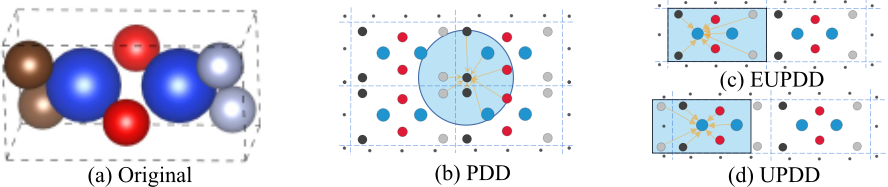
Herein, n represents the number of atoms in the unit cell, and pi and pj denote the spatial coordinates of an atom i and its neighbor j, respectively, and k is the number of nearest neighbors selected when constructing the PDD, sorted in ascending order of Euclidean distance as di1 ≤ · · · ≤ dik, as shown in Figure 2(b). WPDD is equivalent to the PDD of the crystal structure S, except that the rows are not grouped as in the original version. This prevents the loss of atomic information when two primitive points have the same k-nearest neighbor distances but correspond to different atomic types. Therefore, WPDD ∈ Rn×(k+1) , where n is the number of atoms in the constructed graph.
4.2 Unit-cell PDD (UPDD)
When ensuring the completeness of PDD, a large number of neighbors must be predefined, typically requiring information on hundreds of neighbors, and in extreme cases, the number must exceed the atom count in any unit cell within the dataset. The number of neighbors, k, is difficult to determine across different datasets, and for unit cells with fewer atoms, which constitute a larger proportion of the dataset, an excess of neighbor information may interfere with the speed of message aggregation, leading to greater resource consumption.
To address this issue, we introduce Unit-cell PDD (UPDD). We achieve this by reconstructing the unit cell around each atom and encoding the pairwise distances between the atom and other atoms within the reconstructed unit cell. This means that when constructing PDD, we focus more on the overall structure of the atoms within the reconstructed unit cell, thereby reducing interference from excessive neighbor information. UPDD is defined by the following formula:
Since the interaction energy between an atom and its neighboring atoms is usually inversely proportional to the distance, we take the reciprocal feature of the distance after removing zeros.
As shown in Figure 2(d), the selection is not based on Euclidean distances but on choosing atoms within the reconstructed unit cell for construction. The atoms in the unit cell determine the dimension of our UPDD and do not require consideration of the neighbor count, k, across different datasets, making it more generalizable. This UPDD covers unit cell structures with a larger number of atoms while ensuring that unit cell structures with fewer atoms are not disturbed by excessive neighbor information. It also reduces resource consumption. Due to this crystal-specific treatment, the UPDD dimensions of different crystal structures may not match, so dimension alignment is required before feeding them into the neural network.
4.3 Crystal Graph Construction
By introducing PDD, we constructed a general complete and continuous multi-edge crystal graph. In the graph, node features are xi. An edge is established from node j to node i when the Euclidean distance |ej ′ i|2 between a duplicate of j and i satisfies |ej ′ i|2 = |pj + k′1 l1 + k′2 l2 + k′3 l3 - pi|2 ≤ r, where r ∈ R is the cutoff radius. Next, we construct a PDD row for each atom. Since directly representing PDD as edge features is impractical, we retain its matrix form and incorporate it into the construction of the multi-edge crystal graph to reflect the global information of the crystal structure. Therefore, we represent the constructed crystal graph as G = (X,XI, E,PDD). Therein, xi ∈ X is the feature vector of the atom i, ehij ∈ E is the feature vector of the h-th edge between nodes i and j, and we denote XI as the indices of the nodes i and j that form the edge. Sections 4.4 and 4.5 are our proofs of the continuity and general geometric completeness of PDD crystal graphs.
4.4 The Continuity of Proposed Crystal Graphs
The continuity of the constructed crystal graph G (S) under perturbations of the crystal structure S will be measured using the EMD [Rubner et al., 2000], which applies to crystal graphs of any size. Definition 6 applies to any crystal graph G (S) = ([w1 (S) ,R1 (S)] , . . . , [wn (S) ,Rn (S)]), where [wi (S) , Ri (S)] represent the information extracted based on atom i in the unit cell. Ri (S) = Ri (SX , SXI, SE, SPDD) includes atomic information, neighbor information used in constructing the multi-edge crystal graph, and the PDD invariants of the crystal structure S, with weights wi ∈ (0, 1] satisfying the normalization condition ∑ni=1wi (S) = 1.
Subsequently, we only consider the case where the weighted vector [wi,Ri] corresponds to the i-th row of PDD(S; k). Here, n denotes the number of rows in PDD(S; k). The size of each row Ri (S) should be independent of S and depend solely on the number of neighbors k in PDD(S; k). For any vectors Ri = (ri1, . . . , rik) and
Proposition 1. The WPDD and UPDD multi-edge crystal graph is continuous.
Proof. For any neighbor count k ≥ 1, if the periodic crystal S, Q ∈ Rn satisfy dB (S, Q) < r (S), then we have:
Since disturbances only change the positions of atoms and do not alter their types, therefore EMD((SX ,QX)) = 0 and EMD((SXI,QXI)) = 0, refer to Appendix F for details. So, we obtain EMD(G (S) , G (Q)) = EMD((SE,QE)) + EMD ((SPDD, QPDD)) ≤ 2dB (S, Q).
The bottleneck distance dB (S,Q) < r (S) is defined as: dB (S,Q) = infg:S→Q supp∈S |p- g (p)| and the envelope radius r (S) is the minimum half-distance between any two points in r (S). In other words, r (S) is the maximum radius of non-overlapping open balls centered at all points in S. This implies that any small perturbation in atomic positions under the dB [Carstens et al., 1999] will lead to minor changes in the distribution of distances between points in the EMD.
Since the EMD between the constructed crystal graphs only relates to Euclidean distance. Euclidean distance itself is continuous, Theorem 1 extends the following fact: for a unit cell structure with two atoms, when the number of neighbors k = 1, if we perturb at most two points by ϵ, the change in distance between the two points will be at most 2ϵ. Extending this to n atomic points with k neighbors, if we perturb at most n points by ϵ, the change in distance between n points will be at most 2nkϵ. This aligns with Definition 5, hence, the constructed WPDD and UPDD multi-edge crystal graph is continuous.
4.5 General Geometric Completeness
Proposition 2. The WPDD multi-edge crystal graph is generally geometrically complete.
We discuss the limitations of general completeness in Appendix G. We prove this by categorical induction. Crystal structures can be classified into stable and unstable types and further divided into the following three categories: 1. Stable Crystal Structures(i.e., where no two crystals can have the same structure with only a difference in atomic types). 2. Unstable Crystal Structures with Differences in Atomic Coordinates. 3. Unstable Crystal Structures with Identical Structures but Differences in Atomic Types.
Proof. Since UPDD is constructed based on the size of the unit cell, when the number of atoms in the unit cell is relatively small, it could theoretically result in different crystal structures, where all atoms have the same Euclidean distances and atom types but inconsistent atomic positions, sharing the same crystal graph representation.
Since the crystal structures of the first and second categories differ, PDD alone can effectively distinguish them. As WPDD includes PDD, different WPDD representations can be constructed for the two crystals, thereby achieving differentiation. For the third category, we incorporate WPDD as global information into the construction of a multi-edge crystal graph and encode atomic information, such that the WPDD crystal graph G is represented as G = (X, XI, E) + WPDD, where X represents atomic information embedded through CGCNN. For any atom in the unit cell, a WPDD
| Method | Formation Energy | Bandgap(OPT) | Total Energy | Ehull | Bandgap(MBJ) | Bulk Moduli(Kv) | Shear Moduli(Gv) |
|---|---|---|---|---|---|---|---|
| eV/atom | eV | eV/atom | eV | eV | GPa | GPa | |
| PotNet(2023) | 0.0294 | 0.127 | 0.032 | 0.055 | 0.27 | 10.06 | 8.883 |
| CrysMMNet(2023) | 0.028 | 0.128 | 0.034 | - | 0.278 | 9.625 | 8.471 |
| CrysDiff (2024) | 0.029 | 0.131 | 0.034 | 0.062 | 0.287 | 9.875 | 9.193 |
| Crystalformer(2024) | 0.0306 | 0.128 | 0.032 | 0.046 | 0.274 | - | - |
| eComFormer(2024) | 0.0284 | 0.124 | 0.032 | 0.044 | 0.28 | 10.79 | 9.826 |
| iComFormer(2024) | 0.0272 | 0.122 | 0.0288 | 0.047 | 0.26 | 9.617 | 9.098 |
| UPDDFormer | 0.0267 | 0.122 | 0.0287 | 0.0406 | 0.260 | 9.456 | 8.738 |
| WPDDFormer | 0.0257 | 0.119 | 0.0276 | 0.0355 | 0.249 | 9.224 | 8.441 |
| Method | Formation Energy eV/atom | Band Gap eV | Bulk log(GPa) | Shear log(GPa) |
|---|---|---|---|---|
| PotNet | 0.0188 | 0.204 | 0.040 | 0.065 |
| CrysMMNet | 0.0200 | 0.197 | 0.038 | 0.062 |
| Crystalformer | 0.0186 | 0.198 | 0.0377 | 0.0689 |
| eComFormer | 0.01816 | 0.202 | 0.0417 | 0.0729 |
| iComFormer | 0.01826 | 0.193 | 0.0380 | 0.0637 |
| UPDDFormer | 0.01696 | 0.189 | 0.0370 | 0.0670 |
| WPDDFormer | 0.01604 | 0.187 | 0.0323 | 0.0605 |
row vector needs to be constructed along with the corresponding atomic information embedding. This ensures that for any two crystal structures with identical crystal structures but differing atomic types at corresponding coordinates, the (X,XI, E) in their WPDD crystal graphs will differ. On the contrary, if two crystals have the same WPDD crystal graph representation, they share the same WPDD and multigraph representations. It indicates that their crystal structures and the atomic information at corresponding coordinates are identical, thus confirming that they are the same crystal. This contradicts our premise. Hence, the proof is complete. Therefore, the proposed identical crystal graph can represent only the same infinite crystal structure. Then, based on Definition 3, we complete the proof of Proposition 2.
Finally, we conclude that the UPDD crystal graph can only guarantee continuity, while the WPDD crystal graph can ensure both continuity and general completeness.
4.6 Network Architecture
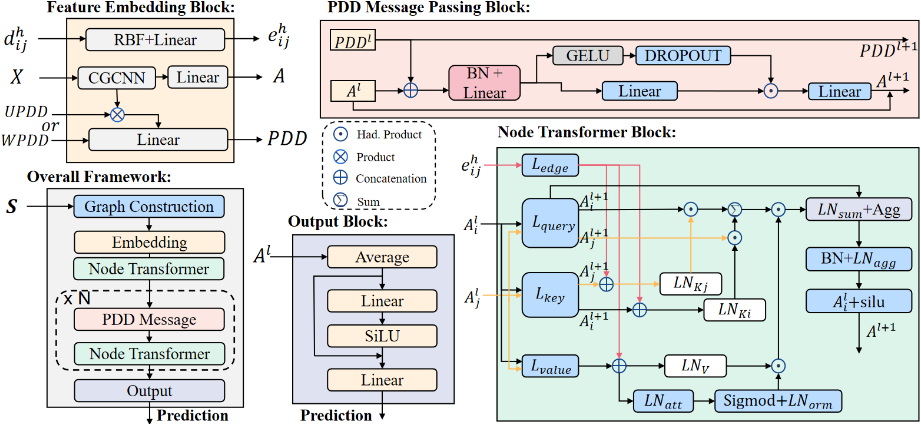
Based on the graph in Section 4.3, we propose the information propagation scheme of PDDFormer. Figure 3 illustrates the overall framework architecture of PDDFormer.
Feature Embedding Block First, we introduce the construction of the graph embedding Block. We use atomic encoding from CGCNN for embedding. For the edge information ehij , we employ radial basis functions to encode the distance between two adjacent nodes in the graph, represented by Equation 5, where γ and µ are hyperparameters. For UPDD, due to the varying feature dimensions of UPDD for different crystals, we perform matrix multiplication on UPDD to align the structural information of different crystals, obtaining information for the PDD message passing layer. Thus, we obtain the graph embedding as:
Node Transformer Block Building upon the constructed graph, we aggregate the node information. Let ali be the input feature vector of node i at layer l in PDDFormer. The information propagation of layer l is formulated as follows:
where LQ,LK,LV,LE are the linear transformations for query, key, value, and edge features. LNK, LNV are the nonlinear transformations for key and value, including two linear layers and an activation layer in between. LNatt represents the linear transformation for updating messages, and LNorm denotes the layer normalization [Ba, 2016] operation. BN denotes the batch normalization layer [Ioffe, 2015], and dqli is the dimension of ql i .
Then, we obtain the message M l i by aggregating the information from the neighborhood of node i over multiple edges, and Al+1 i is realized as follows :
where LNsum is the linear transformation used for updating the edge messages.
PDDMessage Passing Block Al and PDDl represent the atomic features and 3D periodic pattern encoding at layer l, respectively. Its message-passing mechanism is as follows:
Finally, we use average pooling to aggregate the features of all nodes in the graph, followed by a nonlinear layer, and then a linear layer to obtain the scalar output of the graph as described above. A detailed description of the PDDFormer architecture can be found in Appendix B.
| Models | Time/epoch | Total time | Inference time | GPUmemory usage | Complexity | Model Parameter |
|---|---|---|---|---|---|---|
| eComformer | 97s | 13.4h | 361.5s | 17GB | O(nk) | 12.4M |
| iComformer | 103s | 14.3h | 365.6s | 12GB | O(nk) | 5.0M |
| WPDDFormer | 66s | 7.4h | 240.6s | 6GB | O(nk) | 4.52M |
| Method | Num. Block | Ehull | Band Gap |
|---|---|---|---|
| NO PDD Block | 3,0 | 0.0430 | 0.194 |
| NO PDD | 3,2 | 0.0426 | 0.193 |
| UPDDFormer | 3,2 | 0.0406 | 0.189 |
| WPDDFormer | 3,2 | 0.0355 | 0.187 |
5 Experiments
We conducted experiments on two material benchmark datasets, namely the Materials Project [Chen et al., 2019] and Jarvis [Choudhary et al., 2020] datasets. Detailed descriptions of the datasets can be found in Appendix A. More information about the experimental settings of PDDFormer can be found in Appendix C. Baseline methods include PotNet [Lin et al., 2023], CrysMMNet [Das et al., 2023a], CrysDiff [Song et al., 2024], Crystalformer [Taniai et al., 2024], and ComFormer [Yan et al., 2024a], The complete baselines can be found in Appendix E.1. For all baselines on the datasets, we report the results provided in the cited papers.
5.1 Experimental Results
JARVIS The quantitative results for JARVIS [Choudhary et al., 2020] are shown in Table 1. WPDDformer achieves the best performance across all tasks. UPDD achieved the second-best results. Notably, WPDDFormer outperforms eComFormer by 19% respectively in the Ehull task.
The Materials Project (MP) The experimental results on MP [Chen et al., 2019] are shown in Table 2. WPDDFormer significantly outperforms previous works across all tasks, with a 11.7% improvement over the second-best model in the critical formation energy task and a 14.3% improvement in the bulk moduli task. Additionally, the excellent prediction accuracy of WPDDFormer in the bulk modulus and shear modulus tasks, using only 4, 664 training samples, demonstrates the expressiveness and robustness of WPDD multiedge crystal graphs under limited training samples. Overall, our methods are compared with 14 existing methods across the two datasets. Our WPDDFormer consistently outperforms all methods in all tasks. Additionally, WPDDFormer shows a significant improvement in prediction accuracy compared to UPPDFormer. This improvement is not only because the WPDD graph structure is complete and continuous, while UPPD can only ensure continuity, but also because UPPD requires dimensional alignment as mentioned in 4.6, which results in some loss of the expression of global information about the unit cell.
Efficiency We compare model efficiency with Comformer under the best configurations, as reported in Table 3. They have a time complexity of O(nk), where n is the number of atoms in the unit cell and k is the average number of neighbors. Compared to ComFormer, WPDDFormer has fewer parameters and achieves significantly superior experimental results with lower computational cost and faster training and inference speeds, demonstrating the remarkable superiority of our method.
5.2 Ablation Studies
In this section, we demonstrate the impact of introducing (W/U)PDD on the representation learning of crystal materials through ablation studies. Specifically, we conducted experiments on the MP and JARVIS datasets, using testing mean absolute error (MAE) as the quantitative evaluation metric, comparing the results for Band Gap and Ehull tasks, as shown in Table 4. By comparing (W/U)PDDFormer models without PDD message passing blocks to models that retain the PDD message passing blocks but lack (W/U)PDD information, we validated the importance of (W/U)PDD. The results show that compared to models without the PDD message passing blocks, WPDDForemer achieved improvements of 17.4% and 3.6% in the Bulk Moduli and Ehull tasks, respectively. Compared to models that retain only the PDD message passing blocks but lack (W/U)PDD information, we achieved improvements of 16.7% and 3.1% in these two tasks, respectively. More data can be found in Appendix E.3.
6 Conclusion
In this study, we integrated WPDD and UPDD into the representation of crystal structures, achieving a general complete and continuous construction of crystal graphs. This resolves the ambiguity in crystal graph representations for predicting the properties of crystalline materials and bridges the gap between traditional crystal descriptors and dynamic atomic behavior. Experimental results demonstrate the significant advantage of our PDDFormer in various property prediction tasks. Achieving absolute completeness under perturbations is a problem that will be further explored in the future.
Acknowledgments
This research is supported by the National Natural Science Foundation of China (No.42130112, No.42371479), General Program of Shanghai Natural Science Foundation(Grant No.24ZR1419800, No.23ZR1419300), Science and the Technology Commission of Shanghai Municipality (Grant No.22DZ2229004), Beijing Natural Science Foundation (No.QY23187), and Shanghai Frontiers Science Center of Molecule Intelligent Syntheses.
Contribution Statement
M.C., X.T., X.H., J.Y., and X.W. supervised the research project throughout its duration. Z.W. and X.S. conceived the experimental design and jointly developed the model framework. M.C., X.T., X.H., J.Y., S.L., and X.W. provided revisions to the manuscript. The experimental results were collaboratively analyzed by L.S., L.W., Z.W., and X.S. Data interpretation and manuscript writing were carried out by Z.W. and X.S. X.S. and Z.W. are co-first authors, and X.W. is the corresponding author. All authors participated in the discussion of the results and contributed to the final manuscript preparation.
@inproceedings{ijcai2025p859,
  title     = {PDDFormer: Pairwise Distance Distribution Graph Transformer for Crystal Material Property Prediction},
  author    = {Shen, Xiangxiang and Wan, Zheng and Wen, Lingfeng and Sun, Licheng and Yang, Jian and Tang, Xuan and Lin, Shing-Ho J. and He, Xiao and Chen, Mingsong and Wei, Xian},
  booktitle = {Proceedings of the Thirty-Fourth International Joint Conference on
               Artificial Intelligence, {IJCAI-25}},
  publisher = {International Joint Conferences on Artificial Intelligence Organization},
  editor    = {James Kwok},
  pages     = {7724--7732},
  year      = {2025},
  month     = {8},
  note      = {Main Track},
  doi       = {10.24963/ijcai.2025/859},
  url       = {https://doi.org/10.24963/ijcai.2025/859},
}
TY - CPAPER TI - PDDFormer: Pairwise Distance Distribution Graph Transformer for Crystal Material Property Prediction AU - Shen, Xiangxiang AU - Wan, Zheng AU - Wen, Lingfeng AU - Sun, Licheng AU - Yang, Jian AU - Tang, Xuan AU - Lin, Shing-Ho J. AU - He, Xiao AU - Chen, Mingsong AU - Wei, Xian T2 - Proceedings of the Thirty-Fourth International Joint Conference on Artificial Intelligence, IJCAI-25 PB - International Joint Conferences on Artificial Intelligence Organization PY - 2025 SP - 7724 EP - 7732 DO - 10.24963/ijcai.2025/859 UR - https://doi.org/10.24963/ijcai.2025/859 ER -Copied
Machine-readable versions of this paper, for tools and AI agents:





