
MTPNet: Multi-Grained Target Perception for Unified Activity Cliff Prediction
Proceedings of the Thirty-Fourth International Joint Conference on Artificial Intelligence. Main Track. Pages 7733-7741.
https://doi.org/10.24963/ijcai.2025/860
Keywords
- Machine Learning: ML: Applications
- Knowledge Representation and Reasoning: KRR: Applications
- Multidisciplinary Topics and Applications: MTA: Bioinformatics
Abstract
Activity cliff prediction is a critical task in drug discovery and material design. Existing computational methods are limited to handling single binding targets, which restricts the applicability of these prediction models. In this paper, we present the Multi-Grained Target Perception network (MTPNet) to incorporate the prior knowledge of interactions between the molecules and their target proteins. Specifically, MTPNet is a unified framework for activity cliff prediction, which consists of two components: Macro-level Target Semantic (MTS) guidance and Micro-level Pocket Semantic (MPS) guidance. By this way, MTPNet dynamically optimizes molecular representations through multi-grained protein semantic conditions. To our knowledge, it is the first time to employ the receptor proteins as guiding information to effectively capture critical interaction details. Extensive experiments on 30 representative activity cliff datasets demonstrate that MTPNet significantly outperforms previous approaches, achieving an average RMSE improvement of 18.95% on top of several mainstream GNN architectures. Overall, MTPNet internalizes interaction patterns through conditional deep learning to achieve unified predictions of activity cliffs, helping to accelerate compound optimization and design. Codes are available at: https://github.com/ZishanShu/MTPNet.
- [Brandes et al., 2022] Nadav Brandes, Dan Ofer, Yam Peleg, Nadav Rappoport, and Michal Linial. Proteinbert: a uni- versal deep-learning model of protein sequence and func- tion. Bioinformatics, 38(8):2102-2110, 2022.
- [Butler et al., 2018] Keith T. Butler, Daniel W. Davies, Hugh Cartwright, Olexandr Isayev, and Aron Walsh. Machine learning for molecular and materials science. Nature, pages 547-555, July 2018.
- [Chen et al., 2022] Hengwei Chen, Martin Vogt, and Jürgen Bajorath. Deepac -conditional transformer-based chem- ical language model for the prediction of activity cliffs formed by bioactive compounds. Digital Discovery, 1(6):898-909, 2022.
- [Consonni and Todeschini, 2010] Viviana Consonni and Roberto Todeschini. Molecular Descriptors, pages 29-102. January 2010.
- [Dong et al., 2018] Jie Dong, Ning-Ning Wang, Zhi-Jiang Yao, Lin Zhang, Yan Cheng, Defang Ouyang, Ai-Ping Lu, and Dong-Sheng Cao. Admetlab: a platform for sys- tematic admet evaluation based on a comprehensively col- lected admet database. Journal of Cheminformatics, 10(1), December 2018.
- [Drucker et al., 1996] H. Drucker, C. J. Burges, L. Kaufman, A. Smola, and V. Vapnik. Support vector regression ma- chines. In Advances in Neural Information Processing Sys- tems, volume 9, 1996.
- [Du et al., 2024] Wenjie Du, Shuai Zhang, Jun Xia Di Wu, Ziyuan Zhao, Junfeng Fang, and Yang Wang. Mmgnn: A molecular merged graph neural network for explainable solvation free energy prediction. In Proceedings of the Thirty-Third International Joint Conference on Artificial Intelligence, pages 5808-5816, 2024. IJCAI
- [Fang et al., 2023] Y. Fang, Y. Jiang, L. Wei, Q. Ma, Z. Ren, Q. Yuan, and D. Q. Wei. Deepprosite: structure-aware pro- tein binding site prediction using esmfold and pretrained language model. Bioinformatics, 39(12):btad718, Decem- ber 2023.
- [Iqbal et al., 2021] J. Iqbal, M. Vogt, and J. Bajorath. Pre- diction of activity cliffs on the basis of images using con- volutional neural networks. Journal of Computer-Aided Molecular Design, pages 1-8, 2021.
- [Kipf and Welling, 2017] Thomas N. Kipf and Max Welling. Semi-supervised classification with graph convolutional networks. In International Conference on Learning Rep- resentations, 2017.
- [Li et al., 2023] Peiying Li, Yongchang Liu, Shikui Tu, and Lei Xu. Glpocket: A multi-scale representation learning approach for protein binding site prediction. In Proceed- ings of the Thirty-Third International Joint Conference on Artificial Intelligence, pages 4821-4828, 2023. IJCAI
- [Lin et al., 2023] Zeming Lin, Halil Akin, Roshan Rao, Brian Hie, Zhongkai Zhu, Wenting Lu, Nikita Smetanin, Robert Verkuil, Ori Kabeli, Yaniv Shmueli, Allan dos San- tos Costa, Maryam Fazel-Zarandi, Tom Sercu, Salvatore Candido, and Alexander Rives. Evolutionary-scale pre- diction of atomic-level protein structure with a language model. Science, 379(6637):1123-1130, 2023.
- [Meng et al., 2024] Ziqiao Meng, Liang Zeng, Zixing Song, Tingyang Xu, Peilin Zhao, and Irwin King. Towards geo- metric normalization techniques in se (3) equivariant graph neural networks for physical dynamics simulations. In Proceedings of the Thirty-Third International Joint Con- ference on Artificial Intelligence, pages 5981-5989, 2024. IJCAI
- [Moriwaki et al., 2018] Hirotomo Moriwaki, Yu-Shi Tian, Norihito Kawashita, and Tatsuya Takagi. Mordred: a molecular descriptor calculator. Journal of Cheminformat- ics, December 2018.
- [Nie et al., 2024a] Zhiwei Nie, Daixi Li, Jie Chen, Fan Xu, Yutian Liu, Jie Fu, Xudong Liu, Zhennan Wang, Yiming Ma, Kai Wang, et al. Hunting for peptide binders of spe- cific targets with data-centric generative language models. bioRxiv, 2024.
- [Nie et al., 2024b] Zhiwei Nie, Hongyu Zhang, Hao Jiang, Yutian Liu, Xiansong Huang, Fan Xu, Yonghong Tian, Jie Chen, and Wen-Bin Zhang. Multi-purpose enzyme- substrate interaction prediction with progressive condi- tional deep learning. Research Square PREPRINT, 2024.
- [Park et al., 2022] Junhui Park, Gaeun Sung, SeungHyun Lee, SeungHo Kang, and ChunKyun Park. Acgcn: Graph convolutional networks for activity cliff prediction be- tween matched molecular pairs. Journal of Chemical In- formation and Modeling, 62(10):2341-2351, 2022.
- [Rao et al., 2022] Jiahua Rao, Shuangjia Zheng, Yutong Lu, and Yuedong Yang. Quantitative evaluation of explainable graph neural networks for molecular property prediction. Patterns, 3(12):100628, 2022.
- [Rong et al., 2020] Yu Rong, Yatao Bian, Tingyang Xu, Weiyang Xie, Ying Wei, Wenbing Huang, and Jun- zhou Huang. Self-supervised graph transformer on large-scale molecular data. arXiv: Biomolecules,arXiv: Biomolecules, June 2020.
- [Shin et al., 2024] Dong-Hee Shin, Young-Han Son, Deok- Joong Lee, Ji-Wung Han, and Tae-Eui Kam. Dynamic many-objective molecular optimization: Unfolding com- plexity with objective decomposition and progressive opti- mization. In Proceedings of the Thirty-Third International Joint Conference on Artificial Intelligence, pages 6026- 6034, 2024. IJCAI
- [Su et al., 2023] Jin Su, Chenchen Han, Yuyang Zhou, Jun- jie Shan, Xibin Zhou, and Fajie Yuan. Saprot: Protein lan- guage modeling with structure-aware vocabulary, October 2023. bioRxiv 2023.10.01.560349.
- [Van Tilborg et al., 2022] Derek Van Tilborg, Alisa Alenicheva, and Francesca Grisoni. Exposing the limitations of molecular machine learning with activity cliffs. Journal of chemical information and modeling, 62(23):5938-5951, 2022.
- [Vapnik, 2013] Vladimir Vapnik. The Nature of Statistical Learning Theory. Springer Science & Business Media, 2013.
- [Veith et al., 2009] Henrike Veith, Noel Southall, Ruili Huang, Tim James, Darren Fayne, Natalia Artemenko, Min Shen, James Inglese, Christopher P. Austin, David G. Lloyd, and et al. Comprehensive characterization of cy- tochrome p450 isozyme selectivity across chemical li- braries. Nature Biotechnology, 27(11):1050-1055, 2009.
- [Veličković et al., 2017] Petar Veličković, Guillem Cucurull, Arantxa Casanova, Adriana Romero, Pietro Lio, and Yoshua Bengio. Graph attention networks. arXiv preprint arXiv:1710.10903, 2017.
- [Wang et al., 2017] Yanli Wang, Stephen H. Bryant, Tiejun Cheng, Jiyao Wang, Asta Gindulyte, Benjamin A. Shoe- maker, Paul A. Thiessen, Siqian He, and Jian Zhang. Pub- chem bioassay: 2017 update. Nucleic Acids Research, pages D955-D963, January 2017.
- [Wang et al., 2022] Y. Wang, J. Wang, Z. Cao, et al. Molecu- lar contrastive learning of representations via graph neural networks. Nature Machine Intelligence, 4:279-287, 2022.
- [Wu et al., 2021] Zhanghao Wu, Paras Jain, Matthew Wright, Azalia Mirhoseini, Joseph E Gonzalez, and Ion Stoica. Representing long-range context for graph neu- ral networks with global attention. In M. Ranzato, A. Beygelzimer, Y. Dauphin, P.S. Liang, and J. Wortman Vaughan, editors, Advances in Neural Information Pro- cessing Systems, volume 34, pages 13266-13279.
- Curran Associates, Inc., 2021.
- [Wu, 2024] Fang Wu. A semi-supervised molecular learning framework for activity cliff estimation. In Proceedings of the Thirty-Third International Joint Conference on Artifi- cial Intelligence, pages 6080-6088, 2024. IJCAI
- [Xia et al., 2023a] Jun Xia, Lecheng Zhang, Xiao Zhu, Yue Liu, Zhangyang Gao, Bozhen Hu, Cheng Tan, Jiangbin Zheng, Siyuan Li, and Stan Z. Li. Understanding the limitations of deep models for molecular property pre- diction: Insights and solutions. In A. Oh, T. Naumann, A. Globerson, K. Saenko, M. Hardt, and S. Levine, edi- tors, Advances in Neural Information Processing Systems, volume 36, pages 64774-64792.
- Curran Associates, Inc., 2023.
- [Xia et al., 2023b] Jun Xia, Chengshuai Zhao, Bozhen Hu, Zhangyang Gao, Cheng Tan, Yue Liu, Siyuan Li, and Stan Z. Li. Mole-bert: Rethinking pre-training graph neu- ral networks for molecules. In The Eleventh International Conference on Learning Representations, ICLR 2023, Ki- gali, Rwanda, May 1-5, 2023. OpenReview.net, 2023.
- [Xiang et al., 2024] Hongxin Xiang, Shuting Jin, Jun Xia, Man Zhou, Jianmin Wang, Li Zeng, and Xiangxiang Zeng. An image-enhanced molecular graph representation learn- ing framework. In Proceedings of the Thirty-Third Inter- national Joint Conference on Artificial Intelligence, pages 6107-6115, 2024. IJCAI
- [Xie and Fu, 2025] Jiaqing Xie and Tianfan Fu. Deeppro- tein: Deep learning library and benchmark for protein se- quence learning. Bioinformatics, May 2025.
- [Xu et al., 2018] Y. Xu, S. Wang, Q. Hu, S. Gao, X. Ma, W. Zhang, Y. Shen, F. Chen, L. Lai, and J. Pei. Cavity- plus: a web server for protein cavity detection with phar- macophore modelling, allosteric site identification and co- valent ligand binding ability prediction. Nucleic Acids Re- search, 46(W1):W374-W379, 2018.
- [Xu et al., 2019] Keyulu Xu, Weihua Hu, Jure Leskovec, and Stefanie Jegelka. How powerful are graph neural net- works? In International Conference on Learning Rep- resentations, 2019.
- [Yang et al., 2023] Xixi Yang, Li Fu, Yafeng Deng, Yuan- sheng Liu, Dongsheng Cao, and Xiangxiang Zeng. Gpmo: Gradient perturbation-based contrastive learning for molecule optimization. In Proceedings of the Thirty- Third International Joint Conference on Artificial Intelli- gence, pages 4940-4948, 2023. IJCAI
- [Zhao et al., 2023] Ziyuan Zhao, Peisheng Qian, Xulei Yang, Zeng Zeng, Cuntai Guan, Wai Leong Tam, and Xi- aoli Li. Semignn-ppi: Self-ensembling multi-graph neural network for efficient and generalizable protein-protein in- teraction prediction. In Proceedings of the Thirty-Second International Joint Conference on Artificial Intelligence, pages 4984-4992, 2023. IJCAI
- [Zheng et al., 2024] Yan Zheng, Song Wu, Junyu Lin, Yazhou Ren, Jing He, Xiaorong Pu, and Lifang He. Cross- view contrastive fusion for enhanced molecular property prediction. In Proccedings of the Thirty-Third Interna- tional Joint Conference on Artificial Intelligence, 2024.
- [Zhu et al., 2023] Yiheng Zhu, Zhenqiu Ouyang, Ben Liao, Jialu Wu, Yixuan Wu, Chang-Yu Hsieh, Tingjun Hou, and Jian Wu. Molhf: A hierarchical normalizing flow for molecular graph generation. In Proceedings of the Thirty- Second International Joint Conference on Artificial Intel- ligence, pages 5002-5010, 2023. IJCAI
References were extracted automatically from the PDF and may contain errors.
Full text extracted automatically from the PDF; figures, tables and equations may differ. The PDF is the version of record.
1 Introduction
In the field of drug discovery and design, Activity Cliffs (AC) refer to the phenomenon where minor structural changes in molecules lead to significant differences in biological activity [Van Tilborg et al., 2022]. Studying ACs is crucial because even compounds with similar structures can exhibit drastically different biological activities, complicating the drug design process. Traditional computational methods primarily rely on molecular fingerprint comparison and similar techniques for activity cliff prediction [Consonni and Todeschini, 2010], but suffer from limited robustness [Wang et al.,
∗Corresponding author.
2017]. In recent years, GNN-based deep learning approaches have emerged as leaders in this field [Shin et al., 2024; Meng et al., 2024; Yang et al., 2023; Zhu et al., 2023], overcoming the limitations of traditional techniques. For instance, MoleBERT [Xia et al., 2023b] integrates GNNs with pretraining to improve molecular representation accuracy, significantly improving predictive performance. Additionally, GNN-based models like ACGCN [Park et al., 2022] and MolCLR [Wang et al., 2022] have effectively captured complex structure-activity relationships, advancing the accuracy and applicability of activity cliff prediction.
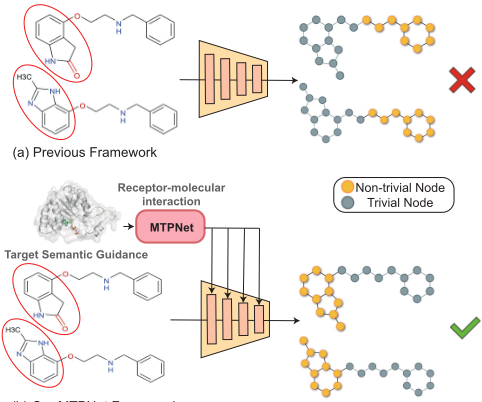
However, existing methods primarily focus on modeling molecules themselves, overlooking the critical role of paired receptor proteins in chemical reactions, particularly in the context of activity cliff (AC) prediction. As shown in Figure 2, these methods face two major challenges: First, the insufficient use of protein features hampers accurate modeling of interactions between molecules and proteins, impacting the precision of AC predictions. Second, these methods struggle to generalize across various types of AC prediction tasks, constraining their applicability to different binding targets. The latter, in particular, has become a significant bottleneck that hinders the widespread adoption of existing approaches. The fundamental principle of ACs suggests that even minor structural changes in molecules can lead to drastic shifts in biological activity, typically driven by complex interactions between ligands and receptor proteins. However, current methods fail to effectively capture these critical dynamic interaction characteristics. To address these challenges, we introduce the Multi-Grained Target Perception (MTP) module, which effectively integrates conditional information from receptor proteins and enhances the model's ability to perceive subtle structural changes. Specifically, the MTP module combines both macro and micro-level semantic guidance, enabling the identification of broad interaction patterns between molecules and the precise detection of small structural variations that result in significant differences in biological activity.
(b) Our MTPNet Framework
Figure 2: Motivation for incorporating receptor protein information in MTPNet. (a) The traditional methods, which only consider molecular features, focus on homogeneous and less significant parts (Motif Pattern). (b) MTPNet, by incorporating receptor protein information, better captures the interaction between molecules and receptors, focusing on the substitution differences in small molecules, thereby effectively revealing the underlying mechanisms of activity cliff formation.
Building upon the MTP module, we further develop MTPNet, a unified framework for activity cliff prediction. MTPNet leverages the MTP module to incorporate receptor protein information into the molecule feature extraction process, enabling efficient predictions across multiple binding targets. By precisely modeling the interactions between molecules and proteins, MTPNet significantly outperforms existing models on datasets with single binding targets, demonstrating superior prediction performance and interpretability. Specifically, experimental results indicate that MTPNet improves RMSE by 7.2% compared to existing SOTA models. Furthermore, MTPNet achieves an Area Under the Curve (AUC) of 0.924, surpassing models such as Mole-BERT (AUC =
0.902) and MolCLR (AUC = 0.896), thereby highlighting its robust generalization capabilities and practical application value across multiple receptor-ligand systems. Moreover, plug-and-play evaluations reveal that with the MTP module, PCC shows an average improvement of 11.6%, R² improves by 17.8%, and RMSE improves by 19.0%, further demonstrating the module's seamless integrability and effectiveness.
In summary, the main contributions of this paper are summaried as follows:
- Integration of Receptor Protein Perception: To the best of our knowledge, MTPNet is the first conditional framework to incorporate receptor protein information into activity cliff prediction task, internalizing interaction patterns through progressive conditional deep learning.
- Multi-Grained Target Perception Module: We propose the Multi-Grained Target Perception (MTP) module, which dynamically optimizes molecular representations through Macro-level Target Semantic (MTS) guidance and Microlevel Pocket Semantic (MPS) guidance, effectively enhancing the predictive performance of the model by complementing the interaction patterns at different levels.
- Unified Framework for Activity Cliff Prediction: MTPNet provides a unified solution for activity cliff prediction across diverse receptor-ligand systems, offering applicability and interpretability.
- Superior Predictive Performance: Extensive experiments on 30 representative activity cliff datasets demonstrate that MTPNet achieves significant improvements in predictive performance, including an average RMSE reduction of 18.95% on top of several mainstream GNN architectures.
2 RelatedWork
Activity Cliff Prediction Methods: Traditional computational methods primarily rely on techniques such as molecular fingerprint comparisons to predict Activity Cliffs [Moriwaki et al., 2018]. Early computational approaches utilized traditional machine learning methods like Support Vector Machines (SVM) [Vapnik, 2013] and Support Vector Regression (SVR) [Drucker et al., 1996] for Activity Cliffs prediction. Although significant progress has been made in achieving high-throughput prediction results, these methods still suffer from limitations in robustness [Dong et al., 2018], generalization [Butler et al., 2018], and interpretability [Moriwaki et al., 2018].
Recent advances in deep learning have significantly improved the prediction of activity cliffs, particularly through enhanced molecular feature representation [Xia et al., 2023a]. Early studies, such as Iqbal et al. [Iqbal et al., 2021], utilized Convolutional Neural Networks (CNNs) to capture spatial features of molecular structures, showcasing the potential of CNNs in molecular data processing. However, as the demand for more powerful molecular embeddings grew, Graph Neural Networks (GNNs) emerged as a superior alternative due to their ability to directly model molecular graphs [Du et al., 2024], effectively capturing complex molecular interactions and learning rich embeddings [Xiang et al., 2024; Zheng et al., 2024; Nie et al., 2024b; Wu, 2024; Nie et al., 2024a]. For instance, the MoleBERT model [Xia et al., 2023b], which integrates GNNs with pretraining techniques, has significantly improved predictive performance across multiple datasets. Park et al. [Park et al., 2022] introduced the ACGCN model, addressing the information loss issues commonly associated with traditional fingerprint-based methods in structure-activity relationship (SAR) analysis. Additionally, MolCLR [Wang et al., 2022] employs contrastive learning to pretrain molecular graphs, while Transformer-based models have further advanced the field. DeepAC [Chen et al., 2022], a conditional Transformer model, leverages SMILES sequences and activity differences to predict ACs and generate novel compounds. GROVER [Rong et al., 2020], which combines Transformer and GNN architectures, captures both local and global molecular features, achieving outstanding performance.
Protein Language Models: Protein language models (PLMs) have significantly advanced receptor protein feature extraction [Zhao et al., 2023; Li et al., 2023]. ESM [Lin et al., 2023] uses self-supervised learning to pretrain on protein sequences, capturing rich features for downstream receptor function prediction, particularly on large-scale datasets. ProteinBERT [Brandes et al., 2022], pretrained on large protein datasets, optimizes BERT for sequence modeling, showing high adaptability and efficiency. DeepProSite [Fang et al., 2023] integrates sequence and structural information to improve receptor function prediction accuracy. DeepProtein [Xie and Fu, 2025] provides a versatile library and benchmark for protein sequence learning, enhancing predictions of function, localization, and interactions. SaProt [Su et al., 2023] integrates sequence and structural data for precise feature extraction, excelling in ligand binding and function prediction.
3 Methodology
3.1 Preliminaries
Activity Cliff Definition: In the process of molecular binding with receptor proteins, the binding target describes the spatial arrangement and interaction patterns between molecules and protein receptors. Different binding targets can affect how molecules bind to receptor proteins, thereby influencing the training of the model. Therefore, understanding and handling different binding targets is crucial for improving the accuracy of activity cliff prediction models. In the task of activity cliff prediction, based on the diversity of different datasets and binding targets, we categorize binding targets into single binding target and multiple binding targets.
Formally, let D be an activity cliff molecular dataset, where each xi represents the input features of a molecularreceptor pair, and yi represents the corresponding continuous property value, i.e., the change in compound potency values (∆pKi), reflecting the difference in assay-independent equilibrium constants (Ki). The input features xi include the receptor protein features xpro(m) i and the ligand molecule features xmol(m) i , which are fused using the Multi-Grained Target Perception (MTP) Module to capture the important interaction features between the protein and ligand.
Single Binding Target: In single binding target learning, it is assumed that all molecular-receptor pairs follow the same binding target, and the dataset is represented as:
The learning objective is to fit a mapping function:
Multiple Binding Targets: In multiple binding target learning, it is assumed that the dataset contains multiple different and independent binding targets, and the dataset is represented as:
where each Dm = {(xpro(m) i , xmol(m) i , y(m) i )}Nm i=1 corresponds to the m-th binding target. The learning objective remains to fit a general mapping function:
3.2 MTPNet
MTPNet is a receptor-aware framework designed to unify activity cliff prediction tasks across multiple binding targets, achieving efficient and flexible modeling. At its core lies the Multi-Grained Target Perception (MTP) Module, which employs a Multigranularity Protein Semantic Condition through Macro-level Target Semantic (MTS) guidance and Microlevel Pocket Semantic (MPS) guidance to dynamically capture the complex interaction patterns between receptors and ligands. In the MTPNet framework, molecules and target proteins are first embedded, where the ESM2 model is used to extract deep semantic information from proteins, and the Mole-BERT model is employed to capture key features of molecules. Subsequently, the MTP module alternates between global context integration and local structural refinement, progressively optimizing ligand feature representations and aligning them with target features. This approach significantly enhances the capability to model activity cliff phenomena.
MTPNet leverages MTP's global-local guidance mechanism to dynamically adapt to multiple binding targets, avoiding redundancy of separate models. This design seamlessly integrates global features Ftarget and local features Fpocket into the optimization of ligand representations Fmol, unifying the feature modeling process across multiple binding targets. By fusing receptor protein and ligand features and modeling multiple binding targets through MTP, MTPNet not only addresses the challenges of activity cliff prediction in multibinding target scenarios but also provides a highly efficient and accurate framework for diverse receptor-ligand systems. This makes MTPNet a unified and flexible paradigm for activity cliff modeling.
Multi-Grained Target Perception (MTP) Module
The Multi-Grained Target Perception (MTP) Module employs a Multigranularity Protein Semantic Condition to dynamically align ligand and target features through global and localized interaction modeling. This strategy combines two complementary mechanisms: Macro-level Target Semantic (MTS) Guidance and Micro-level Pocket Semantic (MPS) Guidance. In the MTP module, the input ligand feature matrix Fmol ∈ Rm×d and target protein feature matrix Ftarget ∈ Rn×d are iteratively refined layer by layer through global and localized semantic modeling to optimize Fmol.
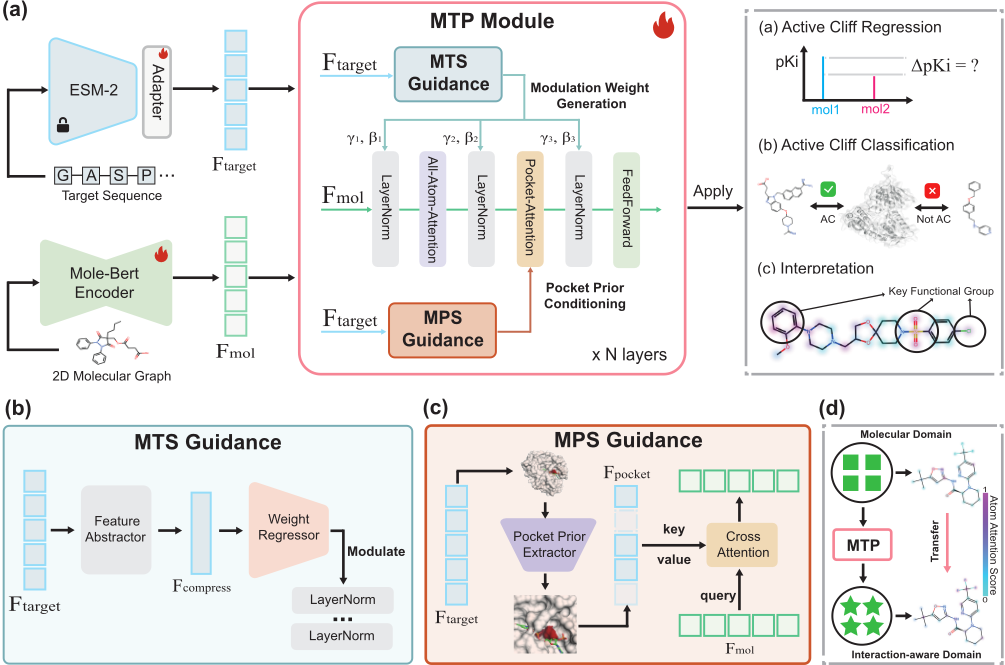
Thus, the layer-by-layer adjustment process is essentially a recursive optimization of Fmol, while target features Ftarget provide global and localized semantic guidance alternately through MTS and MPS. By alternating between these two mechanisms and using attention mechanisms, the MTP module dynamically captures critical molecular-receptor interaction patterns underlying activity cliffs.
In the MTP module, the outputs of MTS (see Eq.11) and MPS (see Eq.13) are alternately used within a stacked attention framework, enabling progressive updates to the ligand representation. This process is described as follows:
First, the MTS Guidance generates the initial optimized ligand features by aligning the ligand representation Fmol with the global context of the receptor Ftarget. This alignment is achieved through a self-attention mechanism (SA) combined with conditionally normalized ligand features, as defined in Eq.11. The initial ligand representation is computed as:
At the l-th layer, the ligand features are refined by alternately incorporating localized receptor information from the MPS Guidance. Using the cross-attention mechanism, the MPS Guidance integrates the ligand features Fmol with pocket features Fpocket, as defined in Eq.13. The ligand representation at each layer is updated iteratively as:
In each iteration, the refined ligand features F (l) mol undergo a further transformation that includes a two-layer feedforward network with dropout and ReLU activation. This process ensures that the updated features effectively capture the dynamic receptor-ligand interaction patterns.
Finally, after L stacked layers of iterative refinement, the MTP module outputs the fully optimized ligand features ΦMTP, which comprehensively integrate both global (MTS) and localized (MPS) receptor information (see Eq.7).
The MTP module provides a comprehensive framework for global and localized semantic optimization. Within the multi-layer stacked attention structure, the MTP module combines the global and localized feature extraction capabilities of MTS and MPS, effectively addressing the challenges posed by multi-binding target scenarios while efficiently integrating receptor protein and ligand molecule features. This approach not only captures subtle molecular structural changes that lead to activity cliffs but also significantly enhances the performance of molecular property prediction.
Macro-level Target Semantic (MTS) Guidance
The Macro-level Target Semantic (MTS) Guidance aims to extract dynamic semantic information from the global context of receptor proteins to align ligand features Fmol with target features Ftarget, facilitating the learning of the mapping fm from x to y. MTS uses the Feature Abstractor to facilitate the extraction of global semantic information from the receptor features. The Feature Abstractor compresses the receptor features to capture their key semantic characteristics. Specifically, it performs average pooling on the input target features Ftarget, reducing the feature dimensions while extracting global semantic information, thus providing simplified.
Then, the global semantic embedding is passed through a Weight Regressor to generate dynamic conditional weights (γi, βi), which are used to adjust the distribution of ligand features. The Weight Regressor module is responsible for generating these weights through a linear transformation, with the core strategy being the linear transformation of global semantic embeddings. This allows the model to learn how to adjust the feature distribution at each layer. Specifically, the Weight Regressor generates a set of dynamic conditional weights based on the input global semantic information, which are then used to modulate the ligand features via Adaptive Layer Normalization (AdaLN), providing dynamic adaptation to different inputs and enhancing the model's flexibility and performance.
In each layer, the ligand features Fmol are refined using Adaptive Layer Normalization (AdaLN), incorporating the conditional weights γi and βi generated by the Weight Regressor to dynamically adjust the feature distribution:
The conditionally normalized ligand features are passed into a self-attention (SA) module to extract global contextual representations of the ligand.
Through this process, the Macro-level Target Semantic (MTS) Guidance dynamically adjusts ligand features to align them with the global semantic context of the receptor. This alignment ensures that the ligand representation captures the global semantic patterns induced by the receptor, thereby supporting further optimization of ligand features and improving the extraction of protein-ligand interaction features.
Micro-level Pocket Semantic (MPS) Guidance
The Micro-level Pocket Semantic (MPS) Guidance focuses on the receptor's binding pocket region to capture local interaction patterns between receptors and ligands. By integrating the binding pocket features Fpocket with ligand features Fmol, the MPS Guidance refines the mapping fm from x to y, enhancing the model's understanding of localized receptorligand interactions.
Specifically, for the target features Ftarget ∈ Rn×d and ligand features Fmol ∈ Rm×d , the binding pocket features Fpocket ∈ Rp×d are extracted from Ftarget using Pocket Prior Extractor (e.g., Cavity Plus [Xu et al., 2018]). These pocket features are then combined with the ligand features Fmol through a cross-attention mechanism to achieve a deep interaction.
In the cross-attention mechanism, the molecule features Fmol are used to compute the query vector Qmol, while the ligand features Fmol and pocket features Fpocket are concatenated to generate the key vector Kpocket and value vector Vpocket. The attention weights are computed using the scaled dot-product attention mechanism:
where Qmol = WqFmol,Kpocket = WkFpocket, Vpocket = WvFpocket and Wq,Wk,Wv ∈ Rd×d are learnable linear transformation matrices that extract the corresponding representations from the ligand and pocket features.
Through this process, the MPS Guidance effectively integrates ligand features Fmol and pocket features Fpocket, capturing the fine-grained interaction patterns between the receptor binding pocket and the ligand. By focusing on relevant molecular substructures, it enhances the model's sensitivity to subtle changes in molecular activity.
The MPS Guidance provides localized semantic alignment, complementing the global contextual representations generated by the Macro-level Target Semantic (MTS) Guidance, ensuring a comprehensive understanding of receptor-ligand interactions.
4 Experiments
4.1 Data and Experimental Setups
All evaluations in this section are conducted on datasets from MoleculeACE (Activity Cliff Estimation) [Van Tilborg et al., 2022], an open-access benchmarking platform available on GitHub at https://github.com/molML/MoleculeACE. This platform provides over 35,000 molecules distributed across 30 macromolecular targets, each corresponding to a separate dataset. Among these, 12 datasets contain fewer than 1,000 molecules in the training set, making MoleculeACE particularly suitable for evaluating model performance in low-data regimes.
In our experiments, we use the MTPNet framework, which integrates the Multi-Grained Target Perception (MTP) Module to dynamically model receptor-ligand interactions. MTP leverages both macro-level receptor context and micro-level binding pocket features to refine ligand representations, enabling precise activity cliff estimation. This receptor-aware design ensures that MTPNet can effectively capture the complex interplay between ligands and receptors, even in scenarios with limited data.
4.2 Performance Evaluation and Comparison
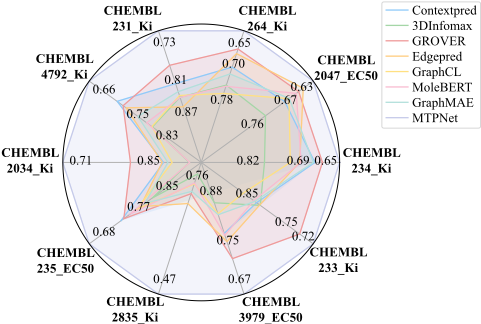
We first compared MTPNet with various machine learning (ML) and deep learning (DL) baseline algorithms on the MoleculeACE dataset, focusing on evaluating the prediction performance of activity cliff molecules. The specific results are presented in Figure 1 and Appendix. The analysis results indicate that MTPNet outperforms all baseline methods across the 30 activity cliff datasets, achieving the lowest RMSE values. Notably, MTPNet exhibits an average improvement of 18.95%, which is significantly higher than the performance gains achieved by current state-of-the-art (SOTA) pretraining methods. This finding emphasizes the importance of integrating receptor protein information in effectively addressing activity cliff tasks.
To validate the robustness and effectiveness of the MTP module, we conducted an evaluation on 30 activity cliff datasets within MoleculeACE, focusing on its impact as a plug-and-play enhancement for baseline models such as GCN [Kipf and Welling, 2017], GAT [Veliˇckovi´c et al., 2017], GIN [Xu et al., 2019], GraphTrans [Wu et al., 2021], MolCLR [Wang et al., 2022], and Mole-BERT [Xia et al., 2023b]. As shown in Table 1, integrating the MTP module resulted in consistent improvements, with PCC increasing by 11.6%, R² by 17.8%, and RMSE decreasing by 19.0%. Additionally, we conducted a "scale-up" experiment by expanding the baseline models to match the parameter size of their MTP-augmented counterparts without incorporating the MTP module. The results indicate that while parameter scaling (e.g., increasing GCN's parameter size from 1.11M to 3.17M) slightly reduced RMSE from 0.950 to 0.915, the improvement was limited and still fell far short of the performance achieved by incorporating the MTP module (RMSE further reduced to 0.744). These findings demonstrate that the MTP module excels in capturing multi-level semantic information and structural nuances between molecules and receptors, far surpassing the benefits of merely increasing model size, thereby highlighting the unique strengths of the MTP module design.
| Model | PCC ↑ | R² ↑ | RMSE ↓ | Param. ↓ |
|---|---|---|---|---|
| GCNICLR2017 | 0.711 | 0.501 | 0.950 | 1.11M |
| w/ Scale up | 0.737 | 0.541 | 0.915 | 3.17M |
| w/ MTP | 0.837 | 0.693 | 0.744 | 3.83M |
| GATICLR2018 | 0.706 | 0.497 | 0.956 | 6.69M |
| w/ Scale up | 0.715 | 0.506 | 0.945 | 9.85M |
| w/ MTP | 0.828 | 0.683 | 0.756 | 9.42M |
| GINICLR2019 | 0.718 | 0.509 | 0.941 | 2.25M |
| w/ Scale up | 0.731 | 0.535 | 0.922 | 5.02M |
| w/ MTP | 0.826 | 0.674 | 0.767 | 4.97M |
| GraphTrans NIPS2021 | 0.719 | 0.515 | 0.936 | 3.43M |
| w/ Scale up | 0.751 | 0.559 | 0.897 | 6.88M |
| w/ MTP | 0.828 | 0.676 | 0.765 | 6.15M |
| MolCLRNMI2023 | 0.715 | 0.504 | 0.946 | 2.04M |
| w/ Scale up | 0.724 | 0.526 | 0.929 | 4.53M |
| w/ MTP | 0.822 | 0.668 | 0.774 | 4.76M |
| Mole-BERTICLR2023 | 0.721 | 0.504 | 0.947 | 2.34M |
| w/ Scale up | 0.742 | 0.546 | 0.906 | 4.78M |
| w/ MTP | 0.845 | 0.703 | 0.733 | 5.07M |
In addition to these evaluations, we also assessed the performance of MTPNet in classification tasks. Specifically, we conducted experiments on the CYP3A4 dataset [Rao et al., 2022] (see Table 2), which includes activity cliff data of Cytochrome P450 3A4 inhibitors/substrates experimentally measured by Veith et al. (2009) [Veith et al., 2009], comprising 3,626 active inhibitors/substrates and 5,496 inactive compounds. The results show that the MTPNet achieved an AUC of 0.924, significantly outperforming baseline models like Mole-BERT (AUC = 0.902) and MolCLR (AUC = 0.896). These results demonstrate that MTPNet excels not only in regression tasks but also in classification tasks, effectively capturing activity cliffs and showcasing its potential for drug discovery and molecular activity prediction.
| Model | AUC |
|---|---|
| GCNICLR2017 | 0.766 |
| GATICLR2018 | 0.773 |
| SemiMolIJCAI2024 | 0.857 |
| GraphTrans NIPS2021 | 0.890 |
| Mole-BERTICLR2023 | 0.902 |
| MolCLRNMI2023 | 0.896 |
| Ours | 0.924 |
4.3 Ablation Study
To evaluate the contribution of each component in MTPNet, we conducted an ablation study (see Table 3) comparing model performance with and without the Adaptive LayerNorm (AdaLN) and Cross Attention (CA) modules. Removing AdaLN is equivalent to disabling Macro-level Target Semantic (MTS) guidance, while removing CA corresponds to disabling Micro-level Pocket Semantic (MPS) guidance. The results show that removing either the AdaLN or CA module leads to a decline in PCC, R², and RMSE, which underscores the critical role of MTS guidance and MPS guidance in capturing global receptor semantics and localized receptor-ligand interactions.
| Model | PCC ↑ | R² ↑ | RMSE ↓ |
|---|---|---|---|
| w/o MTS &MPS w/o MTS w/o MPS Ours | 0.737 | 0.526 | 0.917 |
| 0.830 | 0.680 | 0.760 | |
| 0.826 | 0.676 | 0.766 | |
| 0.845 | 0.703 | 0.733 |
4.4 Interpretation
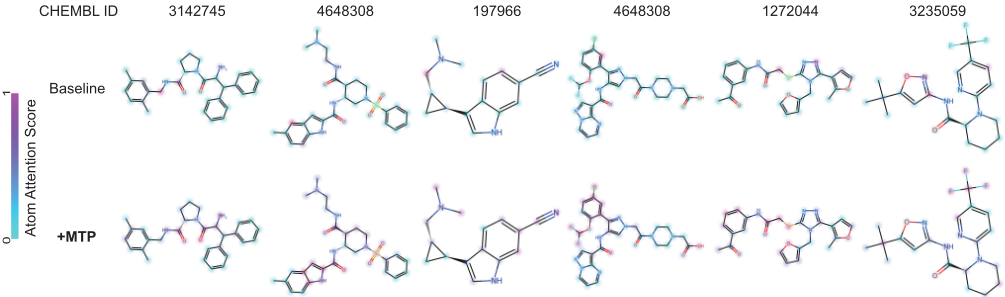
MTPNet, by integrating global and local semantic guidance, accurately captures the interaction patterns between key functional groups and chemical bonds within molecules, thereby uncovering the chemical essence of activity cliff phenomena. Figure 4 shows that the MTP module assigns significant attention to key functional groups such as amino groups (NH2), carbonyl groups (C=O), sulfonyl groups (O=S=O), carboxyl groups (COOH), and halogen groups, as well as to specific chemical bonds such as double and triple bonds. Its attention distribution is far superior to the dispersed attention of baseline models. These functional groups and chemical bonds play critical roles in molecular binding affinity and activity changes with receptors. For instance, amino groups influence molecular activity by forming hydrogen bonds, sulfonyl groups regulate molecular solubility and receptor-binding stability due to their strong polarity, and halogen groups and carboxyl groups significantly impact molecular behavior by modulating hydrophobicity and acidity, respectively. For molecules containing both key functional groups and specific chemical bonds, the MTP module generally assigns greater attention to functional groups than to chemical bonds. This observation supports an important principle in chemistry: functional groups are more critical than chemical bonds in determining molecular properties and reactivity. By capturing this pattern, the MTP module demonstrates strong interpretability, even reflecting fundamental chemical principles. In summary, the MTP module significantly enhances the interpretability of activity cliff predictions, accurately identifying key activity sites within molecules and revealing the core influence of functional groups and chemical bonds on molecular behavior. This has profound implications for the study of chemical reaction mechanisms and protein-ligand binding rules, while also offering novel perspectives and approaches for understanding the causes of activity cliffs and exploring complex receptor-ligand interaction mechanisms.
5 Conclusion
By introducing the interactions of molecules and their target proteins as the guidance, MTPNet achieves unified prediction across diverse downstream tasks related to activity cliffs. Through internalizing interaction patterns at different granularities, MTPNet comprehensively outperforms other methods on 30 representative datasets. In addition, when MTPNet is adopted as a plug-in, the prediction performance of multiple mainstream GNN architectures is significantly improved, showing ideal usability and robustness. Looking to the future, MTPNet is expected to achieve more efficient hit-to-lead optimization to accelerate drug design.
Ethical Statement
There are no ethical issues.
Acknowledgments
This work was supported in part by the Shenzhen Medical Research Funds in China (No. B2302037), Natural Science Foundation of China (No. 61972217, 32071459, 62176249, 62006133, 62271465), and AI for Science (AI4S)- Preferred Program, Peking University Shenzhen Graduate School, China.
Contribution Statement
This work was a collaborative effort by all contributing authors. Zishan Shu, Yufan Deng, and Hongyu Zhang made equal contributions to this study and are designated as co-first authors. Zhiwei Nie and Jie Chen, serving as the corresponding authors, are responsible for all communications related to this manuscript.
@inproceedings{ijcai2025p860,
  title     = {MTPNet: Multi-Grained Target Perception for Unified Activity Cliff Prediction},
  author    = {Shu, Zishan and Deng, Yufan and Zhang, Hongyu and Nie, Zhiwei and Chen, Jie},
  booktitle = {Proceedings of the Thirty-Fourth International Joint Conference on
               Artificial Intelligence, {IJCAI-25}},
  publisher = {International Joint Conferences on Artificial Intelligence Organization},
  editor    = {James Kwok},
  pages     = {7733--7741},
  year      = {2025},
  month     = {8},
  note      = {Main Track},
  doi       = {10.24963/ijcai.2025/860},
  url       = {https://doi.org/10.24963/ijcai.2025/860},
}
TY - CPAPER TI - MTPNet: Multi-Grained Target Perception for Unified Activity Cliff Prediction AU - Shu, Zishan AU - Deng, Yufan AU - Zhang, Hongyu AU - Nie, Zhiwei AU - Chen, Jie T2 - Proceedings of the Thirty-Fourth International Joint Conference on Artificial Intelligence, IJCAI-25 PB - International Joint Conferences on Artificial Intelligence Organization PY - 2025 SP - 7733 EP - 7741 DO - 10.24963/ijcai.2025/860 UR - https://doi.org/10.24963/ijcai.2025/860 ER -Copied
Machine-readable versions of this paper, for tools and AI agents:





