
MeteGS:Meteorology-Guided Gaussian Splatting for Scene Rendering and Recovery in Adverse Weather Conditions
Proceedings of the Thirty-Fifth International Joint Conference on Artificial Intelligence. Main Track. Pages 1070-1078.
https://doi.org/10.24963/ijcai.2026/120
Keywords
- Computer Vision: 3D computer vision
Abstract
3D Gaussian Splatting enables efficient, high-fidelity novel view synthesis with explicit Gaussians and differentiable rendering. However, adverse weather introduces rain streaks and droplets as well as volumetric scattering, producing view-dependent, spatially varying degradations that break the clean multi-view consistency assumption and lead to geometric drift and unstable appearance. Existing approaches are largely confined to the 2D image domain and seldom model the 3D degradation formation process, limiting controllable weather synthesis and consistent restoration in 3DGS. To our knowledge, we are the first to incorporate real meteorological observations as an external prior and propose a 3D-level unified rendering–restoration framework for joint deraining and dehazing within a single 3DGS pipeline. Precipitation is mapped to interpretable parameters controlling the density and morphology of rain Gaussians, while an atmospheric-scattering extinction strength drives 3D fog generation for reproducible weather modeling. We adopt a closed-loop dual-branch optimization where the rendering branch fits degraded observations to capture weather degradation patterns, and the restoration branch regularizes scene Gaussians toward a clean domain with multi-scale perceptual consistency, suppressing artifacts and improving cross-view detail fidelity. Experiments across diverse scenes and weather conditions consistently outperform strong baselines on all three metrics, with a particularly notable PSNR improvement of 1.78 dB on average.
- [Bohren and Huffman, 2008] Craig F Bohren and Donald R Huffman. Absorption and scattering of light by small par- ticles. John Wiley & Sons, 2008.
- [Chen et al., 2022] Xingyu Chen, Qi Zhang, Xiaoyu Li, Yue Chen, Ying Feng, Xuan Wang, and Jue Wang. Halluci- nated neural radiance fields in the wild. In Proceedings of the IEEE/CVF Conference on Computer Vision and Pat- tern Recognition, pages 12943-12952, 2022.
- [Chen et al., 2024] Yiwen Chen, Zilong Chen, Chi Zhang, Feng Wang, Xiaofeng Yang, Yikai Wang, Zhongang Cai, Lei Yang, Huaping Liu, and Guosheng Lin. Gaussianedi- tor: Swift and controllable 3d editing with gaussian splat- ting. In Proceedings of the IEEE/CVF conference on com- puter vision and pattern recognition, pages 21476-21485, 2024.
- [Chen et al., 2025] Xiang Chen, Jinshan Pan, Jiangxin Dong, and Jinhui Tang. Towards unified deep image de- raining: A survey and a new benchmark. IEEE Transac- tions on Pattern Analysis and Machine Intelligence, 2025.
- [Dai et al., 2025] Qiyu Dai, Xingyu Ni, Qianfan Shen, Wen- zheng Chen, Baoquan Chen, and Mengyu Chu. Rainygs: Efficient rain synthesis with physically-based gaussian splatting. In Proceedings of the Computer Vision and Pat- tern Recognition Conference, pages 16153-16162, 2025.
- [Fridovich-Keil et al., 2022] Sara Fridovich-Keil, Alex Yu, Matthew Tancik, Qinhong Chen, Benjamin Recht, and Angjoo Kanazawa. Plenoxels: Radiance fields without neural networks. In Proceedings of the IEEE/CVF con- ference on computer vision and pattern recognition, pages 5501-5510, 2022.
- [Garg and Nayar, 2006] Kshitiz Garg and Shree K Nayar. Photorealistic rendering of rain streaks. ACM Transactions on Graphics (TOG), 25(3):996-1002, 2006.
- [Garg and Nayar, 2007] Kshitiz Garg and Shree K Nayar. Vision and rain. International Journal of Computer Vision, 75(1):3-27, 2007.
- [Jarraud, 2008] M Jarraud. Guide to meteorological instru- ments and methods of observation (wmo-no. 8). World Meteorological Organisation: Geneva, Switzerland, 29, 2008.
- [Johnson et al., 2016] Justin Johnson, Alexandre Alahi, and Li Fei-Fei. Perceptual losses for real-time style transfer and super-resolution. In European conference on computer vision, pages 694-711. Springer, 2016.
- [Kerbl et al., 2023] Bernhard Kerbl, Georgios Kopanas, Thomas Leimkühler, and George Drettakis. 3d gaus- sian splatting for real-time radiance field rendering. ACM Trans. Graph., 42(4):139-1, 2023.
- [Kulhanek et al., 2024] Jonas Kulhanek, Songyou Peng, Zuzana Kukelova, Marc Pollefeys, and Torsten Sattler. Wildgaussians: 3d gaussian splatting in the wild. arXiv preprint arXiv:2407.08447, 2024.
- [Lee and Shang, 2016] Zhongping Lee and Shaoling Shang. Visibility: how applicable is the century-old koschmieder model? Journal of the Atmospheric Sciences, 73(11):4573-4581, 2016.
- [Lee et al., 2024] Byeonghyeon Lee, Howoong Lee, Xi- angyu Sun, Usman Ali, and Eunbyung Park. Deblurring 3d gaussian splatting. In European Conference on Com- puter Vision, pages 127-143. Springer, 2024.
- [Li et al., 2019] Siyuan Li, Iago Breno Araujo, Wenqi Ren, Zhangyang Wang, Eric K Tokuda, Roberto Hirata Junior, Roberto Cesar-Junior, Jiawan Zhang, Xiaojie Guo, and Xiaochun Cao. Single image deraining: A comprehen- sive benchmark analysis. In Proceedings of the IEEE/CVF Conference on Computer Vision and Pattern Recognition, pages 3838-3847, 2019.
- [Li et al., 2020] Ruoteng Li, Robby T Tan, and Loong-Fah Cheong. All in one bad weather removal using architec- tural search. In Proceedings of the IEEE/CVF conference on computer vision and pattern recognition, pages 3175- 3185, 2020.
- [Li et al., 2024] Yunhao Li, Jing Wu, Lingzhe Zhao, and Pei- dong Liu. Derainnerf: 3d scene estimation with adhesive waterdrop removal. In 2024 IEEE International Confer- ence on Robotics and Automation (ICRA), pages 2787- 2793. IEEE, 2024.
- [Liu et al., 2025] Shuhong Liu, Xiang Chen, Hongming Chen, Quanfeng Xu, and Mingrui Li. Deraings: Gaus- sian splatting for enhanced scene reconstruction in rainy environments. In Proceedings of the AAAI Conference on Artificial Intelligence, volume 39, pages 5558-5566, 2025.
- [Ma et al., 2022] Li Ma, Xiaoyu Li, Jing Liao, Qi Zhang, Xuan Wang, Jue Wang, and Pedro V Sander. Deblur-nerf: Neural radiance fields from blurry images. In Proceed- ings of the IEEE/CVF conference on computer vision and pattern recognition, pages 12861-12870, 2022.
- [Martin-Brualla et al., 2021] Ricardo Martin-Brualla, Noha Radwan, Mehdi SM Sajjadi, Jonathan T Barron, Alexey Dosovitskiy, and Daniel Duckworth. Nerf in the wild: Neural radiance fields for unconstrained photo collections. In Proceedings of the IEEE/CVF conference on computer vision and pattern recognition, pages 7210-7219, 2021.
- [Mildenhall et al., 2021] Ben Mildenhall, Pratul P Srini- vasan, Matthew Tancik, Jonathan T Barron, Ravi Ra- mamoorthi, and Ren Ng. Nerf: Representing scenes as neural radiance fields for view synthesis. Communications of the ACM, 65(1):99-106, 2021.
- [Müller et al., 2022] Thomas Müller, Alex Evans, Christoph Schied, and Alexander Keller. Instant neural graphics primitives with a multiresolution hash encoding. ACM transactions on graphics (TOG), 41(4):1-15, 2022.
- [Narasimhan and Nayar, 2002] Srinivasa G Narasimhan and Shree K Nayar. Vision and the atmosphere. International journal of computer vision, 48(3):233-254, 2002.
- [Narasimhan and Nayar, 2003] Srinivasa G. Narasimhan and Shree K. Nayar. Contrast restoration of weather degraded images. IEEE transactions on pattern analysis and ma- chine intelligence, 25(6):713-724, 2003.
- [Nishita et al., 1993] Tomoyuki Nishita, Takao Sirai, Kat- sumi Tadamura, and Eihachiro Nakamae. Display of the earth taking into account atmospheric scattering. In Proceedings of the 20th annual conference on Computer graphics and interactive techniques, pages 175-182, 1993.
- [Qian et al., 2025] Chenghao Qian, Yuhu Guo, Wenjing Li, and Gustav Markkula. Weathergs: 3d scene reconstruc- tion in adverse weather conditions via gaussian splatting. In 2025 IEEE International Conference on Robotics and Automation (ICRA), pages 185-191. IEEE, 2025.
- [Ren et al., 2019] Dongwei Ren, Wangmeng Zuo, Qinghua Hu, Pengfei Zhu, and Deyu Meng. Progressive image de- raining networks: A better and simpler baseline. In Pro- ceedings of the IEEE/CVF conference on computer vision and pattern recognition, pages 3937-3946, 2019.
- [Sabour et al., 2025] Sara Sabour, Lily Goli, George Kopanas, Mark Matthews, Dmitry Lagun, Leonidas Guibas, Alec Jacobson, David Fleet, and Andrea Tagliasacchi. Spotlesssplats: Ignoring distractors in 3d gaussian splatting. ACM Transactions on Graphics, 44(2):1-11, 2025.
- [Simonyan and Zisserman, 2014] Karen Simonyan and An- drew Zisserman. Very deep convolutional networks for large-scale image recognition. arXiv preprint arXiv:1409.1556, 2014.
- [Song et al., 2023] Yuda Song, Zhuqing He, Hui Qian, and Xin Du. Vision transformers for single image dehazing. IEEE Transactions on Image Processing, 32:1927-1941, 2023.
- [Valanarasu et al., 2022] Jeya Maria Jose Valanarasu, Rajeev Yasarla, and Vishal M Patel. Transweather: Transformer- based restoration of images degraded by adverse weather conditions. In Proceedings of the IEEE/CVF conference on computer vision and pattern recognition, pages 2353- 2363, 2022.
- [Wu et al., 2024] Guanjun Wu, Taoran Yi, Jiemin Fang, Lingxi Xie, Xiaopeng Zhang, Wei Wei, Wenyu Liu, Qi Tian, and Xinggang Wang. 4d gaussian splatting for real-time dynamic scene rendering. In Proceedings of the IEEE/CVF conference on computer vision and pattern recognition, pages 20310-20320, 2024.
- [Xiao et al., 2022] Jie Xiao, Xueyang Fu, Aiping Liu, Feng Wu, and Zheng-Jun Zha. Image de-raining transformer. IEEE transactions on pattern analysis and machine intel- ligence, 45(11):12978-12995, 2022.
- [Yang et al., 2023] Yifan Yang, Shuhai Zhang, Zixiong Huang, Yubing Zhang, and Mingkui Tan. Cross-ray neural radiance fields for novel-view synthesis from un- constrained image collections. In Proceedings of the IEEE/CVF International Conference on Computer Vision, pages 15901-15911, 2023.
- [Zamir et al., 2022] Syed Waqas Zamir, Aditya Arora, Salman Khan, Munawar Hayat, Fahad Shahbaz Khan, and Ming-Hsuan Yang. Restormer: Efficient transformer for high-resolution image restoration. In Proceedings of the IEEE/CVF conference on computer vision and pattern recognition, pages 5728-5739, 2022.
- [Zhang et al., 2024] Dongbin Zhang, Chuming Wang, Weitao Wang, Peihao Li, Minghan Qin, and Haoqian Wang. Gaussian in the wild: 3d gaussian splatting for unconstrained image collections. In European Conference on Computer Vision, pages 341-359. Springer, 2024.
References were extracted automatically from the PDF and may contain errors.
Full text extracted automatically from the PDF; figures, tables and equations may differ. The PDF is the version of record.
1 Introduction
In practical applications such as autonomous driving, mobile robotics, virtual reality, and digital twins, rainy and foggy weather introduces rain streaks, lens-adhered droplets that cause localized blur and refraction, and volumetric scattering that reduces contrast and compresses the effective visibility range. Consequently, observed images suffer substantial degradation in structural detail, texture discriminability, and color consistency. More importantly, these degradations are often spatially non-uniform and vary across viewpoints, which undermines the cross-view consistency constraints fundamental to 3D representation learning and novel view synthesis. This results in suppressed geometric details and unstable appearance, ultimately limiting the reliability of 3D systems under adverse weather.
Photorealistic reconstruction and controllable rendering in complex weather are essential for real-world deployment. However, existing rain and fog modeling largely relies on heuristic 2D effects or simplified volumetric approximations, with limited systematic coupling to real meteorological observations. As a result, it remains difficult to simultaneously achieve physical plausibility, multi-view consistency, and interpretable, controllable parameterization. With the success of 3DGS [Kerbl et al., 2023] in efficient and high-fidelity real-time rendering, a key question arises, namely how to introduce weather effects driven by meteorological priors into 3DGS [Kerbl et al., 2023] representations while effectively enforcing perceptual quality during learning. Meanwhile, prior deraining and dehazing research has primarily focused on the 2D image domain [Chen et al., 2025; Li et al., 2019; Zamir et al., 2022]. Although strong performance has been reported on single-frame metrics, these methods typically do not explicitly model multi-view geometric consistency or cross-view radiometric consistency, and thus tend to produce view-dependent artifacts and inconsistent results in multi-view reconstruction and neural rendering. In addition, many 3D representations assume stable imaging conditions [Mildenhall et al., 2021; Martin-Brualla et al., 2021], and applying per-view 2D restoration as a preprocessing step often propagates restoration errors into the 3D model and amplifies cross-view inconsistency. Therefore, robust 3D modeling in rainy and foggy conditions requires unified correction directly in the 3D representation space rather than frame-wise 2D postprocessing.
To address this challenge, we propose a restoration framework that performs joint deraining and dehazing directly in the 3D representation domain. Specifically, we propose a dedicated weather module within 3DGS [Kerbl et al., 2023] that jointly models rain streaks, lens-droplet-induced local blur, and atmospheric scattering, enabling geometrically consistent 3D weather synthesis and rendering. On the meteorological side, we establish a continuous mapping from real precipitation measurements to rendering parameters, providing interpretable and controllable weather strength. On the restoration side, we leverage a clean 3D scene prior by predicting and correcting residual updates of Gaussian parameters, and impose multi-scale perceptual consistency on rendered outputs. This yields a restored 3D scene with strong cross-view consistency, detail preservation, and stable appearance, while avoiding the view inconsistencies introduced by per-view 2D restoration.
Our main contributions are summarized as follows:
- We propose a real meteorological data-driven parameter mapping module that maps meteorological measurements to interpretable weather parameters, providing precise and controllable inputs for 3D weather rendering.
- We develop a weather rendering model based on 3D Gaussian representations that unifies rain streaks, droplet-induced blur, and atmospheric scattering within a single 3D Gaussian field and supports adjustable weather strength.
- We present an end-to-end 3D reconstruction framework for adverse rain-fog conditions that incorporates multiscale perceptual constraints into 3D Gaussian optimization and refines geometry and appearance via residual correction and cross-scale consistency.
- We conduct a comprehensive evaluation across diverse scenes and weather settings, demonstrating consistent gains over prior baselines in both quantitative metrics and visual quality.
2 RelatedWork
2.1 3DReconstruction
Neural Radiance Fields (NeRF) [Mildenhall et al., 2021] achieve multi-view novel view synthesis via differentiable volumetric rendering, yet their volume integration and dense sampling typically incur high training cost and limited realtime performance [M¨uller et al., 2022; Fridovich-Keil et al., 2022]. In contrast, 3D Gaussian Splatting (3DGS) [Kerbl et al., 2023] represents a scene as a set of 3D Gaussians with anisotropic covariance and appearance parameters, and leverages differentiable splatting to strike a favorable balance between rendering quality and efficiency, making it a representative approach for real-time novel view synthesis. Existing 3DGS [Kerbl et al., 2023] studies mainly focus on geometric and appearance modeling, extensions to dynamic scenes [Wu et al., 2024], and editability [Chen et al., 2024], and are commonly built upon the assumption of stable, clean observations without significant atmospheric degradation. Under adverse weather with time-varying degradations, this assumption is violated, and optimization can be driven by corrupted signals, resulting in geometric drift and unstable appearance with degraded cross-view detail fidelity. Overall, these methods largely adopt a forward synthesis paradigm, focusing on controllable weather generation and photorealistic 3D rendering.
2.2 3D Synthesis of Rain and Fog
Conventional rain and fog synthesis is mostly conducted in the 2D image domain by overlaying rain streaks or noise, or by applying simplified scattering approximations to generate degraded samples [Garg and Nayar, 2006; Garg and Nayar, 2007; Narasimhan and Nayar, 2003; Narasimhan and Nayar, 2002]. While simple and efficient, such strategies are decoupled from true 3D geometry and light transport, making it difficult to guarantee multi-view consistency. To improve consistency, recent work has incorporated particle distributions, volumetric fog fields, or depth-guided scattering into 3D rendering pipelines [Narasimhan and Nayar, 2003; Nishita et al., 1993]. In addition, visibility-oriented scattering formulations are commonly used to relate attenuation strength to a physically meaningful notion of visibility range [Lee and Shang, 2016]. Some studies further integrate physically motivated weather effects into 3D Gaussian representations for controllable and scalable weather rendering [Kerbl et al., 2023; Dai et al., 2025]. Overall, these methods emphasize interpretable degradation generation and efficient photorealistic rendering.
2.3 3D Scene Restoration under AdverseWeather
3D scene restoration under adverse weather has mainly progressed along two lines. One representative direction, largely built on NeRF, explicitly incorporates atmospheric effects or occlusion processes into differentiable rendering and jointly optimizes degradation formation together with a clean radiance field, enabling integrated restoration and novel view synthesis from degraded multi-view observations while maintaining geometric consistency [Mildenhall et al., 2021; Li et al., 2024]. With the popularity of 3D Gaussian Splatting (3DGS) [Kerbl et al., 2023], another direction enhances robustness by suppressing transient artifacts during 3DGS optimization, often via visibility reasoning or maskguided fitting, to improve stability and reconstruction quality in unconstrained captures [Martin-Brualla et al., 2021; Chen et al., 2022; Yang et al., 2023; Zhang et al., 2024; Sabour et al., 2025; Kulhanek et al., 2024]. Recently, weather-oriented 3DGS frameworks further explore reconstructing clean scenes from adverse-weather observations by explicitly handling precipitation-induced artifacts and lens effects [Qian et al., 2025; Liu et al., 2025]. In parallel, extensive progress has been made in 2D deraining and adverse weather removal [Ren et al., 2019; Xiao et al., 2022; Li et al., 2020; Valanarasu et al., 2022], but these per-view approaches typically do not explicitly enforce multi-view geometric and radiometric consistency, which can lead to viewdependent artifacts when integrated into multi-view reconstruction pipelines. Overall, existing 3D-level methods either co-estimate degradations and clean 3D representations or mitigate transient corruptions within 3DGS [Kerbl et al., 2023], yet they still leave open the need for a unified 3D-level restoration framework that directly recovers a clean, crossview-consistent scene representation from degraded observations.
3 Method
3.1 Preliminaries
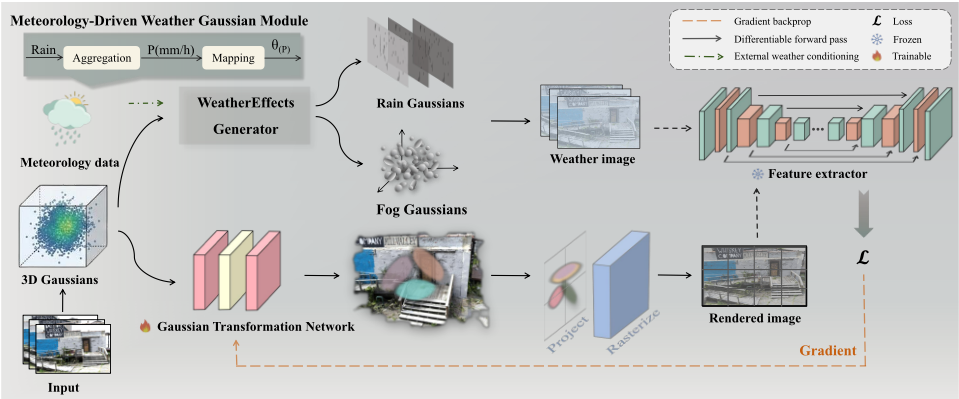
We adopt 3D Gaussian Splatting (3DGS) [Kerbl et al., 2023] as the foundational framework for scene representation and differentiable rendering. The scene is modeled as a set of 3D Gaussian primitives endowed with geometric attributes (e.g., position and shape) as well as opacity and appearance parameters. Given a camera pose, these 3D Gaussians are projected onto the image plane and rendered via differentiable splatting and alpha compositing to produce the final image. Since the entire rendering process is differentiable with respect to the Gaussian parameters, the model can be optimized end-toend by backpropagating gradients from the discrepancy between the rendered images and the corresponding real observations, thereby updating the Gaussian parameters. As shown in Fig. 1, we further augment this differentiable rendering pipeline with a meteorology-driven weather Gaussian module, which generates weather components such as rain streaks and fog conditioned on meteorological cues and jointly renders them with the scene Gaussians to match adverse-weather observations. Meanwhile, additional constraints encourage the scene representation to converge toward the clean domain, enabling unified modeling of weather-induced degradation and scene reconstruction within a single framework.
3.2 Meteorology-DrivenWeather Gaussian
To enable fine-grained, meteorology-driven control of rendering parameters, we design a mapping module grounded in physically motivated empirical formulations. The input to this module is the precipitation rate P (mm/h), derived from accumulated rainfall amounts obtained from meteorological services, either from observations or forecasts. When multiple measurements are available within a temporal window, we aggregate them using Agg(·) ∈ {mean, max, min} to characterize the precipitation intensity at the current time, and normalize the result into a bounded scalar:
Here, Pt denotes the precipitation rate (mm/h) at time t from meteorological observations or forecasts, and Agg(·) optionally aggregates values (mean/max/min) to represent the current intensity. Here, Pmin and Pmax are the normalization bounds, and [·]10 clips to [0, 1]. The normalized factor st is then mapped to weather variables that control the generation and rendering of rain and fog Gaussians. By making weather parameters functions of meteorological inputs, we maintain a physically meaningful link between measured intensity and synthesized degradation, avoiding arbitrary aesthetic tuning.
We denote the meteorology-driven parameter mapping as:
Here, θ(P) denotes the weather-parameter mapping function (or the resulting mapped parameters) driven by the precipitation rate P. θrain represents the parameter set of the Rain Gaussians, and θfog represents the parameter set of the Fog Gaussians. We adopt the precipitation-intensity categories provided by the World Meteorological Organization (WMO) [Jarraud, 2008] as an external prior, and construct a monotonic nonlinear mapping with respect to P such that stronger precipitation yields progressively stronger synthesized weather effects. In the following, we elaborate the specific parameterization and formal definitions of θrain and θfog, respectively.
Concretely, the number of Rain Gaussians is written as:
Here, Nrain is the number of Rain Gaussians controlling rain density, and P is the meteorological precipitation rate. base provides a baseline rain level, k scales the response to precipitation, and γ ∈ (0, 1] introduces a sub-linear nonlinearity to avoid excessive growth under heavy rain. The clamp(·, 0,Nmax) operator enforces the valid range [0, Nmax], where Nmax limits the maximum number of primitives for stable and efficient rendering.
We parameterize fog by θfog, taking inspiration from the classical atmospheric scattering model [Narasimhan and Nayar, 2002]:
where I(d) denotes the observed foggy radiance at depth d, J(d) is the fog-free radiance, t(d) is the transmission, A is the atmospheric light, and β is the extinction coefficient governing attenuation [Bohren and Huffman, 2008]. Rather than explicitly enforcing this image-plane formation model, we use β as a physically grounded control signal within θfog to condition the density and opacity of 3D fog Gaussians, producing progressively stronger fog effects as β increases. In summary, our meteorology-driven design provides interpretable and reproducible control signals for weather Gaussian generation and rendering.
3.3 Joint Optimization Framework
We adopt a closed-loop joint optimization scheme composed of a weather rendering branch and a clean restoration branch, which enables us to explicitly model weather degradations while enforcing clean-scene consistency in the 3D domain. Let the scene be represented by a set of 3D Gaussians, and let the weather effects be represented by a meteorology-driven weather Gaussian, where θ denotes meteorology-conditioned weather parameters controlling both rain and fog effects. Given a camera viewpoint, we construct two parallel forward branches.
Weather rendering branch. This branch feeds the shared scene 3D Gaussians and the meteorology-driven weather Gaussians into the renderer, producing a weather-degraded synthetic image through standard 3DGS [Kerbl et al., 2023] rasterization and alpha compositing:
Here, R(·, c) denotes the differentiable 3DGS [Kerbl et al., 2023] renderer under camera c, Gs is the set of shared scene Gaussians, and Gw(θ) is the set of meteorology-driven weather Gaussians parameterized by θ. The union Gs ∪ Gw(θ) indicates that weather primitives are composited with the scene representation during rendering to synthesize the adverse-weather image ˆ Iw.
If the training data provide the corresponding real weather observation Iobs for the same viewpoint, we supervise the realism of the synthesized weather appearance via a photometric consistency constraint:
where Iobs is the real adverse-weather observation from the same viewpoint, ∥ · ∥1 measures pixel-wise differences, and λ ∈ [0, 1] balances the two terms. Minimizing Lphoto enforces ˆ Iw to match Iobs and provides gradients to the shared scene Gaussians for explicitly modeling weather effects.
Clean restoration branch. In the same iteration, we render a clean image by disabling the weather effects and using only the shared scene Gaussians. This branch enforces cleandomain regularization on the shared 3D representation, encouraging it to capture stable geometry and intrinsic appearance while separating out transient weather-induced degradations. During optimization, it counteracts potential drifts introduced by the weather rendering branch, thereby improving cross-view consistency and stabilizing novel-view synthesis.
We further incorporate a multi-scale perceptual consistency constraint by aligning structural and textural statistics in feature space to suppress over-smoothing and improve detail fidelity. We therefore employ a pretrained feature extractor with frozen parameters [Simonyan and Zisserman, 2014] to avoid training drift. The clean-branch output ˆ Iclean and the corresponding clean reference image Igt are fed into the extractor, and features are collected from multiple intermediate layers. We compute feature discrepancies and aggregate them across layers to obtain the perceptual loss [Johnson et al., 2016]:
Here, ˆ Iclean denotes the rendered clean image, Igt is the corresponding clean reference, Φl(·) is the feature map from the lth frozen layer, and ∥ · ∥1 measures element-wise differences. This loss aligns local contrast, edge shapes, and texture distributions across scales, enabling the clean branch not only to approach the reference at the pixel level but also to preserve textural details, which improves detail fidelity and cross-view appearance stability. Moreover, since deep features are sensitive to texture and noise statistics relevant to restoration, this constraint helps suppress the leakage of residual rain-fog artifacts into the clean rendering. By combining the closedloop dual-branch mechanism with perceptual consistency, we unify explicit degradation accounting and stable clean-scene recovery under a single optimization objective.
The overall training loss is formulated as a weighted combination of a photometric consistency term from the weather rendering branch, a perceptual consistency term from the clean restoration branch, and an optional clean-domain photometric supervision term when clean references are available:
Here, The scalars λphoto, λperc, and λclean weight the relative contributions of these terms. The weather-branch photometric term encourages the synthesized weather appearance to match real degradations and provides optimization signals to the shared 3D scene representation under explicit weatherconditioned rendering. In contrast, the perceptual and clean supervision terms regularize the shared scene representation toward the clean domain, promoting stable geometry and
+3DGS
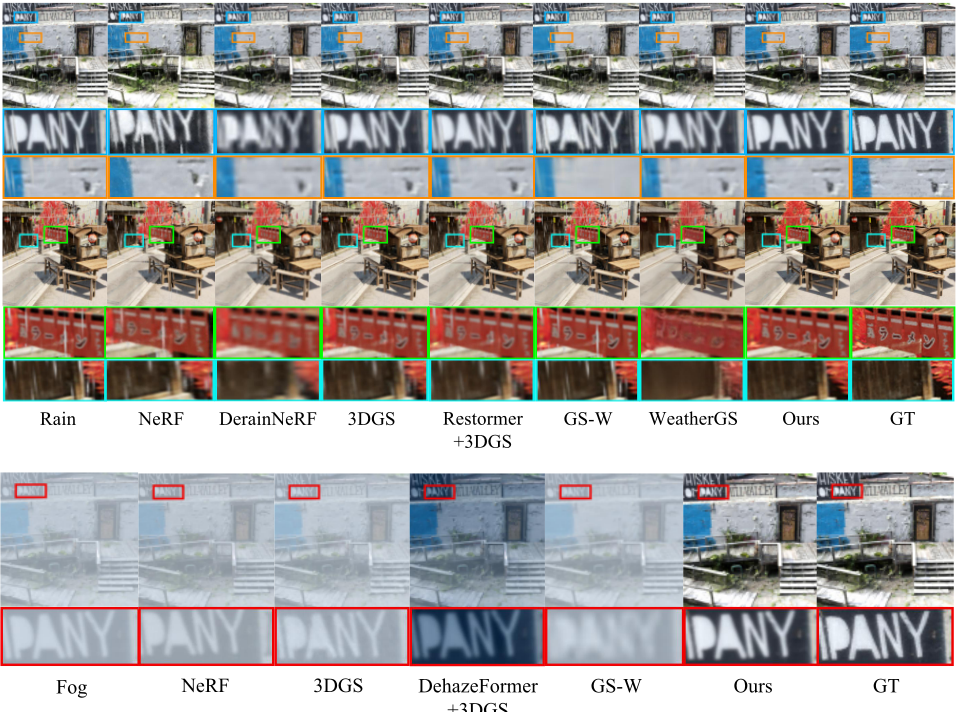
Figure 2: Qualitative results on datasets under rainy (top) and foggy (bottom) conditions.
intrinsic appearance. Through end-to-end backpropagation, these losses jointly optimize the shared scene representation, and weather effects are injected as explicit 3D components conditioned on meteorological cues during rendering.
Overall, the weather branch strengthens the ability to account for degraded observations, while the clean branch strengthens the recovery of intrinsic scene content. The two branches mutually balance each other, enabling cross-view consistent 3D-level deraining/dehazing and detail restoration, and ultimately producing a high-quality clean 3D scene representation for novel view synthesis and downstream tasks.
3.4 Depth-aware Pruning and Point Compensation
We adopt the depth-aware pruning and point compensation strategy fromDeblur-3DGS [Lee et al., 2024] and adapt it to our dual-branch closed-loop framework. For stable structural optimization, densification and pruning statistics are computed only from the shared scene Gaussians (e.g., visibility and projected radius), while weather Gaussians are excluded to prevent transient effects from biasing decisions. In addition, we perform point compensation in sparse regions at early stages by inheriting appearance and local features from neighboring Gaussians, improving the reconstruction of small objects and thin structures and accelerating convergence.
4 Experiments
4.1 Experimental Setup
Datasets. To evaluate the effectiveness of 3D reconstruction under adverse weather, we construct a novel, diverse, and challenging benchmark. Following the base scenes provided by Deblur-NeRF [Ma et al., 2022], we build rainy and foggy inputs for four static multi-view scenes (factory, wine, pool, and tanabata). We further incorporate real precipitation observations from rainfall records of Chinese meteorological stations as the meteorological input for driving the generation of weather parameters. More details about the meteorological data are provided in the supplementary material. Given the clean images and the collected meteorological parameters, we synthesize corresponding rain, fog, and combined rain-fog degraded observations using the weather modeling in Section 3.2, which serve as the degraded inputs for training and testing on the synthetic benchmark. In addition, we evaluate our method on the real-world HydroViews [Liu et al., 2025]
| Model | factory | wine | pool | tanabata | ||||||||
|---|---|---|---|---|---|---|---|---|---|---|---|---|
| PSNR↑ | SSIM↑ | LPIPS↓ | PSNR↑ | SSIM↑ | LPIPS↓ | PSNR↑ | SSIM↑ | LPIPS↓ | PSNR↑ | SSIM↑ | LPIPS↓ | |
| NeRF | 15.305 | 0.276 | 0.543 | 16.415 | 0.351 | 0.265 | 23.324 | 0.671 | 0.283 | 21.842 | 0.586 | 0.328 |
| DerainNeRF | 17.473 | 0.301 | 0.592 | 23.177 | 0.712 | 0.300 | 20.483 | 0.586 | 0.394 | 23.760 | 0.731 | 0.462 |
| 3DGS | 22.285 | 0.673 | 0.304 | 24.468 | 0.806 | 0.241 | 26.874 | 0.764 | 0.252 | 23.173 | 0.675 | 0.327 |
| Restormer+3DGS | 22.712 | 0.635 | 0.379 | 24.851 | 0.605 | 0.262 | 25.132 | 0.713 | 0.263 | 24.327 | 0.526 | 0.284 |
| GS-W | 24.548 | 0.682 | 0.309 | 22.104 | 0.750 | 0.242 | 24.526 | 0.762 | 0.201 | 22.628 | 0.637 | 0.392 |
| WeatherGS | 24.218 | 0.740 | 0.235 | 23.646 | 0.745 | 0.208 | 25.405 | 0.817 | 0.198 | 24.351 | 0.632 | 0.215 |
| Ours | 26.037 | 0.786 | 0.213 | 25.738 | 0.790 | 0.179 | 27.042 | 0.865 | 0.182 | 25.829 | 0.782 | 0.232 |
| Model | factory | wine | pool | tanabata | ||||||||
|---|---|---|---|---|---|---|---|---|---|---|---|---|
| PSNR↑ | SSIM↑ | LPIPS↓ | PSNR↑ | SSIM↑ | LPIPS↓ | PSNR↑ | SSIM↑ | LPIPS↓ | PSNR↑ | SSIM↑ | LPIPS↓ | |
| NeRF | 17.060 | 0.659 | 0.345 | 18.751 | 0.584 | 0.251 | 20.263 | 0.721 | 0.283 | 21.307 | 0.643 | 0.262 |
| 3DGS | 20.226 | 0.725 | 0.274 | 21.478 | 0.682 | 0.391 | 22.057 | 0.741 | 0.266 | 24.472 | 0.801 | 0.205 |
| DehazeFormer+3DGS | 24.795 | 0.667 | 0.303 | 22.574 | 0.705 | 0.263 | 23.568 | 0.730 | 0.198 | 22.196 | 0.761 | 0.291 |
| GS-W | 23.684 | 0.783 | 0.217 | 23.362 | 0.643 | 0.328 | 21.848 | 0.692 | 0.259 | 22.341 | 0.735 | 0.248 |
| Ours | 25.524 | 0.812 | 0.206 | 24.571 | 0.776 | 0.224 | 24.915 | 0.746 | 0.192 | 25.228 | 0.794 | 0.203 |
dataset for qualitative comparison. For HydroViews [Liu et al., 2025], we do not apply any weather rendering. Instead, we directly restore the captured rainy or foggy scenes and compare the results under real conditions.
Implementation details. All methods are compared under the same train and test split and the same input view configuration. Our reconstruction backbone is built upon the 3DGS [Kerbl et al., 2023] framework and implemented in PyTorch. We further employ a lightweight learnable MLP (Gaussian Transformation Network), whose main body consists of three fully connected layers with width 64 and ReLU activations, followed by several linear prediction heads. Its input is formed by concatenating the positional encodings of 3D position and viewing direction (with frequencies 3 and 10, respectively) with scale and rotation features. All experiments are conducted on a single RTX 3090 GPU for 30,000 training iterations, and all input images are resized to a resolution of 600 × 400. Unless otherwise specified, we set the loss weights to λphoto = 1.0, λperc = 0.05, and λclean = 0.1.
Comparison and metrics. To evaluate visual quality, we compare renderings produced by our method with those from state-of-the-art 3D reconstruction approaches, including NeRF [Mildenhall et al., 2021], DerainNeRF [Li et al., 2024], 3DGS [Kerbl et al., 2023], GS-W [Zhang et al., 2024], and WeatherGS [Qian et al., 2025]. We also consider two-stage pipelines that combine 2D restoration with 3D reconstruction, using Restormer+3DGS for rainy scenes [Zamir et al., 2022; Kerbl et al., 2023] and DehazeFormer+3DGS for foggy scenes [Song et al., 2023; Kerbl et al., 2023]. For quantitative evaluation, we benchmark all methods using three standard metrics, namely peak signal-to-noise ratio (PSNR), structural similarity index (SSIM), and learned perceptual image patch similarity (LPIPS).
4.2 Qualitative Analysis
To analyze differences in fine-structure recovery and appearance stability, we present representative qualitative comparisons on rainy and foggy scenes in Fig. 2. NeRF [Mildenhall et al., 2021] and 3DGS [Kerbl et al., 2023] often exhibit geometric drift, unstable textures, or residual artifacts under degraded observations. While two-stage pipelines (e.g., Restormer [Zamir et al., 2022] and DehazeFormer [Song et al., 2023] combined with 3DGS [Kerbl et al., 2023]) can alleviate some degradations, per-frame restoration errors tend to accumulate across views, leading to cross-view-inconsistent "floating" textures. In contrast, our method explicitly models weather degradations in the 3D representation space and imposes clean-domain regularization, enabling more faithful recovery of structural edges and material textures, while maintaining consistent color and contrast across viewpoints.
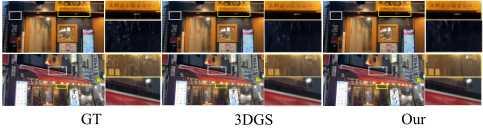
To further assess generalization in real-world conditions, Fig. 3 reports qualitative results on captured rainy scenes. These examples exhibit challenging degradations such as dense, non-uniform rain streaks and local blur, which often lead to texture instability and residual artifacts for the 3DGS [Kerbl et al., 2023] baseline. In comparison, our method produces cleaner reconstructions with sharper structures and more stable textures, and the zoomed-in regions highlight its improved recovery of fine details.
4.3 Quantitative Analysis
Table 1 reports quantitative results on rainy scenes. Overall, our method achieves the most consistent performance across all four scenes and attains the best or second-best results under all metrics, demonstrating robust recovery of geometry and appearance under rain streaks and droplet-induced blur. Compared with the strongest 3D-level baseline, WeatherGS [Qian et al., 2025], our approach provides more stable improvements across scenes. We also observe scenedependent trade-offs in prior methods, 3DGS [Kerbl et al., 2023] attains relatively higher SSIM on wine but falls behind in overall quality, whereas WeatherGS yields lower LPIPS on tanabata at the cost of reduced SSIM. These results suggest that suppressing transient artifacts alone is insufficient; in contrast, our method better balances structural fidelity and texture recovery, leading to more reliable restoration under rainy conditions. Table 2 reports quantitative comparisons
| 3DGS | Weather Branch | Clean Sup | Perceptual | PSNR↑ | SSIM↑ | LPIPS↓ | |
|---|---|---|---|---|---|---|---|
| (a) | ✓ | × | × | × | 22.287 | 0.675 | 0.312 |
| (b) | ✓ | ✓ | × | × | 23.094 | 0.702 | 0.281 |
| (c) | ✓ | ✓ | ✓ | × | 23.716 | 0.719 | 0.241 |
| (d) | ✓ | ✓ | × | ✓ | 24.625 | 0.774 | 0.219 |
| (e) | ✓ | ✓ | ✓ | ✓ | 25.513 | 0.823 | 0.125 |
| Depth-based | pruning | Add extra points | Metrics | |
|---|---|---|---|---|
| PSNR↑ SSIM↑ | LPIPS↓ | |||
| (a) | × | × | 20.971 0.636 | 0.269 |
| (b) | × | ✓ 22.609 | 0.679 | 0.211 |
| (c) | ✓ | × 22.335 | 0.651 | 0.213 |
| (d) | ✓ | ✓ 25.479 | 0.791 | 0.138 |
on foggy scenes. Overall, our method consistently ranks best across the four scenes under standard criteria, demonstrating stronger perceptual quality and more faithful reconstruction than prior approaches. On average, our method improves PSNR by 1.78 dB over the strongest baseline and reduces LPIPS by 0.057, with particularly notable gains in perceptual quality. These results suggest that explicitly introducing extinction-driven 3D fog modeling better explains foggy observations and helps disentangle intrinsic scene appearance from scattering-induced degradations. Moreover, the perceptual consistency constraint effectively alleviates typical postdehazing artifacts, such as over-smoothing and residual haze veils, leading to more stable textures and cleaner novel-view renderings.
4.4 Ablation Studies
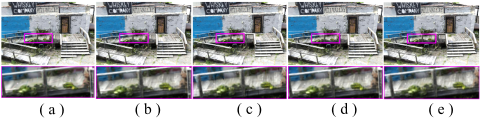
We further conduct ablation studies to quantify the contribution of each component (Table 3). Overall, enabling the Weather Branch already improves reconstruction under degraded observations. Adding the Perceptual constraint further enhances texture and structural fidelity, while introducing Clean Sup brings more pronounced gains in overall restoration quality. With all components enabled, the full model achieves the best performance. Fig. 4 also shows that it most effectively suppresses residual rain-fog artifacts and recovers finer local details with better appearance consistency.
Table 4 further analyzes the impact of depth-guided pruning and extra point sampling on optimization stability. Both strategies yield stable benefits, extra point sampling alleviates under-representation caused by sparse initialization, whereas depth-guided pruning reduces noisy gradients from degraded observations via more reliable visibility filtering. Combining them performs best, suggesting that jointly improving visibility filtering and sample supplementation effectively mitigates erroneous gradients under adverse weather and leads to higher-quality reconstructions.Due to space limitations, more experimental results are provided in the supplementary material.
5 Conclusion
We present a meteorology-driven unified 3D Gaussian rendering-restoration framework for robust 3D modeling and novel view synthesis under rain and fog. By mapping precipitation observations to interpretable rain parameters and estimating an extinction-strength cue for fog generation, our method enables controllable and reproducible weather modeling. We further introduce a dual-branch closed-loop optimization in which a weather rendering branch fits degraded observations to account for adverse-weather effects, while a restoration branch regularizes the shared scene Gaussians toward intrinsic clean appearance via clean-domain supervision and multi-scale perceptual consistency, yielding cross-viewconsistent deraining and dehazing with improved detail fidelity. Extensive experiments demonstrate consistent gains on both rainy and foggy scenes, producing fewer residual artifacts and more stable geometry and textures, and further validate meteorological priors as effective and interpretable conditional control signals. Future work will incorporate richer meteorological factors, extend the framework to temporally consistent and dynamically updated 3D representations, and integrate it with downstream applications such as autonomous driving, robotics, and digital twins.
Acknowledgements
This work was supported in part by NSFC under Grant 62402318 and Grant 24Z990200676 and in part by Artificial Intelligence (AI) for Science Seed Program of Shanghai Jiao Tong University under Grant WH410261901/002.
@inproceedings{ijcai2026p120,
  title     = {MeteGS:Meteorology-Guided Gaussian Splatting for Scene Rendering and Recovery in Adverse Weather Conditions},
  author    = {Fan, Sha and Shan, Xinhua and Liang, Mingyu and Bao, Ningjie and Liu, Wei and Fu, Ying},
  booktitle = {Proceedings of the Thirty-Fifth International Joint Conference on
               Artificial Intelligence, {IJCAI-26}},
  publisher = {International Joint Conferences on Artificial Intelligence Organization},
  editor    = {Diego Calvanese},
  pages     = {1070--1078},
  year      = {2026},
  month     = {8},
  note      = {Main Track},
  doi       = {10.24963/ijcai.2026/120},
  url       = {https://doi.org/10.24963/ijcai.2026/120},
}
TY - CPAPER TI - MeteGS:Meteorology-Guided Gaussian Splatting for Scene Rendering and Recovery in Adverse Weather Conditions AU - Fan, Sha AU - Shan, Xinhua AU - Liang, Mingyu AU - Bao, Ningjie AU - Liu, Wei AU - Fu, Ying T2 - Proceedings of the Thirty-Fifth International Joint Conference on Artificial Intelligence, IJCAI-26 PB - International Joint Conferences on Artificial Intelligence Organization PY - 2026 SP - 1070 EP - 1078 DO - 10.24963/ijcai.2026/120 UR - https://doi.org/10.24963/ijcai.2026/120 ER -Copied
Machine-readable versions of this paper, for tools and AI agents:





