
Mitigating Collaboration Degeneration in Multi-Agent Code Generation via a Controllable Competitive Collaboration Approach
Proceedings of the Thirty-Fifth International Joint Conference on Artificial Intelligence. Main Track. Pages 127-135.
https://doi.org/10.24963/ijcai.2026/15
Keywords
- Agent-based and Multi-agent Systems: Multi-agent learning
- Agent-based and Multi-agent Systems: Coordination and cooperation
Abstract
Empowered by large language models (LLMs), multi-agent systems (MAS) have shown significant potential in code generation by simulating collaborative workflows. However, we identify a collaboration degeneration phenomenon, where one agent dominates while others remain disengaged, occurring in 38.4% of non-routine HumanEval tasks. Surprisingly, introducing competition among LLM agents eliminates this degeneration and sparks innovation in generated code. Inspired by this catfish effect, we posit that competition helps prevent collaboration degeneration. We thus propose C3, a Controllable Competitive Collaboration framework featuring two novel mechanisms: Centralized Auction-Based Competition (CAB) for role allocation via bidding and
Decentralized Communication-Aware Competition (DCC) for solution refinement through opponent-aware adaptation.
Evaluated on 70 complex projects from extended SoftwareDev, C3 reduces collaboration degeneration from 32.4% to 12.8%, while enhancing code innovation and diversity. Human evaluations further confirm C3’s superiority in functionality, maintainability, and robustness over purely collaborative or competitive baselines.
- [Bi et al., 2024] Zhangqian Bi, Yao Wan, Zheng Wang, Hongyu Zhang, Batu Guan, Fangxin Lu, Zili Zhang, Yulei Sui, Hai Jin, and Xuanhua Shi. Iterative refinement of project-level code context for precise code generation with compiler feedback. arXiv preprint arXiv:2403.16792, 2024.
- [Chen et al., 2021] Mark Chen, Jerry Tworek, Heewoo Jun, Qiming Yuan, Henrique Ponde De Oliveira Pinto, Jared Kaplan, Harri Edwards, Yuri Burda, Nicholas Joseph, Greg Brockman, et al. Evaluating large language models trained on code. arXiv preprint arXiv:2107.03374, 2021.
- [Clarke, 1971] Edward H. Clarke. Multipart pricing of pub- lic goods. Public Choice, 11(1):17-33, 1971.
- [Dong et al., 2024] Yihong Dong, Xue Jiang, Zhi Jin, and Ge Li. Self-collaboration code generation via chatgpt. ACM Transactions on Software Engineering and Method- ology, 33(7):1-38, 2024.
- [Dütting et al., 2019] Paul Dütting, Zhe Feng, Harikrishna Narasimhan, David C. Parkes, and Sai S. Ravindranath. Optimal auctions through deep learning. In Proceedings of the 36th International Conference on Machine Learn- ing (ICML), 2019.
- [Gemp et al., 2022] Ian Gemp, Thomas Anthony, Janos Kramár, Tom Eccles, Andrea Tacchetti, and Yoram Bachrach. Designing all-pay auctions using deep learning and multi-agent simulation. Scientific Reports, 12:16937, 2022.
- [Geng et al., 2024] Mingyang Geng, Shangwen Wang, Dezun Dong, Haotian Wang, Ge Li, Zhi Jin, Xiaoguang Mao, and Xiangke Liao. Large language models are few- shot summarizers: Multi-intent comment generation via in-context learning. In Proceedings of the 46th IEEE/ACM International Conference on Software Engineering, pages 1-13, 2024.
- [Geng et al., 2026] Mingyang Geng, Shanzhi Gu, Zhipeng Liu, Chuanfu Xu, Zhaoyang Qu, and Haotian Wang. Failure localization in multi-agent code generation via knowledge-guided and transferable reasoning. In Proceed- ings of the AAAI Conference on Artificial Intelligence, vol- ume 40, pages 318-326, 2026.
- [Gu, 2023] Qiuhan Gu. Llm-based code generation method for golang compiler testing. In Proceedings of the 31st ACM Joint European Software Engineering Conference and Symposium on the Foundations of Software Engineer- ing, pages 2201-2203, 2023.
- [Hong et al., 2023] Sirui Hong, Xiawu Zheng, Jonathan Chen, Yuheng Cheng, Jinlin Wang, Ceyao Zhang, Zili Wang, Steven Ka Shing Yau, Zijuan Lin, Liyang Zhou, et al. Metagpt: Meta programming for multi-agent col- laborative framework. arXiv preprint arXiv:2308.00352, 3(4):6, 2023.
- [Huang et al., 2023] Dong Huang, Jie M. Zhang, Michael Luck, Qingwen Bu, Yuhao Qing, and Heming Cui. Agent- coder: Multi-agent code generation with effective testing and self-optimization. arXiv preprint arXiv:2312.13010, 2023.
- [Ishibashi and Nishimura, 2024] Yoichi Ishibashi and Yoshi- masa Nishimura. Self-organized agents: A llm multi-agent framework toward ultra large-scale code generation and optimization. arXiv preprint arXiv:2404.02183, 2024.
- [Islam et al., 2024] Md Ashraful Islam, Mohammed Eunus Ali, and Md Rizwan Parvez. Mapcoder: Multi-agent code generation for competitive problem solving. arXiv preprint arXiv:2405.11403, 2024.
- [Islam et al., 2025] Md. Ashraful Islam, Mohammed Eunus Ali, and Md. Rizwan Parvez. Codesim: Multi-agent code generation and problem solving through simulation-driven planning and debugging. In Findings of the North Amer- ican Chapter of the Association for Computational Lin- guistics (NAACL), 2025.
- [Janis, 1972] Irving L Janis. Victims of groupthink: A psy- chological study of foreign-policy decisions and fiascoes. Houghton Mifflin, 1972.
- [Jiang et al., 2024] Xue Jiang, Yihong Dong, Lecheng Wang, Zheng Fang, Qiwei Shang, Ge Li, Zhi Jin, and Wenpin Jiao. Self-planning code generation with large language models. ACM Transactions on Software Engi- neering and Methodology, 33(7):1-30, 2024.
- [Li et al., 2024] Jia Li, Yunfei Zhao, Yongmin Li, Ge Li, and Zhi Jin. Acecoder: An effective prompting technique spe- cialized in code generation. ACM Transactions on Soft- ware Engineering and Methodology, 33(8):1-26, 2024.
- [Lowe et al., 2017] Ryan Lowe, Yi Wu, Aviv Tamar, Jean Harb, Pieter Abbeel, and Igor Mordatch. Multi-agent actor-critic for mixed cooperative-competitive environ- ments. In Advances in Neural Information Processing Sys- tems 30 (NIPS 2017), 2017.
- [Mahmud et al., 2025] Tarek Mahmud, Bin Duan, Corina Pasareanu, and Guowei Yang. Enhancing llm code gen- eration with ensembles: A similarity-based selection ap- proach. arXiv preprint arXiv:2503.15838, 2025.
- [Milgrom and Weber, 1982] Paul R. Milgrom and Robert J. Weber. A theory of auctions and competitive bidding. Econometrica, 50(5):1089-1122, 1982.
- [Mosca et al., 2022] Edoardo Mosca, Ferenc Szigeti, Stella Tragianni, Daniel Gallagher, and Georg Groh. Shap-based explanation methods: a review for nlp interpretability. In Proceedings of the 29th international conference on com- putational linguistics, pages 4593-4603, 2022.
- [Myerson, 1981] Roger B. Myerson. Optimal auction de- sign. Mathematics of Operations Research, 6(1):58-73, 1981.
- [Nash, 1950] John F. Nash. Equilibrium points in n-person games. Proceedings of the National Academy of Sciences, 36(1):48-49, 1950.
- [Nash, 1951] John F. Nash. Non-cooperative games. Annals of Mathematics, 54(2):286-295, 1951.
- [Nunez et al., 2024] Ana Nunez, Nafis Tanveer Islam, Sumit Kumar Jha, and Peyman Najafirad. Autosafecoder: A multi-agent framework for securing llm code generation through static analysis and fuzz testing. arXiv preprint arXiv:2409.10737, 2024.
- [Perez et al., 2020] Ivan Perez, Frank Dedden, and Alwyn Goodloe. Copilot 3. Technical report, National Aeronau- tics and Space Administration, 2020.
- [Qian et al., 2023] Chen Qian, Wei Liu, Hongzhang Liu, Nuo Chen, Yufan Dang, Jiahao Li, Cheng Yang, Weize Chen, Yusheng Su, Xin Cong, et al. Chatdev: Commu- nicative agents for software development. arXiv preprint arXiv:2307.07924, 2023.
- [Riccobono et al., 2016] Francesca Riccobono, Manfredi Bruccoleri, and Andreas Größler. Groupthink and project performance: The influence of personal traits and inter- personal ties. Production and Operations Management, 25(4):609-629, 2016.
- [Seo et al., 2025] Minju Seo, Jinheon Baek, Seongyun Lee, and Sung Ju Hwang. Paper2code: Automating code gen- eration from scientific papers in machine learning. arXiv preprint arXiv:2504.17192, 2025.
- [Shoham and Leyton-Brown, 2008] Yoav Shoham and Kevin Leyton-Brown. Multiagent systems: Algorithmic, game-theoretic, and logical foundations. Cambridge University Press, 2008.
- [Taylor, 1919] Frederick Winslow Taylor. The principles of scientific management. Harper & brothers, 1919.
- [Vergopoulos et al., 2025] Konstantinos Vergopoulos, Mark Niklas Müller, and Martin Vechev. Automated benchmark generation for repository-level coding tasks. arXiv preprint arXiv:2503.07701, 2025.
- [Vickrey, 1961] William Vickrey. Counterspeculation, auc- tions, and competitive sealed tenders. Journal of Finance, 16(1):8-37, 1961.
- [von Neumann and Morgenstern, 1944] John von Neumann and Oskar Morgenstern. Theory of Games and Economic Behavior. Princeton University Press, 1st edition, 1944.
- [Wang et al., 2022] Haotian Wang, Wenjing Yang, Longqi Yang, Anpeng Wu, Liyang Xu, Jing Ren, Fei Wu, and Kun Kuang. Estimating individualized causal effect with confounded instruments. In Proceedings of the 28th ACM SIGKDD Conference on Knowledge Discovery and Data Mining, pages 1857-1867, 2022.
- [Wang et al., 2023a] Haotian Wang, Kun Kuang, Long Lan, Zige Wang, Wanrong Huang, Fei Wu, and Wenjing Yang. Out-of-distribution generalization with causal feature sep- aration. IEEE Transactions on Knowledge and Data Engi- neering, 36(4):1758-1772, 2023.
- [Wang et al., 2023b] Shangwen Wang, Mingyang Geng, Bo Lin, Zhensu Sun, Ming Wen, Yepang Liu, Li Li, Tegawendé F Bissyandé, and Xiaoguang Mao. Natural language to code: How far are we? In Proceedings of the 31st ACM joint European software engineering con- ference and symposium on the foundations of software en- gineering, pages 375-387, 2023.
- [Wang et al., 2025] Haotian Wang, Haoxuan Li, Hao Zou, Haoang Chi, Long Lan, Wanrong Huang, and Wenjing Yang. Effective and efficient time-varying counterfac- tual prediction with state-space models. In The Thir- teenth International Conference on Learning Representa- tions, 2025.
- [Wei et al., 2023] Yuxiang Wei, Zhe Wang, Jiawei Liu, Yifeng Ding, and Lingming Zhang. Magicoder: Empow- ering code generation with oss-instruct. arXiv preprint arXiv:2312.02120, 2023.
- [Wei et al., 2024] Yuxiang Wei, Federico Cassano, Jiawei Liu, Yifeng Ding, Naman Jain, Zachary Mueller, Harm de Vries, Leandro Von Werra, Arjun Guha, and Lingming Zhang. Selfcodealign: Self-alignment for code generation. arXiv preprint arXiv:2410.24198, 2024.
- [Wu et al., 2023] Qingyun Wu, Gagan Bansal, Jieyu Zhang, Yiran Wu, Beibin Li, Erkang Zhu, Li Jiang, Xiaoyun Zhang, Shaokun Zhang, Jiale Liu, et al. Autogen: En- abling next-gen llm applications via multi-agent conversa- tion. arXiv preprint arXiv:2308.08155, 2023.
- [Wu et al., 2024] Qinyun Wu, Chao Peng, Pengfei Gao, Ruida Hu, Haoyu Gan, Bo Jiang, Jinhe Tang, Zhiwen Deng, Zhanming Guan, Cuiyun Gao, et al. Repomas- tereval: Evaluating code completion via real-world repos- itories. arXiv preprint arXiv:2408.03519, 2024.
- [Zamfirescu-Pereira et al., 2025] JD Zamfirescu-Pereira, Eunice Jun, Michael Terry, Qian Yang, and Björn Hartmann. Beyond code generation: Llm-supported exploration of the program design space. In Proceedings of the 2025 CHI Conference on Human Factors in Computing Systems, pages 1-17, 2025.
- [Zhang et al., 2024a] Huan Zhang, Wei Cheng, Yuhan Wu, and Wei Hu. A pair programming framework for code generation via multi-plan exploration and feedback-driven refinement. In Proceedings of the 39th IEEE/ACM Inter- national Conference on Automated Software Engineering, pages 1319-1331, 2024.
- [Zhang et al., 2024b] Jiayi Zhang, Jinyu Xiang, Zhaoyang Yu, Fengwei Teng, Xionghui Chen, Jiaqi Chen, Mingchen Zhuge, Xin Cheng, Sirui Hong, Jinlin Wang, et al. Aflow: Automating agentic workflow generation. arXiv preprint arXiv:2410.10762, 2024.
References were extracted automatically from the PDF and may contain errors.
Full text extracted automatically from the PDF; figures, tables and equations may differ. The PDF is the version of record.
1 Introduction
Empowered by recent advances in Large Language Models (LLMs), LLM-based agents have become increasingly promising for software development and project management [Dong et al., 2024; Hong et al., 2023; Ishibashi and Nishimura, 2024; Geng et al., 2024; Wang et al., 2023b; Geng et al., 2026], such as Copilot [Perez et al., 2020], Paper2Code [Seo et al., 2025], and Magicoder [Wei et al., 2023]. Notably, generating code for tasks with complex objectives [Bi et al., 2024; Zhang et al., 2024b] or large-scale codebases [Wu et al., 2024; Vergopoulos et al., 2025] increasingly resembles collaborative human workflows. This observation has motivated a growing line of research on structureaware multi-agent systems (MAS) for code generation [Hong et al., 2023; Islam et al., 2024; Wu et al., 2023].
∗Chuanfu Xu and Haotian Wang are the corresponding authors.
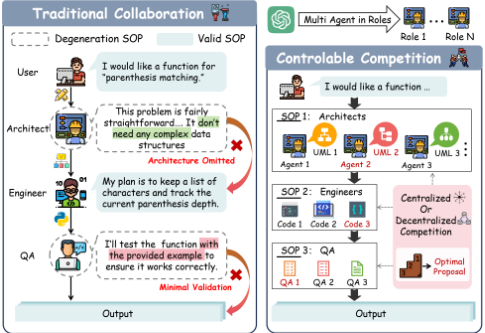
Existing MAS-based code generation frameworks demonstrate strong potential in emulating human collaboration [Hong et al., 2023; Wu et al., 2023; Islam et al., 2024; Dong et al., 2024; Huang et al., 2023]. For example, MetaGPT [Hong et al., 2023] enforces standardized operating procedures to decompose tasks and assign roles; AutoGen [Wu et al., 2023] coordinates specialized agents through structured dialogues; and MapCoder [Islam et al., 2024] decomposes code synthesis into collaborative stages. We refer to these structurally organized MAS workflows as Collaborative Code Generation (Figure 1, left).
However, we observe an overlooked failure mode: existing collaborative frameworks often degenerate into a regime where a single agent dominates iterative interactions while other agents remain largely inactive. In such cases, enforced collaboration effectively collapses into a single-agent multiround process, which we term collaboration degeneration. In a preliminary study on HumanEval [Chen et al., 2021], this phenomenon occurs in 38.4% of non-routine tasks, leading to inefficient or incorrect solutions and undermining the original goal of autonomous MAS collaboration. To understand this issue, we draw inspiration from classical organization theory [Taylor, 1919], which highlights that sustainable cooperation requires a balance between collaboration and competition. Prior studies show that while collaboration provides stability, competition promotes role reallocation, solution diversity, and adaptive reflection, thereby mitigating stagnation [Janis, 1972]. Similar effects have been widely observed in human teams, where controlled competition prevents groupthink and fosters innovation [Riccobono et al., 2016]. These insights motivate a new perspective for MAS-based code generation.
We therefore posit a pioneer viewpoint: introducing strategic competition, rather than relying on collaboration alone, is beneficial for MAS-driven code generation. By allowing agents to contest roles or propose alternative strategies when collaboration stalls, competition can break degenerative loops and stimulate diverse solutions. Despite supporting empirical evidence [Mahmud et al., 2025], it remains unclear how to systematically design competition-aware MAS frameworks for code generation. To fill this gap, we propose a Controllable Competitive Collaboration (C3) framework, inspired by organization theory and algorithmic game theory, to prevent collaboration degeneration in MAS-based code generation. C3 supports two typical competitive scenarios: (i) centralized competition without inter-agent communication, implemented via a Centralized Auction-Based Competition (CAB) mechanism; and (ii) decentralized competition with communication, realized through a Decentralized Communication-Aware Competition (DCC) mechanism. Our main contributions are summarized as follows:
- We introduce a new perspective that strategic competition complements collaboration in MAS-based code generation, and propose the C3 framework with CAB and DCC mechanisms for centralized and decentralized settings, respectively;
- Extensive experiments on 70 complex tasks show that C3 reduces collaboration degeneration from 32.4% to 12.8%, improves executability by 19.9%, and substantially enhances novelty and diversity, with human evaluations confirming superior functionality, maintainability, and robustness.
2 RelatedWork
2.1 Single-Agent Empowered Code Generation
Recent advancements in single-agent frameworks have enhanced code generation via architectural and context-aware optimizations [Gu, 2023; Jiang et al., 2024; Li et al., 2024; Zamfirescu-Pereira et al., 2025; Zhang et al., 2024a]. For instance, Self Code Align automates self-alignment through test-driven filtering, boosting performance on HumanEval+ [Wei et al., 2024]. [Gu, 2023] proposes an LLMbased pipeline for compiler fuzzing, improving testcase quality and coverage over traditional methods. PairCoder [Zhang et al., 2024a] introduces a pair-programming-inspired framework with Navigator and Driver agents, achieving strong benchmark results. Beyond these architectural innovations, recent work has also explored leveraging causal inference and state-space models for more robust and individualized predictions, spanning domains from counterfactual estimation to out-of-distribution generalization [Wang et al., 2022; Wang et al., 2023a; Wang et al., 2025].
2.2 Collaborative Multi-Agent Empowered Code Generation
Recent research has explored multi-agent collaboration to enhance code generation through improved reasoning, modularity, and fault isolation [Hong et al., 2023; Dong et al., 2024; Huang et al., 2023; Ishibashi and Nishimura, 2024; Islam et al., 2025; Nunez et al., 2024]. MetaGPT [Hong et al., 2023] employs Standardized Operating Procedures to emulate software engineering workflows. Self-collaboration frameworks organize agents into specialized roles like analysts or testers [Dong et al., 2024]. AgentCoder [Huang et al., 2023] integrates distinct agents for programming and testing, using structured feedback to achieve strong benchmark performance with reduced token cost.
2.3 Competitions in Game Theory: Insight of LLM-Agents
We briefly review two closely related domains from algorithmic game theory: auction theory and non-cooperative competitions. Classical auction mechanisms provide a foundation for incentive design in multi-agent systems [Vickrey, 1961; Myerson, 1981; Milgrom and Weber, 1982; Clarke, 1971], with recent advances integrating deep learning to synthesize revenue-maximizing mechanisms [D¨utting et al., 2019; Gemp et al., 2022]. Similarly, non-cooperative game theory offers principles for strategic interactions and equilibrium analysis [Nash, 1950; Nash, 1951; von Neumann and Morgenstern, 1944], with modern multi-agent reinforcement learning frameworks enabling efficient equilibrium approximations [Lowe et al., 2017]. These theoretical foundations suggest that structured competition and cooperation can be mutually reinforcing. Applied to multi-agent LLM code generation, they motivate the design of competitive mechanisms to complement collaboration, fostering innovation and robustness through strategic role interplay.
3 Definition of Collaboration Degeneration
We define collaboration degeneration as a phenomenon where two or more agent's Marginal Utility Contribution (MUC) consistently fall below a predefined threshold τ during multi-agent code generation: if the marginal utility of two or more agents, defined as the change in the solution quality due to the agent's input, remains below the threshold over several rounds, we classify this as Collaboration Degeneration. We calculate the MUC via the Shapley Value approach (SHAP) [Mosca et al., 2022], since SHAP can isolate the intrinsic contribution of each agent from others' contributions. The Shapley Value for agent i in round k is calculated as:
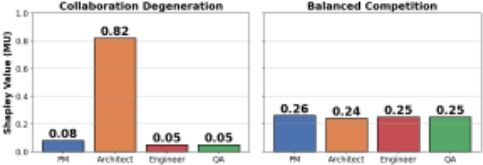
where S represents any subset of agents excluding i; Quality (S) is is any subset of agents excluding i; Quality (S ∪ {i}) is the solution quality produced when agent i joins the set S; |S| and |R| are the sizes of the subsets S and the total set of agents R, respectively. For example, in tasks like algorithmic design, a Product Manager agent may simply repeat the task description without refining functional requirements. A QA Engineer might use only the provided test cases, ignoring edge cases or coverage. The threshold τ is set based on domain-specific quality factors (e.g., correctness), typically set as 0.1. If at least two agents' MUC consistently falls below τ across rounds, collaboration degeneration is treated as occurred.
Collaboration Degeneration in SOP-Driven Frameworks. The MinPath task requires constructing a lexicographically minimal path in a uniquely valued grid. MetaGPT's generic DFS+min, heap solution fundamentally misinterprets the problem: it fails to leverage the injective value domain and incorrectly prioritizes paths, violating lexicographic ordering. This failure stems from collaboration degeneration, a phenomenon observed in 38.4% of non-trivial HumanEval tasks [Chen et al., 2021], where only the Architect agent proposes a naive design while others passively follow, ignoring critical constraints.
Competition as a Catalyst for Improvement. Introducing a basic competitive baseline, where agents of the same role independently propose solutions, demonstrates the potential of competition: the Product Manager surfaces domain constraints, the Architect designs an efficient O(N 2 ) constructive algorithm, and QA validates with targeted edge-cases. Figure 2 illustrates a shift from skewed to balanced agent contributions, confirming competition mitigates degeneration. However, this unstructured approach only improves 12.1% of all tasks, underscoring the need for more systematic and adaptive competition mechanisms to fully realize its benefits.
4 Methodology
In this section, we design two more refined mechanisms, inspired by centralized and decentralized algorithmic game theory [Shoham and Leyton-Brown, 2008], to instantiate compe- Algorithm 1 Hybrid Competition Mechanisms (CAB & DCC)
Require: Agent set R, task T, metrics M, mode mode ∈ {CAB, DCC} Ensure: S∗ (CAB) or S ∗ (DCC) 1: if mode = CAB then ▷ Centralized Auction 2: for each phase P ∈ {PM, Arch, Eng, QA} do 3: for t = 1 to r do 4: S∗ ← arg maxi Score(S(t-1) i , M) ▷ Coordinator selects best 5: S(t) i ←Update(S(t-1) i , Feedback(S∗ , S(t-1) i )) ▷ Lossers refine 6: end for 7: Pass S∗ to next phase 8: end for 9: return S∗ 10: else if mode = DCC then ▷ Decentralized Competition 11: for each role P in parallel do 12: for t = 1 to r do 13: for each agent i ∈ RP do 14: I ← SelectInspiration({S(t-1) j }j̸=i) 15: S(t) i ←Evolve(S(t-1) i , I) ▷ Self-adapt using peers 16: end for 17: end for 18: S ∗P ← {S(t) i } 19: end for 20: return S ∗ = ⋃P S ∗P ▷ Solution pool 21: end iftitions inside the code generation frameworks. We emphasize that all agents in our framework are LLM-based (e.g., GPT4), autonomously handling code generation through natural language reasoning.
4.1 Framework Overview of C3
To address the limitations of purely collaborative workflows, we propose the Controllable Competitive Collaboration (C3) framework, which strategically integrates competition into multi-agent code generation. As illustrated in Figure 3, C3 introduces two competition mechanisms: (1) Centralized Auction-Based Competition (CAB), where a Coordinator Agent orchestrates structured bidding to select optimal proposals (e.g., choosing API designs via weighted scoring); and (2) Decentralized Communication-Aware Competition (DCC), where agents transparently observe and adapt based on peer solutions (e.g., hybridizing architectural designs after reviewing competitors' metrics). A key controllable property lets users steer competition toward specific objectives, such as executability, diversity, or innovation, via pre-defined evaluation metrics [Vergopoulos et al., 2025], enabling targeted and adaptive code generation.
4.2 Centralized Auction-Based Competition (CAB)
The CAB framework balances collaboration and competition through a sequential multi-stage process involving Product Managers, Architects, Engineers, and QA Engineers. A Coordinator Agent evaluates proposals at each stage using defined metrics, selects the best solution, and provides structured feedback to non-winning agents.
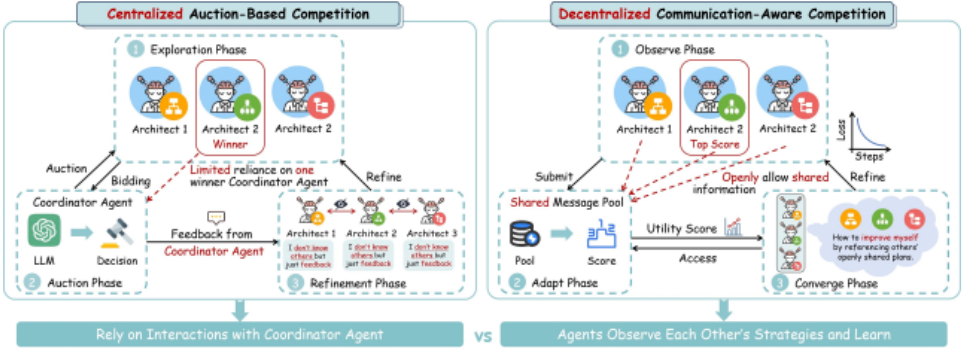
Bidding & Auction. Agents compete within each phase. The Coordinator evaluates proposals based on criteria such as Novelty, Feasibility, and SOP Compliance (PM/Architect phases), Implementability and Performance (Engineer phase), and Test Coverage and Robustness (QA phase). The highest-scoring proposal advances.
Feedback Integration. The process is iterative. After evaluation, the Coordinator provides feedback to losing agents, who refine and resubmit their proposals. This cycle typically runs for 3-5 rounds until agent contributions stabilize, yielding a final solution that is innovative, compliant, and scores highly across key metrics. The overall workflow is illustrated in Figure 3.
Algorithm 1 outlines two hybrid competition modes in the C3 framework. In CAB, a Coordinator agent sequentially selects the best proposal per phase and provides refinement feedback to losers, yielding a single optimized solution S∗ . In DCC, agents within each role operate in parallel, observe peer proposals, and self-adapt by incorporating competitors' inspirations, producing a diverse solution pool S ∗ .
4.3 Decentralized Communication-Aware Competition (DCC)
To systematically understand the design rationale of DCC, we contrast it with the CAB baseline across key architectural dimensions:
Control Structure. CAB employs a centralized Coordinator Agent to govern each phase, while DCC adopts a decentralized, shared-message-pool architecture where agents transparently observe peer outputs and adapt autonomously.
Evaluation Mechanism. Evaluation in CAB is conducted by a single arbiter using predefined metrics. In DCC, evaluation is distributed: each agent scores peer proposals using a standardized rubric, ensuring consistent yet peer-driven assessment.
Feedback & Adaptation. CAB relies on top-down feedback from the coordinator. DCC enables evolutionary adaptation: agents analyze peer proposals, selectively incorporate advantageous elements, and discard weaker strategies through a self-supervised, imitation-based refinement process. This mirrors evolutionary learning, where beneficial traits propagate via competitive peer observation.
Exploration vs. Convergence. DCC balances exploration and convergence through three mechanisms: (1) role-specific standardized evaluation prompts that guide agents toward utility-aligned solutions; (2) empirically grounded limited adaptation rounds (typically 3-5); and (3) mutual visibility of proposals, which promotes convergence on high-scoring strategies via imitation, creating a self-organizing selection pressure.
5 Experiments
5.1 Dataset Contribution: Extended SoftwareDev
Inspired by MetaGPT [Hong et al., 2023], we constructed a benchmark of 70 software development tasks, curated to replicate the categories and proportions described in the original work. Each task, defined by a natural language prompt, covers diverse categories including mini-games, visualization tools, utility applications, algorithmic challenges, and content generators. This dataset provides a comprehensive testbed for evaluating LLM-based agents in end-to-end development workflows, prioritizing diverse agent configurations and task types over isolated algorithmic challenges like HumanEval [Chen et al., 2021]. The task composition is detailed in Table 1.
5.2 Experimental Setting
All methods were evaluated under identical conditions to isolate methodological effects. We used GPT-4o as the base LLM on a homogeneous hardware configuration (8× RTX-4090 GPUs). The benchmark comprised 70 tasks from the SoftwareDev suite, each run with 3 random seeds. For CAB, each phase allowed 2-3 refinement rounds; for DCC, each role performed 3-5 internal adaptation rounds. The evaluation metric set M = {Novelty, Feasibility, SOP-Compliance, Performance} was held constant. A convergence threshold ϵ = 0.01 (relative score change per agent) enabled early termination. Each proposal was constrained to a maximum token length of 4096.
| Category | Proportion | Example Task | Prompt Summary |
|---|---|---|---|
| Interactive Mini-Games | 20/70 (28.6%) | Flappy Bird Game | Implement Flappy Bird in p5.js. The bird flies between pipes and flaps on mouse click. Ends on collision or fall. Score increases with each pipe passed. |
| Data Viz & Dashboards | 15/70 (21.4%) | Weather Dashboard | Python dashboard using OpenWeather API to show cur- rent weather and 5-day forecast. Include visualizations for temperature and humidity. |
| Utility Apps | 18/70 (25.7%) | Excel Processor | Streamlit + Pandas app to upload and view Excel files, ap- ply filters, and get summary stats. Should be lightweight with editable output. |
| Algorithmic Challenges | 10/70 (14.3%) | Music Transcriber | Transcribe music audio into sheet music using pitch track- ing, neural networks, and chromagram alignment. |
| Content Generators | 7/70 (10.0%) | Press Release Bot | Python tool to fetch updates via APIs/social media and auto-generate press releases with tone/length options. Sup- ports PDF export. |
5.3 Research Question
We investigate three research questions to validate the effectiveness of our C3 framework.
- RQ1: Can C3 mitigate collaboration degeneration in multi-agent code generation?
- RQ2: Beyond degeneration prevention, does competition enhance other advantages of generated code artifacts, i.e., novelty and diversity?
- RQ3: What are the comparative benefits of centralized versus decentralized competition in multi-agent systems?
- RQ4: How can we balance competition and collaboration to maximize overall performance?
- RQ5: How do human evaluators perceive the quality of generated software artifacts in real-world case studies?
5.4 EvaluationMetrics and Baselines
To systematically assess model performance, we first adopt original metrics stated in [Hong et al., 2023]:
- Executability: Measures whether generated code runs without syntax or runtime errors, evaluating improvements in degeneration mitigation (RQ1).
- Executability = #of successful executions #of total code samples [Hong et al., 2023], where each code sample is executed in a sand-
box with test input; success yields score 1, failure yields 0.
- Human Revision Cost: Quantifies the effort required to correct generated code to production quality (RQ1, RQ4). Revision Cost = 1N ∑Ni=1 edit scorei, where human annotators rate post-editing effort on a 1-10 scale, averaged across samples.
Furthermore, we also employ more extensive dimensions of evaluations to compare and analyze competition and collaboration in below:
- Degeneration Rate: The proportion of tasks in which collaboration degeneration occurs, defined as cases where the Marginal Utility Contribution of at least two agents consistently falls below the predefined threshold τ (e.g., 0.1), indicating minimal effective contribution frommultiple roles.
- Novelty: Measures deviation from the reference solution (RQ2):
- Novelty = 1 - AST Similarity(G, R), where G is the generated code, R is the reference and similarity is com-
- puted by the tree edit distance.
- Diversity: Computes the average pairwise AST tree edit distance among 5 executable and minimally correct solutions per task by each method (RQ2, RQ4): Diversity = 1 M(M-1) ∑i̸=j AST Dist(Gi,Gj), where pairwise distance between M generated solutions using normalized AST tree edit distance.
- Task Ownership Entropy (TOE): Evaluates fairness in contribution distribution (RQ3). TOE = - ∑ni=1 pi log pi, where pi is the proportion of tasks won by agent i; higher values indicate more balanced participation.
- Adaptation Responsiveness Rate (ARR): Captures improvement frequency after peer feedback (RQ3). ARR = # of improved proposals post-feedback #of total proposals , where compares proposal quality before and after refinement rounds.
| Method | Exec. (%) ↑ | Rev. Cost ↓ | Deg. Rate (%) ↓ |
|---|---|---|---|
| AgentCoder | 70.4 | 7.3 | 39.7 |
| ChatDev | 70.9 | 6.9 | 35.1 |
| MetaGPT | 72.3 | 6.4 | 32.4 |
| NC | 78.6 | 5.2 | 26.3 |
| CAB | 82.1 | 4.3 | 18.9 |
| DCC | 86.7 (↑19.9%) | 3.6 (↓47.8%) | 12.8 (↓60.5%) |
- Feedback Utilization Score (FUS): Measures how often peer suggestions are reflected in final outputs (RQ3, RQ4). FUS = #of peer insights used # of insights provided , where counts explicit mentions or implementation of peer strategies in revised proposals.
We choose five representative baseline methods as follows:
- MetaGPT [Hong et al., 2023] is a multi-agent framework using SOPs for collaboration, prone to collaboration degeneration.
- ChatDev [Qian et al., 2023] is a multi-agent system where LLM agents collaborate via chat across design, coding, and testing.
- AgentCoder [Huang et al., 2023] is a multi-agent framework with specialized programmer, test designer, and executor agents that refine code via feedback loops.
- Naive Competition (NC) serves as a baseline where agents independently generate and submit solutions; the best is selected based on evaluation metrics. It lacks any collaboration, prioritization, or communication.
- Isolated Competition (IC) represents a pure-competition baseline: agents work in complete isolation without communication or shared context. Unlike NC, it excludes all forms of collaboration.
5.5 Experimental Results
RQ1: Effectiveness of C3 in Preventing collaboration degeneration
Table 2 shows that both CAB and DCC significantly reduce collaboration degeneration, with DCC achieving the lowest rate (12.8%) alongside the highest executability (86.7%) and lowest human revision cost (3.6). These results highlight the efficacy of structured competition in improving multi-agent coordination and solution quality. The superior performance of decentralized DCC over centralized CAB-and both over the NC baseline, indicates that fine-grained, peer-aware refinement yields more substantial gains than role-level auctions or unstructured diversity.
RQ2: Gains in Novelty and Diversity
This research question assesses how CAB and DCC enhance solution diversity and novelty. We evaluate across task categories using metrics for novelty, diversity, and semantic distance. As shown in Table 3, competitive mechanisms, especially the decentralized DCC, consistently outperform purely collaborative baselines, yielding more semantically varied and less templated solutions. The advantage is most pronounced in open-ended domains like Creative Content Generators and Algorithmic Challenges, where competition incentivizes exploring non-trivial designs. These results confirm that structured competition not only mitigates collaboration degeneration but actively fosters creativity and innovation.
| Category | Method | Novelty (%) ↑ | Diversity ↑ |
|---|---|---|---|
| Mini-Games | AgentCoder ChatDev MetaGPT NC CAB DCC | 51.2 52.4 54.3 57.8 61.4 66.7 (↑22.8%) 50.7 | 0.36 0.38 0.42 0.49 0.56 0.69 (↑64.3%) |
| AgentCoder ChatDev MetaGPT | 52.0 52.9 56.3 | ||
| Dashboards | 0.34 | ||
| 0.36 | |||
| 0.39 | |||
| NC | 0.46 | ||
| CAB | 60.2 | 0.52 | |
| DCC | 65.5 (↑23.8%) | 0.65 (↑66.7%) | |
| Utilities | AgentCoder | 50.9 | 0.35 |
| ChatDev | 51.8 | 0.37 | |
| MetaGPT | 53.5 | 0.41 | |
| NC | 56.7 | 0.47 | |
| CAB | 61.0 | 0.55 | |
| DCC | 0.67 (↑63.4%) | ||
| 66.1 (↑23.6%) | |||
| Algorithms | AgentCoder | 49.8 | 0.33 |
| ChatDev | 50.6 | 0.35 | |
| MetaGPT | 51.8 | 0.36 | |
| NC | 58.2 | 0.47 | |
| CAB | 63.4 | 0.54 | |
| DCC | 69.5 (↑34.2%) | 0.70 (↑94.4%) | |
| Creativity | AgentCoder | 51.0 | 0.34 |
| ChatDev | 52.2 | 0.37 | |
| MetaGPT | 55.0 | 0.40 | |
| NC | 60.1 | 0.50 | |
| CAB | 65.7 | 0.58 | |
| DCC | 71.2 (↑29.5%) | 0.72 (↑80.0%) |
| Competition Strategy | TOE ↑ | ARR ↑ | FUS ↑ |
|---|---|---|---|
| NC | 1.11 | 0.38 | 1.7 |
| CAB | 1.42 | 0.61 | 3.8 |
| DCC | 1.78 (↑25.4%) | 0.75 (↑23.0%) | 5.1 (↑34.2%) |
RQ3: Centralized vs. Decentralized Competition
Table 4 compares NC, CAB, and DCC. DCC outperforms CAB across all metrics, achieving higher Task Ownership Entropy (1.78), Adaptation Responsiveness (0.75), and Feedback Utilization (5.1), indicating richer peer-driven learning. In contrast, CAB offers controlled convergence but limits cross-agent adaptability, while NC performs poorly due to a lack of structured coordination. The results suggest a trade-off: CAB provides structural clarity, whereas DCC fosters emergent collaboration and innovation.
| Method | Exec. (%) ↑ | Innovation ↑ | Diversity ↑ | Cost ↓ |
|---|---|---|---|---|
| MetaGPT (Collab-Only) | 72.3 | 53.5 | 0.41 | 6.4 |
| IC (Comp-Only) | 68.4 | 69.5 | 0.73 | 7.8 |
| NC (Hybrid) | 78.6 | 57.5 | 0.48 | 5.2 |
| CAB (Hybrid) | 82.1 | 61.7 | 0.55 | 4.3 |
| DCC (Hybrid) | 86.7 | 67.1 | 0.68 | 3.6 |
RQ4: Balancing Competition and Collaboration
Table 5 examines the collaboration-competition tradeoff. Purely collaborative methods yield lower innovation, while purely competitive ones increase revision costs and reduce executability. Hybrid approaches, especially DCC, best balance executability, innovation, and revision cost, demonstrating the synergy of structured competition built on collaborative foundations.
RQ5: Human Evaluation and Case Study
To complement automatic metrics, we conducted a human evaluation with 10 experienced Python developers on all the 70 cases and evaluated 5 methods, i.e., DCC, CAB, Naive Competition, IC, and MetaGPT, resulting in 350 cases. Each annotator reviewed 35 cases covering all methods, followed by cross-validation to ensure consistency. Ratings were assigned on a 1-5 scale across three dimensions: functional completeness, code readability/maintainability, and robustness. The detailed definitions are: (1) Functional Completeness: Assesses if the solution meets all required features; (2) Code Readability/Maintainability: Evaluates the clarity, organization, and ease of maintaining the code. (3) Robustness: Measures how well the solution handles edge cases, errors.
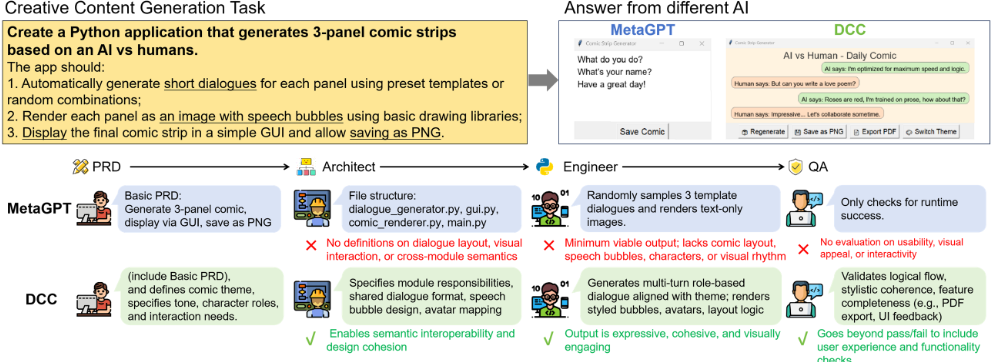
Human evaluators achieved >94% inter-annotator agreement. As shown in Table 6, DCC excels in functionality (4.0), robustness (3.8), and ties for best maintainability (3.8), demonstrating the strength of structured competition. CAB also performs strongly, particularly in functionality (3.8). In contrast, pure collaboration (MetaGPT) and pure competition (IC) exhibit notably lower robustness (2.9 and 2.8). While IC slightly improves functionality over MetaGPT, its maintainability suffers (3.4) due to lacking architectural coherence. Overall, hybrid competition-collaboration strategies, especially DCC, best balance creativity and stability. A case study from Creative Content Generation (Figure 4) further illustrates this: MetaGPT exhibits collaboration degeneration, producing a basic, unstructured text-only comic from minimal agent coordination.
| Method | Functionality ↑ | Maintainability ↑ | Robustness ↑ |
|---|---|---|---|
| MetaGPT | 3.2 | 3.6 | 2.9 |
| IC | 3.4 | 3.4 | 2.8 |
| NC | 3.5 | 3.8 | 3.2 |
| CAB | 3.8 | 3.8 | 3.6 |
| DCC | 4.0 | 3.8 | 3.8 |
6 Conclusion
This paper addresses collaboration degeneration in multiagent code generation, where collaborative systems degrade into single-agent dominance, by introducing the Controllable Competitive Collaboration (C3) framework. C3 integrates Centralized Auction-Based and Decentralized Communication-Aware competition mechanisms to actively foster engagement and innovation. Evaluated on 70 full-stack tasks, C3 significantly improves executability, diversity, and code quality, demonstrating that structured competition catalyzes collaborative intelligence. Future work includes dynamic role switching, cross-domain generalization (e.g., law or science), and human-in-the-loop reinforcement. Our study is the first to formally define and systematically mitigate collaboration degeneration through controlled competitive dynamics.
Ethical Statement
There are no ethical issues.
Acknowledgments
This work is supported in part by the NUDT Youth Independent Innovation Science Fund under Grant No.ZK25-20.
@inproceedings{ijcai2026p15,
  title     = {Mitigating Collaboration Degeneration in Multi-Agent Code Generation via a Controllable Competitive Collaboration Approach},
  author    = {Gu, Shanzhi and Geng, Mingyang and Dong, Yihong and Mao, Yunxin and Qu, Zhaoyang and Zou, Hao and Jin, Ruochun and Liu, Zhipeng and Xu, Chuanfu and Wang, Haotian},
  booktitle = {Proceedings of the Thirty-Fifth International Joint Conference on
               Artificial Intelligence, {IJCAI-26}},
  publisher = {International Joint Conferences on Artificial Intelligence Organization},
  editor    = {Diego Calvanese},
  pages     = {127--135},
  year      = {2026},
  month     = {8},
  note      = {Main Track},
  doi       = {10.24963/ijcai.2026/15},
  url       = {https://doi.org/10.24963/ijcai.2026/15},
}
TY - CPAPER TI - Mitigating Collaboration Degeneration in Multi-Agent Code Generation via a Controllable Competitive Collaboration Approach AU - Gu, Shanzhi AU - Geng, Mingyang AU - Dong, Yihong AU - Mao, Yunxin AU - Qu, Zhaoyang AU - Zou, Hao AU - Jin, Ruochun AU - Liu, Zhipeng AU - Xu, Chuanfu AU - Wang, Haotian T2 - Proceedings of the Thirty-Fifth International Joint Conference on Artificial Intelligence, IJCAI-26 PB - International Joint Conferences on Artificial Intelligence Organization PY - 2026 SP - 127 EP - 135 DO - 10.24963/ijcai.2026/15 UR - https://doi.org/10.24963/ijcai.2026/15 ER -Copied
Machine-readable versions of this paper, for tools and AI agents:





