
What Affects the Stability of Tool Learning? An Empirical Study on the Robustness of Tool Learning Frameworks
Proceedings of the Thirty-Fifth International Joint Conference on Artificial Intelligence. Main Track. Pages 136-144.
https://doi.org/10.24963/ijcai.2026/16
Keywords
- Agent-based and Multi-agent Systems: Applications
- Agent-based and Multi-agent Systems: Agent communication
- Data Mining: Applications
Abstract
Tool learning methods have enhanced the ability of large language models (LLMs) to interact with real-world applications.
Many existing works fine-tune LLMs or design prompts to enable LLMs to select appropriate tools and correctly invoke them to meet user requirements. However, it is observed in previous works that the performance of tool learning varies from tasks, datasets, training settings, and algorithms. Without understanding the impact of these factors, it can lead to inconsistent results, inefficient model deployment, and suboptimal tool utilization, ultimately hindering the practical integration and scalability of LLMs in real-world scenarios. Therefore, in this paper, we explore the impact of both internal and external factors on the performance of tool learning frameworks. Through extensive experiments on two benchmark datasets, we find several insightful conclusions for future work, including the observation that LLMs can benefit significantly from increased trial and exploration. We believe our empirical study provides a new perspective for future tool learning research.
- [Chen and Ding, 2023] Honghua Chen and Nai Ding. Prob- ing the creativity of large language models: Can models produce divergent semantic association? arXiv, 2023.
- [Chhabra et al., 2024] Anshuman Chhabra, Hadi Askari, and Prasant Mohapatra. Revisiting zero-shot abstrac- tive summarization in the era of large language models from the perspective of position bias. arXiv preprint arXiv:2401.01989, 2024.
- [Gao et al., 2024] Shen Gao, Zhengliang Shi, Minghang Zhu, Bowen Fang, Xin Xin, Pengjie Ren, Zhumin Chen, Jun Ma, and Zhaochun Ren. Confucius: Iterative tool learning from introspection feedback by easy-to-difficult curriculum. In Proceedings of the AAAI Conference on Artificial Intelligence: AAAI, 2024.
- [Gu et al., 2022] Jiasheng Gu, Hongyu Zhao, Hanzi Xu, Liangyu Nie, Hongyuan Mei, and Wenpeng Yin. Robust- ness of learning from task instructions. arXiv preprint arXiv:2212.03813, 2022.
- [Guo et al., 2024] Taicheng Guo, Xiuying Chen, Yaqi Wang, Ruidi Chang, Shichao Pei, Nitesh V Chawla, Olaf Wiest, and Xiangliang Zhang. Large language model based multi-agents: A survey of progress and challenges. arXiv preprint arXiv:2402.01680, 2024. IJCAI
- [Hao et al., 2023] Shibo Hao, Tianyang Liu, Zhen Wang, and Zhiting Hu. Toolkengpt: Augmenting frozen language models with massive tools via tool embeddings. arXiv, 2023.
- [Hsieh et al., 2023] Cheng-Yu Hsieh, Si-An Chen, Chun- Liang Li, Yasuhisa Fujii, Alexander Ratner, Chen-Yu Lee, Ranjay Krishna, and Tomas Pfister. Tool documentation enables zero-shot tool-usage with large language models. arXiv preprint arXiv:2308.00675, 2023.
- [Huang et al., 2023] Yue Huang, Jiawen Shi, Yuan Li, Chen- rui Fan, Siyuan Wu, Qihui Zhang, Yixin Liu, Pan Zhou, Yao Wan, Neil Zhenqiang Gong, et al. Metatool bench- mark for large language models: Deciding whether to use tools and which to use. arXiv, 2023.
- [Jiang et al., 2023] Albert Qiaochu Jiang, Alexandre Sablay- rolles, Arthur Mensch, Chris Bamford, Devendra Singh Chaplot, Diego de Las Casas, Florian Bressand, Gi- anna Lengyel, Guillaume Lample, Lucile Saulnier, L'elio Renard Lavaud, Marie-Anne Lachaux, Pierre Stock, Teven Le Scao, Thibaut Lavril, Thomas Wang, Timothée Lacroix, and William El Sayed. Mistral 7b. arXiv preprint arXiv:2310.06825, 2023.
- [Li et al., 2023a] Minghao Li, Yingxiu Zhao, Bowen Yu, Feifan Song, Hangyu Li, Haiyang Yu, Zhoujun Li, Fei Huang, and Yongbin Li. API-bank: A comprehensive benchmark for tool-augmented LLMs. In Association for Computational Linguistics: EMNLP, 2023.
- [Li et al., 2023b] Moxin Li, Wenjie Wang, Fuli Feng, Yixin Cao, Jizhi Zhang, and Tat-Seng Chua. Robust prompt op- timization for large language models against distribution shifts. In Association for Computational Linguistics, 2023.
- [Li et al., 2023c] Zongjie Li, Chaozheng Wang, Pingchuan Ma, Daoyuan Wu, Shuai Wang, Cuiyun Gao, and Yang Liu. Split and merge: Aligning position biases in large language model based evaluators. arXiv preprint arXiv:2310.01432, 2023.
- [Liu et al., 2023] Xiao Liu, Hao Yu, Hanchen Zhang, Yifan Xu, Xuanyu Lei, Hanyu Lai, Yu Gu, Hangliang Ding, Kai- wen Men, Kejuan Yang, et al. Agentbench: Evaluating llms as agents. arXiv preprint arXiv:2308.03688, 2023.
- [Liu et al., 2024] Zhongkun Liu, Zheng Chen, Mengqi Zhang, Zhaochun Ren, Zhumin Chen, and Pengjie Ren. Zero-shot position debiasing for large language models. arXiv preprint arXiv:2401.01218, 2024.
- [Lu et al., 2023] Pan Lu, Baolin Peng, Hao Cheng, Michel Galley, Kai-Wei Chang, Ying Nian Wu, Song-Chun Zhu, and Jianfeng Gao. Chameleon: Plug-and-play composi- tional reasoning with large language models. Neural In- formation Processing Systems: NeurIPS, 2023.
- [Patil et al., 2023] Shishir G Patil, Tianjun Zhang, Xin Wang, and Joseph E Gonzalez. Gorilla: Large language model connected with massive apis. arXiv, 2023.
- [Peeperkorn et al., 2024] Max Peeperkorn, Tom Kouwen- hoven, Dan Brown, and Anna Jordanous. Is temperature the creativity parameter of large language models? arXiv preprint arXiv:2405.00492, 2024.
- [Qiao et al., 2024] Shuofei Qiao, Ningyu Zhang, Runnan Fang, Yujie Luo, Wangchunshu Zhou, Yuchen Eleanor Jiang, Chengfei Lv, and Huajun Chen. AUTOACT: Au- tomatic Agent Learning from Scratch via Self-Planning. arXiv preprint arXiv:2401.05268, 2024.
- [Qin et al., 2023a] Yujia Qin, Zihan Cai, Dian Jin, Lan Yan, Shihao Liang, Kunlun Zhu, Yankai Lin, Xu Han, Ning Ding, Huadong Wang, Ruobing Xie, Fanchao Qi, Zhiyuan Liu, Maosong Sun, and Jie Zhou. WebCPM: Interactive web search for Chinese long-form question answering. In Association for Computational Linguistics: ACL, 2023.
- [Qin et al., 2023b] Yujia Qin, Shengding Hu, Yankai Lin, Weize Chen, Ning Ding, Ganqu Cui, Zheni Zeng, Yufei Huang, Chaojun Xiao, Chi Han, et al. Tool learning with foundation models. arXiv preprint arXiv:2304.08354, 2023.
- [Qin et al., 2023c] Yujia Qin, Shi Liang, Yining Ye, Kunlun Zhu, Lan Yan, Ya-Ting Lu, Yankai Lin, Xin Cong, Xian- gru Tang, Bill Qian, Sihan Zhao, Runchu Tian, Ruobing Xie, Jie Zhou, Marc H. Gerstein, Dahai Li, Zhiyuan Liu, and Maosong Sun. ToolLLM: Facilitating Large Language Models to Master 16000+ Real-world APIs. International Conference on Learning Representations: ICLR, 2023.
- [Ruan et al., 2024] Yangjun Ruan, Honghua Dong, Andrew Wang, Silviu Pitis, Yongchao Zhou, Jimmy Ba, Yann Dubois, Chris J. Maddison, and Tatsunori Hashimoto. Identifying the risks of lm agents with an lm-emulated sandbox. arXiv, 2024.
- [Ruiyang et al., 2023] Ren Ruiyang, Wang Yuhao, Qu Yingqi, Zhao Wayne Xin, Liu Jing, Tian Hao, Wu Hua, Wen Ji-Rong, and Wang Haifeng. Investigat- ing the factual knowledge boundary of large language models with retrieval augmentation. arXiv preprint arXiv:2307.11019, 2023.
- [Schick et al., 2023] Timo Schick, Jane Dwivedi-Yu, Roberto Dessì, Roberta Raileanu, Maria Lomeli, Luke Zettlemoyer, Nicola Cancedda, and Thomas Scialom. Toolformer: Language Models Can Teach Themselves to Use Tools. Neural Information Processing Systems: NeurIPS, 2023.
- [Shi et al., 2023] Zhengliang Shi, Shen Gao, Zhen Zhang, Xiuying Chen, Zhumin Chen, Pengjie Ren, and Zhaochun Ren. Towards a unified framework for reference retrieval and related work generation. In Association for Computa- tional Linguistics: EMNLP, 2023.
- [Shi et al., 2024a] Zhengliang Shi, Shen Gao, Xiuyi Chen, Yue Feng, Lingyong Yan, Haibo Shi, Dawei Yin, Zhumin Chen, Suzan Verberne, and Zhaochun Ren. Chain of tools: Large language model is an automatic multi-tool learner. arXiv preprint arXiv:2405.16533, 2024.
- [Shi et al., 2024b] Zhengliang Shi, Shen Gao, Xiuyi Chen, Lingyong Yan, Haibo Shi, Dawei Yin, Zhumin Chen, Pengjie Ren, Suzan Verberne, and Zhaochun Ren. Learn- ing to use tools via cooperative and interactive agents. arXiv preprint arXiv:2403.03031, 2024.
- [Song et al., 2023] Yifan Song, Weimin Xiong, Dawei Zhu, Chengzu Li, Ke Wang, Ye Tian, and Sujian Li. RestGPT: Connecting Large Language Models with Real-World Ap- plications via RESTful APIs. arXiv, 2023.
- [Student, 1908] Student. The probable error of a mean. In Biometrika, 1908.
- [Tang et al., 2023a] Qiaoyu Tang, Ziliang Deng, Hongyu Lin, Xianpei Han, Qiao Liang, and Le Sun. Toolalpaca: Generalized tool learning for language models with 3000 simulated cases. arXiv preprint arXiv:2306.05301, 2023.
- [Tang et al., 2023b] Raphael Tang, Xinyu Zhang, Xueguang Ma, Jimmy Lin, and Ferhan Ture. Found in the middle: Permutation self-consistency improves listwise ranking in large language models. arXiv preprint arXiv:2310.07712, 2023.
- [Tian et al., 2024] Shubo Tian, Qiao Jin, Lana Yeganova, Po-Ting Lai, Qingqing Zhu, Xiuying Chen, Yifan Yang, Qingyu Chen, Won Kim, Donald C Comeau, et al. Op- portunities and challenges for chatgpt and large language models in biomedicine and health. In Briefings in Bioin- formatics, 2024.
- [Wang et al., 2023a] Guanzhi Wang, Yuqi Xie, Yunfan Jiang, Ajay Mandlekar, Chaowei Xiao, Yuke Zhu, Linxi Fan, and Anima Anandkumar. Voyager: An open- ended embodied agent with large language models. arXiv preprint arXiv:2305.16291, 2023.
- [Wang et al., 2023b] Jindong Wang, Xixu Hu, Wenxin Hou, Hao Chen, Runkai Zheng, Yidong Wang, Linyi Yang, Haojun Huang, Wei Ye, Xiubo Geng, et al. On the ro- bustness of chatgpt: An adversarial and out-of-distribution perspective. arXiv preprint arXiv:2302.12095, 2023.
- [Wang et al., 2024] Xingyao Wang, Yangyi Chen, Lifan Yuan, Yizhe Zhang, Yunzhu Li, Hao Peng, and Heng Ji. Executable code actions elicit better llm agents. arXiv preprint arXiv:2402.01030, 2024.
- [Xie et al., 2024] Jian Xie, Kai Zhang, Jiangjie Chen, Tinghui Zhu, Renze Lou, Yuandong Tian, Yanghua Xiao, and Yu Su. Travelplanner: A benchmark for real- world planning with language agents. arXiv preprint arXiv:2402.01622, 2024.
- [Xu et al., 2023] Qiantong Xu, Fenglu Hong, Bo Li, Changran Hu, Zhengyu Chen, and Jian Zhang. On the tool manipulation capability of open-source large lan- guage models. arXiv preprint arXiv:2305.16504, 2023.
- [Yang et al., 2023a] Rui Yang, Lin Song, Yanwei Li, Sijie Zhao, Yixiao Ge, Xiu Li, and Ying Shan. GPT4Tools: Teaching Large Language Model to Use Tools via Self- instruction. Neural Information Processing Systems: NeurIPS, 2023.
- [Yang et al., 2023b] Zhengyuan Yang, Linjie Li, Jianfeng Wang, Kevin Lin, Ehsan Azarnasab, Faisal Ahmed, Zicheng Liu, Ce Liu, Michael Zeng, and Lijuan Wang. Mm-react: Prompting chatgpt for multimodal reasoning and action. arXiv preprint arXiv:2303.11381, 2023.
- [Yao et al., 2023] Shunyu Yao, Jeffrey Zhao, Dian Yu, Nan Du, Izhak Shafran, Karthik R Narasimhan, and Yuan Cao. ReAct: Synergizing Reasoning and Acting in Language Models. In International Conference on Learning Repre- sentations: ICLR, 2023.
- [Ye et al., 2024a] Junjie Ye, Sixian Li, Guanyu Li, Caishuang Huang, Songyang Gao, Yilong Wu, Qi Zhang, Tao Gui, and Xuanjing Huang. Toolsword: Unveiling safety issues of large language models in tool learning across three stages. arXiv, 2024.
- [Ye et al., 2024b] Junjie Ye, Yilong Wu, Songyang Gao, Six- ian Li, Guanyu Li, Xiaoran Fan, Qi Zhang, Tao Gui, and Xuanjing Huang. Rotbench: A multi-level benchmark for evaluating the robustness of large language models in tool learning. arXiv preprint arXiv:2401.08326, 2024.
- [Yin et al., 2024] Xunjian Yin, Xu Zhang, Jie Ruan, and Xi- aojun Wan. Benchmarking knowledge boundary for large language model: A different perspective on model evalua- tion. arXiv preprint arXiv:2402.11493, 2024.
- [Zhang et al., 2026] Junshuo Zhang, Chengrui Huang, Feng Guo, Zihan Li, Ke Shi, Menghua Jiang, Jiguo Yu, Shuo Shang, and Shen Gao. Dpepo: Diverse parallel exploration policy optimization for llm-based agents. arXiv, 2026.
- [Zhu et al., 2024] Yuqi Zhu, Jia Li, Ge Li, YunFei Zhao, Zhi Jin, and Hong Mei. Hot or cold? adaptive temperature sampling for code generation with large language models. In Proceedings of the AAAI Conference on Artificial Intel- ligence, 2024.
- [Zhuang et al., 2023] Yuchen Zhuang, Yue Yu, Kuan Wang, Haotian Sun, and Chao Zhang. Toolqa: A dataset for llm question answering with external tools. arXiv, 2023.
References were extracted automatically from the PDF and may contain errors.
Full text extracted automatically from the PDF; figures, tables and equations may differ. The PDF is the version of record.
1 Introduction
Tool learning aims to augment LLMs with external tools, teaching them how to select appropriate tools, generate correct parameters and ultimately parse execution results to produce correct responses [Qin et al., 2023b; Li et al., 2023a; Schick et al., 2023]. By learning to use various tools, LLMs can better assist users in completing practical tasks, such as planning itineraries [Xie et al., 2024], controlling physical robots [Wang et al., 2023a] and accessing the Web [Qin et al., 2023a]. This capability is crucial for enhancing the interaction between LLMs and real-world applications, empowering them as agents to provide more comprehensive and useful assistance [Lu et al., 2023; Liu et al., 2023; Tian et al., 2024]. In the tool learning tasks, most of previous work focuses on improving the performance of LLMs in successfully solving complex tasks, including designing chain-of-thought framework [Lu et al., 2023], employing multi-agent algorithms [Shi et al., 2024b; Qiao et al., 2024] or tuning models on specific tool-use datasets [Tang et al., 2023a], Numerous empirical studies are also conducted to evaluate the tool-use capability of LLMs, such as when to use, how to use, and which tool to use [Xu et al., 2023; Huang et al., 2023]. Despite their progress, we find that stability, a crucial dimension to reflect the performance variation of LLMs under volatile scenarios [Li et al., 2023b; Gu et al., 2022], is less investigated. In real-world applications, various factors can affect the performance of tool learning models, and sometimes even produce different responses to identical user queries, a.k.a., instability. For example, [Ye et al., 2024b] show that even simple perturbations can cause models to select entirely incorrect tools or generate incorrect tool-calling parameters. These seemingly unrelated perturbations can lead to the failure of the task. Therefore, comprehensively exploring the factors related to the stability issue and quantitatively analyzing their impact becomes necessary for practical scenarios. In this work, we provide the first empirical study on systematically analyzing the stability of tooluse models. To achieve this, we first categorize the diverse factors into two categories: internal and external factors.
† Corresponding author.
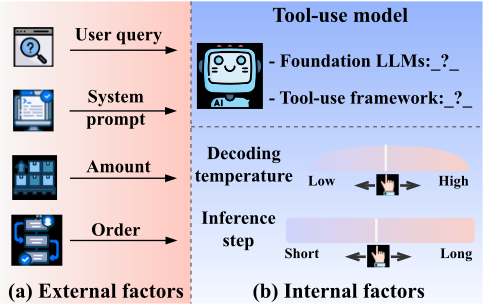
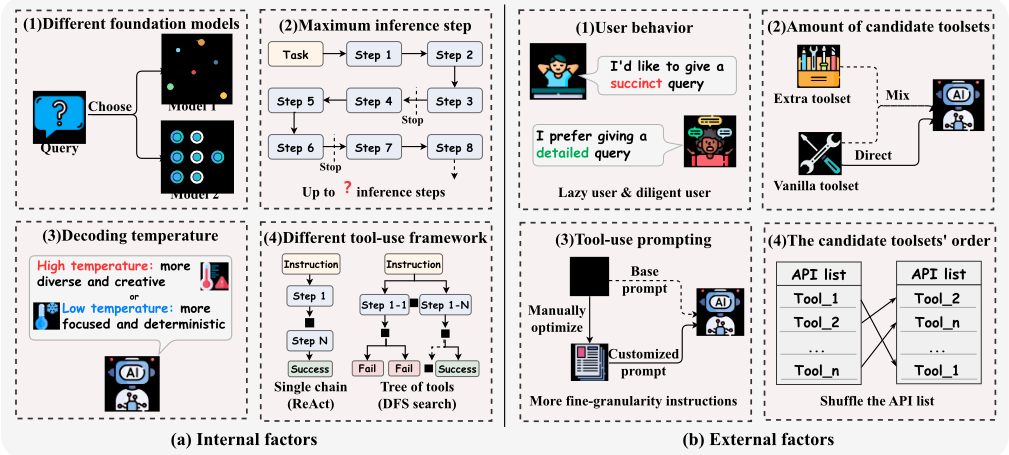
The internal factors indicate uncertainties during the development of tool-use models from the developers' perspective. As shown in Figure 1, we consider the decoding temperature, the maximum inference steps, and the selection of different foundation LLMs. Given the numerous works that guide LLMs to automatically use external tools [Yao et al., 2023; Yang et al., 2023b; Qin et al., 2023c], we also analyze the impact of different tool-use frameworks on the model's performance. Exploring these internal factors will help enhance the performance of the framework during development. Different from the internal factors, external factors primarily involve diverse prompt engineering when interacting with established tool-use models, which are beyond the control of developers once the models are deployed. Specifically, these factors includes different styles of user queries, customized system prompts for tool-use models, and the candidate toolset used to solve a query. For a holistic investigation, we change the candidate toolset by reordering it or expanding its scale, respectively. Investigating these external factors will help developers understand the stability in user-facing scenarios, thereby improving the overall user experience. To quantitatively validate the impact of the aforementioned internal and external factors on the tool learning process, we conduct extensive experiments on the most commonly used ToolBench [Qin et al., 2023c] dataset. We employ several commonly used metrics to measure the performance from multiple perspectives and derive a series of interesting findings. We highlight the following:
- Existing tool-use workflow exhibits obvious instability towards various internal and external factors. Even the state-of-the-art methods still exhibit instability with inessential perturbations.
- Among the internal factors, the proper hyper-parameter settings may boost the LLMs to generate diverse solutions. However, it also leads to instability.
- Among the external factors, the LLMs are sensitive to the change of candidate toolset (i.e., order or scale) and the system prompts.
- The advanced tool selection algorithms (i.e., tree-based search) can improve the accuracy, but they may suffer from accumulated hallucination with less stability, as well as substantial inference costs.
2 RelatedWork
Tool learning with LLMs. Tool learning aims to augment LLMs with real-world tools, extending their utility and empowering them as agents to solve practical tasks [Qin et al., 2023b; Tang et al., 2023a; Shi et al., 2023; Gao et al., 2024; Zhang et al., 2026]. Pioneering work like Toolformer [Schick et al., 2023] and ToolkenGPT [Hao et al., 2023] teaches LLMs to utilize tools by training on specific tool-use datasets [Patil et al., 2023; Wang et al., 2024]. Recent work leverages the inherent in-context learning capability of LLMs to master various tools, where the demonstration and usage are taken as the prompt [Yang et al., 2023b; Shi et al., 2024a; Guo et al., 2024]. Despite the progress of recent tool-use models in successfully solving complex tasks, their stability is less investigated. In this work, we provide a comprehensive empirical study on the stability of them across diverse scenarios.
| # Dataset | # Amount | # Category | # APIs | # Avg. APIs |
|---|---|---|---|---|
| I1-inst. | 200 | 36 | 995 | 5.34 |
| I1-tool | 200 | 33 | 548 | 4.79 |
Evaluation of tool-use LLMs. In tool learning tasks, previous work primarily evaluates the success rate of LLMs in completing tasks, such as Success Rate [Yang et al., 2023a; Song et al., 2023] and Win Rate [Qin et al., 2023c]. Recently, the ToolSword [Ye et al., 2024a] has also proposed to unveil safely-related issues of LLMs during the tool learning process. However, stability, a crucial dimension related to practical applications [Wang et al., 2023b], has been less investigated. Although some work, like RotBench [Ye et al., 2024b], proposes evaluating the robustness of tool-use LLMs, they only consider the different noise types injected into original candidate toolsets. To the best of our knowledge, a thorough stability evaluation of tool-use LLMs remains underexplored. In our work, we fill this gap by providing a systematic evaluation of the stability of tool-use LLMs, and quantitatively analyzing their drawbacks under different settings.
3 Experimental Settings
3.1 Dataset
We conduct experiments on the subset of widely-used ToolBench [Qin et al., 2023c] benchmark, including I1instruction and I1-tools. Each dataset contains 200 tasks involving various real-world applications, which evaluates tooluse models under practical scenarios. The detailed statistics can be found in Table 1. The original ToolBench only provides a task-solving trajectory of GPT-3.5 as an evaluation reference, which includes both ground truth and irrelevant tools. However, commonly used evaluation metrics (§ 3.2) require computing the overlap between model-selected tools and the ground truth. Therefore, we repurpose ToolBench to support our evaluation. For each task, we extract the tools used in the original solution. Next, we invite three welleducated experts with relevant research backgrounds to manually select the correct tools for solving the task.
3.2 EvaluationMetrics
Following previous work [Ye et al., 2024b; Song et al., 2023], we use the Success Rate and T-test as evaluation metrics. We also consider the Give Up Rate, Invalid Selection Rate as metrics for a comprehensive evaluation.
SuccessRate (Success%). Thismetric intuitively evaluates the capability of tool-use LLMs in correctly selecting tools and generating corresponding arguments for execution. It calculates the proportion of tasks that the model can complete successfully within limited steps. The success rate is 1 if and only if all the required tools are used to solve a task.
T-test. To analyze the stability of tool-use LLM towards diverse factors, we use a two-tailed paired t-test [Student, 1908]

following previous work [Ye et al., 2024b]. This metric calculates the statistical significance of the model's performance difference between vanilla and changed experimental conditions. The significance level α is set to 0.05. Results are marked with ▲ if they are statistically significance are observed; otherwise, they are marked with ▼.
Invalid Selection Rate (Invalid%). We use the Invalid Selection Rate to compute the percentage of instances where the LLM selecting non-existent tool, i.e., generating incorrect tool names. It reflects the ability of the model in tool selection, a crucial phase in the overall tool-use workflow, especially when the candidate toolset is large-scale.
Give Up Rate (Give up%). This metric computes the percentage of tasks that LLMs give up answering after trial and error. In practical scenarios, the model may fail to provide a correct solution for a complex task due to their limited ability. Therefore, it is crucial to build a confident model that is aware of its limitations, referred to as its capability boundary [Ruiyang et al., 2023; Yin et al., 2024], allowing it to adaptively and faithfully inform users of incomplete tasks rather than giving incorrect answers.
3.3 Tool Learning Framework
For a fair evaluation, we employ the widely adopted ReAct [Yao et al., 2023] method as a unified framework to enable LLMs to interact with tools across different experimental setups. In the ReAct framework, the LLM is guided to iteratively perform Thought, Action, and Observation steps. As shown in Figure 3, the Thought is to generate tool-use planning in the nature language while the Action is to select an appropriate tool and formulate corresponding parameters. The Observation step is to incorporate the execution results of tools in the current context. To explore the stability of LLMs in different tool-use frameworks, we compare the ReAct method with another framework, i.e., ToolLLM [Qin et al., 2023c], which augments LLMs with a Depth First Search-based Decision Tree (DFSDT) to select relevant tools for solving tasks (§ 4.3).
| Model | Success%↑ | Give up% | Invalid%↓ |
|---|---|---|---|
| gpt-3.5-turbo-16k | 54.00% | 29.50% | 1.48% |
| gpt-3.5-turbo-0125 | 55.50% | 36.50% | 1.45% |
| gpt-3.5-turbo-1106 | 48.00% | 50.50% | 0.88% |
| gpt-4o | 58.00% | 38.00% | 0.54% |
| deepseek-chat | 40.50% | 34.00% | 0.56% |
| llama-3-70b | 8.00% | 4.50% | 42.16% |
| llama-3-8b | 3.50% | 2.00% | 28.56% |
| mixtral-8x7b-inst. | 12.00% | 14.00% | 41.66% |
| mixtral-8x22b | 25.00% | 19.00% | 10.76% |
3.4 Implementation Details
For the closed-source models, e.g., GPT-3.5, we mainly enable them to utilize tools through OpenAI's function-call format 1 . For the open-source models, we use the prompt from [Qin et al., 2023c]. We also analyze the impact of different tool-use prompts in § 5.4.
4 Analysis of Internal Factors
We first investigate the influence of internal factors, which indicate the uncertainties in developing a tool-use models, such as the foundation LLMs and decoding temperature.
4.1 Impact of Foundation LLMs
The foundation LLM is the main component in the overall tool learning framework, which takes the user query as input and automatically executes external tools to generate an answer as a response. We comprehensively evaluate 9 off-theshelf LLMs, including both close-source model, i.e., GPT-3.5 and GPT-4, and open-source models such as Mistral [Jiang et al., 2023]. For deterministic generation, the decoding temperature is set to 1 and 0.5 for closed-source and open-source models, respectively, following previous work [Zhuang et al., 2023; Ruan et al., 2024].
As shown in Table 2, we find that closed-source models substantially outperform open-source models in Success Rate while achieving a lower Invalid Selection Rate. For example, GPT-4 achieves a 58% Success Rate with only a 0.54% Invalid Selection Rate. In addition, for the remaining 42% of uncompleted tasks, it can adaptively give up on 38%, illustrating its confidence in the evaluation task.
We also observe the scaling law in tool learning where the performance of LLMs, including stability and effectiveness, increases along with the scaling up of their parameters. This indicates that the inherent capability of foundation LLMs correlates with their tool-learning abilities.
1 https://platform.openai/function-call
4.2 Impact of Hyper-parameters
In the development of tool-use models, there are several hyper-parameters need to be considered. We investigate two common hyper-parameters that may affect the stability of tool-use LLMs, including the decoding temperature t and the maximum step of inference s. Generally, lower temperature generations are more focused and deterministic while higher temperature generations are more random [Chen and Ding, 2023]. We vary the decoding temperatures t from 0.2 to 1.4 with increments of 0.4. The s indicates the maximum inference steps to conduct tool-use actions, i.e., Thought, Action or Observation, which is alternated in {6, 8, 10, 12, 14}. We allow the LLMs to stop early if they complete or give up on a task within s steps.
We first discuss the influence of temperature. As illustrated in Table 4, with the increase in temperature, the Success Rate improves from 48% to 54.5%, and the Invalid Selection Rate shows a slight increase (0.89%). Significant differences are also observed in the Success Rate metric at different temperatures (e.g., t = 1.0 and t = 0.2). These results indicate that (1) LLMs exhibit unstable performance towards decoding temperature, and (2) higher temperatures can potentially improve performance with a slightly increased error in tool selection. A reason for this phenomenon is that higher temperatures boost the LLM to generate more diverse actions during inference [Peeperkorn et al., 2024; Zhu et al., 2024], thereby expanding the generated solution space. We observe a relatively increasing trend in the Give Up Rate when t shifts from 0.6 to 1.4. We look at the poorly performing cases, where we find the reason is that the LLM generates diverse solutions but still fail to derive a correct answer, thereafter adaptively give up the tasks.
Next, we examine the influence of the inference step. As shown in Table 3, we find that the GPT-3.5 only achieves 32.50% in success rate on the I1-inst. dataset when it allowed inference up to 6 steps. However, its Success Rate increases to 49.00% when the maximum inference step is extended to 10. A more obvious trend can be also observed in the Deepseek model, e.g., shifting from 5.50% to 39.00%. These results show that the LLM can benefit more trial and exploration step to complete a task correctly. We also find a relatively stable performance when the inference steps s keeps increasing, i.e., from 10 to 14. In our experimental setup and dataset, setting the inference step to 14 makes a tradeoff for consideration of effectiveness and efficiency for GPT-3.5.
4.3 Impact of Tool-use Framework
The tool-use frameworks indicate the specific techniques or methods to teach the LLM tool usage, automatically guiding them to interact with tools and solve a practical task. We compare two frameworks that are commonly used in previous work, including the ReAct [Yao et al., 2023] and DFSDT [Qin et al., 2023c]. ReAct is the default framework in our experiment mentioned in § 4.3, which grounds the tooluse process into Thought-Action-Observation format. In contrast, DFSDT [Qin et al., 2023c] augments the LLM with Depth First Search-based Decision Tree to select tools.
The tree-based framework generally performs better but with substantial costs. As illustrated in Table 5, we find that the DFSDT significantly achieves a higher Success Rate on both two datasets with an average of 30.76% point improvement. These results validate the superiority of the treebased search algorithm in recalling required tools to solve a task. However, it comes up with substantial inference cost, i.e., consuming nearly triple tokens, which may limits its effectiveness in low-resource scenarios or low-latency applications.
| Inference step | I1-instruction | I1-tool | ||||
|---|---|---|---|---|---|---|
| Success%↑ | Give up% | Invalid%↓ | Success%↑ | Give up% | Invalid%↓ | |
| gpt-3.5-turbo-16k step s →10 (vanilla) | 49.50% | 31.50% | 0.99% | 50.00% | 27.00% | 0.71% |
| step s → 6 | 32.50%▲ | 21.00%▲ | 0.79%▼ | 32.50%▲ | 16.50%▲ | 0.51%▼ |
| step s → 8 | 46.50%▼ | 22.50%▲ | 1.04%▼ | 41.50%▲ | 23.00%▼ | 0.89%▼ |
| step s → 12 | 54.00%▼ | 29.50%▼ | 1.48%▼ | 55.00%▲ | 25.00%▼ | 0.81%▼ |
| step s → 14 | 51.50%▼ | 32.50%▼ | 1.58%▼ | 57.00%▲ | 25.00%▼ | 1.12%▲ |
| deepseek-chat step s → 10 (vanilla) | 39.00% | 37.50% | 0.46% | 38.00% | 40.50% | 0.68% |
| step s → 6 | 5.50%▲ | 12.00%▲ | 0.68%▼ | 4.00% ▲ | 14.00%▲ | 0.93%▼ |
| step s → 8 | 24.50%▲ | 34.00%▼ | 0.71%▼ | 23.00%▲ | 32.00%▲ | 0.51%▼ |
| step s → 12 | 40.00%▼ | 34.00%▼ | 0.56%▼ | 41.00%▼ | 39.00%▼ | 0.63%▼ |
| step s → 14 | 43.50%▼ | 42.50%▼ | 0.84%▼ | 43.00%▼ | 39.50%▼ | 0.76%▼ |
| Temperature | Success%↑ | Give up% | Invalid%↓ | |
|---|---|---|---|---|
| t = 1.0 (vanilla) | 54.00% | 29.50% | 1.48% | |
| t = 0.2 | ↓0.8 | 48.00%▲ | 26.50%▼ | 1.04%▼ |
| t = 0.6 | ↓0.4 | 49.50%▲ | 24.50%▼ | 1.04%▼ |
| t = 1.4 | ↑0.4 | 54.50%▼ | 34.50%▼ | 1.93%▼ |
We also observe that the Deepseek model, when equipped with the DFSDT method, shows a substantial increase in Invalid Selection Rate. It indicates that open-source models suffer from relatively severe hallucinations to generate nonexisting tool names, especially when intensively selecting tools. Thus, we advocate the optimization of LLM to reduce its hallucination in generating correct tool names, thereby leveraging tree-based tool-use frameworks.
5 Analysis of External Factors
External factors involve the practical prompts to enable tooluse models, including diverse user prompts, customized system prompts, and the input candidate toolset.
5.1 Impact of User Prompts
In real-world applications, users exhibit diverse behaviors when interacting with the tool-use model. Therefore, we first simulate two practical behaviors of users, including: (1) succinct: a user provides a short instruction; and (2) detailed: a user provides a lengthy and comprehensive instruction. To achieve this, we employ gpt-3.5-turbo-0125 to compress or elaborate the description for each task in our experimental datasets, respectively, without changing the semantics and key information.
As shown in Table 6, LLMs are relatively stable towards user behaviors. Since LLMs are trained on a massive web corpus, they have developed strong abilities in capturing key information of a task despite the diverse styles of descriptions from various users.
5.2 Order of Candidate Toolsets
Given a task, the LLM first selects a series of tools from a candidate toolset S in a step-by-step manner and then executes the selected tools to obtain the final answer. Since the LLM suffers from the position bias [Liu et al., 2024] in a broad range of downstream tasks like document ranking [Tang et al., 2023b], we analyze whether the order of the tools in S can influence its performance in the tool-use workflow. We randomly shuffle the original toolset (vanilla) for each task in our experiment dataset and evaluate the model's performance.
Open-source model suffers from the positional bias of tools. As shown in Table 7, we find the weak open-source model, i.e., Deepseek, suffers from pronounced positional bias. For example, when we shuffle the original order of the toolset, its success rate decreases from 41.00% (original) to 27.00% (shuffle) on the I1-tool dataset. The 7.5% decrease is observed in the I1-instruction dataset. A similar phenomenon is also observed in other tasks, such as text summarization [Chhabra et al., 2024], and code search [Li et al., 2023c]. In addition, we find that GPT-3.5 is nearly insensitive to the order of the toolset, and only a 3% point difference in success rate is observed. These results indicate that powerful models with higher Success Rate are more skillful in solving tasks showing less instability toward positional bias, and vice versa.
5.3 Scale of Candidate Toolsets
Beyond the ground truth tools to solve an input task, the toolset S is typically large-scale in real-world scenarios, inevitably containing irrelevant or plausible-looking tools (a.k.a., noise). Therefore, we further benchmark the stability of models under the different scale of toolset S. For a more practical evaluation, we expand the scale of the toolset using two sampling strategies for each task: (1) Intra-category sampling: we augment the original toolset with tools sampled from the same category as the ground truth tools. These tools are related to the current task but not useful. (2) Crosscategory sampling: we sample irrelevant tools from different categories than the ground truth tools.
| Method | I1-instruction | I1-tool | ||||||
|---|---|---|---|---|---|---|---|---|
| Success%↑ | Give up% | Invalid%↓ | Cost (tokens) | Success%↑ | Give up% | Invalid%↓ | Cost (tokens) | |
| gpt-3.5-turbo-16k | ||||||||
| ReAct (vanilla) | 54.00% | 29.50% | 1.48% | 15032 | 55.00% | 25.00% | 0.81% | 16270 |
| DFSDT | 69.50%▲ | 30.00%▲ | 1.65%▲ | 37328 | 67.50%▲ | 31.50%▲ | 2.39%▲ | 45443 |
| deepseek-chat(21B) | ||||||||
| ReAct (vanilla) | 40.00% | 34.00% | 0.56% | 17815 | 41.00% | 39.00% | 0.63% | 17211 |
| DFSDT | 55.00%▲ | 42.50%▼ | 16.87%▲ | 47382 | 54.00%▲ | 42.50%▼ | 19.15%▲ | 49095 |
| Method | I1-instruction | I1-tool | ||
|---|---|---|---|---|
| Success%↑ | Give up% | Success%↑ | Give up% | |
| gpt-3.5-turbo-16k | ||||
| vanilla task | 54.00% | 29.50% | 55.00% | 25.00% |
| - w/ shorten | 49.50%▼ | 33.00%▼ | 52.50%▼ | 25.50%▼ |
| - w/ lengthen | 50.50%▼ | 33.00%▼ | 50.50%▼ | 30.00%▼ |
| deepseek-chat | ||||
| vanilla task | 40.00% | 34.00% | 41.00% | 39.00% |
| - w/ shorten | 38.00%▼ | 40.50%▲ | 39.00%▼ | 43.50% ▼ |
| - w/ lengthen | 37.00%▼ | 38.00%▼ | 32.00%▲ | 47.50%▲ |
Unstable performance is observed with change of toolset scale. We summarize the results in Table 7. We observe that both closed-source and open-source LLMs exhibit substantial performance degradation with the increase of toolsets scale. These results indicate the instability of LLMs towards irrelevant or relevant but useless tools. We also find a decreased trend in Give Up Rate. Thus, we dive into specific cases, where we find that with more candidate tools, the LLM tends to be stubborn and stuck in continuously selecting useless rather than adaptively stopping. These findings motivate us to carefully design the tool selection module in developing tool-use LLM systems or applications.
5.4 Impact of SystemPrompts
The system prompts indicate the input prompt demonstrating LLMs how to use tools, which pre-defines the format of the model's generation. Our vanilla setting implements the system prompt of closed-source LLMs with function call, which is an API interface exclusively supported by OpenAI. For open-source LLMs, the system prompt is a zero-shot instruction P (§ 3.4). Here, we consider human efforts in optimizing the prompts, where we formulate a detailed instruction P † on top of P by supplementing fine-granularity description to specify usage specifications. We evaluate both closedsource and open-source model with P † to analyze their stability towards diverse prompts. Table 8 presents the experimental results. The gpt-3.5-0125 suffers from a 15% decrease in Success Rate and a 13.48% increase in Invalid Selection Rate when we swap the official function-call prompt with manually customized prompts. This result intuitively demonstrates the LLMs are sensitive to different system prompts.. We also observe that the performance of the Deepseek model substantially improves (e.g., 22% higher Success Rate) when equipped with customized prompt P. This result illustrates that the LLM can understand tool-use instructions in a zeroshot manner, aligning with previous work [Hsieh et al., 2023]. Therefore, directly providing clear rules and instructions in system prompts is a potential alternative to enhance the tooluse ability of open-source models without cost-intensive supervised fine-tuning.
6 Discussion
6.1 Self-consistency of Tool-use Models
We further explore the self-consistency of tool-use models. Specifically, we repeatedly prompt a model to solve the tasks in the I1-inst. dataset N times with the same settings as in Table 2. We then count the percentage of completed tasks that can be solved in the first run, which reflects the consistency of the model through the discrepancies between different runs. In our implementation, we set N to 3. We find that the Mixtral-8x7B model can solve 57 tasks in the first run, but 20 of the initially failed tasks can be solved during the second and third runs. Similar phenomena are also observed in other LLMs, such as GPT-3.5. These results directly indicate that the stability of LLMs still needs to be improved.
6.2 Case Study
We compare tool-use model outputs for the same task under different experimental settings, such as prompts, inference steps, and candidate toolsets, revealing instability.
The impact of different foundation models. We find that the closed-model, i.e., gpt-4o-2024-05-13 can successfully finish the task with no redundant steps. However, the commonly used open-source models, i.e., Mixtral-8x7B and deepseek-chat, struggle to generate correct arguments to solve the task. This case indicates the performance among different backbone LLMs and the open-source models still lay behind the closed-source models in the tool learning tasks.
| Method | I1-instruction | I1-tool | ||||
|---|---|---|---|---|---|---|
| Success%↑ | Give up% | Invalid%↓ | Success%↑ | Give up% | Invalid%↓ | |
| gpt-3.5-turbo-16k vanilla toolset | 54.00% | 29.50% | 1.48% | 55.0% | 25.00% | 0.81% |
| randomly shuffle | 51.00%▼ | 31.50%▼ | 1.80%▼ | 52.50% ▼ | 25.50%▼ | 0.77%▼ |
| expand w/ intra-category | 51.00%▼ | 22.50%▲ | 0.77%▼ | 47.50%▲ | 23.50%▼ | 1.38%▲ |
| expand w/ cross-category | 47.00%▲ | 28.00%▼ | 0.53%▼ | 52.50%▼ | 18.00%▲ | 1.00%▼ |
| deepseek-chat vanilla toolset | 40.00% | 34.00% | 0.56% | 41.00% | 39.00% | 0.63% |
| randomly shuffle | 32.50%▼ | 35.50%▼ | 0.52%▼ | 27.00%▲ | 32.50%▼ | 0.76%▼ |
| expand w/ intra-category | 33.00%▲ | 34.00%▼ | 0.05%▼ | 32.50%▲ | 38.50%▼ | 0.63%▼ |
| expand w/ cross-category | 37.50%▼ | 32.00%▼ | 0.26%▼ | 32.00%▲ | 37.00%▼ | 0.51%▼ |
| Prompt | Success%↑ | Give up% | Invalid%↓ |
|---|---|---|---|
| gpt-3.5-turbo-0125 | |||
| Vanilla (func. call) | 55.00% | 36.50% | 1.45% |
| Customized | 40.00%▲ | 35.00%▼ | 14.93%▲ |
| gpt-3.5-turbo-1106 | |||
| Vanilla (func. call) | 48.00% | 50.5% | 0.88% |
| Customized | 47.50%▼ | 41.00%▲ | 6.73%▲ |
| llama-3-70b | |||
| Vanilla (naive) | 8.00% | 4.50% | 42.16% |
| Customized | 30.00%▲ | 10.00%▼ | 3.15%▲ |
The impact of different decoding temperature. We find that when the decoding temperature is set to 0.2, it stubbornly repeats the same incorrect actions instead of generating new ones. In contrast, when the temperature is increased to 1.4, the LLM can correct its mistakes in response to error messages and generate new actions. This case demonstrates that the LLM exhibits varied performance at different temperatures, with higher temperatures encouraging more diverse actions, validating our findings in §4.2.
The impact of the maximum inference step. We find that the LLM fails to solve a complex task within 6 steps. When the maximum inference step is increased to 12, the LLM benefits frommore trials and exploration, thereby completing the task. This case indicates that it is crucial to adapt the maximum inference step according to the task complexity.
The impact of the tools scale. We find that when we add more irrelevant tools in the original toolset, the LLM is misled to select inappropriate tools and generate incorrect arguments, thereafter failing the task. This case indicates that despite the powerful LLMs, e.g., GPT-3.5, they are sensitive to the scale of tools, which is aligned with our analysis in §5.3.
Takeaways. Since the tool-learning frameworks still suffer from instability due to various factors, we summarize our findings as several useful takeaways to boost the performance of tool-learning frameworks: (1) Decoding temperature can significantly affect the stability of tool-use LLMs (§ 4.2). In solving complex tasks, users can set relatively higher temperatures to boost LLMs to generate more diverse actions, thereby expanding the solution space. (2) Users can augment LLMs with tool selection algorithms, e.g., Depth-FirstSearch, which effectively improve the success rate through more trial and error. However, one should also consider the associated disadvantages, such as increased inference costs and the accumulated hallucination of tool selection errors over extended workflows. (3) Different system prompts result in varied performance. The closed-source models are trained to access tools through specialized function-call prompts, thereby showing fewer errors in workflow. Thus, we advocate tuning models with specific tool-use datasets or supplementing fine-granularity descriptions in prompts, aligning their generation with pre-defined usage specifications. (4) The LLMs are sensitive to the order and scale of the toolset.
7 Conclusion
We present an empirical study on the stability of tool-use models. Specifically, we explore the impact of both internal and external factors on the tool-learning frameworks. Internal factors include uncertainties during the development of the tool-use model, while external factors primarily involve diverse input prompts. Our quantitative analysis demonstrates that even powerful models such as GPT-3.5 exhibit significant instability in response to these factors. We also provide valuable findings and practical insights to facilitate further research in this area. Our future work includes: (1) extending our evaluation to tool-use agents empowered by multi-modal LLMs; and (2) exploring the model's stability in more intricate environments, such as dynamic interactions with users.
Acknowledgements
This work was supported by the National Natural Science Foundation of China (62432002, 62406061, U25B2049), the CCF-DiDi GAIA Collaborative Research Funds (CCF-DiDi GAIA 202504), the CCF-Huawei Populus Grove Fund (CCFHuaweiDB202509) and the State Key Laboratory of Internet Architecture (HLW2025MS10).
@inproceedings{ijcai2026p16,
  title     = {What Affects the Stability of Tool Learning? An Empirical Study on the Robustness of Tool Learning Frameworks},
  author    = {Huang, Chengrui and Shi, Zhengliang and Wen, Yuntao and Chen, Xiuying and Han, Peng and Gao, Shen and Shang, Shuo},
  booktitle = {Proceedings of the Thirty-Fifth International Joint Conference on
               Artificial Intelligence, {IJCAI-26}},
  publisher = {International Joint Conferences on Artificial Intelligence Organization},
  editor    = {Diego Calvanese},
  pages     = {136--144},
  year      = {2026},
  month     = {8},
  note      = {Main Track},
  doi       = {10.24963/ijcai.2026/16},
  url       = {https://doi.org/10.24963/ijcai.2026/16},
}
TY - CPAPER TI - What Affects the Stability of Tool Learning? An Empirical Study on the Robustness of Tool Learning Frameworks AU - Huang, Chengrui AU - Shi, Zhengliang AU - Wen, Yuntao AU - Chen, Xiuying AU - Han, Peng AU - Gao, Shen AU - Shang, Shuo T2 - Proceedings of the Thirty-Fifth International Joint Conference on Artificial Intelligence, IJCAI-26 PB - International Joint Conferences on Artificial Intelligence Organization PY - 2026 SP - 136 EP - 144 DO - 10.24963/ijcai.2026/16 UR - https://doi.org/10.24963/ijcai.2026/16 ER -Copied
Machine-readable versions of this paper, for tools and AI agents:





