
Information Entropy for LLM-generated Text Detection
Proceedings of the Thirty-Fifth International Joint Conference on Artificial Intelligence. Main Track. Pages 2028-2036.
https://doi.org/10.24963/ijcai.2026/226
Keywords
- Machine Learning: Cost-sensitive learning
- Computer Vision: Transfer, low-shot, semi- and un- supervised learning
- Machine Learning: Learning sparse models
- Machine Learning: Foundation models
- Machine Learning: Open-World/Open-Set/OOD Learning
Abstract
With the explosive growth of text generated by large language models (LLMs) on the internet, technologies for detecting LLM-generated text are increasingly important. However, existing technologies often require frequent access to LLMs during detection, significantly restricting their application in scenarios where only the text is accessible. To tackle this challenge, we identify that human-written texts exhibit higher entropy than LLM-generated texts. Motivated by this, we propose a novel method named IED, which leverages the Information Entropy for generative text Detection. Specifically, IED first transforms the given text into a vector of which each dimension represents the information entropy of each word, and then adopts a classifier to conduct the detection. Further, we propose IEGD which adopts the information gain to construct the vector by enhancing the differentiation between human-written and LLM-generated texts. To evaluate the effective of the proposed method, we construct a new large-scale dataset comprised of generated texts using various LLMs (LLaMA-7B, GPT-NeoX, etc.). Extensive experiments show that the proposed methods achieve improvement over state-of-the-art methods by up to 10.81%.
- [Antoun et al., 2023] Wissam Antoun, Benoît Sagot, and Djamé Seddah. From text to source: Results in detecting large language model-generated content. arXiv preprint arXiv:2309.13322, 2023.
- [Bakhtin et al., 2019] Anton Bakhtin, Sam Gross, Myle Ott, Yuntian Deng, Marc'Aurelio Ranzato, and Arthur Szlam. Real or fake? learning to discriminate machine from hu- man generated text. arXiv preprint arXiv:1906.03351, 2019.
- [Bao et al., 2023] Guangsheng Bao, Yanbin Zhao, Zhiyang Teng, Linyi Yang, and Yue Zhang. Fast-detectgpt: Efficient zero-shot detection of machine-generated text via conditional probability curvature. arXiv preprint arXiv:2310.05130, 2023.
- [Bhattacharjee et al., 2024] Amrita Bhattacharjee, Raha Moraffah, Joshua Garland, and Huan Liu. Eagle: A domain generalization framework for ai-generated text detection. arXiv preprint arXiv:2403.15690, 2024.
- [Black et al., 2022] Sid Black, Stella Biderman, Eric Halla- han, Quentin Anthony, Leo Gao, Laurence Golding, Ho- race He, Connor Leahy, Kyle McDonell, Jason Phang, et al. Gpt-neox-20b: An open-source autoregressive lan- guage model. arXiv preprint arXiv:2204.06745, 2022.
- [Devlin et al., 2018] Jacob Devlin, Ming-Wei Chang, Ken- ton Lee, and Kristina Toutanova. Bert: Pre-training of deep bidirectional transformers for language understand- ing. arXiv preprint arXiv:1810.04805, 2018.
- [Dugan et al., 2023] Liam Dugan, Daphne Ippolito, Arun Kirubarajan, Sherry Shi, and Chris Callison-Burch. Real or fake text?: Investigating human ability to detect bound- aries between human-written and machine-generated text. In Proceedings of the AAAI Conference on Artificial Intel- ligence, volume 37, pages 12763-12771, 2023.
- [Fan et al., 2018] Angela Fan, Mike Lewis, and Yann Dauphin. Hierarchical neural story generation. arXiv preprint arXiv:1805.04833, 2018.
- [Fröhling and Zubiaga, 2021] Leon Fröhling and Arkaitz Zubiaga. Feature-based detection of automated language models: tackling gpt-2, gpt-3 and grover. PeerJ Computer Science, 7:e443, 2021.
- [Gao et al., 2018] Ji Gao, Jack Lanchantin, Mary Lou Soffa, and Yanjun Qi. Black-box generation of adversarial text sequences to evade deep learning classifiers. In 2018 IEEE Security and Privacy Workshops (SPW), pages 50- 56. IEEE, 2018.
- [Gao et al., 2020] Leo Gao, Stella Biderman, Sid Black, Laurence Golding, Travis Hoppe, Charles Foster, Jason Phang, Horace He, Anish Thite, Noa Nabeshima, et al. The pile: An 800gb dataset of diverse text for language modeling. arXiv preprint arXiv:2101.00027, 2020.
- [Gehrmann et al., 2019] Sebastian Gehrmann, Hendrik Stro- belt, and Alexander M Rush. Gltr: Statistical detec- tion and visualization of generated text. arXiv preprint arXiv:1906.04043, 2019.
- [Huo et al., 2025] Fushuo Huo, Wenchao Xu, Zhong Zhang, Haozhao Wang, Zhicheng Chen, and Peilin Zhao. Self- introspective decoding: Alleviating hallucinations for large vision-language models. In The Thirteenth Interna- tional Conference on Learning Representations, 2025.
- [Kirchenbauer et al., 2023] John Kirchenbauer, Jonas Geip- ing, Yuxin Wen, Jonathan Katz, Ian Miers, and Tom Gold- stein. A watermark for large language models. In Inter- national Conference on Machine Learning, pages 17061- 17084. PMLR, 2023.
- [Lancaster, 2023] Thomas Lancaster. Artificial intelligence, text generation tools and chatgpt-does digital watermark- ing offer a solution? International Journal for Educational Integrity, 19(1):10, 2023.
- [Li et al., 2024a] Shiwei Li, Zhuoqi Hu, Xing Tang, Haozhao Wang, Shijie Xu, Weihong Luo, Yuhua Li, Xi- uqiang He, and Ruixuan Li. Mixed-precision embeddings for large-scale recommendation models. arXiv preprint arXiv:2409.20305, 2024.
- [Li et al., 2024b] Shiwei Li, Wenchao Xu, Haozhao Wang, Xing Tang, Yining Qi, Shijie Xu, Weihong Luo, Yuhua Li, Xiuqiang He, and Ruixuan Li. Fedbat: communication- efficient federated learning via learnable binarization. In Proceedings of the 41st International Conference on Ma- chine Learning, pages 29074-29095, 2024.
- [Li et al., 2025a] Yichen Li, Haozhao Wang, Yining Qi, Wei Liu, and Ruixuan Li. Re-fed+: A better replay strategy for federated incremental learning. IEEE Transactions on Pattern Analysis and Machine Intelligence, 2025.
- [Li et al., 2025b] Yichen Li, Haozhao Wang, Wenchao Xu, Tianzhe Xiao, Hong Liu, Minzhu Tu, Yuying Wang, Xin Yang, Rui Zhang, Shui Yu, et al. Unleashing the power of continual learning on non-centralized devices: A survey. IEEE Communications Surveys & Tutorials, 2025.
- [Liu et al., 2022] Wei Liu, Haozhao Wang, Jun Wang, Ruix- uan Li, Chao Yue, and YuanKai Zhang. Fr: Folded ra- tionalization with a unified encoder. Advances in Neural Information Processing Systems, 35:6954-6966, 2022.
- [Liu et al., 2023a] Xiaoming Liu, Zhaohan Zhang, Yichen Wang, Hang Pu, Yu Lan, and Chao Shen. Coco: Coherence-enhanced machine-generated text detection under low resource with contrastive learning. In Proceed- ings of the 2023 Conference on Empirical Methods in Nat- ural Language Processing, pages 16167-16188, 2023.
- [Liu et al., 2023b] Yiheng Liu, Tianle Han, Siyuan Ma, Ji- ayue Zhang, Yuanyuan Yang, Jiaming Tian, Hao He, An- tong Li, Mengshen He, Zhengliang Liu, et al. Summary of chatgpt-related research and perspective towards the future of large language models. Meta-Radiology, page 100017, 2023.
- [Liu et al., 2026a] Wei Liu, Hongkai Liu, Zhiying Deng, Yee Whye Teh, and Wee Sun Lee. From backward spread- ing to forward replay: Revisiting target construction in llm parameter editing. arXiv preprint arXiv:2605.00358, 2026.
- [Liu et al., 2026b] Wei Liu, Haomei Xu, Hongkai Liu, Zhiy- ing Deng, Ruixuan Li, Heng Huang, Yee Whye Teh, and Wee Sun Lee. Are we evaluating the edit locality of llm model editing properly? arXiv preprint arXiv:2601.17343, 2026.
- [Mitchell et al., 2023] Eric Mitchell, Yoonho Lee, Alexan- der Khazatsky, Christopher D Manning, and Chelsea Finn. Detectgpt: Zero-shot machine-generated text detection us- ing probability curvature. In International Conference on Machine Learning, pages 24950-24962. PMLR, 2023.
- [Narayan et al., 2018] Shashi Narayan, Shay B Cohen, and Mirella Lapata. Don't give me the details, just the sum- mary! topic-aware convolutional neural networks for ex- treme summarization. arXiv preprint arXiv:1808.08745, 2018.
- [Quidwai et al., 2023] Mujahid Ali Quidwai, Chunhui Li, and Parijat Dube. Beyond black box ai-generated plagia- rism detection: From sentence to document level. arXiv preprint arXiv:2306.08122, 2023.
- [Radford et al., 2019] Alec Radford, Jeffrey Wu, Rewon Child, David Luan, Dario Amodei, Ilya Sutskever, et al. Language models are unsupervised multitask learners. OpenAI blog, 1(8):9, 2019.
- [Rajpurkar et al., 2016] Pranav Rajpurkar, Jian Zhang, Kon- stantin Lopyrev, and Percy Liang. Squad: 100,000+ ques- tions for machine comprehension of text. arXiv preprint arXiv:1606.05250, 2016.
- [Sadasivan et al., 2023] Vinu Sankar Sadasivan, Aounon Kumar, Sriram Balasubramanian, Wenxiao Wang, and So- heil Feizi. Can ai-generated text be reliably detected? arXiv preprint arXiv:2303.11156, 2023.
- [Shi et al., 2024] Yuhui Shi, Qiang Sheng, Juan Cao, Hao Mi, Beizhe Hu, and Danding Wang. Ten words only still help: Improving black-box ai-generated text detec- tion via proxy-guided efficient re-sampling. arXiv preprint arXiv:2402.09199, 2024. IJCAI
- [Taguchi et al., 2024] Kaito Taguchi, Yujie Gu, and Kouichi Sakurai. The impact of prompts on zero-shot detection of ai-generated text. arXiv preprint arXiv:2403.20127, 2024.
- [Touvron et al., 2023] Hugo Touvron, Thibaut Lavril, Gau- tier Izacard, Xavier Martinet, Marie-Anne Lachaux, Tim- othée Lacroix, Baptiste Rozière, Naman Goyal, Eric Ham- bro, Faisal Azhar, et al. Llama: Open and efficient founda- tion language models. arXiv preprint arXiv:2302.13971, 2023.
- [Wang et al., 2023a] Pengyu Wang, Linyang Li, Ke Ren, Bo- tian Jiang, Dong Zhang, and Xipeng Qiu. SeqXGPT: Sentence-level AI-generated text detection. In Houda Bouamor, Juan Pino, and Kalika Bali, editors, Proceedings of the 2023 Conference on Empirical Methods in Natural Language Processing, pages 1144-1156, Singapore, De- cember 2023. Association for Computational Linguistics.
- [Wang et al., 2023b] Yuxia Wang, Jonibek Mansurov, Petar Ivanov, Jinyan Su, Artem Shelmanov, Akim Tsvigun, Chenxi Whitehouse, Osama Mohammed Afzal, Tarek Mahmoud, Toru Sasaki, et al. M4: Multi-generator, multi- domain, and multi-lingual black-box machine-generated text detection. arXiv preprint arXiv:2305.14902, 2023.
- [Wang et al., 2024] Peng Wang, Shuai Bai, Sinan Tan, Shi- jie Wang, Zhihao Fan, Jinze Bai, Keqin Chen, Xuejing Liu, Jialin Wang, Wenbin Ge, et al. Qwen2-vl: Enhanc- ing vision-language model's perception of the world at any resolution. arXiv preprint arXiv:2409.12191, 2024.
- [Wang et al., 2025a] Bingbing Wang, Zhengda Jin, Bin Liang, Jing Li, and Ruifeng Xu. Remod: Rethinking modality contribution in multimodal stance detection via dual reasoning. arXiv preprint arXiv:2511.06057, 2025.
- [Wang et al., 2025b] Bingbing Wang, Jingjie Lin, Zhixin Bai, Zihan Wang, Shengzhe Sun, Zhengda Jin, Zhiyuan Wen, Geng Tu, Jing Li, Erik Cambria, et al. Internet meme on social media: A comprehensive review and new per- spectives. Information Fusion, page 104102, 2025.
- [Wang et al., 2026] Bingbing Wang, Jing Li, and Ruifeng Xu. Bounded state in an infinite horizon: Proactive hierar- chical memory for ad-hoc recall over streaming dialogues. arXiv preprint arXiv:2603.04885, 2026.
- [Wu et al., 2023] Kangxi Wu, Liang Pang, Huawei Shen, Xueqi Cheng, and Tat-Seng Chua. Llmdet: A third party large language models generated text detection tool. arXiv preprint arXiv:2305.15004, 2023.
- [Wu et al., 2024] Junchao Wu, Runzhe Zhan, Derek F Wong, Shu Yang, Xuebo Liu, Lidia S Chao, and Min Zhang. Who wrote this? the key to zero-shot llm-generated text detec- tion is gecscore. arXiv preprint arXiv:2405.04286, 2024.
- [Zhang et al., 2022] Susan Zhang, Stephen Roller, Naman Goyal, Mikel Artetxe, Moya Chen, Shuohui Chen, Christopher Dewan, Mona Diab, Xian Li, Xi Victoria Lin, et al. Opt: Open pre-trained transformer language models. arXiv preprint arXiv:2205.01068, 2022.
References were extracted automatically from the PDF and may contain errors.
Full text extracted automatically from the PDF; figures, tables and equations may differ. The PDF is the version of record.
1 Introduction
Large language models (LLMs) recently exhibited the powerful ability to generate textual data [Liu et al., 2023b; Li et al., 2024a; Li et al., 2025b], achieving great attention. However, LLMs may also be abused by malicious actors to generate large volumes of spam text, e.g., generating misleading public opinion content and fraudulent academic material [Wang et al., 2025b; Li et al., 2024b]. Considering this, there is an imperative for the development of efficient detection technologies capable of accurately discerning whether the text is generated by humans or LLMs.
Many approaches [Quidwai et al., 2023; Bhattacharjee et al., 2024; Mitchell et al., 2023; Bao et al., 2023] have been proposed to detect generated text, which can be generally divided into two classes depending on the type of internal information utilized by LLMs, i.e., weights and intermediate layer output. The methods utilizing weight information explore the magnitude of weight fluctuations to discern if the text has been generated by LLMs, i.e., substantial weight alterations pointing towards LLM-generated text, while slight modifications in weights are human-written [Bakhtin et al., 2019]. Other methods use intermediate layer output, such as log probability for each word, to perturb the text and observe the changes in log probability [Taguchi et al., 2024; Wang et al., 2023b; Mitchell et al., 2023; Wang et al., 2023a]. A decrease in log probability indicates text generated by LLMs, while an increase or a small change in log probability suggests text written by humans. While these techniques are highly effective for detecting text when internal model information (e.g., gradients, hidden states) from LLMs is accessible, their utility is limited in black-box settings where only the generated text is available.
∗Haozhao Wang and Jingcai Guo are corresponding authors.
In this work, we seek to develop a technique that relies not on internal mechanisms of LLMs but entirely on the informational content of the text itself to determine whether text is authored by humans or generated by LLMs. Particularly, we identify that human-written text exhibits higher information entropy (IE) than LLM-generated text. Inspired by this observation, we introduce an innovative methodology named IED, which leverages the information entropy for generative text detection. IED first calculates the information entropy value of each word and then transforms each given input text into an IE vector by using the calculated IE. Finally, IED inputs the transformed IE vector into a binary classifier. Furthermore, we propose a novel method named IEGD, which leverages the information gain to construct a text vector, thereby enhancing the differentiation between human-written and LLMgenerated texts. Experimental results on various datasets and models demonstrate that our method can significantly enhance detection accuracy. Our contributions are:
- We identify that human-written texts usually exhibit higher information entropy than LLM-generated text. As we know, this research is the first to explore the detection of LLM-generated text using information entropy gain from an information-theoretic standpoint.
- We propose the novel information entropy-based meth-
ods for distinguishing between human and LLMgenerated texts. Our information entropy detection method is a technique that functions independently of the internal specifics (e.g., architecture, weights) of LLMs, making it broadly applicable.
- We construct a new large-scale dataset comprised of generated texts using various LLMs and prompts from real datasets. Extensive experiments on 9 advanced and commercial LLMs (GPT-4, Qwen-2, GPT-3.5-turbo, LLAMA-13B, etc.) show that our method outperforms state-of-the-art detection methods by up to 10.81%.
2 Related work
In this section, we discuss representative approaches to determine whether humans or LLMs produce the text. These approaches mostly consist of leveraging internal mechanisms of LLMs, statistical analyses of feature information, and watermarking techniques.
Leveraging internal mechanisms of LLMs. Many approaches capitalize on the intricate workings of LLMs, including intermediate layer outputs and weight parameters, to discriminate between human-written and LLM-generated texts [Taguchi et al., 2024; Wang et al., 2023b; Wang et al., 2023a; Bakhtin et al., 2019]. These methods introduce subtle text modifications to track changes in log probabilities. A conspicuous decline in log probability typically points to text generated by large language models. Conversely, an elevation in log probability or insignificant variations tends to imply human authorship [Mitchell et al., 2023; Bao et al., 2023]. Other methods utilize weight information to explore the magnitude of weight fluctuations [Bakhtin et al., 2019; Wang et al., 2026]. While these methodologies demonstrate considerable efficacy in identifying text origins when afforded access to the internal workings of LLMs, their utility is constrained in scenarios where solely the text itself is accessible. Our approach differs fundamentally from theirs in both methodology and underlying assumptions. It is independent of the complex internal mechanics of LLMs and harnesses the metric of IE gain to distinguish human-written and LLM-generated text. Also, our approach's model-agnostic property confers notable universality, seamlessly detecting across a wide array of LLMs without necessitating bespoke optimization for each model [Wang et al., 2025a].
Statistical analyses of feature information. Aiming at detecting text generated by small models, multiple methods employ statistical analysis to examine various features of the text, such as word choice, sentence structure, and stylistic elements, comparing them against known human or generation patterns to detect discrepancies that might indicate nonhuman authorship [Wang et al., 2023b; Shi et al., 2024; Gao et al., 2018; Li et al., 2025a]. Nevertheless, statistical approaches are inherently limited in detecting the text generated by LLMs. Particularly, they rely solely on patterns within vocabulary and structure, which can lead to overfitting in high-dimensional [Wu et al., 2023]. As LLMs continue to advance, their capabilities have reached near parity with human performance, thereby progressively undermining the effectiveness of conventional statistical methods.
Watermarking techniques. Watermarking constitutes an intricate, embedded detection technique that entails the sophisticated embedding of cryptic identification information within the very substrate of the generated text [Gehrmann et al., 2019; Fr¨ohling and Zubiaga, 2021; Antoun et al., 2023]. It allows for identifying the source and validity of the content during subsequent detection [Lancaster, 2023; Sadasivan et al., 2023]. Although the watermarking methodologies assure robustness [Kirchenbauer et al., 2023], they are employed at the creation stage as opposed to being utilized for subsequent detection efforts.
3 Methodology
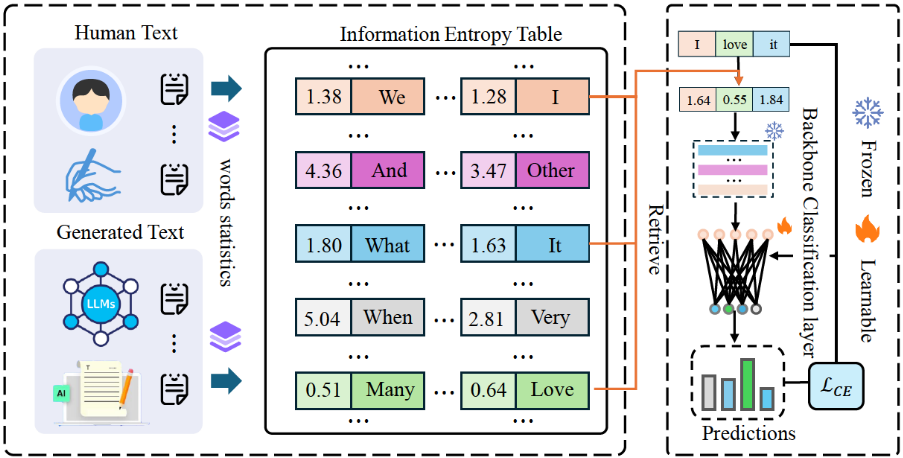
In this section, we introduce a framework named IED, which leverages Information Entropy to discern whether the text is human-written or LLM-generated. Specifically, IED first calculates the entropy value of each word and transforms the input text into an explicit information entropy vector. Then, it adopts a classifier to conduct the detection based on this vector. As shown in Figure 5, this architecture guides the model's semantic capacity with a discriminative, theory-driven signal, enhancing the differentiation between human-written and LLM-generated texts.
3.1 Motivation
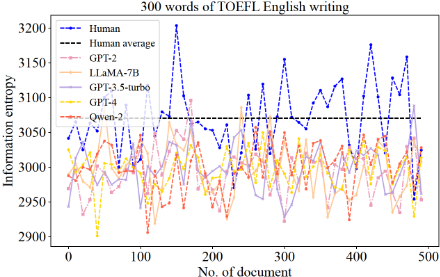
By comparing the texts written by humans and generated by LLMs, we find that the information entropy of humanwritten text is higher than LLM-generated text. Specifically, we compiled a corpus of broader sample essays written for the TOEFL exam from online sources. We employed three advanced language models - GPT-2 [Radford et al., 2019] and LLaMA-7B [Touvron et al., 2023] for the essay generation task, intending to conduct a thorough comparison against essays authored by humans. Let q(xji ) be the frequency of word xji occurring in the document xi, and W be the number of different words. We then can compute the information entropy H(xi) of each input document xi as:
As shown in Figure 1, the IE of human-written texts is higher than LLM-generated texts overall. For instance, the IE of most human-written documents is higher than 3050 (indicated by the horizontal dashed line), while that of most LLM-generated documents is smaller than 3050. The main reason is higher IE generally indicates more variability, unpredictability, and randomness in the text, which corresponds to the characteristics of human writings, which are replete with a broad spectrum of lexical choices and syntactical configurations. Conversely, LLMs tend to generate texts that often conform to structured patterns, which are inherently limited by the scope of the training corpus and algorithmic logic, lacking intrinsic human creativity.
3.2 IED: Information Entropy based Detection
In this section, we introduce IED to discern whether text x originates from LLMs or humans based on the IE. IED mainly consists of two steps, i.e., calculating the information entropy to construct an entropy-word mapping table and then training the text classifier based on this table.
LLM-generated Text Dataset Construction. Due to the lack of readily available LLM-generated text databases, we collect sufficient and representative samples of generated text for each model to be evaluated. To achieve this, we first construct a diversified prompt set C = {c1, c2, · · · , cn} from datasets such as X-sum [Narayan et al., 2018] and RoFT [Dugan et al., 2023] by extracting the questions existed in their samples. Then, we randomly sample a prompt ci from the prompt set C and input it to each LLM j ∈ [S] to generate the text x(i-1)∗j+i = LLMj(ci), where S denotes the number of LLMs. Next, the generated text x(i-1)∗j+i is added to the generation dataset T by T = T ∪ {x(i-1)∗j+i}. This process performs MT iterations, i.e., constructing MT samples for the dataset T. This approach guarantees uniformity and equity in the sampling process, cementing a robust groundwork for LLMs' subsequent evaluation and analysis.
Calculating Information Entropy. The dataset D is composed of LLM-generated dataset T and human-written dataset U. we decompose all the texts in the dataset D into a 1-gram set G={g1,. . . ,gW}. Then, by counting the number r(gi, T) of occurrences of the word gi in the entire dataset T , we can calculate the frequency q(gi,D) of each word gi in dataset D:
we calculate the H(gi, D) with equation (3).
Finally, the IE of the word gi is added to the dictionary D by D = D ∪ {(gi, H(gi, D)}.
Text Classification. For ease of classification, we transform the input text into a vector composed of information entropy gain values by retrieving the mapping table. Then, this vector is adopted as the input for the classification network. This approach enhances the model's ability to discern subtle patterns and anomalies within the text, potentially improving the accuracy and reliability of the detection process.
Specifically, we refer to the mapping table M to get the corresponding information entropy vector ei for the input text xi remaining to be detected, i.e., ei = [M(x1i ),M(x2i ), . . . ,M(xWi )]. Then, we transform the information entropy vector ei to the backbone θb of the neural network, obtaining the hidden feature vector zi = fb(ei, θb). Let θh be the classifier parameter. The detection label is obtained by ˆ yi = fh(zi, θh). Let l(·) be the loss function. Then, our objective is to train the classifier θh by minimizing the average of all sample loss L( ˆ yi, yi; θh):
Note that we keep the parameter θb unchanged during training and only train the classification layer with θh = θh - η∇L( ˆ yi, yi, θh) to improve the efficiency of fine-tuning the model parameter, where η is the learning rate.
3.3 IEGD: Information Entropy Gain based Detection
Drawing upon our insightful observations, we endeavored to leverage information entropy gain as a pivotal element in our experimental design. Particularly, built upon the IE, information entropy gain quantifies the decrease in uncertainty pertinent to data categorization, further enriching the analytical depth of IE. While IED has demonstrated robust efficacy in characterizing textual patterns, the concept of IEG extends this theoretical foundation by providing a quantitative measure of distributional differences between human and machine-generated text features. Specifically, information entropy gain enhances discrimination capability when employed with information entropy metrics, offering a systematic approach to identifying distinctive linguistic patterns between the two text categories. Therefore, we further extends the IED to IEAD that uses the information entropy gain to vectorize the input texts.
Calculating Information Entropy Gain. Let D be the same dataset composed of LLM-generated dataset T and humanwritten dataset U. We first calculate the information entropy H(D) of the whole dataset D:
We divide the dataset D into two subsets: Dgi contains the text with gi, and D¬gi doesn't contain g. Then, we calculate the conditional entropy H(D|gi):
Next, we calculate the information gain ∆H(D|gi) by
Based on the information entropy gain of all words, we transform the texts into the vectors of information entropy gain. Finally, we train the classifier θh using the same equation (4). The algorithm and illustration of IEGD can be found in Appendix A.
4 Experiments
In this section, we first introduce the experimental setup for the datasets, implementation details of the IEGD, and the baselines. We evaluated the accuracy of our approach on four datasets and compared it with state-of-the-art algorithms. Finally, we assessed the impact of hyperparameters on our proposed method.
4.1 Experiment setting
Dataset&LLMs.Our experiment employs a meticulously curated collection of four datasets to rigorously appraise the capabilities of generated text detection across a spectrum of domains. For instance, news articles from the XSum dataset [Narayan et al., 2018] are used for news detection. Wikipedia paragraphs from SQuAD contexts [Rajpurkar et al., 2016] represent machine-written academic essays and prompted stories from the Reddit WritingPrompts dataset [Fan et al., 2018] gauge the models' ability to generate creative writing similar to human submissions. To further test the model's robustness against shifts in data distribution. We include various topics from the RoFT dataset [Dugan et al., 2023]. We use various LLMs to generate text, i.e., GPT2 [Radford et al., 2019], OPT-2.7B [Zhang et al., 2022], Neo-2.7B [Gao et al., 2020], LLaMA-7B [Touvron et al., 2023], LLaMA-13B, GPT-NeoX [Black et al., 2022], GPT3.5-turbo, GPT-4, Qwen-2 [Wang et al., 2024].
Metrics. To evaluate the detector's ability to distinguish between texts generated by LLMs or humans, we employ Accuracy (A), AUROC,F1 scores (F1) and Recall (R) as performance metrics.
Baselines. We compared our method with various approaches for detecting LLM-generated text. FastDetectGPT [Bao et al., 2023] is a method for detecting text generated by large language models (LLMs), which works by evaluating the conditional probability curvature associated with sampled alternative tokens. The Log-Rank is employed to assess whether text generated by a model is based on the value of the log perplexity. GLTR [Gehrmann et al., 2019] integrates a suite of statistical techniques, employing visual analytics to assist users in discerning text generated by models. DetectGPT [Mitchell et al., 2023] exploits the curvature characteristics of language model probability functions to discern synthesized text. LLMDet [Wu et al., 2023] assesses the provenance of generated text by calculating the surrogate perplexity for each LLM. SeqXGPT [Wang et al., 2023a] translates sentences into waveforms akin to those in speech processing, leveraging convolutional networks and self-attention mechanisms for sentence-level detection of generated text. GECScore [Wu et al., 2024] determines whether text originates from LLMs by feeding it into a grammar error correction model, quantifying the similarity between the original and corrected texts. COCO [Liu et al., 2023a] uses contrastive learning to detect text.
Implementation Details. To ensure the reproducibility and efficiency of our experiments, all computations were meticulously conducted on a high-performance computing platform running the Ubuntu operating system. The system is powered by an Intel Xeon Platinum 8176 CPU@2.10GHz, delivering robust computational capabilities for data processing. To handle the memory-intensive tasks associated with large language models, the platform is equipped with a substantial
| Dataset | ACC(%) | FastDetectGPT | DetectGPT | LLMDet | SeqXGPT | GECScore | COCO | IED | IEGD |
|---|---|---|---|---|---|---|---|---|---|
| X-sum | GPT-2 | 72.87± 3.51 | 80.25± 1.58 | 71.07± 3.93 | 87.16± 1.33 | 82.37± 2.37 | 89.22± 5.11 | 80.81± 5.64 | 92.60± 3.87 |
| OPT-2.7 | 81.57± 2.37 | 75.47± 0.21 | 74.36± 4.94 | 84.32± 2.40 | 79.51± 1.03 | 85.25± 5.22 | 86.82± 2.32 | 91.68± 2.21 | |
| Neo-2.7B | 82.23± 1.67 | 68.80± 1.28 | 70.16± 2.46 | 79.04± 1.37 | 70.71± 1.57 | 81.86± 2.28 | 92.94± 3.98 | 93.50± 3.77 | |
| LLaMA-7B | 84.16± 2.61 | 75.30± 1.68 | 75.80± 1.35 | 85.41± 5.80 | 76.28± 0.58 | 83.93± 4.68 | 85.47± 1.05 | 90.40± 0.23 | |
| LLAMA-13B | 77.21± 3.62 | 68.80± 1.58 | 69.86± 3.79 | 74.95± 4.70 | 69.85± 3.12 | 79.28± 3.54 | 81.98± 1.44 | 83.91± 3.18 | |
| GPT-NeoX | 79.24± 1.07 | 67.71± 1.58 | 67.52± 4.90 | 76.76± 3.65 | 69.77± 1.82 | 82.38± 4.09 | 84.02± 5.08 | 86.98± 1.39 | |
| GPT-3.5-turbo | 81.58± 1.76 | 75.68± 2.03 | 65.57± 2.82 | 82.88± 1.40 | 69.99± 1.98 | 84.84± 8.03 | 87.51± 6.80 | 92.15± 1.44 | |
| GPT-4 | 76.17± 1.81 | 81.89± 2.84 | 68.95± 4.57 | 84.77± 1.61 | 71.65± 1.34 | 89.62± 1.63 | 90.68± 2.61 | 93.46± 1.52 | |
| Qwen-2 | 81.42± 2.35 | 70.55± 2.72 | 66.51± 3.73 | 83.87± 2.91 | 73.96± 1.77 | 87.50± 1.58 | 92.65± 1.68 | 93.31± 1.24 | |
| SQuAD | GPT-2 | 80.82± 1.95 | 73.78± 4.71 | 70.21± 1.89 | 89.10± 3.62 | 84.25± 1.68 | 91.47± 2.06 | 90.05± 3.45 | 96.97± 1.92 |
| OPT-2.7 | 78.58± 1.82 | 71.12± 1.50 | 72.96± 1.03 | 81.56± 2.37 | 75.67± 3.59 | 83.06± 2.98 | 86.69± 1.33 | 87.89± 5.34 | |
| Neo-2.7B | 81.69± 1.56 | 72.97± 2.16 | 78.17± 1.68 | 84.16± 53.5 | 70.45± 2.10 | 83.48± 1.17 | 76.90± 1.30 | 86.40± 1.53 | |
| LLaMA-7B | 80.99± 3.47 | 76.65± 0.69 | 78.51± 0.90 | 59.54± 1.91 | 75.06± 2.45 | 91.33± 4.17 | 89.17± 4.75 | 95.17± 4.45 | |
| LLAMA-13B | 86.91± 1.68 | 75.90± 4.42 | 73.59± 2.27 | 82.02± 0.19 | 73.73± 1.12 | 78.04± 0.18 | 82.62± 6.49 | 87.10± 1.06 | |
| GPT-NeoX | 82.11± 0.45 | 69.22± 2.51 | 67.73± 1.68 | 79.28± 1.84 | 68.87± 2.53 | 83.79± 1.55 | 80.39± 5.57 | 85.75± 3.14 | |
| GPT-3.5-turbo | 82.11± 0.45 | 78.28± 1.76 | 60.51± 1.96 | 87.08± 1.56 | 80.03± 2.34 | 87.65± 4.56 | 88.27± 3.17 | 91.97± 2.93 | |
| GPT-4 | 80.17± 0.72 | 82.66± 1.88 | 60.13± 2.85 | 86.78± 6.87 | 71.21± 1.65 | 82.42± 3.83 | 88.27± 3.74 | 98.57± 1.64 | |
| Qwen-2 | 81.61± 2.23 | 75.54± 2.39 | 71.46± 1.61 | 85.08± 1.51 | 65.98± 1.22 | 84.74± 1.49 | 93.11± 2.98 | 95.32± 1.55 | |
| WritingPrompts | GPT-2 | 78.93± 1.64 | 76.70± 1.93 | 73.62± 1.97 | 85.28± 4.20 | 83.77± 1.08 | 83.22± 3.08 | 87.27± 1.71 | 94.32± 1.21 |
| OPT-2.7 | 83.26± 2.97 | 71.33± 1.80 | 75.26± 1.80 | 78.15± 1.74 | 75.76± 3.90 | 80.81± 6.98 | 77.24± 3.75 | 82.08± 7.00 | |
| Neo-2.7B | 81.95± 2.00 | 74.07± 0.56 | 76.02± 3.00 | 80.71± 1.15 | 74.98± 2.22 | 85.10± 2.28 | 82.27± 1.94 | 85.88± 0.23 | |
| LLaMA-7B | 82.30± 2.55 | 62.97± 2.55 | 72.88± 3.51 | 73.77± 1.63 | 66.64± 2.65 | 84.48± 1.21 | 76.93± 1.56 | 87.79± 1.36 | |
| LLAMA-13B | 81.38± 0.26 | 74.88± 0.97 | 78.53± 3.21 | 86.69± 1.05 | 78.82± 2.20 | 89.33± 2.42 | 85.83± 1.06 | 91.23± 5.06 | |
| GPT-NeoX | 81.85± 1.45 | 71.04± 3.70 | 66.30± 2.22 | 80.58± 2.00 | 65.17± 3.48 | 84.19± 1.24 | 87.59± 4.14 | 90.55± 1.34 | |
| GPT-3.5-turbo | 81.85± 1.45 | 72.29± 3.64 | 67.99± 1.76 | 80.09± 1.52 | 78.92± 1.55 | 88.05± 3.94 | 89.62± 1.36 | 89.71± 1.05 | |
| GPT-4 | 79.14± 1.24 | 75.26± 2.87 | 67.57± 1.94 | 86.91± 3.32 | 67.57± 1.94 | 84.52± 2.97 | 89.45± 1.86 | 90.86± 1.52 | |
| Qwen-2 | 76.29± 3.30 | 65.60± 2.69 | 61.73± 1.73 | 82.33± 1.08 | 69.66± 1.45 | 85.10± 2.76 | 88.82± 1.26 | 92.29± 2.13 | |
| GPT-2 | 78.87± 2.66 | 73.73± 2.59 | 68.12± 8.35 | 80.97± 7.99 | 72.92± 7.34 | 77.42± 5.41 | 80.72± 1.26 | 82.63± 4.33 | |
| OPT-2.7 | 51.11± 5.20 | 76.57± 6.76 | 69.27± 6.53 | 80.58± 3.73 | 67.64± 2.21 | 69.81± 1.46 | 85.11± 2.60 | 91.36± 2.70 | |
| Neo-2.7B | 81.75± 2.03 | 70.46± 1.71 | 68.84± 1.78 | 79.42± 3.88 | 71.84± 5.14 | 66.04± 3.08 | 76.40± 7.76 | 83.64± 1.21 | |
| LLaMA-7B | 82.01± 1.44 | 57.88± 2.10 | 67.73± 7.47 | 79.81± 6.40 | 63.27± 1.27 | 72.88± 3.16 | 81.83± 4.98 | 84.04± 1.60 | |
| RoFT | LLAMA-13B | 76.22± 1.12 | 78.00± 1.67 | 72.06± 2.04 | 80.97± 1.83 | 78.63± 2.06 | 83.74± 1.14 | 90.37± 1.93 | 90.89± 0.88 |
| GPT-NeoX | 78.14± 1.34 | 72.26± 6.16 | 66.17± 2.22 | 71.46± 0.76 | 65.79± 0.50 | 70.93± 2.64 | 73.61± 2.91 | 74.15± 4.70 | |
| GPT-3.5-turbo | 81.84± 0.67 | 74.36± 1.81 | 71.48± 8.87 | 85.06± 1.85 | 66.24± 3.49 | 82.22± 2.49 | 93.16± 2.98 | 90.19± 3.64 | |
| GPT-4 | 84.41± 1.62 | 75.21± 4.74 | 74.83± 2.68 | 73.51± 1.11 | 73.04± 1.07 | 82.71± 2.73 | 85.76± 3.05 | 90.23± 1.21 | |
| Qwen-2 | 78.15± 2.46 | 72.77± 1.91 | 59.87± 3.57 | 88.71± 3.84 | 74.76± 2.24 | 88.54± 2.72 | 90.93± 4.07 | 91.57± 1.62 |
503 GB of memory. To accelerate the inference and calculation of information entropy, we utilized four NVIDIA Corporation GA102GL RTX A6000 GPUs.
4.2 Performance Evaluation
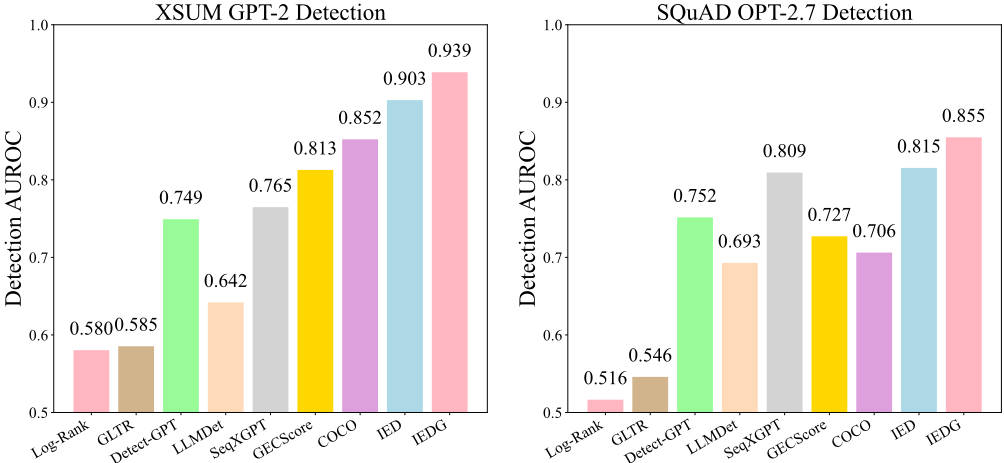
Accuracy. As detailed in Table 1, our proposed method consistently demonstrates superior precision across diverse benchmarks, outperforming state-of-the-art baselines. Specifically, on the X-sum dataset for GPT-2 generated text, IEGD achieves a remarkable accuracy of 92.60%, surpassing competitive methods like DetectGPT (80.25%) and FastDetectGPT (72.87%). Beyond individual datasets, extensive experiments indicate that our method achieves an improvement over existing methods by up to 10.81%. This performance disparity validates our foundational premise: humanauthored texts exhibit higher information entropy due to the complexity of human thought and rich background knowledge. In contrast, LLMs optimize for probability maximization, resulting in structured, predictable patterns with lower entropy. By quantifying this uncertainty gap, IEGD effectively transforms subtle statistical variations into discriminative signals for accurate detection.
F1-score. As illustrated in Table 2, the experimental results demonstrate the superior performance of IED and IEGD in distinguishing LLM-generated text, maintaining a robust balance between precision and recall. On the WritingPrompts dataset, IEGD achieves an F1 score of 89.97% for GPT-2 generated content, significantly outperforming baselines such as Log-Rank (47.12%) and DetectGPT (74.06%). Similarly, for OPT-2.7, IEGD attains an F1 score of 90.10%, showing a substantial lead over Log-Rank's 48.86%. This dominance extends to the RoFT dataset, where IEGD consistently surpasses competitors (e.g., 88.40% on GPT-2). By analyzing information entropy at the lexical level, our methods effectively capture the intrinsic differences in statistical distributions and underlying structures of texts. Beyond merely identifying superficial discrepancies, these entropy-based measures amplify the underlying contrast by quantitatively reflecting the varying degrees of uncertainty, randomness, and informational richness. The subtle yet crucial distinctions in textual properties between human and LLM-generated content are translated into more pronounced and empirically measurable signals, significantly enhancing detection capabilities even in complex creative writing scenarios.
| Dataset | F1(%) | DetectGPT | LLMDet | SeqXGPT | GECScore | COCO | IED | IEGD |
|---|---|---|---|---|---|---|---|---|
| WritingPrompts GPT-2 | Log-Rank 47.12± 2.43 48.86± 3.31 54.98± 2.04 60.95± 4.18 51.94± 3.48 56.53± 1.10 | 74.06± 1.03 66.91± 2.27 | 88.13± 2.53 | 63.35± 7.28 | 88.72± 4.79 | 85.34± 2.48 | 89.97± 2.75 | |
| OPT-2.7 | 67.43± 4.10 | 73.65± 3.96 | 85.08± 1.63 | 75.39± 4.68 | 86.30± 6.12 | 89.32± 2.45 | 90.10± 1.95 | |
| Neo-2.7B | 72.46± 5.21 | 74.48± 1.23 | 79.82± 1.26 | 73.91± 5.55 | 90.79± 6.38 | 92.45± 1.63 | 94.12± 2.11 | |
| LLaMA-7B | 65.89± 1.29 | 58.26± 3.52 76.21± | 4.66 70.08± | 2.43 | 81.93± 1.02 | 88.74± 3.25 | 91.12± 2.22 | |
| LLAMA-13B | 76.35± 6.79 | 63.89± 3.92 | 76.48± 1.99 | 74.57± 2.45 | 83.07± 3.90 | 84.47± 3.08 | 86.42± 2.93 | |
| GPT-NeoX | 76.62± 3.44 | 64.11± 10.73 80.24± | 4.24 69.83± | 1.48 | 82.16± 1.78 | 86.79± 2.59 | 88.54± 2.22 | |
| GPT-3.5-turbo | 50.08± 2.20 | 59.93± 1.71 | 65.39± 2.40 | 77.93± 2.04 | 63.10± 1.49 | 72.36± 4.79 | 80.54± 3.23 | 89.05± 2.15 |
| GPT-4 | 50.72± 4.66 | 71.92± 6.58 | 59.63± 1.19 | 85.59± 2.96 | 60.39± 3.15 | 72.91± 3.53 | 81.03± 2.16 | 89.41± 1.22 |
| Qwen-2 46.68± 3.94 | 67.24± 1.51 | 59.38± 3.65 | 64.87± 3.57 | 71.60± 1.80 | 76.81± 4.21 | 86.44± 2.04 | 89.07± 2.70 | |
| GPT-2 | 53.84± 1.77 | 62.72± 2.39 | 79.66± 08 | 69.31± 1.38 | 83.42± 2.18 | 81.27± 3.09 | 87.27± 3.09 | 88.40± 1.73 |
| OPT-2.7 | 49.48± 3.04 | 84.28± 1.38 | 64.35± 1.02 | 79.05± 1.52 | 67.94± 1.35 | 83.41± 2.49 | 86.43± 1.67 | 89.24± 1.80 |
| Neo-2.7B | 51.26± 1.88 | 71.96± 1.22 | 66.91± 1.53 | 81.11± 1.48 | 87.18± 1.80 | 85.16± 1.48 | 81.45± 1.42 | 90.22± 1.25 |
| LLaMA-7B | 50.98± 1.36 | 71.41± 2.73 | 63.16± 2.86 | 80.68± 3.82 | 68.22± 2.27 | 80.41± 2.47 | 87.49± 1.36 | 90.81± 2.49 |
| RoFT LLAMA-13B | 52.47± 3.48 | 72.47± 1.62 | 63.67± 1.565 | 78.86± 1.92 | 65.74± 3.15 | 80.79± 1.43 | 90.22± 1.57 | 91.80± 2.91 |
| GPT-NeoX | 53.85± 1.58 | 70.83± 2.80 | 62.05± 1.54 | 77.78± 1.42 | 67.59± 1.93 | 82.72± 1.06 | 85.00± 1.65 | 88.60± 3.36 |
| GPT-3.5-turbo | 50.99± 3.55 | 81.96± 1.02 | 64.71± 2.65 | 79.85± 1.57 | 68.22± 1.59 | 81.51± 2.10 | 85.16± 1.79 | 89.05± 1.88 |
| GPT-4 | 52.10± 2.37 | 68.07± 1.95 | 53.20± 1.62 | 78.21± 2.34 | 65.96± 1.35 | 81.62± 2.97 | 87.44± 1.74 | 86.85± 1.31 |
| Qwen-2 | 50.82± 2.71 | 71.97± 1.19 | 67.44± 2.11 | 78.98± 1.81 | 66.50± 1.60 | 80.43± 2.65 | 87.26± 1.54 | 90.03± 2.49 |
Recall. As illustrated in Table 3, the experimental results on the X-sum dataset reveal the superiority of IED and IEGD over other state-of-the-art detection methods when evaluating texts generated by various LLMs. Specifically, IEGD achieves a recall rate of 93.9% for content generated by GPT2, significantly outperforming baselines such as Log-Rank and COCO . This trend extends to the SQuAD dataset, where both IED and IEGD consistently achieve high recall rates across a variety of models. These findings underscore the consistent advantage of IED and IEGD in identifying and distinguishing between human-authored and LLM-generated texts. The superior performance is attributed to their ability to capture both statistical and structural differences.
Ablation Study. Table 4 presents an ablation study focusing on the performance of the IED and IEGD methods when combined with different transformer-based classifier backbones. Across all datasets, the IEGD variant consistently outperforms its IED counterpart. IEGD-BERT achieves 85.99% on X-sum compared to IED-BERT's 79.56%. Similarly, IEGDRoBERTa scores 92.41% on SQuAD, while IED-RoBERTa scores 86.91%. This suggests that using Information Entropy Gain provides more discriminative features for distinguishing between human-written and LLM-generated text than using Information Entropy alone. The IEGD feature engineering approach is more effective than the IED. Using more powerful classifier backbones like RoBERTa and BERT with IEGD features yields the best performance. Furthermore, even lighter models like DistilBERT can achieve competitive results when combined with the potent IEGD features. This demonstrates that the robustness of our feature engineering can compensate for reduced model complexity, making them viable options when computational resources are a concern.
| Dataset R(%) | Log-Rank | DetectGPT | LLMDet | SeqXGPT | GECScore | COCO | IED | IEGD |
|---|---|---|---|---|---|---|---|---|
| GPT-2 LLaMA-7B | 50.58± 6.62 | 72.46± 1.10 | 69.36± 8.14 | 92.62± 3.03 | 70.42± 3.41 | 84.44± 4.37 | 90.73± 2.97 | 93.17± 4.05 |
| OPT-2.7 | 60.69± 4.97 | 78.54± 3.52 | 73.89± 1.22 | 81.39± 2.72 | 79.27± 1.96 | 90.33± 1.44 | 89.64± 2.25 | 94.40± 1.44 |
| Neo-2.7B | 56.29± 2.48 | 70.05± 2.22 | 76.38± 1.59 | 85.59± 5.61 | 69.33± 1.14 | 86.84± 7.02 | 90.48± 3.17 | 93.95± 2.88 |
| X-sum | 54.64± 2.25 | 65.64± 5.93 | 74.92± 1.28 | 81.23± 1.33 | 75.08± 9.48 | 90.00± 5.05 | 92.09± 2.68 | 92.28± 1.23 |
| LLAMA-13B | 52.63± 1.07 | 66.12± 5.56 | 71.81± 3.33 | 75.21± 1.75 | 75.40± 4.52 | 85.96± 2.48 | 83.29± 1.81 | 86.48± 3.24 |
| GPT-NeoX | 45.04± 1.73 | 67.48± 1.56 | 65.67± 2.79 | 75.45± 5.65 | 71.38± 1.19 | 82.05± 5.38 | 85.49± 1.62 | 88.22± 0.44 |
| GPT-3.5-turbo | 47.10± 3.63 | 70.24± 2.25 | 62.54± 1.79 | 74.90± 2.46 | 65.44± 1.79 | 65.44± 1.71 | 78.70± 1.03 | 82.32± 2.75 |
| GPT-4 | 45.96± 2.37 | 69.15± 4.75 | 53.86± 1.66 | 75.42± 2.43 | 58.93± 2.08 | 78.59± 3.34 | 85.91± 1.67 | 89.35± 2.42 |
| Qwen-2 | 43.80± 2.89 | 66.96± 1.73 | 52.78± 4.42 | 65.48± 5.44 | 56.90± 2.28 | 70.99± 2.64 | 80.34± 8.59 | 85.84± 2.32 |
| GPT-2 | 49.41± 2.05 | 66.48± 1.03 | 60.62± 1.33 | 74.78± 1.45 | 68.19± 2.27 | 78.94± 1.46 | 85.91± 2.49 | 88.19± 1.89 |
| OPT-2.7 | 56.80± 2.92 | 67.01± 1.02 | 63.62± 1.09 | 80.93± 2.47 | 63.55± 2.31 | 78.50± 1.95 | 85.40± 1.94 | 90.37± 2.62 |
| Neo-2.7B | 48.85± 1.76 | 58.89± 1.93 | 80.40± 1.49 | 57.88± 1.29 | 78.04± 2.97 | 89.78± 1.14 | 86.01± 1.02 | 90.04± 0.78 |
| LLaMA-7B | 48.32± 2.67 | 65.14± 2.16 | 53.60± 1.35 | 78.62± 1.12 | 64.56± 1.10 | 82.28± 1.33 | 90.62± 1.58 | 87.00± 1.49 |
| SQuAD LLAMA-13B | 51.09± 2.10 | 64.78± 1.09 | 58.70± 2.41 | 75.85± 1.63 | 66.25± 1.08 | 71.43± 2.75 | 83.35± 1.03 | 83.29± 2.56 |
| GPT-NeoX | 46.42± 3.92 | 68.60± 1.88 | 59.51± 2.52 | 77.69± 1.70 | 65.15± 2.82 | 73.79± 1.23 | 81.87± 1.80 | 84.31± 2.9 |
| GPT-3.5-turbo | 43.56± 1.35 | 73.69± 2.13 | 68.34± 2.22 | 79.03± 4.01 | 60.00± 2.39 | 75.33± 1.72 | 80.75± 1.93 | 85.10± 1.71 |
| GPT-4 | 50.92± 4.19 | 62.06± 2.45 | 73.29± 2.33 | 63.90± 2.94 | 77.90± 2.05 | 80.13± 2.93 | 79.13± 2.93 | 86.68± 2.74 |
| Qwen-2 | 46.23± 1.76 70.32± | 3.64 | 61.05± 1.84 | 76.59± 2.63 | 64.41± 3.09 | 79.43± 2.14 | 81.13± 1.68 | 82.07± 1.31 |
| Classifier | X-sum | SQuAD | WritingPrompts | RoFT |
|---|---|---|---|---|
| IED-BERT | 79.56 ± 3.47 | 79.39 ± 3.16 | 84.01 ± 2.08 | 79.04 ± 4.08 |
| IEDG-BERT | 85.99 ± 1.08 | 87.57 ± 0.30 | 88.34 ± 3.64 | 86.12 ± 1.85 |
| IED-RoBERTa | 81.47 ± 3.08 | 86.91 ± 2.14 | 88.00 ± 0.81 | 87.51 ± 1.05 |
| IEDG-RoBERTa | 84.78 ± 3.00 | 92.41 ± 0.98 | 91.65 ± 4.19 | 88.04 ± 4.12 |
| IED-DistilBERT | 75.70 ± 0.11 | 80.53 ± 0.57 | 83.25 ± 2.05 | 81.85 ± 1.92 |
| IEDG-DistilBERT | 80.63 ± 0.33 | 83.24 ± 4.94 | 84.20 ± 2.68 | 85.32 ± 2.36 |
| IED-ALBERT | 79.88 ± 5.23 | 80.74 ± 2.25 | 81.05 ± 1.23 | 84.11 ± 1.03 |
| IEDG-ALBERT | 82.99 ± 2.93 | 81.46 ± 0.50 | 82.74 ± 0.25 | 85.16 ± 0.29 |
5 Conclusion
We proposed a model-agnostic framework for detecting LLM-generated text named IEGD. Our findings confirm that human-written content exhibits inherently higher information entropy than the structured, predictable patterns produced by LLMs. IEGD leverages this distinction by quantifying uncertainty reduction, transforming subtle statistical variations into discriminative signals. Future work will incorporate conditional entropy to capture fine-grained distributional dynamics. By offering token-level resolution, this approach aims to overcome the limitations of aggregate metrics like perplexity, exposing the specific linguistic pacing essential for detecting high-fluency generated content.
Limitations
The empirical validation of our methods predominantly relies on datasets such as XSum, SQUAD, TOEFL, and Reddit WritingPrompts, which are primarily English-based. Future research needs to explore the information entropy characteristics of different languages, potentially revealing unique patterns in entropy distribution for certain languages (such as Chinese) due to the characteristics of their writing systems. Furthermore, the potential for adversarial attacks specifically designed to circumvent entropy-based detection (e.g., by manipulating text to match expected human entropy profiles) poses an ongoing challenge [Liu et al., 2026a]. While our methods provide a strong baseline, their long-term robustness against these evolving threats will require continuous evaluation and potential adaptation, possibly by incorporating features resilient to such manipulations or developing dynamic thresholding mechanisms [Huo et al., 2025].
Acknowledgments
This work is supported by the National Key Research and Development Program of China under grant 2024YFC3307900; the National Natural Science Foundation of China under grants 62302184, 62376103, 62436003 and 62206102; Major Science and Technology Project of Hubei Province under grant 2024BAA008; Hubei Science and Technology Talent Service Project under grant 2024DJC078; Ant Group through CCF-Ant Research Fund. The computation is completed in the HPC Platform of Huazhong University of Science and Technology. Hong Kong RGC General Research Fund (Grant Nos. 15221123, 15216424, and 15211525), and the Hong Kong PolyU Internal Research Fund (Grant Nos. P0058468 and P0056171).
@inproceedings{ijcai2026p226,
  title     = {Information Entropy for LLM-generated Text Detection},
  author    = {Yi, Xiaoquan and Wang, Haozhao and Guo, Jingcai},
  booktitle = {Proceedings of the Thirty-Fifth International Joint Conference on
               Artificial Intelligence, {IJCAI-26}},
  publisher = {International Joint Conferences on Artificial Intelligence Organization},
  editor    = {Diego Calvanese},
  pages     = {2028--2036},
  year      = {2026},
  month     = {8},
  note      = {Main Track},
  doi       = {10.24963/ijcai.2026/226},
  url       = {https://doi.org/10.24963/ijcai.2026/226},
}
TY - CPAPER TI - Information Entropy for LLM-generated Text Detection AU - Yi, Xiaoquan AU - Wang, Haozhao AU - Guo, Jingcai T2 - Proceedings of the Thirty-Fifth International Joint Conference on Artificial Intelligence, IJCAI-26 PB - International Joint Conferences on Artificial Intelligence Organization PY - 2026 SP - 2028 EP - 2036 DO - 10.24963/ijcai.2026/226 UR - https://doi.org/10.24963/ijcai.2026/226 ER -Copied
Machine-readable versions of this paper, for tools and AI agents:





