
Learnable Data Augmentation and Contrastive Pre-training for Temporal Link Prediction
Proceedings of the Thirty-Fifth International Joint Conference on Artificial Intelligence. Main Track. Pages 2726-2734.
https://doi.org/10.24963/ijcai.2026/303
Keywords
- Data Mining: Mining graphs
- Data Mining: Mining heterogenous data
Abstract
Link prediction is a foundational task in temporal graphs. While temporal graph neural networks exhibit commendable performance, they are often criticized for providing inadequate representations, especially under limited data. Contrastive learning has been introduced as a solution for graph pre-training to mitigate data scarcity. However, the data augmentation techniques on which they depend frequently lead to suboptimal augmentations, manifesting either as over-augmentation or under-augmentation.
In light of these challenges, we explore the under-explored domain of contrastive learning of temporal graph transformers and propose a novel model, ContraTGT, which employs a dual-view graph transformer. This transformer is fine-tuned to extract sequences tailored for specific target nodes, encapsulating both spatial and temporal perspectives. To optimize the contrastive learning of this dual-view transformer, we put forth an innovative, learnable data augmentation method. This technique, which involves selective masking of elements within dual-view sequences, generates superior augmentations, thereby amplifying the potency of the contrastive learning approach.
Extensive experiments on five public temporal network datasets demonstrate that our model can consistently outperform all baselines, especially in small training set conditions.
- [Barros et al., 2021] Claudio DT Barros, Matheus RF Mendonc ¸a, Alex B Vieira, and Artur Ziviani. A survey on embedding dynamic graphs. ACM Computing Surveys (CSUR), 55(1):1-37, 2021.
- [Bo et al., 2022] Deyu Bo, BinBin Hu, Xiao Wang, Zhiqiang Zhang, Chuan Shi, and Jun Zhou. Regularizing graph neural networks via consistency-diversity graph augmen- tations. In Proceedings of the AAAI Conference on Artifi- cial Intelligence, volume 36, pages 3913-3921, 2022.
- [Cao et al., 2023] Bowen Cao, Qichen Ye, Weiyuan Xu, and Yuexian Zou. Ftm: A frame-level timeline modeling method for temporal graph representation learning. arXiv preprint arXiv:2302.11814, 2023.
- [Cong et al., 2023] Weilin Cong, Yanhong Wu, Yuandong Tian, Mengting Gu, Yinglong Xia, Chun-cheng Jason Chen, and Mehrdad Mahdavi. Dyformer: A scalable dy- namic graph transformer with provable benefits on gener- alization ability. In Proceedings of the 2023 SIAM Interna- tional Conference on Data Mining (SDM), pages 442-450.
- [da Xu et al., 2020] da Xu, chuanwei ruan, evren korpeoglu, sushant kumar, and kannan achan. Inductive representa- tion learning on temporal graphs. In International Confer- ence on Learning Representations, 2020.
- [Dwivedi and Bresson, 2020] Vijay Prakash Dwivedi and Xavier Bresson. A generalization of transformer networks to graphs. arXiv preprint arXiv:2012.09699, 2020.
- [Feng et al., 2020] Wenzheng Feng, Jie Zhang, Yuxiao Dong, Yu Han, Huanbo Luan, Qian Xu, Qiang Yang, Evgeny Kharlamov, and Jie Tang. Graph random neu- ral networks for semi-supervised learning on graphs. In H. Larochelle, M. Ranzato, R. Hadsell, M.F. Balcan, and H. Lin, editors, Advances in Neural Information Process- ing Systems, volume 33, pages 22092-22103.
- [Grover and Leskovec, 2016] Aditya Grover and Jure Leskovec. node2vec: Scalable feature learning for networks. In Proceedings of the 22nd ACM SIGKDD international conference on Knowledge discovery and data mining, pages 855-864, 2016.
- [Hamilton et al., 2017] Will Hamilton, Zhitao Ying, and Jure Leskovec. Inductive representation learning on large graphs. Advances in neural information processing sys- tems, 30, 2017.
- [Hu et al., 2019] Weihua Hu, Bowen Liu, Joseph Gomes, Marinka Zitnik, Percy Liang, Vijay Pande, and Jure Leskovec. Strategies for pre-training graph neural net- works. arXiv preprint arXiv:1905.12265, 2019.
- [Hu et al., 2020] Ziniu Hu, Yuxiao Dong, Kuansan Wang, Kai-Wei Chang, and Yizhou Sun. Gpt-gnn: Generative pre-training of graph neural networks. In Proceedings of the 26th ACM SIGKDD International Conference on Knowledge Discovery & Data Mining, pages 1857-1867, 2020.
- [Kazemi et al., 2020] Seyed Mehran Kazemi, Rishab Goel, Kshitij Jain, Ivan Kobyzev, Akshay Sethi, Peter Forsyth, and Pascal Poupart. Representation learning for dynamic graphs: A survey. The Journal of Machine Learning Re- search, 21(1):2648-2720, 2020.
- [Kreuzer et al., 2021] Devin Kreuzer, Dominique Beaini, Will Hamilton, Vincent Létourneau, and Prudencio Tossou. Rethinking graph transformers with spectral atten- tion. Advances in Neural Information Processing Systems, 34:21618-21629, 2021.
- [Kumar et al., 2019] Srijan Kumar, Xikun Zhang, and Jure Leskovec. Predicting dynamic embedding trajectory in temporal interaction networks. In Proceedings of the 25th ACM SIGKDD international conference on knowl- edge discovery & data mining, pages 1269-1278, 2019.
- [Madan et al., 2011] Anmol Madan, Manuel Cebrian, Sai Moturu, Katayoun Farrahi, et al. Sensing the" health state" of a community. IEEE Pervasive Computing, 11(4):36-45, 2011.
- [Nguyen et al., 2018] Giang Hoang Nguyen, John Boaz Lee, Ryan A Rossi, Nesreen K Ahmed, Eunyee Koh, and Sungchul Kim. Continuous-time dynamic network em- beddings. In Companion proceedings of the the web con- ference 2018, pages 969-976, 2018.
- [Pareja et al., 2020] Aldo Pareja, Giacomo Domeniconi, Jie Chen, Tengfei Ma, Toyotaro Suzumura, Hiroki Kaneza- shi, Tim Kaler, Tao Schardl, and Charles Leiserson. Evolvegcn: Evolving graph convolutional networks for dynamic graphs. In Proceedings of the AAAI conference on artificial intelligence, volume 34, pages 5363-5370, 2020.
- [Qiu et al., 2020] Jiezhong Qiu, Qibin Chen, Yuxiao Dong, Jing Zhang, Hongxia Yang, Ming Ding, Kuansan Wang, and Jie Tang. Gcc: Graph contrastive coding for graph neural network pre-training. In Proceedings of the 26th ACM SIGKDD international conference on knowledge discovery & data mining, pages 1150-1160, 2020.
- [Rong et al., 2020] Yu Rong, Wenbing Huang, Tingyang Xu, and Junzhou Huang. Dropedge: Towards deep graph con- volutional networks on node classification. In 8th Inter- national Conference on Learning Representations, ICLR 2020, Addis Ababa, Ethiopia, April 26-30, 2020. OpenRe- view.net, 2020.
- [Rossi et al., 2020] Emanuele Rossi, Ben Chamberlain, Fab- rizio Frasca, Davide Eynard, Federico Monti, and Michael Bronstein. Temporal graph networks for deep learning on dynamic graphs. arXiv preprint arXiv:2006.10637, 2020.
- [Sahili and Awad, 2023] Zahraa Al Sahili and Mariette Awad. Spatio-temporal graph neural networks: A survey. arXiv preprint arXiv:2301.10569, 2023.
- [Sankar et al., 2020] Aravind Sankar, Yanhong Wu, Liang Gou, Wei Zhang, and Hao Yang. Dysat: Deep neural rep- resentation learning on dynamic graphs via self-attention networks. In Proceedings of the 13th international con- ference on web search and data mining, pages 519-527, 2020.
- [Tang et al., 2015] Jian Tang, Meng Qu, Mingzhe Wang, Ming Zhang, Jun Yan, and Qiaozhu Mei. Line: Large- scale information network embedding. In Proceedings of the 24th international conference on world wide web, pages 1067-1077, 2015.
- [Trivedi et al., 2019] Rakshit Trivedi, Mehrdad Farajtabar, Prasenjeet Biswal, and Hongyuan Zha. Dyrep: Learn- ing representations over dynamic graphs. In International Conference on Learning Representations, 2019.
- [Vaswani et al., 2017] Ashish Vaswani, Noam Shazeer, Niki Parmar, Jakob Uszkoreit, Llion Jones, Aidan N Gomez, Łukasz Kaiser, and Illia Polosukhin. Attention is all you need. Advances in neural information processing systems, 30, 2017.
- [Velicković et al., 2018] Petar Velicković, Guillem Cucu- rull, Arantxa Casanova, Adriana Romero, Pietro Liò, and Yoshua Bengio. Graph attention networks. In Interna- tional Conference on Learning Representations, 2018.
- [Wang et al., 2021a] Lu Wang, Xiaofu Chang, Shuang Li, Yunfei Chu, Hui Li, Wei Zhang, Xiaofeng He, Le Song, Jingren Zhou, and Hongxia Yang. Tcl: Transformer-based dynamic graph modelling via contrastive learning. arXiv preprint arXiv:2105.07944, 2021.
- [Wang et al., 2021b] Xuhong Wang, Ding Lyu, Mengjian Li, Yang Xia, Qi Yang, Xinwen Wang, Xinguang Wang, Ping Cui, Yupu Yang, Bowen Sun, et al. Apan: Asyn- chronous propagation attention network for real-time tem- poral graph embedding. In Proceedings of the 2021 inter- national conference on management of data, pages 2628- 2638, 2021.
- [Wang et al., 2021c] Yanbang Wang, Yen-Yu Chang, Yunyu Liu, Jure Leskovec, and Pan Li. Inductive representa- tion learning in temporal networks via causal anonymous walks. arXiv preprint arXiv:2101.05974, 2021.
- [Wang et al., 2024] Chloe Wang, Oleksii Tsepa, Jun Ma, and Bo Wang. Graph-mamba: Towards long-range graph sequence modeling with selective state spaces. arXiv preprint arXiv:2402.00789, 2024.
- [Ying et al., 2021] Chengxuan Ying, Tianle Cai, Shengjie Luo, Shuxin Zheng, Guolin Ke, Di He, Yanming Shen, and Tie-Yan Liu. Do transformers really perform badly for graph representation? Advances in Neural Information Processing Systems, 34:28877-28888, 2021.
- [You et al., 2020] Yuning You, Tianlong Chen, Yongduo Sui, Ting Chen, Zhangyang Wang, and Yang Shen. Graph con- trastive learning with augmentations. Advances in neural information processing systems, 33:5812-5823, 2020.
- [You et al., 2021] Yuning You, Tianlong Chen, Yang Shen, and Zhangyang Wang. Graph contrastive learning auto- mated. In International Conference on Machine Learning, pages 12121-12132. PMLR, 2021.
- [Yu et al., 2023] Le Yu, Leilei Sun, Bowen Du, and Weifeng Lv. Towards better dynamic graph learning: New archi- tecture and unified library. NeurIPS, 2023.
- [Zhang et al., 2017] Yao Zhang, Yun Xiong, Xiangnan Kong, and Yangyong Zhu. Learning node embeddings in interaction graphs. In Proceedings of the 2017 ACM on Conference on Information and Knowledge Management, pages 397-406, 2017.
- [Zhang et al., 2023a] Kaike Zhang, Qi Cao, Gaolin Fang, Bingbing Xu, Hongjian Zou, Huawei Shen, and Xueqi Cheng. Dyted: Disentangled representation learning for discrete-time dynamic graph. In Proceedings of the 29th ACM SIGKDD Conference on Knowledge Discovery and Data Mining, pages 3309-3320, 2023.
- [Zhang et al., 2023b] Qianru Zhang, Chao Huang, Lianghao Xia, Zheng Wang, Siu Ming Yiu, and Ruihua Han. Spatial- temporal graph learning with adversarial contrastive adap- tation. In International Conference on Machine Learning, pages 41151-41163. PMLR, 2023.
- [Zhang et al., 2023c] Siwei Zhang, Yun Xiong, Yao Zhang, Yiheng Sun, Xi Chen, Yizhu Jiao, and Yangyong Zhu. Rdgsl: Dynamic graph representation learning with struc- ture learning. arXiv preprint arXiv:2309.02025, 2023.
- [Zhang et al., 2023d] Yao Zhang, Yun Xiong, Yongxiang Liao, Yiheng Sun, Yucheng Jin, Xuehao Zheng, and Yangyong Zhu. Tiger: Temporal interaction graph em- bedding with restarts. In Proceedings of the ACM Web Conference 2023, pages 478-488, 2023.
- [Zhao et al., 2025] Zhongying Zhao, Jinyu Zhang, Chuanxu Jia, Chao Li, Yanwei Yu, and Qingtian Zeng. Cola-former: Graph transformer using communal linear attention for lightweight sequential recommendation. In Proceedings of the 34th International Joint Conference on Artificial In- telligence (IJCAI-25), pages 3689-3697, 2025. IJCAI
- [Zheng et al., 2022] Tongya Zheng, Zunlei Feng, Tianli Zhang, Yunzhi Hao, Mingli Song, Xingen Wang, Xinyu Wang, Ji Zhao, and Chun Chen. Transition propagation graph neural networks for temporal networks. IEEE Trans- actions on Neural Networks and Learning Systems, 2022.
- [Zheng et al., 2023] Tongya Zheng, Xinchao Wang, Zunlei Feng, Jie Song, Yunzhi Hao, Mingli Song, Xingen Wang, Xinyu Wang, and Chun Chen. Temporal aggregation and propagation graph neural networks for dynamic represen- tation. IEEE Transactions on Knowledge and Data Engi- neering, 2023.
- [Zhu et al., 2020] Yanqiao Zhu, Yichen Xu, Feng Yu, Qiang Liu, Shu Wu, and Liang Wang. Deep graph contrastive representation learning. arXiv preprint arXiv:2006.04131, 2020.
- [Zhu et al., 2021] Yanqiao Zhu, Yichen Xu, Feng Yu, Qiang Liu, Shu Wu, and Liang Wang. Graph contrastive learning with adaptive augmentation. In Proceedings of the Web Conference 2021, pages 2069-2080, 2021.
- [Zhu et al., 2023] Yifan Zhu, Fangpeng Cong, Dan Zhang, Wenwen Gong, Qika Lin, Wenzheng Feng, Yuxiao Dong, and Jie Tang. Wingnn: Dynamic graph neural networks with random gradient aggregation window. In Proceed- ings of the 29th ACM SIGKDD Conference on Knowledge Discovery and Data Mining, pages 3650-3662, 2023.
References were extracted automatically from the PDF and may contain errors.
Full text extracted automatically from the PDF; figures, tables and equations may differ. The PDF is the version of record.
1 Introduction
Many real-world networks exhibit dynamic behavior, where interactions or edges carry associated timestamps denoting their occurrence. These are identified as temporal (or dynamic) graphs [Kazemi et al., 2020]. Such dynamism necessitates specialized methods for temporal graph analysis, diverging from traditional graph representation learning techniques [Barros et al., 2021]. Initial endeavors in embedding temporal interaction graphs predominantly yielded static representations [Nguyen et al., 2018; Zhang et al., 2017]. A significant limitation of these approaches is their inability to accommodate newly introduced nodes or edges as graphs progress over time. To address this dynamic element and the need for time-sensitive representations, a new wave of research ushered in the concept of temporal graph neural networks (TGNNs) [Sahili and Awad, 2023], which are crafted to model both temporal nuances and structural dependencies, demonstrating adaptability to emerging nodes and edges [Kumar et al., 2019; Pareja et al., 2020; da Xu et al., 2020; Zhang et al., 2023b; Zhu et al., 2023]. A common theme among these models is the employment of neighborhood aggregation, which dynamically assimilates contextual information essential for node representation learning. Nevertheless, a potential shortcoming is the predominant focus of neighborhood aggregation on immediate contexts and recent history, which may inadvertently sideline the broader global context and invaluable long-term historical insights.
∗Corresponding author
With the advent of graph transformers [Ying et al., 2021; Kreuzer et al., 2021; Dwivedi and Bresson, 2020], a fresh perspective on representation learning in temporal networks has been established. Temporal graph transformers (TGTs) [Cong et al., 2023] have been designed in alignment with traditional practices, primarily utilizing a sequence-based framework, emphasizing the sampling of extensive sequences to encompass both the global context and the historical behaviors associated with a target node. By synergizing these sampled sequences with diverse encodings, TGTs demonstrate a keen ability to identify and interpret prolonged dependencies within the temporal graph. As a testament to their efficacy, TGTs have achieved benchmark performances in a range of temporal graph learning challenges [Wang et al., 2021a; Cong et al., 2023].
The Problem. While Transformer-based approaches have proven effective, they often rely heavily on ample labeled data for model training [Wang et al., 2021a; Cong et al., 2023], which becomes a bottleneck in scenarios with restricted supervision. A promising solution lies in pre-training on graphs, which leverages the intrinsic structures of the graph through a self-supervised approach [Hu et al., 2019; Hu et al., 2020]. Within this context, contrastive learning has emerged as a potent method for pre-training on graphs, particularly for extracting underlying information [Qiu et al., 2020; You et al., 2020; Zhu et al., 2020]. Yet, the application of contrastive learning with graph transformers on temporal graphs remains an under-explored area. This gap is especially pronounced in the realm of temporal graph representation learning under limited supervision. Motivated by this observation, our paper delves into the problem of contrastive learning of graph transformers on temporal graphs.
Challenges. Pre-training graph transformers on temporal graphs holds significant promise but remains an underexplored avenue. Within the domain of temporal graph representation learning, the methodology diverges significantly from the commonly explored contrastive learning that utilizes GNN backbones. Unlike these, graph transformers typically operate in a sequence-based fashion. Therefore, a typical practice is to devise a contrastive strategy tailored for sequence-based learning on temporal graphs. Yet, when considering contrastive learning on graphs, prevalent data augmentation techniques [You et al., 2020] like DropEdge [Rong et al., 2020] and DropNode [Feng et al., 2020] often employ random masking of raw data. However, calibrating the degree of such augmentations is complex, potentially leading to excessive (over-augmentation) or insufficient (underaugmentation) alterations. This poses a conundrum: in the context of contrastive learning on temporal graphs, how to craft an adept contrastive strategy for sequence-based learning that harmoniously integrates an optimal augmentation technique?
Present work. To address the aforementioned challenges, we introduce a novel framework named ContraTGT, for the Contrastive learning of Temporal Graph Transformers. At its core, ContraTGT leverages a dual-view graph transformer, which is tailored to extract sequences for a given target node, encompassing both spatial and temporal views. Such a design facilitates the assimilation of comprehensive contextual information and traces the historical evolution associated with the target node, thereby refining temporal node representation learning. In tandem with this, to proficiently pre-train the dual-view graph transformer, we architect a sequencebased contrastive strategy, which aligns guarantee with the requirements of contrastive learning tailored for temporal graph transformers. Moreover, we introduce an adaptive, learnable data augmentation technique. By selectively masking elements within the dual-view sequences, this method crafts optimized augmentations, thereby enhancing the efficacy of the contrastive learning process.
We leverage dual-view node sequences sampled from temporal graphs, which are derived from both spatial and temporal perspectives, to formulate our contrastive strategy. Particularly, for each node sequence, we employ node masking-specifically, by dropping nodes within the sampled sequences, to act as the data augmentation. The foundational reason behind this approach is that the sequences, even when subjected to such masking perturbations, retain an approximation of the principal context and historical trends associated with the target node. As a result, these modified sequences can effectively function as augmented counterparts in the contrastive learning process.
While random masking serves its purpose, as highlighted earlier, it lacks precision in controlling the extent of augmentation, which can lead to over-augmentation or underaugmentation, potentially compromising the quality of contrastive learning. Therefore, we introduce a learnable data augmentation mechanism, designed to selectively mask nodes within the dual-view sequences. To steer this learnable data augmentation, we define two essential metrics: consistency and diversity. The former, consistency, gauges the prediction alignment between augmented and raw data. A higher consistency suggests that the augmentation closely mirrors the key features of the raw data, leading to aligned predictions. Conversely, diversity evaluates the variance between the augmented representation and its raw counterpart. A greater diversity indicates a more desirable augmentation. This rationale stems from the idea that, beyond capturing primary behaviors, diversity encompasses supplementary or secondary data features-essentially, the minor perturbations. These perturbations help to amplify the distinctions between augmented and raw data, aiding in the label propagation from labeled to unlabeled data. Collectively, these metrics allow for meticulous control over the noise introduced, ensuring optimal augmentations tailored for contrastive learning in temporal graphs.
Contributions. In summary, our contributions can be outlined as follows. We tackle the novel research problem of contrastive learning for graph transformers applied to temporal graphs, which represents a significant and under-explored domain. To address this challenge, we introduce a novel model ContraTGT, designed specifically for the contrastive learning of temporal graph transformers. ContraTGT not only samples sequences from both spatial and temporal perspectives but also incorporates a learnable data augmentation mechanism to generate optimized augmentations for these sequences. We conduct extensive experiments on five realworld datasets, showcasing the superior performance of ContraTGT when compared to state-of-the-art baseline methods.
2 RelatedWork
Graph Representation Learning. The evolution of graph embedding techniques, ranging from early structural mapping [Grover and Leskovec, 2016; Tang et al., 2015] to message-passing paradigms [Hamilton et al., 2017; Velickovi´c et al., 2018], has laid the foundation for modern graph analysis. To capture the evolutionary nature of real-world networks, Dynamic Graph Embeddings (DGEs) extend these concepts into discrete-time snapshots [Pareja et al., 2020; Sankar et al., 2020; Zhang et al., 2023a] and continuous-time event streams [Zhu et al., 2023; Zhang et al., 2023c; Wang et al., 2021c]. While effective, traditional DGEs often struggle to balance fine-grained temporal resolution with global structural dependencies. Recently, Graph Transformers have emerged to capture long-range interactions through self-attention mechanisms [Dwivedi and Bresson, 2020; Kreuzer et al., 2021]. To mitigate the quadratic computational overhead of full attention, sequence-based architectures like TCL [Wang et al., 2021a] and DyFormer [Cong et al., 2023] have been proposed. Building on this, CoLA-Former [Zhao et al., 2025] further refines temporal modeling by integrating to enhance scalability. Parallelly, Graph-Mamba [Wang et al., 2024] introduces the State-Space Model (SSM) paradigm to the graph domain, leveraging selective scan mechanisms to achieve linear-complexity modeling of long-sequence dependencies, thereby surpassing the efficiency bottlenecks of conventional Transformers.
Self-Supervised Learning and Augmentation. Graph Contrastive Learning (GCL) has become a dominant paradigm for learning perturbation-invariant representations without manual labels [Hu et al., 2019; Qiu et al., 2020; You et al., 2020]. In temporal contexts, TCL [Wang et al., 2021a] utilizes time-depth encodings for link-level contrast, while DyFormer [Cong et al., 2023] employs dual-view sequence contrasting. However, these methods typically rely on random sampling or fixed heuristics, which may overlook underlying temporal trends or lead to suboptimal augmentation-specifically, the issues of over-augmentation or under-augmentation [Bo et al., 2022]. To address these limitations, several advanced augmentation strategies have been explored. For instance, JOAO [You et al., 2021] adopts an adversarial framework to select optimal pairs from a predefined pool, though it often neglects representation consistency. Similarly, GCA [Zhu et al., 2021] introduces adaptive augmentation based on node centrality, yet its dropping mechanism remains static and nonlearnable during training. Unlike these approaches, our proposed ContraTGT framework devises a learnable data augmentation strategy guided by both consistency and diversity, specifically optimized for capturing the intricate evolutionary patterns in temporal graphs.
3 Preliminaries
Graph and Temporal Graph. A static graph is defined as G = {V,E,X}, where V is the set of nodes, E ⊆ V ×V is the set of edges, and X ∈ R|V |×dX denotes the node feature matrix. A temporal graph incorporates temporal dynamics, represented as G = {V, E, X, T, ϕ, φ}. Here, T denotes the time domain, while ϕ : (V, T) → {0, 1} and φ : (E, T) → {0, 1} serve as indicators for the existence of nodes and edges at a specific timestamp t ∈ T , respectively.
Problem Formulation. Given a node v at timestamp t, we aim to derive a representation h(v,t) (simplified as hv) by leveraging its contextual and historical information. We focus on the dynamic link prediction task. For an interaction (v, u) at time t, the existence probability pt(v,u) is calculated as:
where ∥ denotes the concatenation operation. The model is optimized using binary cross-entropy loss over a set of training tuples Ttr:
where Uv denotes the uniform distribution for negative sampling. To address scenarios with limited supervision, we employ self-supervised contrastive learning to capture underlying structural nuances.
Graph Transformers. The Transformer architecture [Vaswani et al., 2017] utilizes multi-head self-attention (MSA) to model dependencies within a sequence H(l-1) = [h(l-1) 0 , . . . , h(l-1) n-1 ] ∈ Rn×dl-1 . In layer l, the input is projected into Query, Key, and Value matrices:
where W(l) Q,K ∈ Rdl-1×dKl and W(l) V ∈ Rdl-1×dVl . The attention output is computed via:
The hidden state is updated through a Feed-Forward Network (FFN) with Layer Normalization (LN) and residual connections:
Stacked L layers produce the final sequence representation H(L) for downstream tasks. We denote the parameter set of the Transformer as θt.
4 The ProposedModel: ContraTGT
As illustrated in Fig. 1, ContraTGT consists of three main stages: (1) dual-view sequence sampling (Sect. 4.1), (2) contrastive pre-training with learnable data augmentation (Sect. 4.2), and (3) fine-tuning for downstream tasks (Sect. 4.3).
4.1 Dual-View Sequence Sampling
To circumvent the quadratic complexity of global attention on large graphs, we adopt a sequence sampling strategy to capture local context and historical dynamics.
Spatial Sampling. For a target node v, we sample its ls nearest neighbors based on interaction timestamps. These neighbors are arranged in descending order of time, as recent interactions typically exert more influence. For node v0 in Fig. 1(b), the spatial sequence is (v0, v1, v3, v2, v4). For each node, the time interval ∆t is computed relative to the current timestamp tnow and transformed via time encoding [da Xu et al., 2020].
Temporal Sampling. Temporal sampling captures global trends preceding the target node's latest interaction. If v's latest interaction occurred at tlast, we sample lt interactions immediately preceding tlast in the graph. The involved nodes are chronologically ordered to form a sequence, e.g., (v0, v1, v4, v2, v7) in Fig. 1(b). This allows the model to capture historical trajectories beyond the immediate spatial neighborhood.
4.2 Pre-Training with Contrastive Learning
We propose a contrastive learning strategy driven by learnable data augmentation to avoid the sub-optimal views generated by random masking.
Consistency and Diversity. Guided by [Bo et al., 2022], we optimize augmentations ˆx = Ψ(x; θΨ) using two metrics: Consistency: Ensures the prediction f(hˆx) remains invariant compared to f(hx).
Diversity: Maximizes the representation distance d(hx, hˆx) to provide a challenging view.
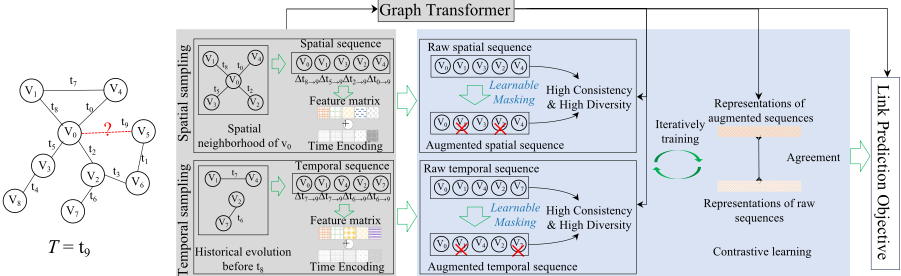
Figure 1: The overall framework of ContraTGT. (a) Temporal graph input. (b) Dual-view sequence sampling for target node v0. (c) Pretraining with learnable masking based on consistency and diversity. (d) Fine-tuning for link prediction between v0 and v5.
Algorithm 1 Pre-Training of ContraTGT
Require: G, ls, lt, α, ρ;
Ensure: θt, θΨlm .
- 1: while not converged do
- 2: Sample batch B ∈ G;
- 3: for each interaction (v, u, t) ∈ B do
- 4: hv , hˆ v = NRL(v); hu = NRL(u);
- 5: Compute p(v,u), p(ˆ v,u) via Eq. (1);
- 6: Laug ← Laug + LΨc + αLΨd;
- ▷ Eq. (9)
- 7: Sample negative q and compute hq;
- 8: Lcon ←Lcon +Eq. (10);
- 9: Update θΨlm by minLaug (fix θt);
- 10: Update θt by minLcon (fix θΨlm );
Algorithm 2 Node Representation Learning (NRL)
Require: Node v;
Ensure: hv, hˆ v.
- 1: ssv, stv ←Spatial/Temporal Sampling for v;
- 2: Ss v, Stv ← Transformer encoding of ssv, stv;
- 3: ˆ ssv, ˆ stv ← Ψlm(Ss v ), Ψlm(Stv );
- 4: hv = TF(ssv)∥TF(stv);
- 5: hˆ v = TF(ˆ ssv )∥TF(ˆ stv );
- 6: return hv, hˆ v.
The SharPen Function. Algorithm 3 implements the gradient-preserving Top-K selection mechanism.
5 Experiments
In this section, we conduct extensive experiments to evaluate the effectiveness of ContraTGTon five benchmark datasets.
5.1 Experimental Setup
Datasets
We evaluate our approach using five publicly available benchmark temporal networks: soc-wiki-elec 1 , ia-slashdot-reply-
1 https://networkrepository.com/soc-wiki-elec.php
LearnableDataAugmentation. We implement a learnable masking module Ψlm that adaptively selects nodes to mask within a sequence. Given a representation sequence S, the augmented features ˆ sx are:
where Atten(·) calculates attention weights via a parameter matrix W, and SharPen(·) yields a gradient-preserving binary mask based on the masking rate ρ.
Using a link prediction head p(v,u), we define the augmentation loss Laug as a weighted sum of consistency (LΨc) and diversity (LΨd):
Contrastive Objective. The Transformer is pre-trained by maximizing the agreement between a node v and its augmentation ˆ v, while minimizing it with a negative instance u:
Optimization alternates between Laug (updating θΨlm ) and Lcon (updating θt).
4.3 Objective
For downstream tasks, the representations from spatial and temporal views (Hs,Ht) are concatenated: hv = Hs[v] ∥Ht[v]. The final model is fine-tuned using supervised binary cross-entropy (Eq. 2).
4.4 Algorithms and Complexity Analysis
Pre-training Paradigm. Algorithm 1 details the iterative training process. The function NRL(·) (Algorithm 2) handles the dual-view encoding and learnable masking.
Complexity Analysis. Pre-training complexity is dominated by the Transformer encoding, which is O(B(l2 s d+l2 t d)) per batch. Since sequence lengths ls, lt are fixed, the model scales linearly with the number of nodes, ensuring efficiency on large-scale temporal graphs.
Algorithm 3 SharPen Function
Require: h,K, ϵ; Ensure: f . 1: m← 0, f ← 1; 2: for i = 1 to K do 3: w← 1-maskprev; y ← SoftMax(h+ log(w+ ϵ)); 4: m←m+y ∗w; f ← f · m; 5: return f ;| # Nodes | # Interactions | # Repetition | |
|---|---|---|---|
| soc-wiki-elec | 7,118 | 107,079 | 4.2% |
| ia-slashdot-reply-dir | 51,083 | 140,778 | 0.2% |
| soc-sign-bitcoinotc | 5,881 | 35,592 | 0.0% |
| Social Evolve 1 month | 74 | 176,088 | - |
| Ubuntu | 159,316 | 964,437 | - |
dir 2 , soc-sign-bitcoinotc 3 , Social Evolve 1 month [Madan et al., 2011] and Ubuntu 4 . Table 1 provides insights into the ratio of nodes that share multiple interactions (edges), where "-" denotes that the statistics is not provided by the authors.
For every dataset, interactions are randomly divided in a 1:1:8 ratio for training, validation, and testing.
Baselines
To comprehensively evaluate our proposed ContraTGT against state-of-the-art approaches, we consider several stateof-the-art baselines categorized into three main groups 5 : (1) Static GNN models: GraphSAGE [Hamilton et al., 2017]; (2) Temporal GNN models: JOIDE [Kumar et al., 2019], CAWN [Wang et al., 2021c], TIP-GNN [Zheng et al., 2022], TAPGNN [Zheng et al., 2023]; (3) Approaches with advanced techniques: DyRep [Trivedi et al., 2019], TGAT [da Xu et al., 2020], APAN [Wang et al., 2021b], TGN [Rossi et al., 2020], TIGER [Zhang et al., 2023d], and FTM [Cao et al., 2023]; and (4) Graph Transformer approaches: TCL [Wang et al., 2021a] and DyGFormer [Yu et al., 2023], and CoLA-Former [Zhao et al., 2025]; and (5) State Space Models: GraphMamba [Wang et al., 2024].
5.2 Performance Evaluation
In this part, we evaluate the performance of ContraTGT on the task of temporal link prediction on temporal graphs.
Evaluation with limited training data
In this experiment, we limit the training data to only 10% of the interactions to simulate scenarios with limited supervision. We conduct the experiments under both transductive and inductive settings. In the transductive setting, the model is evaluated on the entire test dataset, while the inductive setting focuses on predicting interactions involving at least one new node that did not appear in the training data.
2 https://networkrepository.com/ia-slashdot-reply-dir.php
3 https://networkrepository.com/soc-sign-bitcoinotc.php
4 https://snap.stanford.edu/data/sx-askubuntu.html
5 For the temporal baselines, we only consider continuous-time models.
The performance comparison in Table 2 and Table 3 presents results for the transductive and inductive settings, respectively. Our ContraTGToutperforms all competing approaches on Wiki, Slashdot, and Bitcoin-OTC datasets, while achieving slightly inferior performance to Graph-Mamba and CoLa-Former on Ubuntu dataset. Graph-Mamba benefits from effective long-sequence state modeling, while CoLaFormer leverages semantic consistency through contrastive learning.
Evaluation with more training data
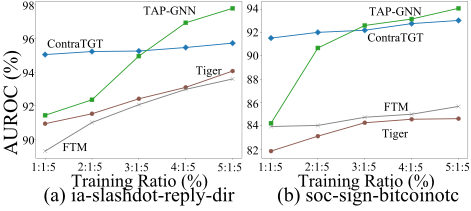
To further assess the efficacy of our proposed model with an increased volume of training data, we executed additional experiments, varying the quantity of training data while keeping the validation and test sets constant at a ratio of n:1:5, where n = {1, 2, 3, 4, 5} represents the proportion of the training data. These experiments were carried out on two datasets (iaslashdot-reply-dir and soc-sign-bitcoinotc), and we selected the most competitive baselines for comparison. The results, with AUC as metric in a transductive setting, are depicted in Fig. 2.
We have the following observations. (1) In scenarios with limited supervision, such as when the proportion of training data is 1 or 2, our proposed model, ContraTGT, surpasses the baselines, underscoring the strength of our model enhanced by pre-training with learnable data augmentation. (2) As the amount of training data increases, the baselines begin to demonstrate comparable, or in some cases, superior performance. This indicates that with ample training data at their disposal, end-to-end models like TAP-GNN, Tiger, and FTM are capable of fully leveraging label information to optimize their models. Typically, these models can surpass those that rely on pre-training when sufficient data is provided, at which point our model still maintains superior performance.
| Methods | soc-wiki-elec AUC | Acc AUC | soc-sign- bitcoinotc AUC | Acc | Social E. 1 m. | AUC | ubuntu | ||||||
|---|---|---|---|---|---|---|---|---|---|---|---|---|---|
| AP | ia-slashdot-reply-dir AP | Acc | AP | AUC | AP | Acc | AP | Acc | |||||
| GraphSAGE | 0.589±0.017 0.588±0.011 | 0.556±0.009 0.600±0.008 | 0.596±0.012 | 0.576±0.011 0.577±0.005 | 0.575±0.009 | 0.533±0.013 | 0.540±0.009 | 0.540±0.012 | 0.516±0.014 0.544±0.013 | 0.531±0.008 | 0.515±0.011 | ||
| JODIE CAWN TIP-GNN TAP-GNN | 0.548±0.007 0.543±0.006 0.788±0.013 0.743±0.019 0.747±0.009 0.606±0.020 0.952±0.008 0.952±0.010 | 0.532±0.007 0.663±0.022 0.761±0.007 0.892±0.008 0.63±0.027 0.809±0.031 0.924±0.022 0.902±0.001 | 0.659±0.021 0.904±0.010 0.634±0.034 0.877±0.007 | 0.620±0.018 0.680±0.013 0.801±0.010 0.831±0.004 0.651±0.037 0.843±0.010 0.806±0.021 0.801±0.008 | 0.690±0.016 0.866±0.003 0.706±0.011 0.774±0.025 | 0.632±0.017 0.764±0.003 0.741±0.012 0.871±0.030 0.775±0.011 0.841±0.003 0.731±0.016 0.771±0.003 | 0.692±0.003 0.875±0.003 0.702±0.009 0.673±0.002 | 0.722±0.005 0.721±0.005 0.773±0.005 0.731±0.003 | 0.774±0.017 0.810±0.008 0.774±0.018 0.811±0.008 0.795±0.010 0.814±0.006 0.847±0.004 0.846±0.008 | 0.695±0.006 0.695±0.006 0.807±0.008 0.812±0.005 | |||
| DyRep TGAT APAN TGN TIGER FTM | 0.538±0.011 0.535±0.009 0.763±0.014 0.745±0.018 0.832±0.009 0.845±0.010 0.867±0.012 0.881±0.010 0.832±0.011 0.845±0.014 0.861±0.023 0.876±0.021 | 0.527±0.008 0.659±0.012 0.681±0.017 0.836±0.004 0.797±0.006 0.798±0.004 0.767±0.012 0.864±0.015 0.697±0.009 0.942±0.005 0.755±0.019 0.918±0.006 | 0.658±0.019 0.878±0.002 0.781±0.011 0.878±0.014 0.949±0.002 0.933±0.004 | 0.615±0.010 0.688±0.008 0.787±0.001 0.766±0.005 0.715±0.008 0.767±0.001 0.663±0.008 0.766±0.006 0.805±0.006 0.763±0.011 0.802±0.004 0.793±0.009 | 0.692±0.011 0.785±0.009 0.766±0.004 0.801±0.006 0.806±0.008 0.820±0.011 | 0.634±0.015 0.719±0.037 0.704±0.011 0.626±0.010 0.720±0.006 0.745±0.012 0.691±0.006 0.904±0.003 0.694±0.014 0.925±0.002 0.721±0.005 0.923±0.002 | 0.676±0.038 0.625±0.011 0.730±0.007 0.882±0.006 0.909±0.004 0.904±0.004 | 0.652±0.034 0.763±0.003 0.579±0.009 0.817±0.024 0.707±0.006 0.731±0.011 0.850±0.003 0.832±0.006 0.887±0.006 0.831±0.005 0.854±0.002 0.852±0.004 | 0.794±0.003 0.853±0.017 0.782±0.004 0.865±0.004 0.882±0.003 0.881±0.001 | 0.695±0.008 0.756±0.026 0.660±0.004 0.770±0.004 0.610±0.012 0.786±0.001 | |||
| TCL DyGFormer Graph-Mamba | 0.777±0.032 0.761±0.026 0.706±0.015 0.655±0.019 0.991±0.001 0.992±0.001 | 0.684±0.026 0.927±0.009 0.654±0.002 0.885±0.008 0.979±0.002 0.953±0.006 | 0.927±0.010 0.898±0.004 0.964±0.004 | 0.732±0.037 0.778±0.004 0.727±0.018 0.822±0.011 0.891±0.034 0.852±0.017 | 0.782±0.015 0.859±0.009 0.885±0.013 | 0.703±0.010 0.756±0.010 0.796±0.017 | 0.929±0.004 0.930±0.009 0.934±0.002 | 0.914±0.005 0.910±0.006 0.917±0.003 | 0.885±0.005 0.835±0.003 0.899±0.012 0.813±0.010 0.864±0.014 0.912±0.005 | 0.867±0.003 0.845±0.008 0.937±0.004 | 0.786±0.005 0.810±0.007 0.862±0.007 | ||
| CoLA-Former | 0.987±0.001 0.989±0.001 | 0.966±0.003 0.930±0.001 | 0.949±0.001 | 0.892±0.009 | 0.870±0.008 0.900±0.008 | 0.801±0.020 | 0.890±0.007 | 0.858±0.010 | 0.776±0.024 0.913±0.002 | 0.938±0.002 | 0.864±0.004 | ||
| ContraTGT | 0.998±0.001 0.998±0.001 | 0.980±0.001 0.955±0.003 | 0.959±0.003 | 0.897±0.003 0.902±0.008 | 0.904±0.011 | 0.826±0.039 | 0.934±0.007 | 0.919±0.009 | 0.862±0.005 | 0.861±0.007 | 0.894±0.009 | 0.822±0.005 | |
5.3 Model Analysis
We analyze ContraTGTfrom four perspectives: ablation, scalability, augmentation comparison, and parameter sensitivity.
Ablation study
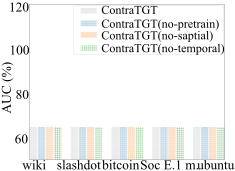
To evaluate the contribution of each component in ContraTGT, we conduct an ablation study by comparing with several degenerate variants: (1) without pretrain: we use the ContraTGT architecture without the pre-training step; (2) no spatial: we remove the spatial-view sequences, by only using the temporal-view sequences for node representation learning. (3)no temporal: we remove the temporal-view sequences, by only using the spatial-view sequences for node representation learning.
We show the results of ablation study (using AUC as the metric) in Fig. 3, and make the following observations. Firstly, the performance consistently drops when the model pretraining step is omitted. This finding underscores the efficacy of the proposed contrastive learning strategy, which is significantly enhanced by the learnable data augmentation. Secondly, when the spatial sequences are omitted, ContraTGT exhibits a notable performance decline. This underscores the indispensable nature of spatial information for node representation learning within transformers applied to temporal graphs. Thirdly, the absence of temporal sequences also leads to a general performance decrease. This demonstrates the value of incorporating temporal sampling into ContraTGT. Notably, both spatial and temporal sequences seem to contribute comparably to the overall performance.
Scalability
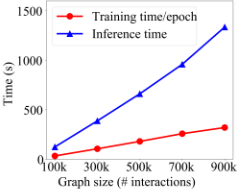
To assess scalability via experiments, we utilized the largest temporal graph in our study, namely Ubuntu. We sampled several temporal graphs with increasing sizes, specifically 100k, 300k, 500k, 700k, and 900k interactions, to assess their training and inference times. For each temporal graph, we maintained the same data split as in our main experiment, with a 1:1:8 ratio for the training, validation, and testing sets. The training (per epoch) and inference times are reported in Fig. 4. Our observations reveal that both training and inference times for our proposed ContraTGT, scale linearly with the increase in temporal graph size. This linear scalability underscores ContraTGT's capability to be efficiently applied to large-scale temporal graphs, matching the complexity analysis in Section 4.4.
Comparison of different augmentations
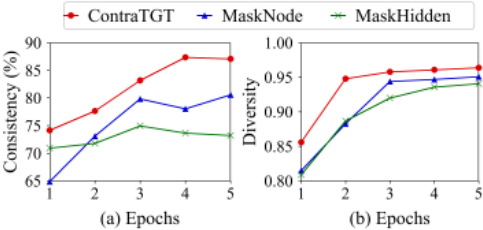
To assess the effectiveness of our proposed learnable data augmentation method, integrated with the graph transformer featuring dual-view sequence sampling, we introduce two simple yet efficient random masking methods: MaskNode and MaskHidden. For MaskNode, we randomly mask a few nodes in a sampled node sequence according to the predefined masking rate ρ and then compute its representation. Meanwhile, for MaskHidden, we first compute the representation of the entire sequence and then randomly mask a few dimensions with respect to the predefined masking rate ρ, akin to the dropout mechanism. We compare the performance of these three approaches on two representative datasets, presenting the results in Table 4. Note that, for each dataset, we tune the masking rate ρ in the range of [0.1, 0.7] for each method to achieve optimal performance. We observe that our proposed model generally outperforms the other two random masking methods.
We further compare different data augmentation methods using consistency and diversity as evaluation metrics, where higher values indicate better performance. Our learnable data augmentation is compared with MaskNode and MaskHidden on the Bitcoinotc dataset, and the results are shown in Fig. 5. We observe that, as training advances, it becomes ev- TGN 0.886±0.008 0.896±0.007 0.802±0.056 0.867±0.017 0.880±0.016 0.692±0.007 0.773±0.006 0.809±0.006 0.701±0.006 0.909±0.007 0.881±0.011 0.852±0.005 0.824±0.007 0.859±0.004 0.763±0.004
| Methods | ia-slashdot-reply-dir | soc-sign-bitcoinotc | Social | ubuntu | |||||||||
|---|---|---|---|---|---|---|---|---|---|---|---|---|---|
| soc-wiki-elec AUC AP | Acc | AUC | AP | Acc | AUC | AP | Acc | AUC | E. 1 m. AP | Acc AUC | AP | Acc | |
| GraphSAGE | 0.596±0.012 0.595±0.017 | 0.569±0.016 0.593±0.012 | 0.582±0.009 | 0.574±0.011 | 0.554±0.011 | 0.559±0.009 | 0.536±0.007 | 0.540±0.009 | 0.530±0.011 | 0.509±0.008 | 0.544±0.007 0.531±0.009 | 0.509±0.014 | |
| JODIE CAWN TIP-GNN DyRep TGAT APAN | 0.548±0.009 0.550±0.007 0.532±0.010 0.961±0.003 0.965±0.005 0.893±0.015 0.694±0.007 0.593±0.019 0.631±0.013 0.532±0.016 0.538±0.012 0.785±0.014 0.761±0.019 0.832±0.009 0.844±0.006 | 0.638±0.017 0.845±0.012 0.773±0.005 0.523±0.011 0.699±0.023 0.797±0.006 | 0.633±0.009 0.823±0.004 0.784±0.004 | 0.641±0.016 0.863±0.012 0.616±0.009 0.639±0.016 0.869±0.002 0.775±0.004 | 0.608±0.012 0.679±0.016 0.743±0.014 0.748±0.015 0.637±0.006 0.821±0.012 0.603±0.008 0.689±0.006 0.776±0.005 0.790±0.007 0.707±0.007 0.774±0.005 | 0.692±0.020 0.798±0.009 0.676±0.008 0.697±0.008 0.714±0.016 0.768±0.006 | 0.633±0.022 0.684±0.010 0.737±0.010 | 0.636±0.020 0.620±0.012 0.721±0.020 | 0.818±0.003 0.903±0.012 0.812±0.011 0.716±0.039 0.630±0.012 0.752±0.005 | 0.755±0.006 0.883±0.024 0.685±0.009 0.687±0.038 0.559±0.004 0.738±0.008 | 0.761±0.005 0.762±0.007 0.859±0.016 0.796±0.078 0.743±0.013 0.775±0.007 0.651±0.042 0.746±0.002 0.806±0.027 0.805±0.027 0.718±0.007 0.726±0.007 | 0.796±0.008 0.835±0.065 0.776±0.006 0.780±0.004 0.844±0.018 0.776±0.004 | 0.682±0.005 0.745±0.081 0.757±0.008 0.685±0.010 0.747±0.028 0.649±0.008 |
TIGER 0.832±0.010 0.845±0.012 0.696±0.008 0.939±0.050 0.947±0.003 0.804±0.007 0.763±0.014 0.806±0.008 0.694±0.016 0.952±0.002 0.938±0.004 0.918±0.007 0.826±0.004 0.878±0.009 0.609±0.014
FTM 0.878±0.017 0.888±0.015 0.760±0.015 0.919±0.006 0.934±0.004 0.807±0.002 0.799±0.011 0.826±0.012 0.728±0.004 0.928±0.003 0.908±0.001 0.849±0.003 0.846±0.004 0.862±0.019 0.779±0.001
CoLA-Former 0.992±0.006 0.992±0.005 0.972±0.009 0.930±0.036 0.950±0.026 0.902±0.042 0.863±0.043 0.886±0.037 0.803±0.030 0.928±0.065 0.908±0.087 0.867±0.094 0.931±0.028 0.948±0.018 0.867±0.017
ContraTGT 0.997±0.001 0.998±0.001 0.981±0.001 0.955±0.003 0.960±0.003 0.895±0.004 0.899±0.008 0.901±0.012 0.824±0.040 0.943±0.007 0.935±0.010 0.877±0.008 0.857±0.007 0.892±0.010 0.820±0.006
Table 3: Inductive learning task results for link prediction.
| Methods | slashdot | Social E. 1m | ||||
|---|---|---|---|---|---|---|
| AUC | AP | Acc | AUC | AP | Acc | |
| MaskNode | 0.944±0.003 | 0.947±0.002 0.955±0.006 0.956±0.002 | 0.866±0.005 0.881±0.008 | 0.929±0.003 0.938±0.004 | 0.912±0.005 0.897±0.006 | 0.853±0.005 0.889±0.006 0.877±0.006 |
| MaskHidden | 0.937±0.001 | 0.914±0.010 | ||||
| ContraTGT | 0.954±0.003 | 0.891±0.004 | 0.924±0.004 | |||
ident that our model persistently surpasses the randommasking techniques, namely MaskNode and MaskHidden, securing markedly enhanced consistency and diversity. This trend highlights the efficacy of our learnable data augmentation strategy, which evidently produces more advantageous data augmentations when contrasted with random masking methods. The superiority of these data augmentations plays a pivotal role in amplifying the success of our contrastive learning approach. Moreover, the progressive improvement of our proposed model with each epoch is noteworthy. In contrast, the performance trend of the random masking approaches appears more variable, particularly in terms of consistency.
Parameters sensitivity
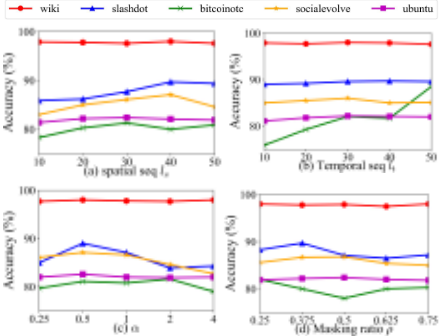
We evaluate the sensitivity of several important hyperparameters in ContraTGT, and show their impact in Fig. 6. For the length of spatial and temporal sequences, i.e., ls and lt, the performance seems to be stable w.r.t.the length, while longer sequences might be slightly better. For the weight of α in Eq. (9), it seems that a smaller α can benefit the performance, showing that consistency is more important in determining the performance. For the masking ratio ρ, the performance seems to be stable across different ρ's. In particular, ρ ∈ [0.25, 0.50] might be a good choice.
The smooth performance across hyperparameters can be attributed to three factors. (1) The effectiveness of our learnable data augmentation, driven by these metrics, ensures that the model is pre-trained with the most informative augmentations even with different ls and lt, contributing to the smooth performance across varying sequence lengths. (2) The smoothness in the masking ratio may be attributed to the effectiveness of the learnable data augmentation mechanism. This mechanism is designed to selectively choose the most informative elements for augmentation, even under extreme masking ratios, leading to promising augmentation generation. (3) For the wiki dataset, the graph Transformer backbone armed with dual-view sequences achieves nearly 100% performance, leaving limited room for significant improvement. As for the Ubuntu dataset, its relatively large size and the utilization of 10% interactions for training may already provide sufficient data for training the graph Transformer.
6 Conclusions
In this work, we introduced a dual-view graph transformer called ContraTGTto extract sequences tailored for specific target nodes, encapsulating both spatial and temporal perspectives. To optimize the contrastive learning of this dualview transformer, we put forth an innovative, learnable data augmentation method, which involves selective masking of elements within dual-view sequences, generates superior augmentations, thereby amplifying the potency of the contrastive learning approach. Extensive experiments on five public temporal network datasets demonstrate that our model can consistently outperform all baselines, especially in small training set conditions.
Acknowledgements
This research was funded by the Natural Science Foundation of Zhejiang Province of China under Grant (No. LMS26F020043,LHZSD24F020001,LZ25F020012).
@inproceedings{ijcai2026p303,
  title     = {Learnable Data Augmentation and Contrastive Pre-training for Temporal Link Prediction},
  author    = {Jin, Canghong and Zhao, Jiafeng and Xu, Feng and Zheng, Tongya and Liu, Zemin and Wei, Lina and Song, Mingli},
  booktitle = {Proceedings of the Thirty-Fifth International Joint Conference on
               Artificial Intelligence, {IJCAI-26}},
  publisher = {International Joint Conferences on Artificial Intelligence Organization},
  editor    = {Diego Calvanese},
  pages     = {2726--2734},
  year      = {2026},
  month     = {8},
  note      = {Main Track},
  doi       = {10.24963/ijcai.2026/303},
  url       = {https://doi.org/10.24963/ijcai.2026/303},
}
TY - CPAPER TI - Learnable Data Augmentation and Contrastive Pre-training for Temporal Link Prediction AU - Jin, Canghong AU - Zhao, Jiafeng AU - Xu, Feng AU - Zheng, Tongya AU - Liu, Zemin AU - Wei, Lina AU - Song, Mingli T2 - Proceedings of the Thirty-Fifth International Joint Conference on Artificial Intelligence, IJCAI-26 PB - International Joint Conferences on Artificial Intelligence Organization PY - 2026 SP - 2726 EP - 2734 DO - 10.24963/ijcai.2026/303 UR - https://doi.org/10.24963/ijcai.2026/303 ER -Copied
Machine-readable versions of this paper, for tools and AI agents:





