
Coarse-to-Fine Latent Guidance: A Multi-Scale Diffusion Transformer for Traffic Flow Forecasting
Proceedings of the Thirty-Fifth International Joint Conference on Artificial Intelligence. Main Track. Pages 2798-2806.
https://doi.org/10.24963/ijcai.2026/311
Keywords
- Data Mining: Mining spatial and/or temporal data
Abstract
Accurate traffic flow prediction is fundamental to Intelligent Transportation Systems (ITS). However, traffic dynamics exhibit inherent multi-scale heterogeneity, where stable global trends are often masked by stochastic local fluctuations. Existing methods struggle to reconcile these conflicting resolutions, leading to sub-optimal forecasting. To address this, we propose the Multi-Scale Spatial-Temporal Diffusion Transformer (MS-STDT). Deviating from previous diffusion approaches that treat generation as a monolithic task, we reframe the forward diffusion process as an intrinsic temporal coarse-graining operation. By leveraging the data's multi-scale hierarchy as a structural anchor, we introduce a coarse-to-fine latent guidance strategy that enables the model to reconstruct stable global trends before refining fine-grained details. This ensures physical consistency and generative stability without requiring external labels. Extensive experiments across six real-world datasets confirm that MS-STDT performs the best, demonstrating significant improvements in predictive accuracy and zero-shot robustness against sensor failures. We provide code and data at https://github.com/ZetaoLiPhD/MS-STDT.
- [Belkin and Niyogi, 2003] Mikhail Belkin and Partha Niyogi. Laplacian eigenmaps for dimensionality re- duction and data representation. Neural Computation, 15(6):1373-1396, 2003.
- [Cai et al., 2024] Wanlin Cai, Yuxuan Liang, Xianggen Liu, Jianshuai Feng, and Yuankai Wu. Msgnet: Learning multi- scale inter-series correlations for multivariate time series forecasting. In Proceedings of the AAAI Conference on Ar- tificial Intelligence, volume 38, pages 11141-11149, 2024.
- [Cao et al., 2025] Lingxiao Cao, Bin Wang, Guiyuan Jiang, Yanwei Yu, and Junyu Dong. Spatiotemporal-aware trend- seasonality decomposition network for traffic flow fore- casting. In Proceedings of the AAAI Conference on Artifi- cial Intelligence, volume 39, pages 11463-11471, 2025.
- [Carianni and Gemma, 2025] Annarita Carianni and Andrea Gemma. Overview of traffic flow forecasting techniques. IEEE Open Journal of Intelligent Transportation Systems, 6:848-882, 2025.
- [Choi et al., 2022] Jeongwhan Choi, Hwangyong Choi, Jee- hyun Hwang, and Noseong Park. Graph neural controlled differential equations for traffic forecasting. In Proceed- ings of the AAAI conference on Artificial Intelligence, vol- ume 36, pages 6367-6374, 2022.
- [Ding et al., 2023] Jiaqi Ding, Chao Yang, Yueyao Wang, Pengfei Li, Fulin Wang, Yuhao Kang, Haoyang Wang, Ze Liang, Jiawei Zhang, Peien Han, et al. Influential fac- tors of intercity patient mobility and its network structure in china. Cities, 132:103975, 2023.
- [Fan et al., 2024] Xinyao Fan, Yueying Wu, Chang Xu, Yuhao Huang, Weiqing Liu, and Jiang Bian. MG-TSD: Multi-granularity time series diffusion models with guided learning process. In The Twelfth International Conference on Learning Representations, 2024.
- [Feichtenhofer et al., 2022] Christoph Feichtenhofer, Yang- hao Li, Kaiming He, et al. Masked autoencoders as spa- tiotemporal learners. Advances in Neural Information Pro- cessing Systems, 35:35946-35958, 2022.
- [Gao et al., 2024] Haotian Gao, Renhe Jiang, Zheng Dong, Jinliang Deng, Yuxin Ma, and Xuan Song. Spatial- temporal-decoupled masked pre-training for spatiotempo- ral forecasting. In Proceedings of the Thirty-Third Interna- tional Joint Conference on Artificial Intelligence, IJCAI- 24, pages 3998-4006, 8 2024.
- [Ho et al., 2020] Jonathan Ho, Ajay Jain, and Pieter Abbeel. Denoising diffusion probabilistic models. Advances in Neural Information Processing Systems, 33:6840-6851, 2020.
- [Hu et al., 2024a] Junfeng Hu, Xu Liu, Zhencheng Fan, Yux- uan Liang, and Roger Zimmermann. Towards unifying diffusion models for probabilistic spatio-temporal graph learning. In Proceedings of the 32nd ACM International Conference on Advances in Geographic Information Sys- tems, pages 135-146, 2024.
- [Hu et al., 2024b] Junfeng Hu, Xu Liu, Zhencheng Fan, Yuxuan Liang, and Roger Zimmermann. Towards unifying diffusion models for probabilistic spatio-temporal graph learning. In Proceedings of the 32nd ACM International Conference on Advances in Geographic Information Sys- tems, page 135-146, New York, NY, USA, 2024. Associ- ation for Computing Machinery.
- [Ji et al., 2023] Jiahao Ji, Jingyuan Wang, Chao Huang, Junjie Wu, Boren Xu, Zhenhe Wu, Junbo Zhang, and Yu Zheng. Spatio-temporal self-supervised learning for traffic flow prediction. In Proceedings of the AAAI Con- ference on Artificial Intelligence, volume 37, pages 4356- 4364, 2023.
- [Jiang et al., 2023] Jiawei Jiang, Chengkai Han, Wayne Xin Zhao, and Jingyuan Wang. Pdformer: Propagation delay- aware dynamic long-range transformer for traffic flow pre- diction. In Proceedings of the AAAI Conference on Artifi- cial Intelligence, volume 37, pages 4365-4373, 2023.
- [Jin et al., 2023] Di Jin, Jiayi Shi, Rui Wang, Yawen Li, Yux- iao Huang, and Yu-Bin Yang. Trafformer: Unify time and space in traffic prediction. In Proceedings of the AAAI Conference on Artificial Intelligence, volume 37, pages 8114-8122, 2023.
- [Kong et al., 2024] Weiyang Kong, Ziyu Guo, and Yubao Liu. Spatio-temporal pivotal graph neural networks for traffic flow forecasting. In Proceedings of the AAAI Con- ference on Artificial Intelligence, volume 38, pages 8627- 8635, 2024.
- [Lana et al., 2018] Ibai Lana, Javier Del Ser, Manuel Velez, and Eleni I Vlahogianni. Road traffic forecasting: Re- cent advances and new challenges. IEEE Intelligent Trans- portation Systems Magazine, 10(2):93-109, 2018.
- [Li et al., 2022a] Gang Li, Heliang Zheng, Daqing Liu, Chaoyue Wang, Bing Su, and Changwen Zheng. Sem- mae: Semantic-guided masking for learning masked au- toencoders. Advances in Neural Information Processing Systems, 35:14290-14302, 2022.
- [Li et al., 2022b] Yan Li, Xinjiang Lu, Yaqing Wang, and Dejing Dou. Generative time series forecasting with dif- fusion, denoise, and disentanglement. Advances in Neural Information Processing Systems, 35:23009-23022, 2022.
- [Lian et al., 2026] Xinglin Lian, Chengtai Cao, Ting Zhong, Yong Wang, Kai Chen, and Fan Zhou. Decompose to un- derstand, fuse to detect: Frequency-decoupled anomaly detection for encrypted network traffic. arXiv preprint arXiv:2605.02970, 2026.
- [Liu et al., 2020] Lingbo Liu, Jiajie Zhen, Guanbin Li, Geng Zhan, Zhaocheng He, Bowen Du, and Liang Lin. Dy- namic spatial-temporal representation learning for traffic flow prediction. IEEE Transactions on Intelligent Trans- portation Systems, 22(11):7169-7183, 2020.
- [Liu et al., 2023] Xu Liu, Yutong Xia, Yuxuan Liang, Jun- feng Hu, Yiwei Wang, Lei Bai, Chao Huang, Zhenguang Liu, Bryan Hooi, and Roger Zimmermann. Largest: A benchmark dataset for large-scale traffic forecasting. Advances in Neural Information Processing Systems, 36:75354-75371, 2023.
- [Ma et al., 2020] Dongfang Ma, Xiang Song, and Pu Li. Daily traffic flow forecasting through a contextual con- volutional recurrent neural network modeling inter-and intra-day traffic patterns. IEEE Transactions on Intelligent Transportation Systems, 22(5):2627-2636, 2020.
- [Maimaris and Papageorgiou, 2016] Athanasios Maimaris and George Papageorgiou. A review of intelligent trans- portation systems from a communications technology perspective. In 2016 IEEE 19th International Conference on Intelligent Transportation Systems (ITSC), pages 54-59, 2016.
- [Manibardo et al., 2021] Eric L Manibardo, Ibai Laña, and Javier Del Ser. Deep learning for road traffic forecasting: Does it make a difference? IEEE Transactions on Intelli- gent Transportation Systems, 23(7):6164-6188, 2021.
- [Ni et al., 2023] Zelin Ni, Hang Yu, Shizhan Liu, Jianguo Li, and Weiyao Lin. Basisformer: Attention-based time series forecasting with learnable and interpretable ba- sis. Advances in Neural Information Processing Systems, 36:71222-71241, 2023.
- [Pan et al., 2019] Zheyi Pan, Yuxuan Liang, Weifeng Wang, Yong Yu, Yu Zheng, and Junbo Zhang. Urban traffic pre- diction from spatio-temporal data using deep meta learn- ing. In Proceedings of the 25th ACM SIGKDD Interna- tional Conference on Knowledge Discovery & Data Min- ing, pages 1720-1730, 2019.
- [Rasul et al., 2021] Kashif Rasul, Calvin Seward, Ingmar Schuster, and Roland Vollgraf. Autoregressive denois- ing diffusion models for multivariate probabilistic time se- ries forecasting. In International Conference on Machine Learning, pages 8857-8868, 2021.
- [Rühling Cachay et al., 2023] Salva Rühling Cachay, Bo Zhao, Hailey Joren, and Rose Yu. Dyffusion: A dynamics-informed diffusion model for spatiotemporal forecasting. Advances in Neural Information Processing Systems, 36:45259-45287, 2023.
- [Song et al., 2020] Chao Song, Youfang Lin, Shengnan Guo, and Huaiyu Wan. Spatial-temporal synchronous graph convolutional networks: A new framework for spatial- temporal network data forecasting. In Proceedings of the AAAI Conference on Artificial Intelligence, volume 34, pages 914-921, 2020.
- [Tan et al., 2023] Qiaoyu Tan, Ninghao Liu, Xiao Huang, Soo-Hyun Choi, Li Li, Rui Chen, and Xia Hu. S2gae: Self-supervised graph autoencoders are generalizable learners with graph masking. In Proceedings of the six- teenth ACM International Conference on Web Search and Data Mining, pages 787-795, 2023.
- [Vaswani et al., 2017] Ashish Vaswani, Noam Shazeer, Niki Parmar, Jakob Uszkoreit, Llion Jones, Aidan N Gomez, Łukasz Kaiser, and Illia Polosukhin. Attention is all you need. Advances in Neural Information Processing Sys- tems, 30, 2017.
- [Wang et al., 2021] Jingyuan Wang, Jiawei Jiang, Wenjun Jiang, Chao Li, and Wayne Xin Zhao. Libcity: An open library for traffic prediction. In Proceedings of the 29th International Conference on Advances in Geographic In- formation Systems, pages 145-148, 2021.
- [Wang et al., 2024] Shiyu Wang, Haixu Wu, Xiaoming Shi, Tengge Hu, Huakun Luo, Lintao Ma, James Y Zhang, and Jun Zhou. Timemixer: Decomposable multiscale mixing for time series forecasting. In International Conference on Learning Representations (ICLR), 2024.
- [Wen et al., 2023] Haomin Wen, Youfang Lin, Yutong Xia, Huaiyu Wan, Qingsong Wen, Roger Zimmermann, and Yuxuan Liang. Diffstg: Probabilistic spatio-temporal graph forecasting with denoising diffusion models. In Pro- ceedings of the 31st ACM International Conference on Ad- vances in Geographic Information Systems, pages 1-12, 2023.
- [Wu et al., 2021] Haixu Wu, Jiehui Xu, Jianmin Wang, and Mingsheng Long. Autoformer: decomposition transform- ers with auto-correlation for long-term series forecasting. In Proceedings of the 35th International Conference on Neural Information Processing Systems, 2021.
- [Yuan et al., 2024] Yuan Yuan, Jingtao Ding, Jie Feng, De- peng Jin, and Yong Li. Unist: A prompt-empowered uni- versal model for urban spatio-temporal prediction. In Pro- ceedings of the 30th ACM SIGKDD Conference on Knowl- edge Discovery and Data Mining, pages 4095-4106, 2024.
- [Yuan et al., 2025] Yuan Yuan, Chonghua Han, Jingtao Ding, Guozhen Zhang, Depeng Jin, and Yong Li. Dif- fusion transformers as open-world spatiotemporal founda- tion models. In The Thirty-ninth Annual Conference on Neural Information Processing Systems, 2025.
- [Zhang et al., 2021] Xiyue Zhang, Chao Huang, Yong Xu, Lianghao Xia, Peng Dai, Liefeng Bo, Junbo Zhang, and Yu Zheng. Traffic flow forecasting with spatial-temporal graph diffusion network. In Proceedings of the AAAI Conference on Artificial Intelligence, volume 35, pages 15008-15015, 2021.
References were extracted automatically from the PDF and may contain errors.
Full text extracted automatically from the PDF; figures, tables and equations may differ. The PDF is the version of record.
1 Introduction
Traffic flow forecasting (TFF) constitutes the cornerstone of modern Intelligent Transportation Systems (ITS), enabling critical downstream applications ranging from congestion mitigation [Lana et al., 2018] and resource optimization [Liu et al., 2023] to the facilitation of sustainable urban mobility [Maimaris and Papageorgiou, 2016]. While urban traffic exhibits inherent periodicity driven by daily commutes and societal routines, the underlying dynamics are deeply stochastic and non-linear [Ma et al., 2020; Wang et al., 2021]. Real-world flows are governed by a complex interplay of spatial-temporal dependencies, where stable global patterns are continuously modulated by volatile perturbations and external factors [Carianni and Gemma, 2025]. Consequently, achieving high-fidelity predictions remains a formidable challenge despite the apparent regularity of the data.
∗Corresponding authors.
Due to the complex spatial-temporal patterns of TFF, existing methods predominantly rely on deep learning [Manibardo et al., 2021]. Within this domain, Transformer-based approaches primarily focus on identifying long-range dependencies, utilizing attention mechanisms to connect distant spatial and temporal events that influence current traffic conditions [Jin et al., 2023; Jiang et al., 2023; Cai et al., 2024]. In parallel, diffusion models address the inherent uncertainty of the system. Instead of producing a single deterministic prediction, these generative frameworks learn the full probability distribution of traffic states, allowing them to better handle noise and missing data [R¨uhling Cachay et al., 2023; Wen et al., 2023; Fan et al., 2024; Hu et al., 2024a].
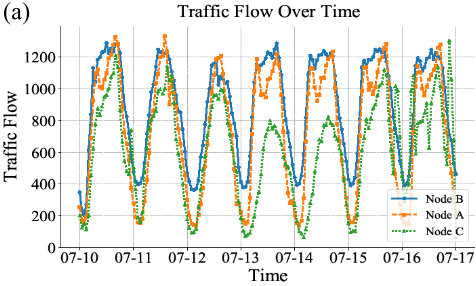
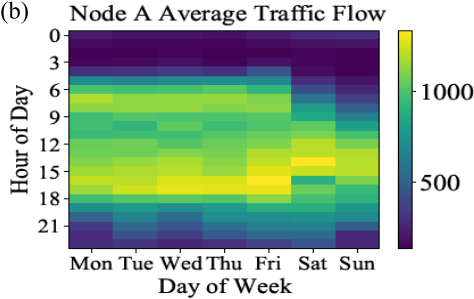
Despite these methodological advances, current models still fail to capture the natural multi-scale physical structure of traffic data, specifically the hierarchical dependency where stable global trends govern stochastic local fluctuations. As illustrated in Fig. 1, this hierarchy manifests as a complex superposition of distinct temporal behaviors. For the coarse scale, the average heatmaps (b) reveal a stable "skeleton"-robust low-frequency patterns governed by weekly routines that clearly differentiate the functional rhythms of distinct regions, such as the airport dynamics of Node A versus the arterial intersection patterns of Node C. Conversely, for the fine scale, the time series (a) exposes the stochastic reality: jagged high-frequency fluctuations superimposed on, yet structurally constrained by, these stable trends. However, existing methods ignore this intrinsic dependency. GNNs often aggressively over-smooth high-frequency details to capture spatial consistency [Choi et al., 2022; Kong et al., 2024], while monolithic diffusion models treat generation as a flat, isotropic process. By attempting to denoise all frequencies simultaneously without structural prioritization, they fail to anchor the prediction to the global context, often leading to unstable or physically inconsistent results [Fan et al., 2024]. This motivates our research: accurate forecasting requires a hierarchical framework that explicitly uses stable coarsegrained trends to guide the generation of fine-grained details.
To realize this, we propose the Multi-Scale SpatialTemporal Diffusion Transformer (MS-STDT). Our framework is founded on the spectral alignment between physical data and generative physics. We frame the multi-scale hierarchy as the intrinsic resolution trajectory of the diffusion process: since the forward injection of noise functions as a coarse-graining operation that naturally dissipates fine details while retaining global trends, the reverse denoising process logically mirrors this hierarchy through a structured coarseto-fine reconstruction. Consequently, the generative trajectory prioritizes recovering robust low-frequency structures in early sampling steps to establish a stable physical skeleton, effectively constraining the subsequent restoration of volatile high-frequency fluctuations. Guided by this insight, we employ hierarchical spatial-temporal encodings to represent distinct levels of granularity and introduce the Coarse-to-Fine Latent Guidance mechanism. This module mathematically aligns the diffusion steps with the data's physical hierarchy, using intrinsic macro-trends as a structural anchor to stabilize the generation. Finally, we incorporate a cross-scale attention mechanism to orchestrate the interaction between resolutions, dynamically re-weighting information flow to adaptively focus on broad trends or local variances as traffic conditions evolve.
To rigorously validate our framework, we conducted extensive experiments across six real-world datasets, benchmarking MS-STDT against 12 state-of-the-art baselines. These evaluations extend beyond standard accuracy metrics to specifically stress-test the model's zero-shot robustness against sensor failures and assess its computational efficiency.
Our contributions are summarized as follows:
- We identify a critical coarse-to-fine dependency in traf-
- fic data, where stable global trends serve as structural anchors for local fluctuations. This finding challenges flat modeling paradigms, demonstrating that robust forecasting requires explicitly disentangling these conflicting multi-scale resolutions.
- We propose the MS-STDT featuring Coarse-to-Fine Latent Guidance. By leveraging intrinsic data structures to guide the diffusion process, our framework effectively reconciles global consistency with local stochasticity without requiring external labels.
- Extensive evaluations on six benchmarks confirm that MS-STDT consistently outperforms existing baselines, improving MAE by 10.1% and CRPS by 12.8%. Beyond accuracy, the results highlight the model's exceptional zero-shot resilience to sensor failures.
2 Preliminaries
2.1 ProblemFormulation
We represent the topology of the road network as a directed graph G = (V, E,A), where V is a set of N nodes (sensors or intersections), and A ∈ RN×N denotes the weighted adjacency matrix encoding spatial connectivity. The dynamic state of the system is captured by the traffic flow tensor X = (X1, . . . ,XT ) ∈ RT×N×D , where Xt represents the D-dimensional traffic features at time step t.
Traffic flow prediction seeks to forecast future traffic states based on historical data. Specifically, the objective is to model the conditional distribution of future time steps (Xt0 , · · · ,XT ) given a historical context window and a graph. Formally, the problem can be formulated as:
Unlike deterministic approaches that output a single point estimate, this probabilistic formulation allows us to capture the stochastic uncertainty inherent in complex traffic dynamics.
2.2 Background: Conditional Diffusion
To model the complex distribution of traffic flows, we adopt the Denoising Diffusion Probabilistic Model (DDPM) [Ho et al., 2020] as our generative backbone. While standard DDPMs generate samples from pure Gaussian noise, traffic forecasting requires conditioning on historical states. Therefore, we align our approach with the autoregressive formulation introduced in TimeGrad [Rasul et al., 2021].
In this framework, the temporal dependencies are managed by a recurrent component (RNN) that summarizes the history X1:t-1 into a hidden state ht-1. The diffusion process is then applied to the current observation Xt conditioned on this state. The training involves a forward diffusion process that gradually corrupts Xt into Gaussian noise xnt over N steps, and a parameterized reverse process that learns to denoise it. Instead of predicting the clean data directly, we train a denoising network ϵθ to estimate the noise component added at each step. The training objective minimizes the reweighted variational bound:
where n is the diffusion step, ¯αn follows a fixed variance schedule, and ϵ ∼ N(0, I). (See Appendix A for the full derivation of the variational lower bound and transition kernels). This design allows the model to generate diverse and realistic future flow by iteratively refining random noise under the guidance of historical traffic patterns.
3 Methodology
3.1 Framework Overview
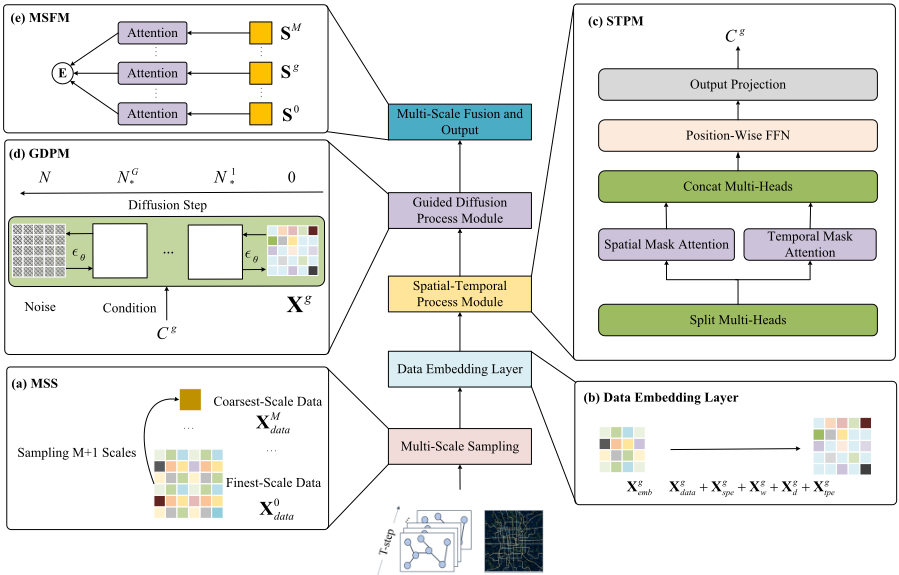
As shown in Fig. 2, MS-STDT framework operates through a progressive, coarse-to-fine strategy comprising five core components:
- Multi-Scale Sampling (MSS): Instead of processing raw data X solely at its finest resolution, we project it into a latent space Xdata and progressively downsample it via strided convolutions. This yields a hierarchy of representations Xms = {X0data , . . . ,XMdata}, where the g-th scale Xgdata captures dynamics at a temporal resolution of T/2g . The sampling process is recursively defined as Xgdata = Conv (Xg-1 data , stride = 2) for g ∈ {1, . . . ,M}, allowing the model to explicitly decouple macro-trends from micro-variations.
- Contextual Embedding: To ground these representations in physical space and time, we augment the data features with a composite embedding. We sum learnable Laplacian eigenvectors Xgspe (encoding graph topology [Belkin and Niyogi, 2003]), periodic embeddings Xgw ,Xgd (capturing weekly and daily cycles [Ding et al., 2023]), and temporal positional encodings Xgtpe [Vaswani et al., 2017]. The final input at each scale is defined as: Xg = Xgdata +Xgspe +Xgw +Xgd + Xgtpe.
- Spatial-Temporal Process Module (STPM): Serving as the conditional encoder, this module operates independently at each scale g. It utilizes a unified masked attention mechanism to extract robust spatial-temporal features Cg , ensuring the model remains resilient to sensor failures and missing data.
- Guided Diffusion Process Module (GDPM): This serves as the generative engine of our framework. Unlike standard diffusion models that treat denoising as a flat, isotropic task, GDPM utilizes the multi-scale representations as structural anchors. This allows the reverse process to stabilize the generation of fine-grained details by conditioning on the coarser, more stable trends.
- Multi-Scale Fusion and Output (MSFO): Finally, we synthesize the predictions across all resolutions. An adaptive attention mechanism dynamically weights the generated samples Sg from each scale, fusing them into a single, cohesive forecast: Output = Ensemble ({Attng(Sg )}Mg=0 ) .
3.2 Spatial-Temporal Process Module (STPM)
Functioning as the scale-specific encoder, the STPM operates independently at each resolution g to extract robust features for the diffusion process. To distinguish intrinsic sparsity (e.g., low volume) from extrinsic missingness (e.g., sensor failure), it employs a unified masked modeling strategy. By forcing the reconstruction of randomly masked tokens via spatial-temporal context, the module ensures that structural dependencies are preserved across the hierarchy-guaranteeing that both stable macro-trends and stochastic micro-variations are accurately encoded even in the presence of sensor failures.
Unified Masking Strategies. We employ a diverse set of masks, each designed to teach the model a specific dependency: Local Robustness: Random Masking (Mrand) drops random patches to encourage local interpolation [Feichtenhofer et al., 2022]. Sensor Reliability: Tube Masking (Mtube) hides specific nodes across all time steps, simulating sensor outages [Yuan et al., 2024]. Global Context: Block Masking (Mblock) removes large contiguous regions, forcing the model to infer states from distant global signals [Li et al., 2022a]. Topology Awareness: Short/Long Masking (Mshort, Mlong) selectively hides neighbors based on graph distance, refining spatial propagation [Jiang et al., 2023]. Forecasting Capability: Future Masking (Mfuture) strictly hides future steps, aligning the training objective with the autoregressive nature of forecasting [Tan et al., 2023].
Masked Attention Mechanism. To process these masked inputs, we utilize a factorized attention mechanism. For a given scale embedding Xg , we compute attention separately along the spatial and temporal axes. Let Xgt:: andXg:n: denote temporal and spatial slices, respectively.
Spatial and Temporal Mask Attention. We adopt masked attention mechanisms to encode structured priors in both spatial and temporal dimensions. For each attention head g, we first construct the query, key, and value matrices as:
Here, the subscripts t and n denote temporal step and spatial node, respectively. Then masked attention scores and outputs are computed as:
where MS ∈ {Mrand,Mtube,Mblock,Mshort,Mlong}, MT ∈ {Mrand, Mtube, Mblock, Mfuture}.
Multi-Head Fusion. To fully integrate diverse spatial and temporal dependencies while maintaining computational efficiency, we apply multi-head attention across various masking strategies. Each head focuses on a specific aspect of the data, and their outputs are concatenated and linearly projected to multi-scale coarse-graining operation. As the diffusion steps advance and noise intensity increases (from step 0 to N), fine-grained high-frequency details dissipate first, leaving behind only the robust low-frequency structural information. We leverage this inherent property to formalize a direct mapping between the intermediate latent variables of the diffusion chain and the coarser resolutions of our data hierarchy. By explicitly anchoring specific diffusion time-steps to their corresponding multi-scale representations, we guide the model to reconstruct the stable global skeleton before refining the local details.
Coarse-Scale Guidance via Anchor Points. Let q(x0 ) denote the distribution of the finest-scale data (g = 0). A standard forward process q(x01:N |x00 ) corrupts this data into noise over N steps. To inject structural guidance, we identify specific intermediate steps N g ∗ ∈ [1,N -1] as anchor points for each coarser scale g.
We enforce that the latent state xN g ∗ at this anchor step must be consistent with the observed coarse-scale data xg . Formally, we optimize the model to maximize the likelihood of the coarse observation at this specific noise level. The marginal distribution of the latent variable xN g ∗ is defined as:
where xN ∼ N(0, I), and each reverse transition is modeled as a Gaussian: pθ (xn-1 | xn) = N (xn-1;µθ(xn, n), σθ(xn, n)) . To enable tractable optimization, a standard approach is to maximize the variational lower bound of the log-likelihood in Eq. 6. This can be
form the final representation.
where Concat(·) denotes concatenation, and W l is a learnable projection matrix. Following the standard Transformer architecture, the fused output is passed through a positionwise feed-forward network, with residual connections and layer normalization applied to stabilize training and enhance representational capacity. The resulting feature representation is denoted as Xo ∈ RT×N×d . Subsequently, a 1 × 1 convolutional projection is employed to map Xo into a conditional embedding Cg ∈ RT×N×dc , which serves as the scale-specific spatial-temporal representation.
3.3 Multi-Scale Guided Diffusion
Standard diffusion models typically neglect the intrinsic multi-scale nature of traffic data, treating the generative process as a monolithic mapping from noise to data. However, traffic flow exhibits a distinct hierarchical structure where stable global trends at coarse scales provide the foundation for local fluctuations at fine scales. To align the generative mechanism with this physical reality, we propose the Guided Diffusion Process Module (GDPM).
The core design principle of our approach is that the forward diffusion process, characterized by the progressive injection of Gaussian noise, is functionally analogous to a achieved by introducing a sequence of latent variables of length N - N g ∗ , which connects the observed coarse-scale data xg to the generative process. Specifically, we define a forward diffusion process over xg consisting of N-N g ∗ steps, producing a sequence of noisy variables xgN g ∗+1 , . . . , xgN . Under this construction, the log-likelihood of the observed coarse sample can be expressed as:
Following the DDPM framework [Ho et al., 2020], this objective simplifies to minimizing the denoising error at the anchor steps:
where xgn = (∏ni=N g ∗ α1 i ) xg + √1 - ∏ni=N g ∗ α1 i ϵ and ϵ ∼ N(0, I) (see Appendix C for full derivation).
Defining the SharingRatio andAnchor Steps. Determining the optimal anchor step N g ∗ is critical to ensure coarse guidance aligns with natural diffusion dynamics. We quantify this via the Sharing Ratio rg := 1-(N g ∗-1)/N. Thismetric formalizes the spectral correspondence between the diffusion process (acting as a progressive low-pass filter) and the data hierarchy. By serving as a normalized coordinate, rg maps discrete physical scales onto the generative timeline, identifying the precise window where coarse guidance is structurally homologous to the latent state.
To avoid arbitrary hyperparameter tuning, we propose a data-driven heuristic to determine N g ∗ . We posit that the optimal anchor step is where the signal complexity of the noisy fine-scale data matches that of the coarse data. Mathematically, we select N g ∗ by minimizing the Kullback-Leibler (KL) divergence: N g ∗ := argminnDKL (q(xg ) || pθ(x0n )) .
In practice, we estimate this by pre-training a baseline model and selecting the step n where the Continuous Ranked Probability Score (CRPS) between the generated sample and the ground-truth coarse data is minimized. This ensures that guidance is applied exactly when the diffusion process is naturally resolving features at that specific resolution.
Multi-Scale Objective. With the anchor points defined, we construct a scale-specific variance schedule αgn . For steps n ≤ N g ∗ , we set αgn = 1 (no noise added), effectively treating the coarse data as "clean" relative to that noise level. For n > N g ∗ , it follows the standard schedule:
We assume a strictly increasing hierarchy of anchor steps: N 0 ∗ < N 1 ∗ < · · · < N M ∗ , ensuring that coarser scales enter the diffusion process later. The final training objective aggregates the losses across all scales, weighted by ωg :
where Cg is the robust context representation from the STPM. This formulation ensures that the model simultaneously learns to generate accurate global trends (via high N g ∗ layers) and precise local details (via the g = 0 layer).
| Datasets | Nodes | Edges | Timesteps | Interval | Range |
|---|---|---|---|---|---|
| PeMS04 | 307 | 340 | 16992 | 5min | 01/01/18-02/28/18 |
| PeMS07 | 883 | 866 | 28224 | 5min | 05/01/17-08/31/17 |
| PeMS08 | 170 | 295 | 17856 | 5min | 07/01/16-08/31/16 |
| NYCTaxi | 75 (15×5) | 484 | 17520 | 30min | 01/01/14-12/31/14 |
| CHIBike | 270 (15×18) | 1966 | 4416 | 30min | 07/01/20-09/30/20 |
| T-Drive | 1024 (32×32) | 7812 | 3600 | 60min | 02/01/15-06/30/15 |
Inference. During inference, we generate predictions recursively. Starting from the end of the historical context t0 - 1, we sample predictions Xgt0 for each scale g. This process is repeated for the entire horizon [t0, T], producing a complete set of multi-scale predictions Sg .
4 Experiments
4.1 Experimental Settings
Datasets. MS-STDT is evaluated on three graph-based benchmarks (PeMS04/07/08 [Song et al., 2020]) and three grid-based benchmarks (NYCTaxi [Liu et al., 2020], CHIBike [Wang et al., 2021], and T-Drive [Pan et al., 2019]); dataset details are summarized in Tab. 1. The forecasting horizon is fixed to 24 steps for all datasets.
Evaluation Metrics. We adopt five widely used metrics for evaluation: Mean Absolute Error (MAE) and Root Mean Squared Error (RMSE) for deterministic accuracy, as well as Continuous Ranked Probability Score (CRPS) for probabilistic prediction.
Baselines. We evaluate the predictive performance of MSSTDT against three categories of strong baselines: (1) Diffusion-based models, including TimeGrad [Rasul et al., 2021], D3VAE [Li et al., 2022b], MG-TSD [Fan et al., 2024], DiffSTG [Wen et al., 2023], USTD [Hu et al., 2024b], UrbanDiT [Yuan et al., 2025] (2) Pretrained and self-supervised models, such as ST-SSL [Ji et al., 2023], UniST [Yuan et al., 2024], STD-MAE [Gao et al., 2024]; (3) Transformer- and MLP-based models, including BasisFormer [Ni et al., 2023], TimeMixer [Wang et al., 2024], STDN [Cao et al., 2025].
Parameters Settings. MS-STDT is trained for 100 epochs using the Adam optimizer with a learning rate of 10-5 . The batch size is conFig.d to 64 for the CHIBike dataset and 32 for all other datasets. All experiments are conducted on a single NVIDIA A100 GPU (40 GB) with 128 GB of memory using PyTorch 1.10.1 on Ubuntu 18.04.
4.2 Main Results
Table 2 presents the quantitative comparison of MS-STDT against 12 competitive baselines across six diverse benchmarks. The results demonstrate that our framework establishes a new state-of-the-art, consistently achieving the lowest error rates across all datasets and metrics.
Deterministic ForecastingPerformance. In terms of point accuracy (MAE and RMSE), MS-STDT exhibits a significant performance margin over both graph-based and grid-based baselines.
Graph-Structured Data (PeMS04/07/08): Our model effectively captures the complex topology of traffic networks.
| Method | PeMS04 | PeMS07 | PeMS08 | ||||||
|---|---|---|---|---|---|---|---|---|---|
| MAE↓ | RMSE↓ | CRPS↓ | MAE↓ | RMSE↓ | CRPS↓ | MAE↓ | RMSE↓ | CRPS↓ | |
| TimeGrad | 22.841±0.229 | 35.709±0.396 | 0.78±0.039 | 21.380±0.252 | 36.247±0.383 | 1.08±0.066 | 15.033±0.159 | 29.179±0.288 | 0.40±0.013 |
| D3VAE | 21.103±0.158 | 33.827±0.291 | 0.88±0.199 | 20.439±0.141 | 35.195±0.289 | 1.43±0.307 | 14.915±0.169 | 27.329±0.239 | 0.59±0.189 |
| MG-TSD | 20.347±0.136 | 31.012±0.259 | 0.67±0.198 | 19.853±0.131 | 33.061±0.247 | 0.95±0.144 | 13.812±0.126 | 25.323±0.204 | 0.54±0.172 |
| DiffSTG | 20.459±0.121 | 32.615±0.226 | 0.42±0.138 | 20.852±0.133 | 32.092±0.242 | 1.10±0.142 | 14.479±0.149 | 26.180±0.197 | 0.50±0.114 |
| USTD | 18.746±0.140 | 30.659±0.216 | 0.38±0.174 | 19.662±0.129 | 31.967±0.231 | 0.92±0.113 | 13.293±0.154 | 21.445±0.263 | 0.46±0.106 |
| UrbanDiT | *17.974±0.138 | *29.057±0.214 | *0.36±0.104 | *18.712±0.139 | *31.072±0.307 | *0.91±0.122 | *11.962±0.144 | *20.844±0.197 | *0.44±0.127 |
| ST-SSL | 21.561±0.018 | 33.715±0.021 | - | 20.875±0.011 | 33.971±0.023 | - | 14.327±0.019 | 26.923±0.021 | - |
| UniST | 18.362±0.016 | 29.253±0.021 | - | 18.753±0.012 | 31.440±0.025 | - | 13.446±0.018 | 22.912±0.023 | - |
| STD-MAE | 20.639±0.019 | 31.314±0.031 | - | 20.318±0.016 | 34.011±0.027 | - | 14.109±0.018 | 24.715±0.024 | - |
| BasisFormer | 21.423±0.012 | 31.314±0.021 | - | 19.293±0.016 | 32.098±0.020 | - | 13.008±0.018 | 22.473±0.024 | - |
| TimeMixer | 18.839±0.015 | 30.611±0.024 | - | 19.838±0.017 | 33.329±0.022 | - | 12.053±0.014 | 21.159±0.026 | - |
| STDN | 18.092±0.002 | 29.827±0.014 | - | 18.824±0.007 | 31.334±0.020 | - | 12.003±0.004 | 21.017±0.017 | - |
| MS-STDT(Ours) | 16.726±0.129 | 27.063±0.173 | 0.30±0.017 | 17.362±0.131 | 29.537±0.204 | 0.87±0.064 | 10.391±0.127 | 18.096±0.152 | 0.32±0.006 |
Method NYCTaxi T-Drive CHIBike MAE↓
RMSE↓
CRPS↓
MAE↓
RMSE↓
CRPS↓
MAE↓
RMSE↓
CRPS↓
TimeGrad
14.990±0.168 24.484±0.229 0.38±0.097 19.826±0.170 35.471±0.397 0.43±0.016 4.074±0.132
5.876±0.221 0.58±0.118
D3VAE
13.745±0.154 22.179±0.277 0.86±0.160 18.791±0.149 33.876±0.285 0.84±0.375 4.061±0.130
5.818±0.159 0.53±0.040
MG-TSD
12.446±0.138 21.365±0.216 0.37±0.178 16.562±0.123 32.092±0.242 0.44±0.116 3.893±0.109
5.456±0.126 0.40±0.163
DiffSTG
13.464±0.148 22.145±0.201 0.42±0.094 17.647±0.181 32.417±0.255 0.37±0.086 4.013±0.100
5.362±0.108 0.39±0.121
USTD
12.132±0.150 21.103±0.239 0.36±0.067 16.214±0.104 31.766±0.211 0.35±0.126 3.899±0.117
5.473±0.156 *0.34±0.097
UrbanDiT
*10.169±0.140 18.019±0.223 *0.33±0.174 *14.623±0.129 *29.812±0.219 *0.34±0.161 *3.698±0.101 *5.357±0.124 0.36±0.122
ST-SSL
13.054±0.014 22.821±0.027
-
19.191±0.019 34.772±0.025
-
4.054±0.005
5.820±0.007
-
UniST
10.291±0.022 17.937±0.032
-
15.173±0.017 30.237±0.024
-
3.879±0.006
5.426±0.009
-
STD-MAE
12.411±0.010 20.813±0.019
-
17.184±0.015 32.143±0.026
-
3.903±0.009
5.586±0.018
-
BasisFormer
11.426±0.010 18.536±0.029
-
16.293±0.013 31.098±0.027
-
3.993±0.009
5.586±0.026
-
TimeMixer
11.327±0.013 18.693±0.027
-
16.119±0.019 30.972±0.025
-
3.761±0.012
5.431±0.023
-
STDN
10.216±0.003 *17.921±0.011
-
15.010±0.002 29.994±0.021
-
3.816±0.001
5.446±0.003
-
MS-STDT(Ours) 9.132±0.122 16.627±0.181 0.26±0.088 12.681±0.134 27.053±0.196 0.30±0.038 3.347±0.080
5.041±0.102 0.33±0.075
Table 2: Performance comparison of MAE, RMSE, and CRPS on six datasets. Best results are bolded, second-best are marked with *.
On the PeMS08 dataset, for instance, MS-STDT achieves an MAE of 10.391, representing a reduction of 13.1% compared to the strongest diffusion baseline, UrbanDiT (11.962), and 13.4% compared to the advanced transformer STDN (12.003). This indicates that our multi-scale guidance strategy allows the model to retain fine-grained spatial dependencies that standard graph diffusion often smooths over.
Grid-Based Data (NYC, T-Drive, CHIBike): The superiority of MS-STDT extends to grid-based inputs, demonstrating its versatility. On the highly dynamic T-Drive dataset, we surpass the second-best method (UrbanDiT) by reducing the MAE from 14.623 to 12.681 (↓13.3%). Notably, while non-generative baselines like UniST and TimeMixer perform competitively on simpler metrics, they struggle to match the peak performance of MS-STDT on high-variance datasets (e.g., NYCTaxi), confirming the necessity of our guided generative approach.
Probabilistic Forecasting Quality. Beyond simple accuracy, the CRPS metric reveals the model's ability to model the full distribution of traffic states. As shown in Table 2, MS-STDT achieves the lowest CRPS across all scenarios. On PeMS04, our model reduces CRPS to 0.30, significantly outperforming the standard diffusion baseline DiffSTG (0.42). This suggests that the Guided Diffusion Process Module (GDPM) does not merely memorize the mean trajectory but accurately calibrates the predictive uncertainty, producing tighter and more reliable confidence intervals-a critical attribute for safety-critical ITS applications.
Comparative Analysis. Comparing across categories, we observe that while self-supervised methods (e.g., UniST, STD-MAE) offer strong stability, they often lack the granular resolution provided by generative models. Conversely, standard diffusion models (e.g., TimeGrad, MG-TSD) often suffer from stochastic instability, leading to higher RMSE. MSSTDT effectively bridges this gap: by anchoring the diffusion process with coarse-scale guidance, it combines the stability of deterministic encoders with the generative expressiveness of diffusion.
4.3 Ablation Study
To validate the contribution of each component, we conducted ablation experiments across all six datasets (Table 3). The removal of the Guided Diffusion Process Module (w/o GDPM) resulted in the most significant performance degradation, confirming its pivotal role in stabilizing generation via multi-scale supervision. Similarly, excluding the Multi-Scale Fusion (w/o MSFO) or Multi-Scale Sampling (w/o MSS) consistently impaired accuracy, verifying that both hierarchical feature extraction and adaptive cross-scale aggregation are essential for capturing complex dependencies. Furthermore, the performance drop in w/o SMA highlights the necessity of explicit spatial modeling. Finally, replacing our decoupled attention with a unified variant (w/ STMA) yielded inferior results, supporting the design choice of separating spatial and temporal processing for more precise feature learning.
4.4 Effect of Parameters
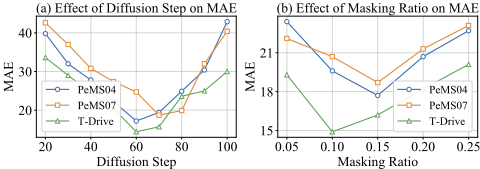
We further investigate the impact of two critical parameters on model performance: the number of diffusion steps and the masking ratio used in training. Specifically, we varied the diffusion step from 20 to 100 and the masking ratio from 0.05 to 0.25, evaluating their effects on MAE across benchmark datasets. The results reveal that model accuracy generally improves with an increased diffusion step up to an optimal point, beyond which performance degrades due to potential over-smoothing. Similarly, a moderate masking ratio yields the best results, suggesting a balance between model robustness and information retention. These findings underscore the importance of careful hyperparameter tuning for optimal spatial-temporal forecasting performance.
| Dataset | Metric | w/o GDPM | w/oMSFO | w/oMSS | w/o SMA | w/ STMA | MS-STDT |
|---|---|---|---|---|---|---|---|
| PeMS04 | MAE↓ RMSE↓ | 18.767 30.202 | 17.847 29.066 | 17.780 29.147 | 17.612 28.669 | 18.065 29.224 | 16.726 27.063 |
| PeMS07 | MAE↓ RMSE↓ | 19.254 32.816 | 18.594 31.723 | 18.557 31.669 | 18.253 31.312 | 18.716 32.065 | 17.362 29.537 |
| PeMS08 | MAE↓ RMSE↓ | 11.492 20.148 | 11.035 19.400 | 11.068 19.472 | 10.931 19.235 | 11.167 19.659 | 10.391 18.096 |
| NYCTaxi | MAE↓ RMSE↓ | 10.109 18.607 | 9.808 17.941 | 9.685 17.792 | 9.597 17.651 | 9.824 18.031 | 9.132 16.627 |
| T-Drive | MAE↓ RMSE↓ | 13.936 29.948 | 13.683 29.271 | 13.559 28.994 | 13.357 28.878 | 13.597 29.428 | 12.681 27.053 |
| CHIBike | MAE↓ RMSE↓ | 3.712 5.631 | 3.551 5.374 | 3.544 5.398 | 3.515 5.329 | 3.653 5.470 | 3.347 5.041 |
4.5 Robustness and Efficiency Analysis
Zero-Shot Resilience. We evaluated model resilience against sensor failures by testing on data with 0-30% random missing rates without retraining. As shown in Fig. 4(a), MS-STDT demonstrates superior stability compared to baselines. While the deterministic STDN degrades rapidly (MAE rising from ∼18 to >24) and generative models like UniST and UrbanDiT exhibit linear error increases, MS-STDT maintains a significantly flatter degradation curve. Notably, at 30% sparsity, our model matches the performance of baselines at only 010% missing rates, validating the Spatial-Temporal Process Module's ability to impute missing global context.
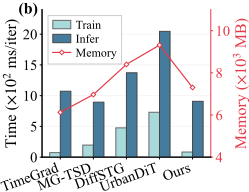
Computational Efficiency. Fig. 4(b) details the computational overhead. Despite its multi-scale architecture, MSSTDT achieves a highly favorable efficiency trade-off. It requires only ∼83 ms/iter for training, significantly faster than UrbanDiT (∼730 ms) and comparable to lightweight baselines due to our parallelized encoder. Inference is similarly accelerated (∼908 ms/iter vs. ∼2046 ms for UrbanDiT) via our guided diffusion strategy. Furthermore, MS-STDT maintains a moderate memory footprint (∼7303 MB), 21% lower than competitive diffusion models, ensuring deployment feasibility.
5 RelatedWork
Diffusion Models for Traffic Flow Forecasting. Diffusion models have become an important paradigm for traf-
(a)
24
MAE
22
20
18
MS-STDT
UrbanDiT
UniST
STDN
0
10
20
30
Missing Rate (%)
UrbanDiT Ours
Figure 4: Robustness (a) and Efficiency (b) Analysis.
fic forecasting due to their ability to model complex predictive distributions and uncertainty [Zhang et al., 2021; R¨uhling Cachay et al., 2023; Wen et al., 2023; Hu et al., 2024a]. Early work such as TimeGrad [Rasul et al., 2021] introduced autoregressive denoising for temporal modeling, while DiffSTG [Wen et al., 2023] further incorporated graph structure into diffusion-based forecasting. More recent studies have explored generation stability and scalability, e.g., MG-TSD [Fan et al., 2024] via multi-granularity guidance and UrbanDiT [Yuan et al., 2025] via Diffusion Transformers. However, most existing methods still treat diffusion as a largely monolithic denoising process. In contrast, MSSTDT explicitly aligns the reverse process with the intrinsic coarse-to-fine hierarchy of traffic data, using stable coarsescale trends to guide fine-grained generation.
Transformers for Traffic FlowForecasting. Transformers dominate long-range spatial-temporal modeling [Wu et al., 2021; Jiang et al., 2023; Jin et al., 2023]. Recent advancements have increasingly focused on pattern disentanglement and generalization. For instance, STDN [Cao et al., 2025] proposes a decomposition network to separate traffic data into distinct trend and seasonality components, and UniST [Yuan et al., 2024] utilizes masked pre-training to learn robust representations for cross-city transfer. However, while architectures like STDN excel at isolating deterministic macrotrends, they often lack the probabilistic capacity to model the stochastic uncertainty inherent in dynamic traffic flows. MS-STDT addresses this limitation by synthesizing the structural decomposition benefits of these Transformers with the generative expressiveness of diffusion models, unifying them within a hierarchical multi-scale framework that is both physically consistent and computationally efficient.
6 Conclusion
In this paper, we proposed the Coarse-to-Fine Latent Guidance strategy via MS-STDT to address the challenge of multi-scale traffic heterogeneity. By reformulating diffusion as a hierarchical generative process, our method utilizes intrinsic data structures as structural anchors to stabilize prediction without external labels. Extensive experiments confirm that MS-STDT consistently outperforms existing baselines in accuracy while demonstrating superior zero-shot robustness and computational efficiency. In future work, we plan to explore its applicability to broader spatial-temporal domains [Lian et al., 2026].
Acknowledgments
This work is partially supported by the National Natural Science Foundation of China (Nos.T2293771 and 42361144718). The funders had no role in the study design, data collection, analysis, decision to publish, or preparation of the manuscript.
@inproceedings{ijcai2026p311,
  title     = {Coarse-to-Fine Latent Guidance: A Multi-Scale Diffusion Transformer for Traffic Flow Forecasting},
  author    = {Li, Zetao and Zhou, Silin and Hu, Zheng and Cai, Shimin and Zhou, Tao},
  booktitle = {Proceedings of the Thirty-Fifth International Joint Conference on
               Artificial Intelligence, {IJCAI-26}},
  publisher = {International Joint Conferences on Artificial Intelligence Organization},
  editor    = {Diego Calvanese},
  pages     = {2798--2806},
  year      = {2026},
  month     = {8},
  note      = {Main Track},
  doi       = {10.24963/ijcai.2026/311},
  url       = {https://doi.org/10.24963/ijcai.2026/311},
}
TY - CPAPER TI - Coarse-to-Fine Latent Guidance: A Multi-Scale Diffusion Transformer for Traffic Flow Forecasting AU - Li, Zetao AU - Zhou, Silin AU - Hu, Zheng AU - Cai, Shimin AU - Zhou, Tao T2 - Proceedings of the Thirty-Fifth International Joint Conference on Artificial Intelligence, IJCAI-26 PB - International Joint Conferences on Artificial Intelligence Organization PY - 2026 SP - 2798 EP - 2806 DO - 10.24963/ijcai.2026/311 UR - https://doi.org/10.24963/ijcai.2026/311 ER -Copied
Machine-readable versions of this paper, for tools and AI agents:





