
No More Shortcuts: Network Traffic Anomaly Detection via Bidirectional Prediction
Proceedings of the Thirty-Fifth International Joint Conference on Artificial Intelligence. Main Track. Pages 2807-2815.
https://doi.org/10.24963/ijcai.2026/312
Keywords
- Machine Learning: Time series and data streams
- Data Mining: Anomaly/outlier detection
- Machine Learning: Multi-view learning
Abstract
Network Traffic Anomaly Detection (NTAD), particularly under zero-positive settings, is a critical task in cybersecurity. Existing zero-positive NTAD approaches primarily rely on reconstruction-based pipelines. Nevertheless, these methods are susceptible to an identical shortcut issue, where models indiscriminately reconstruct both normal and anomalous inputs, leading to anomaly overgeneralization. To address this limitation, we propose BiPred, the first prediction-based detection paradigm for NTAD. BiPred symmetrically divides each network traffic sample into two segments and reformulates the NTAD task as a bidirectional prediction across these two segments. Unlike reconstruction-based methods, our BiPred not only eliminates shortcut learning by design but also establishes explicit bidirectional contextual dependencies, making it more sensitive to anomalous traffic. Moreover, we develop a novel Residual Scanning Mamba block that encodes multi-view contextual information to support bidirectional prediction. A residual fusion mechanism is proposed for the multi-view scanning Mamba to suppress the accumulation of inter-view redundancy. This design prevents representation degradation and provides multi-view contextual details for prediction. Extensive experiments demonstrate the superiority of our BiPred paradigm, highlighting a new research direction for NTAD. Code is available at https://github.com/ikun0124/BiPred.
- [Cai et al., 2026] Jiati Cai, Yuxun Zhao, Yan Liu, Ting Zhong, and Fan Zhou. Scope-diff: A spatiotemporal comprehensive perception diffusion framework for video anomaly detection. Neurocomputing, 678:133157, 2026.
- [Chen et al., 2026a] Bin Chen, Hanting Shen, Zhangtao Cheng, Xueting Liu, Ting Zhong, and Fan Zhou. Un- veiling cross-modal consistency: Taming inter-and intra- modal noise for robust multi-modal knowledge graph completion. Information Processing & Management, 63(2):104472, 2026.
- [Chen et al., 2026b] Mengyang Chen, Lingwei Wei, Wei Zhou, and Songlin Hu. An information-theoretic propa- gation denoising and fusion framework for fake news de- tection. arXiv: 2605.02259, 2026. IJCAI
- [Dang et al., 2025] Zhangxuan Dang, Yu Zheng, Xinglin Lian, Chunlei Peng, Qiuyu Chen, and Xinbo Gao. Semi- supervised learning for anomaly traffic detection via bidi- rectional normalizing flows. IEEE Transactions on Net- work and Service Management, 22(5):5106-5117, 2025.
- [Deng et al., 2025] Xianwen Deng, Ruijie Zhao, Yanhao Wang, Mingwei Zhan, Zhi Xue, and Yijun Wang. Count- mamba: A generalized website fingerprinting attack via coarse-grained representation and fine-grained prediction. In IEEE Symposium on Security and Privacy, pages 1419- 1437, 2025.
- [Eldele et al., 2024] Emadeldeen Eldele, Mohamed Ragab, Zhenghua Chen, Min Wu, and Xiaoli Li. Tslanet: Re- thinking transformers for time series representation learn- ing. In International Conference on Machine Learning, pages 12409-12428, 2024.
- [Fu et al., 2024] Jiadong Fu, Jiang Fang, Jiyan Sun, Shangyuan Zhuang, Liru Geng, and Yinlong Liu. Loft: Lora-based efficient and robust fine-tuning framework for adversarial training. In International Joint Conference on Neural Networks, pages 1-8, 2024.
- [Fu et al., 2026a] Jiadong Fu, Jiang Fang, Jiyan Sun, Laile Xi, Shangyuan Zhuang, Yinlong Liu, and ZhiQiang Lv. Capt: A lightweight continual adversarial pre-training framework for traffic analysis model. In IEEE Interna- tional Conference on Acoustics, Speech and Signal Pro- cessingP, pages 14367-14371, 2026.
- [Fu et al., 2026b] Jiadong Fu, Jiang Fang, Jiyan Sun, Shangyuan Zhuang, Yinlong Liu, and Zhiqiang Lv. To- ward efficient distributed network security: A lightweight multitask traffic analysis framework. IEEE Transactions on Networking, 34:2271-2286, 2026.
- [Ge et al., 2025] Yunfeng Ge, Jiawei Li, Yiji Zhao, Haomin Wen, Zhao Li, Meikang Qiu, Hongyan Li, Ming Jin, and Shirui Pan. T2S: high-resolution time series generation with text-to-series diffusion models. In International Joint Conference on Artificial Intelligence, pages 5208-5216, 2025. IJCAI
- [Gu and Dao, 2024] Albert Gu and Tri Dao. Mamba: Linear- time sequence modeling with selective state spaces. In Conference on Language Mdeling, 2024.
- [Guo et al., 2024] Hang Guo, Jinmin Li, Tao Dai, Zhihao Ouyang, Xudong Ren, and Shu-Tao Xia. Mambair: A sim- ple baseline for image restoration with state-space model. In European Conference on Computer Vision, pages 222- 241, 2024.
- [He et al., 2026] Yaru He, Jiaqi Gao, Daoqi Han, Yueming Lu, and Yaojun Qiao. Hierarchical traffic fingerprint- assisted graph neural networks for encrypted traffic classi- fication in internet of vehicles. Knowledge-Based Systems, 343:116027, 2026.
- [Lashkari et al., 2017] Arash Habibi Lashkari, Gerard Draper-Gil, Mohammad Saiful Islam Mamun, and Ali A. Ghorbani. Characterization of tor traffic using time based features. In ICISSP, pages 253-262. SciTePress, 2017.
- [Li et al., 2023] Yuxin Li, Wenchao Chen, Bo Chen, Dong- sheng Wang, Long Tian, and Mingyuan Zhou. Prototype- oriented unsupervised anomaly detection for multivari- ate time series. In International Conference on Machine Learning, pages 19407-19424, 2023.
- [Li et al., 2025] Zetao Li, Zheng Hu, Peng Han, Yu Gu, and Shimin Cai. Ssl-stmformer self-supervised learning spatio-temporal entanglement transformer for traffic flow prediction. In AAAI Conference on Artificial Intelligence, pages 12130-12138, 2025.
- [Lian et al., 2024] Xinglin Lian, Yang Liu, Shanfeng Wang, and Yu Zheng. Payload level anomaly network traffic de- tection via semi-supervised contrastive learning. In Trust, Security and Privacy in Computing and Communications, pages 2559-2566, 2024.
- [Lian et al., 2025a] Xinglin Lian, Chengtai Cao, Yan Liu, Xovee Xu, Yu Zheng, and Fan Zhou. Facing anoma- lies head-on: Network traffic anomaly detection via uncertainty-inspired inter-sample differences. In the ACM on Web Conference, pages 3908-3917, 2025.
- [Lian et al., 2025b] Xinglin Lian, Yu Zheng, Zhangxuan Dang, Chunlei Peng, and Xinbo Gao. Semi-supervised anomaly traffic detection via multi-frequency reconstruc- tion. Pattern Recognition, 161:111215, 2025.
- [Lian et al., 2026a] Xinglin Lian, Chengtai Cao, Ting Zhong, Yong Wang, Kai Chen, and Fan Zhou. Decom- pose to understand, fuse to detect: Frequency-decoupled anomaly detection for encrypted network traffic. arXiv: 2605.02970, 2026.
- [Lian et al., 2026b] Xinglin Lian, Yu Zheng, Yan Liu, Fan Zhou, Chunlei Peng, and Xinbo Gao. Contextual mask- ing distillation for network traffic anomaly detection. IEEE Transactions on Information Forensics and Security, 21:1273-1286, 2026.
- [Liu et al., 2024] Yong Liu, Tengge Hu, Haoran Zhang, Haixu Wu, Shiyu Wang, Lintao Ma, and Mingsheng Long. itransformer: Inverted transformers are effective for time series forecasting. In International Conference on Learn- ing Representations, 2024.
- [Lunardi et al., 2023] Willian Tessaro Lunardi, Martin An- dreoni Lopez, and Jean Pierre Giacalone. ARCADE: ad- versarially regularized convolutional autoencoder for net- work anomaly detection. IEEE Transactions on Network and Service Management, 20(2):1305-1318, 2023.
- [MontazeriShatoori et al., 2020] Mohammadreza Mon- tazeriShatoori, Logan Davidson, Gurdip Kaur, and Arash Habibi Lashkari. Detection of doh tunnels using time-series classification of encrypted traffic. In IEEE DASC/PiCom/CBDCom/CyberSciTech, pages 63-70, 2020.
- [Neto et al., 2023] Euclides Carlos Pinto Neto, Sajjad Dad- khah, Raphael Ferreira, Alireza Zohourian, Rongxing Lu, and Ali A. Ghorbani. Ciciot2023: A real-time dataset and benchmark for large-scale attacks in iot environment. Sen- sors, 23(13):5941, 2023.
- [Patro and Agneeswaran, 2025] Badri Narayana Patro and Vijay Srinivas Agneeswaran. Mamba-360: Survey of state space models as transformer alternative for long sequence modelling: Methods, applications, and chal- lenges. Engineering Applications of Artificial Intelligence, 159:111279, 2025.
- [Qin et al., 2025] Shuxin Qin, Jing Zhu, Aipeng Guo, Yan- song Yang, Lu Wang, and Gaofeng Tao. Mambaad: Multi- variate time series anomaly detection in iot via multi-view mamba. Neurocomputing, 655:131385, 2025.
- [Qu et al., 2024] Haohao Qu, Liangbo Ning, Rui An, Wenqi Fan, Tyler Derr, Hui Liu, Xin Xu, and Qing Li. A survey of mamba. arXiv preprint arXiv:2408.01129, 2024.
- [Shi et al., 2024] Yuheng Shi, Minjing Dong, and Chang Xu. Multi-scale vmamba: Hierarchy in hierarchy visual state space model. In Annual Conference on Neural Information Processing Systems, pages 25687-25708, 2024.
- [Tran et al., 2025] Hoan My Tran, Damien Lolive, Aghilas Sini, Arnaud Delhay, Pierre-Franc ¸ois Marteau, and David Guennec. Multi-level ssl feature gating for audio deepfake detection. In ACM International Conference on Multime- dia, pages 11766-11775, 2025.
- [Wang et al., 2024] Tongze Wang, Xiaohui Xie, Wenduo Wang, Chuyi Wang, Youjian Zhao, and Yong Cui. Net- mamba: Efficient network traffic classification via pre- training unidirectional mamba. In International Confer- ence on Network Protocols, pages 1-11, 2024.
- [Xia et al., 2025] Linhan Xia, Mingzhan Yang, Jingjing Wang, Ziwei Yan, Yakun Ren, Guo Yu, and Kai Lei. Mamba4net: Distilled hybrid mamba large language mod- els for networking. In International Conference on Net- work Protocols, pages 1-10, 2025.
- [Xiao et al., 2025] Haoke Xiao, Lv Tang, Peng-Tao Jiang, Hao Zhang, Jinwei Chen, and Bo Li. Boosting vision state space model with fractal scanning. In AAAI Conference on Artificial Intelligence, pages 8646-8654, 2025.
- [Xu et al., 2022] Jiehui Xu, Haixu Wu, Jianmin Wang, and Mingsheng Long. Anomaly transformer: Time series anomaly detection with association discrepancy. In Inter- national Conference on Learning Representations, 2022.
- [Yang et al., 2025] Luming Yang, Yongjun Wang, Lin Liu, Junjie Huang, Jiangyong Shi, Shaojing Fu, and Shize Guo. unflows: An unsupervised construction scheme of flow spectrum for network traffic detection. IEEE Transac- tions on Information Forensics and Security, 20:3330- 3345, 2025.
- [Zhang et al., 2022] Lianming Zhang, Xiaowei Xie, Kai Xiao, Wenji Bai, Kui Liu, and Pingping Dong. Manomaly: Mutual adversarial networks for semi-supervised anomaly detection. Information Sciences, 611:65-80, 2022.
- [Zhang et al., 2024] Xinchen Zhang, Running Zhao, Zhihan Jiang, Zhicong Sun, Yulong Ding, Edith C. H. Ngai, and Shuang-Hua Yang. AOC-IDS: autonomous online frame- work with contrastive learning for intrusion detection. In IEEE Conference on Computer Communications, pages 581-590, 2024.
- [Zhang et al., 2025a] Haozhen Zhang, Haodong Yue, Xi Xiao, Le Yu, Qing Li, Zhen Ling, and Ye Zhang. Revolutionizing encrypted traffic classification with mh- net: A multi-view heterogeneous graph model. In AAAI Conference on Artificial Intelligence, pages 1048-1056, 2025.
- [Zhang et al., 2025b] Qiao Zhang, Mingwen Shao, Xinyuan Chen, Xiang Lv, and Kai Xu. Wave-mambaad: Wavelet- driven state space model for multi-class unsupervised anomaly detection. In IEEE/CVF International Confer- ence on Computer Vision, pages 20868-20877, 2025.
- [Zhao et al., 2024a] Ruijie Zhao, Mingwei Zhan, Xianwen Deng, Fangqi Li, Yanhao Wang, Yijun Wang, Guan Gui, and Zhi Xue. A novel self-supervised framework based on masked autoencoder for traffic classification. IEEE/ACM Transactions on Networking, 32(3):2012-2025, 2024.
- [Zhao et al., 2024b] Ziming Zhao, Zhaoxuan Li, Zhuoxue Song, Wenhao Li, and Fan Zhang. Trident: A univer- sal framework for fine-grained and class-incremental un- known traffic detection. In the ACM on Web Conference, pages 1608-1619, 2024.
- [Zheng et al., 2023] Yu Zheng, Xinglin Lian, Zhangxuan Dang, Chunlei Peng, Chao Yang, and Jianfeng Ma. A semi-supervised anomaly network traffic detection frame- work via multimodal traffic information fusion. In Inter- national Conference on Information and Knowledge Man- agement, pages 4455-4459, 2023.
- [Zheng et al., 2024] Yu Zheng, Zhangxuan Dang, Xinglin Lian, Chunlei Peng, and Xinbo Gao. Multi-view multi- label network traffic classification based on mlp-mixer neural network. Computer Networks, 253:110746, 2024.
- [Zong et al., 2018] Bo Zong, Qi Song, Martin Renqiang Min, Wei Cheng, Cristian Lumezanu, Dae-ki Cho, and Haifeng Chen. Deep autoencoding gaussian mixture model for unsupervised anomaly detection. In Interna- tional Conference on Learning Representations, 2018.
References were extracted automatically from the PDF and may contain errors.
Full text extracted automatically from the PDF; figures, tables and equations may differ. The PDF is the version of record.
1 Introduction
Network Traffic Anomaly Detection (NTAD) is a fundamental task in modern cybersecurity. It monitors real-time network traffic to identify unauthorized or malicious connections [He et al., 2026], ensuring high-quality service availability, protected user privacy, and reliable data security [Zhang et al., 2025a; Fu et al., 2026b]. However, accurately detecting anomalous traffic remains challenging, as attackers continuously modify and obfuscate their strategies.
∗Corresponding Author
These evolving and previously unseen attack patterns often render traditional supervised approaches ineffective, particularly when labeled anomalous samples are scarce or outdated [Dang et al., 2025]. Consequently, research efforts in NTAD have increasingly shifted toward more scalable detection paradigms. Reconstruction-based zero-positive learning has emerged as a particularly promising direction. In this paradigm, an autoencoder is trained exclusively on normal traffic to minimize reconstruction error [Zhao et al., 2024b]. During inference, the method assumes that unseen or evolving anomalies will produce higher reconstruction errors, thus enabling their accurate detection [Yang et al., 2025].
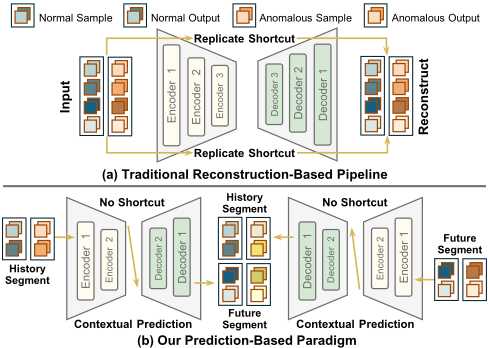
Challenge. Although theoretically appealing, this assumption does not consistently hold in practice. Recent studies reveal that reconstruction-based approaches are susceptible to the "identical shortcut" phenomenon [Lian et al., 2025a; Lian et al., 2026b]. As illustrated in Figure 1(a), the reconstruction-based training pipeline inherently leaves a learnable shortcut, causing the model to reconstruct inputs via simple replication rather than to encode meaningful contextual representations. When the shortcut extends to anomalous samples, they achieve fidelity comparable to normal samples through replication, undermining anomaly detection. Some works mitigate this limitation by introducing inter-sample learning, feature extraction, and memory modules into autoencoder models [Lian et al., 2025a; Lian et al., 2026b; Li et al., 2023]. However, the paradigm-level shortcut is unavoidably triggered by their reconstruction-based pipeline, rendering existing efforts inherently limited. This observation raises a key research question: How can the paradigm-level shortcut curse be fundamentally eliminated?
Contribution 1. To answer this question, we propose a new paradigm named BiPred: Bidirectional Predictionbased anomaly detection for NTAD. As illustrated in Figure 1(b), BiPred divides each network traffic sample into two segments, history and future, and reformulates the reconstruction task as a bidirectional prediction process. Specifically, two prediction models are trained exclusively on normal traffic: one predicts future segments from past segments, and the other predicts past segments from future segments. During inference, anomalous traffic disrupts the learned normal contextual relationships across the two segments, resulting in larger prediction deviations. Compared with reconstructionbased approaches, our paradigm offers two intrinsic advantages: (1) Shortcut Elimination. The prediction-based pipeline leaves the model with no more shortcut pathways to directly replicate inputs, thereby eliminating shortcut learning by design. (2) Contextual Learning. The bidirectional prediction forces the model to encode forward-backward contextual dependencies, enhancing sensitivity to inconsistencies in anomalous traffic patterns.
Contribution 2. Contextual representation is critical for BiPred's prediction models, as inadequate learning can cause prediction collapse. Recently, Mamba-based architectures leverage multi-directional scanning mechanisms, achieving strong sequential modeling capacity while maintaining linear computational complexity [Patro and Agneeswaran, 2025]. This renders Mamba particularly suitable for our prediction framework. Nevertheless, its multi-directional scanning mechanism may introduce severe information redundancy [Guo et al., 2024; Shi et al., 2024], even degrading Mamba's performance in NTAD tasks [Wang et al., 2024]. This redundancy causes the model to repeatedly emphasize overlapping patterns, diluting fine-grained directional information [Xiao et al., 2025]. To address this limitation, we propose a novel Multi-View Residual Scanning Mamba (MRSM) module. Exploiting the hierarchical structure of network traffic, we first design a dual-view scanning strategy to form complementary contextual information at both packet-level and flow-level of network traffic. To explicitly mitigate inter-view redundancy, we propose a residual fusion mechanism: one view is treated as the anchor for primary contextual modeling, while the other serves as an auxiliary view to capture residual representations relative to the anchor. This residual operation isolates auxiliary-specific complementary information while preventing the secondary accumulation issue of inter-view redundancy. The final representation integrates the anchor and auxiliary residual information, forming a fine-grained multi-view context that underpins the bidirectional prediction.
In summary, our contributions are threefold:
- We propose a novel bidirectional prediction-based anomaly detection paradigm. To the best of our knowledge, it is the first framework to fundamentally eliminate the "identical shortcut" issue in zero-positive NTAD.
- We propose a Multi-View Residual Scanning Mamba module that captures rich multi-view contextual information and explicitly mitigates inter-view redundancy, thereby supporting effective bidirectional prediction.
- Experiments on three real-world datasets demonstrate that BiPred consistently outperforms state-of-the-art zero-positive NTAD methods.
2 RelatedWork
2.1 Network Traffic Anomaly Detection
Zero-positive Network Traffic Anomaly Detection (NTAD) aims to identify previously unseen anomalous traffic using only normal training samples [Zhang et al., 2024; Yang et al., 2025]. Existing approaches primarily follow a reconstruction-based paradigm, where autoencoder models are trained to faithfully reconstruct normal traffic patterns. These methods emphasize accurately modeling normal behavior, assuming that anomalies deviate from the learned representations and thus incur larger reconstruction errors. Representative methods include MANomaly [Zhang et al., 2022] and ARCADE [Lunardi et al., 2023], which integrate adversarial training into autoencoder architectures to enhance reconstruction robustness. Trident [Zhao et al., 2024b] employs a U-Net-based autoencoder to preserve fine-grained structural characteristics of network traffic. MFAD [Zheng et al., 2023] and MFR [Lian et al., 2025b] exploit low-pass filtering to highlight texture-level representations for improved normal pattern learning. FreeUp [Lian et al., 2026a] introduces a frequency-decoupled reconstruction framework for modeling encrypted "full-frequency" network traffic. unFlowS [Yang et al., 2025] projects high-dimensional traffic features into a spectral space to facilitate anomaly discrimination.
Despite these reconstruction-oriented enhancements, recent studies have revealed a paradigm-level limitation termed the "identical shortcut" phenomenon [Lian et al., 2025a]. Specifically, autoencoders may converge to shortcut mappings that replicate both normal and anomalous samples with comparable fidelity, undermining anomaly separability. To mitigate this issue, UnDiff [Lian et al., 2025a] introduces inter-sample difference learning to reduce shortcut reliance, ConMD [Lian et al., 2026b] employs a pretrained model to extract discriminative features, while other works adopt memory-augmented mechanisms to reinforce normal pattern memorization [Li et al., 2023]. Nevertheless, these methods remain fundamentally constrained by the reconstructionbased pipeline and cannot fully eliminate the shortcut risk caused by direct input-output replication.
To avoid these paradigm-level limitations, we shift NTAD to a prediction-based formulation. By introducing internal bidirectional prediction between segments of each traffic sample, our approach explicitly removes the direct replication path between inputs and outputs, thereby preventing shortcut learning. Furthermore, this predictive formulation encourages richer contextual modeling, which is particularly effective for detecting anomalies characterized by subtle contextual inconsistencies [Zhao et al., 2024a], rather than relying solely on deviations from naive reconstruction.
2.2 Mamba-Based Representation Learning
The Mamba architecture is built upon selective state-space sequence models, enabling efficient contextual modeling with linear computational complexity. It has demonstrated a favorable efficiency-effectiveness trade-off in domains such as computer vision and time-series analysis [Zhang et al., 2025b; Qin et al., 2025]. By design, Mamba employs multi-directional scanning mechanisms, which are intended to fuse representations from different directions and provide comprehensive global contextual information. However, recent studies have shown that multi-directional scanning often introduces substantial information redundancy across branches [Guo et al., 2024; Shi et al., 2024; Xiao et al., 2025]. This redundancy causes the model to repeatedly emphasize overlapping components, thereby diluting fine-grained directional information and, in extreme cases, degenerating the model into a single-branch scanning behavior.
The redundancy problem is particularly pronounced in the context of network traffic analysis. In traffic classification tasks, multi-directional Mamba scanning can degrade performance, whereas simple unidirectional scanning often yields better results [Wang et al., 2024]. Consequently, some recent works adopt unidirectional Mamba architectures to avoid redundancy-induced degradation [Deng et al., 2025; Xia et al., 2025]. However, network traffic inherently exhibits rich multi-view characteristics, where anomalies often manifest through intricate flow-view and packet-view interactions [Zhao et al., 2024a]. Purely unidirectional scanning, therefore, risks overlooking critical multi-view contextual cues and inducing biased representations.
To address this challenge, we propose a novel Multi-View Residual Scanning Mamba module with explicit redundancy elimination. Instead of simply fusing scan outputs, our approach designates one view as the primary anchor and extracts complementary information from auxiliary views via residual learning. This mechanism mitigates information degradation caused by redundant component accumulation while preserving fine-grained multi-perspective contextual details, thereby supporting more effective bidirectional prediction and contextual anomaly awareness.
3 Methodology
3.1 ProblemDefinition
Let X = {x1, x2, ..., xN} denote a training set of N normal samples. During training, the model exclusively learns to characterize normal network traffic patterns [Lian et al., 2024; Cai et al., 2026]. During inference, for a given test sample x, the model outputs an anomaly score s, where higher values indicate a greater likelihood of anomalous activity. Each sample x corresponds to a network flow, i.e., a sequence of packets exchanged between endpoints within a connection session. To capture the hierarchical characteristics of network traffic, we represent each flow as a packetlevel matrix x ∈ RF×P , where F is the number of packets in the flow and P denotes the packet size in bytes. Each packet follows the prior traffic preprocessing protocol [Lian et al., 2025b; Fu et al., 2026a; Zheng et al., 2024].
3.2 Mamba-Based Bidirectional-Prediction
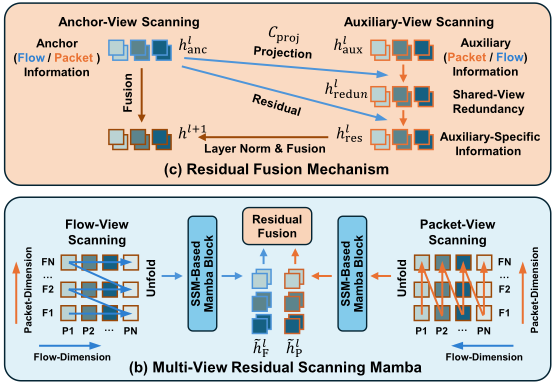
This section presents the proposed BiPred, as illustrated in Figure 2(a). Each traffic sample is first symmetrically divided into two segments. Then, zero-positive NTAD is reformulated as a bidirectional prediction task, in which one segment is used to predict its counterpart. As shown in Figure 2(b), each prediction model is built upon a Multi-View Residual Scanning Mamba encoder to capture rich contextual dependencies. The encoder incorporates an explicit residual mechanism to suppress inter-view redundancy while highlighting view-specific information. The resulting multi-view features provide strong contextual cues for the prediction decoder. During inference, the anomaly score s is quantified as the deviation between the predicted segment and the corresponding input segment, where lower deviations indicate conformity to normal traffic patterns.
Bidirectional Prediction Paradigm for NTAD
Existing NTAD methods suffer from a paradigm-level limitation. Reconstruction-based pipelines are prone to triggering the "identical shortcut", which leads to anomaly overgeneralization. To overcome this, we reformulate NTAD as a bidirectional prediction problem that removes the shortcut learning by design. As illustrated in Figure 2(a), each traffic sample is symmetrically divided along the flow dimension into two segments: the first half serves as the history segment xhis, while the second half serves as the future segment xfut.
The two segments are then processed by independent embedding layers to tokenize byte-level representations:
where Embed(·) comprises a Conv1D-based data embedding layer and a sine-cosine positional encoding layer [Li et al., 2025; Chen et al., 2026b]. The resulting embeddings encode sequential packet information at the byte level, yielding feature representations in R( F2 ·P)×D . To explicitly preserve the inherent flow-packet hierarchy of network traffic, we further reshape them into h0his , h0fut∈ R F2 ×P×D , enabling subsequent hierarchical contextual modeling.
Normal and anomalous traffic exhibit distinct communication patterns [Yang et al., 2025; Lian et al., 2025b], which are reflected in their contextual dependencies across history and future segments. For normal traffic, these segments maintain stable and predictable cross-segment relationships. In contrast, anomalous traffic disrupts such dependencies, preventing the formation of coherent cross-segment context under zero-positive training. Motivated by this observation, we employ two Mamba-based encoders to capture contextual information from the input segments. One prediction branch estimates the future representation hLfut conditioned on the history segment h0his , while the other predicts the history representation hLhis conditioned on the future segment h0fut .
History
Segment
Predict
Decoder
Conv
Relu
Conv
LN
MRSM
LN
FFN
Future
Segment Divide Divide Input
𝑥𝑥୳୲
�
𝑥𝑥୦୧ୱ
Output
Concat
�𝑥𝑥
�
𝑥𝑥୳୲
Concat
× L
Parameters
Non-Shared Conv Relu Conv LN
MRSM
LN
Future
Segment
Predict
Decoder × L
FFN
Embedding History Segment
(a) Mamba-Based Bidirectional Prediction Framework
𝑥𝑥 𝑥𝑥୦୧ୱ
Lightweight decoders with linear layers are then used to map the predicted representations hLhis and hLfut to the corresponding outputs ˆxhis and ˆxfut. Finally, the bidirectional prediction outputs are concatenated to form the overall prediction result ˆx for zero-positive learning. The bidirectional prediction process is formalized as follows:
where L denotes the number of Mamba layers in the encoder.
Overall, our design philosophy goes beyond traditional reconstruction-based frameworks at both the paradigm and learning-mechanism levels. (1) The proposed bidirectionalprediction paradigm removes trivial input-output replication through its construction. By constraining data flow into two independent predictive paths, it prevents unintended information leakage between inputs and outputs, thereby fundamentally eliminating the "identical shortcut". (2) The framework establishes explicit contextual prediction dependencies, where each model is forced to infer the missing segment from partial observations. This design is particularly effective at exposing concealed anomalies manifested across segments.
Multi-View Residual Scanning Mamba
In BiPred, strong contextual representations of Encoderhis and Encoderfut are essential. Insufficient representation learning may cause the prediction paradigm to collapse and unreliable anomaly detection. Motivated by its strong sequential modeling capacity [Qin et al., 2025], we adopt a Mamba-based backbone and design the Multi-View Residual Scanning Mamba (MRSM) module, as shown in Figure 2(b).
Existing traffic analysis works primarily employ unidirectional Mamba scanning [Deng et al., 2025; Xia et al., 2025].
However, unidirectional scanning would yield biased representations for h0his and h0fut [Qu et al., 2024] and fail to capture the flow-packet structure of network traffic [Zhao et al., 2024a]. Therefore, we design a multi-view scanning strategy. As illustrated in Figure 2(b), for both h0his and h0fut segments, we independently rearrange each representation into two complementary views: a flow view h0F ∈ R( F2 ·P )×D and a packet view h0P∈ R(P · F2 )×D . These views are processed by shared Mamba blocks [Gu and Dao, 2024] to capture multiview contextual representations ˜h0F and ˜h0P. The l-th MRSM module is represented as follows:
where LN denotes the layer normalization.
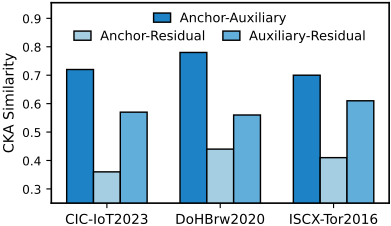
While multi-view scanning provides effective contextual representations, its application to network traffic presents significant challenges. Naive fusion of the scanning branches can repeatedly aggregate inter-view redundancy, causing the multi-view representation to degenerate toward a single branch [Wang et al., 2024]. To quantify this effect, we measure the linear CKA similarity between the view representations [Tran et al., 2025]. As shown in Figure 3, the similarity values of the Anchor-Auxiliary scheme, i.e., between the flow-view and the packet-view, remain high across three datasets, indicating substantial redundancy.
To address the inter-view redundancy, we propose a novel residual fusion mechanism, as shown in Figure 2(c). At each layer, the flow view ˜hlF and the packet view ˜hlP are alternately assigned as the anchor view hlanc and the auxiliary view hlaux . For example, the flow view ˜hlP serves as the anchor at the l-th layer, while the packet view ˜hl+1 P takes the anchor role at the (l + 1)-th layer. The anchor view encodes the primary scanning information, comprising sharedview redundancy and anchor-specific components. For the
Embedding
Encoder Encoder auxiliary view, only the auxiliary-specific information is retained for merging with the anchor view. This residual fusion mechanism explicitly mitigates inter-view redundancy by removing the shared components from the auxiliary view. To achieve this, we first compute the projection coefficient vector Cproj of the auxiliary view with respect to the anchor view via element-wise vector projection. The shared-view redundancy hlredun is then obtained by projecting the auxiliary representation onto the anchor representation using Cproj. Finally, the auxiliary-specific information is extracted by subtracting the shared redundancy, yielding the residual representation hlres . This process is summarized as follows:
where ε is a small constant added for numerical stability.
Our multi-view representation is formed by combining the anchor view with the residual-specific information extracted from the auxiliary view. As confirmed in Figure 3, the proposed Anchor-Residual branch substantially reduces redundancy compared to the naive Anchor-Auxiliary branch. Unlike existing approaches that directly sum scanning results [Qu et al., 2024], this residual-based formulation explicitly suppresses shared-view redundancy, preventing representation degradation. Moreover, it preserves complementary multi-view cues, as reflected by the moderate Auxiliary-Residual branch similarity.
where FFN denotes a feed-forward network implemented with two Conv1D layers [Ge et al., 2025; Chen et al., 2026a].
3.3 Training
Our objective of zero-positive training is to learn normal bidirectional prediction patterns. To this end, BiPred adopts cosine similarity as the objective L to enforce prediction consistency. Specifically, given an input x = Concat[xhis, xfut] and prediction ˆx = Concat[ˆxhis, ˆxfut], the objective L encourages the predicted history ˆxhis (conditioned on xfut) to match the original history xhis, and the predicted future ˆxfut (conditioned on xhis) to match the original future xfut:
3.4 Anomaly Scoring
Consistent with our design philosophy, the model produces accurate bidirectional predictions for normal traffic after zero-positive training. During inference, previously unseen anomalous traffic tends to violate the learned contextual dependencies, resulting in degraded prediction quality. Such deviations are reflected by reduced similarity between the predicted output and the original input. Accordingly, we define the anomaly score as the cosine dissimilarity [Fu et al., 2024] between the prediction ˆx and the original traffic sample x:
4 Experiments
4.1 Experimental Setup
Datasets. We evaluate on three widely used network traffic anomaly detection datasets. (1) CIC-IoT2023: an intrusion detection dataset for Internet of Things network topologies [Neto et al., 2023]. (2) DoHBrw2020: a malicious HTTPS traffic detection dataset [MontazeriShatoori et al., 2020]. (3) ISCX-Tor2016: an anonymous network traffic detection dataset [Lashkari et al., 2017]. We sample 10,000 normal flows for training and use a balanced test set with 5,000 normal and 5,000 anomalous flows.
Evaluation Metrics. We assess model performance using three standard metrics: Area Under Curve (AUC), Accuracy (ACC), and F1-Score (F1), following recent studies [Zheng et al., 2023; Lian et al., 2025a].
Baselines. We compare our method with representative approaches from three categories. (1) Network traffic anomaly detection methods: DAGMM [Zong et al., 2018], ARCADE [Lunardi et al., 2023], MFR [Lian et al., 2025b], UnDiff [Lian et al., 2025a] and ConMD [Lian et al., 2026b]. (2) Transformer-based anomaly detection methods: Anomaly Transformer [Xu et al., 2022], TSLANet [Eldele et al., 2024], and iTransformer [Liu et al., 2024]. (3) Mambabased anomaly detection methods: CountMamba [Deng et al., 2025] and MambaAD [Qin et al., 2025].
Implementation Details. All experiments are conducted on an NVIDIA GeForce RTX 4090 GPU. We set the number of residual Mamba blocks L to 3 and the token embedding dimension D to 64. For traffic representation, we set F = 6 packets per flow and P = 400 bytes per packet. The Adam optimizer is used with a learning rate of 1×10⁻⁴ and a batch size of 128. We conduct five independent runs with different random seeds and report the average results.
4.2 Main Results
We compare BiPred with ten strong baselines to validate its effectiveness. The results are presented in Table 1. Based on these results, we make the following observations:
(O1): BiPred consistently outperforms all baselines across datasets and evaluation metrics by clear margins. In particular, BiPred achieves AUC improvements of 3.16% on CIC-IoT2023 and 4.21% on DoHBrw2020. These gains stem from the proposed prediction-based anomaly detection paradigm. By utilizing bidirectional-prediction, BiPred fundamentally eliminates the "identical shortcut" issue and establishes a contextual prediction pipeline. Furthermore, our Residual Scanning Mamba effectively mitigates inter-view redundancy, encoding complementary contextual information for more stable predictions.
| Methods | CIC-IoT2023 | DoHBrw2020 | ISCX-Tor2016 | ||||||
|---|---|---|---|---|---|---|---|---|---|
| AUC(%) | ACC(%) | F1(%) | AUC(%) | ACC(%) | F1(%) | AUC(%) | ACC(%) | F1(%) | |
| DAGMM | 66.40 | 61.38 | 67.22 | 77.41 | 75.18 | 75.07 | 73.28 | 74.30 | 73.82 |
| ARCADE | 72.09 | 77.32 | 74.94 | 76.79 | 79.91 | 80.07 | 92.35 | 90.15 | 90.50 |
| MFR | 82.68 | 83.03 | 81.56 | 70.51 | 70.23 | 73.44 | 93.68 | 91.74 | 91.94 |
| UnDiff | 83.25 | 82.69 | 81.93 | 81.92 | 79.93 | 80.10 | 94.01 | 91.86 | 91.61 |
| ConMD | 83.76 | 83.11 | 81.80 | 83.44 | 80.14 | 82.09 | 94.35 | 91.79 | 91.23 |
| Anomaly Transformer | 64.63 | 67.15 | 71.86 | 78.86 | 78.55 | 78.87 | 92.27 | 90.19 | 90.52 |
| TSLANet | 81.64 | 76.62 | 80.04 | 77.04 | 68.93 | 73.10 | 93.63 | 90.97 | 90.71 |
| iTransformer | 81.32 | 82.07 | 81.95 | 82.44 | 78.66 | 78.26 | 82.65 | 81.34 | 83.97 |
| MambaAD | 82.29 | 77.70 | 80.02 | 82.79 | 79.36 | 81.85 | 92.54 | 85.21 | 85.48 |
| CountMamba | 75.38 | 68.37 | 74.10 | 80.45 | 78.68 | 81.89 | 92.90 | 89.32 | 89.80 |
| BiPred | 86.92 | 84.94 | 83.74 | 87.65 | 83.52 | 84.11 | 96.54 | 93.05 | 93.12 |
| Variant | IoT2023 | DoHBrw2020 | Tor2016 |
|---|---|---|---|
| w/o Prediction | 83.93 | 84.35 | 94.21 |
| w/o Residual | 85.72 | 86.50 | 95.82 |
| w/o Multi-View | 85.40 | 86.29 | 95.63 |
| w/o Mamba | 83.64 | 81.83 | 94.01 |
| BiPred | 86.92 | 87.65 | 96.54 |
(O2): Existing NTAD methods, such as ConMD and UnDiff, attempt to alleviate the "identical shortcut" issue through feature extraction or alternative anomaly scoring strategies. However, their modeling pipelines remain constrained within the reconstruction paradigm, where shortcut learning is still inherently present. In addition, most of these methods rely on CNN-based architectures, which reduces their sensitivity for long-range contextual anomalies.
(O3): Transformer-based approaches, including Anomaly Transformer, TSLANet, and iTransformer, perform worse than several specialized NTAD methods. This is because these models are primarily designed for time-series data, where anomalies are characterized by trend and fluctuations. In contrast, network traffic is often payload-encrypted, which obscures exploitable time-series characteristics. Furthermore, these approaches also adopt a reconstruction-based pipeline, leaving them vulnerable to the "identical shortcut" problem. Similarly, recent Mamba-based methods such as MambaAD and CountMamba show limited effectiveness.
4.3 Ablation Study
We evaluate four ablated variants by removing key components. The results are reported in Table 2, and the main observations are summarized as follows:
Effect of Prediction Pipeline: Replacing the predictionbased pipeline with a conventional reconstruction pipeline (w/o Prediction) leads to a substantial performance drop. This clearly validates the effectiveness of our paradigm. By eliminating the "identical shortcut" and enforcing cross-contextual dependency modeling, the prediction pipeline enables more discriminative anomaly awareness.
Effect of Residual Mamba: Removing the proposed Residual Scanning Mamba module (w/o Residual) results in noticeable degradation. Combined with the statistical results in Figure 3, this demonstrates that Residual Mamba effectively mitigates inter-view redundancy through residual fusion. By highlighting complementary view-specific information, it strengthens multi-view scanning representations.
Effect of Multi-View Scanning: Discarding multi-view scanning (w/o Multi-View) degrades performance, indicating that a single scanning direction is insufficient to capture the intrinsic multi-view characteristics of network traffic. Notably, single-view scanning (w/o Multi-View) achieves performance comparable to multi-view scanning without residual fusion (w/o Residual), further confirming the necessity of residual fusion for releasing multi-view information.
Effect of Mamba Architecture: Replacing the Mamba backbone with CNNs (w/o Mamba) causes significant performance deterioration. This confirms that contextual modeling is critical for the prediction framework. CNN-based architectures lack the capability to capture long-range contextual dependencies required for accurate bidirectional prediction, severely limiting the effectiveness of the paradigm.
4.4 ParadigmComparison
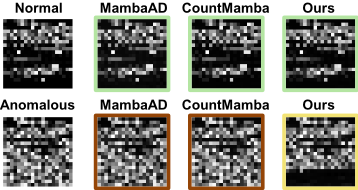
Figure 4 empirically demonstrates the superiority of our prediction-based paradigm. In reconstruction-based methods, the "identical shortcut" is easily triggered, causing models to learn a trivial identity mapping regardless of input normality [Lian et al., 2025a]. As observed in MambaAD and CountMamba, anomalous traffic (red rectangles) can be reconstructed with fidelity comparable to normal samples (green rectangles), violating the core assumption of anomaly detection. In contrast, our prediction-based framework fundamentally avoids this shortcut. Normal samples (green rectangle) yield outputs closely matching the input, whereas anomalous traffic (yellow rectangle) produces significant prediction deviations. This clearer anomaly separability qualitatively validates the advances and effectiveness of our paradigm.
4.5 Paradigm Scalability
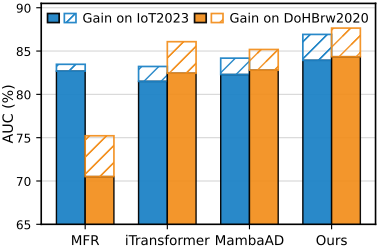
To assess paradigm scalability, we replace the reconstructionbased pipelines in several representative baselines with our prediction-based pipeline. The results, shown in Figure 5, demonstrate that our BiPred exhibits strong scalability. All replaced baselines achieve substantial performance gains, confirming the generality and effectiveness of the bidirectional prediction paradigm. These observations indicate that the benefits of shortcut elimination and enhanced contextual modeling can be naturally transferred to existing methods.
4.6 Hyperparameter Analysis
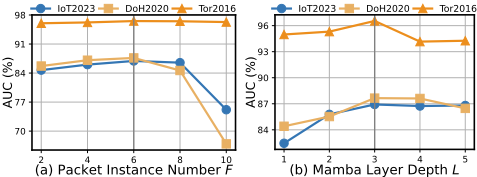
Figure 6 presents the sensitivity analysis of two key hyperparameters in BiPred. The observations are as follows:
(O1): The parameter F controls the amount of flow-view contextual information used for prediction. A relatively small F is sufficient to establish effective flow-level context and an intrinsic predictive pipeline. In contrast, excessively large F degrades detection performance.
(O2): The parameter L determines the contextual representation capacity of the Mamba encoder in the prediction pipeline. Our results show that performance stabilizes for L ≥ 3, so we set L = 3 for both prediction branches to trade off contextual representation and computational efficiency.
4.7 Overhead Analysis
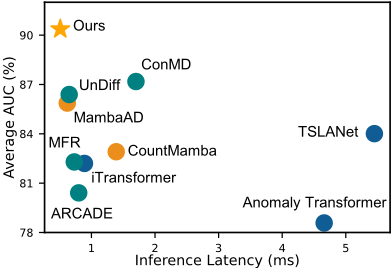
Detection overhead is a critical consideration for the practical deployment of NTAD systems. Figure 7 compares the average AUC across three datasets and the inference latency of competitive approaches. While CNN-based methods have linear complexity O((F · P)D), they rely on extensive feature engineering, which introduces non-negligible overhead. Transformer-based approaches suffer from quadratic complexity O((F · P)2D), leading to substantial computational costs. In contrast, Mamba-based architectures exhibit linear complexity O((F · P)D), providing significantly higher efficiency. This advantage enables the practical deployment of our bidirectional-prediction paradigm and multi-view scanning mechanism. Overall, compared with all baselines, our method achieves both superior detection performance and millisecond-level inference efficiency.
5 Conclusions
In this work, we propose BiPred, the first bidirectional prediction-based paradigm for the NTAD task. From a conceptual paradigm perspective, we move beyond conventional reconstruction-based frameworks by eliminating the inherent risk of the "identical shortcut" and reformulating anomaly detection as a contextual prediction problem. This shift establishes explicit bidirectional contextual dependencies and enables more sensitive and reliable anomaly detection. From a methodological perspective, we introduce a novel Multi-View Residual Scanning Mamba architecture to explicitly address inter-view redundancy in multi-view scanning. The proposed design preserves complementary multi-view information and effectively supports contextual prediction. Extensive experimental results demonstrate the effectiveness of the BiPred. Overall, this work establishes a prediction-based paradigm for NTAD, opening new opportunities for future research.
Acknowledgments
This work was supported by National Natural Science Foundation of China (Grant No. 62572097 and No. 62176043).
@inproceedings{ijcai2026p312,
  title     = {No More Shortcuts: Network Traffic Anomaly Detection via Bidirectional Prediction},
  author    = {Lian, Xinglin and Cao, Chengtai and Yu, Fanglin and Zhong, Ting and Zhou, Fan},
  booktitle = {Proceedings of the Thirty-Fifth International Joint Conference on
               Artificial Intelligence, {IJCAI-26}},
  publisher = {International Joint Conferences on Artificial Intelligence Organization},
  editor    = {Diego Calvanese},
  pages     = {2807--2815},
  year      = {2026},
  month     = {8},
  note      = {Main Track},
  doi       = {10.24963/ijcai.2026/312},
  url       = {https://doi.org/10.24963/ijcai.2026/312},
}
TY - CPAPER TI - No More Shortcuts: Network Traffic Anomaly Detection via Bidirectional Prediction AU - Lian, Xinglin AU - Cao, Chengtai AU - Yu, Fanglin AU - Zhong, Ting AU - Zhou, Fan T2 - Proceedings of the Thirty-Fifth International Joint Conference on Artificial Intelligence, IJCAI-26 PB - International Joint Conferences on Artificial Intelligence Organization PY - 2026 SP - 2807 EP - 2815 DO - 10.24963/ijcai.2026/312 UR - https://doi.org/10.24963/ijcai.2026/312 ER -Copied
Machine-readable versions of this paper, for tools and AI agents:





