
Inductive Knowledge Graph Wave Networks
Proceedings of the Thirty-Fifth International Joint Conference on Artificial Intelligence. Main Track. Pages 2960-2968.
https://doi.org/10.24963/ijcai.2026/329
Keywords
- Machine Learning: Representation learning
- Data Mining: Knowledge graphs and knowledge base completion
- Knowledge Representation and Reasoning: Semantic Web
Abstract
Inductive knowledge graph reasoning (IKGR) requires generalization to entities and relation types not seen during training. We introduce Knowledge Graph Wave Networks (KGWN), an IKGR approach that learns adaptive per-relation wave operators to control relation-dependent propagation, along with velocity normalization ensuring stability at any propagation depth. Experiments demonstrate state-of-the-art results on inductive benchmarks and competitive transductive performance.
- [Bollacker et al., 2008] Kurt Bollacker, Colin Evans, Praveen Paritosh, Tim Sturge, and Jamie Taylor. Freebase: A collaboratively created graph database for structuring human knowledge. In Proceedings of the 2008 ACM SIGMOD International Conference on Management of Data, pages 1247-1250. ACM, 2008.
- [Bordes et al., 2013] Antoine Bordes, Nicolas Usunier, Alberto Garcia-Duran, Jason Weston, and Oksana Yakhnenko. Translating embeddings for modeling multi-relational data. Advances in Neural Information Processing Systems, 26, 2013.
- [Cao et al., 2024] Zongsheng Cao, Jing Li, Zigan Wang, and Jinliang Li. DiffusionE: Reasoning on knowledge graphs via diffusion-based graph neural networks. In Proceed- ings of the 30th ACM SIGKDD Conference on Knowledge Discovery and Data Mining, pages 222-230. ACM, 2024.
- [Chamberlain et al., 2021] Benjamin Paul Chamberlain, James Rowbottom, Maria I Gorinova, Michael Bronstein, Stefan Webb, and Emanuele Rossi. GRAND: Graph neural diffusion. In Proceedings of the 38th Interna- tional Conference on Machine Learning, volume 139 of Proceedings of Machine Learning Research, pages 1407-1418. PMLR, 2021.
- [Cui et al., 2022] Yuanning Cui, Yuxin Wang, Zequn Sun, Wenqiang Liu, Yiqiao Jiang, Kexin Han, and Wei Hu. In- ductive knowledge graph reasoning for multi-batch emerg- ing entities. In Mohammad Al Hasan and Li Xiong, edi- tors, Proceedings of the 31st ACM International Confer- ence on Information & Knowledge Management, Atlanta, GA, USA, October 17-21, 2022, pages 335-344. ACM, 2022.
- [Gesese et al., 2022] Genet Asefa Gesese, Harald Sack, and Mehwish Alam. RAILD: Towards leveraging relation fea- tures for inductive link prediction in knowledge graphs. In Proceedings of the 11th International Joint Conference on Knowledge Graphs, IJCKG 2022, Hangzhou, China, Oc- tober 27-28, 2022, pages 82-90. ACM, 2022.
- [Hairer et al., 2006] Ernst Hairer, Christian Lubich, and Ger- hard Wanner. Geometric Numerical Integration. Springer, 2006.
- [He et al., 2025] Xin He, Yili Wang, Wenqi Fan, Xu Shen, Xin Juan, Rui Miao, and Xin Wang. Mamba-based graph convolutional networks: Tackling over-smoothing with se- lective state space. In Proceedings of the Thirty-Fourth International Joint Conference on Artificial Intelligence, IJCAI-25, pages 5345-5353, 2025. Main Track. IJCAI
- [Hogan et al., 2021] Aidan Hogan, Eva Blomqvist, Michael Cochez, Claudia d'Amato, Gerard de Melo, Clau- dio Gutierrez, Sabrina Kirrane, José Emilio Labra Gayo, Roberto Navigli, Sebastian Neumaier, Axel- Cyrille Ngonga Ngomo, Axel Polleres, Sabbir M. Rashid, Anisa Rula, Lukas Schmelzeisen, Juan Sequeda, Steffen Staab, and Antoine Zimmermann. Knowledge Graphs. Synthesis Lectures on Data, Semantics, and Knowledge. Morgan & Claypool Publishers, 2021.
- [Lee et al., 2023] Jaejun Lee, Chanyoung Chung, and Joyce Jiyoung Whang. InGram: Inductive knowledge graph embedding via relation graphs. In Proceedings of the 40th International Conference on Machine Learn- ing, volume 202 of Proceedings of Machine Learning Re- search, pages 18796-18809. PMLR, 2023.
- [Qian et al., 2025] Feifei Qian, Lu Bai, Lixin Cui, Ming Li, Hangyuan Du, Yue Wang, and Edwin Hancock. Explor- ing the over-smoothing problem of graph neural networks for graph classification: An entropy-based viewpoint. In Proceedings of the Thirty-Fourth International Joint Con- ference on Artificial Intelligence, IJCAI-25, pages 3235- 3244, 2025. Main Track. IJCAI
- [Sanh et al., 2019] Victor Sanh, Lysandre Debut, Julien Chaumond, and Thomas Wolf. DistilBERT, a distilled ver- sion of BERT: smaller, faster, cheaper and lighter. arXiv preprint arXiv:1910.01108, 2019.
- [Shang et al., 2024] Ziyu Shang, Peng Wang, Wenjun Ke, Ji- ajun Liu, Hailang Huang, Guozheng Li, Chenxiao Wu, Jianghan Liu, Xiye Chen, and Yining Li. Learning multi-granularity and adaptive representation for knowl- edge graph reasoning. In Proceedings of the Thirty-Third International Joint Conference on Artificial Intelligence, IJCAI-24, pages 2333-2341. International Joint Confer- ences on Artificial Intelligence Organization, 8 2024. Main Track. Shang et al., 2025] IJCAI
- Ziyu Shang, Peng Wang, Wenjun Ke, Ji- ajun Liu, Hailang Huang, Guozheng Li, Chenxiao Wu, Jianghan Liu, Xiye Chen, and Yining Li. Learning multi-granularity and adaptive representation for knowl- edge edge graph reasoning. IEEE Transactions on Knowl- edge and Data Engineering, 37(9):5360-5377, 2025.
- [Teru et al., 2020] Komal Teru, Etienne Denis, and William L Hamilton. Inductive relation prediction by subgraph reasoning. In Proceedings of the 37th International Conference on Machine Learning, volume 119 of Proceedings of Machine Learning Research, pages 9448-9457. PMLR, 2020.
- [Wu et al., 2025] Peihan Wu, Hongda Qi, Sirong Huang, Dongdong An, Jie Lian, and Qin Zhao. Wave-driven graph neural networks with energy dynamics for over-smoothing mitigation. In Proceedings of the Thirty-Fourth Interna- tional Joint Conference on Artificial Intelligence, IJCAI- 25, pages 6579-6587, 2025. Main Track. IJCAI
- [Xiong et al., 2017] Wenhan Xiong, Thien Hoang, and William Yang Wang. DeepPath: A reinforcement learning method for knowledge graph reasoning. In Proceedings of the 2017 Conference on Empirical Methods in Natural Language Processing (EMNLP), pages 564-573. Associa- tion for Computational Linguistics, 2017.
- [Xu et al., 2022] Xiaohan Xu, Peng Zhang, Yongquan He, Chengpeng Chao, and Chaoyang Yan. Subgraph neigh- boring relations infomax for inductive link prediction on knowledge graphs. In Lud De Raedt, editor, Proceedings of the Thirty-First International Joint Conference on Ar- tificial Intelligence, IJCAI-22, pages 2341-2347. Interna- tional Joint Conferences on Artificial Intelligence Organi- zation, 7 2022. Main Track. IJCAI
- [Yue et al., 2025] Juwei Yue, Haikuo Li, Jiawei Sheng, Yi- han Guo, Xinghua Zhang, Chuan Zhou, Tingwen Liu, and Li Guo. Graph wave networks. In Proceedings of the ACM Web Conference 2025 (WWW '25), pages 1365- 1379. ACM, 2025.
- [Zhang and Yao, 2022] Yongqi Zhang and Quanming Yao. Knowledge graph reasoning with relational digraph. In Proceedings of the ACM Web Conference 2022 (WWW '22), pages 912-924. ACM, 2022.
- [Zhu et al., 2021] Zhaocheng Zhu, Zuobai Zhang, Louis- Pascal Xhonneux, and Jian Tang. Neural Bellman-Ford networks: A general graph neural network framework for link prediction. In Advances in Neural Information Pro- cessing Systems, volume 34, 2021.
References were extracted automatically from the PDF and may contain errors.
Full text extracted automatically from the PDF; figures, tables and equations may differ. The PDF is the version of record.
1 Introduction
Knowledge graphs (KGs) empower various applications [Hogan et al., 2021]. A central challenge is learning KG representations that generalize not only within a fixed graph (transductive setting), but also to entities and relations unseen during training (inductive setting) [Lee et al., 2023]. Consider a KG where Oppenheimer is an unseen entity at training time. To answer the query (Oppenheimer, directed by, ?), a model cannot rely on memorized entity embeddings; instead, it must infer the missing director by propagating evidence through relation patterns (e.g., shared collaborators). Likewise, for (Oppenheimer, genre, ?), evidence can flow through thematic connections (e.g., films), enabling genres prediction. Inductive KG reasoning (IKGR) thus demands relationdependent propagation: selectively gathering evidence through heterogeneous, directed relations while preserving distinct semantic signals. This is challenging under relational heterophily [Qian et al., 2025], where homophilic relations like same genre connect same-type entities and benefit from low-frequency alignment, while heterophilic relations like directed by connect different entity types requiring contrast-preserving propagation for type distinctions.
Related Work. GraIL [Teru et al., 2020], NBFNet [Zhu et al., 2021], SNRI [Xu et al., 2022], MulGA [Shang et al., 2024], and RED-GNN [Zhang and Yao, 2022] reason over query-conditioned local subgraphs to accommodate unseen entities under known relations. IKGR-ME [Cui et al.,
An extended version of the paper, including appendices, is available online at: https://github.com/giuseppepirro/KGWN
| Method | KG | Entity Induction | Relation Induction | Heterophily-aware Propagation | Stability Guarantees |
|---|---|---|---|---|---|
| GraIL (ICML'20) NBFNet (NeurIPS'21) SNRI (IJCAI'22) RED-GNN (WebConf'22) IKGR-ME (CIKM'22) InGram (ICML'23) MulGA (IJCAI'24) | ✓ ✓ ✓ ✓ ✓ ✓ ✓ | ✓ ✓ ✓ ✓ ✓ ✓ | ✗ ✗ ✗ ✗ ✗ ✓ | ✗ ✗ ✗ ✗ ✗ ✗ ✗ | ✗ ✗ ✗ ✗ ✗ ✗ |
| GRAND | ✗ | ✗ ✗ ✗ ✗ | ✗ ✗ ✗ ✗ | ✓ ✗ ✓ ✓ | |
| DiffusionE (KDD'24) GWN (WebConf'25) | ✓ | ✓ ✗ | |||
| ✓ | ✗ | ✗ | |||
| (NeurIPS'21) | ✗ | ||||
| ✗ | |||||
| EWGNN (IJCAI'25) | ✗ | ✗ | |||
| KGWN (Ours) | ✓ | ✓ | ✓ | ✓ | ✓ |
2022] extends entity induction to multi-batch emerging entities. InGram [Lee et al., 2023] supports both new entities and relations at test time. All these methods rely on discrete, neighbor-centric aggregation that is typically biased toward low-pass smoothing, lacking an explicit mechanism to control when low-frequency alignment versus contrast-preserving high-frequency behavior should be emphasized. As depth increases, this can lead to oversmoothing that washes out relational cues crucial for inductive inference [Qian et al., 2025; He et al., 2025]-particularly problematic for heterophilic relations requiring sharp cross-type distinctions. Diffusion models like DiffusionE [Cao et al., 2024] treat propagation as continuous-time heat flow, progressively smoothing node signals; however, diffusion behaves primarily as a low-pass filter, blurring signals in heterophilic relations. GWN [Yue et al., 2025] and EWGNN [Wu et al., 2025] offer conservative alternatives that maintain high-frequency signals, but both are limited to homogeneous, transductive settings.
Our approach. Table 1 shows that existing approaches do not explicitly combine stable wave-based propagation with relation-dependent frequency control in the full IKGR setting. Thus, we introduce Knowledge Graph Wave Networks (KGWN), defining relation-specific propagation channels in which each relation type induces a learnable wave operator with two key parameters: (i) propagation speeds controlling signal strength and reach, and (ii) frequency gates that bias relations toward low-frequency alignment or contrastpreserving propagation. Since mode parameters are learned per relation, they transfer directly to unseen entities. For unseen relations, KGWN computes relation representations using a relation graph.
Contributions and outline. We contribute: (1) a multirelational wave equation for directed KGs using symmetric operators (§3.1) and velocity normalization ensuring bounded propagation at any depth with uniform stability guarantees (§3.2); (2) relation-adaptive frequency control explicitly addressing relational heterophily (§3.3); and (3) a wave-based framework for inductive KG reasoning that generalizes to unseen entities and relations (§4).
2 Preliminaries
A knowledge graph is a tuple G = (V, E,R), where V contains N entities, R is a set of relation types, and E ⊆ V × R × V contains directed triples.
2.1 Knowledge Graph Reasoning Settings
We focus on link prediction, which operates under two broad settings: (i) transductive, where all entities and relations at test time were present during training, and the model predicts missing edges among known elements; and (ii) inductive, where the model must generalize to new entities and/or relations without retraining. We distinguish three inductive cases. In entity-level induction, test triples contain unseen entities but relations are drawn from Rtrain. In relation-level induction, test triples may contain unseen relations, while the protocol provides enough support information or textual metadata to embed those relations at test time. In full induction, test triples may contain both unseen entities and unseen relations; KGWN assumes that unseen elements have textual metadata and are inserted into the corresponding entity or relation graph at test time without gradient updates.
Embedding initializations. We initialize entity and relation embeddings using pretrained text encoders [Sanh et al., 2019] applied to their textual names and descriptions:
3 Knowledge GraphWave Networks
We now introduce Knowledge Graph Wave Networks (KGWN) for inductive knowledge graph reasoning. Fig. 1 gives an overview. After initial embeddings, KGWN defines symmetric wave operators with controlled spectrum to enable multi-relational wave propagation (§3.1), then multirelational aggregation with stability guarantees (§3.2), and finally relation-specific frequency adaptation via relation gates, allowing the model to learn whether each relation should bias propagation toward low-frequency alignment or contrast-preserving behavior (§3.3).
3.1 Symmetric Multi-Relational Operators
The standard wave equation ¨X(t) = LX(t) propagates signals using a single symmetric graph operator L, yielding wave-like dynamics that can preserve high-frequency components and mitigate oversmoothing on homogeneous graphs [Yue et al., 2025]. In contrast, knowledge graphs are multi-relational and directed, with edges typed by relations r ∈ R. To retain the stability and spectral control afforded by wave dynamics, KGWN assigns each relation its own symmetric propagation operator Lr, and combines them into a controlled multi-relational operator for propagation. To handle directionality, we define two KGWN variants.
1. KGWN-S (Symmetric Channel). For each relation r ∈ R, ˜Ar := Ar + A⊤r is its symmetrized adjacency, where Ar is the directed adjacency matrix containing edges of type r. Let Dr = diag( ˜Ar1) denote the corresponding degree matrix. We construct the normalized operator
For zero-degree nodes under relation r, the corresponding entries of D-1/2 r are set to zero. Symmetrization treats each triple (u, r, v) as bidirectional, pooling information from both head-to-tail and tail-to-head. Each Lr is symmetric with spectrum spec(Lr) ⊆ [-2, 0]: symmetrization yields a symmetric normalized adjacency Pr with spec(Pr) ⊆ [-1, 1], and the shift Lr = Pr - I moves the spectrum to [-2, 0] (Lemma 1 Appendix A). This makes the continuous-time dynamics ¨X = LX oscillatory rather than exponentially growing, and provides a spectral bound used for stability.
2. KGWN-L (Lifted Channel). Symmetrization discards directional information, which may be semantically important (e.g., parent of vs. child of). To preserve direction while maintaining symmetry, we use a lifted construction. For each relation r, we construct the adjacency
which encodes directed edges through role-specific block structure: the upper-right block contains forward source-totarget edges, while the lower-left block contains the corresponding reverse role edges. Let D(lift) r = diag(Br1) be the degree matrix for this lifted graph. We then define
Again, zero-degree entries in the inverse square-root degree matrix are set to zero. Consider a simple example with two entities {E1,E2} and one directed edge (E1, r,E2) (e.g., r = parent of). The lifted graph duplicates each entity into forward and backward copies: {E1,f ,E1,b,E2,f ,E2,b}. The block matrix Br encodes directed edges via its blocks: (i) in the upper-right block, E1,f →E2,b represents the original source-to-target role; and (ii) in the lower-left block, E2,f →E1,b represents the reverse role induced by A⊤r . Although propagation on the lifted graph is symmetric, the two partitions encode different head/tail roles, so directionality is preserved through role-specific states rather than through an asymmetric operator. After propagation on this 2N-node bipartite graph, the final embedding for entity Ei fuses the two context-specific states Ei,f and Ei,b via a fusion layer. Despite encoding directed edges, Br is symmetric by construction, so L(lift) r inherits the same spectral properties as the symmetric variant: spectrum in [-2, 0], enabling stable wave propagation. The lifted construction operates on state vectors X(n) ∈ R2N×d that maintain separate representations for each entity in forward and backward contexts (see Lemma 2 in Appendix A).

In what follows, we use Lr to denote the relation operator under either construction. We next show how to combine perrelation operators into a unified wave equation.
3.2 Multi-Relational Aggregation and Stability
To combine the per-relation operators {Lr}r∈R into a single multi-relational wave equation, a natural choice would be a weighted sum Lagg = ∑r∈R wr Lr. The key issue is stability: even if each Lr is individually well behaved, unconstrained weights can increase the spectral radius of Lagg, which in turn can make the update in Eq. (7) unstable. We therefore need a condition, and a normalization, that controls spec(Lagg). Let {ar > 0}r∈R be learnable relation velocities controlling each relation's propagation strength. We define the aggregated operator
yielding the multi-relational wave equation
The squared velocities a2r ensure non-negativity, which is essential for spectral control: since each Lr has spectrum in [-2, 0] and velocities are nonnegative, Rayleigh quotient bounds (Theorem 1, Appendix A) give
To implement wave propagation computationally, we discretize Eq. (5) in time using the leapfrog scheme [Hairer et al., 2006]. The second derivative is approximated by a centered finite difference, leading to the update
where τ > 0 is the time step and X(n) ≈ X(nτ) denotes the state at discrete time nτ . Unless otherwise stated, we use zero initial velocity, implemented as X(-1) = X(0) ; the same convention is used for relation-space propagation.
Stability note. The leapfrog update in Eq. (7) is second-order accurate in τ and has good long-time energy behavior, but it is stable only if every eigenmode stays bounded. Let λ be an eigenvalue of Lagg and consider the corresponding scalar mode x(n) . Substituting x(n) = ρn into Eq. (7) gives the characteristic equation ρ2 - (2 + τ 2λ)ρ + 1 = 0. Boundedness is equivalent to the standard condition (Theorem 2, Appendix B):
Using Eq. (6), the worst case is the most negative eigenvalue λ = -2ν 2 . Plugging this into Eq. (8) yields
which means that the time step τ must be small enough to resolve the fastest oscillations. Rather than hand-tuning τ or manually constraining the learned velocities, we enforce Eq. (9) via a global rescaling:
where δv ∈ (0, 1) is a small safety margin and ν = √∑r∈R a2r . Let ˜ ν 2 = ∑r∈R ˜a2r denote the post-rescaling aggregate velocity. By construction, τ 2 ˜ ν 2 ≤ 2-δv, so every eigenmode remains bounded for any propagation depth. We denote the post-normalization velocities by ˜ar for clarity, and use these rescaled values in all subsequent propagation steps. For notational simplicity in later equations, we write ar with the understanding that it refers to the normalized quantity ˜ar from Eq. (10). See Appendix B for detailed derivations.
While stability prevents numerical blow-up, it does not address a key KG challenge: relations are heterogeneous and may require different spectral responses, such as lowfrequency alignment for homophilic relations and contrast preservation for heterophilic ones.
3.3 Relation-Level Frequency Adaptation
The aggregated operator in Eq. (4) weights relations by strength via the learned velocities {ar}, but it does not allow different relations to exhibit different spectral behaviors. Hence, we introduce relation gates that separate (i) importance and (ii) frequency behavior. Let βr ≥ 0 with ∑r∈R βr = 1 be learned importance weights (e.g., βr = softmax(γr)), and let αr ∈ [-1, 1] be signed frequency gates. Positive gates preserve stable low-frequency alignment, while negative gates invert the spectral response and induce contrast-enhancing dynamics associated with highfrequency components. We retain the learned velocities ar > 0 from Eq. (4) to control coupling strength. The adaptive aggregated operator becomes
Allowing αr < 0 can flip the sign of some terms and introduce positive eigenvalues (Lemma 3, Appendix C). Positive eigenvalues in ˜Lagg induce exponential growth in the corresponding continuous-time modes, and can destabilize the discrete update. Constraining αr ≥ 0 would eliminate this issue but would also remove the model's ability to learn contrast-enhancing propagation along heterophilic relations. We therefore stabilize signed-gate dynamics using two mechanisms: operator rescaling and anchoring toward the initialization. Let
Since ∥Lr∥2 ≤ 2 for both constructions (Appendix C), we have ∥˜Lagg∥2 ≤ 2κ. We define the rescaled adaptive operator
with anchoring strength ε ∈ [0, 1) and margin δa ∈ (0, ε). This ensures τ 2 ∥̂Lagg∥2 ≤ ε - δa. The anchored update is
For any eigenvalue µ of ̂Lagg, the scalar mode coefficient is 2 - ε + τ 2µ. Since |µ| ≤ ∥̂Lagg∥2, the rescaling condition implies -ε < τ 2µ < ε, and hence 2-2ε < 2-ε+τ 2µ < 2. Therefore the leapfrog boundedness condition is satisfied for ε ∈ [0, 1) (Theorem 3 Appendix C). The parameters have distinct roles: βr controls how much relation r contributes overall, while αr controls how it acts spectrally. If we restrict αr ∈ [0, 1], then ˜Lagg remains negative semidefinite, and leapfrog stability follows the condition in §3.2. When allowing signed gates αr ∈ [-1, 1], the anchor in Eq. (13) stabilizes modes induced by positive eigenvalues while retaining contrast-enhancing expressiveness.
4 Inductive Reasoning
KGWN works in both entity-inductive and full scenarios.
4.1 Entity Induction
Consider a link prediction query (h, r, ?) or (?, r, t), where h or t may be unseen during training. Rather than relying on entity-specific embeddings, KGWN performs reasoning over the test-time graph structure. For a candidate tail t, KGWN extracts the k-hop enclosing subgraph around the pair (h, t):
where Nk(v) denotes the set of nodes within k hops of v in the test graph Gtest, computed on the undirected view for extraction. During evaluation, the target test triple and its inverse are removed before subgraph extraction to avoid label leakage. The induced subgraph G (k) h,t = (V (k) h,t , E (k) h,t ,R) is then the domain for wave propagation, with
The crucial observation is that KGWN's dynamics depend only on relation types and textual/structural features, not on memorized entity identities. On the extracted subgraph, we construct per-relation operators L(k;h,t) r following the same recipe as Eqs. (1)-(3), then aggregate:
The relation parameters {ar}, and optionally {αr, βr}, come directly from training-no fine-tuning required. Wave propagation proceeds via the standard leapfrog update:
with zero initial velocity and initial states obtained from the text encoder. Since text embeddings are available for any entity with a name or description, unseen elements can be encoded without retraining.
4.2 Relation and Full Induction
When test queries involve unseen relation types, entity induction alone does not suffice. KGWN addresses this by propagating wave dynamics over a relation graph Grel = (R, Erel), where edges connect relations that co-occur in triples or have sufficiently similar textual descriptions (Appendix D). In our implementation, relation-graph edges are created when relation pairs exceed a co-occurrence threshold θc or a text-similarity threshold θs. For unseen relations, text similarity provides the default connection mechanism; when the benchmark provides support triples, co-occurrence edges are computed only from support information and never from held-out target triples. We initialize relation embeddings R(0) ∈ R|R|×dr from text and propagate via the same leapfrog scheme with normalized Laplacian Lrel:
We use zero initial velocity, R(-1) = R(0) , and choose or rescale τrel analogously to satisfy leapfrog stability. After M propagation steps, learnable projections (w·, b·) decode each embedding r(M) r into the wave parameters:
The activations enforce the constraints in §3.3: softplus ensures ar > 0, tanh bounds αr ∈ (-1, 1), and softmax normalizes the mixing weights {βr} across relations. For unseen relations rnew, we insert their text embeddings into Grel, connect them to similar known relations using the above criterion, rerun Eq. (16), and decode parameters via Eq. (17) without gradient updates. These inferred parameters drive propagation in the query subgraph:
where Rh,t denotes relations in the subgraph and ˜ βr renormalizes the mixing weights over Rh,t. Entity embeddings then evolve via the adaptive update in Eq. (13).
Scoring. For link prediction in the entity induction setting, we use MLP scoring to match DiffusionE [Cao et al., 2024]:
For the full inductive setting, we adopt the bilinear scoring function to match InGram [Lee et al., 2023]:
where the diagonal matrix weights each embedding dimension according to the relation, enabling efficient yet expressive head-tail matching.
4.3 Training
For entity induction, each positive triple (h, r, t) ∈ T + is paired with K corrupted triples T - obtained by replacing the head or tail. We minimize the binary cross-entropy:
In the full inductive setting, following InGram [Lee et al., 2023], we train with margin γ > 0 to rank candidates:
5 Experimental Evaluation
We evaluate KGWN across inductive/transductive settings:
- Main Results: Entity induction (RQ1), relation induction (RQ2), and transductive reasoning (RQ3)
- Analysis: Component ablations and hyperparameter sensitivity (RQ4).
Evaluation protocol. We evaluate link prediction in the filtered setting [Bordes et al., 2013]. For each test triple (h, r, t), we rank tail candidates (h, r, t′ ) and head candidates (h′ , r, t) for all t′ , h′ ∈ Vtest. For each candidate, we extract its k-hop enclosing subgraph (default k = 2), propagate with KGWN, and compute the score. We train KGWN using Adam (lr 5 × 10⁻⁴ ), batch size 128, 50 epochs with early stopping (patience 3) on validation MRR. Default hyperparameters (d=128, k=2, T=3, τ=0.05, ε=0.2, δ=0.15) are identical across all benchmarks without per-dataset tuning (full table in Appendix E); sensitivity is analysed in §5.4. Text features use DistilBERT [Sanh et al., 2019]. Implementation details including Algorithm 1 (pseudocode) and complexity analysis are in Appendix D. We report ranking metrics Hits@1/10 and MRR. Code is available online*.
The two settings use different datasets because they follow distinct community protocols: entity splits (V1-V4) were introduced by [Teru et al., 2020]; NELL/Wikidata68K/Freebase overlap splits were introduced by [Lee et al., 2023] as the only available benchmarks with disjoint unseen-relation test sets, which the entity-induction datasets do not provide.
5.1 Entity-Level Induction (RQ1)
We used the FB15k-237, WN18RR, and NELL-995 benchmarks and splits by [Teru et al., 2020]. We compare against recent KG-based methods evaluated on the same splits: GraIL [Teru et al., 2020], SNRI [Xu et al., 2022], NBFNet [Zhu et al., 2021], RED-GNN [Zhang and Yao, 2022] (R-GNN), MulGA [Shang et al., 2025], and DiffusionE [Cao et al., 2024] (DiffE). For conciseness, we omit baselines that underperformed based on the recent evaluation by [Cao et al., 2024]. Table 2 reports entity-inductive link prediction across four increasingly difficult splits per benchmark.
* https://github.com/giuseppepirro/KGWN
| Method | WN18RR | |||||||
|---|---|---|---|---|---|---|---|---|
| V1 V2 | V3 V4 | V1 V2 | FB15k-237 V3 | V4 | V1 V2 | NELL-995 V3 | V4 | |
| GraIL | .627 .625 | .323 .553 | MRR .279 .276 | .251 | .227 | .481 .297 | .322 | .262 |
| SNRI | .576 .539 | .305 .486 | .186 .227 | OM | OM | .363 .200 | OM | OM |
| NBFNet | .741 .704 | .452 .641 | .514 | .476 | .453 | .584 .410 | .425 | .287 |
| R-GNN | .701 .690 | .427 .651 | .422 .469 | .445 | .442 | .637 .419 | .436 | .363 |
| MulGA | .705 | .476 .655 | .369 .485 .538 | .492 | .472 | .525 | .510 | .429 |
| DiffE | .747 .724 | .460 .660 | .310 .474 | .456 | .446 | .812 .673 .424 | .458 | .308 |
| KGWN-S | .727 .738 .726 | .469 | .328 .489 | .468 | .458 | .702 .448 | .475 | .332 |
| KGWN-L | .761 .732 | .668 .491 .678 | .502 .556 | .511 | .489 | .831 .542 | .528 | .447 |
| Hits@1 | ||||||||
| GraIL | 55.4 54.2 | 27.8 44.3 | 20.5 20.2 | 16.5 | 14.3 | 42.5 19.9 | 22.4 | 15.3 |
| SNRI | 47.9 44.8 | 23.4 39.9 | 10.7 14.4 | OM | OM | 18.5 12.8 | OM | OM |
| NBFNet | 69.5 65.1 | 39.2 60.8 | 33.5 42.1 | 38.4 | 36.0 | 50.0 27.1 | 26.2 | 23.3 |
| R-GNN | 65.3 63.3 | 36.8 60.6 | 30.2 38.1 | 35.1 | 34.0 | 52.5 31.9 | 34.5 | 25.9 |
| MulGA | 70.8 65.2 | 42.4 61.1 | 40.2 44.4 | 39.2 | 37.2 | 75.0 42.5 | 42.2 | 34.1 |
| DiffE | 68.5 67.8 | 41.0 61.5 | 22.8 38.2 | 36.8 | 35.4 | 59.2 32.8 | 36.5 | 24.6 |
| KGWN-S | 69.8 68.2 | 41.8 62.4 | 24.5 39.6 | 37.8 | 36.2 | 62.5 35.2 | 38.4 | 26.8 |
| KGWN-L | 72.4 68.6 | 44.8 64.2 | 42.5 46.8 | 42.1 | 39.5 | 77.3 44.8 | 44.6 | 36.5 |
| Hits@10 | ||||||||
| GraIL | 76.0 77.6 | 40.9 68.7 | 42.9 42.4 | 42.4 | 38.9 | 56.5 49.6 | 51.8 | 50.6 |
| SNRI | 75.0 69.8 | 43.2 65.2 | 33.2 38.8 | OM | OM | 55.5 33.3 | OM | OM |
| NBFNet | 82.6 79.8 | 56.8 69.4 | 57.4 68.5 | 63.7 | 62.7 | 79.5 63.5 | 60.6 | 59.1 |
| R-GNN | 79.9 78.0 | 52.4 72.1 | 48.3 62.9 | 60.3 | 62.1 | 86.6 60.1 | 59.4 | 55.6 |
| MulGA | 82.7 80.1 | 56.0 73.6 | 62.2 70.7 | 66.2 | 65.2 | 93.5 70.9 | 67.9 | 57.1 |
| DiffE | 85.7 84.3 | 60.5 73.7 | 52.5 66.1 | 62.7 | 62.5 | 87.3 66.0 | 62.0 | 52.3 |
| KGWN-S | 85.9 84.5 | 61.2 74.5 | 54.2 67.8 | 64.2 | 63.8 | 89.5 68.2 | 64.5 | 54.8 |
| KGWN-L | 86.4 85.1 | 62.3 76.8 | 64.5 72.4 | 68.9 | 67.8 | 95.2 73.2 | 70.5 | 59.8 |
KGWN-L achieves state-of-the-art on all configurations, while KGWN-S consistently outperforms DiffusionE. DiffusionE's first-order diffusion inherently smooths signals, losing discriminative power on heterophilic relations, whereas KGWN's second-order wave equation preserves high-frequency structure through oscillatory propagation. On WN18RR-V3, KGWN-L improves MRR by +3.1 pp over DiffusionE (.491 vs .460), showing that taxonomic relations benefit from bidirectional wave flow. KGWN-L's learnable per-relation parameters (ar, αr) enable adaptive smoothing/sharpening, yielding MRR improvement over DiffusionE on V1 (.502 vs .310) and consistently outperforming MulGA across all splits. NELL-995 is extracted via noisy web extraction. KGWN-L achieves .831 MRR on V1, surpassing MulGA (.812) by leveraging text-initialized features that provide semantic grounding. The gap widens on harder splits (+0.018 points on both V3 and V4), where wave dynamics better separate signal from noise and KGWN scales gracefully while SNRI runs out-of-memory. KGWN-S offers a favorable accuracy-efficiency trade-off, matching or exceeding DiffusionE. Unlike DiffusionE's learned semantic modules, KGWN's wave operators are derived directly from adjacency structure, reducing learnable parameters to a few scalars per relation. On the hardest V3/V4 splits with sparser test subgraphs, KGWN-L improves over the next-best method by +1.5 pp and +2.3 pp, respectively.
| Method | NELL | Wikidata | Freebase | |||||||||
|---|---|---|---|---|---|---|---|---|---|---|---|---|
| 100 | 75 | 50 | 25 | 100 | 75 | 50 | 25 | 100 | 75 | 50 | 25 | |
| MRR | ||||||||||||
| GraIL | .135 | .096 | .162 | .216 | - | - | - | - | - | - | - | - |
| NBFNet | .096 | .137 | .225 | .283 | .014 | .072 | .062 | .154 | .072 | .089 | .130 | .224 |
| R-GNN | .212 | .203 | .179 | .214 | .096 | .172 | .058 | .170 | .121 | .107 | .129 | .145 |
| InGram | .309 | .261 | .281 | .334 | .107 | .247 | .068 | .186 | .223 | .189 | .117 | .133 |
| KGWN-S | .318 | .268 | .289 | .345 | .114 | .255 | .075 | .193 | .230 | .196 | .126 | .141 |
| KGWN-L | .342 | .291 | .312 | .371 | .128 | .278 | .091 | .215 | .251 | .218 | .148 | .168 |
| Hits@1 | ||||||||||||
| GraIL | .114 | .036 | .104 | .160 | - | - | - | - | - | - | - | - |
| NBFNet | .032 | .077 | .161 | .224 | .005 | .028 | .036 | .092 | .026 | .048 | .071 | .137 |
| R-GNN | .114 | .129 | .115 | .166 | .070 | .110 | .033 | .111 | .053 | .057 | .072 | .077 |
| InGram | .212 | .167 | .193 | .241 | .072 | .179 | .034 | .124 | .146 | .119 | .067 | .067 |
| KGWN-S | .219 | .174 | .200 | .250 | .079 | .186 | .041 | .131 | .153 | .126 | .075 | .076 |
| KGWN-L | .241 | .196 | .223 | .278 | .095 | .208 | .058 | .154 | .176 | .148 | .096 | .101 |
| Hits@10 | ||||||||||||
| GraIL | .173 | .205 | .288 | .366 | - | - | - | - | - | - | - | - |
| NBFNet | .199 | .255 | .346 | .417 | .026 | .172 | .105 | .301 | .154 | .166 | .259 | .410 |
| R-GNN | .385 | .353 | .280 | .266 | .136 | .290 | .093 | .263 | .263 | .201 | .251 | .284 |
| InGram | .506 | .464 | .453 | .501 | .169 | .362 | .135 | .309 | .371 | .325 | .218 | .271 |
| KGWN-S | .517 | .475 | .464 | .514 | .179 | .373 | .145 | .320 | .382 | .337 | .230 | .283 |
| KGWN-L | .548 | .506 | .495 | .547 | .201 | .398 | .168 | .348 | .412 | .368 | .261 | .315 |
5.2 Relation-Level Induction (RQ2)
We evaluate now both unseen relations and entities at test time. We use the benchmarks from InGram [Lee et al., 2023] spanning NELL [Xiong et al., 2017], Wikidata68K [Gesese et al., 2022], and Freebase [Bollacker et al., 2008], with varying overlap (100%, 75%, 50%, 25%). We compare against GraIL [Teru et al., 2020], NBFNet [Zhu et al., 2021], REDGNN [Zhang and Yao, 2022], and InGram [Lee et al., 2023]. Table 3 shows that KGWN-L achieves state-of-the-art across all configurations. InGram pioneered relation-level induction via relation graph construction; KGWN builds on this foundation but replaces static message passing with wavebased dynamics. On NELL-25 (only 25% relations seen), KGWN-L improves MRR by +11.1% over InGram (.371 vs .334), showing that oscillatory propagation captures higherorder relational interactions missed by static aggregation. As known relations decrease (100→25), most methods collapse: NBFNet's MRR on Freebase jumps erratically (.072→.224), revealing brittleness. KGWN-L degrades gracefully, maintaining consistent improvements over InGram (+11.1% on NELL, +15.6% on Wikidata, +26.3% on Freebase at 25split). On heterogeneous Wikidata and Freebase, where GraIL fails entirely and NBFNet/R-GNN struggle below .20 MRR, KGWN-L achieves .278 MRR on Wikidata-75 and .251 on Freebase-100 (+12.6% over InGram for both), confirming that relation-specific wave parameters (ar, αr) adapt to diverse semantics without overfitting.
5.3 Transductive Reasoning (RQ3)
Table 4 reports transductive reasoning results. On WN18RR, DiffusionE achieves .577 MRR, the best prior method. KGWN-L improves to .598 MRR (+3.6% relative improvement), demonstrating that second-order wave propagation extracts complementary structural patterns even when entity embeddings are fully trained. The improvement is particularly evident in Hits@10 (69.8 vs 67.2, +2.6 pp). On FB15k237, with 237 diverse relations, the best baseline is MulGA at .422 MRR. KGWN-L achieves .448 MRR (+6.2% relative), with per-relation wave parameters adapting propagation dynamics to each relation's homophilic or heterophilic profile. Hits@10 improves by 3.4 pp (63.4 vs 60.0). On NELL-995, MulGA leads prior methods at .564 MRR. KGWN-L reaches .589 MRR (+4.4% relative improvement) and 69.6 Hits@10 (+2.7 pp over MulGA's 66.9), confirming wave-based reasoning's effectiveness even in this noisy, web-extracted graph.
| Method | WN18RR | FB15k-237 | NELL-995 | ||||||
|---|---|---|---|---|---|---|---|---|---|
| MRR | H@1 | H@10 | MRR | H@1 | H@10 | MRR | H@1 | H@10 | |
| NBFNet | .551 | 49.7 | 66.6 | .415 | 32.1 | 59.9 | .525 | 45.1 | 63.9 |
| MulGA | .573 | 52.3 | 67.1 | .422 | 33.2 | 60.0 | .564 | 50.4 | 66.9 |
| RED-GNN | .533 | 48.5 | 62.4 | .374 | 28.3 | 55.8 | .543 | 47.6 | 65.1 |
| DiffusionE | .577 | 52.4 | 67.2 | .376 | 29.4 | 53.9 | .552 | 49.0 | 65.4 |
| KGWN-S | .583 | 53.2 | 68.1 | .428 | 33.5 | 60.8 | .568 | 50.8 | 67.5 |
| KGWN-L | .598 | 54.8 | 69.8 | .448 | 35.2 | 63.4 | .589 | 52.8 | 69.6 |
5.4 Ablation Study (RQ4)
We analyze KGWN's components on FB15k-237 (entityinductive, V2) unless otherwise noted.
Wave dynamics. Replacing the second-order wave equation with first-order diffusion ( ˙X = LX) drops MRR by -7.9%, as diffusion smooths signals and loses discriminative power on heterophilic relations. A static 1-hop GNN baseline (-14.0%) confirms that iterative propagation is essential, but wave dynamics capture patterns diffusion misses (Table 5a). Directional encoding: KGWN-S (symmetric) underperforms KGWN-L (lifted) by 12.1% MRR. The lifted construction preserves asymmetric semantics (e.g., hypernym vs. hyponym) that symmetrization conflates, with gaps widen-
ing on taxonomic-heavy WN18RR (15.3%).
Frequency adaptation: fixing αr = 1 (all smoothing) costs 6.3%MRR; uniform importance weights cost 3.2%. Removing both degrades performance by 10.4%, confirming that learning relation-specific smoothing/sharpening is critical.
Stability mechanisms: without velocity normalization (Eq. 10), training becomes unstable after 3-4 layers (13.1% MRR drop). The anchor term (ε) prevents drift from negative gates; removing it costs 5.8% (Table 5a).
Hyperparameter sensitivity. KGWN is robust with graceful degradation outside optimal regions (Table 5b). Specifically: (1) τ too large violates stability (Eq. 9), causing numerical instability; (2) ε too small provides insufficient regularization for negative gates, while too large over-constrains dynamics; (3) T = 1 underexplores multi-hop patterns, while T > 4 yields diminishing returns. Optimal values (τ = 0.05, ε = 0.2, T = 3) work across all datasets.
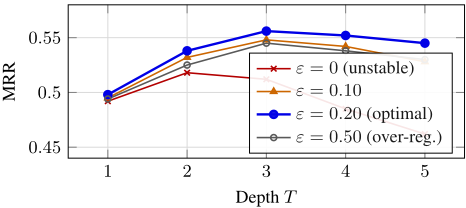
Frequency gates initialization. Starting from zero (neutral) outperforms biased initializations (Table 5c), allowing the model to discover relation-specific behaviors from data. Interestingly, random initialization in [-1, 1] performs comparably, suggesting the optimization landscape is well-behaved. Anchor strength vs propagation depth. Fig. 2 shows MRR across different (ε, T ) combinations. Without anchoring (ε = 0), performance degrades at T ≥ 3 when negative gates introduce positive eigenvalues. Weak anchoring (ε = 0.1) provides partial stabilization but underperforms at the optimal depth. Moderate anchoring (ε = 0.2) achieves the best trade-off, stabilizing wave propagation while preserving expressiveness. Strong anchoring (ε = 0.5) over-regularizes, pulling representations too strongly toward initialization and limiting the model's ability to learn discriminative features.
| Variant | MRRH@1H@10 | ∆ | ||
|---|---|---|---|---|
| KGWN-L (full) | .556 | 46.8 | 72.4 | - |
| Wave dynamics | ||||
| Wave→Diffusion | .512 | 42.1 | 68.5 | -7.9 |
| Wave → Static | .478 | 38.4 | 64.2 | -14.0 |
| Directional encoding Lifted→Symmetric | .489 | 39.6 | 67.8 | -12.1 |
| Frequency adaptation | ||||
| No freq. gates | .521 | 43.2 | 69.8 | -6.3 |
| Uniform βr | .538 | 44.5 | 70.6 | -3.2 |
| Both removed | .498 | 40.8 | 67.1 | -10.4 |
| Stability mechanisms | ||||
| No velocity norm | .483 | 38.9 | 65.4 | -13.1 |
| No anchor | .524 | 43.8 | 69.2 | -5.8 |
Table 5: Ablation study. (a) Component contributions; (b) hyperparameter sensitivity; (c) gate initialization; (d) learned parameters across datasets; (e) computational overhead. Relation graph construction ablation (thresholds θc, θs) is in Appendix E.
Learned parameters. WN18RR learns the highest proportion of sharpening gates (62%), consistent with its heterophilic taxonomic structure (Table 5d). FB15k-237 shows balanced smooth/sharpen ratios reflecting its diverse relation types. NELL-995 learns higher velocities on average, compensating for its noisy extraction process. An additional analysis of per relation learned parameters is available in Appendix E.
Text encoder robustness. Replacing DistilBERT [Sanh et al., 2019] with BERT-base drops MRR by only -0.5%; hash features (no semantic text) recover most of the gap over random initialisation, confirming wave propagation is the primary source of representational power. End-to-end finetuning is impractical: text embeddings are precomputed once and reused across all per-query subgraph passes (fine-tuning would require a full encoder call per candidate). Full ablation results are in Appendix E.
Computational efficiency. Table 5e analyzes the cost of KGWN components on FB15k-237 (V2: 1,660 entities, 237 base relations, 474 with inverses). The lifted construction (KGWN-L) adds ∼50% time overhead due to doubled state dimension (2N×d) and requires 15% more parameters (34K) for the two-stream fusion layer. Wave operators Lr are parameter-free, constructed from graph structure (Eqs. 1-3). Frequency adaptation adds minimal overhead.
Per-query inference cost. Per-query complexity is O(T·|Esub|·d) (Appendix D); with k=2 on sparse graphs, |Esub| ≪ |E|. Subgraph extractions are cached: cold extraction takes ∼20ms on FB15k-237V2, cache hits <0.2ms. KGWN-L end-to-end latency is 0.42 s/query vs. 0.31 s for DiffusionE (full per-dataset breakdown in Appendix D); KGWN-S runs at comparable speed to DiffusionE.
6 Conclusions and FutureWork
Knowledge graph relations require different propagation behaviors. KGWN addresses this with stable second-order wave dynamics and signed frequency gates, enabling relationspecific smoothing or contrast preservation. Experiments show strong performance across inductive and transductive benchmarks, and the same formulation naturally extends from entity to relation reasoning.
Limitations. KGWN-L doubles the state dimension, which can limit scalability on very large graphs. Performance also drops in sparse-subgraph regimes and many-to-many relations. Finally, text features are frozen; fine-tuning them may help, but would add substantial cost.
Future work. We plan to extend KGWN to temporal and multi-modal KGs.
@inproceedings{ijcai2026p329,
  title     = {Inductive Knowledge Graph Wave Networks},
  author    = {Pirrò, Giuseppe},
  booktitle = {Proceedings of the Thirty-Fifth International Joint Conference on
               Artificial Intelligence, {IJCAI-26}},
  publisher = {International Joint Conferences on Artificial Intelligence Organization},
  editor    = {Diego Calvanese},
  pages     = {2960--2968},
  year      = {2026},
  month     = {8},
  note      = {Main Track},
  doi       = {10.24963/ijcai.2026/329},
  url       = {https://doi.org/10.24963/ijcai.2026/329},
}
TY - CPAPER TI - Inductive Knowledge Graph Wave Networks AU - Pirrò, Giuseppe T2 - Proceedings of the Thirty-Fifth International Joint Conference on Artificial Intelligence, IJCAI-26 PB - International Joint Conferences on Artificial Intelligence Organization PY - 2026 SP - 2960 EP - 2968 DO - 10.24963/ijcai.2026/329 UR - https://doi.org/10.24963/ijcai.2026/329 ER -Copied
Machine-readable versions of this paper, for tools and AI agents:





