
Beyond Uniform Updates: Drift Pattern Aware Online Time Series Forecasting Under Delayed Feedback
Proceedings of the Thirty-Fifth International Joint Conference on Artificial Intelligence. Main Track. Pages 4518-4526.
https://doi.org/10.24963/ijcai.2026/503
Keywords
- Machine Learning: Time series and data streams
- Machine Learning: Multi-view learning
Abstract
Online time series forecasting relies on continual updates to cope with concept drift. In multi-step forecasting, however, the ground truth for an H-step prediction arrives only after H steps, so a delayed residual entangles persistent drifts with transient shocks and seasonal fluctuations. Existing methods typically apply a uniform update rule to all delayed errors, which can overreact to noise and under-adapt to real drift. We view delayed residuals as compressed observations of latent drift over the horizon, and propose PADRE, a drift evidence driven framework that converts each delayed feedback event into a context-sensitive adaptation decision. PADRE builds a Tri-View drift representation from (i) the current input context, (ii) recent delayed-residual trajectories, and (iii) retrieved typical types of drift, and quantifies their agreement via a geometric consistency measure. To exploit recurring drift structure, PADRE mines an offline Pattern Bank of regime-conditioned residual prototypes and retrieves a soft pattern prompt online. A lightweight prompt guided policy outputs a continuous update gate that scales the backbone’s gradient step, enabling decisive updates under coherent evidence and conservative updates otherwise. Experiments on five real-world benchmarks and three backbones demonstrate consistent gains under delayed feedback, reducing MSE by 6%–15% relative to recent baselines and improving update stability across horizons.
- [Bai et al., 2018] Shaojie Bai, J. Zico Kolter, and Vladlen Koltun. An empirical evaluation of generic convolutional and recurrent networks for sequence modeling. arXiv preprint arXiv:1803.01271, 2018.
- [Brenner et al., 2025] Manuel Brenner, Elias Weber, Geor- gia Koppe, and Daniel Durstewitz. Learning interpretable hierarchical dynamical systems models from time series data. In The Thirteenth International Conference on Learning Representations, ICLR 2025, Singapore, April 24-28, 2025.
- [Cai et al., 2025] Ruichu Cai, Haiqin Huang, Zhifan Jiang, Zijian Li, Changze Zhou, Yuequn Liu, Yuming Liu, and Zhifeng Hao. Disentangling long-short term state under unknown interventions for online time series forecasting. In Toby Walsh, Julie Shah, and Zico Kolter, editors, AAAI- 25, Sponsored by the Association for the Advancement of Artificial Intelligence, February 25 -March 4, 2025, Philadelphia, PA, USA, pages 15641-15649. AAAI Press, 2025.
- [Chen et al., 2024] Mouxiang Chen, Lefei Shen, Han Fu, Zhuo Li, Jianling Sun, and Chenghao Liu. Calibration of time-series forecasting: Detecting and adapting context- driven distribution shift. In Proceedings of the 30th ACM SIGKDD Conference on Knowledge Discovery and Data Mining, pages 341-352, 2024.
- [Chen et al., 2025] Weiqi Chen, Zhaoyang Zhu, Yifan Zhang, Lefei Shen, Linxiao Yang, Qingsong Wen, and Liang Sun. Learning to extrapolate and adjust: Two-stage meta-learning for concept drift in online time series fore- casting. In Proceedings of the Thirty-Fourth International Joint Conference on Artificial Intelligence, IJCAI 2025, Montreal, Canada, August 16-22, 2025, pages 4869-4877. IJCAI
- [Dama et al., 2025] Srinath Dama, Kevin Course, and Pras- anth B. Nair. Shifting time: Time-series forecasting with khatri-rao neural operators. In Forty-second International Conference on Machine Learning, 2025.
- [Demirel and Holz, 2025] Berken Utku Demirel and Chris- tian Holz. Shifting the paradigm: A diffeomorphism between time series data manifolds for achieving shift- invariancy in deep learning. In The Thirteenth Inter- national Conference on Learning Representations, ICLR 2025, Singapore, April 24-28, 2025.
- [Dong et al., 2024] Zheng Dong, Renhe Jiang, Haotian Gao, Hangchen Liu, Jinliang Deng, Qingsong Wen, and Xuan Song. Heterogeneity-informed meta-parameter learning for spatiotemporal time series forecasting. In Ricardo Baeza-Yates and Francesco Bonchi, editors, Proceedings of the 30th ACM SIGKDD Conference on Knowledge Dis- covery and Data Mining, KDD 2024, Barcelona, Spain, August 25-29, 2024, pages 631-641. ACM, 2024.
- [Gupta et al., 2025] Aditi Gupta, Adeiza James Onumanyi, Satyadev Ahlawat, Yamuna Prasad, and Virendra Singh. B-CAVE: A robust online time series change point de- tection algorithm based on the between-class average and variance evaluation approach. IEEE Trans. Knowl. Data Eng., 37(1):75-88, 2025.
- [He et al., 2025] Hui He, Qi Zhang, Kun Yi, Kaize Shi, Zhendong Niu, and Longbing Cao. Distributional drift adaptation with temporal conditional variational autoen- coder for multivariate time series forecasting. IEEE Trans. Neural Networks Learn. Syst., 36(4):7287-7301, 2025.
- [Kingma and Ba, 2015] Diederik P. Kingma and Jimmy Ba. Adam: A method for stochastic optimization. In 3rd Inter- national Conference on Learning Representations, ICLR 2015, San Diego, CA, USA, May 7-9, 2015, Conference Track Proceedings, 2015.
- [Lau et al., 2025] Ying-yee Ava Lau, Zhiwen Shao, and Dit- Yan Yeung. Fast and slow streams for online time se- ries forecasting without information leakage. In The Thir- teenth International Conference on Learning Representa- tions, ICLR 2025, Singapore, April 24-28, 2025, 2025.
- [Lee et al., 2025] Thomas L. Lee, William Toner, Rajkarn Singh, Artjom Joosen, and Martin Asenov. Lightweight online adaption for time series foundation model fore- casts. In Forty-second International Conference on Ma- chine Learning, ICML 2025, Vancouver, BC, Canada, July 13-19, 2025, 2025.
- [Li et al., 2025] Xingwang Li, Fei Teng, Minbo Ma, Zhen Qin, Jinhong Guo, Ji Xu, and Tianrui Li. Multi-level trans- fer learning for irregular clinical time series prediction. Knowl. Based Syst., 324:113825, 2025.
- [Li et al., 2026a] Xingwang Li, Fei Teng, Tianrui Li, and Qiang Duan. Preference guided meta-learning for cross domain time series forecasting. IEEE Transactions on Knowledge and Data Engineering, 38(4):2366-2379, 2026.
- [Li et al., 2026b] Xingwang Li, Fei Teng, Xin Wu, and Qiang Duan. Uncovering hidden degeneration: A physics- guided bidirectional inference framework for industrial time series prediction. In Fortieth AAAI Conference on Artificial Intelligence, 2026, Singapore, January 20-27, 2026, pages 23204-23211. AAAI Press, 2026.
- [Liberti et al., 2014] Leo Liberti, Carlile Lavor, Nelson Mac- ulan, and Antonio Mucherino. Euclidean distance geome- try and applications. SIAM review, 56(1):3-69, 2014.
- [Liu et al., 2024] Yong Liu, Tengge Hu, Haoran Zhang, Haixu Wu, Shiyu Wang, Lintao Ma, and Mingsheng Long. itransformer: Inverted transformers are effective for time series forecasting. In The Twelfth International Confer- ence on Learning Representations, ICLR 2024, Vienna, Austria, May 7-11, 2024, 2024.
- [Liu et al., 2025] Jiashuo Liu, Nabeel Seedat, Peng Cui, and Mihaela van der Schaar. Going beyond static: Under- standing shifts with time-series attribution. In The Thir- teenth International Conference on Learning Representa- tions, ICLR 2025, Singapore, April 24-28, 2025, 2025.
- [Na et al., 2025] Jihye Na, Youngeun Nam, Junhyeok Kang, and Jae-Gil Lee. Mitigating source label dependency in time-series domain adaptation under label shifts. In
- Luiza Antonie, Jian Pei, Xiaohui Yu, Flavio Chierichetti, Hady W. Lauw, Yizhou Sun, and Srinivasan Parthasarathy, editors, Proceedings of the 31st ACM SIGKDD Confer- ence on Knowledge Discovery and Data Mining, V.2, KDD 2025, Toronto ON, Canada, August 3-7, 2025, pages 2150-2161. ACM, 2025.
- [Nie et al., 2023] Yuqi Nie, Nam H. Nguyen, Phanwadee Sinthong, and Jayant Kalagnanam. A time series is worth 64 words: Long-term forecasting with transformers. In The Eleventh International Conference on Learning Rep- resentations, ICLR 2023, Kigali, Rwanda, May 1-5, 2023.
- [Pham et al., 2023] Quang Pham, Chenghao Liu, Doyen Sa- hoo, and Steven C. H. Hoi. Learning fast and slow for on- line time series forecasting. In The Eleventh International Conference on Learning Representations, ICLR 2023, Ki- gali, Rwanda, May 1-5, 2023. OpenReview.net, 2023.
- [Shao et al., 2025] Zezhi Shao, Fei Wang, Yongjun Xu, Wei Wei, Chengqing Yu, Zhao Zhang, Di Yao, Tao Sun, Guangyin Jin, Xin Cao, Gao Cong, Christian S. Jensen, and Xueqi Cheng. Exploring progress in multivariate time series forecasting: Comprehensive benchmarking and heterogeneity analysis. IEEE Trans. Knowl. Data Eng., 37(1):291-305, 2025.
- [Wang et al., 2025a] Jie Wang, Tianrui Li, Yan Yang, Shiqian Chen, and Wanming Zhai. Diagllm: multimodal reasoning with large language model for explainable bear- ing fault diagnosis. Science China Information Sciences, 68(6):160103, 2025.
- [Wang et al., 2025b] Yihang Wang, Yuying Qiu, Peng Chen, Kai Zhao, Yang Shu, Zhongwen Rao, Lujia Pan, Bin Yang, and Chenjuan Guo. Towards a general time series forecast- ing model with unified representation and adaptive trans- fer. In Forty-second International Conference on Machine Learning, ICML 2025, Vancouver, BC, Canada, July 13- 19, 2025.
- [Wen et al., 2023] Qingsong Wen, Weiqi Chen, Liang Sun, Zhang Zhang, Liang Wang, Rong Jin, Tieniu Tan, et al. Onenet: Enhancing time series forecasting models under concept drift by online ensembling. Advances in Neural Information Processing Systems, 36:69949-69980, 2023.
- [Witulska et al., 2026] Justyna Witulska, Marta Hendler, Magdalena Kasprowicz, Marek Czosnyka, Ireneusz Jablonski, and Agnieszka Wylomanska. Identifying the temporal distribution structure in multivariate data for time-series segmentation based on two-sample test. Inf. Fusion, 125:103445, 2026.
- [Wu et al., 2025] Xingjian Wu, Xiangfei Qiu, Zhengyu Li, Yihang Wang, Jilin Hu, Chenjuan Guo, Hui Xiong, and Bin Yang. CATCH: channel-aware multivariate time se- ries anomaly detection via frequency patching. In The Thirteenth International Conference on Learning Repre- sentations, ICLR 2025, Singapore, April 24-28, 2025.
- [Wu et al., 2026] Xin Wu, Fei Teng, Ji Zhang, Xingwang Li, and Yuxuan Liang. Eris : An energy-guided feature disen- tanglement framework for out-of-distribution time series classification. Information Fusion, 135:104407, 2026.
- [Zhang et al., 2025] Weiyang Zhang, Xinyang Chen, Yu Sun, Weili Guan, and Liqiang Nie. Batch training for streaming time series: A transferable augmentation framework to combat distribution shifts. Trans. Mach. Learn. Res., 2025.
- [Zhao and Shen, 2025] Lifan Zhao and Yanyan Shen. Proac- tive model adaptation against concept drift for online time series forecasting. In Proceedings of the 31st ACM SIGKDD Conference on Knowledge Discovery and Data Mining V. 1, pages 2020-2031, 2025.
- [Zhao et al., 2025] Zhilin Zhao, Longbing Cao, and Yuan- Yu Wan. Mixture of online and offline experts for non- stationary time series. In Toby Walsh, Julie Shah, and Zico Kolter, editors, AAAI-25, Sponsored by the Association for the Advancement of Artificial Intelligence, February 25 -March 4, 2025, Philadelphia, PA, USA, pages 22867- 22874. AAAI Press, 2025.
References were extracted automatically from the PDF and may contain errors.
Full text extracted automatically from the PDF; figures, tables and equations may differ. The PDF is the version of record.
1 Introduction
Time series forecasting underpins a wide range of real-time services, from energy allocation and traffic control to financial trading and industrial monitoring [Wang et al., 2025b; Li et al., 2026a; Wu et al., 2025; Li et al., 2026b]. Classical forecasting pipelines typically assume that a stationary or slowly varying data generating process can be captured and updated only sporadically. However, modern cyber physical systems interact with users, policies, and environments that change continuously, inducing rich forms of concept drift in both the marginal dynamics and the input-output relationships [Demirel and Holz, 2025; Na et al., 2025; Li et al., 2025]. As a result, a forecaster that remains faithful to its initial training distribution can rapidly become mis-calibrated, systematically under-reacting to emerging regimes or amplifying outdated patterns into costly decisions [Liu et al., 2025; Dama et al., 2025; Wang et al., 2025a; Brenner et al., 2025].
Online time series forecasting (OTSF) has therefore attracted attention for combating concept drift by updating models directly on streaming data [Gupta et al., 2025; Zhao et al., 2025; Lee et al., 2025; Cai et al., 2025]. Rather than relying on batch retraining, an OTSF learner interleaves prediction and adaptation, using recent observations to track evolving regimes and maintain performance over long horizons. Theoretically, such continual adaptation resolves the stability plasticity dilemma: enabling the model to adjust rapidly to structural shifts. Real deployments, however, rarely provide "instant" supervision. In multi-step forecasting, a prediction issued at time t targets the entire horizon [t, t + H], while its ground-truth outcome is only revealed after the horizon elapses (i.e., at t +H), as illustrated in Fig 1. This delayedfeedback protocol creates a temporal gap between the decision point and its evaluation: the learner adapts using delayed residuals that are temporally aggregated over [t, t + H], inevitably entangling persistent regime shifts with periodicity and short lived shocks.
Recent OTSF methods progress along two lines. The first line improves the exploitation of recent inputs-e.g., via ensemble mechanisms or context aware sample selection as in OneNet [Wen et al., 2023] and SOLID [Chen et al., 2024], but it overlooks a fundamental constraint of multi-step forecasting: each H-step decision is not observable when the decision is made, and only becomes known after the forecast horizon has passed. The second line acknowledges the H-step feedback delay and updates the model through drift estimation [Zhao and Shen, 2025] or pseudo label supervision [Lau et al., 2025] (Fig.1(b)). However, a limitation persists across current SOTA: adaptation is governed by uniform update rules, where delayed errors trigger comparable gradient steps regardless of the underlying drift type. Because the delayed residual compresses all changes over [t, t + H] into a temporally aggregated signal, such one-size-fits-all updates conflate systematic shifts [Shao et al., 2025; Dong et al., 2024; Wu et al., 2026] that warrant adaptation, transient outliers , and recurring periodic patterns.
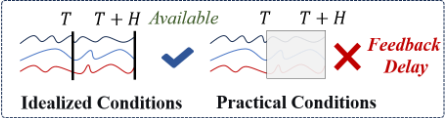
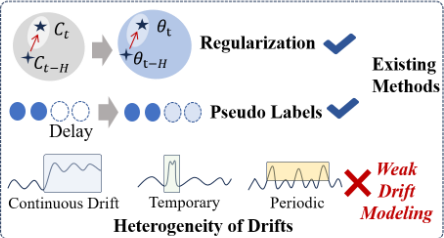
Under H-step delayed feedback, we argue that the supervision signal should be reinterpreted. The delayed residual, rt = ˆ Yt -Yt, serves not as an informative training target, but as a noisy and temporally aggregated observation of the latent drift states over the horizon [t, t +H]. Accordingly, our goal is to make online updates selective and stable by treating rt as evidence of what has accumulated over [t, t+H], rather than using it as raw supervision. Within these constraints, we contextualize delayed residuals via three complementary cues: the current input context (regime transition), the residual trajectory (error evolution), and recurring drift patterns from past events (shift matching). The tripartite perspective provides a structured view of drift signals over the delay window and informs the update strategy.
Building on this tripartite perspective, we propose PADRE, an online forecasting framework, converting each delayed feedback event into a structured adaptation decision. PADRE first constructs a Tri-View drift representation from the current context, the residual trajectory, and retrieved drift memories, and quantifies their agreement via a geometric consistency score to separate coherent drift evidence from transient or poorly explained fluctuations. On top of this representation, an offline-mined Pattern Bank summarizes recurring regime-residual configurations; online retrieval provides a soft pattern prompt that relates the current event to previously observed shifts. Finally, a gated update policy, guided by the drift evidence and the pattern prompt, outputs a continuous update gate that modulates the backbone's effective learning rate-enabling decisive updates when evidence is consistent and conservative updates otherwise.
Our main contributions are threefold:
- We interpret delayed residuals as noisy observations of latent drift states rather than direct supervision. This leads to a Tri-View drift representation that geometri-
- cally fuses online context, backward residual evolution, and episodic memory, providing a stable space for reasoning about when and how to adapt.
- We propose a unified, evidence-driven adaptation framework PADRE, integrates (i) a Tri-View Drift Module with geometric consistency scoring, (ii) a Pattern Bank distilling reusable regime-residual prototypes with soft retrieval, and (iii) a gated policy enabling adaptive yet stable online learning under delayed feedback.
- Extensive experiments on five real-world benchmarks and three strong backbone forecasters demonstrate that our framework consistently improves MSE and MAE under delayed feedback, achieving substantial relative gains over recent OTSF baselines. Ablation and analysis further verify that both the Tri-View geometry and the pattern-bank-guided gating are effective for stable, sample-efficient adaptation.
2 RelatedWork
Concept drift is a primary source of performance degradation in real world time series forecasting, where the underlying dynamics and input-output relations evolve over time [Witulska et al., 2026; He et al., 2025; Zhang et al., 2025]. OTSF tackles this challenge by interleaving prediction and adaptation on streaming data. We organize related work by whether the method explicitly models the delayed supervision protocol inherent in multi-step forecasting.
2.1 Classic Online Time Series Forecasting
A common strategy in classic OTSF is to strengthen short term exploitation of recent context via architectural mechanisms, ensembling, or lightweight memories. FSNet [Pham et al., 2023] and OneNet [Wen et al., 2023] improve robustness under non-stationarity by incorporating associative memory to capture evolving patterns. Another direction performs context-aware sample selection to decide when to adapt, exemplified by SOLID [Chen et al., 2024] (and its variants used in practice). LEAF [Chen et al., 2025] learns adaptation strategies via meta-learning by separating drift effects at different temporal granularities.
These methods form strong baselines for online adaptation under drift; however, they typically do not treat delayed supervision as a first-class constraint in multi-step forecasting. When the accuracy of an H-step decision is only observable after the horizon elapses, update signals may become misaligned with the true delayed objective, and adaptation can be difficult to calibrate using proxy cues alone.
2.2 Online Forecasting with Delayed Feedback
A second line of work explicitly acknowledges H-step feedback delay. Proceed [Zhao and Shen, 2025] bridges the temporal gap by proactively estimating drift so that the model can adapt despite delayed supervision. DSOF [Lau et al., 2025] adopts a dual stream framework that decouples slow experience replay from fast temporal adaptation to mitigate information leakage while coping with delayed feedback.
Despite respecting the feedback delayed protocol, existing methods commonly rely on uniform update rules: delayed residuals trigger comparable gradient steps regardless of the underlying drift type. This can be problematic because a delayed residual aggregates changes accumulated over [t, t + H], conflating persistent regime shifts, transient shocks and recurring periodic variations. Moreover, delay aware methods typically treat each delayed-feedback episode in isolation, without distilling recurring regime-residual structures into reusable priors for calibrating update strength. Our work advances this delay-aware line by enabling selective, multiview grounded updates under feedback delayed.
3 Methodology
3.1 ProblemDefinition
We consider online multi-step time-series forecasting under delayed supervision. At each time step t, the model observes a look-back window xt ∈ RL×V , where L is the lookback length and V is the number of variables, and produces an Hstep-ahead forecast ˆ yt = fθ (xt) ∈ RH×V . The true target yt becomes available only after a delay of H-steps, i.e., at time t+H. Consequently, when the error rt = ˆ yt-yt is observed, it reflects the cumulative effect of all changes that happened over the horizon [t, t +H], including noise, seasonal fluctuations, and concept drift. Naively updating the model with every delayed error is therefore problematic: it can be overly conservative (under-reacting to real drift) or aggressive (overfitting benign fluctuations).
3.2 Framework Overview
Our framework consists of four coupled modules (Fig. 2): (i) a backbone forecaster fθ that produces multi-step predictions; (ii) a Pattern Bank P learned offline, capturing recurring regimes and the backbone's typical residual shapes under those regimes; (iii) a Tri-View Drift Module that encodes delayed feedback into three complementary drift views and a geometric consistency score; and (iv) a Prompt-Guided Update Policy πϕ that queries P online and outputs a continuous update gate γt ∈ (0, 1) to modulate the online gradient step.
Offline stage. We first pretrain the backbone fθ on historical data. Using the pretrained backbone, we construct the Pattern Bank P as a compact set of regime-conditioned residual prototypes (Sec. 3.3). P serves as a contextual prior during online forecasting. Moreover, to remember unseen drift patterns beyond those captured in the offline Pattern Bank, PADRE continuously updates an online episodic memory M with high impact drift episodes (Sec. 3.6).
Online stage. At time t, the forecaster observes the lookback window xt and outputs ˆ yt = fθ(xt) and caches it as yb t for residual construction. When the target yt arrives at time t +H, we treat it as feedback for the earlier decision point t and compute the delayed residual rt. Using (xt, rt), we construct tri-view drift evidence (zon t , zback t , zmem t )-the online, backward, and memory views defined in Sec. 3.4 and a geometric consistency score At, then query the offline Pattern Bank p to obtain a pattern prompt pt. The update policy πϕ maps pt, At to a continuous gate γt ∈ (0, 1), which scales the backbone gradient step on the delayed sample (recomputing ˜ yt = fθ(xt)) for an up-to-date loss).
3.3 Pattern Bank Training
Empirically, we observe that the backbone exhibits systematic, regime-dependent error patterns: when the system operates under similar temporal regimes (e.g., workday morning peak, off-peak night, seasonal transition), it tends to make errors with similar shapes and biases. We distill this regularity into a compact Pattern Bank, where each prototype jointly encodes (i) a regime embedding and (ii) the backbone's typical residual behavior under that regime.
Regime prototypes. For each trainingwindowxt, we compute a regime embedding
where freg is a lightweight projection head (e.g., a shallow MLP), and vec(·) is a parameter-free vectorization. We apply K-means clustering in the regime space to obtain cluster centers {zregime k }Kk=1 and assignments {Ck}Kk=1 , where Ck denotes the set of windows assigned to regime k. Each zregime k summarizes a recurrent input regime.
Regime-conditioned residual prototypes. Rather than clustering residuals independently, we condition residual prototypes on regimes. For each regime cluster Ck, we run the pretrained backbone to compute residuals
We map each residual segment through a residual encoder fres,
and aggregate them within the cluster:
The vector zresidual k captures the typical error shape that the backbone tends to make when the system is in regime k, serving as a regime-specific error label.
Pattern prototypes. Finally, each pattern prototype in the bank concatenates its regime and residual components:
yielding the Pattern Bank P = {pk}Kk=1 . During online adaptation, queries derived from the current window and its delayed residual are matched against P via attention, and the resulting pattern prompt informs the update policy about (i) which regime the system is currently in and (ii) how the backbone has updated in that regime. This regime-conditioned design avoids arbitrary pairing between input and residual clusters, acting as an amortized prior for stable online updates.
3.4 Tri-ViewDrift Representation
Under delayed feedback, a single residual vector is insufficient to characterize drift: it conflates noise with distributional changes and ignores historical context. We therefore construct a Tri-View Drift Module that encodes delayed feedback from three complementary perspectives: an online view based on the input context that produced the cached forecast, a backward view based on the recent evolution of delayed residuals, and a memory view based on past drift episodes that previously triggered strong adaptation.
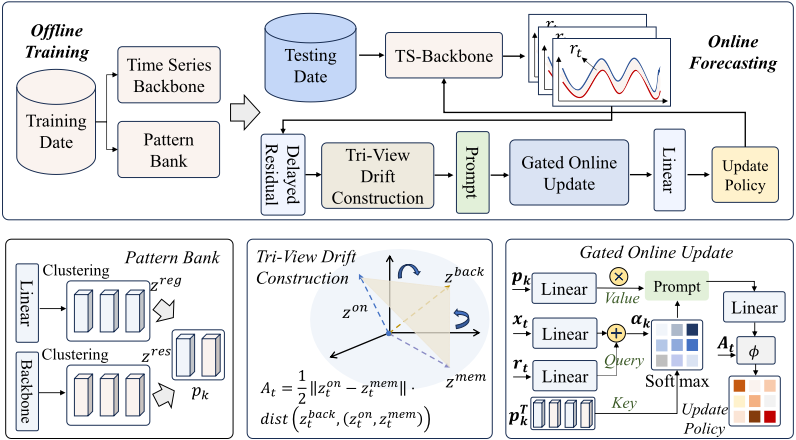
Online view. We encode the input window xt that generated the cached prediction yb t (i.e., the H-step prediction issued at time t) aszon t = gon(vec(xt)) ∈ RD , (6)
where gon is a two-layer MLP. This view captures drift cues directly visible from the current context (e.g., entering a new daily regime).
Backward view. When the delayed target yt arrives, we compute the delayed residual rt = yb t - yt and append it to R. The buffer maintains the most recent Mr residuals in chronological order. We form the backward summary by concatenation
and compute the backward view as
where gback is a two-layer MLP. The chronological concatenation preserves temporal ordering, enabling gback to capture how prediction errors have evolved (e.g., increasing, stable, or decaying). Specifically, the residual trajectory provides a posterior trace of the changes accumulated over the delayed horizon [t, t+H], complementing the context anchor z on t .
Memory view. The drift memoryMstores backward-view embeddings from past update steps that were deemed highimpact by the policy. Given the current backward view zback t , we retrieve the closest memory vector by cosine similarity and project it as
where gmem is a small MLP. If M is empty, we fall back to zmem t = zback t .
Remark (Pattern Bank P vs. drift memoryM). P is an offline prototype library distilled from historical training data; it stores regime-residual prototypes {pk} and is queried online to provide a contextual prior (a pattern prompt) for update decisions. In contrast, M is an online episodic buffer that stores a small set of past drift episodes (backward-view embeddings) that previously triggered strong adaptation; it is used only to construct the memory view zmem t for retrieval and multi-view consistency diagnosis.
3.5 Multi-ViewConsistency via Triangle Area
We treat the backward view zback t , derived from delayed residual evolution, as a relational anchor that links the online context zon t and the episodic memory zmem t . Our key inductive bias is as follows.
Assumption 1. When forecasting errors are caused by a systematic concept shift, it induces coherent changes in (i) the current input context, (ii) the delayed-residual evolution, and (iii) the resemblance to previously observed high-impact drift episodes when such episodes exist in the episodic memory M. Accordingly, the tri-view provides complementary estimates of the same latent drift direction and tends to be mutually compatible in representation space; the memory view serves only as an auxiliary recurrence prior rather than a mandatory match.
By contrast, errors stemming from measurement noise, outliers, or unseen drift mechanisms yield inconsistent multiview signals. We therefore quantify geometric consistency among the three views [Liberti et al., 2014]. Define
We compute the triangle area by the Gram-determinant form:
Geometrically, At measures how far the backward view deviates from the line connecting the context and memory views: it vanishes when the three points are collinear and grows as they diverge. A small At indicates that the three views provide a coherent explanation of the delayed feedback episode (e.g., a familiar context with residual evolution consistent with past high-impact events). A large At signals disagreement across evidence sources, suggesting a noisy or atypical episode poorly explained by memory and context.
Note that At serves as a diagnostic soft consistency regularizer rather than a hard veto: even when the memory view is less informative (e.g., for unseen drifts), the policy can increase the update gate γt if doing so improves the post-update prediction loss, while the At-weighted term mainly discourages overly aggressive updates under conflicting evidence.
3.6 Prompt-Guided Gated Online Update
Once the delayed residual rt is observed, we must decide how strongly to update the model parameters. Rather than using discrete rules to set the update magnitude, we frame this decision as a continuous gated policy that maps structured evidence to an update gate γt ∈ (0, 1).
Pattern prompting. We first query the Pattern Bank with the current input-residual pair. A query embedding is constructed as
Attention over the bank yields
where τ is a temperature hyper-parameter. The resulting pattern prompt pt serves as a soft label indicating which regimeresidual patterns from the bank best match the current delayed feedback event.
Update policy. We form a state vector by concatenating (i) the pattern prompt pt, (ii) the online drift view zon t , and (iii) the multi-view consistency score At:
A lightweight policy network πϕ maps this state to a scalar update gate:γt = πϕ(st) = σ(MLP(st)) ∈ (0, 1), (15)
where σ is the sigmoid function. Intuitively, the policy should output large gates for informative, familiar drift patterns (e.g., confident pattern prompt and small At) and small gates for noisy or poorly explained episodes (e.g., large At or atypical prompts).
Gated online update. Given γt, we modulate the step size of the backbone update. Upon receiving the delayed target yt, we recompute ˜ yt = fθ(xt) and define the robust regression loss Lpred(t) = SmoothL1(˜ yt, yt). The backbone parameters are updated by a gated gradient step:
where η is the base learning rate. We emphasize that the cached prediction yb t is used to form the delayed residual rt for drift evidence, while ˜ yt is recomputed under the current parameters to provide an up-to-date training signal for the actual gradient step.
Episodic memory update. If γt > τmem, we treat the current episode as a high-impact drift event and insert the corresponding backward-view embedding into M using the protocol in Sec. 3.4. (This threshold is used only for memory management, while the update magnitude is governed continuously by γt.)
Learning the update policy. To make πϕ trainable with a clear objective while avoiding second-order derivatives, we optimize the backbone and the policy in an alternating manner. When updating θ via Eq. (17), we treat γt as a constant (no gradient is propagated into ϕ). When updating ϕ, we minimize a one-step look-ahead surrogate that evaluates the post-update prediction loss using a first-order approximation. Let gt = stopgrad(∇θLpred(t)) be the backbone gradient treated as a constant for policy learning, and define a virtual post-update parameter:
We then optimize the policy parameters by
and update ϕ via ϕ ← ϕ-ηϕ∇ϕLπ(t). The first term encourages gates that improve the post-update fit, while the second term discourages large updates when the tri-view evidence is inconsistent. We stop the gradient through At so that it remains a diagnostic statistic rather than an alignment target.
4 Experiment
4.1 Experimental Settings
Datasets and Baseline. We evaluate PADRE on five widely-used benchmarks covering diverse domains: ETTh2 and ETTm1 (energy), Weather (meteorology), ECL (electricity consumption), and Traffic (transportation). To simulate realistic online scenarios with concept drift, we follow a challenging chronological train-validation-test split of 20:5:75 [Zhao and Shen, 2025]. We compare against representative SOTA baselines from both classic delay-agnostic OTSF (OneNet, SOLID++, LEAF) and OTSF under feedback delayed (PROCEED, DSOF), ensuring comprehensive coverage of prior work. Following the setup in Proceed, we adopt the more performant SOLID++ variant, which continually fine-tunes parameters across the online phase, rather than the original SOLID method.
| Model | Method Dataset H | ETTh2 | ETTm1 | Weather | ECL Traffic | |||||||||||
|---|---|---|---|---|---|---|---|---|---|---|---|---|---|---|---|---|
| 24 | 48 | 96 | 24 | 48 | 96 | 24 | 48 | 96 | 24 | 48 | 96 | 24 | 48 | 96 | ||
| \ | 3.156 | 4.141 | 6.019 | 1.770 | 1.908 | 1.673 | 3.301 | 9.718 | 8.588 | 57.782 | 57.948 | 58.729 | 0.569 | 0.637 | 0.676 | |
| OneNet | 2.965 | 4.892 | 8.257 | 1.335 | 1.547 | 1.040 | 0.861 | 1.182 | 1.484 | 9.757 | 10.847 | 15.932 | 0.462 | 0.544 | 0.591 | |
| SOLID++ | 3.231 | 4.111 | 6.191 | 0.674 | 0.795 | 0.868 | 0.867 | 1.311 | 1.670 | 5.991 | 7.340 | 9.412 | 0.418 | 0.479 | 0.529 | |
| TCN LEAF | 3.043 | 4.346 | 6.052 | 0.785 | 0.917 | 1.026 | 0.825 | 1.224 | 1.518 | 6.075 | 8.134 | 9.662 | 0.463 | 0.528 | 0.571 | |
| DSOF | 2.975 | 4.136 | 5.977 | 0.554 | 0.728 | 0.789 | 0.723 | 1.035 | 1.382 | 5.864 | 7.173 | 9.261 | 0.424 | 0.457 | 0.526 | |
| PROCEED | 2.908 | 4.056 | 5.891 | 0.531 | 0.704 | 0.780 | 0.707 | 0.959 | 1.314 | 5.907 | 7.192 | 9.183 | 0.413 | 0.454 | 0.511 | |
| Our | 2.753 | 3.824 | 5.543 | 0.446 | 0.616 | 0.673 | 0.624 | 0.836 | 1.196 | 5.684 | 6.946 | 8.957 | 0.404 | 0.442 | 0.515 | |
| \ | 2.880 | 4.103 | 6.178 | 0.549 | 0.726 | 0.769 | 0.746 | 1.006 | 1.311 | 4.207 | 4.942 | 6.042 | 0.378 | 0.386 | 0.403 | |
| OneNet | 2.717 | 4.095 | 6.044 | 0.681 | 0.721 | 0.788 | 0.824 | 1.052 | 1.319 | 4.111 | 4.752 | 5.767 | 0.360 | 0.372 | 0.387 | |
| SOLID++ | 2.648 | 3.925 | 6.148 | 0.447 | 0.580 | 0.659 | 0.735 | 0.981 | 1.262 | 4.156 | 4.780 | 5.835 | 0.376 | 0.378 | 0.397 | |
| PatchTST LEAF | 2.136 | 3.588 | 5.920 | 0.487 | 0.613 | 0.698 | 0.792 | 0.997 | 1.286 | 4.133 | 4.812 | 5.787 | 0.368 | 0.371 | 0.385 | |
| DSOF | 1.864 | 3.538 | 5.846 | 0.438 | 0.596 | 0.703 | 0.748 | 0.984 | 1.305 | 4.186 | 4.894 | 5.973 | 0.364 | 0.388 | 0.414 | |
| PROCEED | 1.735 | 3.114 | 5.555 | 0.424 | 0.577 | 0.660 | 0.724 | 0.973 | 1.261 | 3.958 | 4.604 | 5.635 | 0.335 | 0.357 | 0.376 | |
| Our | 1.582 | 2.965 | 5.284 | 0.407 | 0.556 | 0.648 | 0.702 | 0.954 | 1.243 | 3.927 | 4.464 | 5.503 | 0.324 | 0.341 | 0.364 | |
| \ | 3.605 | 4.992 | 7.114 | 0.603 | 0.807 | 0.832 | 0.942 | 1.211 | 1.461 | 4.082 | 4.874 | 6.054 | 0.354 | 0.372 | 0.393 | |
| OneNet | 2.985 | 4.015 | 6.451 | 0.609 | 0.746 | 0.766 | 0.803 | 1.089 | 1.418 | 4.077 | 4.906 | 6.100 | 0.349 | 0.371 | 0.395 | |
| SOLID++ | 2.804 | 4.278 | 6.582 | 0.455 | 0.601 | 0.688 | 0.875 | 1.139 | 1.403 | 4.070 | 4.816 | 6.024 | 0.342 | 0.365 | 0.384 | |
| iTransformer LEAF | 2.763 | 4.044 | 6.631 | 0.512 | 0.652 | 0.726 | 0.867 | 1.107 | 1.395 | 4.155 | 4.893 | 5.974 | 0.357 | 0.379 | 0.391 | |
| DSOF | 2.354 | 3.857 | 6.048 | 0.494 | 0.663 | 0.806 | 0.837 | 1.079 | 1.342 | 4.136 | 4.862 | 6.025 | 0.351 | 0.372 | 0.384 | |
| PROCEED | 2.387 | 3.969 | 6.291 | 0.426 | 0.561 | 0.642 | 0.742 | 1.015 | 1.294 | 3.899 | 4.647 | 5.710 | 0.330 | 0.353 | 0.373 | |
| Our | 2.245 | 3.826 | 6.065 | 0.405 | 0.537 | 0.626 | 0.744 | 0.975 | 1.144 | 3.685 | 4.458 | 5.532 | 0.317 | 0.343 | 0.360 | |
| Model | Method | ETTh2 | ETTm1 | Weather | ECL | Traffic | ¯∆MSE |
|---|---|---|---|---|---|---|---|
| TCN | w/o PB w/o TDC w/o GOU PADRE | 4.242 4.404 4.161 | 0.601 0.625 0.590 0.578 | 0.921 0.965 0.903 | 7.555 7.915 7.412 | 0.472 0.490 0.463 | 4.4% |
| w/o PB w/o TDC w/o | 8.8% | ||||||
| 2.4% | |||||||
| 4.040 | 0.885 | 7.196 | 0.454 | - | |||
| PatchTST | 3.408 | 0.558 | 0.995 | 4.817 | 0.353 | 3.6% | |
| 3.539 | 0.580 | 1.053 | 5.048 | 0.367 | 8.2% | ||
| GOU | 3.343 | 0.548 | 0.986 | 4.770 | 0.350 | 2.2% | |
| PADRE | 3.277 | 0.537 | 0.966 | 4.631 | 0.343 | - | |
| iTrans | w/o PB | 4.248 | 0.549 | 0.993 | 4.786 | 0.354 | 4.6% |
| w/o TDC | 4.450 | 0.570 | 1.050 | 5.014 | 0.367 | 9.4% | |
| w/o GOU | 4.167 | 0.538 | 0.983 | 4.695 | 0.347 | 2.8% | |
| PADRE | 4.045 | 0.523 | 0.954 | 4.558 | 0.340 | - |
Online Protocol with Delayed Feedback. We strictly adhere to the practical online forecasting protocol defined in proceed [Zhao and Shen, 2025]. At time step t, the model receives the lookback window Xt ∈ RL×N and predicts the future horizon Yt ∈ RH×N . Crucially, we enforce a realistic constraint where the ground truth Yt is not immediately available. The model can only be updated using historical samples (Xt-H,Yt-H), where the ground truth has been fully observed. This introduces a feedback delay of H steps, creating a temporal gap that exacerbates the concept drift challenge.
Model Configuration. We evaluate performance across forecast horizons H ∈ 24, 48, 96. The lookback window length L is set based on the backbone architecture: L=60 for TCN-based backbone [Bai et al., 2018] and L=512 for Transformer-based backbones (e.g., PatchTST [Nie et al., 2023], iTransformer [Liu et al., 2024]), consistent with Proceed. The number of regime clusters K is selected on the validation set by grid search over K ∈ {2, 4, 6, 8}. In practice, K = 4 works well across most datasets, balancing expressiveness (enough prototypes to capture diverse regimes)
against over-fitting. Mmem
Implementation details. We utilize the Adam optimizer [Kingma and Ba, 2015]. All experiments are implemented in PyTorch on NVIDIA RTX 3090 GPUs. To account for randomness, we report the mean performance across five runs with different random seeds. The evaluation metric is Mean Squared Error (MSE).
4.2 Generalization Performance
Consistent improvement across backbones. Table 1 reports MSE across all settings. Under TCN, PADRE improves over the strongest baseline (typically Proceed) by 5.3-8.7% across datasets. Similar gains appear for PatchTST (e.g., ETTh2: 1.735→1.582 at H=24; Traffic: 0.376→0.364 at H=96) and iTransformer (e.g., Weather: 11.1% and 9.6% reduction at H=24/48).
Horizon-agnostic gains. Relative improvements remain stable across forecast lengths rather than concentrating at particular horizons. Comparing H=24 and H=96, MSE reductions are consistently in the 6-15% range, indicating that PADRE's inductive bias generalizes across temporal scales. The largest gains occur on ECL and Traffic, where concept drift is heterogeneous, confirming that pattern aware adaptation is most beneficial when drift patterns are diverse.
4.3 Ablation Study
Table 2 evaluates three variants: w/o PB (no Pattern Bank; policy receives only local drift evidence), w/o TDC (no TriView Drift Construction; single-view residual encoding), and w/o GOU (no Gated Online Update; fixed learning rate). Removing TDC causes the largest degradation: average MSE increases by 8.8%, 8.2%, and 9.4% on TCN, PatchTST, and iTransformer respectively, with pronounced drops on ECL and Weather. This confirms that enforcing shared geometry across online, delayed, and memory views is central to extracting reliable adaptation signals. Eliminating PB leads to
(a) Latent Landscape
(b) Representative Prototypes & Residuals
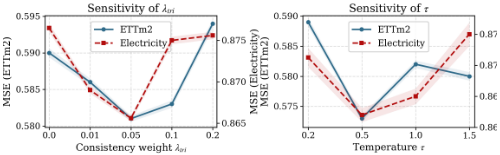
Figure 4: Sensitivity analysis of key hyper-parameters on ETTm2 and Electricity datasets.
moderate but consistent loss (3.6-4.6% increases), especially on Traffic and ECL, suggesting that reusing regime-residual prototypes helps recognize recurring drift patterns in complex, multi-seasonal series. Removing GOU produces 2-3% degradation; the model adapts using geometric cues but becomes less selective between transient shocks and persistent shifts. Pattern Bank brings sample efficiency by amortizing past drift experience; gating refines these signals into stable, drift-aware update magnitudes.
4.4 Case Study
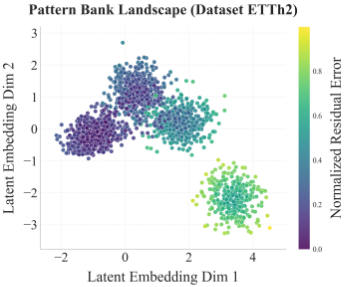
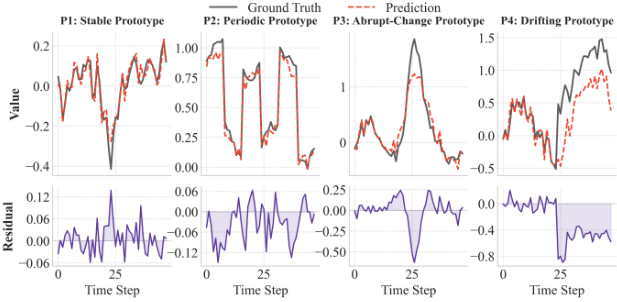
In this section, we project the regime residual embeddings of ETTh2 dataset. Figure 3 probes the semantics of the Pattern Bank on ETTh2 by visualizing the regime-residual embedding, i.e., the concatenation of a regime representation and its regime-conditioned residual prototype. In Figure 3(a), the 2D projection exhibits four separated clusters; points are colored by normalized residual error (darker is lower), and the clusters show systematically different error levels, indicating recurring regime-specific difficulty rather than uniformly distributed delayed-feedback episodes.
Figure 3(b) anchors these clusters with representative prototypes. Stable and well-tracked periodic regimes yield small, largely structureless residuals, whereas a single-peak regime produces localized residual bursts, and a drifting-trend regime exhibits accumulating bias, reflecting persistent mismatch.
This supports our intended role of the bank: prototypes act as regime-conditioned "error labels" that summarize how the backbone typically fails under each regime. Online, PADRE retrieves a soft pattern prompt pt from the bank and combines it with drift evidence and geometric consistency At to produce the update gate γt, enabling stronger updates for coherent, systematic shifts and conservative updates for transient or poorly explained events.
4.5 Hyperparameter Analysis
We further examine PADRE's sensitivity to the geometric consistency weight λtri and the Pattern-Bank temperature τ (Fig.4). Performance is stable across a broad range, while extreme settings degrade results: too small λtri yields noisy, weakly coupled drift views, whereas overly large λtri overregularizes the tri-view space. A similar unimodal pattern appears when sweeping the temperature τ: overly sharp attention (τ=0.2) and overly flat attention (τ=1.0) both underperform the default τ=0.5.
5 Conclusion
In this paper, we highlight the delayed residuals should not be used as raw supervision, but as noisy observations of latent drift states, and instantiated the idea with a Tri-View drift representation that aggregates online context, backward residual trajectories, and episodic drift memory. On top of this space, PADRE combines an offline Pattern Bank of regime residual prototypes with a prompt guided update policy, which outputs horizon aware update gates to modulate gradient steps. Experiments across diverse benchmarks, horizons, and backbone forecasters show that this design yields consistent and often substantial improvements over recent OTSF baselines, while ablations highlight the complementary roles of TriView geometry and pattern-bank guidance. A natural next step is utility and budget aware adaptation: learning update gates under constraints on computation, update frequency, or risk-sensitive costs, turning γt into a principled resource allocation mechanism rather than a purely accuracy driven scalar.
Acknowledgments
This work is supported by the grants from the National Natural Science Foundation of China (No.62272398), Sichuan Science and Technology Program (No.2024NSFJQ0019) and Fundamental and Interdisciplinary Disciplines Breakthrough Plan of the Ministry of Education of China (JYB2025XDXM211).
@inproceedings{ijcai2026p503,
  title     = {Beyond Uniform Updates: Drift Pattern Aware Online Time Series Forecasting Under Delayed Feedback},
  author    = {Li, Xingwang and Teng, Fei and Zhou, Cong and Duan, Qiang},
  booktitle = {Proceedings of the Thirty-Fifth International Joint Conference on
               Artificial Intelligence, {IJCAI-26}},
  publisher = {International Joint Conferences on Artificial Intelligence Organization},
  editor    = {Diego Calvanese},
  pages     = {4518--4526},
  year      = {2026},
  month     = {8},
  note      = {Main Track},
  doi       = {10.24963/ijcai.2026/503},
  url       = {https://doi.org/10.24963/ijcai.2026/503},
}
TY - CPAPER TI - Beyond Uniform Updates: Drift Pattern Aware Online Time Series Forecasting Under Delayed Feedback AU - Li, Xingwang AU - Teng, Fei AU - Zhou, Cong AU - Duan, Qiang T2 - Proceedings of the Thirty-Fifth International Joint Conference on Artificial Intelligence, IJCAI-26 PB - International Joint Conferences on Artificial Intelligence Organization PY - 2026 SP - 4518 EP - 4526 DO - 10.24963/ijcai.2026/503 UR - https://doi.org/10.24963/ijcai.2026/503 ER -Copied
Machine-readable versions of this paper, for tools and AI agents:





