
Instance-Aligned Semantic Reconstruction for Incomplete Multi-View Clustering
Proceedings of the Thirty-Fifth International Joint Conference on Artificial Intelligence. Main Track. Pages 5137-5145.
https://doi.org/10.24963/ijcai.2026/572
Keywords
- Machine Learning: Clustering
- Machine Learning: Multi-view learning
- Machine Learning: Deep learning architectures
Abstract
Incomplete multi-view clustering (IMVC) aims to exploit complementary information from multiple views with missing observations. Recent diffusion-based approaches have shown promise for view completion; however, they often fail to capture instance-aligned global correlations across views and suffer from inefficient inference and loosely coupled optimization. In this paper, we propose IASR, an Instance-Aligned Semantic Reconstruction framework for IMVC. IASR formulates missing-view recovery as a cross-view token alignment generator, in which noisy targets, observed views, and timestep embeddings are jointly represented as tokens and interact to capture long-range cross-view dependencies throughout the denoising trajectory. To stabilize representation learning under generative noise, we further introduce a stable–active dual-encoder representation architecture with a generative-adaptive contrastive learning strategy that tightly couples view completion and clustering. Extensive experiments on eight benchmark datasets demonstrate that IASR consistently outperforms state-of-the-art IMVC methods, especially under high missing-rate settings, while achieving improved inference efficiency.
- [Azizi et al., 2023] Shekoofeh Azizi, Simon Kornblith, Chit- wan Saharia, Mohammad Norouzi, and David J Fleet. Synthetic data from diffusion models improves imagenet classification. arXiv preprint arXiv:2304.08466, 2023.
- [Chao et al., 2024] Guoqing Chao, Yi Jiang, and Dianhui Chu. Incomplete Contrastive Multi-View Clustering with High-Confidence Guiding. Proceedings of the AAAI Con- ference on Artificial Intelligence, 38(10):11221-11229, March 2024.
- [Cui et al., 2024] Can Cui, Yunsheng Ma, Xu Cao, Wenqian Ye, and Ziran Wang. Drive As You Speak: Enabling Human-Like Interaction With Large Language Models in Autonomous Vehicles. In Proceedings of the IEEE/CVF Winter Conference on Applications of Computer Vision, pages 902-909, 2024.
- [Fang et al., 2023] Uno Fang, Man Li, Jianxin Li, Longxi- ang Gao, Tao Jia, and Yanchun Zhang. A Comprehensive Survey on Multi-View Clustering. IEEE Transactions on Knowledge and Data Engineering, 35(12):12350-12368, December 2023.
- [Han et al., 2023] Zongbo Han, Changqing Zhang, Huazhu Fu, and Joey Tianyi Zhou. Trusted Multi-View Classi- fication With Dynamic Evidential Fusion. IEEE Trans- actions on Pattern Analysis and Machine Intelligence, 45(2):2551-2566, February 2023.
- [Ho et al., 2020] Jonathan Ho, Ajay Jain, and Pieter Abbeel. Denoising Diffusion Probabilistic Models. In Advances in Neural Information Processing Systems, volume 33, pages 6840-6851.
- Curran Associates, Inc., 2020.
- [Hu and Chen, 2018] Menglei Hu and Songcan Chen. Dou- bly Aligned Incomplete Multi-view Clustering. In Pro- ceedings of the Twenty-Seventh International Joint Con- ference on Artificial Intelligence, pages 2262-2268, Stock- holm, Sweden, July 2018. International Joint Conferences on Artificial Intelligence Organization. IJCAI
- [Jin et al., 2023] Jiaqi Jin, Siwei Wang, Zhibin Dong, Xin- wang Liu, and En Zhu. Deep Incomplete Multi-View Clustering with Cross-View Partial Sample and Prototype Alignment. In 2023 IEEE/CVF Conference on Computer Vision and Pattern Recognition (CVPR), pages 11600- 11609, June 2023.
- [Jin et al., 2025] Jiaqi Jin, Siwei Wang, Zhibin Dong, Xi- hong Yang, Xinwang Liu, En Zhu, and Kunlun He. Deep Incomplete Multi-view Clustering with Distribution Dual- Consistency Recovery Guidance, March 2025.
- [Li et al., 2023] Haobin Li, Yunfan Li, Mouxing Yang, Peng Hu, Dezhong Peng, and Xi Peng. Incomplete multi-view clustering via prototype-based imputation. arXiv preprint arXiv:2301.11045, 2023. IJCAI
- [Li et al., 2024] Liang Li, Yuangang Pan, Jie Liu, Yue Liu, Xinwang Liu, Kenli Li, Ivor W. Tsang, and Keqin Li. BGAE: Auto-Encoding Multi-View Bipartite Graph Clus- tering. IEEE Transactions on Knowledge and Data Engi- neering, 36(8):3682-3696, August 2024.
- [Lin et al., 2021] Yijie Lin, Yuanbiao Gou, Zitao Liu, Boyun Li, Jiancheng Lv, and Xi Peng. COMPLETER: Incom- plete Multi-view Clustering via Contrastive Prediction. In 2021 IEEE/CVF Conference on Computer Vision and Pat- tern Recognition (CVPR), pages 11169-11178, June 2021.
- [Lin et al., 2022] Yijie Lin, Yuanbiao Gou, Xiaotian Liu, Jinfeng Bai, Jiancheng Lv, and Xi Peng. Dual Con- trastive Prediction for Incomplete Multi-View Represen- tation Learning. IEEE Transactions on Pattern Analysis and Machine Intelligence, pages 1-14, 2022.
- [Lin et al., 2023] Shaobo Lin, Kun Wang, Xingyu Zeng, and Rui Zhao. Explore the power of synthetic data on few-shot object detection. In Proceedings of the IEEE/CVF confer- ence on computer vision and pattern recognition, pages 638-647, 2023.
- [Liu et al., 2021] Xinwang Liu, Miaomiao Li, Chang Tang, Jingyuan Xia, Jian Xiong, Li Liu, Marius Kloft, and En Zhu. Efficient and Effective Regularized Incomplete Multi-View Clustering. IEEE Transactions on Pattern Analysis and Machine Intelligence, 43(8):2634-2646, Au- gust 2021.
- [Lu et al., 2024] Yiding Lu, Yijie Lin, Mouxing Yang, Dezhong Peng, Peng Hu, and Xi Peng. Decoupled Con- trastive Multi-View Clustering with High-Order Random Walks. Proceedings of the AAAI Conference on Artificial Intelligence, 38(13):14193-14201, March 2024.
- [Tang and Liu, 2022] Huayi Tang and Yong Liu. Deep Safe Incomplete Multi-view Clustering: Theorem and Algo- rithm. In Proceedings of the 39th International Confer- ence on Machine Learning, pages 21090-21110. PMLR, June 2022.
- [Tian et al., 2023] Yonglong Tian, Lijie Fan, Phillip Isola, Huiwen Chang, and Dilip Krishnan. Stablerep: Synthetic images from text-to-image models make strong visual rep- resentation learners. Advances in Neural Information Pro- cessing Systems, 36:48382-48402, 2023.
- [Wang et al., 2021] Qianqian Wang, Zhengming Ding, Zhiqiang Tao, Quanxue Gao, and Yun Fu. Generative Partial Multi-View Clustering With Adaptive Fusion and Cycle Consistency. IEEE Transactions on Image Processing, 30:1771-1783, 2021.
- [Wang et al., 2023] Yiming Wang, Dongxia Chang, Zhiqiang Fu, Jie Wen, and Yao Zhao. Incomplete Multiview Clustering via Cross-View Relation Transfer. IEEE Transactions on Circuits and Systems for Video Technology, 33(1):367-378, January 2023.
- [Wang et al., 2025] Ziyu Wang, Yiming Du, Yao Wang, Rui Ning, and Lusi Li. Deep Incomplete Multi-view Cluster- ing via Multi-level Imputation and Contrastive Alignment. Neural Networks, 181:106851, January 2025.
- [Wen et al., 2020] Jie Wen, Yong Xu, and Hong Liu. Incom- plete Multiview Spectral Clustering With Adaptive Graph Learning. IEEE Transactions on Cybernetics, 50(4):1418- 1429, April 2020.
- [Wen et al., 2024] Jie Wen, Shijie Deng, Waikeung Wong, Guoqing Chao, Chao Huang, Lunke Fei, and Yong Xu. Diffusion-based Missing-view Generation With the Ap- plication on Incomplete Multi-view Clustering. In Forty- First International Conference on Machine Learning, June 2024.
- [Xu et al., 2022] Jie Xu, Chao Li, Yazhou Ren, Liang Peng, Yujie Mo, Xiaoshuang Shi, and Xiaofeng Zhu. Deep in- complete multi-view clustering via mining cluster comple- mentarity. In Proceedings of the AAAI conference on arti- ficial intelligence, volume 36, pages 8761-8769, 2022.
- [Xu et al., 2023] Jie Xu, Chao Li, Liang Peng, Yazhou Ren, Xiaoshuang Shi, Heng Tao Shen, and Xiaofeng Zhu. Adaptive Feature Projection With Distribution Alignment for Deep Incomplete Multi-View Clustering. IEEE Trans- actions on Image Processing, 32:1354-1366, 2023.
- [Xu et al., 2024] Gehui Xu, Jie Wen, Chengliang Liu, Bing Hu, Yicheng Liu, Lunke Fei, and Wei Wang. Deep varia- tional incomplete multi-view clustering: Exploring shared clustering structures. In Proceedings of the AAAI confer- ence on artificial intelligence, volume 38, pages 16147- 16155, 2024.
- [Yan et al., 2023a] Weiqing Yan, Meiqi Gu, Jinlai Ren, Guanghui Yue, Zhaowei Liu, Jindong Xu, and Weisi Lin. Collaborative structure and feature learning for multi-view clustering. Information Fusion, 98:101832, October 2023.
- [Yan et al., 2023b] Weiqing Yan, Yuanyang Zhang, Chenlei Lv, Chang Tang, Guanghui Yue, Liang Liao, and Weisi Lin. GCFAgg: Global and Cross-View Feature Aggre- gation for Multi-View Clustering. In 2023 IEEE/CVF Conference on Computer Vision and Pattern Recognition (CVPR), pages 19863-19872, Vancouver, BC, Canada, June 2023. IEEE.
- [Yan et al., 2024a] Weiqing Yan, Kanglong Liu, Wujie Zhou, and Chang Tang. Deep incomplete multi-view clus- tering via dynamic imputation and triple alignment with dual optimization. IEEE Transactions on Circuits and Sys- tems for Video Technology, 2024.
- [Yan et al., 2024b] Weiqing Yan, Yuanyang Zhang, Chang Tang, Wujie Zhou, and Weisi Lin. Anchor-sharing and cluster-wise contrastive network for multiview representa- tion learning. IEEE Transactions on Neural Networks and Learning Systems, 36(2):3797-3807, 2024.
- [Yin et al., 2025] Jun Yin, Pei Wang, Shiliang Sun, and Zhonglong Zheng. Incomplete Multi-View Clustering via Multi-Level Contrastive Learning. IEEE Transactions on Knowledge and Data Engineering, 37(8):4716-4727, Au- gust 2025.
- [Zhang et al., 2020] Pei Zhang, Siwei Wang, Jingtao Hu, Zhen Cheng, Xifeng Guo, En Zhu, and Zhiping Cai. Adap- tive Weighted Graph Fusion Incomplete Multi-View Sub- space Clustering. Sensors, 20:5755, October 2020.
- [Zhang et al., 2025] Yuanyang Zhang, Yijie Lin, Weiqing Yan, Li Yao, Xinhang Wan, Guangyuan Li, Chao Zhang, Guanzhou Ke, and Jie Xu. Incomplete Multi-view Clus- tering via Diffusion Contrastive Generation. Proceed- ings of the AAAI Conference on Artificial Intelligence, 39(21):22650-22658, April 2025.
References were extracted automatically from the PDF and may contain errors.
Full text extracted automatically from the PDF; figures, tables and equations may differ. The PDF is the version of record.
1 Introduction
Real-world objects can often be described from multiple sources or through diverse feature extractors, resulting in multi-view data[Yan et al., 2023b; Han et al., 2023; Jin et al., 2023]. For example, autonomous driving systems commonly rely on heterogeneous sensors such as LiDAR, cameras, and millimeter-wave radar to perceive and navigate the surrounding environment[Cui et al., 2024; Tang and Liu, 2022]; in image understanding tasks, raw RGB images are frequently accompanied by handcrafted features such as SIFT and HOG[Yan et al., 2024b; Wen et al., 2020], or deep features extracted from different convolutional layers. Multiview clustering (MVC) aims to exploit cross-view consistency and complementary information to partition multi-view data into semantically coherent clusters[Yan et al., 2023a; Fang et al., 2023; Li et al., 2024]. However, most existing MVC methods implicitly assume that all views are complete and strictly aligned, an assumption that rarely holds in realworld scenarios. Due to sensor failures, occlusions, asynchronous acquisition, or privacy constraints, data are often partially missing. Consequently, incomplete multi-view clustering (IMVC), which explicitly addresses view-missing scenarios, has emerged as a critical and challenging problem[Yan et al., 2024a].
The core objective of IMVC is to achieve consistent clustering under view-missing conditions[Chao et al., 2024]. Existing IMVC methods can be broadly categorized into nonimputation-based methods and imputation-based methods.
Non-imputation-based methods aim to learn clustering representations directly from observed views through alignment strategies, attention mechanisms, or shared embeddings, thereby avoiding noise introduced by erroneous imputation. For example, APADC[Xu et al., 2023] proposes an adaptive feature projection strategy that maps different views into a common space via distribution alignment, eliminating the need for explicit imputation. DIMVC[Xu et al., 2022] constructs a complementarity mining mechanism based on high-dimensional nonlinear mappings, transforming crossview complementary information into high-confidence supervisory signals to achieve consistent clustering. DVIMC[Xu et al., 2024], built upon a variational autoencoder framework, adopts a Product-of-Experts mechanism to aggregate information from visible views and explore shared structures. However, due to the lack of explicit modeling of missing data, these methods often exhibit limited robustness when confronted with severe missingness or high-noise scenarios.
In contrast, imputation-based methods explicitly generate missing views or their latent representations to recover complete multi-view structures. Representative deep learning approaches such as COMPLETER[Lin et al., 2021] and IMCMCL[Yin et al., 2025]leverage contrastive learning and dualprediction mechanisms to minimize conditional entropy in the latent space for view recovery. DIVIDE[Lu et al., 2024] follows a similar paradigm by designing cross-view decoders to reconstruct missing representations. MICA[Wang et al., 2025] introduces a multi-level imputation strategy to preserve topological consistency across views. Furthermore, with the advancement of generative models, BURG[Jin et al., 2025] employs flow-based models to perform cross-view distribution transfer. Despite these progresses, existing imputationbased methods often struggle to accurately capture the complex distributions of missing views, resulting in limited generation quality and degraded clustering performance under high missing-rate settings.
Motivated by the strong capability of diffusion models in modeling complex data distributions, recent studies have begun to explore diffusion-based frameworks for incomplete multi-view clustering. However, existing diffusion-based IMVC methods still suffer from notable limitations. First, most approaches rely on local convolutional architectures or static conditioning schemes, which are inadequate for capturing long-range, instance-aligned cross-view correlations. Second, the iterative denoising process introduces substantial computational overhead, severely restricting their practical applicability, particularly under high missing-rate scenarios.
To address these challenges, we propose IASR, a crossview token alignment generator for incomplete multi-view clustering. Unlike previous methods, IASR formulates missing-view recovery as an instance-specific and globally conditioned generation process, in which noisy targets, observed views, and timestep embeddings are treated as equally important tokens and jointly processed through a global token-level correlation operator. This design enables explicit modeling of long-range cross-view dependencies throughout the entire denoising trajectory. The main contributions of this work are summarized as follows:
- We design a stable-active dual-encoder architecture that integrates a momentum-updated stable branch with an active branch to jointly learn robust and view-specific representations. This architecture prevents representation collapse and ensures stable learning under severe view missingness.
- Propose a novel cross-view token alignment generator framework for incomplete multi-view clustering, which jointly represents noisy targets, observed views, and timestep embeddings as tokens and models their interactions to capture long-range cross-view dependencies throughout the denoising trajectory, enabling efficient and high-quality imputation.
- Propose a generative-adaptive contrastive learning framework based on a tri-level contrastive paradigm with an adaptive affinity matrix, which explicitly enforces intra-view stability, cross-view complementarity, and semantic consistency of generated representations, thereby yielding substantial performance improvements under high missing-rate scenarios.
2 RelatedWork
2.1 Incomplete Multi-ViewClustering
Early traditional methods predominantly relied on techniques such as matrix factorization[Hu and Chen, 2018], kernel learning[Liu et al., 2021], and graph learning[Zhang et al., 2020] to replenish missing information. However, these shallow models often struggle to capture the nonlinear structures inherent in high-dimensional data. Recently, Deep Incomplete Multi-View Clustering (DIMVC) has emerged as the mainstream approach due to its robust feature representation capabilities. Existing works can be primarily categorized into four classes: (1) Cross-view prediction-based methods aim to learn consistent representations in the latent space by maximizing mutual information. For instance, DCP[Lin et al., 2022] maximizes mutual information via contrastive learning and minimizes conditional entropy via dual prediction, thereby recovering missing views; (2) Generative Adversarial Network (GAN)-based methods leverage adversarial training to fit the distribution of missing data. Representative works such as GP-MVC[Wang et al., 2021] generate missing views from shared representations using view-specific generators and cycle consistency constraints. (3) Graph Neural Network (GNN)-based methods focus on guiding data recovery utilizing topological structures. CRTC[Wang et al., 2023] and ICMVC[Chao et al., 2024] transfer sample neighbor relationships from observed views to missing ones and employ GCNs for feature completion; (4) Direct clustering learning aim to circumvent noise introduced by explicit imputation by enhancing feature discriminability. ProImp[Li et al., 2023] utilize sample-prototype relationships and robust contrastive losses to recover data, effectively preserving instance commonality and view diversity.
2.2 Generative-AssistedMissing-view Learning
Generative models have gradually evolved from pure data synthesizers into powerful assistants for representation learning. The central idea is to introduce reconstruction or generation objectives as auxiliary regularization signals, encouraging models to capture underlying semantic distributions and latent manifold structures. This paradigm has demonstrated remarkable success across various domains, including image classification[Azizi et al., 2023], object detection[Lin et al., 2023], and image generation[Tian et al., 2023].
In early studies on IMVC, reconstruction- or predictionbased objectives were commonly employed to complement discriminative learning. Recently, probabilistic diffusion models[Ho et al., 2020] have shown superior capability in modeling complex data distributions, providing rich semantic priors for downstream tasks. Wen et al.[2024] pioneered the application of conditional diffusion models to IMVC by conditioning the generation of missing views on observed ones, thereby facilitating clustering while completing data. Subsequently, DCG [2025] combines diffusion processes with contrastive learning to reduce the reliance on massive paired data and leverages diffusion priors to enhance clustering compactness.
3 Method
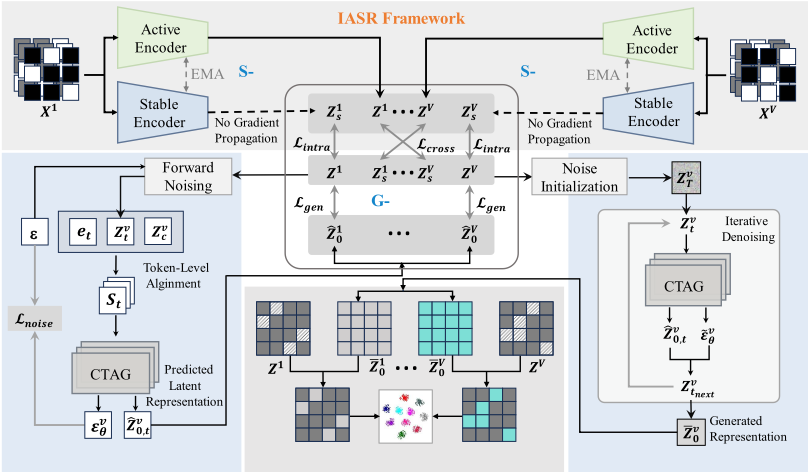
We propose IASR, a unified framework for IMVC. As illustrated in Fig. 1, IASR consists of three core components: S-ADE, CTAG, and G-ACL. S-ADE learns robust and view-specific representations via a momentum-updated stable branch and an active branch. CTAG formulates missingview recovery as an instance-aligned token generation process to capture long-range cross-view dependencies. Meanwhile, G-ACL enforces a tri-level contrastive objective to ensure intra-view stability, cross-view complementarity, and semantic consistency. We detail each module below.
3.1 Representation Learning with Stable-Active Dual Encoders(S-ADE)
To alleviate the adverse impact of early-stage generative noise on representation learning and to prevent degenerate solutions during joint generation and clustering optimization, we introduce an asymmetric dual-encoder architecture consisting of an active encoder and a stable encoder. Both encoders share the same network architecture but follow different parameter update strategies during training.
Active Encoder. The active encoder is responsible for modeling the views and is optimized end-to-end via backpropagation. Specifically, for the v-th view, the active encoder is defined as:z(v) = f (v) (x(v) ; θ(v) ), (1)
where θ(v) denotes the learnable parameters. This encoder enables flexible feature adaptation as training progresses.
Stable Encoder. The stable encoder shares the same architecture as the active encoder but is updated without gradient back-propagation. For the v-th view, it produces a stable representation:
where θ(v) s is updated via an exponential moving average (EMA) of the active encoder parameters θ(v) , with m ∈ [0, 1) denoting the momentum coefficient. The stable encoder evolves smoothly across training iterations, acting as a regularization anchor that constrains the optimization of the active encoder, thereby enabling the latter to focus on learning noise-robust and task-relevant representations.
3.2 Cross-view Token Alignment Generator (CTAG)
We formulate missing-view recovery as a globally conditioned generation process that explicitly enforces instancelevel consistency. Unlike conventional conditional generation approaches that rely on static feature concatenation, our method injects conditioning information via token-level global correlation modeling.
Token-Level Global Correlation Modeling. Given an instance with target view representation z(v) and a set of observed conditional view representations {z(k) c }, we first apply forward diffusion to the target view:
where t denotes the diffusion timestep and ¯αt follows a predefined noise schedule.
At each timestep t, we project the timestep embedding, the noisy target view, and the observed conditional views into token representations along the token dimension:
where Zc denotes the set of available conditional view tokens, and et is the positional embedding at timestep t. Unlike conventional conditional diffusion models that impose an asymmetric conditioning hierarchy, we adopt a symmetrypreserving tokenization scheme, in which the noisy target, conditional views, and timestep embedding are treated as homogeneous tokens to avoid predefined conditioning directions. In the CTAG module, the noise prediction network ϵθ models the input token sequence St through a global tokenlevel correlation operator, which captures instance-specific dependencies among temporal information, target view, and conditional views within a unified latent space. Formally, the noise prediction is defined as:
where WQ1 , WQ2 , WQ3 , and Wo are learnable projection matrices, and ϕ(·) normalizes the values to the range [0, 1]. The model is trained by minimizing the noise prediction error:
Fast Sampling for View Completion. At inference, we utilize the trained CTAG network to recover missing views via a fast reverse denoising process. To balance generation fidelity and efficiency, we employ a deterministic DDIMstyle sampling strategy with stride-based timestep skipping, where the inference timesteps follow a sparsified schedule T = t1, . . . , tL with stride S, resulting in L ≪ T. We employ a Classifier-Free Guidance (CFG) strategy to explicitly align the generated target with observed views. Specifically, within the input sequence St, the target representation is initialized as pure Gaussian noise at t = T , denoted as z(v) T . The adjusted noise prediction is:
where S∅t is the sequence with conditional view tokens removed, and w is the guidance scale. Crucially, to facilitate intermediate supervision in the subsequent contrastive learning stage, we explicitly derive the predicted latent representation ˆz(v) 0,t from the current noisy state z(v) t at each step:
Based on this representation, the reverse update from t to tnext follows the deterministic transition:
where ¯αtnext denotes the cumulative noise coefficient at timestep tnext. After iterating through all timesteps, the recovered target representations ¯z(v) 0 are integrated with the incomplete multi-view representations to form a complete feature set for clustering.
3.3 Generative-Adaptive Contrastive Learning (G-ACL)
To learn discriminative and completion-aware representations under incomplete views, we propose a Generative-Adaptive Contrastive Learning framework. The proposed objective jointly enforces instance-level stability, cross-view semantic alignment, and generation-consistent regularization within a unified contrastive formulation.
At the core of G-ACL is a temperature-scaled InfoNCEstyle contrastive loss equipped with an adaptive affinity matrix M, which allows each sample to align with multiple semantically related neighbors:
where sim(·) denotes cosine similarity, τ is the temperature parameter and N denotes the number of samples in the current mini-batch. The affinity matrix M ∈ [0, 1]N×N encodes soft positive relationships and is constructed via a multi-step random-walk kernel affinity over normalized features, capturing local neighborhood semantics beyond strict one-to-one correspondence.
Intra-ViewContrastive Loss. This loss enforces representation stability by aligning features extracted by the active encoder with those from the Stable Encoder:
Cross-View Contrastive Loss. To capture complementary semantics across views, we impose bidirectional alignment between different views:
Generative Consistency Loss. Since the CTAG network explicitly predicts the latent representation ˆz(v) 0,t , we enforce generative consistency by aligning this prediction with the corresponding view features through a contrastive objective:
The overall training objective is formulated as:
where λ1, λ2, and λ3 are the weighting coefficients.
4 Experiments
We evaluate the proposed IASR on eight widely used multi-view datasets, including HandWritten, synthetic3d, MNIST-USPS, CIFAR-10, ORL, OutdoorScene, COIL20, and 100Leaves. These datasets cover diverse modalities such as images and handcrafted features, with the number of samples ranging from 400 to 50,000. Clustering performance is evaluated using Accuracy (ACC), Normalized Mutual Information (NMI), and Adjusted Rand Index (ARI). Higher values of these metrics indicate better clustering performance. Among them, Table 1 presents the comparison results on the first four dual-view datasets, while Table 2 reports experiments on the remaining four multi-view datasets using baseline methods that support an arbitrary number of views.
| Dataset | Method | 0.1 | 0.3 | 0.5 | 0.7 | ||||||||
|---|---|---|---|---|---|---|---|---|---|---|---|---|---|
| ACC | NMI | ARI | ACC | NMI | ARI | ACC | NMI | ARI | ACC | NMI | ARI | ||
| Completer(CVPR'21) | 67.31 | 70.95 | 50.15 | 55.74 | 60.55 | 29.38 | 57.82 | 61.66 | 35.61 | 59.60 | 58.60 | 35.42 | |
| DIMVC(AAAI'22 ) | 68.26 | 63.54 | 53.48 | 74.78 | 64.21 | 56.91 | 72.02 | 63.78 | 53.81 | 67.37 | 61.56 | 51.88 | |
| APADC(TIP'23) | 71.19 | 77.52 | 62.11 | 68.91 | 75.03 | 58.65 | 68.22 | 71.65 | 55.01 | 76.78 | 72.40 | 60.50 | |
| DVIMC(AAAI'24) | 25.73 | 16.37 | 9.03 | 25.78 | 15.31 | 8.80 | 25.23 | 15.85 | 8.45 | 23.87 | 14.51 | 7.78 | |
| Divide(AAAI'24) | 82.06 | 76.82 | 70.56 | 84.24 | 75.92 | 70.92 | 85.14 | 76.32 | 71.66 | 82.67 | 72.29 | 66.99 | |
| HandWritten MICA(Neural Netw'25) | 65.85 | 69.02 | 57.61 | 66.30 | 61.52 | 49.98 | 59.25 | 52.03 | 41.41 | 35.85 | 39.48 | 22.61 | |
| DCG(AAAI'25) | 29.95 | 51.22 | 29.26 | 29.80 | 51.15 | 28.20 | 29.40 | 48.75 | 27.98 | 29.35 | 48.28 | 28.34 | |
| BURG(ICCV'25) | 89.15 | 80.88 | 77.76 | 84.15 | 74.18 | 68.03 | 68.40 | 64.43 | 51.61 | 50.45 | 53.07 | 31.53 | |
| IMC-MCL(TKDE'25) | 48.98 | 58.65 | 37.18 | 56.25 | 61.95 | 42.35 | 58.82 | 65.09 | 48.27 | 70.88 | 67.92 | 55.52 | |
| IASR (Ours) | 93.35 | 87.50 | 86.00 | 92.21 | 85.60 | 83.58 | 88.36 | 80.45 | 77.58 | 84.23 | 73.46 | 69.63 | |
| Completer(CVPR'21) | 91.30 | 73.07 | 76.31 | 89.53 | 66.94 | 71.48 | 86.67 | 61.37 | 64.66 | 83.33 | 54.45 | 56.80 | |
| DIMVC(AAAI'22 ) | 88.61 | 65.33 | 69.60 | 88.93 | 65.31 | 70.30 | 84.95 | 55.01 | 60.85 | 60.00 | 31.11 | 31.19 | |
| APADC(TIP'23) | 73.03 | 56.50 | 50.68 | 73.27 | 50.29 | 47.44 | 78.23 | 50.52 | 52.32 | 79.63 | 50.44 | 51.80 | |
| DVIMC(AAAI'24) | 80.77 | 52.48 | 55.30 | 77.73 | 44.70 | 46.57 | 73.70 | 41.16 | 40.14 | 69.40 | 34.66 | 33.50 | |
| synthetic3d Divide(AAAI'24) | 85.63 | 58.75 | 62.34 | 81.70 | 50.53 | 53.62 | 78.30 | 44.96 | 47.02 | 73.17 | 37.72 | 37.61 | |
| MICA(Neural Netw'25) | 64.83 | 44.32 | 37.98 | 63.00 | 37.08 | 34.06 | 60.33 | 34.34 | 29.89 | 61.67 | 29.91 | 29.44 | |
| DCG(AAAI'25) | 92.50 | 75.00 | 79.31 | 87.50 | 62.69 | 67.25 | 83.50 | 54.65 | 58.44 | 79.33 | 47.31 | 50.07 | |
| BURG(ICCV'25) | 90.33 | 70.28 | 73.52 | 88.00 | 64.76 | 67.00 | 58.33 | 42.51 | 34.66 | 58.33 | 40.60 | 35.25 | |
| IMC-MCL(TKDE'25) | 68.87 | 33.67 | 34.93 | 77.77 | 43.60 | 46.93 | 72.70 | 38.44 | 39.68 | 73.43 | 36.85 | 38.71 | |
| IASR (Ours) | 96.97 | 87.02 | 91.13 | 95.03 | 80.77 | 85.71 | 92.73 | 74.54 | 79.53 | 91.67 | 71.71 | 76.68 | |
| Completer(CVPR'21) | 88.68 | 93.27 | 87.68 | 82.23 | 89.15 | 78.72 | 85.20 | 88.20 | 81.28 | 84.97 | 82.99 | 76.98 | |
| DIMVC(AAAI'22 ) | 79.87 | 81.62 | 73.54 | 79.41 | 82.39 | 75.30 | 80.52 | 78.29 | 72.18 | 83.15 | 77.29 | 73.16 | |
| APADC(TIP'23) | 97.96 | 94.98 | 92.93 | 96.77 | 92.27 | 92.93 | 95.39 | 89.33 | 90.00 | 91.89 | 83.23 | 82.77 | |
| USPS DVIMC(AAAI'24) | 93.16 | 91.65 | 89.00 | 86.70 | 86.69 | 81.16 | 80.99 | 81.64 | 74.36 | 79.02 | 76.28 | 68.40 | |
| Divide(AAAI'24) | 93.26 | 90.06 | 88.97 | 91.64 | 86.49 | 85.48 | 91.84 | 82.81 | 82.89 | 87.85 | 75.86 | 75.05 | |
| MICA(Neural Netw'25) | 98.80 | 96.61 | 97.35 | 68.26 | 77.83 | 66.35 | 57.58 | 71.71 | 58.66 | 39.44 | 57.85 | 40.70 | |
| MNIST DCG(AAAI'25) | 97.76 | 94.31 | 95.10 | 88.20 | 85.33 | 80.18 | 94.02 | 86.71 | 87.38 | 92.48 | 83.60 | 84.21 | |
| BURG(ICCV'25) | 83.42 | 79.93 | 73.95 | 69.36 | 67.68 | 55.17 | 55.14 | 54.79 | 37.08 | 52.42 | 49.41 | 33.99 | |
| IMC-MCL(TKDE'25) | 90.59 | 91.37 | 87.82 | 86.02 | 87.30 | 82.47 | 88.26 | 85.86 | 83.07 | 92.90 | 84.87 | 85.10 | |
| IASR (Ours) | 98.96 | 97.14 | 97.71 | 97.85 | 94.33 | 95.30 | 96.72 | 91.72 | 92.87 | 94.30 | 86.76 | 87.81 | |
| Completer(CVPR'21) | 80.85 | 85.61 | 75.33 | 88.56 | 86.91 | 83.79 | 92.34 | 86.38 | 86.04 | 92.61 | 83.96 | 84.60 | |
| DIMVC(AAAI'22 ) | 97.10 | 92.84 | 93.76 | 95.76 | 89.94 | 90.93 | 94.19 | 86.75 | 87.67 | 92.95 | 84.20 | 85.21 | |
| APADC(TIP'23) | 96.68 | 91.93 | 92.83 | 95.56 | 89.38 | 90.48 | 90.14 | 85.06 | 83.71 | 84.15 | 80.35 | 75.99 | |
| DVIMC(AAAI'24) | 57.94 | 72.09 | 52.62 | 38.58 | 59.04 | 35.29 | 42.26 | 60.24 | 35.40 | 35.32 | 52.40 | 28.42 | |
| Divide(AAAI'24) | 97.07 | 92.63 | 93.68 | 95.74 | 89.74 | 93.96 | 86.23 | 87.19 | 92.17 | 83.21 | |||
| cifar10 MICA(Neural Netw'25) | 96.67 | 91.64 | 92.83 | 87.28 | 88.37 | 90.90 | 85.56 | 84.64 | 79.76 | 73.11 | 75.08 | 83.57 63.32 | |
| DCG(AAAI'25) | 97.02 | 92.48 | 93.57 | 95.94 | 90.04 | 83.55 91.30 | 94.65 | 87.38 | 88.63 | 93.13 | 84.62 | 85.67 | |
| BURG(ICCV'25) | 61.41 | 67.60 | 52.23 | 57.21 | 58.28 | 37.40 | 47.83 | 50.05 | 28.64 | 34.97 | 39.28 | 17.61 | |
| IMC-MCL(TKDE'25) | 62.76 | 63.87 | 45.94 | 60.63 | 65.55 | 51.51 | 60.36 | 67.91 | 50.85 | 52.64 | 61.99 | 47.72 | |
| IASR (Ours) | 97.77 | 94.19 | 95.16 | 96.53 | 91.32 | 92.53 | 95.32 | 88.75 | 90.01 | 93.92 | 85.98 | 87.14 | |
All experiments are implemented in PyTorch and conducted on a single NVIDIA RTX 3090 GPU. We adopt the Adam optimizer. The batch size is set to 512 for the largescale dataset CIFAR-10 and 256 for the remaining datasets. The learning rate is individually tuned for each dataset to ensure optimal convergence. To simulate missing-view scenarios, we randomly discard partial views of each sample with a missing rate η ∈ {0.1, 0.3, 0.5, 0.7}, while ensuring that at least one view is retained for each sample. All experiments are independently repeated with five different random seeds, and the reported results are averaged over these five runs.
4.1 Comparison with SOTAMethods
We compare the proposed IASR with nine SOTA IMVC methods, including Completer, DIMVC, APADC, DVIMC, Divide, MICA, DCG, BURG, and IMC-MCL. All baseline methods are evaluated under different missing rates using the same evaluation metrics.
Table 1 summarizes the average clustering performance on four representative dual-view datasets. On the synthetic3d dataset, our method significantly outperforms all competing baselines. In particular, under a high missing rate of η = 0.7, IASR achieves improvements of 12.04%, 21.27%, and 24.88% over the second-best method in terms of ACC, NMI, and ARI, respectively, demonstrating its superiority and effectiveness for incomplete multi-view clustering. Moreover, on the HandWritten dataset with a missing rate of 0.1, IASR surpasses the second-best method BURG by 4.2% in ACC.
| Methods | η = 0.1 | η = 0.3 | η = 0.5 | η = 0.7 | ||||||||
|---|---|---|---|---|---|---|---|---|---|---|---|---|
| ACC | NMI | ARI | ACC | NMI | ARI | ACC | NMI | ARI | ACC | NMI | ARI | |
| DCP(TPAMI'23) | 39.30 | 65.24 | 12.66 | 40.45 | 60.33 | 6.89 | 31.55 | 51.38 | 9.96 | 25.40 | 45.01 | 4.18 |
| DIMVC(AAAI'22) | 53.10 | 75.15 | 38.93 | 50.68 | 68.73 | 22.88 | 47.15 | 65.96 | 29.79 | 30.43 | 51.93 | 13.30 |
| ORL DVIMC(AAAI'24) | 49.90 | 70.44 | 33.38 | 48.05 | 66.01 | 27.03 | 38.30 | 57.26 | 15.42 | 27.20 | 47.46 | 29.85 |
| MICA(Neural Netw'25) | 6.75 | 16.51 | 0.61 | 13.00 | 28.37 | 2.57 | 11.25 | 27.36 | 2.07 | 9.07 | 17.22 | 0.99 |
| BURG(ICCV'25) | 62.00 | 80.76 | 50.38 | 59.25 | 76.99 | 42.39 | 47.00 | 66.77 | 26.03 | 43.75 | 65.81 | 25.26 |
| IASR | 73.80 | 86.11 | 62.97 | 73.20 | 84.43 | 60.55 | 66.10 | 79.69 | 50.70 | 58.05 | 73.81 | 41.00 |
| DCP(TPAMI'23) | 45.08 | 38.23 | 21.63 | 54.26 | 44.65 | 28.86 | 48.25 | 39.99 | 21.89 | 47.34 | 40.09 | 20.28 |
| DIMVC(AAAI'22) | 37.34 | 23.84 | 16.97 | 36.28 | 24.94 | 18.72 | 33.73 | 21.29 | 14.64 | 34.85 | 20.56 | 13.62 |
| OutdoorScene DVIMC(AAAI'24) | 48.90 | 34.38 | 24.74 | 43.58 | 27.11 | 19.04 | 41.50 | 25.66 | 18.06 | 36.05 | 19.16 | 12.48 |
| MICA(Neural Netw'25) | 51.13 | 56.05 | 39.54 | 49.92 | 51.97 | 36.04 | 50.91 | 52.05 | 37.39 | 53.96 | 52.79 | 39.27 |
| BURG(ICCV'25) | 55.80 | 51.28 | 38.03 | 47.66 | 44.53 | 28.33 | 43.97 | 41.01 | 24.93 | 42.56 | 34.82 | 17.66 |
| IASR | 74.55 | 63.11 | 54.65 | 73.94 | 62.50 | 53.87 | 73.57 | 61.56 | 53.56 | 71.78 | 58.77 | 50.61 |
| DCP(TPAMI'23) | 63.65 | 78.55 | 54.60 | 64.53 | 77.15 | 54.70 | 60.56 | 75.65 | 50.18 | 60.19 | 73.36 | 40.55 |
| DIMVC(AAAI'22) | 57.00 | 73.84 | 51.28 | 52.55 | 73.04 | 49.31 | 58.27 | 71.61 | 51.72 | 53.73 | 70.91 | 48.90 |
| COIL20 DVIMC(AAAI'24) | 51.64 | 63.25 | 40.91 | 48.39 | 57.59 | 35.56 | 45.47 | 51.92 | 29.07 | 38.71 | 45.85 | 22.47 |
| MICA(Neural Netw'25) | 68.00 | 78.66 | 62.05 | 74.71 | 82.84 | 69.63 | 75.00 | 79.36 | 64.29 | 64.79 | 73.28 | 55.74 |
| BURG(ICCV'25) | 59.86 | 78.16 | 57.53 | 61.94 | 73.01 | 52.85 | 56.67 | 70.68 | 49.88 | 55.14 | 74.63 | 48.05 |
| IASR | 78.68 | 86.84 | 76.04 | 77.74 | 85.85 | 73.83 | 78.22 | 85.70 | 74.06 | 73.33 | 81.56 | 67.52 |
| DCP(TPAMI'23) | 57.68 | 81.99 | 46.90 | 50.29 | 75.15 | 33.85 | 45.51 | 69.23 | 20.36 | 39.19 | 63.96 | 14.01 |
| DIMVC(AAAI'22) | 66.97 | 83.52 | 49.87 | 72.52 | 83.31 | 57.32 | 58.82 | 73.96 | 39.13 | 51.34 | 68.06 | 31.15 |
| 100Leaves DVIMC(AAAI'24) | 40.04 | 67.82 | 26.01 | 36.01 | 63.61 | 20.22 | 32.86 | 60.64 | 16.27 | 26.57 | 56.25 | 11.07 |
| MICA(Neural Netw'25) | 12.94 | 42.70 | 4.25 | 12.81 | 38.49 | 2.97 | 11.50 | 36.04 | 2.03 | 10.87 | 34.34 | 1.52 |
| BURG(ICCV'25) | 69.12 | 87.86 | 62.52 | 57.06 | 77.77 | 37.93 | 45.38 | 70.08 | 25.23 | 36.03 | 63.09 | 16.22 |
| IASR | 86.04 | 93.51 | 80.31 | 76.35 | 86.63 | 64.35 | 66.08 | 80.31 | 50.63 | 54.91 | 74.23 | 37.67 |
As the missing rate increases to 0.7, the ACC of MICA drops sharply by 38.7%, whereas IASR exhibits a much smaller degradation of 9.12% and still maintains an ACC of 84.23% .
We further extend the evaluation to scenarios with more than two views, and the results are reported in Table 2. On OutdoorScene (4 views) and 100Leaves (3 views), IASR consistently demonstrates overwhelming advantages over competing methods. For instance, on 100Leaves with η = 0.1, IASR achieves an ACC of 86.04%, outperforming the second-best method BURG by more than 16%, which clearly validates the effectiveness of modeling global correlations for capturing long-range cross-view dependencies.
4.2 Ablation Studies
We conduct comprehensive ablation studies to evaluate both the architectural components and the contrastive objectives. Table 3 analyzes the impact of key modules, while Table 4 examines the contribution of each loss term. In addition, qualitative visualization is provided to further analyze the effect of conditional generation guidance.
Impact of the Key Modules. Table 3 summarizes the ablation results of the proposed S-ADE, CTAG, and G-ACL modules. As shown, replacing S-ADE with a standard autoencoder causes a significant performance drop, highlighting the importance of stability-enhanced representation learning under severe view-missing scenarios. Similarly, when the missing-view representations are generated by replacing CTAG with a UNet-based prediction architecture, the clustering performance degrades noticeably, indicating that architectures with local receptive fields struggle to capture long-range cross-view dependencies. Moreover, removing the generative consistency loss Lgen while retaining Lintra and Lcross also results in inferior performance, suggesting that decoupling view completion from clustering hinders unified optimization. Overall, the full model consistently achieves the best results, validating the complementary and synergistic contributions of all components.
| Modules | Performance | ||||
|---|---|---|---|---|---|
| S-ADE | CTAG | G-ACL | ACC | NMI | ARI |
| × | ✓ | ✓ | 72.95 | 67.46 | 58.74 |
| ✓ | × | ✓ | 83.56 | 80.89 | 74.86 |
| ✓ | ✓ | × | 79.47 | 72.09 | 66.62 |
| ✓ | ✓ | ✓ | 92.21 | 85.60 | 83.85 |
Analysis of the G-ACL Module. Table 4 shows that removing any single loss in G-ACL module leads to clear degradation, confirming their complementarity. In particular, excluding Lgen causes the largest drop, highlighting its role in enforcing generation-semantic consistency. When optimized alone, neither Lintra nor Lcross suffices for effective clustering, as the former mainly stabilizes intra-view representations while the latter lacks generation-aware supervision. Although Lgen alone performs relatively better, the best results are achieved only when all three losses are jointly optimized, validating the necessity of the tri-level contrastive objective.
Analysis of the CTAGModule. To further investigate the role of conditional information in the CTAG component, we visualize the learned representations using t-SNE under two ablation settings: unconditioned generation (i.e., the w is set as -1 in Eq.(7)) and global correlation-conditioned genera-
| Loss Configuration | Loss Terms | Performance | ||||
|---|---|---|---|---|---|---|
| Lintra | Lcross | Lgen | ACC | NMI | ARI | |
| w/o Lintra | × | ✓ | ✓ | 90.41 | 82.58 | 81.77 |
| w/o Lcross | ✓ | × | ✓ | 91.60 | 83.67 | 82.47 |
| w/o Lgen | ✓ | ✓ | × | 79.47 | 72.09 | 66.62 |
| Only Lintra | ✓ | × | × | 60.45 | 49.58 | 40.86 |
| Only Lcross | × | ✓ | × | 42.15 | 46.12 | 33.72 |
| Only Lgen | × | × | ✓ | 91.15 | 83.26 | 81.76 |
| Ours (Full) | ✓ | ✓ | ✓ | 92.21 | 85.60 | 83.85 |
(a) Conditional
(b) Unconditional
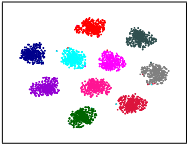
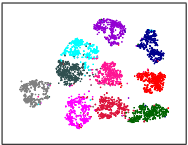
Figure 3: t-SNE visualization on the MNIST-USPS dataset with a missing rate of 0.3. (a) Clustering results guided by conditional view features; (b) Distribution of clustering results under the unconditioned setting.
tion, as shown in Fig. 3. As illustrated in Fig. 3(a), the unconditioned setting produces relatively scattered clusters with ambiguous inter-class boundaries, indicating insufficient semantic alignment in the latent space. In contrast, Fig. 3(b) shows that incorporating conditional guidance leads to more compact intra-class distributions and clearer inter-class separation. This observation suggests that global correlationaware conditioning effectively guides the diffusion process to generate semantically consistent representations, thereby enhancing discriminative structure in the learned space.
4.3 Parameter and Efficiency Analysis
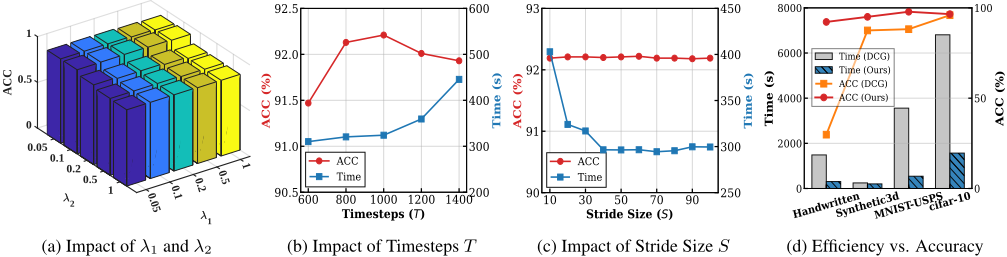
We study the effects of the loss-weight parameters λ in Eq. (14), the sampling timesteps T, and the stride size S on both performance and inference efficiency in the Fast Sampling for View Completion section, and report the runtime comparison in Fig. 2. Fig. 2(a) presents the clustering accuracy on the Handwritten dataset with a missing rate of 0.3 under different combinations of λ1 and λ2 ranging from 0.05 to 1.0. As observed, when λ1 ∈ [0.05, 1.0] and λ2 ∈ [0.05, 0.2], the ACC consistently exceeds 0.90. This suggests that these hyperparameters lie within a stable region, highlighting the robustness. In addition, the sensitivity of λ3 is analyzed in a similar manner. Accordingly, we set λ1 = 0.2, λ2 = 0.1, and λ3 = 0.01 in all experiments.
In this paper, we use the sampling timesteps T to control the number of denoising iterations. As shown in Fig. 2(b), increasing T from 600 to 1000 steadily improves clustering accuracy, which peaks at T = 1000, while further increases bring marginal gains with higher cost. Thus, we set T = 1000 by default. With T = 1000 fixed, Fig. 2(c) shows that the stride S = 40 significantly reduces running time while maintaining stable accuracy, demonstrating robustness to stride variations. Fig. 2(d) compares the running time of our method with DCG [2025]. From the efficiency perspective (left axis), our method consistently requires less running time than DCG on all datasets, achieving over a 4× speedup on the largescale CIFAR-10 dataset. From the performance perspective (right axis), our method consistently attains higher clustering accuracy. In particular, on the challenging Handwritten dataset, DCG fails to converge effectively, whereas our method maintains accuracy above 90%. These results demonstrate a superior balance between effectiveness and efficiency.
5 Conclusion
In this paper, we proposed IASR, a unified framework that reformulates missing-view recovery as an instance-aligned token generation process for incomplete multi-view clustering. By introducing a stable-active dual-encoder architecture(SADE), IASR learns robust and view-adaptive representations while preventing representation collapse under severe view missingness. The proposed cross-view token alignment generator (CTAG) explicitly captures long-range crossview dependencies along the denoising trajectory, and the generative-adaptive contrastive learning (G-ACL) strategy tightly couples view completion with discriminative representation learning. Extensive experiments on eight benchmarks demonstrate that IASR achieves superior clustering performance, especially under high missing rates, while significantly improving inference efficiency.
Acknowledgments
This work was supported in part by the National Natural Science Foundation of China (No. 62471426), the Shandong Provincial Natural Science Foundation (No.ZR2024MF060). The authors would also like to thank the anonymous reviewers for their valuable comments and suggestions.
@inproceedings{ijcai2026p572,
  title     = {Instance-Aligned Semantic Reconstruction for Incomplete Multi-View Clustering},
  author    = {Yan, Weiqing and Du, Yongteng and Song, Peng and Tang, Chang},
  booktitle = {Proceedings of the Thirty-Fifth International Joint Conference on
               Artificial Intelligence, {IJCAI-26}},
  publisher = {International Joint Conferences on Artificial Intelligence Organization},
  editor    = {Diego Calvanese},
  pages     = {5137--5145},
  year      = {2026},
  month     = {8},
  note      = {Main Track},
  doi       = {10.24963/ijcai.2026/572},
  url       = {https://doi.org/10.24963/ijcai.2026/572},
}
TY - CPAPER TI - Instance-Aligned Semantic Reconstruction for Incomplete Multi-View Clustering AU - Yan, Weiqing AU - Du, Yongteng AU - Song, Peng AU - Tang, Chang T2 - Proceedings of the Thirty-Fifth International Joint Conference on Artificial Intelligence, IJCAI-26 PB - International Joint Conferences on Artificial Intelligence Organization PY - 2026 SP - 5137 EP - 5145 DO - 10.24963/ijcai.2026/572 UR - https://doi.org/10.24963/ijcai.2026/572 ER -Copied
Machine-readable versions of this paper, for tools and AI agents:





