
Obstacle Avoidance and Trajectory Tracking of Redundant Manipulators with Unknown Physical Parameters Under Multiple Constraints
Proceedings of the Thirty-Fifth International Joint Conference on Artificial Intelligence. Main Track. Pages 6228-6235.
https://doi.org/10.24963/ijcai.2026/693
Keywords
- Robotics: Behavior and control
- Robotics: Applications
- Robotics: Motion and path planning
Abstract
Redundant manipulators are broadly used in safety tasks that require precise execution. However, some actual factors, such as assembly defects and mechanical wear, inevitably introduce uncertainties in their physical parameters. Due to the insufficient excitation, existing methods fail to achieve high-accuracy physical parameter identification, which seriously affects the accurate operation of multiple safety tasks. Considering that quadratic programming (QP) can integrate desired behaviors with constraints into a unified optimization framework and can be solved online in real time, this paper formulates the collision-free trajectory tracking of redundant manipulators with uncertain structure as a QP problem, which describes the trajectory tracking, obstacle avoidance and joint motion limits simultaneously. To tackle the above issues, we first develop an online physical parameters identification method called regularization and zeroing neural dynamics (RZND) by using the state information of the manipulator, which realizes highly accurate physical parameters identification and real-time Jacobian matrix updates. On the basis of this, a multi-task quadruple projection neural network (MT-QPNN) solver is proposed by applying projection operators to handle the joint constraints, and further the trajectory tracking and obstacle avoidance tasks of the redundant manipulator are well achieved. Relative experiments verify that the presented RZND method and MT-QPNN solver can accurately identify physical parameters and enable collision-free tracking with superior performance.
- [Boyd and Vandenberghe, 2004] Stephen Boyd and Lieven Vandenberghe. Convex optimization. Cambridge Univer- sity Press, 2004.
- [Chen et al., 2024] Shukang Chen, Xiyuan Zhang, Naimeng Cang, Dongsheng Guo, Weidong Zhang, and Shan Xue. Design and validation of new obstacle avoidance scheme with noise suppression capability for redundant robot ma- nipulators. In 2024 14th Asian Control Conference (ASC- C), pages 2301-2306, 2024.
- [Gombolay, 2024] Matthew Gombolay. Human-robot align- ment through interactivity and interpretability: Don't as- sume a "spherical human". In Proceedings of the Thirty- Third International Joint Conference on Artificial Intelli- gence (IJCAI), pages 8523-8528, 2024.
- [He et al., 2025] Yongjun He, Lin Xiao, Qiuyue Zuo, Hang Cai, and Yaonan Wang. A predefined-time robust sliding mode control based on zeroing neural dynamics for posi- tion and attitude tracking of quadrotor. IEEE Transactions on Systems, Man, and Cybernetics: Systems, 55(4):2438- 2450, 2025.
- [Huang et al., 2025] Yisen Huang, Jian Li, Weibing Li, X- ue Zhang, Yichong Sun, Ke Xie, Yingbai Hu, Philip Wai Yan Chiu, and Zheng Li. An accelerated anti-noise adaptive neural network for robotic flexible endoscope with multitype surgical objectives and constraints. IEEE Transactions on Systems, Man, and Cybernetics: Systems, 55(2):990-1003, 2025.
- [Koutras et al., 2023] Leonidas Koutras, Konstantinos Vla- chos, George S. Kanakis, Fotios Dimeas, Zoe Doulgeri, and George A. Rovithakis. Enforcing constraints for dy- namic obstacle avoidance by compliant robots. In 2023 IEEE International Conference on Robotics and Automa- tion (ICRA), pages 5221-5227, 2023.
- [Li et al., 2023] Weibing Li, Zilian Yi, Yanying Zou, Haimei Wu, Yang Yang, and Yongping Pan. A novel obstacle- avoidance solution with non-iterative neural controller for joint-constrained redundant manipulators. In 2023 IEEE/RSJ International Conference on Intelligent Robots and Systems (IROS), pages 237-243, 2023.
- [Li et al., 2025] Weibing Li, Zilian Yi, Ruiqi Rao, Dong- sheng Guo, Yongping Pan, and Kai Huang. A quadrat- ic programming solution to position-level repetitive mo- tion planning and obstacle avoidance of joint-constrained robots. IEEE Transactions on Industrial Electronics, 72(2):1860-1870, 2025.
- [Liu and Cao, 2025] Xinghua Liu and Ming Cao. High-order regularization dealing with ill-conditioned robot localiza- tion problems. IEEE Transactions on Robotics, 41:3539- 3555, 2025.
- [Liu et al., 2022] Mei Liu, Jialiang Fan, Yu Zheng, Shuai Li, and Long Jin. A simultaneous learning and control scheme for redundant manipulators with physical constraints on decision variable and its derivative. IEEE Transactions on Industrial Electronics, 69(10):10301-10310, 2022.
- [Okumura and Défago, 2023] Keisuke Okumura and Xavier Défago. Quick multi-robot motion planning by combin- ing sampling and search. In Proceedings of the Thirty- Second International Joint Conference on Artificial Intel- ligence (IJCAI), pages 252-261, 2023. IJCAI
- [Roveda et al., 2023] Loris Roveda, Andrea Testa, Asad Ali Shahid, Francesco Braghin, and Dario Piga. Q-learning- based model predictive variable impedance control for physical human-robot collaboration (extended abstract). In Proceedings of the Thirty-Second International Joint Conference on Artificial Intelligence (IJCAI), pages 6959- 6963, 2023.
- [Shu et al., 2024] Tianye Shu, Ke Shang, Cheng Gong, Yang Nan, and Hisao Ishibuchi. Learning pareto set for multi- objective continuous robot control. In Proceedings of the Thirty-Third International Joint Conference on Artificial Intelligence (IJCAI), pages 4920-4928, 2024.
- [Song and Lin, 2024] Kai-Tai Song and Chih-Hsuan Lin. MPC-based optimization design for 3D collision avoid- ance of a mobile manipulator based-on obstacle velocity estimation. In 2024 International Automatic Control Con- ference (CACS), pages 1-6, 2024.
- [Sun et al., 2025] Zhongbo Sun, Shijun Tang, Yuzhe Fei, X- ingtian Xiao, Yunfeng Hu, and Junzhi Yu. An orthogonal repetitive motion and obstacle avoidance scheme for om- nidirectional mobile robotic arm. IEEE Transactions on Industrial Electronics, 72(5):4978-4989, 2025.
- [Xie et al., 2025a] Zhengtai Xie, Long Jin, and Xin Lv. A hierarchical control and learning network for redundan- t manipulators with unknown physical parameters. IEEE Transactions on Industrial Electronics, 72(7):7106-7116, 2025.
- [Xie et al., 2025b] Zhengtai Xie, Mei Liu, Zhenming Su, Zhongbo Sun, and Long Jin. A data-driven obstacle avoidance scheme for redundant robots with unknown structures. IEEE Transactions on Industrial Informatics, 21(2):1793-1802, 2025.
- [Yan and Di, 2022] Fuhan Yan and Kai Di. Multi-robot task allocation in the environment with functional tasks. In Pro- ceedings of the Thirty-First International Joint Conference on Artificial Intelligence (IJCAI), pages 4710-4716, 2022. IJCAI
- [Yu et al., 2025] Peng Yu, Ning Tan, and Xiaoyi Gu. A hybrid neurodynamic scheme for bimanual synchronized tracking control of robotic manipulators with uncertain kinematics. IEEE Transactions on Industrial Informatics, 21(4):2967-2976, 2025.
- [Zhang and Zhang, 2025] Mingyang Zhang and Zhijun Zhang. A data-driven distributed recurrent neural network for a collaborative system of multiple redundant manip- ulators with unknown structure. IEEE Transactions on Cybernetics, 55(12):5661-5672, 2025.
- [Zhang et al., 2018] Yinyan Zhang, Siyuan Chen, Shuai Li, and Zhijun Zhang. Adaptive projection neural network for kinematic control of redundant manipulators with un- known physical parameters. IEEE Transactions on Indus- trial Electronics, 65(6):4909-4920, 2018.
- [Zhang et al., 2020] Zhijun Zhang, Siyuan Chen, Xupeng Zhu, and Ziyi Yan. Two hybrid end-effector posture- maintaining and obstacle-limits avoidance schemes for re- dundant robot manipulators. IEEE Transactions on Indus- trial Informatics, 16(2):754-763, 2020.
- [Zhang, 2022] Yinyan Zhang. Tri-projection neural network for redundant manipulators. IEEE Transactions on Cir- cuits and Systems II: Express Briefs, 69(12):4879-4883, 2022.
References were extracted automatically from the PDF and may contain errors.
Full text extracted automatically from the PDF; figures, tables and equations may differ. The PDF is the version of record.
1 Introduction
Redundant manipulators have been applied in various fields such as industry and physical therapy due to their high flexibility [Yan and Di, 2022]. Therefore, they have to execute precise motion tasks while interacting with humans and surrounding objects [Roveda et al., 2023; Gombolay,
∗Corresponding author: Lei Jia.
Main Code: https://github.com/LeiJia223/Code-IJCAI2026
2024]. In these scenarios, obstacles are inevitable and may cause dangerous collisions, task failure, or even damage to humans or robots [Okumura and D´efago, 2023]. Accordingly, practical manipulator motion control not only needs to accurately complete the tasks, but also should maintain safety from the obstacles in the scene [Koutras et al., 2023; Li et al., 2023].
Learning-based obstacle avoidance methods often depend on offline data collection and specific scene training [Shu et al., 2024], which can increase deployment and adaptation cost when the environment changes. However, in actual scenarios, manipulators are expected to make real-time decisions when encountering obstacles. Therefore, a more practical strategy is to continuously monitor the distance between the manipulators and the obstacles, and then adjust the motion of the manipulators in real time, so that avoidance actions are activated when the manipulators approach obstacles [Song and Lin, 2024]. Regrettably, existing methods [Chen et al., 2024; Zhang et al., 2020] rely on accurate physical structure parameters, the motion adjustment may fail to produce the expected distance increment, thereby weakening the obstacle avoidance effect and disrupting the trajectory tracking behavior. Moreover, in many obstacle-avoidance designs [Huang et al., 2025; Li et al., 2025], joint acceleration limits of manipulators are often neglected, which may result in overly aggressive transients and reduce the stability of the movement. Optimization problems are well suited for real-time motion control because they can be solved online within each control cycle [Sun et al., 2025]. Accordingly, this paper formulates obstacle avoidance and joint state limits in a unified constrained optimization problem, so that the manipulators can generate feasible motions.
In practical applications, the uncertainties in operating environment are often considered, yet the physical structure of the manipulators is also subject to unknown. This uncertainty is often caused by assembly tolerances, long-term wear, payload changes, and maintenance or reconfiguration, which leads to deviations in physically calibrated parameters of the factory and the related unreliable [Yu et al., 2025; Zhang et al., 2018]. To address this issue, many optimal learning algorithms combined with control strategies have been developed. For example, [Liu et al., 2022] proposed a simultaneous learning and control scheme for redundant manipulators under physical constraints, addressing the trajectory tracking problem for manipulators under model-free settings while enforcing joint velocity and acceleration constraints. [Xie et al., 2025b] proposed a data-driven obstacle avoidance scheme for redundant robots with unknown structure, which expands the application scenarios under structure uncertainty. However, such methods cannot accurately estimate the structural parameters of manipulators when avoiding obstacles and performing other tasks. Thus, it is necessary to further develop high-precision physical parameter identification methods to guarantee the accurate task execution.
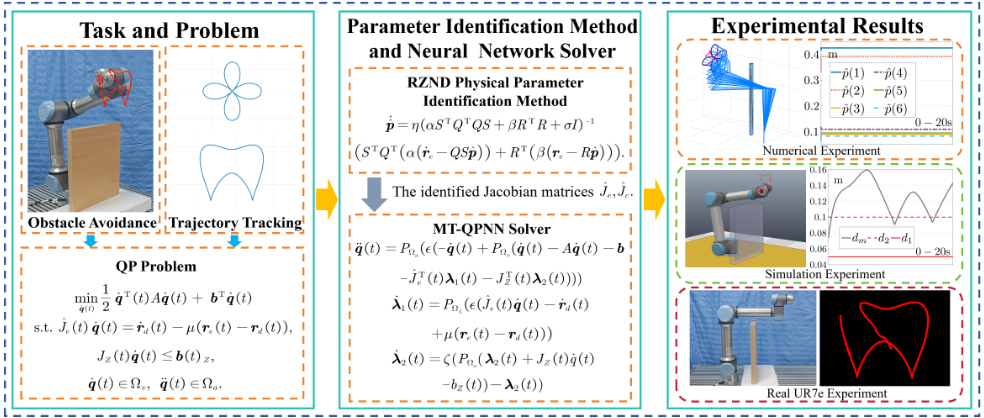
In this paper, we transform the collision-free trajectory tracking for redundant manipulators with unknown physical parameters under joint velocity and acceleration limits into a quadratic programming (QP) problem with multiple constraints. Then, the regularized zeroing neural dynamics (RZND) method to precisely identify the physical parameters and the multi-task quadruple projection neural network (MTQPNN) solver to deal with the corresponding QP problem and finally realize the control of manipulators are proposed. The whole research framework of this paper is shown in Figure 1. The main contributions are summarized as follows.
- We formulate the collision-free trajectory tracking for redundant manipulators with uncertain structure as a real-time QP problem that enforces tracking and obstacle-avoidance tasks, joint velocity and acceleration limits simultaneously.
- We develop a RZND physical parameter identification method based on regularization and zeroing neural dynamics. This presented method identifies the physical parameters with high precision and updates the Jacobian matrix online for the control of manipulators.
- We propose an MT-QPNN solver built on projection operators, which effectively realizes trajectory tracking and obstacle avoidance of manipulators under multiple joint constraints by leveraging the updated Jacobian matrix.
2 Methodologies and Problem
In this section, kinematic equations of redundant manipulators are first provided. Further, RZND identification method for unknown physical parameters and the obstacle avoidance method are proposed in detail, and then the corresponding QP problem is eventually formulated.
2.1 Forward Kinematics
It is well known that forward kinematics defines the mapping relationship between the joint space and the task space of manipulators. The forward kinematics of a redundant manipulator is commonly expressed as follows [Chen et al., 2024]:
where f(·) is a smooth nonlinear mapping that describes the forward kinematic relationship, q = [q1, q2, ..., qn]T ∈ Rn represents the joint angles and re(t) ∈ Rm denotes the endeffector position in the task space, where n > m. Then, differentiating (1) with respect to time t yields an expression regarding the joint velocity level:
where J(q(t)) = ∂f(q)/∂q ∈ Rm×n is the Jacobian matrix, which is used to describe the mapping relationship between the joint velocity and the end-effector velocity ˙re(t).
Based on (1), the error ε(t) ∈ Rm between the actual trajectory of the end-effector and the desired trajectory rd(t) ∈ Rm is defined as follows
By differentiating (3) with respect to time t and combining the velocity-level kinematic relation in (2), the error ˙ε(t) between the actual velocity of the end-effector and the corresponding desired velocity can be written as
2.2 RZND IdentificationMethod
In some uncertain practical scenarios, the physical parameters of the redundant manipulator are often difficult to obtain, with the corresponding Jacobian matrix unknown, which seriously affects the control and movement of the manipulator. To solve this problem, an RZND method is proposed in this paper that can accurately identify the unknown physical parameters of the manipulator based on the regularization and zeroing neural dynamics.
Assuming that the Jacobian matrix to be obtained is ˆ Je(t) ∈ Rm×n , and then based on the end-effector velocity error (4), it can be obtained that:
where ˙r∗ e (t) ∈ Rm represents the precise end-effector velocity obtained by sensors of the manipulator. In order to better identify the physical parameters, we first represent the endeffector position in a linear regression form:
where R(t) ∈ Rm×k is the regressor matrix determined by the joint angle q(t), k is the number of physical parameters for the manipulator and ˆ p(t) ∈ Rk is the vector of unknown physical parameters. Then, the Jacobian matrix is decomposed by vectorization as:
where S(t) ∈ R(m×n)×k is the vectorized regression matrix that depends on the joints of the manipulator.
In addition, due to the vectorization operation of Jacobian matrix, the form of the joint velocity ˙q(t) in (5) also needs to be rewritten:
where Q(t) ∈ Rm×(m×n) represents the mapping matrix constructed based on Kronecker product, which is used to expand the end-effector velocity equation (5) into a vectorized form, I ∈ Rm×m is the identity matrix.
Based on (5) and (6), it follows that:
where φp(t),φv(t) ∈ Rm are two errors that combine the position and velocity of end-effector, α > 0, β > 0. r∗ e (t) ∈
Rm is the end-effector position obtained from the sensors. Next, according to zeroing neural dynamics [He et al., 2025], the evolution formula of error φ(t) is written as:
where γ > 0. According to (10), taking the derivatives of (9a) and (9b) with respect to ˆ p respectively, it has
Combining (11a) and (11b), it follows
Finally, in order to prevent the matrix from becoming nonreversible due to weak excitation, a Tikhonov regularization term [Liu and Cao, 2025] is introduced. Thus, result (12) can ultimately be written as:
where η = γ/2; σ > 0 is a small positive constant; I ∈ Rk×k is the identity matrix.
2.3 Obstacle Avoidance Method
To prevent potential collisions between the redundant manipulator and surrounding obstacles, an obstacle avoidance constraint is introduced at the speed level. In general, each obstacle can be represented by one or several points that are closest to the manipulator, and the parts of the manipulator that are prone to collision are described by a set of key points. By monitoring the relative motion between each critical point and the corresponding obstacle point, an inequality constraint can be formulated to guarantee that the manipulator moves away from the obstacle, which is expressed as:
where JZ(t) = -sgn (⃗rC) ⋄ ˆ Jc(t) ∈ Rm×n and sgn(·) denotes a scalar signum function. Besides, the symbol ⋄ calculates that a ⋄ B = [a1B1, a2B2, ..., aℓBℓ]T, where a is a column vector and B is a matrix. The definition of ⃗rC is
where (xO, yO, zO) and (xC, yC, zC) respectively represent the three-dimensional coordinates of the obstacle point O and the key point C. Specifically, when the manipulator's structure is unknown, the key point C is not derived from the analytical kinematics calculation, but is determined through geometric detection based on the minimum distance between the manipulator and the obstacle. In addition, the corresponding Jacobian matrix ˆ Jc is calculated based on the identified physical parameters:
where ˆ p(t) denotes the identified parameters, and fJ(·) represents the mapping from the estimated physical parameters and joint angles to the local Jacobian matrix of the critical point C.
To avoid the discontinuity of ˙q(t) in (14), further smoothing processing of the constraints is designed as follows:
where bZ(t) = s(dm)max{JZ(t) ˙q(t)|dm=d1 , 0}, and the definition of s(dm) is
where dm denotes the distance between the critical point C and the obstacle point O. The parameter d1 denotes the safe distance, which depends on the link thickness of the manipulator. When the link of the manipulator collides with an obstacle, at this point dm is less than d1. The parameter d2 represents the effective distance of the obstacle avoidance. As the value of d2 increases, the movement of the redundant manipulator becomes safer. On the other hand, a larger operating space will reduce the flexibility of the manipulator and increase the computational cost. Therefore, the parameter d2 should be set to an appropriate value based on safety requirements and hardware performance.
2.4 QP ProblemwithMultiple Constraints
In this subsection, the trajectory tracking and obstacle avoidance tasks of redundant manipulators with uncertain structure are formulated as a QP problem in the joint velocity space. It imposes an equality constraint on the end-effector velocity and incorporates several inequality constraints, including joint velocity limits, joint acceleration limits, and obstacle avoidance conditions. By solving this QP problem at each control step, the computed joint velocity can simultaneously achieve precise closed-loop trajectory tracking, obstacle avoidance safety, and strict compliance with the physical limitations of the manipulator. The details are as follows:
where A = I ∈ Rn×n and b ∈ Rn . The joint velocity constraints are collected in the set Ωv = { ˙q(t) ∈ Rn | ˙q- ≤ ˙q(t) ≤ ˙q+}, while the set Ωa = {¨ q(t) ∈ Rn | ¨ q- ≤ ¨ q(t) ≤ ¨ q+} specifies the admissible joint acceleration. Together, they reflect the physical constraints of the redundant manipulator. The parameter µ > 0 is used to adjust the position error. Clearly, 0 ∈ Ωv, Ωa.
3 MT-QPNN Solver Design
For QP problem (19), Lagrange multipliers are introduced and the Karush-Kuhn-Tucker (KKT) optimality conditions [Boyd and Vandenberghe, 2004] are applied, thereby yielding the results that satisfy optimality, feasibility, and boundary constraints. The Lagrangian function associated with QP problem (19) is constructed in the following form:
Based on the KKT conditions, the steady state of QP problem (19) can be expressed as:
where i = 1, 2, ..., m, PΩv (y) = arg minz∈Ωv ‖y - z‖22 is a projection operator to handle the joint velocity limits. Then, equation (21) is further rewritten as follows:
where Ωo is a closed convex set that defines the allowable obstacle avoidance multiplier and it is nonnegative, i.e., Ωo = {λ2 (t) ∈ Rm | λ2(t) ≥ 0}.
Accordingly, inspired by the multiple projection method in [Zhang, 2022], the MT-QPNN solver for addressing QP problem (19) is proposed:
where ϵ > 0 and ζ > 0 represent adjustable gain parameters; ΩL = { ˙λ1(t) ∈ Rm | ˙λ-1 ≤ ˙λ1(t) ≤ ˙λ+1 } with ˙λ-1 and ˙λ+1 specifying the desired lower and upper limits of ˙λ1. Four sets Ωv, Ωa, ΩL, Ωo respectively bound joint velocity, joint acceleration, the derivative of the Lagrange multiplier and the obstacle avoidance multiplier.
Finally, with the combined effect of four projection operators PΩa (·), PΩv (·), PΩL (·), PΩo (·) and the RZND physical parameter identification method, the proposed MT-QPNN solver (23) not only enables the redundant manipulator to meet various physical limitations, but also effectively solves the obstacle avoidance and trajectory tracking problems in the case of unknown structure of the manipulator.
4 Experiments
This section is divided into three subsections. The first part describes the numerical experiment of the UR5 manipulator on MATLAB, and later the proposed method is compared with methods in [Xie et al., 2025a; Zhang and Zhang, 2025] and [Xie et al., 2025b]. The second part is the simulation experiment of the UR5 manipulator using CoppeliaSim. The last part is the real UR7e physical experiment. Specifically, all experiments are conducted on UR-series manipulators, for which the end-effector task dimension is m = 3 and the number of joints is n = 6.
4.1 Numerical Experiments
This subsection presents the numerical experiments on the MATLAB R2022a software, with the execution time T = 20 s. The experiment requires the UR5 manipulator to avoid the vertically placed triangular prism obstacle in real time, complete the trajectory tracking of the four-leaf clover trajectory, and accurately identify the parameters of each physical link of this redundant manipulator. The upper and lower bounds for the joint velocity constraints in this experiment are set as 0.6 rad/s and -0.6 rad/s respectively, and the upper and lower bounds for the joint acceleration constraints are set as 2rad/s2 and -2rad/s2 , and the limits for the derivative of the Lagrange multiplier in MT-QPNN solver (23) are set to 15 and -15.
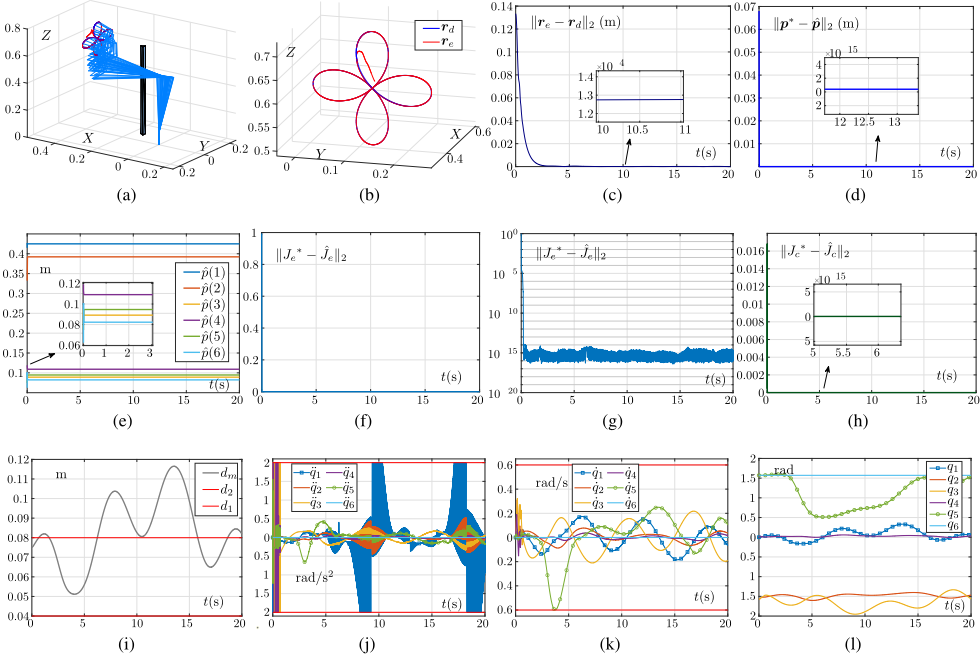
The related parameters of RZND method (13) for identifying the physical parameters are set as η = 4000, σ = 5×10⁻⁵ . The parameters of MT-QPNN solver (23) are set as ϵ = 6666, µ = 2 and ζ = 10000. In addition, since the physical parameters of the redundant manipulator are unknown, we set the initial state of the estimated parameters to ˆ p(0) = [0.415, 0.332, 0.0841, 0.119, 0.075, 0.062]T m. The obstacle is modeled as a regular equilateral triangular prism, whose three vertices are (0.14,-0.095, 0), (0.14,-0.075, 0) and (0.1573, -0.085, 0), and its height is 0.65 m. Finally, the initial joint angles are set to [0, -π/2, -π/2, 0, π/2, π/2]T rad, the initial joint velocity and joint acceleration are set to 0.
First, the experimental results are provided in Figure 2. In Figure 2a, the 20 s experimental process is depicted as a sampling graph that sampled every 0.5 s. Figures 2b and 2c show that the actual trajectory closely coincides with the desired trajectory, and the error norm of two trajectories converges rapidly to the order of 10-4 . Figures 2d and 2e present the results of the physical parameter identification of the UR5 manipulator, and it is obvious that each physical parameter is quickly and accurately identified. In Figures 2f and 2g, because of the high-precision physical parameters identification, the error norm between the estimated Jacobian matrix and true Jacobian matrix remains very small, with the accuracy reaching the order of 10-15 . Similarly, the Jacobian matrix of the critical point C derived from the identified physical parameters converges to the true value very quickly with high accuracy in Figure 2h. Figure 2i presents the curve of the minimum distance dm between the manipulator and the obstacle. The minimum distance is always higher than d1, which indicates that obstacle avoidance is effective and the safe distance is maintained. The changes in the joint acceleration, joint velocity, and joint angle of the manipulator during the experiment are listed in Figures 2j to 2l. Although the joint acceleration curves have many abrupt changes, they always comply with the pre-defined physical constraints.
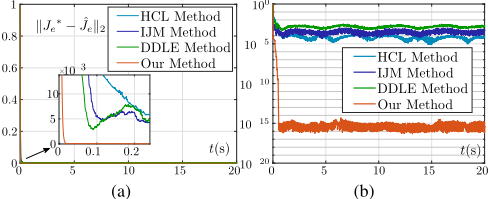
Next, the comparison experiments of the Jacobian matrix obtained by the proposed RZND method (13) and other methods are displayed in Figure 3, where the compared methods include the hierarchical control and learning network (HCL) in [Xie et al., 2025a], the improved Jacobian matrix estimation law (IJM) in [Zhang and Zhang, 2025], and the datadriven learning equation (DDLE) in [Xie et al., 2025b]. Figure 3a presents the error norm curves between the Jacobian matrices identified by four methods and the actual Jacobian matrices. Obviously, the Jacobian matrix identified by the proposed RZND method can converge to the true value more quickly and with higher accuracy. In Figure 3b, the corresponding accuracy of error norms is demonstrated, and it can be observed that our method drives the Jacobian identification error norm down to around 10-15 , which is about 10 orders of magnitude lower than the other three methods. Table 1 finally summarizes the comprehensive performance of the four studies. Our study is the only one that simultaneously enables parameter identification and obstacle avoidance while explicitly considering acceleration constraints, whereas the other three methods consider only joint velocity limits and each lacks at least one capability.
| Different studies | Parameter estimation | Obstacle avoidance | Physical limits |
|---|---|---|---|
| Our study | yes | yes | acceleration velocity velocity velocity |
| [Xie et al., 2025a] | yes | no | |
| [Zhang and Zhang, 2025] | no | no | |
| [Xie et al., 2025b] | no | yes |
4.2 Simulation Experiments
In this subsection, the simulation experiments are conducted on the MATLAB R2022a and CoppeliaSim 4.1.0 cosimulation platform. In the experiments, the desired trajectory to be tracked is a tooth pattern and the relevant physical constraints are ¨ q+ = [2.1, 2.2, 2.3, 2.4, 2.5, 2.6]T rad/s2 , ¨ q- = [-2.1,-2.2,-2.3,-2.4,-2.5,-2.6]T rad/s2 , ˙q+ = 0.7rad/s, ˙q- = -0.7rad/s and ˙λ+1 = 15, ˙λ-1 = -15. Besides, the related parameters of our method are set to η = 5000, α = 2, β = 4, ϵ = 6666, µ = 2 and ζ = 1000, respectively. Similarly, the initial joint angles are set to [0,-π/2,-π/2, 0, π/2, π/2]T rad and the initial joint velocity and joint acceleration of the manipulator remain zero. Specifically, the obstacle in this simulation is a thick wooden board, which is 0.4m long, 0.05m wide and 0.45m high. Finally, the base position of the UR5 manipulator is (0, 0, 0)m and the centroid position of the obstacle is (0.175, 0, 0.225) m.
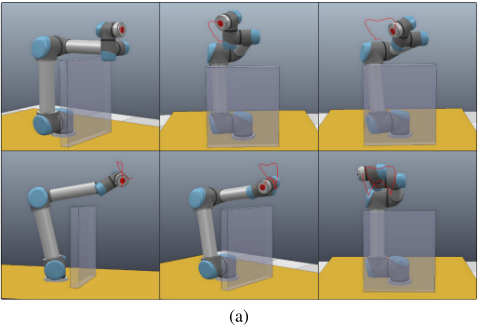
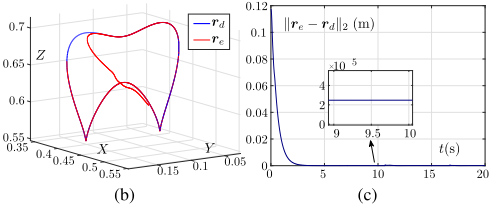
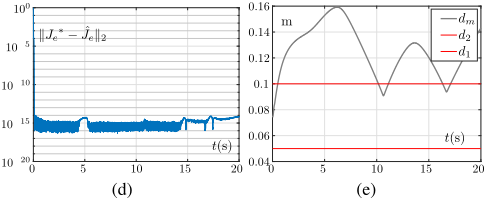
Figure 4 displays the results of this simulation, where the UR5 manipulator successfully avoids obstacles and tracks the tooth trajectory. In Figure 4a, six representative experimental snapshots are presented, and the manipulator obviously avoids the obstacle. In Figure 4b, the actual trajectory coincides with the desired trajectory, indicating excellent trajectory tracking performance. Figure 4c presents the convergence of the trajectory error norm, which rapidly and stably converges to 10-5 m. In Figure 4d, the error of the Jacobian matrix still converges to 10-15 , which proves that the proposed RZND method can accurately identify the parameters and obtain a very precise Jacobian matrix. Finally, Figure 4e exhibits the distance between the manipulator and the obstacle, and the motion of UR5 manipulator is always within the safe range in the simulation.
4.3 Real Experiments
In order to further validate the proposed MT-QPNN solver (23) in practical applications, this experiment is conducted on the real UR7e manipulator. The desired trajectory remains a tooth pattern, whose maximum radius is 0.1m. In addition, the thick wooden board with a length of 0.365m, a width of 0.035m and a height of 0.45m is used as the obstacle. The upper and lower constraints of the joint acceleration are ¨ q+ = 2.2rad/s2 and ¨ q- = -2.2rad/s2 , the parameter ϵ in MT-QPNN solver (23) is set to 2000 and the remaining parameters are consistent with the settings in Subsection 4.2.
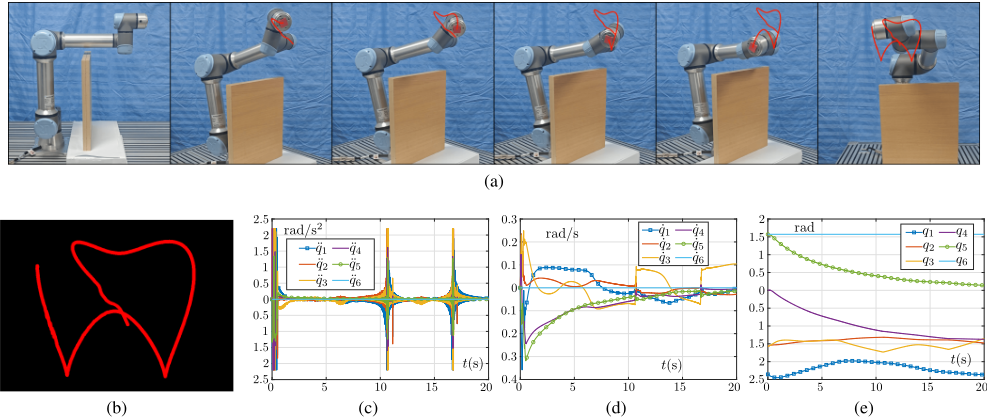
Figure 5 presents the results of trajectory tracking and obstacle avoidance on the UR7e manipulator. Figure 5a shows six snapshots taken every four seconds from 0 s to 20 s in the experiment. Under the MT-QPNN solver proposed in this paper, the UR7e manipulator accurately completes the trajectory tracking and obstacle avoidance tasks. Besides, the motion process of the end tool of the UR7e manipulator is captured in PyCharm 2023.3.4 using OpenCV and the actual trajectory is shown in Figure 5b. Figures 5c to 5e illustrate the joint variations of the UR7e manipulator during the experiment. The joint velocity and acceleration remain within their prescribed constraints and quickly become stable after short transient peaks, while the joint angle evolves smoothly and continuously over the whole movement, which indicates that the manipulator still moves stably under the imposed physical constraints. In summary, all these experiments in the above subsections well verify the effectiveness of the proposed RZND method (13) and MT-QPNN solver (23) in dealing with the parameter identification, obstacle avoidance and trajectory tracking of the redundant manipulator.
5 Conclusion
This paper addresses collision-free trajectory tracking for redundant manipulators with uncertain physical parameters under joint velocity and acceleration constraints, which is formulated as a QP problem. First, we propose a RZND method to identify the physical parameters of the redundant manipulator with high precision and concurrently to update the Jacobian matrix in real time. Based on this, an MT-QPNN solver is presented to solve the QP problem and thereby control the redundant manipulator to perform trajectory tracking and obstacle avoidance motions under multiple constraints. It is worth pointing out that compared with previous parameter identification or Jacobian matrix adaptive methods, the identified physical parameters and the updated Jacobian matrix obtained by the proposed RZND method have errors of only 10-15 compared with the true values. Finally, the superior performance of the proposed scheme is adequately verified through numerical, simulation and real experiments.
Acknowledgments
This work was supported by the Natural Science Foundation of Inner Mongolia Autonomous Region under Grant 2024QN06001.
@inproceedings{ijcai2026p693,
  title     = {Obstacle Avoidance and Trajectory Tracking of Redundant Manipulators with Unknown Physical Parameters Under Multiple Constraints},
  author    = {Jia, Lei and Deng, Hui},
  booktitle = {Proceedings of the Thirty-Fifth International Joint Conference on
               Artificial Intelligence, {IJCAI-26}},
  publisher = {International Joint Conferences on Artificial Intelligence Organization},
  editor    = {Diego Calvanese},
  pages     = {6228--6235},
  year      = {2026},
  month     = {8},
  note      = {Main Track},
  doi       = {10.24963/ijcai.2026/693},
  url       = {https://doi.org/10.24963/ijcai.2026/693},
}
TY - CPAPER TI - Obstacle Avoidance and Trajectory Tracking of Redundant Manipulators with Unknown Physical Parameters Under Multiple Constraints AU - Jia, Lei AU - Deng, Hui T2 - Proceedings of the Thirty-Fifth International Joint Conference on Artificial Intelligence, IJCAI-26 PB - International Joint Conferences on Artificial Intelligence Organization PY - 2026 SP - 6228 EP - 6235 DO - 10.24963/ijcai.2026/693 UR - https://doi.org/10.24963/ijcai.2026/693 ER -Copied
Machine-readable versions of this paper, for tools and AI agents:





