
X-FEMR: A Token-level Explainable Approach for Electronic Health Records Foundation Models using Transformer-based Models
Proceedings of the Thirty-Fifth International Joint Conference on Artificial Intelligence. AI and Health. Pages 6734-6742.
https://doi.org/10.24963/ijcai.2026/749
Keywords
- Health data mining: Health data mining
- EHR analysis: EHR analysis
- Multimodal data: Multimodal data
- Explainable AI: Explainable AI
- Clinical decision support system: Clinical decision support system
Abstract
Foundation Models for Electronic Health Records (FEMRs) are pretrained on large-scale structured patient data, enabling them to convert longitudinal patient trajectories into generalizable representations for diverse clinical prediction tasks. Despite their effectiveness, FEMRs remain black-box models, raising concerns about bias, interpretability, and clinical trust. To address this, we propose the first token-level explainability approach for FEMRs. We train a Transformer-based surrogate model on input-output pairs from the FEMR across two prediction tasks, approximating its behavior while preserving temporal dynamics. We identify the most influential tokens, providing insights into how FEMRs leverage different aspects of patient history for predictions. To evaluate clinical relevance, we introduce a novel clinical alignment metric that quantifies the correspondence between the surrogate model’s key tokens and clinically validated features. Our results demonstrate that the surrogate closely approximates FEMR predictions and that token-level explanations align well with clinical knowledge, offering a practical framework for interpretable and trustworthy clinical AI.
- [Abbas et al., 2025] Qaiser Abbas, Woonyoung Jeong, and Seung Won Lee. Explainable ai in clinical decision sup- port systems: A meta-analysis of methods, applications, and usability challenges. Healthcare, 13(17), 2025.
- [Ali et al., 2023] Sajid Ali, Tamer Abuhmed, Shaker El- Sappagh, Khan Muhammad, Jose M. Alonso-Moral, Roberto Confalonieri, Riccardo Guidotti, Javier Del Ser, Natalia Díaz-Rodríguez, and Francisco Herrera. Explain- able artificial intelligence (xai): What we know and what is left to attain trustworthy artificial intelligence. Informa- tion Fusion, 99:101805, 2023.
- [Almeida et al., 2026] Tiago Almeida, Plinio Moreno, and Catarina Barata. Prediction of 30-day hospital readmis- sion with clinical notes and ehr information. In Nuno Gonc ¸alves, Hélder P. Oliveira, and Joan Andreu Sánchez, editors, Pattern Recognition and Image Analysis, pages 220-232, Cham, 2026. Springer Nature Switzerland.
- [Bienefeld et al., 2023] Nadine Bienefeld, Jens Michael Boss, Rahel Lüthy, Dominique Brodbeck, Jan Azzati, Mirco Blaser, Jan Willms, and Emanuela Keller. Solv- ing the explainable AI conundrum by bridging clini- cians' needs and developers' goals. npj Digital Medicine, 6(1):94, May 2023. [BMJ, 2012] BMJ. A national early warning score for acutely ill patients. BMJ, 345, 2012.
- [Cavalcante et al., 2025] Guilherme J. Cavalcante, José Gabriel A. Moreira, Gabriel A. B. do Nascimento, Vincent Dong, Alex Nguyen, Thaís G. do Rêgo, Yuri Malheiros, Telmo M. Silva Filho, Carla R. Zeballos Torrez, James C. Gee, Anne Marie McCarthy, Andrew D. A. Maidment, and Bruno Barufaldi. Toward explainable ai approaches for breast imaging: adapting foundation models to diverse populations, 2025.
- [Deschepper et al., 2025] Mieke Deschepper, Chloë De Smedt, and Kirsten Colpaert. A literature-based approach to predict continuous hospital length of stay in adult acute care patients using admission variables: A single univer- sity center experience. International Journal of Medical Informatics, 193:105678, 2025.
- [Gokhale et al., 2023] Swapna Gokhale, David Taylor, Jaskirath Gill, Yanan Hu, Nikolajs Zeps, Vincent Le- quertier, Luis Prado, Helena Teede, and Joanne Enticott. Hospital length of stay prediction tools for all hospital admissions and general medicine populations: system- atic review and meta-analysis. Frontiers in Medicine, 10:1192969, August 2023.
- [Guo et al., 2024] Lin Lawrence Guo, Jason Fries, Ethan Steinberg, Scott Lanyon Fleming, Keith Morse, Catherine Aftandilian, Jose Posada, Nigam Shah, and Lillian Sung. A multi-center study on the adaptability of a shared foun- dation model for electronic health records. NPJ Digital Medicine, 7(1):171, 2024.
- [Guo et al., 2025] Fei Guo, Renchu Guan, Yaohang Li, Qi Liu, Xiaowo Wang, Can Yang, and Jianxin Wang. Foundation models in bioinformatics. Natl. Sci. Rev., 12(4):nwaf028, April 2025.
- [Hripcsak George et al., 2015] Hripcsak George, Duke Jon D., Shah Nigam H., Reich Christian G., Huser Vojtech, Schuemie Martijn J., Suchard Marc A., Park Rae Woong, Wong Ian Chi Kei, Rijnbeek Peter R., Van Der Lei Jo- han, Pratt Nicole, Norén G. Niklas, Li Yu-Chuan, Stang Paul E., Madigan David, and Ryan Patrick B. Obser- vational Health Data Sciences and Informatics (OHDSI): Opportunities for Observational Researchers. In Studies in Health Technology and Informatics. IOS Press, 2015.
- [Kaplan et al., 2020] Jared Kaplan, Sam McCandlish, Tom Henighan, Tom B. Brown, Benjamin Chess, Rewon Child, Scott Gray, Alec Radford, Jeffrey Wu, and Dario Amodei. Scaling Laws for Neural Language Models, January 2020. arXiv:2001.08361 [cs].
- [Lee et al., 2025] Hyeokjong Lee, Jaewon Kim, Sangmin Kwak, Azka Rehman, Sang Min Park, and Jooy- oung Chang. Optimizing retinal images based carotid atherosclerosis prediction with explainable foundation models. npj Digital Medicine, 8(1):582, September 2025.
- [Liu et al., 2019] Jianfang Liu, Elaine Larson, Amanda Hes- sels, Bevin Cohen, Philip Zachariah, David Caplan, and Jingjing Shang. Comparison of Measures to Predict Mor- tality and Length of Stay in Hospitalized Patients. Nursing Research, 68(3):200-209, May 2019.
- [Lundberg and Lee, 2017] Scott M Lundberg and Su-In Lee. A unified approach to interpreting model predictions. In I. Guyon, U. Von Luxburg, S. Bengio, H. Wallach, R. Fer- gus, S. Vishwanathan, and R. Garnett, editors, Advances in Neural Information Processing Systems, volume 30. Cur- ran Associates, Inc., 2017.
- [McDonald et al., 2003] Clement J McDonald, Stanley M Huff, Jeffrey G Suico, Gilbert Hill, Dennis Leavelle, Ray- mond Aller, Arden Forrey, Kathy Mercer, Georges De- Moor, John Hook, Warren Williams, James Case, Pat Mal- oney, and for the Laboratory LOINC Developers. LOINC, a Universal Standard for Identifying Laboratory Observa- tions: A 5-Year Update. Clinical Chemistry, 49(4):624- 633, April 2003.
- [Nelson et al., 2011] Stuart J Nelson, Kelly Zeng, John Kil- bourne, Tammy Powell, and Robin Moore. Normalized names for clinical drugs: Rxnorm at 6 years. Journal of the American Medical Informatics Association, 18(4):441- 448, 04 2011.
- [Rasmy et al., 2021] Laila Rasmy, Yang Xiang, Ziqian Xie, Cui Tao, and Degui Zhi. Med-BERT: pretrained contex- tualized embeddings on large-scale structured electronic health records for disease prediction. npj Digital Medicine, 4(1):86, May 2021.
- [Renc et al., 2024] Pawel Renc, Yugang Jia, Anthony E Samir, Jaroslaw Was, Quanzheng Li, David W Bates, and Arkadiusz Sitek. Zero shot health trajectory prediction us- ing transformer. NPJ Digit. Med., 7(1):256, September 2024.
- [Renc et al., 2025] Pawel Renc, Michal K Grzeszczyk, Nas- sim Oufattole, Deirdre Goode, Yugang Jia, Szymon Bie- ganski, Matthew B A McDermott, Jaroslaw Was, An- thony E Samir, Jonathan W Cunningham, David W Bates, and Arkadiusz Sitek. Foundation model of electronic med- ical records for adaptive risk estimation. Gigascience, 14(giaf107), January 2025.
- [Ribeiro et al., 2016] Marco Tulio Ribeiro, Sameer Singh, and Carlos Guestrin. "Why Should I Trust You?": Ex- plaining the Predictions of Any Classifier. In Proceed- ings of the 22nd ACM SIGKDD International Conference on Knowledge Discovery and Data Mining, pages 1135- 1144, San Francisco California USA, August 2016. ACM.
- [Ruan et al., 2025] Yucheng Ruan, Daniel J Tan, See-Kiong Ng, Ling Huang, and Mengling Feng. Towards accurate and reliable icu outcome prediction: a multimodal learn- ing framework based on belief function theory using struc- tured ehrs and free-text notes. Journal of Healthcare In- formatics Research, pages 1-42, 2025.
- [S Band et al., 2023] Shahab S Band, Atefeh Yarahmadi, Chung-Chian Hsu, Meghdad Biyari, Mehdi Sookhak, Rasoul Ameri, Iman Dehzangi, Anthony Theodore Chronopoulos, and Huey-Wen Liang. Application of ex- plainable artificial intelligence in medical health: A sys- tematic review of interpretability methods. Informatics in Medicine Unlocked, 40:101286, 2023.
- [Saraswat et al., 2022] Deepti Saraswat, Pronaya Bhat- tacharya, Ashwin Verma, Vivek Kumar Prasad, Sudeep Tanwar, Gulshan Sharma, Pitshou N Bokoro, and Ravi Sharma. Explainable AI for healthcare 5.0: Opportunities and challenges. IEEE Access, 10:84486-84517, 2022.
- [Sarker, 2021] Iqbal H Sarker. Machine learning: Algo- rithms, real-world applications and research directions. SN computer science, 2(3):160, 2021.
- [Simonyan et al., 2014] Karen Simonyan, Andrea Vedaldi, and Andrew Zisserman. Deep Inside Convolutional Networks: Visualising Image Classification Models and Saliency Maps, April 2014. arXiv:1312.6034 [cs.
- [Smith et al., 2019] Gary B Smith, Oliver C Redfern, Marco Af Pimentel, Stephen Gerry, Gary S Collins, James Malycha, David Prytherch, Paul E Schmidt, and Pe- ter J Watkinson. The National Early Warning Score 2 (NEWS2). Clinical Medicine, 19(3):260, May 2019.
- [Street et al., 2025] Andrew Street, Laia Maynou, Joanna M Blodgett, and Simon Conroy. Association between Hospi- tal Frailty Risk Score and length of hospital stay, hospital mortality, and hospital costs for all adults in England: a nationally representative, retrospective, observational co- hort study. The Lancet Healthy Longevity, 6(8):100740, August 2025.
- [Sundararajan et al., 2017] Mukund Sundararajan, Ankur Taly, and Qiqi Yan. Axiomatic attribution for deep net- works. In Proceedings of the 34th International Confer- ence on Machine Learning -Volume 70, ICML'17, page 3319-3328. JMLR.org, 2017.
- [Timilsina et al., 2025] Mohan Timilsina, Samuele Buosi, Muhammad Asif Razzaq, Rafiqul Haque, Conor Judge, and Edward Curry. Harmonizing foundation models in healthcare: A comprehensive survey of their roles, rela- tionships, and impact in artificial intelligence's advancing terrain. Computers in Biology and Medicine, 189:109925, 2025.
- [Tonekaboni et al., 2019] Sana Tonekaboni, Shalmali Joshi, Melissa D. McCradden, and Anna Goldenberg. What clin- icians want: Contextualizing explainable machine learning for clinical end use. In Finale Doshi-Velez, Jim Fackler, Ken Jung, David Kale, Rajesh Ranganath, Byron Wallace, and Jenna Wiens, editors, Proceedings of the 4th Machine Learning for Healthcare Conference, volume 106 of Pro- ceedings of Machine Learning Research, pages 359-380. PMLR, 09-10 Aug 2019.
- [Verma, 2024] Amol A. Verma. Toward the Rigorous Eval- uation of Early Warning Scores. JAMA Network Open, 7(10):e2438966, October 2024.
- [Wang et al., 2025] Song Wang, Yishu Wei, Haotian Ma, Max Lovitt, Kelly Deng, Yuan Meng, Zihan Xu, Jingze Zhang, Yunyu Xiao, Ying Ding, Xuhai Xu, Joydeep Ghosh, and Yifan Peng. A multi-stage large language model framework for extracting suicide-related social de- terminants of health. Commun. Med. (Lond.), 5(1):404, September 2025.
- [Wellner et al., 2017] Ben Wellner, Joan Grand, Elizabeth Canzone, Matt Coarr, Patrick W Brady, Jeffrey Simmons, Eric Kirkendall, Nathan Dean, Monica Kleinman, Peter Sylvester, et al. Predicting unplanned transfers to the in- tensive care unit: a machine learning approach leverag- ing diverse clinical elements. JMIR medical informatics, 5(4):e8680, 2017.
- [Wornow et al., 2023a] Michael Wornow, Rahul Thapa, Ethan Steinberg, Jason Fries, and Nigam Shah. Ehrshot: An ehr benchmark for few-shot evaluation of foundation models. 2023.
- [Wornow et al., 2023b] Michael Wornow, Yizhe Xu, Rahul Thapa, Birju Patel, Ethan Steinberg, Scott Fleming, Michael A Pfeffer, Jason Fries, and Nigam H Shah. The shaky foundations of large language models and foun- dation models for electronic health records. npj digital medicine, 6(1):135, 2023.
- [Yin et al., 2025] Pengfei Yin, Abel Armas Cervantes, and Daniel Capurro. Measuring and visualizing healthcare process variability. Journal of Biomedical Informatics, 170:104918, 2025.
- [Young et al., 2003] Michael P. Young, Valerie J. Gooder, Karen McBride, Brent James, and Elliott S. Fisher. Inpa- tient transfers to the intensive care unit: Delays are asso- ciated with increased mortality and morbidity. Journal of General Internal Medicine, 18(2):77-83, February 2003.
References were extracted automatically from the PDF and may contain errors.
Full text extracted automatically from the PDF; figures, tables and equations may differ. The PDF is the version of record.
1 Introduction
Foundation models (FMs) are trained on large-scale and diverse datasets using self-supervised objectives, learning to acquire general-purpose representations that can be efficiently adapted to a wide range of downstream tasks [Guo et al., 2025]. The use of abundant data, transformer-based architectures, and advances in optimization and model scaling has produced models with strong transferability and emergent capabilities [Kaplan et al., 2020]. Consequently, FMs often outperform task-specific systems, reducing the need for extensive task-dependent supervision and making them well-suited for complex, data-rich domains, such as healthcare.
In the field of medical artificial intelligence (AI), FMs have primarily been developed along two major lines, reflecting the heterogeneous nature of clinical data. The first stream focuses on unstructured clinical text, creating Clinical Language Models (CLaMs), which are trained on narrative notes and reports. While CLaMs have demonstrated strong performance in extracting information from unstructured clinical narratives, a substantial portion of clinically relevant information is encoded in structured electronic health records (EHRs), which capture longitudinal diagnoses, procedures, medications, and their temporal relationships. Consequently, increasing attention has shifted toward FMs for structured EHR data. These models learn from longitudinal sequences of coded clinical events to capture temporal patterns in patient trajectories, which are referred to as FMs for EHRs (FEMRs) [Wornow et al., 2023b], include ETHOS [Renc et al., 2025] and CLMBR-T-Base [Wornow et al., 2023a].
∗Corresponding author.
Despite their strong empirical performance, the translation of FEMRs into clinical practice remains limited. First, their internal representations and decision mechanisms are largely opaque [Wang et al., 2025], limiting interpretability for clinicians and model developers. Second, while interpretability tools for clinical language models have rapidly matured, they mainly focus on traditional machine learning approaches [S Band et al., 2023; Abbas et al., 2025], and thus comparable explainability frameworks for FEMRs are still underdeveloped. Third, FEMRs are typically trained on institutionspecific datasets constrained by privacy and governance policies, which can encode local practice patterns and biases, thereby raising concerns regarding robustness and generalizability across healthcare settings. Consequently, there is limited understanding of how these models reason over patient histories and temporal event sequences. Together, these limitations motivate the need for explainable FEMRs that provide transparent and clinically meaningful explanations of their representations and predictions. Evaluations for explainability in FEMRs are also lacking due to the absence of explainable methods for FEMRs.
A broad range of explainable AI (XAI) techniques have been proposed to interpret complex machine learning models. Prominent examples include feature-attribution methods such as SHAP [Lundberg and Lee, 2017], which quantify the contribution of individual input features to model predictions, as well as gradient-based approaches like saliency maps [Simonyan et al., 2014], and perturbation-based methods like LIME [Ribeiro et al., 2016]. However, their effectiveness is substantially limited when applied to FMs. FMs operate on high-dimensional, distributed representations and often rely on complex internal interactions across long contexts, making it difficult to meaningfully attribute predictions to individual input features. Moreover, post hoc attribution methods typically assume a fixed input-output mapping, whereas FMs produce task-agnostic latent representations that are reused across multiple downstream tasks. As a result, existing XAI techniques often yield explanations that are unstable, difficult to interpret clinically, or misaligned with the reasoning processes of FMs. This highlights the need for explanation methods that are specifically designed for foundation-scale architectures.
Recent studies have begun to explore XAI techniques for FEMRs, but this line of work has mainly focused on Large Language Models (LLMs) for general purpose. Saraswat et al. [Saraswat et al., 2022] proposed a four-axis taxonomy for XAI, encompassing data explainability, model explainability, post hoc explainability, and explanation assessment. Within this framework, recent XAI research has emphasized the role of proxy representations, interpretable surrogate models that approximate the behavior of black-box systems. As discussed by [Saraswat et al., 2022], proxy models served as intermediate, human-aligned representations that enabled inspection of how a deep model responds to clinically relevant features, even when its internal states are not directly accessible. By introducing an interpretable bottleneck or fitting transparent surrogates such as linear or additive models, proxy representations map complex temporal EHR inputs into a lower-dimensional semantic space that clinicians can reason about. This approach facilitates attribution analysis, detection of spurious feature dependencies, and assessment of whether model behavior aligns with established clinical reasoning. However, the current surrogate models, such as linear regression, and Decision tree (DT), generally assume that the data is smooth linear [Sarker, 2021], which is not true for EHRs.
Despite advances in these surrogate models, most approaches still focus mainly on feature-level explanations. In contrast, FMs generate predictions one token at a time using an autoregressive learning process. This allows for tokenlevel explainability, which can be especially useful in clinical settings. For example, knowing which specific words or values in a patient's record influenced a model's prediction can help clinicians better understand the reasoning behind AI recommendations and improve clinical scoring methods or practice guidelines [Tonekaboni et al., 2019]. Some recent studies have explored token-level explanations in general LLMs using methods like Integrated Gradients (IG), a gradient-based technique that assigns importance scores to each token in a text [Sundararajan et al., 2017; Ali et al., 2023]. However, IG can be fragile in identifying the right features and may give inconsistent explanations [Ali et al., 2023]. Despite its potential, token-level explainability remains rare in clinical applications, particularly for longitudinal EHRs.
Another challenge in explaining predictions from EHR data is their temporal nature. Beyond identifying which clinical variables are important, it is important to knowwhen they influence the prediction. Token-level explainability offers this finer-grained insight, identifying the specific variables and time points that drive model outputs. However, common surrogate models, such as logistic regression, struggle to capture these temporal dynamics, limiting their effectiveness for interpretable predictions in longitudinal EHR data. Furthermore, the evaluation of explainability itself remains an open challenge, with few quantitative metrics available to assess whether explanations align with clinical knowledge or decision-making.
In this work, we propose the first token-level explainability approach for FEMRs. Specifically, we introduce a transformer-based surrogate model to approximate the inputoutput behavior of FEMRs, enabling the capture of temporal dynamics in EHRs for more reliable explanations. In addition, we develop a clinically validated evaluation metric that quantitatively measures the quality of the model explanations. Our experiments on two distinct clinical datasets and tasks show that the surrogate model closely approximates the behavior of FMs in EHRs while achieving comparable predictive performance. Moreover, token-level explainability demonstrates stronger alignment with clinical tasks with the ratio of 0.3, suggesting the effectiveness of our approach. This work lays the foundation for more interpretable and clinically actionable AI in longitudinal EHR analysis.
2 RelatedWork
FMs trained on structured EHR data, such as ETHOS [Renc et al., 2025], CLMBR-T-Base [Wornow et al., 2023a], and Med-BERT [Rasmy et al., 2021], have demonstrated strong performance on a range of clinical tasks. These models support applications including treatment recommendation and 30-day hospital readmission prediction, particularly after task-specific fine-tuning [Almeida et al., 2026; Timilsina et al., 2025].
Traditional interpretable models, including probabilistic approaches such as Na¨ıve Bayes and sequence models like Hidden Markov Models, provide intuitive explanations through explicit probability distributions and state transition structures. However, these models lack the capacity to capture the complexity of modern learning systems. Recent advances in explainable artificial intelligence have enabled post hoc interpretation of deep learning models, improving transparency and supporting clinical adoption [Bienefeld et al., 2023]. Common approaches include feature attribution methods, gradient based explanations, and surrogate models. Nonetheless, these techniques remain limited when applied to foundation scale models.
Research on the interpretability of FMs is still sparse and has largely focused on medical imaging. More specifically, prior work has explored explainability for vision FMs in retinal and breast imaging applications [Lee et al., 2025; Cavalcante et al., 2025]. However, explainability methods for FEMRs are largely unexplored, leaving their internal reasoning processes insufficiently understood.
3 Methodology
In this section, we present our explainability pipeline for analyzing FEMRs. We first describe its overall design, highlighting the integration of proxy representations with token-level interpretation. We then apply the pipeline to FEMRs on clinically relevant prediction tasks to assess their explainability.
3.1 Overview of Explainability Pipeline
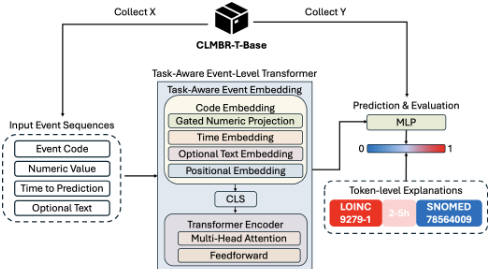
We propose an explainability pipeline that leverages a surrogate model to approximate the behavior of FEMRs and to enable explanations, as illustrated in Figure 1. The pipeline trains a transformer-based surrogate on the input-output mappings of the target FEMRs and applies token attribution methods, such as SHAP, to quantify the contribution of individual token. This approach aims to open the black box of the FMs, revealing how it processes complex patient data to generate predictions. Our focus is primarily on token-wise explainability, assessing which clinical inputs most influence model outputs. This information helps clinicians interpret predictions and understand the factors driving model decisions. Additionally, we propose a novel clinical alignment metric that evaluates how closely the tokens identified by our surrogate models correspond to clinically validated features, thereby assessing the extent to which the surrogate's explanations align with established medical knowledge.
To gain deeper insight into the FEMRs, we run the pipeline under two supervision settings. In the first setting, the surrogate is trained on the binary predictions of FEMRs as hard labels, capturing the model's actual decisions. In the second, it is trained on the predicted probabilities as soft labels, reflecting the nuanced confidence of the models. Comparing token contributions and training dynamics across these settings allows us to distinguish the factors driving observed decisions from those influencing internal uncertainty, revealing where and how the model may deviate from optimal or clinically meaningful behavior. We will first present the data collection pipeline for the FMs, followed by the surrogate model development and explainability analyses.
3.2 Data Collection fromFEMRs
Data format. FEMRs are trained on longitudinal, patientlevel event sequences. Each patient's EHR can be viewed as a time-ordered sequence of clinical events, characterized by irregular time intervals, heterogeneous event types, and codes from multiple medical coding systems. Some events additionally contain numeric values, such as laboratory measurements or vital signs, making EHR data both temporally and semantically complex. In practice, although EHR data are sequential, they are typically stored in structured tables. A widely adopted and standardized representation is the OMOP Common Data Model 1 (OMOP-CDM), which organizes clinical events into relational tables with consistent formats across institutions. In this work, we construct patient-level event sequences from raw data following the OMOP-CDM schema. Each patient's trajectory is represented as chronologically ordered sequences of clinical events. Each event is characterized with four features:
- Code (ct) - e.g., SNOMED CT, LOINC, RxNorm
- Numeric value (nt) -e.g., lab results
- Text field (ut) - e.g., descriptions, notes, or categories
- Timestamp (tevent) - the time of the recorded event
The code refers to standardized medical terminologies and coding systems used to describe and categorize various types of health information, such as LOINC for laboratory tests[McDonald et al., 2003] and RxNorm for medications[Nelson et al., 2011]. The numeric and text fields contain additional information about the corresponding medical code.
Collection of Input-Output Pairs. For each prediction task, we define a prediction time Ti for patient record i. The input to the FEMR consists of the patient's historical EHR data recorded prior to Ti. Formally, each patient record is represented by a time-ordered sequence of clinical events as:
and each event etk = (ck, nk, uk, tk) includes a medical code ck, a numeric value nk, a text field ut, and a timestamp tevent. The FEMR encodes the event sequence Xi into a patient-level representation and produces a prediction for the target task. This process produces two forms of output, which are continuous probabilities (soft labels) and binary labels based on a 0.5 threshold (hard labels) for classification tasks. Both types of labels are used with their corresponding inputs as pairs to train the surrogate model and to evaluate token alignment and interpretability.
3.3 Surrogate Model Development
EHR data is typically long and contains irregular, heterogeneous variables and nonlinear patterns, which simple surrogate models cannot capture effectively. Therefore, we employ a transformer-based surrogate model, which can represent these complex sequences and construct accurate proxy representations of the FEMR.
1 https://www.ohdsi.org/data-standardization/
We propose an event-level transformer encoder to model longitudinal EHR sequences. Each patient record is represented as an ordered sequence of clinical events occurring before the prediction time, and the model produces a sequencelevel prediction.
To capture the irregular time gaps between events, we represent each event by its time-to-prediction interval, enabling the model to reason about the relative timing of events. Specifically, given the event timestamp tevent and the prediction time T , we define
which is measured in hours. To mitigate the long-tailed distribution of time intervals, ∆t is log-transformed and normalized using statistics estimated from the training set, and used as a continuous time feature.
Then, each raw clinical event contains four different feature types (code, numeric value, text value, time delta) shown as:
For encoding part, each event token is initialized with a learned code embedding, augmented with a text embedding. Numerical values are included via a gated injection mechanism, which means the projected numeric embedding is adjusted by a content-dependent gate computed from the current event representation. To encode temporal information, we project the normalised time-to-prediction feature of each event into the model dimension and adding it to the token representation. Learnable positional embeddings are added, followed by layer normalization and dropout.
The sequence of event embeddings is processed by a multilayer transformer encoder to capture temporal dependencies among events. A [CLS] token is then prepended to summarize the sequence, and the final [CLS] representation is fed into a task-specific prediction head for hard-label or soft-label supervision.
Hard-label Supervision. In this setting, the surrogate model is trained to predict the binary outputs of FEMR (e.g., ICU transfer vs. non-transfer). This approach focuses on capturing the final decision boundary of FEMR.
Soft-label Supervision. In this approach, the surrogate model is trained to predict the raw probability outputs of the FEMR, enabling a more nuanced approximation of the confidence and internal decision-making process of the FMs. This extends beyond binary classification to suit multiclass classification and regression tasks.
This comparison further allows us to analyze how the choice of supervision influences the learned token importance patterns, providing insights into how closely the surrogate reflects the underlying decision logic of FMs. We use both surrogate models for subsequent SHAP-based token attribution analysis.
3.4 Token-Level Clinical Explainability
To evaluate how well the surrogate model explains the CLMBR-T-Base in a clinically meaningful way, we perform a token-level analysis using SHAP. The goal is to determine whether the token identified as important by the surrogate model correspond to known clinical predictors of downstream tasks.
For each patient and each event i in the EHR sequence j, SHAP assigns a value to each token that quantifies its contribution to the model prediction. This produces a map of token importance across all events in the dataset. Meanwhile, we define a set of clinically relevant tokens based on different clinical evidence.
To quantify the alignment between SHAP attributions and clinical knowledge, we count how often each token is assigned importance by the surrogate model:
where D is the dataset and occurrence(fj, xi) is the number of times token fj appears in patient record xi. The clinical validated events ratio is then defined as:
where F is the set of all tokens from SHAP analysis, and Fc ⊆ F denotes the subset of clinically relevant tokens. A higher R indicates greater alignment of the surrogate model's explanations with established clinical knowledge.
We compute R for surrogate models trained under hardlabel (binary predictions) and soft-label (predicted probabilities) supervision. This allows us to evaluate which surrogate better captures clinically meaningful reasoning from the CLMBR-T-Base. This analysis converts abstract SHAP values into a quantitative, interpretable metric. It enables us to assess not only whether the surrogate reproduces the predictions of CLMBR-T-Base, but also whether the tokens driving these predictions are consistent with known clinical knowledge.
4 Experimental Setup
4.1 Patient Cohort and Tasks
Cohort. We used the EHRSHOT dataset due to its largescale, longitudinal EHR records, which provide rich temporal information for modeling patient trajectories [Wornow et al., 2023a]. The dataset contains records for 6,739 patients with a wide range of trajectory lengths. The longest patient sequence includes 199,913 events, reflecting the high variability and complexity of real-world EHR data. To ensure compatibility with transformer-based surrogate models to handle reasonable long sequences, we selected the top 75% of patient records based on trajectory length.
Tasks. We focus on two classification tasks: long length of stay(LOS) and ICU transfer. The first task including predicting whether a patient's total LOS during a visit to the hospital will be at least 7 days. LOS is a key factor of both patient outcomes and healthcare costs [Yin et al., 2025]. The prediction time is at 11:59pm on the day of admission, and visits that last less than one day (i.e. discharge occurs on the same day of admission) are excluded. The second task involves predicting whether a patient will be transferred to the ICU during their hospital stay. Predictions are made at 11:59 pm on the day of admission, and ICU transfers occurring on the admission day are excluded [Wornow et al., 2023a]. Both tasks represent common clinical prediction problems that focus on forecasting patient outcomes.
| Statistic | LOS | ICU Transfer |
|---|---|---|
| Min | 6 | 6 |
| Mean | 2,453 | 2,418 |
| 75% | 3,928 | 3,838 |
| Max | 7,888 | 7,888 |
The final study cohorts after preprocessing consist of 4,868 and 5,275 longitudinal records for LOS and ICU transfer prediction tasks, respectively. As shown in Table 1, the length of patient trajectories varies substantially, ranging from 6 to 7,888 clinical events, with an average of ∼2,400 events.
4.2 Model Implementation
Foundation Model. The FEMR used for our explainability analysis is CLMBR-T-Base [Guo et al., 2024], a 141M-parameter autoregressive model trained on 2.57 million de-identified longitudinal EHRs from the EHRSHOT dataset [Wornow et al., 2023a] at Stanford Medicine. CLMBR-T-Base is currently the only FEMR with publicly available weights, enabling reproducible analyses.
Surrogate Model. For both surrogate modeling tasks, we split the dataset into approximately 80% training, 10% validation, and 10% test sets, using stratified sampling to preserve the label distribution across splits. The split is performed at the patient level to ensure that records from the same patient do not appear in multiple sets, thereby preventing potential data leakage. For modeling, we use a Transformer encoder with 3 layers, and each layer has a hidden dimension of 128 and 4 attention heads. The feedforward network size is 256, and GELU (Gaussian Error Linear Unit) is used as the activation function. A dropout rate of 0.2 is applied, and prenormalization is adopted to improve training stability. The maximum input sequence length is set to 2048. Under both training strategies, the model is trained using the Adam optimizer with a learning rate of 10-4 , a batch size of 16, and up to 100 training epochs. Early stopping is applied based on the validation Area Under the Precision-Recall Curve (AUPRC), and training is terminated if no improvement is observed for 20 consecutive epochs. The model is trained on a single GPU, which accelerates training for long sequences and Transformer-based models.
To further improve surrogate model training with soft labels, we apply a logit transformation to the predicted probabilities produced by the CLMBR-T-Base. This transformation maps probability values into the log-odds space, expanding small differences that would otherwise be compressed near zero or one. By operating in the logit domain, the soft labels provide richer supervisory signals and yield more informative gradients during backpropagation, leading to more stable and effective surrogate model optimization.
| Clinical Validated Features | Code |
|---|---|
| Patient's diagnosis, comorbidi- ties | ICD-10-CM 1 |
| Hospital Frailty Risk Score | 109 specific ICD-10 diag- nostic codes found in a pa- tient's hospital records (cur- rent and past 2 years) |
| Physiological measurement (in- cluding heart rate, blood pres- sure, temperture, oxygen satu- ration) | National Early Warning Score (including LOINC/9279-1 LP21258-6 LOINC/88658-0 LOINC/LP201613-9 LOINC/LP409229-4 LOINC/LA17976-4 LOINC/LA19825-1 LOINC/2019-8 SNOMED/413444003 LOINC/8310-5 LOINC/8480-6 SNOMED/271649006 LOINC/8867-4 SNOMED/78564009 LOINC/38214-3) |
4.3 Evaluation
Clinical Validated Features. Multiple studies have proven that patient's diagnosis, laboratory, comorbidity variables and severity of illness(SOI) are all strong predictors of LOS [Deschepper et al., 2025; Street et al., 2025; Gokhale et al., 2023; Liu et al., 2019]. We summarized those validated clinical variables in Table 2 [Deschepper et al., 2025]. This provides clinical evidence to evaluate explainability using the proposed clinical alignment metric.
For ICU transfer, it is a significant predictor of mortality, morbidity, and healthcare costs [Young et al., 2003]. The task about ICU transfer are related to the National Early Warning Score (NEWS2), which aggregates vital signs and physiological measurements known to predict early clinical deterioration, including six physiological parameters: respiratory rate, oxygen saturation, supplemental oxygen, hypercapnic respiratory failure, temperature, systolic blood pressure, heart rate, and AVPU score [BMJ, 2012; Smith et al., 2019; Verma, 2024]. Table 3 displaying the clinically validated features used for ICU transfer tasks in explainability evaluations [Hripcsak George et al., 2015].
1 ICD-10-CM: International Classification of Diseases, 10th Edition, Clinical Modification
| Clinical Validated Features | Code |
|---|---|
| Respiratory rate | LOINC/9279-1 |
| Oxygen saturation | LP21258-6 |
| Use of supplemental oxygen | LOINC/88658-0 LOINC/LP201613-9 LOINC/LP409229-4 LOINC/LA17976-4 LOINC/LA19825-1 |
| Hypercapnic respiratory failure | LOINC/2019-8 SNOMED/413444003 |
| Temperature | LOINC/8310-5 |
| Systolic blood pressure | LOINC/8480-6 SNOMED/271649006 |
| Heart rate | LOINC/8867-4 SNOMED/78564009 |
| AVPU (Alert, Voice, Pain, Un- responsive) Score | LOINC/38214-3 |
5 Results
5.1 CLMBR-T-Base Prediction Results
The CLMBR-T-Base predictive ability on two tasks is summarized in Table 4. For the LOS dataset, it contains 1,274 positive samples out of 5,257, giving a positive rate of 24.2%. The CLMBR-T-Base achieves an AUROC of 0.7046 and an AUPRC of 0.4173, and shows a precision of 0.4556 and a recall of 0.3140. Overall, the CLMBR-T-Base demonstrates a reasonable performance on the LOS prediction task as it achieves an AUPRC nearly two times higher than the baseline positive rate (24.2%), suggesting meaningful performance gains. To provide further context for these results, previous studies on predicting prolonged length of stay have reported AUROC in the range of 0.72-0.77 and AUPRC around 0.340.36 for a wide range of machine learning and deep learning models on EHR datasets [Ruan et al., 2025]. Although the datasets differ, this suggests that CLMBR-T-Base performs competitively against existing benchmarks in the literature.
The ICU transfer dataset is highly imbalanced, with only 213 positive samples out of 4,868, giving a positive rate of only 4.4%. It can be seen from the Table 4, the CLMBRT-Base achieves an AUROC of 0.7282 and an AUPRC of 0.1592. Although the overall classification performance remains challenging, as indicated by the low recall (0.0704) and F1 score (0.1149), the model overperforms the baseline positive rate. It achieves an AUPRC that is more than three times higher than the prevalence of ICU transfer events. Previous studies on ICU transfer tasks have often reported the AUROC as the primary evaluation metric, with values ranging from 0.85-0.90 [Wellner et al., 2017]. Although the AUROC achieved by CLMBR-T-Base on this task is lower than that reported for some other models, direct comparison is difficult due to differences in datasets used and the definitions of the outcomes. Moreover, AUROC alone may be inadequate for understanding model performance in highly imbalanced settings. In this context, the substantial improvement in AUPRC
suggests that, despite the severe class imbalance, CLMBR-TBase can capture informative signals for ICU transfer risk.
5.2 Surrogate Model Comparison
To validate whether the support model can match or exceed the performance of the FEMRs and ensure reliable explainability, we also evaluated the performance of the transformer models on both tasks, as shown in Table 5, using both hard labels and soft labels. For the LOS task, the performance on hard labels shows better results than the FEMR, demonstrating the effectiveness of the surrogate model. Specifically, the surrogate model's AUPRC achieves 0.4434 compared to CLMBR-T-Base's 0.4173, and the surrogate model's F1-score achieves 0.4889 compared to CLMBR-T-Base's 0.3717, indicating that the surrogate model can provide reasonable and reliable approximation of FM's predictive behavior. Regarding the soft labels, it underperforms compared to the CLMBR-T-Base, showing the surrogate model's AUPRC achieves 0.3903 compared to CLMBR-T-Base's 0.4173. This is possibly due to soft-label supervision relies on probability outputs, where predictions slightly above decision threshold (e.g., 0.5) are actually weak positives. A similar trend is observed for the ICU transfer tasks. Therefore, we adopted the surrogate model under hard-label supervision for the following explainability analysis.
5.3 SHAP Analysis Results
For four features of each event, we find that numerical values (e.g., laboratory measurements) and time delta (i.e., duration of events) contributed most significantly, while text and code contributed less. This is because these two features contain the patient's clinical information: numerical values indicate whether the patient experienced the corresponding clinical event and the specific value of the event; time differences represent the patient's medical history over time.
Clinical Validated Events Ratio We summarize the most common codes in tokens in Table 6 and list the clinical validated events ratio for these two prediction tasks in Table 7.
Table 6 shows that the most influential tokens are primarily composed of clinical events; the top five are separately heart rate, systolic blood pressure (SBP), body temperature, diastolic blood pressure (DBP), respiratory rate, and oxygen saturation. We find that the most frequent codes in tokens correspond to clinical validated features we investigated in two prediction tasks, including heart rate, blood pressure, respiratory status, oxygen saturation. This provides token-level evidence that the model's predictions are primarily driven by these clinical validated events, and our identified tokens are clinically meaningful.
Table 7 shows the clinical alignment metric associated with LOS and ICU transfer in surrogate models. In the LOS prediction task, the clinical validated events are 2,257, ratio is 0.3093. This number corresponding to the top 5 most frequent codes in tokens totaled 2,109, accounting for 29% of the total events. A similar trend is observed in the ICU transfer prediction task, showing the top 5 most frequent codes in tokens totaled 1786, representing 24% of the total events, while clinical validated events are 1,985, accounting for 27.17%. That implies the clinical validated events are highly concentrated in the most frequent clinical codes.
| Prediction Task | AUROC | AUPRC | Accuracy | Precision | Recall | F1-score |
|---|---|---|---|---|---|---|
| LOS | 0.7046 | 0.4173 | 0.7428 | 0.4556 | 0.3140 | 0.3717 |
| ICU Transfer | 0.7282 | 0.1592 | 0.9525 | 0.3125 | 0.0704 | 0.1149 |
| LOS | ICU Transfer | |||
|---|---|---|---|---|
| Metric | Hard-label | Soft-label | Hard-label | Soft-label |
| AUROC | 0.7637 | 0.7968 | 0.8235 | 0.9351 |
| AUPRC | 0.4434 | 0.3903 | 0.2701 | 0.2656 |
| Precision | 0.4104 | 0.3429 | 1.0000 | 0.0000 |
| Recall | 0.6044 | 0.2105 | 0.2500 | 0.0000 |
| Accuracy | 0.7677 | 0.8626 | 0.9938 | 0.9959 |
| F1-score | 0.4889 | 0.2609 | 0.4000 | 0.0000 |
| Prediction Task | Code (Event Name) | Frequency |
|---|---|---|
| LOINC/8867-4(Heart rate) | 806 | |
| LOINC/8480-6(SBP) | 412 | |
| LOS | LOINC/8310-5 | 325 |
| (Body temperature) | ||
| LOINC/8462-4(DBP) | 308 | |
| LOINC/9279-1(Respiratory rate) | 258 | |
| LOINC/8867-4(Heart rate) | 581 | |
| LOINC/8310-5 | 405 | |
| ICU transfer | (Body temperature) | |
| LOINC/8480-6(SBP) | 314 | |
| LOINC/8462-4(DBP) | 272 | |
| LOINC/LP21258-6 | 214 | |
| (Oxygen saturation) |
| Prediction Task | No. of Clinical Validated Events | Ratio |
|---|---|---|
| LOS | 2,257 | 0.3093 |
| ICU transfer | 1,985 | 0.2717 |
6 Discussion
Our surrogate design allows us to examine not only what the FEMR predicts, but how it uses different tokens to make those decisions. More importantly, this comparison moves beyond traditional performance metrics and provides an interpretable, token-level evaluations of how the surrogate model aligns with the FEMR. This clinical validated events ratio quantifies an approximate estimate of how many validated clinical events are involved in the model prediction, which helps selecting clinically meaningful events for model training in the future. However, the limitation in this study lies in the alignment problem between the original black box model and the surrogate model. This mismatch can be attributed to several factors: (1) longitudinal patient trajectories are highly complex and noisy, which contains multiple data modalities and irregular temporal information, (2) the patient trajectories are long, which makes sequence-level imitation challenging, and (3) the transformer-based surrogate model typically requires large amount of training data, while the number of available longitudinal EHRs is limited.
Another limitation of the current framework is that clinical events are represented by combining multiple feature channels into a single event-level token. Although effective, this design can result in the loss of fine-grained token-level information. Also, token-level explanations may overemphasize individual events while overlooking clinically meaningful trends used by FEMRs to perform prediction. Future work could explore alternative tokenization strategies that treat time as a primary modeling component. For instance, temporal information could be represented as a distinct token type in order to explicitly model the irregular intervals between events, in a manner similar to recent transformer approaches based on trajectories [Renc et al., 2024]. In the future, as more FEMRs become publicly available, we will generalize our approach to other foundation models.
7 Conclusion
In this work, we present the first token-level explainability approach for FEMRs, providing insights into the specific tokens in EHR data that drive model predictions. We also introduce a novel clinical alignment metric to quantify how well the tokens identified by our surrogate model correspond to clinically validated features, evaluating the alignment of model explanations with established medical knowledge. Our approach addresses a critical gap in the literature on interpreting FEMRs and offers a foundation for future studies aimed at assessing the reliability and clinical trustworthiness of Foundation Models in healthcare.
Contribution Statement
Jie Huang and Pengfei Yin are designated as co-first authors.
@inproceedings{ijcai2026p749,
  title     = {X-FEMR: A Token-level Explainable Approach for Electronic Health Records Foundation Models using Transformer-based Models},
  author    = {Huang, Jie and Yin, Pengfei and Xu, Zihan and Capurro, Daniel and Conway, Mike and Dang, Ting},
  booktitle = {Proceedings of the Thirty-Fifth International Joint Conference on
               Artificial Intelligence, {IJCAI-26}},
  publisher = {International Joint Conferences on Artificial Intelligence Organization},
  editor    = {Diego Calvanese},
  pages     = {6734--6742},
  year      = {2026},
  month     = {8},
  note      = {AI and Health},
  doi       = {10.24963/ijcai.2026/749},
  url       = {https://doi.org/10.24963/ijcai.2026/749},
}
TY - CPAPER TI - X-FEMR: A Token-level Explainable Approach for Electronic Health Records Foundation Models using Transformer-based Models AU - Huang, Jie AU - Yin, Pengfei AU - Xu, Zihan AU - Capurro, Daniel AU - Conway, Mike AU - Dang, Ting T2 - Proceedings of the Thirty-Fifth International Joint Conference on Artificial Intelligence, IJCAI-26 PB - International Joint Conferences on Artificial Intelligence Organization PY - 2026 SP - 6734 EP - 6742 DO - 10.24963/ijcai.2026/749 UR - https://doi.org/10.24963/ijcai.2026/749 ER -Copied
Machine-readable versions of this paper, for tools and AI agents:





