
Modeling Liquid Democracy: A Survey of the (Computational) Social Choice Literature
Proceedings of the Thirty-Fifth International Joint Conference on Artificial Intelligence. Survey Track. Pages 7855-7863.
https://doi.org/10.24963/ijcai.2026/872
Keywords
- Game Theory and Economic Paradigms: Computational social choice
Abstract
Liquid democracy encompasses a family of decision-making processes where votes can be cast directly or passed along proxy chains. We provide a community-maintainable and systematic survey of (computational) social choice papers on liquid democracy, organized through a searchable taxonomy of core modeling features that have appeared in the literature. Drawing on the insights from our survey, we also outline a number of research directions, which we consider of special importance for both the theory and practice of liquid democracy.
- [Abramowitz and Mattei, 2025] Ben Abramowitz and Nicholas Mattei. Flexible representative democracy: An introduction with binary issues. Social Choice and Welfare, 64(1):263-308, 2025. IJCAI
- [Ade et al., 2022] Leyla Ade, Matteo Michelini, and Pietro Vigiani. Proportionality in liquid democracy and representative democ- racy. In Proceedings of the European Summer School for Logic, Language, and Information-Student Session. 2022.
- [Alger, 2006] Dan Alger. Voting by proxy. Public Choice, 126(1):1-26, 2006.
- [Alouf-Heffetz et al., 2024] Shiri Alouf-Heffetz, Tanmay Inamdar, Pallavi Jain, Nimrod Talmon, and Yash More Hiren. Control- ling delegations in liquid democracy. In Proceedings of the In- ternational Conference on Autonomous Agents and Multiagent Systems, pages 2624-2632, 2024.
- [Alouf-Heffetz et al., 2025] Shiri Alouf-Heffetz, Łukasz Janeczko, Grzegorz Lisowski, and Georgios Papasotiropoulos. The cost perspective of liquid democracy: Feasibility and control. In Pro- ceedings of the AAAI Conference on Artificial Intelligence, vol- ume 39, pages 13538-13546, 2025.
- [Armstrong and Larson, 2024] Ben Armstrong and Kate Lar- son. Liquid democracy for low-cost ensemble pruning. arXiv:2401.17443, 2024.
- [Becker et al., 2021] Ruben Becker, Gianlorenzo D'angelo, Es- maeil Delfaraz, and Hugo Gilbert. Unveiling the truth in liquid democracy with misinformed voters. In Proceedings of the In- ternational Conference on Algorithmic Decision Theory, pages 132-146, 2021.
- [Behrens and Swierczek, 2025] Jan Behrens and Björn Swierczek. Multi-dimensional voting beyond peak preferences, 2025.
- [Behrens et al., 2014] Jan Behrens, Axel Kistner, Andreas Nitsche, and Björn Swierczek. The principles of LiquidFeedback. Inter- aktive Demokratie e. V., 2014.
- [Behrens et al., 2022] Jan Behrens, Axel Kistner, Andreas Nitsche, and Björn Swierczek. The temporal dimension in the analysis of liquid democracy delegation graphs. The Liquid Democracy Journal, 7, 2022.
- [Behrens, 2015] Jan Behrens. Circular delegations -myth or disas- ter? The Liquid Democracy Journal, 3, 2015.
- [Bentert et al., 2022] Matthias Bentert, Niclas Boehmer, Maciej Rymar, and Henri Tannenberg. Who won? Winner determination and robustness in liquid democracy. arXiv:2205.05482, 2022.
- [Berinsky et al., 2025] Adam J Berinsky, Daniel Halpern, Joseph Y Halpern, Ali Jadbabaie, Elchanan Mossel, Ariel D Procaccia, and Manon Revel. Tracking truth with liquid democracy. Manage- ment Science, 71(9):7821-7839, 2025.
- [Bersetche, 2025] Francisco M. Bersetche. Generalizing liquid democracy to multi-agent delegation: A voting weight measure and equilibrium analysis. International Journal of Game Theory, 54(2):40, 2025.
- [Blair et al., 2024] Carter Blair, Ben Armstrong, and Kate Lar- son. Liquid ensemble selection for continual learning. arXiv:2405.07327, 2024.
- [Bloembergen et al., 2019] Daan Bloembergen, Davide Grossi, and Martin Lackner. On rational delegations in liquid democracy. In Proceedings of the AAAI Conference on Artificial Intelligence, volume 33, pages 1796-1803, 2019.
- [Blum and Zuber, 2016] Christian Blum and Christina Isabel Zu- ber. Liquid democracy: Potentials, problems, and perspectives. Journal of Political Philosophy, 24(2):162-182, 2016.
- [Boehmer et al., 2024] Niclas Boehmer, Piotr Faliszewski, Łukasz Janeczko, Andrzej Kaczmarczyk, Grzegorz Lisowski, Grzegorz Pierczyński, Simon Rey, Dariusz Stolicki, Stanisław Szufa, and Tomasz W ąs. Guide to numerical experiments on elections in computational social choice. arXiv:2402.11765, 2024. IJCAI
- [Boldi et al., 2009] Paolo Boldi, Francesco Bonchi, Carlos Castillo, and Sebastiano Vigna. Voting in social networks. In Proceedings of the ACM Conference on Information and Knowledge Manage- ment, pages 777-786, 2009.
- [Boldi et al., 2015] Paolo Boldi, Corrado Monti, Massimo San- tini, and Sebastiano Vigna. Liquid FM: Recommending music through viscous democracy. arXiv:1503.08604, 2015.
- [Bollobás, 2011] Béla Bollobás. Random graphs. In Modern Graph Theory, pages 215-252. Springer, 2011.
- [Brill and Talmon, 2018] Markus Brill and Nimrod Talmon. Pair- wise liquid democracy. In Proceedings of the 27th International Joint Conference on Artificial Intelligence, pages 137-143, 2018.
- [Brill et al., 2022] Markus Brill, Théo Delemazure, Anne-Marie George, Martin Lackner, and Ulrike Schmidt-Kraepelin. Liquid democracy with ranked delegations. In Proceedings of the AAAI Conference on Artificial Intelligence, volume 36, pages 4884- 4891, 2022.
- [Brill et al., 2026] Markus Brill, Rachael Colley, Anne-Marie George, Grzegorz Lisowski, Georgios Papasotiropoulos, and Ul- rike Schmidt-Kraepelin. Cycles in liquid democracy: A game- theoretic justification. In Proceedings of the 35th International Joint Conference on Artificial Intelligence, 2026.
- [Brubach et al., 2022] Brian Brubach, Audrey Ballarin, and Heeba Nazeer. Characterizing properties and trade-offs of centralized delegation mechanisms in liquid democracy. In Proceedings of the ACM Conference on Fairness, Accountability, and Trans- parency, pages 1629-1638, 2022.
- [Butterworth and Booth, 2023] Gregory Butterworth and Richard Booth. A contribution to the defense of liquid democracy. In Proceedings of the Annual International Conference on Digital Government Research, pages 244-250, 2023.
- [Caragiannis and Micha, 2019] Ioannis Caragiannis and Evi Micha. A contribution to the critique of liquid democracy. In Proceedings of the 28th International Joint Conference on Artificial Intelligence, pages 116-122, 2019.
- [Carroll, 1884] Lewis (Charles Dodgson) Carroll. The principles of parliamentary representation. Harrison and Sons, 1884.
- [Chatterjee et al., 2025] Krishnendu Chatterjee, Seth Gilbert, Ste- fan Schmid, Jakub Svoboda, and Michelle Yeo. When is liq- uid democracy possible? On the manipulation of variance. In Proceedings of the ACM Symposium on Principles of Distributed Computing, pages 241-251, 2025.
- [Christoff and Grossi, 2017] Zoé Christoff and Davide Grossi. Bi- nary voting with delegable proxy: An analysis of liquid democ- racy. Electronic Proceedings in Theoretical Computer Science, 251:134-150, 2017.
- [Cohensius et al., 2017] Gal Cohensius, Shie Mannor, Reshef Meir, Eli Meirom, and Ariel Orda. Proxy voting for better outcomes. In Proceedings of the International Conference on Autonomous Agents and Multiagent Systems, pages 858-866, 2017.
- [Colley and Grandi, 2022] Rachael Colley and Umberto Grandi. Preserving consistency in multi-issue liquid democracy. In Pro- ceedings of the 31st International Joint Conference on Artificial Intelligence, pages 201-207, 2022. IJCAI
- [Colley et al., 2020] Rachael Colley, Umberto Grandi, and Arianna Novaro. Smart voting. In Proceedings of the 29th Interna- tional Joint Conference on Artificial Intelligence, pages 1734- 1740, 2020.
- [Colley et al., 2023] Rachael Colley, Theo Delemazure, and Hugo Gilbert. Measuring a priori voting power in liquid democracy. In Proceedings of the 32nd International Joint Conference on Arti- ficial Intelligence, pages 2607-2615, 2023. IJCAI
- [D'Angelo et al., 2022] Gianlorenzo D'Angelo, Esmaeil Delfaraz, and Hugo Gilbert. Computation and bribery of voting power in delegative simple games. In Proceedings of the Interna- tional Conference on Autonomous Agents and Multiagent Sys- tems, pages 336-344, 2022.
- [Dey et al., 2021] Palash Dey, Arnab Maiti, and Amatya Sharma. On parameterized complexity of liquid democracy. In Proceed- ings of the Conference on Algorithms and Discrete Applied Math- ematics, pages 83-94, 2021.
- [Escoffier et al., 2019] Bruno Escoffier, Hugo Gilbert, and Adèle Pass-Lanneau. The convergence of iterative delegations in liquid democracy in a social network. In Proceedings of the Interna- tional Symposium on Algorithmic Game Theory, pages 284-297, 2019.
- [Escoffier et al., 2020] Bruno Escoffier, Hugo Gilbert, and Adèle Pass-Lanneau. Iterative delegations in liquid democracy with re- stricted preferences. In Proceedings of the AAAI Conference on Artificial Intelligence, volume 34, pages 1926-1933, 2020.
- [Faliszewski et al., 2017] Piotr Faliszewski, Piotr Skowron, Arkadii Slinko, and Nimrod Talmon. Multiwinner voting: A new challenge for social choice theory. Trends in computational social choice, 74(2017):27-47, 2017.
- [Flanigan et al., 2021] Bailey Flanigan, Paul Gölz, Anupam Gupta, Brett Hennig, and Ariel D Procaccia. Fair algorithms for select- ing citizens' assemblies. Nature, 596(7873):548-552, 2021.
- 2002a] Bryan Ford. Delegative democracy. http://www. brynosaurus.com/deleg/deleg.pdf, 2002. Link
- 2002b] Bryan Ford. Delegative voting. http://www. Link
- [Frieze and Karoński, 2015] Alan Frieze and Michał Karoński. In- troduction to random graphs. Cambridge University Press, 2015.
- [Gölz et al., 2021] Paul Gölz, Anson Kahng, Simon Mackenzie, and Ariel D Procaccia. The fluid mechanics of liquid democracy. ACM Transactions on Economics and Computation, 9(4):1-39, 2021.
- [Green-Armytage, 2005] James Green-Armytage. Direct democracy by delegable proxy. https://web.archive.org/web/ 20050428192452/http://fc.antioch.edu/~james_green-armytage/ vm/proxy.html, 2005. Link
- [Green-Armytage, 2015] James Green-Armytage. Direct voting and proxy voting. Constitutional Political Economy, 26(2), 2015.
- [Grossi and Nitsche, 2025] Davide Grossi and Andreas Nitsche. Delegations as adaptive representation patterns: Rethinking in- fluence in liquid democracy. arXiv:2506.09789, 2025.
- [Hall and Miyazaki, 2024] Andrew B Hall and Sho Miyazaki. What happens when anyone can be your representative? studying the use of liquid democracy for high-stakes decisions in online platforms. Technical report, Stanford University, 2024.
- [Halpern et al., 2023a] Daniel Halpern, Joseph Y Halpern, Ali Jad- babaie, Elchanan Mossel, Ariel D Procaccia, and Manon Revel. In defense of liquid democracy. In Proceedings of the ACM Con- ference on Economics and Computation, pages 852-852, 2023.
- [Halpern et al., 2023b] Daniel Halpern, Gregory Kehne, Ariel D Procaccia, Jamie Tucker-Foltz, and Manuel Wüthrich. Represen- tation with incomplete votes. In Proceedings of the AAAI Con- ference on Artificial Intelligence, volume 37, pages 5657-5664, 2023.
- [Harding, 2022] Jacqueline Harding. Proxy selection in transitive proxy voting. Social Choice and Welfare, 58(1):69-99, 2022.
- [Jain et al., 2022] Pallavi Jain, Krzysztof Sornat, and Nimrod Tal- mon. Preserving consistency for liquid knapsack voting. In Pro- ceedings of the European Conference on Multi-Agent Systems, pages 221-238, 2022.
- [Janson, 2018] Svante Janson. Thresholds quantifying proportion- ality criteria for election methods. arXiv:1810.06377, 2018.
- [Kahng et al., 2021] Anson Kahng, Simon Mackenzie, and Ariel Procaccia. Liquid democracy: An algorithmic perspective. Jour- nal of Artificial Intelligence Research, 70:1223-1252, 2021.
- [Kavitha et al., 2020] Telikepalli Kavitha, Tamás Király, Jannik Matuschke, Ildikó Schlotter, and Ulrike Schmidt-Kraepelin. Pop- ular branchings and their dual certificates. In Proceedings of the International Conference on Integer Programming and Combi- natorial Optimization, pages 223-237, 2020.
- [Kavitha et al., 2024] Telikepalli Kavitha, Kazuhisa Makino, Ildikó Schlotter, and Yu Yokoi. Arborescences, colorful forests, and popularity. In Proceedings of the Annual ACM-SIAM Symposium on Discrete Algorithms, pages 3724-3746, 2024.
- [Kling et al., 2015] Christoph Kling, Jérôme Kunegis, Heinrich Hartmann, Markus Strohmaier, and Steffen Staab. Voting be- haviour and power in online democracy: A study of LiquidFeed- back in Germany's Pirate Party. In Proceedings of the Interna- tional AAAI Conference on Web and Social Media, volume 9, pages 208-217, 2015.
- [Kolonin et al., 2022] Anton Kolonin, Ben Goertzel, Cassio Pen- nachin, Deborah Duong, Marco Argentieri, Matt Iklé, and Nejc Znidar. A liquid democracy system for human-computer soci- eties. arXiv:2210.02356, 2022.
- [Köppe et al., 2024] Matthias Köppe, Krzysztof Sornat, Martin Kouteckỳ, and Nimrod Talmon. Fine-grained liquid democracy for cumulative ballots. In Proceedings of the International Con- ference on Autonomous Agents and Multiagent Systems, pages 1029-1037, 2024.
- [Kotsialou and Riley, 2020] Grammateia Kotsialou and Luke Riley. Incentivising participation in liquid democracy with breadth-first delegation. In Proceedings of the International Conference on Autonomous Agents and Multiagent Systems, pages 638-644, 2020.
- [Lackner and Skowron, 2023] Martin Lackner and Piotr Skowron. Multi-winner voting with approval preferences. Springer, 2023.
- [Lanphier, 1995] Rob Lanphier. A model for electronic democ- racy? https://web.archive.org/web/20051224224928/http://robla. net/1996/steward/, 1995. Link
- [Lindeboom et al., 2026] Feline Lindeboom, Martijn Brehm, Da- vide Grossi, and Pradeep Murukannaiah. Diverse committees with incomplete or inaccurate approval ballots. In Proceedings of the International Conference on Autonomous Agents and Mul- tiagent Systems, 2026.
- [Markakis and Papasotiropoulos, 2021] Evangelos Markakis and Georgios Papasotiropoulos. An approval-based model for single- step liquid democracy. In Proceedings of the International Sym- posium on Algorithmic Game Theory, pages 360-375, 2021.
- [Markakis and Papasotiropoulos, 2024] Evangelos Markakis and Georgios Papasotiropoulos. As time goes by: Adding a tem- poral dimension to resolve delegations in liquid democracy. In Proceedings of the International Conference on Algorithmic De- cision Theory, pages 48-63, 2024.
- [Miller III, 1969] James C. Miller III. A program for direct and proxy voting in the legislative process. Public Choice, 7(1):107- 113, 1969.
- [Natsui and Takazawa, 2022] Kei Natsui and Kenjiro Takazawa. Finding popular branchings in vertex-weighted digraphs. In Pro- ceedings of the International Conference and Workshops on Al- gorithms and Computation, pages 303-314, 2022.
- [Noel et al., 2021] Jonathan A. Noel, Mashbat Suzuki, and Adrian Vetta. Pirates in wonderland: liquid democracy has bicriteria guarantees. In Proceedings of the International Symposium on Algorithmic Game Theory, pages 391-405, 2021.
- [Papasotiropoulos and Schmidt-Kraepelin, 2025] Georgios Papa- sotiropoulos and Ulrike Schmidt-Kraepelin. Liquid democ- racy: An annotated reading list. ACM Sigecom Exchanges, 22(2):130-135, 2025.
- [Papasotiropoulos et al., 2026] Georgios Papasotiropoulos, Oskar Skibski, Piotr Skowron, and Tomasz W ąs. Proportional selec- tion in networks. In Proceedings of the 35th International Joint Conference on Artificial Intelligence, 2026. IJCAI
- [Paulin, 2020] Alois Paulin. An overview of ten years of liquid democracy research. In Proceedings of the Annual International Conference on Digital Government Research, pages 116-121, 2020.
- [Revel et al., 2022] Manon Revel, Daniel Halpern, Adam Berinsky, and Ali Jadbabaie. Liquid democracy in practice: An empirical analysis of its epistemic performance. In Proceedings of the ACM Conference on Equity and Access in Algorithms, Mechanisms, and Optimization, 2022.
- [Schmid and Shestakov, 2024] Stefan Schmid and Dmitry Shes- takov. Blockchain governance and liquid democracy-quantifying decentralization in gitcoin and internet computer. In Proceedings of the Workshop on Advanced Tools, Programming Languages, and PLatforms for Implementing and Evaluating algorithms for Distributed systems, 2024.
- [Skowron et al., 2017] Piotr Skowron, Martin Lackner, Markus Brill, Dominik Peters, and Edith Elkind. Proportional rankings. In Proceedings of the 26th International Joint Conference on Ar- tificial Intelligence, pages 409-415, 2017.
- [Szufa et al., 2022] Stanisław Szufa, Piotr Faliszewski, Łukasz Janeczko, Martin Lackner, Arkadii Slinko, Krzysztof Sornat, and Nimrod Talmon. How to sample approval elections? In Pro- ceedings of the 31st International Joint Conference on Artificial Intelligence, pages 496-502, 2022. IJCAI
- [Szufa et al., 2025] Stanisław Szufa, Niclas Boehmer, Robert Bred- ereck, Piotr Faliszewski, Rolf Niedermeier, Piotr Skowron, Arkadii Slinko, and Nimrod Talmon. Drawing a map of elec- tions. Artificial Intelligence, 343, 2025.
- [Tullock, 1967] Gordon Tullock. Proportional representation. In Toward a Mathematics of Politics, pages 144-157. The Univer- sity of Michigan Press and Ambassador Books Limited, 1967.
- [Tyrovolas et al., 2024] Giannis Tyrovolas, Andrei Constantinescu, and Edith Elkind. Unravelling expressive delegations: Complex- ity and normative analysis. In Proceedings of the AAAI Con- ference on Artificial Intelligence, volume 38, pages 9918-9925, 2024.
- [Utke and Schmidt-Kraepelin, 2023] Markus Utke and Ulrike Schmidt-Kraepelin. Anonymous and copy-robust delegations for liquid democracy. Advances in Neural Information Processing Systems, 36:69441-69463, 2023.
- [Valsangiacomo and Zuber, 2025] Chiara Valsangiacomo and Christina Zuber. Why a European citizens' assembly should replace sortition with liquid democracy. European University Institute, 2025.
- [Valsangiacomo, 2025] Chiara Valsangiacomo. Six arguments in favor of liquid assemblies. Critical Review of International So- cial and Political Philosophy, pages 1-24, 2025.
- [Weidener et al., 2025] Lukas Weidener, Fabio Laredo, Kishore Kumar, and Karlin Compton. Delegated voting in decentral- ized autonomous organizations: A scoping review. Frontiers in Blockchain, 8:1598283, 2025.
- [Zhang and Grossi, 2021] Yuzhe Zhang and Davide Grossi. Power in liquid democracy. In Proceedings of the AAAI Conference on Artificial Intelligence, volume 35, pages 5822-5830, 2021.
- [Zhang and Grossi, 2022] Yuzhe Zhang and Davide Grossi. Track- ing truth by weighting proxies in liquid democracy. In Proceed- ings of the International Conference on Autonomous Agents and Multiagent Systems, pages 1482-1490, 2022.
References were extracted automatically from the PDF and may contain errors.
Full text extracted automatically from the PDF; figures, tables and equations may differ. The PDF is the version of record.
1 Introduction
Liquid democracy (LD) is a family of mechanisms for flexible representation in collective decision-making. Its most characteristic feature is the delegation of voting rights: each participant may choose to cast their vote directly, or to delegate their vote to a proxy, who may in turn decide whether to vote or delegate, and so pass the votes they have accrued further to yet another proxy. The participants who retain their votes cast their ballots and their voting weight increases according to the delegations they have received. The term "liquid" reflects three complementary ideas: (i) it describes the flow of trust and power through delegations, (ii) highlights the flexibility of votes that can change over time allowing a delegator to regain direct participation, and (iii) captures the fluid transition between direct and representative participation, where each participant can choose their position along the spectrum.
A brief history of liquid democracy. In 1884, Charles L. Dodgson (a.k.a. Lewis Carroll) proposed that candidates in multi-winner elections could use received votes for themselves, transfer them to other candidates, or leave them unused, effectively anticipating the idea of delegated voting. Unlike modern LD, however, his system empowered candidates rather than voters and included no transitive delegation beyond a single step. More than 80 years later, Gordon Tullock (1967) proposed a hybrid between direct and representative democracy in which citizens could either vote directly or delegate their vote to another person, anticipating that electronic communication would make such flexibility feasible. James C. Miller (1969) expanded this vision with revocable and issue-specific delegations in an imagined computer-based voting system. The idea resurfaced in the Internet era with Rob Lanphier's Public Ballot Stewardship (1995), introducing transparent, topic-specific, and replaceable delegations. Bryan Ford (2002a; 2002b) later formalized the concept in his model of Delegative Democracy, defining transitive delegation and other structural principles that made the system functionally equivalent to modern liquid democracy. James Green-Armytage (2005) provided further justification for the principle of transitivity and integrated transitive delegations with preferential issue voting in his model of Direct Democracy by Delegable Proxy. 1 Subsequent scholars and developers (see, e.g., the work by Paulin (2020)) have further refined these ideas both in theoretical analyses and in practical implementations in proposition-development systems like LiquidFeedback 2 [Behrens et al., 2014], contributing to the continuing conceptual and technical evolution of the field.
Contribution of the paper. We present a (communitymaintainable) literature survey, supported by a searchable taxonomy that captures key features of the liquid democracy models studied to date. We focus specifically on literature that contributes mathematical and computational models to the study of liquid democracy within the fields of social choice and computational social choice. We make this survey available through a website, which makes our overview continuously expandable as new research develops. Through its shared classification tool, it supports the community in building a more systematic body of knowledge on liquid democracy. By taking stock from our survey, we draw attention to a richer definition of liquid democracy, which covers more of its salient features besides vote delegation and, based on it, we outline a series of directions for future research, which can enrich our theoretical understanding of LD and improve its implementation in software and its deployment in practice.
1 The term "liquid democracy" appears to have been first used by John Washington Donoso (a.k.a. "Sayke") in the Python developer community, where it referred to a knowledge sorting and vote recommendation system. The term appeared later in the political sphere in 2007 as a concept for topic-dependent political representation. The shift around 2009 toward collective decision-making, the possibility for agents to participate directly or via proxies, and transitive delegations marked the emergence of its modern meaning.
2 Preliminaries
In this section we first fix some terminology and then provide a broad overview of the literature that offers the context for our subsequent focus on model-driven research on LD.
2.1 Some Key Terminology
As a starting point for our survey, we present a minimal dictionary and generic framework for liquid democracy. Since there is no settled or consistent terminology in the papers on liquid democracy-and closely related notions are often described using different or even conflicting terms-we try to harmonize such a vocabulary here.
An electorate (also called a society or population) consists of a set of voters, agents or participants, who may either cast their votes directly or delegate them to others. A direct voter, also known as an active or casting voter, votes on their own rather than delegating, while a delegator (or delegating voter) transfers their vote to another voter, called their proxy-and sometimes referred to as the delegatee-who serves as their immediate representative in decision making. All delegation relations together define a delegation graph. Within such graph, by following delegation chains or trust relationships, each delegator is ultimately represented by a unique representative (but as we will see, some models allow for multiple representatives). Such representatives are sometimes also referred to as gurus. When voters declare multiple delegation links, not all of them may take effect: the potential (or declared) delegation graph contains all stated edges, whereas the realized delegation graph, also referred to as the induced or effective delegation graph, results after resolving delegations. Finally, each voter is assigned a voting weight, sometimes called their share, reflecting the number of voters they represent, via delegation chains, in the realized structure, including themselves. Levels of influence of an agent in the system can be conceptualized and measured in many ways, and are referred to as their voting power.
2.2 A Bird's-Eye View on the LD Literature
Research on voting involving delegations has been pursued within several disciplines: from political science, to economics, to computer science and decentralized governance. Its thrust has typically been the aim to better articulate the advantages and limitations of liquid democracy as a mechanism for collective decision-making. Arguments in favor of liquid democracy [Blum and Zuber, 2016; Valsangiacomo, 2025] typically focus on aspects concerning the democratic legitimacy [Alger, 2006; Green-Armytage, 2015; Blum and Zuber, 2016] and accuracy [Berinsky et al., 2025] of collective decisions. Much research, especially in computer science and AI, has focused also on providing models to better understand potential limitations or drawbacks of liquid democracy, and their scope: from power concentration [Zhang and Grossi, 2021; Grossi and Nitsche, 2025], to delegation cycles [Brill et al., 2026], to epistemic inaccuracy [Caragiannis and Micha, 2019], just to mention a few-for a short guide to the relevant literature we refer to the work by Papasotiropoulos and Schmidt-Kraepelin (2025). The papers that introduce and/or analyze specific liquid democracy frameworks are our explicit focus in Section 3.
Moreover, there is work that studies existing implementations or mechanisms of liquid democracy, either axiomatically [Brubach et al., 2022] or experimentally [Kling et al., 2015]. Worth mentioning are also works that, while not primarily focused on liquid democracy, yield results that are relevant to the theory or practice of liquid democracy settings. Skowron et al. (2017) were among the first in the social choice literature to explicitly draw motivation from liquid democracy, studying the computation of rankings of proposals arising in platforms such as LiquidFeedback. The problem studied by Papasotiropoulos et al. (2026) applies to delegation graphs, where the goal is to select k voters from the electorate so as to proportionally represent the electorate's supports. Finally, an algorithmic problem that can also be formulated as taking a delegation graph as input and aiming for a cycle-free delegation outcome that is stable with respect to participants' ranked preferences is studied by Kavitha et al. (2020), Natsui and Takazawa (2022) and Kavitha et al. (2024). Finally, we also note work on proxy voting where delegations are not transitive, that is, in which delegation chains of length greater than one are not permitted [Abramowitz and Mattei, 2025; Cohensius et al., 2017]. In addition to the above, liquid democracy has also obtained attention in the context of machine learning [Armstrong and Larson, 2024; Blair et al., 2024], multiagent systems [Kolonin et al., 2022], recommender systems [Boldi et al., 2015], as well as in blockchain and decentralized governance; for an overview of the later we refer to the survey by Weidener et al. (2025).
3 The Living Taxonomic Survey
Although the most characteristic feature of liquid democracy is transitive vote delegation, the specifics of the models proposed to study this and related features often diverge considerably. The literature on liquid democracy has become highly fragmented, with individual works adopting distinct design choices. As a result, there is no single, unified (family of) framework(s) that could serve as a common point of reference-with only a few exceptions, most models appear in isolation, analyzed in no more than two or three papers. In this work, we identify a set of criteria that capture the fundamental design decisions underlying each model. We take these modeling choices as the basis for a categorization that can underpin a taxonomy of the existing literature. In particular, we conceptualize each liquid democracy model as evolving along a distinct trajectory through a set of design choices, where each decision reflects a modeling assumption that shapes the resulting formulation and distinguishes it from others. We focus on papers which introduce or examine a concrete theoretical framework as this allows us to compare and highlight the modeling choices in the current literature. With such a taxonomy, we aim to bring structure to the field, enable systematic comparisons across models and make potential research gaps more visible, for instance by highlighting which (combinations of) assumptions have been frequently explored and which remain underexamined. Certain modeling choices are often made only implicitly in existing papers, and our taxonomy brings these to light. We view the proposed labeling also as a practical tool for future research:
a road-map for situating new contributions within the broader literature, clarifying their conceptual assumptions, and identifying related existing models. Such a taxonomy facilitates immediate orientation and contextualization for readers.
3.1 A Taxonomy of Liquid Democracy Research
We now outline the categories used in our taxonomy, which we organize into three broad groups.
Decision-Making Settings
In this first group of categories we collect features of the decision-making problem within which liquid democracy is embedded in the papers considered. Liquid democracy naturally arises in situations where collective decisions need to be made. These processes typically unfold in two distinct phases: first, agents express their preferences for delegating voting rights; second, the actual vote takes place. As the main innovation of liquid democracy lies in the vote delegation component, much of the research focuses exclusively on the first phase, without considering how the delegations will ultimately be used in voting [Chatterjee et al., 2025; Kolonin et al., 2022; Escoffier et al., 2019]. We refer to such works as single-stage. In contrast, multi-stage models explicitly consider the decision phase, where the election outcome matters; this applies, for instance, to the papers by Boldi et al. (2009), Zhang and Grossi (2021), Butterworth and Booth (2023), Ade et al. (2022), Harding (2022), and D'Angelo et al. (2022). Deliberation may also occur before or alongside these phases; works that treat it as an explicit part of the process are likewise classified as multi-stage. We note that in some cases (e.g., in the works by Colley and Grandi (2022) and Jain et al. (2022)), voters do express preferences over potential outcomes, but these are used only to resolve consistency constraints rather than to determine the final outcome, so we classify such settings as single-stage.
Following the existing dichotomy from social choice studies, a delegation process might appear for epistemic reasons or for preferential purposes. The first case (e.g., found in the studies by Butterworth and Booth (2023), Kahng et al. (2021), Becker et al. (2021), Brill et al. (2022), Zhang and Grossi (2022), and Revel et al. (2022)) occurs when there is an underlying truth which the agents are trying to uncover through voting and delegation-typically assigning their vote to voters that (they believe) are better informed. The second case deviates from viewing voters as having quality for truth revelation. Instead, then, agents have individual preferences, either over election outcomes (be it a set of candidates or a binary domain) [Jain et al., 2022; Harding, 2022; Bentert et al., 2022; Colley et al., 2023] or among other voters [Noel et al., 2021; Bersetche, 2025; Escoffier et al., 2019; Markakis and Papasotiropoulos, 2024], or both [Kotsialou and Riley, 2020]. Some papers remain non-committal on this distinction, focusing on the structure, dynamics and quality of delegation itself, regardless of whether it originates from epistemic or preferential motivations [Dey et al., 2021; Alouf-Heffetz et al., 2025]; unless the paper explicitly adopts an epistemic perspective, we classify it as preferential, as this is what is typically assumed in social choice. 3
3 In a similar spirit, some works legitimately warrant multiple la-
Types of Delegation
In the second group of categories we distinguish which types of delegation are considered in the literature. A first distinction pertains to the number of acceptable proxies each voter is allowed to designate. In a single-proxy model, each voter may delegate their voting rights to exactly one proxy per issue or domain [Becker et al., 2021; Caragiannis and Micha, 2019; Harding, 2022; Colley and Grandi, 2022]. Only the most specific/recent delegation applies, producing an unambiguous effective delegation graph in which each voter's representation follows a single delegation chain. In a multi-proxy model, participants may delegate to multiple proxies simultaneously, often assigning weights or contextual scopes to each [Chatterjee et al., 2025; Gölz et al., 2021; Alouf-Heffetz et al., 2025; Brill and Talmon, 2018; Bersetche, 2025; Markakis and Papasotiropoulos, 2024; Ade et al., 2022; Colley et al., 2020]. Power can thus be distributed among several representatives or aggregated according to predefined rules.
Then, whether delegations involve stochasticity-such as voters delegating or casting their ballots with certain probabilities [Halpern et al., 2023a; Brill et al., 2026] and revealing the correct outcome only with some likelihood [Caragiannis and Micha, 2019; Kahng et al., 2021]-or whether all decisions are fixed in nature [Revel et al., 2022; Boldi et al., 2009; Brill and Talmon, 2018; Gölz et al., 2021; Escoffier et al., 2020; Colley et al., 2020], gives rise to a classification along the stochastic-deterministic dimension. We note that while a probabilistic interpretation of the model itself [Bersetche, 2025] or of certain notions within it [Boldi et al., 2009] may appear in some works, and probabilities may also be introduced for other purposes, such as capturing power dynamics [Colley et al., 2023; Ade et al., 2022], as long as voters' behavior remains deterministic, we classify these models as deterministic. Conversely, works that nominally describe deterministic settings but analyze their stochastic counterparts for a richer theoretical spectrum-such as the distinction between pure and mixed equilibria [Noel et al., 2021]-are classified as stochastic.
A further distinction arises when considering the role of delegations as vehicles for representation. With substitutive delegations, the act of delegating replaces direct participation in a specific decision: once delegated, the participant's role in that decision is complete [Chatterjee et al., 2025; Escoffier et al., 2019; Escoffier et al., 2020; Dey et al., 2021; Kotsialou and Riley, 2020]. With complementary delegations, delegation and direct voting become independent activities: delegations may then persist and be applied repeatedly across multiple independent decisions or for different purposes within a single decision process [Tyrovolas et al., 2024; Köppe et al., 2024; Harding, 2022]. In such models, voters may retain a fraction of their voting rights when delegating [Grossi and Nitsche, 2025; Brill et al., 2026; Bersetche, 2025], could still be asked to vote even if they prefer to delegate [Alouf-Heffetz et al., 2025]) or may delegate only part of their influence to express a more fine-grained stance while still casting their own opinion on the issue [Ade et al., 2022].
bels when touching on aspects outside their main focus. In such cases, we assign labels according to the work's primary emphasis.
For the last category, we observe that in some settings, voters are free to delegate without any restrictions, selecting any delegatee they wish. We refer to such cases as the unconstrained delegation setting [Markakis and Papasotiropoulos, 2024; Markakis and Papasotiropoulos, 2021; Alouf-Heffetz et al., 2024; Berinsky et al., 2025; Colley and Grandi, 2022]. In contrast, models of constrained delegation a priori impose specific limitations [Boldi et al., 2009; Christoff and Grossi, 2017; Escoffier et al., 2020; Caragiannis and Micha, 2019; Ade et al., 2022; Chatterjee et al., 2025]; for instance, allowing delegations only to more competent voters according to a predefined metric, to agents whose preferences belong to a particular domain (e.g., single-peaked or symmetric), to neighbors within a network structure, or allowing delegations only whenever they respect specific logical constraints.
Systemic Features
In the third group of categories, we focus on features of liquid democracy which concern the processes that bring about or are brought about by delegations. A first natural dichotomy concerns whether agents in the framework can be modeled as strategic-acting to maximize some private or collective utility [Bloembergen et al., 2019; Escoffier et al., 2020; Noel et al., 2021; Brill et al., 2026]-or as non-strategic participants, who truthfully report their preferences and states [Utke and Schmidt-Kraepelin, 2023; Colley et al., 2023; Markakis and Papasotiropoulos, 2024; Köppe et al., 2024; Jain et al., 2022; Kotsialou and Riley, 2020]. Some studies also introduce external actors that behave maliciously, attempting to influence the electorate (e.g., through control [Alouf-Heffetz et al., 2024; Alouf-Heffetz et al., 2025] or bribery [Bentert et al., 2022]) to steer the outcome in their favor, but, even then, when the voters act non-strategically (even if they remain vulnerable to strategic moves), we regard the model as non-strategic.
A second natural dichotomy is driven by whether liquid democracy is modeled as a static or dynamic process. Liquid democracy is in practice a dynamic process unfolding over time, where new issues arise and voters repeatedly engage by casting votes or reassigning their delegations [Behrens et al., 2014]. Some papers explicitly incorporate a dynamic dimension, giving it a distinct role in how delegation evolves [Grossi and Nitsche, 2025; Markakis and Papasotiropoulos, 2024]. However, the majority of research focuses on static settings, analyzing delegation as a one-time event rather than an ongoing process [Gölz et al., 2021; Alouf-Heffetz et al., 2025; Butterworth and Booth, 2023; Harding, 2022; Colley et al., 2020]. Iterative procedures have also been employed as methodological tools to reach stable delegation outcomes, e.g., in the papers by Noel et al. (2021) and Köppe et al. (2024). However, we still classify such works as static, since the iteration takes place at the modeling level rather than through active voter participation over time-unless the authors explicitly frame it as a dynamic interpretation of their approach [Bersetche, 2025; Escoffier et al., 2020].
A further distinction concerns the manner in which effective delegation graphs are determined. This allows us to distinguish between centralized and decentralized settings. In centralized settings, a central authority assists in coordinating delegations, towards achieving a specific objective; a scenario considered, indicatively in the papers by Markakis and Papasotiropoulos (2024; 2021), Becker et al. (2021), Tyrovolas et al. (2024), Caragiannis and Micha (2019), and Brill et al. (2022). In decentralized ones, no such coordinating entity exists, and delegations form organically from individual decisions or behavior [Bloembergen et al., 2019; Colley et al., 2023; Escoffier et al., 2019; Ade et al., 2022; Brill et al., 2026]. Centralized procedures may also appear in contexts where the problem under consideration relates to modification or adjustment of certain preferences [Jain et al., 2022], yet, for our purposes, what matters is whether centralized processes directly affect the delegation behavior itself.
With respect to the latter distinction we added a dedicated category about delegation cycles. Delegation cycles have attracted significant attention, and we tag papers that address their implications. Whether cycles are viewed as an issue depends on the underlying delegation model. Some literature simply models the possibility of cycles and may even regard them as potentially beneficial [Brill et al., 2026; Grossi and Nitsche, 2025; Noel et al., 2021; Berinsky et al., 2025]; we classify these as cycles-tolerant models. In other models, particularly multi-proxy models [Behrens, 2015], explicit resolution mechanisms have been proposed-such as priority rules or centralized interventions-to actively eliminate cycles [Brill and Talmon, 2018; Markakis and Papasotiropoulos, 2024; Gölz et al., 2021]; we classify these as cycles-intolerant models. The same label applies to papers in which cycles cannot occur due to modeling assumptions [Kahng et al., 2021; Ade et al., 2022], as well as to those that include fallback voting options when a delegation chain ends in a cycle [Harding, 2022; Colley et al., 2020].
3.2 Illustration of the Taxonomy: Two Examples
To illustrate our taxonomy, we consider two well-cited papers in the field and explain how they are classified.
First, we examine the paper by Kahng et al. (2021). Its focus is on a binary decision problem, where one of the alternatives is assumed to be objectively correct and voters who do not delegate cast an explicit vote. This makes the model epistemic and multi-stage. Voters may delegate only to more competent neighbors in a directed graph, which rules out delegation cycles and renders the model both constrained and cycle-intolerant. Delegation outcomes are described by a probability distribution over approved neighbors, making the model stochastic, while each realized outcome assigns a single proxy. The basic delegation mechanism is decentralized (although a centralized mechanism is also considered which satisfy specific desiderata). Since voters must either delegate or vote directly, the model is substitutive. Finally, it does not involve temporal or strategic considerations.
As a second example, we consider the work by Brill and Talmon (2018). Here, the setting is an ordinal election, making the model preferential. The focus is on how a voter's final ballot is formed, with voting rules playing only a secondary role; accordingly, we classify the model as singlestage. Voters may delegate different pairwise comparisons to different voters without restrictions, which makes the model multi-proxy and unconstrained. Because such delegations may lead to intransitive preferences, cycles may be formed, and the central question is whether a given delegation graph yields consistent preferences; we classify the model as cycles-intolerant. When not, the authors study centralized methods to resolve them. Since voters may choose to delegate only some comparisons while expressing others themselves, the model is complementary. Finally, this work does not involve temporal, strategic, or stochastic aspects.
3.3 The Community-MaintainableWebsite
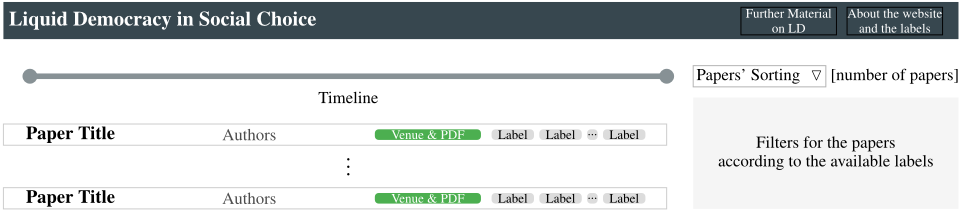
We certainly do not regard our taxonomy as definitive, but rather as a perfectible tool to help researchers navigate the existing literature and identify fruitful avenues for future research. Therefore, instead of providing a static survey of the field-which, inevitably, would sooner or later become outdated-we present our taxonomy as a maintainable webpage that lists and labels existing works according to our taxonomy. In particular, through our online resource, interested researchers will be able to (i) access a curated collection of all papers within the scope of our survey, (ii) explore works by specific labels from the taxonomy, (iii) directly access materials from each publication, (iv) see where LD research is being published, and (v) discover further relevant resources and information on liquid democracy.
A preview of the webpage 4 is shown in Figure 1. The page is hosted on GitHub, to allow direct contributions from the community. Being open-source, our project enables the community to continuously update and refine its content (e.g., by adding new publications, including links, revising labels when appropriate, and expanding the categories and the available filtering options). Hence, our initiative will serve as a living, community-maintained comprehensive overview of the evolving state of research in LD. The platform can, for now, be accessed at the following provisional link.
4 The webpage follows the format and template of the project "Satisfiability Solvers in Mathematics," managed by Bernardo Subercaseaux, which is in turn a fork of the project "Algorithms with Predictions," built and maintained by Alexander Lindermayr and Nicole Megow.
The current, initial, online version of our overview includes 38 papers, which, to the best of our knowledge, forms a complete compendium of the published works on liquid democracy within the social choice field that fall within our intended scope. All labeled papers are listed in the references list of the current manuscript, because, each is associated with at least one indicative label in Section 3.1.
An additional strength of the platform is that it supports basic statistical exploration of the field. A first look reveals that almost half of the papers appear in major AI venues (IJCAI, AAAI, AAMAS), while the rest are dispersed across a broad and heterogeneous set of outlets, ranging from EC and Social Choice and Welfare to the International Journal of Game Theory, NeurIPS, and TARK. It also highlights a temporal trend, with a steady stream of publications of 3-7 papers appearing each year between 2018 and 2025, with the peak at 2021 and 2022. In addition, it reveals structural patterns: while all epistemic models are inherently multi-stage, none of the introduced dynamic models are multi-stage. Taken together, these observations call for more intricate and systematic analyses of the literature, potentially informed by the methodological perspective developed by [Boehmer et al., 2024].
4 Beyond the Survey: Future Research
Our taxonomy summarizes how theoretical work in social choice has approached the topic of liquid democracy and maps the boundaries of current approaches. It forms the basis for the discussion of future research directions that we embark on in this final section of the paper.
4.1 Widening the Scope of Liquid Democracy
We start by drawing the attention of the research community back to a richer definition of LD, which is close to how it is conceived in practice-as implemented for instance in systems like LiquidFeedback-and which captures features that go beyond the sole delegation of voting rights. In doing so, we emphasize the importance of key features of liquid democracy that have yet to be studied in depth and, importantly, that are of special practical relevance. LD has evolved since the latter half of the 20th century through contributions from scholars across multiple disciplines, culminating in the conceptions proposed by Ford (2002b) and Green-Armytage (2015). These conceptualizations frame liquid democracy as a mechanism of collective preference elicitation that integrates direct and representative participation by enabling individuals to: (1) cast votes directly; (2) delegate their voting rights; (3) delegate on a topic-specific basis; (4) make delegations transitive; and (5) revoke or reassign them. These features enable a dynamic division of labor and foster epistemic specialization. Building on this notion, practical implementations aim to develop systems for the democratic selfgovernance of large-scale groups, in which every participant can engage in matters of personal interest while being represented in all others. This development broadened the scope of liquid democracy beyond classical issue voting to encompass additional contexts such as, in particular, deliberation and its moderation. Novel yet compatible concepts, such as hierarchical delegations and the suspension of delegations, provided a foundation for interpreting liquid democracy as an adaptive and self-regulating system. LD can be understood as a learning socio-technical system in which feedback loops and evolving delegation patterns foster the emergence of institutional knowledge and trust.
In what follows we highlight a number of concrete directions that stem out of this richer set of features and broadened perspective on LD, seeking to better connect the current social choice literature with LD's present-day practice.
4.2 Concrete Research Directions
Beyond issue voting. Three principal regimes can be distinguished, which serve different purposes in a collective decision-making process supported by LD. Classical issue voting is conducted within a defined period, employing established methods and typically yielding a set of winning options upon completion of the voting phase. This is the regime which is typically studied in the literature. Continuous polling extends over a prolonged period, in which voting is used as input to aggregative analysis aiming at summarizing, ranking, or filtering groups' preferences [Halpern et al., 2023b; Lindeboom et al., 2026]. Allowing delegations to be revised at any time, the aggregated outcome evolves continuously. Typical applications include the monitoring of public sentiment and the pursuit of deliberative objectives, such as the fair representation of minority positions [Skowron et al., 2017; Papasotiropoulos et al., 2026; Janson, 2018]. Conditional activation operates with a variable time horizon, concluding once a predefined condition (e.g., quorum attainment) is satisfied. This regime is relevant in contexts like the collective moderation of deliberative processes, where the accumulation of sufficient support triggers a specific response, such as the admission of a new alternative in an agenda. These three regimes may coexist within the same model or platform [Behrens et al., 2014]. Research has yet to devote sufficient attention to the latter two regimes and the role of LD in them.
Hierarchical delegations. A hierarchy emerges when delegations have overlapping scopes: through an overlay of policy area-specific default delegations, and topic-specific delegations. Together, these layers give rise to domain-specific representation patterns. Participants can delegate once, allow their preferences to apply broadly, and refine them progressively. This structure reduces the cognitive effort required for participation in collective decisions. While such mechanisms have been implemented and used in practice [Behrens et al., 2014], they remain largely unexplored in theory.
Delegation evolution. As emphasized in Section 4.1, delegations in LD are much richer than normally considered in the literature: not only can they have variable scope, but they can also be retracted or reassigned. These features make it possible for the representation patterns enabled by delegations to evolve over time. Understanding this temporal dimension of LD is an open line of research that could shed light on the extent to which LD gives rise to emergent phenomena like epistemic specialization, the development of institutional knowledge, and trust over time [Behrens et al., 2022; Markakis and Papasotiropoulos, 2024].
Power, influence and representation. The transitivity of delegations in LD has given rise to concerns about the possibility of disproportionate accrual of power, once power is conceived only based on the "flow" of votes, abstracting away from the retractability of delegations. Recent work has started to point towards models of power that are more attuned to the richer conception of LD we argue for here, showing that while voting weight is "liquid"-that is, accrues linearly in the length of delegation paths-power in LD may actually be "viscous"-that is, accrue sublinearly-thanks to the combined effect of the transitivity and retractability of delegations [Grossi and Nitsche, 2025]. Yet, much more work is needed to better understand the nature of power and influence in LD. In such a context it would also be important to better understand the sort of representation that LD provides, with respect to other democratic innovations that are geared towards representative decisions, such as sortition [Flanigan et al., 2021; Valsangiacomo and Zuber, 2025], and with respect to existing formal theories of representation, as developed within the multi-winner voting literature [Faliszewski et al., 2017; Lackner and Skowron, 2023].
Partial delegation mechanisms. Further research could systematically investigate partial delegation mechanisms that allow voters to transfer only those aspects of a decision in which they feel indifferent or insufficiently informed, an idea that has appeared in several works (e.g., by Zhang and Grossi (2022)). This line of inquiry is particularly promising for multi-dimensional decision spaces, where preferences are rarely uniform across all dimensions and where voters may wish to retain control over some bounds while delegating refinement of others. Building on proposals such as Pairwise Liquid Democracy [Brill and Talmon, 2018] or the very recent one of Nested Convex Delegated Voting [Behrens and Swierczek, 2025], future work could explore formal models, incentive properties, and computational implications of resolving indifference through structured delegation chains. Such research would clarify how partial delegation can enhance representational accuracy without fragmenting responsibility across dimensions, and how it interacts with aggregation rules that treat unresolved indifference in a principled way. In doing so, it could contribute to a more nuanced theory of delegation that is tailored to complex policy spaces rather than discrete choice settings.
Real-world data and data generation. Current research in LD severely suffers from the lack of delegation data. Very few and only highly heterogeneous relevant empirical studies on real-world data exist [Kling et al., 2015; Revel et al., 2022; Hall and Miyazaki, 2024; Schmid and Shestakov, 2024]. At the same time, while synthetic data on delegation graphs are regularly used to assess theoretical models, data generation methods vary considerably, leading to often incomparable studies. Future work should aim at developing principled and standardized pipelines for the generation of delegation data, possibly building on recent insights into methods for sampling elections [Szufa et al., 2022; Szufa et al., 2025]; the theory of random graphs [Bollobás, 2011; Frieze and Karo´nski, 2015] may also provide useful guidance for constructing such a toolkit.
Acknowledgements
We are grateful to Ulrike Schmidt-Kraepelin and Manon Revel for their input in structuring the literature and the taxonomy. D. Grossi and A. Nitsche acknowledge support by the European Union under the Horizon Europe project Perycles (Participatory Democracy that Scales). G. Papasotiropoulos was supported by the European Union (ERC, PRO-DEMOCRATIC, 101076570). Views and opinions expressed are however those of the authors only and do not necessarily reflect those of the European Union or the European Research Council. Neither the European Union nor the granting authority can be held responsible for them.

@inproceedings{ijcai2026p872,
  title     = {Modeling Liquid Democracy: A Survey of the (Computational) Social Choice Literature},
  author    = {Grossi, Davide and Nitsche, Andreas and Papasotiropoulos, Georgios},
  booktitle = {Proceedings of the Thirty-Fifth International Joint Conference on
               Artificial Intelligence, {IJCAI-26}},
  publisher = {International Joint Conferences on Artificial Intelligence Organization},
  editor    = {Diego Calvanese},
  pages     = {7855--7863},
  year      = {2026},
  month     = {8},
  note      = {Survey Track},
  doi       = {10.24963/ijcai.2026/872},
  url       = {https://doi.org/10.24963/ijcai.2026/872},
}
TY - CPAPER TI - Modeling Liquid Democracy: A Survey of the (Computational) Social Choice Literature AU - Grossi, Davide AU - Nitsche, Andreas AU - Papasotiropoulos, Georgios T2 - Proceedings of the Thirty-Fifth International Joint Conference on Artificial Intelligence, IJCAI-26 PB - International Joint Conferences on Artificial Intelligence Organization PY - 2026 SP - 7855 EP - 7863 DO - 10.24963/ijcai.2026/872 UR - https://doi.org/10.24963/ijcai.2026/872 ER -Copied
Machine-readable versions of this paper, for tools and AI agents:





