
Dynamic Heterogeneous Graph Representation Learning: A Survey
Proceedings of the Thirty-Fifth International Joint Conference on Artificial Intelligence. Survey Track. Pages 7940-7948.
https://doi.org/10.24963/ijcai.2026/881
Keywords
- Machine Learning: Self-supervised Learning
- Machine Learning: Representation learning
- Machine Learning: Sequence and graph learning
- Data Mining: Mining graphs
Abstract
Graph representation learning (GRL) serves as a canonical paradigm for modeling complex networks. However, real-world AI systems inherently manifest as evolving heterogeneous entities with complex interactions, posing significant challenges to static or homogeneous modeling. To address these complexities, representation learning for Dynamic Heterogeneous Graphs (DHGs) has emerged as a vital approach for learning low-dimensional representations that simultaneously preserve structural semantics and temporal dynamics. This survey presents the first systematic review of DHG representation learning methods. We first introduce a unified formal definition that encompasses both discrete-time and continuous-time DHGs from the perspective of temporal granularity. Building upon this formulation, we propose a novel algorithm-centric taxonomy that categorizes existing literature, including early embedding-based approaches, graph neural network (GNN)-based models, and relatively recent Transformer-based DHG methods, while explicitly highlighting their intrinsic modeling biases with respect to dynamic granularity. Furthermore, we summarize representative applications of DHG representation learning, along with commonly used datasets and benchmarks. Finally, we discuss promising research directions that guide future advances in this rapidly evolving field.
- [Bai et al., 2022] Qijie Bai, Jiawen Guo, Haiwei Zhang, Changli Nie, Lin Zhang, and Xiaojie Yuan. H2tne: Tem- poral heterogeneous information network embedding in hyperbolic spaces. In ISWC 2022, pages 179-195, 2022.
- [Barros et al., 2021] Claudio D. T. Barros, Matheus R. F. Mendonça, Alex B. Vieira, and Artur Ziviani. A survey on embedding dynamic graphs. ACM Comput. Surv., 55(1), 2021.
- [Bian et al., 2019] Ranran Bian, Yun Sing Koh, Gillian Dob- bie, and Anna Divoli. Network embedding and change modeling in dynamic heterogeneous networks. In SIGIR, pages 861-864, 2019.
- [Dai et al., 2025] Yue Dai, Yifan Feng, Nan Ma, Xibin Zhao, and Yue Gao. Cross-modal 3d shape retrieval via heteroge- neous dynamic graph representation. TPAMI, 47(4):2370 - 2387, 2025.
- [Dileo et al., 2023] Manuel Dileo, Matteo Zignani, and Sab- rina Gaito. Durendal: Graph deep learning framework for temporal heterogeneous networks. In NeurIPS, 2023.
- [Fan et al., 2021] Yujie Fan, Mingxuan Ju, Shifu Hou, Yan- fang Ye, Wenqiang Wan, Kui Wang, Yinming Mei, and Qi Xiong. Heterogeneous temporal graph transformer: An intelligent system for evolving android malware detection. In KDD, pages 2831-2839, 2021.
- [Fan et al., 2022] Yujie Fan, Mingxuan Ju, Chuxu Zhang, and Yanfang Ye. Heterogeneous temporal graph neural network. In SDM, pages 657-665, 2022.
- [Fang et al., 2022] Yang Fang, Xiang Zhao, Peixin Huang, Weidong Xiao, and Maarten de Rijke. Scalable representa- tion learning for dynamic heterogeneous information net- works via metagraphs. TOIS, 40(4):64:1-64:27, 2022.
- [Fey et al., 2024] Matthias Fey, Weihua Hu, Kexin Huang, Jan Eric Lenssen, Rishabh Ranjan, Joshua Robinson, Rex Ying, Jiaxuan You, and Jure Leskovec. Position: Relational deep learning -graph representation learning on relational databases. ICML, 235:13592-13607, 2024.
- [Gastinger et al., 2024] Julia Gastinger, Shenyang Huang, Mikhail Galkin, Erfan Loghmani, Ali Parviz, Farimah Pour- safaei, Jacob Danovitch, Emanuele Rossi, Ioannis Koutis, Heiner Stuckenschmidt, Reihaneh Rabbany, and Guillaume Rabusseau. Tgb 2.0: A benchmark for learning on temporal knowledge graphs and heterogeneous graphs. In NeurIPS, volume 37, pages 140199-140229, 2024.
- [Hong et al., 2020] Huiting Hong, Yucheng Lin, Xiaoqing Yang, Zang Li, Kung Fu, Zheng Wang, Xiaohu Qie, and Jieping Ye. Heterogeneous information network embedding for estimating time of arrival. In KDD, 2020.
- [Hu et al., 2020] Ziniu Hu, Yuxiao Dong, Kuansan Wang, and Yizhou Sun. Heterogeneous graph transformer. In WWW, pages 2704-2710, 2020.
- [Huang et al., 2021] Hong Huang, Ruize Shi, Wei Zhou, Xiao Wang, Hai Jin, and Xiaoming Fu. Temporal hetero- geneous information network embedding. In IJCAI, pages 1470-1476, 2021. IJCAI
- [Ji et al., 2021] Yugang Ji, Tianrui Jia, Yuan Fang, and Chuan Shi. Dynamic heterogeneous graph embedding via hetero- geneous hawkes process. In PKDD, 2021.
- [Jiang et al., 2021] Song Jiang, Bernard Koch, and Yizhou Sun. Hints: Citation time series prediction for new pub- lications via dynamic heterogeneous information network embedding. In WWW, pages 3158-3167, 2021.
- [Jin et al., 2024] Bowen Jin, Gang Liu, Chi Han, Meng Jiang, Heng Ji, and Jiawei Han. Large language models on graphs: A comprehensive survey. TKDE, 36(12):8622-8642, 2024.
- [Kazemi et al., 2020] Seyed Mehran Kazemi, Rishabh Goel, Kshitij Jain, Ivan Kobyzev, Akshay Sethi, Peter Forsyth, and Pascal Poupart. Representation learning for dynamic graphs: A survey. JMLR, 21(70):1-73, 2020.
- [Li et al., 2020] Qiuyan Li, Yanlei Shang, Xiuquan Qiao, and Wei Dai. Heterogeneous dynamic graph attention network. In ICKG, pages 404-411, 2020.
- [Li et al., 2023a] Ce Li, Rongpei Hong, Xovee Xu, Goce Tra- jcevski, and Fan Zhou. Simplifying temporal heterogeneous network for continuous-time link prediction. In CIKM, pages 1288-1297, 2023.
- [Li et al., 2023b] Jiazheng Li, Chunhui Zhang, and Chuxu Zhang. Heterogeneous temporal graph neural network explainer. In CIKM, pages 1298-1307, 2023.
- [Li et al., 2023c] Yilin Li, Jiaqi Zhu, Congcong Zhang, Yi Yang, Jiawen Zhang, Ying Qiao, and Hongan Wang. Thgnn: An embedding-based model for anomaly detection in dynamic heterogeneous social networks. In CIKM, 2023.
- [Li et al., 2024a] Guangyue Li, Zilong Zhao, Xiaogang Guo, Luliang Tang, Huazu Zhang, and Jinghan Wang. Towards integrated and fine-grained traffic forecasting: A spatio- temporal heterogeneous graph transformer approach. In- form. Fusion, 102, 2024.
- [Li et al., 2024b] Hongbo Li, Wenli Zheng, Feilong Tang, Yi- tong Song, Bin Yao, and Yanmin Zhu. Dynamic heteroge- neous attributed network embedding. INS, 662, 2024.
- [Li et al., 2024c] Ru-Bin Li, Man-Sheng Chen, Xin-Yu Ding, Chang-Dong Wang, Sihong Xie, Shuangyin Liu, Min Chen, and Mohsen Guizani. Periodic prompt on dynamic hetero- geneous graph for next basket recommendation. In ICDM, pages 747-752, 2024.
- [Liu et al., 2021] Chen Liu, Bo Li, Jun Zhao, Ming Su, and Xu-Dong Liu. Mg-dvd: A real-time framework for malware variant detection based on dynamic heterogeneous graph learning. In IJCAI, pages 1512-1519, 2021. IJCAI
- [Liu et al., 2024] Huan Liu, Pengfei Jiao, Xuan Guo, Huam- ing Wu, Mengzhou Gao, and Jilin Zhang. Hgn2t: A simple but plug-and-play framework extending hgnns on heteroge- neous temporal graphs. TBD, 10(5):620-632, 2024.
- [Liu et al., 2025a] Huan Liu, Pengfei Jiao, Mengzhou Gao, Chaochao Chen, and Di Jin. Heterogeneous temporal hyper- graph neural network. In IJCAI, pages 3117-3125, 2025. IJCAI
- [Liu et al., 2025b] Jiawei Liu, Cheng Yang, Zhiyuan Lu, Junze Chen, Yibo Li, Mengmei Zhang, Ting Bai, Yuan Fang, Lichao Sun, Philip S. Yu, and Chuan Shi. Graph foundation models: Concepts, opportunities and challenges. TPAMI, 47:5023-5044, 2025.
- [Luo et al., 2020] Wenjuan Luo, Han Zhang, Xiaodi Yang, Lin Bo, Xiaoqing Yang, Zang Li, Xiaohu Qie, and Jieping Ye. Dynamic heterogeneous graph neural network for real- time event prediction. In KDD, pages 3213-3223, 2020.
- [Peng et al., 2022] Hao Peng, Renyu Yang, Zheng Wang, Jianxin Li, Lifang He, Philip S. Yu, Albert Y. Zomaya, and Rajiv Ranjan. Lime: Low-cost and incremental learn- ing for dynamic heterogeneous information networks. TC, 71(3):628-642, 2022.
- [Qi et al., 2025] Yinhao Qi, Chuyi Yan, Zehui Wang, Chen Zhang, Song Liu, Zhigang Lu, and Bo Jiang. Attention- based temporal heterogeneous graph neural network for insider threat detection. COMPUT SECUR, 157, 2025.
- [Ruan et al., 2022] Beibei Ruan, Cui Zhu, and Wenjun Zhu. A link prediction model of dynamic heterogeneous network based on transformer. In IJCNN, pages 01-07, 2022.
- [Shekhar et al., 2020] Shubhranshu Shekhar, , Deepak Pai, , and Sriram Ravindran. Entity resolution in dynamic hetero- geneous networks. In WWW, pages 662-668, 2020.
- [Wang et al., 2022a] Xiao Wang, Deyu Bo, Chuan Shi, Shao- hua Fan, Yanfang Ye, and Philip S Yu. A survey on hetero- geneous graph embedding: methods, techniques, applica- tions and sources. TBD, 9(2):415-436, 2022.
- [Wang et al., 2022b] Xiao Wang, Yuanfu Lu, Chuan Shi, Rui- jia Wang, Peng Cui, and Shuai Mou. Dynamic hetero- geneous information network embedding with meta-path based proximity. TKDE, 34(3):1117-1132, 2022.
- [Wang et al., 2024a] Fengyi Wang, Guanghui Zhu, Chunfeng Yuan, and Yihua Huang. Llm-enhanced cascaded multi- level learning on temporal heterogeneous graphs. In SIGIR, pages 512-521, 2024.
- [Wang et al., 2024b] Ruomei Wang, Yuanmao Luo, Fuwei Zhang, Mingyang Liu, and Xiaonan Luo. Hsshg: Heuris- tic semantics-constrained spatio-temporal heterogeneous graph for videoqa. TMM, 26:11176 -11190, 2024.
- [Wang et al., 2025a] Jing Wang, Zhiyang Feng, Xiaojun Ning, Youfang Lin, Badong Chen, and Ziyu Jia. Two- stream dynamic heterogeneous graph recurrent neural net- work for multi-label multi-modal emotion recognition. TAC, 16(3):2396 -2409, 2025.
- [Wang et al., 2025b] Xin Wang, Jiawei Jiang, Xiao Yan, and Qiang Huang. Tesa: A trajectory and semantic-aware dy- namic heterogeneous graph neural network. In WWW, pages 1305-1315, 2025.
- [Wang, 2025] Yili Wang. Htgformer: Heterogeneous tempo- ral graph transformer. In SIGIR, pages 2550-2554, 2025.
- [Wu et al., 2023] Cheng Wu, Chaokun Wang, Jingcao Xu, Zi- wei Fang, Tiankai Gu, Changping Wang, Yang Song, Kai Zheng, Xiaowei Wang, and Guorui Zhou. Instant repre- sentation learning for recommendation over large dynamic graphs. In ICDE, pages 82-95, 2023.
- [Xie et al., 2021a] Tao Xie, Yangjun Xu, Liang Chen, Yang Liu, and Zibin Zheng. Sequential recommendation on dynamic heterogeneous information network. In ICDE, pages 2105-2110, 2021.
- [Xie et al., 2021b] Yuanzhen Xie, Zijing Ou, Liang Chen, Yang Liu, Kun Xu, Carl Yang, and Zibin Zheng. Learning and updating node embedding on dynamic heterogeneous information network. In WSDM, pages 184-192, 2021.
- [Xiong et al., 2018] Yun Xiong, Yizhou Zhang, Xiangnan Kong, and Yangyong Zhu. Netcycle+: A framework for collective evolution inference in dynamic heterogeneous networks. TKDE, 30(8):1547-1560, 2018.
- [Xu et al., 2022] Xovee Xu, Ting Zhong, Ce Li, Goce Tra- jcevski, and Fan Zhou. Heterogeneous dynamical academic network for learning scientific impact propagation. KBS, 238:107839, 2022.
- [Xue et al., 2021] Hansheng Xue, Luwei Yang, Wen Jiang, Yi Wei, Yi Hu, and Yu Lin. Modeling dynamic heteroge- neous network for link prediction using hierarchical atten- tion with temporal rnn. PKDD, pages 282-298, 2021.
- [Yang et al., 2020a] Carl Yang, Yuxin Xiao, Yu Zhang, Yizhou Sun, and Jiawei Han. Heterogeneous network rep- resentation learning: A unified framework with survey and benchmark. TKDE, 34(10):4854-4873, 2020.
- [Yang et al., 2020b] Luwei Yang, Zhibo Xiao, Wen Jiang, Yi Wei, Yi Hu, and Hao Wang. Dynamic heterogeneous graph embedding using hierarchical attentions. In ECIR, pages 425 -432, 2020.
- [Yue et al., 2025] Chongjian Yue, Qiao Mi, and Lun Du. A unified framework for link prediction on heterogeneous temporal graph. In APWeb 2024, pages 310-322, 2025.
- [Zhang et al., 2023a] Lin Zhang, Jiawen Guo, Qijie Bai, and Chunyao Song. Dynamic heterogeneous graph represen- tation learning with neighborhood type modeling. Neuro- computing, 533(C):46-60, 2023.
- [Zhang et al., 2023b] Zeyang Zhang, Ziwei Zhang, Xin Wang, Yijian Qin, Zhou Qin, and Wenwu Zhu. Dynamic heterogeneous graph attention neural architecture search. AAAI, 37(9):11307-11315, 2023.
- [Zhou et al., 2023] Wei Zhou, Hong Huang, Ruize Shi, Xiran Song, Xue Lin, Xiao Wang, and Hai Jin. Temporal het- erogeneous information network embedding via semantic evolution. TKDE, 35(12):13031-13042, 2023.
References were extracted automatically from the PDF and may contain errors.
Full text extracted automatically from the PDF; figures, tables and equations may differ. The PDF is the version of record.
1 Introduction
Graphs have been established as a foundational data structure for modeling complex real-world networks and have seen widespread applications across many fields in recent years, such as social network analysis [Li et al., 2023c; Wang, 2025], foundation models [Fey et al., 2024; Liu et al., 2025b], and recommendation systems [Liu et al., 2021; Li et al., 2024c]. By preserving the complex structure and dependencies of graphs in a low-dimensional vector space, graph representation learning (GRL) has been a cornerstone for enabling generalizable reasoning over relational data in modern intelligent systems such as large language models (LLMs), and has attracted considerable research interest [Fey et al., 2024; Jin et al., 2024; Liu et al., 2025b].
∗Corresponding author.
However, real-world systems typically manifest as dynamically evolving, multi-typed entities with complex interactions [Hong et al., 2020; Qi et al., 2025], where dynamics and heterogeneity are inseparably coupled rather than independent properties [Xu et al., 2022; Wang et al., 2025b]. Thus, Dynamic Heterogeneous Graph (DHG) representation learning has emerged as a vital paradigm for capturing the joint interplay between heterogeneous semantics and temporal evolution [Fey et al., 2024; Liu et al., 2025b]. Nevertheless, existing research typically models heterogeneity and dynamics separately [Wang et al., 2022a; Kazemi et al., 2020], and effective DHG representation learning remains non-trivial due to several key challenges. First, heterogeneous semantics and temporal dynamics are intrinsically coupled; thus, methods that simply concatenate heterogeneous modeling with sequential models fail to capture relationspecific evolutionary behaviors. Second, as heterogeneous interactions follow different temporal behaviors, homogeneous modeling is insufficient to capture the sudden, periodic, and long-term cumulative dynamic changes of multi-typed nodes/edges. Third, discrete- and continuous-time DHGs exhibit distinct structural evolution patterns at different temporal granularities; while the former captures coarse-grained global updates, the latter tracks rapid, asynchronous, and localized changes. Consequently, designing unified architectures that preserve granularity-specific dynamics while effectively filtering temporal noise remains an open challenge. Finally, explicitly parameterizing relation-specific semantics and dynamics increases computational overhead, thus hindering the scalability of large-scale DHG learning.
Although a growing body of studies has addressed certain facets of these challenges [Dileo et al., 2023; Wang, 2025], the literature remains fragmented and lacks a unified review. To bridge this gap, we present the first comprehensive survey dedicated to DHG representation learning. We establish a unified formal definition of DHGs that bridges discrete-time and continuous-time formulations. On this basis, we propose an algorithm-centric taxonomy of DHG representation learning, categorizing methods into embedding-based, GNN-based, and Transformer-based paradigms, and explicitly characterizing their inductive biases under different temporal granularities.
We further discuss representative applications and summarize commonly used open-source datasets and benchmarks for DHG representation learning, revealing widespread inconsistencies in graph construction and fixed temporal partitions that hinder fair comparison and reliable performance evaluation.
Distinct from prior GRL surveys, this work provides a unified and systematic review of DHG representation learning. Existing surveys on heterogeneous graphs focus on heterogeneous modeling principles and representation techniques under static settings [Yang et al., 2020a; Wang et al., 2022a]. In parallel, surveys on dynamic GRL offer valuable insights into temporal modeling paradigms and evaluation protocols [Kazemi et al., 2020; Barros et al., 2021], but primarily under homogeneous assumptions. This work also diverges from benchmarking studies such as TGB 2.0 [Gastinger et al., 2024], which emphasize evaluation frameworks rather than algorithmic mechanisms. While these existing efforts have significantly advanced their respective areas, the joint modeling of heterogeneity and temporal evolution remains under-explored, necessitating a dedicated and holistic review of DHG representation learning. Our major contributions include:
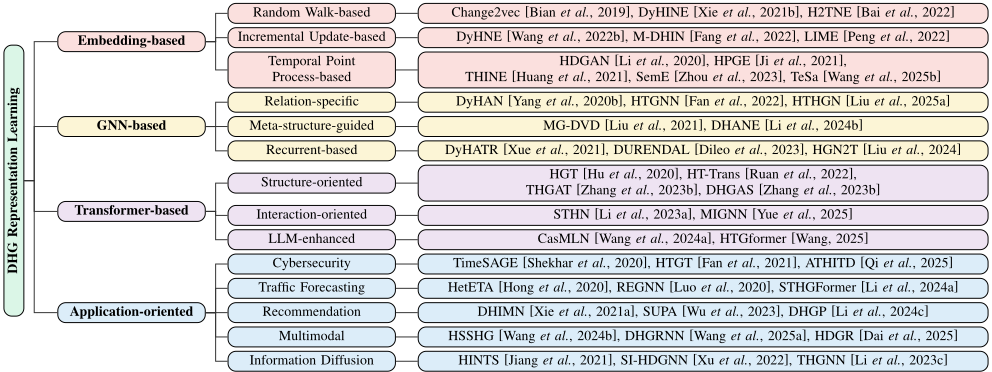
- We present a formal definition of DHG encompassing both discrete-time and continuous-time formulations, and introduce a structured taxonomy organizing methods into four families based on their core architecture. An overview is presented in Figure 1.
- We systematically review representative methods within each family, analyzing their technical mechanisms and identifying shared limitations that constrain current DHG learning. We further compile open-source datasets and benchmarks, exposing inconsistent construction and deterministic evaluation protocols that hinder fair comparison and reliable assessment.
- We identify three progressive research frontiers toward DHG foundation models: efficiency for enabling scaling law investigation, generalizability for cross-domain transfer and continual learning, and trustworthiness for enabling explainable DHG learning and causal discovery.
2 Preliminaries and Notations
This section introduces the formal definition for DHGs and the representation learning tasks.
Definition 1 (Dynamic Heterogeneous Graph). A Dynamic Heterogeneous Graph (DHG) is defined as a graph jointly modeling structural heterogeneity and temporal evolution:
where V and E denote the (possibly time-varying) sets of nodes and edges over a temporal domain T . The type-mapping functions ϕ : V → A and φ : E → R assign each node and edge to a node-type set A and an edge-type set R, respectively.
Remark. This formulation is general and subsumes multiple mainstream graph types as special cases:
Heterogeneous vs. Homogeneous. A graph G is heterogeneous if it involves multiple semantic types, i.e., |A|+|R| > 2. When |A| = 1 and |R| = 1, G degenerates to a homogeneous graph with a single node and edge type.
Discrete vs. Continuous. The temporal domain T governs the dynamic nature of the graph. If |T | = 1, G reduces to a static graph G = (V, E,A,R, ϕ, φ) representing a single heterogeneous graph snapshot. If T is a discrete ordered set, then G is a discrete-time DHG, represented as a sequence of heterogeneous graph snapshots G = {G (t) }t∈T . If T is continuous, the graph is a continuous-time DHG consisting of a sequence of timestamped edges:
thereby capturing fine-grained, asynchronous interactions.
Definition 2 (DHG Representation Learning). Given a DHG G = (V, E, A, R, T , ϕ, φ) with optional node features X(t) , the goal of DHG representation learning is to learn an encoder fΘ : G → R|V|×d that maps each node v ∈ V to a lowdimensional embedding h(t) v ∈ Rd , such that h(t) v jointly preserves heterogeneity and dynamics proximity, supporting various downstream tasks.
3 DHGRepresentation Learning Taxonomy
DHG representation learning requires jointly encoding typespecific semantics and temporal dependencies, as different relation types exhibit distinct evolutionary patterns. Based on the algorithmic mechanism for capturing such coupled dynamics, we categorize methods into: (1) embedding-based approaches preserving structural and temporal proximity through random walks or matrix factorization; (2) GNN-based approaches with type-aware message-passing and aggregation across snapshots; (3) Transformer-based approaches unifying type and temporal signals within attention mechanisms; and (4) applicationoriented approaches formulating domain problems as DHG learning tasks. Table 1 summarizes representative methods.
3.1 Embedding-based
Embedding-based approaches learn node representations by preserving structural proximity derived from neighborhoods. Based on temporal granularity, we distinguish: (1) random walk-based and (2) incremental update-based methods, both operating on discrete snapshots to capture co-occurrence patterns; and (3) temporal point process-based methods modeling continuous-time events and fine-grained interactions.
Random Walk-based
Random-walk-based methods leverage predefined metastructure to capture the co-evolution of network topology and heterogeneous semantics across temporal snapshots. The core objective is to maximize the co-occurrence likelihood of nodes in sequences generated by constrained random walks:
where S ∈ {P,M} denotes the meta-paths or meta-graphs and N (t) S (v) represents the time-aware context of node v induced by meta-structure S at snapshot t. Foundational approaches like Change2vec [Bian et al., 2019] perform walks on historical-current snapshot pairs to preserve short-term temporal continuity. To capture complex dependencies, DyHINE [Xie et al., 2021b] and M-DHIN [Fang et al., 2022] introduce attention mechanisms and meta-graph guidance to weight relevant paths dynamically. Recent advances, such as H2TNE [Bai et al., 2022], employ hyperbolic embeddings to capture hierarchical scale-free DHG structures.
While effective in preserving structural proximity, these methods rely on expert-defined meta-paths/graphs and often struggle to incorporate rich node attributes, limiting their expressiveness for complex semantic tasks.
Incremental Update-based
Incremental update frameworks efficiently model network evolution by focusing on localized calibration rather than retraining. The core of these methods is to combine the previous state with DHG perturbations to update node representations:
DyHNE [Wang et al., 2022b] models evolution as perturbations of meta-path augmented adjacency matrices, efficiently updating embeddings via generalized eigenvalue perturbation. LIME [Peng et al., 2022] employs a recursive neural network to selectively adjust shared semantic embeddings within a local cuboid space. Besides, Change2vec [Bian et al., 2019], DyHINE [Xie et al., 2021b] and M-DHIN [Fang et al., 2022] explicitly identify nodes affected by edge additions/deletions and node insertions/removals and restrict embedding updates to local neighborhoods rather than the entire network.
Despite their scalability advantages, these methods suffer from cumulative approximation drift over long temporal horizons and struggle with abrupt structural changes that violate temporal smoothness assumptions.
Temporal Point Process-based
Temporal point process (TPP) frameworks treat DHG evolution as a stream of asynchronous events, modeling the conditional intensity of heterogeneous interactions. The technical core involves modeling the conditional intensity function λ(e) of a heterogeneous event e = (u, v, r, t), which characterizes the instantaneous arrival rate of a type-r relation between source node u and target node v at time t:
where µr(·) represents the base rate, α(·) measures the excitation influence from a historical event eh, and κ(·) is a kernel function capturing the temporal decay influence. HPGE [Ji et al., 2021] integrates a heterogeneous evolving attention mechanism to distinguish fine-grained excitation patterns between different-typed historical and current events, while utilizing temporal importance sampling to extract representative interactions efficiently. HDGAN [Li et al., 2020] and THINE [Huang et al., 2021] further leverage meta-paths to constrain candidate sets and employ hierarchical attention to jointly model semantic relevance and structural influence. SemE [Zhou et al., 2023] abstracts chronological meta-path instances as semantic units driven by an attention-Hawkes process. Besides, TESA [Wang et al., 2025b] employs a trajectory-based neural TPP to encode node interaction sequences independently, enhancing scalability and long-term pattern capture.
Despite computational efficiency, embedding-based methods remain constrained by predefined proximity measures that limit representation capacity, shallow architectures that preclude higher-order structural modeling, and the absence of task-specific gradients that impedes downstream transfer.
3.2 GNN-based
GNN-based methods extend message-passing to DHGs by incorporating heterogeneous edge types and temporal evolution, predominantly operating at the snapshot granularity. Based on the mechanism for integrating type-aware propagation, we categorize these methods into: (1) relation-specific GNNs that decompose each snapshot into type-specific subgraphs with separate transformation matrices; (2) meta-structure-guided GNNs that constrain propagation along predefined meta-paths or meta-graphs to capture high-order semantic patterns; and (3) recurrent-based GNNs that couple spatial aggregation with temporal state evolution through RNN units.
Relation-specific GNNs
Relation-specific GNNs represent a dominant paradigm for modeling DHGs by adopting a divide-and-conquer strategy, decomposing complex heterogeneous interactions into multiple relation-specific subgraphs across different snapshots. These methods typically employ hierarchical message-passing and aggregation to disentangle the influence of different relation types while maintaining temporal consistency:
where N t r (v) denotes the neighbors of node v under relation r at time t. DyHAN [Yang et al., 2020b] and HTGNN [Fan et al., 2022] implement this via hierarchical attention, aggregating first across neighbors of the same type, then across types, and finally over time. Some approaches also incorporate hypergraph structures. For example, HTHGN [Liu et al., 2025a] generalizes the receptive field to high-order group interactions through heterogeneous hyperedge construction and expansion to preserve local connectivity while capturing group dynamics.
Despite their expressiveness, such hierarchical architectures are difficult to scale, as separate message-passing over neighbor types and historical snapshots incurs substantial computational and memory overhead. Moreover, repeated attentionbased aggregation across both type and time dimensions potentially leads to over-smoothing.
Meta-structure-guided GNNs
Meta-structure-guided GNNs predefine meta-paths or metagraphs based on specific semantics and constrain messagepassing only between nodes reachable from these structures, thus explicitly modeling semantic dependencies. Formally, given a snapshot G (t) and a meta-structure S ∈ {P,M}, the representation of node v is computed by aggregating messages from its meta-structure-induced context N (t) s (v):
HDGAN [Li et al., 2020] constrains propagation by enumerated meta-paths and treats each meta-path as an independent semantic channel, enabling additive composition of path-level semantics via attention-based fusion. DHANE [Li et al., 2024b] merges multiple paths into a unified meta-graph structure and performs message-passing at the meta-graph level, thereby capturing cross-path contextual dependencies in a single propagation process. Furthermore, MG-DVD [Liu et al., 2021] pre-enumerates frequent meta-graphs as semantic templates, under which node or graph representations are aggregated and then aggregated by template-level attention.
While semantically interpretable, these methods suffer from combinatorial explosion when enumerating meta-structures over rich type schemas, and their static semantic templates cannot adapt to temporal shifts in which meta-structures become salient at different evolutionary stages.
Recurrent-based GNNs
Recurrent-based GNNs capture the temporal evolution of node representations by maintaining historical states that are recursively updated across snapshots or interactions. The core mechanism employs a heterogeneous GNN to encode structural information at each snapshot, coupled with recurrent units to evolve the node memory M(t) :
where m(t) v denotes a recurrent memory state of node v at time t, and fHGNN(·) encodes the heterogeneous structure and features of snapshot G (t) . DyHATR [Xue et al., 2021] employs a hierarchical attention mechanism as the encoder to capture heterogeneity within each snapshot, followed by an RNN and temporal self-attention to model sequential dependencies. DURENDAL [Dileo et al., 2023] generalizes this paradigm by investigating the structural placement of the recurrent update relative to the heterogeneous aggregation, proposing both Aggregate-Then-Update and Update-Then-Aggregate schemes to balance memory efficiency and relational temporal dynamics. Unlike the above methods that separate structural encoding and temporal updating, HGN2T [Liu et al., 2024] proposes a plug-and-play coupling mechanism that tightly integrates a static heterogeneous GNN with a recurrent module, allowing the temporal evolution of node representations to be conditioned jointly on heterogeneous graph structure and relation-specific dynamics.
In summary, GNN-based methods enable end-to-end learning with expressive message-passing, yet remain constrained by hierarchical decomposition that prevents parallelization, snapshot discretization that discards fine-grained temporal signals, and computational complexity that scales multiplicatively with relation types and temporal depth.
3.3 Transformer-based
Transformer-based approaches represent the most recent paradigm shift in DHG representation learning, which leverage architectural advances that have driven breakthroughs across deep learning. By unifying DHG modeling via selfattention, they bypass the hierarchical decomposition inherent to GNN-based methods while enabling parallelized training. Three paradigms operate at distinct granularities: (1) structure-oriented methods, which attend over spatial neighborhoods at snapshot granularity with type-parameterized weights and relative time encodings; (2) interaction-oriented methods, which model each node's event history at interaction granularity through sequence-level attention; and (3) LLMenhanced methods, which inject external semantic knowledge from LLMs to complement structural representations.
Structure-oriented Transformer
Structure-oriented Transformers unify heterogeneous and temporal modeling within a single attention mechanism, departing from hierarchical GNNs that aggregate separately across relation types and time steps. The core paradigm computes attention over the full dynamic heterogeneous neighborhood, where attention weights jointly depend on source/target node types, edge type, and relative temporal position:
| Category | Granularity | Code | |||
|---|---|---|---|---|---|
| Embedding-based | Method Change2vec [Bian et al., 2019] THINE [Huang et al., 2021] DyHINE [Xie et al., 2021b] HPGE [Ji et al., 2021] M-DHIN [Fang et al., 2022] DyHNE [Wang et al., 2022b] LIME [Peng et al., 2022] SemE [Zhou et al., 2023] H2TNE [Bai et al., 2022] DHANE [Li et al., 2024b] HDGAN [Li et al., 2020] DyHAN [Yang et al., 2020b] | Dis. Con. Dis. Con. Dis. Dis. Dis. Con. Con. Dis. Con. | Core Technique Meta-path RW with Incremental Update Meta-pathWalk with Hawkes Process Relation-specific RW with Att. Relation-specific Att. with TPP Meta-graph Sampling with LSTM Meta-path Proximity with Eigen Perturbation Meta-path RW with Recursive NN Semantic Meta-path Walk with Hawkes Att. Relation-specific Walk with Hyperbolic Embedding Meta-graph Att. with Online Update Meta-path GNN with TPP Relation-specific GNN with Temporal Att. | Task Clust. NC/LP/TLP TLP NC/TLP NC/LP/TLP NC/RP/TLP NC/Clust. NC/RP/TLP NC/LP/TLP NC NC/Clust. TLP TLP NR/TLP LP/TLP LP/TLP | Link Link - - Link - - Link Link - Link |
| Chronological | |||||
| Link | |||||
| Link | |||||
| Link | |||||
| Link | |||||
| Link | |||||
| Dis. | |||||
| GNN-based | DyHATR [Xue et al., 2021] | Dis. | Relation-specific GNN with Temporal Att. | Link | |
| HTGNN [Fan et al., 2022] | Dis. | Relation-specific GNN with Temporal Modeling | |||
| DURENDAL [Dileo et al., 2023] | Dis. | Relation-specific GNN with RNN | Link | ||
| HGN2T [Liu et al., 2024] | Dis. | Relation-specific GNN with GRNN | |||
| HTHGN [Liu et al., 2025a] | Dis. | Relation-specific GNN with Temporal Att. | LP/TLP | Link | |
| TeSa [Wang et al., 2025b] | Con. | Relation-specific GNN with TPP | LP/TLP | ||
| Transformer-based | HGT [Hu et al., 2020] | Con. | Relation-specific Transformer with RTE | TLP | |
| HT-Trans [Ruan et al., 2022] | Con. | Relation-specific Transformer Encoder | LP/TLP | - | |
| DHGAS [Zhang et al., 2023b] | Dis. | Relation- and Time-aware Self-Att. | NC/NR/RP/LP/TLP | Link | |
| THGAT [Zhang et al., 2023a] | Con. | Relation-specific Att. with RTE | NC/Clust./TLP | Link | |
| STHN [Li et al., 2023a] | Con. | Structural-Temporal Transformer | LP/TLP | Link | |
| CasMLN [Wang et al., 2024a] | Dis. | LLM-enhanced Relation-specific Transformer | NC/NR/RP/LP/TLP | Link | |
| HTGformer [Wang, 2025] | Dis. | LLM-enhanced Transformer for DHG | NC/NR/RP/LP/TLP | - | |
| MIGNN [Yue et al., 2025] | Con. | Att.-based GNN with GRU | LP/TLP | - | |
| HTGT [Fan et al., 2021] | Dis. | Relation-specific Att. with RTE | Cybersecurity | Link | |
| ATHITD [Qi et al., 2025] | Dis. | Relation-specific Att. with RTE | Cybersecurity | - | |
| HetETA [Hong et al., 2020] | ST. | Heterogeneous GNN with Causal Conv. | Traffic | Link | |
| STHGFormer [Li et al., 2024a] | ST. | Relation-specific Att. with Temporal Att. | Traffic | - | |
| SUPA [Wu et al., 2023] | Con. | Meta-path RW with Memory Update | Recomm. | Link | |
| Application-oriented | DHGP [Li et al., 2024c] | Dis. | Relation- and Time-aware Att. | Recomm. | Link |
| DHGRNN [Wang et al., 2025a] | ST. | Relation-specific Att. with GRU | Multimodal | - | |
| HDGR [Dai et al., 2025] | Dis. | Relation-specific GConv. with Reconstruction | Multimodal | - | |
| SI-HDGNN [Xu et al., 2022] | Con. | Relation-specific RW with GRU | Diffusion | Link | |
| THGNN [Li et al., 2023c] | Con. | Relation-specific Att. with LSTM | Diffusion | Link |
where α(r) vu denotes the heterogeneous and temporal attention weight parameterized by the meta-relation triplet (ϕ(u), r, ϕ(v)) and relative temporal encoding fRTE(∆t). HGT [Hu et al., 2020] pioneers this paradigm via tripletbased parameter decomposition and sinusoidal relative temporal encoding (RTE). HT-Trans [Ruan et al., 2022] and DHGAS [Zhang et al., 2023b] extend this with full Transformer encoders and neural architecture search for attention patterns. STHGFormer [Li et al., 2024a] further refines this by integrating spatio-temporal positional encodings directly into the attention scores.
Despite unifying attention for DHG modeling, structureoriented Transformers face scalability bottlenecks as attention over full neighborhoods across all relation types incurs quadratic complexity, and fine-grained type parameterization risks overfitting on infrequent meta-relations.
Interaction-oriented Transformer
Interaction-oriented Transformers diverge from neighborcentric structural aggregation by modeling the continuous stream of edge events as a temporal sequence, where selfattention operates over a node's chronological interaction history rather than its spatial neighborhood. The technical core is to maintain a historical event sequence Hv = {e1, . . . , en} for each node, where each event ei = (ui, v, ri, ti) carries heterogeneous types and continuous timestamps, and to compute the node representations via sequence-level attention:
where α(t) i denotes the attention weight at time t over the i-th historical event, fMSG(·) encodes heterogeneous type information, and fRTE(·) provides relative temporal position encoding. STHN [Li et al., 2023a] introduces a unified link encoder that integrates type encoding and relative time encoding, and devises a patching technique that segments long event sequences into fixed-length patches to reduce complexity from quadratic to linear. MIGNN [Yue et al., 2025] further employs a dualwindow strategy to separately model short-term fine-grained dynamics and long-term distributional patterns through multiscale temporal aggregation.
This paradigm excels at fine-grained temporal modeling by capturing event-level dynamics, enabling precise tracking of evolving interaction patterns. However, it incurs memory overhead for maintaining per-node event histories and often underutilizes local structural context.
LLM-enhanced Transformer
LLM-enhanced Transformers integrate LLMs to inject external semantic knowledge into DHG learning, addressing the limitations of purely structural methods in capturing implicit type-level properties and domain-specific evolution patterns. Since different node types exhibit distinct temporal dynamicsfor example, papers grow monotonically while e-commerce interactions show periodicity-LLMs provide complementary semantic priors that are difficult to learn from topology alone. The core paradigm fuses LLM-derived semantic embeddings with structural representations at multiple granularities:
where p indicates the instruction prompt for the current graph context, and τ (ϕ(v), G) denotes the textual description of node type and graph-level characteristics. The fusion function fθ(·) integrates these complementary views to produce semanticallyenriched node embeddings. CasMLN [Wang et al., 2024a] pioneers this paradigm by constructing structured prompts for both node types and the overall graph, then modulating aggregated representations with LLM-derived embeddings through element-wise product to compensate for skewed heterogeneous data distributions. HTGformer [Wang, 2025] aligns semantic and structural spaces through instruction tuning, enabling the model to interpret dynamic heterogeneous event patterns as textual instructions, shifting the paradigm from structural encoding towards semantic reasoning.
To summarize, Transformer-based methods unify DHG modeling within attention mechanisms, avoiding hierarchical decomposition. However, they remain constrained by quadratic complexity that limits scalability, additive fusion of type and temporal encodings rather than intrinsic coupling, the absence of pre-training objectives that precludes crossdomain transfer, and underexplored tokenization strategies for heterogeneous node/edge types and temporal granularities.
3.4 Application-oriented
Application-oriented approaches formulate domain-specific problems as DHG, serving as a unifying substrate where heterogeneous entities and relations evolve over time. Here we summarize representative applications in the following fields.
Cybersecurity
Cybersecurity addresses adversarial behavior detection where attackers deliberately fragment malicious actions across entity types and extended time horizons, rendering individual activities benign in isolation yet collectively revealing coordinated attacks. HTGT [Fan et al., 2021] models app-marketdeveloper relations through a heterogeneous temporal Transformer that iteratively aggregates spatial dependencies with historical sequences, jointly capturing malware propagation and evolution. MG-DVD [Liu et al., 2021] translates API event streams into dynamic graphs with discriminative metagraphs, enabling real-time variant detection via dynamic walks without full retraining. ATHITD [Qi et al., 2025] introduces temporal neighbors within sliding windows for short-term evolution, while Transformer modules learn long-term drift to highlight anomalous time periods. TimeSAGE [Shekhar et al., 2020] incorporates time-decayed edge weights and temporal random walks to resolve fraudulent identities drifting over subscription lifecycles. These methods require accumulated behavioral evidence, enabling long-horizon attack detection but limiting responsiveness to zero-day exploits. While these methods effectively detect known attack patterns, adapting to adversaries' evolving tactics remains an open challenge.
Traffic Forecasting
Traffic forecasting predicts dynamics across infrastructure where road segments follow smooth diurnal periodicity, intersections exhibit abrupt phase-dependent transitions, and transit hubs aggregate multimodal demand with distinct volatility patterns that uniform embeddings would collapse. HetETA [Hong et al., 2020] constructs multi-relational networks with trajectory sequences, employing parallel temporal convolutions for recent, daily, and weekly patterns before graph propagation. STHGFormer [Li et al., 2024a] explicitly distinguishes segments from turn nodes via heterogeneous spatial embeddings, with a unified Transformer capturing road-turn interdependencies. REGNN [Luo et al., 2020] dynamically constructs eventcentric graphs encoding ride requests with supply-demand context, enabling inductive generalization through transferable demand patterns. Although effective in capturing spatiotemporal patterns on observed road networks, generalization to unseen topologies or non-recurrent events remains limited.
Recommendation
Recommendation infers preferences from behavioral signals carrying heterogeneous semantic weight and temporal dynamics: clicks indicate transient interest with rapid decay, purchases reflect committed preferences with lasting influence, and reviews encode explicit sentiment requiring delayed integration. DHIMN [Xie et al., 2021a] maintains type-specific memory states with two-level attention that weights items within behavior types then aggregates across types. DHGP [Li et al., 2024c] introduces periodic prompts aligning cyclic interests with temporal context through prompt embeddings modulating basket representations. SUPA [Wu et al., 2023] addresses neighborhood disturbance via sampling influenced subgraphs, updating endpoints, and propagating incrementally without full retraining. Despite effectively capturing type-specific preference, these methods remain limited under cold-start conditions with sparse heterogeneous interactions.
Multimodal Learning
Multimodal learning integrates data streams whose semantic alignments shift as context evolves, particularly when modalities exhibit asynchronous sampling rates or intermittent availability that preclude fixed correspondence assumptions. HSSHG [Wang et al., 2024b] constructs spatio-temporal graphs where co-occurrence and consistency constrain adjacency, using plot summaries and locations as priors to weight edges for video question answering. DHGRNN [Wang et al., 2025a] fuses spatial-temporal and spatial-spectral streams, with graph Transformers modeling channel heterogeneity and evolving convolutions adapting to missing EEG channels as structure changes. HDGR [Dai et al., 2025] builds dynamic intra-modal graphs with bipartite cross-modal graphs capturing semantic transitivity for 3D retrieval. While effective in fusing multimodal data with dynamic alignments, robustness to missing or noisy modalities remains underexplored.
Information Diffusion
Information diffusion examines propagation across heterogeneous actors governed by type-specific dynamics. For example, citations accrue monotonically, evidencing durable scholarly influence; social endorsements decay rapidly in accordance with attention cycles; and financial contagion transmits through correlation structures that shift abruptly under changing market regimes. HINTS [Jiang et al., 2021] addresses cold-start prediction by imputing pseudo-historical trajectories via network alignment, converting embeddings into citation model parameters. SI-HDGNN [Xu et al., 2022] models academic influence via temporal-attentive aggregation over directed author-paper-venue graphs. NetCycle+ [Xiong et al., 2018] incorporates life-cycle stages, recognizing that nodes at different evolutionary phases exhibit distinct patterns. THGNN [Li et al., 2023c] constructs daily correlation graphs with heterogeneous attention for financial contagion. Despite these efforts, unifying diffusion dynamics across actor types with disparate temporal scales remains open.
4 Open-source Datasets and Benchmarks
This section summarizes commonly used open-source DHG datasets, covering their application domains, numbers of node and edge types, number of time snapshots/timestamps, availability of node labels, and data source links. The datasets are ordered in descending usage frequency in Table 2.
Note that although many studies nominally rely on the same public sources, they frequently employ inconsistent graph construction rules, temporal discretizations, and evaluation protocols, which undermine reproducibility and cross-method comparability. To mitigate this, TGB 2.0 [Gastinger et al., 2024] introduces standardized DHG datasets with unified preprocessing and evaluation pipelines, providing a more consistent foundation for benchmarking and facilitating future extensions. Nevertheless, the current release primarily targets link prediction and includes only a relative limited set of baseline methods. Prevailing fixed-split evaluation protocols that test solely on final-period edges fail to capture DHG
| Domain | Dataset | |A| | |R| | |T | | Label | URL |
|---|---|---|---|---|---|---|
| Academic | DBLP | 4 | 3 | 10 | ✓ | Link |
| Academic | AMiner | 4 | 3 | 10 | ✓ | Link |
| Review | Yelp | 4 | 3 | 10 | ✓ | Link |
| Social | 1 | 3 | 7 | × | Link | |
| Datasets Epidemic | COVID | 2 | 3 | 304 | ✓ | Link |
| Recomm. | Movielens | 3 | 3 | 25,864 | × | Link |
| Recomm. | Ecomm | 2 | 4 | 11 | × | Link |
| Academic | MAG | 4 | 4 | 10 | ✓ | Link |
| Recomm. | Alibaba | 2 | 4 | 11 | × | Link |
| Academic | Math-Overflow | 1 | 3 | 11 | × | Link |
| 2.0 Software | software | 4 | 14 | 689,549 | × | Link |
| Social | forum | 2 | 2 | 2,558,457 | × | Link |
| Software | github | 4 | 14 | 2,510,415 | × | Link |
| TGB Recomm. | myket | 2 | 2 | 14,828,090 | × | Link |
evolution and tend to overestimate. Extending task coverage, establishing incremental learning protocols, and dveloping comprehensive benchmarks remain critial for future research.
5 Conclusion and Future Directions
This survey presents the first systematic review of DHG representation learning. We provide a generalized definition of DHGs, establish an algorithm-centric taxonomy, and summarize key modeling biases. Our analysis of representative methods and benchmarks reveals important limitations in current modeling mechanisms and evaluation protocols. Despite recent advances toward foundation models [Liu et al., 2025b], three critical challenges in DHG representation learning persist: (1) Prohibitive computational complexity hinders scaling to Web-scale graphs, precluding systematic investigation of scaling laws; (2) Current task-specific paradigms lack pretraining frameworks for learning transferable representations across heterogeneous schemas and temporal distributions; (3) Limited interpretability impedes high-stakes deployment and obscures whether models capture causal mechanisms versus spurious correlations. We conclude by identifying three progressive research frontiers to address these challenges that will catalyze future advances in this rapidly evolving field.
Efficiency. The quadratic complexity of current DHG learning methods [Hu et al., 2020; Li et al., 2024a] that explicitly couple message-passing with temporal aggregation fundamentally restricts their applicability to Web-scale DHGs. While recent efforts have attempted to alleviate this bottleneck through partial linearization strategies such as event patching [Li et al., 2023a] or incremental propagation [Fang et al., 2022], the expressiveness-efficiency trade-off persists. Thus, a critical open problem is to explore efficient alternatives, such as kernelapproximation-based variants of linear attention mechanisms or sparsification strategies for DHGs, as a prerequisite for investigating the scaling laws of DHG representation learning.
Generalizability. Current DHG methods are largely confined to task-specific supervised training, failing to exhibit transfer capabilities seen in vision and language foundation models. Although preliminary attempts have integrated LLMderived semantics [Wang et al., 2024a] or unified attention mechanisms across heterogeneous types [Wang, 2025], the field still lacks principled pre-training objectives for DHGs. Future research could develop pre-training paradigms such as self-supervised tasks, combined with transfer learning, fewshot adaptation, and continuous learning, to enable model generalizability across multi-domain evolutionary patterns.
Trustworthiness. As DHGmodels increasingly informhighstakes decision-making, interpretability is imperative for ensuring trustworthiness. Current approaches [Li et al., 2023b] emphasize post-hoc subgraph identification but lack faithfulness guarantees and causal grounding. Future work should prioritize inherently interpretable architectures, such as attention or bottleneck layers projecting onto human-interpretable concepts, and integrate structural causal models with DHG learning to distinguish genuine causal relationships from spurious correlations across heterogeneous entities and time.
Acknowledgments
Pengfei Jiao was partially supported by the National Natural Science Foundation of China under Grant No. 62372146, the Zhejiang Province Key R&D Program Project under Grants No. 2024C01212 and 2025C01023, and the Zhejiang Provincial Key Laboratory for Sensitive Data Security Protection and Confidentiality Management under Grant No. 2024E10048. Jie Yin was partially supported by the Australian Research Council under Grant No. DP250100871.
@inproceedings{ijcai2026p881,
  title     = {Dynamic Heterogeneous Graph Representation Learning: A Survey},
  author    = {Liu, Huan and Jiao, Pengfei and Yin, Jie and Chen, Hongjiang and Zhao, Zhidong},
  booktitle = {Proceedings of the Thirty-Fifth International Joint Conference on
               Artificial Intelligence, {IJCAI-26}},
  publisher = {International Joint Conferences on Artificial Intelligence Organization},
  editor    = {Diego Calvanese},
  pages     = {7940--7948},
  year      = {2026},
  month     = {8},
  note      = {Survey Track},
  doi       = {10.24963/ijcai.2026/881},
  url       = {https://doi.org/10.24963/ijcai.2026/881},
}
TY - CPAPER TI - Dynamic Heterogeneous Graph Representation Learning: A Survey AU - Liu, Huan AU - Jiao, Pengfei AU - Yin, Jie AU - Chen, Hongjiang AU - Zhao, Zhidong T2 - Proceedings of the Thirty-Fifth International Joint Conference on Artificial Intelligence, IJCAI-26 PB - International Joint Conferences on Artificial Intelligence Organization PY - 2026 SP - 7940 EP - 7948 DO - 10.24963/ijcai.2026/881 UR - https://doi.org/10.24963/ijcai.2026/881 ER -Copied
Machine-readable versions of this paper, for tools and AI agents:





