
Toward LoRA Copyright Protection with an Authorized Dual-Watermarking Framework
Proceedings of the Thirty-Fifth International Joint Conference on Artificial Intelligence. Main Track. Pages 853-861.
https://doi.org/10.24963/ijcai.2026/96
Keywords
- AI Ethics, Trust, Fairnes: AI and law, governance, regulation
- AI Ethics, Trust, Fairnes: Societal impact of AI
- AI Ethics, Trust, Fairnes: Ethical, legal and societal issues
- AI Ethics, Trust, Fairnes: Trustworthy AI
Abstract
Text-to-Image (T2I) diffusion models have been widely adopted due to their strong generative capabilities, while Low-Rank Adaptation (LoRA) has emerged as an efficient mechanism for customizing these models for diverse creative and commercial applications. This trend has fostered LoRA-centric service platforms that that enable the customization and commercial distribution of LoRA modules according to user requirements. However, the growing prevalence of LoRA and its critical role in customized AI services have raised urgent concerns about LoRA copyright protection. To address this gap, we propose LoRA2D, an authorized dual-watermarking framework specifically designed to protect LoRA modules in T2I diffusion models. LoRA2D integrates license-based authorization control with explicit watermarks as visible deterrents for unauthorized or trial usage, which can be removed upon valid authorization, while persistently embedding an implicit watermark for robust black-box ownership verification. Extensive experiments on multiple image-generation datasets demonstrate the effectiveness and practicality of LoRA2D for securing copyrights in LoRA-adapted T2I diffusion models.
- [Aldhaheri et al., 2024] Lameya Aldhaheri, Noor Alshehhi, Irfana Ilyas Jameela Manzil, Ruhul Amin Khalil, Shu- maila Javaid, Nasir Saeed, and Mohamed-Slim Alouini. Lora communication for agriculture 4.0: Opportunities, challenges, and future directions. IEEE Internet of Things Journal, 2024.
- [Andrade and Yoo, 2019] Roberto Omar Andrade and Sang Guun Yoo. A comprehensive study of the use of lora in the development of smart cities. Applied Sciences, 9(22):4753, 2019.
- [Borji, 2022] Ali Borji. Generated faces in the wild: Quanti- tative comparison of stable diffusion, midjourney and dall- e 2. arXiv preprint arXiv:2210.00586, 2022.
- [Bui et al., 2023] Tu Bui, Shruti Agarwal, Ning Yu, and John Collomosse. Rosteals: Robust steganography using au- toencoder latent space. In Proceedings of the IEEE/CVF conference on computer vision and pattern recognition, pages 933-942, 2023.
- [Cao et al., 2024] Pu Cao, Feng Zhou, Qing Song, and Lu Yang. Controllable generation with text-to- image diffusion models: A survey. arXiv preprint arXiv:2403.04279, 2024.
- [Chou et al., 2023] Sheng-Yen Chou, Pin-Yu Chen, and Tsung-Yi Ho. How to backdoor diffusion models? In Proceedings of the IEEE/CVF Conference on Computer Vision and Pattern Recognition, pages 4015-4024, 2023.
- [Feng et al., 2024] Weitao Feng, Wenbo Zhou, Jiyan He, Jie Zhang, Tianyi Wei, Guanlin Li, Tianwei Zhang, Weim- ing Zhang, and Nenghai Yu. Aqualora: Toward white-box protection for customized stable diffusion models via wa- termark lora. arXiv preprint arXiv:2405.11135, 2024.
- [Heusel et al., 2017] Martin Heusel, Hubert Ramsauer, Thomas Unterthiner, Bernhard Nessler, and Sepp Hochre- iter. Gans trained by a two time-scale update rule converge to a local nash equilibrium. Advances in neural information processing systems, 30, 2017.
- [Hu et al., 2022] Edward J Hu, Yelong Shen, Phillip Wallis, Zeyuan Allen-Zhu, Yuanzhi Li, Shean Wang, Lu Wang, Weizhu Chen, et al. Lora: Low-rank adaptation of large language models. ICLR, 1(2):3, 2022.
- [Huan and Shun, 2025] Muchen Huan and Jianhong Shun. Fine-tuning transformers efficiently: A survey on lora and its impact. 2025. [Kalajdzievski, 2023]
- Damjan Kalajdzievski. A rank stabi- lization scaling factor for fine-tuning with lora. arXiv preprint arXiv:2312.03732, 2023.
- [Kwon, 2024] Dong-Hyun Kwon. Analysis of prompt ele- ments and use cases in image-generating ai: Focusing on midjourney, stable diffusion, firefly, dall• e. Journal of Digital Contents Society, 25(2):341-354, 2024.
- [Liu et al., 2023] Aiwei Liu, Leyi Pan, Xuming Hu, Shiao Meng, and Lijie Wen. A semantic invariant robust watermark for large language models. arXiv preprint arXiv:2310.06356, 2023.
- [Liu et al., 2024] Yihao Liu, Jinhe Huang, Yanjie Li, Dong Wang, and Bin Xiao. Generative ai model privacy: a sur- vey. Artificial Intelligence Review, 58(1):33, 2024.
- [Lu et al., 2024] Shilin Lu, Zihan Zhou, Jiayou Lu, Yuanzhi Zhu, and Adams Wai-Kin Kong. Robust watermarking us- ing generative priors against image editing: From bench- marking to advances. arXiv preprint arXiv:2410.18775, 2024.
- [Luo et al., 2025] Zihao Luo, Xilie Xu, Feng Liu, Yun Sing Koh, Di Wang, and Jingfeng Zhang. Privacy-preserving low-rank adaptation against membership inference attacks for latent diffusion models. In Proceedings of the AAAI Conference on Artificial Intelligence, volume 39, pages 5883-5891, 2025.
- [Ma et al., 2025] Zhiyuan Ma, Yuzhu Zhang, Guoli Jia, Liangliang Zhao, Yichao Ma, Mingjie Ma, Gaofeng Liu, Kaiyan Zhang, Ning Ding, Jianjun Li, et al. Efficient dif- fusion models: A comprehensive survey from principles to practices. IEEE Transactions on Pattern Analysis and Machine Intelligence, 2025.
- Norod78, ] Norod78. Simpsons-blip-captions. https://huggingface.co/datasets/Norod78/simpsons- blip-captions. Link
- [Parthasarathy et al., 2024] Venkatesh Balavadhani Parthasarathy, Ahtsham Zafar, Aafaq Khan, and Ar- salan Shahid. The ultimate guide to fine-tuning llms from basics to breakthroughs: An exhaustive review of technologies, research, best practices, applied re- search challenges and opportunities. arXiv preprint arXiv:2408.13296, 2024.
- [Radford et al., 2021] Alec Radford, Jong Wook Kim, Chris Hallacy, Aditya Ramesh, Gabriel Goh, Sandhini Agar- wal, Girish Sastry, Amanda Askell, Pamela Mishkin, Jack Clark, et al. Learning transferable visual models from nat- ural language supervision. In International conference on machine learning, pages 8748-8763. PmLR, 2021.
- [Ray and Roy, 2020] Arkadip Ray and Somaditya Roy. Re- cent trends in image watermarking techniques for copy- right protection: a survey. International Journal of Multi- media Information Retrieval, 9(4):249-270, 2020.
- [Rombach et al., 2022] Robin Rombach, Andreas Blattmann, Dominik Lorenz, Patrick Esser, and Björn Ommer. High-resolution image synthesis with latent diffusion models. In Proceedings of the IEEE/CVF conference on computer vision and pattern recognition, pages 10684-10695, 2022.
- [Shen et al., 2025] Hui Shen, Jingxuan Zhang, Boning Xiong, Rui Hu, Shoufa Chen, Zhongwei Wan, Xin Wang, Yu Zhang, Zixuan Gong, Guangyin Bao, et al. Ef- ficient diffusion models: A survey. arXiv preprint arXiv:2502.06805, 2025.
- [Sundaram et al., 2019] Jothi Prasanna Shanmuga Sun- daram, Wan Du, and Zhiwei Zhao. A survey on lora networking: Research problems, current solutions, and open issues. IEEE Communications Surveys & Tutorials, 22(1):371-388, 2019.
- [Tu et al., 2024] Xiaoguang Tu, Zhi He, Yi Huang, Zhi-Hao Zhang, Ming Yang, and Jian Zhao. An overview of large ai models and their applications. Visual Intelligence, 2(1):34, 2024.
- [Varghese et al., 2016] Justin Varghese, Saudia Subash, Omer Bin Hussain, Krishnan Nallaperumal, Mo- hammed Ramadan Saady, and Mohamed Samiulla Khan. An improved digital image watermarking scheme using the discrete fourier transform and singular value decom- position. Turkish Journal of Electrical Engineering and Computer Sciences, 24(5):3432-3447, 2016.
- [Wang et al., 2025a] Zichong Wang, Zhipeng Yin, Zhen Liu, Roland HC Yap, Xiaocai Zhang, Shu Hu, and Wenbin Zhang. Redefining fairness: A multi-dimensional perspec- tive and integrated evaluation framework. In Joint Eu- ropean Conference on Machine Learning and Knowledge Discovery in Databases, pages 336-353. Springer, 2025.
- [Wang et al., 2025b] Zichong Wang, Zhipeng Yin, Liping Yang, Jun Zhuang, Rui Yu, Qingzhao Kong, and Wenbin Zhang. Fairness-aware graph representation learning with limited demographic information. In Joint European Con- ference on Machine Learning and Knowledge Discovery in Databases, pages 354-371. Springer, 2025.
- [Wang et al., 2026a] Zichong Wang, Zhipeng Yin, Zhong Chen, Jack Yang, Jun Liu, and Wenbin Zhang. Learn- ing counterfactual fairness from authentic generation. In Proceedings of the 35th International Joint Conference on Artificial Intelligence, 2026. IJCAI
- [Wang et al., 2026b] Zichong Wang, Zhipeng Yin, Mo Sha, Xiaofeng Gao, Xiaoli Li, and Wenbin Zhang. Towards fair graph learning without demographic supervision. In Proceedings of the 35th International Joint Conference on Artificial Intelligence, 2026. IJCAI
- [Wang et al., 2026c] Zichong Wang, Zhipeng Yin, and Wen- bin Zhang. A unified framework for fair graph generation: Theoretical guarantees and empirical advances. Advances in Neural Information Processing Systems, 38:64883- 64909, 2026.
- [Yang et al., 2024] Menglin Yang, Jialin Chen, Jinkai Tao, Yifei Zhang, Jiahong Liu, Jiasheng Zhang, Qiyao Ma, Harshit Verma, Regina Zhang, Min Zhou, et al. Low-rank adaptation for foundation models: A comprehensive re- view. arXiv preprint arXiv:2501.00365, 2024.
- [YaYaB, 2022] YaYaB. One piece blip captions. https: //huggingface.co/datasets/YaYaB/onepiece-blip-captions/, 2022. Link
- [Yin et al., 2025] Zhipeng Yin, Zichong Wang, Avash Pa- likhe, Zhen Liu, Jun Liu, and Wenbin Zhang. Amcr: A framework for assessing and mitigating copyright risks in generative models. 28th European Conference on Artifi- cial Intelligence, 2025.
- [Yin et al., 2026a] Zhipeng Yin, Zichong Wang, Zhong Chen, Jack Yang, Xin Ning, and Wenbin Zhang. Dis- entangled graph-enhanced large language models for fair learning. In Proceedings of the 35th International Joint Conference on Artificial Intelligence, 2026. IJCAI
- [Yin et al., 2026b] Zhipeng Yin, Zichong Wang, Weifeng Xu, Jun Zhuang, Pallab Mozumder, Antoinette Smith, and Wenbin Zhang. Digital Forensics in the Age of Large Lan- guage Models, pages 55-82. Springer Nature Switzerland, 2026.
- [Zhang and Ntoutsi, 2019] Wenbin Zhang and Eirini Ntoutsi. Faht: An adaptive fairness-aware decision tree classifier. In Proceedings of the Twenty-Eighth Interna- tional Joint Conference on Artificial Intelligence, pages 1480-1486. International Joint Conferences on Artificial Intelligence Organization, 2019. IJCAI
- [Zhang and Weiss, 2021] Wenbin Zhang and Jeremy C Weiss. Fair decision-making under uncertainty. In 2021 IEEE international conference on data mining (ICDM), pages 886-895. IEEE, 2021.
- [Zhang and Weiss, 2022] Wenbin Zhang and Jeremy C Weiss. Longitudinal fairness with censorship. In proceed- ings of the AAAI conference on artificial intelligence, vol- ume 36, 2022.
- [Zhang et al., 2018] Jialong Zhang, Zhongshu Gu, Jiyong Jang, Hui Wu, Marc Ph Stoecklin, Heqing Huang, and Ian Molloy. Protecting intellectual property of deep neural net- works with watermarking. In Proceedings of the 2018 on Asia conference on computer and communications secu- rity, pages 159-172, 2018.
- [Zhang et al., 2021] Wenbin Zhang, Liming Zhang, Dieter Pfoser, and Liang Zhao. Disentangled dynamic graph deep generation. In Proceedings of the 2021 SIAM International Conference on Data Mining (SDM). SIAM, 2021.
- [Zhang et al., 2023a] Qingru Zhang, Minshuo Chen, Alexander Bukharin, Nikos Karampatziakis, Pengcheng He, Yu Cheng, Weizhu Chen, and Tuo Zhao. Adalora: Adaptive budget allocation for parameter-efficient fine-tuning. arXiv preprint arXiv:2303.10512, 2023.
- [Zhang et al., 2023b] Wenbin Zhang, Tina Hernandez- Boussard, and Jeremy Weiss. Censored fairness through awareness. In Proceedings of the AAAI conference on artificial intelligence, 2023.
- [Zhang, 2024a] Wenbin Zhang. Ai fairness in practice: Paradigm, challenges, and prospects. Ai Magazine, 45(3):386-395, 2024.
- [Zhang, 2024b] Wenbin Zhang. Fairness with censorship: Bridging the gap between fairness research and real-world deployment. In Proceedings of the AAAI Conference on Artificial Intelligence, volume 38, 2024.
- [Zhao et al., 2023] Yunqing Zhao, Tianyu Pang, Chao Du, Xiao Yang, Ngai-Man Cheung, and Min Lin. A recipe for watermarking diffusion models. arXiv preprint arXiv:2303.10137, 2023.
- [Zhou and Nabus, 2023] Kai-Qing Zhou and Hatem Nabus. The ethical implications of dall-e: Opportunities and chal- lenges. Mesopotamian Journal of Computer Science, 2023:16-21, 2023.
References were extracted automatically from the PDF and may contain errors.
Full text extracted automatically from the PDF; figures, tables and equations may differ. The PDF is the version of record.
1 Introduction
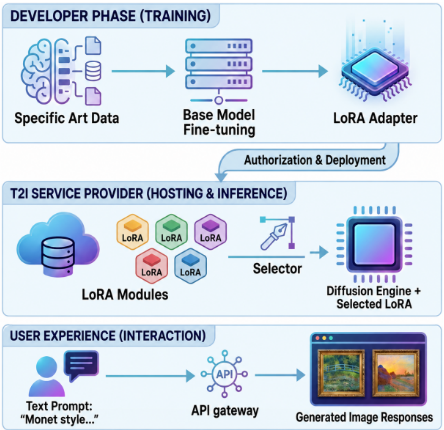
Text-to-Image (T2I) diffusion models have made remarkable advances in recent years, exemplified by prominent models such as Stable Diffusion [Borji, 2022], DALL·E [Zhou and Nabus, 2023], and Midjourney [Kwon, 2024], driving significant progress in visual content generation across various industries. However, training these large-scale generative models demands considerable computational resources and massive volumes of high-quality visual datasets, rendering full-parameter fine-tuning economically and practically prohibitive for many researchers and developers [Parthasarathy et al., 2024; Tu et al., 2024]. Consequently, practitioners commonly adopt the strategy of leveraging pre-trained diffusion models and efficiently fine-tuning them for specific downstream tasks [Ma et al., 2025]. To mitigate the prohibitive costs associated with traditional full-model tuning, Low-Rank Adaptation (LoRA) has emerged as a prevalent and highly efficient solution [Hu et al., 2022]. LoRA modules function as lightweight plug-in components, containing substantially fewer parameters relative to the large backbone diffusion models they augment [Shen et al., 2025]. These modules are typically trained on specialized, task-specific image datasets and can subsequently be seamlessly integrated into pre-trained diffusion architectures. This paradigm enables a modular and cost-effective approach, in which the pretrained diffusion model provides generalized visual synthesis capabilities, while LoRA modules contribute precise and customized knowledge crucial for targeted image-generation tasks [Huan and Shun, 2025]. The flexibility, efficiency, and effectiveness of LoRA for T2I diffusion models have given rise to a burgeoning market, fostering the commercial distribution of professionally customized LoRA modules. This emerging paradigm, termed LoRA-Service (LoRAS), involves three primary stakeholders: the LoRA developer, the T2I service provider, and the end user. An illustrative overview of the LoRAS workflow is shown in Figure 1. By clearly delineating responsibilities and incentives among stakeholders, LoRAS also promotes specialized LoRA contributions and establishes a thriving ecosystem centered around the provision of specialized visual generative services [Ma et al., 2025; Cao et al., 2024].
∗Corresponding author.
With the increasing reliance on LoRA modules for specialized AI solutions, protecting the intellectual property rights associated with these modules has become a critical concern for commercial LoRA providers [Aldhaheri et al., 2024; Sundaram et al., 2019]. The unauthorized or illicit use of LoRA modules poses significant threats in multiple dimensions. From an economic perspective, unauthorized use directly undermines the benefits and incentives that LoRA developers gain from investing significant effort and resources into the development and optimization of modules [Andrade and Yoo, 2019]. Furthermore, the datasets used to train LoRA often contain sensitive information, making unauthorized reuse susceptible to severe privacy risks, including potential data leaks and inference attacks. Additionally, without robust protection mechanisms, LoRA can be manipulated, destroyed, and redistributed, resulting in unpredictable or harmful model behavior. [Liu et al., 2024; Luo et al., 2025] Despite these obvious risks, there remains a notable research gap in effective copyright protection strategies for LoRA modules.
Ensuring ownership of artificial intelligence models is typically achieved through watermarking technology, which has become a widely accepted and effective method of copyright protection within the industry [Zhang et al., 2018; Ray and Roy, 2020]. Watermarking methods embed specific identification information or unique signatures into either the parameters or outputs of AI models. Even if the model undergoes various intentional modifications, such as fine-tuning or parameter adjustments, the embedded information can still be extracted and verified. However, conventional watermarking methods originally designed for large-scale machine learning models are not directly applicable to LoRA modules. This limitation stems primarily from the fact that LoRA modules have far fewer trainable parameters than large foundational models, resulting in extremely low redundancy available for embedding watermarks. Consequently, imposing traditional watermarking methods might negatively affect LoRA's ability to achieve the intended performance in downstream tasks.
Motivated by the necessity to address these specific challenges and ensure reliable protection of LoRA modules, we introduce a novel framework LoRA2D: an authorized dualwatermarking approach for LoRA copyright protection. Our method is specifically designed for image generation tasks, with Stable Diffusion serving as the backbone architecture. Unlike previous methods, the LoRA2D framework integrates two complementary watermarking mechanisms into the LoRA module: explicit (visible) watermarks and implicit (invisible) watermarks. Our main contributions are summarized as follow:
- We conducted a systematic study on LoRA copyright protection in the context of LoRA plugin services, analyzed the risks associated with unauthorized use of LoRA in platform-based artificial intelligence ecosystems, and identified the technical standards required to achieve LoRA copyright protection.
- We propose the first authorization-controlled dual watermarking framework for LoRA copyright protection. Our method combines license-based explicit watermarks with persistent implicit watermarks, enabling flexible management of LoRA distribution and reliable ownership verification in both authorized and unauthorized scenarios.
- Extensive experiments on benchmark datasets demonstrate that our dual watermarking method effectively prevents unauthorized use and achieves robust watermark detection, thereby meeting the practical requirements of copyright enforcement.
2 RelatedWorks
Low-Rank Adaptation (LoRA) [Hu et al., 2022] has become a popular parameter-efficient fine-tuning technique for large machine learning models. By inserting low-rank trainable matrices into specific layers of the pre-trained model, the LoRA module can efficiently adapt to downstream tasks without modifying the original model parameters. This plug-andplay capability has been demonstrated across various applications in both language and vision domains, including textto-image diffusion models such as Stable Diffusion [Yang et al., 2024]. The success and widespread adoption of LoRA have driven the development of advanced variants to enhance its efficiency and applicability. For example, rsLoRA [Kalajdzievski, 2023] introduces a rank-stabilizing scaling factor to address gradient collapse in higher ranks and unlock the performance potential of high-rank adapters without incurring inference overhead. AdaLoRA [Zhang et al., 2023a] proposes an adaptive budget allocation strategy that evaluates the relative importance of LoRA components and selectively removes less informative singular values during training, allowing the model to concentrate its limited parameter capacity on the most influential updates and achieve effective fine-tuning under strict parameter budgets. These improvements reflect ongoing efforts to extend LoRA's utility, making it increasingly suitable for deployment in resource-constrained environments. Given the growing commercial value and importance of LoRA, the necessity of implementing robust copyright protection measures to prevent unauthorized use has become increasingly evident.
Watermarks for Diffusion Models. With the widespread adoption of diffusion models in commercial image generation services, protecting their intellectual property from unauthorized exploitation has become increasingly critical. Existing watermarking methods for diffusion models generally fall into two categories: white-box and black-box. Whitebox techniques typically embed watermarks directly into model parameters via retraining or fine-tuning. For instance, AquaLoRA [Feng et al., 2024] incorporates watermark signals through parameter-efficient adaptations in the U-Net backbone, enabling reliable watermark verification when internal weights are accessible. Chou et al. [Chou et al., 2023] implant implicit watermarking through modified diffusion dynamics, triggered by predefined signals. Conversely, blackbox methods embed watermark triggers into the model's generation behaviors. Zhao et al. [Zhao et al., 2023] and Liu et al. [Liu et al., 2023] employ trigger-based prompt strategies for watermark encoding. However, these trigger-dependent techniques remain susceptible to adversarial detection or removal. Additionally, existing methods largely neglect watermark protection tailored explicitly for standalone LoRA modules. In contrast, our proposed framework addresses this limitation by introducing a dual-watermark embedding strategy specifically designed for LoRA-based diffusion models. This approach introduces robust implicit watermarking for blackbox verification and explicit watermarking as a visual deterrent, specifically designed to protect LoRA modules.
3 Background
Text-to-Image Diffusion Models. Text-to-Image (T2I) diffusion models generate images from textual prompts through a probabilistic diffusion process operating in a latent representation space [Rombach et al., 2022]. Typically, these models integrate three essential modules: i) A text encoder, ii) A latent diffusion module, and iii) An autoencoder, typically a variational autoencoder. To effectively model complex image distributions, T2I diffusion models first introduce noise into structured image data (forward diffusion) and then learn to reverse this noise-adding process to reconstruct images from noise (reverse diffusion).
Forward Diffusion Process. During this stage, structured image data is gradually corrupted into noise through a Markovian sequence. Formally, forward diffusion is defined by the conditional distribution p(xt | xt-1), incrementally introducing Gaussian noise into latent variables at each discrete time step t, represented as: xt = √1-βt xt-1 +βt ϵ, ϵ ∼ N(0, I), where βt represents a variance schedule dependent on time. Equivalently, the cumulative diffusion from the initial latent representation x0 to a given noisy state xt can be simplified through the cumulative parameters αt = 1 - βt and ¯αt = ∏ts=1 αs: xt = √ ¯αt x0 + √1 - ¯αt ϵ.
Reverse Diffusion Process. In this process, noise is progressively transformed back into structured image data. Given a noisy latent state zt and a embedding τ(y) derived from the textual prompt y, the diffusion model estimates the original noise through the prediction function ϵθ(zt, t, τ(y)). Accurate prediction facilitates the estimation of the posterior distribution q(zt-1 | zt), reversing the forward diffusion dynamics and progressively reconstructing coherent images from noise.
Low-Rank Adaptation. Fine-tuning large pretrained models, particularly large language models (LLMs) and diffusion models, often involves significant computational costs and storage requirements due to their enormous parameter sizes. Low-Rank Adaptation (LoRA) [Hu et al., 2022] efficiently addresses this by restricting updates to low-rank matrices, significantly reducing resource demands. Specifically, given a pretrained weight matrix W ∈ Rd×k , LoRA modifies it as: W ′ = W + BA, where B ∈ Rd×r , A ∈ Rr×k , and r ≪ min(d, k). Here, r denotes the rank of the adaptation, typically much smaller than the original dimensions d and k. During fine-tuning, only matrices A and B are updated, drastically reducing memory usage and computational complexity. LoRA has demonstrated effectiveness in various domains, including natural language processing, vision, and generative modeling, making it widely adopted for practical, scalable fine-tuning.
4 Methodology
4.1 The proposed framework - LoRA2D
In this section, we introduce a novel framework, LoRA2D, an authorized dual-watermarking system composed of complementary components: explicit watermark embedding (Bvis) and implicit watermark embedding (Bimp). Both watermarks, together with the primary task module (Btask), are integrated into a multi-head LoRA structure, where each component occupies an independent low-rank head to minimize interference and ensure parameter efficiency. Specifically, the explicit watermark provides visual authorization deterrence via a perceptible logo, while the implicit watermark enables continuous black-box verification for copyright enforcement. A license-based gating mechanism dynamically controls the visibility of the explicit watermark head, ensuring unobtrusive authorized usage. During copyright verification, suspected services are queried, and the presence of the implicit watermark is validated using a pretrained watermark decoder. We detail each component in the following sections.
4.2 Dual Watermarks Embedding
We begin by introducing the dual-watermark pre-training mechanism of our proposed LoRA2D, which employs two complementary embedding components: (i) implicit watermark embedding, encoding invisible watermark signals into the latent space through a dual-encoder fusion mechanism for black-box verification; and (ii) explicit watermark embedding, generating a perceptible visual logo within designated regions of output images as a clear deterrent against unauthorized use. In the following, we detail implicit watermark embedding component firstly.
Implicit watermark embedding. In this section, we detail the implicit watermark embedding component of LoRA2D. This module aims to encode a robust and imperceptible ownership signal into the generative behavior of a LoRA, ensuring generated images implicitly carry a recoverable watermark while preserving original generative fidelity. Specifically, the implicit watermark is embedded in the latent representation of the image, rather than directly in the pixel space. Such implicit watermarks enable reliable black-box copyright verification after deployment, even if explicit visual marks are removed or suppressed. Given that LoRA modules have a limited number of trainable parameters unsuitable for embedding high-capacity watermarks directly, we propose a twostage embedding strategy operating in latent diffusion space, tightly integrated with LoRA fine-tuning. Our approach utilizes a dual-encoder fusion structure consisting of a watermark encoder Ew and an image encoder EI . The use of two separate encoders allows the watermark and image-content distributions to be modeled independently, which is important because the binary watermark signal and the continuous image latent features have substantially different statistical properties. Such a probabilistic dual-encoder design enhances adaptability by explicitly capturing the uncertainty and modality-specific characteristics of both watermark and image representations, while also reducing mutual interference between them. Consequently, this structure improves watermark robustness while preserving the original image quality and generative fidelity. Instead of directly producing deterministic embeddings, the two encoders parameterize latent distributions for the watermark message and the image content, respectively. Formally, given a binary watermark message w ∈ {0, 1}k , where k denotes the predefined watermark length, The watermark encoder produces a latent distribution:
where µw(·) represent the mean parameterized by the watermark encoder, diag(σ2w (·)) denotes a diagonal covariance matrix and hw denotes the latent embeddings of the watermark.
Given a clean cover image Ic, the image encoder parameterizes the latent distribution of the image-content:
where µI (·) are the corresponding mean parameterized by the image encoder, and similarly diag(σ2 I (·)) is the diagonal covariance matrix and hI denotes the latent embeddings of the image-content. The two embeddings are then concatenated and passed through a learnable fusion module Fψ:
where [·∥·] denotes feature concatenation and MLPψ maps the concatenated representation into a joint latent embedding.
We integrate the watermark and image embeddings into a fused representation hf , but this alone does not guarantee sufficient preservation of information from both sources. To explicitly quantify and control such nonlinear statistical dependencies, we employ the Hirschfeld-Gebelein-R´enyi (HGR) maximal correlation, which is quantify complex nonlinear statistical dependencies, making it particularly suited for capturing the intricate relationships between watermark and image embeddings. Formally, HGR is defined as:
Specifically, we compute:
representing the correlation between fused latent embedding hf and watermark embedding hw, as well as between hf and image-content embedding hI. To ensure balanced information fusion from both sources, we formulate a balanced HGRbased regularization term:
where first termmaximizes overall statistical dependence between the fused representation and both embeddings, while the second term penalizes significant differences in the contributions between HGRw and HGRI . Therefore, the fused representation is encouraged to retain watermark-related information for robust recovery and image-content information for visual fidelity in a balanced manner.
Although HGR regularization encourages fused representation hf to preserve watermark-related information, it does not directly ensure that the embedded message can be recovered from the final generated image after VAE decoding and realistic distortions. Therefore, we further introduce a message similarity loss to provide supervision for watermark recoverability:
where ˆw is the decoded watermark prediction from the watermark decoder Dw.
In addition to recoverability, in our dual-encoder latent fusion structure, the watermark embedding hw and the imagecontent embedding hI are first fused into the joint representation hf , which is then used to generate the injected latent residual ∆z. Since hf is explicitly encouraged to preserve watermark-related information through the HGR regularization, the model may otherwise increase watermark recoverability by injecting an excessively large residual into the clean latent representation, which can cause the watermarked latent representation to deviate significantly from the original clean latent. We define the injected latent residual as: ∆z = zwm - zc, where zc and zwm denote the clean and watermarked latent representations. We then constrain the relative energy of the injected residual:
where i, j index the locations of the latent feature map with resolution L×W. By penalizing the magnitude of ∆z, this constraint prevents the watermark signal from being embedded through excessively large latent perturbations, thereby encouraging a compact watermark injection while preserving the original generative behavior.
Finally, combining all these terms, we formulate our overall training objective for encoder-decoder pre-training as:
where θ and ω denote the parameters of the watermark encoder and image encoder.
Building upon the implicit embedding of watermark, we further introduce the implicit watermark verification. The objective is to determine whether a suspected T2I service employs protected LoRA under a black-box setting, where only generated outputs are observable and internal model parameters remain inaccessible. Given a suspected T2I service, we verify by querying the service with a set of n semantically coherent prompts {yi}ni=1 and collecting the corresponding generated images {Ii}ni=1 . To verify the embedded watermark, we employ the pre-trained watermark decoder Dw, which is designed to recover the watermark message from implicitly embedded patterns in the generated images. Watermark verification is conducted by comparing the computed accuracy, which is empirically calibrated to ensure robustness and minimize false positives.
Explicit watermark embedding. While the implicit watermark embedding discussed above provides a robust yet imperceptible watermark, an explicit watermark serves a complementary and essential role, providing an immediate, visible indication of unauthorized or trial usage. Specifically, our explicit watermark embedding mechanism aims to generate a consistent, clearly identifiable logo or text pattern at a predefined spatial location within generated images. Unlike implicit embedding, the explicit watermarking should ensure perceptual visibility to fulfill its deterrent purpose, yet it should minimally interfere with overall image aesthetics.
To realize explicit watermark embedding, we select a set of diverse images that are background-agnostic (typically 100 ∼ 500) and overlay each image with an identical logo, placed consistently in the same fixed location with uniform size and transparency. Alongside the watermarked images, we generate a binary mask Mlogo, marking the precise logo region as 1, with all other areas as 0. Formally, given an original clean image I, the explicitly watermarked training sample ˆ I is obtained as:
where Ilogo denotes the predefined logo pattern, and ⊙ represents element-wise multiplication.
For embedding explicit watermarks in a parametrically efficient manner without modifying the backbone diffusion model, we employ a lightweight LoRA optimization strategy. Specifically, we freeze the backbone diffusion model (e.g., the stable diffusion model) and introduce LoRA modules exclusively in the decoder blocks of U-Net, in particular in the terminal layer closest to the output potential representation. By restricting the trainable parameters in this way, we ensure that explicit watermarks can be reliably generated without significantly affecting the generalization ability of the original model. Given an input latent representation derived from a clear image, we optimize the LoRA parameters to reconstruct the corresponding image with an explicit watermark. Let ˆ I denote the real image with an explicit watermark, and I ∗ be the output image generated by the diffusion model augmented with the LoRA module. To guide the explicit watermark embedding, we define a reconstruction loss that emphasizes the consistency of the watermarked region while maintaining the quality of the overall image generation:
where the first term Lgen(I ∗ , ˆ I) is the standard image reconstruction objective (e.g., mean squared error or perceptual loss), and the second term explicitly enforces pixel-level accuracy within the logo region, balanced by hyperparameter λlogo.
4.3 Authorization andWatermark Control
Having established the embedding mechanisms for implicit and explicit watermarking, we next explore how to selectively activate and manage and detect these watermarking features in real applications. To this end, we first introduce a multihead LoRA architecture equipped with a gating mechanism and a permission-based authorization framework, as illustrated in Figure 2. This design enables fine-grained control over watermarking visibility, allowing the system to dynamically switch to explicit or implicit watermarking modes based on the user's authorization status. Specifically, This architecture consists of three independent LoRA branches, each specialized for a distinct functionality: i) LoRA-main (Hmain): Encodes primary generative capabilities specific to tasks or styles, trained on the target domain dataset without watermark constraints. ii) LoRA-vis (Hvis): Generates visually explicit watermark logos in generated images. iii) LoRA-imp (Himp): Embeddings robust and invisible watermark signals within images.
During the training phase, the backbone diffusion model remains frozen, and each LoRA head is trained independently or jointly with separate optimization objectives, as discussed earlier. In inference, each head is selectively activated or deactivated via the corresponding binary gates: gmain, gvis, gimp ∈ {0, 1}, allowing the runtime configuration to flexibly determine the generated outputs' watermark properties. Formally, the weight matrices of the multi-head LoRA are represented as low-rank decompositions added to the frozen pre-trained weight matrix W. Specifically, each LoRA head is defined as follows:
where W represents the frozen weight matrix of the backbone diffusion model and each LoRA head consists of two low-rank matrices A ∈ Rr×d and B ∈ Rd×r , with r ≪ d denoting the low-rank dimension.
For practical control of watermark visibility, we introduce authorization via digitally signed license files issued upon commercial purchase or subscription. A typical license file includes: (i) User Identifier, uniquely identifying the authorized user; (ii) Hardware or Account Binding, restricting activation to a specific deployment environment; (iii) Gate Control Parameters, setting gvis = 0 upon authorization to disable explicit watermarking; and (iv) Digital Signature, generated using RSA or ECDSA, to ensure license authenticity and integrity. At service initialization, the following validation processes are performed: (i) read the license file and verify its digital signature to prevent unauthorized modifications; (ii) verify the hardware or account bindings specified in the license file; and (iii) upon successful validation, update the gate value to reflect the authorized usage settings. For a valid license, the gate value is typically set to (gmain, gvis, gimp) = (1, 0, 1), which allows the main function to be enabled while implicitly embedding the watermark without displaying the explicit watermark. Well-designed gating mechanisms enable different runtime watermarking behaviors based on the user's authorization status:
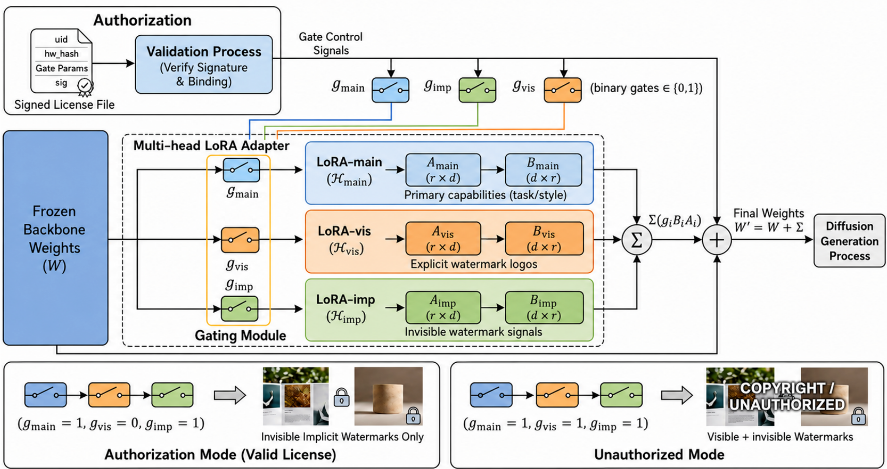
- Unauthorized Mode (gvis = 1): The explicit LoRA watermark is active, producing a clearly visible logo pattern in the resulting image that serves as an important reminder of unauthorized use. Meanwhile, the implicit watermark remains embedded at all times to ensure strong copyright validation.
- Authorization Mode (gvis = 0): Explicit watermark generation is disabled to avoid obvious visual distractions to authorized users. However, implicit watermark embedding is kept active (gimp = 1), enabling continuous copyright tracking and black-box validation by securing ownership through invisible watermarking signals.
This comprehensive authorization and watermark control design ensures that explicit watermarks effectively prevent unauthorized redistribution, while implicit watermarks reliably and discreetly track model usage. This approach achieves commercial viability while rigorously safeguarding intellectual property.
5 Experiments
5.1 Experimental Setting
Model and Datasets. We evaluate our method on four taskspecific datasets designed for stylized text-to-image generation. These include two open-domain character datasets, One Piece [YaYaB, 2022], Simpsons [Norod78, ], and artist-style datasets Wikiart (Van Gogh and Picasso). All experiments are conducted using Stable Diffusion V1.5 as the backbone model. LoRA modules are fine-tuned on each dataset to enable task-specific generation, and the same backbone configuration is used across all methods to ensure fair comparison. Evaluation Metrics. We evaluate the effectiveness of the watermark through the accuracy of its extraction. Additionally, Fresnel Epistatic Distance (FID) [Heusel et al., 2017] and CLIP score [Radford et al., 2021] are employed to evaluate the visual quality and semantic consistency of generated images.
Baseline. As LoRA specific watermarking remains largely unexplored, we construct comparison baselines by first embedding watermarks into the training images and subsequently fine-tuning LoRA modules on the watermarked datasets. We adopt one traditional watermarking method, DFT-SVD [Varghese et al., 2016], two learning-based approaches: RoSteALS [Bui et al., 2023] and TrustMark [Lu et al., 2024]. For each baseline, watermark embedding is applied at the data level prior to LoRA training, and watermark presence is evaluated on images generated by the trained LoRA.
5.2 Experiment Results
Comparison Study. We evaluated the effectiveness of our implicit watermarking method against several on two distinct task-specific datasets. The primary criterion for evaluating watermarking effectiveness is the accuracy of implicit watermark extraction accuracy, which measures the ability to reliably decode embedded watermark information from generated images. For each watermarking method, we first generate images using a LoRA-adapted diffusion model trained on these datasets, then apply the trained watermark decoder to extract the implicit watermark information. We then computed the extraction accuracy for each dataset, then calculated the overall average in two types of task-specific datasets to derive a performance metric. As shown in Table 1, our proposed LoRA2D consistently achieves superior watermark extraction accuracy in all evaluated datasets, outperforming both traditional watermarking baselines and advanced learningbased methods. Our method achieves a significantly higher average compared to the best-performing baseline, clearly demonstrating the robustness and reliability of our implicit watermark embedding strategy. These results highlight the effectiveness of LoRA2D in embedding imperceptible yet reliable watermark signals, effectively securing copyright ownership of LoRA modules in real-world deployment scenarios.
| Dataset | Metrics | DFT-SVD | RoSteALS | TrustMark | w/o Watermark | Ours |
|---|---|---|---|---|---|---|
| Character datasets One Piece; Simpsons | Accuracy ↑ FID↓ | 0.478 154.99 | 0.651 164.73 | 0.805 166.00 | - 151.73 | 0.913 151.38 |
| Accuracy ↑ | 0.489 | 0.491 251.08 | 0.755 | - | 0.835 | |
| CLIP Score↑ | 29.04 | 28.90 | 27.20 | 29.31 | 29.22 | |
| Artist-style datasets Wikiart Van Gogh; Picasso | ||||||
| FID↓ | 239.23 | 251.34 | 236.13 | 240.29 | ||
| CLIP Score↑ | 26.04 | 26.66 | 26.90 | 27.15 | 26.91 |
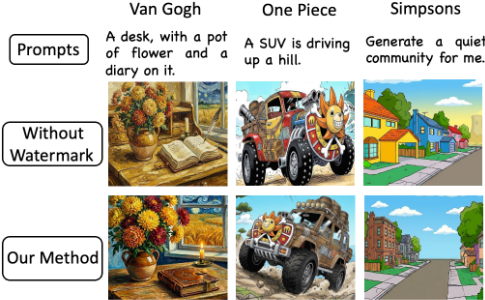
T2I Generation Quality Evaluation. We assess the fidelity of our watermarking method by examining whether the watermarked LoRA module retains the generative performance of the clean model. Using FID and CLIP scores as benchmarks for perceptual quality, we observe in Table 1 that our method yields the lowest FID across Character datasets. This indicates that the watermarking process causes minimal degradation to the image distribution. Additionally, the CLIP scores align closely with those of the non-watermarked model, demonstrating that semantic alignment is not compromised. Visual comparisons provided in Figure 3 support these quantitative findings, revealing that the watermarked model preserves stylistic integrity and visual quality, devoid of any visible distortions or artifacts.
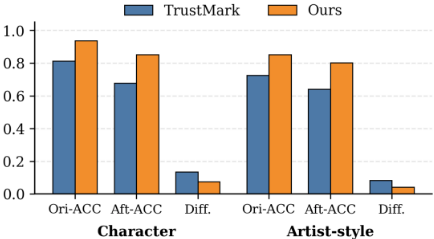
Robustness Study. The experimental results summarized in Figure 4 demonstrate that our proposed approach offers notably improved robustness against LoRA merging attacks compared to TrustMark. To reflect realistic attack conditions, we consider a scenario in which an attacker, lacking access to the original training dataset, attempts to compromise the watermark by merging the protected LoRA module with another unrelated LoRA module. Under such conditions, our method consistently achieves high watermark extraction accuracy, exhibiting only minor degradation across both character-based and artist-style datasets. In contrast, the baseline method suffers significant performance reductions, especially noticeable in character-based datasets. These findings confirm the inherent resilience of our watermark embedding strategy, highlighting its robustness to realistic parameter-merging attacks designed to evade watermark verification.
6 Conclusion
Despite the growing popularity of T2I diffusion models, prior studies have largely neglected copyright protection tailored specifically for LoRA modules. To address this gap, we introduce the LoRA2D framework, an authorization-controlled dual-watermarking solution explicitly designed for LoRA copyright protection. Our approach integrates explicit watermarking, which visibly marks images generated in unauthorized or trial scenarios, and implicit watermarking, offering persistent, invisible encoding to enable robust ownership verification under adversarial alterations or unauthorized redistributions. Experiments confirm the effectiveness of our method, laying a strong foundation for secure and practical watermarking strategies in modular generative AI.
@inproceedings{ijcai2026p96,
  title     = {Toward LoRA Copyright Protection with an Authorized Dual-Watermarking Framework},
  author    = {Yin, Zhipeng and Wang, Zichong and Chen, Ruijun and Ning, Xin and Zhang, Xingyu and Zhang, Wenbin},
  booktitle = {Proceedings of the Thirty-Fifth International Joint Conference on
               Artificial Intelligence, {IJCAI-26}},
  publisher = {International Joint Conferences on Artificial Intelligence Organization},
  editor    = {Diego Calvanese},
  pages     = {853--861},
  year      = {2026},
  month     = {8},
  note      = {Main Track},
  doi       = {10.24963/ijcai.2026/96},
  url       = {https://doi.org/10.24963/ijcai.2026/96},
}
TY - CPAPER TI - Toward LoRA Copyright Protection with an Authorized Dual-Watermarking Framework AU - Yin, Zhipeng AU - Wang, Zichong AU - Chen, Ruijun AU - Ning, Xin AU - Zhang, Xingyu AU - Zhang, Wenbin T2 - Proceedings of the Thirty-Fifth International Joint Conference on Artificial Intelligence, IJCAI-26 PB - International Joint Conferences on Artificial Intelligence Organization PY - 2026 SP - 853 EP - 861 DO - 10.24963/ijcai.2026/96 UR - https://doi.org/10.24963/ijcai.2026/96 ER -Copied
Machine-readable versions of this paper, for tools and AI agents:





