
A Testbed for Studying COVID-19 Spreading in Ride-Sharing Systems
Proceedings of the Twenty-Ninth International Joint Conference on Artificial Intelligence. Demos. Pages 5294-5296.
https://doi.org/10.24963/ijcai.2020/774
Keywords
- Human-Computer Interactive Systems: general
- Multi-agent Systems: general
Abstract
Order dispatch is an important area where artificial intelligence (AI) can benefit ride-sharing systems (e.g., Grab, Uber), which has become an integral part of our public transport network. In this paper, we present a multi-agent testbed to study the spread of infectious diseases through such a system. It allows users to vary the parameters of the disease and behaviours to study the interaction effect between technology, disease and people's behaviours in such a complex environment.
- [Armant and Brown, 2020] Vincent Armant and Kenneth N. Brown. Fast optimised ridesharing: Objectives, reformu- lations and driver flexibility. Expert Systems with Applica- tions, 141, 2020.
- [Maximilian et al., 2016] Schreiec Maximilian, Safetli Hazem, Siddiqui Sajjad, Pflügler Christoph, Wiesche Manuel, and Krcmar Helmut. A matching algorithm for dynamic ridesharing. Transportation Research Procedia, 19:272-285, 2016.
- [Pan et al., 2009] Li Pan, Xiangxu Meng, Zhiqi Shen, and Han Yu. A reputation pattern for service oriented comput- ing. In ICICS, pages 1-5, 2009.
- [Pan et al., 2016] Zhengxiang Pan, Han Yu, Chunyan Miao, and Cyril Leung. Efficient collaborative crowdsourcing. In AAAI, pages 4248-4249, 2016.
- [REUTERS, 2020] REUTERS. Chinese ride-sharing cars in- stall added layer of protection amid virus. February 2020.
- [Shen et al., 2011] Zhiqi Shen, Han Yu, Chunyan Miao, and Jianshu Weng. Trust-based web service selection in vir- tual communities. Web Intelligence and Agent Systems, 9(3):227-238, 2011.
- [WHO, 2020] WHO. WHO announces COVID-19 outbreak a pandemic. March 2020.
- [Wu et al., 2013] Qiong Wu, Xiaogang Han, Han Yu, Zhiqi Shen, and Chunyan Miao. The innovative application of learning companions in Virtual Singapura. In AAMAS, pages 1171-1172, 2013.
- [Yu et al., 2007] Han Yu, Zhiqi Shen, and Chunyan Miao. Intelligent software agent design tool using goal net methodology. In WI-IAT, pages 43-46, 2007.
- [Yu et al., 2008] Han Yu, Zhiqi Shen, and Chunyan Miao. A goal-oriented development tool to automate the incorpora- tion of intelligent agents into interactive digital media ap- plications. ACM Computers in Entertainmen, 6(2):24:1- 24:15, 2008.
- [Yu et al., 2010] Han Yu, Yundong Cai, Zhiqi Shen, Xue- hong Tao, and Chunyan Miao. Agents as intelligent user interfaces for the net generation. In IUI, pages 429-430, 2010.
- [Yu et al., 2011] Han Yu, Zhiqi Shen, Chunyan Miao, and Ah-Hwee Tan. A simple curious agent to help people be curious. In AAMAS, pages 1159-1160, 2011.
- [Yu et al., 2013a] Han Yu, Chunyan Miao, Bo An, Cyril Le- ung, and Victor R. Lesser. A reputation management mod- el for resource constrained trustee agents. In IJCAI, pages 418-424, 2013.
- [Yu et al., 2013b] Han Yu, Zhiqi Shen, Cyril Leung, Chun- yan Miao, and Victor R. Lesser. A survey of multi-agent trust management systems. IEEE Access, 1(1):35-50, 2013.
- [Yu et al., 2017] Han Yu, Chunyan Miao, Yiqiang Chen, Si- mon Fauvel, Xiaoming Li, and Victor Lesser. Algorith- mic management for improving collective productivity in crowdsourcing. Scientific Reports, 7(12541), 2017.
- [Yu et al., 2018] Han Yu, Zhiqi Shen, Chunyan Miao, Cyril Leung, Victor R. Lesser, and Qiang Yang. Building ethic- s into artificial intelligence. In IJCAI, pages 5527-5533, 2018. IJCAI
- [Yu et al., 2019a] Han Yu, Yang Liu, Xiguang Wei, Chuyu Zheng, Tianjian Chen, Qiang Yang, and Xiong Peng. Fair and explainable dynamic engagement of crowd workers. In IJCAI, pages 6575-6577, 2019. IJCAI
- [Yu et al., 2019b] Han Yu, Chunyan Miao, Yongqing Zheng, Lizhen Cui, Simon Fauvel, and Cyril Leung. Ethically aligned opportunistic scheduling for productive laziness. In AIES, pages 45-51, 2019.
References were extracted automatically from the PDF and may contain errors.
Full text extracted automatically from the PDF; figures, tables and equations may differ. The PDF is the version of record.
1 Introduction
Typical artificial intelligence (AI)-empowered ride-sharing systems employ order dispatch algorithms which take into account of the states of drivers and passengers, such as location, availability, and time to match cars to passengers. These factors are formulated into a combinatorial optimization to crowdsource [Pan et al., 2016] cars to satisfy user demands. Such algorithms often aim to find trade-offs among multiple objectives including improving access for passengers, reduce emissions and congestion, sustain the long term profitability of the system, and managing divers' wellbeing and social welfare [Yu et al., 2018]. [Maximilian et al., 2016; Yu et al., 2019b; Armant and Brown, 2020].
Recently, the 2019 Novel Coronavirus Disease (COVID19) outbreak has been declared a pandemic by the World Health Organization (WHO) [WHO, 2020]. It has seriously disrupted people's daily life. Being a confined space which the driver and passengers need to share for prolonged periods of time, ride-sharing systems can be a potential channel through which infectious diseases spread [REUTERS, 2020]. Currently, there is no tool available for studying how COVID19 spreads through AI-empowered ride-sharing systems.
To bridge this gap, this paper reports a testbed based on multi-agent systems [Yu et al., 2007; Yu et al., 2008; Yu et al., 2010; Yu et al., 2011; Wu et al., 2013] to support the study of the spread of infectious diseases through a ridesharing system with AI-empowered order dispatch. It is built on an open dataset of real-world ride-sharing in Chengdu, China with a fair and explainable order dispatch optimization algorithm based on [Yu et al., 2013a; Yu et al., 2017; Yu et al., 2019b]. It allows users to vary the parameters of the disease and people's behaviours to study the interaction effect between technology, disease and behaviours in such a complex environment.
∗Contact Author
†Contact Author
2 The Testbed System
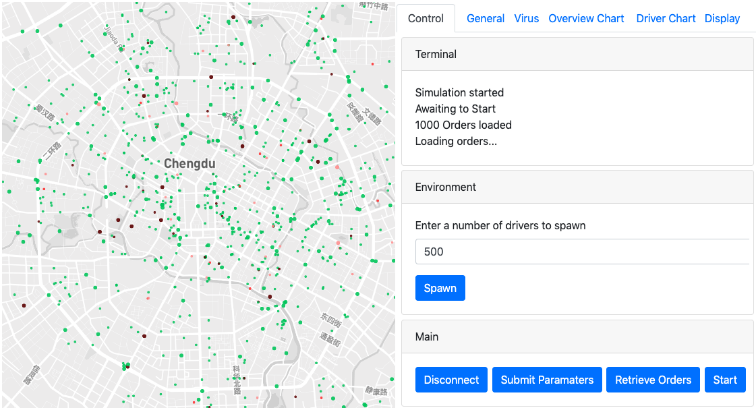
The testbed (Figure 1) is designed based on the dataset of ride-sharing activities from Chengdu, China published by DiDi through its GAIA Open Dataset Initiative (https: //outreach.didichuxing.com/research/opendata/en/). It consists of an order dispatcher and a disease spread simulator.
2.1 Order Dispatcher
The Order Dispatcher in the testbed jointly considers the following factors.
Order: The order is a ride requested by a passenger. An order consists of a start position and end position.
Driver: A driver is a worker in the ride sharing system. A driver consist of regret, fatigue, reputation and motivation to work. These variables can change with the situation.
Regret: The regret of the driver is modelled as a queue. The queuing dynamics of a driver i's pending regret queue can be expressed as: Yi(t + 1) = max{0, Yi(t) - vi(t) + ¯ vr(t)} where Yi(t + 1) is driver i's regret at time (t + 1), Yi is driver i's regret at time t, vi(t) is the value of the order which driver i takes at time t, and ¯ vr(t) is the average value of orders which other drivers (with similar reputation as driver i) take at time t. The Lyapunov function for the regret among drivers is defined as L(t) = 12 ∑Nt=1 Yi(t)2 . By letting Y(t) be a vector of all drivers' regret queues at time t. Using the Lyapunov drift, ∆(Y(t)), the variation in drivers' regret can be expressed as: ∆(Y(t)) = E{L(t+1 - L(t)|Y(t)}.
Social Welfare: The expected social welfare of a strategy which dispatches orders among N drivers at time t is U(t) = ∑Nt=1 vi(t)(ri(t)-wi(t)) where vi(t) is the value of the order which driver i take at time t. ri(t) and wi(t) are the reputation and fatigue of driver i at time t, respectively.
The objective of efficiently dispatching a large number of orders among drivers can be defined as (social welfare - regret): 1 T ∑T -1 t=1 (σi(t) ×E{U(t)|Y(t) -∆(Y(t))). This objective function can be optimized through an index ranking approach. The formula is described as ϕi(t) = σi(t) × (ri(t) - wi(t)) + Yi(t) where ϕ is the ranking index, σ is the motivation, ri is the reputation, wi is the fatigue and Yi is the regret of the driver at time t. The ranking index is used to prioritize the drivers by the order dispatcher.
In the testbed, we simulate a uniform distribution of drivers' motivation at the start of each run. The beta reputation model [Pan et al., 2009; Shen et al., 2011; Yu et al., 2013b] is adopted to compute drivers' reputation as they complete tasks. Drivers' fatigue levels are set to 0 at the start of a run and increase gradually as they complete more tasks without rest. All these values are normalized before performing the calculation in order to remove distortions.
2.2 Disease Spread Simulator
The spread of a disease in a ride-sharing system is formulated as: pk = si(m) ∧ b(v) ∧ rk(m) where p is the probability of a person k being infected by a person i. s is the probability of spread if person i wears a mask m. b is the probability of the infection with respect to the virus v level (i.e. Mild, Moderate or Severe). r is the probability of a person k being infected if he wears a mask m. The mask m has a effectiveness rate between 0 and 1. This formula is executed when driver is fetching the passenger to its destination. The longer the ride, the higher probability of getting infected provided there is one infected person in the car.
With COVID-19, symptoms may not appear for some time while the carrier is infectious. Hence, we implementation a probability evolution mechanism: v" = f(t, v) where v" is the next stage of virus, and is determined by the current time t and the current stage of virus v. Each stage (except last one - Severe) has a non-zero probability of transiting to the next stage. The aforementioned variables can be adjusted before each run to simulate different disease characteristics and people's behaviour patterns.
To show how infections spread through the ride-sharing system, we vary the percentage of the infected drivers and passengers. The simulation runs are based on the first 1,000 passengers of a day. The mask effectiveness is set to 95%.
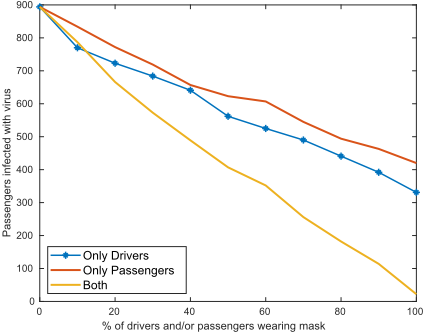
In Figure 2, if only the passengers or only the drivers wear masks, the trends of infection based on the percentage of them wearing masks are similar. The higher the percentage of people wearing masks, the fewer infections. With only drivers wearing masks results in lower number of infections compared to with only passengers wearing masks. This is due to the effect that an infected driver can pass the disease on to more unprotected passengers before succumbing to the disease. If both groups wear masks, the spread of the disease decreases as a faster rate as they are both less exposed.
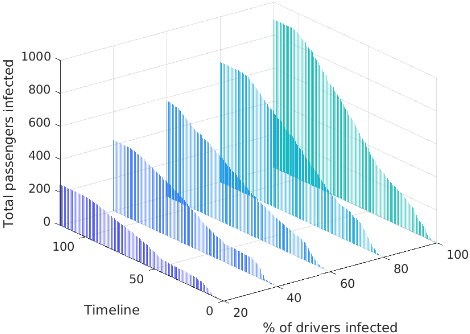
In Figure 3 shows the trends of infected passengers based on different percentage of initial infected drivers without wearing masks. It can be observed that early adoption of good personal hygiene practices can help slow down the spread of the disease. A video demonstration on the visualization of the virus spread among passengers and drivers under various conditions can be found at (https://youtu.be/ABf13AeUrVI).
3 Discussions and FutureWork
In this paper, we present a testbed that can be used to study the spread of infectious diseases through ride-sharing systems under different conditions based on real-world data.
In subsequent research, we will focus on incorporating more diverse order dispatch algorithms and providing more flexible settings of disease characteristics and behaviour patterns to enable the tool to offer more insight into this research topic. We will also develop actionable explanation techniques [Yu et al., 2019a] to help discover emerging behaviour patterns which can significantly mitigate the situation and are easy for the majority of the population to adopt.
Acknowledgments
This research is supported, in part, by the Nanyang Assistant Professorship (NAP), AISG-GC-2019-003, NRFNRFI05-2019-0002, NTU-SDU-CFAIR (NSC-2019-011), and Alibaba-NTU-AIR2019B1.
@inproceedings{ijcai2020p774,
  title     = {A Testbed for Studying COVID-19 Spreading in Ride-Sharing Systems},
  author    = {Yong Wong, Harrison Jun and Deng, Zichao and Yu, Han and Huang, Jianqiang and Leung, Cyril and Miao, Chunyan},
  booktitle = {Proceedings of the Twenty-Ninth International Joint Conference on
               Artificial Intelligence, {IJCAI-20}},
  publisher = {International Joint Conferences on Artificial Intelligence Organization},
  editor    = {Christian Bessiere},
  pages     = {5294--5296},
  year      = {2020},
  month     = {7},
  note      = {Demos},
  doi       = {10.24963/ijcai.2020/774},
  url       = {https://doi.org/10.24963/ijcai.2020/774},
}
TY - CPAPER TI - A Testbed for Studying COVID-19 Spreading in Ride-Sharing Systems AU - Yong Wong, Harrison Jun AU - Deng, Zichao AU - Yu, Han AU - Huang, Jianqiang AU - Leung, Cyril AU - Miao, Chunyan T2 - Proceedings of the Twenty-Ninth International Joint Conference on Artificial Intelligence, IJCAI-20 PB - International Joint Conferences on Artificial Intelligence Organization PY - 2020 SP - 5294 EP - 5296 DO - 10.24963/ijcai.2020/774 UR - https://doi.org/10.24963/ijcai.2020/774 ER -Copied
Machine-readable versions of this paper, for tools and AI agents:





