
Controllable Neural Story Plot Generation via Reward Shaping
Proceedings of the Twenty-Eighth International Joint Conference on Artificial Intelligence. AI for Improving Human Well-being. Pages 5982-5988.
https://doi.org/10.24963/ijcai.2019/829
Keywords
- Special Track on AI for Improving Human-Well Being: Entertainment;games applications (Special Track on AI and Human Wellbeing)
Abstract
Language-modeling--based approaches to story plot generation attempt to construct a plot by sampling from a language model (LM) to predict the next character, word, or sentence to add to the story. LM techniques lack the ability to receive guidance from the user to achieve a specific goal, resulting in stories that don't have a clear sense of progression and lack coherence. We present a reward-shaping technique that analyzes a story corpus and produces intermediate rewards that are backpropagated into a pre-trained LM in order to guide the model toward a given goal. Automated evaluations show our technique can create a model that generates story plots which consistently achieve a specified goal. Human-subject studies show that the generated stories have more plausible event ordering than baseline plot generation techniques.
- [Bamman et al., 2013] David Bamman, Brendan O'Connor, and Noah A. Smith. Learning Latent Personas of Film Characters. In ACL, pages 352-361, 2013.
- [Cavazza et al., 2002] Marc Cavazza, Fred Charles, and Steven J. Mead. Planning characters' behaviour in inter- active storytelling. Journal of Visualization and Computer Animation, 13:121-131, 2002.
- [Fan et al., 2018] Angela Fan, Mike Lewis, and Yann Dauphin. Hierarchical Neural Story Generation. In ACL, pages 889-898, 2018.
- [Gehring et al., 2017] Jonas Gehring, Michael Auli, David Grangier, Denis Yarats, and Yann N. Dauphin. Convolu- tional Sequence to Sequence Learning. In ICML, 2017.
- [Gervás et al., 2005] Pablo Gervás, Belen Díaz-Agudo, Fed- erico Peinado, and Raquel Hervás. Story plot generation based on CBR. Journal of Knowledge-Based Systems, 18(4-5):235-242, 2005.
- [Jenks and Caspall, 1971] George F. Jenks and Fred C Cas- pall. Error on choroplethic maps: definition, measurement, reduction. Annals of the Association of American Geogra- phers, 61(2):217-244, 1971.
- [Khalifa et al., 2017] Ahmed Khalifa, Gabriella AB Barros, and Julian Togelius. Deeptingle. In ICCC, 2017.
- [Khandelwal et al., 2018] Urvashi Khandelwal, He He, Peng Qi, and Dan Jurafsky. Sharp nearby, fuzzy far away: How neural language models use context. In ACL, 2018.
- [Lebowitz, 1987] Michael Lebowitz. Planning stories. In CogSci, pages 234-242, 1987.
- [Li et al., 2013] Boyang Li, Stephen Lee-Urban, George Johnston, and Mark O. Riedl. Story generation with crowdsourced plot graphs. In AAAI, July 2013.
- [Li et al., 2016] Jiwei Li, Will Monroe, Alan Ritter, Michel Galley, Jianfeng Gao, and Dan Jurafsky. Deep reinforce- ment learning for dialogue generation. In EMNLP, pages 1192-1202, 2016.
- [Martin et al., 2018] Lara J. Martin, Prithviraj Am- manabrolu, Xinyu Wang, William Hancock, Shruti Singh, Brent Harrison, and Mark O. Riedl. Event Rep- resentations for Automated Story Generation with Deep Neural Nets. In AAAI, pages 868-875, 2018.
- [Meehan, 1977] James R. Meehan. TALE-SPIN: An inter- active program that writes stories. In IJCAI, pages 91-98, 1977.
- [Miller, 1995] George A. Miller. Wordnet: a lexical database for english. Communications of the ACM, 38(11):39-41, 1995.
- [Mostafazadeh et al., 2016] Nasrin Mostafazadeh, Lucy Vanderwende, Wen-tau Yih, Pushmeet Kohli, and James Allen. Story Cloze Evaluator: Vector Space Representa- tion Evaluation by Predicting What Happens Next. In 1st Workshop on Evaluating Vector Space Representations for NLP, pages 24-29, 2016.
- [Ng et al., 1999] Andrew Y Ng, Daishi Harada, and Stuart Russell. Policy invariance under reward transformations: Theory and application to reward shaping. In ICML, vol- ume 99, pages 278-287, 1999.
- [Pérez y Pérez and Sharples, 2001] Rafael Pérez y Pérez and Mike Sharples. MEXICA: A computer model of a cogni- tive account of creative writing. Journal of Experimental and Theoretical Artificial Intelligence, 13:119-139, 2001.
- [Porteous and Cavazza, 2009] Julie Porteous and Marc Cavazza. Controlling narrative generation with planning trajectories: the role of constraints. In ICIDS, pages 234-245. Springer, 2009.
- [Purdy et al., 2018] Christopher Purdy, Xinyu Wang, Larry He, and Mark Riedl. Predicting story quality with quanti- tative measures. In AIIDE, 2018.
- [Radford et al., 2019] Alec Radford, Jeffrey Wu, Rewon Child, David Luan, Dario Amodei, and Ilya Sutskever. Language Models are Unsupervised Multitask Learners. Technical report, OpenAI, 2019.
- [Riedl and Young, 2010] Mark O. Riedl and R. Michael Young. Narrative planning: Balancing plot and charac- ter. Journal of Artificial Intelligence Research, 39:217- 268, 2010.
- [Roemmele and Gordon, 2015] Melissa Roemmele and An- drew S. Gordon. Creative help: A story writing assistant. In ICIDS, pages 81-92, 2015.
- [Schuler and Kipper-Schuler, 2005] Karin Kipper Schuler and Karen Kipper-Schuler. VerbNet: A Broad-Coverage, Comprehensive Verb Lexicon. PhD thesis, University of Pennsylvania, 2005.
- [Sutskever et al., 2014] Ilya Sutskever, Oriol Vinyals, and Quoc V Le. Sequence to sequence learning with neural networks. In NeurIPS, pages 3104-3112, 2014.
- [Sutton and Barto, 1998] Richard S. Sutton and Andrew G. Barto. Reinforcement Learning: An Introduction. MIT press, 1998.
- [Swanson and Gordon, 2012] Reid Swanson and Andrew Gordon. Say Anything: Using textual case-based reason- ing to enable open-domain interactive storytelling. ACM TiiS, 2(3):16:1-16:35, 2012.
- [Ware and Young, 2011] Stephen Ware and R. Michael Young. CPOCL: A Narrative Planner Supporting Conflict. In AIIDE, pages 97-102, 2011.
- [Williams, 1992] Ronald J. Williams. Simple statistical gradient-following algorithms for connectionist reinforce- ment learning. Machine Learning, 8(3):229-256, May 1992.
- [Yao et al., 2019] Lili Yao, Nanyun Peng, Weischedel Ralph, Kevin Knight, Dongyan Zhao, and Rui Yan. Plan-and- write: Towards better automatic storytelling. In AAAI, 2019.
References were extracted automatically from the PDF and may contain errors.
Full text extracted automatically from the PDF; figures, tables and equations may differ. The PDF is the version of record.
1 Introduction
Automated plot generation is the problem of creating a sequence of main plot points for a story in a given domain and with a set of specifications. Many prior approaches to plot generation relied on planning [Lebowitz, 1987; Gerv´as et al., 2005; Porteous and Cavazza, 2009; Riedl and Young, 2010]. In many cases, these plot generators are provided with a goal, outcome state, or other guiding knowledge to ensure that the resulting story is coherent. However, these approaches also required extensive domain knowledge engineering.
Machine learning approaches to automated plot generation can learn storytelling and domain knowledge from a corpus of existing stories or plot summaries. To date, most existing neural network-based story and plot generation systems lack the ability to receive guidance from the user to achieve a specific goal. For example, one might want a system to create a story that ends in two characters getting married. Neural language modeling-based story generation approaches in particular [Roemmele and Gordon, 2015; Khalifa et al., 2017; Gehring et al., 2017; Martin et al., 2018] are prone to generating stories with little aim since each sentence, event, word, or letter is generated by sampling from a probability distribution. By themselves, large neural language models have been shown to work well with a variety of short-term tasks, such as understanding short children's stories [Radford et al., 2019]. However, while recurrent neural networks (RNNs) using LSTM or GRU cells can theoretically maintain long-term context in their hidden layers, in practice RNNs only use a relatively small part of the history of tokens [Khandelwal et al., 2018]. Consequently, stories or plots generated by RNNs tend to lose coherence as the generation continues.
∗Denotes equal contribution.
One way to address both the control and the coherence issues in story and plot generation is to use reinforcement learning (RL). By providing a reward each time a goal is achieved, a RL agent learns a policy that maximizes the future expected reward. For plot generation, we seek a means to learn a policy model that produces output similar to plots found in the training corpus and also moves the plot along from a start state s0 towards a given goal sg. The system should be able to do this even if there is no comparable example in the training corpus where the plot starts in s0 and ends in sg.
Our primary contribution is a reward-shaping technique that reinforces weights in a neural language model which guide the generation of plot points towards a given goal. Reward shaping is the automatic construction of approximate, intermediate rewards by analyzing a task domain [Ng et al., 1999]. We evaluate our technique in two ways. First, we compare our reward-shaping technique to the goal achievement rate and perplexity of a standard language modeling technique. Second, we conduct a human subject study to compare subjective ratings of the output of our system against a conventional language modeling baseline. We show that our technique improves the perception of plausible event ordering and plot coherence over a baseline story generator, in addition to performing computationally better than the baseline.
2 Background and RelatedWork
Early story and plot generation systems relied on symbolic planning [Meehan, 1977; Lebowitz, 1987; Cavazza et al., 2002; Porteous and Cavazza, 2009; Riedl and Young, 2010; Ware and Young, 2011] or case-based reasoning [P´erez y P´erez and Sharples, 2001; Gerv´as et al., 2005]. These techniques only generated stories for predetermined, well-defined domains, conflating the robustness of manually-engineered knowledge with algorithm suitability. Regardless, symbolic planners in particular are able to provide long-term causal coherence. Early machine learning story generation techniques include textual case-based reasoning trained on blogs [Swanson and Gordon, 2012] and probabilistic graphical models learned from crowdsourced example stories [Li et al., 2013].
More recently, recurrent neural networks (RNNs) have been promising for story and plot generation because they can be trained on large corpora of stories and used to predict the probability of the next letter, word, or sentence in a story. A number of research efforts have used RNNs to generate stories and plots [Roemmele and Gordon, 2015; Khalifa et al., 2017; Martin et al., 2018]. RNNs are also often used to solve the Story Cloze Test [Mostafazadeh et al., 2016] to predict the 5th sentence of a given story; our work differs since we focus on the generation of the entire story to fit a specified story ending. Similar to our task, Fan et al. [2018] and Yao et al. [2019] focus on a form of controllability in which a theme, topic, or title is given.
Reinforcement learning (RL) addresses some of the issues of preserving coherence for text generation when sampling from a neural language model. Additionally, it provides the ability to specify a goal. Reinforcement learning [Sutton and Barto, 1998] is a technique that is used to solve a Markov decision process (MDP). An MDP is a tuple M = 〈S,A, T,R, γ〉 where S is the set of possible world states, A is the set of possible actions, T is a transition function T : S × A → P (S), R is a reward function R : S × A → R, and γ is a discount factor 0 ≤ γ ≤ 1. The result of reinforcement learning is a policy π : S → A, which defines which actions should be taken in each state in order to maximize the expected future reward. The policy gradient learning approach to reinforcement learning directly optimizes the parameters of a policy model, which is represented as a neural network. One model-free policy gradient approach, REINFORCE [Williams, 1992], learns a policy by sampling from the current policy and backpropagating any reward received through the weights of the policy model.
Deep reinforcement learning (DRL) has been used successfully for dialog-a similar domain to plot generation. Li et al. [2016] pretrained a neural language model and then used a policy gradient technique to reinforce weights that resulted in higher immediate reward for dialogue. They also defined a coherence reward function for their RL agent. Contrasted with task-based dialog generation, story and plot generation often require long-term coherence to be maintained. Thus we use reward shaping to force the policy gradient search to seek out longer-horizon rewards.
3 Reinforcement Learning for Plot Generation
We model story generation as a planning problem: find a sequence of events that transitions the state of the world into one in which the desired goal holds. In the case of this work, the goal is that a given verb (e.g., marry, punish, rescue) occurs in the final event of the story. While simplistic, it highlights the challenge of control in story generation.
Specifically, we use reinforcement learning to plan out the events of a story and use policy gradients to learn a policy model. We start by training a language model on a corpus of story plots. A language model P(xn|xn-1...xn-k; θ) gives a distribution over the possible tokens xn that are likely to come next given a history of tokens xn-1...xn-k and the parameters of a model θ. This language model is a first approximation of the policy model. Generating a plot by iteratively sampling from this language model, however, provides no guarantee that the plot will arrive at a desired goal except by coincidence. We use REINFORCE [Williams, 1992] to specialize the language model to keep the local coherence of tokens initially learned and also to prefer selecting tokens that move the plot toward a given goal.

If reward is only provided when a generated plot achieves the given goal, then the rewards will be very sparse. Policy gradient learning requires a dense reward signal to provide feedback after every step. As such, our primary contribution is a reward-shaping technique where the original training corpus is automatically analyzed to construct a dense reward function that guides the plot generator toward the given goal.
3.1 Initial Language Model
Martin et al. [2018] demonstrated that the predictive accuracy of a plot generator could be improved by switching from natural language sentences to an abstraction called an event. An event is a tuple e = 〈wn(s), vn(v),wn(o),wn(m)〉, where v is the verb of the sentence, s is the subject of the verb, o is the object of the verb, and m is a propositional object, indirect object, causal complement, or any other significant noun. The parameters o and m may take the special value of empty to denote there is no object of the verb or any additional sentence information, respectively. We use the same event representation in this work. As in Martin et al., we stem all words and then apply the following functions. The function wn(·) gives the WordNet [Miller, 1995] Synset of the argument two levels up in the hypernym tree (i.e. the grandparent Synset). The function vn(·) gives the VerbNet [Schuler and KipperSchuler, 2005] class of the argument. See Figure ?? for an example of an "eventified" sentence. Where possible, we split sentences into multiple events, which creates a potential oneto-many relationship between a sentence and the event(s) it produces. Once produced, events are used sequentially.
In this paper, we use an encoder-decoder network [Sutskever et al., 2014] as our starting language model and our baseline. Encoder-decoder networks can be trained to generate sequences of text for dialogue or story generation by pairing one or more sentences in a corpus with the successive sentence and learning a set of weights that captures the relationship between the sentences. Our language model is thus P(ei+1|ei; θ) where ei = 〈si, vi, oi, mi〉.
3.2 Policy Gradient Descent
We seek a policy model θ such that P(ei+1|ei; θ) is the distribution over events according to the corpus and also that increase the likelihood of reaching a given goal event in the future. For each input event ei in the corpus, an action involves choosing the most probable next event ei+1 from the probability distribution of the language model. The reward is calculated by determining how far the event ei+1 is from our given goal event. The final gradient used for updating the parameters of the network and shifting the distribution of the language model is calculated as follows:
where ei+1 and R(v(ei+1)) are, respectively, the event chosen at timestep i + 1 and the reward for the verb in that event. The policy gradient technique thus gives an advantage to highly-rewarding events by facilitating a larger step towards the likelihood of predicting these events in the future, over events which have a lower reward. In the next section we describe how R(v(ei+1)) is computed.
3.3 Reward Shaping
For the purpose of controllability in plot generation, we wish to reward the network whenever it generates an event that makes it more likely to achieve the given goal. For the purposes of this paper, the goal is a given VerbNet class that we wish to see at the end of a plot. Reward shaping [Ng et al., 1999] is a technique whereby sparse rewards-such as rewarding the agent only when a given goal is reached-are replaced with a dense reward signal that provides rewards at intermediate states in the exploration leading to the goal.
To produce a smooth, dense reward function, we make the observation that certain events-and thus certain verbs-are more likely to appear closer to the goal than others in story plots. For example, suppose our goal is to generate a plot in which one character admires another (admire-31.2 is the VerbNet class that encapsulates the concept of falling in love). Events that contain the verb meet are more likely to appear nearby events that contain admire, whereas events that contain the verb leave are likely to appear farther away.
To construct the reward function, we pre-process the stories in our training corpus and calculate two key components: (a) the distance of each verb from the target/goal verb, and (b) the frequency of the verbs found in existing stories.
Distance
The distance component of the reward function measures how close the verb v of an event is to the target/goal verb g, which is used to reward the model when it produces events with verbs that are closer to the target verb. The formula for estimating this metric for a verb v is:
where Sv,g is the subset of stories in the corpus that contain v prior to the goal verb g, ls is the length of story s, and ds(v, g) is the number of events between the event containing v and the event containing g in story s (i.e., the distance within a story). Subtracting from the length of the story produces a larger reward when events with v and g are closer.
Story-Verb Frequency
Story-verb frequency rewards based on how likely any verb is to occur in a story before the target verb. This component estimates how often a particular verb v appears before the target verb g throughout the stories in the corpus. This discourages the model from outputting events with verbs that rarely occur in stories before the target verb. The following equation is used for calculating the story-verb frequency metric:
where Nv is the count of verb v in the corpus, and kv,g is the number of times v appears before goal verb g in any story.
Final Reward
The final reward for a verb-and thus event as a whole-is calculated as the product of the distance and frequency metrics. The rewards are normalized across all the verbs in the corpus. The final reward is:
where α is the normalization constant. When combined, both r metrics advantage verbs that 1) appear close to the target, while also 2) being present before the target in a story frequently enough to be considered significant.
Verb Clustering
In order to discourage the model from jumping to the target quickly, we cluster all verbs based on Equation 4 using the Jenks Natural Breaks optimization technique [Jenks and Caspall, 1971]. We restrict the vocabulary of vout-the model's output verb-to the set of verbs in the c + 1th cluster, where c is the index of the cluster that verb vin-the model's input verb-belongs to. The rest of the event is generated by sampling from the full distribution. The intuition is that by restricting the vocabulary of the output verb, the gradient update in Equation 1 takes greater steps toward verbs that are more likely to occur next (i.e., in the next cluster) in a story headed toward a given goal. If the sampled verb has a low probability, the step will be smaller than if the verb is highly probable according to the language model.
4 Automated Experiments
We ran experiments to measure three properties of our model: (1) how often our model can produce a plot-a sequence of events-that contains a desired target verb; (2) the perplexity of our model; and (3) the average length of the stories. Perplexity is a measure of the predictive ability of a model; particularly, how "surprised" the model is by occurrences in a corpus. We compare our results to those of a baseline event2event story generation model fromMartin et al. [2018].
4.1 Corpus Preparation
We use the CMU movie summary corpus [Bamman et al., 2013]. However, this corpus proves to be too diverse; there is high variance between stories, which dilutes event patterns. We used Latent Dirichlet Analysis to cluster the stories from the corpus into 100 "genres". We selected a cluster that appeared to contain soap-opera-like plots. The stories were "eventified"-turned into event sequences, as explained in the Initial Language Model section of the paper.
We chose admire-31.2 and marry-36.2 as two target verbs because those VerbNet classes capture the sentiments of "falling in love" and "getting married", which are appropriate for our sub-corpus. The romance corpus was split into 90% training, and 10% testing data. We used consecutive events from the eventified corpus as source and target data, respectively, for training the sequence-to-sequence network.
4.2 Model Training
For our experiments we trained the encoder-decoder network using Tensorflow. Both the encoder and the decoder comprised of LSTM units, with a hidden layer size of 1024. The network was pre-trained for a total of 200 epochs using minibatch gradient descent and batch size of 64.
We created three models:
- Seq2Seq: This pre-trained model is identical to the "generalized multiple sequential event2event" model in Martin et al. [2018]. This is our baseline.
- DRL-clustered: Starting with the weights from the Seq2Seq, we continued training using the policy gradient technique and the reward function, along with the clustering and vocabulary restriction in the verb position described in the previous section, while keeping all network parameters constant.
- DRL-unrestricted: This is the same as DRL-clustered but without vocabulary restriction while sampling the verb for the next event during training (§ Verb Clustering).
The DRL-clustered and DRL-unrestricted models are trained for a further 200 epochs than the baseline.
4.3 Experimental Setup
With each event in our held-out dataset as a seed event, we generated stories with our baseline Seq2Seq, DRL-clustered, and DRL-unrestricted models. For all models, the story generation process was terminated when: (1) the model outputs an event with the target verb; (2) the model outputs an endof-story token; or (3) the length of the story reaches 15 lines.
Goal achievement rate was calculated by measuring the percentage of these stories that ended in the target verb (admire or marry). Additionally, we average generated story lengths to compare to the average story length in our test data where the goal event occurs (setting length to 15 if it doesn't occur). Finally, we measure the perplexity for all the models, with the exception of the testing data since it is not a model.
4.4 Results and Discussion
Results are summarized in Table 1. Only 22.47% of the stories in the testing set, on average, end in our desired goals, illustrating how rare the chosen goals were in the corpus. The DRL-clustered model generated the given goals on average 93.82% of the time, compared to 37.72% on average for the baseline Seq2Seq and 19.935% for the DRL-unrestricted model. This shows that our policy gradient approach can direct the plot to a pre-specified ending and that our clustering method is integral to doing so. Removing verb clustering from our reward calculation to create the DRL-unrestricted model harms goal achievement; the system rarely sees a verb in the next cluster so the reward is frequently low, making distribution shaping towards the goal difficult.
| Goal | Model | Goal achievement rate | Average perplexity | Average story length |
|---|---|---|---|---|
| admire | Test Corpus Seq2Seq | 20.30% 35.52% 15.82% | n/a 48.06 5.73 7.61 n/a 48.06 | 7.59 7.11 7.32 4.90 7.37 6.94 7.38 5.76 |
| Unrestricted | ||||
| Clustered | 94.29% | |||
| marry | Test Corpus | 24.64% | ||
| Seq2Seq | 39.92% | |||
| Unrestricted | 24.05% | 9.78 | ||
| Clustered | 93.35% | 7.05 |
We use perplexity as a metric to estimate how accurate the learned distribution is for predicting unseen data. We observe that perplexity values drop substantially for the DRL models (7.61 for DRL-clustered and 5.73 for DRLunrestricted with goal admire; 7.05 for DRL-clustered and 9.78 for DRL-unrestricted with goal marry) when compared with the Seq2Seq baseline (48.06). This can be attributed to the fact that our reward function is based on the distribution of verbs in the story corpus, refining the model's ability to recreate the corpus distribution. Because DRL-unrestricted's rewards are based on subsequent verbs in the corpus instead of verb clusters, it sometimes results in a lower perplexity, but at the expense of not learning how to achieve the goal often.
The average story length is an important metric because it is trivial to train a language model that reaches the goal event in a single step. DRL models don't have to produce stories the same length as the those in the testing corpus, as long as the length is not extremely short (leaping to conclusions) or too long (the story generator is timing out). The baseline Seq2Seq model creates stories that are about the same length as the testing corpus stories, showing that the model is mostly mimicking the behavior of the corpus it was trained on. The DRL-unrestricted model produces similar behavior, due to the absence of clustering or vocabulary restriction to prevent the story from rambling. However, the DRL-clustered model creates slightly shorter stories, showing that it is reaching the goal quicker, while not jumping immediately to the goal.
5 Human Evaluation
The best practice in the evaluation of story/plot generation is human subject evaluation. However, the use of the event representation makes human subject evaluation difficult since events are not easily readable. Martin et al. [2018] used a second neural network to translate events into human-readable sentences, but their technique did not have sufficient accuracy to use in a human evaluation. The use of a second network also makes it impossible to isolate the generation of events from the generation of the final natural language sentence in terms of human perception. To overcome this challenge, we have developed an evaluation protocol that allows us to directly evaluate plots with human judges. Specifically, we recruited and taught individuals to convert event sequences into natural language before giving generated plots to human judges. By having concise, grammatically- and semanticallyguaranteed human translations of generated plot events we know that the human judges are evaluating the raw events and not the creative aspects of the way sentences are written.
5.1 Corpus Creation
We collected 5 stories generated by our DRL-clustered system, 5 generated from our Seq2Seq baseline, and 3 from the eventified testing corpus. The stories were selected by randomly picking start events-keeping the same start events across conditions-until we had stories that were 5-10 events long. By keeping a story length limit, we guarantee having DRL stories that reached the goal. The testing corpus was mainly used to verify the translation process's accuracy since we do not expect our models to reach this upper bound; thus only three stories were selected. We trained 26 unbiased people to "translate" events into short natural language sentences.
Each translator was instructed that their "primary goal is to produce faithful translations of stories from an abstract 'event' representation into a natural language sentence." The instructions then continued with: (1) a refresher on parts of speech, (2) the format of the event representation, (3) examples of events and their corresponding sentences, (4) resources on WordNet and VerbNet with details on how to use both, and (5) additional general guidelines and unusual cases they might encounter (e.g., how to handle empty parameters in events). The translators were further instructed to not add extraneous details, swap the order of words in the event, nor choose a better verb even if the plot would be improved.
Pairs of people translated plots individually and then came together to reach a consensus on a final version of the plot. That is, human translators reversed the eventification process to create a human-readable sentence from an event. Table 2 shows an example of an entire eventified story and the corresponding human translations.
5.2 Experimental Setup
We recruited 175 participants on Amazon Mechanical Turk. Each participant was compensated $10 for completing the questionnaire. Participants were given one of the translated plots at a time, rating each of the following statements on a 5-point Likert scale for how much they agreed (Strongly Agree, Somewhat Agree, Neither Agree nor Disagree, Somewhat Disagree, or Strongly Disagree):
- This story exhibits CORRECT GRAMMAR.
- This story's events occur in a PLAUSIBLE ORDER.
- This story's sentences MAKE SENSE given sentences before and after them.
- This story AVOIDS REPETITION.
- This story uses INTERESTING LANGUAGE.
- This story is of HIGHQUALITY.
- This story is ENJOYABLE.
- This story REMINDSME OF A SOAP OPERA.
9. This story FOLLOWS A SINGLE PLOT.
Through the equal interval assumption, we turn Likert values into numerals 1 (Strongly Disagree) to 5 (Strongly Agree).
The first seven questions are taken from a tool designed specifically for the evaluation of computer-generated stories which has been validated against human judgments [Purdy et al., 2018]. Each participant answered the questions for all three story conditions. The question about the story being a soap opera was added to determine how the performance of the DRL story generator affects reader perceptions of the theme, since the systemwas trained on soap-opera-like plots. The single plot question was added to determine if our DRL model was maintaining the plot better than the Seq2Seq model. The questions about correct grammar, interesting language, and avoiding repetition are irrelevant to our evaluation since the natural language was produced by the human translators but were kept for consistency with Purdy et al. [2018].
Finally, participants answered two additional prompts that required short answer responses: (1) Please give a summary of the story above in your own words; and (2) For THIS STORY, please select which of the previous attributes (e.g. enjoyable, plausible, coherent) you found to be the MOST IMPORTANT and explain WHY. The answers to these questions were not evaluated, but if any participants failed to answer the short answer questions, their data was removed from the results. We removed 25 participants' data in total.
5.3 Results and Discussion
We performed one-way repeated-measures ANOVA on the data since each participant rated a story from each category, using Tukey HSD as the post-test. We verified that the data is normal, and the variances are not significantly different. The data was collected independently. Average scores and their significance across conditions can be seen in Figure 2.
Questions on interesting language and avoiding repetition are not found to be significant across all three conditions. Since these are not related to event generation model performance this provides an indication that the translations are fair across all conditions. Grammar was significantly different between testing corpus stories and DRL-generated stories (p < 0.05), which was unanticipated. Upon further analysis, both the baseline Seq2Seq model and the DRL model generated empty values for the object and modifier at higher rates than found in the corpus. It is harder to make complete, grammatical sentences with only two tokens in an event, namely when a verb is transitive-requiring at least one object. Beyond more expected results, such as having a better plausible order, the testing corpus stories were also significantly more likely to be perceived as being soap operas (p < 0.01), the genre from which the corpus stories were drawn. It is unclear why this would be the case, except that both the Seq2Seq and DRL models could be failing to learn some aspect of the genre despite being trained on the same corpus. It is also worth noting that randomly-selecting 5 generated stories does not guarantee that they will be representative of their respective models.
Stories in the DRL condition were significantly perceived to have more plausible orderings than those in the baseline Seq2Seq condition (p < 0.05) and were significantly more likely to be perceived as following a single plot (p < 0.05). Since stories generated by the baseline Seq2Seq model begin to lose coherence as the story progresses, these results confirm our hypothesis that the DRL's use of reward shaping keeps the plot on track. The DRL is also perceived as generating stories with more local causality than the Seq2Seq, although the results were not statistically significant.
| Event Output (subject, verb, object, modifier) | Translated Sentence |
|---|---|
| relative.n.01, disappearance-48.2, empty, empty | My cousin died. |
| PERSON1, say-37.7-1, visit, empty | Alexander insisted on a visit. |
| PERSON1, meet-36.3-1, female.n.02, empty | Alexander met her. |
| PERSON0, correspond-36.1, empty, PERSON1 | Barbara commiserated with Alexander. |
| physical entity.n.01, marry-36.2, empty, empty | They hugged. |
| group.n.01, contribute-13.2-2, empty, LOCATION | The gathering dispersed to Hawaii. |
| gathering.n.01, characterize-29.2-1-1, time interval.n.01, empty | The community remembered their trip. |
| physical entity.n.01, cheat-10.6, pack, empty | They robbed the pack. |
| physical entity.n.01, admire-31.2, social gathering.n.01, empty | They adored the party. |
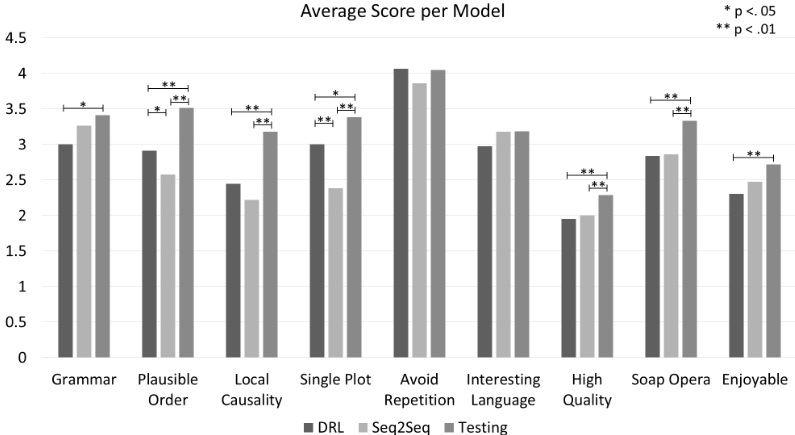
For all other dimensions, the DRL stories are not found to be significantly different than baseline stories. When further training a pre-trained language model using a reward function instead of the standard cross-entropy loss there is a non-trivial chance that model updates will degrade any aspect of the model that is not related to goal achievement. Thus, a positive result is one in which DRL-condition stories are never significantly lower than Seq2Seq-condition stories. This shows that we are able to get to the goal state without any significant degradation in other aspects of story generation.
6 Conclusions
Language model-based story and plot generation systems produce stories that lack direction. Our reward shaping technique learns a policy that generates stories that are probabilistically comparable with the training corpus while also reaching a pre-specified goal ∼93% of the time. Furthermore, the reward-shaping technique improves perplexity when generated plots are compared to the testing corpus. However, in plot generation, the comparison to an existing corpus is not the most significant metric because novel plots may also be good. A human subject study showed that the reward shaping technique significantly improves the plausible ordering of events and the likelihood of producing a sequence of events that is perceived to be a single, coherent plot. We thus demonstrated for the first time that control over neural plot generation can be achieved in the form of providing a goal that indicates how a plot should end.
Acknowledgements
This work is supported by DARPA W911NF-15-C-0246. The views, opinions, and/or conclusions contained in this paper are those of the authors and should not be interpreted as representing the official views or policies, either expressed or implied of the DARPA or the DoD.
@inproceedings{ijcai2019p829,
  title     = {Controllable Neural Story Plot Generation via Reward Shaping},
  author    = {Tambwekar, Pradyumna and Dhuliawala, Murtaza and Martin, Lara J. and Mehta, Animesh and Harrison, Brent and Riedl, Mark O.},
  booktitle = {Proceedings of the Twenty-Eighth International Joint Conference on
               Artificial Intelligence, {IJCAI-19}},
  publisher = {International Joint Conferences on Artificial Intelligence Organization},
  editor    = {Sarit Kraus},
  pages     = {5982--5988},
  year      = {2019},
  month     = {8},
  note      = {AI for Improving Human Well-being},
  doi       = {10.24963/ijcai.2019/829},
  url       = {https://doi.org/10.24963/ijcai.2019/829},
}
TY - CPAPER TI - Controllable Neural Story Plot Generation via Reward Shaping AU - Tambwekar, Pradyumna AU - Dhuliawala, Murtaza AU - Martin, Lara J. AU - Mehta, Animesh AU - Harrison, Brent AU - Riedl, Mark O. T2 - Proceedings of the Twenty-Eighth International Joint Conference on Artificial Intelligence, IJCAI-19 PB - International Joint Conferences on Artificial Intelligence Organization PY - 2019 SP - 5982 EP - 5988 DO - 10.24963/ijcai.2019/829 UR - https://doi.org/10.24963/ijcai.2019/829 ER -Copied
Machine-readable versions of this paper, for tools and AI agents:





