
A Unified View of Relational Deep Learning for Drug Pair Scoring
Proceedings of the Thirty-First International Joint Conference on Artificial Intelligence. Survey Track. Pages 5564-5571.
https://doi.org/10.24963/ijcai.2022/777
Keywords
- Survey Track: Machine Learning
- Survey Track: Knowledge Representation and Reasoning
- Survey Track: Data Mining
- Survey Track: -
Abstract
In recent years, numerous machine learning models which attempt to solve polypharmacy side effect identification, drug-drug interaction prediction, and combination therapy design tasks have been proposed. Here, we present a unified theoretical view of relational machine learning models which can address these tasks. We provide fundamental definitions, compare existing model architectures and discuss performance metrics, datasets, and evaluation protocols. In addition, we emphasize possible high-impact applications and important future research directions in this domain.
- [Baek et al., 2020] Jinheon Baek et al. Accurate Learning of Graph Representations with Graph Multiset Pooling. In International Conference on Learning Representations, 2020.
- [Bai et al., 2020] Yunsheng Bai et al. Bi-Level Graph Neural Networks for Drug-Drug Interaction Prediction. ICML 2020 Graph Representation Learning and Beyond (GRL+) Workshop, 2020.
- [Brahim et al., 2021] Kuru Halil Brahim et al. MatchMaker: A Deep Learning Framework for Drug Synergy Prediction. IEEE/ACM Transactions on Computational Biology and Bioinformatics, 2021.
- [Burkhardt et al., 2019] Hannah A. Burkhardt et al. Predicting Adverse Drug-Drug Interactions with Neural Embedding of Semantic Predications. In American Medical Informatics Association Annual Symposium, 2019.
- [Cao et al., 2020] Xusheng Cao, Rui Fan, and Wanwen Zeng. DeepDrug: A General Graph-Based Deep Learning Framework for Drug Relation Prediction. bioRxiv, 2020.
- [Chen et al., 2014] Xing Chen et al. ASDCD: Antifungal Syn- ergistic Drug Combination Database. PloS one, 9(1):e86499, 2014.
- [Chen et al., 2019] Huiyuan Chen et al. Large-Scale Analysis of Drug Combinations by Integrating Multiple Heterogeneous Information Networks. In Proceedings of the 10th ACM International Conference on Bioinformatics, Computational Biology and Health Informatics, BCB '19, page 67-76, 2019.
- [Chen et al., 2020] Xin Chen et al. GCN-BMP: Investigating Graph Representation Learning for DDI Prediction Task. Methods, 179:47-54, 2020.
- [Chen et al., 2021] Yujie Chen et al. MUFFIN: Multi-Scale Feature Fusion For Drug-Drug Interaction Prediction. Bioin- formatics, 2021.
- [Chiang et al., 2020] Wen-Hao Chiang et al. Drug-Drug Inter- action Prediction Based on Co-Medication Patterns and Graph Matching. International Journal of Computational Biology and Drug Design, 13(1):36-57, 2020.
- [Dai et al., 2021] Yuanfei Dai et al. Drug-Drug Interaction Prediction with Wasserstein Adversarial Autoencoder-Based Knowledge Graph Embeddings. Briefings in Bioinformatics, 22(4):bbaa256, 2021.
- [Deac et al., 2019] Andreea Deac et al. Drug-Drug Adverse Effect Prediction with Graph Co-Attention. ICML Workshop on Computational Biology, 2019.
- [Dewulf et al., 2021] Pieter Dewulf et al. Cold-Start Problems in Data-Driven Prediction of Drug-Drug Interaction Effects. Pharmaceuticals, 14(5):429, 2021.
- [Feeney et al., 2021] Arthur Feeney et al. Relation Matters in Sampling: A Scalable Multi-Relational Graph Neural Network for Drug-Drug Interaction Prediction. Graph Representation Learning and Beyond (GRL+) Workhop at ICML, 2021.
- [Feng et al., 2020] Yue-Hua Feng, Shao-Wu Zhang, and Jian-Yu Shi. DPDDI: A Deep Predictor for Drug-Drug Interactions. BMC Bioinformatics, 21(1):1-15, 2020.
- [Feng et al., 2021] YueHua Feng et al. MTDDI: A Graph Convolutional Network Framework for Predicting Multi-Type Drug-Drug Interactions. Research Square, 2021.
- [Fey et al., 2018] Matthias Fey et al. SplineCNN: Fast Geo- metric Deep Learning with Continuous B-Spline Kernels. In Proceedings of the IEEE Conference on Computer Vision and Pattern Recognition, pages 869-877, 2018.
- [Fey et al., 2019] Matthias Fey et al. Fast Graph Representation Learning with PyTorch Geometric. In ICLR Workshop on Representation Learning on Graphs and Manifolds, 2019.
- [Gaudelet et al., 2021] T Gaudelet et al. Utilizing Graph Ma- chine Learning within Drug Discovery and Development. Briefings in Bioinformatics, 2021.
- [Hamilton et al., 2017] William L Hamilton et al. Inductive Representation Learning on Large Graphs. In Proceedings of the 31st International Conference on Neural Information Processing Systems, pages 1025-1035, 2017.
- [Han et al., 2022] Xueting Han et al. Smilegnn: Drug-drug interaction prediction based on the smiles and graph neural network. Life, 12(2), 2022.
- [Holbeck et al., 2017] Susan L Holbeck et al. The National Cancer Institute ALMANAC: A Comprehensive Screening Resource for the Detection of Anticancer Drug Pairs with Enhanced Therapeutic Activity. Cancer research, 77(13):3564- 3576, 2017.
- [Hu et al., 2018] Baofang Hu et al. Adverse Drug Reaction Predictions Using Stacking Deep Heterogeneous Information Network Embedding Approach. Molecules, 23(12):3193, 2018.
- [Huang et al., 2019] Lei Huang et al. Driver Network as a Biomarker: Systematic Integration and Network Modeling of Multi-Omics Data. Bioinformatics, 35(19):3709-3717, 2019.
- [Huang et al., 2020a] Kexin Huang et al. CASTER: Predicting Drug Interactions with Chemical Substructure Representation. AAAI, 2020.
- [Huang et al., 2020b] Kexin Huang et al. SkipGNN: Predicting Molecular Interactions with Skip-Graph Networks. Scientific reports, pages 1-16, 2020.
- [Huang et al., 2021] Kexin Huang et al. Therapeutics Data Commons: Machine Learning Datasets and Tasks for Drug Discovery and Development. In 35th Conference on Neural Information Processing Systems Datasets and Benchmarks Track, 2021.
- [Ianevski et al., 2020] Aleksandr Ianevski et al. SynToxProfiler: An Interactive Analysis of Drug Combination Synergy, Toxicity and Efficacy. PLoS computational biology, 16(2):e1007604, 2020.
- [Iloanusi et al., 2021] Sorochi Iloanusi et al. Polypharmacy Among COVID-19 Patients: A Systematic Review. Journal of the American Pharmacists Association, 61(5):e14-e25, 2021.
- [Jin et al., 2021] Wengong Jin et al. Deep Learning Identi- fies Synergistic Drug Combinations for Treating COVID-19. Proceedings of the National Academy of Sciences, 118(39), 2021.
- [Kim et al., 2021] Yejin Kim et al. Anticancer Drug Synergy Prediction in Understudied Tissues Using Transfer Learning. Journal of the American Medical Informatics Association, 28(1):42-51, 2021.
- [Korshunova et al., 2021] Maria Korshunova et al. OpenChem: A Deep Learning Toolkit for Computational Chemistry and Drug Design. Journal of Chemical Information and Modeling, 61(1):7-13, 2021.
- [Li et al., 2018] Hongyang Li et al. Network Propagation Pre- dicts Drug Synergy in Cancers. Cancer research, pages 5446-5457, 2018.
- [Lin et al., 2020] Xuan Lin et al. KGNN: Knowledge Graph Neural Network for Drug-Drug Interaction Prediction. In IJCAI, pages 2739-2745, 2020. IJCAI
- [Liu et al., 2010] Yanbin Liu et al. DCDB: Drug Combination Database. Bioinformatics, 26(4):587-588, 2010.
- [Liu et al., 2014] Yanbin Liu et al. DCDB 2.0: A Major Update of the Drug Combination Database. Database, 2014, 2014.
- [Liu et al., 2020] Hui Liu et al. DrugCombDB: A Comprehen- sive Database of Drug Combinations Toward the Discovery of Combinatorial Therapy. Nucleic acids research, 48(D1):D871- D881, 2020.
- [Liu et al., 2021] Qiao Liu et al. TranSynergy: Mechanism- Driven Interpretable Deep Neural Network for the Synergistic Prediction and Pathway Deconvolution of Drug Combinations. PLoS computational biology, 17(2):e1008653, 2021.
- [Liu et al., 2022] S. Liu, Y. Zhang, et al. Enhancing drug-drug interaction prediction using deep attention neural networks. IEEE/ACM Transactions on Computational Biology and Bioinformatics, (01), 2022.
- [Ma et al., 2018] Tengfei Ma et al. Drug Similarity Integration Through Attentive Multi-View Graph Auto-Encoders. In IJCAI, pages 3477-3483, 2018. IJCAI
- [Malone et al., 2018] Brandon Malone, Alberto García-Durán, and Mathias Niepert. Knowledge Graph Completion to Predict Polypharmacy Side Effects. In International Conference on Data Integration in the Life Sciences, pages 144-149. Springer, 2018.
- [Nyamabo et al., 2021] Arnold K Nyamabo et al. SSI-DDI: Substructure-Substructure Interactions for Drug-Drug Interac- tion Prediction. Briefings in Bioinformatics, 2021.
- [O'Neil et al., 2016] Jennifer O'Neil et al. An Unbiased On- cology Compound Screen to Identify Novel Combination Strategies. Molecular Cancer Therapeutics, 15(6):1155-1162, 2016.
- [Peng et al., 2019] Bo Peng and Xia Ning. Deep Learning for High-Order Drug-Drug Interaction Prediction. In Proceedings of the 10th ACM International Conference on Bioinformatics, Computational Biology and Health Informatics, BCB '19, page 197-206, 2019.
- [Preuer et al., 2018] Kristina Preuer et al. DeepSynergy: Pre- dicting Anti-Cancer Drug Synergy with Deep Learning. Bioin- formatics, 34(9):1538-1546, 2018.
- [Qi et al., 2017] Charles R Qi et al. PointNet: Deep Learning on Point Sets for 3D Classification and Segmentation. In Proceedings of the IEEE conference on computer vision and pattern recognition, pages 652-660, 2017.
- [Ramsundar et al., 2019] Bharath Ramsundar et al. Deep Learn- ing for the Life Sciences: Applying Deep Learning to Genomics, Microscopy, Drug Discovery, and More. O'Reilly Media, Inc., 2019.
- [Rozemberczki et al., 2021a] Benedek Rozemberczki et al. MOOMIN: Deep Molecular Omics Network for Anti-Cancer Drug Combination Therapy Design. 2021.
- [Rozemberczki et al., 2021b] Benedek Rozemberczki et al. Py- Torch Geometric Temporal: Spatiotemporal Signal Processing with Neural Machine Learning Models. In Proceedings of the 30th ACM International Conference on Information and Knowledge Management, 2021.
- [Ryu et al., 2018] Jae Yong Ryu et al. Deep Learning Improves Prediction of Drug-Drug and Drug-Food Interactions. Pro- ceedings of the National Academy of Sciences, 2018.
- [Seo et al., 2020] Heewon Seo et al. SYNERGxDB: An Inte- grative Pharmacogenomic Portal to Identify Synergistic Drug Combinations for Precision Oncology. Nucleic Acids Research, 48(W1):W494-W501, 2020.
- [Sidorov et al., 2019] Pavel Sidorov et al. Predicting Synergism of Cancer Drug Combinations Using NCI-ALMANAC Data. Frontiers in chemistry, 7:509, 2019.
- [Singh et al., 2017] Nina Singh et al. Suppressive Drug Combi- nations and Their Potential to Combat Antibiotic Resistance. The Journal of Antibiotics, 70(11):1033-1042, 2017.
- [Sun et al., 2020a] Mengying Sun et al. Structure-Based Drug- Drug Interaction Detection via Expressive Graph Convolutional Networks and Deep Sets. In Proceedings of the AAAI Confer- ence on Artificial Intelligence, volume 34, pages 13927-13928, 2020.
- [Sun et al., 2020b] Zexuan Sun et al. DTF: Deep Tensor Factor- ization for Predicting Anticancer Drug Synergy. Bioinformat- ics, 36(16):4483-4489, 2020.
- [Sunyoung et al., 2017] Kwon Sunyoung and Yoon Sungroh. DeepCCI: End-to-End Deep Learning for Chemical-Chemical Interaction Prediction. In Proceedings of the 8th ACM Interna- tional Conference on Bioinformatics, Computational Biology, and Health Informatics, pages 203-212, 2017.
- [Szklarczyk et al., 2016] Damian Szklarczyk et al. STITCH 5: Augmenting Protein-Chemical Interaction Networks with Tis- sue and Affinity Data. Nucleic Acids Research, 44(D1):D380- D384, 2016.
- [Tatonetti et al., 2012] Nicholas P Tatonetti et al. Data-Driven Prediction of Drug Effects and Interactions. Science transla- tional medicine, 4(125), 2012.
- [Vinyals et al., 2016] Oriol Vinyals et al. Order Matters: Se- quence to Sequence for Sets. In 4th International Conference on Learning Representations, 2016.
- [Wang et al., 2019] Minjie Wang et al. Deep Graph Library: Towards Efficient and Scalable Deep Learning on Graphs. 2019.
- [Wang et al., 2020] Hanchen Wang et al. GoGNN: Graph of Graphs Neural Network for Predicting Structured Entity Interactions. In Christian Bessiere, editor, IJCAI, pages 1317- 1323, 2020. IJCAI
- [Wang et al., 2021a] Jinxian Wang and othersi. DeepDDS: Deep Graph Neural Network with Attention Mechanism to Predict Synergistic Drug Combinations. Briefings in Bioinformatics, 09 2021.
- [Wang et al., 2021b] Yingheng Wang et al. Multi-view Graph Contrastive Representation Learning for Drug-Drug Interaction Prediction. In Proceedings of the Web Conference 2021, pages 2921-2933, 2021.
- [Wishart et al., 2018] David S Wishart et al. DrugBank 5.0: A Major Update to the DrugBank Database for 2018. Nucleic acids research, 46(D1):D1074-D1082, 2018.
- [Xie et al., 2018] Tian Xie et al. Crystal Graph Convolutional Neural Networks for an Accurate and Interpretable Prediction of Material Properties. Physical Review Letters, 120(14), 2018.
- [Xu et al., 2019] Nuo Xu et al. MR-GNN: Multi-Resolution and Dual Graph Neural Network for Predicting Structured Entity Interactions. IJCAI, 2019.
- [Xu et al., 2020] Hao Xu et al. Tri-Graph Information Propaga- tion for Polypharmacy Side Effect Prediction. 2020.
- [Yang et al., 2021] Jiannan Yang et al. GraphSynergy: Net- work Inspired Deep Learning Model for Anti-Cancer Drug Combination Prediction. 2021.
- [Yu et al., 2021] Yue Yu et al. SumGNN: Multi-Typed Drug Interaction Prediction via Efficient Knowledge Graph Summa- rization. Bioinformatics, 2021.
- [Zagidullin et al., 2019] Bulat Zagidullin et al. DrugComb: An Integrative Cancer Drug Combination Data Portal. Nucleic acids research, 47(W1):W43-W51, 2019.
- [Zhang et al., 2017] Wen Zhang et al. Predicting Potential Drug-Drug Interactions by Integrating Chemical, Biological, Phenotypic and Network Data. BMC Bioinformatics, pages 1-12, 2017.
- [Zhang et al., 2021a] Heming Zhang et al. Mining Signaling Flow to Interpret Mechanisms of Synergy of Drug Combina- tions Using Deep Graph Neural Networks. bioRxiv, 2021.
- [Zhang et al., 2021b] Tianyu Zhang et al. Synergistic Drug Combination Prediction by Integrating Multiomics Data in Deep Learning Models. In Translational Bioinformatics for Therapeutic Development, pages 223-238. Springer, 2021.
- [Zheng et al., 2021] Shuyu Zheng et al. DrugComb Update: A More Comprehensive Drug Sensitivity Data Repository and Analysis Portal. Nucleic Acids Research, 2021.
- [Zitnik et al., 2018a] Marinka Zitnik, Monica Agrawal, and Jure Leskovec. Modeling Polypharmacy Side Effects with Graph Convolutional Networks. Bioinformatics, 34(13):i457-i466, 06 2018.
- [Zitnik et al., 2018b] Marinka Zitnik et al. BioSNAP Datasets: Stanford Biomedical Network Dataset Collection. http://snap. stanford.edu/biodata, August 2018. Link
References were extracted automatically from the PDF and may contain errors.
Full text extracted automatically from the PDF; figures, tables and equations may differ. The PDF is the version of record.
1 Introduction
Relational deep learning has an unprecedented potential for revolutionizing the drug discovery process and pharmaceutical industry [Gaudelet et al., 2021]. A number of high value use cases for relational deep learning in the pharmaceutical domain involve answering questions about what happens when two drugs are administered at the same time. These potential applications might want to answer questions such as: Will a combination of two drugs be more effective at destroying a specific type of lung cancer cells [Preuer et al., 2018]? Is there an unexpected (polypharmacy) side effect [Zitnik et al., 2018a] of using these two drugs together? Is there an unwanted chemical interaction [Sunyoung et al., 2017] that these drug molecules can have?
All of these previously mentioned questions can be answered by what we see as drug pair scoring, a machine learning task that involves a set of drugs and the task of predicting the behaviour of pairs in a specific context of interest. Given an incomplete database of drug pairs, drug administration contexts and outcomes, the goal is to train a model to accurately make probabilistic predictions for unseen entries. The reasons for answering these questions via algorithmic methods are multi-fold. Firstly, testing all drug pairs in all of the contexts is not feasible due to time and financial constraints such as drug prices and labour costs [Preuer et al., 2018]. Secondly, certain pair scoring tasks such as polypharmacy side effect prediction can only be validated in human-based trials. Finally, laboratory testing of drug pairs is prone to human errors [Liu et al., 2020].
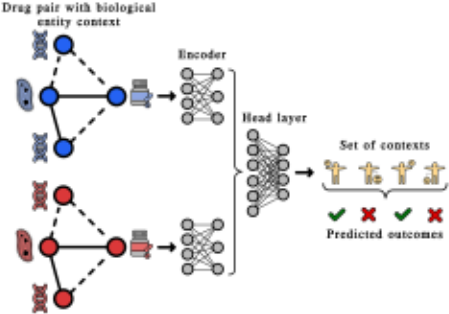
Traditional supervised machine learning methods which solve the drug pair scoring task use handcrafted molecular features to predict the outcome of administering the drugs together in a specific context [Sidorov et al., 2019; Chiang et al., 2020]. Another group of techniques uses an unsupervised approach which diffuses the profile of the drug pair on a heterogeneous biological graph [Zhang et al., 2017; Li et al., 2018; Huang et al., 2019] in order to find potential polypharmacy, synergy or interaction indications. Deep learning techniques which solve the drug pair scoring task can be seen as a fusion and extension of these traditional methods. Such models first generate drug representations based either on molecular structure or the heterogeneous graph based neighbourhood context. In the second optional step, these representations are propagated in the biological graph and aggregated. Finally, drug pair representations are formed and probability scores are outputted in the specific drug administration contexts. We present a high level summary of the drug pair scoring task idea in Figure 1.
Our main contributions can be summarized as:
- We provide a unification of drug-drug interaction, polypharmacy side effect and synergistic combination prediction tasks.
- We present an overview on the design of relational machine learning models which can address these predictive tasks.
- We highlight the publicly available datasets used to train and test the models on these tasks and survey the literature for the most commonly used evaluation metrics.
- We review the most important applications of these techniques and discuss directions for future research in the domain.
The remainder of this survey is structured as follows. In Section 2 we establish the foundations of a unified view of discriminative machine learning tasks defined on pairs of drugs. Section 3 discusses the architectural details of models that can solves these tasks. The evaluation metrics, protocols and datasets used in the literature are detailed in Section 4. Several important key application areas are highlighted in Section 5. We discuss the limitations of current approaches and future research directions in Section 6. The paper concludes with Section 7. The survey is supported by a collection of related work under the https: //github.com/AstraZeneca/awesome-drug-pair-scoring repository.
2 Background
Our discussion of drug pair scoring models requires the introduction of a drug set D = {d1, . . . , dn} that describes compounds of interest and a context set C = {c1, . . . , ck} that contains contexts where two drugs are used in a pair combination.
Definition 1. Labeled drug pair. A labeled drug pair defined on drug set D and context set C is the tuple (d, d′ , c, yd,d′ ,c), where the binary indicator yd,d′ ,c ∈ {0, 1} is the outcome for drug pair d, d′ ∈ D in context c ∈ C.
A labeled drug pair is a known fact about the drug pair having an effect in a context such as a specific polypharmacy side effect, interaction or synergistic relationship at treating a disease. The purpose of pair scoring models is to learn from these tuples to predict the labels for unlabeled drug pairs and contexts.
Definition 2. Database of labeled drug pairs. A database of labeled drug pairs defined on drug and context sets D and C is the set S containing labeled drug pairs (d, d′ , c, yd,d′ ,c) where d, d′ ∈ D and c ∈ C.
Pair scoring models are trained on databases of labeled drug pairs and the trained models are used to predict the label of pairs for which we do not know the outcome in certain contexts.
Definition 3. Heterogeneous interaction graph with drug entities. We denote with G(V, R, E) the heterogeneous interaction graph with drug entities, where V and R are the entity and relation sets, it holds that the drug set D ⊂ V and E is formed by typed edges of the form (v, r, u) ∈ V ×R× V .
We consider a heterogeneous graph where the drug set is a subset of the vertex set. This definition of heterogeneous (biological) knowledge graph helps to create knowledge graph based representation for the compounds of interest.
Definition 4. Neighbourhood encoder. A neighbourhood encoder is the function:
In Equation (1) Θu is a parametric vector representation of u ∈ V and N(·) is a neighbourhood set.
The neighbourhood encoder function [Hamilton et al., 2017] creates a vector representation of drug vertices of the graph based on the aggregation of trainable parameter vectors in the neighbourhood of the source node. Neighbourhoods of a drug can be defined based on arbitrary notions of proximity and the aggregation itself could be a parametric transformation.
Definition 5. Molecular encoder. A molecular encoder is the function hd = hΘ(Md), parametrized by Θ where hd is the learned vector representation andMd is a generic notation of molecular features describing the drug d.
A molecular encoder is a neural network which generates a vector representation from the features of the molecule - these molecular features can be derived from generic features (e.g. hydrophilicity), a string representation, molecular graph or geometry.
Definition 6. Neighbourhood informed molecular encoder. This encoder is the function :
where hΘ(Mu) and AGGREGATE(·, ∀u ∈ N(d)) are molecular and neighbourhood encoders respectively.
This encoder combines the layers described in Definitions 4 and 5. It is essentially a neighbourhood encoder parametrized by representations outputted by a molecular encoder - molecular representations learned by the molecular encoder are aggregated in the neighbourhood of source drug nodes in the knowledge graph which has drug entities.
Definition 7. Molecular representation combiner. Given the drugs d, d′ ∈ D with vector representations h,hd′ the molecular representation combiner is the function hd,d′ = gΘ(hd; hd′ ) that outputs hd,d′ a vector representation of the drug pair.
The representation output by this combiner function can be drug orchestration order dependent. This way the temporal order of drug orchestration can be expressed by the pair scoring model. For example the concatenation of drug vectors results in order dependent representations of pairs, while a bilinear transformation of drug representations with a diagonal matrix does not.
Definition 8. Scoring head layer. The scoring head layer is the function ˆ yd,d′ ,c = kΘ(hd,d′ , c), where the predicted label proability satisfies that {ˆ yd,d′ ,c ∈ R | 0 ≤ ˆ yd,d′ ,c ≤ 1}.
Given a drug pair representation and a context, the scoring head layer outputs a probability score for the outcome.
Definition 9. Drug pair scoring loss and cost functions. Given the drug pair d, d′ ∈ D , context c ∈ C, ground-truth label yd,d′ ,c and predicted score ˆ yd,d′ ,c the loss is defined as the function ℓ(yd,d′ ,c; ˆ yd,d′ ,c). The cost on the whole drug pair database S is defined by Equation (2).
In practical settings, drug pair scoring models are trained by the minimization of the binary cross-entropy summed over the labeled drug pair, context triples.
| Entity Types | Drug Features | ||||||||||
|---|---|---|---|---|---|---|---|---|---|---|---|
| Task | Method | Reference | Model view | Induction | Drug | Protein | Disease | SMILES | Graph | Geometry | Generic |
| Polypharmacy | DECAGON | [Zitnik et al., 2018a] | Higher | • | • | ||||||
| KBLRN | [Malone et al., 2018] | Higher | • | • | |||||||
| SDHINE | [Hu et al., 2018] | Higher | • | • | • | ||||||
| ESP | [Burkhardt et al., 2019] | Higher | • | • | • | ||||||
| MHCADDI | [Deac et al., 2019] | Lower | • | ||||||||
| TIP | [Xu et al., 2020] | Higher | • | • | |||||||
| DeepCCI | [Sunyoung et al., 2017] | Lower | • | • | • | ||||||
| MVGAE | [Ma et al., 2018] | Hierarchical | • | • | • | • | • | ||||
| DeepDDI | [Ryu et al., 2018] | Lower | • | • | |||||||
| D3 I | [Peng et al., 2019] | Hierarchical | • | • | |||||||
| MR-GNN | [Xu et al., 2019] | Lower | • | • | |||||||
| SkipGNN | [Huang et al., 2020b] | Higher | • | • | • | ||||||
| CASTER | [Huang et al., 2020a] | Lower | • | • | |||||||
| DeepDrug | [Cao et al., 2020] | Lower | • | • | • | • | |||||
| GoGNN | [Wang et al., 2020] | Hierarchical | • | • | |||||||
| DPDDI | [Feng et al., 2020] | Lower | • | • | |||||||
| Interaction | KGNN | [Lin et al., 2020] | Higher | • | • | • | |||||
| BiGNN | [Bai et al., 2020] | Hierarchical | • | • | • | • | |||||
| MIRACLE | [Wang et al., 2021b] | Hierarchical | • | • | • | ||||||
| EPGCN-DS | [Sun et al., 2020a] | Lower | • | ||||||||
| SumGNN | [Yu et al., 2021] | Higher | • | • | • | ||||||
| DANN-DDI | [Liu et al., 2022] | Higher | • | • | |||||||
| SSI-DDI | [Nyamabo et al., 2021] | Lower | • | ||||||||
| MTDDI | [Feng et al., 2021] | Hierarchical | • | • | • | • | |||||
| MUFFIN | [Chen et al., 2021] | Hierarchical | • | • | • | • | |||||
| DDIAAE | [Dai et al., 2021] | Higher | • | • | • | ||||||
| RWGCN | [Feeney et al., 2021] | Higher | • | • | • | ||||||
| SmileGNN | [Han et al., 2022] | Hierarchical | • | • | • | ||||||
| GCN-BMP | [Chen et al., 2020] | Lower | • | • | • | • | |||||
| DeepSynergy | [Preuer et al., 2018] | Lower | • | • | • | ||||||
| MCDC DTF | [Chen et al., 2019] [Sun et al., 2020b] | Hierarchical Higher | • | • | |||||||
| DeepSignalFlow | [Zhang et al., 2021a] | Hierarchical | • | • | • | ||||||
| DeepDDS | [Wang et al., 2021a] | Lower | • | • | |||||||
| Synergy | GraphSynergy | [Yang et al., 2021] | Higher | • | • | • | |||||
| TranSynergy MatchMaker | [Liu et al., 2021] [Brahim et al., 2021] | Hierarchical Lower | • | • | • | • | • | ||||
| DNNSynergy | [Zhang et al., 2021b] | Lower | • • | • | |||||||
| AID | [Kim et al., 2021] | Hierarchical | • | • | • | • | |||||
| MOOMIN | [Rozemberczki et al., 2021a] | Hierarchical | • | • | • | • | |||||
3 Drug Pair ScoringModels
Our discussion of the drug pair scoring models introduces our unified view about the general architecture of these models and compares state-of-the-art architecture designs.
3.1 Unified View: The Drug Pair ScoringModel
Based on the definitions outlined in Section 2 we propose a unified view of drug pair scoring models. We postulate that the abstract design of drug pair scoring models irrespective of the specific subtask solved always has the following architecture:
- An encoder to generate drug representations - this can be one of the functions described by Definitions 4, 5 and 6.
- A molecular representation combiner function to generate a drug pair representation - see Definition 7.
- The scoring head layer to predict the probability of a context dependent outcome proposed by Definition 8.
- The loss function of Definition 9 which depends on groundtruth labels and the probabilities output by the head layer.
This architecture and design allows for the joint end-to-end training of the individual model components - gradient descent based update of the layer weights.
3.2 Specific Architecture Designs
We compare state-of-the-art model architectures in Table 1 that can solve pair scoring tasks. Our comparison considers the model level, induction capabilities, specific subtask, node types of the heterogeneous graph and the molecular features exploited by the model. Model attributes used for comparison were the following:
- Model level: A model operates at the following levels based on the encoder architecture used for generating the drug representations: (a) higher-view - neighbourhood encoder, (b) lower-view - molecular encoder, (c) hierarchical-view - neighbourhood informed molecular encoder.
- Machine learning task: The drug pair scoring task of interest solved by the dedicated model architecture proposed in the research paper. It has to be one of interaction, polypharmacy or synergy prediction.
- Induction: A model is inductive if it can predict the label of drug pairs where at least one of the drugs was not in the training set drug pairs.
- Entities: The types of hetereogeneous graph entities (drugs, proteins, diseases) used by the model to solve the task.
- Drug features: Molecular features and information about the compound encoded by the molecular encoder function.
Our comparison highlights that there is a hard trade-off between induction and exclusion of compound features. It is also evident that there is a connection between the subtask and architecture design: for example, polypharmacy side effect prediction models are mostly high level transductive neighbourhood encoders with a scoring layer on top. Synergy scoring models are mostly inductive techniques which exploit the molecular information about the drugs. Currently, there is no single pair scoring model which includes all of the considered biological modalities.
4 Evaluation
The evaluation of machine learning models requires performance metrics, train-test split strategies and publicly accessible datasets.
4.1 Performance Metrics
The predictive performance of drug pair scoring models is evaluated by metrics tailored to binary classification tasks. We summarise how these metrics are used for the evaluation of state-of-the-art drug pair scoring architectures in Table 2.
| Evaluation metric | |||||
|---|---|---|---|---|---|
| Model | Reference | AUPRC | AUROC | Precision Recall | Accuracy F1 |
| DECAGON | [Zitnik et al., 2018a] | • | • | • | |
| KBLRN | [Malone et al., 2018] | • | • | • | |
| SDHINE | [Hu et al., 2018] | • | • | ||
| ESP | [Burkhardt et al., 2019] | • | • | • | |
| MHCADDI | [Deac et al., 2019] | • | |||
| TIP | [Xu et al., 2020] [Sunyoung et al., 2017] | • | • • | • | • • |
| DeepCCI MVGAE | [Ma et al., 2018] | • | • | • | • |
| DeepDDI | [Ryu et al., 2018] | • | • | ||
| D3 I | [Peng et al., 2019] | • | • • • | • • | |
| MR-GNN | [Xu et al., 2019] | • | |||
| SkipGNN | [Huang et al., 2020b] | • | • | ||
| CASTER | [Huang et al., 2020a] | • | • | • | |
| DeepDrug | [Cao et al., 2020] | • | • • | • | • |
| GoGNN DPDDI KGNN | [Wang et al., 2020] [Feng et al., 2020] [Lin et al., 2020] | • • | • • | • • | • • • |
| BiGNN MIRACLE | [Bai et al., 2020] [Wang et al., 2021b] | • | • • | • | • • |
| EPGCN-DS | [Sun et al., 2020a] | • | • | • | |
| SumGNN | [Yu et al., 2021] | • | • | • • | |
| DANN-DDI | [Liu et al., 2022] | • | • | • • | • |
| SSI-DDI MTDDI | [Nyamabo et al., 2021] | • | • | • | |
| [Feng et al., 2021] | • | • | • • | • • | |
| [Chen et al., 2021] | • | • • | • | • | |
| • | • | ||||
| MUFFIN DDIAAE RWGCN | [Dai et al., 2021] [Feeney et al., 2021] | • | • • | • | • |
| SmileGNN | [Han et al., 2022] | • | • | • • | |
| GCN-BMP DeepSynergy | [Chen et al., 2020] | • | • • | • | • |
| MCDC | [Preuer et al., 2018] [Chen et al., 2019] | • | |||
| DTF | • | • | • | ||
| DeepSignalFlow | [Sun et al., 2020b] [Zhang et al., 2021a] | • | • | ||
| DeepDDS | [Wang et al., 2021a] | • | • | • | • |
| GraphSynergy TranSynergy | [Yang et al., 2021] | • | • | • | • • |
| MatchMaker | [Liu et al., 2021] [Brahim et al., 2021] | • | • | ||
| • | |||||
| DNNSynergy | [Zhang et al., 2021b] | • | • • | • | • |
| AID | [Kim et al., 2021] | ||||
| • | • | ||||
| MOOMIN | [Rozemberczki et al., 2021a] | • | |||
| • | |||||
Looking at Table 2 it is evident that the evaluation metrics used in the literature can be grouped into two categories:
- Score based metrics: These quantify predictive performance based over the whole domain of discrimination thresholds. The precision-recall area under the curve (AUPRC) considers the precision-recall trade off under the whole domain of discrimination thresholds while the receiver operating characteristic area under the curve (AUROC) considers false and true positive rates.
- Hard cut off evaluation metrics: These performance metrics (accuracy, F1 score, precision, recall) apply a hard discrimination threshold to assign a label to the data points based on the scores output by the pair scoring model. In order to calculate these, one needs to set a discrimination threshold.
Our findings demonstrate that pair scoring models are predominantly evaluated by score based metrics (AUPRC and AUROC)
which do not require manual setting of a discrimination threshold. It is also evident that seminal research works which defined the key pair scoring tasks influenced the later evaluation metric choices - polypharmacy prediction models adapted the evaluation metrics from [Zitnik et al., 2018a] for example.
4.2 Train-Test Split Strategies
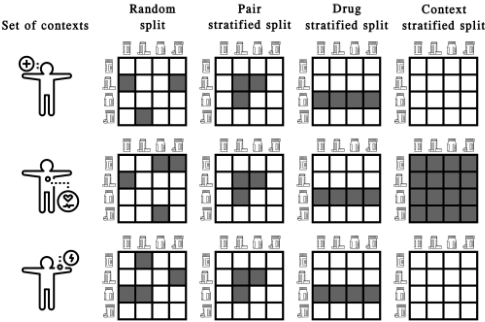
The evaluation of drug pair scoring tasks allows for the use of various train-test split strategies [Preuer et al., 2018] to test the performance of the model under cold-start and inductive scenarios [Dewulf et al., 2021]. Given a labeled drug pair-context database S, defined on the drug and context sets D and C, we assume that one can create the randomized splits STrain and STest. We summarized these splitting strategies in Figure 2.
Using the formalism established to describe the pair scoring models, the splitting strategies are defined as:
- Random split: labeled drug pair - context entries of S are randomly split between STrain and STest.
- Drug pair stratified split: A drug pair d, d′ ∈ D that appears in entries of STrain does not appear in entries of STest. This split requires a pair scoring model which is inductive with respect to drugs.
- Drug stratified split: A drug d ∈ D that appears in entries of STrain does not appear in entries of STest. Like the drug pair stratified split this requires the model to be inductive with respect to new drugs.
- Context stratified split: A context c ∈ C that appears in entries of STrain does not appear in entries of STest. This requires that the pair scoring model is inductive with respect to the set of contexts.
4.3 Datasets
We detail public sources for drug pair data which have been used by the approaches in this review in Table 3. Datasets are listed chronologically according to subtask and the licence and any restrictions for commercial use are detailed where available. It can be seen that the majority of datasets contain a small number of drugs, indicating most focus on approved drugs rather than all possible compounds, with the interactions captured in drug pairs being much more numerous.
It should be noted that established resources such as TWOSIDES and DrugBank are frequently filtered, cleaned and split into new datasets. For example the Therapeutics Data Commons (TDC) resource contains filtered versions of both of these datasets designed for benchmark use [Huang et al., 2021]. It is also common for datasets to be named differently in publications, for example the split of TWOSIDES contained in TDC is also called ChChSe-Decagon in some works [Zitnik et al., 2018b].
5 Applications
In this section we introduce three key, yet currently largely, unexplored applications for the methods detailed in this review.
5.1 Combination Therapy for COVID-19
One topical application of these methods is in relation to COVID19 pandemic. Patients affected by polypharmacy of certain drug types (anti-psychotics and opiates being prominent examples) had a significantly higher chance of a negative clinical outcome from COVID-19 [Iloanusi et al., 2021; Jin et al., 2021]. Using methods covered in this review to predict which combinations may have a negative effect for COVID-19 patients, could enable high risk groups to seek alternative treatments, reducing the risk of a negative outcome.
5.2 Antibiotic Evolutionary Pressure
The prevalent use of antibiotics has resulted in microbes evolving resistance to the drugs, reducing efficacy and potentially eliminating cost effective ways of treating severe bacterial-related diseases such as Tuberculosis. Interestingly, it has been shown that the combination of different antibiotics can slow, and even reverse, this evolutionary resistance [Singh et al., 2017]. However discovering these suppressive interactions using traditional methods is a complex and slow process, yet one currently unexplored using the methods covered in this review.
5.3 Reducing Toxicity
Although drug combinations can result in an increase of unwanted side effects, one promising application is that the combination of two or more drugs can actually lead to a reduced level of toxicity for patients. This is due to the fact that synergistic drugs, which together posses a higher level of efficacy at targeting a certain condition, means that the levels of each individual compound can actually be lowered, reducing toxicity issues associated with higher doses [Ianevski et al., 2020]. Thus, accurate prediction of synergistic drug combinations can reduce the impact of toxicity resulting from the individual compounds.
6 Discussion and Future Directions
The body of work regarding relational machine learning for drug pair scoring primarily focuses on the design of novel architectures and applications. Our unification survey identified a number of potential shortcomings of existing approaches and venues for novel research in the domain.
6.1 EncodingMolecular Geometry
Our summary on the design of relational machine learning architectures for drug pair scoring tasks in Table 1 highlighted that molecular geometry and spatial structure of the molecules is rarely encoded by existing models. Recent advances in geometric deep learning applied to chemistry [Qi et al., 2017; Xie et al., 2018; Fey et al., 2018] would allow the inclusion of geometric information which could lead to better predictive performance on the pair scoring tasks. The modularity of existing architectures makes replacing the molecular encoders with state-of-the-art geometric encoder layers a possibility.
6.2 Higher Order Drug Combinations
Existing research about the interactions, unwanted side effects and synergy of drugs is primarily focused on the evaluation of binary pair combinations. This is driven by the lack of datasets focused on the outcomes of using higher order drug combinations and the lack of architectures designed specifically for these higher order combinations. By using set based representation aggregation layers [Vinyals et al., 2016; Baek et al., 2020], the existing pair scoring models could be adapted to generate drug subset representations.
6.3 Transfer Learning
Self-supervised and unsupervised learning for pretraining molecular encoders is already widely used for single molecule machine learning tasks [Dewulf et al., 2021]. This provides an opportunity for pretraining the molecular encoders on single molecule tasks and fine-tuning them on the data scarce, pair scoring tasks. Another opportunity for transfer learning comes from the fact that certain pair scoring tasks have a greater quantity of labeled data available. The summary of drug pair scoring datasets in Table 2 demonstrated that the drug-drug interaction prediction task has datasets such as STITCH-CCI-5 which covers a large number of pair combinations, while the polypharmacy side effect and synergy prediction tasks have smaller databases. Pretraining models by performing drug-drug interaction prediction and fine-tuning these models for other tasks seems to be an important future research direction for training accurate, and therefore useful, models.
6.4 Multimodal Learning
A heterogeneous graph based representation of drugs allows for the fusion of multiple data modalities. Our survey of existing models in Table 1 has demonstrated that only a handful of existing architectures integrates multimodal data effectively [Rozemberczki et al., 2021a; Liu et al., 2021] without losing induction. Integrating multi-omics data such as proteomics, molecular structure and biological pathway information could be an important venue for designing novel pair scoring architectures.
6.5 Software for Drug Pair Scoring
Currently there is no dedicated open-source machine learning library which was specifically designed for solving the drug pair scoring task. Developing a dedicated relational machine learning framework on top of existing geometric deep learning [Fey et al., 2019; Wang et al., 2019; Rozemberczki et al., 2021b] and deep chemistry frameworks [Ramsundar et al., 2019; Korshunova et al., 2021] could be an important contribution to the domain. This would require curated datasets and the architectural design of encoder, combiner, scoring layers and drug pair iterators.
| Dataset | Reference | Subtask | Compounds | Pairs | Contexts | Licence | Restricted |
|---|---|---|---|---|---|---|---|
| TWOSIDES | [Tatonetti et al., 2012] | Polypharmacy | 1,918 | 211,990 | 12,726 | Not Specified | |
| DrugBank 5 | [Wishart et al., 2018] | Polypharmacy | 14,575 | 365,000+ | 86+ | CC BY-NC 4.0 | • |
| DeepDDI | [Ryu et al., 2018] | Polypharmacy | 1,710 | 191,995 | 86 | Not Specified | |
| TDC (TWOSIDES) | [Huang et al., 2021] | Polypharmacy | 645 | 63,473 | 1,317 | CC BY 4.0 | |
| TDC (DrugBank) | [Huang et al., 2021] | Polypharmacy | 1,706 | 191,519 | 86 | CC BY-NC 4.0 | • |
| STITCH-CCI 5 | [Szklarczyk et al., 2016] | Interaction | 389,393 | 17,705,799 | 4 | CC BY-NC-SA 4.0 | • |
| ZhangDDI | [Zhang et al., 2017] | Interaction | 548 | 48,548 | - | Not Specified | |
| ChCh-Miner | [Zitnik et al., 2018b] | Interaction | 1,514 | 48,514 | - | Not Specified | |
| DCDB | [Liu et al., 2010] | Synergy | 485 | 499 | - | Not Specified | |
| DCDB 2.0 | [Liu et al., 2014] | Synergy | 904 | 1,363 | - | Not Specified | |
| ASDCD | [Chen et al., 2014] | Synergy | 105 | 215 | - | Not Specified | |
| O'Neil | [O'Neil et al., 2016] | Synergy | 38 | 583 | 39 | Not Specified | |
| NCI-ALMANAC | [Holbeck et al., 2017] | Synergy | 104 | 5,000+ | 60 | CC BY 4.0 | |
| DrugComb | [Zagidullin et al., 2019] | Synergy | 2,276 | 437,932 | 93 | CC BY-NC-SA 4.0 | |
| SynergyXDB | [Seo et al., 2020] | Synergy | 1,977 | 22,507 | 151 | Not Specified | |
| DrugCombDB | [Liu et al., 2020] | Synergy | 2,887 | 448,555 | 124 | Not Specified | • |
| TDC (OncoPolyPharm) | [Huang et al., 2021] | Synergy | 38 | 583 | 39 | CC BY 4.0 | |
| DrugComb 2.0 | [Zheng et al., 2021] | Synergy | 8,397 | 751,498 | 2,320 | CC BY-NC-SA 4.0 | |
| TDC (DrugComb) | [Huang et al., 2021] | Synergy | 129 | 5,628 | 29 | CC BY-NC-SA 4.0 |
7 Conclusion
We have provided an exhaustive overview of relational machine learning models designed to solve drug pair scoring tasks. We outlined a general theoretical framework which unifies the drugdrug interaction, polypharmacy side effect and drug synergy prediction tasks and created a taxonomy of models which address these. By surveying the literature, considering the architecture and evaluation of existing models, we identified key real world application areas and important directions for future research.
Acknowledgements
The authors would like to thank Peizhen Bai, Piotr Grabowski, Haiping Lu, Roc´ıo Mercado, Christopher Morris, and Paul Scherer for feedback throughout the preparation of this manuscript. Stephen Bonner is a fellow of the AstraZeneca postdoctoral program.
@inproceedings{ijcai2022p777,
  title     = {A Unified View of Relational Deep Learning for Drug Pair Scoring},
  author    = {Rozemberczki, Benedek and Bonner, Stephen and Nikolov, Andriy and Ughetto, Michaël and Nilsson, Sebastian and Papa, Eliseo},
  booktitle = {Proceedings of the Thirty-First International Joint Conference on
               Artificial Intelligence, {IJCAI-22}},
  publisher = {International Joint Conferences on Artificial Intelligence Organization},
  editor    = {Luc De Raedt},
  pages     = {5564--5571},
  year      = {2022},
  month     = {7},
  note      = {Survey Track},
  doi       = {10.24963/ijcai.2022/777},
  url       = {https://doi.org/10.24963/ijcai.2022/777},
}
TY - CPAPER TI - A Unified View of Relational Deep Learning for Drug Pair Scoring AU - Rozemberczki, Benedek AU - Bonner, Stephen AU - Nikolov, Andriy AU - Ughetto, Michaël AU - Nilsson, Sebastian AU - Papa, Eliseo T2 - Proceedings of the Thirty-First International Joint Conference on Artificial Intelligence, IJCAI-22 PB - International Joint Conferences on Artificial Intelligence Organization PY - 2022 SP - 5564 EP - 5571 DO - 10.24963/ijcai.2022/777 UR - https://doi.org/10.24963/ijcai.2022/777 ER -Copied
Machine-readable versions of this paper, for tools and AI agents:





