
Learning Efficient Truthful Mechanisms for Trading Networks
Proceedings of the Thirty-Second International Joint Conference on Artificial Intelligence. Main Track. Pages 2862-2869.
https://doi.org/10.24963/ijcai.2023/319
Keywords
- Multidisciplinary Topics and Applications: MDA: Economics
- Game Theory and Economic Paradigms: GTEP: Mechanism design
Abstract
Trading networks are an indispensable part of today's economy, but to compete successfully with others, they must be efficient in maximizing the value they provide to the external market. While the prior work relies on truthful disclosure of private information to achieve efficiency, we study the problem of designing mechanisms that result in efficient trading networks by incentivizing firms to truthfully reveal their private information to a third party. Additional desirable properties of such mechanisms are weak budget balance (WBB; the third party needs not invest) and individual rationality (IR; firms get non-negative utility). Unlike combinatorial auctions, there may not exist mechanisms that simultaneously satisfy these properties ex post for trading networks. We propose an approach for computing or learning truthful and efficient mechanisms for given networks in a Bayesian setting, where WBB and IR, respectively, are relaxed to ex ante and interim for a given distribution over the private information. We incorporate techniques to reduce computational and sample complexity. We empirically demonstrate that the proposed approach successfully finds the mechanisms with the relaxed properties for trading networks where achieving ex post properties is impossible.
- [Alon et al., 2021] Tal Alon, Ron Lavi, Elisheva S Shamash, and Inbal Talgam-Cohen. Incomplete information VCG contracts for common agency. arXiv preprint arXiv:2105.14998, 2021.
- [Candogan et al., 2021] Ozan Candogan, Markos Epitropou, and Rakesh V. Vohra. Competitive equilibrium and trad- ing networks: A network flow approach. Operations Re- search, 69(1):114-147, 2021.
- [Conitzer and Sandholm, 2002] Vincent Conitzer and Tuo- mas Sandholm. Complexity of mechanism design. In Pro- ceedings of the 18th Conference on Uncertainty in Artifi- cial Intelligence, page 103-110, August 2002.
- [Duetting et al., 2019] Paul Duetting, Zhe Feng, Harikrishna Narasimhan, David Parkes, and Sai Srivatsa Ravindranath. Optimal auctions through deep learning. In Kamalika Chaudhuri and Ruslan Salakhutdinov, editors, Proceed- ings of the 36th International Conference on Machine Learning, volume 97 of Proceedings of Machine Learn- ing Research, pages 1706-1715. PMLR, 09-15 Jun 2019.
- [Faccio et al., 2021] Francesco Faccio, Louis Kirsch, and Jürgen Schmidhuber. Parameter-based value functions. In International Conference on Learning Representations, 2021.
- [Harb et al., 2020] Jean Harb, Tom Schaul, Doina Precup, and Pierre-Luc Bacon. Policy evaluation networks. CoRR, abs/2002.11833, 2020.
- [Hatfield and Kominers, 2012] John William Hatfield and Scott Duke Kominers. Matching in networks with bilateral contracts. American Economic Journal: Microeconomics, 4(1):176-208, 2012.
- [Hatfield et al., 2013] John William Hatfield, Scott Duke Kominers, Alexandru Nichifor, Michael Ostrovsky, and Alexander Westkamp. Stability and competitive equilib- rium in trading networks. Journal of Political Economy, 121(5):966-1005, 2013.
- [Hatfield et al., 2015] John William Hatfield, Scott Duke Kominers, Alexandru Nichifor, Michael Ostrovsky, and Alexander Westkamp. Full substitutability in trading net- works. In Proceedings of the 16th ACM Conference on Economics and Computation, pages 39-40, 2015.
- [Hatfield et al., 2019] John William Hatfield, Scott Duke Kominers, Alexandru Nichifor, Michael Ostrovsky, and Alexander Westkamp. Full substitutability. Theoretical Economics, 14(4):1535-1590, 2019.
- [Iwata et al., 2005] Satoru Iwata, Satoko Moriguchi, and Kazuo Murota. A capacity scaling algorithm for m- convex submodular flow. Mathematical Programming, 103(1):181-202, May 2005.
- [Likhodedov and Sandholm, 2004] Anton Likhodedov and Tuomas Sandholm. Methods for boosting revenue in combinatorial auctions. In Proceedings of the 19th Na- tional Conference on Artifical Intelligence, AAAI'04, page 232-237. AAAI Press, 2004.
- [Likhodedov and Sandholm, 2005] Anton Likhodedov and Tuomas Sandholm. Approximating revenue-maximizing combinatorial auctions. In Proceedings of the 20th Na- tional Conference on Artifical Intelligence, pages 267- 274, 01 2005.
- [Manisha et al., 2018] Padala Manisha, C V Jawahar, and Sujit Gujar. Learning optimal redistribution mechanisms through neural networks. In Proceedings of the 17th In- ternational Conference on Autonomous Agents and Multi- Agent Systems, page 345-353, July 2018.
- [Myerson and Satterthwaite, 1983] Roger B. Myerson and Mark A. Satterthwaite. Efficient mechanisms for bilat- eral trading. Journal of Economic Theory, 29(2):265-281, 1983.
- [Nisan, 2007] Noam Nisan. Introduction to mechanism de- sign (for computer scientists). In Algorithmic Game Theory, chapter 9, page 209-241. Cambridge University Press, 2007.
- [Osogami et al., 2022] Takayuki Osogami, Segev Wasserkrug, and Elisheva S. Shamash. Mechanism learning for trading networks. arXiv:2208.09222, 2022.
- [Ostrovsky, 2008] Michael Ostrovsky. Stability in supply chain networks. American Economic Review, 98(3):897- 923, 2008.
- [Othman and Sandholm, 2009] Abraham Othman and Tuo- mas Sandholm. How pervasive is the myerson- satterthwaite impossibility? In Proceedings of the 21st International Joint Conference on Artificial Intelligence, IJCAI'09, page 233-238, San Francisco, CA, USA, 2009.
- [Parkes, 2001] David Christopher Parkes. Iterative Com- binatorial Auctions: Achieving Economic and Computa- tional Efficiency. PhD thesis, University of Pennsylvania, 2001.
- [Rahme et al., 2021] Jad Rahme, Samy Jelassi, and S. Matthew Weinberg. Auction learning as a two- player game. In International Conference on Learning Representations, 2021.
- [Schlegel, 2022] Jan Christoph Schlegel. The structure of equilibria in trading networks with frictions. Theoretical Economics, 17(2):801-839, May 2022.
- [Tacchetti et al., 2022] Andrea Tacchetti, DJ Strouse, Marta Garnelo, Thore Graepel, and Yoram Bachrach. Learning truthful, efficient, and welfare maximizing auction rules. In ICLR 2022 Workshop on Gamification and Multiagent Solutions, 2022.
References were extracted automatically from the PDF and may contain errors.
Full text extracted automatically from the PDF; figures, tables and equations may differ. The PDF is the version of record.
1 Introduction
Trading networks [Hatfield et al., 2013] are becoming increasingly ubiquitous and essential in vital areas such as transportation and supply chain. A trading network consists of the firms who trade through bi-lateral contracts and aims at benefiting those firms and the markets external to the network. A major goal of a trading network is thus efficiency in the sense of maximizing the value (social welfare) that the trading network creates.
Prior work on trading networks primarily investigates solution concepts such as stability and competitive equilibrium [Hatfield et al., 2013; Candogan et al., 2021], which result in efficiency. To compute these solutions for a given trading network, however, existing algorithm require the information about how the firms value trades (which we define as the types truthfully revealed by the firms. As we will show, however, the firms typically have incentive to be untruthful.
∗This work was performed at IBM Research.
We thus seek to provide a mechanism for a given trading network such that the firms have the incentive to be truthful, which in turn leads to efficiency. To this end, we allow the firms to make (possibly negative) payment to an Independent Party (IP). In this setting, we desire mechanisms that satisfies weak budget balance (WBB; non-negative utility of IP) and individual rationality (IR; non-negative utility of firms) in addition to efficiency and dominant-strategy incentive compatibility (DSIC; promotion of truthfulness). These four properties are standard in mechanism design [Parkes, 2001]. In particular, for combinatorial auctions, the VCG mechanism with the Clarke pivot rule is known to satisfy all of the four properties ex post, i.e. surely for any types, [Nisan, 2007].
However, trading networks are fundamentally more complex than combinatorial auctions. In particular, a trade transfers a good from a seller to a buyer, and the seller who has negative valuation on the trade is compensated by the payment from the buyer. Therefore, as we describe in the sequel, it is impossible to simultaneously satisfy the four properties ex post for a broad class of trading networks, making the design of mechanisms for such networks non-trivial, in contrast to combinatorial auctions.
We thus relax the WBB and IR properties, and restrict ourselves to a Bayesian setting, in which there is a (prior) discrete distribution over the types. In this setting, we seek to compute a mechanism that satisfies WBB and IR ex ante and interim respectively (i.e., in expectation with respect to the distribution of types). To ensure DSIC and efficiency, we utilize the class of Groves mechanisms and show how to compute the pivot rule of the Groves mechanism via a linear program (LP) that encodes WBB and IR as constraints.
While this LP successfully computes a mechanism with the four desirable properties, it involves two shortcomings. First, the LP needs the exact knowledge of the distribution of types. Second, the LP becomes intractable as the number of trades, players, or types increases. To mitigate these shortcomings, we provide a mechanism learning approach, which only requires a sample of types instead of their exact distribution. We further propose several techniques to reduce the computational and sample complexity of the mechanism learning. In particular, we manually design special Groves mechanisms, which achieve some but not all of the four properties ex post, and demonstrate how the dimension of the feature vector of the types can be reduced based on the knowledge of those special mechanisms.
Our contribution is an automated mechanism design (AMD; [Conitzer and Sandholm, 2002]) approach for computing or learning desirable mechanisms for trading networks (Section 4-5). This consists of a) formulating an LP whose solution gives a Groves mechanism that satisfies all of the four desirable properties for a trading network with a given distribution of types, b) integrating machine learning techniques into the LP to extend the cases where such mechanisms can be designed, and c) reducing the number of variables in LP or the dimension of the feature vectors in the corresponding learning approach based on special Groves mechanisms. Furthermore, we provide empirical analysis to support the effectiveness of our AMD approaches (Section 6). For reproducibility, the source code is open-sourced at https://github.com/IBM/mechanism-learning.
1.1 RelatedWork
Trading networks and their efficiency have been extensively studied [Hatfield et al., 2013; Candogan et al., 2021; Ostrovsky, 2008; Hatfield and Kominers, 2012; Hatfield et al., 2015]), but no approaches are known to simultaneously achieve the four properties in trading networks. In fact, there are few studies on incentive compatibility in trading networks with an exception of [Schlegel, 2022], who establishes incentive compatibility but only for those firms who are buyers (or sellers) in all trades.
Frommethodological perspectives, the prior work most related to ours is some of the AMD approaches for combinatorial auctions, where constrained optimization problems are formulated and approximated with the sample from the distribution of types. However, in [Duetting et al., 2019; Rahme et al., 2021], DSIC is encoded as a constraint of the optimization problem and is not necessarily guaranteed due to the sample approximation unless the dataset covers the full support of the distribution, while we always ensure DSIC via the Groves mechanism (hence, we do not require the knowledge of the support, which is a fundamental advantage over [Duetting et al., 2019; Rahme et al., 2021]). On the other hand, [Manisha et al., 2018; Tacchetti et al., 2022] learn the mechanism (specifically, the rule of redistributing payment from IP to players) that minimizes the expected revenue of IP, while ensuring the four properties via the VCG mechanism. In trading networks, however, it is possible to guarantee only two properties via the Groves mechanism, and we encode the other two properties as constraints of our LP.
[Alon et al., 2021] also study an approach of computing (no learning) a mechanism for a principal-agent model as a solution to LP, while ensuring some of the properties via the VCG mechanism. Earlier work along this line of computing a mechanism within a restricted class of mechanisms includes [Likhodedov and Sandholm, 2004], who maximize expected revenue in combinatorial auctions. Sample approximation of this method is studied by [Likhodedov and Sandholm, 2005].
2 Trading Networks
Following [Hatfield et al., 2013], we model a trading network by a tuple (N,Ω, v), where N is a set of players (or firms), Ω is a set of bi-lateral trades, and v ≡ (vi)i∈N, where each vi : 2Ω → R is the type (valuation) of player i. That is, vi(Φ) represents the (possibly negative) value of Φ ⊆ Ω for the player with type vi (i.e., a player's valuation is allowed to depend on the trades between other players). For notational convenience, we denote a trading network (N, Ω, v) as T (v) when specific N and Ω are unimportant or clear from the context. Without loss of generality, we assume that the value of no trade is zero for any player (i.e., vi(∅) = 0, ∀i ∈ N). Each trade is associated with a seller and a buyer in N, and the buyer makes non-negative payment to the seller. Let p(ω) be the payment associated with ω ∈ Ω. We refer to a pair (ω, p(ω)) as a contract. A pair of Φ and p determines a set of contracts, {(ω, p(ω)) : ω ∈ Φ}.
One's goal with a trading network is to determine a set of trades Φ ⊆ Ω to be conducted together with the payment associated with each trade in a way that certain properties are satisfied. A particularly important metric is the total valuations associated with the trades to be conducted (i.e., ∑i∈N vi(Φ)), since it is the value that the trading network produces to the external markets. The total valuations may be considered as net payment from the external markets to the trading network, who buys raw materials and sells final products. Therefore, we say that the set of trades Φ⋆ is efficient for a trading network T (v) if
The efficiency may also be represented in terms of the utilities of players. Specifically, by conducting the set of contracts {(ω, p(ω)) : ω ∈ Φ}, the player i ∈ N gets the following (quasi-linear) utility:
where Φi→ is the subset of Φ where i is the seller, and Φ→i is the one where i is the buyer. Since the total payment from sellers equals the total payment to buyers, we can show (see (26)-(29) in [Osogami et al., 2022]) that, for any p, (1) is equivalent to
The prior work has developed algorithms for finding the set of contracts that have the properties stronger than efficiency (e.g., competitive equilibrium and stability) under certain conditions (e.g., full substitutability [Hatfield et al., 2019]). However, they all rely on the knowledge of the types.
In practice, however, the types are private information and need to be revealed by the players. Then, the players can have the incentive to be untruthful, which in turn leads to inefficiency, as the following example shows:
Example 1. Consider a trading network with a single potential trade, Ω = {ω}, between two players, N = {S, B}. With ω, the seller (S) incurs a production cost CS, and the buyer (B) gets a profit 1-CB (retail price minus handling cost): i.e., vS(Φ) = -CS I{Φ = Ω} and vB(Φ) = (1-CB) I{Φ = Ω}, where I{·} is the indicator function. Consider the payment, p(ω) = 1+CS-CB 2 , that equally shares the net profit. Given the types (i.e., CS and CB), we can achieve efficiency by letting Φ = Ω if CS + CB < 1 and Φ = ∅ otherwise. When CS +CB < 1, the utility of each player is 1-CS-CB 2 . However, then each player i has the incentive to untruthfully declare higher cost Ci + ε to get higher utility 1-CS-CB+ε 2 . If the declared cost is too high, the trade is not conducted. Since 1 - CS - CB = vS(Ω) + vB(Ω) > vS(∅) + vB(∅) = 0, untruthfulness indeed leads to inefficiency.
3 Mechanisms for Trading Networks
We consider the trading networks where the types are private information of the respective players and study the mechanisms that promote truthfulness, leading to efficiency. To facilitate truthfulness, we allow the mechanism to require each player i to make (possibly negative) payment τi ∈ R to an independent party (IP). A trading network with IP is denoted by T +(v) = (N +, Ω, v), where N + ≡ N∪{IP} denotes the set of all players and IP. Also, let Vi be the discrete space of types for each i ∈ N and let V ≡ ×i∈NVi be the product space. Moreover, let T +(V) ≡ (N,Ω, V) ≡ {T +(v) : v ∈ V} be the set of trading networks with IP under V. We will simply refer to T +(v) or T +(V) as a trading network.
We study the Bayesian setting where there exists a (prior) distribution q over V such that the players have types v with probability q(v). Throughout, we assume that the true type vi of each player i ∈ N is known by that player. However, we we make varying assumptions on other knowledge about the types, which are made explicit in each result in the following.
3.1 Direct Mechanisms and Desirable Properties
We study direct mechanisms, where players and IP act according to the following protocol:
- Each player i declares a possibly untruthful type ˆ vi
- IP determines the set of contracts, {(ω, π(ω; ˆ v)) : ω ∈ ϕ(ˆ v)}, and (possibly negative) payment, τi(ˆ v), from each player i to IP
A direct mechanism of a trading network T (V) is specified by an outcome rule (ϕ, τ, π), where ϕ : V → 2Ω is the allocation rule that maps declared types, ˆ v ≡ (ˆ vi)i∈N, to a set of trades ϕ(ˆ v) to be conducted; τ determines the rule of payment to IP, τi ∈ V → R, for each i ∈ N; π : 2Ω ×V → R is the payment rule that determines the payment associated with each trade, depending on the declared types. In the following, we refer to a direct mechanism simply as a mechanism.
When ˆ v is declared by the players in the trading network T +(v), each player i ∈ N gets the following utility under the mechanism (ϕ, τ, π):
We denote the net-payment to IP (or utility of IP) by
We consider the four desirable properties of a mechanism that is standard in mechanism design [Parkes, 2001]: Dominant Strategy Incentive Compatibility (DSIC), Efficiency, Weak Budget Balance (WBB), and Individual Rationality (IR). These properties are known to be simultaneously achievable in combinatorial auctions, but we will see that such positive results do not carry over to trading networks. We formally define each property in the following, but note that, under the Bayesian setting, we can discuss both ex post properties (which hold surely for any v ∈ V) and ex ante or interim properties (which hold in expectation with respect to the distribution q over V).
DSIC is an ex post property and ensures that the best strategy of each player is truthfully revealing its type regardless of the strategies of the other players. This gives a clear course of action for each player. Formally, we say that a mechanism (ϕ, τ, π) for a trading network T +(V) is DSIC if the profile of truthful strategies form a dominant-strategy equilibrium:
where v-i is the strategy profile of players except i. We will discuss the corresponding ex ante property of Bayesian Nash Incentive-Compatibility (BNIC) only in relation to the prior work, but BNIC only ensures that a truthful player can maximize its expected utility under the additional condition that other players are truthful.
Efficiency is also an ex post property and ensures that the trades are allocated in a way that they maximize total value. Following the definition without IP in (1), we say that a mechanism (ϕ, τ, π) for T +(V) is Efficient if
We will not discuss the corresponding ex ante property.
WBB ensures non-negative utility of IP. We say that a mechanism (ϕ, τ, π) for T +(V) is ex post WBB if
and ex ante WBB if
where the expectation is with respect to the distribution of v. That is, if the players are truthful (which is guaranteed with DSIC), the utility of IP is non-negative surely under ex post WBB and in expectation under ex ante WBB.
IR ensures that every player gets non-negative utility. IR can also be ex post or ex ante. However, when players know their own types, each player should require non-negative expected utility given its own type, and such a property is called interim IR. Formally, we say that a mechanism (ϕ, τ, π) for T +(V) is ex post IR if
for each i ∈ N and interim IR if
for each i ∈ N. That is, if the players are truthful (guaranteed with DSIC), a truthful player gets non-negative utility surely under ex post IR and in expectation under interim IR.
Note that ex post properties are more desirable than the corresponding ex ante properties. For example, maximizing expected utility may not be the objective of risk-sensitive players. Also, the optimality of the truthful strategy under BNIC relies on the truthfulness of the other players, which is not required under DSIC.
3.2 No Payment Between Players
As far as the utilities of the forms in (3)-(4) are concerned, we do not lose generality by ignoring the payment among players (i.e., π(ω; ˆ v) = 0, ∀(ω, ˆ v)). Intuitively, if there is a payment p(ω) from a buyer to a seller, we can let the buyer pay p(ω) to IP and let IP pay p(ω) to the seller without changing the net-payment of the two players and IP. Formally, we prove the following theorem in [Osogami et al., 2022].
Theorem 1. For any mechanism (ϕ, τ, π) and a payment rule π′ for T +(V) = (N +,Ω, V), there exists a rule of payment to IP τ ′ such that each of DSIC, Efficiency, WBB (either ex ante or ex post), and IR (either ex ante or interim) is satisfied with (ϕ, τ, π) iff it is satisfied with (ϕ, τ ′ , π′ ).
Theorem 1 simplifies our analysis, since it implies that we only need to consider mechanisms with no payment between players (i.e., let π′ = π0, where π0 allocates zero payment to any trade) as long as the desirable properties are the ones that depend only on the utility. Namely, for any set of properties that depend on the utility, there exists a mechanism with no payment between players that achieves those properties if and only if there exists a mechanism (with an arbitrary payment rule) that achieves those properties. Hence, we will only consider designing a mechanism (ϕ, τ, π0) without payment between players and denote such a mechanism by (ϕ, τ ).
3.3 Impossibility
We show that, for a discrete set of valuations, no mechanism (ϕ, τ) can achieve all of the four properties ex post for trading networks with a single potential trade except for trivial cases. Theorem 1 then implies that no mechanisms (ϕ, τ, π), with any payment rule π, can simultaneously achieve those properties except for trivial cases. Formally,
Definition 1. We say that a trading network (N +, {ω}, V) with a single trade between two players, |N| = 2, has nontrivial V if it satisfies both of the following conditions: i) there exists v ∈ V such that ∑j∈N vj({ω}) < 0, and ii) for any vi ∈ Vi, there exists v-i ∈ V-i such that ∑j∈N vj({ω}) > 0, where {i, -i} ∈ N .
In other words, V is said to be trivial if at least one of the two conditions in Definition 1 are violated. When condition i) is violated, the trade should always be conducted (i.e., ϕ(ˆ v) = {ω}, ∀ˆ v ∈ V) for Efficiency to hold, and all of the four properties are trivially satisfied with a constant payment rule (see [Osogami et al., 2022]). When condition ii) is violated, there exists a player i who has the type vi that makes it impossible to make the social welfare, vi({ω}) + v-i({ω}), positive no matter what types v-i that the other player has. Such player i should not participate in the trading network from the perspective of social welfare, even if all of the four properties may be achieved with some mechanisms.
For other non-trivial cases, we have impossibility:
Theorem 2. For any trading network (N +, {ω}, V) with a single trade between two players having non-trivial V, no mechanisms can achieve all of DSIC, Efficiency, ex post WBB, and ex post IR.
Proof. We outline a proof here (see [Osogami et al., 2022] for a complete proof). For each player, consider the two types that respectively give the lowest and highest valuation on ω. We prove that no mechanisms can achieve the four properties by showing that we cannot satisfy all of the necessary conditions associated with the players of those two types.
[Myerson and Satterthwaite, 1983] show similar impossibility but assumes that the distribution over V has absolutely continuous density, which does not hold e.g. for discrete V [Othman and Sandholm, 2009]. Our impossibility theorem does not require such an assumption, but ours is with DSIC and hence weaker in that respect than MyersonSatterthwaite's, which establishes impossibility with BNIC. In Section 6, we will experiment with instances of trading networks where satisfying the four properties ex post is impossible due to Theorem 2.
4 ComputingMechanisms
The impossibility suggested by Theorem 2, together with the incentives for players to untruthfully report their valuations, motivates us to study the mechanisms that achieve weaker properties of ex ante WBB and interim IR in addition to DSIC and Efficiency. These weaker properties are still meaningful in practice and are sufficient for risk-neutral players.
To guarantee DSIC and Efficiency, we rely on the Groves mechanism. For any trading network (N +,Ω, V), a mechanism (ϕ, τ ′ ) is called a Groves mechanism if it can be represented by the use of a pivot rule, h ≡ (hi)i∈N where hi : V-i →R, as follows:
for any v ∈ V. Here, the pivot rule hi determines the payment, in addition to the second term of the right-hand side of (12), in a way that it depends only on the types of other players (and not the type of player i). The Groves mechanism is guaranteed to satisfy Efficiency and DSIC, and we may arbitrarily choose h to achieve other properties. We refer to h as a Groves mechanism when it does not cause confusion.
There may or may not exist an h that satisfies both ex ante WBB and interim IR. When it does not exist, one could seek to find the h that minimizes the violation of these conditions.
However, here we focus on studying whether such an h exists and finding one if it does. Also, when there are multiple h that satisfy both ex ante WBB and interim IR, we prefer the one with stronger budget balance (i.e., the total payment to IP should be as close to zero as possible).
Therefore, we proposed to find h as the solution to the following optimization problem:
where E is the expectation with respect to the distribution of types. The constraint (14) is on ex ante WBB (see (55)-(57) in [Osogami et al., 2022] for the derivation). The constraint (15) is on interim IR (see (58)-(60) in [Osogami et al., 2022]). For a given trading network (N +, Ω, V), the right-hand sides of (14)-(15) are constants that can be computed by the use of the allocation rule ϕ⋆ and the distribution of types. When N and V are finite, the optimization problem (13)-(15) is a linear program (LP). The LP has nmn-1 variables (i.e., hi(v-i) for v-i ∈ V, i ∈ N) and nm + 1 constraints, when there are n = |N| players, and each player i has m = |Vi| types.
Example 2. Consider the trading network in Example 1, but we now assume that each player has one of two types: the production cost of the seller of type X is C X S forX ∈ {L,H}, and the handling cost of the buyer of type Y is C YB for Y ∈ {L,H}. Let C L i < C H i for i ∈ {S,B}. By Theorem 2, there is no mechanism that simultaneously achieves the four properties ex post when cHS + cHB > 1 and cXS + cYB < 1 for (X, Y ) ∈ {(H, L), (L, H), (L, L)}. Under the Groves mechanism, the amount of payment to IP from S of type X and B of type Y is respectively given by
where q⋆ (X, Y ) ≡ I{ϕ⋆ (X, Y ) = Ω} is the number of goods to be traded when the types of S and B are X and Y respectively. Note that the pivot rule of each player depends on the type of the other player and can be determined by solving the LP (13)-(15), which involves four variables h ≡ (hS(L), hS(H), hB(L), hB(H)) and four constraints (see (66)-(69) in [Osogami et al., 2022]).
Although the solution to the LP (13)-(15) gives non-trivial Groves mechanisms that are of practical interest, it is intractable except for small trading networks. For example, i) there can be infinitely many possible types vi, resulting in infinitely many variables in the LP. Also, ii) one may not know the exact distribution of types, which we need to compute the expectation in (13)-(15). In addition, iii) it may be hard to compute the efficient allocation ϕ⋆ (v) for a given v ∈ V.
5 LearningMechanisms
Among these three challenges, i) and ii) are fundamental, since one cannot even represent the optimization problem with infinitely many variables or without knowing the distribution of types. Here, we propose learning techniques to overcome these challenges. For the computational complexity of ϕ⋆ , efficient algorithms are known under some conditions on V [Candogan et al., 2021; Iwata et al., 2005].
5.1 Learning Pivot Rules
We now address a less restricted setting where the mechanism designer (IP) has the sample D of types from the distribution q, rather than the exact knowledge on q. The expectation in (13)-(15) can then be replaced with sample average, resolving Challenge ii). IP may collect such D by running a Groves mechanism that is not necessarily ex ante WBB (hence, IP needs investment). Since players act truthfully under the Groves mechanism, the collected D follows q. IP may also keep collecting sample while learning mechanisms repeatedly (see [Osogami et al., 2022]).
Recall that the variables in (13)-(15) correspond to the output values of the pivot rule, hi(v-i) for v-i ∈ V-i and i ∈ N , which constitute the codomain of the functions h = (hi)i∈N . To deal with infinitely many variables that stem from the functions with infinite codomain, we approximate those functions with machine learning models, hθ ≡ (hθi i )i∈N where hθi i : V-i →Rwith parameter θi for each i.
Although such machine learning has been successfully applied in the prior work of AMD, in our case, it is not sufficient to replace the expectation with sample average and h with hθ . In particular, the sample average in (15) is unreliable or cannot be obtained, since the set {˜ v ∈ D | ˜ vi = vi} is often small and can be empty for some vi. We solve this by learning, for each i ∈ N, a regressor ˆ gi (e.g., Gaussian process regressor) that maps vi ∈ Vi to ∑j∈N E[vj(ϕ⋆ (v)) | vi], where the training data is ˆDi ≡ {(˜ vi, ∑j∈N ˜ vj (ϕ⋆ (˜ v)))}˜ v∈D.
We can now reduce (13)-(15) to the following constrained non-linear optimization and learn a locally optimal θ with the augmented Lagrangian method:
where Di ≡ {vi ∈ Vi | ∃˜ v ∈ D s.t. ˜ vi = vi} is the set of the types of player i that appear in D. More precisely, we use a lower confidence bound for ˆ g(˜ vi) in (20) and an upper confidence bound for the right-hand side of (19). The learning problem (18)-(20) matches the optimization problem (13)-(15) in the limit of |D| → ∞ when the law of large numbers applies to the sample averages (e.g., ˜ vi(ϕ⋆ (˜ v)) has finite variance), the regressors are asymptotically consistent (i.e., ˆ gi(vi) → E[vj(ϕ⋆ (v)) | vi]), the optimal h is in the class of hθ (i.e., realizable), the support of the distribution q covers the whole V, and V is finite.
While the use of hθ alleviates Challenge i), the issue of computational complexity still remains. Namely, each hθi i takes types v-i as its input, but each type, vj : 2Ω → R, is a function. A question is how to represent those functions. One may for example assume that the types are in a certain parametric family of functions (e.g., neural networks) and give their parameters as the input to hθ-i i [Faccio et al., 2021].
We take an alternative approach of representing a function with its output values [Harb et al., 2020]. Observe that vi : 2Ω → R is fully characterized by a 2|Ω| -dimensional valuation-vector, (vi(Φ))Φ⊆Ω, that represents the output values for all of the possible inputs. Each hi : V-i → R is then a function that maps |N|-1 vectors, each having 2|Ω| dimensions, to a real number; namely, hi : R2|Ω| (|N|-1) → R (see Figure 3(a) in [Osogami et al., 2022]).
5.2 Variable Reduction
The valuation-vector has exponentially many dimensions and does not fully resolve Challenge i). We now show, based on game theoretic analysis, that some of the features of the valuation-vector are particularly important to achieve some of the desirable properties. We will then form a low dimensional valuation-vector with these important features to better address Challenge i).
To this end, we have designed special Groves mechanisms:
where Ω-i ≡ Ω \ (Ωi→ ∪ Ω→i) is the set of trades where player i is neither the seller nor the buyer. We will utilize these mechanisms, because it can be shown that hWBB is always ex post WBB, and hIR is ex post IR when no players reduce the social welfare, where a player reducing the social welfare is defined as follows:
Definition 2. In a trading network (N +,Ω, V), a player i ∈ N with type vi ∈ Vi is called a negative player if there exists v-i ∈ V-i such that
Formally,
Theorem 3. For any trading network (N +, Ω, V), the Groves mechanism with hWBB in (21) satisfies DSIC, Efficiency, and ex post WBB, and the Groves mechanism with hIR in (22) satisfies DSIC, Efficiency, and ex post IR if (N +,Ω, V) has no negative players.
Proof. We outline a proof here (see [Osogami et al., 2022] for a complete proof). Since DSIC and Efficiency are guaranteed with the Groves mechanism, we show that the payment to IP is non-negative for each player, which implies ex post WBB, and that the utility of each player is non-negative, which implies ex post IR, when there are no negative players.
Since hWBB i and hIR i , respectively, achieve ex post WBB and interim IR, we combine them with the expectation to simultaneously achieve the weaker properties of ex ante WBB and interim IR. Observe that an arbitrary combination of two functions can be represented by a function that takes the input of the two functions. Since
we see that (vj(Φ⋆ ))j̸=i and (vj(Φ⋆,i ))j̸=i are the input of hWBB i and hIR i , respectively, and hence are the important features of the valuation-vector. We thus seek to find the optimal function within the class of functions that take those important features as input (see Figure 3(b) in [Osogami et al., 2022]). We may also consider a larger class of functions by allowing additional (e.g., random) elements of the original valuation-vector as input, trading off the quality of approximation against computational complexity.
6 Experiments
To show the relevance of the proposed approaches, we conduct experiments on a large number of trading networks where it is impossible to achieve all of the four desirable properties ex post. Specifically, we generate 1,642 non-trivial instances of trading networks uniformly at random in the setting of Example 2, which involves a single potential trade between a seller and a buyer (see [Osogami et al., 2022] for details of how those instances are generated). By Theorem 2, there exist no mechanisms that satisfy all of the four desirable properties ex post for those non-trivial instances. We apply the proposed approaches to these trading networks and study whether they find the mechanisms that satisfy the four properties if WBB is ex ante and IR is interim. We run all experiments on a workstation having 64 GB memory and 4.0 GHz CPU.
We first validate our computational approach by applying it to each of the randomly generated instances. Here, we solve the optimization problem in (13)-(15) via CPLEX 22.1.
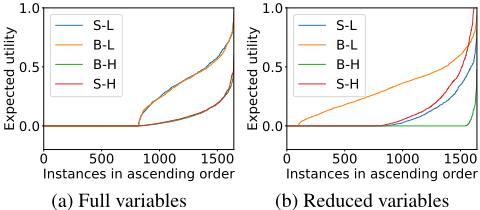
Figure 1(a) shows the expected utility of each player for the 1,642 instances plotted in ascending order. Observe that, for all instances, every player (supplier or buyer of any type) expects non-negative utility. The corresponding expected budget balance (utility) of IP is essentially zero for all instances and only shown in Figure 4(a) in [Osogami et al., 2022]. Therefore, the proposed approach finds the mechanism that achieves both ex ante WBB and interim IR (in addition to DSIC and Efficiency) for every randomly generated instance where achieving the four properties ex post is impossible.
This however does not mean that one can always achieve ex ante WBB and interim IR. There indeed exist instances for which ex ante WBB or interim IR cannot be achieved. Empirically, however, such infeasible instances appear to have zero Lebesgue measure and are not generated in our random process. A caveat is that, when an instance is close to an infeasible instance, our approach tends to find the mechanism that requires a large amount of payment to or from IP (see Figure 5 in [Osogami et al., 2022]).
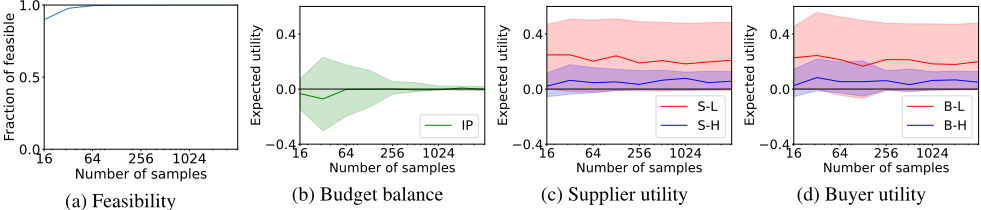
Next, we validate the effectiveness of our learning approach with a focus on the impact of sample approximation. Here, for each of the 1,642 instances, we take varying number of samples from the distribution of types to solve the learning problem (18)-(20). We use the lower confidence bound of a Gaussian process regressor to evaluate the right-hand side of (20) and add the sample standard deviation to the right-hand side of (19) to form an upper confidence bound. We seek to find an exact h without functional approximation hθ .
Figure 2 shows (a) the fraction of the instances for which the learning problem has feasible solutions as well as the expected utility of (b) IP, (c) the supplier, and (d) the buyer, under the mechanisms learned with our approach. In (b)-(d), the solid lines show the average over the feasible instances, and the shaded area represents the [15.9%, 84.1%]-quantile, which coincide with the confidence intervals set in (19)-(20).
Figure 2(a) shows that the learning problems do not necessarily have feasible solutions (while the corresponding optimization problems are all feasible). With sufficient amount of data (≥ 512 in this case), however, all of the learning problems become feasible. For those feasible learning problems, our approach learns the mechanisms that satisfy ex ante WBB and interim IR with high probability (Figure 2(b)-(d)). Although these properties are sometimes violated, they become more frequently satisfied as the sample size increases.
Finally, we study the effectiveness of variable reduction in the settings of the previous experiments. See [Osogami et al., 2022] for how the variables are reduced in these settings.
Figure 1(b) shows the expected utility of each player under the mechanisms computed with variable reduction (see Figure 7 in [Osogami et al., 2022] for details). By comparing against the corresponding results in Figure 1(a) without variable reduction, we find different mechanisms depending on whether the variables are reduced or not, as is suggested by the different expected utilities of the players. However, the mechanisms computed with reduced variables still achieve ex ante WBB and interim IR for all of the random instances.
Figure 8 in [Osogami et al., 2022] shows the performance of the mechanisms learned with variance reduction. Similar to Figure 2 (no variable reduction), ex ante WBB and interim IR are achieved with high probability as long as the learning problems are feasible. Variable reduction, however, reduces the solution space, and the instances that are feasible without variable reduction can become infeasible. Nevertheless, the fraction of feasible instances increases with the sample size (and essentially all of the instances become feasible with the exact distribution, as with the computational approach).
7 Conclusion
We have shown that, by computing or learning appropriate mechanisms, it can be made possible to achieve DSIC, Efficiency, ex ante WBB, and interim IR in trading networks where achieving these four properties ex post is impossible. Since this paper proposes the first AMD approach for trading networks, we have discussed and formalized the problem of mechanism design for trading networks, including fundamental characteristics such as Theorem 1 and Theorem 2.
There are some directions of future work that can be built upon these foundations. For example, while we learn mechanisms from previously collected (offline) data, the prior work has investigated the approaches of learning mechanisms while collecting data in an online manner (see [Osogami et al., 2022]). Such online methods involves the additional challenge of the tradeoff between exploration and exploitation, and it is interesting to study such online methods for trading networks. It is also interesting to study sample complexity of learning mechanisms for trading networks (see [Osogami et al., 2022] for such prior work on combinatorial auctions).
Ethical Statement
There are no ethical issues.
@inproceedings{ijcai2023p319,
  title     = {Learning Efficient Truthful Mechanisms for Trading Networks},
  author    = {Osogami, Takayuki and Wasserkrug, Segev and Shamash, Elisheva S.},
  booktitle = {Proceedings of the Thirty-Second International Joint Conference on
               Artificial Intelligence, {IJCAI-23}},
  publisher = {International Joint Conferences on Artificial Intelligence Organization},
  editor    = {Edith Elkind},
  pages     = {2862--2869},
  year      = {2023},
  month     = {8},
  note      = {Main Track},
  doi       = {10.24963/ijcai.2023/319},
  url       = {https://doi.org/10.24963/ijcai.2023/319},
}
TY - CPAPER TI - Learning Efficient Truthful Mechanisms for Trading Networks AU - Osogami, Takayuki AU - Wasserkrug, Segev AU - Shamash, Elisheva S. T2 - Proceedings of the Thirty-Second International Joint Conference on Artificial Intelligence, IJCAI-23 PB - International Joint Conferences on Artificial Intelligence Organization PY - 2023 SP - 2862 EP - 2869 DO - 10.24963/ijcai.2023/319 UR - https://doi.org/10.24963/ijcai.2023/319 ER -Copied
Machine-readable versions of this paper, for tools and AI agents:





