
Planning for Temporally Extended Goals in Pure-Past Linear Temporal Logic (Extended Abstract)
Proceedings of the Thirty-Third International Joint Conference on Artificial Intelligence. Sister Conferences Best Papers. Pages 8378-8383.
https://doi.org/10.24963/ijcai.2024/926
Keywords
- Planning and Scheduling: General
- Knowledge Representation and Reasoning: KRR: Knowledge representation languages
- Knowledge Representation and Reasoning: KRR: Qualitative, geometric, spatial, and temporal reasoning
Abstract
We study classical planning for temporally extended goals expressed in Pure-Past Linear Temporal Logic (PPLTL).
PPLTL is as expressive as Linear-time Temporal Logic on finite traces (LTLf), but as shown in this paper, it is computationally much better behaved for planning.
Specifically, we show that planning for PPLTL goals can be encoded into classical planning with minimal overhead, introducing only a number of new fluents that is at most linear in the PPLTL goal and no spurious additional actions.
Based on these results, we implemented a system called Plan4Past, which can be used along with state-of-the-art classical planners, such as LAMA.
An empirical analysis demonstrates the practical effectiveness of Plan4Past, showing that a classical planner generally performs better with our compilation than with other existing compilations for LTLf goals over the considered benchmarks.
- [Alechina et al., 2018] Natasha Alechina, Brian Logan, and Mehdi Dastani. Modeling norm specification and verifica- tion in multiagent systems. FLAP, 5(2):457-490, 2018.
- [Bacchus and Kabanza, 1996] Fahiem Bacchus and Frodu- ald Kabanza. Planning for temporally extended goals. In AAAI, pages 1215-1222. AAAI Press, 1996.
- [Bacchus and Kabanza, 2000] Fahiem Bacchus and Frodu- ald Kabanza. Using temporal logics to express search control knowledge for planning. AIJ, 116(1-2):123-191, 2000.
- [Bacchus et al., 1996] Fahiem Bacchus, Craig Boutilier, and Adam Grove. Rewarding behaviors. In AAAI, pages 1160- 1167, 1996.
- [Bacchus et al., 1997] Fahiem Bacchus, Craig Boutilier, and Adam Grove. Structured solution methods for non- markovian decision processes. In AAAI, pages 112-117, 1997.
- [Baier and McIlraith, 2006] Jorge A. Baier and Sheila A. McIlraith. Planning with first-order temporally extended goals using heuristic search. In AAAI, pages 788-795. AAAI, 2006.
- [Baier et al., 2008a] Christel Baier, Joost-Pieter Katoen, and Kim Guldstrand Larsen. Principles of Model Checking. MIT, 2008.
- [Baier et al., 2008b] Jorge A. Baier, Christian Fritz, Meghyn Bienvenu, and Sheila A. McIlraith. Beyond classical planning: Procedural control knowledge and preferences in state-of-the-art planners. In AAAI, pages 1509-1512. AAAI, 2008.
- [Barringer et al., 1989] Howard Barringer, Michael Fisher, Dov M. Gabbay, Graham Gough, and Richard Owens. METATEM: A framework for programming in temporal logic. In REX Workshop, volume 430 of LNCS, pages 94- 129. Springer, 1989.
- [Bienvenu et al., 2011] Meghyn Bienvenu, Christian Fritz, and Sheila A. McIlraith. Specifying and computing pre- ferred plans. Artif. Intell., 175(7-8):1308-1345, 2011.
- [Bonassi et al., 2021] Luigi Bonassi, Alfonso Emilio Gerevini, Francesco Percassi, and Enrico Scala. On planning with qualitative state-trajectory constraints in PDDL3 by compiling them away. In ICAPS, pages 46-50. AAAI Press, 2021.
- [Bonassi et al., 2022a] Luigi Bonassi, Alfonso Emilio Gerevini, and Enrico Scala. Planning with qualitative action-trajectory constraints in PDDL. In IJCAI, pages 4606-4613. ijcai.org, 2022. IJCAI
- [Bonassi et al., 2022b] Luigi Bonassi, Enrico Scala, and Al- fonso Emilio Gerevini. Planning with PDDL3 qualitative constraints for cost-optimal solutions through compilation (short paper). In IPS/RiCeRcA/SPIRIT@AI*IA, volume 3345 of CEUR Workshop Proceedings. CEUR-WS.org, 2022.
- [Bonassi et al., 2023a] Luigi Bonassi, Giuseppe De Giacomo, Marco Favorito, Francesco Fuggitti, Al- fonso Emilio Gerevini, and Enrico Scala. FOND planning for pure-past linear temporal logic goals. In ECAI, volume 372 of Frontiers in Artificial Intelligence and Applications, pages 279-286. IOS Press, 2023.
- [Bonassi et al., 2023b] Luigi Bonassi, Giuseppe De Giacomo, Marco Favorito, Francesco Fuggitti, Al- fonso Emilio Gerevini, and Enrico Scala. Planning for temporally extended goals in pure-past linear temporal logic. In ICAPS, pages 61-69. AAAI Press, 2023.
- [Bonassi et al., 2024] Luigi Bonassi, Alfonso Emilio Gerevini, and Enrico Scala. Dealing with numeric and metric time constraints in PDDL3 via compilation to numeric planning. In AAAI, pages 20036-20043. AAAI Press, 2024.
- [Chakraborti et al., 2024] Tathagata Chakraborti, Jungkoo Kang, Francesco Fuggitti, Michael Katz, and Shirin Sohrabi. Interactive plan selection using linear temporal logic, disjunctive action landmarks, and natural language instruction. In AAAI, 2024.
- [Cimatti et al., 1997] Alessandro Cimatti, Fausto Giunchiglia, Enrico Giunchiglia, and Paolo Traverso. Planning via model checking: A decision procedure for AR. In ECP, pages 130-142. Springer, 1997.
- [Cimatti et al., 2020] Alessandro Cimatti, Luca Geatti, Nicola Gigante, Angelo Montanari, and Stefano Tonetta. Reactive synthesis from extended bounded response LTL specifications. In FMCAD, pages 83-92. IEEE, 2020.
- [De Giacomo and Vardi, 1999] Giuseppe De Giacomo and Moshe Y. Vardi. Automata-theoretic approach to planning for temporally extended goals. In ECP, pages 226-238. Springer, 1999.
- [De Giacomo and Vardi, 2013] Giuseppe De Giacomo and Moshe Y. Vardi. Linear temporal logic and linear dy- namic logic on finite traces. In IJCAI, pages 854-860. IJCAI/AAAI, 2013. IJCAI
- [De Giacomo et al., 2020] Giuseppe De Giacomo, Antonio Di Stasio, Francesco Fuggitti, and Sasha Rubin. Pure-past linear temporal and dynamic logic on finite traces. In IJ- CAI, pages 4959-4965. ijcai.org, 2020. IJCAI
- [Emerson, 1990] E. Allen Emerson. Temporal and modal logic. In Handbook of Theoretical Computer Science, Chapter 16, 1990.
- [Fisher and Wooldridge, 2005] Michael Fisher and Michael Wooldridge. Temporal reasoning in agent-based systems. In FAI, pages 469-495. Elsevier, 2005.
- [Fraga Pereira et al., 2024] Ramon Fraga Pereira, Francesco Fuggitti, Felipe Meneguzzi, and Giuseppe De Giacomo. Temporally extended goal recognition in fully observ- able non-deterministic domain models. Appl. Intell., 54(1):470-489, 2024.
- [Fuggitti and Chakraborti, 2023] Francesco Fuggitti and Tathagata Chakraborti. NL2LTL -a python package for converting natural language (NL) instructions to linear temporal logic (LTL) formulas. In AAAI, pages 16428-16430. AAAI Press, 2023.
- [Fuggitti, 2023] Francesco Fuggitti. Efficient Techniques for Automated Planning for Goals in Linear Temporal Logics on Finite Traces. PhD Dissertation, Sapienza University & York University, September 2023.
- [Gabbay et al., 1980] Dov M. Gabbay, Amir Pnueli, Saharon Shelah, and Jonathan Stavi. On the temporal analysis of fairness. In POPL, pages 163-173. ACM Press, 1980.
- [Gerevini et al., 2009] Alfonso Gerevini, Patrik Haslum, Derek Long, Alessandro Saetti, and Yannis Dimopoulos. Deterministic planning in the fifth international planning competition: PDDL3 and experimental evaluation of the planners. AIJ, 173(5-6):619-668, 2009.
- [Giunchiglia and Traverso, 1999] Fausto Giunchiglia and Paolo Traverso. Planning as model checking. In ECP, pages 1-20. Springer, 1999.
- [Knobbout et al., 2016] Max Knobbout, Mehdi Dastani, and John-Jules Ch. Meyer. A dynamic logic of norm change. In ECAI, pages 886-894, 2016.
- [Lichtenstein et al., 1985] Orna Lichtenstein, Amir Pnueli, and Lenore D. Zuck. The glory of the past. In Logic of Programs, pages 196-218. Springer, 1985.
- [Manna, 1982] Zohar Manna. Verification of Sequential Pro- grams: Temporal Axiomatization, pages 53-102. Springer Netherlands, 1982.
- [Percassi and Gerevini, 2019] Francesco Percassi and Al- fonso Emilio Gerevini. On compiling away PDDL3 soft trajectory constraints without using automata. In ICAPS, pages 320-328. AAAI Press, 2019.
- [Richter and Westphal, 2010] Silvia Richter and Matthias Westphal. The LAMA planner: Guiding cost-based any- time planning with landmarks. JAIR, 39:127-177, 2010.
- [Röger et al., 2014] Gabriele Röger, Florian Pommerening, and Malte Helmert. Optimal planning in the presence of conditional effects: Extending LM-Cut with context split- ting. In ECAI, pages 765-770, 2014.
- [Sohrabi et al., 2011] Shirin Sohrabi, Jorge Baier, and Sheila McIlraith. Preferred explanations: Theory and generation via planning. In AAAI, volume 25, pages 261-267, 2011.
- [Thiébaux et al., 2005] Sylvie Thiébaux, Jörg Hoffmann, and Bernhard Nebel. In defense of PDDL axioms. Artif. Intell., 168(1-2):38-69, 2005.
- [Torres and Baier, 2015] Jorge Torres and Jorge A. Baier. Polynomial-time reformulations of LTL temporally ex- tended goals into final-state goals. In IJCAI, pages 1696- 1703. AAAI Press, 2015. IJCAI
References were extracted automatically from the PDF and may contain errors.
Full text extracted automatically from the PDF; figures, tables and equations may differ. The PDF is the version of record.
1 Introduction
In AI Planning, a temporally extended goal is a (possibly complex) property that the state-trace induced by a plan has to satisfy. Planning for temporally extended goals has a long tradition in AI Planning, including pioneering work in the late '90s [Bacchus et al., 1996; Bacchus and Kabanza, 1996; Bacchus et al., 1997; Bacchus and Kabanza, 2000], work on planning via Model Checking [Cimatti et al., 1997; De Giacomo and Vardi, 1999; Giunchiglia and Traverso, 1999], and work on declarative and procedural constraints [Baier and McIlraith, 2006; Baier et al., 2008b]. Also, recent works focus on handling the subset of temporally extended goals defined by PDDL3 [Gerevini et al., 2009], interpreting them as preferences [Percassi and Gerevini, 2019], state-trajectory constraints [Bonassi et al., 2021; Bonassi et al., 2022b; Bonassi et al., 2024], or over action sequences [Bienvenu et al., 2011; Bonassi et al., 2022a].
∗Extended abstract of the paper [Bonassi et al., 2023b] published in ICAPS 2023.
†Views and opinions expressed here are of the author's own and are not representative of the Bank of Italy's official position.
In this scenario, a powerful formalism to express temporally extended goals is Linear-time Temporal Logic (LTL), which has been advocated as an excellent tool to express properties of processes in Formal Methods [Baier et al., 2008a]. Given that tasks in AI planning are inherently of finite nature, a finite-trace variant of LTL, namely LTLf , has often been employed [Bacchus and Kabanza, 1996; Baier and McIlraith, 2006; De Giacomo and Vardi, 2013]. Notably, an alternative to LTLf is the Pure-Past Linear Temporal Logic, or PPLTL [Lichtenstein et al., 1985], which has been attractive in expressing non-Markovian rewards in MDPs [Bacchus et al., 1996], normative properties in multi-agent systems [Fisher and Wooldridge, 2005; Knobbout et al., 2016; Alechina et al., 2018], explanations in dynamical systems [Sohrabi et al., 2011], synthesis specifications [Cimatti et al., 2020], or in the context of plan/goal recognition [Fraga Pereira et al., 2024]. PPLTL looks at the trace backward instead of forward as LTLf and does so by expressing properties on traces using past operators only. PPLTL and LTLf have the same expressive power, but translating a formula from one into the other (and vice versa) can be prohibitive since the best-known algorithms are 3EXPTIME [De Giacomo et al., 2020].
In this paper, we study the problem of planning for PPLTL temporally extended goals in deterministic domains. Similarly to planning for LTLf goals, which has already been studied in, e.g., [Baier and McIlraith, 2006; De Giacomo and Vardi, 2013; Torres and Baier, 2015], planning for PPLTL goals requires reaching a certain state satisfying the PPLTL goal, i.e., the state-trace produced to reach such a state satisfies the goal formula.
From the literature, it is well-known that LTL formulas have a fixpoint characterization that allows splitting any formula into a propositional formula to be checked at the current instant and a temporal formula to be checked at the next instant [Gabbay et al., 1980; Manna, 1982; Emerson, 1990]. This property has already been exploited in AI, e.g., in the MetateM approach [Barringer et al., 1989], and later by Bacchus and Kabanza [1996], one of the most influential work on planning for temporally extended goals. Analogously, when we consider PPLTL formulas, such a fixpoint characterization splits the formula into a propositional formula on the current instant and a temporal formula on the past to be checked at the previous instant. In this paper, similarly to what was done by [Bacchus et al., 1997] in the context of (factorized) MDPs with PPLTL rewards, we exploit the fixpoint characterization of PPLTL formulas to show that planning for PPLTL goals can be polynomially encoded into classical planning and without adding any spurious actions. The use of PPLTL is crucial to obtain such nice results, as encoding LTLf goals into classical planning problems results either in worst-case exponential encodings [Baier and McIlraith, 2006] or in encodings that include additional spurious actions significantly increasing the plan length [Torres and Baier, 2015].
Finally, we developed our approach in a tool called Plan4Past that can be used along with state-of-the-art classical planners and experimentally showed its practical effectiveness by comparing it against techniques for LTLf goals.
2 Classical Planning with Pure-Past Linear Temporal Logic Goals
We model a classical planning domain as a tuple D = ⟨F,A, Pre, Eff ⟩, where F is a set of fluents (i.e., a set of positive literals), A is a set of action labels, and Pre and Eff are two functions denoting the preconditions and effects of each action a ∈ A. A planning state s is a collection of atoms from F, meaning that f is true in s if f ∈ s and f is false in s otherwise. Both functions Pre and Eff take an action label a ∈ A as input and return a propositional formula over F and a set of conditional effects, respectively. A conditional effect is a pair c ▷ e, where c is a formula, and e is a set of literals. An action a can be applied in a state s only if Pre(a) holds true in s, and applying a in s induces a new state s′ , denoted with s[a], that is defined following the standard definition of conditional effects [R¨oger et al., 2014]. Intuitively, a conditional effect c ▷ e specifies that if the condition c holds in the current state, then the effect e needs to be applied.
A classical planning problem is a tuple Γ = ⟨D, s0,G⟩, where D is a domain model, s0 is the initial state, and G is a formula over F representing the goal to achieve. A solution to a planning problem Γ is a sequence of actions a ∈ A called plan π = a0, . . . , an-1 such that, when executed, induces a finite state-trace τ = s0, . . . , sn, where si satisfies Pre(a) and si+1 = s[a] for i = 0, . . . , n-1, and sn satisfies G.
Usually, G is a reachability goal as it represents a property that must hold in the final state. Many real-world scenarios require achieving more general goals than just reachability goals. In most cases, realistic goals require properties to hold over a sequence of planning states. These types of temporal goals, also called temporally extended goals, are often expressed using temporal logics on finite or infinite sequences of states. In particular, this paper focuses on temporally extended goals expressed in Pure-Past Linear Temporal Logic (PPLTL). PPLTL is the variant of LTLf that talks about the past instead of the future. Given a set P of propositions, PPLTL is defined as:
where p ∈ P, Y is the yesterday operator and S is the since operator. PPLTL formulas are interpreted on finite nonempty traces, also called histories, τ = s0 · · · sn where si at instant i is a propositional interpretation over the alphabet 2P . We define the satisfaction relation τ, i |= φ, stating that φ holds at instant i, as follows:
- τ, i |= p iff p holds in si (for p proposition);
- τ, i |= ¬φ iff τ, i does not satisfy φ;
- τ, i |= φ1 ∧φ2 iff both φ1 and φ2 hold at instant i;
- τ, i |= Yφ iff φ held at the previous instant i - 1 with i ≥ 1. If i = 1, then Yφ is false.
- τ, i |= φ1 Sφ2 iff φ2 held at some previous instant k, and φ1 held in every subsequent instant j with k < j ≤ i.
The entire trace τ satisfies φ, denoted with τ |= φ, when φ holds in the last instant of τ. From the primitive PPLTL operators, one can easily derive other operators, such as φ1 ∨ φ2 ≡ ¬(φ1 ∧ φ2), the once operator Oφ ≡ true Sφ and the historically operator Hφ ≡ ¬O¬φ. Intuitively, Oφ specifies that φ held true sometimes in the past, while Hφ requires φ to always hold in each past state. We denote by sub(φ) the set of all subformulas of φ obtained from the syntax tree of φ [De Giacomo and Vardi, 2013].
If we specify planning goals using PPLTL, a planning problem becomes a tuple Γ = ⟨D, s0, φ⟩, where φ is a PPLTL goal formula. In the case of planning with a temporally extended goal φ, a plan π is a solution to Γ if the sequence of states τ = s0, . . . , sn induced by π satisfies φ. The following example shows two properties that are naturally expressed in PPLTL. Further examples can be found in Fuggitti [2023].
Example 1. The goal "We are now at location l1 and have passed through location l2" in PPLTL is l1 ∧O(l2). Another interesting property is "Every time I took the bus, I bought a new ticket beforehand", which translates as H(Bus =⇒ Y(¬Bus S T icket)) [De Giacomo et al., 2020].
3 Handling PPLTL Goals
Our approach exploits three main observations: (i) to evaluate the PPLTL goal formula we only need the truth value of its subformulas; (ii) every PPLTL formula can be put in a form where its evaluation depends only on the current state and the evaluation of a key set of PPLTL subformulas at the previous instant; (iii) one can recursively compute the value of such a small set of formulas and keep track of them with additional propositional variables in the state of the planning domain.
The well-known fixpoint characterization of LTL and variants [Gabbay et al., 1980; Manna, 1982; Emerson, 1990] is key to our approach. For PPLTL, such a fixpoint characterization splits the formula into a propositional formula on the current instant and a temporal formula on the past to be checked at the previous instant. In particular, PPLTL formulas can be decomposed into present and past components, given the fixpoint characterization of the since operator: ϕ1 Sϕ2 ≡ ϕ2∨(ϕ1∧Y(ϕ1 Sϕ2)). Exploiting this equivalence, the formula decomposition can be computed by recursively applying the following transformation function pnf(·):
- pnf(p) = p;
- pnf(Yϕ) = Yϕ;
- pnf(ϕ1 Sϕ2) = pnf(ϕ2) ∨ (pnf(ϕ1) ∧Y(ϕ1 Sϕ2));
- pnf(ϕ1 ∧ ϕ2) = pnf(ϕ1) ∧ pnf(ϕ2);
- pnf(¬ϕ) = ¬pnf(ϕ).
A formula resulting from the application of pnf(·) is in Previous Normal Form (PNF). Note that formulas in PNF have proper temporal subformulas (i.e., subformulas whose main construct is a temporal operator) appearing only in the scope of the Y operator. Also, observe that the formulas of the form Yϕ in pnf(φ) are such that ϕ ∈ sub(φ). It is easy to see that every PPLTL formula φ can be converted to its PNF form pnf(φ) in linear-time in the size of the formula (i.e., |sub(φ)|) and that pnf(φ) is equivalent to φ.
Example 2. As a running example, we use the formula φ = t ∧ ¬r Sm, which enforces scenarios where an agent finishes the task t without using the resource r since activating the machine m. The pnf of φ is:
Notably, the PNF transformation allows us to determine the truth value of a PPLTL formula by knowing the truth of some atomic propositions at the current instant and the truth of some key subformulas at the previous instant. In particular, the key subformulas that we need to consider are those appearing within the Y-scope in the PNF. Therefore, we interpret these specific subformulas as atomic propositions, denoting them with quotes, and collecting them in a set denoted as Σφ. These propositions are:
- "Yϕ" for each subformula of φ of the form Yϕ;
- "Y(ϕ1 Sϕ2)" for each subformula of φ of the form ϕ1 S ϕ2;
Example 3. For φ = t ∧ ¬r Sm we have Σφ = {"Y(¬r Sm)"}. Therefore, to evaluate φ, we only need to keep track of the subformula Y(¬r Sm) using the propositional variable "Y(¬r Sm)".
To evaluate the truth value of propositions in Σφ, we introduce the interpretation σ : Σφ → {⊤,⊥}, and characterize the evaluation of subformulas at a certain instant i ≤ n with σi. Intuitively, given an instant i, σi tells us which propositions related to the previous instant (i.e., in Σφ) are true at the instant i. Therefore, a PPLTL formula φ can be simply evaluated considering the propositional interpretation in the current instant i and the truth value assigned by σi to propositions related to the previous instant. We can easily do so by introducing an evaluation procedure denoted by val(φ, σi, si). Essentially, val(·) takes as input a PPLTL formula φ, the current interpretation si of the propositional symbols, and the current interpretation σi of the "Y(ϕ)" atoms, and evaluates the (propositional) formula obtained by swapping every Y(ϕ) with "Y(ϕ)" in the recursive computation of pnf(φ). An example of this procedure is shown below.
Example 4. We have that val(t ∧ ¬r Sm, si, σi) evaluates whether the formula:
holds true given the interpretations si and σi. For instance, val(t ∧ ¬r Sm, si, σi) is true when σi("Y(¬r Sm)") = ⊤ and si satisfy both t and ¬r.
Note that, the same procedure can be applied to determine val(ϕ, σi, si) for every subformula ϕ ∈ sub(φ). With this approach, we can use val(φ, σi, si) to capture the truth of φ at any instant i (i.e., val(φ, σi, si) is true iff τ, i |= φ). Clearly, computing val(·) for some instant i requires the interpretation σi. Luckily, given a trace τ = s0, s1, . . . sn, we can easily construct σi for every i ∈ {0, 1, . . . n} as follows. At the beginning of the trace, we know that, by definition of PPLTL, every formula of the form Y(ϕ) is false. Hence, we set σ0("Yϕ") .= ⊥ for each "Yϕ" ∈ Σφ, enabling the computation of val(ϕ, s0, σ0) for every ϕ ∈ sub(φ). Then, since Y(ϕ) holds at instant i iff ϕ holds at the previous instant i-1, we can iteratively set σi("Yϕ") .= val(ϕ, σi-1, si-1) for every i = {1, . . . n}. By doing so, we can evaluate any PPLTL formula at any instant i without considering the entire history produced so far.
4 Encoding PPLTL Goals in Planning
Intuitively, given a goal formula φ, we introduce a set of fresh atoms to keep track of the interpretation σ. Then, we simulate the construction of σi and the computation of val(φ, σi, si) for every instant i of the state trace as actions are applied. We do so by modifying the effect function and by employing axioms and derived predicates [Thi´ebaux et al., 2005]. Given a problem Γ = ⟨D, s0, φ⟩, in the following we describe how to encode Γ into Γ′ = ⟨D′ , s′0 , G′ ⟩, where G′ is a reachability goal, and D′ = ⟨F ′ ,X ′ ,A, Pre, Eff ′ ⟩ is the new planning domain extended with a set of axioms X ′ .
Fluents. F ′ contains the fluents of F, as well as one fluent for each proposition "Yϕ" in Σφ to keep track of propositional interpretations σi, and the set of predicates Pder defined below. Formally, F ′ = F ∪ Σφ ∪ Pder.
Axioms. We employ axioms to elegantly determine val(ϕ, σi, si) in every state si. Axioms have the form d ← ψ, where d ∈ Pder is a positive literal called derived predicate, and ψ is a propositional formula over a set of predicates. Let s be a state, axiom d ← ψ determines that the derived predicate d holds in s if and only if s |= ψ.
We include an axiom valϕ ← ψ for every subformula ϕ ∈ sub(φ), and Pder is defined as the set of all derived predicates valϕ, i.e., Pder = {valϕ | ϕ ∈ sub(φ)}. By mimicking the recursive computation of pnf(·), we get the following axioms:
- valp ← p;
- valYϕ ← "Yϕ";
- valϕ1 S ϕ2 ← (valϕ2 ∨ (valϕ1 ∧ "Y(ϕ1 S ϕ2)"));
- valϕ1∧ϕ2 ← (valϕ1 ∧ valϕ2 );
- val¬ϕ ←¬valϕ.
Clearly, we have that valϕ captures the evaluation of val(ϕ, σi, si). We add to D′ a set of axioms for every subformula ϕ in sub(φ), i.e., X ′ = {valϕ ← ϕ | ϕ ∈ sub(φ)}.
Initial State. The initial state assigns each fluent "Yϕ" ∈ Σφ to the truth value given by σ0. That is, s′0 = (σ0, s0).
Effects. The effect of every action is modified by adding a way to update the assignments of propositions in Σφ. For each "Yϕ" ∈ Σφ, we model the assignment σi("Yϕ") .= val(ϕ, σi-1, si-1) using two conditional effects of the form:
These effects specify that the fluent "Yϕ" is set to true (false, resp.) in the state si iff valϕ is true (false, resp.) in si-1. The effect of each action is extended with the same set of conditional effects. Formally, for all a ∈ A, Eff ′ (a) = Eff (a) ∪ {valϕ ▷ "Yϕ", ¬valϕ ▷ ¬"Yϕ" | "Yϕ" ∈ Σφ}.
Goal. The new goal is G′ = valφ. That is, we require the derived predicate associated with the original PPLTL goal formula φ to hold in the last instant.
The encoding is polynomially related to the original problem. In addition, every plan π for Γ is also a plan for Γ′ and vice versa, making the encoding sound and complete.
Theorem 1 (Bonassi et al. 2023b). Let Γ be a planning problem with a PPLTL goal φ, and Γ′ be the corresponding encoded planning problem. The size of Γ′ is polynomial in the size of Γ. In particular, the additional fluents introduced are linear in the size of the PPLTL goal φ of Γ. Moreover, every plan π is a plan for Γ iff π is a plan for Γ′ .
5 Experiments
This section briefly summarizes the experimental analysis presented in Bonassi et al. [2023b]. The novel approach has been implemented in a tool called Plan4Past (P4P), which is available at https://github.com/whitemech/Plan4Past.
The experimental analysis compares P4P with the two state-of-the-art compilations Exp [Baier and McIlraith, 2006] and Poly [Torres and Baier, 2015] for LTLf temporally extended goals. In particular, Exp explicitly uses NFAs to represent the LTLf formula, whereas Poly implicitly constructs the NFA for the goal formula. As a result, the Exp encoding is worst-case exponential in the size of the LTLf formula, while the Poly encoding remains polynomial in the size of the LTLf goal at the cost of a polynomial increase in the size of solution plans. On the other hand, the P4P encoding is polynomial in the size of the PPLTL goal and preserves the plan length.
We evaluated all compilation systems over a set of semantically equivalent LTLf and PPLTL goals. In total, our benchmark suite features 152 instances across the planning domains BLOCKSWORLD, ELEVATOR, ROVERS, and OPENSTACKS. The instances resulting from each compilation system were solved using the LAMA [Richter and Westphal, 2010] classical planner with runtime and memory limits of 1800s and 8GB, respectively.
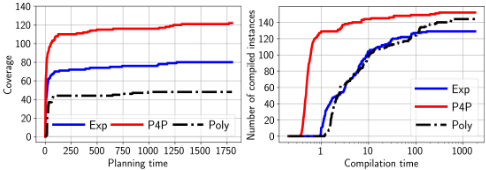
Table 1 reports on the coverage (number of instances solved) of all compilations across all domains. We observe that P4P performs equally to or better than both Poly and Exp in all domains. In many cases, the Poly encoding forces LAMA to schedule many spurious actions after each original planning action taken. For example, the biggest instance of BLOCKSWORLD solved by Poly requires 6402 actions, of which 104 are actions of the original domain. Instead, the Exp encoding blows up during compilation or produces problems that cannot be handled by LAMA. The compilation time seems to be an issue for both LTLf compilations. Indeed, if we look at Figure 1 (right), P4P compiles 94.7% instances within 10s, while both Poly and Exp converge much more slowly. Figure 1 (left) displays the number of benchmark instances solved with a given timeout. All systems achieve their maximum coverage quite quickly, with P4P leaving the others well behind right after the start.
| Domain | P4P | Poly | Exp |
|---|---|---|---|
| ROVERS (47) | 40 | 13 | 28 |
| BLOCKSWORLD (36) | 36 | 16 | 9 |
| OPENSTACKS (40) | 17 | 15 | 14 |
| ELEVATOR (29) | 29 | 4 | 29 |
| Total | 122 | 48 | 80 |
6 Conclusion
This paper summarizes the results presented in Bonassi et al. [2023b] on classical planning for PPLTL goals. In particular, our work shows that planning for PPLTL goals can be encoded into classical planning for reachability goals with minimal overhead and without increasing the plan length. Handling PPLTL goals is remarkably simple and elegant, given the direct mapping between the theoretical formulation and the encoding compilation without sacrificing efficiency. Moreover, we practically show that the novel encoding is able to solve a broader range of problems compared to the state-ofthe-art encodings for LTLf goals. Interestingly, the proposed encoding can be seamlessly extended to Fully Observable Non-Deterministic (FOND) planning domains [Bonassi et al., 2023a]. Also, our findings have already paved the way for the use of PPLTL in other applications, such as plan selection through natural language [Fuggitti and Chakraborti, 2023; Chakraborti et al., 2024], suggesting that PPLTL may definitely become a promising candidate to be the mainstream language to express temporal goals in planning. Future work concerns handling more expressive formalisms such as PurePast Linear Dynamic Logic (PPLDL) [De Giacomo et al., 2020], developing planners that can natively handle PPLTL goals, and exploring PPLTL-aware heuristics.
Acknowledgments
This work has been partially supported by the EU H2020 project AIPlan4EU (No. 101016442), the ERC-ADGWhiteMech (No. 834228), the EU ICT-48 2020 project TAILOR (No. 952215), the PRIN project RIPER (No. 20203FFYLK), and the PNRR MUR project FAIR (No. PE0000013).
@inproceedings{ijcai2024p926,
  title     = {Planning for Temporally Extended Goals in Pure-Past Linear Temporal Logic (Extended Abstract)},
  author    = {Bonassi, Luigi and De Giacomo, Giuseppe and Favorito, Marco and Fuggitti, Francesco and Gerevini, Alfonso Emilio and Scala, Enrico},
  booktitle = {Proceedings of the Thirty-Third International Joint Conference on
               Artificial Intelligence, {IJCAI-24}},
  publisher = {International Joint Conferences on Artificial Intelligence Organization},
  editor    = {Kate Larson},
  pages     = {8378--8383},
  year      = {2024},
  month     = {8},
  note      = {Sister Conferences Best Papers},
  doi       = {10.24963/ijcai.2024/926},
  url       = {https://doi.org/10.24963/ijcai.2024/926},
}
TY - CPAPER TI - Planning for Temporally Extended Goals in Pure-Past Linear Temporal Logic (Extended Abstract) AU - Bonassi, Luigi AU - De Giacomo, Giuseppe AU - Favorito, Marco AU - Fuggitti, Francesco AU - Gerevini, Alfonso Emilio AU - Scala, Enrico T2 - Proceedings of the Thirty-Third International Joint Conference on Artificial Intelligence, IJCAI-24 PB - International Joint Conferences on Artificial Intelligence Organization PY - 2024 SP - 8378 EP - 8383 DO - 10.24963/ijcai.2024/926 UR - https://doi.org/10.24963/ijcai.2024/926 ER -Copied
Machine-readable versions of this paper, for tools and AI agents:





