
GATES: Cost-aware Dynamic Workflow Scheduling via Graph Attention Networks and Evolution Strategy
Proceedings of the Thirty-Fourth International Joint Conference on Artificial Intelligence. Main Track. Pages 8635-8643.
https://doi.org/10.24963/ijcai.2025/960
Keywords
- Search: S: Combinatorial search and optimisation
- Search: S: Evolutionary computation
- Planning and Scheduling: PS: Scheduling
- Machine Learning: ML: Reinforcement learning
Abstract
Cost-aware Dynamic Workflow Scheduling (CADWS) is a key challenge in cloud computing, focusing on devising an effective scheduling policy to efficiently schedule dynamically arriving workflow tasks, represented as Directed Acyclic Graphs (DAG), to suitable virtual machines (VMs). Deep reinforcement learning (DRL) has been widely employed for automated scheduling policy design. However, the performance of DRL is heavily influenced by the design of the problem-tailored policy network and is highly sensitive to hyperparameters and the design of reward feedback. Considering the above-mentioned issues, this study proposes a novel DRL method combining Graph Attention Networks-based policy network and Evolution Strategy, referred to as GATES. The contributions of GATES are summarized as follows: (1) GATES can capture the impact of current task scheduling on subsequent tasks by learning the topological relationships between tasks in a DAG. (2) GATES can assess the importance of each VM to the ready task, enabling it to adapt to dynamically changing VM resources. (3) Utilizing Evolution Strategy's robustness, exploratory nature, and tolerance for delayed rewards, GATES achieves stable policy learning in CADWS. Extensive experimental results demonstrate the superiority of the proposed GATES in CADWS, outperforming several state-of-the-art algorithms. The source code is available at: https://github.com/YaShen998/GATES.
- Scenarios
- ProLis GRP-HEFT ES-RL SPN-CWS GATES (our) ⟨1.00, S⟩ 773.69 1685.01(-) 223.68(51.51)(+)(+) 158.28(14.45)(+)(+)(+) 143.95(18.94)(+)(+)(+)(+) ⟨1.00, M ⟩ 1829.25 2867.64(-) 422.26(100.92)(+)(+) 308.93(75.88)(+)(+)(+) 225.41(37.21)() ⟨1.00, L⟩ 3641.79 5873.20(-) 829.64(262.91)(+)(+) 524.83(163.15)(+)(+)(+) 324.93(65.))(+) ⟨1.25, S⟩ 923.15 1967.31(-) 320.75(83.69)(+)(+) 143.12(15.73)(+)(+)(+) 124.14
- ⟨1., M ⟩ 2068.78 3578.04(-) 565.53(213.00)(+)(+) 272.77(60.65)(+)(+)(+) 193.26(24.)) ⟨1.25, L⟩ 4213.29 6868.22(-) 989.79(458.04)(+)(+) 496.63(155.02)(+)(+)(+) 300.19(76.))(+) ⟨1.50, S⟩ 901.40 1963.39(-) 270.93(67.20)(+)(+) 144.13(18.97)(+)(+)(+) 121.56
- ⟨1., M ⟩ 2035.52 3567.97(-) 505.44(222.45)(+)(+) 276.09(60.63)(+)(+)(+) 196.90(33.)) ⟨1.50, L⟩ 4066.84 6863.62(-) 886.87(380.26)(+)(+) 511.69(161.85)(+)(+)(+) 316.23(99.))(+) ⟨1.75, S⟩ 804.33 1959.71(-) 241.09(51.43)(+)(+) 137.36(14.10)(+)(+)(+) 118.45
- ⟨1., M ⟩ 1977.10 3560.22(-) 491.97(229.48)(+)(+) 263.12(57.61)(+)(+)(+) 195.25(35.)) ⟨1.75, L⟩ 3898.42 6854.40(-) 828.06(359.74)(+)(+) 502.67(155.64)(+)(+)(+) 315.84(92.))(+) ⟨2.00, S⟩ 789.71 1957.25(-) 225.70(50.89)(+)(+) 129.75(12.72)(+)(+)(+) 113.48
- ⟨2., M ⟩ 1921.42 3554.07(-) 427.16(213.71)(+)(+) 251.83(52.01)(+)(+)(+) 185.55(30.)) ⟨2.00, L⟩ 4024.03 6847.49(-) 780.77(408.14)(+)(+) 497.65(158.52)(+)(+)(+) 322.01(110.))(+) ⟨2.25, S⟩ 710.18 1954.71(-) 201.54(50.56)(+)(+) 126.18(13.02)(+)(+)(+) 110.90
- ⟨2., M ⟩ 1924.27 3551.31(-) 374.96(190.21)(+)(+) 238.35(48.26)(+)(+)(+) 179.17(24.)) ⟨2.25, L⟩ 3957.08 6842.88(-) 678.94(396.79)(+)(+) 475.46(139.99)(+)(+)(+) 318.19(112al., 2015]
- Jürgen Branke, Su Nguyen, Christoph W Pickardt, and Mengjie Zhang. Auto- mated design of production scheduling heuristics: A review. IEEE Transactions on Evolutionary Computation, 20(1):110-124, 2015.
- [Cunha et al., 2020] Bruno Cunha, Ana M Madureira, Ben- jamim Fonseca, and Duarte Coelho. Deep reinforcement learning as a job shop scheduling solver: A literature re- view. In 18th International Conference on Hybrid Intelli- gent Systems, pages 350-359. Springer, 2020. Deelman et al., 2015]
- Ewa Deelman, Karan Vahi, Gideon Juve, Mats Rynge, Scott Callaghan, Philip J Maechling, Rajiv Mayani, Weiwei Chen, Rafael Ferreira Da Silva, Miron Livny, et al. Pegasus, a workflow management sys- tem for science automation. Future Generation Computer Systems, 46:17-35, 2015.
- [Dong et al., 2021] Hang Dong, Boshi Wang, Bo Qiao, Wen- qian Xing, Chuan Luo, Si Qin, Qingwei Lin, Dongmei Zhang, Gurpreet Virdi, and Thomas Moscibroda. Predic- tive job scheduling under uncertain constraints in cloud computing. In IJCAI, pages 3627-3634, 2021. IJCAI
- [Faragardi et al., 2019] Hamid Reza Faragardi, Mohammad Reza Saleh Sedghpour, Saber Fazliahmadi, Thomas Fahringer, and Nayereh Rasouli. Grp-heft: A budget- constrained resource provisioning scheme for workflow scheduling in iaas clouds. IEEE Transactions on Paral- lel and Distributed Systems, 31(6):1239-1254, 2019.
- [Geiger et al., 2006] Christopher D Geiger, Reha Uzsoy, and Haldun Aytug. Rapid modeling and discovery of prior- ity dispatching rules: An autonomous learning approach. Journal of Scheduling, 9:7-34, 2006.
- [HasanzadeZonuzy et al., 2021] Aria HasanzadeZonuzy, Dileep Kalathil, and Srinivas Shakkottai. Model-based reinforcement learning for infinite-horizon discounted constrained markov decision processes. IJCAI 2021, 2021. IJCAI
- [Huang et al., 2022] Victoria Huang, Chen Wang, Hui Ma, Gang Chen, and Kameron Christopher. Cost-aware dy- namic multi-workflow scheduling in cloud data center us- ing evolutionary reinforcement learning. In International Conference on Service-Oriented Computing, pages 449- 464. Springer, 2022.
- [Iklassov et al., 2023] Zangir Iklassov, Dmitrii Medvedev, Ruben Solozabal Ochoa De Retana, and Martin Takac. On the study of curriculum learning for inferring dispatching policies on the job shop scheduling. In IJCAI, pages 5350- 5358, 2023. IJCAI
- [Jadeja and Modi, 2012] Yashpalsinh Jadeja and Kirit Modi. Cloud computing-concepts, architecture and challenges. In 2012 international conference on computing, electron- ics and electrical technologies (ICCEET), pages 877-880. IEEE, 2012.
- [Kayhan and Yildiz, 2023] Behice Meltem Kayhan and Gokalp Yildiz. Reinforcement learning applications to machine scheduling problems: a comprehensive literature review. Journal of Intelligent Manufacturing, 34(3):905-929, 2023.
- [Khadka and Tumer, 2018] Shauharda Khadka and Kagan Tumer. Evolution-guided policy gradient in reinforcement learning. Advances in Neural Information Processing Sys- tems, 31, 2018.
- [Khalil et al., 2017] Elias Khalil, Hanjun Dai, Yuyu Zhang, Bistra Dilkina, and Le Song. Learning combinatorial op- timization algorithms over graphs. Advances in neural in- formation processing systems, 30, 2017.
- [Ning et al., 2020] Xuefei Ning, Yin Zheng, Tianchen Zhao, Yu Wang, and Huazhong Yang. A generic graph-based neural architecture encoding scheme for predictor-based nas. In European Conference on Computer Vision, pages 189-204. Springer, 2020.
- [Ou et al., 2023] Junwei Ou, Lining Xing, Feng Yao, Mengjun Li, Jimin Lv, Yongming He, Yanjie Song, Jian Wu, and Guoting Zhang. Deep reinforcement learning method for satellite range scheduling problem. Swarm and Evolutionary Computation, 77:101233, 2023.
- [Pallathadka et al., 2022] Harikumar Pallathadka, Guna Sekhar Sajja, Khongdet Phasinam, Mahyudin Ritonga, Mohd Naved, Rajni Bansal, and Jose Quiñonez- Choquecota. An investigation of various applications and related challenges in cloud computing. Materials Today: Proceedings, 51:2245-2248, 2022.
- [Pham and Fahringer, 2020] Thanh-Phuong Pham and Thomas Fahringer. Evolutionary multi-objective work- flow scheduling for volatile resources in the cloud. IEEE Transactions on Cloud Computing, 10(3):1780-1791, 2020.
- [Price et al., 2025] Ilan Price, Alvaro Sanchez-Gonzalez, Ferran Alet, Tom R Andersson, Andrew El-Kadi, Dominic Masters, Timo Ewalds, Jacklynn Stott, Shakir Mohamed, Peter Battaglia, et al. Probabilistic weather forecasting with machine learning. Nature, 637(8044):84-90, 2025.
- [Qazi et al., 2024] Faiza Qazi, Daehan Kwak, Fiaz Gul Khan, Farman Ali, and Sami Ullah Khan. Service level agreement in cloud computing: Taxonomy, prospects, and challenges. Internet of Things, page 101126, 2024.
- [Salimans et al., 2017] Tim Salimans, Jonathan Ho, Xi Chen, Szymon Sidor, and Ilya Sutskever. Evolution strategies as a scalable alternative to reinforcement learning. arXiv preprint arXiv:1703.03864, 2017.
- [Shen et al., 2024] Ya Shen, Gang Chen, Hui Ma, and Mengjie Zhang. Cost-aware dynamic cloud workflow scheduling using self-attention and evolutionary reinforce- ment learning. In International Conference on Service- Oriented Computing, pages 3-18. Springer, 2024.
- [Song et al., 2022] Wen Song, Xinyang Chen, Qiqiang Li, and Zhiguang Cao. Flexible job-shop scheduling via graph neural network and deep reinforcement learning. IEEE Transactions on Industrial Informatics, 19(2):1600-1610, 2022.
- [Sun and Yang, 2023] Zhiqing Sun and Yiming Yang. Di- fusco: Graph-based diffusion solvers for combinatorial optimization. Advances in Neural Information Processing Systems, 36:3706-3731, 2023.
- [Thekumparampil et al., 2018] Kiran K Thekumparampil, Chong Wang, Sewoong Oh, and Li-Jia Li. Attention-based graph neural network for semi-supervised learning. arXiv preprint arXiv:1803.03735, 2018.
- [Vaswani, 2017] A Vaswani. Attention is all you need. Ad- vances in Neural Information Processing Systems, 2017.
- [Veličković et al., 2017] Petar Veličković, Guillem Cucurull, Arantxa Casanova, Adriana Romero, Pietro Lio, and Yoshua Bengio. Graph attention networks. arXiv preprint arXiv:1710.10903, 2017.
- [Wang et al., 2019] Xiao Wang, Houye Ji, Chuan Shi, Bai Wang, Yanfang Ye, Peng Cui, and Philip S Yu. Hetero- geneous graph attention network. In The world wide web conference, pages 2022-2032, 2019.
- [Wu et al., 2017] Quanwang Wu, Fuyuki Ishikawa, Qing- sheng Zhu, Yunni Xia, and Junhao Wen. Deadline- constrained cost optimization approaches for workflow scheduling in clouds. IEEE Transactions on Parallel and Distributed Systems, 28(12):3401-3412, 2017.
- [Yang et al., 2022] Yifan Yang, Gang Chen, Hui Ma, and Mengjie Zhang. Dual-tree genetic programming for deadline-constrained dynamic workflow scheduling in cloud. In Service-Oriented Computing, pages 433-448. Springer, 2022.
- [Yang et al., 2025] Yifan Yang, Gang Chen, Hui Ma, Cong Zhang, Zhiguang Cao, and Mengjie Zhang. Graph as- sisted offline-online deep reinforcement learning for dy- namic workflow scheduling. In The Thirteenth Interna- tional Conference on Learning Representations, 2025.
- [Zhang et al., 2020] Cong Zhang, Wen Song, Zhiguang Cao, Jie Zhang, Puay Siew Tan, and Xu Chi. Learning to dispatch for job shop scheduling via deep reinforcement learning. Advances in neural information processing sys- tems, 33:1621-1632, 2020.
- [Zhang et al., 2024] Cong Zhang, Zhiguang Cao, Wen Song, Yaoxin Wu, and Jie Zhang. Deep reinforcement learning guided improvement heuristic for job shop scheduling. In The Twelfth International Conference on Learning Repre- sentations, 2024.
- [Zhu et al., 2016] Xiaomin Zhu, Ji Wang, Hui Guo, Dakai Zhu, Laurence T Yang, and Ling Liu. Fault-tolerant scheduling for real-time scientific workflows with elastic resource provisioning in virtualized clouds. IEEE Trans- actions on Parallel and Distributed Systems, 27(12):3501- 3517, 2016.
References were extracted automatically from the PDF and may contain errors.
Full text extracted automatically from the PDF; figures, tables and equations may differ. The PDF is the version of record.
1 Introduction
Real-world problems are often highly complex, requiring applications tailored to solve them to execute efficiently and deliver prompt results to meet user demands [Pallathadka et al., 2022]. For example, if a weather forecasting application fails to run in real time and provide timely, accurate predictions, it may interrupt the regular management of vital industrial operations [Price et al., 2025]. Cloud computing enables the deployment of such complex applications structured as workflows consisting of multiple tasks. It facilitates the scheduling of elastic computational resources to ensure efficient and timely task execution [Jadeja and Modi, 2012]. This process is known as Workflow Scheduling (WS).
∗Corresponding author
A workflow can be represented as a Directed Acyclic Graph (DAG), with vertices representing tasks and edges representing task dependencies [Shen et al., 2024]. Workflows with different patterns have different DAG structures. Additionally, each workflow includes a Service Level Agreement (SLA) that defines the maximum allowed completion time for the workflow [Qazi et al., 2024]. This study focuses on the Cost-aware Dynamic Workflow Scheduling (CADWS) problem [Shen et al., 2024], which aims to develop an efficient scheduling policy that minimizes VM rental costs and SLA violation penalties, while handling the complexity caused by the dynamic arrival of workflows with diverse DAG structures [Huang et al., 2022].
Compared to traditional scheduling problems such as job shop scheduling and vehicle routing, CADWS exhibits complex dynamic characteristics, including unpredictable workflow arrivals, varying workflow patterns, and rapidly fluctuating computational resources (e.g., the number of available VMs). Moreover, unlike job shop and vehicle routing problems, workflows in CADWS have highly diverse graph topologies across different patterns, while the others maintain similar structures regardless of scale. This study focuses on using deep reinforcement learning (DRL) techniques to automatically learn scheduling policies for solving CADWS, with an emphasis on designing effective policy networks tailored to the problem characteristics of CADWS.
The key challenges of this study are: (1) how to design an effective policy network to properly control the influence of every scheduling decision on future task execution in a dynamic environment with continuously arriving workflows of highly diverse patterns; (2) how can the designed policy network support a time-varying collection of VMs; and (3) how to reliably train this policy network to ensure robust performance across varying system settings. To address the aforementioned challenges, this paper proposes a novel DRL method that integrates Graph Attention Networks (GAT) and Evolution Strategy (ES), referred to as GATES.
Specifically, the main contributions of GATES are as follows: (1) GATES employs GAT to efficiently and scalably process the local topological information of each ready task. Leveraging GAT's attention mechanism, GATES accurately learns the global attention information between the ready task and other tasks, enabling a holistic view of current scheduling impacts on future tasks by aggregating all task embeddings. (2) Dynamic heterogeneous graphs with analogous structures but varying scales are constructed to represent the relationships between the ready task and all available VMs at each time step. Regardless of dynamic changes in VM numbers, GAT can compute attention coefficients from these graphs to identify the most suitable VM at each time step. (3) In CADWS, the reward function typically includes VM rental fees and SLA violation penalties. However, since SLA penalties can only be accurately determined after workflow execution, it's difficult to design a reward function that quantifies SLA violations at each time step. To overcome this challenge, ES is utilized to train the policy network. This approach eliminates the need for complex reward design and hyperparameter tuning, while also preventing performance issues caused by poorly designed rewards.
2 RelatedWork
Currently, most methods for solving scheduling problems focus on designing effective scheduling policies [Branke et al., 2015; Khalil et al., 2017; Dong et al., 2021; HasanzadeZonuzy et al., 2021]. Some manually designed policies have been developed to solve CADWS [Pham and Fahringer, 2020; Wu et al., 2017; Faragardi et al., 2019], as these methods are easy to understand and implement. However, these methods heavily rely on expert experience and substantial domain knowledge, limiting their adaptability to dynamic environments [Geiger et al., 2006], as they are developed based on historical workflows and may fail to perform effectively in rapidly changing scenarios or with unknown workflows [Shen et al., 2024].
Several DRL studies [Kayhan and Yildiz, 2023; Cunha et al., 2020; Ou et al., 2023; Iklassov et al., 2023] have shown that using neural network-based policy networks to automatically learn scheduling policies is a feasible and promising approach to solving scheduling problems. For instance, Ou et al. [2023] utilized DRL to solve the satellite range scheduling problem, while Song et al. [2022] and Zhang et al. [2020] employed DRL to learn effective policies for addressing the jobshop scheduling problem. However, the problems addressed by these works are either static or do not have a graph topological structure, such as the DAG of CADWS. Moreover, although Shen et al. [2024] and Huang et al. [2022] applied DRL to dynamic WS, their policy networks ignored the DAG structures of workflows, failing to leverage task dependencies for effective scheduling. Thus, the architecture of policy networks designed in these approaches did not take dynamic information or graph topological information into account to extract essential knowledge for learning scheduling policies, making them unsuitable for CADWS.
Recently, some studies [Sun and Yang, 2023; Zhang et al., 2024] proposed graph-based policy networks to extract state features for effective policy learning by leveraging the graph topological properties inherent in problems, such as traveling salesman, maximal independent set, and job shop problems. Sun and Yang [2023] proposed a graph-based diffusion model to exploit the graph topological information in the traveling salesman problem and the maximal independent set problem. Similarly, Zhang et al. [2024] utilized Graph Neural Networks (GNNs) to extract state features for effective policy learning by leveraging the graph topological properties of the job shop scheduling problems. While the above studies considered the graph topological information, they assume static structure and fixed scheduling resources. In contrast, CADWS accounts not only for the dynamic workflow arrivals and patterns but also for the variability in scheduling resources over time [Shen et al., 2024]. Specifically, the pool of active VMs can change across different system states and time steps.
Unlike existing DRL approaches, GATES is specifically designed in this study to address the dynamic nature of scheduling problems. It handles the unpredictable arrival and varying patterns of workflows, as well as fluctuations in available scheduling resources, achieving stable policy learning in complex and dynamic environments.
3 ProblemDefinition
3.1 Preliminary of CADWS
The CADWS problem involves a set of workflows W arriving dynamically over time and a dynamically changing collection of heterogeneous VMs M for task execution, meaning that |M| is not fixed. Each workflow Wi ∈ W is modeled as a DAG (OWi , CWi ), where the node set OWi = {Oi1, Oi2, . . . , Oin} represents tasks, and the edge set CWi = {(Oij,Oik) | Oij,Oik ∈ OWi } denotes precedence constraints (see Appendix A). An edge (Oij,Oik) implies that task Oij must complete before task Oik can begin execution. Oij becomes a ready task O∗ waiting for current scheduling when there are no predecessor tasks for it [Zhu et al., 2016].
The complete set of tasks across all workflows is denoted as O = OW1 ∪ OW2 ∪ · · · ∪ OW|W| . Each task Oij is associated with a workload WLij ∈ R+ and can be executed on any VM Mk ∈ M. The execution time of Oij on VM Mk is determined as ET(Oij)k = WLij PSk , where PSk denotes the processing speed of machine Mk. Hence, CT(Oij) = ST(Oij)+ET(Oij)k gives the completion time of Oij onMk, where ST(Oij) is the start time of Oij. Oij is the start task of Wi, if ST(Oij) = AT(Wi), where AT(Wi) is the arrival time of workflowWi. The finish time of workflowWi is defined as FT(Wi) = maxj{CT(Oij)}. The total process time of workflowWi is computed as PT(Wi) = F T (Wi) - AT (Wi).
3.2 Optimization Objective of CADWS
The VM rental fees cover the total cost of all leased VMs used to execute all workflows dynamically arrived during a given time period T. This period, starting at time ts and ending at te, depends on the scheduling policy π adopted. For each VM v ∈ M, its usage period during T is denoted as: UP(v, π, T) = [ts(v, π, T), te(v, π, T)], where ts(v, π, T) represents the start time of using v, and te(v, π, T) indicates the time when v is no longer in use, satisfying te(v, π, T) ≤ te. The total rental cost for all VMs under the scheduling policy π over T is computed as: V MFee(π, T ) = ∑v∈Set(π,T ) (P rice(v) × ⌈ te(v,π,T )-ts(v,π,T ) 3600 ⌉), where Set(π, T) is the set of VM instances leased for task execution during T. The ceiling function ensures that the rental time during an hour will be charged as an hour, following the common practice in the cloud computing industry [Shen et al., 2024;
Huang et al., 2022].
The SLA penalty for a workflow wi under a scheduling policy π is defined as: SLAPenalty(Wi, π) = β × max{0, [WCT(Wi, π) - DL(Wi)]}, where WCT(Wi, π) refers to the PT(Wi) by following policy π, and DL(Wi) denotes the SLA-specified deadline for Wi. The penalty factor β quantifies the severity of SLA violations. Following many existing studies [Huang et al., 2022; Shen et al., 2024], the deadline DL(Wi) is calculated as: DL(Wi) = AT (Wi) + γ ×MinMakespan(Wi), where AT (Wi) is the workflow's arrival time, MinMakespan(Wi) is the theoretical minimum time required to process Wi using the fastest VMs without delays, and γ is a relaxation coefficient. A higher γ value allows for a more lenient deadline.
The objective of CADWS is to find an optimal scheduling policy π that minimizes the total cost, including both the VM rental fees and SLA penalties, as formulated below:
4 Methology
This section elaborates on the proposed GATES for solving CADWS in detail. CADWS is a sequential decisionmaking process that can be formulated as a Markov Decision Process (MDP) [Huang et al., 2022; Shen et al., 2024; Yang et al., 2025], where scheduling decisions are made iteratively. At each step, GATES selects a compatible VM to execute a specific ready workflow task, continuing this process until all workflow tasks are scheduled. The workflow of GATES for solving CADWS is illustrated in Figure 1.
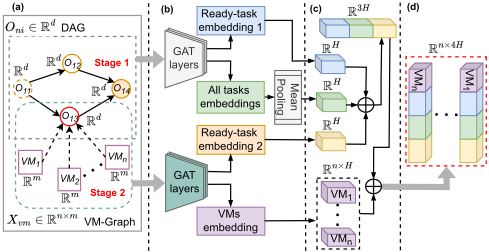
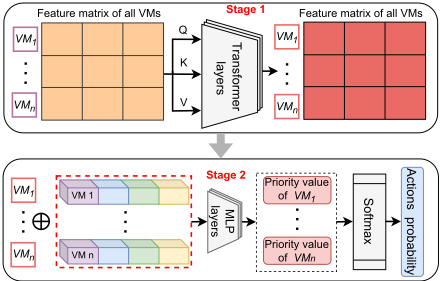
As shown in Figure 1, the current state of the scheduling system is captured by a Dynamic Heterogeneous Graph (DHG) representation (see Figure 2). Subsequently, a heterogeneous Graph Attention Network (HGAT) employing a two-stage embedding mechanism is applied to process this graph. This step extracts feature embeddings of both tasks and VMs (see Figure 3). These embeddings are then utilized by a decision-making network to compute the action probability distribution, from which a VM is sampled or greedily selected (as detailed in Figure 4). The next subsection introduces the MDP formulation of the CADWS process.
4.1 MDP Formulation of CADWS
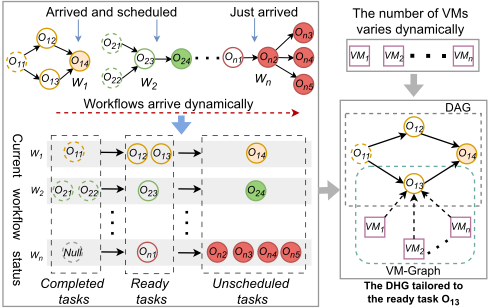
System State: Each system state st ∈ S represents a snapshot of the current state of the entire CADWS problem at decision step t, including the following elements: (1) the current ready task O∗ at t; (2) details of all active workflows, encompassing pattern information on their constituent tasks and task dependencies (modeled as DAG), and workflow arrival times; (3) the numbers and processing status of all available VMs at t. By designing an effective policy network that accurately captures the three aforementioned factors, the system state of CADWS at any time step can be precisely represented, addressing the first two challenges mentioned in Section 1. To achieve this, we define the system state of CADWS at any time step as a DHG (as shown in Figure 2) and propose the HGAT employing GAT with a two-stage embedding mechanism to extract useful state embeddings for ready tasks (details in Figure 3), enabling the learning of effective scheduling policies and making informed decisions.
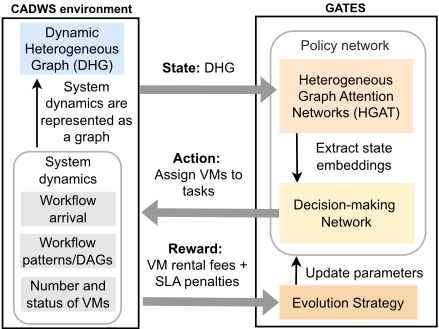
Actions: At the decision step t, each action at ∈ A assigns the ready task O∗ to the waiting queue of an eligible VMM (M ∈M). The size of the action space is |A| = |M|.
Transition: Upon taking an action at, the system transitions from state st to the next state st+1, where the focused ready task at decision step t is assigned to a specific VM for execution (Refer to Figure 1).
Rewards: The reward rt provides a scalar feedback signal based on the action at taken at system state st. To achieve the objective of minimizing the total cost as formulated in Eq. (1), the reward is defined as rt = -(V MFee + SLAPenalty).
Policy: The policy π(at | st) of GATES defines a probability distribution over the action set A for each state st, modeled as a parametric neural network.
Learning Objective: The goal of the scheduling agent is to learn an optimal policy that maximizes the total rewards after the completion of the CADWS problem.
4.2 Dynamic Heterogeneous Graph (DHG)
In CADWS, we leverage the topological information of the workflows represented as DAGs to learn embeddings for ready tasks. These embeddings not only capture the features of the current ready task but also learn the global features by considering the relationships with other tasks. This DAGbased global feature learning reveals the influence of predecessor tasks on the ready task and the potential impact of the ready task on subsequent tasks.
Additionally, we incorporate dynamically changing VMs into the DAG to construct a DHG, as shown in Figure 2. Since the number and types of VMs vary dynamically at different decision steps, the VM nodes and edges in the DHG are inherently dynamic. The DHG provides a global perspective to describe the influence of all tasks and currently available VMs on the scheduling of the ready task. Moreover, the DHG is constructed specifically for each ready task: whenever a task becomes ready and awaits scheduling, a DHG is generated to capture the essential system's dynamics for executing the ready task.
4.3 Proposed Policy Network
To support scheduling policy learning in GATES (the Agent), it is crucial to extract state embedding from the constructed DHG. GNNs are well-suited for learning embeddings from graph data. Among them, GAT outperforms Graph Convolutional Networks (GCN) and Graph Isomorphism Networks (GIN) in learning node embeddings from heterogeneous graphs. This advantage arises from GAT's use of attention mechanisms to assign dynamic weights to each neighboring node, enabling it to adapt to heterogeneous node features and diverse neighborhood relationships [Veliˇckovi´c et al., 2017]. In contrast, GCN and GIN rely on fixed weights or mean aggregation, limiting their ability to model feature differences in heterogeneous graphs [Thekumparampil et al., 2018]. Moreover, GAT does not require strict alignment of node features and naturally handles various relationships in heterogeneous graphs through its multi-head attention mechanism, offering greater flexibility and scalability [Wang et al., 2019].
Heterogeneous Graph Attention Networks (HGAT)
We propose an HGAT to extract the state embedding from the DHG, as shown in Figure 3. The embedding learning process of HGAT consists of two stages: (1) Use GAT to learn feature embedding for each task from the DAG (Stage 1 of Figure 3), in which the Ready-task embedding 1 refers to the feature embedding of the ready task. Meanwhile, the feature embeddings of all tasks are aggregated using mean pooling to obtain the All tasks embedding; (2) Another GAT is employed to learn the Ready-task embedding 2 from the VM-graph in the DHG, as well as the VMs embeddings, enabling GATES to assess the relative importance of each VM to the ready task. Finally, these learned embeddings are concatenated to form the state embedding in GATES that comprehensively captures critical dynamics in CADWS, including the dynamic arrival of workflows, the changing DAG structures, and the dynamic variation in the number and status of VMs.
The Decision-making Networks
We design the decision-making networks, as shown in Figure 4, to calculate the VM selection probabilities (i.e., the action distribution). Although the DHG of Figure 2 can capture the significance of dynamically changing VMs, an individual VM cannot reference the status information of others to determine its scheduling decisions. To address this, we employ a self-attention mechanism to learn global information among VMs, enabling each VM's feature embedding to account for the scheduling status of other VMs, thereby identifying the optimal VM to handle ready tasks. The computation process of the decision-making network consists of two stages: (1) the feature matrix of all VMs is first fed into a Transformer [Vaswani, 2017], where a self-attention mechanism captures the global information among VMs; (2) each VM's embedding is then concatenated with the state embedding to jointly determine the corresponding action score. The softmax function then computes the probability of selecting each VM based on these action scores. The detailed embedding learning process of Figure 3 and Figure 4 is described further in Appendix B.
4.4 Raw Features of CADWS
The scheduling policy learned by GATES for CADWS relies on the state embedding derived from both the ready task (denoted as O∗ ) and all VMs at the current time step. The state embedding is constructed using three categories of raw features: Workflow-related, Task-related, and VM-related raw features. For any task ready for execution, these features are extracted from the current state of workflows, tasks, and VMs to construct the input to GATES, as summarized below.
Workflow-related raw features:
- Forthcoming successors: the count of tasks dependent on O∗ .
- Completion ratio: the ratio of completed tasks (Ctasks) to total tasks (Ttasks) in Wi, calculated as Ctasks/Ttasks.
- Estimated arrival rate: an estimation of future workflow arrival rates based on the current execution status of Wi.
Task-related raw features:
- Predecessor: the number of predecessor tasks of each task in its corresponding DAG.
- Successor: the number of successor tasks of each task in its corresponding DAG.
- Processing time: the average duration required to execute a task on all types of VMs.
- Task size: the workload of each task in DAG.
- Task deadline: the task deadline is calculated using the method in [Wu et al., 2017]. The deadline is assigned to each task, subject to the task size. A large task will be assigned a more relaxed task deadline.
- Task status: the task status is represented by an integer: 0 for unscheduled, 1 for scheduled, and 2 for ready to be scheduled.
VM-related raw features:
- Task deadline feasibility: an indicator that shows whether a VM can meet the deadline of O∗ , assigned based on workflow size.
- Incurred cost: the sum of the VM rental fee and SLA violation penalties for using the VM to execute O∗ .
- Remaining rental time: the remaining rental time on a VM after executing O∗ .
- Fittest VM: an indicator that shows whether a VM has the lowest incurred cost among all candidates while meeting the task deadline.
4.5 Training Process via Evolution Strategy
The performance of gradient-based DRLs is often influenced by hyperparameter choices and the design of reward functions, which can result in unstable or suboptimal learning outcomes [Salimans et al., 2017]. Evolution Strategy (ES) has been proposed as a robust alternative to mitigate these issues and achieve stable performance [Khadka and Tumer, 2018; Salimans et al., 2017]. In this study, we employ ES to train the policy network denoted as πGATES. The pseudo-code of the training algorithm is presented in Algorithm 1. The training process is described below:
- Policy Sampling: Let ˆ θ represent the current parameter of the policy πGATES. In each generation of ES, a population of N individuals is sampled. Specifically, for each individual θi, where i = 1, 2, . . . , N, θi is drawn from an isotropic multivariate Gaussian distribution with mean ˆ θ and covariance σ2 I, i.e., θi ∼ N(ˆ θ, σ2 I). This can be expressed equivalently as θi = ˆ θ + σϵi, where ϵi ∼ N(0, I). Here, θi denotes the parameters of the corresponding policy πi.
- Fitness Evaluation: The fitness of each sampled parameter θi is evaluated as F(θi), which corresponds to the total cost achieved by the policy πi on a given CADWS problem instance. The fitness function is defined as F(θi) = F (ˆ θ + σϵi) = -TotalCost(πi), where TotalCost(πi) represents the overall cost of executing πi as shown in Eq. (1).
- Policy Update: To optimize the policy parameter ˆ θ, ES maximizes the expected fitness Eθi∼N(ˆ θ,σ2 I) [F(θi)], effectively minimizing the total cost. The gradient is estimated as:
Algorithm 1 The training process of Evolution Strategy
Input: Population size: N, max number of generation: Gen, initial parameters of πGATES: ˆ θ, initial learning rate: α, and the Gaussian standard noise deviation: σ
Output: The trained πGATES
- 1: while the current number of generation <= Gen do
- 2: Randomly sample a CADWS training instance: Pro.
- 3: for each individual (i=1,2,...) in N do
- 4: Sample a ϵi ∼ N(0, I).
- 5: The parameters of πi represented by individual i: θi = ˆ θ + σϵi
- 6: Evaluate the fitness value of F(θi) using Eq. (1) based on P ro
- 7: end for
- 8: Estimate the policy gradient ∇ˆ θ Eθi∼N(ˆ θ,σ2 I)F (θi) using Eq. (2).
- 9: Update parameters of πGATES: ˆ θ ← ˆ θ +α 1 Nσ ∑Ni=1 {F ( ˆ θ + σϵi)ϵi}.
- 10: end while
- 11: return πGATES
5 Experiments
We conduct experiments using a dedicated simulator designed for the CADWS problem [Yang et al., 2022; Yang et al., 2025], leveraging Amazon EC2-based virtual machine (VM) configurations and four workflow patterns/DAGs: CyberShake, Montage, Inspiral, and SIPHT [Deelman et al.,
2015], as shown in Appendix C. To reflect real-world resource heterogeneity, we employ six VM types with varying computational capacities and costs. Workflows are categorized into three scales, including small, medium, and large, based on the number of tasks, representing different levels of computational complexity. SLA deadlines are defined using a coefficient γ ∈ {1.00, 1.25, 1.50, 1.75, 2.00, 2.25}, guiding resource selection under varying time constraints. More details on training and testing can be found in Appendix D.
The proposed GATES method is compared against four baseline algorithms: ProLis [Wu et al., 2017], GRPHEFT [Faragardi et al., 2019], ES-RL [Huang et al., 2022], and SPN-CWS [Shen et al., 2024], spanning recently developed heuristic and DRL-based approaches. Key hyperparameters are configured to ensure fair comparison and computation efficiency.
5.1 Experiment Configuration
VM Configuration: We have six VM types, ranging from m5.large to m5.12xlarge, with varying computational resources (e.g., vCPUs, memory) and hourly costs (e.g., $0.096 to $2.304). Each type of VM can be rented on demand to accommodate dynamically changing resource requirements. The detailed configuration of VMs is shown in Table 1.
| VMname | vCPU | Memory (GB) | Cost ($ per hour) |
|---|---|---|---|
| m5.large | 2 | 8 | 0.096 |
| m5.xlarge | 4 | 16 | 0.192 |
| m5.2xlarge | 8 | 32 | 0.384 |
| m5.4xlarge | 16 | 64 | 0.768 |
| m5.8xlarge | 32 | 128 | 1.536 |
| m5.12xlarge | 48 | 192 | 2.304 |
Workflow Patterns: As shown in Table 2, workflows were categorized into three scales according to task size:
| Workflow set | Name of pattern/number of task | |||
|---|---|---|---|---|
| Small | CyberShake/30 | Montage/25 | Inspiral/30 | SIPHT/30 |
| Medium | CyberShake/50 | Montage/50 | Inspiral/50 | SIPHT/60 |
| Large | CyberShake/100 | Montage/100 | Inspiral/100 | SIPHT/100 |
SLA Penalties: SLA deadlines were defined using γ, which influenced resource selection. Larger SLA penalties encouraged renting cheaper VMs to manage cost while adhering to deadlines. The penalty weight β was set to 0.24/hour [Shen et al., 2024].
Baseline Algorithms: ProLis [Wu et al., 2017] and GRPHEFT [Faragardi et al., 2019] are heuristic methods. ESRL [Huang et al., 2022] is a DRL-based scheduling policy, developed based on OpenAI's code 1 . SPN-CWS [Shen et al., 2024] is also a DRL-based method using the self-attention mechanism incorporated within the Transformer [Vaswani, 2017].
Hyperparameters of GATES: The hyperparameters of GATES mainly involve the parameters of HGAT (as shown in Figure 3), decision-making networks (as illustrated in Figure 4), and the training method ES (see Algorithm 1).
1 https://github.com/openai/evolution-strategies-starter
In Figure 3, both stage 1 and stage 2 employ two GAT layers. The first layer has two attention heads and the second layer has one. The output dimensions H of all GATs are 16. In Figure 4, the Transformer layers consist of 2 encoder layers, each with 2 self-attention heads, an input and output dimension of 16, and a hidden layer dimension of 128. In Stage 2 of the decision-making network, the MLP consists of 4 layers with hidden dimensions of 128 and output dimension of 1, and uses ReLU as the activation function. For ES in Algorithm 1, the hyperparameter settings are based on [Huang et al., 2022] and [Shen et al., 2024]. Specifically, we set the population size to 40, the maximum number of generations to 2000, the initial learning rate to 0.01, and the standard deviation of Gaussian noise to 0.05.
5.2 Results and Analysis
The results of all algorithms are presented in Table 3. The notation ⟨1.00, S⟩ indicates that γ = 1.00 and the algorithms are tested on the small-scale CADWS instance. ProLis and GRPHEFT, being deterministic heuristic methods, do not have associated standard deviations. The symbols (+), (-), or (≈) denote that the results are significantly better, worse, or statistically equivalent, respectively, compared to the corresponding algorithm. These comparisons are based on the Wilcoxon test with a significance level of 0.05.
As shown in Table 3, GATES achieves the lowest average total cost across all tested scenarios, encompassing various SLA coefficients (γ) as well as small (S), medium (M), and large (L) workflow sizes. It also demonstrates relatively small standard deviations, indicating more stable performance across multiple independent runs. Compared with existing approaches (ProLis, GRP-HEFT, ES-RL, and SPNCWS), GATES exhibits notable cost advantages in multiple scenarios. For instance, under the ⟨1.50,M⟩ scenario, the total cost is reduced to 196.90, which is notably lower than the 276.09 achieved by SPN-CWS and also surpasses the results of other algorithms. Even under tight γ (=1) and with large workflow size, GATES consistently maintains the lowest cost, highlighting its adaptability across both relaxed and stringent SLA constraints. A Wilcoxon rank-sum test (p < 0.05) based on 30 independent runs confirms the statistical significance of these differences, indicating that GATES significantly outperforms the current state-of-the-art methods for workflows with varying patterns and scales. Considering the average cost, variance, and statistical evidence, GATES offers a distinct combined advantage in reducing overall cost while preserving performance stability, providing a more practical approach for solving CADWS.
5.3 Trade-off between VMFees and SLA Penalties
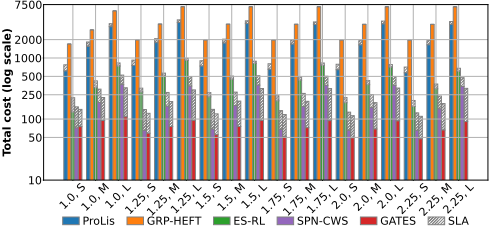
Figure 5 compares the VM rental fees and corresponding SLA penalty costs for all algorithms under various scenarios. The y-axis is plotted on a logarithmic scale for better visualization, with each algorithm's bar representing VM fees and the diagonally striped portion indicating SLA penalties. GRP-HEFT enforces strict SLA deadlines, leading to high VM fees but negligible penalties, while ProLis exhibits a similar pattern. ES-RL employs reinforcement learning for adaptive allocation, obtaining moderately high fees and relatively low penalties. SPN-CWS focuses on reducing VM rental costs by using cheaper VMs at the price of high SLA penalties. In comparison, GATES demonstrates strong capabilities in balancing VM rental fees and SLA penalties to effectively reduce the total cost. Although GATES incurs slightly higher SLA penalties than ES-RL and SPN-CWS in some scenarios, it significantly lowers the total cost by effectively leveraging cheap VMs for task scheduling.
| Scenarios | ProLis | GRP-HEFT | ES-RL | SPN-CWS | GATES (our) |
|---|---|---|---|---|---|
| ⟨1.00, S⟩ ⟨1.00,M⟩ ⟨1.00,L⟩ | 773.69 1829.25 3641.79 | 1685.01(-) 2867.64(-) 5873.20(-) | 223.68(51.51)(+)(+) 422.26(100.92)(+)(+) 829.64(262.91)(+)(+) | 158.28(14.45)(+)(+)(+) 308.93(75.88)(+)(+)(+) 524.83(163.15)(+)(+)(+) | 143.95(18.94)(+)(+)(+)(+) 225.41(37.21)(+)(+)(+)(+) 324.93(65.65)(+)(+)(+)(+) |
| ⟨1.25, S⟩ ⟨1.25,M⟩ ⟨1.25,L⟩ | 923.15 2068.78 4213.29 | 1967.31(-) 3578.04(-) 6868.22(-) | 320.75(83.69)(+)(+) 565.53(213.00)(+)(+) 989.79(458.04)(+)(+) | 143.12(15.73)(+)(+)(+) 272.77(60.65)(+)(+)(+) 496.63(155.02)(+)(+)(+) | 124.14(7.10)(+)(+)(+)(+) 193.26(24.06)(+)(+)(+)(+) 300.19(76.29)(+)(+)(+)(+) |
| ⟨1.50, S⟩ ⟨1.50,M⟩ ⟨1.50,L⟩ | 901.40 2035.52 4066.84 | 1963.39(-) 3567.97(-) 6863.62(-) | 270.93(67.20)(+)(+) 505.44(222.45)(+)(+) 886.87(380.26)(+)(+) | 144.13(18.97)(+)(+)(+) 276.09(60.63)(+)(+)(+) 511.69(161.85)(+)(+)(+) | 121.56(7.11)(+)(+)(+)(+) 196.90(33.40)(+)(+)(+)(+) 316.23(99.12)(+)(+)(+)(+) |
| ⟨1.75, S⟩ ⟨1.75,M⟩ ⟨1.75,L⟩ | 804.33 1977.10 3898.42 | 1959.71(-) 3560.22(-) 6854.40(-) 1957.25(-) | 241.09(51.43)(+)(+) 491.97(229.48)(+)(+) 828.06(359.74)(+)(+) | 137.36(14.10)(+)(+)(+) 263.12(57.61)(+)(+)(+) 502.67(155.64)(+)(+)(+) 129.75(12.72)(+)(+)(+) | 118.45(4.85)(+)(+)(+)(+) 195.25(35.83)(+)(+)(+)(+) 315.84(92.48)(+)(+)(+)(+) 113.48(5.30)(+)(+)(+)(+) |
| ⟨2.00, S⟩ ⟨2.00,M⟩ ⟨2.00,L⟩ ⟨2.25, S⟩ ⟨2.25,M⟩ ⟨2.25,L⟩ | 789.71 1921.42 4024.03 710.18 1924.27 3957.08 | 3554.07(-) 6847.49(-) 1954.71(-) 3551.31(-) 6842.88(-) | 225.70(50.89)(+)(+) 427.16(213.71)(+)(+) 780.77(408.14)(+)(+) 201.54(50.56)(+)(+) 374.96(190.21)(+)(+) 678.94(396.79)(+)(+) | 251.83(52.01)(+)(+)(+) 497.65(158.52)(+)(+)(+) 126.18(13.02)(+)(+)(+) 238.35(48.26)(+)(+)(+) 475.46(139.99)(+)(+)(+) | 185.55(30.66)(+)(+)(+)(+) 322.01(110.05)(+)(+)(+)(+) 110.90(5.70)(+)(+)(+)(+) 179.17(24.54)(+)(+)(+)(+) 318.19(112.21)(+)(+)(+)(+) |
Overall, Figure 5 illustrates distinct trade-offs between cost and SLA compliance. While GRP-HEFT and ProLis favor meeting tight deadlines at the expense of higher VM fees, and SPN-CWS accepts greater penalties to minimize costs, GATES achieves a strong balance between these objectives by keeping both VM fees and SLA penalties within a favorable range to reduce the total cost.
5.4 Convergence
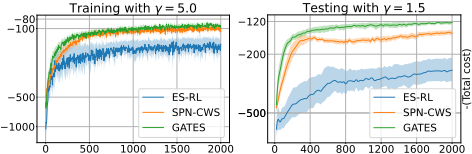
As shown in Figure 6, all three DRL-based algorithms (ESRL, SPN-CWS, and GATES) converge during both training and testing, but their final performances vary significantly. GATES achieves superior results compared to the other algorithms, with its total cost curve significantly lower, indicating its ability to learn better scheduling policies in complex dynamic environments to reduce the total scheduling cost of CADWS. SPN-CWS ranks second, with convergence levels lower than GATES but better than ES-RL. In contrast, ESRL exhibits lower curves with higher fluctuations, suggesting poorer policy quality and less stability.
From the perspective of confidence intervals, both GATES and SPN-CWS demonstrate smaller fluctuations in training and testing curves, showing greater robustness to random seeds and environmental disturbances. Although some oscillations occur in the early iterations, their overall convergence variance is notably better than that of ES-RL. In comparison, ES-RL falls short in both solution quality and stability. Overall, GATES excels in solution quality, with its learned scheduling policies offering superior stability and significantly outperforming the other two DRL algorithms. This analysis further validates that the DHG constructed in GATES effectively captures the dynamics of CADWS, and the designed HGAT network extracts meaningful state embeddings to learn efficient scheduling policies.
6 Conclusion
This paper addresses the complex characteristics of CADWS in cloud environments, such as dynamic workflow arrivals and resource variations, by proposing a novel DRL method called GATES, which integrates GAT and ES. GATES learns task-level topological dependencies and VM importance to dynamically allocate tasks to optimal VMs while leveraging ES to avoid the challenges of complex reward design and hyperparameter tuning. Experimental results demonstrate that GATES can learn an efficient and stable scheduling policy, significantly outperforming several existing methods.
Ethical Statement
There are no ethical issues. The name of "GATES" is used coincidentally and has no relation to [Ning et al., 2020] in terms of problem setting or technical content.
Acknowledgments
The authors would like to express their gratitude to the anonymous reviewers for their valuable feedback and constructive suggestions. The authors also acknowledge Victoria Huang, Chen Wang, Yifan Yang, and their collaborators for their prior works, on which the simulation environment used in this study is based. This research is partially supported by Grant VUW-FSRG- 410114, administered by Victoria University of Wellington.
@inproceedings{ijcai2025p960,
  title     = {GATES: Cost-aware Dynamic Workflow Scheduling via Graph Attention Networks and Evolution Strategy},
  author    = {Shen, Ya and Chen, Gang and Ma, Hui and Zhang, Mengjie},
  booktitle = {Proceedings of the Thirty-Fourth International Joint Conference on
               Artificial Intelligence, {IJCAI-25}},
  publisher = {International Joint Conferences on Artificial Intelligence Organization},
  editor    = {James Kwok},
  pages     = {8635--8643},
  year      = {2025},
  month     = {8},
  note      = {Main Track},
  doi       = {10.24963/ijcai.2025/960},
  url       = {https://doi.org/10.24963/ijcai.2025/960},
}
TY - CPAPER TI - GATES: Cost-aware Dynamic Workflow Scheduling via Graph Attention Networks and Evolution Strategy AU - Shen, Ya AU - Chen, Gang AU - Ma, Hui AU - Zhang, Mengjie T2 - Proceedings of the Thirty-Fourth International Joint Conference on Artificial Intelligence, IJCAI-25 PB - International Joint Conferences on Artificial Intelligence Organization PY - 2025 SP - 8635 EP - 8643 DO - 10.24963/ijcai.2025/960 UR - https://doi.org/10.24963/ijcai.2025/960 ER -Copied
Machine-readable versions of this paper, for tools and AI agents:





