
Solving QNP and FOND+ with Generating, Testing and Forbidding
Proceedings of the Thirty-Fourth International Joint Conference on Artificial Intelligence. Main Track. Pages 8644-8651.
https://doi.org/10.24963/ijcai.2025/961
Keywords
- Planning and Scheduling: PS: Planning under uncertainty
- Planning and Scheduling: PS: Planning algorithms
Abstract
Qualitative Numerical Planning (QNP) extends classical planning with numerical variables that can be changed by arbitrary amounts. FOND+ extends Fully Observable Non-Deterministic (FOND) planning by introducing explicit fairness assumptions, resulting in a more expressive model that can also capture QNP as a special case. However, existing QNP and FOND+ solvers still face significant scalability challenges. To address this, we propose a novel framework for solving QNP and FOND+ by generating strong cyclic solutions of the associated FOND problem, testing their validity, and forbidding non-solutions in conducting further searches. For this, we propose a procedure called SIEVE*, which generalizes the QNP termination testing algorithm SIEVE to determine whether a strong cyclic solution is a FOND+ solution. Additionally, we propose several optimization techniques to further improve the performance of our basic framework. We implemented our approach based on the advanced FOND solver PRP; experimental results show that our solver shows superior scalability over the existing QNP and FOND+ solvers.
- [Bonet and Geffner, 2020] Blai Bonet and Hector Geffner. Qualitative numeric planning: Reductions and complexity. J. Artif. Intell. Res., 69:923-961, 2020.
- [Bonet et al., 2009] Blai Bonet, Héctor Palacios, and Hector Geffner. Automatic derivation of memoryless policies and finite-state controllers using classical planners. In Pro- ceedings of the 19th International Conference on Auto- mated Planning and Scheduling, ICAPS-09, 2009.
- [Cimatti et al., 2003] Alessandro Cimatti, Marco Pistore, Marco Roveri, and Paolo Traverso. Weak, strong, and strong cyclic planning via symbolic model checking. Artif. Intell., 147(1-2):35-84, 2003.
- [Dong et al., 2025] Hao Dong, Zheyuan Shi, Hemeng Zeng, and Yongmei Liu. An automatic sound and complete ab- straction method for generalized planning with baggable types. In Proceedings of the 39th AAAI Conference on Ar- tificial Intelligence, AAAI-25, 2025.
- [Geffner and Geffner, 2018] Tomas Geffner and Hector Geffner. Compact policies for fully observable non- deterministic planning as SAT. In Proceedings of the 28th International Conference on Automated Planning and Scheduling, ICAPS-18, 2018.
- [Hoffmann, 2003] Jörg Hoffmann. The Metric-FF planning system: Translating "ignoring delete lists" to numeric state variables. J. Artif. Intell. Res., 20:291-341, 2003.
- [Lifschitz, 2008] Vladimir Lifschitz. What is answer set pro- gramming? In Proceedings of the 23rd AAAI Conference on Artificial Intelligence, AAAI-08, 2008.
- [Lin et al., 2022] Xiaoyou Lin, Qingliang Chen, Liangda Fang, Quanlong Guan, Weiqi Luo, and Kaile Su. Gen- eralized linear integer numeric planning. In Proceedings of the 32nd International Conference on Automated Plan- ning and Scheduling, ICAPS-22, 2022.
- [Muise et al., 2012] Christian J. Muise, Sheila A. McIlraith, and J. Christopher Beck. Improved non-deterministic planning by exploiting state relevance. In Proceedings of the 22nd International Conference on Automated Planning and Scheduling, ICAPS-12, 2012.
- [Muise et al., 2024] Christian Muise, Sheila A. McIlraith, and J. Christopher Beck. PRP rebooted: Advancing the state of the art in FOND planning. In Proceedings of the 38th Annual AAAI Conference on Artificial Intelligence, AAAI-24, 2024.
- [Rodriguez et al., 2022] Ivan D. Rodriguez, Blai Bonet, Se- bastian Sardiña, and Hector Geffner. FOND planning with explicit fairness assumptions. J. Artif. Intell. Res., 74:887-916, 2022.
- [Srivastava et al., 2011] Siddharth Srivastava, Shlomo Zil- berstein, Neil Immerman, and Hector Geffner. Qualitative numeric planning. In Proceedings of the 25th AAAI Con- ference on Artificial Intelligence, AAAI-11, 2011.
- [Tarjan, 1972] Robert Endre Tarjan. Depth-first search and linear graph algorithms. SIAM J. Comput., 1(2):146-160, 1972.
- [Zeng et al., 2022] Hemeng Zeng, Yikun Liang, and Yong- mei Liu. A native qualitative numeric planning solver based on AND/OR graph search. In Proceedings of the 31st International Joint Conference on Artificial Intelli- gence, IJCAI-22, 2022. IJCAI
References were extracted automatically from the PDF and may contain errors.
Full text extracted automatically from the PDF; figures, tables and equations may differ. The PDF is the version of record.
1 Introduction
Fully Observable Non-Deterministic (FOND) planning extends classical planning to handle non-deterministic actions. In this context, strong-cyclic (SC) planning seeks to find a policy that ensures any reachable state has a trajectory leading to the goal. In contrast, strong planning finds policies that are guaranteed to reach the goal. It turns out that strong cyclic solutions are policies that are guaranteed to achieve the goal under the fairness assumption, which states that if an action occurs infinitely often, then any of its possible effects occurs infinitely often. Building on these, Qualitative Numerical Planning (QNP) [Srivastava et al., 2011] further introduces non-deterministic numeric effects, while FOND+ [Rodriguez et al., 2022] generalizes SC, strong, and QNP planning by incorporating explicit fairness assumptions.
∗Corresponding author
There are a number of existing solvers for QNP and FOND+. Srivastava et al. [2011] proposed a generate-andtest method for solving a QNP problem, which translates the QNP problem into a FOND problem, solves it in the strongcyclic setting and verifies termination using the SIEVE algorithm. However, there is no efficient implementation of this idea. Later, Bonet and Geffner [2020] proposed a method called qnp2fond, which compiles QNP into a more complex FOND problem and solves it with existing FOND solvers like PRP [Muise et al., 2012]. Another recent QNP solver, DSET [Zeng et al., 2022], introduced an algorithm that directly searches for a solution on the AND/OR graph induced by the QNP problem. FOND-ASP [Rodriguez et al., 2022] provides a unified framework for solving QNP and FOND+ problems by reducing them to Answer Set Programming (ASP) [Lifschitz, 2008], characterizing solutions as policies where all reachable states "terminate" under conditional fairness assumptions.
While existing solvers perform well on small problems, they often struggle with large-scale problems. For example, qnp2fond introduces a large number of additional actions and variables, leading to overly complex and hard-to-parse encodings. DSET lacks effective heuristics, resulting in poor scalability on large QNPs. As the only efficient FOND+ solver currently, FOND-ASP frequently encounters timeouts or memory issues due to its need to encode all reachable states, leading to large and costly representations.
Motivated by the idea of building an efficient QNP and FOND+ solver based on the advanced PRP solver which uses a key technique of forbidden state action pairs (fsaps), we propose a novel Generate-Test-and-Forbid (GTF) framework for solving QNP and FOND+ problems. Our approach iteratively generates SC solutions by adapting PRP, tests their validity under explicit fairness assumptions, and conducts further searches by forbidding existing state-action assignments (referred to as steps). For this purpose, we propose a testing algorithm for FOND+ called SIEVE* that generalizes SIEVE, and show that the solutions of a FOND+ problem are the strong-cyclic solutions of the underlying FOND problem that pass the SIEVE* test. If a generated solution is invalid, the framework refines the search by forbidding specific steps, guiding the solver toward valid solutions.
To improve the efficiency of this process, we introduce several optimization techniques: 1) Pruning with key steps.
By identifying essential state-action assignments that must be preserved for any valid solution, we prune unnecessary branches in the search space. 2) Precomputing vital fsaps. We precompute some vital fsaps and forbid them in advance. 3) Heuristics for ordering forbidden steps. We leverage insights from SIEVE* and numeric planners to rearrange the order of forbidding steps, guiding the search toward branches that are more likely to contain valid solutions.
Based on our proposed approach, we implemented three variants of QNP and FOND+ solvers. Through extensive experiments on existing and newly constructed problems, we demonstrate that our method shows superior performance over existing solvers on large-scale QNP problems and the majority of FOND+ problems, and performs comparably to state-of-the-art solvers on small-scale QNP problems.
2 Preliminaries
2.1 FOND Planning
We follow the representation of fully observable nondeterministic (FOND) problems from [Muise et al., 2012]. Let V be a finite set of variables, each with a finite domain D+ v that includes ⊥ to denote undefined values. A partial state is a function mapping each v ∈ V to a value in D+ v , while a complete state (or simply state) assigns every variable a defined value (i.e., no ⊥). A partial state s entails s′ (written s |= s′ ) if s agrees with s′ on all variables defined in s′ . The update s ⊕ s′ applies s′ to s, taking values from s′ where defined, and from s otherwise.
Definition 1. A FOND planning problem is a tuple 〈V, s0 , s∗ ,A〉, where V is a finite set of variables, the initial state s0 is a complete state, the goal s∗ is a partial state, and A is a set of actions. Each action in A is made up of two parts: Prea, a partial state that describes the condition under which a may be executed; and Effa, a finite set of partial states that describe the possible outcomes of the action.
An action a is non-deterministic if |Effa| > 1, and deterministic if |Effa| = 1. It is applicable in a partial state s if s |= Prea. The progression of a partial state s w.r.t. an action a and effect e ∈ Effa, denoted Prog(s, a, e), is the updated partial state s ⊕ e when a is applicable in s, and undefined otherwise. The set of successor states after executing action a in s is denoted by: F(a, s) = {Prog(s, a, e) | e ∈ Effa}.
Definition 2. A policy π for a FOND problem P is a partial function mapping non-goal states into applicable actions.
Given a policy π, a state trajectory s0, s1, . . . (finite or infinite) is called a π-trajectory if s0 is the initial state, and for all i ≥ 0, si+1 ∈ F(ai, si) where ai = π(si). A π-trajectory is maximal if it is infinite, or it is finite and the last state sn is the first goal state in the sequence or π(sn) = ⊥. A state s is reachable by π if there is a π-trajectory s0, . . . , s; and a state s′ is reachable from s by π if there is a π-trajectory s0, . . . , s, . . . , s′ .
There are three types of solutions in the FOND setting [Cimatti et al., 2003]:
Definition 3. Let P be a FOND problem.
- A policy π is a weak solution of P if there exists a πtrajectory reaching the goal.
- A policy π is a strong solution of P if every maximal π-trajectory is finite and goal-reaching.
- A policy π is a strong cyclic (SC) solution of P if every state reachable by π can reach the goal.
In the rest of this section, we will use the Boolean version of FOND problems where all variables are Boolean.
2.2 QNP
Given a set of Boolean atoms At and a set of non-negative numerical variables V , we use L to denote the class of all consistent sets of literals of the form p and ¬p for p ∈ At, and X > 0 and X = 0 for X ∈ V . A set of literals is said to be consistent if it does not contain both p and ¬p for any Boolean atom p, and does not contain both X > 0 and X = 0 for any numerical variable X.
Definition 4. A qualitative numerical planning (QNP) problem Q is a tuple ⟨At, V, I, O, G⟩ where At is a set of Boolean atoms, V is a set of non-negative numerical variables, I ∈ L is the initial state, G ∈ L is the goal condition, and O is a set of actions. Every o ∈ O has a set of preconditions pre(o) ∈ L, and effects eff(o). Boolean effects of eff(o) contain literals of the form p and ¬p for p ∈ At. Numerical effects of eff(o) contain special atoms of the formX↑ or X↓ for X ∈ V which increase or decrease X by an arbitrary amount. The literal X > 0 is a precondition of all actions with X ↓ effects.
A sound and complete two-step method for solving QNPs was formulated by Srivastava et al. [2011]: the QNP problem Q is converted into a standard FOND problem P = TD(Q) and its (strong-cyclic) solution is checked for termination. To get TD(Q), a Boolean atom pX is introduced for each numerical variable X. Then literals X > 0 and X = 0 are replaced by literals pX and ¬pX, respectively. Effect X ↑ is replaced by effect pX, and effect X ↓ is replaced by a nondeterministic choice of pX and ¬pX.
To check the termination of a policy π for P = TD(Q), Srivastava et al. [2011] proposed a sound and complete algorithm called SIEVE by repeatedly removing edges from the transition graph of π until the graph becomes acyclic or no additional edges can be removed. SIEVE identifies first the strongly connected components (SCCs) of the graph, then tries to remove an edge from an SCC. An edge can be removed from an SCC if there is a variable X s.t. the edge decrements X and no edge in the SCC increments X.
2.3 FOND+
Definition 5. A FOND+ problem Pc = ⟨P,C⟩ is a FOND problem P extended with a set C of (conditional) fairness assumptions of the form Ai/Bi, i = 1, ..., n, where each Ai is a set of non-deterministic actions in P , and each Bi is a set of actions in P disjoint fromAi.
Definition 6. A π-trajectory τ for a FOND+ problem Pc is fair if the following holds: for any fairness assumption Ai/Bi in Pc, and for any action a ∈ Ai, if a occurs infinitely often on τ and actions from Bi occurs finitely often, then any of a's possible effects occurs infinitely often on τ .
Besides, we say an action a is adversarial if it is not in any Ai of any fairness assumption ⟨Ai/Bi⟩, and is fair if there is a fairness assumption ⟨Ai/∅⟩ where a ∈ Ai. Here we use ∅ to represent the empty set.
Definition 7. A policy π solves a FOND+ problem if all maximal π-trajectories that are fair reach the goal.
Rodriguez et al. [2022] showed that strong, strong cyclic and QNP planning can all be reduced to FOND+ planning:
- The strong solutions of a FOND problem P are the solutions of the FOND+ problem Pc = ⟨P, ∅⟩.
- The strong-cyclic solutions of a FOND problem P are the solutions of the FOND+ problem Pc = ⟨P, {A/∅}⟩, where A is the set of all non-deterministic actions in P .
- The solutions of a QNP problem Q are the solutions of the FOND+ problem Pc = ⟨P, C⟩ where P = TD(Q) and C is the set of fairness assumptions Ai/Bi, one for each numerical variable xi in Q, such that Ai contains all the actions in Q that decrement xi, and Bi contains all the actions in Q that increment xi.
3 SIEVE* Testing for FOND+
We propose a testing algorithm for FOND+, called SIEVE*, which generalizes the QNP-specific SIEVE, and show that FOND+ solutions are precisely the strong cyclic solutions of the underlying FOND problem that pass the SIEVE* test.
The main idea of SIEVE* is as follows: Like SIEVE, given a policy, SIEVE* repeatedly removes edges from the transition graph of the policy until the graph becomes acyclic or no more edges can be removed, and the condition for removing an edge is a generalization of that for SIEVE. As shown in Alg. 1, SIEVE* takes as input a graph g and a set C of conditional fairness assumptions. SIEVE* first checks for the strong connectivity of g, and if it is not strongly connected, we compute the SCCs of g following Tarjan's algorithm [Tarjan, 1972] (line 2), and run SIEVE* on these sub-graphs recursively; if g is strongly connected, then we repeatedly remove edges from g when conditions 1) and 2) are satisfied (line 7). If g is acyclic, it is considered to pass the test (line 10). If no edge is removed, the graph g is said to fail the test (line 12). Otherwise, SIEVE* is recursively applied to the graph after edge removals (line 13).
We now illustrate the algorithm with an example.
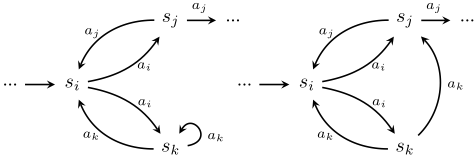
Example 1. Consider a FOND+ problem with a single fairness assumption A/∅, where A = {aj , ak}. Fig. 1 illustrates two state transition graphs gleft and gright for different scenarios of a policy π, with only three states si, sj , and sk and the associated transitions displayed. Let lr = left or right.
SIEVE*(glr ) identifies the SCC (line 2), denoted as gijk lr , containing nodes si, sj, and sk. It then removes the edge (sj, si), as π(sj) is in A and F(π(sj), sj) contains nodes outside gijk lr (line 7). Despite this removal, gijk lr remains cyclic, leading the algorithm to call SIEVE* again (line 13). At this point, the SCC obtained by SCCs-of(gijk lr ) in SIEVE*(gijk lr ) only contains nodes si and sk, denoted as gik lr . However, in the left case, no edge satisfies both conditions 1) and 2),
Algorithm 1: SIEVE*
Input: Graph g, fairness assumptions C Output: "True" for passing, "False" otherwise 1 if g is not strongly connected then 2 foreach g′ ∈ SCCs-of (g) do 3 if SIEVE*(g′ ,C) = "False" then 4 return "False"; 5 return "True"; 6 repeat 7 remove an edge (s, s′ ) in g if 1) there exists Ai/Bi ∈ C such that π(s) ∈ Ai and no action in Bi appears in g and 2) at least one state in F(π(s), s) is not in g. 8 until no edge can be removed; 9 if g is acyclic then 10 return "True"; 11 if no edge was removed then 12 return "False"; 13 return SIEVE*(g,C);so SIEVE*(gik left ) returns False, causing SIEVE*(gijk left ) then SIEVE*(gleft) to return False (line 4). In contrast, in the right case, F(π(sk), sk) contains sj not in gik right , allowing edge (sk, si) to be removed, thus converting gik right into acyclic, and SIEVE*(gik right ) returns True. So SIEVE*(gijk right ) returns True (line 5) and we need to check other SCCs in SCCsof(gright). Actually, in the left graph, there is a fair π-trajectory (s0, . . . , si, sk, sk, si, . . .) that loops infinitely in gik left , indicating π is not a FOND+ solution according to Def. 7.
We have the following nice characterization of FOND+ solutions. We use G(π) to denote the transition graph of π.
Theorem 1. A policy π is a solution to a FOND+ problem Pc = ⟨P,C⟩ iff π is a strong cyclic solution of P and SIEVE*(G(π), C) returns "True".
Sketch. ⇒: Assume π is not a strong cyclic solution of P . We use π-deadend to refer to a state s that is reachable by π but cannot reach the goal. Then there must exist an SCC where all states are π-deadends. We can use this SCC to construct a fair maximal π-trajectory that is not goal-reaching. So π is a strong cyclic solution of P. Assume π fails to pass SIEVE*.
Then there must exist an SCC gsc of G(π) s.t. SIEVE*(gsc) returns "False". Again, we can use this SCC to construct a fair maximal π-trajectory that is not goal-reaching.
⇐: Assume π is not a solution of Pc. Then there exists a fair maximal π-trajectory τ that cannot reach the goal. From τ , we can get an SCC of G(π) where no edge can be removed by SIEVE*. Thus π fails to pass the SIEVE* test.
Note when a sub-graph of G(π) fails the SIEVE* test, G(π) will also fail the test (as the left case in Fig. 1 shows). This makes it possible for early detection of failure of a partial policy and serves as a pruning mechanism during the search for a solution, which will be introduced in Section 5.1.
Also note that SIEVE is a special case of SIEVE*. By the reduction of QNP to FOND+ at the end of Section 2.3, the edge removal condition used in the SIEVE algorithm corresponds to condition 1) in SIEVE*. Condition 2) always holds in the QNP setting, which can be shown by contradiction, though we will not prove it here.
4 The Generate-Test-and-Forbid Framework
To solve FOND+ problems, we aim to generate an SC solution that passes SIEVE*. In this section, we propose the PRP-based generate-test-and-forbid (GTF) framework as the basic framework for solving FOND+, and prove its soundness and completeness.
To solve FOND problems, PRP builds an SC solution by repeatedly repairing a weak solution generated by a classical planner. A key technique used by PRP is the recording of deadends as forbidden partial state-action pairs (fsaps) to avoid them in all subsequent searches.
In this work, we adapt PRP as the underlying strong cyclic generator and further use fsaps for two purposes: (1) to prevent the generation of SC solutions that use vital fsaps (which will be identified in Section 5.2), and (2) to generate all SC solutions by incrementally forbidding complete state-action pairs, which we refer to as steps.
Definition 8. A state-action pair ⟨s, a⟩ is a step if s |= Prea. Given a policy π, its step set Ψ(π) is the set of state-action pairs ⟨s, π(s)⟩ where s is reachable by π and π(s) ̸= ⊥.
Given a policy π, for any π′ , if there exists ⟨s, a⟩ ∈ Ψ(π) such that ⟨s, a⟩ ̸∈ Ψ(π′ ), then π′ is different from π. Thus, by searching without using the steps in Ψ(π), we can obtain solutions distinct from π. We refer to the steps that are not allowed to be used as Forbidden Steps (FSteps). A strong cyclic solution π forbids step set fsteps if Ψ(π) does not include any step from fsteps.
Definition 9. Given a FOND problem P and a step set fsteps, we use FSCP (fsteps) to denote the set of all strong cyclic solutions of P that forbid fsteps: FSCP (fsteps) = {π | π is an SC solution of P, Ψ(π) ∩ fsteps = ∅}.
Clearly, FSCP (∅) is the set of strong cyclic solutions of P. The following proposition states that to enumerate all SC solutions forbidding a step set fsteps, it suffices to find one such solution π, and then recursively enumerate all SC solutions obtained by additionally forbidding each step in Ψ(π):
Algorithm 2: FOND+ Solver. Entry Program
Input: FOND+ problem Pc = ⟨P, C⟩ Output: A FOND+ solution π or "None" 1 F ←∅; 2 ⋆K ←∅; 3 ⋆PreComputeVFsaps(F); 4 return GTF(Pc, F, ⋆K);Algorithm 3: FOND+ Solver. GTF Input: FOND+ problem Pc = ⟨P, C⟩, fsaps F , ⋆key steps K Output: A FOND+ solution forbidding F or "None" 1 π ←FindSC(P,F); 2 if there is no SC solution then 3 return "None"; 4 if SIEVE*(G(π),C) = "True" then 5 return π; 6 ⋆Rearrange(Ψ(π)); 7 foreach step ∈ Ψ(π) do 8 ⋆if step ∈K then 9 continue 10 if π′ ←GTF(Pc, F ∪ {step}, ⋆K) then 11 return π′ ; 12 ⋆K.add(step); 13 ⋆if SIEVE*(G(K),C) = "False" then 14 return "None"; 15 ⋆F.AddBlockingFSteps(step); 16 return "None";Proposition 1. For a FOND problem P, if π ∈ FSCP (fsteps), then we have FSCP (fsteps) = {π} ∪ ⋃⟨s,a⟩∈Ψ(π) F SCP (f steps ∪ {⟨s, a⟩}).
The solving framework consists of two parts: the entry program for initializing the solving process (Alg. 2) and the generate-test-and-forbid process GTF (Alg. 3). In this section, we do not consider the lines and variables marked with ⋆, which concern optimization techniques and will be discussed in the next section. Given a set of FSteps F, the process GTF(Pc, F) returns a FOND+ solution in FSCP (F). Thus, by initializing F to an empty set, the entire framework computes a FOND+ solution within the entire space of strong cyclic solutions.
Algorithm 3 illustrates how GTF works. Given Pc and F , we first generate an SC solution in FSCP (F ) (line 1) and test with SIEVE* (line 4). For generating, we amend the sound and complete FOND solver PRP to generate an SC solution forbidding F , which is actually searching for the "π" in Prop. 1 with fsteps = F. When π fails SIEVE*, we forbid each step in Ψ(π) and search in FSCP (F ∪ {step}) (line 10). When all steps have been forbidden and no solution is found, GTF returns "None" in line 16.
We now present the soundness and completeness results.
Theorem 2. For a given FOND+ problem Pc = ⟨P, C⟩ and a set of steps F , if GTF(Pc, F ) returns π, then π is a solution of Pc forbidding F; and if GTF(Pc, F) returns "None", there is no solution of Pc forbidding F.
Proof. This follows from Theorem 1, Proposition 1, and the soundness and completeness of PRP.
Corollary 1. For a given FOND+ problem Pc = ⟨P,C⟩, if GTF(Pc,∅) returns π, then π solves Pc; and if GTF(Pc,∅) returns "None", then Pc is unsolvable.
Note this framework is not limited to generating a single FOND+ solution. By replacing "return π" in line 5 with "store π", we can collect all valid solutions.
5 Optimization Techniques
In this section, we focus on the ⋆-marked lines in the algorithm which are all designed for accelerating the FOND+ solving process. The soundness remains as these techniques don't modify the conditions of the algorithm to return a policy, i.e., a strong cyclic solution that passes SIEVE*; and we are going to show the completeness is also not affected.
5.1 Prune with Key Steps
In the basic version of GTF, we do nothing when forbidding a step leads to no solution in line 10. Indeed, we have the following observation, which can be proved by contradiction:
Proposition 2. If GTF(Pc, F ∪ {step}) = "None", then for any F ′ ⊇ F , π = GTF(Pc, F ′ ) implies step ∈ Ψ(π).
We refer to such a step as a key step (w.r.t. F), which means that this step is required for any potential FOND+ solution within FSCP (F). We use a set K to store these key steps (line 12), and pass them to subsequent calls of GTF (line 10). The third input K of the GTF procedure means that K is a set of key steps that must be included in any solution returned by GTF.
We develop two pruning techniques. The first is called "Skip Key" (line 8-9). When we find that the step to be forbidden has been identified as a key step, we skip the current iteration and proceed to the next iteration of the loop. The second is called "Test Keys" (line 13-14). As K ⊆ Ψ(π) for any potential solution π, if G(K) fails SIEVE*, π also fails SIEVE* (according to Theorem 1).
Additionally, we add some extra steps that we call BlockingFSteps to F to prevent other applicable actions to be picked in the state of a key step (line 15) . Specifically, for a key step ⟨s, a⟩, we let F ← F∪{⟨s, a′ ⟩ | s |= Prea′∧a′ ̸= a}.
Completeness reserves with the above techniques due to Proposition 2.
5.2 Precompute Vital Fsaps
To enhance FOND+ solving, we further identify certain partial state-action pairs that lead to invalid solutions, referred to as Vital Fsaps (VFsaps), and forbid them during the search process. Specifically, a pair ⟨s, a⟩ is considered a vital fsap if, for any state s′ entailing s, executing action a causes the SIEVE* test to fail.
In this work, we precompute a subset of VFsaps that induce one-node SCCs where no edge can be removed: {⟨s, a⟩ | a is adversarial, there is e ∈ Effa s.t. Prog(s, a, e) = s}. These steps are precomputed and incorporated into the global fsaps F (line 3 in the entry program) to exclude invalid policies while ensuring completeness is preserved.
5.3 Rearrange the Order for Forbidding Steps
Note that the soundness and completeness are not affected by the order of forbidding steps. In this part, we propose different strategies to rearrange (line 6) the order of forbidding steps to improve performance.
Breadth-First Forbidding (BFF) means to rearrange the steps Ψ(π) according to the order in which the states are visited in a breadth-first search of G(π). It can be proved that with the technique "AddBlockingFSteps" proposed in Section 5.1, we guarantee when an SC solution is generated by FindSC in line 1, it is different from all other SC solutions generated before. However, it can still be inefficient to find a solution with this strategy due to the large search space of SC solutions. The following forbidding strategy enables the integration of heuristics:
Futile-First Forbidding (3F): We refer to the steps that might be harmful (e.g., by leading to a fair trajectory not reaching the goal) or useless (e.g., redundant for achieving the goal) as "futile steps". Futile-First Forbidding sorts steps in a specific order based on certain heuristics, guiding GTF to forbid futile steps first, aiming to find a solution as quickly as possible.
In this work, we introduce two kinds of heuristics for Futile-First Forbidding. The first, 3FF, is obtained from the Failure result of SIEVE* testing for a policy, i.e., we forbid the steps in an SCC whose edges cannot be removed. The second, 3FN, involves translating the QNP problem into a Numerical planning problem. Actions unused in the resulting solution are considered redundant and are prioritized for forbidding. Specifically, in this work, we transform the problem by fixing all amounts of numerical changes to 1 and replacing any initial non-zero numerical values with 1, then use MetricFF [Hoffmann, 2003] to compute such a solution.
6 Implementation and Experiments
We implemented three solvers in C++ using the above three rearrangement strategies: GTF-BFF (FOND+ solver), GTF3FF (FOND+ solver) and GTF-3FN (QNP solver). 1
Note that in this section, when we mention FOND+ domains or problems, we specifically refer to those that cannot be represented as QNPs. We evaluate the performance of our three solvers on QNPs in comparison with DSET [Zeng et al., 2022], FOND-ASP [Rodriguez et al., 2022], and three solvers using qnp2fond translator [Bonet and Geffner, 2020], each paired with different underlying FOND solvers for SC planning: PRP [Muise et al., 2012], (FOND-)SAT [Geffner and Geffner, 2018], and PR2 [Muise et al., 2024]. For FOND+ planning, we compare GTF-BFF and GTF-3FF against FOND-ASP. All experiments were run on an Ubuntu 20.04 Linux machine with an Intel Core i9-10980XE CPU
1 Codes and data - https://github.com/sysulic/GTF4FONDX.
(3.00 GHz). Each instance was allocated a maximum of 8 GB of memory and a runtime limit of 30 minutes.
6.1 Domains
The QNP instances with small numbers of actions, features, and reachable states are categorized as Tiny-domains, including: blocks clear, blocks on, gripper, delivery, delivery2, q1, q2 (unsolvable), q3, gripper2 and rewards from Bonet and Geffner [2020]; Gripper1u (unsolvable) and Nest3u (unsolvable) from Zeng et al. [2022]; and 9 instances in qnp1 from Rodriguez et al. [2022]. Other existing QNP domains (each including one or more instances) include: Nests and Nests u (all instances are unsolvable) from Zeng et al. [2022]; qnp2 from Rodriguez et al. [2022]; GripperAbs, FerryAbs, LogisticsAbs, ZenotravelAbs, NomysteryAbs, and FloortileAbs from Dong et al. [2025]. Note that domains from [Dong et al., 2025] are actually bounded QNP problems, where the change in any numerical variable caused by an action is exactly one. However, we found that some of them can still be solved by certain QNP solvers. Existing FOND+ domains are all from Rodriguez et al. [2022]: qnp2-f11, qnp2-f01 (unsolvable), football and football u (unsolvable).
We propose two new QNP domains and further extend them to FOND+ versions.
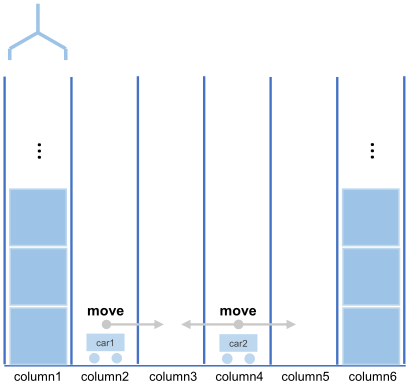
BlocksColumns This domain consists of several columns, each containing some blocks, with robot cars initially positioned in the columns except for the rightmost one. The objective is to move these cars to the rightmost column. Additionally, there are grippers that can move between columns and are capable of picking up and dropping blocks in a column, provided no car is present in that column. The cars can also move to an adjacent column if that column contains no blocks. A column that contains no blocks is considered to have sufficient space to hold multiple cars simultaneously. In this domain, numerical variables are used to represent the number of blocks in each column, which increase when blocks are dropped and decrease when blocks are picked up. One solution is to move the blocks from the columns to the right of the cars into the columns to their left, thereby clearing a path for the cars. Once the path is clear, the cars can be moved to the rightmost column.
By making the effect of car-moving non-determinisitic, we construct two FOND+ domains: BlocksColumns-Fair (BCFair) and BlocksColumns-Adv (BC-Adv), as shown in Fig. 2. In both domains, the objective and the possible actions of grippers are the same as the domain BlocksColumns. The only difference is that car movements are non-deterministic: when a car is moved, it may go left or right. However, if the adjacent column in one direction contains blocks, that direction is blocked, and the car will move to the other direction instead. The difference between the two domains is that in BC-Fair, the move action is assumed to be fair, while in BCAdv there is no such fairness assumption.
HallsFloors This domain is adapted from the Halls domain [Bonet et al., 2009; Lin et al., 2022]. The environment consists of multiple floors and a single agent. Each floor contains an uncertain number of interconnected halls arranged in a rectangular ring. Some floors are connected via staircases, which are located at the four corners of the rectangle. Four numeric variables represent the agent's distance to the four sides of the rectangular floor layout. The agent can move between halls and is considered to have reached a corner when two of these distance variables are simultaneously zero. A floor is considered visited once the agent has visited all four of its corners. The goal is to visit all floors. In the QNP version, the positions of the staircases are fixed initially, and the agent can use a staircase if it is located at the same corner. In contrast, in the FOND+ version, called HF-ND, the staircases are hidden and must be revealed by executing the "discoverstair" action after the agent has visited the floor. This action is non-deterministic and causes a staircase to appear at one of the four corners.
6.2 Results
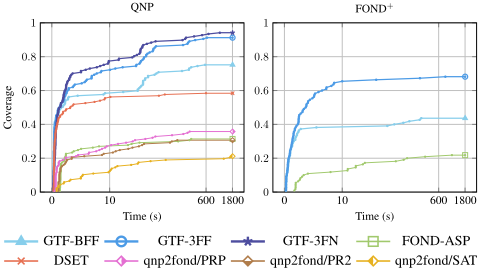
The information about the size of these domains and overall solving results are shown in Tables 1 (QNP) and 2 (FOND+). A bold line separates the existing domains from the new ones. For each domain and solver, we report the coverage of the solver, that is, the ratio of instances solved by the solver. For tiny domains, we also report the average solving time in the parentheses when the solver can solve all instances. Figure 3 illustrates the overall coverage performance (the ratio of all instances solved) of various solvers over time for QNP/FOND+.
As shown in Fig. 3, GTF-3FN achieves the best performance in QNP planning, consistently solving the highest proportion of instances across all time limits, with GTF-3FF following closely. GTF-BFF and DSET also perform well but fall behind the top two methods. In contrast, FOND-ASP and solvers using qnp2fond fail to solve even half of the QNP instances. For FOND+ planning, where GTF-3FN is not applicable, GTF-3FF outperforms all other methods, achieving a coverage of 68% (as shown in Table 2). Meanwhile, GTFBFF solves fewer than half of the instances, and FOND-ASP lags further behind with a final coverage of only 22%.
| Size (Average) | GTF (ours) | FOND | qnp2fond | ||||||||
|---|---|---|---|---|---|---|---|---|---|---|---|
| Domains | |F| | |O| | #RStates | BFF | 3FF | 3FN | ASP | DSET | PRP | PR2 | SAT |
| Tiny-domains(21) | 5.0 | 5.5 | 9.8 | 1(0.09s) | 1(0.09s) | 1(0.10s) | 1(0.43s) | 1(0.09s) | 1(35.93s) | 0.86 | 0.86 |
| Nests(7) | 7.0 | 7.0 | 290.3 | 1.00 | 1.00 | 1.00 | 0.00 | 1.00 | 0.00 | 0.00 | 0.00 |
| Nests u(7) | 7.0 | 7.0 | 146.1 | 1.00 | 1.00 | 1.00 | 1.00 | 1.00 | 0.00 | 0.00 | 0.00 |
| qnp2(9) | 7.0 | 7.0 | 228.1 | 1.00 | 1.00 | 1.00 | 0.89 | 1.00 | 0.89 | 0.67 | 0.44 |
| GripperAbs(8) | 10.0 | 11.4 | 3102.6 | 0.50 | 0.88 | 1.00 | 0.50 | 0.88 | 0.88 | 0.88 | 0.25 |
| FerryAbs(2) | 10.0 | 24.0 | 577.0 | 0.50 | 1.00 | 1.00 | 0.50 | 0.50 | 1.00 | 0.50 | 0.50 |
| LogisticsAbs(1) | 22.0 | 36.0 | 7e+04 | 1.00 | 1.00 | 1.00 | 0.00 | 0.00 | 1.00 | 1.00 | 0.00 |
| ZenotravelAbs(20) | 160.2 | 6164.1 | ≥1e+07 | 1.00 | 1.00 | 1.00 | 0.00 | 0.05 | 0.35 | 0.35 | 0.10 |
| NomysteryAbs(20) | 192.4 | 3572.9 | ≥5e+06 | 0.70 | 0.70 | 0.70 | 0.00 | 0.60 | 0.05 | 0.05 | 0.00 |
| BlocksColumns(30) | 35.0 | 60.0 | ≥4e+05 | 0.23 | 0.83 | 0.93 | 0.03 | 0.27 | 0.03 | 0.00 | 0.03 |
| HallsFloors(12) | 26.9 | 32.8 | ≥2e+07 | 1.00 | 1.00 | 1.00 | 0.08 | 0.58 | 0.08 | 0.08 | 0.08 |
| Overall(137) | 64.3 | 1440.8 | ≥4e+06 | 0.75 | 0.91 | 0.94 | 0.31 | 0.58 | 0.36 | 0.31 | 0.21 |
| Size (Average) | GTF (ours) | FOND | ||||
|---|---|---|---|---|---|---|
| Domains | |F| | |O| | #RStates | BFF | 3FF | ASP |
| qnp2-f11(9) | 9.0 | 9.0 | 910.4 | 1.00 | 1.00 | 0.67 |
| qnp2-f01(9) | 7.0 | 7.0 | 228.1 | 1.00 | 1.00 | 0.89 |
| football u(10) | 61.0 | 196.5 | 2860.0 | 0.10 | 0.00 | 0.30 |
| football(10) | 61.0 | 196.5 | 2860.0 | 1.00 | 1.00 | 0.30 |
| BC-Fair(30) | 45.0 | 51.3 | 1e+06 | 0.23 | 1.00 | 0.03 |
| BC-Adv(30) | 45.0 | 51.3 | 1e+06 | 0.00 | 0.17 | 0.03 |
| HF-ND(12) | 49.7 | 55.5 | ≥7e+06 | 1.00 | 1.00 | 0.17 |
| Overall(110) | 42.4 | 71.1 | ≥2e+06 | 0.44 | 0.68 | 0.22 |
The superior performance of our method stems from several factors: (1) building on top of an advanced FOND solver, which enables the use of existing heuristics from SC and classical planning; (2) the low memory cost of the generate-andtest method compared to FOND-ASP; and (3) the effectiveness of the proposed heuristics, derived from failure analysis in SIEVE* and solutions provided by a numerical planner in the QNP setting.
We also found that our method struggles with certain problems, as shown in Tables 1 and 2, highlighting potential areas for future improvement. For the QNP domain NomysteryAbs, our underlying solver encounters difficulty finding a strong-cyclic (SC) solution when the problem size becomes too large. Additionally, in solvable FOND+ domains, GTF-3FF still requires excessive SC search efforts for BC-Adv, suggesting the need for more effective strategies to reorder or prioritize search. Furthermore, the failure in the unsolvable problem football u demonstrates cases where our method performs poorly: there are exponentially many SC solutions, yet none of them solves the FOND+ problem.
7 Conclusion
In this paper, based on the advanced FOND solver PRP, we propose a generate-test-and-forbid framework for solving QNP and FOND+ problems. Moreover, we propose several optimization techniques such as pruning with key steps, precomputing vital fsaps, and heuristics for ordering forbidden steps. Based on our proposed approach, we implemented three variants of QNP and FOND+ solvers. Experimental results on existing and newly constructed domains demonstrate that our method shows superior scalability over existing solvers. In the future, we are interested in exploring further heuristics to improve the performance of our solvers, and efficient solving techniques for QNP or FOND+ problems with large space of strong cyclic policies but few solutions.
Acknowledgments
We thank the annonymous reviewers for helpful comments. We acknowledge support from the Natural Science Foundation of China under Grant No. 62076261.
@inproceedings{ijcai2025p961,
  title     = {Solving QNP and FOND+ with Generating, Testing and Forbidding},
  author    = {Shi, Zheyuan and Dong, Hao and Liu, Yongmei},
  booktitle = {Proceedings of the Thirty-Fourth International Joint Conference on
               Artificial Intelligence, {IJCAI-25}},
  publisher = {International Joint Conferences on Artificial Intelligence Organization},
  editor    = {James Kwok},
  pages     = {8644--8651},
  year      = {2025},
  month     = {8},
  note      = {Main Track},
  doi       = {10.24963/ijcai.2025/961},
  url       = {https://doi.org/10.24963/ijcai.2025/961},
}
TY - CPAPER TI - Solving QNP and FOND+ with Generating, Testing and Forbidding AU - Shi, Zheyuan AU - Dong, Hao AU - Liu, Yongmei T2 - Proceedings of the Thirty-Fourth International Joint Conference on Artificial Intelligence, IJCAI-25 PB - International Joint Conferences on Artificial Intelligence Organization PY - 2025 SP - 8644 EP - 8651 DO - 10.24963/ijcai.2025/961 UR - https://doi.org/10.24963/ijcai.2025/961 ER -Copied
Machine-readable versions of this paper, for tools and AI agents:





