
Beyond Isolated Investor: Predicting Startup Success via Roleplay-Based Collective Agents
Proceedings of the Thirty-Fifth International Joint Conference on Artificial Intelligence. AI4Tech: AI Enabling Technologies. Pages 6480-6490.
https://doi.org/10.24963/ijcai.2026/721
Keywords
- Domain-specific AI4Tech: AI4Finance
Abstract
Due to the high value and high failure rates of startups, predicting their success is a critical challenge. Existing approaches typically model startup success from a single decision-maker's perspective, overlooking the collective dynamics that dominate real-world venture capital (VC) decision-making. We propose SimVC-CAS, a collective agent system that simulates VC decisions as a multi-agent interaction process. By designing role-playing agents and a GNN-based supervised interaction module, we reformulate startup financing prediction as a group decision-making task, capturing both enterprise fundamentals and investor network dynamics. Each agent represents an investor with distinct traits and preferences, enabling heterogeneous evaluations and realistic information exchange over a graph-structured co-investment network.
Using both proprietary and public VC data with strict anti-leakage controls, we show that SimVC-CAS significantly improves predictive performance, achieving approximately 25% relative improvement in average precision@10, while exhibiting consistency with real investor decisions. The interaction mechanism is particularly effective for network-central startups, confirming the importance of network in VC decision-making. Analysis of agents' reasoning for decision changes further reveals how network environment influence decision quality, demonstrating the system's interpretability. Our approach may generalize to broader group decision-making scenarios. Our code is available at https://github.com/ZhangDataLab/SimVC-CAS.
- [Argyle et al., 2023] Lisa P Argyle, Ethan C Busby, Nancy Fulda, Joshua R Gubler, Christopher Rytting, and David Wingate. Out of one, many: Using language models to simulate human samples. Political Analysis, 31(3):337- 351, 2023.
- [Banerjee, 1992] Abhijit V Banerjee. A simple model of herd behavior. The Quarterly Journal of Economics, 107(3):797-817, 1992.
- [Bargagli-Stoffi et al., 2021] Falco J Bargagli-Stoffi, Jan Niederreiter, and Massimo Riccaboni. Supervised learn- ing for the prediction of firm dynamics. In Data Science for Economics and Finance: Methodologies and Appli- cations, pages 19-41. Springer International Publishing Cham, 2021.
- [Cassar, 2004] Gavin Cassar. The financing of business start- ups. Journal of business venturing, 19(2):261-283, 2004.
- [Dellermann et al., 2021] Dominik Dellermann, Nikolaus Lipusch, Philipp Ebel, Karl Michael Popp, and Jan Marco Leimeister. Finding the unicorn: Predicting early stage startup success through a hybrid intelligence method. arXiv preprint arXiv:2105.03360, 2021.
- [Diamond and Rajan, 2001] Douglas W Diamond and Raghuram G Rajan. Banks, short-term debt and financial crises: theory, policy implications and applications. In Carnegie-Rochester conference series on public policy, volume 54, pages 37-71. Elsevier, 2001.
- [Elfring and Hulsink, 2007] Tom Elfring and Willem Hulsink. Networking by entrepreneurs: Patterns of tie-formation in emerging organizations. Organization studies, 28(12):1849-1872, 2007.
- [Goldstein et al., 2025] Itay Goldstein, Yan Xiong, and Liyan Yang. Information sharing in financial markets. Journal of Financial Economics, 163:103967, 2025.
- [Gompers et al., 2020] Paul A Gompers, Will Gornall, Steven N Kaplan, and Ilya A Strebulaev. How do ven- ture capitalists make decisions? Journal of Financial Eco- nomics, 135(1):169-190, 2020.
- [Gompers, 1995] Paul A Gompers. Optimal investment, monitoring, and the staging of venture capital. The Journal of Finance, 50(5):1461-1489, 1995.
- [Han and Yang, 2013] Bing Han and Liyan Yang. Social net- works, information acquisition, and asset prices. Manage- ment Science, 59(6):1444-1457, 2013.
- [He et al., 2025] Junda He, Christoph Treude, and David Lo. Llm-based multi-agent systems for software engineer- ing: Literature review, vision, and the road ahead. ACM Transactions on Software Engineering and Methodology, 34(5):1-30, 2025.
- [Hochberg et al., 2007] Yael V Hochberg, Alexander Ljungqvist, and Yang Lu. Whom you know matters: Venture capital networks and investment performance. The journal of finance, 62(1):251-301, 2007.
- [Kaplan and Strömberg, 2004] Steven N Kaplan and Per Strömberg. Characteristics, contracts, and actions: Ev- idence from venture capitalist analyses. The Journal of Finance, 59(5):2177-2210, 2004.
- [Kaplan et al., 2009] Steven N Kaplan, Berk A Sensoy, and Per Strömberg. Should investors bet on the jockey or the horse? evidence from the evolution of firms from early business plans to public companies. The Journal of Fi- nance, 64(1):75-115, 2009.
- [Kerr et al., 2014] William R Kerr, Ramana Nanda, and Matthew Rhodes-Kropf. Entrepreneurship as experimen- tation. Journal of Economic Perspectives, 28(3):25-48, 2014.
- [Kim and Lee, 2022] Dohyeon Kim and Su Yong Lee. When venture capitalists are attracted by the experienced. Jour- nal of Innovation and Entrepreneurship, 11(1):31, 2022.
- [Krishna et al., 2016] Amar Krishna, Ankit Agrawal, and Alok Choudhary. Predicting the outcome of startups: less failure, more success. In 2016 IEEE 16th international conference on data mining workshops (ICDMW), pages 798-805. IEEE, 2016.
- [Lee et al., 2015] Insuk Lee, Eiru Kim, and Edward M Mar- cotte. Modes of interaction between individuals domi- nate the topologies of real world networks. PloS one, 10(3):e0121248, 2015.
- [Lerner, 1994] Joshua Lerner. The syndication of venture capital investments. Financial Management, 23(3):16-27, 1994.
- [Li et al., 2025] Hao Li, Ruoyuan Gong, and Hao Jiang. Po- litical actor agent: Simulating legislative system for roll call votes prediction with large language models. In Pro- ceedings of the AAAI Conference on Artificial Intelligence, volume 39, pages 388-396, 2025.
- [Liu, 2017] Ying Liu. Why do large investors disclose their information? Swiss Finance Institute Research Paper, (18- 17), 2017.
- [Luo et al., 2025] Junyu Luo, Weizhi Zhang, Ye Yuan, Yusheng Zhao, Junwei Yang, Yiyang Gu, Bohan Wu, Binqi Chen, Ziyue Qiao, Qingqing Long, et al. Large language model agent: A survey on methodology, appli- cations and challenges. arXiv preprint arXiv:2503.21460, 2025.
- [Lyu et al., 2025] Shiwei Lyu, Xiaofeng Li, Suting Hong, Qing Ke, Jinjie Gu, Kunpeng Zhang, and Haipeng Zhang. Help me screen: Analyzing and predicting the success of start-ups in dynamic venture capital networks. ACM Trans. Intell. Syst. Technol., 16(6), October 2025.
- [Maarouf et al., 2025] Abdurahman Maarouf, Stefan Feuer- riegel, and Nicolas Pröllochs. A fused large language model for predicting startup success. European Journal of Operational Research, 322(1):198-214, 2025.
- [Mavromatis and Karypis, 2024] Costas Mavromatis and George Karypis. Gnn-rag: Graph neural retrieval for large language model reasoning. arXiv preprint arXiv:2405.20139, 2024.
- [Miloud et al., 2012] Tarek Miloud, Arild Aspelund, and Mathieu Cabrol. Startup valuation by venture capitalists: an empirical study. Venture Capital, 14(2-3):151-174, 2012.
- [Pei et al., 2026] Haoyu Pei, Zhongyang Liu, Xiangyi Xiao, Xiaocong Du, Suting Hong, Kunpeng Zhang, and Haipeng Zhang. The gaining paths to investment success: Information-driven llm graph reasoning for venture capi- tal prediction, 2026.
- [Qian et al., 2025] Chen Qian, Zihao Xie, YiFei Wang, Wei Liu, Kunlun Zhu, Hanchen Xia, Yufan Dang, Zhuoyun Du, Weize Chen, Cheng Yang, Zhiyuan Liu, and Maosong Sun. Scaling large language model-based multi-agent col- laboration. In Y. Yue, A. Garg, N. Peng, F. Sha, and R. Yu, editors, International Conference on Learning Represen- tations, volume 2025, pages 41488-41505, 2025.
- [Sahlman, 1990] William A Sahlman. The structure and gov- ernance of venture-capital organizations. Journal of Fi- nancial Economics, 27(2):473-521, 1990.
- [Sevilla-Bernardo et al., 2022] Javier Sevilla-Bernardo, Blanca Sanchez-Robles, and Teresa C. Herrador-Alcaide. Success factors of startups in research literature within the entrepreneurial ecosystem. Administrative Sciences, 12(3), 2022.
- [Sharchilev et al., 2018] Boris Sharchilev, Michael Roizner, Andrey Rumyantsev, Denis Ozornin, Pavel Serdyukov, and Maarten De Rijke. Web-based startup success predic- tion. In Proceedings of the 27th ACM international con- ference on information and knowledge management, pages 2283-2291, 2018.
- [Song et al., 2008] Michael Song, Ksenia Podoynitsyna, Hans Van Der Bij, and Johannes IM Halman. Success fac- tors in new ventures: A meta-analysis. Journal of product innovation management, 25(1):7-27, 2008.
- [Sørensen, 2007] Morten Sørensen. How smart is smart money? a two-sided matching model of venture capital. The Journal of Finance, 62(6):2725-2762, 2007.
- [Spence, 1973] Michael Spence. Job market signaling. The Quarterly Journal of Economics, 87(3):355-374, 1973.
- [Stuart et al., 1999] Toby E Stuart, Ha Hoang, and Ralph C Hybels. Interorganizational endorsements and the perfor- mance of entrepreneurial ventures. Administrative science quarterly, 44(2):315-349, 1999.
- [Ünal, 2019] Cemre Ünal. Searching for a unicorn: A ma- chine learning approach towards startup success predic- tion. 2019.
- [Union, 2019] OE Union. The missing entrepreneurs 2019: Policies for inclusive entrepreneurship, 2019.
- [Wang et al., 2025a] Haochun Wang, Sendong Zhao, Jingbo Wang, Zewen Qiang, Bing Qin, and Ting Liu. Beyond frameworks: Unpacking collaboration strategies in multi- agent systems. In Wanxiang Che, Joyce Nabende, Eka- terina Shutova, and Mohammad Taher Pilehvar, editors, Proceedings of the 63rd Annual Meeting of the Association for Computational Linguistics (Volume 1: Long Papers), pages 21361-21375, Vienna, Austria, July 2025. Associa- tion for Computational Linguistics.
- [Wang et al., 2025b] Xisen Wang, Yigit Ihlamur, and Fuat Alican. Ssff: Investigating llm predictive capabilities for startup success through a multi-agent framework with en- hanced explainability and performance, 2025.
- [Yu et al., 2024] Yangyang Yu, Zhiyuan Yao, Haohang Li, Zhiyang Deng, Yuechen Jiang, Yupeng Cao, Zhi Chen, Jordan W Suchow, Zhenyu Cui, Rong Liu, et al. Fin- con: A synthesized llm multi-agent system with concep- tual verbal reinforcement for enhanced financial decision making. Advances in Neural Information Processing Sys- tems, 37:137010-137045, 2024.
- [Zhang et al., 2021] Shengming Zhang, Hao Zhong, Zixuan Yuan, and Hui Xiong. Scalable heterogeneous graph neu- ral networks for predicting high-potential early-stage star- tups. In Proceedings of the 27th ACM SIGKDD Con- ference on Knowledge Discovery & Data Mining, pages 2202-2211, 2021.
- [Zhang et al., 2024a] Erhan Zhang, Xingzhu Wang, Peiyuan Gong, Yankai Lin, and Jiaxin Mao. Usimagent: Large lan- guage models for simulating search users. In Proceedings of the 47th International ACM SIGIR Conference on Re- search and Development in Information Retrieval, pages 2687-2692, 2024.
- [Zhang et al., 2024b] Wentao Zhang, Lingxuan Zhao, Hao- chong Xia, Shuo Sun, Jiaze Sun, Molei Qin, Xinyi Li, Yuqing Zhao, Yilei Zhao, Xinyu Cai, et al. A multimodal foundation agent for financial trading: Tool-augmented, diversified, and generalist. In Proceedings of the 30th acm sigkdd conference on knowledge discovery and data min- ing, pages 4314-4325, 2024.
- [Zhang et al., 2025] Qiang Zhang, Keyan Ding, Tianwen Lv, Xinda Wang, Qingyu Yin, Yiwen Zhang, Jing Yu, Yuhao Wang, Xiaotong Li, Zhuoyi Xiang, et al. Scientific large language models: A survey on biological & chemical do- mains. ACM Computing Surveys, 57(6):1-38, 2025.
References were extracted automatically from the PDF and may contain errors.
Full text extracted automatically from the PDF; figures, tables and equations may differ. The PDF is the version of record.
1 Introduction
Startups contributed 60% of global new jobs (20102020) [Union, 2019] yet face a 90% failure rate [Kerr et al., 2014]. This significant contrast has made the prediction of early-stage startup success (e.g., financing outcomes and IPO potential) a central problem in interdisciplinary research [Zhang et al., 2021; Lyu et al., 2025]. Among various success indicators, early-stage financing plays a critical role, serving as the "lifeline" for startup survival and growth [Cassar, 2004]. Access to capital not only provides essential financial resources but also shapes long-term strategic direction. Consequently, predicting whether a startup can successfully secure financing has emerged as a core task in startup success prediction [Zhang et al., 2021; Dellermann et al., 2021].
∗Corresponding author
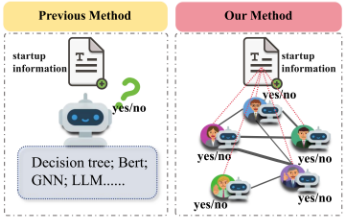
In venture capital (VC), investors typically base their decisions on comprehensive evaluations that consider factors such as team composition, business model, and market potential [Miloud et al., 2012; Kim and Lee, 2022]. Following this logic, prior automated methods have primarily modeled financing outcomes from the perspective of individual decision-making by extracting firm-level features using technical paradigms. Lines of work include: (i) traditional machine learning on engineered features [Krishna et al., 2016; ¨Unal, 2019]; (ii) graph neural network (GNN)-based modeling of investment networks [Zhang et al., 2021; Lyu et al., 2025]; and (iii) pre-trained language models for textual analysis [Maarouf et al., 2025]. Despite methodological diversity, these approaches share a common assumption: they aim to simulate a single, idealized investor.
In reality, investor decisions directly shape startup financing outcomes and subsequent development trajectories. The absence of investment can trigger immediate survival crises, while investors' heterogeneous resources, expertise, and networks can profoundly influence long-term growth paths [Diamond and Rajan, 2001; Miloud et al., 2012]. Importantly, real-world VC evaluations are rarely conducted in isolation. Instead, startups are assessed by multiple potential investors embedded within co-investment networks, where information exchange and peer influence play a central role [Han and Yang, 2013; Liu, 2017; Goldstein et al., 2025]. Our data confirm this dynamic: the average graph distance among investors who eventually coinvest in the same startup is only 2.16, compared to 4.23 across the entire VC network. As a result, financing outcomes often emerge from the collective judgment of an investor group, and startups of similar quality may experience markedly different outcomes depending on the composition of their investor collective. This "investor collective effect" is not captured by existing single-decision-maker models. Given the inherent multi-agent nature of real-world VC decision-making, a multi-agent framework is a natural and necessary modeling choice.
However, existing multi-agent systems fail to capture two defining characteristics of VC forecasting: (i) the collective nature of syndicated decision-making and (ii) the complex relational dynamics among co-investors. First, most frameworks rely on agent specialization to simulate compartmentalized reasoning across information dimensions-assigning individual agents to analyze different dimensions of information [Yu et al., 2024; Zhang et al., 2024b; Wang et al., 2025b; Pei et al., 2026]. While effective for simulating the internal reasoning process of a single investor, this paradigm fails to capture the diversity and interaction of multiple independent investors. Second, existing agent interaction mechanisms are largely heuristic-based [Wang et al., 2025a; Qian et al., 2025; Li et al., 2025] and cannot model the nuanced, asymmetric relationships observed in real co-investment behavior-relationships shaped by network topology, investor heterogeneity, and startup-specific context.
To address these challenges, we propose SimVC-CAS: a collective agent system for simulating real-world venture capital decision-making. The core idea is to reframe financing prediction as the outcome of a simulated collective decision process carried out by a network of investors, each modeled as an autonomous agent. SimVC-CAS jointly captures enterprise fundamentals and multi-investor decision dynamics. Given a target startup, the system simulates (i) heterogeneous individual evaluations by distinct investor agents and (ii) collective decision updates shaped by a co-investment network. The resulting group-level verdict forms the basis for financing prediction. As shown in Figure 1, this framework enables joint modeling of both company-level attributes and investor-collective behaviors, offering a more realistic and interpretable approach to VC forecasting.
Specifically, SimVC-CAS consists of three modules: 1. Startup Panoramic Portrait. This module integrates diverse startup data - including basic information, founding team backgrounds, and financing history - to construct a comprehensive profile that serves as shared context for all investor agents. 2. Heterogeneous Investor Portraits. We construct the potential investor pool from the startup's historical investors and their past co-investment partners. Empirically, 77.35% of investors in new financing rounds originate from this group in our dataset. Each investor agent is assigned a distinct profile based on background information, experience, and historical investment behavior. Leveraging the role-playing capabilities of large language models (LLMs) [Wang et al., 2025a], agents interpret startup information through personalized lenses, capturing heterogeneous preferences, cognitive biases, and decision patterns. 3. Collective Agent Interaction Modeling. Investor interactions depend not only on their own attributes and network structure, but also vary with the characteristics of the evaluated startup, forming startup-centric interaction modes [Elfring and Hulsink, 2007; Lee et al., 2015]. To model these dynamics, we design a graph attention network with virtual nodes (VGAT), where a virtual node represents the target startup and serves as an information hub connected to all investor agents. Investor nodes are linked via edges derived from historical co-investment relationships. Through VGAT, SimVCCAS captures multi-dimensional interaction patterns that balance investor heterogeneity, startup characteristics, and graph topology, thereby approximating realistic group deliberation processes.
Our contributions are summarized as follows:
- We introduce a simulation-based paradigm that reframes startup financing prediction as a collective decisionmaking process by integrating LLM role-playing with multi-agent modeling.
- We propose SimVC-CAS, which jointly models company fundamentals and investor dynamics through scalable profiles and graph-based interactions, achieving significant performance improvements on proprietary and public datasets, with behavioral alignment with real investors.
- We demonstrate that the interaction mechanism is particularly effective for network-central startups, confirming the importance of network structure in VC decisionmaking. Analysis of agents' reasoning for decision changes further reveals how network environments influence decision quality, demonstrating the system's interpretability. Beyond VC, our design may generalize to other group decision-making problems.
2 RelatedWork
2.1 Startup Success Prediction
Predicting early-stage startup success is a critical task. Early research identified key predictive factors [Song et al., 2008; Sevilla-Bernardo et al., 2022] which informed manual feature engineering efforts. Initial methods used commercial datasets such as PitchBook, Crunchbase to design features based on domain knowledge and heuristics for traditional machine learning models [ ¨Unal, 2019; Bargagli-Stoffi et al., 2021]. As large-scale datasets become available, the field evolved toward three approaches: (1) graph neural networks (GNNs) [Zhang et al., 2021; Lyu et al., 2025], which mine relational structures for investment patterns; (2) pre-trained language models (LMs) [Maarouf et al., 2025], which extract semantic features from company descriptions and filings; and (3) multi-agent systems [Wang et al., 2025b; Pei et al., 2026], which assign agents to analyze complementary aspects of a company's information, aiming to address the interpretability and scalability limitations.
Despite these advances, existing models all focus on single-investor decision frameworks, failing to capture the multi-perspective evaluation and group dynamics typical of the real world. Even when employing multi-agent approaches, they merely use multiple agents to analyze different dimensional information [Wang et al., 2025b], remaining within a single decision-maker perspective.
2.2 LLMAgents in Decision Simulation
Large Language Models have shown significant potential in simulating human intelligence and are increasingly used as a foundational component in autonomous agent systems [Luo et al., 2025; He et al., 2025; Zhang et al., 2025]. In decision simulation, LLM agents have been deployed to model user search behavior and predict click-through rates [Zhang et al., 2024a], forecast legislative bill outcomes based on policymaker behavior [Li et al., 2025], and replicate group voting patterns from demographic data [Argyle et al., 2023].
However, the application of LLMs to simulate investor decision-making in VC remains largely underexplored. Current approaches are insufficient for modeling the heterogeneous, relational dynamics inherent in VC investment networks. To address this gap, we propose a graph neural network-based multi-agent interaction framework for simulating VC investment decisions. Beyond VC, this framework offers a generalizable foundation for decision modeling in other complex, heterogeneous network environments.
3 Task Definition
This study focuses on predicting the success of early-stage startups. Following prior work [Zhang et al., 2021], we define early-stage startups as those that have completed their first formal financing round (seed or angel), but have not yet raised subsequent rounds (e.g., Series A). These companies enter the venture capital ecosystem for the first time through initial investors. While success is often measured by whether a startup secures Series A funding [Zhang et al., 2021; Dellermann et al., 2021], prior studies have used different observation windows, potentially introducing time biases. To alleviate this, we adopt a consistent one-year observation window. Accordingly, the core task is defined as: predicting whether a startup secures subsequent funding within one year of its initial financing.
4 Method
This section details the core framework of our proposed method, shown in Figure 2. We begin by constructing a comprehensive profile for each target startup, integrating basic information, team composition, and historical financing records. This profile serves as the fundamental input for investment evaluation. Meanwhile, we generate heterogeneous profiles for potential investors, encompassing personal information, investment experience, and professional background. To simulate investor decision-making, we employ an LLMbased agent to model the investment preferences of individual investors through role-playing. Building on this, we introduce a collective agent interaction system: for each startup, we construct a co-investment network linking its potential investors based on historical co-investment relationships. In addition, we designed a GAT with virtual nodes (VGAT) to capture the investor interaction patterns centered on startups in this network, enabling us to approximate the collective decision-making dynamics in the real world. This collective modeling enhances the predictive accuracy of startup success.
4.1 Startup Panoramic Portrait
To predict success, we construct a panoramic profile capturing the target startup's core characteristics as input for subsequent agents.
Basic Information: This includes founding date, industry, description, location, products, keywords, and other core attributes. These characteristics provide fundamental signals for screening investment opportunities and reducing information asymmetry between entrepreneurs and investors [Kaplan and Str¨omberg, 2004; Spence, 1973].
Team Composition: We collect key members' backgrounds, including gender, education, prior employment, investment experience, and roles. This reflects the "bet on the jockey" hypothesis in VC, which emphasizes human capital as a key predictor of venture success [Kaplan et al., 2009; Gompers et al., 2020].
Historical Financing Records: We summarize past funding rounds, including amounts raised and investor backgrounds. These records reflect capital staging mechanisms for monitoring progress and mitigating agency costs, while also providing cues on valuation trajectory and external validation [Gompers, 1995; Sahlman, 1990].
Affiliated Companies: We incorporate information on startups sharing key individuals with the target. Such links enable information spillovers and social endorsements, allowing affiliated firms' attributes to serve as signals of the target's potential [Stuart et al., 1999; Hochberg et al., 2007].
4.2 Heterogeneous Investor Portraits
For each target startup, we construct heterogeneous profiles of its potential investors. The candidate investor set follows this rule: We randomly sample k individuals from the union of the startup's historical investors and their past co-investment partners. Empirically, 77.35% of investors in new financing rounds originate from this group in our dataset.
Based on this set, we generate investor profiles and simulate their behavior through a role-playing agent architecture. Each agent represents a distinct investor persona, offering differentiated analysis and decision-making support. The profiling system is extensible and integrates demographic information, professional experience, and past investment records.
Personal Information This includes the investor's name, gender, and educational background.
Past Investment Experience This section summarizes the investor's funding history, including: (i) early-stage investments, mainly seed and Series A rounds, as primary references; and (ii) other mid-to-late-stage or non-startup investments as supplementary context. Each investment record is paired with structured startup summaries to characterize the investor's track record.
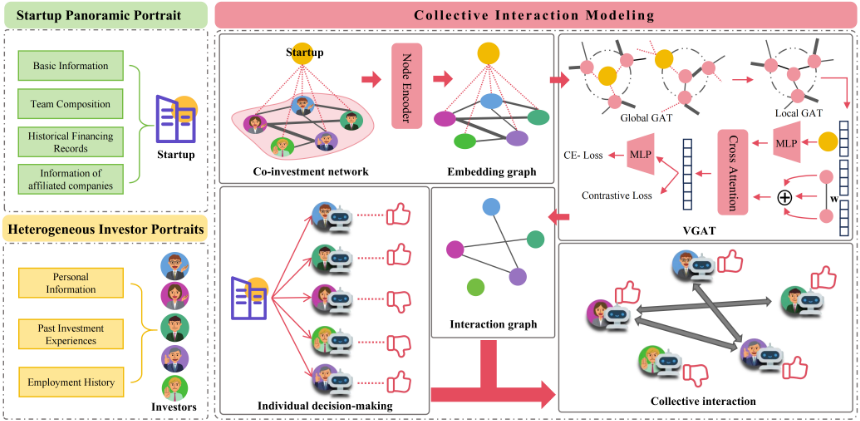
Employment History This details the investor's professional background, including previous roles and affiliations.
4.3 Collective Agent InteractionModeling
To better approximate real-world investor decision-making dynamics, we design a collective agent interaction framework supervised by a graph neural network. In this system, each investor agent first performs an individual evaluation of the target startup based on their profile and outputs an initial investment decision. Next, the historical co-investment network is used (along with VGAT) to determine the interaction structure among these investor agents. Finally, the agents interact according to the learned topology, updating their beliefs and assessments based on peer influence. This dynamic group reasoning process allows agents to revise their initial decisions, resulting in a final, aggregated investment decision that reflects both individual judgment and collective insight.
VGAT
To model investor interaction patterns shaped jointly by the characteristics of the target startup, the attributes of individual investors, and the topology of the co-investment network, we design the Virtual Node Graph Attention Network (VGAT). In this architecture, the target company is introduced as a virtual node, serving as a global query to attend to relevant investor interactions.
Formally, let G = (V, E, ω) be an undirected weighted graph. The node set is defined as V = VR ∪ {vtarget}, where VR = {v1, . . . , vn} represents real investor nodes and vtarget /∈ VR denotes the virtual node (i.e., the target company). The edge set consists of two parts: E = ER ∪ EV , where ER ⊆ VR × VR represents real investor connections, and EV = {(vtarget, vi) | ∀vi ∈ VR} connects the virtual node to all real nodes. A weight function ω : E → R+ assigns positive weights to all edges.
The VGAT model processes G through three sequential components. First, a global Graph Attention (GAT) layer updates embeddings for all nodes:
Second, a local GAT layer refines the embeddings specifically for real investor nodes:
Concurrently, the virtual node embedding is transformed via an MLP to serve as the global query vector:
To determine the importance of each co-investment relationship, we compute an attention score for each real edge eij = (vi, vj) ∈ ER. The cross-attention mechanism uses the virtual node as the query and the edges as keys. The normalized attention coefficient αij is computed via a Softmax operation over all edges in the batch:
where dk is the scaling dimension. The final edge embedding eij is then obtained by weighting the value projection:
where the base edge representation mij concatenates the node features and edge weight:
Here,WQ,WK, andWV are learnable projectionmatrices.
| Method | Precision | Recall | F1 |
| GAT | 69.62 | 77.76 | 73.47 |
| VGAT | 76.18 | 82.70 | 79.31 |
We formulate the interaction prediction as a binary classification task. Since direct data on investor communications is private and unobservable, we employ future coinvestment relationships as a proxy for effective interaction. The rationale is that if two investors co-invest in the same startup within a specific future window, they likely engaged in meaningful interaction or shared similar decision logic to mitigate selection uncertainty [Lerner, 1994; Hochberg et al., 2007]. Thus, the goal is to predict the existence of a valid future co-investment link (Class 1) versus a non-existent one (Class 0).
The model is optimized jointly using cross-entropy and contrastive losses. The Cross-Entropy Loss is defined as:
where NC = 2 is the number of classes. yc ij indicates the ground truth label derived from future co-investment data, and ˆ yc ij is the predicted probability derived from eij.
The Contrastive Loss enhances the distinctiveness of edge embeddings:
where P is the set of positive pairs, Nij represents negative samples, and τ is the temperature parameter. The final loss is:
where λ is a hyperparameter balancing the two terms.
Training and Validation: We strictly adhered to the temporal split strategy of the main experiment (see Sec.5.1) to train and evaluate VGAT: data prior to September 2021 was utilized for training and validation. As shown in Table 1, VGAT significantly outperforms the GAT baseline (F1: 79.31% vs. 73.47%). This confirms that explicitly modeling the startup as a global query node enables the network to more accurately discern context-specific investor interaction patterns. (See Appendix D for training data construction.)
Investor Agent Decision-Making
Given a set of k investor agents {A1,A2, . . . ,Ak}, we construct a heterogeneous profile Pi for each investor Ai. Through role-playing, conditioned on the startup profile S, each agent generates an initial independent decision D(0) i using a frozen LLM:
We construct a co-investment network G where nodes V = {A1, . . . ,Ak} ∪ {vtarget} represent investors and the target startup. Edges encode historical co-investments and connections to the target. Using a pre-trained 1 encoder, we embed investor profiles and the startup profile:
- Investor embedding: hi = NodeEncoder(Pi).
- Startup embedding: hvtarget = NodeEncoder(S).
These embeddings form the input graph Gembed for VGAT to infer interaction edges:
These edges define the peer influence topology for the second decision round.
Agents revise their decisions by incorporating insights from interaction neighbors. Specifically, agent Ai updates D(0) i to D(1) i :
The overall investment confidence score Cinvest is defined as the proportion of agents opting to invest:
where δi = 1 if D(1) i is an investment decision, and 0 otherwise. This score aggregates individual assessments and collective peer influence.
5 Experiments
5.1 Datasets
PitchBook. We compile a comprehensive global venture capital dataset from PitchBook 2 covering the period from 2005 to November 2023. The dataset includes 263,729 startups and 1,014,157 individuals, with rich information on investment histories, demographic backgrounds, and detailed company profiles. For evaluation, we focus on 2,507 startups that received their initial funding between September 2021 and November 2022. The task is to determine whether a startup secures follow-on financing within one year of its initial funding round, resulting in 533 positive samples and 1,974 negative samples. To avoid look-ahead bias, all startup profiles are constructed exclusively using information available prior to the initial funding event.
Crunchbase. Besides the private dataset, we used an opensource 2013 Crunchbase snapshot 3 as a supplementary experiment. We report results in Appendix E.
5.2 EvaluationMetrics
While standard classification metrics (e.g., F1 score) are reported, we prioritize Average Precision at K (AP@K) to align with the practical VC objective of identifying top-tier opportunities from a large candidate pool. In our proposed SimVCCAS, to reflect real-world co-investment dynamics, a startup is considered positively predicted if at least one investor agent chooses to invest; rankings are then determined by the confidence score Cinvest, mirroring how investment decisions aggregate in practice. Following prior work [Sharchilev et al., 2018; Zhang et al., 2021; Lyu et al., 2025], we use Precision at K (P@K) to measure the success rate among the topK ranked startups. To ensure temporal robustness, AP@K is computed by averaging P@K across monthly rolling windows. This metric directly quantifies the model's effectiveness in shortlisting high-potential investments over time.
1 https://huggingface.co/jinaai/jina-colbert-v2. We selected this model for its superior long-context processing capabilities.
3 https://github.com/datahoarder/crunchbase-october-2013
| Method | AP@10 | AP@30 | Precision | Recall | F1 |
|---|---|---|---|---|---|
| Random | - | - | 19.98 | 19.02 | 19.49 |
| BERT Fusion | 24.67 | 25.33 | 23.63 | 24.95 | 24.27 |
| SHGMNN | 25.41 | 26.22 | 20.51 | 82.37 | 32.97 |
| GST | 25.71 | 27.86 | 21.75 | 83.54 | 34.51 |
| GNN-RAG | 27.53 | 26.17 | 22.81 | 71.10 | 34.54 |
| SSFF | 30.02 | 27.26 | 23.23 | 69.41 | 34.81 |
| SimVC-CAS | 37.52 | 30.83 | 24.19 | 74.07 | 36.47 |
5.3 Implementation Details
We employ GPT-3.5 4 (knowledge cutoff: Sep 2021) on a test dataset collected September 2021 to ensure strict temporal isolation and prevent data leakage. For reproducibility, the temperature is fixed at 0. The number of candidate investors k is set to 10, which we empirically found to balance performance gains and computational efficiency (detailed analysis in Appendix A). All reported results represent the average of five independent runs with random investor sampling.
5.4 Baselines
To evaluate the effectiveness of our proposed method, we benchmark it against six diverse baselines: Random, which predicts based on historical success rates; BERT Fusion [Maarouf et al., 2025], which combines structured variables with BERT-encoded unstructured text for classification; SHGMNN [Zhang et al., 2021], a heterogeneous graph neural network that learns representations end-to-end; GST [Lyu et al., 2025], a spatiotemporal graph model that employs incremental graph self-attention to capture dynamic node representations; GNN-RAG [Mavromatis and Karypis, 2024], which synergizes GNN embeddings with RAG-retrieved shortest paths as context for LLMs; and SSFF [Wang et al., 2025b], a multi-agent framework that, unlike our interactive approach, analyzes dimensions in isolation before aggregating insights via a single centralized decision-maker.
5.5 Experimental Results
The main experimental results on the PitchBook dataset are presented in Table 2. The proposed model significantly outperforms baselines across all evaluation metrics except recall, demonstrating its strong effectiveness in predicting the early-stage startup success. In particular, our SimVC-CAS
4 https://platform.openai.com/docs/models/gpt-3.5-turbo
| Method | AP@10 | AP@30 | F1 | Decision Consistency |
|---|---|---|---|---|
| w/o roleplay (single LLM) w/o interaction | 26.58 | 23.44 28.04 | 33.14 35.62 | - |
| 35.43 | 0.68 | |||
| F ullInteraction | 32.14 | 27.85 | 33.64 | 0.62 |
| NetworkInteraction | 36.43 | 29.28 | 35.87 | 0.67 |
| GAT Interaction | 36.89 | 29.74 | 36.07 | 0.69 |
| SimVC-CAS | 37.52 | 30.83 | 36.47 | 0.71 |
| SimVC-CAS (4o-mini) | 38.11 | 31.24 | 37.02 | 0.73 |
| SimVC-CAS (Claude 3.5) | 38.27 | 31.79 | 37.39 | 0.74 |
achieves substantial gains on ranking-based metrics, with AP@10 improving by 25.0%, and AP@30 by 13.1% relative to the strongest baseline. These results highlight SimVCCAS's superior capability to prioritize and rank startups with high success potential.
Further comparative analysis shows that graph-based models, including both traditional GNN approaches (e.g., SHGMNN and GST) and LLM RAG-enhanced variants like GNN-RAG, consistently underperform relative to SimVCCAS. This underscores the importance of explicitly modeling potential investor relationships surrounding startups. Additionally, the notably weaker performance of the traditional multi-agent method SSFF further validates the advantage of incorporating multi-decision-maker interaction dynamics over single-decision mechanisms.
Furthermore, we find that while GNN methods (such as GST) achieve high recall (83.54%) through aggressive prediction, their precision drops significantly (21.75%). SimVCCAS demonstrates overwhelming superiority in the most decision-critical AP@10 metric (37.52% vs 25.71%, a relative improvement of 46.1%), with precision and overall F1 scores also significantly outperforming GNN methods.
Results on the public Crunchbase dataset align with our main findings, showing improvements of +6.82% in AP@10, +2.66% in AP@30, and +1.66% in F1 over the strongest baseline (see Appendix E for details).
5.6 Ablation Study
Table 3 shows ablation results. w/o roleplay, where a single LLM jointly processes the startup profile and all k investor resumes without simulating individual personas, suffers the most significant performance drop. This further validates that centralized reasoning cannot substitute for the collective intelligence of diverse agents. Similarly, w/o interaction removes the interaction module and underperforms the full model, demonstrating the effectiveness of our interaction design.
We further compare different interaction strategies. FullInteraction, where all agents communicate indiscriminately, performs worse than the non-interaction baseline (w/o interaction) (F1: 33.64 vs 35.62), suggesting that unstructured communication introduces detrimental noise. In contrast, NetworkInteraction, which restricts interactions to historical co-investors, outperforms both (F1: 35.87), validating the importance of leveraging established coinvestment topologies. Finally, while GATInteraction improves upon NetworkInteraction, it still lags behind our full model (F1: 36.07 vs 36.47). This confirms that our VGAT mechanism, by explicitly modeling the startup context, captures interaction patterns more effectively than standard GNNs.
Finally, benchmarking with upgraded backbones (GPT-4omini 5 , Claude 3.5 Sonnet 6 ) yields consistent improvements, confirming the robustness of our framework across different LLMs. However, we acknowledge that data leakage in these newer models likely contributes to the gains.
5.7 Consistency with Real Investors
To evaluate whether our agents simulate real investor behavior, we introduce the Decision Consistency metric. For all investor-startup pairs, this metric measures the alignment between simulated and actual decisions, defined as the percentage of simulated decisions matching ground truth, for which the random baseline is 0.50. 7 Despite potential noise where investors simply missed unseen opportunities rather than rejecting them, this metric validates that our agents capture specific preferences beyond chance.
As shown in Table 3, SimVC-CAS achieves the highest Decision Consistency (0.71), outperforming w/o interaction (0.68) and the random baseline (0.50). The failure of FullInteraction (0.62) confirms that our selective, graph-based interaction design is essential for modeling real VC dynamics.
5.8 Decision Benefit fromModeling Interactions
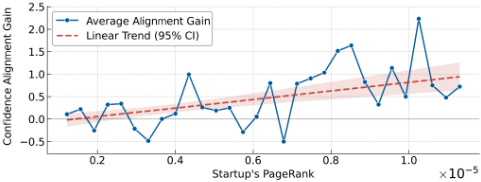
To quantify the marginal contribution of the collective interaction mechanism, we introduce Confidence Alignment Gain (∆C), which captures whether interaction steers predictions closer to ground truth:
where C (1) invest and C (0) invest are confidence scores after and before interaction, and y is the ground-truth label. The term (2y - 1) ensures that ∆C > 0 indicates improved alignment with ground truth-higher confidence for successful startups or lower confidence for failed ones.
We investigate the correlation between this gain and startup network centrality (Figure 3). We calculate the PageRank score for each startup in the test set based on the investorstartup bipartite graph and compute the mean ∆C across PageRank bins. A linear regression with 95% confidence interval reveals a clear trend: confidence alignment gain increases with PageRank. A higher PageRank indicates that the startup is embedded in a denser VC network, making it more critical to capture complex investor interaction dynamics. The trend validates that for startups embedded in active investment networks, our interaction design is effective.
5 https://platform.openai.com/docs/models/gpt-4o-mini
6 https://docs.anthropic.com/en/docs/about-claude/models
7 We use a balanced dataset (all positive samples + equal random negatives) to calculate Decision Consistency. In raw VC data, "Invest" decisions are rare, so consistency is dominated by "Pass" decisions-allowing trivial "always Pass" strategies to score high. Balancing forces the metric to equally weight the agent's ability to identify "Invest" opportunities and correctly "Pass".
5.9 Why Change Decisions After Interaction?
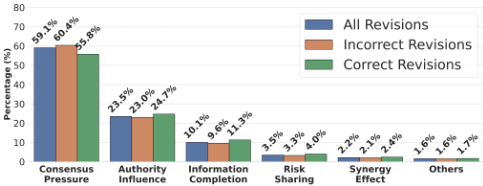
To understand what drives decision changes, we prompt agents who revised their decisions after interaction to select from predefined reasons. As shown in Figure 4 (bars in blue), Consensus Pressure (59.1%), Authority Influence (23.5%), and Information Completion (10.1%) emerge as the most frequently cited factors. We further distinguish between correct revisions (changes aligning with ground truth, in green) and incorrect revisions (orange). Notably, correct revisions rely less on conforming to majority opinions from surrounding agents (55.8% vs 60.4%), but place more weight on deferring to established investors (24.7% vs 23.0%) and incorporating new factual details through the network (11.3% vs 9.6%), suggesting that effective decisions prioritize expert opinions and facts from the network over surrounding consensus [Sørensen, 2007; Banerjee, 1992]. See Appendix F for classification details.
6 Conclusion
From the perspective of investor groups, this study proposes SimVC-CAS, a collective agent system designed to simulate the decision-making dynamics of venture capital. Unlike traditional approaches that overlook the investor collective effect, SimVC-CAS explicitly models the interactions among investors during the investment decision-making process. Our experiments demonstrate that this collective modeling approach achieves significant performance improvements and reveals how network environments shape decision quality, particularly for network-central startups. The SimVCCAS framework is designed to be general and may extend to other complex group decision-making settings.
Appendices
A Effect of Candidate Investor Scale (k)
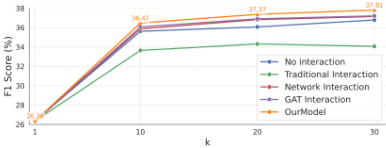
We evaluate the sensitivity of our model to the number of candidate investors k ∈ {1, 10, 20, 30}. As Figure 5 shows, performance improves with increasing k, but the marginal gains diminish beyond k = 10. Compared with k = 1, using k = 10 improves F1 by about 8%, demonstrating the benefit of multiple perspectives while maintaining computational efficiency. Therefore, k = 10 is used in all experiments as a cost-effective trade-off.
B Prompt Display
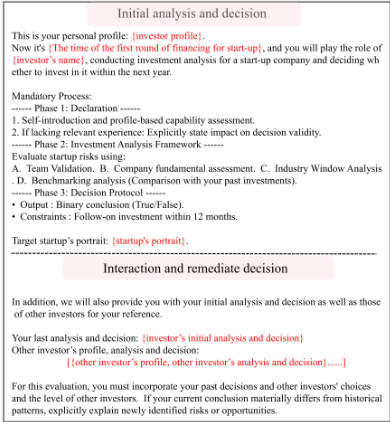
Figure 6 shows the prompts used for both initial investment and interactive revision decisions.
C Consistency Analysis
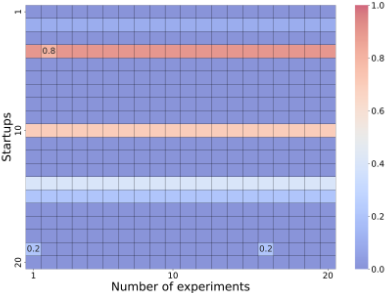
Since large language models may produce varying results across runs, we evaluated the consistency of SimVC-CAS by repeating experiments 20 times on 20 randomly selected startups. As shown in Figure 7, only a negligible number of samples yielded different results across runs, demonstrating the strong consistency of our model.
D VGAT Training Data Construction
The VGAT models investor interaction patterns jointly influenced by startup characteristics, investor attributes, and coinvestment network topology. Since direct investor communication data is unobservable, we use future co-investment relationships as proxy supervision signals.
To avoid overlap with the main evaluation period, VGAT is trained and evaluated using startups whose first financing dates precede the main test period. The data are chronologically split by startups' first financing dates: training set from Oct. 2016 to Sep. 2019, validation set from Oct. 2019 to Mar. 2020, and test set from Apr. 2020 to Sep. 2020. For each eligible startup, candidate investors are sampled with k ∈ {10, 20, 30}, and an edge is labeled positive if the corresponding two investors co-invest within the following year; otherwise, it is labeled negative. Thus, the latest future co-investment supervision window ends on September 1, 2021, before the main evaluation period, whose initial funding events occur after September 1, 2021 and span September 2021 to November 2022. Networks with extremely low positive-to-negative ratios (< 0.05) are discarded to reduce uninformative sparsity. The final dataset includes 1,992/247/222 train/validation/test networks, with an average positive-to-negative ratio of 0.2062.
E Crunchbase Public-Dataset Evaluation
We further evaluate on the public Crunchbase 2013 snapshot, which covers investment records from 2005 to 2013. For evaluation, we focus on startups that received seed/angel funding between 2012 and 2013. The task is to determine whether these startups raise Series A funding within one year of their initial funding round, yielding 4,375 labeled samples. To avoid look-ahead bias, for each test case, company profiles, investor profiles, and investment relationship contexts are constructed exclusively using information available prior to its seed/angel funding event.
SimVC-CAS outperforms all baselines by +6.82% AP@10, +2.66% AP@30, and +1.66% F1, consistent with the main PitchBook results. Performance is lower due to the smaller scale and less comprehensive information of the public snapshot.
Figure 8: ScienceIO: Investor decision-making and revision process.
| Method | AP@10 | AP@30 | Prec. | Rec. | F1 |
|---|---|---|---|---|---|
| BERT Fusion | 25.57 | 25.26 | 23.54 | 48.10 | 31.61 |
| SHGMNN | 26.38 | 26.13 | 18.85 | 64.82 | 29.12 |
| GST | 26.54 | 26.32 | 19.64 | 68.45 | 30.48 |
| GNN-RAG | 27.12 | 25.26 | 20.88 | 58.34 | 30.70 |
| SSFF | 27.36 | 25.41 | 22.15 | 51.92 | 31.05 |
| SimVC-CAS | 34.18 | 28.98 | 24.05 | 54.12 | 33.27 |
Table 4: Performance on public Crunchbase data.
F Decision Revision Reason Classification
Agents whose decisions change after peer interaction are classified into six categories: Information Completion, Authority Influence, Consensus Pressure, Synergy Effect, Risk Sharing, Others.
For clarity, the six categories are defined as follows: Information Completion refers to revising a decision after acquiring previously missing market or team information; Authority Influence refers to being swayed by the judgment of a senior or lead investor; Consensus Pressure refers to adjusting a decision upon observing that the majority holds a contrary opinion; Synergy Effect refers to investing due to expected complementary resources from co-investors; Risk Sharing refers to investing after others join, thereby reducing perceived individual risk; and Others covers reasons not captured above.
We used GPT-4o-mini to assign each agent's self-reported revision rationale to one of the six predefined categories.
G Explainability Display
As shown in Figures 8 and 9, we present two examples (ScienceIO and First Automation) to illustrate the interpretability of SimVC-CAS prediction results. In each example, an investor first introduces themselves, presents their independent analysis and initial decision, then revises it after interacting with peers.
Acknowledgements
This project is supported by the Shanghai Soft Science Research Program from the Science and Technology Commission of Shanghai Municipality (No.25692108200) and National Natural Science Foundation of China (No.72302148).
@inproceedings{ijcai2026p721,
  title     = {Beyond Isolated Investor: Predicting Startup Success via Roleplay-Based Collective Agents},
  author    = {Liu, Zhongyang and Pei, Haoyu and Xiao, Xiangyi and Du, Xiaocong and Li, Yihui and Hong, Suting and Zhang, Kunpeng and Zhang, Haipeng},
  booktitle = {Proceedings of the Thirty-Fifth International Joint Conference on
               Artificial Intelligence, {IJCAI-26}},
  publisher = {International Joint Conferences on Artificial Intelligence Organization},
  editor    = {Diego Calvanese},
  pages     = {6480--6490},
  year      = {2026},
  month     = {8},
  note      = {AI4Tech: AI Enabling Technologies},
  doi       = {10.24963/ijcai.2026/721},
  url       = {https://doi.org/10.24963/ijcai.2026/721},
}
TY - CPAPER TI - Beyond Isolated Investor: Predicting Startup Success via Roleplay-Based Collective Agents AU - Liu, Zhongyang AU - Pei, Haoyu AU - Xiao, Xiangyi AU - Du, Xiaocong AU - Li, Yihui AU - Hong, Suting AU - Zhang, Kunpeng AU - Zhang, Haipeng T2 - Proceedings of the Thirty-Fifth International Joint Conference on Artificial Intelligence, IJCAI-26 PB - International Joint Conferences on Artificial Intelligence Organization PY - 2026 SP - 6480 EP - 6490 DO - 10.24963/ijcai.2026/721 UR - https://doi.org/10.24963/ijcai.2026/721 ER -Copied
Machine-readable versions of this paper, for tools and AI agents:





