
Zero-shot Generalist Graph Anomaly Detection with Unified Neighborhood Prompts
Proceedings of the Thirty-Fourth International Joint Conference on Artificial Intelligence. Main Track. Pages 3226-3234.
https://doi.org/10.24963/ijcai.2025/359
Keywords
- Data Mining: DM: Mining graphs
- Data Mining: DM: Anomaly/outlier detection
Abstract
Graph anomaly detection (GAD), which aims to identify nodes in a graph that significantly deviate from normal patterns, plays a crucial role in broad application domains. However, existing GAD methods are one-model-for-one-dataset approaches, i.e., training a separate model for each graph dataset. This largely limits their applicability in real-world scenarios. To overcome this limitation, we propose a novel zero-shot generalist GAD approach UNPrompt that trains a one-for-all detection model, requiring the training of one GAD model on a single graph dataset and then effectively generalizing to detect anomalies in other graph datasets without any retraining or fine-tuning. The key insight in UNPrompt is that i) the predictability of latent node attributes can serve as a generalized anomaly measure and ii) generalized normal and abnormal graph patterns can be learned via latent node attribute prediction in a properly normalized node attribute space. UNPrompt achieves a generalist mode for GAD through two main modules: one module aligns the dimensionality and semantics of node attributes across different graphs via coordinate-wise normalization, while another module learns generalized neighborhood prompts that support the use of latent node attribute predictability as an anomaly score across different datasets. Extensive experiments on real-world GAD datasets show that UNPrompt significantly outperforms diverse competing methods under the generalist GAD setting, and it also has strong superiority under the one-model-for-one-dataset setting. Code is available at https://github.com/mala-lab/UNPrompt.
- [Abdi and Williams, 2010] Hervé Abdi and Lynne J Williams. Principal component analysis. Wiley interdisci- plinary reviews: computational statistics, 2(4):433-459, 2010.
- [Chai et al., 2022] Ziwei Chai, Siqi You, Yang Yang, Shil- iang Pu, Jiarong Xu, Haoyang Cai, and Weihao Jiang. Can abnormality be detected by graph neural networks? In IJCAI, pages 1945-1951, 2022. IJCAI
- [Chen et al., 2024] Jingyan Chen, Guanghui Zhu, Chunfeng Yuan, and Yihua Huang. Boosting graph anomaly detec- tion with adaptive message passing. In The Twelfth Inter- national Conference on Learning Representations, 2024.
- [Ding et al., 2019] Kaize Ding, Jundong Li, Rohit Bhanushali, and Huan Liu. Deep anomaly detection on attributed networks. In Proceedings of the 2019 SIAM international conference on data mining, pages 594-602.
- [Ding et al., 2021] Kaize Ding, Kai Shu, Xuan Shan, Jun- dong Li, and Huan Liu. Cross-domain graph anomaly detection. IEEE Transactions on Neural Networks and Learning Systems, 33(6):2406-2415, 2021.
- [Fan et al., 2020] Haoyi Fan, Fengbin Zhang, and Zuoyong Li. Anomalydae: Dual autoencoder for anomaly detec- tion on attributed networks. In ICASSP 2020-2020 IEEE International Conference on Acoustics, Speech and Signal Processing (ICASSP), pages 5685-5689. IEEE, 2020.
- [Fang et al., 2024] Taoran Fang, Yunchao Zhang, Yang Yang, Chunping Wang, and Lei Chen. Universal prompt tuning for graph neural networks. Advances in Neural In- formation Processing Systems, 36, 2024.
- [Gao et al., 2023] Yuan Gao, Xiang Wang, Xiangnan He, Zhenguang Liu, Huamin Feng, and Yongdong Zhang. Ad- dressing heterophily in graph anomaly detection: A per- spective of graph spectrum. In Proceedings of the ACM Web Conference 2023, pages 1528-1538, 2023.
- [Huang et al., 2022] Tianjin Huang, Yulong Pei, Vlado Menkovski, and Mykola Pechenizkiy. Hop-count based self-supervised anomaly detection on attributed networks. In Joint European conference on machine learning and knowledge discovery in databases, pages 225-241. Springer, 2022.
- [Kipf and Welling, 2016] Thomas N Kipf and Max Welling. Semi-supervised classification with graph convolutional networks. arXiv preprint arXiv:1609.02907, 2016.
- [Kumar et al., 2019] Srijan Kumar, Xikun Zhang, and Jure Leskovec. Predicting dynamic embedding trajectory in temporal interaction networks. In Proceedings of the 25th ACM SIGKDD international conference on knowl- edge discovery & data mining, pages 1269-1278, 2019.
- [Li et al., 2023] Aodong Li, Chen Qiu, Marius Kloft, Padhraic Smyth, Maja Rudolph, and Stephan Mandt. Zero-shot anomaly detection via batch normalization. In Thirty-seventh Conference on Neural Information Pro- cessing Systems, 2023.
- [Li et al., 2024] Yuhan Li, Peisong Wang, Zhixun Li, Jef- frey Xu Yu, and Jia Li. Zerog: Investigating cross-dataset zero-shot transferability in graphs. In Proceedings of the 30th ACM SIGKDD Conference on Knowledge Discovery and Data Mining, pages 1725-1735, 2024.
- [Liu et al., 2021a] Yang Liu, Xiang Ao, Zidi Qin, Jianfeng Chi, Jinghua Feng, Hao Yang, and Qing He. Pick and choose: a gnn-based imbalanced learning approach for fraud detection. In Proceedings of the web conference 2021, pages 3168-3177, 2021.
- [Liu et al., 2021b] Yixin Liu, Zhao Li, Shirui Pan, Chen Gong, Chuan Zhou, and George Karypis. Anomaly detec- tion on attributed networks via contrastive self-supervised learning. IEEE transactions on neural networks and learn- ing systems, 33(6):2378-2392, 2021.
- [Liu et al., 2022] Kay Liu, Yingtong Dou, Yue Zhao, Xuey- ing Ding, Xiyang Hu, Ruitong Zhang, Kaize Ding, Canyu Chen, Hao Peng, Kai Shu, et al. Bond: Benchmark- ing unsupervised outlier node detection on static attributed graphs. Advances in Neural Information Processing Sys- tems, 35:27021-27035, 2022.
- [Liu et al., 2023a] Jiawei Liu, Cheng Yang, Zhiyuan Lu, Junze Chen, Yibo Li, Mengmei Zhang, Ting Bai, Yuan Fang, Lichao Sun, Philip S Yu, et al. Towards graph foundation models: A survey and beyond. arXiv preprint arXiv:2310.11829, 2023.
- [Liu et al., 2023b] Pengfei Liu, Weizhe Yuan, Jinlan Fu, Zhengbao Jiang, Hiroaki Hayashi, and Graham Neubig. Pre-train, prompt, and predict: A systematic survey of prompting methods in natural language processing. ACM Computing Surveys, 55(9):1-35, 2023.
- [Liu et al., 2023c] Zemin Liu, Xingtong Yu, Yuan Fang, and Xinming Zhang. Graphprompt: Unifying pre-training and downstream tasks for graph neural networks. In Proceed- ings of the ACM Web Conference 2023, pages 417-428, 2023.
- [Liu et al., 2024] Yixin Liu, Shiyuan Li, Yu Zheng, Qingfeng Chen, Chengqi Zhang, and Shirui Pan. Arc: A generalist graph anomaly detector with in-context learning. arXiv preprint arXiv:2405.16771, 2024.
- [McAuley and Leskovec, 2013] Julian John McAuley and Jure Leskovec. From amateurs to connoisseurs: model- ing the evolution of user expertise through online reviews. In Proceedings of the 22nd international conference on World Wide Web, pages 897-908, 2013.
- [Pang et al., 2021] Guansong Pang, Chunhua Shen, Long- bing Cao, and Anton Van Den Hengel. Deep learning for anomaly detection: A review. ACM computing surveys (CSUR), 54(2):1-38, 2021.
- [Peng et al., 2018] Zhen Peng, Minnan Luo, Jundong Li, Huan Liu, Qinghua Zheng, et al. Anomalous: A joint mod- eling approach for anomaly detection on attributed net- works. In IJCAI, volume 18, pages 3513-3519, 2018. IJCAI
- [Qiao and Pang, 2023] Hezhe Qiao and Guansong Pang. Truncated affinity maximization: One-class homophily modeling for graph anomaly detection. Advances in Neu- ral Information Processing Systems, 36, 2023.
- [Qiao et al., 2024] Hezhe Qiao, Hanghang Tong, Bo An, Ir- win King, Charu Aggarwal, and Guansong Pang. Deep graph anomaly detection: A survey and new perspectives. arXiv preprint arXiv:2409.09957, 2024.
- [Radford et al., 2021] Alec Radford, Jong Wook Kim, Chris Hallacy, Aditya Ramesh, Gabriel Goh, Sandhini Agar- wal, Girish Sastry, Amanda Askell, Pamela Mishkin, Jack Clark, et al. Learning transferable visual models from nat- ural language supervision. In International conference on machine learning, pages 8748-8763. PMLR, 2021.
- [Rayana and Akoglu, 2015] Shebuti Rayana and Leman Akoglu. Collective opinion spam detection: Bridging re- view networks and metadata. In Proceedings of the 21th acm sigkdd international conference on knowledge discov- ery and data mining, pages 985-994, 2015.
- [Sánchez et al., 2013] Patricia Iglesias Sánchez, Emmanuel Müller, Fabian Laforet, Fabian Keller, and Klemens Böhm. Statistical selection of congruent subspaces for mining attributed graphs. In 2013 IEEE 13th international conference on data mining, pages 647-656. IEEE, 2013.
- [Stewart, 1993] Gilbert W Stewart. On the early history of the singular value decomposition. SIAM review, 35(4):551-566, 1993.
- [Sun et al., 2023] Xiangguo Sun, Hong Cheng, Jia Li, Bo Liu, and Jihong Guan. All in one: Multi-task prompt- ing for graph neural networks. In Proceedings of the 29th ACM SIGKDD Conference on Knowledge Discovery and Data Mining, pages 2120-2131, 2023.
- [Tang et al., 2022] Jianheng Tang, Jiajin Li, Ziqi Gao, and Jia Li. Rethinking graph neural networks for anomaly de- tection. In International Conference on Machine Learn- ing, pages 21076-21089. PMLR, 2022.
- [Tang et al., 2023] Jianheng Tang, Fengrui Hua, Ziqi Gao, Peilin Zhao, and Jia Li. Gadbench: Revisiting and bench- marking supervised graph anomaly detection. Advances in Neural Information Processing Systems, 36:29628-29653, 2023.
- [Veličković et al., 2017] Petar Veličković, Guillem Cucurull, Arantxa Casanova, Adriana Romero, Pietro Lio, and Yoshua Bengio. Graph attention networks. arXiv preprint arXiv:1710.10903, 2017.
- [Wang et al., 2023] Qizhou Wang, Guansong Pang, Mahsa Salehi, Wray Buntine, and Christopher Leckie. Cross- domain graph anomaly detection via anomaly-aware con- trastive alignment. In Proceedings of the AAAI Conference on Artificial Intelligence, volume 37, pages 4676-4684, 2023.
- [Wu et al., 2019] Felix Wu, Amauri Souza, Tianyi Zhang, Christopher Fifty, Tao Yu, and Kilian Weinberger. Simpli- fying graph convolutional networks. In International con- ference on machine learning, pages 6861-6871. PMLR, 2019.
- [Wu et al., 2020] Zonghan Wu, Shirui Pan, Fengwen Chen, Guodong Long, Chengqi Zhang, and S Yu Philip. A comprehensive survey on graph neural networks. IEEE Transactions on Neural Networks and Learning Systems, 32(1):4-24, 2020.
- [Xu et al., 2022] Zhiming Xu, Xiao Huang, Yue Zhao, Yushun Dong, and Jundong Li. Contrastive attributed network anomaly detection with data augmentation. In Pacific-Asia conference on knowledge discovery and data mining, pages 444-457. Springer, 2022.
- [Yang et al., 2019] Yang Yang, Yuhong Xu, Yizhou Sun, Yuxiao Dong, Fei Wu, and Yueting Zhuang. Mining fraud- sters and fraudulent strategies in large-scale mobile social networks. IEEE Transactions on Knowledge and Data En- gineering, 33(1):169-179, 2019.
- [You et al., 2020] Yuning You, Tianlong Chen, Yongduo Sui, Ting Chen, Zhangyang Wang, and Yang Shen. Graph con- trastive learning with augmentations. Advances in neural information processing systems, 33:5812-5823, 2020.
- [Zhao et al., 2024] Haihong Zhao, Aochuan Chen, Xiang- guo Sun, Hong Cheng, and Jia Li. All in one and one for all: A simple yet effective method towards cross- domain graph pretraining. In Proceedings of the 30th ACM SIGKDD Conference on Knowledge Discovery and Data Mining, pages 4443-4454, 2024.
- [Zheng et al., 2021] Yu Zheng, Ming Jin, Yixin Liu, Lianhua Chi, Khoa T Phan, and Yi-Ping Phoebe Chen. Generative and contrastive self-supervised learning for graph anomaly detection. IEEE Transactions on Knowledge and Data En- gineering, 35(12):12220-12233, 2021.
- [Zhou et al., 2024] Qihang Zhou, Guansong Pang, Yu Tian, Shibo He, and Jiming Chen. AnomalyCLIP: Object- agnostic prompt learning for zero-shot anomaly detection. In The Twelfth International Conference on Learning Rep- resentations, 2024.
- [Zhu and Pang, 2024] Jiawen Zhu and Guansong Pang. To- ward generalist anomaly detection via in-context residual learning with few-shot sample prompts. In Proceedings of the IEEE/CVF Conference on Computer Vision and Pat- tern Recognition, pages 17826-17836, 2024.
- [Zhu et al., 2020] Yanqiao Zhu, Yichen Xu, Feng Yu, Qiang Liu, Shu Wu, and Liang Wang. Deep graph contrastive representation learning. arXiv preprint arXiv:2006.04131, 2020.
References were extracted automatically from the PDF and may contain errors.
Full text extracted automatically from the PDF; figures, tables and equations may differ. The PDF is the version of record.
1 Introduction
Graph anomaly detection (GAD) has attracted extensive research attention in recent years [Pang et al., 2021; Qiao et al., 2024] due to the broad applications in various domains such as spam review detection in online shopping networks
∗Corresponding author: Guansong Pang (gspang@smu.edu.sg).
[McAuley and Leskovec, 2013; Rayana and Akoglu, 2015] and malicious user detection in social networks [Yang et al., 2019]. To handle high-dimensional node attributes and complex structural relations between nodes, graph neural networks (GNNs) [Kipf and Welling, 2016; Wu et al., 2020] have been widely exploited for GAD due to their strong ability to integrate the node attributes and graph structures. These methods can be roughly divided into two categories, i.e., supervised and unsupervised methods. The former formulates GAD as a binary classification problem and aims to capture anomaly patterns under the guidance of labels [Tang et al., 2022; Peng et al., 2018; Gao et al., 2023]. By contrast, due to the difficulty of obtaining these class labels, the latter category takes the unsupervised approach that aims to learn normal graph patterns, e.g., via data reconstruction or other proxy learning tasks that are related to GAD [Qiao and Pang, 2023; Liu et al., 2021b; Ding et al., 2019; Huang et al., 2022].
Despite their remarkable detection performance, these methods need to train a dataset-specific GAD model for each graph dataset. This one-model-for-one-dataset paradigm limits their applicability in real-world scenarios since training a model from scratch can incur extensive computation costs and require a large amount of labeled data for supervised GAD methods on each dataset [Liu et al., 2024; Qiao et al., 2024]. Training on a target graph may not even be possible due to data privacy protection and regulation. To address this limitation, a new one-for-all anomaly detection (AD) paradigm, called generalist anomaly detection [Zhu and Pang, 2024; Zhou et al., 2024], has been proposed for image AD with the emergence of foundation models such as CLIP [Radford et al., 2021]. This new direction aims to learn a generalist detection model on auxiliary datasets so that it can generalize to detect anomalies effectively in diverse target datasets without any re-training or fine-tuning. This paper explores this direction in the area of GAD.
Compared to image AD, there are some unique challenges for learning generalist models for GAD. First, unlike image data where raw features are in the same RGB space, the node attributes of graphs from different applications and domains can differ significantly in node attribute dimensionality and semantics. For example, as a shopping network dataset, Amazon contains the relationships between users and reviews, and the node attribute dimensionality is 25. Differently, Facebook, a social network dataset, describes relationships between users with 576-dimensional attributes. Second, generalist AD models on image data rely on the superior generalizability learned in large visual-language models (VLMs) through pre-training on web-scale image-text-aligned data [Zhu and Pang, 2024; Zhou et al., 2024], whereas there are no such foundation models for graphs [Liu et al., 2023a]. Therefore, the key question here is: can we learn generalist models for GAD on graph data with heterogeneous node attributes and structure without the support of foundation models?
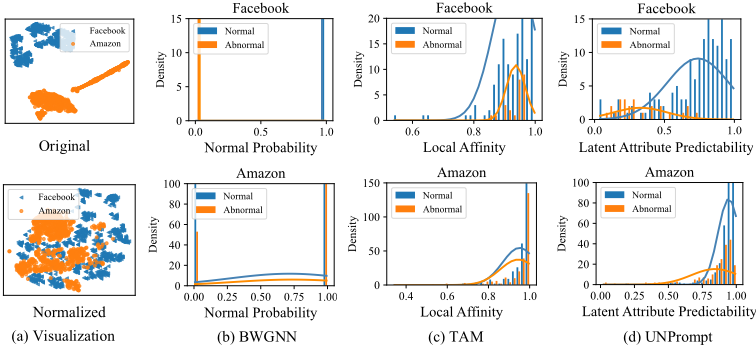
To address these challenges, we propose UNPrompt, a novel generalist GAD approach that learns Unified Neighborhood Prompts on a single auxiliary graph dataset and then effectively generalizes to directly detect anomalies in other graph datasets under a zero-shot setting. The key insight in UNPrompt is that i) the predictability of latent node attributes can serve as a generalized anomaly measure and ii) graph-agnostic normal and abnormal patterns can be learned via latent node attribute prediction in a properly normalized node attribute space. UNPrompt achieves this through two main modules, including coordinate-wise normalizationbased node attribute unification and neighborhood prompt learning. The former module aligns the dimensionality of node attributes across graphs and transforms the semantics into a common space via coordinate-wise normalization, as shown in Figure 1(a). In this way, the diverse distributions of node attributes are calibrated into the same semantic space. On the other hand, the latter module focuses on modeling graph-agnostic normal and abnormal patterns across different graph datasets. This is achieved in UNPrompt by learning generalized graph prompts in the normalized attributes of the neighbors of a target node via a latent node attribute prediction task. In doing so, UNPrompt, being trained on a single graph with a small GNN, can yield effective anomaly scores for detecting anomalous nodes in diverse unseen graphs without any re-training, as shown in Figure 1(b)-(d).
Overall, the main contributions of this paper are summarized as follows. (1) We propose a novel zero-shot generalist GAD approach, UNPrompt. To the best of our knowledge, this is the first method that exhibits effective zero-shot GAD performance across various graph datasets. There is concurrent work on generalist GAD [Liu et al., 2024], but it can only work under a few-shot setting. (2) By unifying the heterogeneous distributions in the node attributes across different graphs, we further introduce a novel neighborhood prompt learning module that utilizes a neighborhood-based latent node attribute prediction task to learn generalized prompts. This enables the zero-shot GAD of UNPrompt across different graphs. (3) Extensive experiments on real-world GAD datasets show that UNPrompt significantly outperforms stateof-the-art competing methods under the zero-shot generalist GAD. (4) We show that UNPrompt can also work in the conventional one-model-for-one-dataset setting, outperforming state-of-the-art models in this popular GAD setting.
2 RelatedWork
Graph Anomaly Detection. Existing GAD methods can be roughly categorized into unsupervised and supervised approaches [Qiao et al., 2024]. The unsupervised methods are typically built using data reconstruction, self-supervised learning, and learnable graph anomaly measures [Qiao et al., 2024; Liu et al., 2022]. The reconstruction-based approaches like DOMINANT [Ding et al., 2019] and AnomalyDAE [Fan et al., 2020] aim to capture the normal patterns in the graph, where the reconstruction error in both graph structure and attributes is utilized as the anomaly score. CoLA [Liu et al., 2021b] and SL-GAD [Zheng et al., 2021] are representative self-supervised learning methods assuming that normality is reflected in the relationship between the target node and its contextual nodes. The graph anomaly measure methods typically leverage the graph structure-aware anomaly measures to learn intrinsic normal patterns for GAD, such as node affinity in TAM [Qiao and Pang, 2023]. In contrast to the unsupervised approaches, the supervised approaches have shown substantially better detection performance in recent years due to the incorporation of labeled anomaly data [Liu et al., 2021a; Chai et al., 2022]. Most supervised methods concentrate on the design of propagation mechanisms and spectral feature transformations to address the notorious over-smoothing issues [Tang et al., 2022; Gao et al., 2023; Chai et al., 2022]. Although both approaches can be adapted for zero-shot GAD by directly applying the trained GAD models to the target datasets, they struggle to capture generalized normal and abnormal patterns for GAD across different graph datasets. There are some works on cross-domain GAD [Ding et al., 2021; Wang et al., 2023] that aim to transfer knowledge from a labeled graph dataset to a target dataset, but it is a fundamentally different problem from generalist GAD since cross-domain GAD requires training on both source and target graph datasets.
Graph Prompt Learning. Prompt learning, initially developed in natural language processing, seeks to adapt largescale pre-trained models to different downstream tasks by incorporating learnable prompts while keeping the pre-trained models frozen [Liu et al., 2023b]. Specifically, it designs task-specific prompts capturing the knowledge of the corresponding tasks and enhances the compatibility between inputs and pre-trained models to improve the pre-trained models in downstream tasks. Recently, prompt learning has been explored in graphs to unify multiple graph tasks [Sun et al., 2023; Liu et al., 2023c] or improve the transferability of graph models on the datasets across the different domains [Li et al., 2024; Zhao et al., 2024] which optimize the prompts with labeled data of various downstream tasks [Fang et al., 2024; Liu et al., 2023c]. Although being effective in popular graph learning tasks like node classification and link prediction, they are inapplicable to generalist GAD due to the unsupervised nature and/or irregular distributions of anomalies.
Generalist Anomaly Detection. Generalist AD has been very recently emerging as a promising solution to tackle sample efficiency and model generalization problems in AD. There have been a few studies on non-graph data that have large pre-trained models to support the generalized pattern learning, such as image generalist AD [Zhou et al., 2024; Zhu and Pang, 2024]. However, it is a very challenging task for graph data due to the lack of such pre-trained models. Recently, a concurrent approach, ARC [Liu et al., 2024], introduces an effective framework that leverages in-context learning to achieve generalist GAD without relying on large pre-trained GNNs. Unlike ARC which focuses on a few-shot GAD setting, i.e., requiring the availability of some labeled nodes in the target testing graph dataset, we tackle a zero-shot GAD setting, assuming no access to any labeled data during inference stages.
3 Methodology
3.1 Preliminaries
Notations. Let G = (V, E) be an attributed graph with N nodes, where V = {v1, v2, . . . , vN} represents the node set and E is the edge set. The attributes of nodes can be denoted as X = [x1, x2, . . . , xN]T ∈ RN×d and the edges between nodes can be presented by an adjacency matrix A ∈ {0, 1}N×N with Aij = 1 if there is an edge between vi and vj and Aij = 0 otherwise. For simplicity, the graph can be represented as G = (A,X). In GAD, the node set can be divided into a set of normal nodes Vn and a set of anomalous nodes Va. Typically, the number of normal nodes is significantly larger than the anomalous nodes, i.e., |Vn| ≫ |Va|. Moreover, the anomaly labels can be denoted as y ∈ {0, 1}N with yi = 1 if vi ∈ Va and yi = 0 otherwise.
Conventional GAD. Conventional GAD typically focuses on model training and anomaly detection on the same graph. Specifically, given a graph G, an anomaly scoring model f : G → R is optimized on G in a supervised or unsupervised manner. Then, the model is used to detect anomalies within the same graph. The model is expected to generate higher anomaly scores for abnormal nodes than normal nodes, i.e., f(vi) < f(vj) if vi ∈ Vn and vj ∈ Va.
Generalist GAD. Generalist GAD aims to learn a generalist model f on a single training graph so that f can be directly applied to different target graphs across diverse domains without any fine-tuning or re-training. More specifically, the model is optimized on Gtrain with the corresponding anomaly labels ytrain. After model optimization, the learned f is utilized to detect anomalies within different unseen target graphs Ttest = {G (1) test , . . . , G (n) test } which has heterogeneous attributes and/or structures to Gtrain, i.e., Gtrain ∩Ttest = ∅. Depending on whether labeled nodes of the target graph are provided during inference, the generalist GAD problem can be further divided into two categories, i.e., few-shot and zeroshot settings. We focus on the zero-shot setting where the generalist models cannot get access to any labeled data of the testing graphs during both training and inference.
3.2 Overview of UNPrompt
The framework of UNPrompt is illustrated in Figure 2, which consists of two main modules, coordinate-wise normalization-based node attribute unification and neighborhood prompt learning. For all graphs, the attribute unification aligns the dimensionality of node attributes and transforms the semantics into a common space. Then, in the normalized space, the generalized latent attribute prediction task is performed with the neighborhood prompts to learn generalized GAD patterns. Specifically, UNPrompt aims to maximize the predictability of the latent attributes of normal nodes while minimizing those of abnormal nodes. In this paper, we evaluate the predictability via the similarity. In doing so, the graphagnostic normal and abnormal patterns are incorporated into the prompts. During inference, the target graph is directly fed into the learned models after node attribute unification without any re-training or labeled nodes of the graph. For each node, the predictability of latent node attributes is directly used as the normal score for final anomaly detection.
3.3 Node Attribute Unification
Graphs from different distributions and domains significantly differ in the dimensionality and semantics of node attributes.
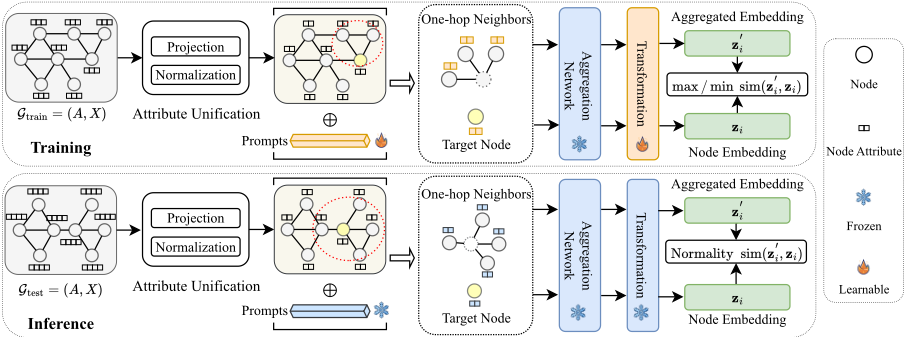
The premise of developing a generalist GAD model is to unify the dimensionality and semantics of node attributes into the same space. To address this issue, we propose a simple yet effective node attribute unification module that consists of feature projection and coordinate-wise normalization.
Feature Projection. To address the inconsistent attribute dimensions across graphs, various feature projection methods can be utilized, such as singular value decomposition [Stewart, 1993] (SVD) and principal component analysis [Abdi and Williams, 2010] (PCA). Formally, given the attribute matrix X(i) ∈ RN (i)×d(i) of any graph G (i) from Gtrain ∪ Ttest, we transform it into ˜X(i) ∈ RN (i)×d′ with the common dimensionality of d′ ,
Coordinate-wise Normalization. Besides the inconsistent attribute dimensionality, the divergent node attribute semantics and distributions of different graphs pose significant challenges for generalist GAD. A recent study [Li et al., 2023] has demonstrated that semantic differences across datasets are mainly reflected in the distribution shifts and calibrating the distributions into a common frame helps learn more generalized AD models. Inspired by this, we propose to use coordinate-wise normalization to align the semantics and unify the distributions across graphs. Specifically, the transformed attribute matrix ˜X(i) is shifted and re-scaled to have mean zeros and variance ones via the following equation:
where µ(i) = [µ(i) 1 , . . . , µ(i) d′ ] and σ(i) = [σ(i) 1 , . . . , σ(i) d′ ] are the coordinate-wise mean and variance of ˜X(i) of the graph G (i) . In this way, the distributions of normalized attributes along each dimension are the same within and across graphs, as shown in Figure 1(a). This helps to capture the generalized normal and abnormal patterns for generalist GAD.
3.4 Neighborhood Prompt Learning
Latent Node Attribute Predictability as Anomaly Score. In this paper, we reveal that the predictability of latent node attributes can serve as a generalized anomaly measure, and highly generalized normal and abnormal graph patterns can be learned via latent node attribute prediction in the normalized attribute space with neighborhood prompts. The key intuition of this anomaly measure is that normal nodes tend to have more connections with normal nodes of similar attributes due to prevalent graph homophily relations, resulting in a more homogeneous neighborhood in the normal nodes [Qiao and Pang, 2023]. By contrast, the presence of anomalous connections and/or attributes makes abnormal nodes deviate significantly from their neighbors. Therefore, for a target node, its latent attributes (i.e., node embedding) are more predictable based on the latent attributes of its neighbors if the node is a normal node, compared to abnormal nodes. The neighborhood-based latent attribute prediction is thus used to measure the normality for GAD. As shown in our experiments (see Figures 1(b)-(d) and Tables 1), it is a generalized anomaly measure that works effectively across graphs. However, due to the existence of irrelevant and noisy attribute information in the original attribute space, the attribute prediction is not as effective as expected in the simply projected space. To address this issue, we propose to learn discriminative prompts via the latent attribute prediction task to enhance the effectiveness of this anomaly measure.
To achieve this, we first design a simple GNN g, a neighborhood aggregation network, to generate the aggregated neighborhood embedding of each target node. Specifically, given a graph G = (A, ¯X), the aggregated neighborhood embeddings for each node are obtained as follows:
where ˜ Z is the aggregated representation of neighbors, ˜ A = (D)-1A is the normalized adjacency matrix with D being a diagonal matrix and its elements Dkk = ∑j Akj, and W is the learnable parameters. Compared to conventional GNNs such as GCN [Kipf and Welling, 2016] and SGC [Wu et al., 2019], we do not require ˜ A to be self-looped and symmetrically normalized as we aim to obtain the aggregated representation of all the neighbors for each node. To design the latent node attribute prediction task, we further obtain the latent attributes of each node as follows:
where Z serves as the prediction ground truth for the latent attribute prediction task. The adjacency matrix A is discarded to avoid carrying neighborhood-based attribute information into Z which would lead to ground truth leakage in this prediction task. We further propose to utilize the cosine similarity to measure this neighborhood-based latent attribute predictability for each node:
where z and ˜zi are the i-th node embeddings in Z and ˜ Z respectively. A higher similarity denotes that the target node can be well predicted by its neighbors and indicates the target is normal with a higher probability. Therefore, we directly utilize the similarity to measure the normal score of the nodes.
GNN Pre-training. To build generalist models, we pretrain the above neighborhood aggregation network via graph contrastive learning due to the ability to obtain robust and transferable models [You et al., 2020; Zhu et al., 2020] across graphs. Without pre-training, the dataset-specific knowledge would be captured by the model as it is directly optimized based on the neighborhood-based latent attribute prediction of normal and abnormal nodes, limiting the generalizability of the model to other graphs.
Neighborhood Prompting via Latent Attribute Prediction. After the pre-training, we aim to further learn more generalized normal and abnormal patterns via prompt tuning. Thus, we devise learnable prompts appended to the attributes of the neighboring nodes of the target nodes, namely neighborhood prompts, for learning robust and discriminative patterns that can detect anomalous nodes in different unseen graphs without any re-training during inference.
Specifically, neighborhood prompting aims to learn some prompt tokens that help maximize the neighborhood-based latent prediction of normal nodes while minimizing that of abnormal nodes simultaneously. To this end, the prompt is designed as a set of shared and learnable tokens that can be incorporated into the normalized node attributes. Formally, the neighborhood prompts are represented as P = [p1, . . . , pk]T ∈ RK×d′ where K is the number of vectorbased tokens pi. For each node in G = (A, ¯X), the node attributes in the unified feature space are augmented by the weighted combination of these tokens, with the weights obtained fromK learnable linear projections:
where αj denotes the importance score of the token pj in the prompt and wj is a learnable projection. For convenience, we denote the graph modified by the graph prompt as ˜ G = (A, ¯X + P). Then, ˜ G is fed into the frozen pretrained model g to obtain the corresponding aggregated embeddings ˜ Z and node latent attributes Z via Eq.(3) and Eq.(4) respectively to measure the attribute predictability. To further enhance the representation discrimination, a transformation layer h is applied on the learned ˜ Z and Z to transform them into a more anomaly-discriminative feature space,
The transformed representations are then used to measure the latent node attribute predictability with Eq.(5). To optimize P and h, we employ the following training objective,
where ℓ(zi, ˜zi) = -sim(zi, ˜zi) if yi = 0, and ℓ(zi, ˜zi) = sim(zi, ˜zi) if yi = 1.
3.5 Training and Inference of UNPrompt
Training. Given Gtrain, a neighborhood aggregation network g is optimized via graph contrastive learning. Then, the neighborhood prompts P and the transformation layer h are optimized to capture the graph-agnostic normal and abnormal patterns while keeping the pre-trained model g frozen. In this way, the transferable knowledge of the pre-trained g is maintained, while the neighborhood prompt learning helps learn the generalized normal and abnormal patterns.
Inference. During inference, given G (i) test ∈ Ttest, the node attributes are first aligned. Then, the test graph G (i) test is augmented with the learned neighborhood prompt P and fed into the model g and the transformation layer h to obtain the neighborhood aggregated representations and the latent node attributes. Finally, the similarity (Eq.(5)) is used as the normal score for anomaly detection. Note that the inference does not require any further re-training and labeled nodes of G (i) test .
4 Time Complexity Analysis
UNPrompt consists of GNN pre-training, neighborhood prompt learning, and the transformation layer. The overall time complexity is O(4E1(|A|dh + Ndhd′ + 6Nd2h ) + 2E2(|A|dh+Ndhd′ +2KNd′ +Nd2h )), where dh is the number of hidden units, |A| returns of the number of edges of the Gtrain, N is the number of nodes, d′ represents the predefined dimensionality of node attributes, E1 is the number of pretraining epoch, K is the size of prompt and E2 is the training epochs for prompt learning. Theoretical and empirical results on computational cost are presented in the supplementary 1 .
5 Experiments
5.1 Performance on Zero-shot Generalist GAD
Datasets. We evaluate UNPrompt on several real-world GAD datasets from diverse social networks, online shopping co-review networks, and co-purchase networks. Specifically, the social networks include Facebook [Xu et al.,
1 https://github.com/mala-lab/UNPrompt/blob/main/ UNPrompt Supplementary.pdf
| Metric | Method | Amazon | Dataset YelpChi | Aamzon-all | YelpChi-all | Disney | Avg. | ||
|---|---|---|---|---|---|---|---|---|---|
| Unsupervised Methods | |||||||||
| AnomalyDAE (ICASSP'20) CoLA (TNNLS'21) HCM-A (ECML-PKDD'22) TAM (NeurIPS'23) GADAM (ICLR'24) | 0.5818±0.039 0.4580±0.054 0.4784±0.005 0.4720±0.005 0.6646±0.063 | 0.5016±0.032 0.4623±0.005 0.5387±0.041 0.5725±0.004 0.4532±0.024 | 0.7785±0.058 0.3924±0.041 0.5782±0.048 0.4867±0.028 0.3652±0.052 | 0.4837±0.094 0.4907±0.017 0.5000±0.000 0.5035±0.014 0.3376±0.012 | 0.7228±0.023 0.4091±0.052 0.5056±0.059 0.7543±0.002 0.5959±0.080 | 0.5002±0.018 0.4879±0.010 0.5023±0.005 0.4216±0.002 0.4829±0.016 | 0.4853±0.003 0.4696±0.065 0.2014±0.015 0.4773±0.003 0.4288±0.023 | 0.5791 0.4529 0.4721 0.5268 0.4755 | |
| AUROC | Supervised Methods | ||||||||
| GCN (ICLR'17) GAT (ICLR'18) BWGNN (ICML'22) GHRN (WebConf'23) XGBGraph (NeurIPS'23) GraphPrompt (WebConf'23) | 0.5988±0.016 0.4981±0.008 0.4769±0.020 0.4560±0.033 0.4179±0.000 0.4904±0.001 0.7525±0.016 | 0.5645±0.000 0.5000±0.025 0.5208±0.016 0.5253±0.006 0.4601±0.000 0.4677±0.001 0.5337±0.002 | 0.2232±0.074 0.4521±0.101 0.4815±0.108 0.5318±0.038 0.5373±0.000 0.6135±0.008 0.8860±0.007 | 0.5366±0.019 0.5871±0.016 0.5538±0.027 0.5524±0.020 0.5722±0.000 0.3935±0.002 | 0.7195±0.002 0.5005±0.012 0.3648±0.050 0.3382±0.085 0.7950±0.000 0.3215±0.001 0.7962±0.022 | 0.5486±0.001 0.4802±0.004 0.5282±0.015 0.5125±0.016 0.4945±0.000 0.4976±0.000 | 0.5000±0.000 0.5175±0.054 0.6073±0.026 0.5336±0.030 0.6692±0.000 0.5192±0.002 | 0.5273 0.5051 0.5048 0.4928 0.5637 0.4719 0.6790 | |
| Unsupervised Methods | |||||||||
| AUPRC | UNPrompt (Ours) AnomalyDAE (ICASSP'20) CoLA (TNNLS'21) HCM-A (ECML-PKDD'22) TAM (NeurIPS'23) GADAM (ICLR'24) GCN (ICLR'17) GAT (ICLR'18) BWGNN (ICML'22) GHRN (WebConf'23) XGBGraph (NeurIPS'23) GraphPrompt (WebConf'23) UNPrompt (Ours) | 0.0833±0.015 0.0669±0.002 0.0669±0.002 0.0666±0.001 0.1562±0.103 0.0891±0.007 0.0688±0.002 0.0652±0.002 0.0633±0.003 0.0536±0.000 0.0661±0.000 0.1602±0.013 | 0.0327±0.004 0.0391±0.004 0.0391±0.004 0.0413±0.001 0.0293±0.001 0.0439±0.000 0.0329±0.002 0.0389±0.003 0.0407±0.002 0.0330±0.000 0.0334±0.000 0.0351±0.000 | 0.6064±0.031 0.1189±0.014 0.1189±0.014 0.1240±0.014 0.0830±0.005 Supervised 0.1109±0.020 0.1009±0.017 0.2241±0.046 0.1965±0.059 0.2256±0.000 0.2014±0.004 0.6406±0.026 | 0.5875±0.016 0.0624±0.017 0.0511±0.000 0.0511±0.000 0.0524±0.002 0.0352±0.001 Methods 0.0648±0.009 0.0810±0.005 0.0708±0.018 0.0661±0.010 0.0655±0.000 0.0382±0.000 0.0712±0.008 | 0.1921±0.026 0.0861±0.019 0.0861±0.019 0.1736±0.004 0.1595±0.121 0.1536±0.002 0.0696±0.001 0.0586±0.003 0.0569±0.006 0.2307±0.000 0.0666±0.000 0.2430±0.028 | 0.5558±0.012 0.1484±0.009 0.1466±0.003 0.1466±0.003 0.1240±0.001 0.1371±0.006 0.1735±0.000 0.1400±0.002 0.1605±0.005 0.1505±0.005 0.1449±0.000 0.1542±0.000 0.1810±0.012 | 0.6412±0.030 0.0566±0.000 0.0701±0.023 0.0355±0.001 0.0628±0.001 0.0651±0.012 0.0484±0.000 0.0530±0.004 0.0624±0.003 0.0519±0.003 0.1215±0.000 0.0617±0.001 0.1236±0.031 | 0.1688 0.0827 0.0777 0.0921 0.0951 0.0977 0.0780 0.0972 0.0894 0.1250 0.0888 0.2078 |
2022], Reddit [Kumar et al., 2019] and Weibo [Kumar et al., 2019]. The co-review networks consist of Amazon [McAuley and Leskovec, 2013], YelpChi [Rayana and Akoglu, 2015], Amazon-all and YelpChi-all. Disney [S´anchez et al., 2013] is a co-purchase network.
Competing Methods. Since there is no zero-shot generalist GADmethod, a set of state-of-the-art (SotA) unsupervised and supervised competing methods are employed for comparison. The unsupervised methods comprise reconstructionbased AnomalyDAE [Fan et al., 2020], contrastive learningbased CoLA [Liu et al., 2021b], hop prediction-based HCMA [Huang et al., 2022], local affinity-based TAM [Qiao and Pang, 2023] and GADAM [Chen et al., 2024]. Supervised methods include two conventional GNNs - GCN [Kipf and Welling, 2016] and GAT [Veliˇckovi´c et al., 2017] - and three SotA GAD GNNs - BWGNN [Tang et al., 2022], GHRN [Gao et al., 2023] and XGBGraph [Tang et al., 2023]. As a graph prompting method, GraphPrompt [Liu et al., 2023c] is also used. Following [Liu et al., 2024; Qiao and Pang, 2023; Qiao et al., 2024], two widely-used metrics, AUROC and AUPRC, are used to evaluate the performance of all methods. For both metrics, the higher value denotes the better performance. Moreover, for each method, we report the average performance with standard deviations after 5 independent runs with different random seeds.
Implementation Details. For a fair comparison, the common dimensionality is set to eight for all methods, and SVD is used for feature projection. The number of GNN layers is set to one and the number of hidden units is 128. The transformation layer is implemented as a one-layer MLP with the same number of hidden units. The size of the neighborhood prompt is set to one. Results for other hyperparameter settings are presented in the supplementary. For all baselines, their recommended optimization and hyperparameter settings are used. Note that GraphPrompt is a graph prompting method. To adapt it for generalist GAD, after pretraining, we further perform the prompt learning in the source graph for supervised GAD. Then, the pre-trained model and learned prompts are used for generalist anomaly detection. UNPrompt and all competing methods are trained on Facebook and then directly tested on the other GAD datasets. Facebook is used in the training since its anomaly patterns are more generic.
Main Results. The results of all methods are presented in Table 1 and we can have the following observations. (1) Under the proposed generalist GAD scenario where a model is trained on a single dataset and evaluated on seven other datasets, all the competing baselines fail to work well, demonstrating that it is very challenging to build a generalist GAD model that generalizes across different datasets under the zero-shot setting. (2) For supervised methods, the simple GCN achieves better performance than the specially designed GAD GNNs. This can be attributed to more dataset-specific knowledge being captured in these specialized GAD models, limiting their generalization capacity to the unseen testing graphs. (3) Unsupervised methods perform more stably than supervised methods across the target graphs. This is because the unsupervised objectives are closer to the shared anomaly patterns across graphs compared to the supervised ones, especially for TAM which employs a fairly generalized local affinity-based objective for GAD. (4) Despite being a graph prompting method, GraphPrompt fails to achieve promising performance for zero-shot generalist GAD. This is because no label information is provided and no further model optimization is performed during the inference. (5) The proposed UNPrompt demonstrates strong and stable generalist GAD capacity across graphs from different distributions and domains. Specifically, UNPrompt achieves the best AUROC performance on 5 out of 7 datasets, and the average performance outperforms the best-competing method by over 9%. The superiority is attributed to i) the proposed coordinate-wise normalization effectively aligns the features across graphs, and ii) the shared generalized normal and abnormal patterns are well captured in the neighborhood prompts.
| Method | Amazon | YelpChi | Avg. | ||
|---|---|---|---|---|---|
| UNPrompt | 0.7525 | 0.5337 | 0.8860 | 0.5875 | 0.6899 |
| w/o Normalization | 0.4684 | 0.5006 | 0.1889 | 0.5620 | 0.4300 |
| w/o Pre-training | 0.5400 | 0.5233 | 0.5658 | 0.4672 | 0.5241 |
| w/o Prompt | 0.5328 | 0.5500 | 0.4000 | 0.4520 | 0.4837 |
| w/o Transformation | 0.7331 | 0.5556 | 0.7406 | 0.5712 | 0.6501 |
Ablation Study. To evaluate the importance of each component in UNPrompt, we design four variants, i.e., w/o coordinate-wise normalization, w/o graph contrastive learning-based pre-training, w/o neighborhood prompts, and w/o transformation layer. The results of these variants are reported in the Table 2. Due to the page limits, four datasets are used, including Amazon, Reddit, Weibo and YelpChi. From the table, we can see that all four components contribute to the overall superior performance of UNPrompt. More specifically, (1) without the coordinate-wise normalization, the method fails to calibrate the distributions of diverse node attributes into a common space, leading to large performance drop across all datasets. (2) Besides the semantics alignment, the graph contrastive learning-based pre-training ensures our GNN network is transferable to other graphs instead of overfitting to the training graph. As expected, the performance of the variant without pre-training also drops significantly. (3) If the neighborhood prompts are removed, the learning of latent node attribute prediction is ineffective for capturing generalized normal and abnormal patterns. (4) The variant without the transformation layer achieves inferior performance on nearly all the datasets, demonstrating the importance of mapping the features into a more anomaly-discriminative space.
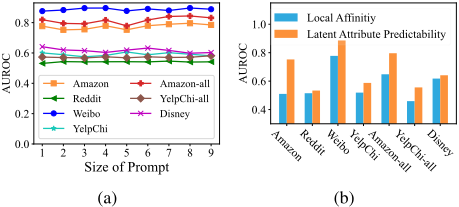
Sensitivityw.r.t theNeighborhoodPrompt Size. We evaluate the sensitivity of UNPrompt w.r.t the size of the neighborhood prompts i.e., K. We vary K in the range of [1, 9] and report the results in Figure 3(a). It is clear that the performances on Reddit, Weibo and YelpChi-all remain stable with varying sizes of neighborhood prompts while the other datasets show slight fluctuation, demonstrating that the generalized normal and abnormal patterns can be effectively captured in our neighborhood prompts even with a small size.
Prompt learning using latent attribute prediction vs. alternative graph anomaly measures. To further justify the effectiveness of latent attribute predictability on learning generalized GAD patterns in our prompt learning module, we compare our learnable anomaly measure to the recently proposed anomaly measure, local node affinity [Qiao and Pang, 2023]. All modules of UNPrompt are fixed, with only the latent attribute prediction task replaced as the maximization of local affinity as in TAM. The results are presented in Figure 3(b). We can see that the latent attribute predictability consistently and significantly outperforms the local affinitybased measure across all graphs, demonstrating its superiority in learning generalized patterns for generalist GAD.
| Method | Amazon | Dataset YelpChi | Amazon-all | YelpChi-all | Avg. | ||
|---|---|---|---|---|---|---|---|
| iForest | 0.5621 | 0.5382 | 0.4363 | 0.4120 | 0.1914 | 0.3617 | 0.4169 |
| ANOMALOUS | 0.4457 | 0.9021 | 0.5387 | 0.4956 | 0.3230 | 0.3474 | 0.5087 |
| DOMINANT | 0.5996 | 0.5677 | 0.5555 | 0.4133 | 0.6937 | 0.5390 | 0.5615 |
| CoLA | 0.5898 | 0.8434 | 0.6028 | 0.4636 | 0.2614 | 0.4801 | 0.5402 |
| SL-GAD | 0.5937 | 0.7936 | 0.5677 | 0.3312 | 0.2728 | 0.5551 | 0.5190 |
| HCM-A | 0.3956 | 0.7387 | 0.4593 | 0.4593 | 0.4191 | 0.5691 | 0.5069 |
| ComGA | 0.5895 | 0.6055 | 0.5453 | 0.4391 | 0.7154 | 0.5352 | 0.5716 |
| TAM | 0.7064 | 0.9144 | 0.6023 | 0.5643 | 0.8476 | 0.5818 | 0.7028 |
| UNPrompt (Ours) | 0.7335 | 0.9379 | 0.6067 | 0.6223 | 0.8516 | 0.6084 | 0.7267 |
5.2 Performance in Unsupervised GAD
UNPrompt can also be easily adapted to conventional unsupervised GAD. Experimental details are provided in the supplementary. The results of comparing UNPrompt to SotA unsupervised methods are presented in Table 3. Despite being a generalist method, UNPrompt also works very well as a specialized GAD model. UNPrompt substantially outperforms all the baselines on all datasets. Particularly, the average performance of UNPrompt surpasses the best-competing method by over 2%, showing that the latent node attribute predictability is a generalized GAD measure that also holds for different graphs under unsupervised settings.
6 Conclusion
In this paper, we propose a novel zero-shot generalist GAD method that trains one detector on a single dataset and can effectively generalize to other unseen target graphs without any further re-training or labeled nodes of target graphs during inference. The attribute inconsistency and the absence of generalized anomaly patterns are the main obstacles for generalist GAD. To address these issues, two main modules are proposed, i.e., coordinate-wise normalization-based attribute unification and neighborhood prompt learning. The first module aligns node attribute dimensionality and semantics, while the second module captures generalized normal and abnormal patterns via the neighborhood-based latent node attribute prediction. Extensive experiments on both generalist and unsupervised GAD demonstrate the effectiveness of UNPrompt.
Acknowledgments
This research is supported by ARC under Grant DP240101349, the Ministry of Education, Singapore under its Tier-1 Academic Research Fund (24-SIS-SMU008), A*STAR under its MTC YIRG Grant (M24N8c0103), and the Lee Kong Chian Fellowship (T050273).
Contribution Statement
† denotes that Chaoxi Niu and Hezhe Qiao are co-first authors and contribute equally to this work.
@inproceedings{ijcai2025p359,
  title     = {Zero-shot Generalist Graph Anomaly Detection with Unified Neighborhood Prompts},
  author    = {Niu, Chaoxi and Qiao, Hezhe and Chen, Changlu and Chen, Ling and Pang, Guansong},
  booktitle = {Proceedings of the Thirty-Fourth International Joint Conference on
               Artificial Intelligence, {IJCAI-25}},
  publisher = {International Joint Conferences on Artificial Intelligence Organization},
  editor    = {James Kwok},
  pages     = {3226--3234},
  year      = {2025},
  month     = {8},
  note      = {Main Track},
  doi       = {10.24963/ijcai.2025/359},
  url       = {https://doi.org/10.24963/ijcai.2025/359},
}
TY - CPAPER TI - Zero-shot Generalist Graph Anomaly Detection with Unified Neighborhood Prompts AU - Niu, Chaoxi AU - Qiao, Hezhe AU - Chen, Changlu AU - Chen, Ling AU - Pang, Guansong T2 - Proceedings of the Thirty-Fourth International Joint Conference on Artificial Intelligence, IJCAI-25 PB - International Joint Conferences on Artificial Intelligence Organization PY - 2025 SP - 3226 EP - 3234 DO - 10.24963/ijcai.2025/359 UR - https://doi.org/10.24963/ijcai.2025/359 ER -Copied
Machine-readable versions of this paper, for tools and AI agents:





