
Multi-Dimensional Single-Peaked Consistency and Its Approximations
Proceedings of the Twenty-Third International Joint Conference on Artificial Intelligence. Pages 375-381.
© 2013 International Joint Conferences on Artificial Intelligence
Abstract
Single-peakedness is one of the most commonly used domain restrictions in social choice. However, the extent to which agent preferences are single-peaked in practice, and the extent to which recent proposals for approximate single-peakedness can further help explain voter preferences, is unclear. In this article, we assess the ability of both single-dimensional and multi-dimensional approximations to explain preference profiles drawn from several real-world elections. We develop a simple branch-and-bound algorithm that finds multi-dimensional, single-peaked axes that best fit a given profile, and which works with several forms of approximation. Empirical results on two election data sets show that preferences in these elections are far from single-peaked in any one-dimensional space, but are nearly single-peaked in two dimensions. Our algorithms are reasonably efficient in practice, and also show excellent anytime performance.
- [Ballester and Haeringer, 2011] M. Angel Ballester and G. Haeringer. A characterization of the single-peaked do- 6 Our own preliminary experiments with spatial models show that 2D models fit the Irish voting data well. main. Social Choice and Welfare, 36(2):305-322, 2011.
- [Barberà et al., 1993] S. Barberà, F. Gul, and E. Stacchetti. Generalized median voter schemes and committees. Jour- nal of Economic Theory, 61(2):262-289, 1993.
- [Barberà, 2010] S. Barberà. Strategy-proof social choice. In K. J. Arrow, A. K. Sen, and K. Suzumura, eds., Hand- book of Social Choice and Welfare, volume 2, pp.731-832.
- [Bartholdi and Trick, 1986] J. Bartholdi and M. A. Trick. Stable matching with preferences derived from a psycho- logical model. Operations Research Letters, 5(4):165- 169, 1986.
- [Black, 1948] D. Black. On the rationale of group decision- making. Journal of Political Economy, 56(1):23-34, 1948.
- [Bradley and Terry, 1952] R. A. Bradley and M. E. Terry. Rank analysis of incomplete block designs. Biometrika, 39:324-345, 1952.
- [Conitzer, 2009] V. Conitzer. Eliciting single-peaked pref- erences using comparison queries. Journal of Artificial Intelligence Research, 35:161-191, 2009.
- [Dokow et al., 2012] E. Dokow, M. Feldman, R. Meir, and I. Nehama. Mechanism design on discrete lines and cycles. In Proc. 13th ACM Conference on Electronic Commerce (EC'12), pp.423-440, Valencia, Spain, 2012.
- [Erdélyi et al., 2012] G. Erdélyi, M. Lackner, and A. Pfan- dler. The complexity of nearly single-peaked consis- tency. In Proc. 4th Intl. Workshop on Computational So- cial Choice (COMSOC-2012), Kraków, Poland, 2012.
- [Escoffier et al., 2008] B. Escoffier, J. Lang, and M. Öztürk. Single-peaked consistency and its complexity. In Proc. 18th European Conference on Artificial Intelligence (ECAI-08), pp.366-370, Patras, Greece, 2008.
- [Escoffier et al., 2011] B. Escoffier, L. Gourvès, T. N. Kim, F. Pascual, and O. Spanjaard. Strategy-proof mecha- nisms for facility location games with many facilities. In Proc. 2nd Intl. Conference on Algorithmic Decision The- ory (ADT-11), pp.67-81, Piscataway, NJ, 2011.
- [Faliszewski et al., 2011] P. Faliszewski, E. Hemaspaandra, and L. A. Hemaspaandra. The complexity of manipula- tive attacks in nearly single-peaked electorates. In Proc. 13th Conference on Theoretical Aspects of Rationality and Knowledge (TARK-11), pp.228-237, Groningen, The Netherlands, 2011.
- [Fotakis and Tzamos, 2010] D. Fotakis and C. Tzamos. Winner-imposing strategyproof mechanisms for multiple facility location games. In Proc. 6th Intl. Workshop on In- ternet and Network Economics (WINE-10), pp.234-245, Stanford, CA, 2010.
- [Galand et al., 2012] L. Galand, D. Cornaz, and O. Span- jaard. Bounded single-peaked width and proportional rep- resentation. In Proc. 4th Intl. Workshop on Computational Social Choice (COMSOC-2012), Kraków, Poland, 2012.
- [Gibbard, 1973] A. Gibbard. Manipulation of voting schemes: A general result. Econometrica, 41(4):587-601, 1973.
- [Gormley and Murphy, 2007] I. C. Gormley and T. B. Mur- phy. A latent space model for rank data. In E. Airoldi, D. Blei, S. Fienberg, A. Goldenberg, E. Xing, and A. Zheng, eds., Statistical Network Analysis: Models, Is- sues, and New Directions, pp.90-102. Springer, 2007.
- [Hinich, 1978] M. J. Hinich. Some evidence on non-voting models in the spatial theory of electoral competition. Pub- lic Choice, 33(2):83-102, 1978.
- [Hotelling, 1929] H. Hotelling. Stability in competition. The Economic Journal, 39(153):41-57, 1929.
- [Lu et al., 2010] P. Lu, X. Sun, Y. Wang, and Z. A. Zhu. Asymptotically optimal strategy-proof mechanisms for two-facility games. In Proc. 11th ACM Conference on Electronic Commerce (EC'10), pp.315-324, Cambridge, MA, 2010.
- [Luce, 1959] R. D. Luce. Individual Choice Behavior: A Theoretical Analysis. Wiley, 1959.
- [Moulin, 1980] H. Moulin. On strategy-proofness and single peakedness. Public Choice, 35(4):437-455, 1980.
- [Poole and Rosenthal, 1985] K. T. Poole and H. Rosenthal. A spatial model for legislative roll call analysis. American Journal of Political Science, 29(2):357-384, 1985.
- [Procaccia and Tennenholtz, 2009] A. D. Procaccia and M. Tennenholtz. Approximate mechanism design with- out money. In Proc. 10th ACM Conference on Electronic Commerce (EC'09), pp.177-186, Stanford, CA, 2009.
- [Regenwetter et al., 2006] M. Regenwetter, B. Grofman, A. A. J. Marley, and I. Tsetlin. Behavioral Social Choice: Probabilistic Models, Statistical Inference, and Applica- tions. Cambridge University Press, Cambridge, 2006.
- [Satterthwaite, 1975] M. A. Satterthwaite. Strategy- proofness and Arrow's conditions: Existence and corre- spondence theorems for voting procedures and social wel- fare functions. Journal of Economic Theory, 10:187-217, 1975.
- [Schummer and Vohra, 2007] J. Schummer and R. V. Vohra. Mechanism design without money. In Noam Nisan, Tim Roughgarden, Eva Tardos, and Vijay V. Vazirani, eds., Al- gorithmic Game Theory, pp.243-265. Cambridge Univer- sity Press, 2007.
- [Shepard, 1959] R. N. Shepard. Stimulus and response generalization: A stochastic model relating generaliza- tion to distance in psychological space. Psychometrika, 22(4):325-345, 1959.
- [Sui et al., 2013] X. Sui, C. Boutilier, and T. Sandholm. Analysis and optimization of multi-dimensional percentile mechanisms. In Proc. 23rd Intl. Joint Conference on Arti- ficial Intelligence (IJCAI-13), Beijing, 2013. to appear. IJCAI
References were extracted automatically from the PDF and may contain errors.
Full text extracted automatically from the PDF; figures, tables and equations may differ. The PDF is the version of record.
1 Introduction
Social choice deals with the aggregation of individual preferences to determine a consensus decision. However, mechanisms for social choice are complicated by computational, communication and incentive issues. For example, general impossibility results limit the ability to incentivize agents to truthfully reveal their preferences [Gibbard, 1973; Satterthwaite, 1975]. Fortunately, certain domain restrictions allow one to circumvent these issues. The widelystudied notion of single-peaked preferences [Black, 1948; Moulin, 1980] does just this. When options can be ordered along an axis, and an agent's preference for an option can be defined using the "distance" along this axis from her most preferred (or ideal) point, protocols such as the median mechanism reduce communication burden, ensure truthful reporting, and can often ease computational demands. Multi-dimensional single-peakedness, using multiple axes, also admits effective mechanisms [Barber`a et al., 1993; Barber`a, 2010].
While conceptually attractive, single-peakedness is a very strong assumption, one unlikely to hold in realistic settingse.g., elections with thousands of voters and more than a handful of candidates [Conitzer, 2009; Escoffier et al., 2008]. However, one might hope that preferences are approximately
Craig Boutilier
Dept. of Computer Science University of Toronto cebly@cs.toronto.edu
single-peaked, and thereby retain some of the advantages mentioned above. To this end, recent research has begun to investigate computational methods to test single-peakedness [Escoffier et al., 2008], and various forms of approximation (e.g., by deleting outlier candidates, clustering candidates, deleting voters, or adding additional axes) [Escoffier et al., 2008; Faliszewski et al., 2011; Erd´elyi et al., 2012; Galand et al., 2012]. These techniques, however, have focused on one-dimensional (1D) preferences, and have not been tested empirically to determine if these approximations can explain observed preferences in real-world elections or other social choice problems.
We address this issue in two ways. First, we test singlepeaked consistency, and several forms of approximation (in isolation and in combination) on two election data sets to see if these approximations have any empirical explanatory power. To do so, we develop a branch-and-bound (BB) algorithm to find the best (1D) axis given a preference profile, i.e., the ordering of candidates for which the greatest number of voters are single-peaked. The algorithm is easily extended to support various forms of approximation. While the best-axis problem is computationally difficult, our method works well in practice. We show that none of the forms of approximation proposed in the literature come close to explaining voter preferences in these elections: the best axis explains under 2.9% of voter preferences in one case and under 0.4% in the other; and even aggressive approximation improves this to only 50% and 25%, respectively. To address this, we extend our algorithm to find the best multi-dimensional ordering to explain a preference profile. Focusing on the two-dimensional (2D) case, we show that exact 2D-single-peakedness explains the datasets much better-without approximation, the best axis set explains over 65.7% and 47.3% of voter preferences, respectively; and with a very small degree of approximation, the 2D model explains almost all voters.
Apart from our algorithmic developments, our findings suggest that a focus on multi-dimensional rather than 1D models can greatly enhance the applicability of single-peaked models in practice. In so doing, one may be able to apply richer and more effective preference learning and mechanism design techniques to practical problems.
2 Single-peakedness and its Approximations
Our setting is standard in social choice. Let N = {1, . . . , n} be a set of agents (or voters) and C = {1, . . . , z} be a set of z options (or candidates). Each voter i ∈ N has a preference (or strict total order) ≻i over C, with a ≻i b meaning i prefers a to b. A preference profile ≻= {≻1, . . . ,≻n} reflects the joint preferences of all voters.
Single-peaked preferences. An axis A is any strict ordering <A of the candidates C. Intuitively, it represents an ordering of candidates relative to some salient quality, e.g., on the left-right political spectrum. In the 1D case, we assume a single axis. Each voter i has an ideal point τi = τ (≻i), which is her most preferred candidate: we say that i's preference are single-peaked w.r.t. axis A if a ≻i b whenever b <A a <A τi or τi <A a <A b. Informally, the "closer" a candidate is to i's ideal point τi, the more preferred it is. Notice that, given A, i's ideal point does not uniquely determine its full ranking ≻i. But when all voter preferences are single-peaked relative to a fixed axis A, mechanisms such as the median mechanism can be used, in which voters need only specify their ideal points.
The definition can be extended to m dimensions by assuming m distinct axes. Let Am = 〈A1, . . . ,Am〉 be such an m-dimensional space:
Definition 1 [Barber`a et al., 1993] i's preference order ≻i is single-peaked w.r.t. Am if a ≻i b whenever we have, for each axis Ad, d ≤ m, either b <Ad a <Ad τi or τi <Ad a <Ad b.
In other words, if a lies within the "bounding box" of τi and b, then a is preferred to b, since a is "closer" to the peak τi than b. For any a, b ∈ C satisfying this relationship, we refer to b = 〈τi, a, b〉 as a bounding box constraint on ≻i, and denote b1 = τi, b2 = a and b3 = b. This does not restrict i's preference for a and b if neither lies within the other's bounding box w.r.t. τi. As in the 1D case, a profile is mdimensional single-peaked w.r.t. Am if each voter preference ≻i is. In such a case, generalized median mechanisms can be used to truthfully elicit voter peaks and efficiently select outcomes [Barber`a et al., 1993; Barber`a, 2010].
Example 1 The following 2D example with five candidates c1, . . . , c5 illustrates the concept. Assume two axes, A1 = c4 <A1 c3 <A1 c1 <A1 c2 <A1 c5 and A2 = c1 <A2 c2 <A2 c4 <A2 c5 <A2 c3. The only bounding box constraint is 〈c1, c2, c5〉, which induces two constraints on voter preferences: (a) if τi = c1, then we must have c2 ≻i c5; and (b) if τi = c5, then we must have c2 ≻i c1.
Single-peaked approximations. While single-peakedness is a powerful concept, preference profiles are unlikely to be single-peaked in practice, especially as the number of voters or candidates becomes large. 1 Several forms of approximate single-peakedness have been proposed recently that allow limited violations of the constraints imposed by singlepeakedness. We now outline some of these.
1 In problems defined on metric spaces, such as facility location [Procaccia and Tennenholtz, 2009; Lu et al., 2010; Escoffier et al., 2011; Dokow et al., 2012; Sui et al., 2013] single-peakedness is more likely to hold, but even then may be compromised by considerations apart from distance.
Given a profile ≻, one important task is testing whether it is single-peaked. Escoffier et al. [2008] develop an algorithm for this purpose in the 1D setting. It has a running time of O(nz) (recall n and c are the number of agents and candidates, respectively), improving on an earlier O(n2 z) algorithm proposed by Bartholdi and Trick [1986]. It exploits the fact that candidates ranked last in any voter's ranking must lie at the extreme points of the axis. The algorithm finds an axis A that renders the profile (perfectly) single-peaked if one exists; but if no such A exists, it does not find a best axis that fits the greatest number of voters, nor does it generalize to multiple dimensions (see below).
Approximation methods attempt to find some minimal change to the profile that would render it single-peaked. Faliszewski et al. [2011] consider the removal of maverick voters to render a profile single-peaked (e.g., perhaps certain voters are "irrational" in their declared preferences). The aim is to delete as few mavericks as possible, which measures the quality of the approximation.
Definition 2 [Faliszewski et al., 2011] A profile ≻ is kmaverick single-peaked if a profile ≻′ obtained by removing at most k voters from ≻ is single-peaked.
Erd´elyi et al. [2012] consider local candidate deletion (LCD), allowing the deletion of misordered candidates from each voter's preference-the notion is "local" since different candidates can be deleted from each ≻i. The goal is to minimize the (local) number of candidates deleted.
Definition 3 [Erd´elyi et al., 2012] A profile ≻ is k-local candidate deletion (k-LCD) single-peaked if a profile ≻′ obtained by removing at most k candidates from each ≻i is single-peaked.
One can also approximate single-peakedness by allowing multiple axes, where each voter must be single-peaked w.r.t. at least one of these axes:
Definition 4 [Escoffier et al., 2008] A profile ≻ is kadditional axis (k-AA) single-peaked if there are k + 1 axes A1, . . . ,Ak+1 such ≻i is single-peaked w.r.t. at least one axis, ∀i ∈ N.
It is important to note that k-AA single-peakedness, while it implies k + 1-dimensional single-peakedness, is not equivalent to it. It imposes the stringent requirement that each voter be single-peaked with respect to one of the axes, something not needed in true multi-dimensional models.
Several other notions of approximation have been proposed, but these are somewhat weaker than those above, so we do not investigate them. Among these are k-Dodgson [Faliszewski et al., 2011], which allows performing at most k swaps of adjacent candidates in each voter's ranking. kLCD is at least as powerful, since deleting a candidate is at least as effective as swapping two candidates [Erd´elyi et al., 2012]. Another is clustered single-peakedness [Galand et al., 2012], which allows groups of candidates to be clustered and requires single-peakedness w.r.t. such clusters, with the aim of minimizing maximal cluster size. k-LCD (indeed "global"
candidate deletion) can simulate its effects (though their quality measures are somewhat different).
Other related work. Key research on single-peakedness in the 1D and multi-dimensional cases have been outlined above, as have recent proposals for approximation. See Barbera's [2010] excellent survey for an overview of how singlepeakedness is exploited in voting and mechanism design (and see Schummer and Vohra's [2007] discussion of computational considerations).
The rich literature on spatial models for voter or consumer choice bears a strong relationship as well [Hotelling, 1929; Hinich, 1978; Poole and Rosenthal, 1985]. Spatial models explain voter choice by inferring (from data) distances between voters and candidates, and typically using some form of probabilistic choice based on these distances [Bradley and Terry, 1952; Luce, 1959; Shepard, 1959]. While the model is more restrictive than multi-dimensional single-peakedness in some senses, stochastic choice allows for accommodation of "misorderings," much like approximations in single-peaked models. Spatial models are typically used to explain choice data rather than full preference rankings (see [Gormley and Murphy, 2007] for an exception).
Finally, work in behavioral social choice [Regenwetter et al., 2006] addresses very related questions, observing that standard domain restrictions (such as single-peakedness or Sen's value restriction) are rarely observed in real-world election data. Probabilistic variants of such conditions are used to explain (among other things) the stability often observed in elections, and specifically the overwhelming lack of majority cycles. We take a different approach, investigating various approximations to the domain restrictions themselves. We extend them to multiple dimensions, and focus on recovering approximate variants of single-peakedness to (ultimately) assist in the design of mechanisms. However, our conceptual stances are very much aligned.
3 One-Dimensional Branch and Bound
To find the best approximations for single-peaked preferences, we first consider the best axis problem: given a profile ≻, find a single axis A that explains the preferences of the greatest number of voters (i.e., renders ≻i single-peaked). Letting the score s(A) of an axis be the number of voters whose preferences are consistent with it, we want to find the axis A∗ with the greatest score. This is, of course, just the optimization variant of the k-maverick problem, which is NP-complete [Erd´elyi et al., 2012]. However, we develop a branch-and-bound algorithm for this problem, and use this as a building block for generating additional axes and for supporting k-LCD approximation. We focus in this section on 1D single-peakedness.
3.1 The Algorithm
Our branch-and-bound algorithm, 1D-SPBB, is specified in Alg. 1 and adopts ideas from the single-peaked consistency method of Escoffier et al. [2008]. Each node in the search tree is labeled by a partial axis of the form Ap,q = {(c1, . . . , cp), . . . , (cq, . . . , cz)}, where p candidates c1 <Ap,q . . . <Ap,q cp are ordered on the left of the Algorithm 1 1D-SPBB(A0,z+1 ← ∅, Cr ← C, lb∗ ← 0)
1: while There exists an unchecked axis do 2: Pick two candidates c′ and c′′ fromCr 3: Build the axis Ap+1,q-1 fromAp,q by locating c′ at the position of p + 1 and c′′ at q - 1 4: if Cr\{c′ , c′′ } = ∅ then 5: Mark the complete axis Ap+1,q-1 as checked 6: Compute the score s(Ap+1,q-1) 7: if s(Ap+1,q-1) > lb∗ then 8: lb∗ ← s(Ap+1,q-1) and A∗ ← Ap+1,q-1 9: else 10: Compute the upper bound ub for Ap+1,q-1 11: if ub > lb∗ then 12: 1D-SPBB(Ap+1,q-1, Cr\{c′ , c′′ }, lb∗ ) 13: else 14: Mark the whole branch as checked 15: Returnaxis and z - q + 1 candidates cq <Ap,q . . . <Ap,q cz are ordered on the right. The remaining candidates Cr = C\{c1, . . . , cp, cq, . . . , cm} are not yet ordered on the axis. An extension of partial axis Ap,q is any complete axis A that retains the two suborderings and completes the ordering by placing the remaining candidates between the two in some fashion. Let E(Ap,q) be the set of extensions of Ap,q. We say a voter i is consistent with Ap,q if ≻i is single-peaked for some A ∈ E(Ap,q). 1D-SPBB also maintains, at each node, the list of voters who are consistent with that node's partial axis.
The algorithm starts with an empty axis and extends it from the "outside in." At each step, 1D-SPBB branches by placing two candidates in Cr at positions p + 1 and q - 1 of a partial axis Ap,q to form a more complete axis Ap+1,q-1. It then computes the induced bounding box constraints and the corresponding consistent voters. The number of consistent voters provides a upper bound on the score s(A) of any A ∈ E(Ap+1,q-1). If the axis is complete, this gives us the exact score s(A) of this axis, and a lower bound on s(A∗ ). In typical fashion, 1D-SPBB maintains a global lower bound lb∗ , corresponding to the score of the best complete axis A∗ found so far. It cuts the search for extensions of a partial axis Ap,q when the upper bound on Ap,q falls below lb∗ ; and when it terminates, the best axis A∗ is the optimal axis.
We now consider several key steps in the algorithm that ensure its practicality despite the theoretical hardness of the problem. First, note that axes of the form A1,z at the first level of the search tree fix only the two extreme points of the axis. Symmetry means that we need not consider any axis with c′ at the leftmost position and c at the rightmost, if we have already expanded the partial axis with c leftmost and c′ rightmost. This reduces the search tree size by a factor of two, improving efficiency.
A critical component of 1D-SPBB is the identification of consistent voters given a partial (or complete) axis. Given A, Alg. 2 computes an upper bound on the score of any ˜ A ∈ E(A); and if A is complete, it will return s(A). We let A[j ] denote the candidate at the jth position of A and ≻i,t the candidate ranked tth in voter i's preference ≻i. The algorithm is based on that of Escoffier et al. [2008] for testing single-
Axis A
1: V ← {} %Set of consistent voters% 2: for agent i ∈ N do 3: consistent ←TRUE 4: l ← 1, r ← n %Left and right pointers% 5: for t from z to 1 do 6: if A[l] =≻i,t or unplaced candidate then 7: l ← l + 1 8: else if A[r] =≻i,t or unplaced candidate then 9: r ← r - 1 10: else 11: consistent ← FALSE 12: break 13: if consistent = TRUE then 14: V ← V ∪ {i}peaked consistency, exploiting the fact that candidates ranked last in any ≻i must lie at the extreme ends of the axis.
Since Alg. 2 will be called frequently by 1D-SPBB (Alg. 1), its running time should be slight. Fortunately, it is easy to see that this is the case:
Theorem 1 Algorithm 2 has a running time of O(nz).
Good heuristics for selecting branches (i.e., partial axes to expand) can have a dramatic impact on any branch-andbound algorithm: the ability to increase our lower bound quickly can significantly impact the degree of pruning. Our current heuristic simply expands nodes in descending order of their upper bounds, in the hope that a partial axis with a large upper bound will have some completion with a high score, thereby improving our global lower bound. If additional domain-specific information is available, other heuristics may be used. For instance, if a probabilistic prior distribution over voter preferences is known, then the expected degree of consistency can be used to heuristically score nodes for expansion. Other possibilities include expanding nodes that are "least similar" or most likely to be "correct" given the nodes that have already been expanded.
3.2 Approximation
We use the best axis algorithm 1D-SPBB as the core of more general algorithms to find optimal axes under various forms of approximation, and to estimate the degree to which a preference profile is approximately single-peaked. We propose several extensions of 1D-SPBB for three different notions of approximate single-peaked consistency. In some cases, the algorithms do not guarantee discovery of the optimal approximation (i.e., the minimum k), but they provide both upper and lower bounds on the degree of approximation.
k-maverick consistency. Computing the minimum k for which a profile is k-maverick consistent is precisely what 1DSPBB does. The best axis A∗ found by the algorithm explains s(A∗ ) consistent voters (and this is the maximum number of voters explainable by any axis). Hence, the remaining n - s(A∗ ) voters form the maverick set of minimum size. Hence, Alg. 1 can be applied without any change.
k-additional axis consistency. The 1D-SPBB algorithm can also be used to compute k-AA consistency. We investigate a simple greedy algorithm to approximate the minimum k for which a profile ≻ is k-AA single-peaked consistent. The algorithm, 1D-SPBB-AA, works as follows: starting with the full profile, we find the best axis A1 using 1D-SPBB. We then remove all n1 voters consistent with A1 from the profile and rerun 1D-SPBB on the profile of the n-n1 remaining voters. We repeat until the profile is empty. If it terminates after k +1 iterations, 1D-SPBB-AA verifies k-AA consistency.
The value k determined by 1D-SPBB-AA is only an upper bound on the minimum k required for k-AA consistency because of its greedy nature: it may not give the optimal k. The first iteration of the algorithm also determines a lower bound on k: if the first axis returned explains n1 voters, then k ≥ ⌈ n n1 ⌉ is needed to ensure k-AA consistency. We exploit this fact below in analyzing our data sets. Deciding if a profile is k-AA consistent is NP-complete [Erd´elyi et al., 2012].
k-local candidate deletion consistency. We can readily adapt 1D-SPBB to work with k-LCD consistency. Specifically, given a fixed value of k, we modify the algorithm to compute the best axis, i.e., the axis that renders the greatest number of voters single-peaked when we allow up to k candidates to be deleted from any voter's ranking. This is useful if we wish to see how single-peaked a profile is when voters, say, make "mistakes" in their ballots, or fail to distinguish certain candidates from one another. We can also combine this with k-AA consistency, finding the number of additional axes needed when each axis is allowed to explain voter preferences using k-LCD.
1D-SPBB can be used directly for this purpose, and requires only a modification in Alg. 2, when computing the upper bound of a partial axis (or score of a complete axis) for k-LCD. Instead of reporting a violation of single-peakedness when ≻i is inconsistent with the (partial) axis, it records, for each voter i, the number of inconsistencies detected so fareach inconsistency can be managed by a local deletion. If k + 1 violations occur, then i is reported as inconsistent with the (partial) axis.
We use this method to find the best axis for fixed values of k in experiments below. We also adapt the greedy algorithm, 1D-SPBB-AA, to find (approximate) the minimal number of additional axes needed when allowing k-LCD: we call this method 1D-SPBB-AA-k-LCD. Since the number of consistent voters is non-decreasing in k, we can use binary search to find the minimum value of k that ensures k-LCD singlepeaked consistency w.r.t. the best axis found by Alg. 1. Since we can always make any profile single-peaked by removing z - 2 candidates from each voter's ranking in the worst case, binary search will take at most log2(z - 1) iterations. Like k-AA, this problem is NP-complete [Erd´elyi et al., 2012] and the algorithm may not find the minimum number of local deletions required: this is due to the fact that when a violation occurs, we simply remove the lower-ranked candidate in ≻i, whereas a deletion of the higher-ranked candidate may have led to a fewer future deletions for voter i. Thus our method returns only an upper bound of the optimal solution.
| Dublin West Dublin North | ||
|---|---|---|
| # of consistent voters | 109 (2.9%) | 14 (0.4%) |
| Complete axis visited | 2 | 3 |
| Branch out due to bound | 9,375 | 509,202 |
| Running time (in sec.) | 0.64 | 2.92 |
3.3 Results from 2002 Irish General Election
We applied our algorithms to two data sets taken from the 2002 Irish general election. 2 The Dublin West election has 9 candidates and 29,989 votes of the top-t form (for varying values of t), of which 3,800 are complete preference rankings. In Dublin North, there are 12 candidates and 43,942 votes, of which 3,662 are complete. 3 Our primary experiments are run on the subset of votes comprising all complete rankings. We first ran 1D-SPBB (Alg. 1), combined with Alg. 2, to compute the best single axis for the two data sets. Fig. 1 shows that the best axis explains, assuming single-peaked preferences, a tiny fraction of voter preferences, only 109 of 3,800 (2.87%) and 14 of 3,662 (0.38%) in West and North, respectively. Clearly voter preferences are far from being single-peaked.
Our methods can easily be adopted to partial rankings in the obvious fashion (we omit details here). Preliminary results on the full voting data sets, including the truly partial rankings, show that 6% (resp., 6.5%) of voters are singlepeaked w.r.t. the best axis in the West (resp., North) data sets. This larger fraction is not unexpected, since singlepeakedness cannot be violated by unranked candidates (so voters with top-t preferences for smaller values of t are consistent with far more axes). Despite this, voter preferences remain far from being single-peaked.
We also see that 1D-SPBB is quite efficient. While the total number of axes are 9!/2 ≈ 181K and 12!/2 ≈ 240M, respectively, the algorithm needs only 0.64s. (resp., 2.92s) to find the best axis, visiting only two (resp., three) complete axes, and branching out 9,375 (resp., 509,202) times, indicating good pruning due to strong lower bounds.
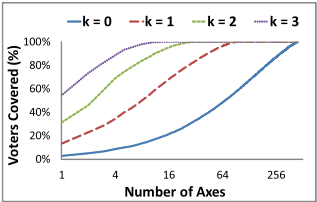
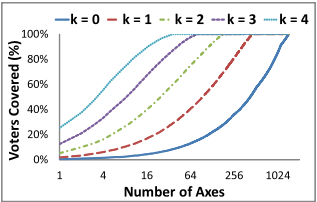
We also investigate the various approximations described above. The (single) best axis results immediately tell us that k-maverick consistency requires deletion of 97.13% (resp., 99.62%) of voters to ensure the preference profile is singlepeaked. We also immediately obtain a lower bound on k-AA consistency: Dublin West needs a minimum of ⌈ 3800 109 ⌉ = 35 additional axes, while North needs 262 additional axes. We also ran the greedy k-LCD approximation algorithm, 1DSPBB-AA-k-LCD, for different values of k (when k = 0, this is just 1D-SPBB-AA). Fig. 2(a) and (b) show the percentage of voters explained with each additional axis added for different values of k (note the log-scale on the x-axis). Without k-LCD approximation (i.e., when k = 0), 447 (resp., 1,452) axes are needed to explain all voter preferences (this is an upper bound on k-AA consistency). k-LCD without multiple axes requires k = 7 (resp., k = 10)-the maximum possible for each data set. Even with k-LCD for reasonable values of k, many additional axes are needed to explain the data: for instance, 31 axes are needed to explain Dublin West when k = 2, while Dublin North, with an aggressive k = 4, needs 39 axes. The linear nature of the plots (recall the log-scale) also shows that deletion of maverick voters will not help. This suggests that, even allowing for combinations of approximations proposed in the literature, preferences in these data sets are very far from being single-peaked in 1D. This motivates the use of higher-dimensional models, to which we now turn.
2 Data sets obtained from: www.dublincountyreturningofficer.com.
3 A ranking has top-t form if a voter ranks only his t mostpreferred candidates. If t <m-1, the ranking is incomplete.
4 Two-dimensional Branch and Bound
Since voter preferences in the data sets above are not singlepeaked in the one-dimensional sense-even when aggressive approximation is considered-the explanatory power of these proposed approximations in 1D is rather limited. We now extend these techniques to two-dimensional (2D) models. Our extensions generalize beyond two dimensions, but we focus on 2D models for ease of presentation, and also because, as we see below, two dimensions suffice for our data sets.
4.1 The Algorithm
Extending our branch-and-bound algorithm to the 2D case presents several challenges. First, the search space explodes, as we must potentially consider all O((z!)2 ) combinations of first and second axes. Second, candidates ranked last in some ≻i need no longer lie at the extreme point of an axis (e.g., in Ex. 1, c4 ≻i c3 ≻i c1 ≻i c5 ≻i c2 is a valid single-peaked preference, but the least preferred candidate c2 is not extreme on either axis). Third, in two-dimensions, some axes are dominated by others-these should be pruned for computational efficiency to the greatest extent possible. We now outline a 2D extension of the 1D-SPBB called 2D-SPBB. We omit full details due to space limitations and focus on the intuitions behind the method. However, we do explain how to tackle each of the issues above.
To address the combinatorial explosion of possible pairs of axes, instead of considering all candidate permutations as possible first axes, we admit only a relatively small set of potential initial axes, or a limited sample of possible axes. For each such (potential) first axis, we fix it as our first dimension, then apply our 1D algorithm 1D-SPBB to compute the second dimension. Our implementation uses 1D-SPBB-AA to find the collection of 1D axes that fully explains the given profile ≻-we use this as our set of potential first dimension axes. This guarantees that each ≻i is single-peaked consistent w.r.t. at least one of the axes. 4 This way of structuring 2D-SPBB means any axis searched/expanded in the first dimension is always complete, never partial. Of course, this is simply a heuristic, and may limit our ability to find a good 2D model.
Computing scores and upper bounds. To address the second problem, we develop a new algorithm to compute the upper bound for a pair of partial axes in a 2D space (i.e., maximum number of voters that are consistent with some extension of the partial pair), or the score of the pair of axes if they are complete. This includes variants that incorporate the same forms of approximation as above. One key difference between 2D and 1D lies in the computation of consistency. In a 2D space, the inconsistency of ≻i with single-peakedness only occurs with the violation of some bounding box constraint (see Ex. 1): our algorithm checks for such violations. Specifically, for each ≻i, we compute the set of bounding box constraints B induced by the partial axes. Recall that each constraint b = 〈b1, b2, b3〉, involves three candidates: if τi = b1 (resp., τi = b3), then we must have b2 ≻i b3 (resp., b2 ≻i b1) to ensure single-peakedness of ≻i. If no constraints are violated, i joins the set of consistent voters.
4 If a voter is single-peaked w.r.t. one axis A, then she is also single-peaked w.r.t. any 2D-space using A as one of its axes.
As in the 1D case, consistency testing must be fast to ensure that nodes in the branch-and-bound tree are processed quickly. Consistency testing is polynomial time:
Theorem 2 Given a preference profile ≻, the number of voters consistent with a pair of partial axes A1, A2 can be computed in O(nz4 ) time.
Proof: The set of bounding box constraints B can be computed in O(z3 ) time, since each constraint involves candidate triples (of which there are at most (z3)). Testing a ranking ≻i against each such constraint (as described above) can be accomplished in O(z) time, and must be done at most once for each of n voters. (generally, substantially fewer at deeper nodes in the tree). 5 Thus total running time is O(c3 ) + O(nc4 ) = O(nz4 ).
We mention two important details regarding the computation of B. First, it can be done incrementally by inheriting bounding box constraints from nodes higher in the search tree, then adding only the new constraints induced by placing two more candidates on the second axis. Second, for any incomplete axis, apart from "explicit" constraints involving candidates on the axis, we can also compute "implicit" constraints. For example, suppose A1 is fixed, with c1 <A1 c2 <A1 c3 <A1 c4 <A1 c5 <A1 c6, while A2 is partial, with A2 = c1 <A2 c6 <A2 . . . <A2 c5 <A2 c2. The only explicit constraint is 〈c6, c5, c2〉; but four implicit constraints can be added: 〈c1, c3, c5〉, 〈c1, c4, c5〉, 〈c6, c4, c2〉 and 〈c6, c3, c2〉. This allows more precise upper bound computation and more aggressive pruning.
Removing dominated axes. The fact that pairs of axes in 2D give rise to bounding box constraints leads to a form of "domination" that can be exploited to further reduce the combinatorial overhead of searching.
5 Other efficiencies, e.g., caching consistency tests across voters with identical preference orderings, are also possible.
| DublinWest | Dublin North | |
|---|---|---|
| k = 0 | 2,498/3800 | 1,732/3,662 |
| k = 1 | 3,553/3800 | 2,948/3,662 |
| k = 2 | 3,788/3800 | 3,436/3,662 |
| k = 3 | 3,800/3800 | 3,645/3,662 |
Definition 5 A pair of (partial) axes A = 〈A1,A2〉 is dominated by A′ = 〈A′1 , A′2 〉 if the set of bounding box constraints induced by A′ is a strict subset of that induced by A.
Consider A = 〈A1,A2〉, with complete axis A1 = c1 <A1 c2 <A1 c3 <A1 c4 <A1 c5 and partial axis A2 = c1 <A2 . . . <A2 c5. A = 〈A1,A2〉 is dominated by a different pair A = 〈A1,A′2 〉: we obtain strictly fewer bounding box constraints by swapping c1 with whichever candidate happens to be placed in the second position of A2, and c5 with whichever candidate is placed in the fourth position. As such, assuming A1 is fixed (as we would in a specific branch of 2D-SPBB), a different axis A′2 offers strictly more flexibility than A2.
We exploit this fact by using an algorithm for removing (some, but not all) dominated axes during 2D-SPBB: detecting this can allow pruning of a large part of the branch-andbound tree. We test domination by checking whether a swap of two adjacent candidates on any axis can induce a strict subset of original constraints (as in the above example): if yes, the (partial) axis is pruned. This simple test is sound; and while it does not ensure pruning of all dominated axes, it improves run-time dramatically.
Approximation. As in the 1D case, 2D-SPBB automatically generates the minimal k required for k-maverick consistency. Of course, if we use sampling to limit the axes that will be considered for the first dimension, we will obtain only an upper bound on k. It can also be applied repeatedly to greedily approximate the minimal set of additional 2D "axis pairs" needed to explain a profile; and we easily incorporate k-LCD approximation into 2D-SPBB using similar modifications to those described in Sec. 3.2. We focus on k-LCD below.
4.2 Results from the 2002 Irish General Election
We use the Dublin West and North data sets to test the effectiveness of 2D-SPBB and specifically the ability of k-LCD approximation to fit the Irish voting data. Fig. 3 shows the fraction of voters that are explained by the best axis pair generated using 2D-SPBB, both without approximation (k = 0), and allowing k-LCD approximation for k ≤ 3. The contrast with the 1D fit is notable: even without approximation, the best 2D-axis pair explains 65.7% (resp., 47.3%) of all voters. Allowing 2 out of 9 (resp., 3 out of 12) local candidate deletion provides a near-perfect fit, covering 99.68% (resp., 99.54%) of voters. This strongly suggests that the 2D model carries far more explanatory power for this Irish voting data.
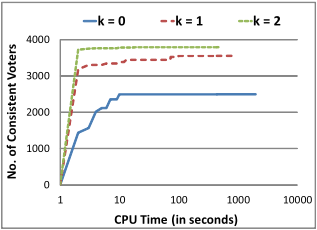
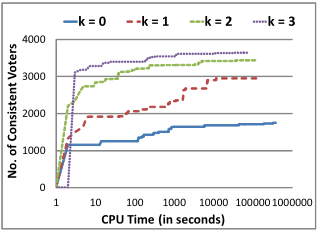
The 2D algorithms are more computationally intensive than their 1D counterparts (though restricting attention to sampled axes in the first dimension helps tremendously). It is instructive to examine the anytime performance of 2D-SPBB to see how quickly it converges to the best 2D model, and how quickly model quality improves for various levels of kLCD. Figs. 4 (a) and (b) show that, while convergence to the best 2D model can take a considerable amount of time, the anytime performance is very good, allowing the discovery of models that capture most of the (explainable) voters extremely quickly (note the log-scale on the x-axis).
5 Conclusions and FutureWork
We have developed a branch-and-bound algorithm designed to determine the degree to which a preference profile can be viewed as single-peaked in both the single- and multidimensional senses. It uses, and combines, various forms of approximation. Experiments on two election data sets demonstrate clearly that one-dimensional models, for any reasonable degree of approximation, cannot explain voter preferences in the two data sets we have explored. By contrast, a two-dimensional model provides an excellent fit, using very low degrees of local candidate deletion (as the only form of approximation) to explain the preferences of over 99% of the voters in each data set. Our algorithms are very effective in practice in 1D spaces, and feasible in 2D with strong anytime performance, despite the NP-completeness of these problems. While these findings are preliminary, and need to be corroborated on further election and other preference data sets, they suggest that the extension to two (or additional) dimensions may render the use of single-peaked modeling, or its approximations, more applicable in practice.
A number of interesting directions emerge from this work. One is to further develop the theoretical foundations of singlepeaked consistency for different forms of approximations, especially as we move to higher dimensions. Erd´elyi et al. [2012] show that the 1D-problem is NP-complete for several of the forms of approximation considered here. We conjecture that the problem remains NP-complete in twodimensions for the approximations discussed in this paper.
Obviously, multi-dimensional single-peakedness is a much weaker assumptions than its 1D counterpart; so while it may fit preference data better, its predictive power is lessened. Developing a deeper understanding of these tradeoffs is vital. An interesting question is, for instance, minimum conditions on profiles that prevent the fit of any m-dimensional model (c.f 1D, where single-peakedness can be violated with only two voters and four candidates, or three voters and three candidates [Ballester and Haeringer, 2011]).
Another direction is the exploration of connections with spatial models [Hinich, 1978; Poole and Rosenthal, 1985]. which are more restrictive than multi-dimensional singlepeaked models in some ways, and more flexible in others. Interestingly, 1D and 2D models are often considered to be sufficient in practice [Poole and Rosenthal, 1985], corroborating our findings in the more qualitative single-peaked framework. 6 Related is developing connections to the probabilistic models of behavioral social choice [Regenwetter et al., 2006].
Finally, this work as an important step towards the design of mechanisms for approximately single-peaked preferences. While much attention has been paid to mechanisms that exploit single-peakedness [Moulin, 1980; Barber`a et al., 1993; Schummer and Vohra, 2007; Procaccia and Tennenholtz, 2009; Lu et al., 2010; Escoffier et al., 2011; Dokow et al., 2012; Sui et al., 2013; Fotakis and Tzamos, 2010], little work has addressed the impact of approximate single-peakedness on these mechanisms, or the design and analysis of mechanisms specifically for approximate single-peakedness. Having a sense of which forms of approximation best fit realworld preferences can help focus mechanism design efforts on those most likely to have a practical impact.
Acknowledgements: Thanks to the participants of COMSOC-12 for lively discussions and the anonymous reviewers for their comments. This research was supported by NSERC.
@inproceedings{ijcai2013p63,
  title     = {Multi-Dimensional Single-Peaked Consistency and Its Approximations},
  author    = {Sui, Xin and Francois-Nienaber, Alex and Boutilier, Craig},
  booktitle = {Proceedings of the Twenty-Third International Joint Conference on
               Artificial Intelligence, {IJCAI-13}},
  publisher = {AAAI Press / International Joint Conferences on Artificial Intelligence},
  editor    = {Francesca Rossi},
  pages     = {375--381},
  year      = {2013},
  month     = {8},
  url       = {https://ijcai.org/proceedings/2013/63},
}
TY - CPAPER TI - Multi-Dimensional Single-Peaked Consistency and Its Approximations AU - Sui, Xin AU - Francois-Nienaber, Alex AU - Boutilier, Craig T2 - Proceedings of the Twenty-Third International Joint Conference on Artificial Intelligence, IJCAI-13 PB - AAAI Press / International Joint Conferences on Artificial Intelligence PY - 2013 SP - 375 EP - 381 UR - https://ijcai.org/proceedings/2013/63 ER -Copied
Machine-readable versions of this paper, for tools and AI agents:





