
Secure Routing in Wireless Sensor Networks via POMDPs
Proceedings of the Twenty-Fourth International Joint Conference on Artificial Intelligence. Special Track on Computational Sustainability. Pages 2617-2622.
© 2015 International Joint Conferences on Artificial Intelligence
Abstract
Wireless sensor networks are being increasingly used for sustainable development. The task of routing in these resource-constraint networks is particularly challenging as they operate over prolonged deployment periods, necessitating optimal use of their resources. Moreover, due to the deployment in unattended environments, they become an easy target for attackers. In this paper, we propose a hierarchical POMDP based approach to make routing decisions with partial/limited information about the sensor nodes, in a secure and energy-efficient manner. We demonstrate in a large-scale simulation that the approach provides a better energy/packet delivery tradeoff than competing methods, and also validate these conclusions in a real-world testbed.
- [Barr et al., 2005] Rimon Barr, Zygmunt J Haas, and Rob- bert Van Renesse. Scalable wireless ad hoc network simu- lation. Handbook on Theoretical and Algorithmic Aspects of Sensor, Ad hoc Wireless, and Peer-to-Peer Networks, pages 297-311, 2005.
- [Buchegger and Le Boudec, 2002] Sonja Buchegger and Jean-Yves Le Boudec. Performance analysis of the CONFIDANT protocol (Cooperation of nodes: Fairness in dynamic ad-hoc networks). In MobiHoc, 2002.
- [Dyo et al., 2010] Vladimir Dyo, Stephen A Ellwood, David W Macdonald, Andrew Markham, Cecilia Mascolo, Bence Pásztor, Salvatore Scellato, Niki Trigoni, Ricklef Wohlers, and Kharsim Yousef. Evolution and sustainabil- ity of a wildlife monitoring sensor network. In SenSys, 2010.
- [Foka and Trahanias, 2007] Amalia Foka and Panos Traha- nias. Real-time hierarchical POMDPs for autonomous robot navigation. Robotics and Autonomous Systems, 55(7):561-571, 2007.
- [Ganeriwal et al., 2008] Saurabh Ganeriwal, Laura K Balzano, and Mani B Srivastava. Reputation-based framework for high integrity sensor networks. ACM Transactions on Sensor Networks (TOSN), 4(3):15, 2008.
- [Grześ et al., 2013] Marek Grześ, Pascal Poupart, and Jesse Hoey. Controller compilation and compression for re- source constrained applications. Algorithmic Decision Theory, pages 193-207, 2013.
- [Heinzelman et al., 2000] Wendi Rabiner Heinzelman, Anantha Chandrakasan, and Hari Balakrishnan. Energy- efficient communication protocol for wireless microsensor networks. In HICSS, 2000.
- [Irissappane et al., 2014] Athirai A Irissappane, Frans A Oliehoek, and Jie Zhang. A POMDP based approach to optimally select sellers in electronic marketplaces. In AA- MAS, 2014.
- [Jiang et al., 2013] Siwei Jiang, Jie Zhang, and Yew-Soon Ong. An evolutionary model for constructing robust trust networks. In AAMAS, 2013.
- [Kaelbling et al., 1998] Leslie Pack Kaelbling, Michael L Littman, and Anthony R Cassandra. Planning and acting in partially observable stochastic domains. Artificial intel- ligence, 101(1):99-134, 1998.
- [Karlof and Wagner, 2003] Chris Karlof and David Wagner. Secure routing in wireless sensor networks: Attacks and countermeasures. Ad hoc networks, 1(2):293-315, 2003.
- [Liu et al., 2007] Fang Liu, Xiuzhen Cheng, and Dechang Chen. Insider attacker detection in wireless sensor net- works. In INFOCOM, 2007.
- [Mac Ruairí and Keane, 2007] Rónán Mac Ruairí and Mark T Keane. An energy-efficient, multi-agent sensor network for detecting diffuse events. In IJCAI, 2007. IJCAI
- [Marti et al., 2000] Sergio Marti, Thomas J Giuli, Kevin Lai, and Mary Baker. Mitigating routing misbehavior in mobile ad hoc networks. In MobiCom, 2000.
- [Nurmi, 2007] Petteri Nurmi. Reinforcement learning for routing in ad hoc networks. In WiOpt, 2007.
- [Pineau and Thrun, 2002] Joelle Pineau and Sebastian Thrun. An integrated approach to hierarchy and abstrac- tion for POMDPs. Carnegie Mellon University Technical Report CMU-RI-TR-02-21, 2002.
- [Poupart, 2005] Pascal Poupart. Exploiting structure to effi- ciently solve large scale Partially Observable Markov De- cision Processes. PhD thesis, University of Toronto, 2005.
- [Rezgui and Eltoweissy, 2007] Abdelmounaam Rezgui and Mohamed Eltoweissy. Tarp: A trust-aware routing pro- tocol for sensor-actuator networks. In MASS, 2007.
- [Román et al., 2009] Rodrigo Román, Carmen Fernandez- Gago, Javier López, and Hsiao Hwa Chen. Trust and repu- tation systems for wireless sensor networks. Security and Privacy in Mobile and Wireless Networking, pages 105- 128, 2009.
- [Ross et al., 2008] Stéphane Ross, Joelle Pineau, Sébastien Paquet, and Brahim Chaib-draa. Online planning algo- rithms for POMDPs. Journal of Artificial Intelligence Re- search, 32(1):663-704, 2008.
- [Stone and Veloso, 1998] Peter Stone and Manuela Veloso. Layered approach to learning client behaviors in the robocup soccer server. Applied Artificial Intelligence, 12(2-3):165-188, 1998.
- [Sun et al., 2006] Yan Lindsay Sun, Zhu Han, Wei Yu, and KJ Ray Liu. A trust evaluation framework in distributed networks: Vulnerability analysis and defense against at- tacks. In INFOCOM, 2006.
- [Theocharous, 2002] Georgios Theocharous. Hierarchical learning and planning in partially observable Markov de- cision processes. PhD thesis, Michigan State University, 2002.
- [Yu et al., 2012] Yanli Yu, Keqiu Li, Wanlei Zhou, and Ping Li. Trust mechanisms in wireless sensor networks: Attack analysis and countermeasures. Journal of Network and Computer Applications, 35(3):867-880, 2012.
- [Zhang and Sridharan, 2012] Shiqi Zhang and Mohan Srid- haran. Active visual sensing and collaboration on mobile robots using hierarchical POMDPs. In AAMAS, 2012.
References were extracted automatically from the PDF and may contain errors.
Full text extracted automatically from the PDF; figures, tables and equations may differ. The PDF is the version of record.
1 Introduction
Sustainable development involves detailed analysis, design and modeling of complex systems used in making decisions about managing natural resources. Gathering data at minimal cost is important to study these complex systems for which Wireless Sensor networks (WSNs) are used [Dyo et al., 2010]. WSNs are composed of spatially distributed sensor nodes to cooperatively monitor environmental changes over time. Sensors sense the data and transmit it to the sink (gateway between sensor nodes and end users) through multihop routing. A key challenge in sustainable development is that the (resource-constraint [Mac Ruair´ı and Keane, 2007]) sensor nodes need to be deployed for prolonged time periods, frequently unattended in remote environments, which not only requires the optimal use of network resources but also strong security provisioning, as the unreliable wireless channels and unattended operations make it very easy to compromise/capture the nodes. One such scenario is the monitoring of oil/chemical leaks from an industry in, say a nearby river. The monitors (government) will want to assess the true impact of the leaks and the industry might have an incentive to corrupt the measurements.
The use of trust systems for defending against (internal) security attacks and performing routing has been extensively studied in literature [Rom´an et al., 2009; Yu et al., 2012]. Internal attackers [Liu et al., 2007] are malicious nodes within the network, who can easily bypass traditional cryptographic mechanisms. Trust schemes can identify such nodes, as they can predict a node's behavior (quality) both directly, via evaluation based on its past actions, and indirectly, using recommendations (opinions) from other nodes. However, many trust schemes cannot effectively handle attacks targeting trust systems themselves [Sun et al., 2006] i.e., they are heavily affected by malicious nodes deliberately providing misleading opinions (unfair ratings) about other nodes. Also, existing trust schemes fail to address the energy constraints of WSNs, as they focus on accurately determining node quality but ignore the overhead of such computation by relentlessly seeking recommendations from all the other sensor nodes.
This paper presents a Partially Observable Markov Decision Process (POMDP) based trust scheme [Irissappane et al., 2014] to simultaneously address security issues and energy constraints while routing in WSNs. The POMDP model [Kaelbling et al., 1998] provides a principled approach for decision making under uncertainty, making it an ideal choice for nodes in WSNs that need to choose a suitable nexthop neighbor to route packets with only limited information. But, the POMDP model for such a decision making problem is large, and even when representing it using factored representations [Poupart, 2005], state-of-the-art off-line solution methods fail to find acceptable POMDP solutions. Though on-line methods [Ross et al., 2008] can improve scalability, they are not applicable due to the energy constraints of WSNs.
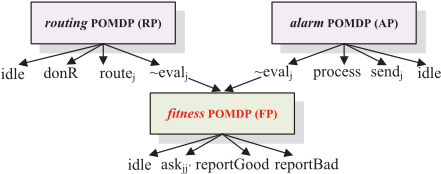
To overcome the above issues, we model the routing problem for each node using a hierarchical POMDP (called Secure Routing POMDP (SRP)). We also employ factored representations to address the complexity in solving each SRP component. The SRP hierarchy (Fig. 1) consists of the routing POMDP for making routing decisions, the alarm POMDP for sending/receiving alarms about malicious nodes and the fitness POMDP to compute the fitness (suitability) of nodes to route packets. As major contributions, we: 1) present the SRP model which can optimize the tradeoff between better security and energy savings in WSNs; 2) demonstrate that SRP can effectively deal with black-hole, on-off attacks and other attacks targeting the trust system; 3) conduct extensive evaluation in a simulated and a real-world testbed, showing the effectiveness of SRP against state-of-the-art trust based routing schemes. The above contributions greatly help to facilitate the employment of WSNs in hostile environments.
2 RelatedWork
RFSN [Ganeriwal et al., 2008] determines the quality of a node using the Beta distribution on the co-operation information collected from a watchdog [Marti et al., 2000] mechanism as well as from recommendations given by other nodes. TARP [Rezgui and Eltoweissy, 2007] avoids routing through malicious nodes by assessing their forwarding ratio using both direct evaluation and recommendation information from other nodes. However, the above trust schemes are not resilient to sophisticated unfair rating attacks which target the trust systems and do not effectively consider the energy constraints of WSNs. CONFIDANT [Buchegger and Le Boudec, 2002] uses a broadcasting mechanism to send alarms about malicious nodes, however it is still susceptible to unfair ratings, where nodes can send false alarms in a sophisticated manner. [Nurmi, 2007] proposes a POMDP based routing scheme that estimates its state composed of neighbor nodes' local parameters (selfishness and energy). However, it uses gradient techniques to determine policies which (as we show empirically), can be far from optimal. Also, it does not use recommendation information from other sensor nodes.
Hierarchical POMDP based approaches have been studied in literature to harness the curse of dimensionality and history in solving POMDPs [Zhang and Sridharan, 2012; Pineau and Thrun, 2002; Theocharous, 2002; Foka and Trahanias, 2007], using action based decomposition (action hierarchy), state space abstraction, or both. In our approach, we consider the action hierarchy as in [Pineau and Thrun, 2002] because the routing problem can be easily partitioned into sub-problems based on the actions (see Fig. 1).
3 Secure Routing Problem forWSNs
We consider a network N = {ni|i = 1 · · · |N|} of sensor nodes. The neighborhood of each node ni consists of sensors reachable within the transmission radius r. Every node independently optimizes its routing behavior and chooses a nexthop neighbor (using the SRP model described in Sec. 5) to route packets to the sink. The following paragraphs describe the important aspects involved in this decision problem.
Fitness (for routing purposes) For a node ni, a nexthop neighbor nj is chosen based on its fitness (fj ∈ {good, bad}) in routing packets, calculated using the fitness factors: residual-energy, distance and routing behavior.
Residual-Energy: f.ej ∈ {high, low} denotes the remaining energy in nj, to route packets. We use [Heinzelman et al., 2000] to determine nj's actual energy e(nj) and then discretize 1 it (to use standard POMDP solvers): f.ej=high, if e(nj) is greater than half its initial value and low, otherwise.
Distance: Distance D(nj , sink) of nj from the sink is determined by broadcasting HELLO 〈source, hopCount〉 messages. Initially, 〈source = sink, hopCount = 0〉 is broadcast from the sink. The neighboring nodes of the sink receive this message and determine their distance by incrementing hopCount. The new hopCount is then re-broadcast to each nj , f.dj=near, if D(nj , sink)<D(ni, sink), else f.dj=far. Routing Behavior: Node nj can forward the packets sent to it i.e., f.rbj=forward, or drop packets f.rbj=drop, exhibiting network based attacks [Karlof and Wagner, 2003], such as: 1) black-hole attack, where node nj drops packets with probability pd=1, always; 2) on-off attack, where pd=1 only during specific intervals of time, and pd=0 otherwise, etc.
1 Though a larger number of behaviors is possible, in order to find a good POMDP strategy it may suffice to consider a moderate number of values (see 'robustness' experiments in Fig. 5(a)).
Message Protocols To determine the above fitness factors of fj , node ni can request opinions (query action) about node nj from another neighbor nj ′ using a QUERY 〈ni, nj ′ , nj〉 message 2 . A REPLY 〈nj ′ , ni, nj, f.ej, f.dj, f.rbj〉 message is then sent by nj ′ about the fitness factors of nj. Node ni can also opt to route packets (route action) to nj, to determine its fitness factors. Once ni routes packets to nj, nj sends an acknowledgement ACK 〈nj , ni, f.ej , f.dj 〉 message 2 , informing ni about its residual-energy and distance values. Node ni also employs a watchdog mechanism [Marti et al., 2000] to peek nj's transmission packets and monitor its routing behavior f.rbj , whether it actually forwards/drops the sent packets. Thus, the actual values of f.ej, f.dj and f.rbj can be determined by routing packets to nj. Node ni can also send/receive ALARM 〈ni, nj, f.ej, f.dj, f.rbj〉 messages, carrying information about a malicious node nj .
Unfair Ratings When sending a REPLY to a QUERY message, node nj ′ can be unfair by providing misleading opinions about nj. We use a variable rj ′ to denote the trustworthiness of nj ′ in its rating behavior, when providing opinions about other nodes. nj ′ can be truthful (rj ′=true) or provide unfair ratings about nj, exhibiting any of the following attacks [Jiang et al., 2013]: 1) random (rj ′=rand), where nj ′ randomly provides fair and unfair ratings; 2) adversarial (rj ′=adv), where nj ′ always provides unfair ratings; 3) camouflage (rj ′=cam), where nj ′ is honest in the beginning and provides unfair ratings after φ packet transmissions; 4) collusive-unfair (rj ′=coll), where attackers form the majority in the system and always promote their neighbors.
Overall Goal Given that ni can use query and route actions to determine the fitness factors of its neighbors, there exists a tradeoff as querying information can lead to energy drain, while routing through malicious nodes can lead to packet drop. To balance the tradeoff of information gaining (query) actions and exploitation (route/alarm) actions, we adopt a Partially Observable Markov Decision Process (POMDP) model, which selectively queries for information to select a suitable next-hop neighbor to successfully route packets (and send alarms, if necessary), thereby minimizing energy consumption and maximizing lifetime of the sensor nodes. Sec. 4 gives a brief description of a POMDP model.
2 In case of no response (REPLY/ACK) from a node, it can be queried again max times, after which it will be deemed malicious.
4 POMDP
A POMDP [Kaelbling et al., 1998] can be described by the tuple 〈S, A, T, R, Ω, O〉: given that the environment has a state s ∈ S, the POMDP agent takes some action a ∈ A, causing a state transition from s to s′ , using T , the transition model that specifies probabilities Pr(s′ |s, a). The agent also receives observations (o ∈ Ω) based on the observation model O, specifying the probabilities Pr(o|a, s′ ). For a transition, the agent receives a reward R(s, a, s′ ). We also assume an infinite horizon problem. The POMDP agent maintains a belief b ∈ B, i.e., a probability distribution over states via Bayes' rule. If b(s) specifies the probability of s (∀ s), the updated belief b′ after taking action a and receiving observation o is given by,
A POMDP policy maps beliefs to actions and is associated with a value function Vπ(b) that specifies the expected total reward of executing policy π starting from b. The objective of a POMDP agent is to find an optimal POMDP policy π∗ , which maximizes the expected total reward. Unfortunately, the routing problem in WSNs is too large to be modeled as a single POMDP (finding the optimal policy is intractable, PSPACE complete). As factored solvers [Poupart, 2005] do not scale sufficiently to large problems and online planning algorithms cannot be applied to the energy-constraint WSNs, we propose an hierarchical approach, while still using factored solvers to solve the individual hierarchical components.
5 Secure Routing POMDP (SRP)
Here, we propose a hierarchical formulation (as shown in Fig. 1) for the secure routing problem, exploiting the fact that this problem admits a natural decomposition in sub-tasks. In particular, at the higher level, we select a next-hop neighbor based on its fitness, performed by the routing POMDP (RP). At the lower level, we evaluate the fitness of the nodes based on more detailed observations and trust propagation mechanisms, handled by the fitness POMDP (FP). Additionally, we investigate whether adding functionality to raise alarms about potentially unfit neighbors can improve the overall WSN performance. This alarm functionality is isolated in a separate component: the alarm POMDP (AP).
The hierarchy functions as follows: every time a node receives a packet to route, an episode of RP is activated. This episode can trigger multiple episodes of FP by using the 'evaluate' (evalj) actions to evaluate the fitness of its neighbors. As such, each episode of FP has as its goal to provide an estimation of the fitness of a specific node (say nj ). To this end, FP can ask different nodes about the various fitness factors of nj (implemented using QUERY messages, described in Sec. 3). When FP is certain enough, it reports that nj is 'good' (g) or 'bad' (b), thereby ending the FP episode. At this point, control is transferred back to RP which receives the report (g or b) as an observation, using which it updates its high-level belief about the fitness of the node. Each episode of RP ends by selecting a neighbor to route packets.
The AP (if present) is activated after each packet is handled by RP. The goal of AP is to send alarms about nodes that seem unfit (if no alarm has been sent about them yet). For this, AP can also call FP to perform node evaluations. AP is also activated when an alarm is received from one neighbor about another neighbor. In this case, AP should decide whether or not to process the alarm [Buchegger and Le Boudec, 2002], which may/may not lead to a belief update.
5.1 Routing POMDP (RP)
The main goal of RP is to determine a fit next-hop neighbor to route packets. The states, actions, observations and rewards for RP are described in Table 1. RP maintains a belief over the overall fitness fj of each neighboring node (nj) i.e., fj = good(g), if nj is fit to route packets and fj = bad(b), if nj is unfit. To determine fj , it uses the evaluate action ∼evalj and decides a next-hop neighbor nj using routej action. The donR (do not route to any neighboring node) action is taken when no nodes are fit to route packets. There is a cost associated with the ∼evalj action. We assume that selecting an unfit neighbor to route packets will fail to transmit packets to the sink and thus a penalty R(f ′ j =b, routej) is levied. Similarly, a reward R(f ′ j =g, routej) is given for selecting a fit node which can successfully transmit packets to the sink. We can also see that ∼evalj is an abstract action which in turn calls FP (action hierarchy for SRP is shown in Fig. 1).
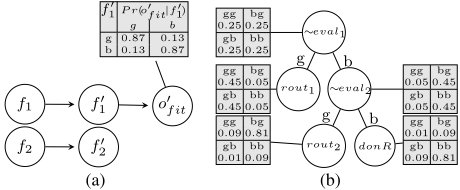
To specify the transition and observation functions, we describe the model for a two-node neighborhood (∈ {n1, n2}). We follow the factored representation [Poupart, 2005], which uses Dynamic Bayesian Networks (DBNs) with Conditional Probability Tables (CPTs) to compactly represent the state spaces. The transition and observation probabilities for the ∼evalj=1 action is shown in Fig. 2(a). Here, transitions are static and observation o′fit depends on fitness f ′1 of n1. The transition and observation probabilities for the higher level POMDPs (RP, AP) can be learned from the behavior of FP (similar to layered learning [Stone and Veloso, 1998]). Thus, probabilities for o′fit in Fig. 2(a), are learned based on the policy of FP (by conducting experiments as described in Sec. 6).
To briefly illustrate the belief updating process in RP, Fig. 2(b) shows a (partial) routing policy for the two-node (∈ {n1, n2}) neighborhood. The beliefs prior to taking the
| POMDP | States | Observations | Actions | Rewards |
|---|---|---|---|---|
| routing | fj ∈ {g, b} | ofit ∈ {g, b} | ∼evalj routej donR idle | R(∼evalj) = -10 R(f ′ j = g, routej) = 150 R(f ′ j = b, routej ) = -200 R(idle) = -3 |
| alarm | fj ∈ {g, b} alarmFrom ∈ {1, · · · k} alarmAbout ∈ {1, · · · k} alarmSentj ∈ {yes, no} | ofit ∈ {g, b} ofrom ∈ {1, · · · k} oabout ∈ {1, · · · k} osent ∈ {1, · · · k} | ∼evalj process sendj idle | R(∼evalj) = -10 R(f ′from = g/b, process) = 50/ - 100 R(f ′ j =b/g, sendj )=50/-100 R(idle) = -3 |
| fitness | f.ej ∈ {high, low} f.dj ∈ {near, far} f.rbj ∈ {forward, drop} rj ∈ {true, rand, adv, camsleep, camact, coll} evaluation node ∈ {1, · · · k} fj ∈ {g, b} | oener ∈ {high, low} odist ∈ {near, far} orb ∈ {forward, drop} or ∈ {true, lie} onode ∈ {1, · · · k} | askjj′ reportGood reportBad idle | R(askjj′ ) = -10 R(f ′node = g, reportGood) = 150 R(f ′node = b, reportGood) = -200 R(f ′node = bad, reportBad) = 150 R(f ′node = g, reportBad) = -200 R(idle) = -3 |
∗ rand - random, adv - adversarial, cam - camouf lage, act - active, coll - collusive-unfair
Table 1: State, action, observation variables, rewards specified in SRP. Variable j is a vector of k=no. of neighbors elements.
actions (represented by nodes in Fig. 2(b)) are shown using tables associated with the nodes. Here, we present the marginal beliefs on the fitness of nodes f1, f2 ∈ {g, b}. As a sample state, gg represents that both n1 and n2 are fit to route packets. Initially, RP assumes uniform quality levels for f1, f2 (0.5 g, 0.5 b). On taking action ∼eval1, when observation g is received (traversing through left child of the tree), beliefs are updated (using Eqn. 1) such that more weights are given to states where f1 is good (gg = 0.45, gb = 0.45) and route1 action is taken. The beliefs when observation is b, are shown using right children of the tree, resulting in donR action.
5.2 AlarmPOMDP (AP)
There are two modes in which AP can operate: 1) 'periodic' mode after every packet transmission by node ni, to send alarms about malicious (unfit) nodes; 2) 'triggered' mode after receiving an incoming alarm, to decide whether to process alarms received from other nodes. AP maintains beliefs over the fitness fj ∈ {g, b} of each neighboring node and uses the ∼evalj action (as shown in Table 1) to determine them. It can broadcast alarms about a malicious node nj using the sendj action. To avoid re-broadcasting the same alarms, the alarms sent are tracked using alarmSentj ∈ {yes, no} variable. When AP is triggered on receiving an alarm from alarmFrom about node alarmAbout, it decides either to process these alarms, leading to a subsequent belief update about the fitness of node alarmAbout or simply ignore them. There is a reward/penalty R(f ′ j =b/g, sendj) for broadcasting truthful/false alarms about nj . There is also a reward/penalty R(f ′from=g/b, process) for processing truthful/false alarms from good/bad nodes, respectively.
The DBN and CPT 3 for ∼evalj action are similar to Fig. 2(a). For process action, observation o′fit depends on the fitness of nodes alarmF rom and alarmAbout. To deal with both 'periodic' and 'triggered' functionalities in the same POMDP, we introduce an auxiliary (dummy) first time step in AP: the initial belief is an uniform random distribution over the alarmFrom, alarmAbout, alarmSentj variables, but during the second time step, the agent receives perfect observations about these factors, leading to beliefs that only have positive probabilities for the states that are consistent with the required functionality. Transition for alarmSentj is such that alarmSentj=yes on sending an alarm about nj . We also add some randomness to model variable delay forgetting.
3 Figures are not shown due to space constraints.
5.3 Fitness POMDP (FP)
The main goal of FP is to evaluate the fitness of a specific node, and report it to the higher level POMDPs. Apart from maintaining beliefs on the fitness of each neighbor nj i.e., fj∈{g, b}, FP also maintains beliefs over the individual factors that make up fj, i.e., residual-energy f.ej, distance f.dj, and routing behavior f.rbj. The rating behavior of nj in providing opinions is also maintained using variable rj. Whenever the ∼evalj action is taken by RP or AP, FP is activated. To determine fitness of nj (evaluation node in Table 1), FP can query nj ′ using askjj ′ action, which translates to QUERY and REPLY messages (see Sec. 3). The reportGood/reportBad action is then taken, determining fitness of nj to be g/b, respectively, which are then reported as observations to update the high-level beliefs about the fitness of node nj in RP or AP. There is a reward/penalty for correctly/incorrectly determining the node's quality.
Fig. 3(a) shows the DBN and CPT of the ask12 (query n2 about fitness of n1) action. Apart from the state variables for node n1, the DBN also contains a variable r2, which denotes the rating behavior i.e., trustworthiness of n2 in providing truthful opinions about n1. The observation probabilities for o′rb ∈ {forward(w), drop(d)} depend on the routing behavior f.rb′1 of n1 and rating behavior r′2 of n2. o′ener and o′dist have similar probability values 3 as o′rb . The observation probabilities for o′rb encode that asking a trustworthy node (r′2 = true) gives more accurate observations (with 90% probability) than untrustworthy nodes. Specifically, random, adversarial nodes provide unfair ratings with 50%, 80% probability, respectively. camouflage nodes, are honest in the beginning, then provide unfair ratings with 70% probability. To model such change in behavior, we consider two state variables i.e., camsleep (to represent the honest phase) and camact(ive) (to represent the unfair rating phase), such that, nodes in the camsleep state can transition to camact state with a 50% probability. collusive-unfair are groups of nodes, providing unfair ratings with 70% probability. Though the above probabilities may not represent the true node behaviors, they are still effective in identifying the unfair raters as demonstrated by our experiments in Sec. 6.
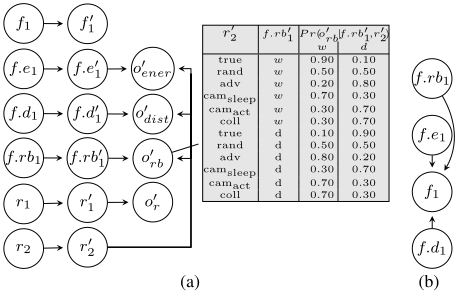
However, in Fig. 3(a), there is no observation for the fitness f1 of n1. Instead, we specify in the initial state distribution of FP, how the different fitness factors (f.e1, f.d1, f.rb1) contribute to f1 (Fig. 3(b), Eqn. 2). The specific probabilities are given in Eqn. 3 and 4, where Ngood is the number of positive fitness factors i.e., number of times f.e1=high, f.d1=near, f.rb1=forward and Nbad is the number of negative fitness factors i.e., number of times f.e1=low, f.d1=far, f.rb1=drop. Thus, even though we do not get direct observations about f1, now it will be updated as part of the overall belief update. reportGood, reportBad actions merely notify about fitness of a node and do not receive any observations.
The belief updating process 3 in FP follows a similar approach as that of RP (shown in Fig. 2(b)).
5.4 Parallel Belief Update
The belief update takes place separately for RP, AP and FP. For a routing task, RP and FP are active i.e., when RP takes the ∼evalj action, FP is called and based on the reportGood/reportBad action of FP, observation good/bad is received by RP. However, in this case the beliefs about nj are updated only in RP and left outdated in AP. To update the knowledge about nj even in AP, we introduce the idle action (in each POMDP). Whenever the ∼evalj action is called in RP and beliefs are updated about nj, the idle action of AP is also called to update the beliefs on nj. Similarly, when ∼evalj action is called by AP, idle action is taken in RP.
Whenever the actual fitness factors i.e., f.ej , f.dj andf.rbj of nj are determined after the routing process (as described in Sec. 3), the idle action is taken by FP to update the beliefs about nj, resulting in reportGood/reportBad action. Based on these actions, the idle actions of both the RP and AP are taken, to update the beliefs about nj.
6 Performance Evaluation
We conduct experiments in a simulated environment as well as a real-world testbed and compare the performance of SRP with RFSN [Ganeriwal et al., 2008], CONFIDANT [Buchegger and Le Boudec, 2002] and Nurmi [Nurmi, 2007]. To show the usefulness of AP, we compare the results of SRP with and without AP denoted by SRP and SRP-NAP, respectively. To verify the usefulness of the hierarchical structure, we implemented SRP without any hierarchy, but the method failed to find a reasonable solution (due to the large state/action space), thus not shown in the results. We measure the average Packet Delivery Ratio (PDR) i.e, ratio of data packets successfully delivered to the sink and Residual-Energy (RE) i.e., average (remaining) energy of each sensor node in the network.
To learn the observation probabilities for ∼evalj action of RP (AP) based on the policy of FP (for which we manually specify the probabilities), we use a maximum likelihood approach. Using (offline) simulations, we run SRP and randomly select 500 actions of RP (AP) which invoke FP. We measure the number of instances where FP correctly identifies a node's quality and determine the probability of receiving a correct/incorrect observation for ∼evalj action to be 0.87/0.13, respectively. Also, the RP, AP and FP policies are computed (using Symbolic Perseus [Poupart, 2005]) offline, assuming a maximum neighborhood size M 4 .
For simulation, we use the SWANS Simulator [Barr et al., 2005]. We consider 100 stationary nodes, uniformly randomly distributed within a 1000m×1000m square, with the sink at its right end. The transmission radius is 100m and M=5. Each node generates packets at the rate λ=1 per time step. The size of each data packet is 512 bytes, HELLO packet is 60 bytes, QUERY, ALARM and ACK packet is 125 bytes. The initial energy of each sensor node is 2J. The radio dissipates 50 nJ/bit to run the transmitter/receiver circuitry and 100 pJ/bit/m2 for the transmitter amplifier. We consider 20% of the nodes to be compromised. The experiments are run for 100 time steps, transmitting over 10, 000 data packets.
Fig. 4(a-h) show the PDR and residual-energy of the routing schemes under different attacking scenarios. In Fig. 4(a), under black-hole attack, SRP and SRP-NAP achieve the highest PDR (97% after 100 time steps). SRP performs slightly better than SRP-NAP, especially in the beginning, as it identifies malicious nodes earlier by propagating alarms. SRP, SRP-NAP, RFSN, CONFIDANT use both direct evaluation and recommendations, while Nurmi uses only direct evaluation, one of the reasons for its low PDR (73%), apart from the limitation of using gradient techniques for computing policy. In Fig. 4(b), SRP obtains a lower residual-energy (1.61J) than SRP-NAP (1.70J), as SRP additionally sends alarms. RFSN queries all neighbors and CONFIDANT relentlessly sends alarms about malicious nodes, obtaining a lower residual-energy. Nurmi does not query other nodes, obtaining a high residual-energy. Fig. 4(c-d) show similar results, where on-off attackers drop packets every 5 time steps.
In Fig. 4(e-h), the 20% compromised nodes (black-hole attackers) also target the trust system by providing unfair ratings (showing random, collusive-unfair behavior) 5 . SRP and SRP-NAP can effectively identify unfair raters as they model such behaviors as a part of their POMDP states. In Fig. 4(e-f), under random attack, SRP, SRP-NAP achieve high performance. In Fig. 4(g-h), under collusive-unfair attack, unfair raters are increased to 60%, forming the majority. SRP (PDR 96%) performs better than SRP-NAP as it easily identifies attackers by propagating alarms, while SRPNAP (PDR 93%) initially obtains misleading opinions from the colluders, thereby routing through malicious nodes, until their actual behavior is identified after routing. Further Fig. 4(a-h) also show that AP indeed improves the performance of SRP (PDR of SRP is always greater than SRP-NAP, though AP involves additional energy drain, in some cases).
4 Non-existent nodes will be considered malicious.
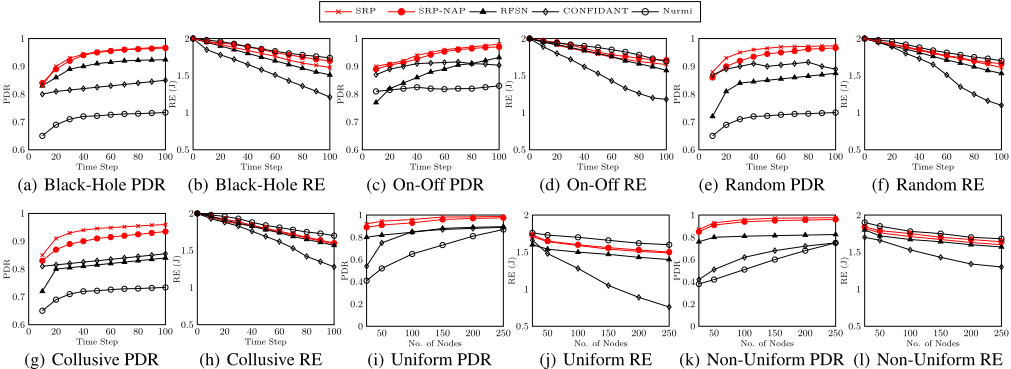
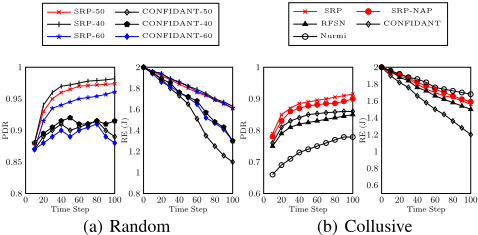
Fig. 4(i-l) show the results (under collusive-unfair attack 5 ), when network environment changes. SRP performs better under uniform load (λ=1 per node) as well as under non-uniform load (λ∈[0, 1] is selected randomly per node). Also, PDR of all schemes increase with the number of nodes, as probability of finding a more reliable route to sink increases. Since most probabilities in SRP are manually specified (e.g., random nodes provide unfair ratings with probability pu=50%), we analyze the robustness of SRP to the specification of such values when the actual behaviors of random nodes change: 1) SRP-60, where pu=60% instead of 50% (as assumed in FP); 2) SRP-40, where pu=40%; 3) SRP-50 for perfectly random nodes with pu=50%. Fig. 5(a) show that even when interacting with advisors that act differently than those assumed in FP, performance of SRP is robust (relatively better than its CONFIDANT counterpart).
5 Experiments on other attacks exhibit similar conclusion and are not shown here due to space constraints.
We also conduct experiments on a real testbed, consisting of 10 sensor nodes placed randomly in a 5×10 m2 in-door space. Each node is built on an Arduino Due board, with a XBee- Pro RF Module for radio transmission, a SHT21 Digital Sensor Module for temperature sensing and a TOL-10617 LiPo Fuel Gauge for measuring energy. The neighborhood radius is 5m, size of packets is 62 bytes, initial node energy is 2J and λ=1. Fig. 5(b), under collusive-unfair attack 5 , show that SRP (PDR 91.5%) outperforms other schemes.
7 Conclusion and FutureWork
We present the Secure Routing POMDP (SRP) approach, to select suitable next-hop neighbors and successfully route packets to the sink. SRP can deal with black-hole, on-off attacks, etc., and attacks targeting the trust system. It balances the exploration/exploitation tradeoff in gaining/exploiting information about sensor nodes, thereby effectively addressing their energy constraints. We model SRP using hierarchical and factored representations to address the complexity in solving POMDPs. Experiments show that SRP consistently achieves higher packet delivery rates by coping with various attacks, while still maintaining high residualenergy. Thus, we guarantee reliable, energy-efficient routing in WSNs, which are key factors in sustainable development.
While we established that SRP is robust against the choice of parameters for transition and observation models, an interesting direction of future work is to automatically optimize these. We will also investigate using finite-state controllers, which can be more energy-efficient [Grze´s et al., 2013].
Acknowledgments
This work is supported by the A*STAR SERC grant (1224104047) awarded to Dr. Jie Zhang, NWO Innovational Research Incentives Scheme Veni #639.021.336 awarded to Dr. Frans A. Oliehoek and the Institute for Media Innovation at Nanyang Technological University.
@inproceedings{ijcai2015p371,
  title     = {Secure Routing in Wireless Sensor Networks via POMDPs},
  author    = {Irissappane, Athirai Aravazhi and Zhang, Jie and Oliehoek, Frans A. and Dutta, Partha Sarathi},
  booktitle = {Proceedings of the Twenty-Fourth International Joint Conference on
               Artificial Intelligence, {IJCAI-15}},
  publisher = {International Joint Conferences on Artificial Intelligence},
  editor    = {Qiang Yang and Michael Wooldridge},
  pages     = {2617--2622},
  year      = {2015},
  month     = {7},
  note      = {Special Track on Computational Sustainability},
  url       = {https://ijcai.org/proceedings/2015/371},
}
TY - CPAPER TI - Secure Routing in Wireless Sensor Networks via POMDPs AU - Irissappane, Athirai Aravazhi AU - Zhang, Jie AU - Oliehoek, Frans A. AU - Dutta, Partha Sarathi T2 - Proceedings of the Twenty-Fourth International Joint Conference on Artificial Intelligence, IJCAI-15 PB - International Joint Conferences on Artificial Intelligence PY - 2015 SP - 2617 EP - 2622 UR - https://ijcai.org/proceedings/2015/371 ER -Copied
Machine-readable versions of this paper, for tools and AI agents:





