
Real-Time Web Scale Event Summarization Using Sequential Decision Making
Proceedings of the Twenty-Fifth International Joint Conference on Artificial Intelligence. Pages 3754-3759.
Abstract
We present a system based on sequential decision making for the online summarization of massive document streams, such as those found on the web. Given an event of interest (e.g. Boston Marathon bombing), our system is able to filter the stream for relevance and produce a series of short text updates describing the event as it unfolds over time. Unlike previous work, our approach is able to jointly model the relevance, comprehensiveness, novelty, and timeliness required by time-sensitive queries. We demonstrate a 28.3% improvement in summary F1 and a 43.8% improvement in time-sensitive F1 metrics.
- [Allan et al., 2001] James Allan, Rahul Gupta, and Vikas Khandelwal. Temporal summaries of new topics. In Pro- ceedings of the 24th annual international ACM SIGIR con- ference on Research and development in information re- trieval, pages 10-18. ACM, 2001.
- [Aslam et al., 2013] Javed Aslam, Matthew Ekstrand- Abueg, Virgil Pavlu, Fernado Diaz, and Tetsuya Sakai. Trec 2013 temporal summarization. In Proceedings of the 22nd Text Retrieval Conference (TREC), November, 2013.
- [Chang et al., 2015] Kai-Wei Chang, Akshay Krishna- murthy, Alekh Agarwal, Hal Daume, and John Langford. Learning to search better than your teacher. In David Blei and Francis Bach, editors, Proceedings of the 32nd ICML (ICML-15), pages 2058-2066. JMLR Workshop and Conference Proceedings, 2015.
- [Conroy et al., 2011] John M Conroy, Judith D Schlesinger, Jeff Kubina, Peter A Rankel, and Dianne P OLeary. Classy 2011 at tac: Guided and multi-lingual summaries and eval- uation metrics. In Proceedings of the Text Analysis Con- ference, 2011.
- [Dang and Owczarzak, 2008] Hoa Trang Dang and Karolina Owczarzak. Overview of the tac 2008 update summariza- tion task. In Proceedings of text analysis conference, pages 1-16, 2008.
- [Daumé III et al., 2009] Hal Daumé III, John Langford, and Daniel Marcu. Search-based structured prediction. Ma- chine learning, 75(3):297-325, 2009.
- [Du et al., 2011] Pan Du, Jipeng Yuan, Xianghui Lin, Jin Zhang, Jiafeng Guo, and Xueqi Cheng. Decayed divrank for guided summarization. In Proceedings of Text Analysis Conference, 2011.
- [Erkan and Radev, 2004] Günes Erkan and Dragomir R Radev. Lexrank: Graph-based lexical centrality as salience in text summarization. JAIR, pages 457-479, 2004.
- [Frank et al., 2012] John R Frank, Max Kleiman-Weiner, Daniel A Roberts, Feng Niu, Ce Zhang, Christopher Ré, and Ian Soboroff. Building an entity-centric stream filter- ing test collection for trec 2012. Technical report, DTIC Document, 2012.
- [Frey and Dueck, 2007] Brendan J Frey and Delbert Dueck. Clustering by passing messages between data points. Sci- ence, 315(5814):972-976, 2007.
- [Graff and Cieri, 2003] David Graff and C Cieri. English gi- gaword corpus. Linguistic Data Consortium, 2003.
- [Guo and Diab, 2012] Weiwei Guo and Mona Diab. A sim- ple unsupervised latent semantics based approach for sen- tence similarity. In Proceedings of the Sixth International Workshop on Semantic Evaluation, SemEval '12, pages 586-590, Stroudsburg, PA, USA, 2012. Association for Computational Linguistics.
- [Guo et al., 2013] Qi Guo, Fernando Diaz, and Elad Yom- Tov. Updating users about time critical events. In ECIR, ECIR, pages 483-494, Berlin, Heidelberg, 2013. Springer- Verlag.
- [Haghighi and Vanderwende, 2009] Aria Haghighi and Lucy Vanderwende. Exploring content models for multi- document summarization. In Proceedings of Human Lan- guage Technologies: The 2009 Annual Conference of the North American Chapter of the Association for Computa- tional Linguistics, pages 362-370. Association for Com- putational Linguistics, 2009.
- [Kedzie et al., 2015] Chris Kedzie, Kathleen McKeown, and Fernando Diaz. Predicting salient updates for disas- ter summarization. In Proceedings of the 53rd Annual Meeting of the Association for Computational Linguis- tics and the 7th International Joint Conference on Natural Language Processing, pages 1608-1617. Association for Computational Linguistics, July 2015.
- [Lin and Hovy, 2000] Chin-Yew Lin and Eduard Hovy. The automated acquisition of topic signatures for text summa- rization. In ACL, pages 495-501. ACL, 2000.
- [Mason and Charniak, 2011] Rebecca Mason and Eugene Charniak. Extractive multi-document summaries should explicitly not contain document-specific content. In Pro- ceedings of the Workshop on Automatic Summarization for Different Genres, Media, and Languages, pages 49-54. Association for Computational Linguistics, 2011.
- [McCreadie et al., 2014] Richard McCreadie, Craig Mac- donald, and Iadh Ounis. Incremental update summariza- tion: Adaptive sentence selection based on prevalence and novelty. In CIKM, pages 301-310. ACM, 2014.
- [Nenkova and McKeown, 2012] Ani Nenkova and Kathleen McKeown. A survey of text summarization techniques. In Mining Text Data, pages 43-76. Springer, 2012.
- [Nenkova and Vanderwende, 2005] A. Nenkova and L. Van- derwende. The impact of frequency on summariza- tion. Technical Report MSR-TR-2005-101, MSR-TR- 2005-101, January 2005.
- [Radev et al., 2000] Dragomir R Radev, Hongyan Jing, and Malgorzata Budzikowska. Centroid-based summariza- tion of multiple documents: sentence extraction, utility- based evaluation, and user studies. In Proceedings of the 2000 NAACL-ANLP Workshop on Automatic summariza- tion. Association for Computational Linguistics, 2000.
- [Ross et al., 2011] Stéphane Ross, Geoffrey J. Gordon, and Drew Bagnell. A reduction of imitation learning and struc- tured prediction to no-regret online learning. In Proceed- ings of the Fourteenth International Conference on AIS- TATS 2011, pages 627-635, 2011.
References were extracted automatically from the PDF and may contain errors.
Full text extracted automatically from the PDF; figures, tables and equations may differ. The PDF is the version of record.
1 Introduction
Tracking unfolding news at web-scale continues to be a challenging task. Crisis informatics, monitoring of breaking news, and intelligence tracking all have difficulty in identifying new, relevant information within the massive quantities of text that appear online each second. One broad need that has emerged is the ability to provide realtime event-specific updates of streaming text data which are timely, relevant, and comprehensive while avoiding redundancy.
Unfortunately, many approaches have adapted standard automatic multi-document summarization techniques that are inadequate for web scale applications. Typically, such systems assume full retrospective access to the documents to be summarized, or that at most a handful of updates to the summary will be made [Dang and Owczarzak, 2008]. Furthermore, evaluation of these systems has assumed reliable and relevant input, something missing in an inconsistent, dynamic, noisy stream of web or social media data. As a result, these systems are poor fits for most real world applications.
In this paper, we present a novel streaming-document summarization system based on sequential decision making. Specifically, we adopt the "learning to search" approach, a technique which adapts methods from reinforcement learning for structured prediction problems [Daum´e III et al., 2009; Ross et al., 2011]. In this framework, we cast streaming summarization as a form of greedy search and train our system to imitate the behavior of an oracle summarization system.
Kathleen McKeown
Columbia University Dept. of Computer Science kathy@cs.columbia.edu
4:19 p.m. - Two explosions shattered the euphoria of the Boston Marathon finish line on Monday, sending authorities out on the course to carry off the injured while the stragglers were rerouted away...
4:31 p.m. - Police in New York City and London are stepping up security following explosions at the Boston Marathon.
4:31 p.m. - A senior U.S. intelligence official says two more explosive devices have been found near the scene of the Boston marathon where two bombs detonated earlier.
5:10 p.m. - Several candidates for Massachusetts Senate special election have suspended campaign activity in response to the explosions...
Figure 1: Excerpt of summary for the query 'Boston marathon bombing' generated from an input stream.
Given a stream of sentence-segmented news webpages and an event query (e.g. "Boston marathon bombing"), our system monitors the stream to detect relevant, comprehensive, novel, and timely content. In response, our summarizer produces a series of short text updates describing the event as it unfolds over time. We present an example of our realtime update stream in Figure 1. We evaluate our system in a crisis informatics setting on a diverse set of event queries, covering severe storms, social unrest, terrorism, and large accidents. We demonstrate a 28.3% improvement in summary F1 and a 43.8% improvement in time-sensitive F1 metrics against several state-of-the-art baselines.
2 RelatedWork
Multi-document summarization (MDS) has long been studied by the natural language processing community. We focus specifically on extractive summarization, where the task is to take a collection of text and select some subset of sentences from it that adequately describes the content subject to some budget constraint (e.g. the summary must not exceed k words). For a more in depth survey of the field, see [Nenkova and McKeown, 2012].
Because labeled training data is often scarce, unsupervised approaches to clustering and ranking predominate the field.
Popular approaches involve ranking sentences by various notions of input similarity or graph centrality [Radev et al., 2000; Erkan and Radev, 2004].
Other ranking based methods use coverage of topic signatures [Lin and Hovy, 2000], or KL divergence between input/summary word distributions [Haghighi and Vanderwende, 2009] as the ranking, possibly adding some diversity penalty to ensure broader coverage.
Update summarization research has primarily focused on producing a 100 word summary from a set of 10 documents, assuming the reader is familiar with a different initial set of 10 documents [Dang and Owczarzak, 2008]. Generally the approaches to update summarization have adapted the above techniques. Top performers at the 2011 Text Analysis Conference (the last year update summarization was a task) made use of graph ranking algorithms, and topic model/topicsignature style importance estimates [Du et al., 2011; Mason and Charniak, 2011; Conroy et al., 2011].
Streaming or temporal summarization was first explored in the context of topic detection and tracking [Allan et al., 2001] and more recently at the Text Retrieval Conference (TREC) [Aslam et al., 2013]. Top performers at TREC included an affinity propagation clustering approach [Kedzie et al., 2015] and a ranking/MDS system combination method [McCreadie et al., 2014]. Both methods are unfortunately constrained to work in hourly batches, introducing potential latency. Perhaps most similar to our work is that of [Guo et al., 2013] which iteratively fits a pair of regression models to predict ngram recall and precision of candidate updates to a model summary. However, their learning objective fails to account for errors made in subsequent prediction steps.
3 ProblemDefinition
A streaming summarization task is composed of a brief text query q, including a categorical event type (e.g. 'earthquake', 'hurricane'), as well as a document stream [X0↪X1↪ ▷ ▷ ▷]. In practice, we assume that each document is segmented into a sequence of sentences and we therefore consider a sentence stream [x0↪ x1↪ ▷ ▷ ▷]. A streaming summarization algorithm then selects or skips each sentence x as it is observed such that the end user is provided a filtered stream of sentences that are relevant, comprehensive, low redundancy, and timely (see Section 5.2). We refer to the selected sentences as updates and collectively they make up an update summary. We show a fragment of an update summary for the query 'Boston marathon bombing' in Figure 1.
4 Streaming Summarization as Sequential Decision Making
We could na¨ıvely treat this problem as classification and predict which sentences to select or skip. However, this would make it difficult to take advantage of many features (e.g. sentence novelty w.r.t. previous updates). What is more concerning, however, is that the classification objective for this task is somewhat ill-defined: successfully predicting select on one sentence changes the true label (from select to skip) for sentences that contain the same information but occur later in the stream.
In this work, we pose streaming summarization as a greedy search over a binary branching tree where each level corresponds to a position in the stream (see Figure 2). The height of the tree corresponds to the length of stream. A path through the tree is determined by the system select and skip decisions.
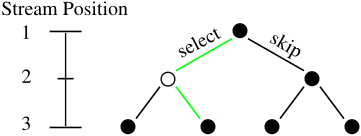
When treated as a sequential decision making problem, our task reduces to defining a policy for selecting a sentence based on its properties as well as properties of its ancestors (i.e. all of the observed sentences and previous decisions). The union of properties-also known as the featuresrepresents the current state in the decision making process.
The feature representation provides state abstraction both within a given query's search tree as well as to states in other queries' search trees, and also allows for complex interactions between the current update summary, candidate sentences, and stream dynamics unlike the classification approach.
In order to learn an effective policy for a query q, we can take one of several approaches. We could use a simulator to provide feedback to a reinforcement learning algorithm. Alternatively, if provided access to an evaluation algorithm at training time, we can simulate (approximately) optimal decisions. That is, using the training data, we can define an oracle policy that is able to omnisciently determine which sentences to select and which to skip. Moreover, it can make these determinations by starting at the root or at an arbitrary node in the tree, allowing us to observe optimal performance in states unlikely to be reached by the oracle. We adopt locally optimal learning to search to learn our model from the oracle policy [Chang et al., 2015].
In this section, we will begin by describing the learning algorithm abstractly and then in detail for our task. We will conclude with details on how to train the model with an oracle policy.
4.1 Algorithm
In the induced search problem, each search state st corresponds to observing the first t sentences in the stream x1↪ ▷ ▷ ▷ ↪ xt and a sequence of t - 1 actions a1↪ ▷ ▷ ▷ ↪ at-1. For all states s 2 S, the set of actions is a 2 ¶0↪ 1♦ with 1 indicating we add the t-th sentence to our update summary, and 0 indicating we ignore it. For simplicity, we assume a fixed length stream of size T but this is not strictly necessary. From each input stream, x = x1↪ ▷ ▷ ▷ ↪ xT , we produce a corresponding output a 2 ¶0↪ 1♦T . We use x:t to indicate the first t elements of x.
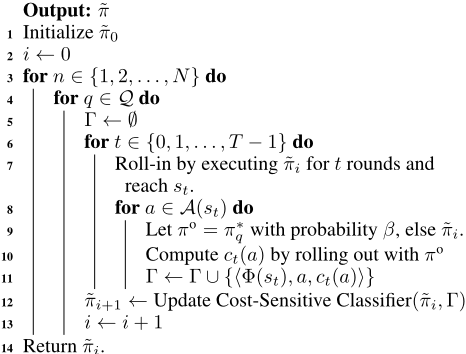
Algorithm 1: Locally optimal learning to search.
For a training query q, a reference policy ⇡⇤ q can be constructed from the training data. Specifically, with access to the relevance and novelty of every xi in the stream, we can omnisciently make a decision whether to select or skip based on a long term metric (see Section 5.2). The goal then is to learn a policy ˜⇡ that imitates the reference well across a set of training queries Q. We encode each state as a vector in Rd with a feature function Φ and our learned policy is a mapping ˜⇡ : Rd ! A of states to actions.
We train ˜⇡ using locally optimal learning to search [Chang et al., 2015], presented in Algorithm 1. The algorithm operates by iteratively updating a cost-sensitive classifier. For each training query, we construct a query-specific training set Γ by simulating the processing of the training input stream xq. The instances in Γ are triples comprised of a feature vector derived from the current state s, a candidate action a, and the cost c(a) associated with taking action a in state s. Constructing Γ consists of (1) selecting states and actions, and (2) computing the cost for each state-action pair.
The number of states is exponential in T, so constructing Γ using the full set of states may be computationally prohibitive. Beyond this, the states in Γ would not be representative of those visited at test time. In order to address this, we sample from S by executing the current policy ˜⇡ throughout the training simulation, resulting in T state samples for Γ, (lines 5-12).
Given a sampled state s, we need to compute the cost of taking actions a 2 ¶0↪ 1♦. With access to a query-specific oracle, ⇡⇤ q , we can observe it's preferred decision at s and penalize choosing the other action. The magnitude of this penalty is proportional to the difference in expected performance between the oracle decision and the alternative decision. The performance of a decision is derived from a loss function `, to be introduced in Section 4.3. Importantly, our loss function is defined over a complete update summary, incorporating the implications of selecting an action on future decisions. Therefore, our cost needs to incorporate a sequence of decisions after taking some action in state s. The algorithm accomplishes this by rolling out a policy after a until the stream has been exhausted (line 10). As a result, we have a prefix defined by ˜⇡, an action, and then a suffix defined by the roll out policy. In our work, we use a mixture policy that combines both the current model ˜⇡ and the oracle ⇡⇤ (line 9). This mixture policy encourages learning from states that are likely to be visited by the current learned policy but not by the oracle.
After our algorithm has gathered Γ for a specific q using ˜⇡i, we train on the data to produce ˜⇡i+1. Here ˜⇡i is implemented as a cost-sensitive classifier, i.e. a linear regression of the costs on features and actions; the natural policy is to select the action with lowest predicted cost. With each query, we update the regression with stochastic gradient descent on the newly sampled (state, action, cost) tuples (line 12). We repeat this process for N passes over all queries in the training set.
In the following sections, we specify the feature function Φ, the loss `, and our reference policy ⇡⇤ .
4.2 Features
As mentioned in the previous section, we represent each state as a feature vector. In general, at time t, these features are functions of the current sentence (i.e. xt), the stream history (i.e. x:t), and/or the decision history (a:t-1). We refer to features only determined by xt as static features and all others as dynamic features. 1
Static Features
Basic Features Our most basic features look at the length in words of a sentence, its position in the document, and the ratio of specific named entity tags to non-named entity tokens. We also compute the average number of sentence tokens that match the event query words and synonyms using WordNet.
Language Model Features Similar to [Kedzie et al., 2015], we compute the average token log probability of the sentence on two language models: i) an event type specific language model and ii) a general newswire language model. The first language model is built fromWikipedia articles relevant to the event-type domain. The second model is built from the New York Times and Associate Press sections of the Gigaword-5 corpus [Graff and Cieri, 2003].
Single Document Summarization Features These features are computed using the current sentence's document as a context and are also commonly used as ranking features in other document summarization systems. Where a similarity or distance is need, we use either a tf-idf bag-of-words or kdimensional latent vector representation. The latter is derived by projecting the former onto a k-dimensional space using the weighted textual matrix factorization method [Guo and Diab, 2012].
We compute SUMBASIC features [Nenkova and Vanderwende, 2005]: the average and sum of unigram probabilities in a sentence. We compute the arithmetic and geometric means of the sentence's cosine distance to the other sentences of the document [Guo et al., 2013]. We refer to this quantity as novelty and compute it with both vector representations.
1 We have attempted to use a comprehensive set of static features used in previous summarization systems. We omit details for space but source code is available at: https://github.com/kedz/ijcai2016
We also compute the centroid rank [Radev et al., 2000] and LexRank of each sentence [Erkan and Radev, 2004], again using both vector representations.
Summary Content Probability For a subset of the stream sentences we have manual judgements as to whether they match to model summary content or not (see Sec. 5.1, Expanding Relevance Judgments). We use this data (restricted to sentences from the training query streams), to train a decision tree classifier, using the sentences' term ngrams as classifier features. As this data is aggregated across the training queries, the purpose of this classifier is to capture the importance of general ngrams predictive of summary worthy content.
Using this classifier, we obtain the probability that the current sentence xt contains summary content and use this as a model feature.
Dynamic Features
Stream Language Models We maintain several unigram language models that are updated with each new document in the stream. Using these counts, we compute the sum, average, and maximum token probability of the non-stop words in the sentence. We compute similar quantities restricted to the person, location, and organization named entities.
Update Similarity The average and maximum cosine similarity of the current sentence to all previous updates is computed under both the tf-idf bag-of-words and latent vector representation. We also include indicator features for when the set of updates is empty (i.e. at the beginning of a run) and when either similarity is 0.
Document Frequency We also compute the hour-to-hour percent change in document frequency of the stream. This feature helps gauge breaking developments in an unfolding event. As this feature is also heavily affected by the daily news cycle (larger average document frequencies in the morning and evening) we compute the 0-mean/unit-variance of this feature using the training streams to find the mean and variance for each hour of the day.
Feature Interactions Many of our features are helpful for determining the importance of a sentence with respect to its document. However, they are more ambiguous for determining importance to the event as a whole. For example, it is not clear how to compare the document level PageRank of sentences from different documents. To compensate for this, we leverage two features which we believe to be good global indicators of update selection: the summary content probability and the document frequency. These two features are proxies for detecting (1) a good summary sentences (regardless of novelty with respect to other previous decisions) and (2) when an event is likely to be producing novel content. We compute the conjunctions of all previously mentioned features with the summary content probability and document frequency separately and together.
4.3 Oracle Policy and Loss Function
Much of the multi-document summarization literature employs greedy selection methods. We adopt a greedy oracle that selects a sentence if it improves our evaluation metric (see Section 5.2).
We design our loss function to penalize policies that severely over- or under-generate. Given two sets of decisions, usually one from the oracle and another from the candidate model, we define the loss as the complement of the Dice coefficient between the decisions,
This encourages not only local agreement between policies (the numerator of the second term) but that the learned and oracle policy should generate roughly the same number of updates (the denominator in the second term).
5 Materials andMethods
5.1 Data
We evaluate our method on the publicly available TREC Temporal Summarization Track data. 2 This data is comprised of three parts.
The corpus consists of a 16.1 terabyte set of 1.2 billion timestamped documents crawled from the web between October, 2011 and February 2013 [Frank et al., 2012]. The crawl includes news articles, forum data, weblogs, as well as a variety of other crawled web pages. 3
The queries consist of a set of 44 events which occurred during the timespan of the corpus. Each query has an associated time range to limit the experiment to a timespan of interest, usually around two weeks. In addition, each query is associated with an 'event category' (e.g. 'earthquake', 'hurricane'). Each query is also associated with an ideal summary, a set of short, timestamped textual descriptions of facts about the event. The items in this set, also known as nuggets, are considered the completed and irreducible sub-events associated with the query. For example, the phrases "multiple people have been injured" and "at least three people have been killed" are two of the nuggets extracted for the query 'Boston marathon bombing'. On average, 73.35 nuggets were extracted for each event.
The relevance judgments consist of a sample of sentences pooled from participant systems, each of which has been manually assessed as related to one or more of a query's nuggets or not. For example, the following sentence, "Two explosions near the finish line of the Boston Marathon on Monday killed three people and wounded scores," matches the nuggets mentioned above. The relevance judgments can be used to compute evaluation metrics (Section 5.2) and, as a result, to also define our oracle policy (Section 4.3).
Expanding Relevance Judgments
Because of the large size of the corpus and the limited size of the sample, many good candidate sentences were not manually reviewed. After aggressive document filtering (see below), less than 1% of the sentences received manual review. In order to increase the amount of data for training and evaluation of our system, we augmented the manual judgements with automatic or "soft" matches. A separate gradient boosting classifier was trained for each nugget with more than
2 http://www.trec-ts.org/
3 http://streamcorpus.org/
10 manual sentence matches. Manually matched sentences were used as positive training data and an equal number of manually judged non-matching sentences were used as negative examples. Sentence ngrams (1-5), percentage of nugget terms covered by the sentence, semantic similarity of the sentence to nugget were used as features, along with an interaction term between the semantic similarity and coverage. When augmenting the relevance judgments with these nugget match soft labels, we only include those that have a probability greater than 90% under the classifier. Overall these additional labels increase the number of matched sentences by 1600%.
For evaluation, the summarization system only has access to the query and the document stream, without knowledge of any nugget matches (manual or automatic).
Document Filtering
For any given event query, most of the documents in the corpus are irrelevant. Because our queries all consist of news events, we restrict ourselves to the news section of the corpus, consisting of 7,592,062 documents.
These documents are raw web pages, mostly from local news outlets running stories from syndication services (e.g. Reuters), in a variety of layouts. In order to normalize these inputs we filtered the raw stream for relevancy and redundancy with the following three stage process.
We first preprocessed each document's raw html using an article extraction library. 4 Articles were truncated to the first 20 sentences. We then removed any articles that did not contain all of the query keywords in the article text, resulting in one document stream for each query. Finally, documents whose cosine similarity to any previous document was > ▷8 were removed from the stream.
5.2 Metrics
We are interested in measuring a summary's relevance, comprehensiveness, redundancy, and latency (the delay in selecting nugget information). The Temporal Summarization Track adopts three principle metrics which we review here. Complete details can be found in the Track's official metrics document. 5 We use the official evaluation code to compute all metrics.
Given a system's update summary a and our sentence-level relevance judgments, we can compute the number of matching nuggets found. Importantly, a summary only gets credit for the number of unique matching nuggets, not the number of matching sentences. This prevents a system from receiving credit for selecting several sentences which match the same nugget. We refer to the number of unique matching nuggets as the gain. We can also penalize a system which retrieves a sentence matching a nugget far after the timestamp of the nugget. The latency-penalized gain discounts each match's contribution to the gain proportionally to the delay of the first matching sentence.
The gain value can be used to compute latency and redundancy-penalized analogs to precision and recall. Specifically, the expected gain divides the gain by the number of system updates. This precision-oriented metric can be considered the expected number of new nuggets in a sentence selected by the system. The comprehensiveness divides the gain by the number of nuggets. This recall-oriented metric can be considered the completeness of a user's information after the termination of the experiment. Finally, we also compute the harmonic mean of expected gain and comprehensiveness (i.e. F1). We present results using either gain or latency-penalized gain in order to better understand system behavior.
4 https://github.com/grangier/python-goose
5 http://www.trec-ts.org/trec2015-ts-metrics.pdf
To evaluate our model, we randomly select five events to use as a development set and then perform a leave-one-out style evaluation on the remaining 39 events.
5.3 Model Training
Even after filtering, each training query's document stream is still too large to be used directly in our combinatorial search space. In order to make training time reasonable yet representative, we downsample each stream to a length of 100 sentences. The downsampling is done uniformly over the entire stream. This is repeated 10 times for each training event to create a total of 380 training streams. In the event that a downsample contains no nuggets (either human or automatically labeled) we resample until at least one exists in the sample.
In order to avoid over-fitting, we select the model iteration for each training fold based on its performance (in F1 score of expected gain and comprehensiveness) on the development set.
5.4 Baselines andModel Variants
We refer to our "learning to search" model in the results as LS. We compare our proposed model against several baselines and extensions.
Cosine Similarity Threshold One of the top performing systems in temporal-summarization at TREC 2015 was a heuristic method that only examined article first sentences, selecting those that were below a cosine similarity threshold to any of the previously selected updates. We implemented a variant of that approach using the latent-vector representation used throughout this work. The development set was used to set the threshold. We refer to this model as COS (Team WATERLOOCLARKE at TREC 2015).
Affinity Propagation The next baseline was a top performer at the previous year's TREC evaluations [Kedzie et al., 2015]. This system processes the stream in non-overlapping windows of time, using affinity propagation (AP) clustering [Frey and Dueck, 2007] to identify update sentences (i.e. sentences that are cluster centers). As in the COS model, a similarity threshold is used to filter out updates that are too similar to previous updates (i.e. previous clustering outputs). We use the summary content probability feature as the preference or salience parameter. The time window size, similarity threshold, and an offset for the cluster preference are tuned on the development set. We use the authors' publicly available implementation and refer to this method as APSAL.
Learning2Search+Cosine Similarity Threshold In this model, which we refer to as LSCOS, we run LS as before, but filter the resulting updates using the same cosine similarity threshold method as in COS. The threshold was also tuned on the development set.
| unpenalized | latency-penalized | ||||||
|---|---|---|---|---|---|---|---|
| exp. gain | comp. | F1 | exp. gain | comp. | F1 | num. updates | |
| APSAL | 0▷119c | 0▷09 | 0▷094 | 0▷105 | 0▷088 | 0▷088 | 8▷333 |
| COS | 0▷075 | 0▷176s | 0▷099 | 0▷095 | 0▷236s | 0▷128s | 145▷615s↪f |
| LS | 0▷097 | 0▷207s↪f | 0▷112 | 0▷136c | 0▷306s↪c↪f | 0▷162s | 89▷872s↪f |
| LSCOS | 0▷115c↪l | 0▷189s | 0▷127s↪c↪l | 0▷162s↪c↪l | 0▷276s | 0▷184s↪c↪l | 29▷231s↪c |
| latency-penalized | |||
|---|---|---|---|
| exp. gain | comp. | F1 | |
| COS | 0▷095 | 0▷236 | 0▷128 |
| LSFS | 0▷164 | 0▷220 | 0▷157 |
| LSCOSFS | 0▷207 | 0▷18 | 0▷163 |
| Miss Lead | Miss Body | Empty | Dupl. | Total | |
|---|---|---|---|---|---|
| APSAL | 29.6% | 68.7% | 1.6% | 0.1% | 15,986 |
| COS | 17.8% | 39.4% | 41.1% | 1.7% | 12,873 |
| LSFS | 25.4% | 71.7% | 2.0% | 0.9% | 13,088 |
| LSCOSFS | 27.9% | 70.8% | 1.0% | 0.2% | 15,756 |
| LS | 19.6% | 55.3% | 19.9% | 5.1% | 13,380 |
| LSCOS | 24.6% | 66.7% | 7.5% | 1.2% | 11,613 |
6 Results
Results for system runs are shown in Figure 3. On average, LS and LSCOS achieve higher F1 scores than the baseline systems in both latency penalized and unpenalized evaluations. For LSCOS, the difference in mean F1 score was significant compared to all other systems (for both latency settings).
APSAL achieved the overall highest expected gain, partially because it was the tersest system we evaluated. However, only COS was statistically significantly worse than it on this measure.
In comprehensiveness, LS recalls on average a fifth of the nuggets for each event. This is even more impressive when compared to the average number of updates produced by each system (Figure 3); while COS achieves similar comprehensiveness, it takes on average about 62% more updates than LS and almost 400%more updates than LSCOS. The output size of COS stretches the limit of the term "summary," which is typically shorter than 145 sentences in length. This is especially important if the intended application is negatively affected by verbosity (e.g. crisis monitoring).
7 Discussion
Since COS only considers the first sentence of each document, it may miss relevant sentences below the article's lead. In order to confirm the importance of modeling the oracle, we also trained and evaluated the LS based approaches on first sentence only streams. Figure 4 shows the latency penalized results of the first sentence only runs. The LS approaches still dominate COS and receive larger positive effects from the latency penalty despite also being restricted to the first sentence. Clearly having a model (beyond similarity) of what to select is helpful. Ultimately we do much better when we can look at the whole document.
We also performed an error analysis to further understand how each system operates. Figure 5 shows the errors made by each system on the test streams. Errors were broken down into four categories. Miss lead and miss body errors occur when a system skips a sentence containing a novel nugget in the lead or article body respectively. An empty error indicates an update was selected that contained no nugget. Duplicate errors occur when an update contains nuggets but none are novel.
Overall, errors of the miss type are most common and suggest future development effort should focus on summary content identification. About a fifth to a third of all system error comes frommissing content in the lead sentence alone.
After misses, empty errors (false positives) are the next largest source of error. COS was especially prone to empty errors (41% of its total errors). LS is also vulnerable to empties (19.9%) but after applying the similarity filter and restricting to first sentences, these errors can be reduced dramatically (to 1%).
Surprisingly, duplicate errors are a minor issue in our evaluation. This is not to suggest we should ignore this component, however, as efforts to increase recall (reduce miss errors) are likely to require more robust redundancy detection.
8 Conclusion
In this paper we presented a fully online streaming document summarization system capable of processing web-scale data efficiently. We also demonstrated the effectiveness of "learning to search" algorithms for this task. As shown in our error analysis, improving the summary content selection especially in article body should be the focus of future work. We would like to explore deeper linguistic analysis (e.g. coreference and discourse structures) to identify places likely to contain content rather than processing whole documents.
9 Acknowledgements
We would like to thank Hal Daum´e III for answering our questions about learning to search. The research described here was supported in part by the National Science Foundation (NSF) under IIS-1422863. Any opinions, findings and conclusions or recommendations expressed in this paper are those of the authors and do not necessarily reflect the views of the NSF.
@inproceedings{ijcai2016p528,
  title     = {Real-Time Web Scale Event Summarization Using Sequential Decision Making},
  author    = {Kedzie, Chris and Diaz, Fernando and McKeown, Kathleen R.},
  booktitle = {Proceedings of the Twenty-Fifth International Joint Conference on
               Artificial Intelligence, {IJCAI-16}},
  publisher = {AAAI Press / International Joint Conferences on Artificial Intelligence},
  editor    = {Subbarao Kambhampati},
  pages     = {3754--3759},
  year      = {2016},
  month     = {7},
  url       = {https://ijcai.org/proceedings/2016/528},
}
TY - CPAPER TI - Real-Time Web Scale Event Summarization Using Sequential Decision Making AU - Kedzie, Chris AU - Diaz, Fernando AU - McKeown, Kathleen R. T2 - Proceedings of the Twenty-Fifth International Joint Conference on Artificial Intelligence, IJCAI-16 PB - AAAI Press / International Joint Conferences on Artificial Intelligence PY - 2016 SP - 3754 EP - 3759 UR - https://ijcai.org/proceedings/2016/528 ER -Copied
Machine-readable versions of this paper, for tools and AI agents:





