
ContextCare: Incorporating Contextual Information Networks to Representation Learning on Medical Forum Data
Proceedings of the Twenty-Sixth International Joint Conference on Artificial Intelligence. Main track. Pages 3497-3503.
https://doi.org/10.24963/ijcai.2017/489
Keywords
- Multidisciplinary Topics and Applications: AI and Social Sciences
- Machine Learning: Data Mining
Abstract
Online users have generated a large amount of health-related data on medical forums and search engines. However, exploiting these rich data for orienting patient online and assisting medical checkup offline is nontrivial due to the sparseness of existing symptom-disease links, which caused by the natural and chatty expressions of symptoms. In this paper, we propose a novel and general representation learning method ContextCare for human generated health-related data, which learns the latent relationship between symptoms and diseases from the symptom-disease diagnosis network for disease prediction, disease category prediction and disease clustering. To alleviate the network sparseness, ContextCare adopts regularizations from rich contextual information networks including a symptom co-occurrence network and a disease evolution network. Therefore, our representations of symptoms and diseases incorporate knowledge from these three networks. Extensive experiments on medical forum data demonstrate that ContextCare outperforms the state-of-the-art methods in disease category prediction, disease prediction and disease clustering.
- [Adamic and Adar, 2003] Lada A Adamic and Eytan Adar. Friends and neighbors on the web. Social networks, 25(3):211-230, 2003.
- [Baike, 2017] Baidu Baike. Haodf (haodf.com)-baike, the free encyclopedia in chinese, 2017. [Online; accessed 02- February-2017].
- [Berger et al., 1996] Adam L Berger, Vincent J Della Pietra, and Stephen A Della Pietra. A maximum entropy approach to natural language processing. Computational Linguistic- s, 22(1):39-71, 1996.
- [Blei et al., 2003] David M Blei, Andrew Y Ng, and Michael I Jordan. Latent dirichlet allocation. Journal of Machine Learning Research, 3:993-1022, 2003.
- [Bordes et al., 2013] Antoine Bordes, Nicolas Usunier, Alberto Garcia-Duran, Jason Weston, and Oksana Yakhnenko. Translating embeddings for modeling multi-relational data. In NIPS, pages 2787-2795, 2013.
- [Bordes et al., 2014] Antoine Bordes, Sumit Chopra, and Ja- son Weston. Question answering with subgraph embed- dings. In Proceedings of the EMNLP, pages 615-620.
- A- CL, October 2014.
- [Breiman et al., 1984] Leo Breiman, Jerome Friedman, Charles J Stone, and Richard A Olshen. Classification and regression trees. CRC press, 1984.
- [Chang and Lin, 2011] Chih-Chung Chang and Chih-Jen Lin. Libsvm: a library for support vector machines. ACM Transactions on Intelligent Systems and Technology, 2(3):27, 2011.
- [Che et al., 2010] Wanxiang Che, Zhenghua Li, and Ting Li- u. Ltp: A chinese language technology platform. In Pro- ceedings of the 23rd COLING, pages 13-16. ACL, 2010.
- [Choi et al., 2015] Edward Choi, Nan Du, Robert Chen, Le Song, and Jimeng Sun. Constructing disease network and temporal progression model via context-sensitive hawkes process. In Proceedings of the IEEE ICDM, pages 721-726. IEEE, 2015.
- [Denny, 2012] Joshua C Denny. Mining electronic health records in the genomics era. PLoS Comput Biol, 8(12):e1002823, 2012.
- [Fox and Duggan, 2013] Susannah Fox and Maeve Duggan. Health online 2013. Health, pages 1-55, 2013.
- [Hartigan and Wong, 1979] John A Hartigan and Manchek A Wong. Algorithm as 136: A k-means clustering algorithm. Journal of the Royal Statistical Society, 28(1):100-108, 1979.
- [Hripcsak and Albers, 2013] George Hripcsak and David J Albers. Next-generation phenotyping of electronic health records. Journal of the American Medical Informatics As- sociation, 20(1):117-121, 2013.
- [Jacob et al., 2014] Yann Jacob, Ludovic Denoyer, and Patrick Gallinari. Learning latent representations of nodes for classifying in heterogeneous social networks. In Pro- ceedings of the 7th ACM WSDM, pages 373-382. ACM, 2014.
- [Jeh and Widom, 2002] Glen Jeh and Jennifer Widom. Sim- rank: a measure of structural-context similarity. In Pro- ceedings of the 8th ACM KDD, pages 538-543. ACM, 2002.
- [Jeh and Widom, 2003] Glen Jeh and Jennifer Widom. Scal- ing personalized web search. In Proceedings of the 12th ACM WWW, pages 271-279. ACM, 2003.
- [Joshi, 2017] Anjali Joshi. Primum non nocere: Healthcare in the digital age. In Proceedings of the 10th ACM WSDM, pages 579-579. ACM, 2017.
- [Perotte et al., 2011] Adler J Perotte, Frank Wood, Noemie Elhadad, and Nicholas Bartlett. Hierarchically supervised latent dirichlet allocation. In NIPS, pages 2609-2617, 2011.
- [Perozzi et al., 2014] Bryan Perozzi, Rami Al-Rfou, and Steven Skiena. Deepwalk: Online learning of social repre- sentations. In Proceedings of the 20th ACM KDD, pages 701-710. ACM, 2014.
- [Rand, 1971] William M Rand. Objective criteria for the e- valuation of clustering methods. Journal of the American Statistical association, 66(336):846-850, 1971.
- [Shi et al., 2014] Chuan Shi, Xiangnan Kong, Yue Huang, Philip S Yu, and Bin Wu. Hetesim: A general frame- work for relevance measure in heterogeneous network- s. IEEE actions on Knowledge and Data Engineering, 26(10):2479-2492, 2014.
- [Sun et al., 2011] Yizhou Sun, Jiawei Han, Xifeng Yan, Philip S Yu, and Tianyi Wu. Pathsim: Meta path-based top-k similarity search in heterogeneous information net- works. Proceedings of the 37th VLDB, 2011.
- [Sun et al., 2012] Jimeng Sun, Jianying Hu, Dijun Luo, Marianthi Markatou, Fei Wang, Shahram Ebadollahi, Zahra Daar, and Walter F Stewart. Combining knowledge and data driven insights for identifying risk factors using electronic health records. 2012:901-10, 2012.
- [Tang et al., 2015] Jian Tang, Meng Qu, Mingzhe Wang, Ming Zhang, Jun Yan, and Qiaozhu Mei. Line: Large- scale information network embedding. In Proceedings of the 24th ACM WWW, pages 1067-1077. ACM, 2015.
- [Wang et al., 2014a] Fei Wang, Ping Zhang, Buyue Qian, X- iang Wang, and Ian Davidson. Clinical risk prediction with multilinear sparse logistic regression. In Proceedings of the 20th ACM KDD, pages 145-154. ACM, 2014.
- [Wang et al., 2014b] Xiang Wang, David Sontag, and Fei Wang. Unsupervised learning of disease progression mod- els. In Proceedings of the 20th ACM KDD, pages 85-94. ACM, 2014.
- [Zhao et al., 2017] Sendong Zhao, Quan Wang, Sean Mas- sung, Bing Qin, Ting Liu, Bin Wang, and ChengXiang Zhai. Constructing and embedding abstract event causali- ty networks from text snippets. In Proceedings of the 10th ACM WSDM, pages 335-344. ACM, 2017.
References were extracted automatically from the PDF and may contain errors.
Full text extracted automatically from the PDF; figures, tables and equations may differ. The PDF is the version of record.
1 Introduction
With the prevailing of Web 2.0 applications, an increasing number of individuals are seeking diagnostic aids online. As reported, 33% American adults went online to figure out what medical conditions they might have [Fox and Duggan, 2013] and 5% google searches are healthcare related [Joshi, 2017]. To get online diagnostic aids, individuals can either search symptom related queries or ask questions on medical forums such as PatientsLikeMe and Haodf [Baike, 2017]. In the former scenario, part of users would click returned documents of diseases according to their symptoms, which generates links between diseases and symptoms. In the latter scenario, medical experts or patients with the same symptoms would help to explain what's going on with one's body on medical forums, which generate plenty of symptom-disease links as well.
Can we leverage these large amounts of medical forum data and heath related query logs to orient patient online and assist professional clinical checkup offline? Are these links between textual symptoms and textual diseases good enough to use directly? Unfortunately, symptoms in both queries and medical forum posts are usually informally expressed with narrative language. Especially on medical forums, symptoms and diseases, which are in rounds of QAs, are usually too natural and chatty instead of professional and brief. As a consequence, symptoms with similar literal meanings or medical implications are usually expressed in different narrative ways, leading to very sparse links between symptoms and diseases.
∗This work was supported by 863 Program via grant 2015AA015407 and NSFC via grants 61632011 and 61370164.
†Corresponding author
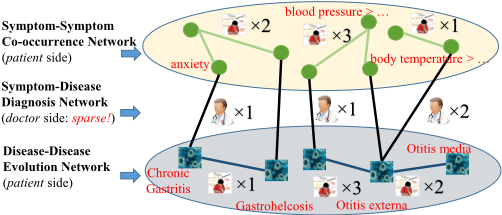
In order to enhance the utility of the rich online medical forum data for disease prediction, as mentioned above, we have to face challenges of the serious issue of sparseness, that are, 1) the number of descriptions of symptoms and diseases is in thousand-level due to the variety of symptoms and diseases and the diversity of natural language expressions for symptoms, 2) the number of symptom-disease links is relatively small. For example, the sample on our data indicates that the density of the symptom-disease network is only 0.07%.
To address the sparsity problem, we propose a new idea of using the rich contextual information of diseases and symptoms to bridge the gap between disease candidates and symptoms, and detach it from the specific way of implementing the idea using network embedding. Specifically, we create a twolayer network which consists of a bipartite diagnosis network and the following two homogeneous networks. (see Figure 1).
- Symptom co-occurrence network. A patient may have multiple symptoms. We spot co-occurrence of the symptoms, for instance, headache and high blood pressure.
- Disease evolution network. A patient may report the disease co-occurrence or evolution that they know from the experts online or clinicians offline. We observe the evolution of the diseases, for example, tuberculosis increases the risk of lung cancer.
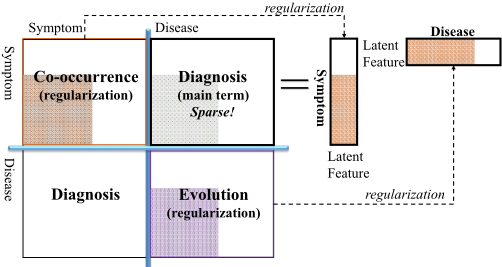
We believe that these two networks can highly mitigate the sparsity of bipartite diagnosis network. To make use of those two networks as contextual information for accurate disease prediction, we propose a novel method, CONTEXTCARE, to integrate the three networks of different aspects but rich information. The basic ideas of CONTEXTCARE are 1) the linked disease and symptom in the bipartite diagnosis network should be closer in a certain way; 2) frequently co-occurred symptoms should be closer in representation; 3) evolutionary diseases should be closer in representation. Compacting symptoms in 2) and diseases in 3) both benefit alleviating the sparsity of the bipartite diagnosis network. By encoding all these aspects, our CONTEXTCARE utilizes information from the three networks to facilitate the predictive model. CONTEXTCARE takes the sparse symptom-disease diagnosis network as the main term in the objective function and adopts the contextual information including the symptom co-occurrence and disease evolution as regularization terms (see Figure 2).
It is worthwhile to highlight our contributions as follows.
- Important problem and new idea. We leverage the rich medical QA posts from online medical forums for disease prediction and patient guidance with informally expressed symptoms, which could benefit diagnostic aids online and offline. To deal with the sparseness of diagnosis network, we propose CONTEXTCARE to integrate the diagnosis network, symptom co-occurrence network and disease evolution network for learning the latent representations of symptoms and diseases.
- Effectiveness in real data. Experiments on medical forum data demonstrate that CONTEXTCARE outperforms the state-of-the-art methods in disease prediction on thousands of classes, with a 23.1% relative improvement.
2 Problem Statement
We define the networks get from online medical forums and the problem studied in this work.
DEFINITION 1 (Symptom-Disease Diagnosis Network)
The network, denoted as GSD = (S ∪ D,E), is a bipartite network that captures the relation between patient's symptoms Sp and the corresponding disease d. S is the set of symptoms and Sp ∈ S. D is the set of diseases and d ∈ D. E ⊂ S × D is the set of symptom-disease links extracted from the diagnosis by doctors and experts.
The symptom-disease diagnosis network which consists of relationships between symptoms and disease is the essential resource for disease prediction. However, the extremely sparsity of paths in this bipartite network is an absolute disaster for any prediction models. In order to alleviate the sparseness of the symptom-disease diagnosis network, we introduce the following two networks.
DEFINITION 2 (SymptomCo-occurrence Network) This network is denoted by GSS = (S, Eco ), where S is the set of symptoms and Eco ⊂ S × S is the set of symptom-symptom co-occurrence links whose frequency is beyond a threshold τ. Each (si, sj) ∈ Eco indicates that symptom si and sj co-occurred above τ times.
DEFINITION 3 (Disease Evolution Network) This network is denoted by GDD = (D, Eev ), where D is a set of diseases, and Eev ⊂ D × D is the set of disease-disease evolution links. Each (dm, dn) ∈ Eev indicates that disease dm and dn are evolutionary diseases.
Given these definitions, we can formally formulate the problem studied in this work.
PROBLEM 1 (Representation Learning) Given the sparse network GSD and rich contextual information from networks GSS and GDD , find the latent representation s of symptom s and d of disease d.
It is a fundamental problem towards disease prediction, since the prediction performance highly depends on the quality of the latent features we learn.
3 The CONTEXTCARE Method
We introduce details of the proposed representation learning method (CONTEXTCARE) in this section. This model operates in bipartite symptom-disease diagnosis network learning and makes use of symptom-symptom co-occurrence network and disease-disease evolution network as the constraints of the bipartite network learning.
3.1 Bipartite Symptoms-Disease Network Learning
Given the bipartite symptom-disease network GSD , it is quite appealing to learn latent representations of vertices via modeling symptom-disease paths. The underlying assumption of the embedding method is that the disease can be represented with its relationships with symptoms and vice versa, which derives from [Bordes et al., 2013]. It is implemented by taking the symptom-disease relationship as a transition t. Specifically, We define a simple energy function f(Sp , d) on each (Sp , d) as follows.
We are using an ℓ1 norm in the latent space, but other metrics could be used as well. We take the symptom-disease as a transition vector t. True symptoms-disease pairs (Sp , d) are assumed to have low energies in the energy function. For each true symptoms-disease pair, we generate a contrast via sampling a negative pair with normal distribution and make any deviation from (Sp , d) as costly as possible. It is worth to mention that we also try another energy function, which considers the transition between symptoms and disease as multiplying a matrix, as a baseline model.
To learn the symptom embeddings {s}, the disease embeddings {d} and the transition vector t, we consider a ranking criterion. Intuitively, given a true pair (Sp , d), if the disease d is missing, we would like the model to be able to predict the correct disease. The objective of training is to learn the energy function f so that it can successfully rank the true pair (Sp , d) to be preceded all other possible pairs. Therefore, we define a loss to formalize this intuition:
where M+ is the set of true (Sp , d) pairs found in the online medical QA pairs from medical forums, M- contains corrupted pairs constructed by replacing the symptom set or the disease in the true (Sp , d), γ > 0 is a margin separating true symptom-disease pairs and corrupted pairs, and [x]+ = max(0, x) denotes the positive part of x.
3.2 Regularization of SymptomCo-occurrence
Beyond learning the bipartite symptom-disease diagnosis network, CONTEXTCARE also exploits symptom-symptom cooccurrence network GSS as the constraints to alleviate the sparseness of the bipartite network for more accurate representations of symptoms, thus benefits disease prediction. Hence, we define the ℓ1 penalty over frequently co-occurred symptoms, ‖si - sj‖1, defines the symptom-symptom regularization. It incentivizes the vector representations of frequently co-occurred symptoms to be close, the larger wij, the greater penalty.
where wij = |Γ(si)∩Γ(sj)| |Γ(si)∪Γ(sj)| is the Jaccard similarity between symptoms si and sj , Γ(si) and Γ(sj) denote the set of neighbors of symptom si and symptom sj in the symptomsymptoms co-occurrence network with frequency respectively. Note that we consider the frequency of the edge between neighbors when counting Γ(s), i.e., we take a symptom sj as a neighbor of si when the co-occurrence frequency of si and sj is beyond a threshold τ.
By minimizing R1 (G SS ), the representations of symptoms which encode contextual information lead to close representations of symptoms with similar meanings or implications.
3.3 Regularization of Disease Evolution
Our model considers the disease evolution as a very important contextual information of diseases for alleviating the sparseness of bipartite symptom-disease diagnosis network GSD . In order to make full use of the explicit and implicit information involved in disease evolution, we define the ℓ2 penalty over the difference on evolutionary diseases, ‖dm -dn‖2, defines the disease evolution regularization. It incentivizes the vector representations of diseases which are different stages of the same patient to be close, the larger vmn, the greater penalty.
where vmn = |Γ(dn)∩Γ(dm)| |Γ(dn)∪Γ(dm)| is again the the Jaccard similarity, Γ(dn) and Γ(dm) denote the set of neighbors of disease dn and disease dm in the disease evolution network respectively. Note that we make use of ℓ2 on evolutionary diseases rather than ℓ1 like the penalty on co-occurred symptoms. The reason is 1) we want treat these two kinds of relations differently and 2) put more emphasis on disease evolution because of more significant effect on compacting diseases.
The evolution of diseases is used as the constraint for learning more accurate representations of diseases, thus benefits disease prediction. Disease evolution is the knowledge of the progression and change directions of disease. By encoding disease progression and direction in them, disease representations are given the potential to predict different variations of the diseases and long-term diseases given initial symptoms of patients. The constraint of disease evolution is also good for compacting symptom representations because approximating those evolutionary diseases will indirectly lead to approximate those symptoms which should be compacted. Therefore, by minimizing R2 (G DD ), the representations of disease which encode contextual information lead to close representations of diseases which are similar in the medical sense and also benefit condensing similar symptoms.
3.4 Latent Representation Learning
Towards the goal of learning representations of symptoms and diseases, the final objective loss of our model combines symptom-disease bridging loss, symptom-symptom cooccurrence loss and disease-disease evolution loss 2, 3 and 4, which is minimized as follows:
where α > 0 and β > 0 are both parameters which weight the regularizations. This proposed model directly bridges symptoms and diseases. Besides, it extends to incorporate symptom-symptom co-occurrence and disease-disease evolution as constraints for learning symptom and disease representations onto a latent space. This model can capture longterm influence from one disease to another by strengthening evolution between diseases. The frequently co-occurred symptoms are also grouped close to each other. All these two aspects benefit bridging symptoms with diseases. The optimization in Eq. (5) favors lower energies for true symptomsdisease pairs than corrupted pairs, and is thus a natural implementation of the intended criterion. The optimization is carried out by stochastic gradient descent in mini-batch mode. We enforce the constraints that the embedding of each node ‖s‖ = 1 and ‖d‖ = 1 to avoid overfitting. The computational complexity approximates to O(TNK), where N is the number of iterations, N the number of cases, K the number of symptoms in each case.
4 Experiments
4.1 Dataset
We conduct experiments on a real Chinese medical QA narrative data from an online medical forum, i.e., Haodf [Baike, 2017]. From the online medical QA posts of each patient, we have a set of symptoms in narratives, diagnosed diseases given by online experts. Except for the historical diseases proposed by the patient initially, the evolution of diseases can be easily obtained from multiple rounds of QA in each post. In our dataset, there are 17,803 medical QA posts with 18,899 symptoms and 1,066 diseases in total. We split all medical QA posts into a training/validation/test set randomly, with the ratio of 8:1:1. The first part is for training model, the second for hyper-parameter tuning, and the third for evaluation. According to ICD-10, the 1,066 diseases are assigned to 9 categories, which is to evaluate disease category prediction and clustering. In order to get symptom phrases, we leverage a medical dictionary and a unified pre-processing platform for Chinese [Che et al., 2010] to recognize symptom related noun phrases and verb phrases.
4.2 Baseline Methods
Classification Models. Disease prediction by taking symptoms as binary features is a typical muti-label classification. Here, we take SVM [Chang and Lin, 2011], Decision Tree [Breiman et al., 1984] and MaxEnt [Berger et al., 1996] as baselines. However, these baselines just take the one-hot feature of symptoms thus suffer from the sparsity of symptoms.
Topic Modeling Method. The well-established Latent Dirichlet Allocation (LDA) model [Blei et al., 2003] has been applied to get phenotypes for diagnosis code prediction [Perotte et al., 2011]. Therefore, we take LDA [Blei et al., 2003] to learn the symptom distribution and the disease distribution for disease prediction by regarding symptoms as words and diseases as documents.
Link Prediction Models. Researchers have proposed a few methods that can predict the links between symptoms and disease with the diagnosis network GSD . P-PageRank prefers those popular diseases and therefore tends to take popular diseases as predictions. SimRank [Jeh and Widom, 2002] links a disease d and a symptom s by considering the links between the neighbor diseases of d, i.e., Γ(d) and neighbor symptoms of s, i.e., Γ(s). However, it is inflexible to link those diseases and symptoms with few neighbors and suffer from the sparseness of symptom-disease links. HeteSim [Shi et al., 2014] learns links between diseases and symptoms by walking on the GSD through the path [disease→disease→symptom→symptom]. However, it is insufficient to deal with latent relations thus suffers from the sparseness of symptom-disease diagnosis network. These methods are both designed for one-to-one link prediction instead of one-to-many relationship prediction as our task. In order to fit our many-to-one prediction task, we extend these methods to combine one-to-one links by voting.
Network Embedding Methods. Representing diseases and symptoms into latent spaces is a more flexible way to bridge the gap of disease and symptoms. LSHM [Jacob et al., 2014] learns a classification function meanwhile takes into account that neighbor symptoms or diseases should be close. The idea behind is that two diseases or symptoms which are connected in GSD will tend to share similar representations. However, it deals with evolutionary diseases and co-occurred symptoms in the same manner and treats every disease evolution and symptom co-occurrence with the same importance, which might limit the predictive performance. The LSHM is also designed for dealing with one-to-one similarity computation rather than many-to-one. Therefore, we leverage voting to meet with the many-to-one mode. ContextCare× is a variation of our CONTEXTCARE by taking the symptom-disease relationship as a transition matrix T in ContextCare× rather than a transition vector t.
We considered the work on QA embedding by Bordes et al. [Bordes et al., 2014], however, mapping entity names in questions to subgraphs of KBs is undoable in our narrativedata case. In their design, the question and the subgraph must share at least one entity. In this way, it is reasonable that questions and answers share the same embedding matrix. However, in our dataset, symptoms and the corresponding disease do not share even a word in most cases.
4.3 Implementation Details
For baselines, we tune hyper-parameters for best results. For our methods, we select the learning rate λ for stochastic gradient descent among {0.001, 0.01, 0.1}, the margin γ among {1, 2, 10}, and the latent dimension k among {10, 20, 30, 40, 50} on the validation set. Optimal configurations for CONTEXTCARE are k = 40, λ = 0.01, γ = 1, α = 0.35, β = 0.55. Training is limited to at most 1,000 epochs over the training set. The best models are selected by early stopping on the validation sets. We conducted multiple rounds of crossvalidation to avoid the issue of time sensitivity.
4.4 Evaluation Criterion
For disease prediction and disease category prediction, we use accuracy to evaluate results. For those methods which can generate ranking lists, we use Precision@5 and Precision@10 to check the proportion of correct diseases located in the top 5 and 10. For each given set of symptoms, our model gives a ranking list of diseases. The prediction accuracy, that equals as precision@1, along with other precision@k metrics can well evaluate the performance. Recall (and f-score) is not sensitive in the task: one disease is often connected to only one symptom; so, if precision@k increases, recall increases as well. For disease category prediction, we re-train the classification models for 9 classes according to ICD-10. Rand index (RI) [Rand, 1971] is taken to evaluate the performance of disease clustering.
| Method | Accuracy | Precision@5 | Precision@10 | |||
|---|---|---|---|---|---|---|
| Diagnosis Network | +Co | +Ev | +Co,Ev | |||
| SVM (linear) | 16.02 | - | - | - | - | - |
| SVM (RBF) | 16.79 | - | - | - | - | - |
| Decision Tree (C4.5) | 17.31 | - | - | - | - | - |
| MaxEnt | 18.98 | - | - | - | - | - |
| LDA | 14.73 | - | - | - | 23.46 | 35.21 |
| P-PageRank | 17.22 | 19.71 | 17.25 | 19.74 | 43.17 | 62.16 |
| SimRank | 19.36 | 21.97 | 19.38 | 21.98 | 46.52 | 64.33 |
| HeteSim | 20.62 | 23.03 | 20.69 | 23.32 | 55.31 | 70.48 |
| LSHM | 21.38 | 25.87 | 22.55 | 25.77 | 65.74 | 82.45 |
| ContextCare× | 22.35 | 28.09 | 24.74 | 30.66 | 69.38 | 85.76 |
| CONTEXTCARE | 23.57 | 30.32 | 27.26 | 31.73 | 73.21 | 87.36 |
4.5 Disease Prediction
Results and Analysis. Table 1 shows the accuracy of the baseline methods as well as our CONTEXTCARE on disease prediction. Each row of Table 1 represents a model for disease prediction. Each column stands for a type of resource combination used to predict disease. For example, the column "Diagnosis Network" denotes the use of bipartite symptom-disease diagnosis network including a large number of symptom-disease paths and the column "+Co" and "+Ev" denotes that symptom co-occurrence and disease evolution are integrated separately besides symptom-disease paths.
From the second column of Table 1, we can see that network embedding methods outperform classification baseline models, LDA and link prediction models. Symptoms are represented as one-hot features which are extremely sparse in classification models, which greatly limits the performance of disease prediction. LDA is deficient for sparseness. Link prediction models utilize the explicit paths between symptoms and diseases, which is inflexible to link diseases and symptoms thus cannot help to solve the sparsity problem. Network embedding methods utilize symptom-disease relations to represent symptoms and diseases onto latent spaces. They are more flexible to capture latent links between symptoms and diseases thus benefit disease prediction.
From the last 6 rows of Table 1, we can see that taking into account of symptom co-occurrence and disease evolution separately or jointly can consistently improve the performance of disease prediction for both link prediction models and network embedding models. However, these resources produce greater improvement on disease prediction in our CONTEXTCARE. CONTEXTCARE increases accuracy by 6.75% from using symptom co-occurrence network to regularize the representations of symptoms, which indicates that compacting representations of symptoms benefits disease prediction. CONTEXTCARE increases accuracy by 3.68% from using disease evolution network to regularize the representations of diseases, which indicates that compacting representations of diseases improves disease prediction. When taking these two regularization terms, our CONTEXTCARE increases accuracy by 8.16% in total. Essentially, compacting symptoms and diseases are both ways to alleviate the sparsity of symptomdisease links. The results demonstrate that CONTEXTCARE successfully alleviate the issue of sparseness and improve the performance of prediction by integrating networks.
The above observation shows that: 1) our new idea of using additional homogeneous networks as contexts works well for all the ways to make predictions; 2) the particular embedding method CONTEXTCARE works better than other methods, showing that embedding-based approach is better because they are flexible to capture latent links in the diagnosis network; 3) our CONTEXTCARE is more effective in alleviating the sparseness of the diagnosis network by taking symptom co-occurrence network and disease evolution network to regularize the representations of diseases and symptoms, thus obtain the best results.
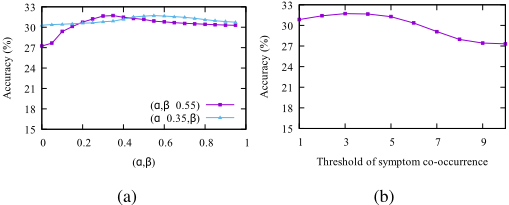
Effect of α and β in CONTEXTCARE. We tune the hyperparameter α and β of CONTEXTCARE on the validation set. We randomly assign a value from (0:0.5:1) to α and got the β which achieve the best accuracy, then conduct the same on β. Then we proceed to iteratively find best α and β. The Figure 3(a) shows the effect of α and β to the performance.
Effect of threshold τ in R1 (G SS ). We investigate how the threshold of the frequency of the symptom-symptom co-occurrence affects the performance of CONTEXTCARE for disease prediction. We vary the threshold value of the symptom-symptom co-occurrence from 1 to 10, increased by 1. Results of the effect of threshold on disease prediction on our validation set are given in Figure 3(b). We can see that the best threshold configuration is 3 and greater or less than 3 will cause a worse performance.
4.6 Disease Category Prediction
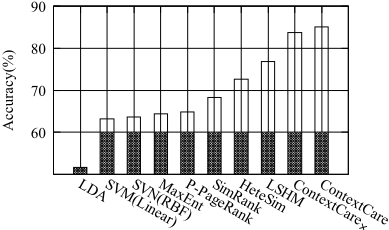
Given symptoms, predicting specific disease from 1,066 diseases is a difficult task. The reason is that similar diseases tend to share similar symptoms, such as "gastric ulcer" and "gastritis". However, we will not fall into the unconsidered differences between "gastric ulcer" and "gastritis" in symptoms if we just predict the category of disease instead of specific disease because they are both diseases of the "digestive system" according to ICD-10. Predicting the category of disease is valuable because of the following two scenarios. First, it is necessary to early determine the department that a patient should make an appointment with. Second, doctors and experts can provide quick consulting if they have the correct category of the potential disease in advance. Figure 4 shows the results that LSHM is considerable for application but still not as good as our CONTEXTCARE which stands out from all baseline methods in disease category prediction.
4.7 Disease Clustering
This experiment is to test the effectiveness of the learned disease embeddings in clustering similar diseases. We utilize classical k-means [Hartigan and Wong, 1979] with random initialization to cluster the 1,066 diseases and evaluate the clustering performance with Rand index (RI) [Rand, 1971]. Note that we follow the disease categories in ICD10, i.e., 1,066 diseases in our dataset are assigned to 9 categories. These labeled diseases are taken as the ground truth to verify whether diseases in the same category of ICD10 are represented to be much closer than diseases belonging to different categories. From the experiment, LSHM gets 79.23%, ContextCare× gets 88.09% and CONTEXTCARE gets 89.14%. It is clear that our proposed CONTEXTCARE performs the best. The effectiveness of our CONTEXTCARE in clustering diseases is a very important reason that we achieve the better disease prediction and disease category prediction. The reason is that CONTEXTCARE makes the representations of diseases with few supports of symptoms much closer to its similar diseases with rich supports of symptoms, and consequently improves the performance of predicting disease with few supports of symptoms.
5 RelatedWork
Disease prediction. There are several studies working on disease prediction based on rich electronic health record (EHR) with different methods, such as [Sun et al., 2012; Wang et al., 2014a; Choi et al., 2015; Wang et al., 2014b]. Disease prediction based on EHR requires relatively long records of a patient for generating good results. However, EHR is expensive for both patients and researchers. More importantly, there are large of amount of users want to check their medical condition with narrative symptoms online. Our research emphasizes on mitigating the sparsity between symptoms and diseases thus obtains better results on disease prediction with narrative symptoms only.
EHR-based phenotyping is a process to map raw EHR data into meaningful medical concepts, learning medically relevant characteristics of the data [Denny, 2012], and is important for supporting genome-wide association studies [Hripcsak and Albers, 2013]. Phenotyping can be viewed as a form of dimensionality reduction, where each phenotype forms a latent space. The well-established Latent Dirichlet Allocation (LDA) model [Blei et al., 2003] has been applied to get phenotypes for diagnosis code prediction [Perotte et al., 2011] and disease progressionmodeling [Wang et al., 2014b].
However, our goal is to predict disease with informal symptoms for orienting patient who might want to get guidance from online medical QA systems, search engines and online medical forums. Therefore, the big challenge is the sparsity which comes from textual symptoms with informal expressions. Phenotyping uses clean structured EHR rather than the noisy online QA data from medical forums, thus much less sparsity than that in our task. LDA which essentially leverage the high frequent co-occurrence in data can hardly deal with the serious sparseness of narrative symptoms.
Network mining and analysis is also a related topic as we can formulate our problem as link prediction in diseasesymptom networks. Most of the existing studies [Adamic and Adar, 2003; Jeh and Widom, 2003; Sun et al., 2011; Shi et al., 2014] predict links directly rely on existed links in networks, and these methods are not effective for our problem because disease-symptom networks are very sparse. As shown in experiments, our method outperforms state-of-theart method in this line. In recent years, a number of embedding methods have been proposed, which learn distributed representations of nodes and can better handle sparsity problem. However, most of these studies focus on homogeneous networks, and they do not exploit contextual links among homogeneous nodes to alleviate sparsity problem, such as [Perozzi et al., 2014], [Bordes et al., 2013], [Tang et al., 2015] and [Zhao et al., 2017]. LSHM [Jacob et al., 2014] is designed for heterogeneous networks, but it doesn't focus on addressing sparsity problem, and our method outperforms LSHM significantly on disease prediction (see Table 1).
6 Conclusions
In order to leverage the large amounts of medical forum data and heath related query logs to orient patient online and assist professional clinical checkup offline, we proposed a general new idea of using the symptom-symptom and disease-disease networks to bridge the gap between disease and symptoms and then detach it from the specific way of implementing the idea using network embedding. Specifically, on the one hand, we treat the contextual information of symptom as a constraint on representations of symptoms. On the other hand, we treat the contextual information of disease as a constraint on representations of disease. By encoding the above contextual information, our CONTEXTCARE effectively alleviate the sparseness of the symptom-disease diagnosis network.
@inproceedings{ijcai2017p489,
  title     = {ContextCare: Incorporating Contextual Information Networks to Representation Learning on Medical Forum Data},
  author    = {Zhao, Stan and Jiang, Meng and Yuan, Quan and Qin, Bing and Liu, Ting and Zhai, ChengXiang},
  booktitle = {Proceedings of the Twenty-Sixth International Joint Conference on
               Artificial Intelligence, {IJCAI-17}},
  publisher = {International Joint Conferences on Artificial Intelligence Organization},
  editor    = {Carles Sierra},
  pages     = {3497--3503},
  year      = {2017},
  month     = {8},
  note      = {Main track},
  doi       = {10.24963/ijcai.2017/489},
  url       = {https://doi.org/10.24963/ijcai.2017/489},
}
TY - CPAPER TI - ContextCare: Incorporating Contextual Information Networks to Representation Learning on Medical Forum Data AU - Zhao, Stan AU - Jiang, Meng AU - Yuan, Quan AU - Qin, Bing AU - Liu, Ting AU - Zhai, ChengXiang T2 - Proceedings of the Twenty-Sixth International Joint Conference on Artificial Intelligence, IJCAI-17 PB - International Joint Conferences on Artificial Intelligence Organization PY - 2017 SP - 3497 EP - 3503 DO - 10.24963/ijcai.2017/489 UR - https://doi.org/10.24963/ijcai.2017/489 ER -Copied
Machine-readable versions of this paper, for tools and AI agents:





