
AutoFolio: An Automatically Configured Algorithm Selector (Extended Abstract)
Proceedings of the Twenty-Sixth International Joint Conference on Artificial Intelligence. Journal track. Pages 5025-5029.
https://doi.org/10.24963/ijcai.2017/715
Keywords
- Combinatorial & Heuristic Search: Meta-Reasoning and Meta-heuristics
- Constraints and Satisfiability: Evaluation and Analysis
- Combinatorial & Heuristic Search: Evaluation and Analysis
Abstract
Algorithm selection (AS) techniques -- which involve choosing from a set of algorithms the one expected to solve a given problem instance most efficiently -- have substantially improved the state of the art in solving many prominent AI problems, such as SAT, CSP, ASP, MAXSAT and QBF. Although several AS procedures have been introduced, not too surprisingly, none of them dominates all others across all AS scenarios. Furthermore, these procedures have parameters whose optimal values vary across AS scenarios. In this extended abstract of our 2015 JAIR article of the same title, we summarize AutoFolio, which uses an algorithm configuration procedure to automatically select an AS approach and optimize its parameters for a given AS scenario. AutoFolio allows researchers and practitioners across a broad range of applications to exploit the combined power of many different AS methods and to automatically construct high-performance algorithm selectors. We demonstrate that AutoFolio was able to produce new state-of-the-art algorithm selectors for 7 well-studied AS scenarios and matches state-of-the-art performance statistically on all other scenarios. Compared to the best single algorithm for each AS scenario, AutoFolio achieved average speedup factors between 1.3 and 15.4.
- [Bergstra et al., 2011] J. Bergstra, R. Bardenet, Y. Bengio, and B. Kégl. Algorithms for hyper-parameter optimiza- tion. In Proc. of NIPS'11, pages 2546-2554, 2011.
- [Bischl et al., 2016] B. Bischl, P. Kerschke, L. Kotthoff, M. Lindauer, Y. Malitsky, A. Frechétte, H. Hoos, F. Hutter, K. Leyton-Brown, K. Tierney, and J. Vanschoren. ASlib: A benchmark library for algorithm selection. AIJ, pages 41-58, 2016.
- [Collautti et al., 2013] M. Collautti, Y. Malitsky, D. Mehta, and B. O'Sullivan. SNNAP: Solver-based nearest neigh- bor for algorithm portfolios. In Proc. of ECML/PKDD'13, pages 435-450, 2013.
- [Fawcett and Hoos, 2016] C. Fawcett and H. Hoos. Analysing differences between algorithm configurations through ablation. Journal of Heuristics, 22(4):431-458, 2016.
- [Feurer et al., 2015a] M. Feurer, A. Klein, K. Eggensperger, J. T. Springenberg, M. Blum, and F. Hutter. Efficient and robust automated machine learning. In Proc. of NIPS'15, 2015.
- [Feurer et al., 2015b] M. Feurer, T. Springenberg, and F. Hutter. Initializing Bayesian hyperparameter optimiza- tion via meta-learning. In Proc. of AAAI'15, pages 1128- 1135, 2015.
- [Gomes and Selman, 2001] C. Gomes and B. Selman. Algo- rithm portfolios. AIJ, 126(1-2):43-62, 2001.
- [Hoos et al., 2013] H. Hoos, B. Kaufmann, T. Schaub, and M. Schneider. Robust benchmark set selection for boolean constraint solvers. In Proc. of LION'13, pages 138-152, 2013.
- [Hoos et al., 2014] H. Hoos, M. Lindauer, and T. Schaub. claspfolio 2: Advances in algorithm selection for answer set programming. TPLP, 14:569-585, 2014.
- [Hoos et al., 2015] H. Hoos, R. Kaminski, M. Lindauer, and T. Schaub. aspeed: Solver scheduling via answer set pro- gramming. TPLP, 15:117-142, 2015.
- [Huberman et al., 1997] B. Huberman, R. Lukose, and T. Hogg. An economic approach to hard computational problems. Science, 275:51-54, 1997.
- [Hutter et al., 2009] F. Hutter, H. Hoos, K. Leyton-Brown, and T. Stützle. ParamILS: An automatic algorithm config- uration framework. JAIR, 36:267-306, 2009.
- [Hutter et al., 2011] F. Hutter, H. Hoos, and K. Leyton- Brown. Sequential model-based optimization for general algorithm configuration. In Proc. of LION'11, pages 507- 523, 2011.
- [Hutter et al., 2014] F. Hutter, H. Hoos, and K. Leyton- Brown. An efficient approach for assessing hyperparam- eter importance. In Proc. of ICML'14, pages 754-762, 2014.
- [Kadioglu et al., 2010] S. Kadioglu, Y. Malitsky, M. Sell- mann, and K. Tierney. ISAC -instance-specific algorithm configuration. In Proc. of ECAI'10, pages 751-756, 2010.
- [Kadioglu et al., 2011] S. Kadioglu, Y. Malitsky, A. Sabhar- wal, H. Samulowitz, and M. Sellmann. Algorithm selec- tion and scheduling. In Proc. of CP'11, pages 454-469, 2011.
- [Kotthoff, 2013] L. Kotthoff. LLAMA: leveraging learn- ing to automatically manage algorithms. CoRR, abs/1306.1031, 2013.
- [Kotthoff, 2014] L. Kotthoff. Algorithm selection for com- binatorial search problems: A survey. AI Magazine, pages 48-60, 2014.
- [Lindauer et al., 2015a] M. Lindauer, H. Hoos, and F. Hutter. From sequential algorithm selection to parallel portfolio selection. In Proc. of LION'15, pages 1-16, 2015.
- [Lindauer et al., 2015b] M. Lindauer, H. Hoos, F. Hutter, and T. Schaub. Autofolio: An automatically configured algorithm selector. JAIR, 53:745-778, August 2015.
- [López-Ibáñez et al., 2016] M. López-Ibáñez, J. Dubois- Lacoste, L. Perez Caceres, M. Birattari, and T. Stützle. The irace package: Iterated racing for automatic algorithm configuration. Operations Research Perspectives, 3:43- 58, 2016.
- [Malitsky et al., 2013] Y. Malitsky, A. Sabharwal, H. Samu- lowitz, and M. Sellmann. Algorithm portfolios based on cost-sensitive hierarchical clustering. In F. Rossi, editor, Proc. of IJCAI'13, pages 608-614, 2013. IJCAI
- [Maratea et al., 2014] M. Maratea, L. Pulina, and F. Ricca. A multi-engine approach to answer-set programming. TPLP, 14:841-868, 2014.
- [Nudelman et al., 2004] E. Nudelman, K. Leyton-Brown, A. Devkar, Y. Shoham, and H. Hoos. Understanding ran- dom SAT: Beyond the clauses-to-variables ratio. In Proc. of CP'04, pages 438-452, 2004.
- [Rice, 1976] J. Rice. The algorithm selection problem. Ad- vances in Computers, 15:65-118, 1976.
- [Smith-Miles, 2008] K. Smith-Miles. Cross-disciplinary perspectives on meta-learning for algorithm selection. ACM, 41(1), 2008.
- [Snoek et al., 2012] J. Snoek, H. Larochelle, and R. P. Adams. Practical Bayesian optimization of machine learn- ing algorithms. In Proc. of NIPS'12, pages 2960-2968, 2012.
- [Thornton et al., 2013] C. Thornton, F. Hutter, H. Hoos, and K. Leyton-Brown. Auto-WEKA: combined selection and hyperparameter optimization of classification algorithms. In Proc. of KDD'13, pages 847-855, 2013.
- [Xu et al., 2008] L. Xu, F. Hutter, H. Hoos, and K. Leyton- Brown. SATzilla: Portfolio-based algorithm selection for SAT. JAIR, 32:565-606, 2008.
- [Xu et al., 2011] L. Xu, F. Hutter, H. Hoos, and K. Leyton- Brown. Hydra-MIP: Automated algorithm configuration and selection for mixed integer programming. In RCRA workshop on Experimental Evaluation of Algorithms for Solving Problems with Combinatorial Explosion at the In- ternational Joint Conference on Artificial Intelligence (IJ- CAI), 2011.
References were extracted automatically from the PDF and may contain errors.
Full text extracted automatically from the PDF; figures, tables and equations may differ. The PDF is the version of record.
1 Introduction
Over the last decade, tremendous progress in Boolean constraint solving technology has brought benefits to several areas within AI. In all these areas, multiple algorithms with complementary solving strategies exist, and none dominates all others on all kinds of problem instances. This fact can be exploited by algorithm selection (AS) [Rice, 1976] methods, which use characteristics of individual problem instances (socalled instance features) to choose a promising algorithm for each instance. Algorithm selectors have been shown empirically to improve the state of the art for solving heterogeneous Torsten Schaub University of Potsdam INRIA Rennes torsten@cs.uni-potsdam.de instance sets and, as a result, have won many prizes at competitions.
∗This paper is an invited extended abstract of our 2015 JAIR article [Lindauer et al., 2015].
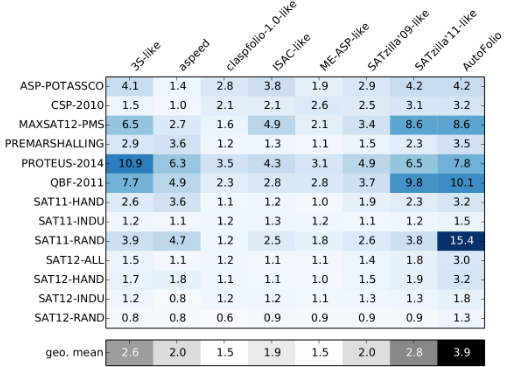
Figure 1 illustrates the performance benefits these existing selection strategies (as realized in CLASPFOLIO 2 [Hoos et al., 2014]) yield across the wide range of AS benchmarks in the Algorithm Selection Library [Bischl et al., 2016]. We observe that each approach has strengths and weaknesses on different scenarios. The SATZILLA'11-like approach [Xu et al., 2011] performs best overall, but only achieves better performance than the other approaches considered on 8 out of the 13 scenarios, with 3S [Kadioglu et al., 2011], ASPEED [Hoos et al., 2015] or ISAC [Kadioglu et al., 2010] yielding better performance in the remaining cases.
All these selection methods make use of machine learning techniques, whose performance is known to depend on hyperparameter settings (e.g., in the case of an SVM, the kernel, kernel hyper-parameter and soft margin; cf. [Bergstra et al.,
2011; Snoek et al., 2012; Thornton et al., 2013; Feurer et al., 2015a]). We note that the hyper-parameters of the machine learning methods used in Figure 1 were fixed manually, based on limited experiments. Therefore, the performance of some of these AS systems could likely be improved by using more carefully chosen hyper-parameter settings.
Facing a new AS problem, we thus have to answer three salient questions: (i) which selection approach to use; (ii) how to effectively set the parameters of the selection approach (and its underlying machine learning method); and (iii) how to make best use of techniques augmenting pure AS, such as pre-solving schedules [Xu et al., 2008; Kadioglu et al., 2011]. Instead of the common, manual trial-and-error approach, we propose to automatically answer these questions by using automated algorithm configuration methods [Hutter et al., 2009] to configure flexible AS frameworks. While the manual approach is error-prone, potentially biased and requires substantial human expert time and knowledge, the approach we introduce here is fully automatic, unbiased, and leverages the full power of a broad range of AS methods. It thus facilitates an easier and more effective use of algorithm selection and makes AS techniques accessible to a broader community.
Specifically, we present AUTOFOLIO, a general approach for automatically determining a strong AS method for a particular dataset. The last column of Figure 1 previews the results obtained with AUTOFOLIO and clearly shows significant improvements over CLASPFOLIO 2 on 10 of the 13 scenarios in ASLIB.
2 Preliminaries on AS and AC
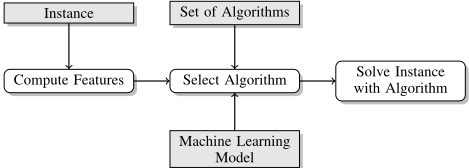
Algorithm Selection. Figure 2 shows the general outline of algorithm selection [Rice, 1976; Smith-Miles, 2008; Kotthoff, 2014]. For a given problem instance, we first compute cheap instance features [Nudelman et al., 2004]; these are numerical characteristics, including simple ones (such as the number of variables or clauses in a SAT instance) and more complex ones (such as statistics gathered from short probing runs of an actual SAT solver on the given instance). Based on these features, a machine learning model is used to select an appropriate algorithm from a set of algorithms to solve the given instance [Huberman et al., 1997; Gomes and Selman, 2001].
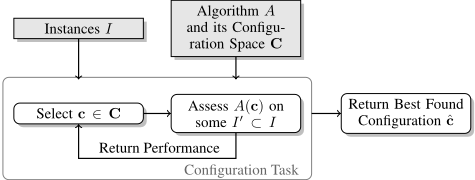
Algorithm Configuration. Figure 3 shows a general outline for algorithm configuration methods [Hutter et al., 2009]. Given a parameterized algorithm A with possible parameter settings C, a set of training problem instances I, and a performance metric m : C × I → R, the objective in the algorithm configuration problem is to find a parameter configuration c ∈ C that optimize m across the instances in I. In the following, we assume w.o.l.g. that performance metric m is to be minimized, as is the case for running time or classification error. The configuration procedure (or short configurator) iteratively evaluates the performance of parameter configurations c ∈ C (by running A with them on one or more instances in I) and uses the result to decide about the next configurations to evaluate. After a given budget for the configuration process has been exhausted, the configurator returns the best known parameter configuration it found until then.
3 Configuration of Algorithm Selectors
We now present our AUTOFOLIO approach of using algorithm configurators to automatically customize flexible AS frameworks to specific AS scenarios. To apply algorithm configuration in this context, we need to specify a parameterized selector and its configuration space, as well as the performance metric by which we judge its performance.
3.1 Formal Problem Statement
An AS scenario includes algorithms A, problem instances I, performance and feature data D, and a performance metric m : A × I → R to be minimized, with the data split into disjoint sets Dtrain and Dtest. Let S(Dtrain) : I → A denote the selector learned by the AS system S when trained on the data Dtrain. Then, the performance of S, P(S) is the average performance of the algorithms it selects on the instances in the test data set Dtest:
Likewise, we can evaluate the performance of an AS system Sc parameterized by a configuration c as P(Sc). In order to obtain an unbiased estimate of the configured selector's performance, we need to hold back a test set of instances that is not touched during the configuration process. In order to still be able to optimize parameters without access to that test set, the standard solution in machine learning is to partition the training set further, into k cross-validation folds. Overall, we use the following approach for each selection scenario: (i) we split the full set of instances into a training and a test set and (ii) we partition the training data further into k folds (in our experiments, we use k = 10), which are used as follows.
Let D(1) train , . . . ,D(k) train be a random partition of the training set Dtrain. The cross-validation performance CV (Sc) of Sc on the training set, which is optimized during configuration, is then:
We minimize CV (Sc) with an algorithm configuration procedure to yield
We then evaluate the generalization performance of ˆ c by training a selector Sˆ c with it on the entire training data and evaluating P (Sˆ c) on Dtest, as defined in Equation 1.
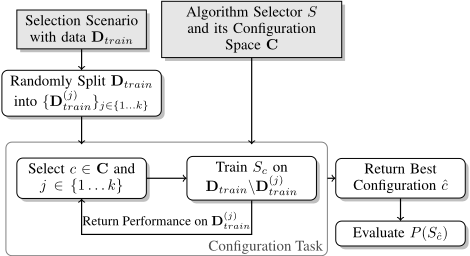
Following Thornton et al. (2013), we use each of the k folds D(j) train as one meta-instance within the configuration process. We note that many configurators, such as FocusedILS [Hutter et al., 2009], irace [L´opez-Ib´a˜nez et al., 2016] and SMAC [Hutter et al., 2011], can discard configurations when they perform poorly on a subset of meta-instances and therefore do not have to evaluate all k cross-validation folds for every configuration. This saves time and lets us evaluate more configurations within the same configuration budget. Based on these considerations, Figure 4 outlines the process to configure an algorithm selector with AUTOFOLIO.
3.2 Configuration Space of Selectors
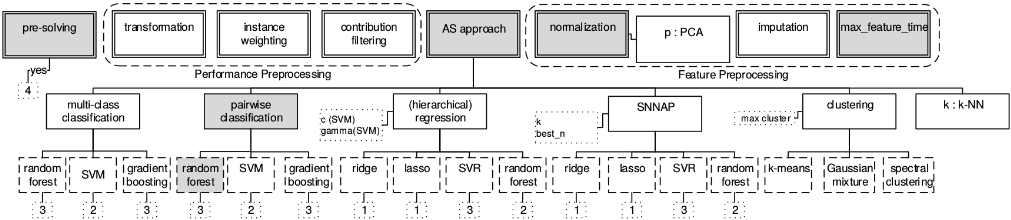
Most existing algorithm selectors implement one specific AS approach, using one specific machine learning technique. However, most selection approaches, at least implicitly, admit more flexibility, and in particular could be used with a range of machine learning techniques. Based on this observation, we consider a hierarchically structured configuration space with a top-level parameter that determines the overall AS approach. For most selection approaches, we can then choose between different regression techniques. Each of these machine learning techniques can be configured by its own (hyper-)parameters. Additionally, further techniques can be used for preprocessing the training data and for presolving schedules, which can be configured independently from the selection approach, and are therefore also handled by top-level parameters.
We implemented these choices in the CLASPFOLIO 2 system. Figure 5 illustrates the complete configuration space thus obtained. Our current version, which we use for the concrete implementation of our AUTOFOLIO approach, covers six different AS approaches:
(hierarchical) regression (inspired by SATZILLA'09; [Xu et al., 2008]) learns a regression model for each algorithm; for a new instance, it then selects the algorithm with best predicted performance;
multiclass classification (inspired by LLAMA; [Kotthoff, 2013]) learns a classification model that directly selects an algorithm based on the features of a new instance;
pairwise classification (inspired by SATZILLA'11; [Xu et al., 2011]) learns a (cost-sensitive) classification model for all pairs of algorithms; for a new instance, it evaluates all models and selects the algorithm with the most votes;
clustering (inspired by ISAC; [Kadioglu et al., 2010]) determines subsets of similar training instances in the feature space and the best algorithm on these subsets; for a new instance, it determines the nearest cluster center and selects the associated algorithm;
k-NN (inspired by 3S; [Kadioglu et al., 2011], and MEASP; [Maratea et al., 2014]) determines a set of similar training instances in the feature space for a given new instance and selects the algorithm with the best performance on this instance set;
SNNAP (inspired by [Collautti et al., 2013]) predicts the performance of each algorithm with regression models and uses this information for a k-NN approach in the predicted performance space.
For each of these approaches, CLASPFOLIO 2 covers at least three different machine learning techniques (where appropriate). For preprocessing strategies, it supports several feature and performance preprocessing strategies.
The current version of AUTOFOLIO employs the algorithm configurator SMAC [Hutter et al., 2011] to search for the best AS approach in this combined space. We chose SMAC, because it performed best across the algorithm configuration problems we studied so far.
4 Empirical Performance Analysis
We studied the performance of AUTOFOLIO across a wide variety of hard combinatorial problems from the algorithm selection library (ASlib [Bischl et al., 2016]). 1 Figure 1 shows the performance of AUTOFOLIO (last column) compared to its components with fixed parameter settings. AUTOFOLIO found well-performing configurations of CLASPFOLIO 2 and performed better than all other approaches on 11 out of the
1 www.aslib.net
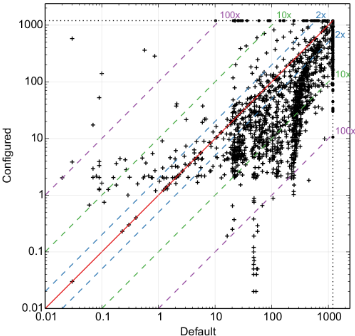
13 ASlib scenarios. Figure 6 shows the performance difference between the default of CLASPFOLIO 2 and AUTOFOLIO on an per-instance basis on the ASlib scenario SAT12-ALL indicating much better performance of AUTOFOLIO.
Additionally, in our journal article [Lindauer et al., 2015b], we investigated several aspects of AUTOFOLIO's behaviour in more detail:
- We characterized the performance of AUTOFOLIO with different configuration spaces, showing advantages of a small space if only few performance evaluations are feasible in the configuration budget;
- We demonstrated that AUTOFOLIO performs more robustly than other state-of-the-art selectors, establishing new state-of-the-art performance on 7 ASlib scenarios;
- We applied parameter importance analysis [Hutter et al., 2014; Fawcett and Hoos, 2016] to identify that the following choices were crucial to obtain strong performance for a given ASlib scenario: feature computation time, the set of instance features and the AS approach.
5 Conclusions and FutureWork
In this extended abstract of our JAIR article [Lindauer et al., 2015b], we summarized AUTOFOLIO-to the best of our knowledge, the first approach to automatically configure algorithm selectors. Using a concrete realization of this approach based on the highly parameterized AS framework CLASPFOLIO 2, we showed that by using state-of-the-art algorithm configurators, algorithm selectors can be customized to robustly achieve peak performance across a range of AS scenarios. The resulting approach performs significantly (and sometimes substantially) better than manually configured selectors and can be applied out-of-the-box to previously unseen AS scenarios.
In future work, we plan to investigate how the potential gains of larger configuration spaces (including feature and algorithm subset selection) can be used more effectively. To this end, we would like to (i) extend AUTOFOLIO's configuration space by implementing more algorithm selection approaches (e.g., CSHC [Malitsky et al., 2013]); (ii) shrink large configuration spaces based on the analysis of parameter importance through fANOVA [Hutter et al., 2014] and ablation [Fawcett and Hoos, 2016], allowing the configurator to focus on the most important parameters; and (iii) automatically select between pre-configured algorithm selectors, based on features of a given AS scenario, and further improve performance by warmstarting automatic configuration from the configurations thus selected [Feurer et al., 2015b]. Another promising avenue for reducing the computational cost of our approach would be to pre-select algorithms, features, and problem instances based on the techniques proposed by Hoos et al. (2013). Finally, we plan to investigate to which extent AUTOFOLIO can configure AS systems for selecting parallel portfolios [Lindauer et al., 2015a] to exploit the increasing availability of parallel computing resources.
Overall, our results for AUTOFOLIO strongly suggest that the automated configuration of AS systems can improve the performance and versatility of those systems across a broad range of application domains. Our AUTOFOLIO approach also facilitates future improvements, by making it easier to realize and assess the performance potential inherent in new design choices for the various components of an AS system. Our open-source implementation of AUTOFOLIO is available at www.ml4aad.org/autofolio/.
@inproceedings{ijcai2017p715,
  title     = {AutoFolio: An Automatically Configured Algorithm Selector (Extended Abstract)},
  author    = {Lindauer, Marius and Hutter, Frank and Hoos, Holger H. and Schaub, Torsten},
  booktitle = {Proceedings of the Twenty-Sixth International Joint Conference on
               Artificial Intelligence, {IJCAI-17}},
  publisher = {International Joint Conferences on Artificial Intelligence Organization},
  editor    = {Carles Sierra},
  pages     = {5025--5029},
  year      = {2017},
  month     = {8},
  note      = {Journal track},
  doi       = {10.24963/ijcai.2017/715},
  url       = {https://doi.org/10.24963/ijcai.2017/715},
}
TY - CPAPER TI - AutoFolio: An Automatically Configured Algorithm Selector (Extended Abstract) AU - Lindauer, Marius AU - Hutter, Frank AU - Hoos, Holger H. AU - Schaub, Torsten T2 - Proceedings of the Twenty-Sixth International Joint Conference on Artificial Intelligence, IJCAI-17 PB - International Joint Conferences on Artificial Intelligence Organization PY - 2017 SP - 5025 EP - 5029 DO - 10.24963/ijcai.2017/715 UR - https://doi.org/10.24963/ijcai.2017/715 ER -Copied
Machine-readable versions of this paper, for tools and AI agents:





