
Structure Learning for Safe Policy Improvement
Proceedings of the Twenty-Eighth International Joint Conference on Artificial Intelligence. Main track. Pages 3453-3459.
https://doi.org/10.24963/ijcai.2019/479
Keywords
- Machine Learning: Reinforcement Learning
- Planning and Scheduling: Model-Based Reasoning
- Planning and Scheduling: Planning under Uncertainty
Abstract
We investigate how Safe Policy Improvement (SPI) algorithms can exploit the structure of factored Markov decision processes when such structure is unknown a priori. To facilitate the application of reinforcement learning in the real world, SPI provides probabilistic guarantees that policy changes in a running process will improve the performance of this process. However, current SPI algorithms have requirements that might be impractical, such as: (i) availability of a large amount of historical data, or (ii) prior knowledge of the underlying structure. To overcome these limitations we enhance a Factored SPI (FSPI) algorithm with different structure learning methods. The resulting algorithms need fewer samples to improve the policy and require weaker prior knowledge assumptions. In well-factorized domains, the proposed algorithms improve performance significantly compared to a flat SPI algorithm, demonstrating a sample complexity closer to an FSPI algorithm that knows the structure. This indicates that the combination of FSPI and structure learning algorithms is a promising solution to real-world problems involving many variables.
- [Boutilier et al., 1995] Craig Boutilier, Richard Dearden, and Moisés Goldszmidt. Exploiting Structure in Policy Construction. In Proc. Int. Joint Conf. on Artificial Intelli- gence, pages 1104-1113. IJCAI
- Morgan Kaufmann, 1995.
- [Brafman and Tennenholtz, 2002] Ronen I. Brafman and Moshe Tennenholtz. R-MAX -A General Polynomial Time Algorithm for Near-Optimal Reinforcement Learn- ing. Journal of Machine Learning Research, 3:213-231, 2002. IJCAI
- [Chakraborty and Stone, 2011] Doran Chakraborty and Pe- ter Stone. Structure Learning in Ergodic Factored MDPs without Knowledge of the Transition Function's In- Degree. In Proc. of International Conference on Machine Learning, pages 737-744.
- [Degris et al., 2006] Thomas Degris, Olivier Sigaud, and Pierre-Henri Wuillemin. Learning the Structure of Fac- tored Markov Decision Processes in Reinforcement Learn- ing Problems. In Proc. of International Conference on Ma- chine Learning, volume 148 of ACM International Confer- ence Proceeding Series, pages 257-264. ACM, 2006.
- [Delage and Mannor, 2010] Erick Delage and Shie Man- nor. Percentile Optimization for Markov Decision Pro- cesses with Parameter Uncertainty. Operations Research, 58(1):203-213, 2010.
- [Dietterich, 1998] Thomas G Dietterich. The MAXQ Method for Hierarchical Reinforcement Learning. In Proc. of International Conference on Machine Learning, vol- ume 98, pages 118-126, 1998.
- [Diuk et al., 2009] Carlos Diuk, Lihong Li, and Bethany R. Leffler. The Adaptive k-meteorologists Problem and Its Application to Structure Learning and Feature Selection in Reinforcement Learning. In Proc. of International Confer- ence on Machine Learning, pages 249-256. ACM, 2009.
- [García and Fernández, 2015] Javier García and Fernando Fernández. A Comprehensive Survey on Safe Reinforce- ment Learning. Journal of Machine Learning Research, 16:1437-1480, 2015.
- [Guestrin et al., 2002] Carlos Guestrin, Relu Patrascu, and Dale Schuurmans. Algorithm-Directed Exploration for Model-Based Reinforcement Learning in Factored MDPs. In Proc. of International Conference on Machine Learn- ing, pages 235-242.
- Morgan Kaufmann, 2002.
- [Guestrin et al., 2003] Carlos Guestrin, Daphne Koller, Ronald Parr, and Shobha Venkataraman. Efficient Solu- tion Algorithms for Factored MDPs. Journal of Artificial Intelligence Research, 19:399-468, 2003.
- [Hallak et al., 2015] Assaf Hallak, Franc ¸ois Schnitzler, Tim- othy Arthur Mann, and Shie Mannor. Off-policy Model- based Learning under Unknown Factored Dynamics. In Proc. of International Conference on Machine Learning, pages 711-719. JMLR.org, 2015.
- [Laroche et al., 2019] Romain Laroche, Paul Trichelair, and Rémi Tachet des Combes. Safe Policy Improvement with Baseline Bootstrapping. In Proc. of International Confer- ence on Machine Learning, 2019.
- [Li et al., 2011] Lihong Li, Michael L. Littman, Thomas J. Walsh, and Alexander L. Strehl. Knows What It Knows: A Framework For Self-Aware Learning. Machine Learning, 82(3):399-443, 2011.
- [Petrik et al., 2016] Marek Petrik, Mohammad Ghavamzadeh, and Yinlam Chow. Safe Policy Im- provement by Minimizing Robust Baseline Regret. In Advances in Neural Information Processing Systems 29, pages 2298-2306.
- Curran Associates, Inc., 2016.
- [Puterman, 1994] Martin L. Puterman. Markov Decision Processes: Discrete Stochastic Dynamic Programming.
- [Simão and Spaan, 2019] Thiago D. Simão and Matthijs T. J. Spaan. Safe Policy Improvement with Baseline Bootstrap- ping in Factored Environments. In Proceedings of the Thirty-Third AAAI Conference on Artificial Intelligence, 2019.
- [Strehl et al., 2007] Alexander L. Strehl, Carlos Diuk, and Michael L. Littman. Efficient Structure Learning in Factored-State MDPs. In Proceedings of the Twenty- Second AAAI Conference on Artificial Intelligence, pages 645-650. AAAI Press, 2007.
- [Strehl, 2007] Alexander L Strehl. Model-Based Reinforce- ment Learning in Factored-State MDPs. In 2007 IEEE International Symposium on Approximate Dynamic Pro- gramming and Reinforcement Learning, pages 103-110. IEEE, 2007.
- [Thomas et al., 2015] Philip S. Thomas, Georgios Theocharous, and Mohammad Ghavamzadeh. High Confidence Policy Improvement. In Proc. of International Conference on Machine Learning, pages 2380-2388.
- JMLR.org, 2015.
References were extracted automatically from the PDF and may contain errors.
Full text extracted automatically from the PDF; figures, tables and equations may differ. The PDF is the version of record.
1 Introduction
Reinforcement Learning (RL) algorithms aim to make smart decisions during interactions with an unknown environment. Safe RL mitigates undesirable effects experienced during the learning process of such algorithms [Garc´ıa and Fern´andez, 2015]. For instance, in applications where a policy πb, called the behavior policy, is already in use, deploying a new policy π computed by an RL algorithm might decrease the performance of the system. In these situations, it is important to provide guarantees that π is better than πb, otherwise one would prefer to keep executing πb to avoid such risks. To do so, a safe RL algorithm can use data collected while executing πb to compute π and estimate π's performance.
In particular, Safe Policy Improvement (SPI) is the problem of computing a policy that is better than πb with high confidence [Thomas et al., 2015]. In this setting, an RL algorithm can either return an improved policy, which will replace
πb, or return πb, indicating that it did not find a better policy and that πb should continue to be used. An SPI algorithm is considered safe if it has a high probability of returning a policy at least as good as πb.
Until recently, SPI algorithms used flat representations [Thomas et al., 2015; Petrik et al., 2016; Laroche et al., 2019]. This limited their application since, to be reliable, they would need a large number of samples before returning an improved policy instead of πb. In previous work [Sim˜ao and Spaan, 2019], we showed how SPI algorithms that use a factored representation require fewer samples to return an improved policy by exploiting the independence between the variables of the problem to generalize past experiences.
Nevertheless, this factored approach assumes that the local structure is known a priori, which can be quite impractical in many applications. For instance, in applications with many variables, it is difficult for an expert to provide the exact structure of the problem. Therefore, it is necessary to investigate how to relax this assumption, without resorting to flat representations to maintain a good sample complexity. We aim to develop SPI algorithms that are sample efficient even when the structure of the problem is unknown.
The problem of learning the structure has already been investigated from different perspectives. For example, algorithms have been proposed to improve exploration efficiency [Strehl et al., 2007; Diuk et al., 2009] and to increase the accuracy of off-policy evaluation methods [Hallak et al., 2015]. These methods, however, do not consider the safety of the learning agent. In fact, typical approaches consider "optimism in the face of uncertainty", which is highly undesirable in a safe RL setting.
To address safety in environments with an unknown structure, we propose an SPI framework that can use different structure learning algorithms to estimate the dynamics of the environment. We provide two algorithms that instantiate the new SPI framework using different structure learning algorithms and prove that they have safety guarantees. Our experiments compare these algorithms to an algorithm that has access to the structure of the problem [Sim˜ao and Spaan, 2019] and to an algorithm that ignores the underlying structure [Laroche et al., 2019]. They show that, depending on the structure learning algorithm and how well the problem can be factorized, this framework can yield algorithms with performance competitive to an algorithm that knows the structure.
2 Background
In this section we review basic concepts related to Reinforcement Learning and how to derive sample efficient algorithms given different levels of prior knowledge about the structure of the problem.
2.1 MDPs and FactoredMDPs
The Markov Decision Process (MDP) [Puterman, 1994] is a common framework to model the interaction between a decision maker (the agent) and its environment (the world). Formally, an MDP M is represented by a set of states of the world S, a set of actions of the agent A, a transition function P(s′ |s, a) that represents the probability of moving to s′ ∈ S after executing a ∈ A in s ∈ S, a reward function R : S × A → R that indicates the reward obtained after executing a ∈ A in s ∈ S, and the discount factor γ ∈ [0, 1) that captures the agent's preference for immediate rewards over future rewards. The solution of an MDP is a policy π : S ×A → [0, 1] that represents the behavior of the agent. The optimal policy maximizes the sum of the expected discounted reward V (π,M) = E[∑∞t=0 γ tRt | π, S0 = s0], where Rt is a random variable indicating the reward the agent receives at time step t.
A sequence of interactions between the agent and the environment is represented by an episode h = [st, at, rt, st+1, · · · ] where at ∼ π(st) is the action applied in the state st and rt = R(st, at) is the reward obtained and st+1 ∼ P(· | st, at). We denote a set of episodes by D = {hi | i ∈ [1, |D|]}.
A Factored MDP (FMDP) [Boutilier et al., 1995] is a compact formalization of MDPs for problems where the state space S is represented by a set of state variables X = {X1, . . . ,X|X|}, where each variable might assume a value xi from its domain dom(Xi). Two assumptions are commonly made that allow us to compactly represent the transition function using Dynamic Bayesian Networks (DBNs). First, the outcome of each variable is independent of the outcome of the other variables:
where s[·] denotes the value of a variable Xi (or a set of variables ∆ ⊆ X) on the s ∈ S and P (xi | s, a) is the probability of observing xi ∈ dom(Xi) conditioned on (s, a).
Second, the dynamics of a variable Xi ∈ X for a given action a ∈ A depend only on its parents, a subset of the variables Paa(Xi) ⊆ X. In this way, the probability distribution of each variable Xi can be conditioned only on Paa(Xi): P(xi | s, a) = P(xi | s[Paa(Xi)], a), which yields a compact representation of the transition function:
2.2 Model-based Exploration
In this section we review sample-efficient RL algorithms, focusing on how they exploit the structure of the environment.
The Knows What It Knows (KWIK) framework was developed to help RL agents stay aware of under-explored parts of the environment [Li et al., 2011]. A KWIK learner must only return ϵ-accurate predictions with high probability 1-δ, otherwise it can return "I do not know" (⊥). However, a KWIK learner can only return ⊥ a limited number of times. This way, a KWIK learner can be used by model-based RL algorithms to learn the transition function of a flat MDP or the components of an FMDP.
Sophisticated exploration strategies can reduce the number of interactions necessary to find an optimal policy. R-max is a family of model-based algorithms that quickly build an accurate estimate of the transition function, by incentivizing the agent to visit under-explored parts of the environment. These algorithms use a KWIK-like method to keep track of the set of state-action pairs that are still considered unknown.
The original R-max was proposed for flat representations [Brafman and Tennenholtz, 2002], in this case the set of known state-action pairs is defined as follows:
where m is a minimum number of observations to consider the state-action pair (s, a) as known, and n(s, a) is the number of times (s, a) was observed. Note that the R-max algorithm implicitly uses a KWIK algorithm to estimate the transition function when m is defined according to the required precision ϵ and the expected level of confidence 1 - δ.
Extensions of this algorithm have been proposed for FMDPs with different assumptions regarding the prior knowledge about the structure of the DBN [Guestrin et al., 2002; Strehl, 2007; Diuk et al., 2009; Chakraborty and Stone, 2011]. In general, these extensions use a subalgorithmAXi,a for each variable-action pair (Xi, a) ∈ X × A to estimate the distribution of the components of the FMDP. If the subalgorithm is KWIK admissible, given a state s, this subalgorithm must return the probability distribution of Xi if it has a low parametric uncertainty over this distribution, otherwise it must return ⊥. The main algorithm only consider a stateaction pair (s, a) ∈ S ×A as known, if all the subalgorithms related to the action a consider (s, a) as known:
For problems where the structure of the problem is known a priori the subalgorithm AXi,a only needs to keep track of ˆ P(Xi = xi | s[Paa(Xi)], a)1 using a maximum likelihood estimate [Guestrin et al., 2002]. Each subalgorithm also has a parameter mi, that indicates the minimum number of observations to consider the distribution of Xi known. Therefore, given a state s, the subalgorithm defines whether a component is known or not as follows:
where n(s[Paa(Xi)]) is the number of times a was executed in states where the parents of Xi were in the same configuration as in s. In the next section, we present algorithms that can be used when the structure of the problem is unknown.
1 Hereinafter, we omit the action a and the variable Xi whenever they are in the scope of a subalgorithmAXi,a.
2.3 Structure Learning
When the structure is unknown the subalgorithm AXi,a needs to initially search for the set of parents Paa,Xi . This problem has been extensively studied [Degris et al., 2006; Strehl et al., 2007; Diuk et al., 2009; Chakraborty and Stone, 2011]. Here we present two structure learning algorithms with KWIK guarantees.
Given a maximum in-degree d, which bounds the size of the set of parents Paa(Xi), these algorithms need to choose a candidate from Comb(X, d) that contains the true set of parents, where Comb(X, d) is the collection of subsets of X of size d.
The Structure Learning (SL) algorithm [Strehl et al., 2007] relies on the fact that the probability distribution of the variable Xi is independent of non-parents given the true parents. To choose the set of parents the SL algorithm estimates the distribution for each pair of candidates (∆i,∆j) ∈ Comb(X, d) × Comb(X, d). Given a state s, this algorithm chooses ∆i as parents if two conditions are met: (i) it has collected enough samples of the realizations of ∆i and all the other candidates were in the same configuration as in state s:
and (ii) the distribution estimate of all pairs of candidates that include ∆i are similar, that is, the distribution divergence between different pairs that include ∆i is smaller than a given ϵ1:
In this way, given a state s, the SL algorithm returns the probability distribution of Xi if it finds a subset of variables ∆i that satisfies both conditions:
The k-meteorologists algorithm [Diuk et al., 2009] makes the same assumptions as the SL algorithm and initializes the set of tracked candidates R with Comb(X, d). However, it relies on a different fact to find the best candidate: the squared error of the distribution function computed according to a candidate containing the true parents is smaller than the one computed without the true parents. Given a transition sample (s, a, s′ ) ∈ S × A × S, the squared error of the set of parents ∆ ⊆ X is given by e = (1 - ˆ P(s′ [Xi] | s[∆]))2 . Therefore, this algorithm keeps track of the accumulated squared error for each pair of candidate parents and their number of mismatches ci,j. After two candidates have disagreed enough times (ci,j ≥ c), the k-meteorologists algorithm discards the one with the largest accumulated error. When asked for the distribution of variable Xi for a given state-action pair, the k-meteorologists algorithm returns the average of of the probability distribution of the remaining candidates R, if they are confident in the distribution (n(s[∆i]) ≥ m) and if they agree on such:
otherwise, it returns ⊥.
Algorithm 1 Policy-based SPIBB (Πb-SPIBB)
Input: Previous experiences D
Input: Parameters ϵ, δ
Input: Behavior policy πb
Output: Safe Policy
- 1: Estimate ˆ P(· | s, a), ∀(s, a) ∈ S ×A
- 2: m= 2 ϵ2 log |S||A|2|S| δ
- 5: return argmaxπ∈Πb V (π, ˆM)
3 Safe Policy Improvement
Safe RL aims to develop reliable agents to be deployed in real-world applications. In particular, when a behavior policy πb is already in execution, one must provide guarantees that a new policy π, computed by an RL algorithm, outperforms πb. We consider a batch RL setting, where given πb and a set of past interactions D collected by executing πb, the RL algorithm needs to compute a new policy to be deployed. Note that in this setting, the agent does not interact with the environment during the learning process. The main concern is to avoid returning policies that have a poor performance.
We call an RL algorithm safe if, given D and πb, it has high probability 1 - δ of returning a new policy π that is better than πb:
where ζ is an admissible error and P(· | D) is the posterior distribution over all possible MDPs given the batch of previous experiences. Unfortunately, finding a policy π that maximizes the expected value V (π,M) under the constraints above is intractable if one does not make any assumptions about P(· | D) [Delage and Mannor, 2010].
3.1 The SPIBB Framework
To develop tractable SPI algorithms, Laroche et al. [2019] propose the SPI by Baseline Bootstrapping (SPIBB) criterion, where the goal is to compute a policy that is better than the behavior policy on the MDPs whose dynamics are close to the estimated MDP Ξ( ˆM), that is:
We refer to Laroche et al. [2019] and Petrik et al. [2016] for more details on how Ξ( ˆM) is computed such that it contains the true MDP with high probability.
To solve (6), Laroche et al. [2019] propose to bootstrap the behavior policy in parts of the environment with high parametric uncertainty. These parts of the environment are represented by a set of state-action pairs B ⊆ S × A. The Policy Based SPIBB (Πb-SPIBB) algorithm solves the estimated MDP while constraining the policies to use the same probability as the behavior policy in every bootstrapped state-action
Algorithm 2 Factored Πb-SPIBB
Input: Previous experiences D
Input: Parameters ϵ, δ
Input: Behavior policy πb
Input: DBN Structure Pa
Output: Safe Policy
- 1: Estimate ˆ P(· | Paa(Xi), a), ∀(Xi, a) ∈ X ×A
3: Initialize ⃗mwith mi = 2|X|2
▷ Q is the number of parameters of the FMDP
- 4: B=K⃗m
▷ (3)
- 5: Compute Πb
▷ (7)
- 6: return argmaxπ∈Πb V (π, ˆM)
δ
pair (s, a) ∈ B. Formally, the constrained set of policies is defined as:
and the safe policy is:
Algorithm 1 presents an overview of this method. Note that computing a new policy in this framework is relatively simple and can be done using slightly adapted value iteration or policy iteration algorithms.
3.2 The Factored SPIBB Framework
In previous work [Sim˜ao and Spaan, 2019], we show that the Πb-SPIBB framework can be extended to factored environments. Algorithm 2 shows an overview of the Factored ΠbSPIBB algorithm. Note that this algorithm takes as input the structure of the DBN, represented by the set of parents of each variable-action pair. The main enhancement of this algorithm is a reduction in the number of samples required to stop bootstrapping a state-action pair.
An important contribution of this method is to overcome the limitation of the SPIBB framework where the probability of taken an action a in state s would always be 0, if that probability was 0 in the behavior policy. In Factored SPIBB, the agent can generalize past experiences to predict the outcome of an action that was never taken.
The Factored Πb-SPIBB algorithm assumes that the structure of the FMDP is known a priori, a strong assumption that frequently is not satisfied. In the next section we present a method to overcome this limitation.
4 Structure Learning for Safe Policy Improvement
In this section, we propose a more general version of the Factored SPIBB framework for problems where the structure of the problem is unknown.
Structure Learning Πb-SPIBB keeps track of the distribution of each transition component using a separate subalgorithm AXi,a, ∀(Xi, a) ∈ X × A. The subalgorithms used by this framework can be borrowed from the factored RL literature (Section 2.3). Algorithm 3 presents an overview of the
ϵ2 log |Q|2|dom(Xi)|
Algorithm 3 Structure Learning Πb-SPIBB
new framework. Different from the original SPIBB algorithm (Algorithm 1), this framework takes as input a class of subalgorithms A that must be chosen according to the prior knowledge available. Note that if the given subalgorithm knows the underlying structure, this algorithm would be equal to the Factored Πb-SPIBB algorithm.
First, Algorithm 3 instantiates one subalgorithm for each variable-action pair and presents the relevant transitions from the batch of previous experiences D to it (lines 1-4). Next, it estimates the transition function and, at the same time, it builds the set of bootstrapped state-action pairs (lines 514). Line 8, shows how the set of bootstrapped state-action pairs B is constructed. For a given state-action pair (s, a), if one of the subalgorithms related to a returns ⊥ given s (line 7), then the pair (s, a) is added to B. Note that for these pairs, at least one of the subalgorithms does not return a distribution, therefore we assume that these state-action pairs are absorbing. Finally, the safe policy is computed in the same way as by the original SPIBB algorithm.
For the theoretical analysis of the proposed algorithm, we first show that the transition function of non-bootstrapped state-action pairs is precise with high probability.
Proposition 1. When the Structure Learning Πb-SPIBB algorithm is equipped with a subalgorithm A that is KWIKadmissible, all non-bootstrapped state-action pairs have a transition error smaller than ϵ with high probability 1 - δ:
Proof. According to Strehl [2007, Corollary 1], if all |X| relevant subalgorithms return a distribution with error smaller than ϵ |X| then the error of the estimated transition function is smaller than ϵ. Using a union bound, we conclude that the probability that there is a factor with error larger than ϵ |X| is smaller than ∑|X||A| 1 δ |X||A| = δ. Given that the subalgorithm used is KWIK admissible, the above assumptions hold, which concludes our proof 2 .
We can use Proposition 1 to show that the proposed algorithm is safe.
Theorem 1. (Safe Policy Improvement of the Structure Learning Πb-SPIBB Algorithm). Let Πb be the set of policies under the constraint of following πb in every bootstrapped state-action pair (s, a) ∈ B. Then, the policy πpol computed by the Structure Learning Πb-SPIBB algorithm, is at least a ζ-approximate safe policy improvement over πb with high probability 1 - δ, with
Proof. We use Proposition 1 (above) to replace Proposition 1 in the proof of Theorem 2 by Laroche et al. [2019].
In conclusion, the algorithm Structure Learning Πb-SPIBB is safe when equipped with a KWIK admissible algorithm.
5 Empirical Analysis
We evaluate the Structure Learning Πb-SPIBB framework combined with the two structure learning algorithms presented before (SL and k-meteorologists) in three domains. The two baselines for comparison are the Factored Πb-SPIBB algorithm [Sim˜ao and Spaan, 2019], that knows the structure of the problem, and the (flat) Πb-SPIBB algorithm [Laroche et al., 2019], that does not consider this structure. We also consider an algorithm without safety guarantees, which is referred to as Factored Basic RL. This algorithm has access to the structure of the problem and computes a greedy policy according to an estimate of the factored transition function of the problem.
All algorithms use a flat estimate of the transition function and a flat Value Iteration algorithm with a discount factor of 0.99. We assume that the reward function is known in all algorithms. The problems used are: (i) the Taxi domain with a horizon of 200 steps [Dietterich, 1998], (ii) the SysAdmin domain with 9 machines in a bidirectional ring topology and a horizon of 40 steps [Guestrin et al., 2003], and (iii) the Stock-Trading domain with 3 sectors and 2 stocks per sector with a horizon of 40 steps [Strehl et al., 2007]. We follow a setup similar to the experiments by Laroche et al. [2019], where the behavior policy πb is defined as a softmax over the optimal value function. The softmax temperature is set to 2 for the Taxi and Stock-Trading domains and to 3 for the SysAdmin domain.
Each experiment is executed in three steps varying the number of episodes in the batch D of previous experiences:
- (i) create D by executing the behavior policy,
2 This proof follows the same principle used by Li et al. [2011, p. 413, Problem 9] to show that the output combination algorithm is KWIK admissible. However, to prove that Factored MDPs with unknown structure are KWIK-learnable, Li et al. [2011] use a different algorithm that includes the action as one of the input variables.
| Taxi | SysAdmin | Stock-Trading | ||
|---|---|---|---|---|
| Πb-SPIBB | m | 10.00 | 100.00 | 10.00 |
| Factored Πb-SPIBB | m | 20.00 | 10.00 | 20.00 |
| Πb-SPIBB SL | m | 20.00 | 10.00 | 20.00 |
| ϵ1 | 0.01 | 0.20 | 0.30 | |
| Πb-SPIBB | m | 10.00 | 10.00 | 20.00 |
| k-meteorologists | ϵ1 | 0.01 | 0.00 | 0.01 |
| c | 2000.00 | 2000.00 | 300.00 |
- (ii) present D and πb (in the case of the safe algorithms) to each algorithm and compute a new policy, and
- (iii) estimate the performance of each new policy by averaging the discounted returns of 1000 trials.
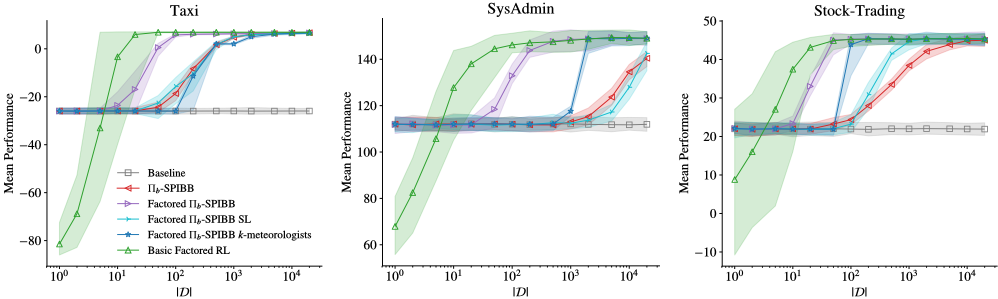
Table 1 reports the parameters used by each algorithm. These values were chosen in order to reduce the number of samples required to improve the policy, while keeping a safe behavior. Figures 1 and 2 present the results. In every plot the x-axis shows the number of trials in the batch collected with the behavior policy. We highlight that the experiments with different batch sizes are independent of each other, that is, the trajectories collected where |D| = x are not related to the trajectories collected where |D| < x. In both figures, each column shows the results obtained in different domains: Taxi (left), SysAdmin (middle) and Stock-Trading (right).
5.1 Searching for the Best Candidate Structure
Figure 1 shows how the estimated structure improves as the structure learning algorithms receive more data. For the SL algorithm it shows the number of parents missing in the selected candidate: ∑Xi,a∈X×A |Paa(Xi) \ ∆Xi,a|, where ∆Xi,a is the candidate chosen by subalgorithm AXi,a. For the k-meteorologists algorithm it shows the average number of missing parents between all remaining candidates:
where RXi,a is the set of remaining candidates of AXi,a.
In the Taxi domain (Figure 1 left) the overall number of missing parents is small, which is expected since this domain has only four variables. We note that the k-meteorologists algorithm needs significantly more samples to discard the candidates that do not contain the true parents. That occurs because the number of mismatches (c) must be large to avoid erroneously discarding a candidate.
In the SysAdmin domain (Figure 1 middle) and in the Stock-Trading domain (Figure 1 right), the structure learning algorithms exhibit a similar behavior. Both algorithms select candidates missing many parents for small batches. However, the k-meteorologists algorithm has a sudden drop in the number of missing parents. This is explained by the fact that all the subalgorithms crossed the minimum number of mismatches when the batch is larger than a certain threshold.
We also note that the SL algorithm does not display a monotonic improvement in these domains. This is because to compute the distribution divergence of two sets of candidates (5), we only consider configurations that have been observed at least once. Without this measure, the SL algorithm is not able to learn the structure of the Taxi domain, where some configurations are never observed. Therefore, in the SysAdmin and Stock-Trading domains, when |D| is small, the SL algorithm ignores some of the configurations and can improve the estimated structure. However, when |D| contains more configurations it becomes more conservative again, returning ⊥ until it gets enough data for all configurations.

5.2 Policy Improvement
Next, we evaluate the performance of the Factored Πb-SPIBB equipped with structure learning algorithms (Figure 2). We present the average performance of 50 repetitions and to measure the risk of the algorithms the 1%-quantile and 99%- quantile (shaded area).
First we observe that in the Taxi domain (Figure 2 left), the structure learning approaches are slightly more conservative than the flat Πb-SPIBB algorithm. This is not surprising, since, as pointed out by Strehl et al. [2007], a DBN is not the ideal structure to capture the independence between the variables of this domain. Comparing the methods using structure learning algorithms, we see that the Factored ΠbSPIBB SL algorithm requires less samples to exceed the performance of the behavior policy than the Factored Πb-SPIBB k-meteorologists algorithm. This is because, as mentioned before, the k-meteorologists algorithm requires a large number of mismatches to discard a candidate, while the SL algorithm can choose the best candidate with fewer samples.
The advantages of using a structure learning algorithm are more prominent in well-factorized environments, where the maximum in-degree d is much smaller than the number of state variables. The experiments with the SysAdmin and Stock-Trading domains illustrate this fact (Figure 2 middle and right). We note that in the Stock-Trading domain, the Factored Πb-SPIBB algorithm needs around 50 trajectories to find the optimal policy while the Factored Πb-SPIBB kmeteorologists algorithm needs 200 trajectories and the flat Πb-SPIBB algorithm needs 10000 trajectories. Their relative performance is similar in the SysAdmin domain. In summary, using the k-meteorologists algorithm, Structure Learning ΠbSPIBB demonstrates a behavior closer to the Factored ΠbSPIBB algorithm and manages to find an improved policy with an order of magnitude fewer samples than the flat ΠbSPIBB algorithm.
6 Conclusions
We presented a Safe Policy Improvement framework for factored environments with unknown structure. Relaxing the assumption that the underlying structure is known a priori makes this method applicable in a wider range of problems. Furthermore, when equipped with an efficient structure learning method, this framework can still exploit the factored structure of the environment and typically requires fewer samples than a flat algorithm to improve the behavior policy.
Studying how to exploit other types of structure such as decision trees and linear dynamics in this setting is a promising line of future work.
Acknowledgments
This research received funding from the Netherlands Organisation for Scientific Research (NWO).
@inproceedings{ijcai2019p479,
  title     = {Structure Learning for Safe Policy Improvement},
  author    = {Simão, Thiago D. and Spaan, Matthijs T. J.},
  booktitle = {Proceedings of the Twenty-Eighth International Joint Conference on
               Artificial Intelligence, {IJCAI-19}},
  publisher = {International Joint Conferences on Artificial Intelligence Organization},
  editor    = {Sarit Kraus},
  pages     = {3453--3459},
  year      = {2019},
  month     = {8},
  note      = {Main track},
  doi       = {10.24963/ijcai.2019/479},
  url       = {https://doi.org/10.24963/ijcai.2019/479},
}
TY - CPAPER TI - Structure Learning for Safe Policy Improvement AU - Simão, Thiago D. AU - Spaan, Matthijs T. J. T2 - Proceedings of the Twenty-Eighth International Joint Conference on Artificial Intelligence, IJCAI-19 PB - International Joint Conferences on Artificial Intelligence Organization PY - 2019 SP - 3453 EP - 3459 DO - 10.24963/ijcai.2019/479 UR - https://doi.org/10.24963/ijcai.2019/479 ER -Copied
Machine-readable versions of this paper, for tools and AI agents:





