
Interpolation Consistency Training for Semi-supervised Learning
Proceedings of the Twenty-Eighth International Joint Conference on Artificial Intelligence. Main track. Pages 3635-3641.
https://doi.org/10.24963/ijcai.2019/504
Keywords
- Machine Learning: Deep Learning
- Machine Learning: Semi-Supervised Learning
Abstract
We introduce Interpolation Consistency Training (ICT), a simple and computation efficient algorithm for training Deep Neural Networks in the semi-supervised learning paradigm. ICT encourages the prediction at an interpolation of unlabeled points to be consistent with the interpolation of the predictions at those points. In classification problems, ICT moves the decision boundary to low-density regions of the data distribution. Our experiments show that ICT achieves state-of-the-art performance when applied to standard neural network architectures on the CIFAR-10 and SVHN benchmark dataset.
- [Athiwaratkun et al., 2019] Ben Athiwaratkun, Marc Finzi, Pavel Izmailov, and Andrew Gordon Wilson. There are many consistent explanations of unlabeled data: Why you should average. In International Conference on Learning Representations, 2019.
- [Berthelot et al., 2019] David Berthelot, Colin Raffel, Aurko Roy, and Ian Goodfellow. Understanding and improving interpolation in autoencoders via an adversarial regularizer. In International Conference on Learning Representations, 2019.
- [Chapelle et al., 2010] Olivier Chapelle, Bernhard Schlkopf, and Alexander Zien. Semi-Supervised Learning. The MIT Press, 1st edition, 2010.
- [Clanuwat et al., 2018] Tarin Clanuwat, Mikel Bober-Irizar, Asanobu Kitamoto, Alex Lamb, Kazuaki Yamamoto, and David Ha. Deep learning for classical japanese literature. arXiv preprint arXiv:1812.01718, 2018.
- [Dumoulin et al., 2016] Vincent Dumoulin, Ishmael Belg- hazi, Ben Poole, Olivier Mastropietro, Alex Lamb, Martin Arjovsky, and Aaron Courville. Adversarially learned in- ference. arXiv preprint arXiv:1606.00704, 2016.
- [Goodfellow et al., 2014] Ian Goodfellow, Jean Pouget- Abadie, Mehdi Mirza, Bing Xu, David Warde-Farley, Sher- jil Ozair, Aaron Courville, and Yoshua Bengio. Generative adversarial nets. In Advances in neural information pro- cessing systems, pages 2672-2680, 2014.
- [Grandvalet and Bengio, 2005] Yves Grandvalet and Yoshua Bengio. Semi-supervised learning by entropy minimization. In L. K. Saul, Y. Weiss, and L. Bottou, editors, Advances in Neural Information Processing Systems 17, pages 529-536.
- [Laine and Aila, 2016] Samuli Laine and Timo Aila. Tem- poral ensembling for semi-supervised learning. CoRR, abs/1610.02242, 2016.
- [Lecouat et al., 2018] Bruno Lecouat, Chuan-Sheng Foo, Houssam Zenati, and Vijay Chandrasekhar. Manifold reg- ularization with gans for semi-supervised learning. arXiv preprint arXiv:1807.04307, 2018.
- [LeCun et al., 2015] Yann LeCun, Yoshua Bengio, and Geof- frey Hinton. Deep learning. nature, 521(7553):436, 2015.
- [Loshchilov and Hutter, 2016] Ilya Loshchilov and Frank Hutter. SGDR: stochastic gradient descent with restarts. CoRR, abs/1608.03983, 2016.
- [Luo et al., 2018] Yucen Luo, Jun Zhu, Mengxi Li, Yong Ren, and Bo Zhang. Smooth neighbors on teacher graphs for semi-supervised learning. In 2018 IEEE Conference on Computer Vision and Pattern Recognition, CVPR 2018, Salt Lake City, UT, USA, June 18-22, 2018, pages 8896-8905, 2018.
- [Miyato et al., 2018] Takeru Miyato, Shin ichi Maeda, Masanori Koyama, and Shin Ishii. Virtual adversarial training: a regularization method for supervised and semi- supervised learning. IEEE transactions on pattern analysis and machine intelligence, 2018. [Nakkiran, 2019] Preetum Nakkiran. Adversarial robust- ness may be at odds with simplicity. arXiv preprint arXiv:1901.00532, 2019.
- [Oliver et al., 2018] A. Oliver, A. Odena, C. Raffel, E. D. Cubuk, and I. J. Goodfellow. Realistic Evaluation of Deep Semi-Supervised Learning Algorithms. In Neural Informa- tion Processing Systems (NIPS), 2018.
- [Park et al., 2018] Sungrae Park, JunKeon Park, Su-Jin Shin, and Il-Chul Moon. Adversarial dropout for supervised and semi-supervised learning. AAAI, 2018.
- [Radford et al., 2015] Alec Radford, Luke Metz, and Soumith Chintala. Unsupervised representation learning with deep convolutional generative adversarial networks. arXiv preprint arXiv:1511.06434, 2015.
- [Sajjadi et al., 2016] Mehdi Sajjadi, Mehran Javanmardi, and Tolga Tasdizen. Regularization with stochastic transforma- tions and perturbations for deep semi-supervised learning. In Proceedings of the 30th International Conference on Neural Information Processing Systems, NIPS'16, pages 1171-1179, USA, 2016.
- Curran Associates Inc. [Shawe-Taylor et al., 1996] John Shawe-Taylor, Peter Bartlett, Robert C. Williamson, and Martin Anthony. A framework for structural risk minimisation. pages 68-76, 01 1996.
- [Tarvainen and Valpola, 2017] Antti Tarvainen and Harri Valpola. Mean teachers are better role models: Weight- averaged consistency targets improve semi-supervised deep learning results. In Advances in Neural Information Pro- cessing Systems 30, pages 1195-1204, 2017.
- [Tokozume et al., 2018] Yuji Tokozume, Yoshitaka Ushiku, and Tatsuya Harada. Between-class learning for image classification. In The IEEE Conference on Computer Vision and Pattern Recognition (CVPR), June 2018.
- [Tsipras et al., 2018] Dimitris Tsipras, Shibani Santurkar, Lo- gan Engstrom, Alexander Turner, and Aleksander Madry. Robustness may be at odds with accuracy. stat, 1050:11, 2018.
- [Verma et al., 2018] Vikas Verma, Alex Lamb, Christo- pher Beckham, Amir Najafi, Ioannis Mitliagkas, Aaron Courville, David Lopez-Paz, and Yoshua Bengio. Manifold Mixup: Better Representations by Interpolating Hidden States. arXiv e-prints, page arXiv:1806.05236, Jun 2018.
- [Zagoruyko and Komodakis, 2016] Sergey Zagoruyko and Nikos Komodakis. Wide residual networks. In Edwin R. Hancock Richard C. Wilson and William A. P. Smith, editors, Proceedings of the British Machine Vision Confer- ence (BMVC), pages 87.1-87.12
- [Zhang et al., 2018] Hongyi Zhang, Moustapha Cisse, Yann N. Dauphin, and David Lopez-Paz. mixup: Beyond empirical risk minimization. In International Conference on Learning Representations, 2018.
References were extracted automatically from the PDF and may contain errors.
Full text extracted automatically from the PDF; figures, tables and equations may differ. The PDF is the version of record.
1 Introduction
Deep learning achieves excellent performance in supervised learning tasks where labeled data is abundant [LeCun et al., 2015]. However, labeling large amounts of data is often prohibitive due to time, financial, and expertise constraints. As machine learning permeates an increasing variety of domains, there are more and more applications where unlabeled data is voluminous and labels are scarce. For instance, recognizing documents in extinct languages [Clanuwat et al., 2018] has access to few labels, produced by highly-skilled scholars.
The goal of Semi-Supervised Learning (SSL) [Chapelle et al., 2010] is to leverage large amounts of unlabeled data to improve the performance of supervised learning over small datasets. Often, SSL algorithms use unlabeled data to learn additional structure about the input distribution. For instance, the existence of cluster structures in the input distribution could hint the separation of samples into different labels. This is often called the cluster assumption: if two samples belong to the same cluster in the input distribution, then they are likely to belong to the same class. The cluster assumption is equivalent to the low-density separation assumption: the decision boundary is likely to traverse low-density regions. The equivalence becomes clear when thinking in terms of density-based clustering. Since clusters are high-density regions, decision boundaries traversing low-density regions do not partition data from the same cluster into groups with different labels. The low-density separation assumption has inspired many recent consistency-regularization semi-supervised learning techniques, including entropy Minimization [Grandvalet and Bengio, 2005], the Π-model [Sajjadi et al., 2016; Laine and Aila, 2016], temporal ensembling [Laine and Aila, 2016], VAT [Miyato et al., 2018], and the Mean-Teacher [Tarvainen and Valpola, 2017].
∗Contact Author
Consistency regularization methods for semi-supervised learning enforce the low-density separation assumption by encouraging invariant prediction f(u) = f(u + δ) for perturbations u + δ of unlabeled points u. Such consistency and small prediction error can be satisfied simultaneously if and only if the decision boundary traverses a low-density path.
Different consistency regularization techniques vary in how they choose the unlabeled data perturbations δ. One simple alternative is to use random perturbations δ. However, random perturbations are inefficient in high dimensions, as only a tiny proportion of input perturbations are capable of pushing the decision boundary into low-density regions. To alleviate this issue, Virtual Adversarial Training or VAT [Miyato et al., 2018], searches for small perturbations δ that maximize the change in prediction of the model. This involves computing the gradient of the predictor with respect to its input, which can be expensive for large neural network models. This additional computation makes VAT [Miyato et al., 2018] and other related methods [Park et al., 2018] less appealing in situations where unlabeled data is available in large quantities. Furthermore, recent research has shown that training with adversarial perturbations can hurt generalization performance [Nakkiran, 2019; Tsipras et al., 2018].
To overcome the above limitations, we propose the Interpolation Consistency Training (ICT) 1 , an efficient consistency regularization technique for state-of-the-art semisupervised learning. In a nutshell, ICT regularizes semisupervised learning by encouraging consistent predictions f(αu1 + (1 - α)u2) = αf(u1) + (1 - α)f(u2) at interpolations αu1 + (1 - α)u2 of unlabeled points u1 and u2.
Our experimental results on the benchmark datasets CIFAR10 and SVHN and neural network architectures CNN-13 [Laine and Aila, 2016; Miyato et al., 2018; Tarvainen and Valpola, 2017; Park et al., 2018; Luo et al., 2018] and WRN282 [Oliver et al., 2018] outperform (or are competitive with) the state-of-the-art. Figure 1 illustrates how ICT learns a decision boundary traversing a low density region in the "two moons" problem.
1 Code available at https://github.com/vikasverma1077/ICT
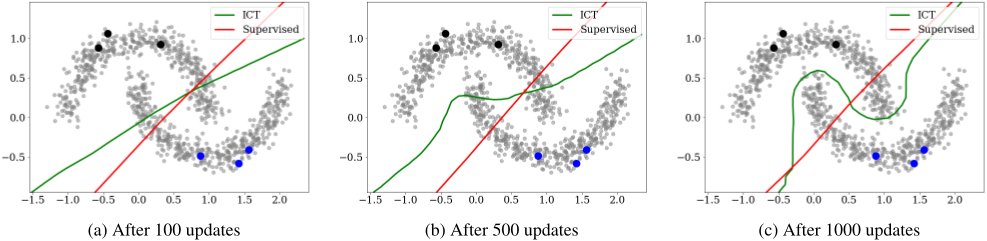
2 Interpolation Consistency Training
Given a mixup [Zhang et al., 2018] operation:
Interpolation Consistency Training(ICT) trains a prediction model fθ to provide consistent predictions at interpolations of unlabeled points:
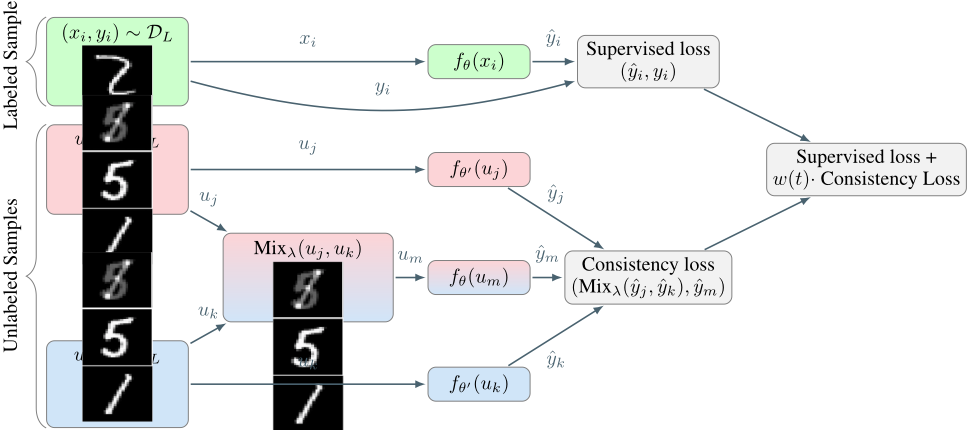
where θ′ is a moving average of θ (Figure 2). But, why do interpolations between unlabeled samples provide a good consistency perturbation for semi-supervised training?
To begin with, observe that the most useful samples on which the consistency regularization should be applied are the samples near the decision boundary. Adding a small perturbation δ to such low-margin unlabeled samples uj is likely to push uj + δ over the other side of the decision boundary. This would violate the low-density separation assumption, making uj +δ a good place to apply consistency regularization. These violations do not occur at high-margin unlabeled points that lie far away from the decision boundary.
Back to low-margin unlabeled points uj , how can we find a perturbation δ such that uj and uj + δ lie on opposite sides of the decision boundary? Although tempting, using random perturbations is an inefficient strategy, since the subset of directions approaching the decision boundary is a tiny fraction of the ambient space. Instead, consider interpolations uj+δ = Mixλ(uj , uk) towards a second randomly selected unlabeled examples uk. Then, the two unlabeled samples uj and uk can either:
- lie in the same cluster,
- lie in different clusters but belong to the same class,
- lie on different clusters and belong to the different classes.
Assuming the cluster assumption, the probability of (1) decreases as the number of classes increases. The probability of (2) is low if we assume that the number of clusters for each class is balanced. Finally, the probability of (3) is the highest. Then, assuming that one of (uj, uk) lies near the decision boundary (it is a good candidate for enforcing consistency), it is likely (because of the high probability of (3)) that the interpolation towards uk points towards a region of low density, followed by the cluster of the other class. Since this is a good direction to move the decision, the interpolation is a good perturbation for consistency-based regularization.
Our exposition has argued so far that interpolations between random unlabeled samples are likely to fall in lowdensity regions. Thus, such interpolations are good locations where consistency-based regularization could be applied. But how should we label those interpolations? Unlike random or adversarial perturbations of single unlabeled examples uj , our scheme involves two unlabeled examples (uj, uk). Intuitively, we would like to push the decision boundary as far as possible from the class boundaries, as it is well known that decision boundaries with large margin generalize better [Shawe-Taylor et al., 1996]. In the supervised learning setting, one method to achieve large-margin decision boundaries is mixup [Zhang et al., 2018]. In mixup, the decision boundary is pushed far away from the class boundaries by enforcing the prediction model to change linearly in between samples. This is done by training the model fθ to predict Mixλ(y, y′ ) at location Mixλ(x, x′ ), for random pairs of labeled samples ((x, y), (x′ , y′ )). Here we extend mixup to the semi-supervised learning setting by training the model fθ to predict the "fake label" Mixλ(fθ(uj), fθ(uk)) at location Mixλ(uj, uk). In order to follow a more conservative consistent regularization, we encourage the model fθ to predict the fake label Mixλ(fθ′(uj), fθ′(uk)) at location Mixλ(uj, uk), where θ′ is a moving average of θ, also known as a meanteacher [Tarvainen and Valpola, 2017].
We are now ready to describe in detail the proposed Interpolation Consistency Training (ICT). Consider access to labeled samples (xi, yi) ∼ DL, drawn from the joint distribution P(X, Y ). Also, consider access to unlabeled samples uj, uk ∼ DUL, drawn from the marginal distribution P(X) = P(X,Y ) P(Y |X) Our learning goal is to train a model fθ, able to predict Y from X. By using stochastic gradient descent, at each iteration t, update the parameters θ to minimize
where LS is the usual cross-entropy supervised learning loss over labeled samples DL, and LUS is our new interpolation consistency regularization term. These two losses are computed on top of (labeled and unlabeled) minibatches, and the ramp function w(t) increases the importance of the consistency regularization term LUS after each iteration. To compute LUS, sample two minibatches of unlabeled points uj and uk, and compute their fake labels ˆ yj = fθ′(uj) and ˆ yk = fθ′(uk), where θ′ is an moving average of θ [Tarvainen and Valpola, 2017]. Second, compute the interpolation um = Mixλ(uj, uk), as well as the model prediction at that location, ˆ ym = fθ(um). Third, update the parameters θ as to bring the prediction ˆ ym closer to the interpolation of the fake labels Mixλ(ˆ yj, ˆ yk). The discrepancy between the prediction ˆ ym and Mixλ(ˆ yj, ˆ yk) can be measured using any loss; in our experiments, we use the mean squared error. Following [Zhang et al., 2018], on each update we sample a random λ from Beta(α, α).
In sum, the population version of our ICT term can be written as:
ICT is summarized in Figure 2 and Algorithm 1.
3 Experiments
3.1 Datasets
We follow the common practice in semi-supervised learning literature [Laine and Aila, 2016; Miyato et al., 2018; Tarvainen and Valpola, 2017; Park et al., 2018; Luo et al., 2018] and conduct experiments using the CIFAR-10 and SVHN datasets, where only a fraction of the training data is labeled, and the remaining data is used as unlabeled data. We followed the standardized procedures laid out by [Oliver et al., 2018] to ensure a fair comparison.
The CIFAR-10 dataset consists of 60000 color images each of size 32 × 32, split between 50K training and 10K test images. This dataset has ten classes, which include pictures of cars, horses, airplanes and deer. The SVHN dataset consists of 73257 training samples and 26032 test samples each of size 32×32. Each example is a close-up image of a house number (the ten classes are the digits from 0-9).
We adopt the standard data-augmentation and preprocessing scheme which has become standard practice in the semi-supervised learning literature [Sajjadi et al., 2016; Laine and Aila, 2016; Tarvainen and Valpola, 2017; Miyato et al., 2018; Luo et al., 2018; Athiwaratkun et al., 2019]. More specifically, for CIFAR-10, we first zero-pad each image with 2 pixels on each side. Then, the resulting image is randomly cropped to produce a new 32 × 32 image. Next, the image is horizontally flipped with probability 0.5, followed by ZCA preprocessing. For SVHN, we zero-pad each image with 2 pixels on each side and then randomly crop the resulting image to produce a new 32 × 32 image, followed by zero-mean and unit-variance image whitening.
3.2 Models
We conduct our experiments using CNN-13 and Wide-Resnet28-2 architectures. The CNN-13 architecture has been adopted as the standard benchmark architecture in recent state-of-theart SSL methods [Laine and Aila, 2016; Tarvainen and Valpola, 2017; Miyato et al., 2018; Park et al., 2018; Luo et al., 2018]. We use its variant (i.e., without additive Gaussian noise in the input layer) as implemented in [Athiwaratkun et al., 2019]. We also removed the Dropout noise to isolate the improvement achieved through our method. Other SSL methods in Table 1 and Table 2 use the Dropout noise, which gives them more regularizing capabilities. Despite this, our method outperforms other methods in several experimental settings.
[Oliver et al., 2018] performed a systematic study using Wide-Resnet-28-2 [Zagoruyko and Komodakis, 2016], a specific residual network architecture, with extensive hyperparameter search to compare the performance of various consistencybased semi-supervised algorithms. We evaluate ICT using this same setup as a mean towards fair comparison to these algorithms.
3.3 Implementation Details
We used the SGD with nesterov momentum optimizer for all of our experiments. For the experiments in Table 1 and Table 2, we run the experiments for 400 epochs. For the experiments in Table 3, we run experiments for 600 epochs. The initial learning rate was set to 0.1, which is then annealed using the cosine annealing technique proposed in [Loshchilov and Hutter, 2016] and used by [Tarvainen and Valpola, 2017]. The momentum parameter was set to 0.9. We used an L2 regularization coefficient 0.0001 and a batch-size of 100 in our experiments.
In each experiment we report mean and standard deviation across three independently run trials.
The consistency coefficient w(t) is ramped up from its initial value 0.0 to its maximum value at one-fourth of the total number of epochs using the same sigmoid schedule of [Tarvainen and Valpola, 2017]. We used MSE loss for computing the consistency loss following [Laine and Aila, 2016; Tarvainen and Valpola, 2017]. We set the decay coefficient for the mean-teacher to 0.999.
We conduct hyperparameter search over the two hyperparameters introduced by our method: the maximum value of the consistency coefficient w(t) (we searched over the values in {1.0, 10.0, 20.0, 50.0, 100.0}) and the parameter α of distribution Beta(α, α) (we searched over the values in {0.1, 0.2, 0.5, 1.0}). We select the best hyperparameter using a validation set of 5000 and 1000 labeled samples for CIFAR-10 and SVHN respectively. This size of validation set is same as that used in the other methods compared in this work.
We note the in all our experiments with ICT, to get the supervised loss, we perform the interpolation of labeled sample pair and their corresponding labels (as in mixup [Zhang et al., 2018]). To make sure, that the improvements from ICT are not only because of the supervised mixup loss, we provide the direct comparison of ICT against supervised mixup and Manifold Mixup training in the Table 1 and Table 2.
3.4 Results
We provide the results for CIFAR10 and SVHN datasets using CNN-13 architecture in the Table 1 and Table 2, respectively.
To justify the use of a SSL algorithm, one must compare its performance against the state-of-the-art supervised learning algorithm [Oliver et al., 2018]. To this end, we compare our method against two state-of-the-art supervised learning algorithms [Zhang et al., 2018; Verma et al., 2018], denoted as Supervised(Mixup) and Supervised(Manifold Mixup), respectively in Table 1 and 2. ICT method passes this test with a wide margin, often resulting in two-fold reduction in the test error in the case of CIFAR10 (Table 1) and four-fold reduction in the case of SVHN (Table 2)
Furthermore, in Table 1, we see that ICT improves the test error of other strong SSL methods. For example, in the case of 4000 labeled samples, it improves the test error of best reported method by ∼ 25%. In the case of lesser labeled sample experiments (1000 and 2000 labeled samples) the improvement achieved by ICT is even more profound. The best values of hyperparameter max-consistency coefficient for 1000, 2000 and 4000 labels experiments were found to be 10.0, 100.0 and 100.0 respectively. The best values of hyperparameter α for 1000, 2000 and 4000 labels experiments were found to be 0.2, 1.0 and 1.0 respectively. In general, we observed that for less number of labeled data, lower values of max-consistency coefficient and α obtained better test errors.
For SVHN, the test errors obtained by ICT are competitive with other state-of-the-art SSL methods (Table 2). The best values of hyperparameters max-consistency coefficient and α were found to be 100 and 0.1 respectively, for all the ICT results reported in the Table 2.
[Oliver et al., 2018] performed extensive hyperparameter search for various consistency regularization SSL algorithm using the WRN-28-2 and they report the best test errors found for each of these algorithms. For fair comparison of ICT against these SSL algorithms, we conduct experiments on WRN-28-2 architecture. The results are shown in Table 3. ICT achives improvement over other methods both for the CIFAR10 and SVHN datasets.
We note that unlike other SSL methods of Table 1, Table 2 and Table 3, we do not use Dropout regularizer in our implementation of CNN-13 and WRN-28-2. Using Dropout along with the ICT may further reduce the test error.
We also note that Π-model, VAT and VAdD methods in Table 1 and Table 2 do not use a mean teacher to make predictions on the unlabeled data. Although, the EMA teacher [Tarvainen and Valpola, 2017] used in Interpolation Consistency Training does not incur any significant computation cost, one might argue that a more direct comparison with Π-model, VAT and VAdD methods requires not using a mean teacher. To this end, we conduct experiment on the CIFAR10 dataset, without the EMA teacher in Interpolation Consistency Training, i.e. the prediction on the unlabeled data comes from the network fθ(x) instead of the EMA teacher network fθ′ (x) in Equation 1. We obtain test errors of 19.56 ± 0.56%, 14.35 ± 0.15% and 11.19 ± 0.14% for 1000, 2000, 4000 labeled samples respectively. This shows that even without a mean-teacher, Interpolation Consistency Training has major advantage over methods such as VAT [Miyato et al., 2018] and VAdD [Park et al., 2018] that it does not require an additional gradient computation yet performs on the same level of the test error.
3.5 Ablation Study
We note that Π-model, VAT and VAdD methods in Table 1 and Table 2 do not use a mean-teacher to make predictions on the unlabeled data. Although the mean-teacher [Tarvainen and Valpola, 2017] used in ICT does not incur any significant
Algorithm 1 The Interpolation Consistency Training (ICT) Algorithm
Require: fθ(x): neural network with trainable parameters θ Require: fθ′(x) mean teacher with θ′ equal to moving average of θ Require: DL(x, y): collection of the labeled samples Require: DUL(x): collection of the unlabeled samples Require: α: rate of moving average Require: w(t): ramp function for increasing the importance of consistency regularization Require: T: total number of iterations Require: Q: random distribution on [0,1] Require: Mixλ(a, b) = λa + (1 - λ)b. for t = 1, . . . , T do Sample {(xi, yi)}Bi=1 ∼ DL(x, y) ▷ Sample labeled minibatch LS = CrossEntropy({(fθ(xi), yi)}Bi=1 ) ▷ Supervised loss (cross-entropy) Sample {uj}Uj=1 , {uk}Uk=1 ∼ DUL(x) ▷ Sample two unlabeled examples {ˆ yj}Uj=1 = {fθ′ (uj)}Uj=1 , {ˆ yk}Uk=1 = {fθ′(uk)}Uk=1 ▷ Compute fake labels Sample λ ∼ Q ▷ sample an interpolation coefficient (um = Mixλ(uj , uk), ˆ ym = Mixλ(ˆ yj, ˆ yk)) ▷ Compute interpolation LUS = ConsistencyLoss({(fθ(um), ˆ ym)}Um=1 ) ▷ e.g., mean squared error L = LS +w(t) · LUS ▷ Total Loss gθ ←∇θL ▷ Compute Gradients θ′ = αθ′ + (1 -α)θ ▷ Update moving average of parameters θ ← Step(θ, gθ) ▷ e.g. SGD, Adam end forreturn θ
computation cost, one might argue that a more direct comparison with Π-model, VAT and VAdD methods requires not using a mean-teacher. To this end, we conduct an experiment on the CIFAR10 dataset, without the mean-teacher in ICT, i.e. the prediction on the unlabeled data comes from the network fθ(x) instead of the mean-teacher network fθ′ (x) in Equation 1. We obtain test errors of 19.56 ± 0.56%, 14.35 ± 0.15% and 11.19 ± 0.14% for 1000, 2000, 4000 labeled samples respectively (We did not conduct any hyperparameter search for these experiments and used the best hyperparameters found in the ICT experiments of Table 1). This shows that even without a mean-teacher, ICT has major a advantage over methods such as VAT [Miyato et al., 2018] and VAdD [Park et al., 2018] that it does not require an additional gradient computation yet performs on the same level of the test error.
4 RelatedWork
This work builds on two threads of research: consistencyregularization for semi-supervised learning, interpolationbased regularizers.
On the one hand, consistency-regularization semisupervised learning methods [Sajjadi et al., 2016; Laine and Aila, 2016; Tarvainen and Valpola, 2017; Miyato et al., 2018; Luo et al., 2018; Athiwaratkun et al., 2019] encourage that realistic perturbations u+δ of unlabeled samples u should not change the model predictions fθ(u). These methods are motivated by the low-density separation assumption [Chapelle et al., 2010], and as such push the decision boundary to lie in the low-density regions of the input space, achieving larger classification margins. ICT differs from these approaches in two aspects. First, ICT chooses perturbations in the direction of other randomly chosen unlabeled sample, avoiding expensive gradient computations. When interpolating between distant points, the regularization effect of ICT applies to larger regions of the input space.
On the other hand, interpolation-based regularizers [Zhang et al., 2018; Tokozume et al., 2018; Verma et al., 2018] have been recently proposed for supervised learning, achieving state-of-the-art performances across a variety of tasks and network architectures. While [Zhang et al., 2018; Tokozume et al., 2018] was proposed to perform interpolations in the input space, [Verma et al., 2018] proposed to perform interpolation also in the hidden space representations. Furthermore, in the unsupervised learning setting, [Berthelot et al., 2019] proposes to measure the realism of latent space interpolations from an autoencoder to improve its training.
Other works have approached semi-supervised learning from the perspective of generative models. Some have approached this from a consistency point of view, such as [Lecouat et al., 2018], who proposed to encourage smooth changes to the predictions along the data manifold estimated by the generative model (trained on both labeled and unlabeled samples). Others have used the discriminator from a trained generative adversarial network [Goodfellow et al., 2014] as a way of extracting features for a purely supervised model [Radford et al., 2015]. Still, others have used trained inference models as a way of extracting features [Dumoulin et al., 2016].
| Model | 1000 labeled 50000 unlabeled | 2000 labeled 50000 unlabeled | 4000 labeled 50000 unlabeled |
|---|---|---|---|
| Supervised | 39.95 ± 0.75 | 31.16 ± 0.66 | 21.75 ± 0.46 |
| Supervised (Mixup) | 36.48 ± 0.15 | 26.24 ± 0.46 | 19.67 ± 0.16 |
| Supervised (Manifold Mixup) | 34.58 ± 0.37 | 25.12 ± 0.52 | 18.59 ± 0.18 |
| Π model [Laine and Aila, 2016] | 31.65 ± 1.20 | 17.57 ± 0.44 | 12.36 ± 0.31 |
| TempEns [Laine and Aila, 2016] | 23.31 ± 1.01 | 15.64 ± 0.39 | 12.16 ± 0.24 |
| MT [Tarvainen and Valpola, 2017] | 21.55 ± 1.48 | 15.73 ± 0.31 | 12.31 ± 0.28 |
| VAT [Miyato et al., 2018] | - | - | 11.36± NA |
| VAT+Ent [Miyato et al., 2018] | - | - | 10.55± NA |
| VAdD [Park et al., 2018] | - | - | 11.32 ± 0.11 |
| SNTG [Luo et al., 2018] | 18.41 ± 0.52 | 13.64 ± 0.32 | 10.93 ± 0.14 |
| MT+ Fast SWA [Athiwaratkun et al., 2019] | 15.58± NA | 11.02± NA | 9.05± NA |
| ICT | 15.48 ± 0.78 | 9.26 ± 0.09 | 7.29 ± 0.02 |
| Model | 250 labeled 73257 unlabeled | 500 labeled 73257 unlabeled | 1000 labeled 73257 unlabeled |
|---|---|---|---|
| Supervised | 40.62 ± 0.95 | 22.93 ± 0.67 | 15.54 ± 0.61 |
| Supervised (Mixup) | 33.73 ± 1.79 | 21.08 ± 0.61 | 13.70 ± 0.47 |
| Supervised ( Manifold Mixup) | 31.75 ± 1.39 | 20.57 ± 0.63 | 13.07 ± 0.53 |
| Π model [Laine and Aila, 2016] | 9.93 ± 1.15 | 6.65 ± 0.53 | 4.82 ± 0.17 |
| TempEns [Laine and Aila, 2016] | 12.62 ± 2.91 | 5.12 ± 0.13 | 4.42 ± 0.16 |
| MT [Tarvainen and Valpola, 2017] | 4.35 ± 0.50 | 4.18 ± 0.27 | 3.95 ± 0.19 |
| VAT [Miyato et al., 2018] | - | - | 5.42± NA |
| VAT+Ent [Miyato et al., 2018] | - | - | 3.86± NA |
| VAdD [Park et al., 2018] | - | - | 4.16 ± 0.08 |
| SNTG [Luo et al., 2018] | 4.29 ± 0.23 | 3.99 ± 0.24 | 3.86 ± 0.27 |
| ICT | 4.78 ± 0.68 | 4.23 ± 0.15 | 3.89 ± 0.04 |
| SSL Approach | CIFAR10 4000 labeled 50000 unlabeled | SVHN 1000 labeled 73257 unlabeled |
|---|---|---|
| Supervised † | 20.26 ± 0.38 | 12.83 ± 0.47 |
| Mean-Teacher † | 15.87 ± 0.28 | 5.65 ± 0.47 |
| VAT † | 13.86 ± 0.27 | 5.63 ± 0.20 |
| VAT-EM † | 13.13 ± 0.39 | 5.35 ± 0.19 |
| ICT | 7.66 ± 0.17 | 3.53 ± 0.07 |
5 Conclusion
In this paper, we have proposed a simple but efficient SSL algorithm, Interpolation Consistency Training(ICT), which has two advantages over previous approaches to semi-supervised learning. First, it uses almost no additional computation, as opposed to computing adversarial perturbations or training generative models. Second, it outperforms strong baselines on two benchmark datasets. As for the future work, extending ICT to interpolations not only at the input but at hidden representations [Verma et al., 2018] could improve the performance even further. Another direction for the future work is to better understand the theoretical properties of ICT.
@inproceedings{ijcai2019p504,
  title     = {Interpolation Consistency Training for Semi-supervised Learning},
  author    = {Verma, Vikas and Lamb, Alex and Kannala, Juho and Bengio, Yoshua and Lopez-Paz, David},
  booktitle = {Proceedings of the Twenty-Eighth International Joint Conference on
               Artificial Intelligence, {IJCAI-19}},
  publisher = {International Joint Conferences on Artificial Intelligence Organization},
  editor    = {Sarit Kraus},
  pages     = {3635--3641},
  year      = {2019},
  month     = {8},
  note      = {Main track},
  doi       = {10.24963/ijcai.2019/504},
  url       = {https://doi.org/10.24963/ijcai.2019/504},
}
TY - CPAPER TI - Interpolation Consistency Training for Semi-supervised Learning AU - Verma, Vikas AU - Lamb, Alex AU - Kannala, Juho AU - Bengio, Yoshua AU - Lopez-Paz, David T2 - Proceedings of the Twenty-Eighth International Joint Conference on Artificial Intelligence, IJCAI-19 PB - International Joint Conferences on Artificial Intelligence Organization PY - 2019 SP - 3635 EP - 3641 DO - 10.24963/ijcai.2019/504 UR - https://doi.org/10.24963/ijcai.2019/504 ER -Copied
Machine-readable versions of this paper, for tools and AI agents:





