
Trend-Aware Tensor Factorization for Job Skill Demand Analysis
Proceedings of the Twenty-Eighth International Joint Conference on Artificial Intelligence. Main track. Pages 3891-3897.
https://doi.org/10.24963/ijcai.2019/540
Keywords
- Machine Learning: Data Mining
- Machine Learning Applications: Other Applications
Abstract
Given a job position, how to identify the right job skill demand and its evolving trend becomes critically important for both job seekers and employers in the fast-paced job market. Along this line, there still exist various challenges due to the lack of holistic understanding on skills related factors, e.g., the dynamic validity periods of skill trend, as well as the constraints from overlapped business and skill co-occurrence. To address these challenges, in this paper, we propose a trend-aware approach for fine-grained skill demand analysis. Specifically, we first construct a tensor for each timestamp based on the large-scale recruitment data, and then reveal the aggregations among companies and skills by heuristic solutions. Afterwards, the Trend-Aware Tensor Factorization (TATF) framework is designed by integrating multiple confounding factors, i.e., aggregation-based and temporal constraints, to provide more fine-grained representation and evolving trend of job demand for specific job positions. Finally, validations on large-scale real-world data clearly validate the effectiveness of our approach for skill demand analysis.
- [Blei et al., 2003] David M Blei, Andrew Y Ng, and Michael I Jordan. Latent dirichlet allocation. Journal of machine Learning research, 3(Jan):993-1022, 2003.
- [Ghadimi and Lan, 2013] Saeed Ghadimi and Guanghui Lan. Stochastic first-and zeroth-order methods for non- convex stochastic programming. SIAM Journal on Opti- mization, 23(4):2341-2368, 2013.
- [Harshman, 1970] Richard A Harshman. Foundations of the parafac procedure: Models and conditions for an" explana- tory" multimodal factor analysis. 1970.
- [Hong and Jung, 2018] Minsung Hong and Jason J Jung. Multi-sided recommendation based on social tensor fac- torization. Information Sciences, 447:140-156, 2018.
- [Jiang et al., 2014] Meng Jiang, Peng Cui, Fei Wang, Xin- ran Xu, Wenwu Zhu, and Shiqiang Yang. Fema: flexible evolutionary multi-faceted analysis for dynamic behav- ioral pattern discovery. In Proceedings of the 20th ACM SIGKDD international conference on Knowledge discov- ery and data mining, pages 1186-1195. ACM, 2014.
- [Karatzoglou et al., 2010] Alexandros Karatzoglou, Xavier Amatriain, Linas Baltrunas, and Nuria Oliver. Multiverse recommendation: n-dimensional tensor factorization for context-aware collaborative filtering. In Proceedings of the fourth ACM conference on Recommender systems, pages 79-86. ACM, 2010.
- [Li et al., 2017a] Huayu Li, Yong Ge, Hengshu Zhu, Hui Xiong, and Hongke Zhao. Prospecting the career devel- opment of talents: A survival analysis perspective. In Proceedings of the 23rd ACM SIGKDD International Con- ference on Knowledge Discovery and Data Mining, pages 917-925. ACM, 2017.
- [Li et al., 2017b] Xin Li, Mingming Jiang, Huiting Hong, and Lejian Liao. A time-aware personalized point-of- interest recommendation via high-order tensor factoriza- tion. ACM Transactions on Information Systems (TOIS), 35(4):31, 2017.
- [Liu et al., 2018] Qi Liu, Han Wu, Yuyang Ye, Hongke Zhao, Chuanren Liu, and Dongfang Du. Patent litigation prediction: A convolutional tensor factorization approach. In IJCAI, pages 5052-5059, 2018. IJCAI
- [Maringe, 2006] Felix Maringe. University and course choice: Implications for positioning, recruitment and mar- keting. International journal of educational management, 20(6):466-479, 2006.
- [Qin et al., 2018] Chuan Qin, Hengshu Zhu, Tong Xu, Chen Zhu, Liang Jiang, Enhong Chen, and Hui Xiong. Enhanc- ing person-job fit for talent recruitment: An ability-aware neural network approach. In The 41st International ACM SIGIR Conference on Research & Development in Infor- mation Retrieval, pages 25-34. ACM, 2018.
- [Rendle and Schmidt-Thieme, 2010] Steffen Rendle and Lars Schmidt-Thieme. Pairwise interaction tensor fac- torization for personalized tag recommendation. In Proceedings of the third ACM international conference on Web search and data mining, pages 81-90. ACM, 2010.
- [Shen et al., 2018] Dazhong Shen, Hengshu Zhu, Chen Zhu, Tong Xu, Chao Ma, and Hui Xiong. A joint learning ap- proach to intelligent job interview assessment. In IJCAI, pages 3542-3548, 2018. IJCAI
- [Tucker, 1966] Ledyard R Tucker. Some mathematical notes on three-mode factor analysis. Psychometrika, 31(3):279- 311, 1966.
- [Wang et al., 2018] Jinkun Wang, Yuanchun Jiang, Jianshan Sun, Yezheng Liu, and Xiao Liu. Group recommendation based on a bidirectional tensor factorization model. World Wide Web, 21(4):961-984, 2018.
- [Wilden et al., 2010] Ralf Wilden, Siegfried Gudergan, and Ian Lings. Employer branding: strategic implications for staff recruitment. Journal of Marketing Management, 26(1-2):56-73, 2010.
- [Xu et al., 2015] Huang Xu, Zhiwen Yu, Hui Xiong, Bin Guo, and Hengshu Zhu. Learning career mobility and hu- man activity patterns for job change analysis. In 2015 IEEE International Conference on Data Mining, pages 1057-1062. IEEE, 2015.
- [Xu et al., 2016] Huang Xu, Zhiwen Yu, Jingyuan Yang, Hui Xiong, and Hengshu Zhu. Talent circle detection in job transition networks. In Proceedings of the 22nd ACM SIGKDD International Conference on Knowledge Discov- ery and Data Mining, pages 655-664. ACM, 2016.
- [Xu et al., 2018] Tong Xu, Hengshu Zhu, Chen Zhu, Pan Li, and Hui Xiong. Measuring the popularity of job skills in recruitment market: A multi-criteria approach. In Thirty- Second AAAI Conference on Artificial Intelligence, 2018.
- [Yu et al., 2018] Runlong Yu, Yunzhou Zhang, Yuyang Ye, Le Wu, Chao Wang, Qi Liu, and Enhong Chen. Multi- ple pairwise ranking with implicit feedback. In Proceed- ings of the 27th ACM International Conference on Infor- mation and Knowledge Management, pages 1727-1730. ACM, 2018.
- [Zhang et al., 2019] Le Zhang, Chen Zhu, Hengshu Zhu, Tong Xu, Enhong Chen, Chuan Qin, and Hui Xiong. Large-scale talent flow forecast with dynamic latent fac- tor model. In Proceedings of The Web Conference 2019, pages 2312-2322, 2019.
- [Zhu et al., 2016] Chen Zhu, Hengshu Zhu, Hui Xiong, Pengliang Ding, and Fang Xie. Recruitment market trend analysis with sequential latent variable models. In Pro- ceedings of the 22nd ACM SIGKDD International Con- ference on Knowledge Discovery and Data Mining, pages 383-392. ACM, 2016.
- [Zhu et al., 2018] Chen Zhu, Hengshu Zhu, Hui Xiong, Chao Ma, Fang Xie, Pengliang Ding, and Pan Li. Person- job fit: Adapting the right talent for the right job with joint representation learning. ACM Transactions on Manage- ment Information Systems (TMIS), 9(3):12, 2018.
References were extracted automatically from the PDF and may contain errors.
Full text extracted automatically from the PDF; figures, tables and equations may differ. The PDF is the version of record.
1 Introduction
With the coming of knowledge economy era, competition for skilled talents becomes extremely severe. Along this line, skill-oriented recruitment market analysis, has become increasingly crucial for both employers and job seekers. On the one hand, it is necessary for employers to understand the skill trend. On the other hand, job seekers have to acquire specific skills for competing against other candidates. Therefore, large efforts have been made on this task.
Traditionally, skill-oriented analyses were conducted by human resource (HR) experts based on simple statistics of historical recruitment records. With the rapid development of online recruitment services, such as LinkedIn and Lagou in China, massive recruitment data have been accumulated to support comprehensive summarization based on data mining techniques. For instance, LinkedIn has published the ranking lists of popular skills for each year 1 to guide the recruitment market. Moreover, some prior arts, e.g., [Xu et al., 2018] and [Zhu et al., 2016] proposed data driven solutions for job skill demand analysis based on various techniques. However, the fine-grained skill demand analysis for specific targets (e.g., positions) has not yet been fully solved.
∗Corresponding Author
To achieve the fine-grained skill demand analysis, intuitively, based on the triple form as (company-position-skill), classic Tensor Factorization (TF) methods might be appropriate due to its effectiveness and interpretability. However, basic TF method may suffer some defects. Firstly, dynamic validity periods exists for skills, which reflects the evolving skill trend with temporal correlation. For example, though Deep Learning has become the mainstream technique, traditional solutions like logistic regression are still widely required in industrial applications. Secondly, more constraints could be designed based on various aggregations. For instance, companies with overlapping business may require similar skills, e.g., both Google and Amazon pursue talents on cloud computing, which results in the competition-based aggregation. At the same time, co-occurrence of skills may lead to the skill package for the common task, e.g., Ajax and CSS for UI design, which results in the co-occurrence-based aggregation. Therefore, basic TF method could be further enhanced with integrating temporal correlation and various aggregations.
To that end, in this paper, we propose a more comprehensive framework called Trend-Aware Tensor Factorization (TATF). Specifically, we firstly estimate the aggregations among companies and skill packages via heuristic solutions, and then constraints for both skill trend (temporal correlation) and various aggregations are integrated into basic TF method to improve the performance. Along this line, more accurate representation for specific skill and position requirement will be achieved to support position-specific skill demand analysis for job seekers. To the best of our knowledge, we are among the first ones who study the job skill demand analysis in the perspective of tensor factorization with comprehensive enhancements. Extensive experiments on real-world data set have demonstrated the effectiveness of our TATF framework compared with several baselines, and further provide some interesting rules via case studies.
1 https://learning.linkedin.com/blog/top-skills/the-skillscompanies-need-most-in-2018-and-the-courses-to-get-t
2 Technical Solution of TATF
In this paper, we attempt to develop a data-driven approach for analyzing demand of job skills with specific target and comprehensive constraints. To deal with this task, we will first formulate our job skill demand analysis in the perspective of Tensor Factorization, and then propose our Trend-Aware Tensor Factorization (TATF ) in detail.
2.1 Preliminary &ProblemDefinition
Intuitively, to measure the appropriateness of job skills via Tensor Factorization (TF) methods, we firstly formulate the recruitment records in the triple form as (c-p-s: l), in which:
- c ∈ C denotes the specific company;
- p ∈ P denotes the specific job position;
- s ∈ S denotes the specific job skill;
- l ∈ L indicates the level of demand for skill.
Along this line, given a triple formed as (c-p-s) ∈ C×P×S, we target at measuring the potential level l for the given tripe, so that skill s could be recommended to the specific position p in company c, if highly demanded.
Moreover, as mentioned above that the temporal trend of job skills may further enhance the performance, we extend the triple form as quadruple with considering the temporal factor as (t-c-p-s), in which t ∈ T denotes the timestamp of specific record. Under this situation, our job skill demand analysis will be formally defined as follow:
Definition 1 (Problem Statement). Given the set of recruitment records A ⊂ T×C×P×S×L, for each triple (t-c-p), we target measuring the demand level l for each potential skill s, so that highly demanded skills will be revealed.
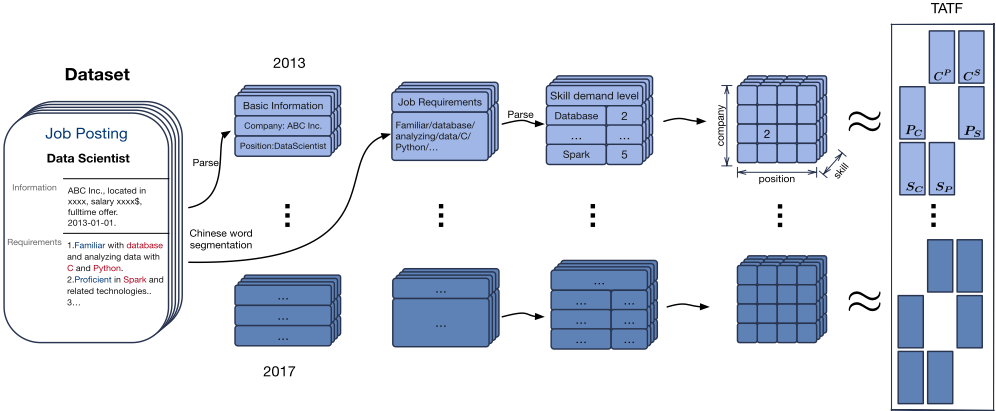
Data flow of tensor formation is summarized in Figure 1.
2.2 Basic Tensor FactorizationModel
Then, we turn to introduce the basic model of our skill demand analysis. Intuitively, according to the definitions above, we realize that the records A could be directly formulated as tensors in the form of (t-c-p-s: l), and then the Tensor Factorization (TF) method will be adapted to deal with this problem. The basic TF model could be formulated as follow:
in which P presents all the parameters used in this model, and ‖ · ‖ denotes any reasonable norm here. Besides, λ presents the hyper-parameter of the regularization term.
To optimize the objective function above, we adopt the widely used solution, namely the Pairwise Interaction Tensor Factorization (PITF) [Rendle and Schmidt-Thieme, 2010] method, in which the tensors will be transferred as several matrices to ease the computation. Specifically, if we utilize the PITF method for the basic skill demand analysis, i.e., the triple tensor (c-p-s: l) without temporal factor, the tensor in PITF will be transferred as follow:
Along this line, we have six matrices to present the latent factor for three elements in tensor, namely CP ,CS ∈ R|C|×K for the "company", P C ,P S ∈ R|P|×K for the "position", and SC ,SP ∈ R|S|×K for the "skill". Here K indicates the hyper-parameter for the dimension of latent factor. In this case, pairwise relations among elements could be clearly reflected and estimated. Then, the objective function will be adapted as follow:
2.3 Enhanced Tensor Factorization with Aggregation-based Constraint
Based on the basic TF model, we then turn to introduce our TATF framework with enhanced constraints. Specifically, we will first introduce the comprehensive constraints based on two aggregations, i.e., competition (among companies) and co-occurrence (among skills) based aggregations. Technical details to achieve the aggregations will be introduced in Section 3.1 in experimental part. In this section, we will focus on how to design the constraints based on aggregations.
Constraint for Competition-based Aggregation
First, we will introduce the constraint for competition-based aggregation. Intuitively, companies with overlapping business may probably seek for talents with similar positions or skills, which could be easily reflected by their similar job postings. Correspondingly, companies with similar job postings should have similar preference on positions or skills, i.e., similar features for each company. Therefore, we could reveal the competition-based aggregation among companies via measuring the similarities of their job postings, and then enhance the TF model with the aggregation.
Specifically, given the C categories of business, considering that each company may involve multiple business categories, we have P(i|c) to denote the probability of company c which belongs to the i-th category. Along this line, we design the constraint as follow:
Here, two new parameter matrices are utilized, namely G 1,P , G 1,S ∈ RC×K to present the features of "center company" of each category, which indicates the latent preference for position and skill, separately. In this case, companies which belong to the same business category should be mutually similar, which leads to the constraint.
Constraint for Co-occurrence-based Aggregation
Second, we will introduce the constraint for co-occurrencebased aggregation. As mentioned above that co-occurrence of skills may lead to the "skill package" for the common task. Correspondingly, skills in the same package could probably satisfy the similar companies or positions. Therefore, similar with the constraint above, given the S packages of skills, we have P (i|s) to denote the probability of skill s which belongs to the i-th package, and then design the constraint as follow:
Here, we have two more new parameter matrices as G 2,C , G 2,P ∈ RS×K to present the features of "center skill" of each package, which indicates the latent preferences for company and position, separately.
Integrated Model & Complexity Analysis
With integrating two constraints above, we could now enhance the basic TF model with the loss function as follow:
Compared with the traditional PITF method, the Equation 5 require additional time complexity as Θ((C + S + |C| + |S|)K), which results in the overall time complexity as Θ((|A| + |C| + |P| + |S| + C + S)K).
Considering that |A|, i.e., the amount of records, could be much larger than the rest part, i.e., |C| + |P| + |S| + C + S. Thus, the overall time complexity is mainly determined by the amount of records |A|, and the dimension of latent vector K. In this case, time complexity of our enhanced model may not be significantly higher than the basic PITF model.
2.4 Trend-aware Tensor Factorization (TATF)
Finally, based on the constraint-enhanced TF model, in this subsection, we will introduce the temporal factor to propose the complete TATF framework, so that the evolving trend of job skills will be captured.
Intuitively, supposing that the recruitment records are denoted as {A0, ...,A|T|-1}, with |T| timestamps in total. To integrate the temporal factor, for each time t, we could individually estimate the corresponding parameters as Pt, so that those time-sensitive features could be captured. Moreover, considering the dynamic validity period exists for skills with temporal correlation, which means that skill requirements in adjacent timestamps should be mutually similar. Therefore, we further design the temporal constraint based on previous models, which could be formulated as follows:
Based on the formulations above, for the first timestamp, i.e., t = 0, parameters will be estimated without temporal constraint. Then, as time goes by, newly estimated parameters will be constrained by all the previous models with the hyper-parameter λ3 to measure the weight. Also, we have ϕt(i) to measure the time decay effects, so that influence from earlier models will be limited. ϕt(i) is formulated as follow:
Convergence Analysis. For both Equation 5 and 6, only two norms, namely L2-norm and F-norm are used in the loss functions. Therefore, for any row vector in any parameter matrix, the loss functions L satisfies the Lipschitz continuous condition. Along this line, for all the parameters P, the loss function still satisfies the Lipschitz continuous condition. According to the prior art [Ghadimi and Lan, 2013], for a non-convex and smooth loss function, if the SGD algorithm is used for training, it will converge to the critical point at the convergence speed of ‖∇f(x)‖2 ≤ O(1/√T). In summary, the convergence of our TATF method could be ensured.
3 Experiments
In this section, we will evaluate the effectiveness of our purposed TATF framework. After that, we will discuss some interesting rules via intuitive case studies, which further confirm our basic assumptions.
3.1 Experimental Setup
Firstly, we will summarize the details of experimental setup in this subsection, including data description, pre-processing, aggregation method, baseline methods and metrics.
Dataset Description & Preprocessing
In our research, the experiments were conducted on a realworld data set collected from an online recruiting market. Specifically, we have 2,284,903 job postings in total, which were posted by 147,690 companies during the year from 2013 to 2017. To ensure the data quality, we set threshold for companies, positions and skills as 20, 10 and 10, respectively. In other words, companies with less than 20 job postings will be removed, and so do the rest. Related statistics for both raw and filtered data set are summarized in Table 1.
Along this line, for each job posting, some detailed information, including company, position, timestamp and skill requirements were extracted. For describing skills in a unified form, we utilized the pre-defined job skill list, which is widely used in prior arts like [Xu et al., 2018]. Then, we matched the list with each job posting to extract mentioned skills.
At the same time, for the level of demand for each skill, i.e., the l for each quadruple (t-c-p-s), we rated the level based on textual description in skill requirements. For example, for skill A, we have "expert in A" in the requirement of job posting corresponds to the quadruple (t-c-p-s), then the level here is set as "Very High", i.e., l = 5. Similarly, "familiar with A" will lead to l = 3, namely "Medium". Based on the ratings, we divided the demand level as 1-5 for each quadruple.
Solutions for Aggregation
Then, we turn to introduce the solutions for aggregations of companies and skills, as mentioned in Section 2.3.
To be specific, we captured the skill packages based on their co-occurrence in job postings. Then, we intuitively used the classic Latent Dirichlet Allocation (LDA) [Blei et al., 2003] to reveal the latent aggregation among skills. For each job posting, we treat it as a document, in which the extracted skills are treated as words. Besides, the skills will be repeated based on their demand level, e.g., a document as "Java, Java, MySQL" indicates that Java is demanded in level 2, and level 1 for MySQL. Along this line, LDA could reveal the latent topic, i.e., skill package for the common task. Intuitively, we have S topics (skill packages) for LDA, and the hyperparameters were set as α = 50/S, β = 0.1. Sensitiveness of S will be discussed in Section 3.2.
At the same time, for the business overlapping among companies, we clustered the companies based on their preference vectors, which were generated via connecting each row vector in the matrices as (position-skill) for each company. Along this line, we utilized the classic K-means method with C clusters, so that similar companies will be aggregated based on their Euclidean distance of preference vectors. Sensitiveness of C will be also discussed in Section 3.2.
| RawData | Filtered data | |
|---|---|---|
| Unique Companies | 147,690 | 24,531 |
| Unique Positions | 500,941 | 11,826 |
| Unique Skills | 1,832 | 681 |
| Elements in Tensor | 5,897,739 | 2,151,445 |
| Sparsity of Tensor |
Sparsity of Tensor 4.38×10⁻⁸ 1.08×10⁻⁴
Table 1: The Statistics of Data Set.
Baseline Methods & Evaluation Metrics
To validate the performance of TATF for skill demand analysis, several typical baseline methods are selected as baseline methods as follows:
- Market Average (MA), which intuitively counts the most popular skill for specific position in training data (without considering the companies).
- Tucker Decomposition (TD) [Tucker, 1966], which is a classic method to treat the original sparse tensor as product of a small tensor and several matrices.
- Candecomp/Parafac Decomposition (CP) [Harshman, 1970], a variant of TD but removes the small tensor.
- PITF [Rendle and Schmidt-Thieme, 2010], which is the basic model of our TATF framework.
At the same time, to evaluate the performance, three metrics were utilized as follows:
- Mean Square Error (MSE), which is the mean value of squared error for all samples, as 1n ∑ni=1 (f (xi) - yi)2 .
- Mean Absolute Percentage Error (MAPE), which focuses on the absolute ratio between the prediction error and ground truth value, as 1n ∑ni=1 ∣∣∣ f (xi)-yi yi ∣∣∣,
- R-Square (RS), which measures the how the proposed model is better than the "mean" value, compared with the ground truth value separately, as 1- ∑ni=1 (f(xi)-yi)2 ∑ni=1 (¯ y-yi)2 .
3.2 Experimental Results
Then, we turn to introduce the experimental results. Specifically, one experiment was executed for records in one year. Along this line, to integrate the trend-aware constraint as mentioned in Section 2.4, model parameters of previous years were also utilized following Equation 7.
Overall Performance
First, we will report the overall performance of TATF framework compared with baseline methods. To be specific, here C and S for aggregations were set as 20, and K for the dimension of vector was set as 10. Besides, we have λ0 = 0.5, and λ1 = λ2 = λ3 = 1 for the regularization term.
The results are summarized in Table 2, in which the improvement of our TATF method compared with baselines are also listed. According to the results, we realized that our TATF outperforms all the baselines, which verified that our assumptions of various enhancement could really benefit the skill demand analysis. At the same time, we found that the heuristic method performed the worst, which indicated that the performance is sensitive to the company factor.
| MA | TD | CP | PITF | TATF | |
|---|---|---|---|---|---|
| Time complexity | - | Θ(|A|K3 ) | Θ(|A|K) | Θ(|A|K) | Θ(|A|K) 23164 |
| CPU Time(s) | < 100 | 851746 | 13345 | 17260 | 1.0332 |
| MSE Improve(%) | 1.3897 25.653 | 1.1923 13.341 | 1.1868 12.936 | 1.0906 5.2567 | - |
| MAPE | 35.111 | 31.735 | 30.611 | ||
| Improve(%) | 17.920 | 32.940 7.0726 | 32.543 5.9367 | 3.5418 | - |
| R-Square | -0.162 | 0.0110 | 0.0875 | 0.1355 | |
| Improve(%) | - | 1125.1 | 0.0071 1808.4 | 54.857 | - |
| 2013 | 2014 | 2015 | 2016 | 2017 | |
|---|---|---|---|---|---|
| Basic Model | 1.99781 | 1.24219 | 1.07473 | 1.07103 | 1.06157 |
| BM+1 | 1.89819 | 1.21796 | 1.05541 | 1.04773 | 1.03919 |
| BM+2 | 1.52479 | 1.15705 | 1.05505 | 1.04445 | 1.03687 |
| BM+3 | 1.99781 | 1.21293 | 1.05290 | 1.04211 | 1.02761 |
| BM+1+2 | 1.33991 | 1.15614 | 1.03655 | 1.02855 | 1.01332 |
| BM+1+3 | 1.89819 | 1.19058 | 1.04758 | 1.03748 | 1.02034 |
| BM+2+3 | 1.52479 | 1.16272 | 1.03404 | 1.01788 | 0.99985 |
| TATF | 1.33991 | 1.13541 | 1.02820 | 1.01374 | 0.99629 |
Ablation Study
Then, for better understanding which kind of constraint contributes the most in the improvement, we turned to conduct the ablation study, which is summarized in Table 3 for the MSE metric. According the results, we realized that the cooccurrence-based aggregation, i.e., constraint based on skill packages could better improve the overall results. Besides, we found that with longer period, the strength of temporal constraint could be more significant. Obviously, more sufficient trend-aware factors lead to better performance.
Parameter Sensitiviness
Finally, we turn to evaluate the parameter sensitiveness. To be specific, two sets of parameters were discussed, namely C and S for aggregations, and K for the latent vector dimension.
First, discussion for aggregation parameters is shown in Table 4. According to the results, it seems that for both C and S, a medium value around 40-60 might be the best choice, since more clusters (topics) lead to more overlapping, while less clusters (topics) may interfere the distinction.
| C = 20 | 40 | 60 | 80 | 100 | ||
|---|---|---|---|---|---|---|
| MSE | S = 20 | 1.03320 | 1.03367 | 1.02982 | 1.03115 | 1.03069 |
| 40 | 1.02975 | 1.03554 | 1.03209 | 1.03183 | 1.03196 | |
| 60 | 1.03374 | 1.03646 | 1.03376 | 1.03309 | 1.03194 | |
| 80 | 1.03323 | 1.03485 | 1.03746 | 1.03552 | 1.03772 | |
| 100 | 1.04158 | 1.03597 | 1.03571 | 1.03474 | 1.03713 | |
| S = 20 | 30.6113 | 30.6342 | 30.5719 | 30.6063 | 30.5712 | |
| 40 | 30.5497 | 30.6430 | 30.5934 | 30.6054 | 30.5557 | |
| MAPE | 60 | 30.6264 | 30.6600 | 30.6264 | 30.5834 | 30.5733 |
| 80 | 30.6043 | 30.6206 | 30.6770 | 30.6792 | 30.6418 | |
| 100 | 30.6931 | 30.6636 | 30.6766 | 30.6354 | 30.6336 |
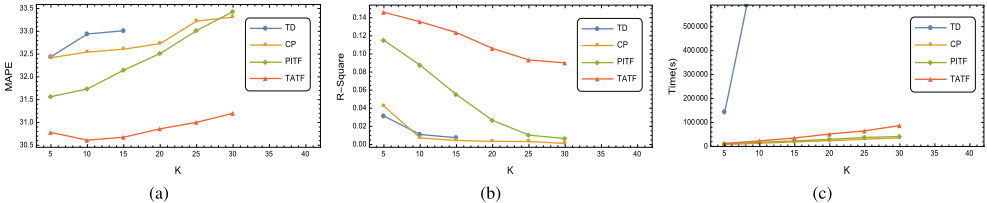
Second, discussion for vector dimension K is shown in Figure 2(a), including performance of MAPE and R-Square, as well as time spending. According to the results, we interestingly found that generally a smaller K leads to a better result for all the three aspects, which may reflect that higher K could result in overfitting problem. Besides, our TATF performed the best on MAPE when K = 10, which was selected for the overall performance validation.
3.3 Discussion and Insights with Case Studies
As the effectiveness of TATF has been validated, we will further discuss about two interesting rules as follows.
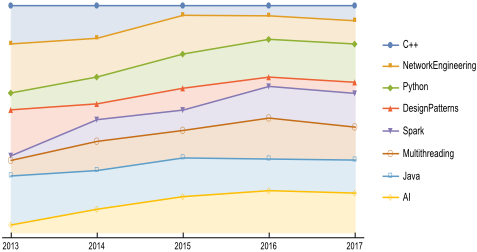
Trend of Popular Skills. To better understand the evolving trend of skill popularity, we manually selected several representative skills as example, which are shown in Figure 3. Unsurprisingly, we realized that Big Data and AI-related skills are increasingly demanded in recent years, such as "Python" for data analytics, and "Spark" for large-scale data processing. On the contrary, some classic skills, e.g., "C++" and
| 2013 | + | 2014 | + | 2015 | + | 2016 | + | 2017 |
|---|---|---|---|---|---|---|---|---|
| Data Analysis | Design Patterns Script | OOP | AI Statistics | Statistics | Cyber Security Network | AI | CV Rendering | Multithreading |
| OOP | Multithreading | Design Patterns | Virtual Reality | AI | Data Analysis | Statistics | Face Recognition | Rendering |
| Maintain | Script | Virtual Reality | Multithreading | Face Recognition | ||||
| UI | - APP | Multithreading | - Script | UI | - UI | Cyber Security | - AI | Cyber Seurity |
| APP | Cocoa Data Analysis | CSS | CSS Design Patterns | Human-Computer Interaction | Virtual Reality Human- | Network | Network Data Analysis | CV |
| Cocoa | Software Structure | Multithreading | Computer Interaction. | Data Analysis | OS |
"Design Patterns" are much less required. At the same time, some other skills like "Java" generally keep their demand level, as it is still widely used in Web and Android applications. In a sense, the popularity of skills are highly correlated to the importance of business field, as well as the diversity of application range, as skills with more diversified applications are more difficult to be replaced.
Evolving Skill Package. Similar phenomenon could be found in the evolving skill packages. As shown in Figure 4, the evolution of "C/C++" related skills are summarized year by year. Interestingly, we realized that though "AI" occurred during 2015-2016 as a novel technique, it was replaced by "CV" and even "Face Recognition" in 2017. To a certain degree, this case reflected the fine-grained trend of AIrelated techniques. Recently, traditional statistical-based machine learning methods are facing the impact of Deep Learning based techniques, especially for CV and NLP related researches. At the same time, "Cyber Security" attracted wide attention to protect the data, which also supports the main idea that Data-related skills are highly demanded.
4 RelatedWork
In this section, we summarize related works in two aspects, namely Recruitment Analysis and Tensor Factorization.
4.1 Recruitment Analysis
As an essential part to support the success of organizations, recruitment analysis has attracted tremendous efforts. Traditional recruitment analysis highly depend of personal experience and simple statistics. For instance, [Maringe, 2006] investigated the influence factor of skill learning in different universities to provide recruitment strategies. However, they could only provide qualitative analysis without solid quantitative evidences.
Recently, thanks to the accumulation of recruitment data resource, data analytic techniques are now deeply integrated to benefit the recruitment market. On the one hand, job seekers are guided by personalized career path planning [Li et al., 2017a] and talent circles analysis [Xu et al., 2016; Xu et al., 2015]. On the other hand, the employers are supported by job interview assessment [Shen et al., 2018], talent flow analysis [Zhang et al., 2019] and person-job fit [Wilden et al., 2010; Zhu et al., 2018; Qin et al., 2018]. Besides, some skilloriented researches were proposed, including the popularity ranking of skills [Xu et al., 2018] and skill requirement trends analysis [Zhu et al., 2016]. However, few of them have focused on the fine-grained skill demand analysis task, which could be effectively achieved by our TATF framework with comprehensive constraints.
4.2 Tensor Factorization
Due to its effectiveness and interpretability, Tensor Factorization (TF) has been widely used in many research fields, e.g., tag recommendation [Karatzoglou et al., 2010; Yu et al., 2018], social media analysis [Hong and Jung, 2018] and patent litigation[Liu et al., 2018]. In order to capture the unique characteristics of different data source, TF methods were adapted following different assumptions. For instance, similar with the aggregation constraints utilized in our TATF framework, in BTF-GR [Wang et al., 2018] method, user ratings are corrected based on the inner product between latent vectors of user and added group. Moreover, [Jiang et al., 2014] utilized a flexible and dynamic factorization scheme to improve the effectiveness and decomposition efficiency. At the same time, comprehensive constraints, e.g., temporal correlations are always utilized in variant TF models to enhance the effectiveness, such as [Li et al., 2017b].
In this paper, we intuitively proposed the TATF framework based on comprehensive analysis, constraints for temporal correlation and various aggregations, so that fine-grained job skill demand analysis will be achieved.
5 Conclusion
In this paper, we propose a comprehensive data-driven framework called Trend-Aware Tensor Factorization (TATF) to deal with the job skill demand analysis, in which constraints for temporal correlation and various aggregations are integrated to improve the performance. Along this line, more accurate representation for skill requirement, as well as the evolving trend of skill package will be accurately achieved. Extensive experiments on real-world dataset demonstrated the effectiveness of our TATF framework, and further provide some interesting rules via intuitive case studies.
Acknowledgements
This research was partially supported by grants from the National Natural Science Foundation of China (Grants No. 91746301, 61703386 and U1605251), and the Anhui Provincial Natural Science Foundation (Grant No. 1708085QF140).
@inproceedings{ijcai2019p540,
  title     = {Trend-Aware Tensor Factorization for Job Skill Demand Analysis},
  author    = {Wu, Xunxian and Xu, Tong and Zhu, Hengshu and Zhang, Le and Chen, Enhong and Xiong, Hui},
  booktitle = {Proceedings of the Twenty-Eighth International Joint Conference on
               Artificial Intelligence, {IJCAI-19}},
  publisher = {International Joint Conferences on Artificial Intelligence Organization},
  editor    = {Sarit Kraus},
  pages     = {3891--3897},
  year      = {2019},
  month     = {8},
  note      = {Main track},
  doi       = {10.24963/ijcai.2019/540},
  url       = {https://doi.org/10.24963/ijcai.2019/540},
}
TY - CPAPER TI - Trend-Aware Tensor Factorization for Job Skill Demand Analysis AU - Wu, Xunxian AU - Xu, Tong AU - Zhu, Hengshu AU - Zhang, Le AU - Chen, Enhong AU - Xiong, Hui T2 - Proceedings of the Twenty-Eighth International Joint Conference on Artificial Intelligence, IJCAI-19 PB - International Joint Conferences on Artificial Intelligence Organization PY - 2019 SP - 3891 EP - 3897 DO - 10.24963/ijcai.2019/540 UR - https://doi.org/10.24963/ijcai.2019/540 ER -Copied
Machine-readable versions of this paper, for tools and AI agents:





